When Alistair MacLean Quit – “The Satan Bug” (1965)

Scrolling down the credits for The Satan Bug (1965) you might have been surprised to discover that the film was based not on a book by Alistair MacLean but by one Ian Stuart. Yes, this turned out to be a pseudonym but you might be asking yourself why on earth did a world-famous thriller writer need to employ a pseudonym.

Pseudonyms were generally used for two reasons, and most often in genre fiction. Firstly, they were utilized by authors who were far from world-famous and needed to churn out four or five books a year to make a living. In those days only the likes of Agatha Christie or Simenon could get away with producing three or four books annually without the public getting fed up with their output. Long before the likes of the prolific Danielle Steel or James Patterson showed publishers that the public would devour anything they produced, it was considered ruinous to your career to be seen to be turning out more than one book a year.

Salvatore Lombino wrote under the pseudonyms of Ed McBain (the 87th Precinct series), Evan Hunter (The Blackboard Jungle etc), Richard Marsten, and Hunt Collins. Most famous under his own name, British author John Creasey (The Toff series) had 27 pseudonyms including J.J. Marric (the Gideon books) and Anthony Morton (The Baron series) as well as a number of different names for his westerns and romances.  A famous author wanting to dip a toe into a new genre was the other common reason a pseudonym came into play, the outstanding recent example being J.K. Rowling who turned to crime under the name of Robert Galbraith.

Alistair MacLean fell into neither of these categories. An unexpected success, the Scottish schoolteacher hit the jackpot with his debut HMS Ulysses in 1955, a straightforward war novel, and two years later bestseller The Guns of Navarone which was turned into a movie. He followed up with another four thrillers in four years under his own name, the last being Fear Is the Key (1961).

The reissued 1969 hardback while retaining the Ian Stuart name on the cover
links the book to Alistair Maclean in the inside flap.

By this point, MacLean, a somewhat touchy individual, had become exceedingly annoyed at the treatment his manuscripts received at the hands of his publisher Collins. In particular, he was often taken to task by editors for making simple errors like confusing “of” with “off.” But more importantly, editors treated his books as if they should be met with a rejection slip – in fact it was strongly suggested that the author set aside his third book South by Java Head in favor of something else – rather than slung out to an adoring public. As his biographer Jack Webster put it, he felt “very much like a pupil under severe pressure from a master.” It would have been humiliating for an English teacher to be told off for his use of English. The editors also complained there were too many incidents which made the books hard to read rather than enrapturing the reader.

While no doubt every author gets picked up for momentary lapses or for elements of the story that need reconsideration, it was clear to MacLean that his publishers were taking a very snobbish attitude to his output rather than falling over themselves to have in their possession such a cash cow. MacLean also felt that his books only sold so well because his name was attached. Every book was “by the author of HMS Ulysses” or, after the fantastic success of the movie, “by the author of The Guns of Navarone.” He was beginning to feel more of a unwelcome commodity than a cherished asset. And he had already made so much money from his millions of books sales and additional revenues from film studios -£30,000 for HMS Ulysses for example – that he did not need to listen to his publishers.

In fact, matters had come to a head with Fear Is the Key (1961), his least successful book. Clearly this provided his enemies in the publishing house with the opportunity to gloat and to attempt to force him to listen to their superior wisdom and toe their line But for MacLean Fear Is the Key was an experiment, a deliberate change of writing style. “What I’m trying to do is develop a technique of completely impersonal story-telling in the first person”  – in essence the reader would see action unfold as if through the eye of a camera. His publishers, who appeared to view sales as the only measure of a book’s success, felt otherwise. After one too many clashes with the Collins hierarchy, he took himself off to renowned agent Curtis Brown who welcomed him with open arms and none of the niggling that marked his dealings with the publishers. While Collins would remain his British publisher, Curtis Brown took on the task of invigorating foreign rights.

Having snared what they expected was a golden goose, you can imagine Curtis Brown’s astonishment on being told that the first book they were to sell under this new deal would not bear the name of Alistair MacLean. It would be by an unknown author – Ian Stuart. The Dark Crusader (retitled The Black Shrike for U.S. readers) was set in Australia and concerned a hunt for missing scientists. Never mind previous antipathy between author and publisher, Collins hated this book, complaining about over-complicated plot, boring characters, and improbable action. It was “a thoroughly bad book.” MacLean was incensed: “If the book is as bad as you say and you obviously lack faith in it, can you genuinely imagine that I believe you will honestly and sincerely get behind it in promotion, publishing and selling?”

Desperate to retain the author and hoping that this experiment would be short-lived, especially if sales showed a marked downturn from the MacLean books, Collins agreed to publish it. Naturally, the only way to ensure that it reached any kind of sales peak rather than vanish into the chasms of oblivion that faced most new authors, Collins gave the book “by a new author” a heavy publicity campaign. The poorer sales did not dampen MacLean’s ardour for his pseudonym and he went to produce The Satan Bug by Ian Stuart, his faith in his decision justified when a Hollywood director of the caliber of John Sturges (The Magnificent Seven, 1960), clearly seeing far greater potential in the novel than the publishers, snapped it up for production.

The rule breaker – the back cover of the 1962 U.S. paperback gives the game away and clearly, judging by the quote from King Features, the true author’s identity must have been in the public domain.

Myth has it that both The Dark Crusader and The Satan Bug played by the rules laid down by the author. But that did not turn out to be the case. The paperback edition of The Satan Bug published by Popular Library in 1962 on the back cover reveals the true author. In any case in due course the book was reissued under the MacLean moniker and is a far better example of the cinematic style the author was attempting to achieve than The Dark Crusader and became the template for his later books.

But, as it turned out, this was not the first time that Alistair MacLean would go on strike.

Catch Up: movies made from Alistair MacLean novels featuring in the Blog are The Guns of Navarone (1961), The Secret Ways (1961) and The Satan Bug (1965).

SOURCESAlistair MacLean by Jack Webster (Chapmans Publishing, 1962, paperback edition), pages 73, 89-90, 94-96, 112-117.  

Behind the Scenes – “The Satan Bug” (1965)

In 1963 John Sturges made a deal for his Kappa Productions outfit with United Artists.  The director was keenest on The Hallelujah Trail (1965) and what became Hour of the Gun (1967) but The Satan Bug was greenlit first because of the production difficulties inherent in developing westerns. To cut down on travel, Sturges decided to shoot in and around the desert area close to his home turf of Palm Springs and the Joshua Tree National Park. He called in James Clavell, responsible for the screenplay of The Great Escape (1963), and Edward Anhalt (Becket, 1964) to Americanize  and update the English-set Alistair Maclean thriller written before the Cold War escalation of the Cuban Crisis and the increasing fears of nuclear arsenals.

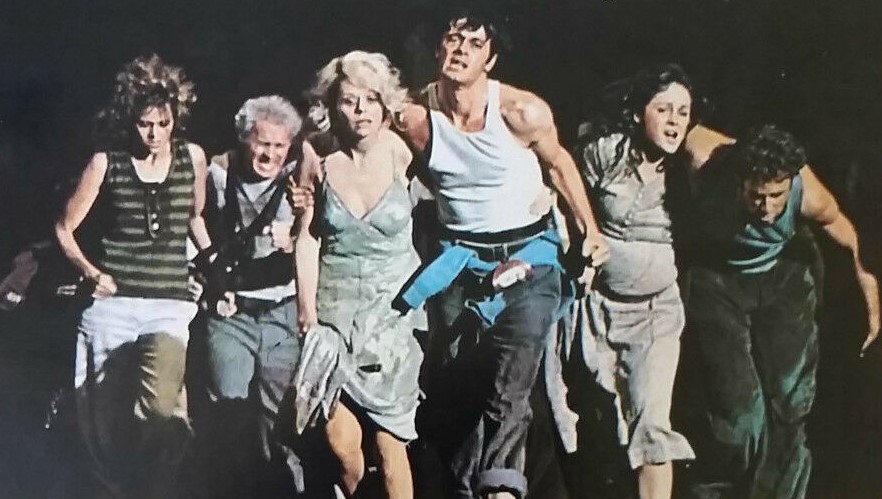
Hardly a director known for “message pictures” – more likely to emanate from the likes of Stanley Kramer – nonetheless he recognized the implicit threat of biological warfare for “its terror potential” and envisioned a powerful climax in the evacuation of Los Angeles. He swapped the married, lame and disfigured hero of the novel for a hip loner in the Steve McQueen mold.

Unable on a $6 million budget to afford a leading man of the McQueen calibre – a strange notion when Two for the Road’s $5 million budget included $1 million for Audrey Hepburn – he settled on rising star George Maharis (Quick Before It Melts, 1964) who had graduated from television’s Route 66 (1960-1963). “We were disappointed that we were not able to get a major star to play the leading role,” commented producer Walter Mirisch, whose company Mirisch Pictures bankrolled the picture. “The idea of using… George Maharis was suggested… John (Sturges) pressured us to cast him. I had felt the subject required a major action-adventure star. George Maharis wasn’ t that, nor did he ever become a major shooting star. ”

Richard Basehart was also plucked from television – the star of Voyage to the Bottom of the Sea (1964-1968) – as was Frank Sutton (Donald in the film) from comedy Gomer Pyle, USMC (1964-1969). Initially cast as the general’s daughter, Joan Hackett (The Group, 1966)   – in what would have been her movie debut – was replaced by Anne Francis. In fact, Hackett worked on the movie for two weeks. “John called,” explained Mirisch,” and told me he was very dissatisfied with Joan.” Sturges had worked with her replacement Anne Francis before on Bad Day at Black Rock (1955).

Sturges biggest problem was creating imposing research facility Station 3. Sticking it underground saved a chunk of cash on the budget, since interiors were minimalist. “The set cost us nothing,” said Sturges. But to add a sense of tension, the set was lit with an ominous amber glow.

However, it proved impossible to achieve the one effect Sturges had set his heart on – the panic-crazed evacuation of Los Angeles. City officials put a block on the gridlock called for in the script. Recalled Sturges, “The sons-of-bitches wouldn’t let me stop traffic…we didn’t get the panic on the streets, the motorists trapped on the freeways…the nightmare of the evacuation.” The director was forced to resort to “glass shots” and background noise to create the sense of pandemonium, the gridlock limited to the roadblock.

Also hampering production was a sense that the director’s mind was not fully on the job. Screenwriter John Gay (The Hallelujah Trail) was often on set conferring between shots with Sturges. The laughter they enjoyed dreaming up ideas for the comedy western seemed at odds with the mood of the pandemic thriller, leaving some actors annoyed.

Commented Mirisch, “It never developed any momentum on its (U.S.) release and wasn’t successful commercially.” According to the Mirisch internal records, the picture’s negative cost (excluding marketing and advertising) was $1.78 million. It only brought in $850,000 in rentals from the U.S. release though foreign business was better, $1.75 million, but the combined total was not enough, once the promotional costs were included, to turn a profit.

SOURCES: Glenn Lovell, Escape Artist: The Life and Films of John Sturges, University of Wisconsin Press, 2008,p243-248; Walter Mirich, I Thought We Were Making Movies, Not History, University of Wisconsin Press, 2008, p211-212; Mirisch Financial Records for 1965.

The Bond They Couldn’t Sell – “Dr No” (1962)

United Artists almost had to give away this picture in the United States in order to gain bookings. Astonishingly, it was the picture the studio felt it could not sell. And for good reason – the studio hated it. “To them it was a B-picture,” recalled producer Harry Saltzman. “They said Hammer made the same kind of picture for one-third of the price.”

Dr No, produced on a miserly budget of $840,000 – $40,000 over budget –  had triumphed in London after snagging an opening run in 1962 at the Leicester Square Theatre primarily because the cinema needed to fulfil its quota of showing British pictures. Although it set a London box office record that would stand for more than a decade and proved a huge draw throughout Britain, U.S. studio United Artists had been burned once too often by British films that did well at home only to flop spectacularly in America.

Since box office statistics began to be gathered in earnest in the 1930s only a handful of British pictures mustered the $1 million in rentals required for entry into the annual list of box office champions. The bulk of the Ealing comedies had not made the grade, nor had such diverse successes as Doctor in the House (1954), Reach for the Sky (1956), Room at the Top (1959) and Saturday Night and Sunday Morning (1960). American audiences rejected British films as too slow, technically backward, and with accents it was often impossible to understand. Putting together an advertising, public relations and marketing package for them could easily cost as much as the film itself.

“When we had an answer print ready there were about eight people from United Artists including (chairman) Arthur Krim who came to see it,” Saltzman told Variety a quarter of a century later. “We started the film at 10am and when it was over a few minutes before twelve the lights came up and nobody said anything except a man who was head of the European operation and he said, ‘the only good thing about the picture is that we can only lose $840,000.’ Cubby (Broccoli) and I were just shattered,” confessed Saltzman.

That didn’t stop Saltzman and Broccoli embarking on their own campaign to raise awareness. They went right to the heart of the American exhibition community, taking space at the annual Show-a-Rama event in Kansas City in March, bringing along Sean Connery and models to represent the Bond girls. In addition, around the same time UA held a sneak preview in New York attended by the likes of Johnny Carson, Zsa Zsa Gabor and Rudy Vallee i.e. not that high-falutin’ an audience but at least the festivities were filmed and broadcast on NBC Monitor and Armed Forces Radio. Sean Connery also featured in a 12-minute segment in the middle of ABC Sunday Night at the Movies.

The Bond promotional bandwagon set up shop for a couple of days each in New York, Chicago and Los Angeles between March 7 and March 15 and pulled in journalists from the surrounding areas. There was also a touring show comprising 150 stills. And the marketeers had some success in targeting exhibitors through the trade magazines although the two-page article featuring in Box Office attempted to interest exhibitors on the basis of a marketing campaign in Connery’s native Scotland, which hardly seemed to be ideally suited. Nor did the marketing team really care what tricks exhibitors pulled to bring in the customers – for no particular reason one cinema employed a safe-cracking stunt even though the film’s story did not lend itself to that.

Dr No’s biggest marketing tools were photos of Ursula Andress in a bikini and copies of the Ian Fleming novels which since 1961 had the endorsement of President John F. Kennedy. Cheap paperbacks sold in drug stores and newsstands had created greater awareness of the character as well as acting as unpaid advertising for the forthcoming film.

But, basically, that was as much – or as little – as the film had going for it. In effect, no great marketing energy.

As it happened, exhibitors were beginning to organise their own marketing programs – “box office building campaigns” – and the Bond team were able to convince exhibitors in the Midwest and Southwest to kick off the idea with Dr No.

That meant shifting away from the conventional release pattern where a film opened in one cinema in a big city and then fanned out week-by-week to smaller venues and towns. Instead it was everywhere all at once which meant it cannibalized its own audience since it could not be held over in any cinema for a further week because the prints were already scheduled elsewhere.

Although most historians pinpoint New York as the launch pad for Dr No, United Artists did not want to risk the picture potentially flopping in that territory.  According to Harry Saltzman the first commercial showing, effectively a trial run, was in Atlanta, Georgia, where it ran for eleven weeks and was considered a success. But not enough for UA to consider shifting its release strategy. A movie that launched anywhere other than New York was considered a dodgy proposition.

From May 8 it was launched in 450 cinemas in the Midwest and southwest. This was the same release strategy as had been employed on another film about which UA had its commercial doubts – The Magnificent Seven (1960) – and that had turned into a flop. It opened in New York in June in 18 cinemas including two in the city centre, the Astor and the Murray Hill, both arthouses.

But here’s the kicker.

In order to get the bookings, United Artists had to dramatically lower its asking price.

Normally new pictures were sold to exhibitors on a 50/50 basis – meaning the studio received 50 per cent of the gross. “The funny things is,” recalled Saltzman, “they booked it for 30 percent. The theaters took it at first because they got it for 30 per cent.” That meant UA sold Dr No to cinemas on the basis that any exhibitor booking the picture would retain 70 per cent of the gross.

This was not unheard-of. In fact, it was often the standard deal for foreign movies going into arthouses. But arthouse pictures with the occasional exception of a La Dolce Vita were usually hard sells to a very finite audience. James Bond was anything but.

As a result of this approach, the movie did not register particularly well on the annual box office rankings. In fact, it placed 42nd. Not a disaster, but not a particularly brilliant showing. However, that did not represent the film’s true appeal. Had it been sold on a 50/50 basis, the rentals would have been high enough to pitch it just outside the Top 20, which would been seen as a genuine success. On the other hand, if UA had not been so generous in handing the exhibitors the bigger share of the box office, perhaps it might have elicited far fewer bookings and the James Bond story might have been completely different.

SOURCES: “United Artists Sell Campaign in Its Dr No Film,” Box Office, February 25, 1963, p10;  “Festivities Mark Dr No Sneak Preview in New York,” Box Office, March 11, 1963, pE-2; “450 Situations Play Dr No at Opening,” Variety, April 3, 1963, 19; “Producer Saltzman Faces Big Decision on 2nd James Bond Thriller,” Variety, April 25, 1962, p13; “Feature Reviews,” Box Office, April 1, 1953 pA-11; “Showmandiser: Premiere Showmen Say Yes to Dr No, Ticket Buyers Too,” Box Office, April 29, 1963, pA1; “Harry Saltzman Recalls Early Coolness to Bond Features,” Variety, May 13, 1987, p57; “Dr No in 17 Theatres,” Box Office, May 27, 1963, pE-8; “Picture Grosses,” Variety, June 5, 1963, p10; “Smash Business General for 4-Day Holiday,” Box Office, June 10, 1963, pE-2; “Box Office Barometer,” Box Office, June 17, 1963, pA3; “Safe Crackers Invited,” Box Office, June 24, 1963, pA3.

Behind the Scenes – “The Cincinnati Kid” (1965)

As you can see from the advertisement above, this was originally intended to be quite a different film, directed by Sam Peckinpah and starring Spencer Tracy in the role of ageing poker champ Lancey. The director had just come off one troubled shoot, Major Dundee (1965), and was seeking Hollywood redemption. Two-time Oscar winner Tracy was also hoping to revive his career. Except for what amounted to little more than a extended cameo on It’s A Mad, Mad,, Mad, Mad World (1963) he had not worked since Judgement at Nuremberg (1961). Also initially on board in a small role was Sharon Tate (Valley of the Dolls, 1967)

This was also a big gamble for industry outsider Martin Ransohoff who had moved to the forefront of independent production after The Americanization of Emily (1964) with Julie Andrews and James Garner and The Sandpiper (1965) starring current top-billed royalty Elizabeth Taylor and Richard Burton. He had wheeled and dealed with top studios – MGM, Columbia and United Artists – desperate for quality product. He was planning the biggest movie of his career having purchased the rights to the Alistair MacLean bestseller Ice Station Zebra. Ransohoff was a marketing innovator and long before Robert Evans pumped tens of thousands of Paramount dollars into advertising the book of Love Story (1970) to ensure it rode high on the bestseller charts and thus increased public awareness, Ransohoff had pulled off the same trick for Richard Jessup’s novel The Cincinnati Kid.

Tracy was first to quit, infuriated that he was denied script approval. Essentially, he wanted his role beefed up. But Ransohoff “would not expand his role in any way” and angered at the prospect of playing second fiddle to McQueen the actor walked out, to be replaced by a star with considerably less marquee appeal, Edward G. Robinson.

At least Tracy was able to depart with head held high. Peckinpah was ignominiously fired after shooting had begun. The intemperate director had already locked horns with the producer over a story which had now taken the efforts of four screenwriters – Oscar-winner Paddy Chayefsky (The Americanization of Emily), Oscar-winner Ring Lardner Jr. (Woman of the Year, 1943), Oscar nominee Terry Southern (Dr Strangelove, 1964) and newcomer Charles Eastman (Little Fauss and Big Halsy, 1970) – to knock the book into a workable screenplay without the extra bother of Peckinpah adding his own scenes.

Trade newspaper Variety reported: “Peckinpah’s problems stemmed from his filming of a nude scene that wasn’t in the script but which the director wrote on his own. Last Friday (November 4, 1964) he reportedly excused the featured cast and began to lense the nudie scene using an extra from the cast.” Whether this was indeed Sharon Tate, of whom Peckinpah was reported to have filmed in a flimsy shirt without a bra so that her nipples were showing, is unclear. And although there is an undertone of sex in the actual picture, as delivered by Ann-Margret, it was considerably more discreet.

Strangely enough, Ransohoff was no stranger to the benefits of nudity in his pictures and had fought a losing battle with the all-powerful MPAA, the industry ruling body in matters of censorship, to have nude scenes included in The Americanization of Emily. The nude statue of Elizabeth Taylor in The Sandpiper was permitted, however, and Ransohoff sent hundreds of miniature statues out to influencers as a gift.

Peckinpah did not have final cut so Ransohoff could easily have excised any nude scenes from the finished movie. What was considerably more alarming was that Peckinpah was shooting in black-and-white. Later, Ransohoff would contend that he was outraged by this notion but he surely must have signed off on it at the outset. Whatever the reasons, and some believed fisticuffs were involved, Peckinpah was sacked, leaving a $750,000 hole in the budget.

Production closed for over a month while Ransohoff scrambled for a new director. McQueen was pay-or-play, so if the film was cancelled, the actor was due his entire fee. McQueen had signed on for a fee of $200,000 – or $350,000 depending on who you believe – and $30,000 a week in overtime plus 25 per cent of the profit and a host of extras. McQueen had been initially lined up for a Ranoshoff remake of Boys Town to co-star James Garner, but that proved little more than a publicity flyer.

Replacement Norman Jewison had no reputation for hard-line drama – more at home with light comedy such as Send Me No Flowers (1964) – but was available and more likely to toe the Ransohoff line. However, initially he demurred. It was against the rules of the Directors Guild to step in in such a manner and Jewison required reassurance that Peckinpah was indeed out of the picture, and the film had been shut down, before accepting the job. Theoretically, Jewison received more control of the final cut than Peckinpah. His contract called for him to be in sole charge of the completed picture until after the third public preview. If it wasn’t working by that point, Ransohoff had the right to take over. Jewison exerted control in other ways, denying actors a chance to look at the rushes

Theoretically, McQueen had conceded top billing to Spencer Tracy, but that was not reflected in the artwork MGM put out – the illustration at the top of the Blog appeared in the trade press prior to production. To keep McQueen sweet during the layoff, Ransohoff handed him $25,000 to play the tables in Vegas. Edward G. Robinson had the same worries as Spencer Tracy, fearing his part would be cut to build up the star. In reality, McQueen welcomed going head-to-head with an older star, a situation he had not experienced since The Magnificent Seven (1960) with Yul Brynner.

But if the male stars, under the confident direction of Jewison, gave no trouble, that was not the case with the female contingent. Tuesday Weld came with a heap of personal issues related to becoming, as a child model,  the family breadwinner at an early age – nervous breakdown at nine, alcoholic at ten, suicide attempt at twelve. She had never quite achieved stardom, in part as a result of turning down roles like Lolita (1962)

Ann-Margret was the opposite. She could earn nearly as much as McQueen – her fee at some studios was $250,000. However, Twentieth Century Fox was holding her to an earlier four-picture deal which paid a miserly $25,000 per movie, forcing her to lose out on a $150,000 payday in Europe for The 10th Victim (1965) with Marcello Mastroianni – known at the time as The Seventh Victim, Ursula Andress her replacement – in order to take up a contracted role in the remake of Stagecoach (1966). Her over-sexed screen persona had caused playwright William Inge to remove his name from Bus Riley’s Back in Town (1965).

One of the hottest young stars in the business, she intended to stay that way, and her portrayal of Melba in The Cincinnati Kid pretty much fitted in with audience expectation. She was in such demand that she was under contract to make a total of 17 pictures for five separate studios plus Frank Sinatra’s independent production company. Her deals were with Universal (six pictures), Fox (four), MGM (three), Columbia (three) and United Artists (one). But after dropping out of Marriage on the Rocks (1965) with Sinatra her output for the rest of the decade comprised one movie apiece for Paramount, MGM, Fox and Columbia and four independent pictures in Italy.

MGM spent big bucks promoting the picture and, in particular, the Ann-Margret connection. The studio had put a marker down on Thanksgiving 1965 for the launch date, but was marketing the movie more than six months ahead, the kind of exposure that was normally only allotted to roadshow features.

SOURCES: Christopher Sandford, McQueen: The Biography, Harper Collins paperback (2002) pages 165, 170-176; Penina Spiegel, Steve McQueen: The Untold Story of a Bad Boy in Hollywood,  Collins, 1986, p162, 169-173; “Ransohoff To Start Five Films in 6-Month Period,” Box Office, June 17, 1963, p27; “Marty Ransohoff To Seek Code Changes,” Box Office, November 25, 1963, p6; “Ann-Margret Into The Cash Splash,” Variety, July 22, 1964, p5; advert, Box Office, October 9, 1964, p9; “More Cincinnati Kid Books,” Box Office, October 24, 1964, pW-5; “Refuse Spencer Tracy Xincy Kid Script Okay So Actor Takes Powder,” Variety, November 11, 1964, p24; “Jewison Replacement for Sam Peckinpah,” Variety, December 9, 1964, p24; Advert, Variety, March 10, 1965, p80; “Fear Ann-Margret Going Wrongo In Her Screen Image,” Variety, March 24, 1965, p5; “Fox Holds Ann-Margret To Stagecoach, Denying Her For Mastroianni,” Variety, April 14, 1965, 4; Advert, Variety, May 19, 1965, p20.

Selling Ursula Andress – The Pressbook for “She” (1965)

Dr No (1962) had only enjoyed moderate success in the United States so it was far from given that Ursula Andress meant much to American audiences. The first Bond outing had finished 43rd in the annual box office rankings and Andress had not exactly swept Elvis Presley off his feet in her only Hollywood offering so far, Fun in Acapulco. However, she was the immediate beneficiary of one of the most extraordinary pieces of luck to fall to a barely-known star.

The gargantuan success of Goldfinger (1964) had sent studio United Artists back to the vaults to resurrect the first two films in the Bond series and put them out in a double bill – the first of many such Bond pairings – in April 1965, a couple of months before She hit the big screen in the U.S. Dr No/From Russia with Love was a record-breaking sensation, attracting three times the numbers that had attended the first release of Dr No.  So outstanding a performer was the double bill that it hit number five on the annual box office chart.   So by the time She was launched Ursula Andress’s iconic bikini-clad entrance in Dr No was fresh in audience memories.

MGM, the U.S. distributor of the Hammer picture, had wisely not counted on the unexpected resurrection of Dr No and had a stack of other promotional wheezes up its sleeve. The 12-page A3 Pressbook kicked off with a “phone stunt” whereby exhibitors would set up a message on a telephone line purportedly from “She-Who-Must-Be-Obeyed.”  The statuesque figure of Ursula Andress in figure-clinging costume was a natural for a standee in a cinema lobby as was the setting up of an artificial flame.

There were any number of ideas for competitions held in conjunction with a radio station or local newspaper: famous women who had ended up as film titles – Cleopatra and so on; famous female rulers; or a list of “love goddesses” to whose ranks it was decreed Andress deserved a place – in posters MGM had no hesitation is calling the actress “the most beautiful woman in the world.”

Journalists were to be hooked into running editorial pieces by a variety of interesting facts that could be cobbled together for an interesting article. The luxurious furs used to decorate the queen’s inner sanctum had been insured for $300,000. Andress had worn a total of nine gowns, designed by Cal Tomms, but none weighed more than a few pounds, the gossamer-like material both free-flowing and clinging to her natural assets. The crown weighed 3lb, a heavy object to carry around on your head for a week, as Andress had. Her cloak contained 3,000 feathers. No doubles were used for the duel between John Richardson and Christopher Lee, both being accomplished swordsmen.

There were human interest items as well. Both Andress and Richardson had previously signed contracts with major studios without ever being given any roles. Andress, shy in real life, had learned to claim to be someone lese when approached by fans.  Filming Dr No, she was grateful it was shot in Jamaica: “I didn’t want anyone to see what a fool I might be making of myself,” she said.

However, she was certainly self-assured in general. Interviewed exclusively for the Pressbook, she said, “Beauty gets you everywhere. It is a gate opener. It takes a long time to discover a good mind, but a beautiful woman attracts attention right away. Only stupid people think that a woman who is attractive must be silly.”

She added: “I will give you a list of the qualities that are most important for a woman – emotional range, beauty, intelligence, education and talent. Emotions are the most important, the ability to feel and love. Beauty next, and intelligence after that. Education is less important than intelligence because if you have the latter you’ll acquire education.

“I have never made a study of acting,” she explained. “I just do it if and when I feel like it. I have no desire to work on the stage and what I do in front of the camera is instinctive and spontaneous. My best takes are the first. Repetition distracts from the quality of my performance. Ayesha in She was a difficult part because this mysterious queen is 2,000 years old  and I had to be very stylized.”

Andress was central to the advertising campaign and although there were a number of different adverts, the actress featured in all, the only difference being her position on the poster, left, right or central. “She had waited 2,000 years waiting for her lover to be reborn – the lover she had slain by her own hand.” To whet audience appetite, a variety of scenes were included at the foot of some posters. 

To grab the attention of the exhibitor, and ensure full cooperation in selling the picture, MGM was offering a treasure chest of rewards for the best local campaign – a total of $10,000 in prize money. To gain additional publicity there was a single record and, more important, a new tie-in edition of the famed novel by H. Rider Haggard, which had already sold 20 million copies in America.

Behind the Scenes – “Advise and Consent” (1962)

Just before setting off to film Exodus (1960), director Otto Preminger ponied up $200,000 for the rights to Allen Drury’s inflammatory novel three months after publication. He expected to place the picture with United Artists, with whom he was in partnership over Exodus, but perhaps his remuneration package was too high, for Advise and Consent ended up at Columbia.

Preminger postponed shooting of Bunny Lake Is Missing in order to start on Advise and Consent. But filming of the former was in part delayed due to pregnancy of the proposed female lead Lee Remick.

When Wendell Mayes script was submitted in July 1961 to the Production Code for approval, the main issue under discussion was the treatment of homosexuality, and as a consequence some scenes were trimmed or treated in a different manner. In fact, Preminger was more explicit than the novel about same-sex relationships. The Code approved the production with changes on the basis that a revision of the current system was imminent. Preminger was turned down by a number of well-known actors because of this aspect of Brig’s character, before eventually turning to Don Murray.

As mentioned in the review yesterday, Preminger hired actors who had long been out of the business. The blacklisted Will Geer hadn’t made a film in over a decade, Franchot Tone had not been seen on screen since 1951 when he had been involved in love triangle, for Lew Ayres it was nearly a decade, while Gene Tierney, who had been institutionalized, had last made a picture in 1955. Martin Luther King was offered the role of a Georgia senator.

Astonishingly since the book and film had taken pot shots at the American political system, beginning late September 1961, Preminger was granted permission to shoot in the Senate, taking over the Russell Senate State building, with the Senate Caucus Room used for the sub-committee rooms. To cut down on shooting time, Preminger often filmed with two cameras and finished filming after two or three takes.  Preminger was racing through shooting in order to release the film in December in the hope of snagging Oscar nominations.

Filming lasted barely three months in total, beginning September 5 and ending on . the early scenes shot included the sequences in Munson’s hotel room (filmed at the Sheraton Park hotel), the White House correspondents’ dinner (the ballroom of the same hotel) and Dolly’s party (at Tregaron, a private residence once owned by joseph A. Davies, an ambassador to the Soveiet Union.

Understandably nervous after such a long time away from filming, and probably doubly nervous to be working with a director known for his titanic rages, Gene Tierney, “though just frightened to death” received nothing but gentlemanly treatment. Franchot Tone, on the other hand, was reduced to tears. Don Murray only once felt the sharp end of the Preminger tongue, but other found that he could manage the director as long as he did not show a weakness. However, Preminger did disparage cinematographer Sam Leavitt and actor Larry Tucker, apparently to demonstrate his fiery side for visiting journalists, fired three crewmen. Arguments with unions set the production back $150,000-$200,000.

Away from the set, Peter Lawford’s involvement in the picture apparently drew the ire of President John F. Kennedy. The Press had a field day after “word leaked out.” There was also concern about Gene Tierney’s role as a society hostess.

Possibly aware of the changing mood in the critical world, Preminger had invited Jean Domarchi of Cahiers du Cinema to observe the shooting.

By the time the film was being prepped for released, Allen Drury’s novel had spent over 100 weeks on the New York Times bestseller list and the author had won the Pulitzer Prize. Drury hated what Preminger had done to this novel, got his revenge by delaying the film’s release. A stage version of the book was not going to complete its run until June 1962 and Drury applied for – and won – an injunction to prevent the film opening before then. Preminger had been aware of the problem and had attempted, while the movie was in the first month of filming, to exploit a legal loophole to allow the movie to be shown in December. (Hitchcock’s Dial M for Murder in 1954 had suffered the same fate). This also put the blocks on RCA Victor’s plans to release a soundtrack album – “for minutes of music…no vocals.”

Sources: Chris Fujiwara, The World and its Double: The Life and Work of Otto Preminger, Faber and Faber 2008, p280-289; Mark Shives, “Otto Preminger on Advise and Consent,” Movie 4, p26-27; Jean Domarchi, “Voyage a Washington,” Cahiers du Cinema 22, p28-30; “Code Seal to Advise and Consent,” Box Office, December 18, 1961, p8; “Preminger Postpones One; To Start on Advise,” Box Office; January 12, 1961, p23; “Otto Preminger’s Advise Transferred to Columbia,” Box Office, August 14, 1961, p10; “Bunny Lake Is Delayed; Prem Moves Up Casting of Advise and Consent,” Variety, June 7, 1961, p18; “Consent Pic Delay Stalls Victor album,” Variety, December 27, 1961, p39; “Lew Ayres into Consent, He and Tierney on Comeback Trail,” Variety, August 16, 1961, p20; “Is JFK Miffed About Lawford Role Or Is It More Pic Ballyhoo?,” Variety, August 30, 1961, p2; “Report Preminger Seeks Early Release of Advise,” Variety, October 11, 1961, p69.

Behind the Scenes – “Cast a Giant Shadow” (1966)

If recruiting John Wayne is essential to getting your new picture off the ground, it would help not to have fallen out with him big-style previously. After every studio in Hollywood had turned down Cast a Giant Shadow, writer-producer-director Melville Shavelson turned to the Duke. The only problem was the pair had hit trouble on football picture Trouble All the Way (1953) should take.  

In his capacity as producer of Trouble All the Way, Shavelson, also co-writing the screenplay, had given Wayne one version of the script while behind his back instructing director Michael Curtiz to shoot a different version with subsidiary characters that would change the film’s plotline. When Wayne found out, Shavelson was the loser. When you make an enemy of John Wayne, it takes a lot to win him back as a friend.

After that debacle, Shavelson had gone on to win some kudos and occasional commercial success as a triple hyphenate on pictures like Houseboat (1958), It Started in Naples (1960) and A New Kind of Love (1963) with top-ranked performers in the vein of Cary Grant, Sophia Loren, Clark Gable and Paul Newman. When Shavelson pitched to Wayne the story of Cast a Giant Shadow, about the birth of Israel and based on the bestselling biography of Mickey Marcus by Ted Berkmann, the star’s response was: “That’s the most American story I ever heard.” Wayne was hooked on the idea that America had helped Israel achieve its independence and that top American soldier Colonel Mickey Marcus had died in the process.

Senta Berger as the gun-toting Magda.

Wayne’s potential involvement came with a proviso – he had script approval. And while Shavelson owned the rights to the book, he didn’t have a screenplay. Nor, with his background as a writer being primarily concerned with comedy, did he consider himself best suited to the job.

He had, however, written a treatment. In his eyes, a treatment was not just about encapsulating the story, but about selling it to a studio. So his first few paragraphs included references to box office behemoths Lawrence of Arabia, The Guns of Navarone and Bridge on the River Kwai – planting in the minds of potential backers the notion that this film was headed down the same route of substantial profit – and a reference to an “American of heroic proportions…with  the ability to love,” the latter being code for sex.

But in the end he wrote the screenplay as well. Wayne put his imprimatur on the picture in more ways than one. Part of the deal was that his production outfit Batjac become involved, with son Michael in line for a co-producer credit. Shavelson managed to snag Kirk Douglas for the starring role only by giving up part of his own salary to meet the star’s fee. Douglas and Wayne, with the credit ranking reversed, had starred together in In Harm’s Way (1965).

It was Douglas who insisted his character’s role be change from passive to active. Shavelson invented an American general for John Wayne and a female Israeli soldier (Senta Berger) for Douglas – in reality his character was a married man – to have an affair with. “I’m introducing a fictitious romance into the film with the full consent of Marcus’s widow,” Shavelson told Variety, though it’s doubtful that real-life wife Emma Marcus went along so merrily with this notion.

It wasn’t only Wayne who demanded script approval.  The Israeli government, with whom cooperation was essential to guarantee the use of troops and equipment, had made the same condition. The Israelis worried that the film would fall into the usual Hollywood trap and to that extent the government insisted that the picture not end up as a “an Errol Flynn Burma stunt” – a reference to Objective Burma (1945), originally banned in London for Americanizing the film.  The government spelled it out: “Col Marcus didn’t win our war, he just helped.” But the production was offered “further facilities than normal.” Two sound stages – the first in the country – were being built in Tel Aviv.

Shavelson was shown military locations that no other civilian had ever seen. When the Israelis did “approve” the script it was with the proviso that 31 changes were made including the deletion of the “sex-starved woman” (Senta Berger), although in reality Shavelson got away with his vision intact.

When the film went ahead it had a crew of 125 plus 800 Israeli soldiers, 1,000 extras and 34 featured players including Yul Brynner, Frank Sinatra, and Angie Dickson. Only some of the film was made in Israel. The interiors for the Macy’s department store were built in Rome, along with the concentration camp sequence, one of the battles, and scenes set in Coney Island that were edited out from the final picture.  

The biggest problem was the supply of soldiers and equipment at a price the production could afford. Shavelson was being charged twice as much for the soldiers as the producers of Judith (1966). It took the intervention of the Israeli Prime Minister for sensible negotiation to get under way and for prices to drop to a tolerable level. Neither was it possible to film on the original battle sites in Israel since they were basically in a no man’s land, covered in barbed wire and littered with mines.

Principal photography began on May 18, 1965, in 115 degree heat – so hot the film buckled in the cameras – at the fortress of Iraq Suidan to recreate the Battle of Latrun. Shavelson had been denied permission to access the Latrun fortress itself which stood across the Jordanian border even though the engagement had been an Arab victory. To keep the sun off his face, Kirk Douglas decided to wear an Australian Army forage cap, and it did the job so successfully he kept it on for the entire movie.

On another location – this time when the temperature reached 126 degrees – a $40,000 Panavision camera exploded filming too close to a tank-muzzle firing, the jeeps got vapor lock, three soldiers were wounded by dummy bullets and the charging tanks vanished after the first take when their commander received new instructions from his army superiors.

Shavelson had met Sinatra some years before when he and scripting partner Jack Rose had helped write the Inaugural Gala organized by the singer in honor of President John F. Kennedy. Using that connection and the fact they shared the same agent, Sinatra, who had a pilot’s license, agreed to play a two-day role as a Piper Cub aviator dropping seltzer bottles on tanks. When filming began Shavelson discovered that what he had imagined was his own inspired invention turned out to be close to the actual truth.  To write the score, Elmer Bernstein visited Israel to conduct his own research.

He also discovered the real reason for Sinatra’s eagerness to be involved. His salary had been donated to set up the Frank Sinatra Arab-Israeli Youth Centre in Nazareth. Actually, there was another less noble reason for Sinatra signing up. He had begun an aviation business, Cal-Jet Airways, supplying planes to Hollywood, and clearly thought appearing as a pilot in a picture would help promote the new company.

However, when filming of his scenes began Sinatra proved unintelligible. He had taken the script at face value and thought he was playing a Texan and delivered his lines with a Texan accent. Eventually, Sinatra was persuaded to play it with his own normal voice. But Sinatra could only be filmed in the plane on the ground since his insurance didn’t cover him being in the air unless accompanied by a co-pilot.

By the time they came to film the immigrants’ landing scene the picture was already half a million dollars over budget. With the country enjoying full employment and nobody inclined to take time off to work in the blazing sun as an extra, the 800 extras were in reality all newly arrived immigrants – and therefore unemployed – from Hungary, Rumania, Poland, Russia and Czechoslovakia.

The only item that was lacking to complete the landing scene was a ship offshore, but the owners were asking too much money. Instead, the director came up with the idea of a “glass shot.”  An artist had painted in smoke billowing from the funnels, but it was blowing in the wrong direction from the wind. The solution – a double-exposure job in the lab – cost as much as hiring the ship.  

Once the production headed home, Shavelson discovered that virtually all the sound recordings made in Israel were unusable. Frank Sinatra and Kirk Douglas re-recorded their dialog in Hollywood, Yul Brynner and Senta Berger in London and dozens of Israeli students attending Los Angeles universities were called upon to replicate background Hebrew voices.  

For prestige purposes, the movie was launched at the end of March 1966 as a restricted roadshow, just three cinemas in New York – the DeMille in the Broadway area, the Fantasy Theater in Long Island and Cinema 46 in New Jersey. Douglas employed a helicopter to fly from venue to venue. The first wave of first run houses followed in Baltimore, Philadelphia, San Francisco and Miami.

Most of the promotional activity centered on the true story of Mickey Marcus but in London, where the character was unknown, United Artists took the gimmick route, placing an advert in The Times newspaper calling for “giant men” standing over six foot seven inches tall. Expecting to find 25 such giants, they ended up with 100 attending the British premiere, the tallest seven foot three inches. In keeping with this gimmicky approach, tickets for the first performance were also a king-sized  twelve inches by nine inches.  

SOURCES:  Melville Shavelson, How To Make a Jewish Movie, W.H. Allen, 1971; “Wayne To Co-Produce, Star in Israeli War Pic,” Variety, May 27, 1964, 2; “We’ll Lift Part of Local Expenses, Israeli Offer to UA,” Variety, July 1, 1964, p3; “Kirk Douglas Set to Star in Cast a Giant Shadow,” Box Office, March 8, 1965 pW-2; “Batjac Productions Moves to Paramount Lot,” Box Office, March 29, 1965, pW-2; “Shavelson Aim on Mickey Marcus Film: Realism,” Variety, March 31, 1965, p25; “WB-Sinatra Film in October; Sinatra’s Aviation Firm,” Box Office, August 23, 1965, 6; “Elmer Bernstein to Israel for Film Music Research,” Box Office, October 18, 1965, pW-3; “Cast a Giant Shadow Set for 3 N.Y. Roadshow Dates,” Box Office, December 6, 1965, pE3; “Kirk Douglas To Helicopter to All 3 Shadow Openings,” Box Office, March 28, 1966, pE-7; “Cast a Giant Shadow set in 14 Key Centers, April 6-8,” Box Office, April 11, 1966, p6; “Small Ad Brings 100 Giant Men to London Opening of United Artists’ Cast a Giant Shadow,” Box Office, October 3, 1966, pA3.   

Behind the Scenes – “Topaz” (1969)

Hitchcock wanted to follow Torn Curtain (1966) with Frenzy – initially with an American setting – and spent $75,000 on a screenplay but his paymasters Universal nixed the idea. Stuck for another project and hating idleness, Hitchcock rummaged through the studio’s outstanding list of properties and came up with Topaz because it was “better than nothing” and “he was getting to the point where he would consider anything, pretty well, just to continue exercising his craft.” The Donald Spoto version has it that Hitchcock’s wife Alma “approached Lew Wasserman, begging him to find a project to get her husband back to work.”

Nonetheless this hardly had “desperate” written all over it, as some have argued, not with Universal willing to stump up $4 million, his biggest budget to date. With a political backdrop similar to Torn Curtain, the director aimed for “espionage with an emotional relationship” like Notorious (1946).

Hitchcock hired Topaz author Leon Uris (Exodus) to write the screenplay. Uris had some experience in this field have written the screenplays for Gufight at the O.K. Corral (1957) and adapted his own Battle Cry. Uris was far more high-powered writing partner than Hitchcock had been used to, considering himself as much a master of his own genre as the director was of his. He had such a high opinion of himself that he wrote the lyrics to a song “Topaz” to go out as a sales gimmick for the publication of the book. And was formidable in other ways. He had been the first author to deny the hardback publisher a share, as was traditional, of both paperback and movie rights.

Incidentally, Universal only picked up the project on second go-round. Uris had originally sold the movie rights for $500,000 to British businessmen Shel Talmy and Sir William Piggott. But the Bank of England refused to sanction the deal because Britain had just devalued the pound sterling and it did not wish such a large sum of money to leave the country.  

It was unlikely that Hitchcock and Uris would hit it off. The relationship got off to a difficult start when Hitchcock tried to install the author “in a little office in his cottage” while Uris held out for his own private domain in the studio’s executive building. Uris “made a fight” out of other little things in order to exert his own authority. Perhaps to get his own back, Hitchcock forced Uris to undergo a crash-course in Hitchcock films, watching the director’s output with the director providing a personal commentary. Uris called it “a drill in self-aggrandizement.” The partnership failed to gel and Uris was off the project.

But Hitchcock recognized that Uris had been correct in some of his assessments of the director’s approach and realizing he was out of touch with modern espionage arranged to receive briefings from top intelligence operators including George Horkan, former deputy inspector general of the CIA.

Next up for screenwriting duties was Samuel Taylor (Vertigo, 1958). Hitchcock dropped Uris’s flashbacks to World War Two and insisted on building up the Cuban section, altering the Uris plotline and making Rico Parra (John Vernon) “a sympathetic, almost tragic figure.”

The most memorable scene in the picture – the death of Juanita – was never properly scripted and instead relied on the genius of Hitchcock’s cinematic inspiration. “Although it was a death scene,” said Hitchcock, “I wanted it to look very beautiful.” It was also a piece of technical (of the old-fashioned kind) wizardry. The director had attached five pieces of thread to her gown. The threads were held by five men positioned off-camera. As Juanita fell, “the men pulled the threads and her robe splayed out like a flower that was opening up.”

Hitichcock’s biographers continued to insist that the director was caught short by the production process. The picture’s main problem, according to Taylor, was that “Hitch was trying to make something as if he had Ingrid Bergman and Cary Grant in it.” To accommodate a major Hollywood star would have meant changing the entire plot to accommodate the desire of a big star to be included in more of the action. Bankable international stars like Yves Montand (Z, 1969) and Catherine Deneuve (Belle de Jour, 1967) were passed over in favor of relative unknown Frederick Stafford (OSS 117, Mission for a Killer, 1965), a late starter in the movie business, but bringing a certain elan to any part, and old dependables like John Forysthe (The Trouble with Harry, 1955). 

But Hitchcock had already decided to ditch big stars and would not have been looking for a Bergman/Grant equivalent while working through the screenplay. Prior to production he announced he would “cast unknowns to give the film more authenticity.” And he already planned to take a less-than-heroic look at the spy game. He had been disappointed at the ending of Torn Curtain. “I would personally preferred to have the hero suffer qualms about behaving like a professional spy and I would have ended the film with his disgust at his own position.”

Biographers also asserted that the opposition of the French government came as something of shock. Not true either. It was obvious to all that the film would annoy the French. Asked about this issue in a press conference, Hitchcock joked, “I shall disguise myself as thin man.”  The French government, clearly not sharing the Cahiers du Cinema blind faith in the director, complained the script was anti-French and refused permission to shoot in France and although the issue was finally resolved after top-level discussions shooting was delayed.

Coupled with an almost documentary-style approach and the fact that some of his most acclaimed films – Shadow of a Doubt (1943), Strangers on a Train (1951), The Trouble with Harry and Psycho (1960) – had been made without big stars, he seemed to be taking no great risk.

Roberto Contreros as the Cuban police chief Vernon was also a last-minute replacement, called in for Aram Katcher, who had shot all his scenes and didn’t realise this had occurred until, having been lined up for television talk shows, he discovered he had ended up on the cutting room floor.

The key role of Juanita was not cast until a few days before her scenes were to be shot. Hitchcock had turned up his nose up at various suggestions and found fault with every actress interviewed. “She will show up,” said Hitchcock. And at the last minute she did. The German-born Karin Dor (You Only Live Twice, 1965) had Latin features and fluent English.

Huge sets were built on the Universal lot for the Harlem hotel, a mansion in Virginia, a Cuban street and La Guardia airport, but for a Cuban hacienda Hitchcock had to look no further than director Clarence Brown (National Velvet, 1944) who made available his home.

Hitchcock had planned that Topaz would include his first modern love scene, that is with the actors fully topless. That notion was scuppered when Hitchcock was informed that both principals had significant surgical scars on their torsos.

The climax was not in the book either – an old-fashioned duel in a soccer stadium. But Hitchcock did not shoot it. His wife Alma had suddenly fallen ill and Hitchcock left the filming of the scene to Herbert Coleman. Test audiences rejected the ending. Interestingly, the main reason the original ending was changed was due to adverse reaction at the San Francisco preview. There had been an unholy scramble for tickets, primarily from youngsters, among whom Hitchcock’s stock was riding high – and far higher than any other director among the older generation. So it may have been that he was brought down to earth by the very audiences that were otherwise praising him to the stars.   

Under pressure from Universal, Hitchcock shot another more cynical ending, Devereux (Frederick Stafford) and the French traitor Granville (Michel Piccoli) waving each other off as they boarded planes for Washington and Moscow, respectively. To pacify the French, who might object to a traitor getting off scot-free, Hitchcock devised a third ending, utilised from existing footage, which suggested Granville committed suicide.

There was enormous debate at the studio over which ending to use. The result was, inevitably, compromise. Different versions were shown. So what ending you saw depended on where and when you viewed the film. Between a 142-minute preview screening in London – it was released in Britain prior to America – and a 126-minute release a week later the ending changed to the suicide. Biographers claimed British distributor Rank lopped 20 minutes off the picture, but since the 142-minute version was a rough cut the editing was not quite as brutal as it sounds.  The suicide was seen in France and America. The duel version can be seen on a DVD. 

The one I saw, in case you are interested, had the pair waving each other off at the airport which I thought an excellent and wholly believable ending, given that most famous British traitors did escape. 

Nor was there outright condemnation of the finished picture. The New York critics, the most influential in the country, were split. Vincent Canby, the most highly-regarded mainstream critic of the time, gave it a rave review in the New York Times. (Canby placed it number seven on his year’s top ten). Two others – the New York News and the New York Post – gave it favorable reports. The three magazines who gave it gave it the thumbs-down – Newsday, New York and Cue – had significantly smaller circulations than the newspapers. Universal had no concerns about its potential, releasing it during the busy Xmas period.

However, it didn’t help that the film came out just as the lionization of Hitchcock had begun. The Truffaut book had begun to win admirers, Hitchcock was awarded an honorary Oscar in 1968 and elected to the French Order of Letters in 1969. Critics, except in France naturally, felt it was vastly inferior to his previous work. As a consequence, when his career began to be reassessed, biographers began to look for reasons why this film did not meet with their approval, forgetting that they had been mauling him for most of the decade.

He must have been ill, was one assumption. According to biographer Patrick McGilligan: “Photographs taken during the filming of Marnie show an almost trim and dapper man; in contrast…in 1968 (he) was again far overweight, pink-cheeked from drinking and transparently depressed with the realization that time, always his cruelest enemy, was closing in.” It would take quite a photographer to make Hitchcock look trim and dapper but the almost purple prose employed here by McGilligan serves his purpose of explaining why Topaz fell below, in his view, the director’s normal high standards.    

John Russell Taylor, Hitchcock’s official biographer, commented: “He (Hitchcock) has declined to discuss the film beyond making it clear that he regards it as a complete disaster, whatever some of his wilder admirers may say in its favor.”

But this would not the be the first good – not to say excellent – movie produced in difficult or traumatic circumstances. Since Hitchcock was the most fastidious of directors and liked the movie he made to be a mere reflection of the movie that had already unspooled in his head a long time before, his antipathy towards the picture clearly comes from his unhappiness at his loss of control, rather than, I would guess, any genuine horror that he had made an atrocity.  As a Hollywood veteran, and especially one who had worked with David O. Selznick, he would be more than familiar with the need to re-edit pictures after previews. Perhaps he felt he was beyond all that.

Whatever the case, don’t let the inevitable inanities of Hollywood production and post-production, or the carping of critics, put you off an enjoyable film.

SOURCES: Patrick McGilligan, Alfred Hitchcock, A Life in Darkness and Light, (Harper Collins, 2003), p682-695; John Russell Taylor, Hitch, The Life and Work of Alfred Hitchcock, the Authorised Biography (Faber and Faber, 1978), p279-281; Donald Spoto, The Dark Side of Genius, The Life of Alfred Hitchcock, (De Capo Press, 1983), p498-503; “Leon Uris Forces Publishing Yield Better Terms to Successful Writers,” Variety, November 23, 1966, p28; “Cuffo Disk to Promote Uris Upcoming Topaz,” Variety, September 20, 1967, p49;  “Bank of England Asks Pic Savvy,” Variety, December 13, 1967, p8; “Hitchcock-Uris Reveal Topaz as De-Politicized,” Variety, May 8, 1968, p32; “Hitchcock To Produce Topaz for Universal,” Box Office, May 13, 1968, p17; “Says Actor: U’s Kindness Hurts,” Variety, April 30, 1969, p7; “Hitchcock London Bow Exudes More Mystery Than Pic Itself,” Variety, November 12, 1969, p30;  “NY Critics Dec 24-31,” Variety, December 24, 1969, p4; “Time for Year’s 10 Best Lists,” Variety, December 31, 1969, p7.  

Readers’ Choice – Behind the Scenes and Other Stuff Top 10

Regular readers will know that I don’t just write movie reviews but pick up on “Other Stuff” relating to the 1960s. This will take the form of articles about interesting aspects of the decade, book reviews and analyses of how particular movies were sold to the exhibitor via the studio’s Pressbooks / Campaign Manuals.

In addition, I have become especially interested in how works of fiction were adapted for the screen and these go out under the general heading of “Book into Film.” And, lastly, I have written a number of Behind The Scenes posts on the making of specific pictures.

So given I have been highlighting those movies that were the most highly regarded either by myself or my readers during the year, I thought it only fair to include some mention of the “Other Stuff.”

So these are my Top Ten posts of “Other Stuff”- as measured by reader response – during my inaugural year as a movie blogger. It’s worth pointing out that had the “Other Stuff” been included in the same chart as the Top 30 Readers’ pictures, five would have made the Top 20.

  1. “Box Office Poison 1960s Style” highlighted the stars whose attraction was beginning to fade.
  2. The Gladiators vs Spartacus was a two-volume book that I reviewed about the ill-fated production launched by Yul Brynner against the Kirk Douglas production of Spartacus (1960).
  3. Behind the Scenes of “Genghis Khan” (1965) related the battle to bring this Omar Sharif vehicle to the screen
  4. Behind the Scenes of The Night They Raided Minskys (1968) produced a surprising amount of interest given the film, directed by William Fredkin and starring Britt Ekland, was a notorious flop.
  5. The Pressbook for “The Dark of the Sun” / “The Mercenaries” (1968) identified the efforts of the MGM marketing wizards to sell the Rod Taylor-Jim Brown action picture to the wider public.
  6. Behind the Scenes of “The Guns of Navarone” (1961) was based on my own successful book The Making of The Guns of Navarone which had been reissued with additional text and illustrations to celebrate the film’s 60th anniversary.
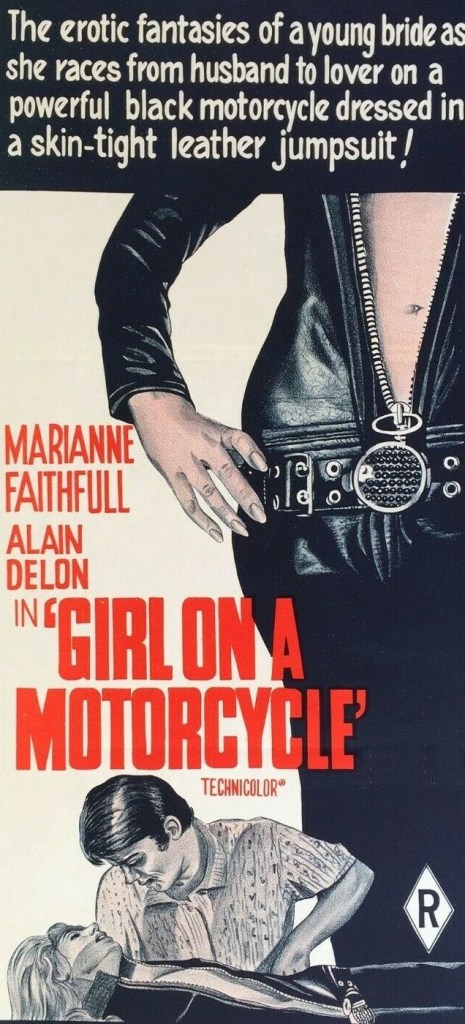
  7. Behind the Scenes of “The Girl on a Motorcycle” tracked how director Jack Cardiff beat the censor and cajoled a decent performance from Marianne Faithful even though it was yanked form U.S. release.
  8. Book into Film – “The Venetian Affair” explained how screenwriter E. Jack Neumann took the bare bones of the Helen MacInnes thriller and turned it into an excellent vehicle for Robert Vaughn trying to escape his The Man from Uncle television persona.
  9. Selling “Doctor Zhivago” (1965) examined the media campaign run by MGM for the London launch of the David Lean blockbuster.
  10. Book into Film – “A Cold Wind in August” demonstrated how screenwriter John Hayes toned down the sexy novel by Burton Wohl to escape the wrath of the censor while turning it into a touching vehicle for Lola Albright.

Behind the Scenes: “The Girl on a Motorcycle” / “Naked under Leather” (1968)

Although multi-country co-productions were very common in the 1960s, British-French co-productions were particularly thin on the ground, as if the cultural identities were so far apart there was nowhere they could ever meet. This was only the third such co-production in three years. British Lion, a long-established operation, had recently been overhauled with a new boss in John Boulting, a renowned filmmaker of Boulting Brothers (The Family Way, 1966) fame.

The film was based on a prestigious prize-winning French novel by Andre Pieyre de Manidargues. The budget was set at a modest $1.5 million with location shoots in Geneva, Heidelberg and Strasbourg with interiors shot at Shepperton. Director Jack Cardiff (Dark of the Sun, 1967) had originally hired a German actress, a Playboy centerfold,  for the leading role of the young girl who marries a timid young man while obsessed with a less conventional ex-lover. But the actress suffered a drug overdose and dropped out. Ironically, Marianne Faithful, her replacement, was also a drug addict and famed as a singer and as girlfriend of Mick Jagger.

Although her acting  experience was limited to television film Anna (1967) and a small part in Michael Winner’s I’ll Never Forget Whatsisname (1967), Cardiff was captivated by her sensuality which was ideal for her character. Bear in mind that Cardiff knew what a camera captured. He had made his name as a cinematographer and worked with great beauties like Ava Gardner (The Barefoot Contessa, 1954), Sophia Loren (Legend of the Lost, 1957) and Marilyn Monroe (The Prince and the Showgirl, 1957) so if he thought Faithfull fitted that category then there was no reason to doubt his assessment. He commented: “Never since I saw Marilyn Monroe through the camera lens have I seen such irresistible beauty. To focus on her is to focus the camera on your innermost heart.”  

Cardiff took advantage of a new trend to film movies in both English and French to open up distribution channels. Claude Chabrol’s The Road to Corinth (1967) was shot in this manner as was Farewell Friend / Adieu L’Ami (1968) with Charles Bronson and Alain Delon.   

Faithfull could not ride a motorbike so a stunt double was utilised for long shots. But instead of resorting to back projection, for medium shots and close-ups the actress was towed on a trailer behind a camera car. Not having to worry about the controls also meant that Faithfull could look dreamlike while driving and with Cardiff not having to think about the actress he could turn the camera in a 360-degree pan while she rode along.

Since Faithfull was going to be seen on a motorbike for long sections of the movie, Cardiff came up with a method of creating variety. One of the techniques employed was “solarization.” This was, in effect, a half-positive half-negative exposure, but it had only been used in the past in very small doses, nothing like what Cardiff had in mind. BBC boffin Laurie Atkin had invented a computer system that allowed solarization to be used more extensively. Footage shot during the day was taken immediately to the BBC lab at night where Cardiff could tinker about with creating his effects.   

One of the biggest beneficiaries of this technique were the sex scenes. Without the solarization which hid naked bodies under a psychedelic whirl the sex scenes would never have got past the censor.  There was an unfortunate downside, however. The Girl on a Motorcycle had been invited to the Cannes Film Festival. Critical approval there would have given the picture artistic momentum. Unfortunately, delays caused by the laboratory work meant the film missed its scheduled screening slot. Even so, French critics gave it the thumbs-up. British critics, on the other hand, gave it the thumbs-down. Lack of critical estimation did not appear to matter to British audiences who came out in their droves.

But it was a different story in the United States.

No wonder that to some extent this is one of the great lost pictures because Warner Brothers could not find a way to sell it in the U.S. Having paid a record $1.5 million advance, the studio (known at that time as Warner-Seven Arts) was hit by a double whammy. The picture was the first to receive an X-rating from the newly-established MPAA censorship system which replaced the previous Production Code. The new system was supposed to allow filmmakers greater latitude in terms of sex, violence and language.

Theoretically, that should have been a marketing bonus and the film should have ridden the “sex-art” wave and turned into an arthouse hit with the mainstream, captivated by solid grosses, to follow.  In reality, many exhibitors refused to touch it, regarding the X-rating as a separate category catering for the worst of the adults-only smut market. Newspapers refused to carry advertising for films so rated. Critics hated it, all the New York critics giving negative reviews.

Warners slotted it into a handful of arthouse houses before pulling all prints out of circulation in May 1970 and sending to back for re-editing with the intention of re-submitting it, shorn of some of the nudity, to the MPAA in a bid to win a more acceptable R-rating. In other words, to “re-gear the picture for the general market rather than the adult sex-art trade originally in mind.”  

To ensure that its reputation was not “soiled” the picture was re-titled Naked under Leather – if the content was tamer, the title was certainly not. Initially, that appeared to do the trick when it was re-released a full year later. It pulled in a “boff” $125,000 (worth around $864,000 now – a whopping $36,000 per-screen average) in 24 houses in wide release in Los Angeles, was “hot” in Denver and “tidy” in Chicago and found a few bookings elsewhere. But then it stalled and could not find the extra gear. In reality it did not do much better than on initial release. In the 1969 annual box office chart it featured at No 231 and for the corresponding 1970 chart it placed at number 253.

Sources: Jack Cardiff, Magic Hour, Faber and Faber, 1996, p242-243; “New British Lion Mgt. Gets Motorcyle Rights in UK,” Variety, October 18, 1967, 23; “Stylistic Dash Marks Cannes Films,” Variety, May 22, 1968, 26“British Lion Wraps Up Distribution Deal with W-7 for U.S., Towa for Japan,” Variety, August 28, 1968, 29, “Features Passing Through MPAA,” Variety, December 4, 1968, 20; “All Imports; N.Y. Critics All Bad,” Variety, December 4, 1968, 7; “Recall and Re-Edits W-7’s Motorcycle; X-Rating Now R,” Variety, January 29, 1969, 7; “Computer Tally of 729, 1968,” Variety,  May 7, 1969, 36; “Naked under Leather,” Variety, April 22, 1970, 4; “L.A. First Run Healthy,” Variety, May 13, 1970, 9; “Top 330 Pix in U.S. for 1970,” Variety, May 12, 1971, 37.

Discover WordPress

A daily selection of the best content published on WordPress, collected for you by humans who love to read.

The Atavist Magazine

by Brian Hannan

WordPress.com News

The latest news on WordPress.com and the WordPress community.