I am a published author of books about film - over a dozen to my name, the latest being "When Women Ruled Hollywood." As the title of the blog suggests, this is a site devoted to movies of the 1960s but since I go to the movies twice a week - an old-fashioned double-bill of my own choosing - I might occasionally slip in a review of a contemporary picture.
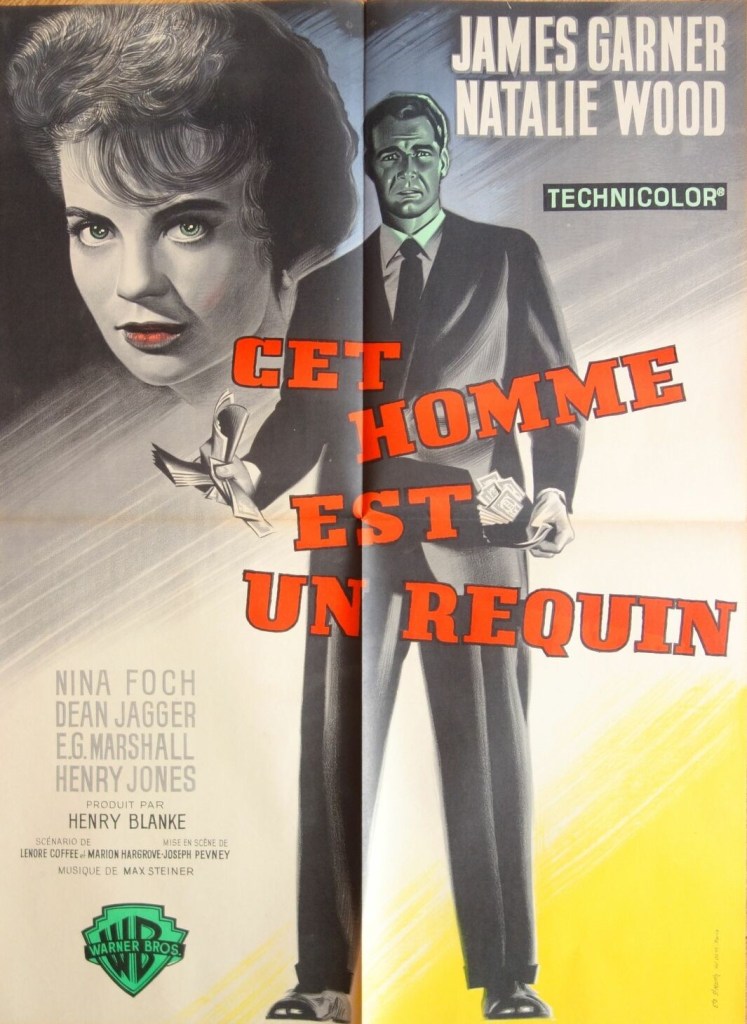
As time wore on and attitudes to corporate skull-duggery hardened – Wall Street (1987), Other People’s Money (1991), The Big Short (2015) – it was no longer necessary to soften a venal character with romance. And I guess the ruthless Cash McCall (James Garner) falling in love with Lory (Natalie Wood), daughter of takeover target Grant (Dean Jagger), provides the movie with a soft underbelly, intended presumably to show the inhuman businessman’s more human side, but instead diverting the picture away from delivering a massive punch against the asset-stripping proliferating too fast in American business.
Otherwise, it is a good assessment of the double-dealing and pitiless behavior of business sharks preying on weaker businesses. Then complaining when the tables are turned. Anti-Trust investigators would have a field day, but I’m not sure if the U.S. Securities & Exchanges Commission, set up in the wake of the 1929 Wall St Crash, was as powerless as today, usually turning up when the damage is done rather than stepping into prevent it.
Grant decides to sell up when his biggest customer Schofield Industries, run by retired Army General Danvers (Roland Winters), holds him to ransom. Cash McCall swoops in but, after finding a flaw in Schofield Industries, determines through clever maneuver to add that to his mountain of companies and make an immediate $1 million profit on Grant’s company which he purchased for $2 million.
The romance resistance that is standard for such pictures pivots on Lory having been rejected (on a stormy night) by Cash the previous summer. Ironically (though I doubt if the makers noticed the irony), Lory is viewed as a bonus in the deal, Cash’s wealth making him an ideal catch in the eyes of her parents, despite the abhorrence he inspires.
A contemporary audience might expect her to be the fly in the ointment, especially as she owns ten per cent of her father’s company, offering an opportunity to stand up to Cash on principle. But that’s not envisaged here. And you can’t expect her, in those sexist times, of complaining that her father is depriving her of her inheritance and the chance to run a big company.
It’s at its best in the financial chicanery. Danvers comes unstuck when Cash discovers that Grant holds an unexpected ace and can run his company into the ground. Every time anyone tries to get the drop on Cash it turns out he owns their company or nullifies their intent by knowing what they’re up to. He recruits or increases the salary of anyone who stands in his way. Money not only talks it minimises and even forgives or elevates heinous action.
The only person who bests him is a hotel assistant manager Maude (Nina Foch) who, misreading the signals, believes herself to be his love interest. In revenge, she scuppers his burgeoning romance with Lory.
In fairness, Cash is as upfront about his intentions as Gordon Gekko in Wall Street. He describes himself as a “thoroughly vulgar character – I enjoy making money” while confessing he doesn’t buy businesses to run them but to sell them or break them up into more viable smaller pieces.
But the James Garner (The Americanization of Emily, 1964) charm gets in the way. He wants to have his cake eat it. Move into serious roles without falling foul of the public. Romance is seen as the tool.
Garner evolved a sneaky screen persona, attempting to be rascal who got away with it thanks to his charm, best personified in The Great Escape (1963) and The Americanization of Emily, in both films his escapades endorsed by the authorities. But it would be hard to find any redeeming qualities in a ruthless business buccaneer who exalted in the chaos he caused, little regard for the wrecked lives left in his wake.
The film attempts to get by this via the romance – a beautiful woman couldn’t possibly end up with a scoundrel, could she – and by setting up virtually every other character excepting Grant as dodgy (and even Grant ends up congratulating him on his clever schemes).
As an insight into corporate malfeasance, it’s interesting enough, and bold for the times, and certainly gets points for not falling back on the old trope of the little guy fighting big business. This features grown-ups knowing exactly what they are letting themselves in for.
A couple of sections jar – the flashback and a labored explanation that “Cash” is not a nickname but a Christian name. On the other hand, it could as easily be perceived as a romance that just happened to take place against the unusual backdrop of the boardroom.
It’s worth noting that Garner himself was not above unscrupulous dealing. Having convinced Warner Brothers to fund his first three movies, he then proceeded to sue the studio over his contract, leaving them with the bill for his flops.
Nina Foch (Spartacus, 1960) and Dean Jagger (Firecreek, 1968) are the pick of the supporting actors. The most interesting aspect of Joseph Pevney (The Plunderers, 1960) was that he directed a quartet of films in this single year and then not another for the rest of the decade.
The final screenplay from celebrated writer Lenore Coffee, whose career spanned forty years, an astonishing feat for a female in Hollywood, and was at one time the highest-paid screenwriter in the industry. It was co-written by Marion Hargrove (40 Pounds of Trouble, 1962) from the bestseller by Cameron Hawley.
Would have been a better picture if it had stuck to the knitting and not wandered into romance, so good in parts rather than a major success.
Had the audacity to take on Mutiny on the Bounty (1962) at the ticket wickets, beating that much-delayed production into cinemas in both Britain (where it was hugely successful, the ninth biggest film of the year) and the U.S. (less so). While in some respects young officer Lt Scott-Pagett (Dirk Bogarde) fits the Fletcher Christian template as the arrogant upstart, he is actually more of a Captain Bligh, mercilessly flogging his crew.
While Scott-Pagett is loathed by all, he is not the real cause of a mutiny. That had been a long time coming, thanks to inflation, poor conditions and a change in equipment that kept sailors at sea far longer than before.
Set in 1797 at the beginnings of the Napoleonic War, Captain Crawford (Alec Guinness) is tasked with escorting ships from Italy to England. He abhors unnecessary punishment and will even reduce the number of strokes to minimize human damage for a miscreant. But in taking his young son along on his first trip to sea, he becomes a hostage to fortune as Scott-Pagett finds any excuse to beat the lad.
Crawford has to tread carefully for his junior officer has powerful friends in London and been responsible for ensuring his previous commanders fell foul of the Admiralty. Even so, Scott-Pagett continually over-steps the mark, challenging his superior’s decisions, even disobeying orders, until he is finally brought to heel, humiliated and confined to quarters. That makes him even more determined to get his own way and bring down the captain. When Crawford is wounded in a battle with an enemy ship, Scott-Pagett takes over, only to unleash the wrath of the crew.
Never shying away from exposing the harsh life aboard – the actually mutiny sparked by a sailor forced to eat food riddled with worms – it also in mellower moments offers a fascinating glimpse of life at sea, the racing up the rigging, the dancing to a hornpipe. The sea battles, especially in the absence of CGI, are exceptionally well done, Captain Crawford’s men enduring terrific fusillades as they draw close enough to inflict damage.
Oddly enough, the situation only escalates into mutiny after a lesser rebellion, the equivalent these days of a strike, with a call for the entire Navy to down tools, fails to materialize. Rebel ideas clash with patriotism when the mutiny prevents delivery of vital information about a French invasion of England.
But the film also depicts the uneven power struggle. Sailors are completely impotent, on board a ship there’s no appeal to a higher power, while a captain hesitates before over-ruling an officer for fear it sends out the wrong signals about hierarchy and obedience to the general recruits.
The crux of the film is the duel between captain and lieutenant. Crawford can be undermined as long as his son is under the command of Scott-Pagett. Fellow officers would think twice about upsetting a man of such high breeding who has the ear of the powerful ashore.
The role was a very bold choice for British matinee idol Dirk Bogarde (The High Bright Sun, 1964). Having rid himself of his Rank contract, he had determined to act against type, a role as a sadistic officer, face twisted in constant sneer, was so far from the dashing heroes of previous films that there was a fair chance it would alienate his legion of fans as much as its predecessor Victim (1961) in which he played a blackmailed homosexual.
It was a bit of a swap for Alec Guinness who in Tunes of Glory (1960) had played the arrogant bully determined to bring down a superior officer. Both are excellent and the scenes between them are superb, one of the few times when two British actors of the highest caliber were affordable in a non-roadshow picture. But there’s also a rich supporting cast. Anthony Quayle (East of Sudan), more normally associated with officer roles, tones down the bombast to play an ordinary seamen, split between fomenting agitation and keeping his own supporters in check.
A bunch of rising stars making the most of the opportunity include Nigel Stock (The High Bright Sun), Ray Brooks (The Knack, 1965), Tom Bell (Lock Up Your Daughters!, 1969) and Johnny Briggs (The Devil-Ship Pirates, 1964) – all of whom would make bigger career strides in British television through, respective, Owen M.D. (1971-1973), Big Deal (1984-1986), Out (1978) and Coronation Street (1974-2006).
Lewis Gilbert (The 7th Dawn, 1964) directed from a screenplay by Edmund North (Patton, 1970) and Nigel Kneale (Quatermass and the Pit, 1967) based on Mutiny by Frank Tilsley and completed by his son Vincent Tilsley. With a wealth of material, Gilbert proves adept at moving through the gears while not losing sight of the main drama.
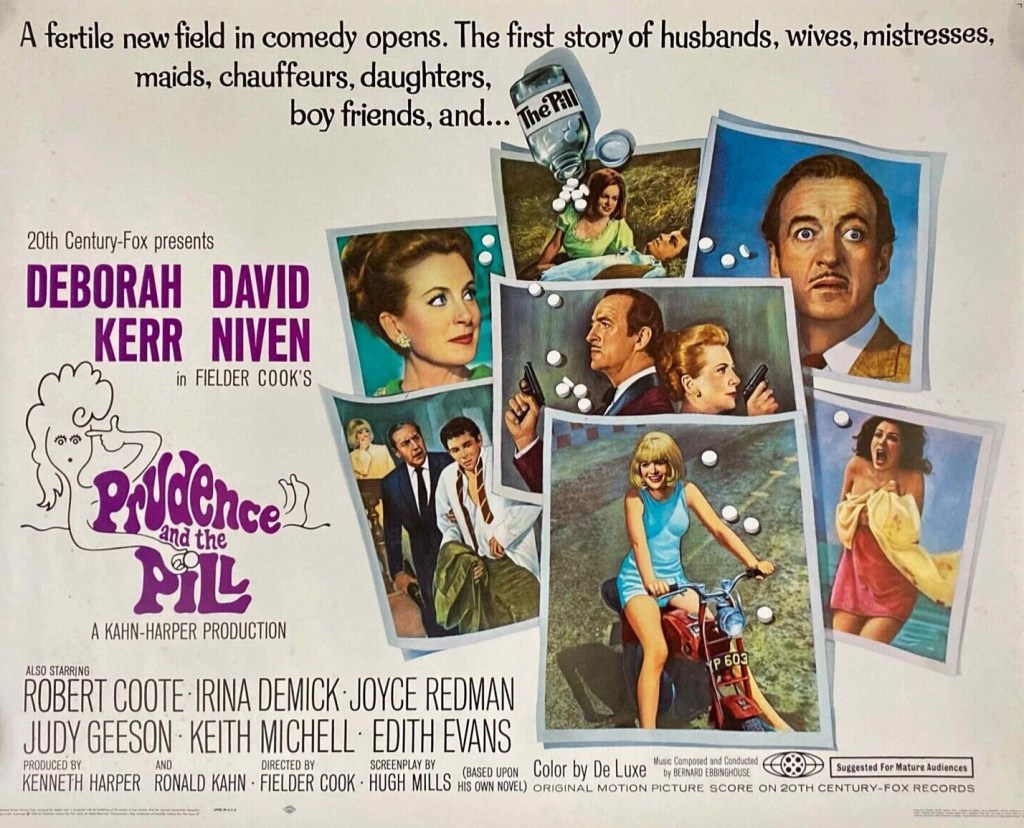
Cleverly calibrated chuckle-worthy comedy of manners. Far more enjoyable than the basic material might suggest, especially as you will easily guess where it all ends. Anchored by redemptive performances, after disappointing turns in The Eye of the Devil / 13 (1966), by Deborah Kerr and David Niven, playing a middle-aged upper-class childless couple whose marriage survives on civility alone, and a sparkling showing by Judy Geeson (Here We Go Round the Mulberry Bush, 1967).
It’s surprising what a fresh look at cliché can achieve. On the face of it, American director Fielder Cook (How to Save a Marriage and Ruin Your Life, 1968) is the last person to be tackling the upper classes, especially as there’s scarcely a hint of satire. It’s wonderfully pitched, no sexist jokes, no farce, no tourist or Swinging London, and avoids the temptation of aiming for the lowest common denominator (Carry On Up the Pill for example). But authority is constantly confounded, pomposity pricked, and, astonishingly for a movie about relationships in Britain – the home of the kitchen sink drama – in the late Sixties, everyone ends up happier ever after.
The titular drug in question, in case that term is no longer in common usage, is the contraceptive pill, here sold under the generic name of Thelon. The biggest shocks here might well be that mothers and fathers in middle-age still have sex. Although that is balanced by a contemporary vibe of having children late in life.
So the fun begins when Henry (Robert Cooote) and Grace (Joyce Redman) discover bubbly daughter Geraldine (Judy Geeson) in bed with Tony (David Dundas). Cue howls of anger from staid parents, who divide up the ticking-off, the mother tasked with warning daughter about the dangers of pregnancy – and with it the specter of single motherhood, a high society no-no – the father to whip the young rascal.
The mother is only mollified – though still affronted at such blatant expression of sexuality – when she discovers her daughter is on the Pill. But shocked to discover Geraldine has been pilfering her own supply. Father is taken aback to discover the lover is not only heir to a fortune but has already proposed.
Unlike most movies of the era, where sexuality remained a dirty word, and most illicit romances were conducted in secrecy and ended up in disaster, the vivacious Geraldine could be the poster girl for sex. She is delighted to have lost her virginity, and to expand her sex education, and stands up against her mother’s old-fashioned views.
However, the replacement of mother’s Pill with aspirin presents a dilemma. Robert and Grace are also enthusiastic lovers and the absence of contraception for so long points towards the possibility of a very embarrassing pregnancy.
Meanwhile, Henry’s brother, bored company chairman Gerald (David Niven), who lives in a mansion with servants and swans around in a chauffeur-driven Rolls-Royce, discovers, to his horror, that his wife Prudence (Deborah Kerr) has been taking the Pill, denying him his much-cherished desire to have children. So he swaps it for a vitamin pill. Unknown to him, his young maid Rose (Vickery Turner), warming to the amorous attentions of the chauffeur Ted (Hugh Armstrong), has taken a leaf out of Geraldine’s book and snaffled her mistress’s Pill.
You can see where this is headed. But there’s a complication. Assuming (as a man would) that their lack of children was due to his wife’s infertility, Gerald could have had children by his younger mistress Elizabeth (Irina Demick). But he refuses to seek a divorce (the scandal, don’t you know) and Elizabeth views him as a poor candidate for marriage (would he not just have another mistress) and fatherhood.
Prudence, it soon transpires, also has a lover, Dr Huart (Keith Michell). Equally resistant to divorce, for societal reasons and to prevent her husband marrying his mistress, Prudence soon warms to the thought of having a child, but abhors the prospect of having Gerald as its father.
In the best Hitchcock fashion, the audience is privy to information denied the characters who fluster around in their incompetence.
It should never work. The story is so obvious and, from a narrative perspective – given unplanned pregnancy does not lead to dark deeds, humiliation and abandonment – weak. That it is pretty much a triumph owes as much to the direction (witty use of musical cues, for example) as a script that feasts on reversals. The acting is first-class all round. David Niven and Deborah Kerr, in their final pairing, atone for the under- and over-acting, respectively, of Eye of the Devil. Judy Geeson is a standout as a marvellously gleeful liberated young woman. Edith Evans (The Chalk Garden, 1964) pops up for a delightful cameo.
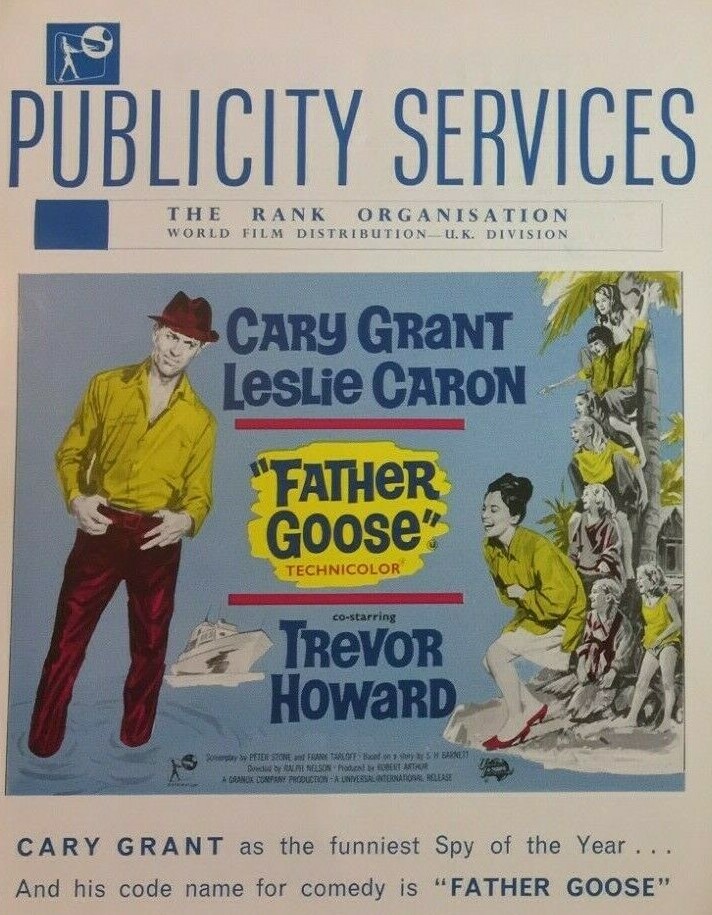
The African Queen with kids or 100 ways to see Cary Grant deflated. The penultimate movie in the screen giant’s career is a tame affair especially after the thrilling Charade (1963) and it may have prompted him to shy away from attempting to carry on a romance with a woman decades younger as occurs in his final offering Walk, Don’t Run (1966). When Trevor Howard (Von Ryan’s Express, 1965) effortlessly steals the picture with a performance that turns his screen persona on its head, you can be sure it’s not quite top notch.
In World War Two, Walter (Cary Grant), a hobo on water with a knack of stealing official supplies, is commandeered by British officer Houghton to operate a radio outpost on a Pacific island giving early warning on Japanese aircraft sorties. While there, he encounters Catherine (Leslie Caron), a French schoolmistress and consul’s daughter, in charge of a pack of female schoolkids.
Effectively, both relationships follow a pattern of verbal duels, initially with Walter losing them all as he is kept on a leash by Houghton and then is beaten by teacher and children. The kids steal his hut, his bedding, clothes (shredded and sewn to fit young girls), food, booze and sanity.
The straight-laced Catherine is happiest when straightening a picture. Walter only regains some of his standing when it transpires he has practical skills like catching fish, repairing a boat and encouraging to talk a girl who has been traumatized by war into temporary dumbness. Naturally enough, any time Leslie warms to him he does something off-putting. But gradually, of course, they get to know each other better, romance is in the air, and secrets are revealed, his hidden past laughable.
It’s a series of set pieces, designed to make the most of Cary Grant’s deftness with physical comedy, he can pull faces with best of them and long ago mastered the double take and the pratfall. So there’s little here you’ve not seen before. And the trope of man and woman trapped on a desert island – most recently probably best exemplified given its inherent twist in Heaven Knows, Mr Allison (1957) – has long been over-used and this addition to the sub-genre suffers from lack of originality.
The little blighters are less an innovation than a complication (or perhaps a multiplication) but they do have the advantage of reducing him to impotence, since he can hardly deal with their transgressions the way he might Catherine. And of them is smart enough to realize that he runs on booze and rations this out.
All in all it’s gentle stuff, nothing too demanding, redemption neither an issue nor an option. Cary Grant is an unusual species of top star in that, as with Rock Hudson and a few others, he didn’t mind being the butt of all the jokes, and in some respects sent up his screen persona.
Keeping Cary Grant in check might well be a sub-genre of its own, so Leslie Caron (Guns of Darkness, 1962) is inevitably limited in the role, primarily a foil/feed for the Grant, the part not not quite of the caliber of the roles played by actresses in his thrillers such as like Grace Kelly (To Catch a Thief, 1965), Eva Marie Saint (North by Northwest, 1959) and Audrey Hepburn in Charade.
As I mentioned, Trevor Howard is the surprise turn, and steals the show. Ralph Nelson (Soldier Blue, 1970) directs from s script by Peter Stone (Charade), Frank Tarloff (The Double Man, 1967) and S.H Barnett, a television writer in his only movie. I’ve clearly under-rated the script because it collected the Oscar.
Perfectly harmless and enjoyable, if a tad obvious.
Dvorak would be turning in his grave at the audacity of using his New World Symphony (Ridley Scott used it with more subtlety for the Hovis advert a couple of years later) as the score for a Charles Bronson picture. But you could argue this really isn’t a Charles Bronson movie. He’s not the tough guy. He doesn’t come out all guns blazing. He doesn’t slap people around.
This is probably the biggest reversal of screen persona in Bronson’s career (if you exclude The Sandpiper, 1965, where he plays an artist, and you could probably chalk it off anyway because he wasn’t a star at that point). This is so far from the Bronson you guess it must be a cruel hoax.
Here, Bronson is the dupe, the patsy, the stooge.
Come again?
He’s not even dignified with a name, just “The Stranger.” In fact, this could be a remake of Rider on the Rain (1970) with Bronson playing the bad guy not the mysterious cop.
The Stranger, found standing in the road and no idea how he got there, ends up the patient of neurosurgeon and psychoanalyst Laurence (Anthony Perkins). The Stranger is suffering from amnesia so being the good guy he is, and always interested in another scalp for his casebook, Laurence takes him home – in Folkestone on the English south coast, next to Dover – and helps him begin the process of unravelling his identity.
Laurence is a bit cross, it has to be said, because he’s discovered his wife Frances (Jill Ireland) is having an affair with a French journalist Paul Damien. Laurence brings in his brother-in-law to break her alibi of always staying with him.
From a suitcase found on the nearby beach, whose clothes fit The Stranger, it’s conceivable this might be the very same Paul. But he could as easily be an escaped madman. Or he could be the chap who’s raped and murdered a blonde on the beach.
The Stranger, mightily confused, begins to suspect, especially when he finds a photo of a naked Jill in his pocket, he might indeed be Paul. And to even things up, he has reason to be jealous. If he is Frances’s lover, it could very well be Paul Damien to blame.
Naturally, Laurence has arranged for there to be gun handy. And gradually he twists the facts and works inventively to convince The Stranger that he should be very hot and bothered should, as appears likely, at any moment Frances and Paul walk through the door, allowing Laurence to take revenge and get off scot-free.
Whether The Stranger is ill or not, he is clearly easily led and pretty much accepts the situation Laurence presents. Any time he queries anything, Laurence has a ready answer.
So what you have really is two parallel tales of cat-and-mouse. On the one hand you have Laurence snaring The Stranger in a spider’s web of possibility and drawing a tighter noose around his wife and her lover (whoever that may be). But you also have, in his debut, clever-dick Hungarian director Nicolas Gessner (The Little Girl Who Lived Down the Lane, 1976) playing with audience expectation. At any moment, in the first parallel tale, you expect The Stranger will come to his senses, memory recovered, and putting an end to the nasty plan. Equally, at any moment, you expect the real Charles Bronson to stand up, take control and blast everyone to hell.
But neither of these possibilities occurs. The Stranger looks lost for the most part, diminished, outwitted, twisted around like an impotent puppet. Rather than concealing the difference in height between the principals ( that a big star is never smaller than anyone else seems set in the Hollywood Bible of Audience Deception), Bronson always appears to be cowering in front of Perkins.
Not falling back on his screen persona, in fact staying as far away from it as is possible (beyond showing off his torso from time to time to placate his female fans), Bronson delivers a more than believable performance as the little boy lost. This may not be an Oscar-winning elements performance, but in the Bronson portfolio this may well be his finest.
Sure, there a couple of implausible moments, but that’s par for the course in this kind of thriller.
And the coup de grace is that when, finally, Bronson does break loose of his shackles, it’s to act in a way no fan would like to see, when he commits a heinous act.
Bronson was far from the big Hollywood star at this point. While French audiences had certainly taken to him, that wasn’t reciprocated much elsewhere and despite being tossed into films like You Can’t Win ‘Em All (1970) opposite Tony Curtis and an international cast in eastern-western Red Sun (1971) he was still some way short of the top of the Hollywood tree. It would take another year before stardom was validated by the double whammy of The Valachi Papers (1972) and The Mechanic (1972) and another couple of years before Death Wish crowned him a superstar.
So it was an incredibly bold move to make such a shift away from creating a tough-guy screen persona. More so, to pull off such diffidence and weakness.
Interestingly, this isn’t the Anthony Perkins of Psycho (1960) either. He’s not the tic-ridden jumpy quavery-voiced individual that had appeared to be his screen persona.
Very much worth a look. Unless of course you don’t want to disturb your image of Bronson.
As you may be aware, this blog is quite unusual, you might say unique (although to prove it I’d have to check a gazillion sites) in paying attention to the way films are made rather than just the movie itself. Casting issues, directorial squabbles, source material, the myriad on-set dramas are all covered here.
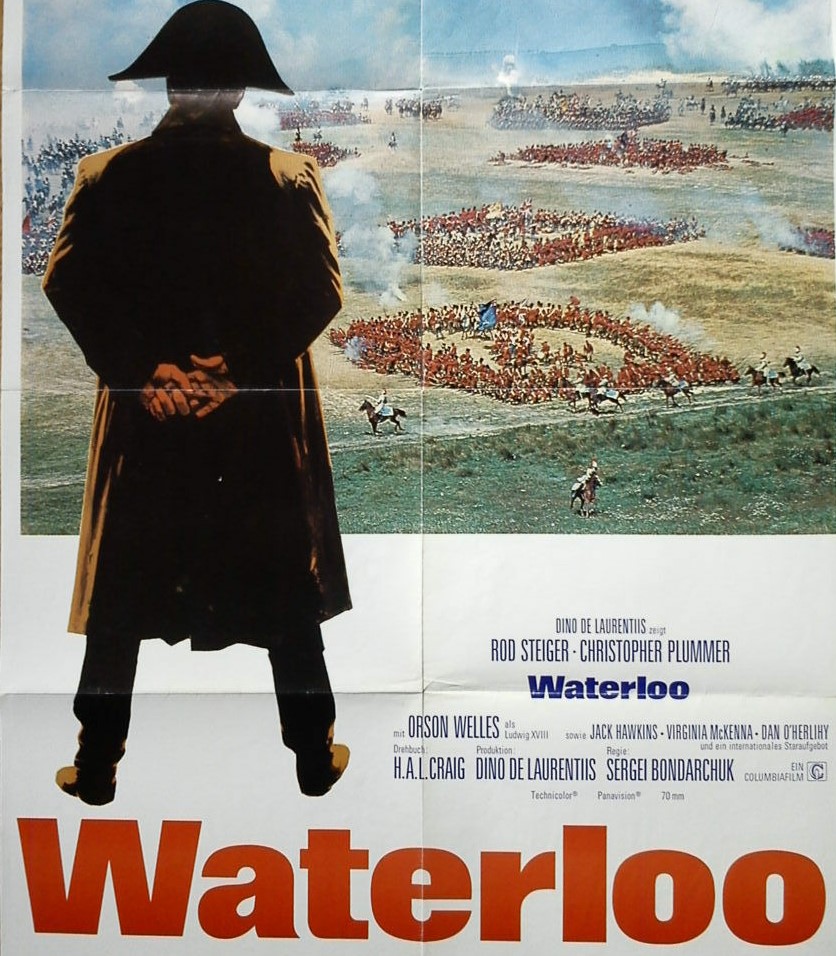
Waterloo (1970). The making of the film was more fascinating than the film itself.
Ice Station Zebra (1968). Alistair Maclean’s Arctic thriller went though a ton of casting changes and embraced new techniques to get to the screen.
In Harm’s Way (1965). No Otto Preminger picture is without incident but with one of his most top-notch casts including John Wayne and Kirk Douglas it was always going to be an incendiary set.
The Satan Bug (1965). Director John Sturges got into all sorts of tangles trying to film Alistair MacLean plague thriller.
Cast A Giant Shadow (1966). Melville Shavelson, better known for comedies, risked his reputation on this Israeli biopic, re-teaming John Wayne and Kirk Douglas with Angie Dickinson and Senta Berger as the love interests.
Spartacus (1961). Not the version you know so well but the one Yul Brynner attempted to make at the same time.
Naked Under Leather / The Girl on a Motorcycle (1968). The erotic, the psychedelic and controversial clashed in Jack Cardiff drama starring Marianne Faithfull and Alain Delon.
Battle of the Bulge (1965). The epic Cinerama production had to see off a rival production before encountering horrendous weather in Spain.
The Guns of Navarone (1961). After first choice stars dropped out, the production was nearly cancelled when it was scheduled to film in a war zone. David Niven nearly died, the biggest set was destroyed, the budget muschroomed and producer Carl Foreman battled Columbia in an attempt to win a prestigious roadshow release.
100 Rifles (1969). Never mind the miscegenation, the violence caused an uproar as Raquel Welch and Jim Brown teamed up in more ways than one to topple a ruthless Mexican regime. Also starring Burt Reynolds. Hot sex and an even hotter shower scene.
When Global Box Office Didn’t Exist. In the 1960s movies lived or died by the U.S. box office figures. In an exclusive report, I reveal how movies actually fared when you took overseas box office into account.
Sink the Bismarck (1962). British World War Two drama overcomes endless obstacles.
The Deadly Companions (1961). The producers were so dismissive of Sam Peckinpah’s maiden effort that the only way they could think of selling it was on the back of a nude dip in a pool by star Maureen O’Hara.
The Cincinnati Kid (1965). Another Peckinpah disaster. He was fired for filming an unscripted nude scene. Steve McQueen was sent to Las Vegas to gamble with the studio’s money while they found a replacement.
Night of the Living Dead (1968). Poster boy for the low-budget shocker. Astonishing that it ever saw the light of day.
The Shoes of the Fisherman (1968). MGM roadshow that tried to fuse the Vatican and the Communists.
Top of the Box Office Flops – box office figures were much harder to come by in the 1960s. Here, I exclusively reveal the extent of the films made by United Artists between 1965 and 1969 that bit the dust.
They Shoot Horses, Don’t They (1969). Originally mooted in the 1930s, various previous developments were halted in their tracks for financial or artistic reasons.
The Bridge at Remagen (1969). The location of the actual bridge for the famed World War Two battle was long gone, but when the production opted to film in Yugoslavia it hadn’t counted on being caught up in an uprising.
The Borgia Stick / F.B.I. vs Gangsters (1967). How one of the earliest movies specifically made for American television won a cinema release overseas. Rather than investing in occasional one-offs, Universal wanted to create a brand, the “World Premiere” series, but it had to rely on up-and-comers like Inger Stevens and fading stars like Don Murray.
All the trade papers have cottoned on to the notion of doing half-yearly assessments of the movies on offer. Not suggesting they’ve stolen my idea, of course, but I always find it interesting to see which of my blogs attract more attention than others. So here’s the top-viewed films for January-June 2023.
The Swinger (1966). No surprises here since this movie is king of the all-time swingers. Ann-Margret stars as a wannabe writer living out her character’s adventures and, in passing, taking every opportunity to shake her booty.
Fireball XL5 (2022) The Gerry Anderson 1960s sci fi television series featuring Steve Zodiac, colorized and winning over a new legion of fans.
Plane (2023). Pilot Gerry Butler goes Die Hard on a remote island where his plane crash lands and his passengers are taken hostage by terrorists. No word yet on a sequel but another Den of Thieves 2 is in production.
Fraulein Doktor (1969). German spy Suzy Kendall outwits British opposite number during World War One.
Vendetta for the Saint (1969). Roger Moore as Simon Templar taking on the Sicilian Mafia in a movie stitched together from two television episodes. Love interest supplied by Rosemary Dexter.
Pendulum (1969). George Peppard, charged with murdering adulterous wife Jean Seberg, must clear his name.
Sgt Ryker (1968). Lee Marvin creates merry hell in Korea. Another compilation of television episodes and revived to cash in on his success.
Stagecoach (1966). Ann-Margret, Alex Cord and Bing Crosby head the cast of a decent remake of the John Ford western.
100 Rifles (1969). Raquel Welch and Jim Brown team up to drive out the ruthless Mexicans in a steamy, violent western.
Moment to Moment (1966). Jean Seberg caught up Hitchcockian skulduggery in the South of France.
Baby Love (1969). Linda Hayden as the object of too many people’s affections as she is taken in by a well-off London family.
Titanic (1997). The 3D version of the James Cameron classic, much in the news at the moment after the Titan disaster, which was reissued in advance of the Avatar sequel.
Sisters (1969). Nathalie Delon and Susan Strasberg in semi-incestuous Italian drama.
Mickey One (1965). Cult Arthur Penn existentialist thriller starring Warren Beatty and a stand-up comedian hiding out from the Mob.
Rage (1966). Glenn Ford and Stella Stevens battle a rabies outbreak in Mexico.
Sword of Lancelot/Lancelot and Guinevere (1963). Cornel Wilde writes, directs and stars in historical epic. Wife Jean Wallace has the female lead.
Beat Girl / Wild for Kicks (1960). Gillian Hills dips into the seamy side of London.
Charade (1963). Classic Hitchcockian thriller with Cary Grant and Audrey Hepburn at the top of their game with a host of rising stars and directed by Stanley Donen.
Here We Go Round the Mulberry Bush (1968). Provincial teenager Barry Evans tries to get his share of the Swinging Sixties with the help of Judy Geeson.
Lady in Cement (1969). Frank Sinatra as private eye Tony Rome makes the mistake of taking on mob moll Raquel Welch as a client.
Can Heironymus Merkin Ever Forget Mercy Humppe and Find True Happiness (1969). Anthony Newley warbles his way through cult musical, another actor-writer-director extravaganza this time mainlining on Fellini and with copious nudity.
The Invitation (2022). Nathalie Emmanuel finds her lover enmeshed in a Gothic conspiracy.
Once a Thief (1965). Ann-Margret again, this time in a more serious role as the wife of reformed criminal Alain Delon sucked back into a heist. Directed by Ralph Nelson. Hip jazz score by Lalo Schifrin.
Hannibal Brooks (1969). Michael Winner World War Two comedy drama with Oliver Reed making best friends with an elephant.
Arabella (1967). Delightful Italian comedy with Virna Lisi trying to seduce various versions of Terry-Thomas.
Naked Under Leather / The Girl on a Motorcycle (1968). Chanteuse Marianne Faithful brings erotic heft to controversial movie, heavily cut for U.S. release. Co-star Alain Delon smokes a pipe.
King’s Pirate (1967). Decent swashbuckler starring Doug McClure and Jill St John.
The First Deadly Sin (1980). Superb performance by Frank Sinatra as cop hunting serial killer. Co-stars Faye Dunaway.
Whirlpool / She Died With Her Boots On (1970). Creepy thriller from Jose Ramon Larraz sees top model Vivian Neves terrorized by photographer Karl Lanchbury. Lost for decades.
Giant (1956). Big screen revival of George Stevens’ oil epic starring Rock Hudson, Elizabeth Taylor and James Dean.
Richard Burton was first choice. Sean Connery second. Jack Lemmon a distinct possibility. A suave Frenchman such as Jean-Paul Belmondo (Breathless, 1960) was briefly entertained. Brigitte Bardot a certainty for the female lead. Thoughts of entertaining Steve McQueen for the male lead were so far beyond left field as to have entered the outer limits. He played down’n’dirty working characters clad in nothing more sophisticated than denim. Faye Dunaway’s screen persona – violent slutty bitch – was the opposite of the character depicted.
Producer Walter Mirisch was well versed than most about McQueen, having hired him for The Magnificent Seven (1960) and The Great Escape (1963). But when Burton rejected the part, “we determined to try to interest Sean Connery in the role.” The Scottish actor was receptive to any movies that would instantly take him away from the typecasting of the James Bond series. Lunch at the Regency Hotel was followed by further conversation “for most of a Saturday afternoon.”
But to no avail. “We were crestfallen when we failed to convince Sean Connery,” who was, after all, the biggest star in the world, and looked immaculate in a suit.
Even Steve McQueen acknowledged he was an odd choice. He told a film school class in January 1967 that he was a “limited actor, I mean my range isn’t very great.” But after the possibility of crowning his acting career with Oscar glory for The Sand Pebbles (1966) had faded and with motor racing epic Day of the Champion in cold storage but with a six-picture with Warner brothers promising a hefty $700,000 per, he had the pick of projects.
Maybe too many came his way, over 100 in a few months. He took a meeting with Twentieth Century Fox over a proposal to star with Audrey Hepburn in Two for the Road (1967). He was mooted, along with Paul Newman, for In Cold Blood (1967) and was wooed by John Huston for The Kremlin Letter (not made till 1970).
Eventually, director Norman Jewison, who had worked with McQueen on The Cincinnati Kid (1965), another change to the actor’s screen persona, after much badgering, agreed to let him see the script. “Norman and I both felt that Steve was completely wrong to play Thomas Crown,” commented Mirisch, especially over the demand that “he should to wear a necktie on the screen.”
Although Jewison and McQueen shared the same agency, William Morris, the notion of the actor being tapped up for the role didn’t come from there. McQueen heard about it from a friend Steve Ferry who had seen the screenplay. Jewison came straight to the point when he took a telephone call from McQueen: “If it’s Thomas Crown, forget it. You’re not right. I love you and respect you as an actor. But I’ll never tell you lies. You can’t have the part.”
Jewison went further, listing the actor’s shortcomings, explaining McQueen was prone to “looking down at the ground or squinting up into the sun…What’s going to happen when you have to look people in the eye?” Only after three hours on the director’s back lawn did Jewison’s obstinacy relent. “The more he talked, the more I saw him as Thomas Crown. Now we had the problem of turning him physically into Thomas Crown.”
“He’s a rebel like me,” surmised McQueen, “Sure, a high society rebel, but my kinda cat.” Jewison kept telling him he “wasn’t right for it.” It was “unlike anything Steve had ever done” and casting him still seemed a risk. McQueen was aware of the damage miscasting could do to this career. “I don’t have any illusions on that score…If people laugh at me, my ass is gone.”
McQueen explained his enthusiasm for the role. “I had thought of changing my screen image for more than a year. I felt it was time to get past those tough upright types. When Norman showed me the Crown part I grabbed it.”
It was an odd movie from the beginning, not churned out by a seasoned professional. An experienced Hollywood type would never have considered writing a heist picture where the mastermind was a slick millionaire with a string of successful businesses behind him, who, rather than being a professional criminal, was drawn to crime from sheer boredom.
Alan R. Trustman was a legal eagle, partner at the law firm of Nutter, McClennen and Fish. “I had never written a line, except for law briefs. One Sunday afternoon I got bored watching TV and suddenly, for no apparent reason, I thought it would be fun to write a screen story…in two months The Crown Caper was done.” But it was nothing like the polished movie that ended up on screen. “It had a lot of dialogue, a lot of description and a lot of prose,” recalled Mirisch, and at thirty pages long was more of a treatment than a script. “But it had a great germ of an idea.”
Mirisch was an early advocate of Faye Dunaway, having seen her on stage in a play, Hogan’s Goat (1965), recognized her potential and “always had in mind that, one day, a role would come along.”
Mirisch had McQueen on some sort of a financial string. Their multiple-picture deal with him dated back to The Magnificent Seven (1960), at a time when he was a rising rather than established star. In the way of such pacts, initial remuneration was pretty low, rising with each successive picture, and relying on the actor having become, somehow, a success.
“His agent and manager made a big fuss about the nominal salary provided for in our second option. To settle the argument,” stated Mirisch, “I agreed to pay him the salary called for in the third option as well as to cancel that last option. I recognized that we really should be paying him more than the price stipulated in the option. Also I felt that trying to enforce the third option would be difficult if not impossible.”
If Walter Mirisch thought he was getting a bargain, it wasn’t much of one. McQueen still pulled in $650,000 plus $1,000 a week living expenses and a ton of perks – including it later transpired the dune buggy (worth about $50,000 at today’s prices), all the tailor-made suits, and the shoes and a swag-bag of props. The actor called on his Beverley Hills tailor Ron Postal to deck him out in $400 suits (over $3,500 now), had his hair transformed by celebrity stylist Jay Sebring (later murdered along with his girlfriend Sharon Tate by the Manson gang) and learned to play polo “until his hands literally bled.”
Dunaway, by contrast, with Bonnie and Clyde (1967) in the bank and wanted by every studio in town, was paid a larger salary (though McQueen made up for it by his profit share). Out of the $4.3 million budget around a third was spent on the salaries of the two principals.
Dunaway proved terrific casting for another reason. She was as tough, single-minded and independent as the character she played. She had an inner strength McQueen’s previous leading ladies and contemporary amours lacked. In person “she threw him off-balance” and she “did the same thing on camera” which provided the anchor of their relationship. She was far from the typical Hollywood “love interest.”
Mirisch’s pact with Jewison had proved wildly successful, among the best financial deals the company had ever achieved, the hot box office of The Russians Are Coming, The Russians Are Coming (1966) exceeded by In the Heat of the Night (1967). Jewison rehired many of the crew from his previous picture, including two budding directors, cinematographer Haskell Wexler (Medium Cool, 1969) and editor Hal Ashby (Shampoo, 1975).
Aside from the sensational screen charisma of the leading actors, the screenplay’s originality was enhanced by a huge step forward in the use of technology, the innovative split-screen process, executed by visual designer Pablo Ferro, who had devised the credit sequence for The Russians Are Coming, The Russians Are Coming.
Multiple image was used in three principal area – to introduce six characters and establish their relationship during the initial robbery, for the polo game, and in the final caper. The polo game employed “not only out-of-focus and soft effect panels but also at some point involved over fifty separate panels on the screen simultaneously,” said Jewison. For the second robbery “the amount of film used in relationship to the amount of screen time was probably in the ratio of four-to-one.”
In other words, not only was it incredibly stylish, but it vastly compressed screen time, reducing the running length by fifteen or twenty minutes, ensuring that the audiences concentrated on the evolving relationship between McQueen and Dunaway.
McQueen could ride, of course, what Hollywood star, with westerns in high demand, could not. “But he hated horses and he hated polo, but he wasn’t about to give up.” Thanks to his dedication, he proved a worthy competitor. Jewison only believed in McQueen once he witnessed him in action playing polo. “That’s when I realized how much he was giving for the film. Polo was symbolic of all the reasons why he wanted to play Thomas Crown.” The snobs at the club might sneer but they could not ignore “his sensational back hand.”
McQueen had never used the English saddle, a prerequisite for polo. He trained at the Myopia hunt club from morning till night until he mastered the art of riding using his knees not his arms (essential to be kept as free as possible to swing the mallet) as well as becoming such a “proficient player” he received a standing ovation from the members.
The F.B.I. refused to cooperate. Rejecting a request to film in its Boston office, the crime buster operation complained about what it perceived as “an outrageous portrayal of the Bureau” especially as the film ended with Thomas Crown outwitting the organization.
McQueen turned up for shooting as if he had swallowed the Method. “Call me Tommy,” he told the crew. But there was limited time to knock the character into shape, the actor having only signed up for a week of pre-production.
The twelve-week shoot was marred for McQueen by “some letters of a threatening nature that he had received.” That meant posting a security guard on his rented house to ensure the safety of his children. “It preyed on his mind a great deal during the shooting,” said Mirisch.
According to Jewison, McQueen’s security concerns evolved into paranoia, itself driven by his drug-taking. As well as a 24-hour security detail and surveillance on the front of his house, he demanded the same facility for the back of his house which between him and the Atlantic Ocean consisted only of a private beach. “Who the hell did he think was going to get in from there?” mused the director. Off-screen McQueen never exhibited his on-screen confidence. Jewison observed, “He was tortured.”
Filming was, as Jewison put it, best described as “bittersweet.” Producer Robert Relyea recalled “refereeing” a few incidents between actor and director. McQueen’s unease or the eternal power battle between director and actor resulted in one opportunity missed. For the dune buggy scene, said Jewison, “we had everything lined up for a scene on the beach at Magic Hour just as the sun was going down. Beautiful… conditions were perfect, everyone was ready except Thomas Crown Esq who was out in the surf in his dune buggy not answering his radio.”
Oddly enough, McQueen objected to the director speaking to him snippily when the actor returned and after that their relationship wasn’t the same, McQueen nibbling away at the director’s confidence, objecting to scenes or lines, until Jewison at one point ended up in tears. McQueen became a consummate actor, expressing emotion with the slightest lift of an eyebrow, or tightening a facial muscle, because “he couldn’t get his tongue around a lot of words.”
The producer was delighted to return to Boston, the movie’s main location, because he had attended college there a quarter of a century previously. Locations used included Old Copp’s Hill Cemetery, the Boston commons, the Little Italy outdoor markets, Anthony’s Pier 4 restaurant, and the sand dunes near Crane’s Beach and Provincetown. The St James Ballroom of the Jordan Marsh mansion provided the setting for the ballroom while the chess game was shot at the Goldwyn Studio. The initial bank robbery was filmed using hidden cameras at the National Shawmut Bank.
For the chess game “ we were hoping to get inspired moments that could give us more than dialog could.” Inspiration didn’t stop there, the fashionable outfits adorning Dunaway helped enormously and, of course, the movie hit pay dirt with the Oscar-winning theme song, “The Windmills of Your Mind” composed by Michel Legrand with lyrics by Marilyn and Alan Bergman, a huge success in the global singles charts.
The original title of The Crown Caper was changed for a time to Thomas Crown and Company before setting finally on The Thomas Crown Affair.
Although initially criticized as being primary style over substance, and now recognized as a work of inspired genius, one of the few times when everything falls into place on a movie, according to Mirisch, it was more “an exhibition of style…we hoped to dazzle the audience with the multiple panels and the chess game, the photography and the music.”
It proved a smash at the box office, rentals of $6.25 million in the U.S, nearly matched by $5 million abroad.
SOURCES: Walter Mirisch, I Thought We Were Making Movies, Not History (The University of Wisconsin Press, 2008) p265-270; Penina Spiegel, Steve McQueen, The Untold Story of the Bad Boy of Hollywood (Collins, 1968) p201-209; Christopher Sandford, McQueen, The Biography (HarperCollins Entertainment, 2002) p196-198, 202-206.
Employs Hitchcock’s trick of having you rooting for the bad guy. The caper picture remade. Steve McQueen (Nevada Smith, 1966) reinvented. Faye Dunaway (The Extraordinary Seaman, 1969) making the most stunning entrance this side of Ursula Andress in Dr No (1962). The technological dream of the split screen. Film noir filmed in bright sunshine with a femme fatale on the right side, only just, of the law.
Takes the insurance agent of Psycho (1960) and switches the gender. Nabs the Hitchcock crown (Notorious, 1942) for the longest screen kiss. Steals from Ingmar Bergman (The Seventh Seal, 1957) the title of best chess scene.
Female sleuth at a time when I don’t think the idea of a female detective crossed anyone’s minds in Hollywood. And one so sexy, stylish and uber-confident that she attracts not one sexist remark. Not dumb enough either like Lila in Psycho to walk into a trap.
And, incredibly, given wealth has been a movie trope since day one, luxuriates in a lifestyle – gliders, dune buggies, polo – never seen before. Not just a mesmerising song (“The Windmills of Your Mind”) but an absolutely outstanding score from Michel Legrand (Play Dirty, 1968). Almost works as a visual greatest hits collection, one memorable scene after another, a cat-and-mouse scenario, twists aplenty and smart, smart dialog.
Ignores back story and dark hidden secrets. Dispenses with the usual robbery cliches of planning the heist and the robbers irritating the hell out of each other. Theft here is carried out with mathematical precision, the crew members never meeting, mastermind Thomas Crown (Steve McQueen) hidden from view at initial interview behind a bank of blinding lights. But the investigation is clever, too, donkey work – tracking everyone who flew to Geneva (where the stolen cash is banked) – coupled with instinct, insurance agent Vicki (Faye Dunaway) choosing Crown as the most likely criminal from his photograph, and a piece of inspiration, offering a huge reward for anyone noticing their spouse had been in Boston on the day of the robbery and been behaving oddly.
Crown is a fabulous invention, savvy businessman, bursting with competitive instinct, unable to prevent himself crowing, his opening line – “you overpaid” – puncturing the triumph of businessmen who believed they bettered him in a deal. But he’s bored, riches and all the toys that brings including sexy girlfriend Gwen (Astrid Heeren) not enough, and he seeks to test himself against the law.
But he’s always testing himself, regardless of how high or how low the stakes. He’s the kind of guy who just bets for the thrill. The only reversal in the whole movie is a golf match where he employs the old sucker punch, double-or-quits routine, to be able to repeat an unexpectedly successful shot. When he loses spouts another brilliant line, “What else can we do on Sunday?”
But he’s up against as steely a competitor. Has any character ever delivered such an immortal line with such panache – “I’m immoral” – as Vicki who has no qualms about invading Crown’s house on a flimsy pretext or kidnapping the son of one of the gang. “You won that round,” she tells Crown after bringing gang member Erwin (Jack Weston) in for questioning and stationing him in the same room as Crown, hoping to elicit recognition.
You’d hardly be surprised to discover she’s more than capable of using her body as a weapon, but you’d be hard put to work out who is seducing who. For both, part of the attraction must be danger, being up close (and very personal) with your rival. It wouldn’t take much to imagine this is a reversal, that Vicki is being hunted, that in the throes of romance she will give away too much. Or that the arrogant Crown believes he can have his cake and eat it. He doesn’t need the money, he can give it back, avoid arrest and sail off into the sunset with a woman his match in style and intellect.
If there’s one flaw in the spellbinding narrative, it’s here. We all know insurance exists outside the law. Retrieving money for clients is the sole aim, justice not on the agenda. No bank chief executive wants to suffer the embarrassment of being hauled into a courtroom to explain just how fallible their security systems are. Hand back the money, bury the publicity and all’s well. I’m not entirely sure why Vicki had to seek the approval of detective Eddy (Paul Burke), leading the police side of the investigation, when she could as easily have bypassed him and picked up her ten per cent of the money as reward and sailed off into the sunset.
Unless, of course, it’s not a flaw. And that for Vicki, as resolute a competitor as Crown, she requires official recognition of victory and to prove her superiority over the criminal by allowing him to be set free, giving her if you like the upper hand in the relationship.
Director Norman Jewison was on a box office roll after turning conspiracy upside down with The Russians Are Coming, The Russians Are Coming (1966), and exploring racism with In the Heat of the Night (1967). Where most critics prefer directors who reveal thematic consistency, Jewison seemed to be headed every which way – although in the cat-and-mouse stakes you could look at The Cincinnati Kid (1965) – with elan his ace in the hole.
And if you ever sat in a movie theater and thought you could do better than the drivel you were watching, then screenwriter Alan R. Trustman would be your patron saint. A lawyer by profession, he wrote The Thomas Crown Affair in a couple of weeks and, hardly surprising, given its audacity, it found its way to an agent. He went on to write Bullitt (1969), Lady Ice (1973) – almost a remake of Thomas Crown – and The Next Man (1974) for Sean Connery.
The best fun crime movie since Hitchcock paired Cary Grant and Grace Kelly in To Catch a Thief (1955) and never bettered since.
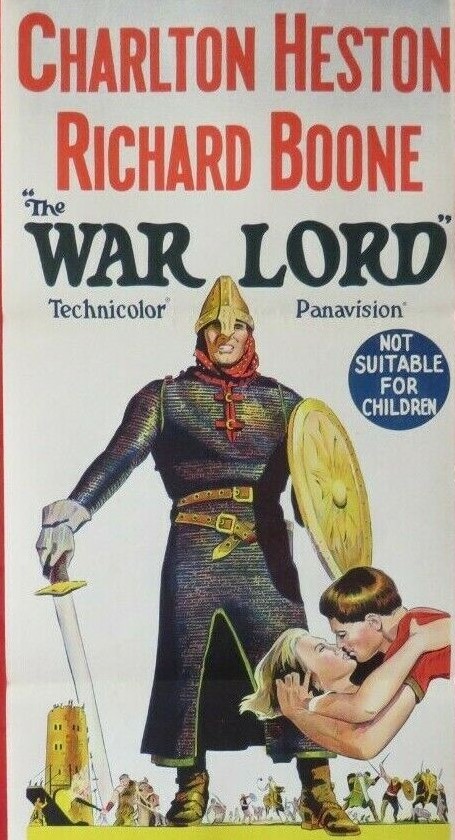
Contemporary audiences will gib at a narrative that relies on legalised rape. Audiences at the time had the same response but since then it has picked up considerable critical acclaim on account of its down-and-dirty portrayal of a medieval era far removed from the knight in shining armour. But it still pivots on the distasteful notion of “droit de seigneur”, the right of any noble to take the virginity of any female underling on their wedding night – it was motivation for William Wallace’s rebellion in Braveheart (1995).
The idea that this was pervasive or even occurred at all has been proven to be historically inaccurate. Logic tells you that any ruler wanting to keep his subjects in check would scarcely resort to wholesale rape that could spark disloyalty among his subjects. Or that any no one would be unaware of the dangers of inbreeding should the nobleman’s seed result in pregnancy.
What of course the movie does get right is that women were treated as chattels – “she’s mine” / “you’re mine” a recurrent refrain – or were makeweights in deals uniting the vested interests of kings or dukes.
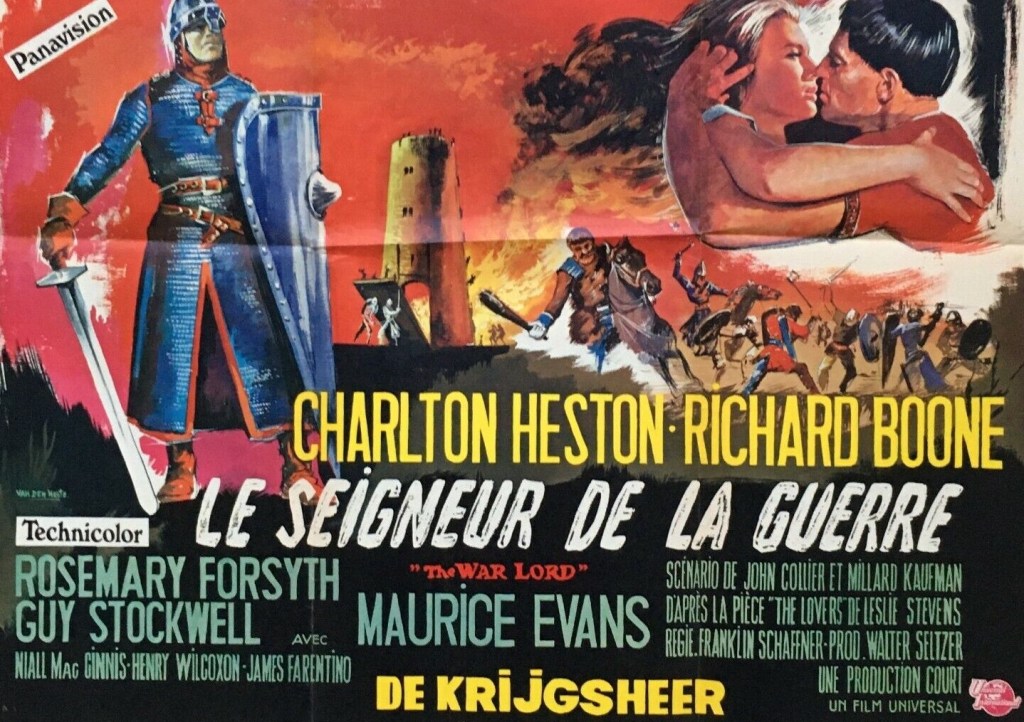
As reward for years of service to the Duke of Ghent, Chrysagon (Charlton Heston) is handed a fiefdom in Normandy, prone to attack by Frisian raiders from the neighbouring Netherlands. In interrupting such an assault, Chrysagon captures the enemy chief’s son without being aware of it, prompting a later battle.
While the area boasts vestiges of normality, a priest and a strong tower, the inhabitants are inclined to the pagan rather than Christianity with rites (reminiscent of Game of Thrones) involving stone and trees while anyone using herbs for medicinal purposes is likely to be accused of witchcraft. Chrysagon takes a fancy to Bronwen (Rosemary Forsyth) already bethrothed to Marc (James Farentino). Egged on by his brother Draco (Guy Stockwell), Chrysagon decides to take up the option of droit de seigneur, but refuses to return the bride after the allotted time period (before dawn), incurring the wrath of the villagers who recruit the Frisians to their cause.
So it’s siege time although it seems unlikely that the attackers would be capable of producing such dangerous siege weapons in such a short time or that they wouldn’t simply resort to starving out the beseiged. Chrysagon’s troops engage the attackers in time-honoured fashion from the top of the tower by arrow, boulders and boiling oil. Chysagon slides down a rope like Errol Flynn to prevent the raised drawbridge being lowered and uses a boat anchor to dislodge the siege tower. Battering rams and catapults soon enter the equation.
The only question-mark (unspoken) against Chrysagon’s employment of the “droit” privilege comes when the Duke demotes him and appoints Draco in his stead, prompting various endgame twists.
The battle is interesting enough, threat repeatedly countered, but there’s only so many times a director can cut to a soldier tumbling to his death. The ending is an anomaly, Chrysagon showing more respect to the son of his enemy than the wife of his villagers, and it seems odd that Draco is suddenly revealed as a bad guy, despite not being the one who triggered the conflict.
Chrysagon might have easily have fallen into the Martin Scorsese category of characters with “no redeeming features” – who are exempt apparently from the need for decency because of war – and it’s hard to summon up the necessary audience sympathy to make this picture work, especially given its starting point. Had Chrysagon merely fallen in love with Bronwen who reciprocated his feelings and that caused enmity among the villagers it would have been one thing but to start out from an historically inaccurate base is another.
One of the problems is that Bronwen doesn’t evolve. Her transition is from interesting to passive. She has actually gone through a marriage ritual (of the Druid kind, but still binding as far as the villagers are concerned) and is therefore embarking on an adulterous relationship once the cock crows. It seems ludicrous, without allowing the woman dialog to express her feelings and acknowledge the peril of her actions, that she would believably take this route.
So, if you like, accepting the droit de seigneur, in some ways it becomes a bolder picture, a major Hollywood star risking his reputation by playing a rapist, and in the way of all rapists justifying his action. And, like the characters in the recently-reviewed Play Dirty (1969) or Judith (1966), it becomes a question of individuals as pawns, the powerful taking advantage of position to abuse the weak. And it wouldn’t be the first time the innocent have suffered through a superior taking an indefensible approach.
Franklin Schaffner (Planet of the Apes, 1968) directed. Charlton Heston (Diamond Head) performs as if he’s the French equivalent of a Brit constantly biting on that stiff upper lip. Richard Boone (Rio Conchos, 1964) is wasted. Guy Stockwell (Tobruk, 1967) essays another weasel. It’s a picture of two halves for Rosemary Forsyth (Where It’s At, 1969) – while being wooed she’s good but then she’s pretty much dumped as far as the narrative goes.
Screenwriter John Collier, who later wrote the even creepier Some Call It Loving (1973) – an early Zalman King production – and Millard Kaufman (Raintree County, 1957) adapted the screenplay from an unusual source, a Broadway play by Leslie Stevens (Incubus, 1966) called The Lovers. The play had a different perspective, the bride ultimately committing suicide, while the War Lord and husband killed each other in a duel. Needless to say, there are no Frisians, so no siege, and no brother.
Before the arrival of Ridley Scott, this would been viewed as the best depiction of genuine medieval siege, so that part certainly still holds up. But the rest of it will only stand the test of time if you are willing to view it as an expression of the corruption of power.







 The Magnificent 60s