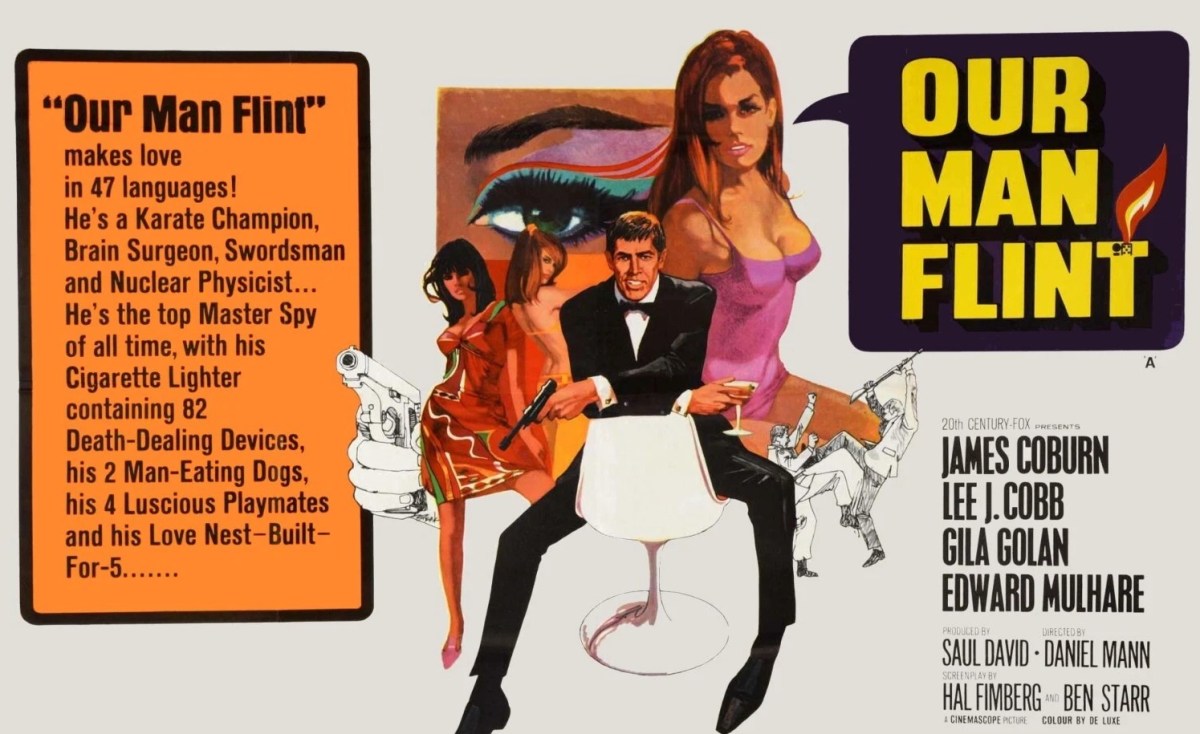
I have two confessions to make. Firstly, I’ve never seen this picture. It appeared at a time when I lived in a town without a cinema. While this was virtually impossible in Scotland, a country with the highest cinemagoing audience per capita in Europe, I lived in a new town and the planners had decided we could all do without a cinema. So we were limited to a couple of outings a year, once to Glasgow to see a roadshow musical and once on our holidays to see something suitable for kids.
Secondly, I resisted seeing it for over half a century. James Bond spoofs were old hat by the time my cinemagoing habit kicked in. So I came this with some trepidation.
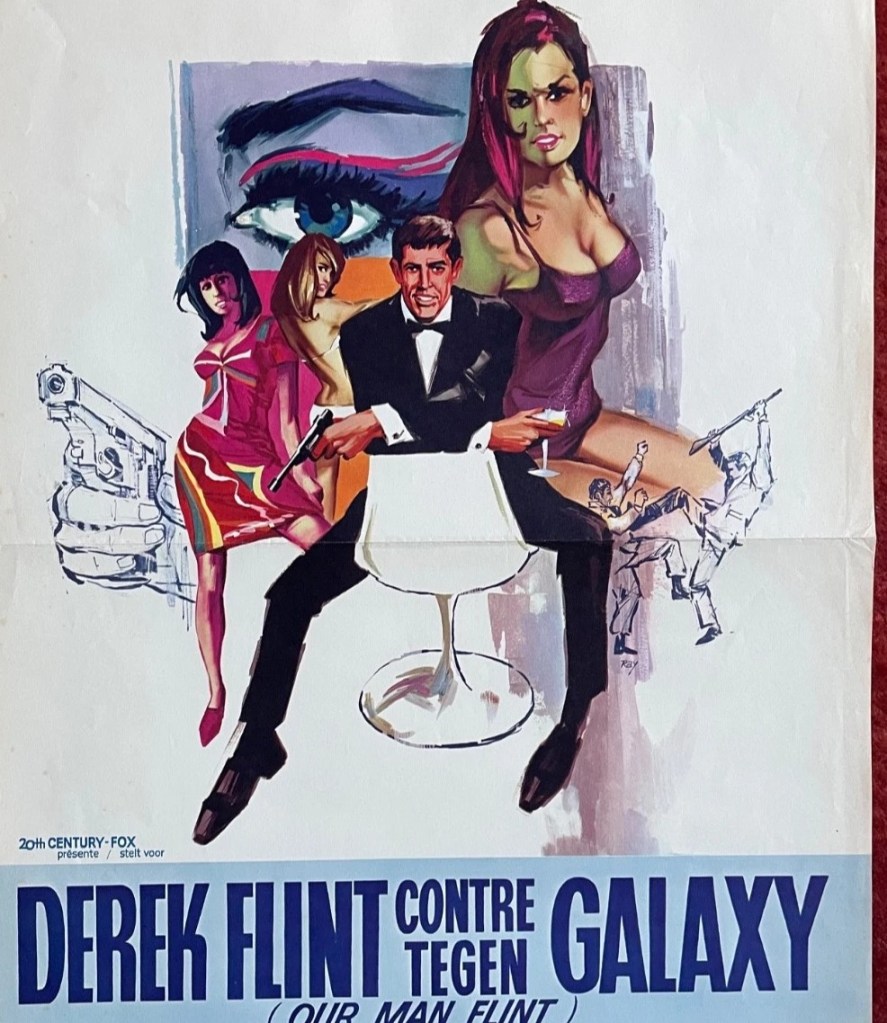
Instead, I enjoyed it hugely. Far removed from Bond-mania, it seemed to sit quite happily in its own espionage space. And it is as refreshing now as it must have been at the time for our hero to be so courteous to his playmates. And before Bulldog Drummond hove into view, who often came off second best against the highly intelligent female villains. Here the person leading the villainous campaign of destruction is a female, Gila (Gila Golan)..
Derek Flint (James Coburn) is such a maverick that his boss Cramden (Lee J. Cobb) won’t have anything to do with him although he’s clearly the best man to investigate who’s causing a succession of apparently natural disasters. He’ll only take on the job if he can do it all his way with the high-ups at his beck and call.
The invention is truly inspired. Flint has a wristwatch that scratches him awake at the appointed time. The flame on his cigarette lighter can be turned to oxy-acetylene levels. The thread on a shirt button becomes the kind of stethoscope that safe crackers use. His nose is so advanced in the detection of smells that from examination of a poison dart he works out that it is connected to a certain type of bouillabaisse made in Marseilles. He can go into such deep hibernation when required that it fools the villains into believing him dead.
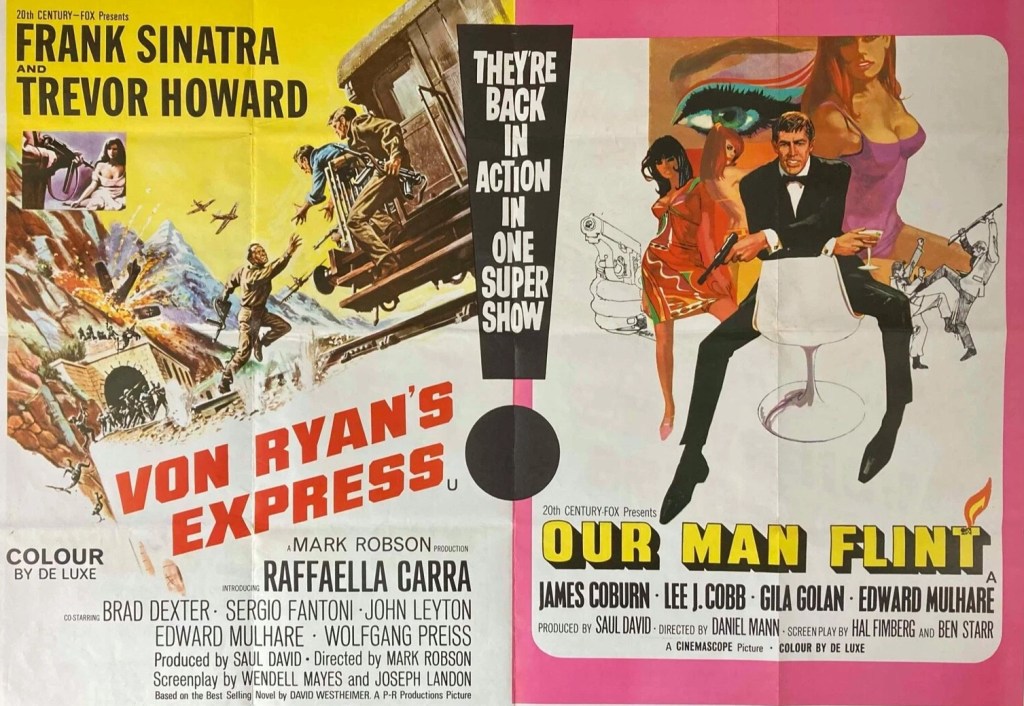
He employs an advanced numeric code of his own making. Even the more down-to-earth elements are interesting. When the world’s leaders vote for the best super agent, their voting cards are tabulated through a computer. Instead of a secretary or housekeeper welcoming visitors to his house, it’s a dog whose teeth alight on the visitor’s hand and drags him through to his master.
The villains are equally inspired. When in an house in Marseilles Flint manages to open a highly secret safe but he’s locked inside, we discover the safe is contained inside a large portable room. The house he’s in can disappear into the ground. The strings on a harp are utilised to fire a poison arrow.
Know-it-alls are usually dull boffins relegated to walk-on parts, so it’s just terrific that Flint possesses amazing levels of all types of skills. Prior to any assignment, he doesn’t require a visit to Q’s lab, he disdains the kind of weaponry to which James Bond is accustomed, and relies instead on his own multi-functioning hand-made tools.
And there’s also a kind of double play going on. Flint thinks he has seduced Gila and she thinks she has seduced him. She believes she’s persuaded him to walk into a trap. But he deliberately walks into the trap. He thinks with all the tools in his possession that he’ll escape the trap. He’s wrong.
Given that by this point James Bond tales were growing more and more preposterous, the bad guys here, three doctors who run an oufit called Galaxy, fit nicely into that mode. But Gila is deemed unfit for purpose by her bosses and assigned to the Pleasure Unit on their remote island, which means she’s ready to team up with Flint for revenge, leaving the way clear for proper romance. All Flint needs to defeat the villains is his brain and more of his gadgets.
James Coburn (Dead Heat on the Merry Go Round, 1966) had previously been restricted to supporting roles in films like The Magnificent Seven (1960) and The Great Escape (1963). When elevated to second or third banana in Major Dundee (1965) and A High Wind in Jamaica (1965), they did nothing for his career. But he emerges from this a full-blown star, screen persona already in place, cool, fit, and with a smile that can be both charming and predatory.
Gila Golan (Ship of Fools, 1965) wasn’t so lucky and the highlight of her career thereafter was The Valley of Gwangi (1969). Director Daniel Mann (Butterfield 8, 1960) turns Lee J. Cobb’s screen persona on its head. Instead of filming him from below, with jutting chin personifying his robust dominance, he’s mostly filmed from above or at height-level and the actor subsumes his natural combustion to take it on the chin.
The concept was devised by Hal Fimberg on his screen debut. He only wrote one other picture, In like Flint (1967). Ben Starr (Texas Across the River, 1966) helped out.
Sheer enjoyment.


