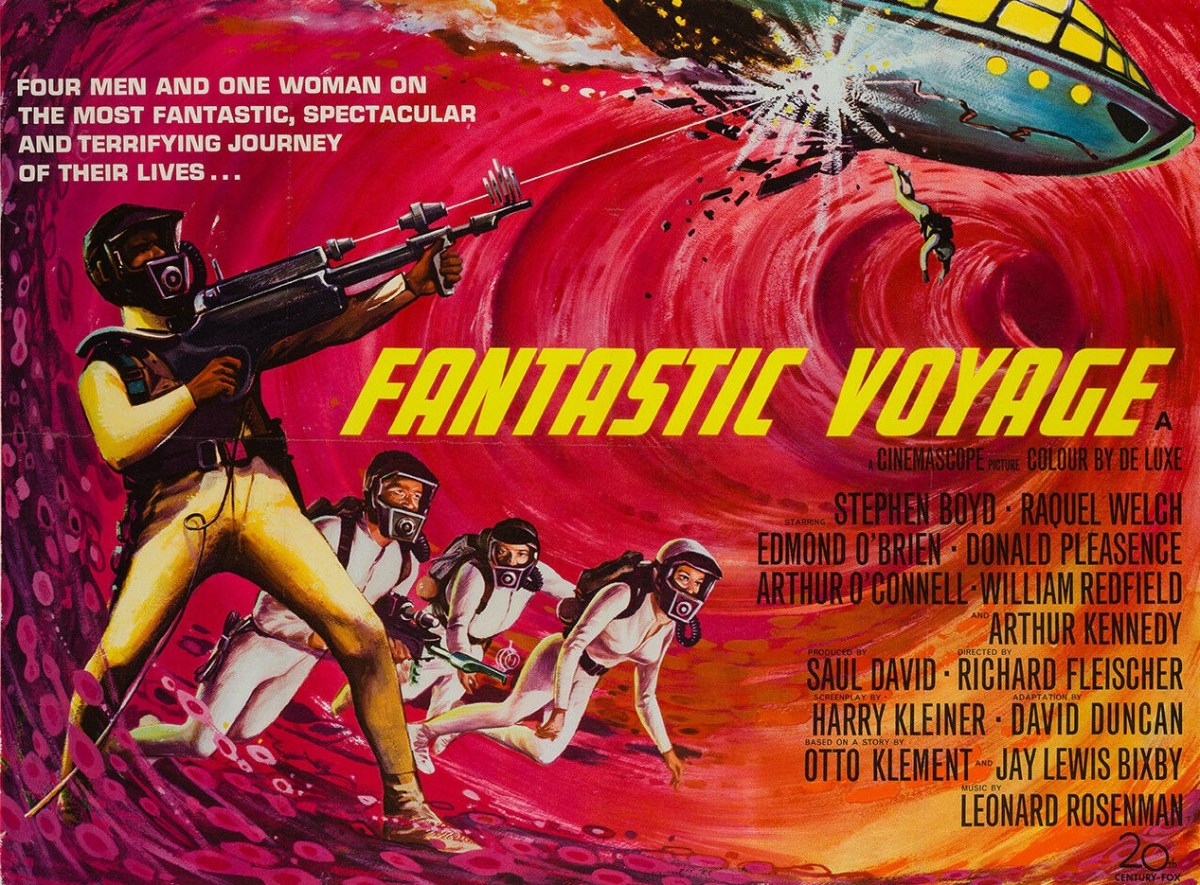
If this had appeared a couple of years later after Stanley Kubrick had popularised the psychedelic in 2001: A Space Odyssey (1968), and with his budget, it might have been a bigger hit. As it is, the ground-breaking sci-fi adventure, going in the opposite direction from Kubrick, exploring the mysteries of the body rather than the universe, is a riveting watch.
Before we even get to the science fiction, there’s a stunning opening 15 minutes or so, a thriller tour de force, the attempted assassination of scientist Dr Jan Bedes (Jean Del Val), vital to the development of embryonic new miniaturization technology, baffled C.I.A. agent Charles Grant (Stephen Boyd) transported to a futuristic building (electronic buggies, photo ID) where he is seconded to a team planning invasive surgery, entering the scientist’s bloodstream and removing a blood clot from his brain. They only have 60 minutes and there’s a saboteur on board.
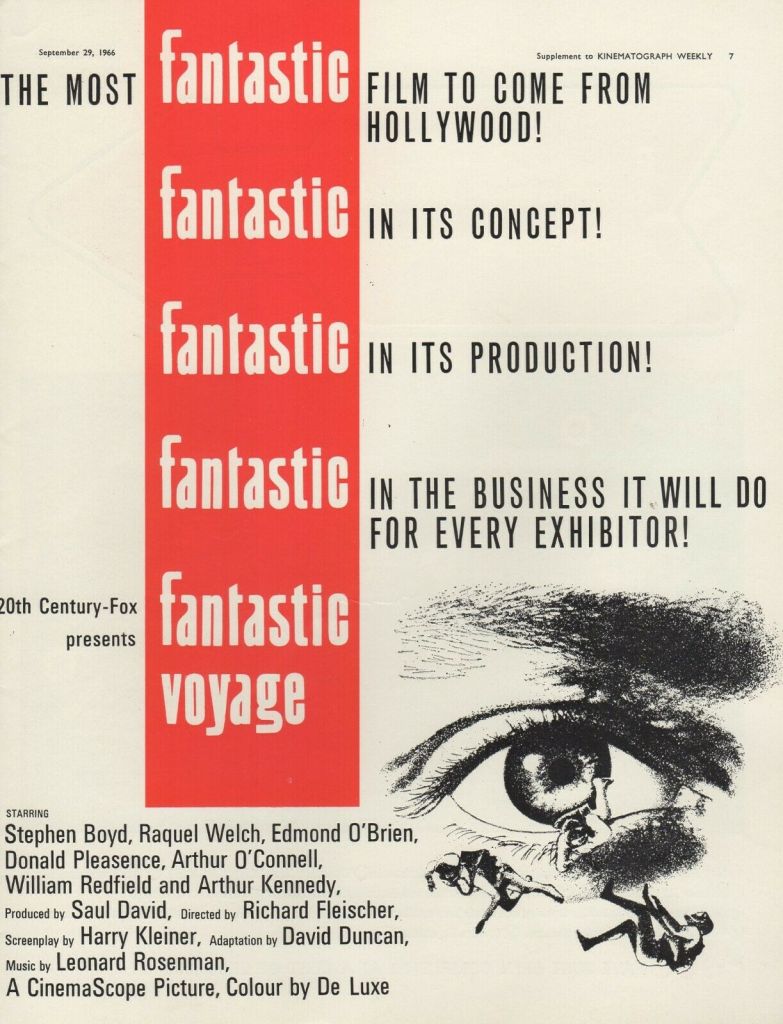
Heading the mission are claustrophobic circulation specialist Dr Michaels (Donald Pleasance), brain surgeon Dr Peter Duval (Arthur Kennedy) and lovelorn assistant Cora (Raquel Welch). Backing them are up Captain Bill Owens (William Redfield) who designed the Proteus submarine.
The high concept is brilliantly delivered with ingenious improvisations, of the kind we have come to expect from the likes of Apollo 13 (1995) and The Martian (2015) that save the day. I’ve no idea how accurate the anatomical science was but it sounded very convincing to me. There’s a brilliant sequence when the scientist’s heart is slowed down and the heartbeat is reduced to a low thump but when the heart is reactivated the sub literally jumps.
The bloodstream current proves far stronger than imagined, taking them away from their planned route. After unexpectedly losing air, they need to literally suck air in from the scientist’s body. Swarms of antibodies attack. Claustrophobia and sabotage up the ante, not to mention the anxious team overseeing the operation in the control room, the minutes ticking by.

It’s not a fantastic voyage but a fantastic planet, the visualisation of the human interior – at a time when nobody could call on CGI – is as fascinating as Kubrick’s meditations on outer space. They could have landed on a distant planet judging by what look like rock formations. It’s wondrous. Sometimes the world takes on a psychedelic tone. The special effects rarely fail, the worse that occurs is an occasional flaw in a process shot, and a couple of times the actors have to fall back on the old device of throwing themselves around to make it look like the vessel was rocking. The craft itself is impressive and all the gloop and jelly seems realistic. There’s a gripping climax, another dash of improvisation.
The only problem is the characters who seem stuck in a cliché, Grant the action man, Duval blending science with God, Michaels the claustrophobic, an occasional clash of personality. But given so much scientific exposition, there’s little time for meaningful dialogue and most of the time the actors do little more than express feelings with reaction shots. Interestingly enough, Raquel Welch (Lady in Cement, 1968) holds her own. In fact, she is often the only one to show depth. When the process begins, she is nervous, and the glances she gives at Duval reveal her feelings for him. It’s one of the few films in which she remains covered up, although possibly it was contractual that she be seen in something tight-fitting, in this case a white jump suit.
If you are going to cast a film with strong screen personalities you couldn’t do worse than the group assembled. Stephen Boyd (Assignment K, 1968), five-time Oscar nominee Arthur Kennedy (Nevada Smith, 1966) ), Donald Pleasance (The Great Escape, 1963), Edmond O’Brien (Rio Conchos, 1964) and William Redfield (Duel at Diablo, 1966) aren’t going to let you down.
But the biggest credit goes to Richard Fleischer (The Big Gamble, 1961, which starred Boyd) and his Oscar-winning special effects and art direction teams. While not indulging in wonder in the way of Kubrick, Fleischer allows audiences time to navigate through the previously unseen human body simply by sticking to the story. There are plenty of set pieces and brilliant use of sound. Harry Kleiner (Bullitt, 1968) created the screenplay based on a story by Otto Klement and contrary to myth the only part Isaac Asimov played in the picture was to write the novelization.
A joy from start to finish with none of the artistic pretension of Kubrick. This made a profit on initial release, knocking up $5.5 million in domestic U.S. rentals against a budget of $5.1 million according to Twentieth century Fox expert Aubrey Solomon and would have made probably the same again overseas plus television sale.


I’ve loved this movie ever since I first saw it in the late sixties when ABC gave it its American television premiere (and can still recall excitedly babbling about it as my mom ushered me off to bed). It’s story problems were obvious to me even as a child (why didn’t the Proteus grow back to normal size at the end?) and the sloppy bluescreen work still makes me angry (why didn’t they just use rear screen projection?) but I watch it every year with the wide-eyed enthusiasm of a child.
It’s odd the movie doesn’t have the quasi-mystical buzz to it that “2001” does as much of the imagery is equally wondrous despite all the overlaid expository dialogue and as impressive as anything created during the era of practical effects. 20th Century Fox was the preeminent effects studio at this time both here and on television creating some really wonderful work on the Irwin Allen shows (at least initially).
I agree that Fleischer does a terrific job directing and demonstrates just how much more effective an unfussy, nuts and bolts style is with an adventure film (something sorely lacking these days) and I agree that the casting, even Welch, is just perfect here.
I’ve read that the original Otto Klement/Jerome Bixby was a Jules Verne-styled Victorian period piece which is in itself an intriguing premise.
LikeLiked by 3 people
Thanks, Byron, I hadn’t realised the source material was based on an earlier era. Certainly very intriguing. FV certainly never attracted the acclaim of 2001 and I was never sure why. But I do recall sitting wide-eyed in front of a television as a child/teenager and being astonished by the magic of cinema, especially those which were effects-driven.
LikeLiked by 1 person
Wonderful memories of watching this one on TV as a kid multiple times. Mom would always let me know if it was showing. There is a very funny story on the making of this one in Fleischer’s book, Just Tell Me When to Cry about the boys being reluctant to film the scene tearing at the wormlike things (antibodies?) strangling Miss Welch and ripping her body.
LikeLiked by 2 people
Fleischer’s book is hard to come by. I was always intrigued by his career. Very under-rated in my opinion.
LikeLiked by 2 people
I have on occasion come across a copy at flea markets, if I see it again I’d be happy to send it your way. Very enjoyable read.
LikeLiked by 2 people
Managed to source one. looking forward to reading it.
LikeLiked by 2 people
Are you having problems with WordPress? Not been able to get on to it for past day though I can view comments for some reason.
LikeLiked by 1 person
No, running fine as far as I can tell.
LikeLiked by 2 people
Mine has been down now for two days – “we’re sorry but an unexpected error has occurred” is what I get on the screen though I can read the sidebar of comments.
LikeLiked by 1 person
You’re not missing much.
LikeLike
Here is a recent bio of Fleischer- https://www.amazon.com/Richard-Fleischer-Journeyman-Screen-Classics/dp/1985904322. Excellent book. Also his autobio is available at:https://www.bookfinder.com/search/?author=&binding=ANY&condition=ANY¤cy=USD&destination=US&firstEdition=false&isbn=&keywords=&language=EN&maxPrice=&minPrice=&noIsbn=false&noPrintOnDemand=false&publicationMaxYear=&publicationMinYear=&publisher=&bunchKey=zWwaYXnfA3ekZkHdU0uGVPxdk1Q_0_0&signed=false&title=Just%20tell%20me%20when%20to%20cry&viewAll=false&bunchTitle=Just%20Tell%20Me%20When%20to%20Cry%3A%20A%20Memoir&bunchAuthor=Fleischer%2C%20Richard&mode=ADVANCED&searchOrigin=HOME
LikeLiked by 1 person
I’ve got his book. Thanks.
LikeLike
If you are going to cast a film with strong screen personalities you couldn’t do worse than the group assembled…surely you mean ‘better’. Love this film to bits, for all its flaws…
LikeLiked by 2 people
I probably do mean better but I’m blaming Julie Andrews.
LikeLiked by 1 person
One of my most favorite “early” films for me.. It’s one of if not the first movie I remember ever seeing, and while I have not seen it in many years I still remember it well. Great premise, cast, and director.
LikeLiked by 2 people
Great to have these memories of the first “real” film you saw rather than a cute Disney one.
LikeLiked by 2 people
Sixty years ago(gheesh!)…I still vivdly remember seeing this at the age of 11 at the Fox Bay Theater in Whitefish Bay, Wisconsin. Had a hoot. An 11 year old’s dream(along with Raquel).
“The 1 May 1964 NYT announced that production was scheduled to begin that summer. On 30 Dec 1964, DV revealed that the project had been delayed for several months, preventing director Richard Fleischer’s participation in Battle of the Bulge (1965, see entry). Principal photography began 25 Jan 1965, as stated in 5 Feb 1965 DV production charts. In the 1 Feb 1965 issue, Fleischer admitted that the outlandish designs for sets and gadgetry required several months to realize, and some were still being developed at the time of the article. Post-production effects and animation were expected to last another six months after filming was completed, requiring $200,000 of the film’s $6.5 million budget. Location shooting was currently underway at the Los Angeles Sports Arena, which contained a series of tunnels similar to the catacombs underneath the Pentagon in Washington, DC. Filming had to be completed and equipment stored away before 5:00 pm every evening, so as not to interfere with sporting events.
The picture marked the first major screen role for actress Raquel Welch, who told the 12 Sep 1965 LAT that she was recommended by the wife of producer Saul David. After screen testing for Our Man Flint (1966, see entry), Welch was placed under contract to Twentieth Century-Fox Film Corporation, and won the role of Cora Peterson by demonstrating her ability to “run down a long flight of stairs gracefully without looking at her feet.”
Casting notices included Edward Binns (19 Jan 1965 DV); Bob Goshen (21 Jan 1965 LAT); Breland Rice, Brendon Boone, Kitty Kelly, Marie Janisse, Anne Merman, Ellen Leddy, Judy Stoner, Saul Gorss , Carol Kepple, Edith Nichols, and Regan Burke (2 Feb 1965 DV); Harry Carter (5 Feb 1965 DV); Joel Fluellen (2 Mar 1965 DV); Simon Scott (10 Apr 1965 LAT); and Laurence Haddon (19 Apr 1965 LAT). The 28 Dec 1964 DV announced Jack Roe as second assistant director, and the 13 Aug 1965 edition identified Martin Fink as unit publicist.
According to the 11 Feb 1965 DV, Twentieth Century-Fox was reserving at least four stages to contain the elaborate sets until the projected 26 Apr 1965 close of principal photography. Because one sequence required four special effects printed on the same strip of film, the sets were to remain intact until the process could be completed, in case retakes were necessary. The 26 Mar 1965 DV noted that one of the sets would be adapted for use in Our Man Flint. The 5 Apr 1965 edition reported that filming of the inner-capillary sequence was underway on Stage 5. Cast members dressed in skin-tight diving suits were suspended by wires to create the illusion of swimming through the bloodstream. Raquel Welch was nearly rendered unconscious when the harness “exerted unexpected pressure,” while a similar experience left Stephen Boyd “severely bruised.”
In the 14 Mar 1965 LAT, Richard Fleischer described the submarine used in the picture as forty-one and one half feet in length, twenty-three feet wide, fifteen feet high, and weighing 8,000 pounds. Four smaller versions were also built, ranging in size from one and one half inches to five feet in length. Devices conceived for the production included a “micro tracker,” intended to follow the submarine’s progress, and Fleischer’s suggestion, “thermal blankets,” which supposedly lowered the body temperature and slowed blood flow. Fleischer also mentioned that the film’s advertising campaign would be designed by surrealist painter Salvador Dali. Screenwriter Harry Kleiner appended the 142-page script with “an indexed book of physical research,” which was copied and distributed to all departments of the production.
According to the 25 Sep 1966 LAT, Dr. B. V. Dryer, “an eminent heart specialist from the University of Pittsburgh,” was profoundly impressed with the giant reproductions of internal human organs used on screen. Expenditures on sets and special effects were estimated at more than $3 million, causing Twentieth Century-Fox to forego efforts at cost-containment halfway through production. Using medical illustrations provided by the University of California, Los Angeles (UCLA), the studio’s art department sketched the individual sets, from which the various departments collaborated on creating “something photographable.” One of their achievements was a simulated bloodstream, composed of thirty-six pressure jets attached to a water tank, which contained a mixture of mineral oil, petroleum jelly, and vegetable dye. A different mixture, comprised in part of “carbopol and oil, colored with a blend of dyes,” was developed to simulate an oncoming barrage of white corpuscles.
On 13 May 1965, DV stated that another month of shooting was expected, which prevented actor William Redfield from accepting a role in The Chase (1966, see entry). More than two weeks later, the 28 May 1965 DV anticipated five months of special effects work following a total seventeen weeks of principal photography. Expenditures to date were estimated at $5 million. The 16 Jun 1965 issue announced the completion of filming. As of 19 Aug 1965, DV stated that another six months would be needed to ready the film for release.
Sets and props from the production were displayed at the Lytton Center of the Visual Arts in Los Angeles, CA, from 1 Feb to 15 Apr 1966, as reported in the 27 Jan and 25 Feb 1966 issues of DV. Titled “Fantastic Voyage-From Image to Imagination”, the exhibit also included footage and still photographs from the picture, along with “works of modern abstract artists to demonstrate the merging of art and science in the modern world.” Props included “the heart valve, brain, lymph nodes and pleural cavity.” An adaptation of the screenplay was published as a two part series in the 26 Feb 1966 and 12 Mar 1966 editions of the Saturday Evening Post. The 9 Feb 1966 DV claimed it was the “longest fiction piece” to ever appear in the magazine.
An article in the 9 Mar 1966 DV reported that the National Association of Theatre Owners (NATO) were requesting the best releases from major studios for their “National Movie Week” the following Sep. Twentieth Century-Fox could not guarantee that The Fantastic Voyage would be ready in time.
The 26 Jul 1966 DV announced the 16 Aug 1966 premiere at Grauman’s Chinese Theatre in Hollywood, CA. The film was originally scheduled to open fifteen days later, until theater management determined that their current feature, What Did You Do in the War, Daddy? (1966, see entry) was not drawing sufficient crowds. The premiere screening was by invitation only, as stated in the 1 Aug 1966 LAT. The New York City opening followed on 7 Sep 1966 at the Loew’s State and Festival theaters. Reviews were generally positive, as was public response, earning the film $65,000 during its opening week in Los Angeles.
Fantastic Voyage garnered Academy Award nominations for Cinematography, Color (Ernest Laszlo); Film Editing (William B. Murphy); Sound Effects (Walter Rossi); Special Visual Effects (Art Cruickshank); and Art Direction-Set Decoration, Color (Jack Martin Smith, Dale Hennesy, Walter M. Scott, and Stuart A. Reiss). It won in the latter two categories. The film also won awards from the American Cinema Editors USA, and Motion Picture Sound Editors USA, along with nominations for Hugo and Laurel Awards. The Harvard Lampoon took an opposing view, declaring it one of the ten worst pictures of the year. On 3 Jan 1967, DV noted that the film earned $514,214 during its Los Angeles run, making it the city’s sixth highest-earning release of 1966.”
LikeLiked by 1 person
Great film especially for the time.
LikeLike