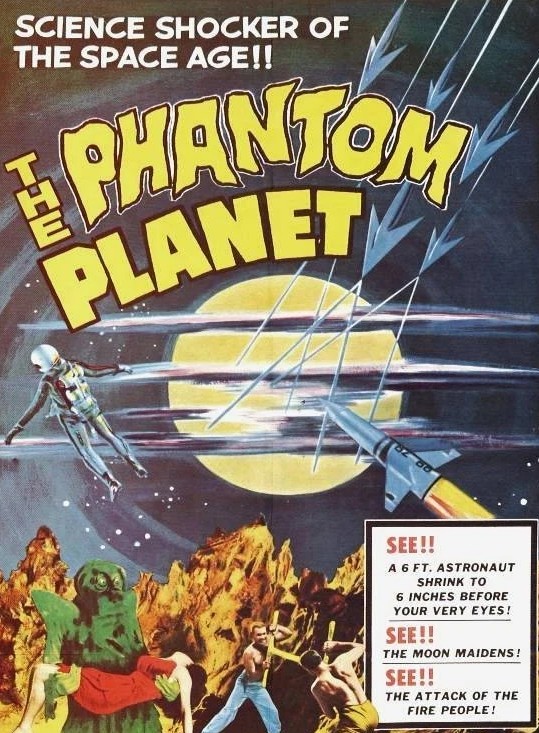
A cross between Stanley Kubrick and Ed Wood. The intelligence of the former and the special effects deficiencies of the latter. But at least a sci fi where some attempt is made to render the science logical and believable and with a bit better acting would have left an emotional lump in the throat at the end.
The science in most successful sci fi – Interstellar (2015), The Martian (2015) or Project Hail Mary (2026) – is so complex that you really have to trust the imaginations of those involved and go with the flow. So I quite appreciate it when the science is more intelligible. So let’s start there.
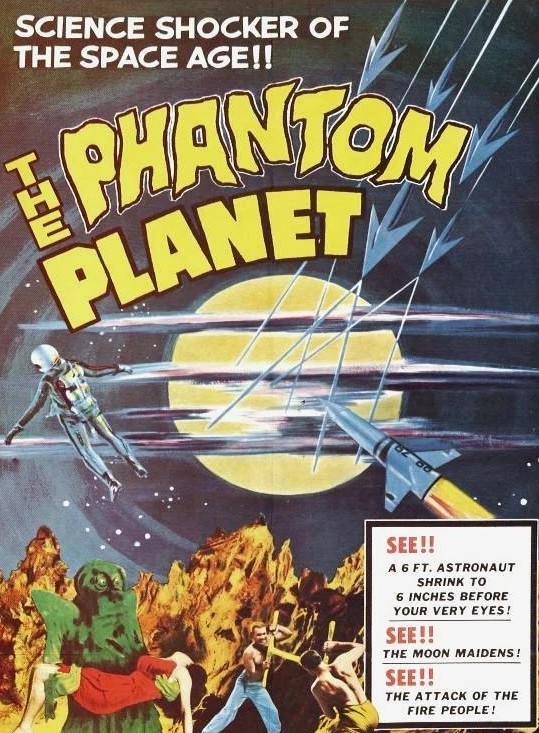
The Phantom Planet is actually an asteroid and can whizz around and disappear from time to time because the inhabitants have found a way to control gravity thanks to the high density of the planet. The air they breathe means the inhabitants are tiny and because the planet is barren food is chemically produced.
Despite its level of scientific advancement, the inhabitants have opted for a primitive lifestyle of toil to avoid becoming dependent on labor-saving devices. To resolve dangerous disputes, they resort to duels where the loser is disintegrated by gravity. They’ve also managed to use a high magnetic field to lock molecules so closely together it creates an invisible impenetrable wall, ideal for containing dangerous prisoners, in this case their deadly enemy, a Solarite monster (Richard Kiel).
No idea if any of this science makes sense but it worked enough for me.
Astronaut Chapman (Dean Fredericks) is stranded on the planet where he is automatically miniaturized. He’s only a prisoner in that he can’t escape the planet and comes in handy to help leader Sessom (Francis X. Bushman) deter other space travellers. He’s even being romantically set up – given the choice between Sessom’s daughter Liara (Colleen Gray) or the mute Zetha (Dolores Faith), both, as you might expect, beauties dressed in alluring gowns.
Unfortunately, he’s got a love rival in Herron (Anthony Dexter) and that leads to a duel to the death although the inhabitants screaming for blood like in a Roman amphitheater are astonished when Chapman spares Herron’s life. Although initially more attracted to Liara, Chapman finds her too cold-blooded and becomes more inclined towards the mute girl.
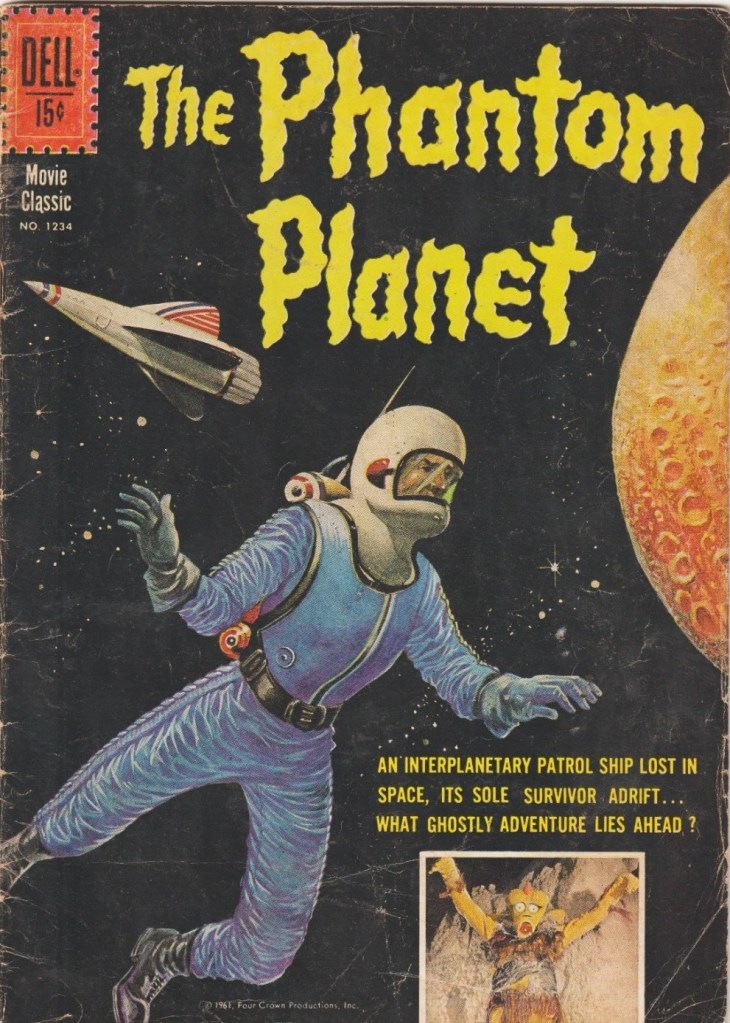
The Solarites, whose planet is being sucked by gravity towards their sun, plan an invasion and while that is deflected it does free the imprisoned monster. Which is lucky in the narrative sense because first of all Zetha regains her voice through screaming in fear and secondly in tackling the monster creates a bond between Herron and Chapman, resulting in the former helping the latter to escape the planet.
Chapman’s torn between staying with Zetha and leaving and if the screenwriter had spent more time building this up and the director hired a better actor we would have had that rare event – a sci-fi tearjerker.
While the special effects look as if they’ve come out of a cereal packet or they’ve pre-empted Space Invaders, the miniaturization scene is exceptionally well done.
There’s maybe a moral in here somewhere, of how the mighty are fallen, in that Francis X. Bushman was one of the biggest stars of the silent era, having the titular role in Biblical spectacular Ben-Hur: A Tale of the Christ (1925). And there’s a sense of pre-empting the Bond Girl phenomenon with a clutch of beauties in the background, presumably hoping a bigger director or someone from the casting department of a major studio might take notice.
As far as the talent contest went, this came too late in Dean Fredericks’ (Savage Sam, 1963) career to do him much good. Coleen Gray (P.J./ A New Face in Hell, 1967) didn’t make another film for four years. Anthony Dexter (Thoroughly Modern Millie, 1967) made only three more films, Dolores Faith (Wild Harvest, 1962) another six. Almost by default, Richard Kiel (Moonraker, 1979) was in effect the pick.
The final directorial effort – out of just three movies – from William Marshall. Screenplay by William Telaak in his only movie, Fred De Gorter (Dayton’s Devils, 1968) and Fred Gebhardt (12 to the Moon, 1960).
You can see this in the original black-and-white or in a colorized version.
Easy viewing and you won’t be annoyed by screenwriting laziness.


One thought on “The Phantom Planet (1961) ***”