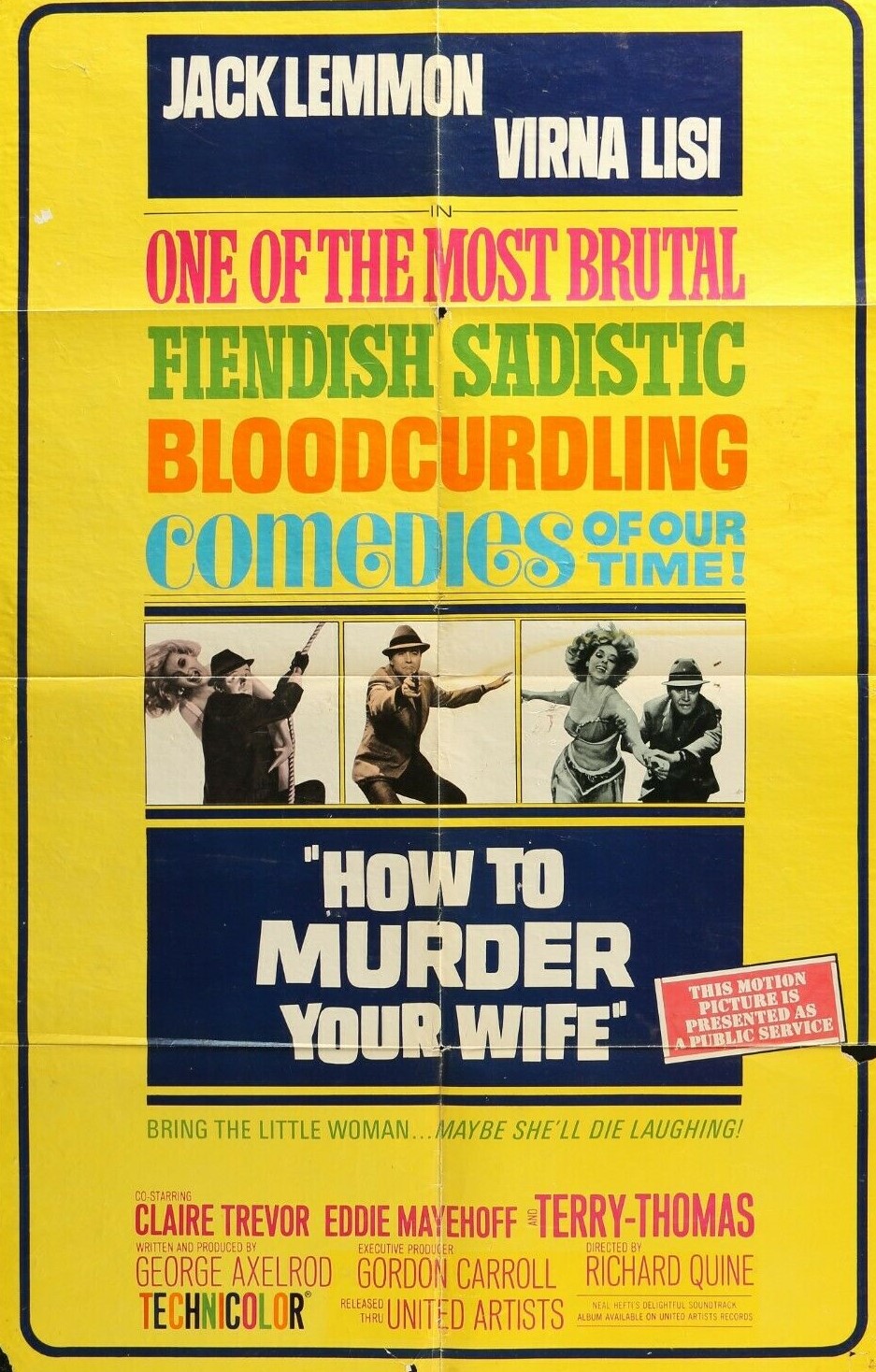
Men had a hell of a time in the 1960s to judge from this riff on marital strife that starts off like Walter Mitty meets The Odd Couple. It’s one of those daft comedies that only work on their own terms – and for the most part this works very well.
Dedicated bachelor Stanley Ford (Jack Lemmon), enjoying a host of one-night stands, ensconced in almost a bromance with butler and kindred spirit, the very English Charles (Terry-Thomas), makes the mistake of getting hammered at a drunken party and ends up married to a beauty queen (Virna Lisi). Although she is gorgeous and very loving – most scenes end on a fade as she devours him in kisses – and a good cook (though a bit lax by the high housekeeping standards of Charles), Stanley resents being burdened with a wife, especially when it costs him the services of his butler.
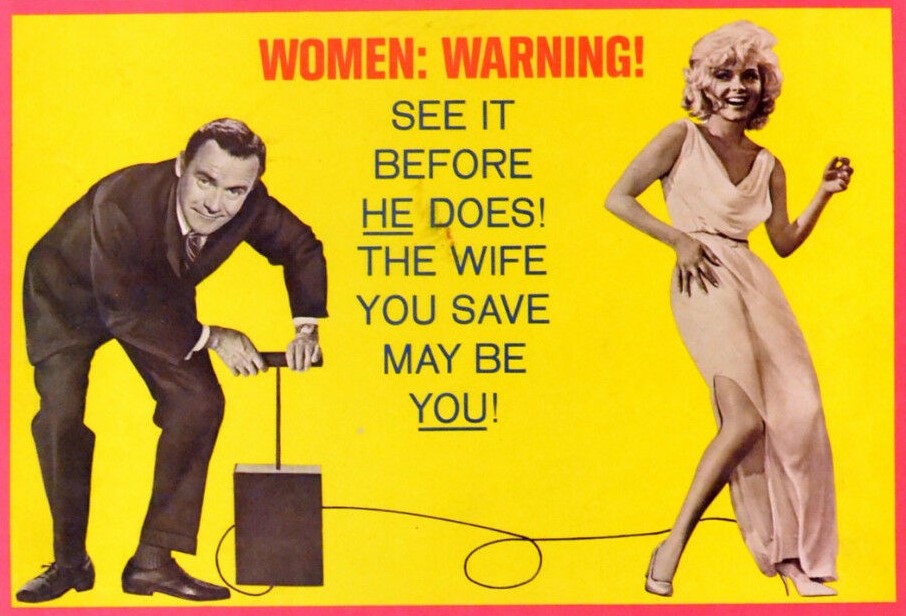
The biggest casualty is his self-image. He has fashioned his persona after his Bash Brannigan comic strip, syndicated to hundreds of newspapers, that permitted him the fantasy of being secret agent/adventurer/detective, fighting off bad guys and rescuing damsels in distress. Marriage inflicts a devastating change in his mental state, and he transforms from hero into hen-pecked booby.
In a bid to restore his self-esteem, and provide a fictional glimpse of freedom, he plans to murder his wife, if only in the comic strip. It has been Stanley’s working practice to act out and have photographed all the elements of his stories so Charles records the whole episode, from getting advice on how to drug Mrs Ford to (using a dummy) incarcerating her in cement. Unfortunately, Mrs Ford, outraged on discovering the illustrations for this particular comic strip episode, vanishes, leaving no explanation for her disappearance, except that various people witnessed him carrying out the supposed murder. He is arrested and put on trial.
You couldn’t make this up, but strangely enough, it is all very believable. The opening section where Stanley enacts the part of his action man Bash Brannigan in “The Case of the Faberge Navel” is just a delight. When the future Mrs Ford comes to explain exactly why she came to be jumping out of a birthday cake in a bikini, it is as daft as everything else.
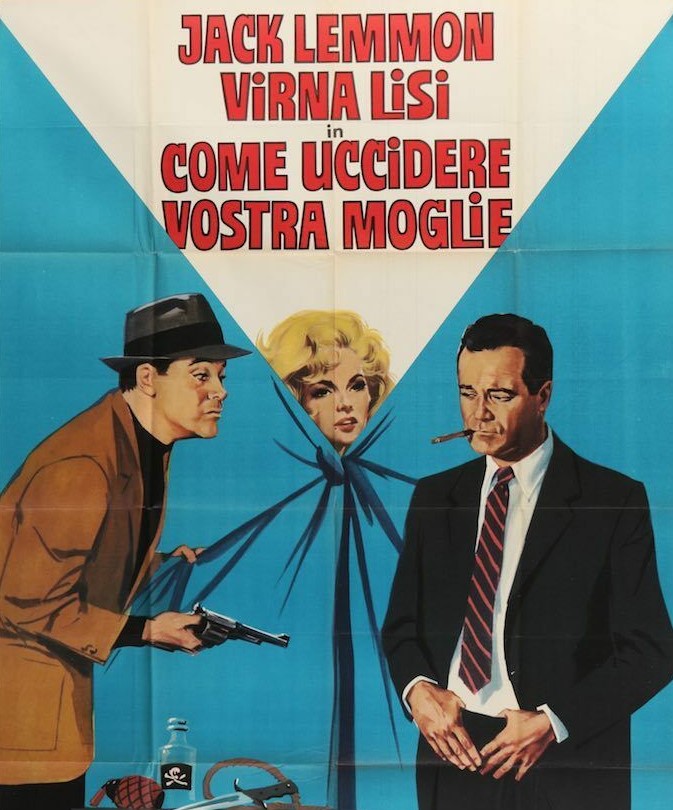
However, the picture’s overall theme, the war between men and women, where men feel controlled, is somewhat dated. You might expect such a war to go nuclear when Mrs Ford dares to infringe on the sanctuary of a men-only enclave. The trial scene is particularly laborious in trying to determine that men are victims of controlling women. Despite that, there are some very funny lines that hit the nail on the head – men “are always guilty about something” declares Mrs Ford’s confidante Edna (Claire Trevor) whose strategy is always to keep men off-balance.
Jack Lemmon (The Apartment, 1960) has ploughed this path before, conspirator to the illicit, although generally to be found in the loser camp rather than, as, effectively here, despite his complaints to the contrary, in the winner’s circle with an enviable lifestyle and willing girlfriends to hand. There’s a gleefulness in his performance, the little boy getting away with everything, that turns into a small boy’s sullenness when it is all apparently taken away.
Italian star Virna Lisi (Assault on a Queen, 1966), in her Hollywood debut, is a delight. Her frothy sexuality goes down a treat but she is far from a dumb blonde, learning English from television, excellent cook, and wise enough not to go down Edna’s route of dealing with men. Terry-Thomas (Bang! Bang! You’re Dead!, 1966) delivers just as interesting a confection, a touch of ruthlessness to the stiff upper lip, high chieftain of the Male Protection League, reveling in the prospect of ridding the world of insidious influences like Mrs Ford. And there’s a welcome role for Claire Trevor (Stagecoach, 1939), especially when, in a party scene, she really lets go.
The other males, ranging from dumb and dumber to dumbest, totally lacking in Jack Lemmon’s charm, perfectly illustrate the need for a woman’s firm hand, among them Eddie Mayehoff (Luv, 1967), Sidney Blackmer (A Covenant with Death, 1967) and Harold Wendell (My Blood Runs Cold, 1965).
Richard Quine (The World of Suzie Wong, 1960) directed from an original screenplay by George Axelrod (The Secret Life of an American Wife, 1968).

 The Magnificent 60s
I was going to write something about terry Thomas and the Male Protection League, and then I realised that reality had already caught up with this fanciful idea…
https://www.independent.co.uk/news/world/americas/us-politics/garrett-ziegler-jan-6-committee-rant-b2128313.html
LikeLike
Wouldn’t be surprised if he gets cosmetic surgery to insert a gap in his teeth.
LikeLike
A bit:
“How To Murder Your Wife marked the first time screenwriter-producer George Axelrod developed an original script into a theatrically-released feature film. At the time of production, he was known as a playwright who had become successful in Hollywood after adapting two plays for the screen, Phffft (1954, see entry) starring Jack Lemmon, (who was an early supporter of How To Murder Your Wife), and The Seven Year Itch (1955, see entry). In addition, Axelrod’s screen adaptation of Truman Capote’s Breakfast at Tiffany’s (1961, see entry), for which he was nominated for an Academy Award, and his motion picture version of Richard Condon’s The Manchurian Candidate (1962, see entry), made him a marketable filmmaker. On 5 Apr 1963, DV announced Axelrod’s new distribution deal with United Artists, in which he would write and produce How To Murder Your Wife from his own story. Axelrod’s Charleston Enterprises was listed as the production company.
By 30 Dec 1963, Jack Lemmon and director Richard Quine had partnered as producers, and Italian actress Virna Lisi had been cast in her first American film as “Mrs. Ford,” as reported in that day’s DV. The 10 Jan 1964 LAT added Gordon Carroll as executive producer. Nearly two weeks later, a 22 Jan 1964 DV news item stated that Axelrod had “checked in” to the Paramount Pictures studio lot in Los Angeles, CA, where filming was set to begin in Mar 1964. Lemmon’s Jalem Productions and Axelrod’s Charleston Enterprises merged to form the company “Murder Inc.” for the film, as announced in the 10 Feb 1964 DV.
Principal photography was originally planned to begin 9 Mar 1964, according to a DV production chart on 7 Feb 1964, but the start date of the seven-week shooting schedule was pushed back to 16 Mar 1964, as stated in a DV brief published that day. During production, DV added the following actors to the cast list: Elmer Bull (on 24 Mar 1964); Mike Monroe, Curley Kline, and Tom Ayres (on 26 Mar 1964); John Pickard and Peter Adams (on 3 Apr 1964); and Phil Ruff and Jack Reddy (on 20 Apr 1964).
The 1 May 1964 DV reported that filming would begin that day on a “5-day courtroom sequence” on the Paramount lot, with 150 actors on set. Location shots in New York City were underway by mid-late May 1964, as scenes were being filmed in Times Square after three days on the Brooklyn waterfront, the 2 Jun 1964 noted. The next day, Var stated that Lisi was back in Hollywood after completing two weeks of filming in Manhattan. One week later, a 10 Jun 1964 Var item stated that actor Terry-Thomas was on his way home to London, England, after finishing work on the picture, and the 17 Jun 1964 DV noted that Lemmon performed his last scene the previous day. The final shot was reportedly a close-up of Lemmon’s extended belly after consuming an Italian supper. The shooting schedule was ultimately increased to fourteen weeks.
A “sneak preview” was held on 25 Sep 1964 in Westwood, CA, as stated in the 28 Sep 1964 DV. An advertisement in the 7 Jan 1965 DV stated that Lemmon and Lisi were supporting the release with a “cross-country personal appearance tour,” in which they would host screenings for the press. How To Murder Your Wife opened in New York City on 26 Jan 1965 at the Victoria Theater and Cinema I, and in Los Angeles, CA, on 14 Apr 1965 at the Chinese Theatre. Despite mixed reviews, the film performed well at the box-office.”
LikeLiked by 1 person
I had thought Axelrod was a bigger name before this but I didn’t know this was his first venture into production.
LikeLike