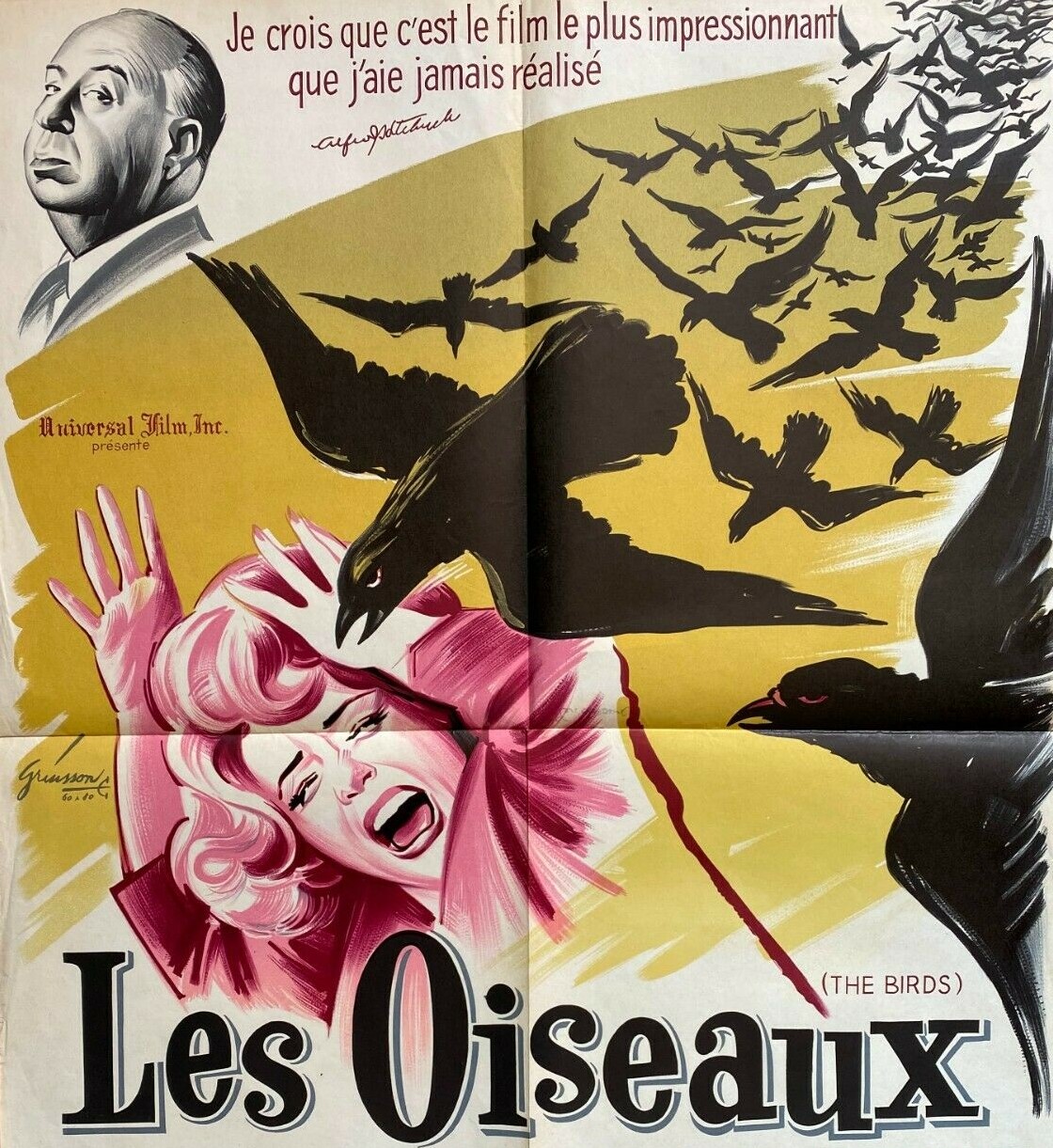
Behind the Scenes: “The Birds” (1963)

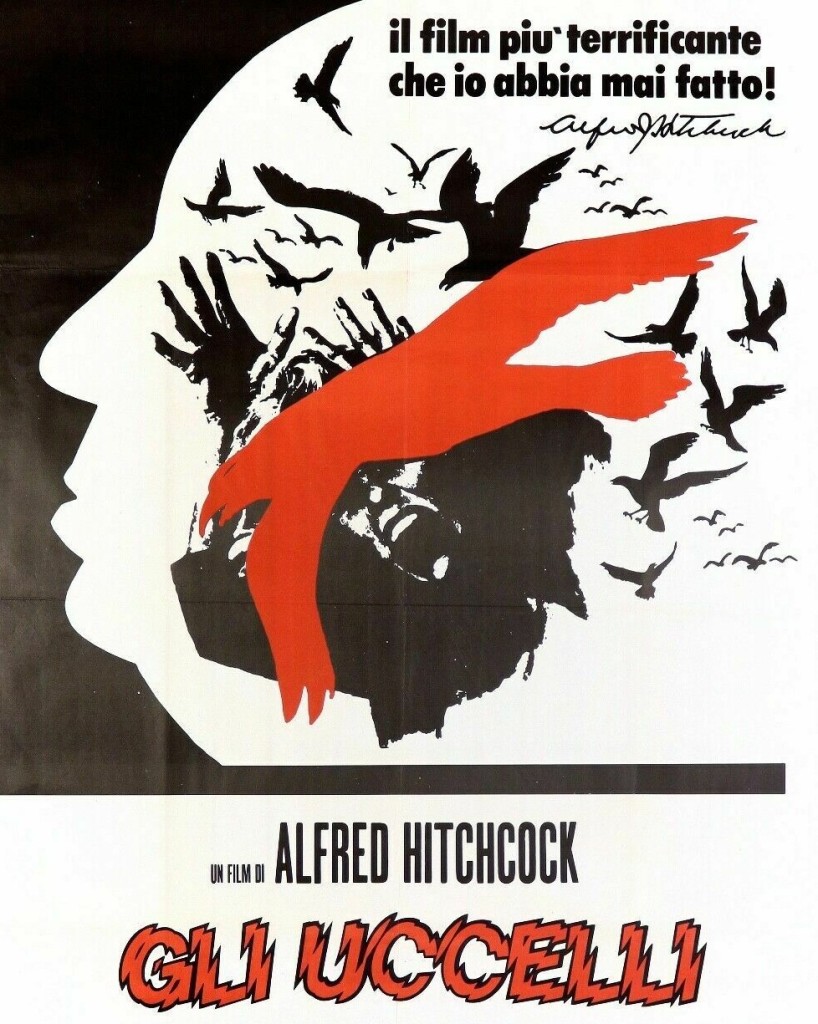
Alfred Hitchcock had a different picture – in fact, several movies – in mind as the follow-up to Psycho (1960), the biggest hit of his career. In pole position was Marnie to star Grace Kelly (“she voluntarily offered to do the picture after reading the story”), the woman he had made a star, in a sensational return to the screen after her marriage to Prince Rainier of Monaco. Her participation would bring her around $1 million. He worked on a script during 1961 but Kelly’s schedule meant the film would have to be postponed to 1963-1964 at the earliest.

A close second came No Bail for a Judge to star Audrey Hepburn. When those projects failed to get off the ground in the gap between Psycho and The Birds (1963), Hitchcock also considered reuniting with James Stewart (Vertigo, 1958) for Blind Man. The original idea came from a visit by the writer to Disneyland where he had an idea for a blind man given an eye transplant who subsequently remembers things he could not have witnessed. This was then transposed to an ocean liner, with Ernest Lehman signing on for script duties in December 1960. For almost a year he worked on a movie called Frenzy, no relation except for serial killing, to the later picture. But there was also Trap for a Solitary Man, Cold War thriller Village of Stars and The Mind Thing.
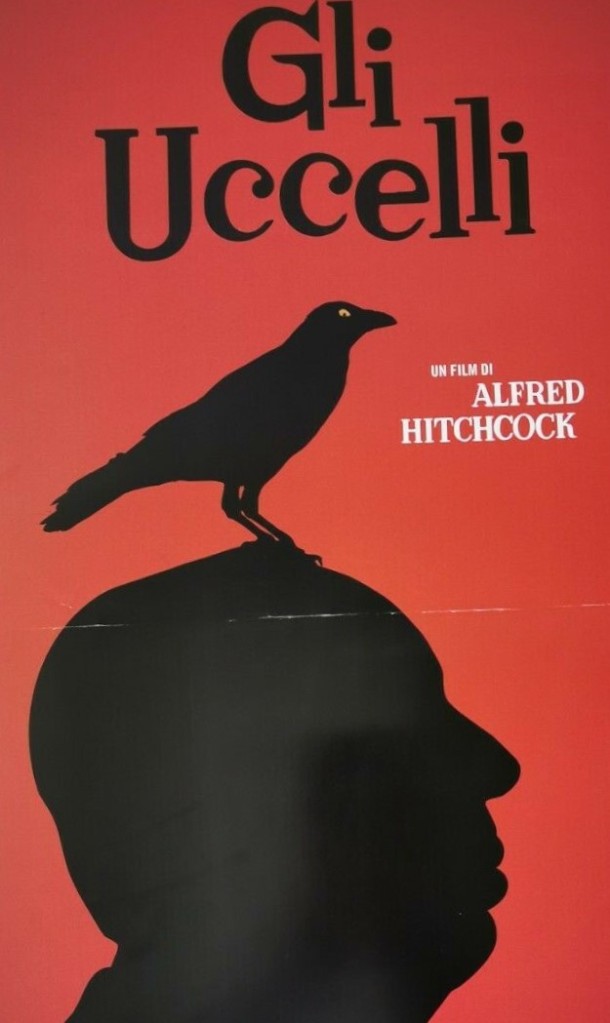
When Hitchcock finally settled on The Birds, based on a short story published in Good Housekeeping magazine in 1952 and reprinted in a Hitchcock anthology in 1959, he first turned to Scottish author James Kennaway (Tunes of Glory, 1960). That collaboration lasted until Kennaway decided the only way the movie would work would be if the birds were never seen. He considered Wendell Mayes (Von Ryan’s Express, 1965) and Ray Bradbury (The Picasso Summer, 1969) before in August 1961 turning to Evan Hunter (Last Summer, 1969). Wearing his Ed McBain (Fuzz, 1972) hat, Hunter  was a crime aficionado so it was no surprise he suggested adding a murder to the mix.

But Hitchcock’s first act was to shift the location from Cornwall to Bodega Bay, sixty miles away from San Francisco. While the screenplay was being worked upon, an extensive proce3ss that would include last-minute changes once filming had begun, Hitchcock considered a potential female star.

He screen-tested Pamela Tiffin (One, Two, Three, 1961) and examined footage featuring Yvette Mimieux (The Time Machine, 1960), Carol Lynley (Return to Peyton Place, 1961) and Sandra Dee (Tammy Tell Me True, 1961). He also considered two actresses he already had under contract Joanna Moore (Walk on the Wild Side, 1962) and Claire Griswold (Experiment in Terror, 1962).

Both the women already under contract had proved disappointing. Of Moore, John Russell Taylor wrote: “no one could have been less cooperative in the required making-over process, she did not like the clothes, she did not like the hair styles and she did not seem to like anyone she came into contact with at the studio.” Griswold, more compliant, “seemed to have little professional ambition and was quite content with what she was, Mrs Sydney Pollack.”

But then he spotted model Tippi Hedren in a television commercial. She was signed up to a seven-year $26,000-a-year ($254,000 at current prices) contract before she even met Hitchcock, one of the director’s modus operandi to ensure fees did not increase when his name was mentioned. Although actors, once successful, tended to complain they were hired at unfair salaries, this was in fact a pretty good amount for an untrained actress who would automatically become a star by the very fact of being in a Hitchcock picture. Of course, Hitchcock hoped to profit by keeping her salary low for any future movie. But it was still a gamble; if her career fizzled out, as did occur, he would lose out.
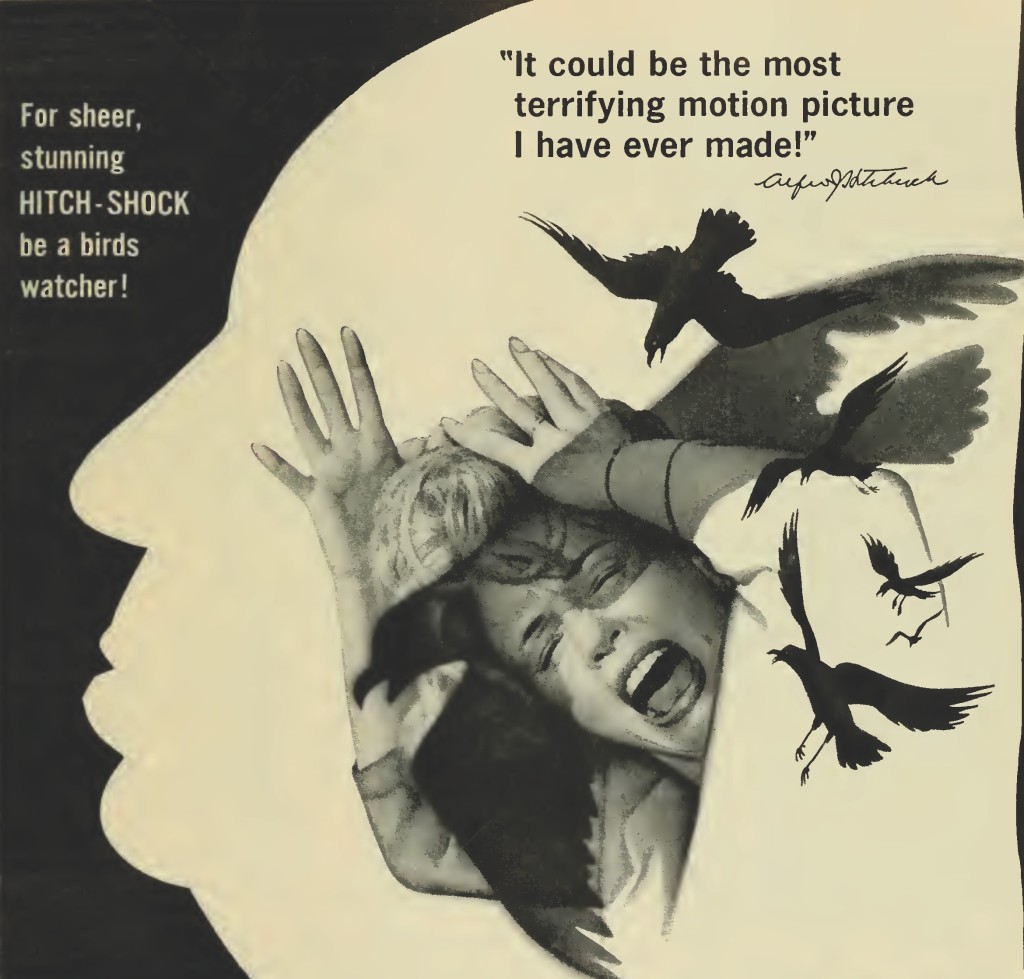
However, given his reputation for treating actors as cattle and expecting them to know what to do with little direction, he went to extreme pains to ensure Hedren was prepared for the role. He encouraged her to sit in on script conferences, meetings with set designers, and other essential collaborations like the director pf photography and the music supervisor and went into considerable detail about her motivation and how the film would move from periods of intensity to relaxation. Nobody ever received a more complete education in the Hitchcock method.

Hitchcock admitted he would have preferred to cast more experienced stars with guaranteed box office marquee such as Cary Grant and Audrey Hepburn  but the long shooting schedule and the time required for trick photography would render them too expensive.  

For this picture, Hitchcock switched studios from Paramount to Universal. At $3.3 million, very little going to the stars, this was his most expensive movie date especially in comparison to the $800,000 of Psycho. After a tortuous screenplay process, Hitchcock also sought input from others like famed short story writer V.S. Pritchett whose several notable suggestions the director accepted, much to the ire of Evan Hunter.  According to Taylor, Hitchcock found himself “nervy and oppressed” possible due to the film’s Day of Judgement elements, and abandoned his normal shooting routine.

He was famous for shooting the picture he already had in his head. Instead, here “he started studying the scenario all over again while shooting it…(and) began to do something he never normally did – improvising on set.” He went deeper into characterizations – making  the viewpoint far more subjective than initially conceived, in particular “keeping the audience much closer to the Tippi Hedren character”

At the last minute he dropped several pages of dialogue and the original Hunter ending. He edited out a love scene between Hedren and Taylor and detailed a script for the sound, specifying what kind he wanted for every scene. While Bernard Herrmann was involved, it wasn’t in the usual sense, and instead they worked out musical scenario of “evocative sound and silence” which was created by Remi Gassman and Oskar Sala who specialized in electronic music.

It was by far the most complicated shoot Hitchcock had ever attempted. The birds were a mixture of trained birds, dummies and optical illusions. When the gull attacked Hedren as the boat docks that was a dummy on a wire pulley, the blood a pellet implanted on her clothes. But as filming intensified, the blood seen on the screen was real blood. Anchovies and ground meat were spread on the actors’ hands at attract the gulls. 

But when it came time to shoot the scene in the attic Hedren was not warned the birds would be real. Hitchcock believed terror would be better expressed by an untrained actress if it was real. While propmen wore thick leather gloves to protect their skin, the actress was permitted no such luxury. When the birds avoided Hedren, the propmen simply picked them up and threw them at the actress. Filming took a week, by the end of which, after getting her eye clawed, Hedren broke down in tears. It would be impossible for a director to take such liberties today although young, impressionistic actors tend to fall prey to such actions.

The proposed ending was jettisoned in favor of a lengthy shot of Hedren and co-star Rod Taylor driving through a bird-infested landscape that the director called the “single most difficult shot I’ve ever done.”

Hitchcock got into trouble with the authorities over unauthorized use of birds. His permit allowed for the use of 20 dead and 30 live birds but an investigation by the U.S. Wildlife and fisheries found 40 dead gulls and 54 live ones as well as 60 songbirds for which no license had been given. He was fined $400. The movie was of course a boon for exhibitors planning promotional stunts. A thousand pigeons were released in a shopping center in Albany, carrier pigeons carried a message from Los Angeles to Memphis, birds trainers were in full flight, 200 exotic birds were displayed in the lobby of the Stanton in Baltimore, while the director attracted notoriety by making birds singular rather than plural when the tagline became “The Birds Is Here!

Much has been written of Hedren’s reactions to the birds, but it’s worth having a look at Roar (1981), a famous disaster of a picture, which she and husband Noel Marshall financed, where she appeared to be quite happy to be bitten and clawed by lions, a lot less tame than was suggested. The mauling was so bad Hedren required 50 stitches, required plastic surgery and nearly lost an eye. In one unscripted scene that ended up in the picture a lion grabbed her hair and would not let go. Most of the lion attacks resulted in injury to someone, actors and crew, including cinematographer Jan de Bont who required 120 stitches to sew his torn scalp back in place.  By such standards, her treatment by Hitchcock was relatively tame.

SOURCES: Patrick McGilligan, Alfred Hitchcock, A Life in Darkness and Light (Regan Books, 2003), p608-629; John Russell Taylor, Hitch, The Authorised Biography (Faber and Faber, 1978) p262-270; Brian Hannan, Darkness Visible, Alfred Hitchcock’s Greatest Film (Baroliant, 2013); “Princess Grace’s Take Per Hitchy Estimate,” Box Office, April 4, 1962, p2; “Fine Hitchcock $400,” Box Office, April 18, 1962, p17; “Pigeons Blaze a Trail,” Box Office, April 8, 1963, pB3; “Pigeons for Birds,” Box Office, May 6, 1963, pB3; “The Birds Is Here,” Box Office, May 13, 1963, pA1; “Bad Girls Bird House,” Box Office, May 27, 1963, pA3.
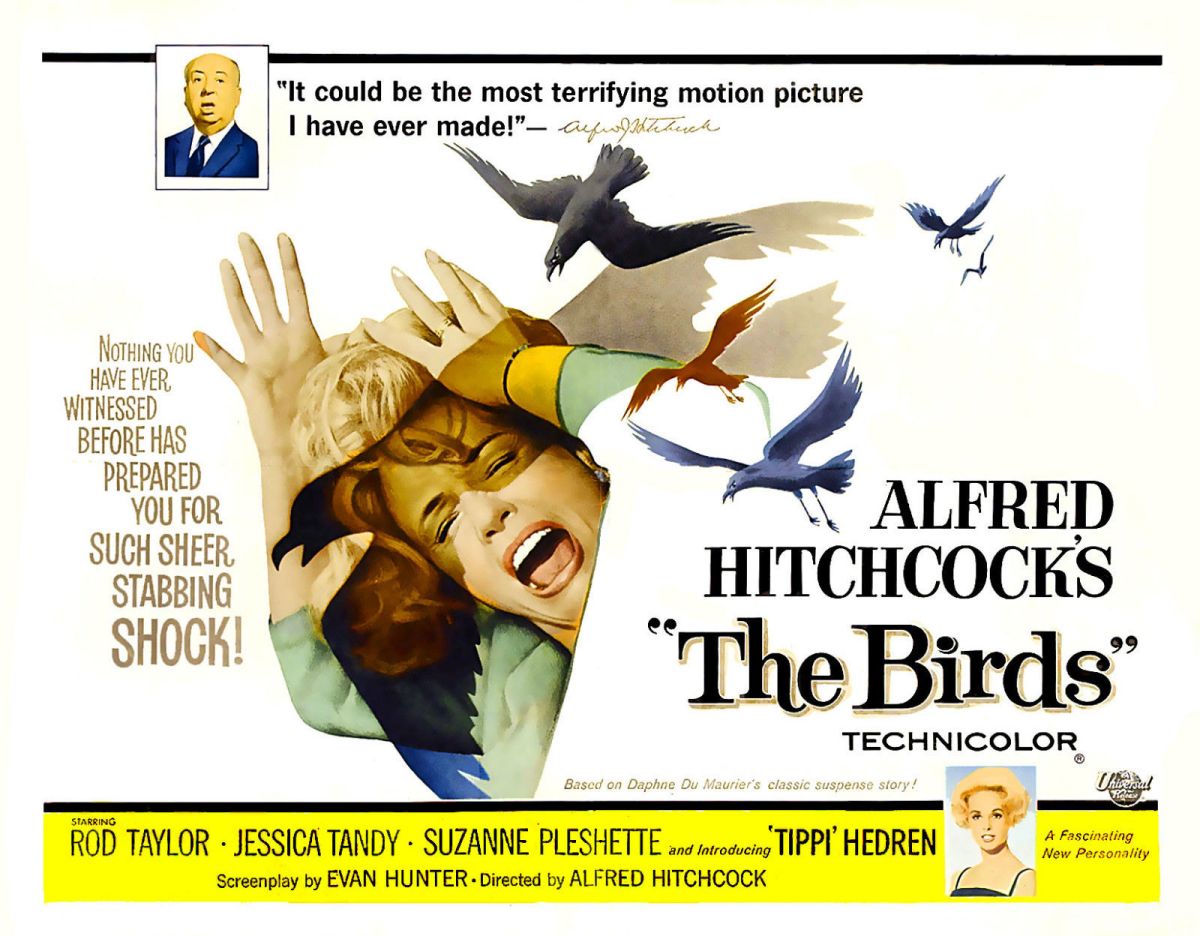
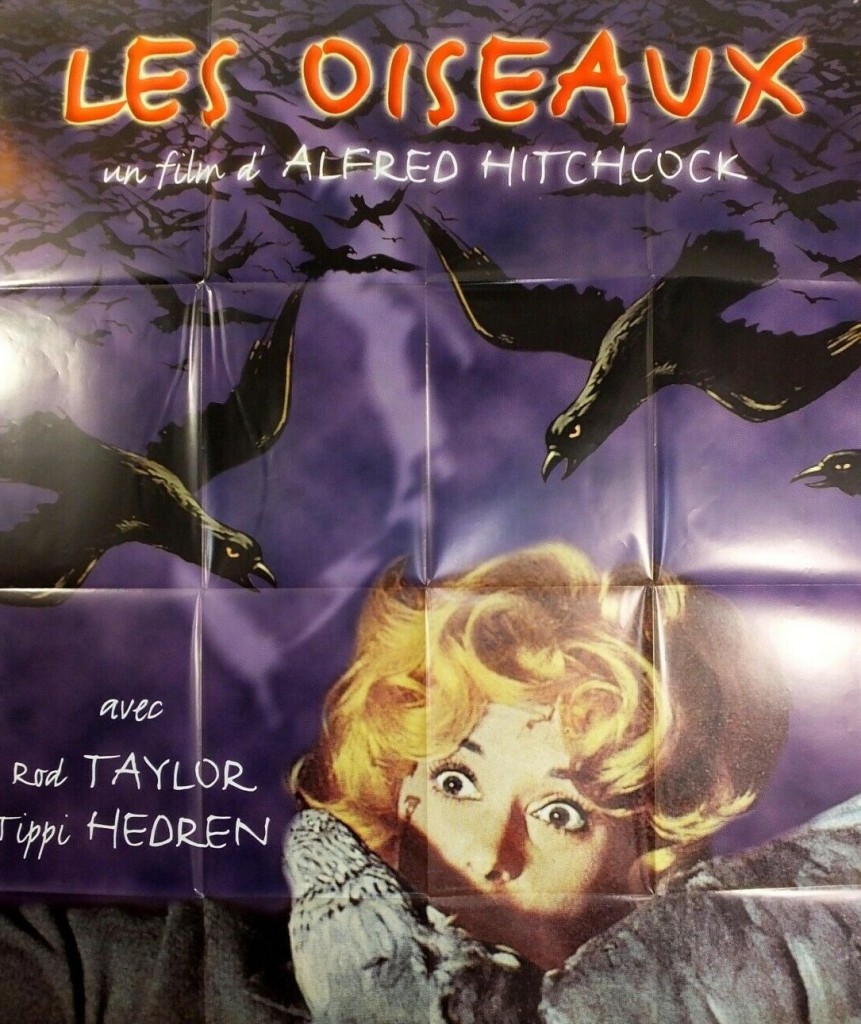
The Birds (1963) *****

Years ago I was asked to write a book on the six best Hitchcock films and from those choose the one I considered his very best. My choice was The Birds (1963). And it is for these reasons.

Firstly, unusually in the master’s work, there is a proper meet-cute. In most of his films, the couple are either already together (Rear Window, 1954; Torn Curtain, 1966) or when they get together it is for a hidden reason, one is on the run, or being pursued by the other, and the getting together is a convenient way of reaching an ulterior goal. When Melanie (Tippi Hedren) and Mitch (Rod Taylor) meet in the pet shop it is a certainly a precursor for the future and ensures that Mitch gets in a stickier jam he would otherwise likely have avoided but in the true sense it is the traditional Hollywood boy-meets-girl.

Secondly, and now cutting more to the chase, this is where the modern action film was invented. You might think that honour rested with Dr No (1962) or any other of the Bond pictures or even as late as Bullitt (1968) with its epochal car chase. But although the Bonds are filled with derring-do and escape, there is nothing to match the scene when the birds attack the town, wave after wave, as if they were World War Two bombers. There is even the point-of-view from the air which Hitchcock also invented and has been repeated in airplane war films ever since, most famously Pearl Harbor (2001).

But the way in which full-scale disaster, with everyone rendered helpless, unfolds is a true first. People in the café can see the river of petrol and the match about to be discarded and can only observe as the river of flame reaches the petrol tanker and in a perfectly ordinary town setting – rather than a military base – there is an almighty explosion. It is terror for the sake of it. And there is no escape, no one racing to the rescue, just pure devastation,

Lastly is the ending. It is apocalyptic. In every other Hitchcock when the hero/heroine escapes from dire peril, that is the end of the matter, there is no final twist as with a film like Carrie (1976). But although the birds are now silent and the couple can pick their way through their lines, you know full well this is not the end and that the birds will soon be as inexplicably massing somewhere else.  

That’s three reasons but there are many more. For a start, in other films where the hero/heroine is in danger, the peril is not relentless. And often it is the threat of danger or of being captured that provides the narrative spring. And if there is physical threat in that era it was not unrelenting. And it is with another character whom you can fight or at least attempt to outwit. Not just, later in this instance rather than sooner, realize that there is no way to defeat these marauding creatures, no way at all. So, compared to his other films, when attacks of one kind or another punctuate a film, here it is like a battery of machine-guns and not episodic but virtually non-stop for over 30 minutes.

The storyline since it is after all a meet-cute is excessively simple. Melanie and Mitch meet, trade remarks, she leaves him what would easily be interpreted as a love token, and they link up after she is attacked by a gull. Wherever they go now, there will be no escape. Gulls attack children playing outside. The same day sparrows invade Melanie’s home. There is another attack on children. In town the gulls swarm in wholesale, wreaking the devastation mentioned above. All his is just a prelude to the final overwhelming siege. Except in modern horror pictures where a body is dispatched every ten minutes or so, there is  nothing to match the unremitting attacks. It is as though Mitch and Melanie are in the front line of battle, under siege, Zulu (1964) with birds perhaps, but with no hope of salvation. Unlike Zulu, there is no sign that in raising the siege, the birds are hailing their bravery.

Unusually, too, for a Hitchcock film, there is considerable back story that informs current action. Mitch has an overbearing mother who seems to hover over his life attempting to scare off any woman who comes near. Annie has been left behind precisely because he needed to escape his mother. For her part, Melanie’s mother ran off with another man and she is a spoiled socialite with a habit of getting into trouble, possibly attention-seeking behaviour as a result of abandonment issues. Full to the brim with sophistication. Melanie is the least likely candidate for motherhood, yet her maternal feelings rush to the fore when she has to care for a terrified child.

Tippi Hedren’s career when south when she parted company with Hitchcock so we only have this and Marnie (1964) to consider her worth as a star. This is easily her best performance, shifting from icy cold to playful to romantic to maternal and of course no one has quite emoted such shock and terror. This is Rod Taylor (Dark of the Sun, 1968) coming into his stride as a leading man. He always had the charm and certainly the brawn, but rarely displayed both in the one picture. You would not have picked the Rod Taylor of Seven Seas to Calais to lead a squad of mercenaries in Dark of the Sun but he might well be first pick after this performance.

Hitchcock got so many of his effects by laying on the tension, a man or woman on the run, an innocent framed, a man displaying dubious morality (Rear Window, 1954, and Vertigo, 1958) nonetheless being presented as hero, the question in every instance being whether they will escape their fate. Here, the barrage of devilry is so intense it is almost inconceivable that anyone could get out alive. That they sneak out by the skin of their teeth, watched by their silent conquerors, for me was only the prelude to The Birds Part Two.  

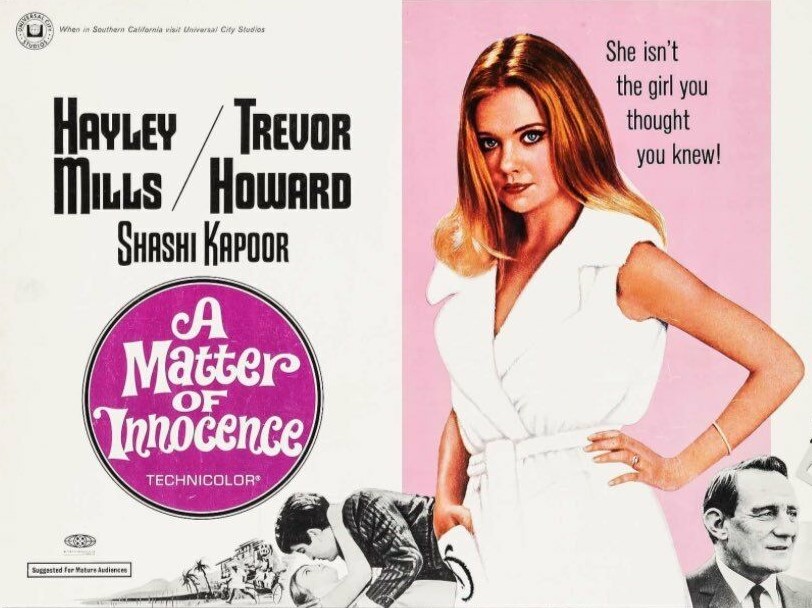
A Matter of Innocence / Pretty Polly (1967) ***

Dramatically undernourished coming-of-age tale over-reliant on “authentic” travelogue and continuing the transformation of Hayley Mills from child to adult star, although that change had been clearly wrought by her previous outing in  The Family Way (1966) which had contained her first nude scene. While there’s definitely way more sex here it’s all off-screen.

In Singapore, family black sheep Robert (Trevor Howard) tries to stifle romance blossoming between his ugly duckling niece Polly (Hayley Mill) and local king of the fixers Amaz (Shashi Kapoor), to quote from list of the clichés the screenplay happily summons up. Polly is the bespectacled, dowdy, shy travelling companion to snippy aunt (Brenda de Banzie) – Robert’s sister not wife – who resides in a magnificent suite in Raffles Hotel, consigning her niece to a hovel of a room. When said aunt drops dead in the swimming pool, Polly, wasting no time on mourning, is free to turn butterfly, channeling her inner Brigitte Bardot with bouffant hairstyle and tight red dress.

The genial Amaz is on hand as a guide, in sexual matters as well as tourist, until huffing-and-puffing plantation manager Robert threatens to intervene and smarmy American Critch (Peter Bayliss) attempts to sweep her off her feet. And that’s about it, plot-wise. The meandering story provides insights into different aspects of local culture –  Whicker’s World was the only globe-trotting television series available at the time so all this would probably have entranced moviegoers rather than, as now, bored them to death.

Perhaps what’s most interesting is what’s left unsaid or never dwelt upon, of the posh English girl having sex with a native of Singapore. In previous movies – Bhowani Junction et al – miscegenation would have been the sole plot point with Brits up in arms at the suggestion of it. Here, the only objection to Amaz is that he’s a bit of a Casanova, practised seducer in the main of older women. While Amaz falls in love, Polly is considerably more objective, viewing their relationship in terms of rite-of-passage, rather an un-British approach, more in keeping with the attitudes those bold females exhibited in pictures like The Group (1966).

Polly is a pretty cool-headed kid, with a good head for booze, not staggering in gutters or throwing up after imbibing too much, alert to the intentions of Critch and more than capable of putting her uncle in his place. Despite her delight at enjoying sex Polly is more independent than you might imagine and the film’s actually a character study of a woman refusing to be defined – or trapped – by love and its obvious consequence marriage and viewing this new freedom as merely the starting point of her life.

For Hayley Mills fans, of course, her career divides sharply into Disney and post-Disney. Few child stars ever manage to take the first steps to an adult career never mind sustain one, but the actress made a good stab at throwing off her previous precocious screen persona by taking on challenging roles that perhaps upset her core followers. But the film would have benefitted from a better storyline and minus the distracting tourist elements been a lot tighter.   

The career of Trevor Howard, long-time second male lead, was on a bit of an upswing after sterling roles in Von Ryan’s Express (1965) and The Long Duel (1967) and although he remained the scowler supreme he brings more vulnerability to this role. Bollywood heartthrob Shashi Kapoor had come to prominence as far as the English-speaking countries were concerned through arthouse director James Ivory’s The Householder (1963) and Shakespeare-Wallah (1966) but this was his mainstream debut. He certainly has a screen presence and enjoys the best character arc, going from the cynicism of sex to the innocence of love. I’m sure the title is intended to refer to Polly but she is innocent, in screen shorthand terms, for about two seconds. Pretty Polly, the title of the short story on which the film is based, was not usable in certain countries because the name was the trademark of a popular brand of hosiery.

This was the final film of Brenda de Banzie (The Man Who Knew Too Much, 1956) and the second for British television stalwart Patricia Routledge (Keeping Up Appearances, 1990-1995), while for Chinese star Kalen Liu (Welcome to Hard Times, 1967) it was both her second and last picture.

This was perhaps an odd choice for director Guy Green (A Patch of Blue, 1965) but he was mired in the on-again off-again saga of proposed MGM roadshow epic Forty Days of Musa Dagh and compared to those travails this may have been welcome light relief. Keith Waterhouse and Willis Hall (Lock Up Your Daughters, 1969) developed the screenplay from Noel Coward’s short story.

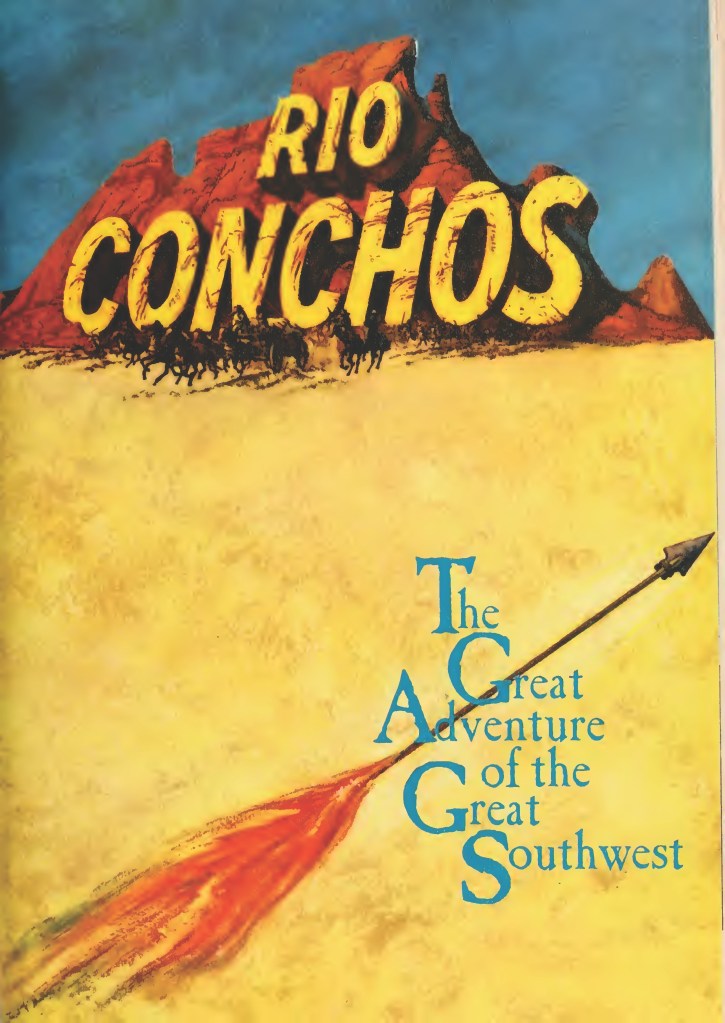
Rio Conchos (1964) ***

Starts and ends as a rootin’-tootin’ western but sags badly in between. The chance of turning it into The Magnificent Four or even The Dirty Pair go a-begging and it’s both revenge- and redemption-driven without either taking enough precedent. And there’s a curious dynamic in that the murderers are clearly smarter than the soldiers. Set in the aftermath of the Civil War, it’s engaging enough but too episodic and far short of a classic.

Lassiter (Richard Boone) kills Apaches with brutal efficiency in revenge for losing wife and child to them. But there’s no law against murdering Native Americans, not even when they form a harmless burial party, and when arrested by Captain Haven (Stuart Whitman) it’s for buying a stolen rifle, part of a consignment of 2,000 feared to be heading into the hands of the Apaches and a rogue Confederate Col Pardee (Edmond O’Brien), under whom Lassiter once served.

Charged with going undercover to get the weapons back is Haven, who lost the cargo in the first place, and another soldier Franklyn (Jim Brown), posing as gunpowder salesmen. Lassiter is freed from jail along with exceptionally vain murderer Rodriguez (Anthony Franciosca). From captured Apache Sally (Wende Wagner) they discover the Apaches are hooking up three days hence with Pardee in Rio Conchos in Mexico.

Mostly, it’s tension between the soldiers and their captives-turned-colleagues. There’s an incident with a dead baby at a house attacked by Apaches, Lassiter shooting the tortured mother. Lassiter attacks a saloon keeper for refusing to serve Franklyn. Pardee is building an army to re-start the war. There’s a brutal scene of the men being dragged behind horses. While Haven plans to use the gunpowder to blow up the Apaches and/or the rifles, Lassiter and Rodriguez nurture plans to steal the cargo.

Lassiter is pretty smart, twice outwitting the Apaches by using fire as a distracting device, easily getting the better of Haven and more than a match for the duplicitous Rodriguez. But there’s a powder keg waiting to explode in more ways than one, the chances of Lassiter toadying along to Apaches seeming remote.

Richard Boone (Night of the Following Day, 1969) coming off Have Gun –Will Travel (1957-9163) and The Richard Boone Show (1963-1964) is impressive as the wily renegade. Here’s one of those actors you never quite know what he’s going to do and that unpredictability adds continuous tension, but it would probably have helped if the audience was fully filled in on his intentions, rather than being surprised all the time. Given he was the star here, he was allotted time to be seen making up his mind in various situations, something he would be denied as a later supporting actor. So when there’s not really much going, he creates tension.

Stuart Whitman (Sands of the Kalahari, 1965) doesn’t really have enough to do what with Boone’s character always being one step ahead and clearly more attuned to danger. Anthony Franciosca (A Man Could Get Killed, 1966) has a gem of role, adding to his characterization withlittle bits of scene-stealing business, sharpening a knife on a wagon wheel, recovering a knife from the stomach of a victim being dragged away by a horse, snaffling a packet of cigarettes, and never ceasing to admire his attraction to women.

Jim Brown (The Split, 1968) makes a solid movie debut, offering more by his presence than in action terms since for the most part he is just the sidekick. Wende Wagner (Guns of the Magnificent Seven, 1969) has more screen time but mostly just smolders or looks sullen apart from a nice scene mourning the baby and another defying her tribe. Look out for Edmond O’Brien (The Man Who Shot Liberty Valance, 1962) and silent child actor Warner Anderson.

The action sequences are well done and director Gordon Douglas (Robin and the Seven Hoods, 1964) also deserves credit for allowing Boone such scope while the opening scene and the death of the unseen woman are exceptional. He has a great gift for the widescreen, but the movie could have done with more clarity. It’s not his fault the poster was misleading and led me into the picture with different expectations. The screenplay by Joseph Landon (Von Ryan’s Express, 1965) and Clair Huffaker (The War Wagon, 1967).was based on the latter’s book.

The Deadly Affair (1966) ***

Initially, much more of a character study than murder mystery or spy tale. And like the previous John Le Carre adaptation The Spy Who Came in from the Cold (1965) directed by an American, there Martin Ritt, here Sidney Lumet. Although as repressed as the main character in Lumet’s  The Pawnbroker (1964) and sharing with it remembrance of the Holocaust, master spy Charles Dobbs (name changed from George Smiley due to Paramount’s rights from the earlier film) is far more capable of expressing his feelings and taking action than the pawnbroker.

Dobbs sleeps in a separate bedroom, his wife Ann (Harriet Andersson) indulging in so many affairs she is considered a nymphomaniac. Although resigned to this behavior, he is nonetheless shocked when her latest amour turns out to be his old friend and colleague Dieter (Maximilian Schell) and even attempts to offer him advice, the politeness of the English at its best. “In any other country,” retorts Dieter, “we wouldn’t be on speaking terms.” This kind of betrayal Dobbs can manage, but the other kind, of a professional nature, has him rushing to the bathroom to throw up.

If you’ve come to admire the character of George Smiley (aka Dobbs) as played by Alec Guinness in BBC TV series Tinker, Tailor, Soldier, Spy (1979) and its sequel where he is generally a passive character you might get a shock when here the man springs into action.

Dobbs comes up against the Establishment when his boss (Max Adrian) refuses to investigate the suicide of a low-level agent Fennan (Robert Flemyng), a former Communist cleared of suspicion of being a double agent by Dobbs himself. Dobbs resigns in order to go his own way enlisting retired policeman Mendel (Harry Andrews), a pet lover and prone to falling asleep at inopportune moments. Although it is essentially a murder story, it’s Mendel who does most of the detecting, using his resources to track relevant pieces of information – typewriters, wake up calls, theatre tickets fall into his purview – and very much the old-school cop, not above a bit of burglary and beating up a suspect.

There are leaks within the secret service, Dobbs tailed, a blond man Harek (Les White) hovering into view long enough to tamper with witnesses, including dodgy car dealer Scarr (Roy Kinnear), a bubbly character with “two wives.”  Key to the investigation is Fennan’s wife Elsa (Simone Signoret), a Jewish refugee from the concentration camps, and committing the cardinal sin of not offering Dobbs a cup of tea when he comes to visit, though pouring herself one. “I’m a battlefield for your toy soldiers,” she proclaims, another in le Carre’s stream of innocents unwittingly caught up in the “game.”

This is dingy rather than tourist London, Battersea power station on the horizon, rain prominent, a murky Embankment, the Thames a river of sludge, dubious pubs in unsavory locations, except for a very English spurt of theatre (a plot point) involving characters with very jolly accents. In The Spy Who Came in from the Cold, the spy’s downfall is “minor human weakness” i.e. falling in love and so it is here, Dobbs’ mental health taking a beating by not just his wife’s unfaithfulness but by remaining faithful to her. Of course, he wouldn’t be the first man to have married out of his league and be unwilling to surrender his prize.

Lumet’s gaze is anything but sentimental. In fact, as much as Dobbs is a master of the spy game, he is a dunce at the game of love, and Lumet does not let him off lightly. Any man who commiserates with his wife’s lover on the grounds that he (said lover) will be hurt when the woman ultimately abandons him, is straight from idiot school.

So this is a far more complex, and human, reflection on the spy game, and it’s not so much about paying the price of being a spy, as occurred with Alec Leamas, than the folly of marrying the wrong woman. You can see how easily Dobbs was seduced by the insane prospect that a beautiful woman had fallen in love with him, rather than, as he must have been trained to do, examining her reasons.

Of course, it’s not unusual for detectives to have miserable home lives and end up as loners, but this was part of a trend (see The Quiller Memorandum, 1966) to see spies not as bed-hoppers of the James Bond variety but as human beings with normal failings. One oddity is that, in line with the Paramount dictat on names, Dobbs’ boss is called “The Adviser” rather than “Control” (although apparently there was such a title in le Carre’s version of the secret service prior to this book).

James Mason (Age of Consent, 1969) is excellent as brilliant spy/bewildered lover. Harry Andrews (The Hill, 1965) has a ball in a change from his normal taciturn characters. Oscar-winner Maximilian Schell (Topkapi, 1964) is equally convincing but I found Harriet Andersson (Through a Glass Darkly, 1961) too much one-note certainly compared to the riveting performance by Simone Signoret (Is Paris Burning? 1966).

You can spot a string of future stars in a supporting cast led by Lynn Redgrave (Georgy Girl, 1966), Corin Redgrave (The Girl with a Pistol, 1968) and Kenneth Haigh (A Lovely Way to Die, 1968) among older hands like Robert Flemyng (The Blood Beast Terror, 1968), Roy Kinnear (The Hill) and Max Aitken (Henry V, 1944).

Paul Dehn (The Spy Who Came in from the Cold) wrote the screenplay based on John le Carre’s novel Call for the Dead, which was written before the book which made the author famous.

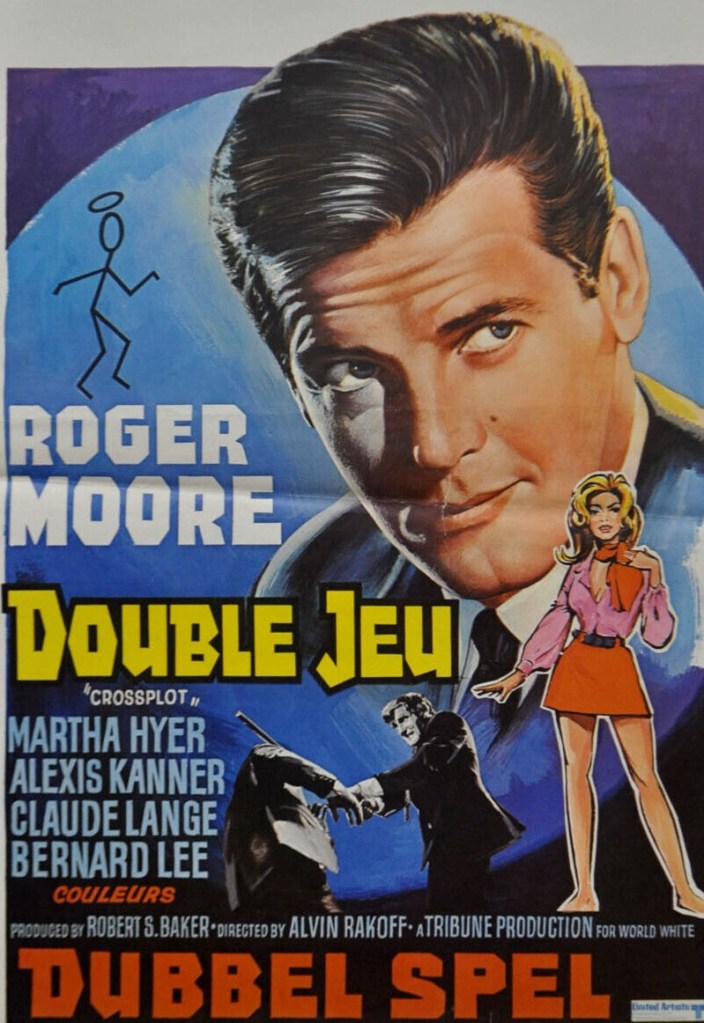
Crossplot (1969) ***

Roger Moore – in his first movie in seven years – almost auditioning for James Bond with his lothario instinct, light touch for dialogue, a nice side-line in double takes, and enough action to show that even in his early 40s he was still nimble enough. Not in the Charade (1963) or Arabesque (1966) league and over-reliant on the Swinging Sixties and other “Tourist Britain” clichés and a plot that takes far too long to get going, it takes all the actor’s charm to make it watchable.

After one of his staff Warren (Dudley Sutton) switches the photo of a model in his portfolio, ad-man Gary (Roger Moore) finds himself on the trail of Marla (Claudia Lange), a sometime fugitive hiding out on a houseboat. Meet-cute is prompted when she pushes him into the Thames. On leaving he is knocked out and framed on a dope charge and once he manages to get her into the photographic studio Warren attempts to throw her off the roof, the would-be killer himself eliminated by his boss Ruddock (Francis Matthews) who in a marvelous piece of quick-thinking throws his gun to Gary who instinctively catches it, further implicating himself.

After going all round the houses (including a stately home), evading pursuit via an antique car race and a wedding, Gary finally gets to the bottom of why Marla is in such danger – she overheard a conversation between her aunt Joe (Martha Hyer) and Ruddock. Only problem is – she can’t remember it. And it takes even more time for Gary to figure it out, (not realizing, how could he,  that the clue is in the title, in fact two clues in a crossword puzzle). You can imagine how it goes from then.

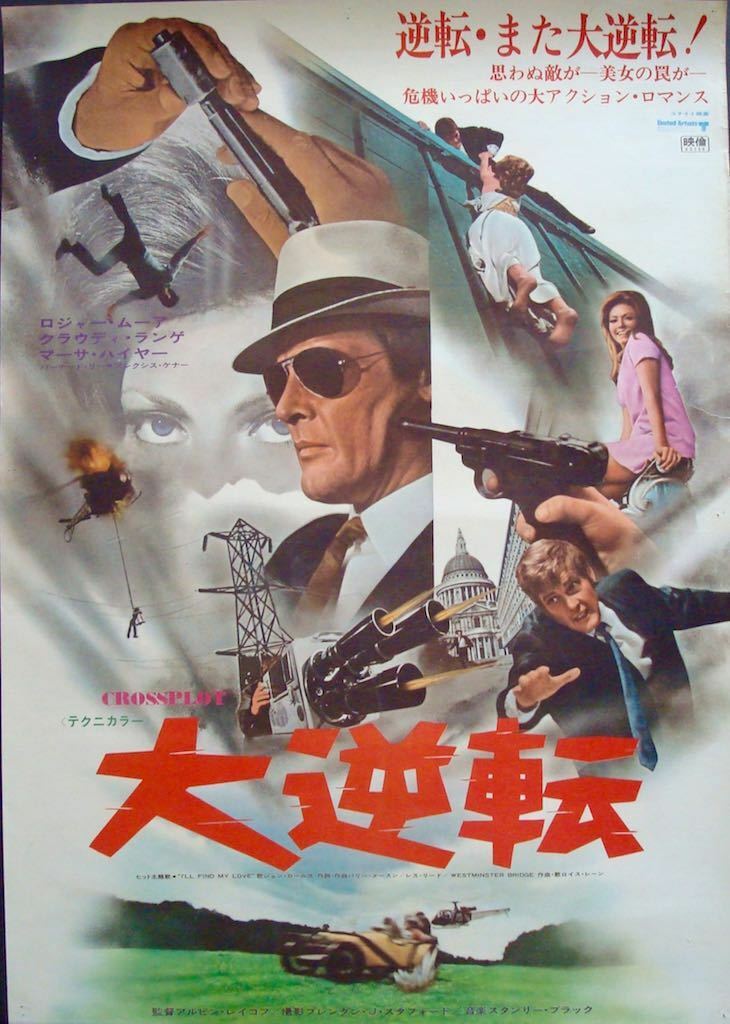
This poster takes the easy route by trying to sell the picture on the back of “The Saint.”

On the plus side is mostly Roger Moore. “I come from a long line of hippopotamuses,” isn’t the sort of line you can deliver without some skill. But Moore’s performance lifts what is for the most part  a shaggy dog story, and he’s game enough to do all the running and fighting required, even the heavy lifting (of his eyebrows), to keep the story moving. It’s far from as funny as it thinks and not as funny as it needs to be, but there are still some good stabs at humour, a pistol held to Gary’s head discovered to be a toy gun, Gary turning the tables in a shower on Marla, telling the bride that her groom is a bigamist, and a running joke about the Marla being perennially hungry.  

The politics barely touches on the conspiracy aspects that Hollywood would have pounced upon and made a better fist of, although the idea that Britain could be undermined by civil strife was not far off the mark for the times. It needed some smarter thinking, though, for that element to work.

A much better attempt at selling a thriller with scenes from the film,
including the toy pistol pointed at Roger Moore’s head.

The rest of the cast are game enough. Claudie Lang (The Gatling Gun, 1968) is no Sophia Loren or Audrey Hepburn but nobody is pretending she is and she just about gets away with the dumb model approach. Martha Hyer (The Chase, 1966) delivers a glamorous villain and the suave Francis Matthews (Rasputin: The Mad Monk, 1966) her ideal match.

There’s quite a supporting cast: Veronica Carlsen (Dracula Has Risen from the Grave, 1968), Gabrielle Drake (Suburban Wives, 1972), Dave Prowse (Star Wars, 1977),  Bernard Lee (You Only Live Twice, 1967), Alexis Tanner (The Ernie Game, 1967), Ursula Howells (BBC’s The Forsyte Saga, 1967) and Dudley Sutton (Rotten to the Core, 1965).

If Alvin Rakoff (The Comedy Man, 1964) is in charge of the material he doesn’t have enough material to work with. He does enough to keep it on course but would have benefitted from a a tighter screenplay from Leigh Vance (The Frightened City, 1961). Both had done better in the past, but it is easy to be seduced by the romantic thriller format, almost a mini-genre in itself, assuming it is easier to pull off than it looks. The likes of Alfred Hitchcock (North by Northwest, 1959) and Stanley Donen (Charade) made it look easy but they had the advantage of big stars in Cary Grant and Audrey Hepburn who possessed the ability to make the lightest confection work.

The Mad Room (1969) ***

Tight little thriller lifted by excellent performances from Stella Stevens and Shelley Winters focusing on murders a dozen years apart. Mandy (Barbara Sammeth) and older brother George (Michael Burns), incarcerated in a mental institution after the murder of their parents, the twist being nobody can discover which child was responsible, are released into the custody of big sister Ellen (Stella Stevens), secretary to wealthy widow Mrs Armstrong (Shelley Winters) and betrothed to her son Sam (Skip Ward).

While concealing the children’s past, Ellen persuades Mrs Armstrong to offer them lodgings, that arrangement coming unstuck when the kids demand a room where they can go “to work things out.”  Armstrong is a bit barmy, engaged on building beside her home a museum to her husband, hence contractors and construction workers on site, and a horde of “ladies who lunch” involved in fundraising. She has also appropriated masseur Armand (Lou Kane), husband of alcoholic Mrs Racine (Beverly Garland), to fulfil her sexual needs.

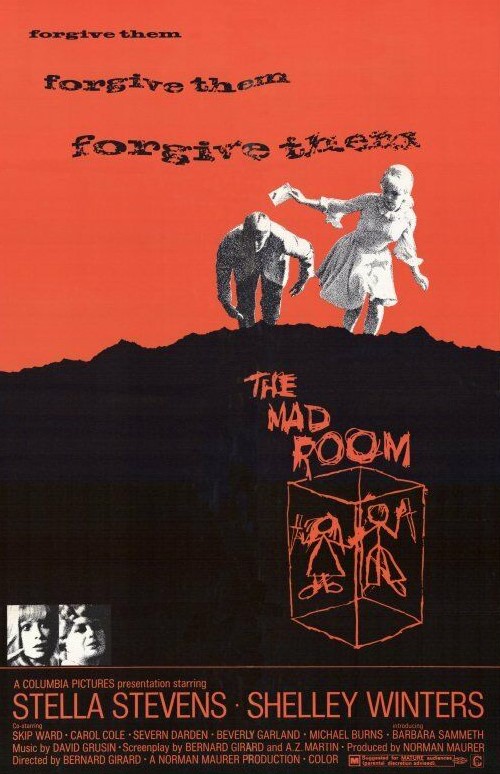
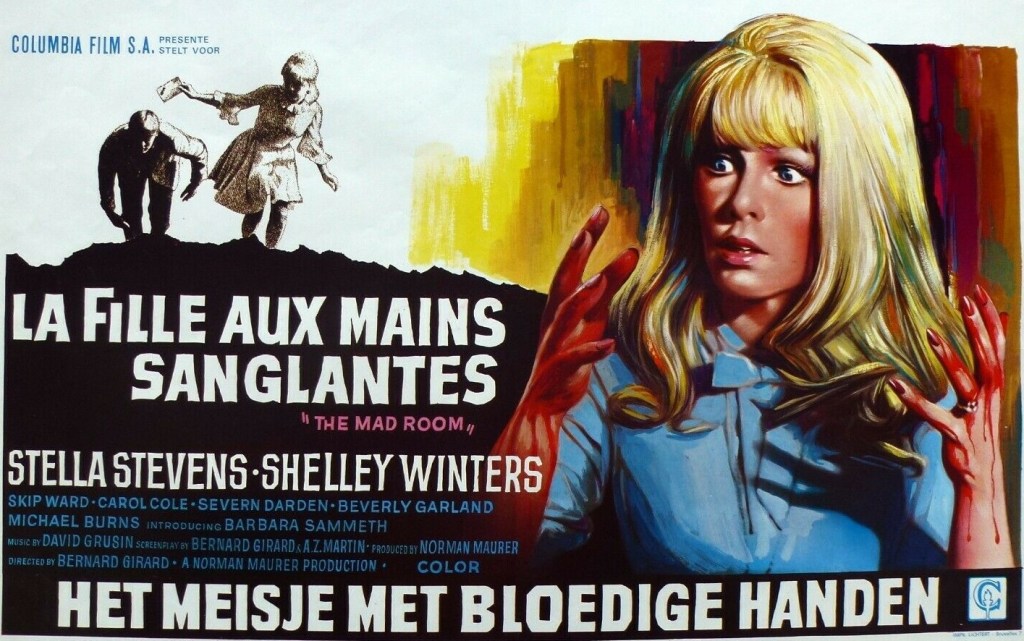
Don’t worry – the poster doesn’t give the game away.
The blood comes from Stella Stevens discovering the corpse.

When Mrs Armstrong threatens to chuck the kids out, she comes to a sticky end, and the question is raised again of whether Mandy or George are responsible. Mandy is the more highly-strung, stubborn and likely to challenge authority. George appears predatory, stalking the maid. Both are convinced the other is guilty.

Meanwhile, Ellen undertakes to remove the body and pretend Armstrong met her death by accident at a beauty spot, no mean feat given the palaver caused by the builders outside and the constant need for construction decisions and the unexpected arrival of a posse of ladies including the alcoholic Mrs Racine intent on raising merry hell.

It’s part whodunit, part nutcases-on-the-loose, part film noir, part slasher picture,  and part grand guignol. Hands are severed and blood is used to daub flowers on the walls. It’s tense enough even before Armstrong’s demise. She’s not only a loony, but untrustworthy, selfish, capricious and demanding, and it’s as much as Ellen can stand to constantly iron out all the loose ends in her employer’s life. But she sounds believable, an earnest do-gooder even while conspiring against what she sees as Ellen’s gold-digging.

Ellen, life thrown into turmoil after the death of her overbearing impoverished parents and only now building a new identity removed from the shadow of the children, faces the prospect of losing her ideal future. While it would have suited her for the children never to be released, she exhibits surprisingly a strong emotional attachment to her siblings, willing to both shelter and protect them, and conceal again their crimes.

Initial tension revolves around a chase, savage dogs, a shifty maid and Ellen dealing with the manipulative Mrs Armstrong, holding her own long enough until she is safely married, while further pressure builds with the necessity to cover up the murder, explain Mrs Armstrong’s absence, cope with the sudden influx of people and ascertain who has the murderous tendencies. There are some excellent scenes and twisty payoffs, and quite a bit of misdirection – the chase, rabid dogs, a childish song – and some inspired drama such as Mrs Racine letting rip, and Mrs Armstrong’s growing puzzlement.

Stella Stevens (Sol Madrid, 1968), normally eye candy or in a supporting role, is a revelation as Ellen, creating a grounded personality, with several changes of emotion and except for being a little pop-eyed on occasion carries off the part tremendously well and not falling prey to the temptation of grandstanding. Shelley Winters (A House Is Not a Home, 1964), who knows all about playing larger-than-life characters, tones it down here, even the obvious nuttiness reined in.

Michael Burns (That Cold Day in the Park, 1969) is the better of the two younger actors, while Barbara Sammeth’s (Foul Play, 1978) stiffness could be put down to inexperience – this was her debut. Otherwise former horror queen Beverly Garland (Stark Fear, 1962), one-time horr

In the Cool of the Day (1963) ***

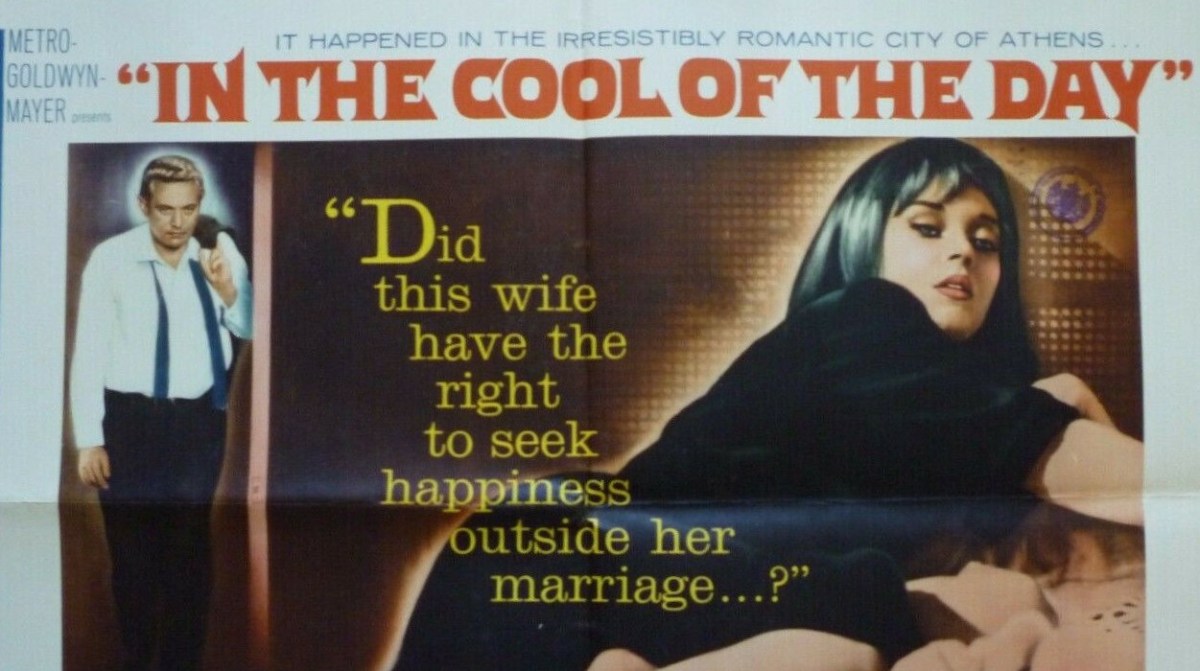
Jane Fonda tagged this the worst film of her career but that’s a bit harsh and I suspect it owed a lot to the actress being dressed up Audrey Hepburn-style in outfits that scarcely suited her. While it’s certainly overheated, melodramatic moments indicated by thundering music, a marvellous supporting cast, including a quite bitchy Angela Lansbury, provides ample compensation.

It’s  romance in the Love Story vein, rich young flighty heroine Christine (Jane Fonda) at death’s door half her life, but feeling smothered by understandably over-protective husband Sam (Arthur Hill). When she falls for married publisher Murray (Peter Finch) and sets off on a trip to Greece, chaperoned it turns out by Murray’s bitter wife Sybil (Angela Lansbury), it takes a while for romance to physically bud. That it does at all is only because   Sybil has taken off with suave traveling salesman Leonard (Nigel Davenport).

The movie takes a long time to heat up because, as in The Bramble Bush fashion, there’s overmuch character filling-in to do. Part of the interest in this picture is how the bad guys are effectively good guys, more victims of their partner’s behaviour than anything else, though for story purposes, the audience has to be persuaded otherwise.

So besotted Sam, having dealt with umpteen bouts of his wife’s pneumonia and lung operations, a “slave” to her illnesses, is deemed as treating her like a child rather than a wife, preferring her ill rather than well, and denying her the adventure to which she feels entitled. When she meets Murray she has run away. Murray’s wife has a downer on her husband because, wait for it, he killed her child and left her facially scarred (hidden now by hair but she’s still very sensitive about it) in a car accident he caused.

But she’s portrayed as over-sensitive, worried about her appearance, snippy, blaming him for her distraught life, and worse, a philistine, hating being dragged around ancient Greek monuments. Aware of her husband’s proclivities, she mocks, “You’d be an idiot to fall in love with her.” And any time she ventures out, the music rises to a crescendo as if she is a character straight out of film noir.

When she goes off with Leonard, her love affair is viewed as sneaky rather than redemptive, even though he restores her faith in herself. Triumphantly, she tells Christine, “He’s all yours” and her husband “nobody need feel sorry for me any more.”Admittedly, she does take revenge by informing Christine’s husband, who has entrusted his wife to Murray’s care, of their affair. And you would be hard put to argue, although the film wants you to believe otherwise, that Sybil and Sam have been ill-treated by their partners, Sam, in particular, funding her trip to Greece in the hope that allowing her the freedom she needs will save their marriage.

Of course, the characters of both partners, even if their self-pitying is the result of circumstance, do mean that Christine and Murray are presented as people trapped in bad marriages and for whom love, however brief, provides sanctuary from tortured lives, her physical, his more mental, since he is not averse to guilt. 

Sybil’s lack of interest in tourist Greece handily gives the prospective lovers plenty time to fall in love, amid gorgeous scenery, and breathing in air rich in culture. With all film made in the 1960s and set in foreign parts – Pretty Polly (1967) another example – sometimes the story takes second place to the scenery, so it’s lucky that the romance is played out against such an interesting background, an ideal combination, killing two birds with one stone if you like. Given this is prior to Zorba the Greek (1964), the filmmakers have even managed to sneak in some traditional Greek dancing, albeit on the deck of a ferryboat.

Dress-wise, the lovers are ill-matched, Murray plodding around in a suit while Christine parades the latest often clingy fashion. When Sybil departs the scene, that leaves one happy character of the happy couple free of marital encumbrance, but still leaves open the question of how Christine will rid herself of Sam and, more importantly, will Murray wish to take on the all-consuming job of nursing Christine. He never gets the chance to find out. When she does fall ill – as the result of Murray recklessly keeping her out in a thunderstorm – her mother Lily (Valerie Kendrick) swoops in to rush her to hospital.

Spoiler Alert – I’m telling you that she dies because it seems to me that the ending the filmmakers hoped for is not how the audience will perceive it. Beautiful young woman dies too young, yep that’s there, but the man, now free and able to shake off his dull life and start afresh as a writer, seems a long shot. Given he has now, thanks to the thunderstorm episode, killed two people, I would surprised if guilt was not uppermost in his mind.

Not so-good-it’s-bad, and despite the complications, and perhaps because of the Sybil-Leonard romance, it’s certainly an interesting picture as much, perhaps, because it fails to send the audience in the desired direction.

In only her fifth movie, Jane Fonda (They Shoot Horses, Don’t They, 1969), exhibiting the nervous friskiness that would become a hallmark, does pretty well with a febrile, spoiled, character. If she falls down at all it’s that she appears uncomfortable wearing Orry Kelly’s fabulous gowns and it would take Hollywood some time to work out she was not a natural successor to Audrey Hepburn. Peter Finch (The Pumpkin Eater, 1964) is perfectly at ease with the illicit.

But Angela Lansbury (Harlow, 1965), a hoot as the wife who turns rejection into triumph, steals the show. Throw in Arthur Hill (Moment to Moment, 1966), Nigel Davenport (Sands of the Kalahari, 1965), for once neither smug nor snippy, Alexander Knox (Khartoum, 1966), veterans Constance Cummings (The Criminal Code, 1930) and Valerie Taylor (Went the Day Well, 1942), John Le Mesurier (The Liquidator, 1965) and Alec McCowan (Frenzy, 1972) and you have a movie where hardly a moment goes by without admiring a performance.

Robert Stevens (I Thank a Fool, 1962) directed from a screenplay by Meade Roberts (Danger Route, 1967) based on the novel by Susan Ertz.

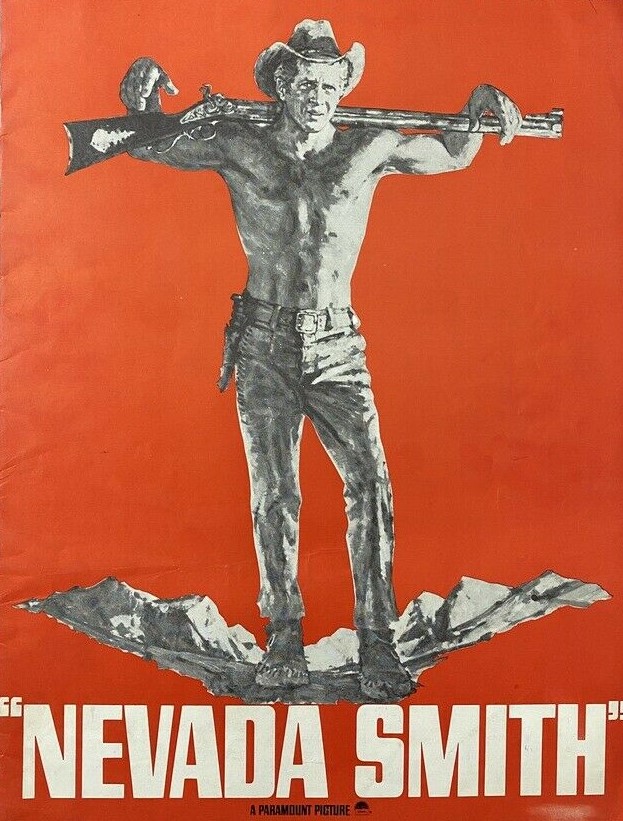
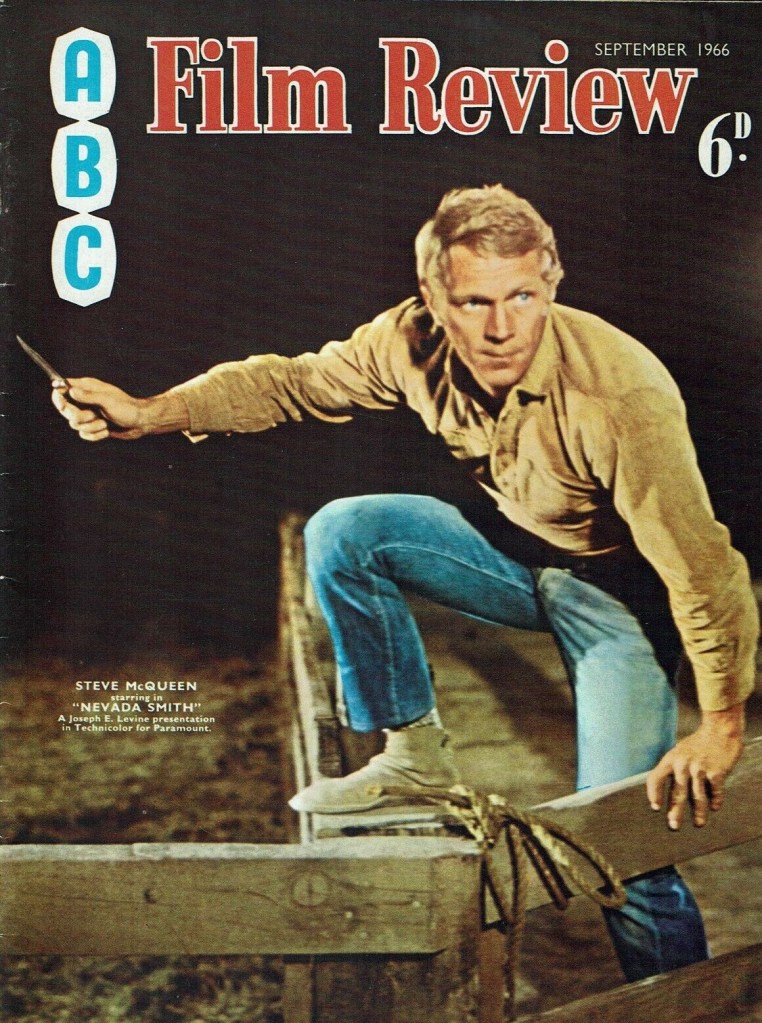
Selling Steve McQueen – Pressbook for “Nevada Smith” (1966)

Truth never stopped producer Joe Levine. Not finding in the film the requisite image to encapsulate the struggle of Nevada Smith he just invented one. The iconic poster of Steve McQueen with rifle over his shoulders did not appear in the movie. Yes, in the early part of the picture Nevada Smith trekked through the wasteland. But that was minus any weapon, unless you count the broken pistol he had found under a wrecked wagon. Naturally enough, if he did have a rifle at that point, presumably Levine surmised, that’s exactly how he would have carried it.

Levine was an unusual character even by Hollywood standards. He was pretty much the first to invent the metaverse, the extended world within which a main character revolved, having sourced Nevada Smith from the Harold Robbins bestseller The Carpetbaggers which he had turned into a blockbusting film in 1964, and by dint of picking up the story of Nevada Smith at an earlier age than in the movie created a “prologue,” better known these days as a prequel or an origin story. Better still, it was two pictures for the price of one book.

Of course, it wasn’t Levine’s idea to make a prequel, or at least that’s how the publicists spun it. “It doesn’t happen very often,” begins the Pressbook, “but it happens, a character in a motion picture intrigues the fancy of fans to such an extent that they write the producer and beg more of him. Instead of wanting to know more about this fascinating character, the public wrote in asking how this intriguing character got that way.” 

Levine took quite a different approach to marketing a movie than other producers. He tended to concentrate on one central image, creating a single core advertisement rather than, as other studios did, churning out a host of different adverts to meet the various perceived needs of exhibitors. And he also liked to fix subsidiary characters in the audience’s mind by providing nuggets of information about their personalities in the poster.

Assuming McQueen was such a big star, exhibitors didn’t need any more juicy nuggets, so the first two editorial pages of the Pressbook concentrate on everything but McQueen. And given that the star’s production company, Solar, was involved in the making, it seems McQueen was exactly of the same opinion. The biggest plug went to Henry Hathaway (The Sons of Katie Elder, 1965), “one of Hollywood’s most celebrated directors,” credited with inventing the action picture three decades before with Lives of the Bengal Lancers. But “action was never permitted to get in the way of the story which, Hathaway always insisted, was of prime interest.”

Five-time Oscar nominee Arthur Kennedy, rather than the second-billed Oscar-winner Karl Malden, came next in the promotion stakes. Kennedy epitomized the importance of a stage training for actors, borne out by the fact that, except for McQueen, all the main players received their training in the theatre. Brian Keith, however, addressed the downside of being in a long-running play. “It means you’re tied down,” he complained, “nothing to do every afternoon, can’t go anywhere or do anything, you have to keep yourself fresh for the evening.”

The Pressbook was surprisingly short on the kind of journalistic snippets that an exhibitor might feed to a local newspaper. That Suzanne Pleshette had a pathological terror of snakes, that Pat Hingle had nearly died after falling down an elevator shaft, and that Hathaway had given Karl Malden his big break were the closest the Pressbook came to anything that might interest a newspaperman.

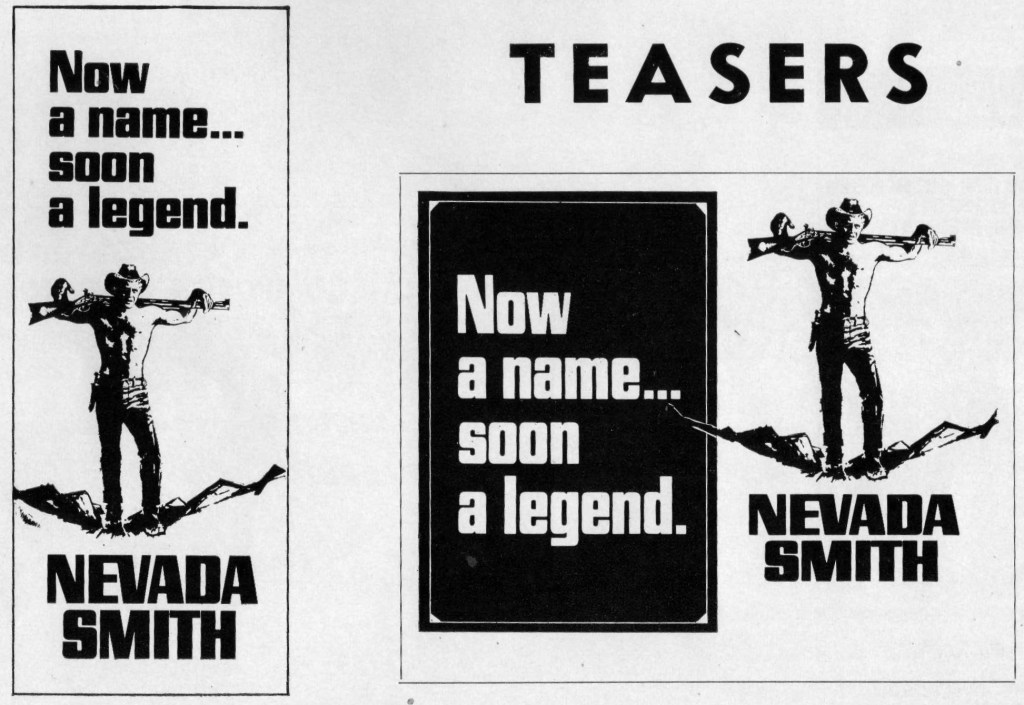
The iconic image of McQueen shouldering the rifle was mostly used on its own in teaser adverts. For the main advert, that was placed centrally above a montage of scenes from the picture and at the foot came the one-liners about the other characters. Tom Fitch (Karl Malden) was described as “he treated Nevada like a kid – then spent a lifetime regretting it” (not true as it happens). Jonas Cord (Brian Keith) – “he taught Nevada how to kill – then got out of the way.” Bowdre (Arthur Kennedy) – “the bravest man in the world with a gun – and a coward when he faces one” (not true either). Pilar (Suzanne Pleshette) – “she found Nevada in jail and he loved his way out.”

While the main advert, outside of the teasers, was the only advert, there were more taglines. And quite wordy at that. “Some call him savage – and some called him saint…some felt his hate – and one found his love…some had to run – and three had to die…and there never was another like Nevada Smith.” (Incidentally, he had two lovers, not one.) A second tagline ran: “From the California gold fields to the Louisiana bayous, he drank and killed and loved and never forgot, how to hate!”  There was a third, briefer, tagline – “Now a name…soon a legend” and that sometimes prefixed the other taglines.

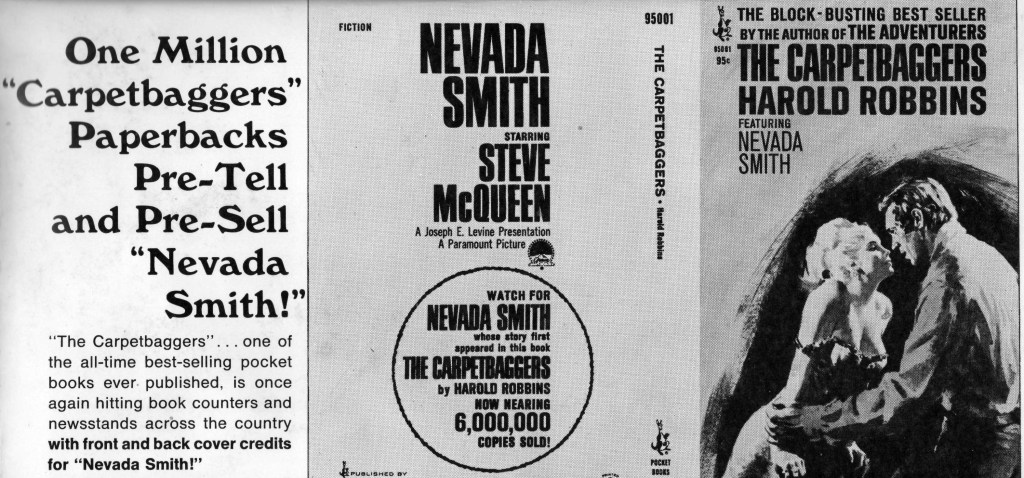
In terms of tie-ins, there was little. Possibly The Carpetbaggers had already done the work for Levine. The novel had been the biggest-selling fiction since the turn of the decade, around six million copies printed, so it was the ultimate “pre-sell” with a movie tie-in edition, front and back covers bearing testament to Nevada Smith. Pocket Books was one of the biggest publishers in the country and there were over 20,000 outlets for paperbacks including book stores, drug stores, and newsstands. Window banners, rack cards, counter displays and dump displays meant pedestrians would be passing an artillery of promotion every day.

Nevada Smith (1966) ****

Half breed Max Sand (Steve McQueen) has little truck with the notion that revenge is a dish best served cold. But he’s too young and raw, far from Lee Marvin’s callous killer in Point Blank (1969), to properly avenge the slaughter of his family by three outlaws.

This is a coming-of-age tale with a distinct difference. Max’s development includes, apart from initiation into sex of course, learning to read and write so he can make sense of signposts in order to track down the murderers and receiving tuition from gunsmith Jonas Cord (Brian Keith) so that he can at least loose off some shots without doing himself damage. Vengeance burns so deep that he even stages a bumbled robbery so he can be sent to the prison where the second of his targets is incarcerated. Now that’s dedication for you. And along the way he learns the most important lesson of all, how to live, and not destroy himself through vengeance.

Even so, all Cord’s tuition counts for nought when Max needs a knife to dispatch his first victim Coe (Martin Landau). And he’s not yet so slick with a weapon to avoid serious injury himself. Kiowa saloon girl Neesa (Janet Margolin) nurses him back to health at her tribe’s camp. They become lovers but he rejects the wisdom of the elders and the opportunity to make a life with her.

Unfortunately, Bowdre (Arthur Kennedy)  is a jailbird. And worse, held prisoner in a swamp. Probably the worst bank robbery ever committed sends Nevada there. Max enrols another woman, Cajun Pilar (Suzanne Pleshette) working in nearby rice fields – fraternisation between the jailbirds and these women permitted – to steal a boat to help him and Bowdre escape. Bowdre gets his and this time it’s Pilar who is the collateral damage.

A genuine outlaw now, Max has no trouble joining a band of robbers headed by Fitch (Karl Malden), the final prey. By now calling himself Nevada Smith, Max’s plans are thrown into confusion when it becomes apparent Fitch is aware of his true identity. A surprise ending is on the cards whichever way you cut it, and especially thrilling since it occurs during a well-planned gold bullion robbery.

It’s a film of two parts but divided into three if you like, the unusual swamp setting fitting in between two sections of more straightforward western. Though in the hands of director Henry Hathaway (True Grit, 1969), there is little that’s so straightforward given his mastery of the widescreen and his hallmark extreme long shot. He’s capable of moving from the extreme violence of the vicious murder and rape of Max’s mother to the son’s discovery of the bodies shown just through Max’s physical reaction. And there’s some irony at play, too: gold triggers slaughter and climax; mental dereliction not as feared as its physical counterpart.

Although Hathaway was a true veteran, he was not best known for westerns in the manner of John Ford, more at home with film noir (Kiss of Death, 1947), war (The Desert Fox, 1951) and big-budget pictures like Niagara (1954) with Marilyn Monroe and Legend of the Lost (1957) teaming John Wayne and Sophia Loren. In a 30-year career he had only made three westerns of note – The Trail of the Lonesome Pine (1936), Rawhide (1951) and Garden of Evil (1954). So it was something of a surprise that in the 1960s over half his output was in the western genre. And unlike Ford and Howard Hawks who stuck to the formula of action within a defined community, Hathaway tended towards films of adventure, where the main character, often of a somewhat shady disposition, wandered far and wide.

Steve McQueen (The Cincinnati Kid, 1965) carries the picture with some aplomb, moving deftly from the wet-behind-the-ears youngster to a clever and calculated killer and still retaining enough humanity to enjoy a romantic dalliance. There’s enough action here to satisfy McQueen’s fans spoiled by The Magnificent Seven (1960) and The Great Escape (1963) and for those who had come to appreciate his acting plenty to enjoy. This and The Cincinnati Kid, where perforce as a poker player, he had to do a great deal of brooding, solidified his screen persona, a star you can’t keep your eyes off, wondering what on earth is going on in his mind. As much as he’s playing a character finding his feet, this is McQueen at very nearly the top of his game.

Brian Keith (The Rare Breed, 1966) is the pick of the support, adding a little softness to his usual more hard-nosed screen characters. The villains – Karl Malden (The Cincinnati Kid), Martin Landau (The Hallelujah Trail, 1965) and Arthur Kennedy (Claudelle Inglish, 1961) – are all good in their own different ways, and in the hands of excellent actors, easily differentiated. Suzanne Pleshette (Fate is the Hunter, 1964) shines in a too-brief role.

The sterling supporting cast includes Janet Margolin (Bus Riley’s Back in Town, 1965), Pat Hingle (Sol Madrid, 1968) and Raf Vallone (The Secret Invasion, 1964). John Michael Hayes (Harlow, 1965) fashioned the screenplay from The Carpetbaggers by Harold Robbins. 

Although Hollywood had been prone to sequels – Father’s Little Dividend (1951) following Father of the Bride (1950), Return to Peyton Place (1961), Return of the Seven (1966) etc – there had been no perceived market for prequels, so this was something of a first, Alan Ladd having essayed an older and considerably more sophisticated Nevada Smith in the 1964 film of Harold Robbins bestseller. 

Discover WordPress

A daily selection of the best content published on WordPress, collected for you by humans who love to read.

The Atavist Magazine

by Brian Hannan

WordPress.com News

The latest news on WordPress.com and the WordPress community.