The Detective (1968) ****

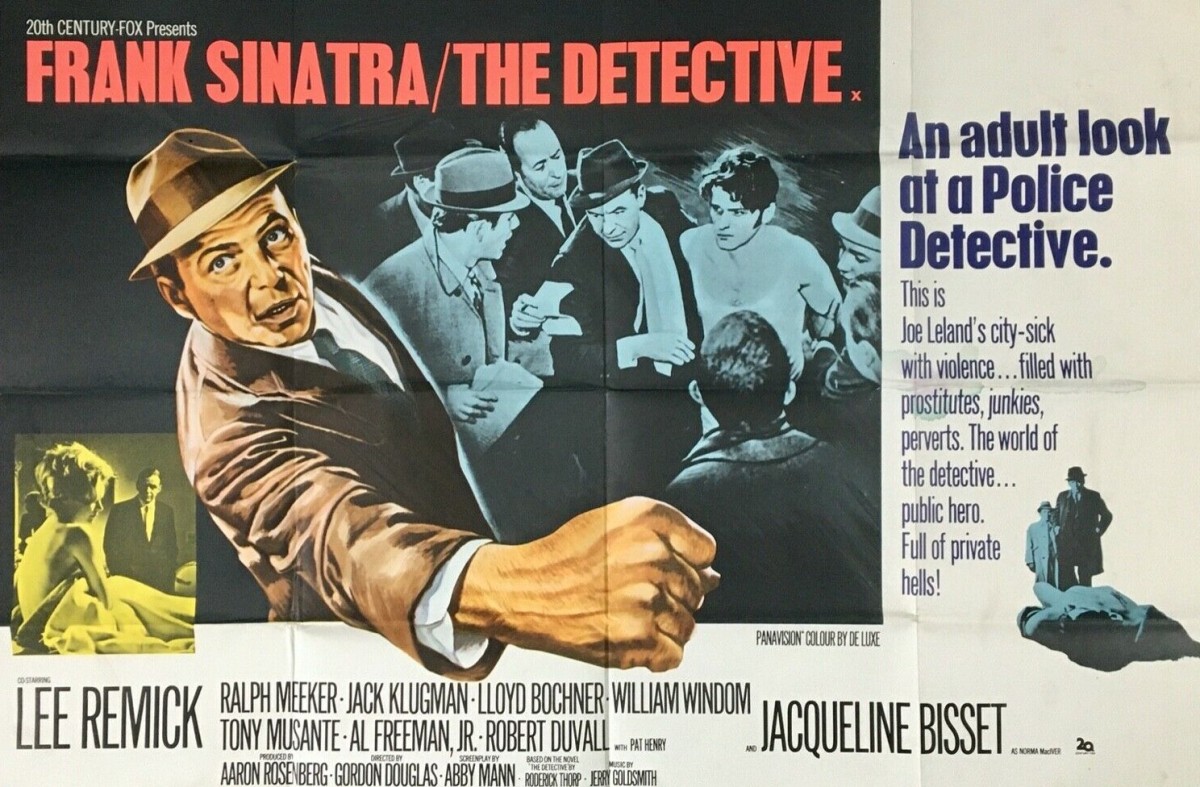
Perhaps the boldest aspect of this raw look at the seamier side of life as a New York cop is that perennial screen loverboy Frank Sinatra plays a cuckold. Prior to what is always considered the more hard-hitting cop pictures of the 1970s – Dirty Harry (1971), The French Connection (1971), Serpico (1973) etc – this touched upon just about every element of society’s underbelly. Despite an old-school treatment, more a police procedural than anything else, homosexuality, nymphomania, corruption, police brutality, and a system that ensured poverty remained endemic all fell into its maw. And, for the times, several of these issues were dealt with in often sympathetic fashion.

Joe Leland (Frank Sinatra), an ambitious but principled detective gunning for promotion, investigates the murder of a prominent homosexual while dealing with the disintegration of his marriage to Karen (Lee Remick) and colleagues on the take. When other cops want to beat confessions out of suspects or strip them naked to humiliate them, Leland intervenes to prevent further brutality. He is not just highly moral, but takes a soft approach to criminals, not just playing the “good cop” part of a good cop/bad cop double-act but genuinely showing sympathy. Not only does Leland leap to the defense of those he feels unfairly treated, but he trades punches with those meting out such treatment. In addition, he clearly feels guilt over sending to the electric chair a man he believes should be treated in a mental institution.

Although at first glance this appears a homophobic picture, it is anything but, Leland showing tremendous sympathy towards homosexual suspect Felix (Tony Musante) – whom his  colleagues clearly despise – to the extent of holding his hand and gently cajoling him through an interview. Later, rather than condemn a bisexual the film shows empathy for his torment. Certainly, some of the attitudes will appear dated, especially the idea of sexual expression as a brand of deviancy, but the film takes a genuinely even-handed approach. Through the medium of Leland’s perspective, it is clearly demonstrated that it is other police officers who have the warped notions.  

Having solved the first murder, Leland takes up the case of an apparent suicide at the behest of widow Norma McIver (Jacqueline Bisset), only for this to lead not only to civic corruption on a large scale but back to the original investigation. Leland also has a wider social perspective than most cops and there is a terrific scene where he berates civic authorities for creating a system that perpetuates poverty. The ending, too, casts new light on Leland’s  character.

By this point, most screen cops were defined by their alcoholism and ruined domestic lives, but this is altogether a more tender portrait of an honest cop. Leland’s relationship with Karen is exceptionally well done. Normally, of course, it is the man who usually strays. This reversal in the infidelity stakes adds a new element. Karen has more in common with an independent woman like the Faye Dunaway character in The Arrangement (1969).

While playing the good cop would come relatively easy to an actor like Sinatra, carrying off the role of the hurt husband is a much tougher ask. Coupled with his sensitive approach to criminals, this is acting of some distinction, a mature performance by a mature star.  This is the last great Hollywood role by Lee Remick (No Way to Treat a Lady, 1968) and she brilliantly portrays a woman trapped by her self-destructive desires.

Jacqueline Bisset (Bullitt, 1969) leads an excellent supporting cast that includes Jack Klugman (The Split, 1968), Ralph Meeker (The Dirty Dozen, 1967), Robert Duvall (The Godfather, 1972), Lloyd Bochner (Point Blank, 1967) and Al Freeman Jr. (Dutchman, 1966).

While Gordon Douglas (Claudelle Inglish, 1961, and Tony Rome, 1967) was viewed very much as a journeyman director, he brings an inventive approach and some surprising subtleties to the picture. He opens with a very audacious shot. It looks like you are seeing skyscrapers upside down, as if a Christopher Nolan sensibility had entered a time warp, until you realize it is the city reflected off a car roof. There are some bold compositions, often with Sinatra appearing below Remick’s sightline, rather than the normal notion that the star must be taller or at least the same height as everyone else.

Oscar-winning Abby Mann (The Judgement at Nuremberg, 1961) adapted the bestseller by Roderick Thorp who achieved greater fame much later for writing the source novel for Die Hard (1988) – Nothing Lasts Forever, a sequel to The Detective. For the Bruce Willis film Joe Leland became John McClane. Sinatra, although 73 at the time, was offered that role first as part of his original contract for The Detective.

In The Detective Sinatra’s wife Mia Farrow was initially contracted to play the part of Norma McIver but pulled out when Rosemary’s Baby (1968) overshot its schedule. Partly in revenge, Sinatra sued her for divorce.
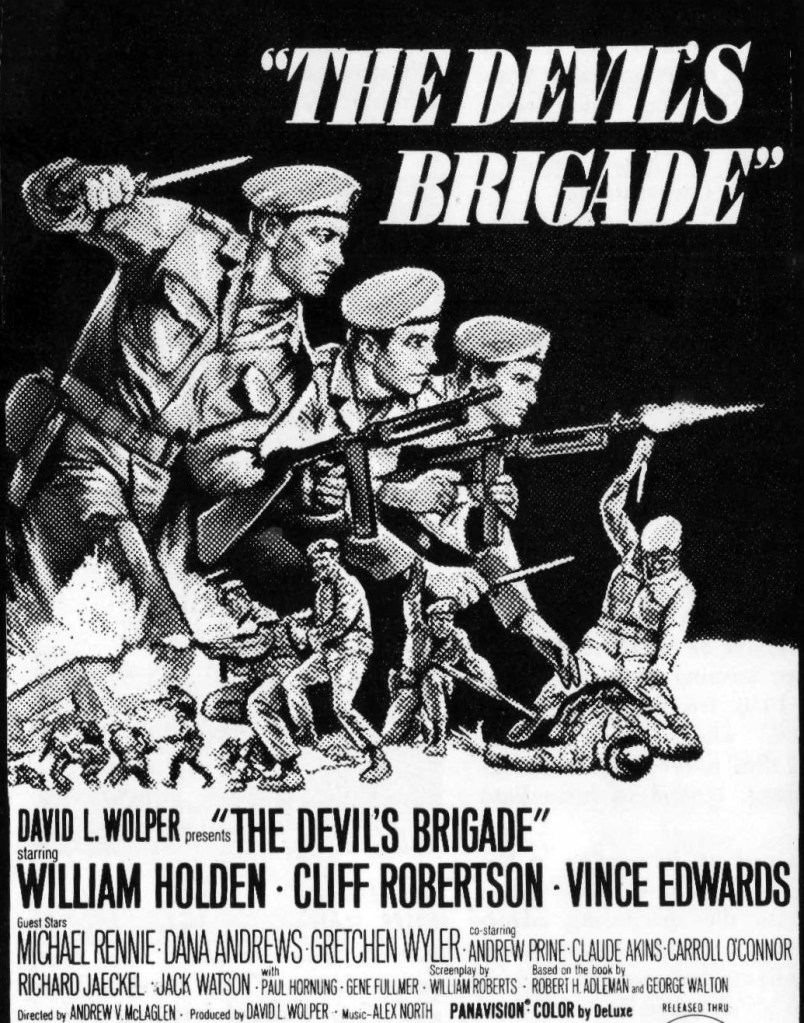
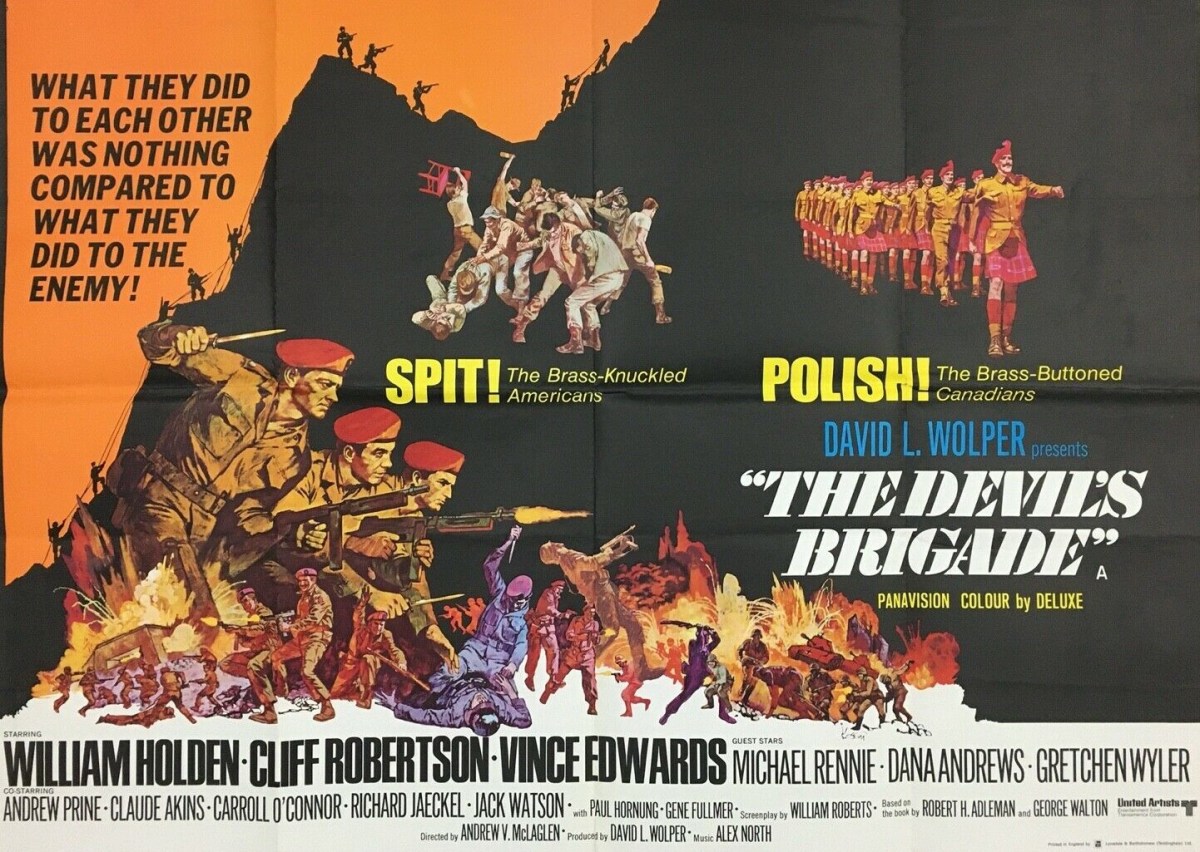
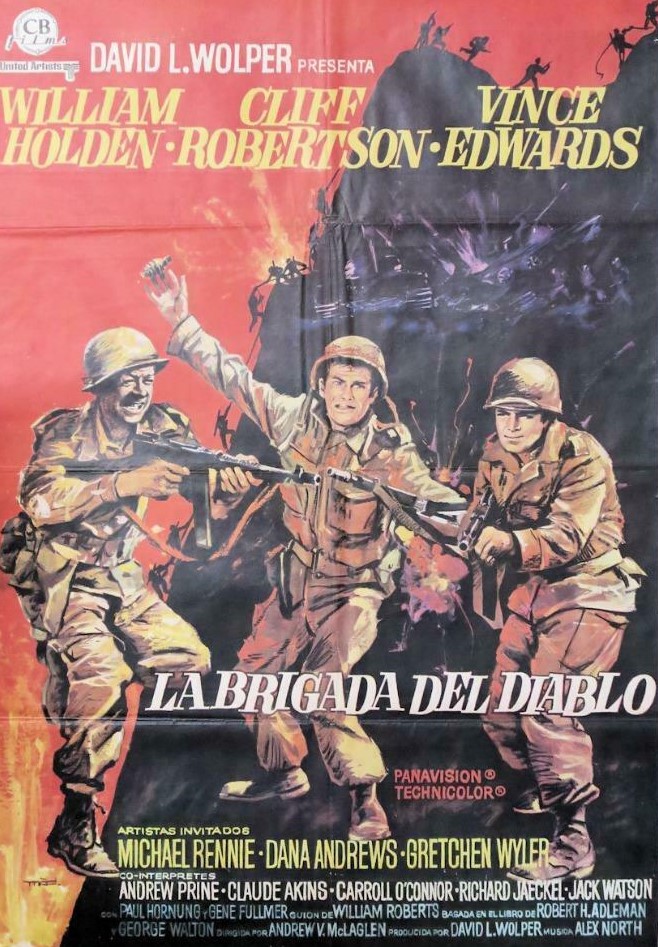
Selling War – The Pressbook for “The Devil’s Brigade” (1968)

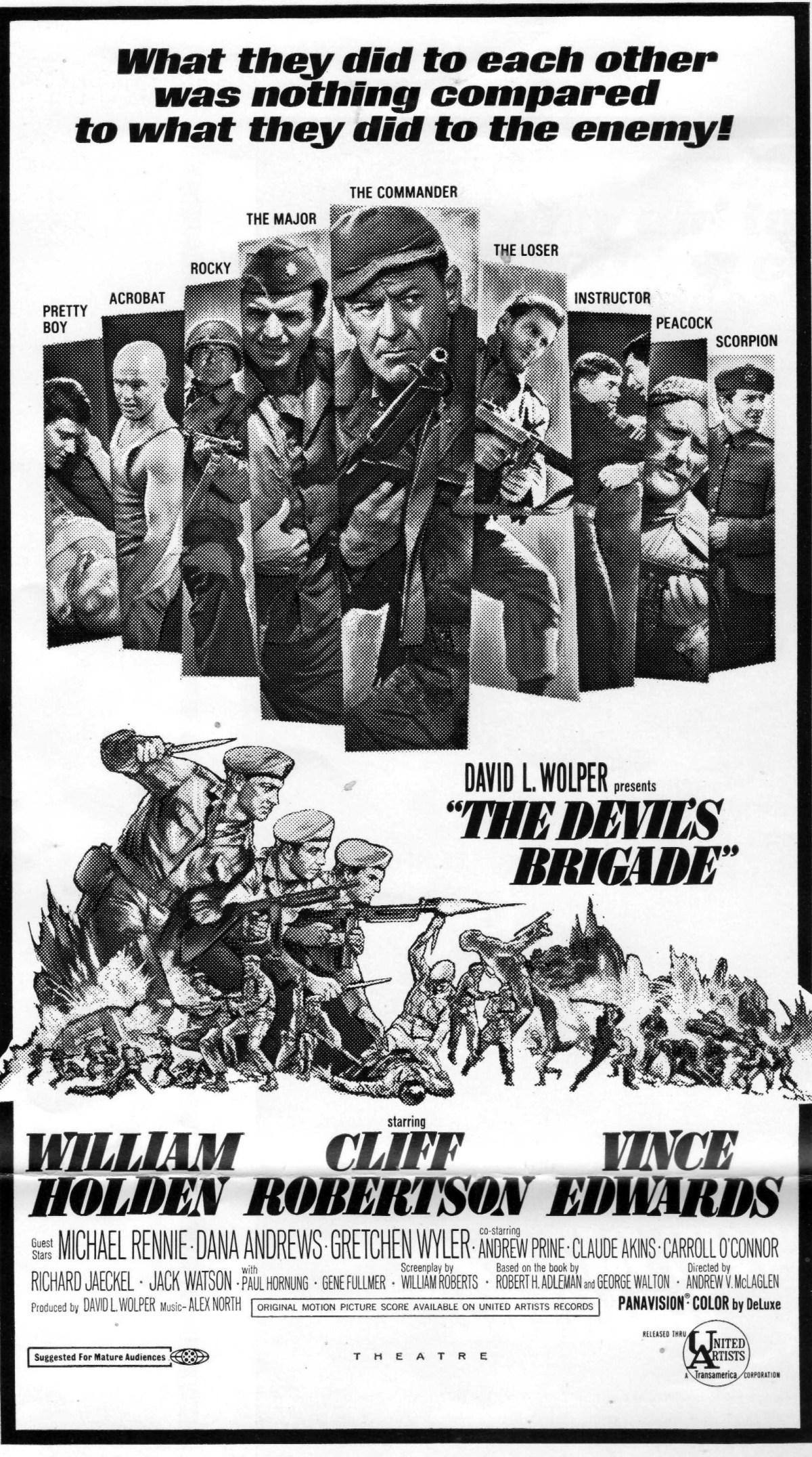
This was an extremely unusual Pressbook for the 1960s. For a start with one minor exception there was only one advertisement. In the 1960s it was traditional for studios to provide upwards of five or six separate ads so that exhibitors could display the one most appropriate for their audience – that could mean, for example, that a tough western focused on the leading lady because an exhibitor wanted to appeal to female customers for a film that would fairly straightforwardly appeal to the male clientele simply because of its genre. Joseph E. Levine had broken this rule for Nevada Smith (1965), but he was an experienced producer not someone making his first movie.

But producer David L. Wolper went with the one image repeated over and over in different sizes – the varying sizes mattered because to make up an advertisement in a newspaper an exhibitor simply cut out the relevant advert from the Pressbook and took it down to their local newspaper. However, it was an an unusual advert in one sense in that it was a composite, an attempt to sell the two separate parts of the film, a first section that related to training and the cultural differences between the American and Canadian troops, and the second concerning the war where battle illustration was the priority.

Smaller advert taken from a section of the main advert.

Again, when studios invested in several advertisements, the marketing team came up with a fair number of taglines. Here, that idea goes out the window.  The sole advert contained only three taglines – “What they did to each other was nothing compared to what they did to the enemy” / “Spit! The brass-knuckled Americans” / “Polish! The brass-buttoned Canadians.”

And that was it, ten adverts of differing sizes, all with the same three taglines. Some other adverts minus the taglines but incorporating the action illustrations from the main image were available in smaller sizes.

The one exception kept some of the action material but topped it with details of the characters above their photos i.e. “The major. He keeps rattlesnakes for pets.” / “The loser. Last time he led was Dunkirk” / “The Commander. Creator of the Brigade – a madman or a genius!” For whatever reason, the actors’ names were omitted, so it was possibly pot luck whether audiences recognised, Vince Edwards, Cliff Robertson and William Holden, respectively. There were nine characters featured in this collage, so it was possibly an attempt to humanise the picture which was otherwise sold on conflict.

As the Pressbook pointed out, Wolper was an innovator. But thus far that had been restricted to television where he was “called by many TV’s most skilful producer of documentaries” with over 250 credits to his name including The Legend of Marilyn Monroe (1965), Hollywood: The Golden Years (1961), The Making of a President: 1964 (1966), The Incredible World of James Bond (1965) and his debut The Race for Space (1959). His biggest claim to fame had actually been a financial one, going direct to sponsors for funding raher than relying on broadcast companies. 

Since adverts hogged the Pressbook, other marketing material was scant. That Vince Edwards had begun his career as a lifeguard, that William Holden had business interests in four continents and that screenwriter William Roberts had been responsible for The Magnificent Seven (1960) was hardly likely to stimulate into action editors of the entertainment sections looking for nuggets to promote the film. While there was a tiny bit of information about locations and the origins of The Devil’s Brigade outfit, Wolper saw fit to note that the unit was the fore-runner of The Green Berets all the time as the film had the men, erroneously, wearing red berets.

In terms of exploitation ideas for exhibitors the sole advice was to contact former members of the brigade for publicity purposes. Otherwise there was a Bantam paperback movie tie-in, an album of the Alex North soundtrack and single of the film’s march played by a group called The Devil’s Brigade.

Wolper may have gone an innovation too far with his restricted approach to marketing but he did become a movie and television producer of some distinction, behind such films as L.A. Confidential (1997), The Bridge at Remagen (1968), Willie Wonka and The Chocolate Factory (1971) and television shows like Roots (1977), The Thorn Birds (1983) and North and South (1985).

The Devil’s Brigade (1968) ***

I couldn’t get my head around the idea of the U.S. Army recruiting a bunch of undisciplined misfits, many with jail time, in order to link them up with a crack Canadian outfit. Turns out this part of the film was fictional, the Americans in reality responding to advertisements at Army posts which prioritized men previously employed as forest rangers, game wardens, lumberjacks and the like which made sense since the original mission was mountainous Norway.  I should also point out the red beret the soldiers wear is also fictional and while depicted on the poster sporting a moustache commanding officer Lt. Col. Frederick (William Holden) is minus facial hair in the film.

But, basically, it follows a similar formula to The Dirty Dozen (1967), training and internal conflict followed by a dangerous mission. The conflict comes from a clash of cultures between spit-and-polish Canucks and disorderly/juvenile Yanks though, as with the Robert Aldrich epic, the leader taking some of the brunt of the discontent.  Collapsible bunk beds, snakes under the sheets and a tendency to fisticuffs are the extent of the antipathy between the units, which is all resolved, as with The Dirty Dozen, when they have to take on people they jointly hate, in this case local bar-room brawlers in Utah.

The movie picks up once they are sent to Italy. Initially employed on reconnaissance, Frederick challenges Major-General Hunter (Carroll O’Connor) who wants to do things by the book and sets out to take an Italian position by trekking two miles up a riverbed, creeping into town by stealth and capturing the location without firing a shot. 

Next up is the impregnable Monte la Difensa. Taking a leaf out of the Lawrence of Arabia playbook, in a brilliant tactical move, the Americans attack the mountainous stronghold from the rear by way of a mile-high cliff.  But that’s the easy part. The rest is trench-by-trench, pillbox-by-pillbox, brutal hand-to-hand fighting.

The battle scenes are excellent and the training section would be perfectly acceptable except for the high bar set by The Dirty Dozen. That said, there is enough going on with the various shenanigans to keep up the interest, but we don’t get to know the characters as intimately as in The Dirty Dozen and there is certainly nobody in the supporting cast to match the likes of Telly Savalas, Charles Bronson, Jim Brown and John Cassavetes. That also said, the men do bond sufficiently for some emotional moments during the final battle.

At this point William Holden’s career was in disarray, just one leading role (Alvarez Kelly, 1966) and a cameo (Casino Royale, 1967) in four years, and although his screen persona was more charming maverick than disciplined leader he carries off the role well, especially solid when confronting superiors, exhibiting the world-weariness that would a year later in The Wild Bunch put him back on top. Ironically, Cliff Robertson was coming to a peak and would follow his role as the strict disciplinarian Major Crown, the Canadian chief, with an Oscar-winning turn as Charly (1968). Vince Edwards (Hammerhead, 1968) as cigar-chomping hustler Major Bricker makes an ill-advised attempt to steal scenes.

This was the kind of film where the supporting cast were jockeying for a breakout role that would rocket them up the Hollywood food chain – as it did with The Dirty Dozen. Jack Watson (Tobruk, 1967) is the pick among the supporting cast, but he has plenty of competition from Richard Jaeckel (The Dirty Dozen), Claude Akins (Waterhole 3, 1967), Jeremy Slate (The Born Losers, 1967), Andrew Prine (Texas Across the River, 1966), Tom Stern (Angels from Hell, 1968) and Luke Askew (Cool Hand Luke, 1967). Veterans in tow include Dana Andrews (The Satan Bug, 1965) and Michael Rennie (Hotel, 1966).

William Roberts (The Magnificent Seven, 1960) adapted the bestselling book by Robert H. Ableman and George Walton. Director Andrew V. McLaglen (Shenandoah, 1965) was more at home with the western and although there are some fine sequences and the battle scenes are well done this lacks the instinctive touch of some of his other films.

The Last Duel (2021) **** – Seen at the Cinema

A surprisingly contemporary core, bolstered by a quartet of excellent performances, drives Ridley Scott’s bold Rashomon-style historical tale. Despite its length it’s less of a historical epic in the style of Gladiator (1999) and more of an intimate and intricate exploration of power – and its lack. Each of the main characters, including and especially the women, while exerting some kind of power nonetheless are in thrall to a superior being whose word is absolute law. Challenging that authority could result in instant death. It’s a slow-burn for sure but exerts a tenacious grip as the story unfolds from three points-of-view to a double climax, both riveting for different reasons.   

And it’s far from typical Ridley Scott except in attention to historical detail. The battle scenes are almost perfunctory – in fact few end in victory – and except to demonstrate bravery do not follow the usual heroic template. There’s none of the trademark Scott cinematic sweep although the duel itself is exceptional.

Scarred to the point of facial disfigurement Damon has never played a character like this before.

In 14th century France Marguerite (Jodie Comer), wife of Sir Jean de Carrouges (Matt Damon), accuses Jacques Le Gris (Adam Driver) of rape, the accusation finally settled by duel to the death. All three characters are given the chance to give their version of the story and this is where it becomes fascinating as shades of personality are filled in.

At the outset Jean comes across as brave, impulsive, marrying Marguerite to save her honour (her father is a traitor), and when wronged willing to challenge authority. But as other perspectives unfold he is revealed as blustering, ambitious, more interested in his wife’s sizeable dowry than her honour, over-proud, and a poor manager of his estate. While brave, educated and charming Le Gris turns out to be a greedy, conniving bed-hopper. Initially presented as a grateful wife and little more than an adornment Marguerite is revealed as the most courageous of all, an able estate manager, challenging the King, accepting the prospect of death rather than, as was apparently the custom of the times, allowing the rape to go unremarked.

Comer is a revelation and you could argue she steals the picture from her more experienced colleagues. There is an astonishing scene where she realises that, her husband’s bravery notwithstanding, he has condemned her to a terrible death should he lose the duel.

The sexual mores of the era are examined in depth, the worst examples of male prerogative sometimes just touched upon in passing, for example, since a wife is her husband’s property, in law he is the one besmirched not her. In taking sexual power as his central theme rather than the triumphs and woes of the men, Scott takes a huge risk in alienating a following expecting more action and cinematic bravura, but the bold story-telling pays off and although starting with Alien (1979) the director has a record of strong female characters this has more in common with Thelma and Louise (1991) where wronged women are backed up into a cul de sac.

Rejecting the heroism route allows Scott to present far more rounded characters. None of the four principals conforms to type. Damon is neither the common man nor the action hero, but a boor. Driver is neither charming seducer nor outright villain but somewhere in between, living on his wits. Comer cannot rely on female machismo or cleverness but must remain stout in the face of an onslaught of humiliation. And mention must be made of Ben Affleck as Pierre d’Alencon, employer of Le Gris and master of Carrouges, who is cocky, immoral, amoral, greedy, shifty and cunning. Other standout performances feature Alex Lawther (The Imitation Game, 2014) as a gleeful king and Harriet Walter (Atonement, 2007) as a loathsome and cruel mother-in-law. I just hope Oscar voters recognise at least some of these perfomances.

A blond and goateed Affleck as you have never seen him before, cockiness running riot, with a mean streak a mile wide, the epitome of Middle Ages entitlement.

It’s worth paying attention to the screenplay by Nicole Holofcener (Oscar-nominated for Can You Ever Forgive Me, 2018) and Damon and Affleck (their first joint effort since Good Will Hunting, 1997) and note how the language the characters employ changes according to the perspective. Words that we imagine in one section that appear to be spoken by one character in another section are delivered by someone else entirely.

I am a huge fan of Ridley Scott and while I came looking for adventure in the style of Gladiator (2000) or his other historical masterpiece Kingdom of Heaven (2005) I came away more than satisfied in the way he altered his style to suit the story almost in the same manner as he had done with American Gangster (2007), another picture about power.

You will probably be aware by now that this has been a colossal box office bomb and although the film has enormous merit you can see why audiences looked the other way. Oddly enough, I think it will acquire a bigger audience through small-screen streaming since it is really a drama.  I would still recommend catching it at the cinema but there’s fair chance it will not last for its full 45-day window.

I tend to judge directors not by critical acclaim but by a more rudimentary measure – how often I watch their pictures. I have seen Alien, Blade Runner (1982), Thelma and Louise, Gladiator, Kingdom of Heaven, American Gangster, the Martian (2015)  and even the flawed Prometheus (2012) and Black Hawk Down (2001) more than half a dozen times each – often three or four times at the cinema – and I have a notion that The Last Duel will comfortably fit into this elite.

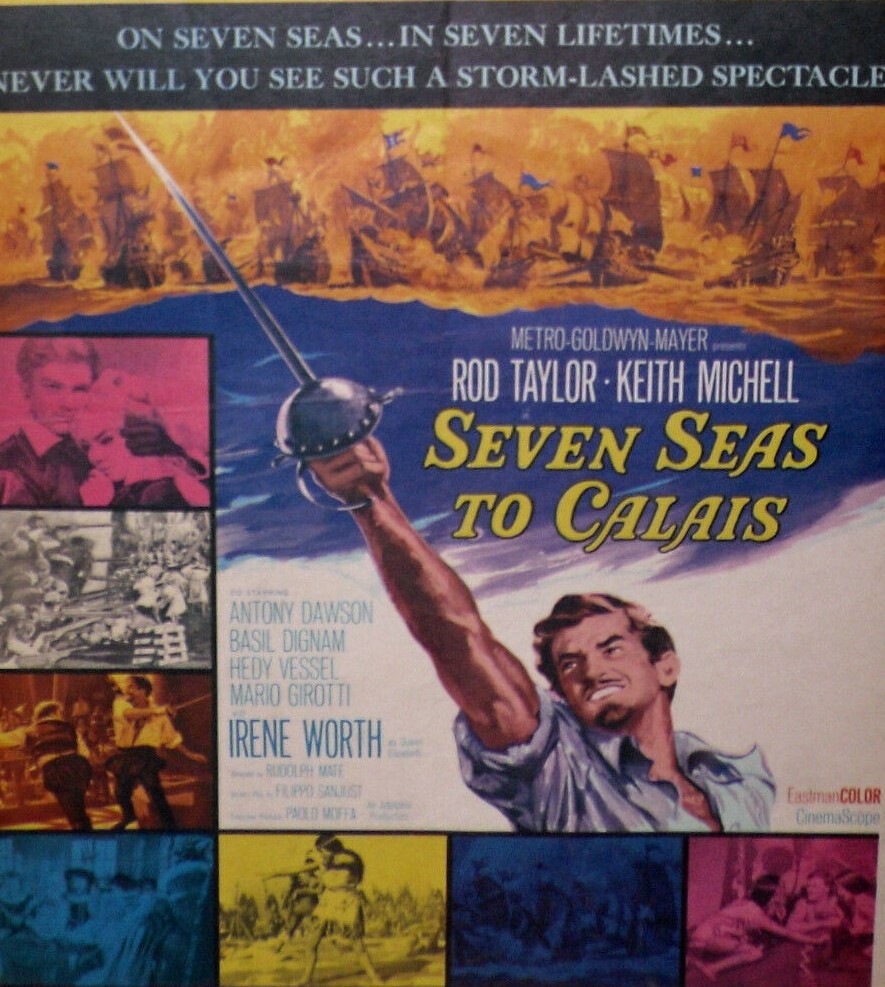
Seven Seas to Calais (1962) ***

In between hi-hat Hollywood endeavors The Time Machine (1960) and The Birds (1963) Rod Taylor made a couple of pit stops in Italy. Here, he tries his hand at a swashbuckler and does a pretty good job of it, depicting famed English naval hero Sir Francis Drake, in a story that covers about a dozen years from him circumnavigating the globe to masterminding the defeat of the Spanish Armada in 1588.

Not content with glorifying tales of his derring-do as he robs the Spanish of their gold, the producers also mine a rich seam of political intrigue as the Spanish King Philip II seeks to nullify the English threat first by a treaty and then by conspiracy before embarking on full-blown invasion. Queen Elizabeth (Irene Worth) proves a political maestro, telling the Spanish what they want to believe and condemning Drake’s activities in public while in fact privately financing his expedition and relying on his booty to fund her navy.  

After putting down a potential mutiny, most of Drake’s time is spent plundering Spanish galleons or gold mines. When not pillaging, Drake takes time out from his adventures to discover potato and tobacco and for a romantic dalliance with what appear to be Native Americans (judging from the feathers they wear) including a young woman called Potato (Rossella D’Aquino). It is left to his number two Malcolm Marsh (Keith Michell) to carry the main subplot which has French beauty Arabella (Edy Vessel) in his absence taking up with Babington (Terence Hill), a traitor with an eye to freeing the imprisoned Mary, Queen of Scots (Esmeralda Ruspoli).

There are more than enough swordfights for purists and Drake employs a certain amount of cunning and bravado in his various piratical enterprises. Clever filming makes the ships look realistic enough, though in long shot they do resemble toys. In making it look as though Drake has returned from his voyage in the nick of time to save Elizabeth from the Spanish aggressors, the producers neatly kaleidoscope the actual time frame. Elizabeth takes no prisoners and there are spicy exchanges between the queen and the pirate.

Rod Taylor presents a more muscular and athletic screen persona than in any of his previous pictures and his presence exudes authority but he also has that lightness of tone that would become a trademark. However, American stage actress Irene Worth just about plays him off the screen, her regal bearing hiding an agile mind.  Keith Michell (The Hellfire Club, 1961) makes a strong impression as does future spaghetti western star Terence Hill, (They Call Me Trinity, 1970) credited here as Mario Girotti. Edy Vessel (The Thief of Baghdad, 1961) only made two more films, although one was Fellini’s (1963). This was the second film outing after Antonioni’s L’Avventura (1960) for Esmeralda Ruspoli

Strangely enough, given the part Drake played in English history, he has been dealt a poor hand in the movies. A British television series Sir Francis Drake (1961-1962) starring Terence Morgan was unlikely to have instigated this picture so it is odd to rely on Italy for the only picture, regardless of its veracity.

In the portfolio of veteran director Rudolph Mate (When Worlds Collide, 1951), this immediately followed on from The 300 Spartans (1962) but lacks that film’s rigor and vigor. The script was dreamt up by Filippo Sanjust (also Morgan the Pirate).

CATCH-UP: Rod Taylor pictures reviewed in the Blog are The Liquidator (1965), The Glass Bottom Boat (1966), Hotel (1967) and Dark of the Sun (1968).

When Alistair MacLean Quit – “The Satan Bug” (1965)

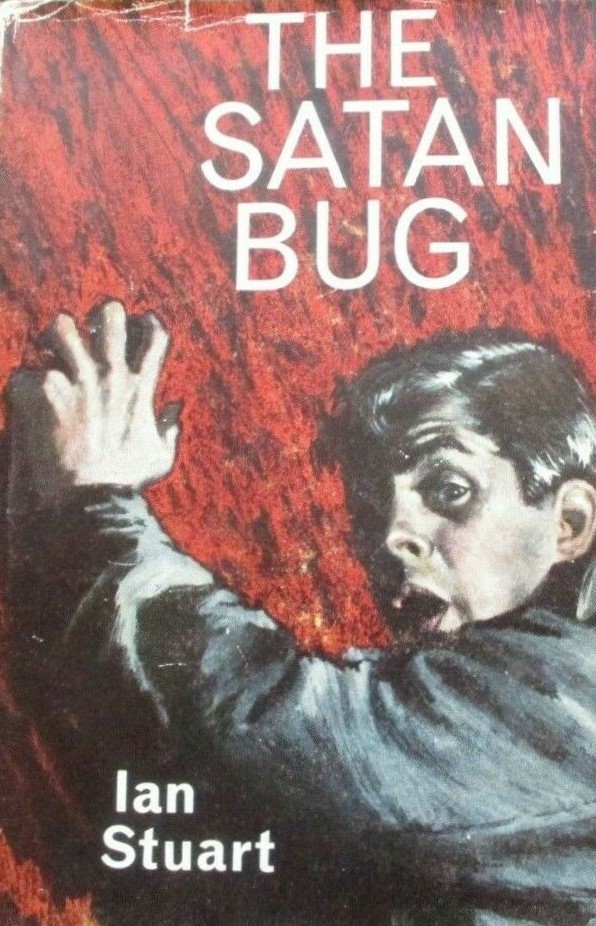
Scrolling down the credits for The Satan Bug (1965) you might have been surprised to discover that the film was based not on a book by Alistair MacLean but by one Ian Stuart. Yes, this turned out to be a pseudonym but you might be asking yourself why on earth did a world-famous thriller writer need to employ a pseudonym.

Pseudonyms were generally used for two reasons, and most often in genre fiction. Firstly, they were utilized by authors who were far from world-famous and needed to churn out four or five books a year to make a living. In those days only the likes of Agatha Christie or Simenon could get away with producing three or four books annually without the public getting fed up with their output. Long before the likes of the prolific Danielle Steel or James Patterson showed publishers that the public would devour anything they produced, it was considered ruinous to your career to be seen to be turning out more than one book a year.

Salvatore Lombino wrote under the pseudonyms of Ed McBain (the 87th Precinct series), Evan Hunter (The Blackboard Jungle etc), Richard Marsten, and Hunt Collins. Most famous under his own name, British author John Creasey (The Toff series) had 27 pseudonyms including J.J. Marric (the Gideon books) and Anthony Morton (The Baron series) as well as a number of different names for his westerns and romances.  A famous author wanting to dip a toe into a new genre was the other common reason a pseudonym came into play, the outstanding recent example being J.K. Rowling who turned to crime under the name of Robert Galbraith.

Alistair MacLean fell into neither of these categories. An unexpected success, the Scottish schoolteacher hit the jackpot with his debut HMS Ulysses in 1955, a straightforward war novel, and two years later bestseller The Guns of Navarone which was turned into a movie. He followed up with another four thrillers in four years under his own name, the last being Fear Is the Key (1961).

The reissued 1969 hardback while retaining the Ian Stuart name on the cover
links the book to Alistair Maclean in the inside flap.

By this point, MacLean, a somewhat touchy individual, had become exceedingly annoyed at the treatment his manuscripts received at the hands of his publisher Collins. In particular, he was often taken to task by editors for making simple errors like confusing “of” with “off.” But more importantly, editors treated his books as if they should be met with a rejection slip – in fact it was strongly suggested that the author set aside his third book South by Java Head in favor of something else – rather than slung out to an adoring public. As his biographer Jack Webster put it, he felt “very much like a pupil under severe pressure from a master.” It would have been humiliating for an English teacher to be told off for his use of English. The editors also complained there were too many incidents which made the books hard to read rather than enrapturing the reader.

While no doubt every author gets picked up for momentary lapses or for elements of the story that need reconsideration, it was clear to MacLean that his publishers were taking a very snobbish attitude to his output rather than falling over themselves to have in their possession such a cash cow. MacLean also felt that his books only sold so well because his name was attached. Every book was “by the author of HMS Ulysses” or, after the fantastic success of the movie, “by the author of The Guns of Navarone.” He was beginning to feel more of a unwelcome commodity than a cherished asset. And he had already made so much money from his millions of books sales and additional revenues from film studios -£30,000 for HMS Ulysses for example – that he did not need to listen to his publishers.

In fact, matters had come to a head with Fear Is the Key (1961), his least successful book. Clearly this provided his enemies in the publishing house with the opportunity to gloat and to attempt to force him to listen to their superior wisdom and toe their line But for MacLean Fear Is the Key was an experiment, a deliberate change of writing style. “What I’m trying to do is develop a technique of completely impersonal story-telling in the first person”  – in essence the reader would see action unfold as if through the eye of a camera. His publishers, who appeared to view sales as the only measure of a book’s success, felt otherwise. After one too many clashes with the Collins hierarchy, he took himself off to renowned agent Curtis Brown who welcomed him with open arms and none of the niggling that marked his dealings with the publishers. While Collins would remain his British publisher, Curtis Brown took on the task of invigorating foreign rights.

Having snared what they expected was a golden goose, you can imagine Curtis Brown’s astonishment on being told that the first book they were to sell under this new deal would not bear the name of Alistair MacLean. It would be by an unknown author – Ian Stuart. The Dark Crusader (retitled The Black Shrike for U.S. readers) was set in Australia and concerned a hunt for missing scientists. Never mind previous antipathy between author and publisher, Collins hated this book, complaining about over-complicated plot, boring characters, and improbable action. It was “a thoroughly bad book.” MacLean was incensed: “If the book is as bad as you say and you obviously lack faith in it, can you genuinely imagine that I believe you will honestly and sincerely get behind it in promotion, publishing and selling?”

Desperate to retain the author and hoping that this experiment would be short-lived, especially if sales showed a marked downturn from the MacLean books, Collins agreed to publish it. Naturally, the only way to ensure that it reached any kind of sales peak rather than vanish into the chasms of oblivion that faced most new authors, Collins gave the book “by a new author” a heavy publicity campaign. The poorer sales did not dampen MacLean’s ardour for his pseudonym and he went to produce The Satan Bug by Ian Stuart, his faith in his decision justified when a Hollywood director of the caliber of John Sturges (The Magnificent Seven, 1960), clearly seeing far greater potential in the novel than the publishers, snapped it up for production.

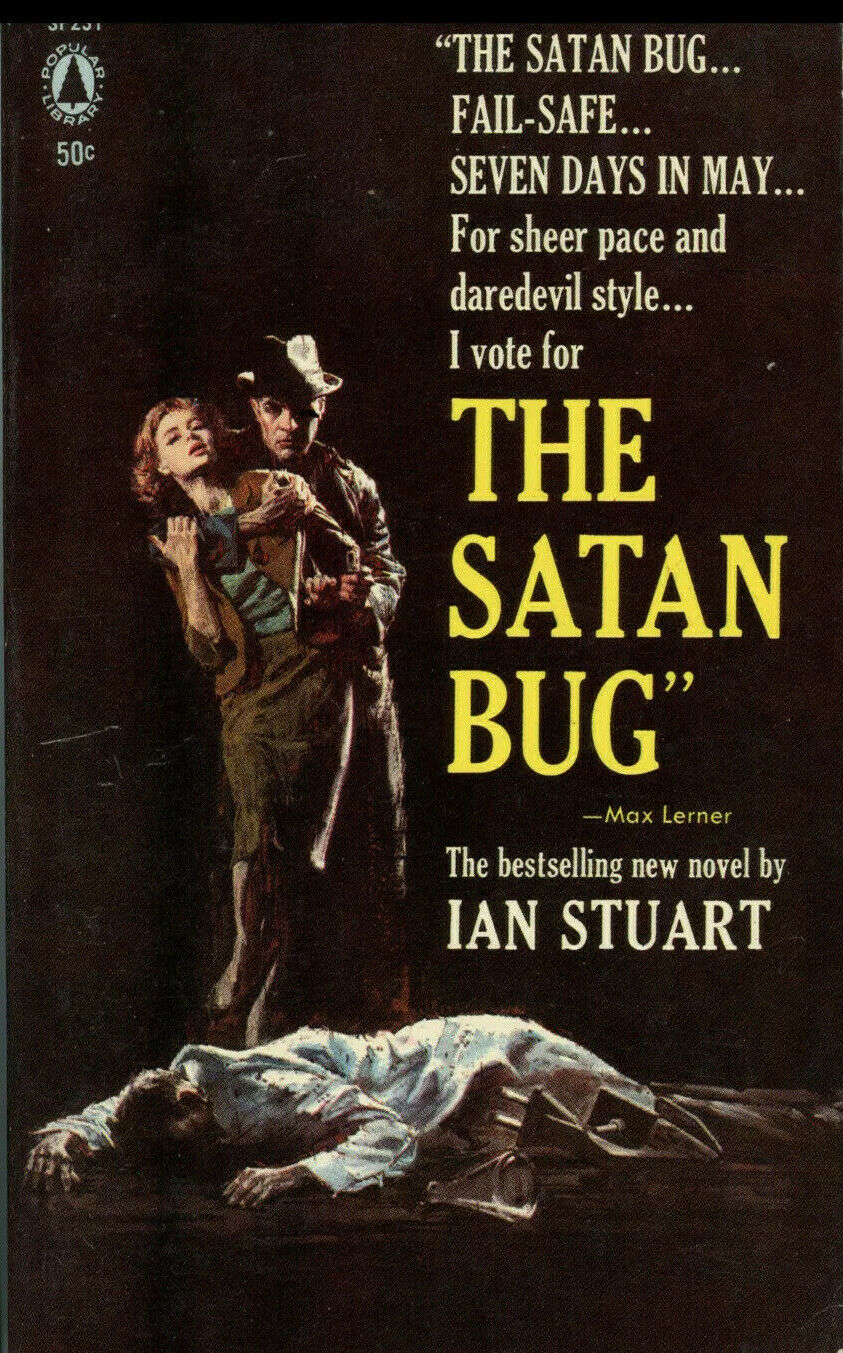
The rule breaker – the back cover of the 1962 U.S. paperback gives the game away and clearly, judging by the quote from King Features, the true author’s identity must have been in the public domain.

Myth has it that both The Dark Crusader and The Satan Bug played by the rules laid down by the author. But that did not turn out to be the case. The paperback edition of The Satan Bug published by Popular Library in 1962 on the back cover reveals the true author. In any case in due course the book was reissued under the MacLean moniker and is a far better example of the cinematic style the author was attempting to achieve than The Dark Crusader and became the template for his later books.

But, as it turned out, this was not the first time that Alistair MacLean would go on strike.

Catch Up: movies made from Alistair MacLean novels featuring in the Blog are The Guns of Navarone (1961), The Secret Ways (1961) and The Satan Bug (1965).

SOURCESAlistair MacLean by Jack Webster (Chapmans Publishing, 1962, paperback edition), pages 73, 89-90, 94-96, 112-117.  

Jason and the Argonauts (1963) *****

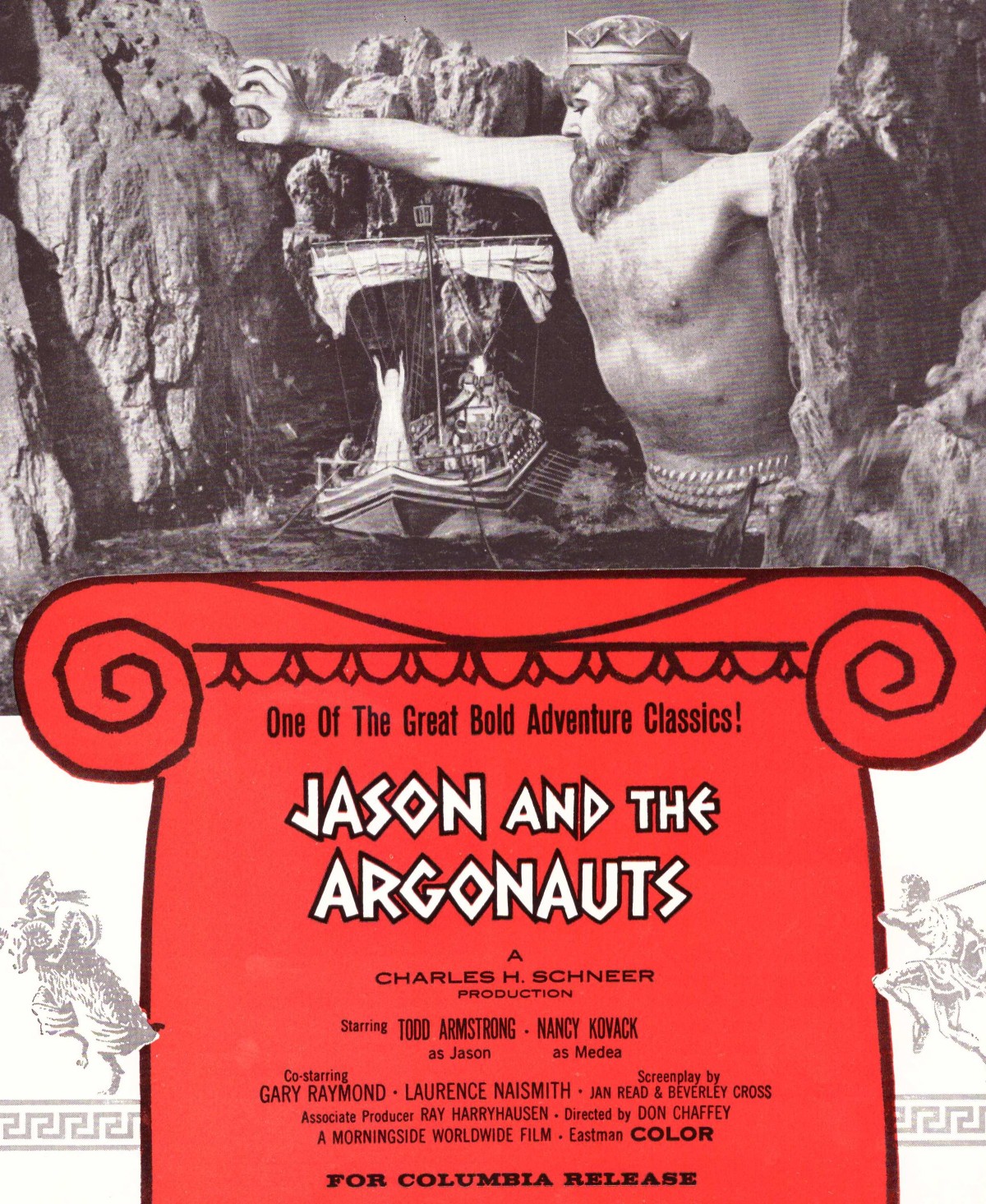
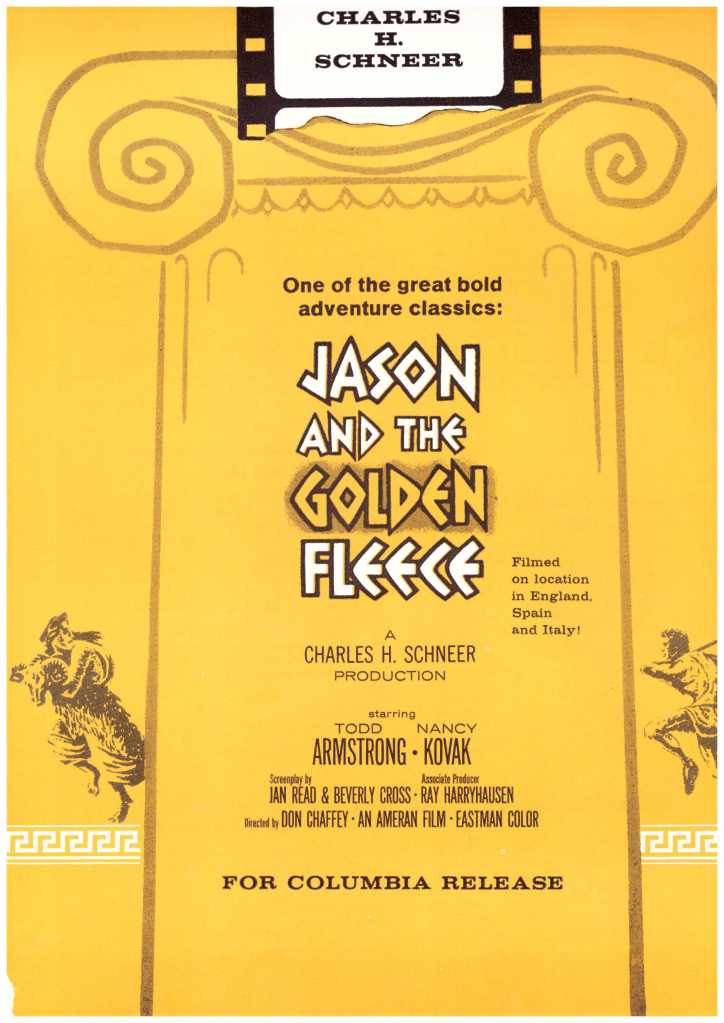
An absolute delight, great storytelling married to groundbreaking special effects produces an adventure picture of the highest order. Though mostly known for its Ray Harryhausen stop-motion animation, its success also relied heavily on the direction of Don Chaffey (The Viking Queen, 1967) and a great script. It’s one of the few films to benefit from not being viewed in its original size, the small screen minimizing the flaws of the special effects. In essence it’s a combination of three genres – the Italian peplum, the men-on-a-mission picture and the classic detective story. it was originally entitled Jason and the Golden Fleece (see below).

Plus there are interesting stabs at philosophy – if man refuses to believe in the gods do they cease to exist? And if the golden fleece brings peace and prosperity to a nation what will happen to that country when it is stolen?  And if various people can call on their own gods for help will that not create conflict in heaven as much as on earth? And the ultimately question – what can man achieve without celestial interference?

While the episodic structure derives from the clues meted out piecemeal to hero Jason (Todd Armstrong) during his long voyage to find the golden fleece these often come minus vital pieces of information ensuring that surprise remains a key element.

Without doubt the special effects are the triumph, although some work better than others. The highlights for me were the towering bronze statue of Talos and the skeleton warriors. I can’t be the only one who thinks that some of the visuals in Game of Thrones were inspired by the sight of Talos astride two land masses separated by the sea. Talos is not so much a man-mountain as an actual mountain, first viewed coming round the corner of a cliff top, his head topping it. But where, except for cunning Jason, the crewmen are viewed primarily in miniature in relation to the giant Talos, the skeletons are the same size as the adventurers and that fight scene all the more impressive as the ensuing battle appears completely real.

Scale allows Harryhausen to wriggle out of the problems of contact. If the creatures are out of reach anyway, there’s little need to attempt to bring them into close proximity. The way the Harpies are utilised, close enough to strip clothes from a blind man but otherwise hovering just out of reach, is a classic example of clever direction. The multi-headed Hydra, on the other hand, is the least convincing monster simply because it is impossible for Jason to get close to the beast. Scale is also one of the film’s best weapons. The scenes where a miniaturized Jason is transported to Mount Olympus to face the gods are well done as are the occasions when the gods peer down on tiny man.

Outside of the special effects and the varying degrees of excitement aroused, in the background is constant intrigue. Jason is the son of the King of Thessaly slain by the usurper Pelias (Douglas Wilmer) and his crew includes Acastus (Gary Raymond), son of Pelias, whose task is to cause trouble and if Jason succeeds in his endeavor to kill him. On top of that, there is a heavenly battle over Jason’s fate. Jason, having defied Zeus (Niall MacGinnis) by first of all refusing to believe he exists and that his life is determined by fate, becomes enmeshed in a battle between the king of the gods and his wife Hera (Honor Blackman) who grants Jason a get-out-jail-free card, the ability to call on her help, but only five times.

Jason determines to recruit his own team and in the manner of The Guns of Navarone (1961) and The Professionals (1966) they are all experts in their fields but unlike that film and The Dirty Dozen (1967) are willing conscripts. The team also includes Hercules (Nigel Green) and Hylas (John Cairney) and in the first of the film’s many surprises and reversals, the weedy latter is able to beat the muscular former in a contest of strength.

There is enough incident to keep the story ticking along but Don Chaffey fills in the blanks with montage, the various essentials of a ship – sails, oarsmen, sides, stern, figurehead, pace set by drumbeat  – and a full color palette from the bright blue sky, from dawn and dusk to sunset and night, a wonderful image of rowers at sunset on the sea the pick. He also makes great use of the sea – pounding surf, storms, the sea turned tempest by the clashing rocks, a shipwreck. And we have dancing girls, colorful costumes, ancient backdrops and the sense that the budget has been well spent

Some scenes call for immense skills in coupling special effects with real characters. For the clashing rocks sequence five elements are simultaneously in play: the crew in danger, a tempest, rocks crashing into the water, the ship itself and Neptune.

And the romance is well handled dramatically: if Jason rescues Medea (Nancy Kovack) then she too rescues him. Love produces conflict. To love Jason, Medea must betray her country. There is hardly a moment when Jason, confronted either by monsters or kings, does not face death.  

In addition, there is a stunning score by Bernard Herrmann (Psycho, 1960).

Any top-notch acting would have been overshadowed in any case by the special effects. Which is just as well because the entire cast is drawn from the lower strata of the stardom ladder. Todd Armstrong, from the Manhunt tv series (1961), needs only not to mess up, which he manages adequately. Nancy Kovack (Diary of a Madman, 1963) does well to make an impact given she does not appear until the final third. This did not turn out to be much of a star-making vehicle for either. Honor Blackman drops the slinky persona with which she had made her name in The Avengers tv series (1962-1964) and instead plays a confident goddess willing to out-maneuver husband Zeus.

The rest of the cast comprises a regiment of future movie supporting actors – Nigel Green (Tobruk, 1967), Niall MacGinnis (The Viking Queen, 1967) and Douglas Wilmer (The Brides of Fu Manchu, 1966). Future television stars ranged from Patrick Troughton (the second Dr Who) and Scottish actor John Cairney (This Man Craig, 1966-1967) to Laurence Naismith (The Persuaders, 1971), Gary Raymond (The Rat Patrol, 1966-1968), Mike Gwynn (Poison Island, 1965) and Andrew Faulds (The Protectors, 1964).

The screenplay was written by Jan Read (First Men on the Moon, 1964) and Beverley Cross (The Long Ships, 1964), husband of Maggie Smith. Cross returned to ancient worlds again for producer Charles H. Schneer for Sinbad and the Eye of the Tiger (1977) and Clash of the Titans (1981)

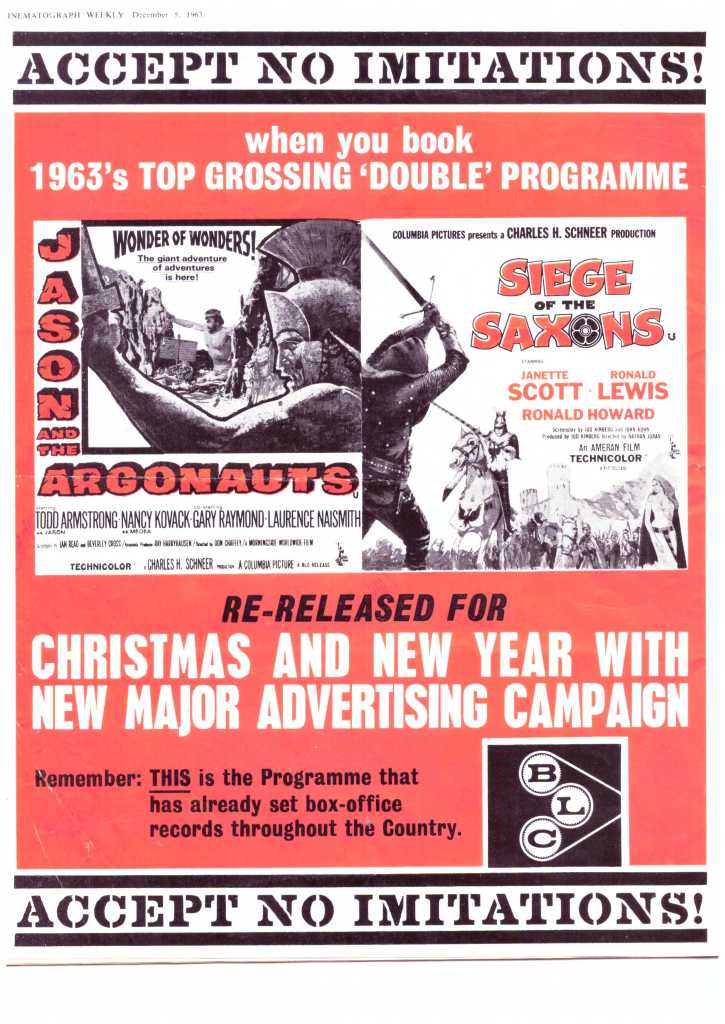
Although the ending appeared to leave the door open for a sequel, none was made. A huge box office hit in Britain, it did not repeat its success elsewhere.

I first saw this film as a boy and was so enthralled I wouldn’t have noticed if there was anything awry with the special effects. I have not seen it since. Coming at it with some degree of scepticism I found that attitude misplaced for I was equally enthralled.

Catch-Up: Nigel Green’s portrayal of Hercules was a far cry from his normal screen persona of martinet. His movies previously reviewed in the Blog are The Skull (1965), Khartoum (1966), Tobruk (1967) and Africa Texas Style (1967).

Danger Route (1967) ***

If the producers had not signalled Bond-style ambitions with a big credit sequence theme song by Anita Harris, moviegoers might have come at this with more fitting expectations in the Harry Palmer and John le Carre vein. So although slipping into the late decade spy boom flourish don’t expect villains planning world domination, gadgets or a flotilla of bikinis.

Seth Holt’s bread-and-butter espionage thriller sets government agent Jonas Wild (Richard Johnson) – on his “last assignment” no less after eight licensed murders in five years – to kill off a defector in the far from exotic location of a Dorset country house not realizing that he is also being set up. That his liquidator will be a woman puts the mysterious Mari (Barbara Bouchet) in pole position.  

The Eliminator was the source material for Danger Route.

Wild gains access to the heavily-guarded mansion by seducing housekeeper Rhoda (Diana Dors) but after completing his mission is captured and tortured by Luciana – pronounced with a “k” – (Sam Wanamaker) who explains he is a patsy and that there is a mole in M.I.5. When his boss Tony Canning (Harry Andrews) disappears and another friend is murdered, Wild goes on the run with Mrs Canning (Sylvia Syms) and eventually makes his way back to his bolt-hole in Jersey to solve the mystery.

There is a decent amount of action, including a fight with a guard dog and a battle on a fog-bound yacht. Clever maneuvers abound – a bug is planted in a bandage. Treachery is always just round the corner and there is no shortage of suspects.

The film’s down-to-earth approach is somewhat refreshing after half a decade of spy thrillers and spoofs. Wild doesn’t employ anything more hi-tech than masquerading as a brush salesman to win over Rhoda. And although that relationship ends up in bed, there is no sex, Wild having drugged her to avoid that complication. Tony Canning is nagged by his wife. Wild’s girlfriend (Carol Lynley) is a sweet girl, sexy in a languid rather than overt fashion.  And Luciana takes enormous pride in telling Wild just how stupid he has been.

Sylvia Sims in a ticklish situation.

But that comes with a caveat. The plot doesn’t quite hang together and the movie sometimes fails to connect.

That said, Johnson (Deadlier than the Male, 1967) is excellent, quite an accomplished actor rather than a brand name. Both Barbara Bouchet (Casino Royale) and Carole Lynley (Harlow, 1965) play against type while Sylvia Sims (East of Sudan, 1964) and Harry Andrews (The Hill, 1965) present variations to their normal screen personas. Sam Wanamaker (The Warning Shot, 1967) has a peach of a role and Gordon Jackson (The Long Ships, 1964) and Maurice Denham (The Long Duel, 1967) are afforded small but critical parts. 

This is not easy to come by, so you are best looking for a secondhand copy.

The Swinger (1966) ***

Pure confection. There was a sub-genre of romantic comedy pictures that spun on a simple plot device to throw together actors with terrific screen charisma. Doris Day, Rock Hudson and Cary Grant did little more than meet a potential new partner, fall out with them and then resolve their differences. The importance of actors of this calibre was the difference between a high class piece of froth and mere entertainment. This falls into the latter category, neither Ann-Margret nor Anthony Franciosca reaching the high standards of the likes of That Touch of Mink or Pillow Talk.

That said, this was clearly custom-made for Ann-Margret and her growing fan-base. Despite displaying unexpectedly serious acting chops in Once a Thief (1965) this plays more obviously to her strengths. She gets to sing, dance and generally throw herself around. The face, hair, smile and body combine in a sensational package.

Kelly Olsson (Ann-Margret) plays a budding writer so naïve she tries to sell her stories to Girl-Lure, a Playboy-type magazine, owned by high-class Brit Sir Hubert Charles (Robert Coote) and run by Ric Colby (Anthony Franciosca). When her work is rejected, Olsson writes an imitation sex-novel, The Swinger, purportedly based on her own life. Sir Hubert buys the idea and Ric sets up a series of accompanying photo-shoots using Kelly as the model until he discovers her book is pure fiction.

The setting is an excuse to show an avalanche of young women in bikinis. The slight story is justification enough for Ann-Margret to strut her stuff as a singer and dancer. Since her stage show depended more on energy than singing, this effectively showcases her act.

So two-dimensional are the principals, you are not going to mistake any of these characters for actual characters. The film lacks such depth you would not be surprised if the likes of Elvis Presley or Cliff Richard popped up. The comedy is very lite, an initial attempt at satire soon dropped, the few bursts of slapstick seeming to catch the stars unawares.  

But that’s not to say it’s not enjoyable, Ann-Margret is a gloriously old-fashioned sex symbol and certainly knows how to shake her booty. The standout (for lack of a better word) scene revolves around body painting. She even gets the chance to ride a motorcycle, one of  her trademarks. Anthony Franciosca (Go Naked in the World, 1961) has little to do except smile. Yvonne Romain (The Frightened City, 1961) has a thankless role as Ric’s girlfriend.

Director George Sidney teams up with Ann-Margret for the third time after Bye Bye Birdie (1963) and Viva Las Vegas (1964). This was his penultimate outing in a 20-year Hollywood career whose highlights included Anchors Aweigh (1945), The Three Musketeers (1948), Annie Get Your Gun (1950), Showboat (1951) and Pal Joey (1957). So he certainly had the musical pedigree to ensure the songs had some pizzazz but clearly less impact on the script which was reputedly scrambled together at short notice by Lawrence Roman (McQ, 1974) to fulfil a studio commitment to the star.

The film is available on Youtube.

CATCH-UP: Previous Ann-Margret films reviewed in the Blog are The Cincinnati Kid (1965) and Once a Thief (1965).

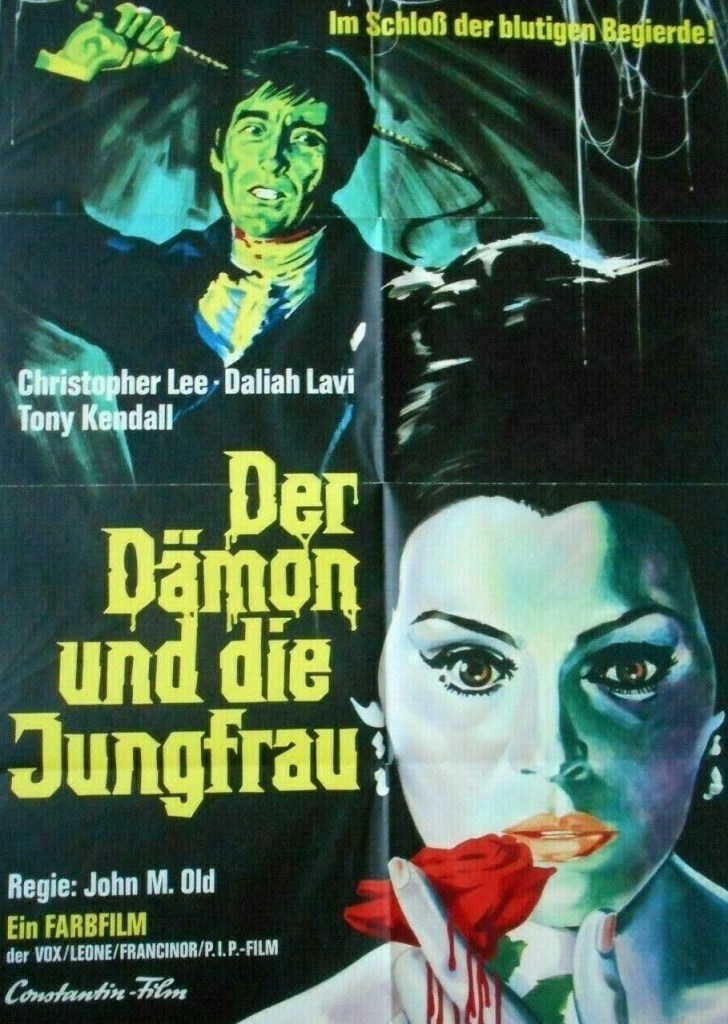
The Whip and the Body / The Whip and the Flesh / What? (1963) ****

Has there ever been actress so skilled at displaying fear as Daliah Lavi? Where the female stars of horror movies too quickly succumbed to the scream and goggle eyes, Lavi could run a whole gamut of terror without uttering a sound and continue doing so for virtually an entire picture. Top-billed ahead of the reigning king of British horror Christopher Lee, this is another acting tour de force, not quite sustaining the intensity of The Demon (1963) but at times not far off it.

Italian director Mario Bava (Black Sabbath, 1963), here masquerading as John M. Old, has stitched together a mixture of horror and an early form of giallo, the picture taking place in the classic old dark house, in this case a castle perched on a rock above the sea, the deaths grisly, and almost fitting into the “locked room” subgenre of the detective story, where the murders appear impossible to carry out.

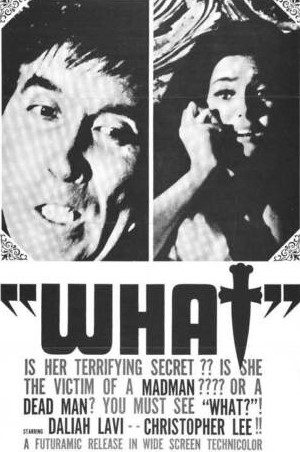
Originally released as The Whip and the Body, it underwent some title changes, first to The Whip and the Flesh, the German title translated as The Devil and the Young Woman and while in the U.S. it was shown as What?

The disgraced Kurt Menliff (Christopher Lee) returns to his ancestral home, begging forgiveness from his father Count Vladimir (Gustavo De Nardo) and hoping to reclaim his inheritance and his betrothed Nevenka (Daliah Lavi). While his father exonerates him, Kurt is denied the rest, Nevenka already committed to marriage to his brother Christian (Tony Kendall). Other tensions are soon evident: the housekeeper Giorgia wants revenge on Kurt for the death of her daughter and Christian is in love with another, Katia (Evelyn Stewart).

Nevenka who outwardly protests how much she hates Kurt quickly reveals masochistic tendencies as she gives in to a whipping. But Kurt’s sudden inexplicable murder instigates an investigation, suspicion falling firstly on the father, then Christian and finally Giorgia.

But Nevenka is not convinced Kurt is dead, although his body has been entombed in the castle crypt. Torment creeps into her face at his funeral and we can almost see her grow gaunt in front of our eyes. In a brilliant scene where she tracks what she imagines to be the sound of whip it turns out to be a branch lashing a window in a storm. Some of her supposed visions are easily explained, muddy footsteps leading from Kurt’s tomb actually belonging to the limping manservant Losat (Luciano Pigozzi). But how do you account for the hand, in an almost 3D shape, reaching out to her in the darkness or her ecstasy in still being whipped, her nightdress stripped from her back?

Although sometimes relying too heavily on atmospherics – windows swinging open at night, storm outside – Bava brilliantly marshals the real and the imagined, until the investigation into murder involves all the characters. Once the film begins, the drawbridge in a sense comes down, and nobody else enters the castle, and so we move from one character to another, each with their own motive for possibly committing dire deed. And with each passing moment we return to the demented Nevenka, who wishes Kurt dead but cannot live without him, and, craving the whip, cannot escape his sadistic power. Her faith in Kurt’s resurrection is so intense that the others are soon seeking signs that the dead man is still alive.

This is superior horror to Hammer. Using the same leading man, the British studio generally expected Lee to be over-the-top, his innate malevolence very obvious from the start. Here, he is at his most handsome and although definitely sadistic, the emphasis is less on his pleasure than that of his victim. And while Bava resorts to a similar kind of Hammer set, this castle is remote, has no relationship with villagers, and exudes regal dominance rather than just the normal fear of a Dracula picture. Bava employs a more subtle color palette and the piano theme tune by Carlo Rusticelli has a romantic tone.

But for all Bava’s proven skill, this would not be the same without Lavi. I doubt if there is a single actress in the horror domain throughout the 1960s who could match the actress for portraying fright, as she marches up the scale from mere anxiety to full-blown terror. And although women in Dracula movies succumbed to vampire teeth with more than a frisson of sexuality, there is a different deeper sensuality at work here, in what must rank as one of the greatest-ever portrayals of masochism embedded in love.

As noted previously, Lavi, in stepping onto the bigger Hollywood stage of Lord Jim (1965) and The Silencers (1966), lost the intensity she displayed here and never came close to matching this performance or that of The Demon. Christopher Lee, although claiming to dislike his experience, continued to rule the horror world until afforded a wider audience through James Bond, Star Wars, J.R.R. Tolkien and Tim Burton. 

Tony Kendall made his debut and soon graduated to the Kommissar X series, spaghetti westerns (he played Django twice), horror (Return of the Evil Dead, 1973), and thrillers such as Machine Gun McCain (1969). Evelyn Stewart went down much the same route, her long career sprinkled with gems like Django Shoots First (1966), The Sweet Body of Deborah (1968) and The Psychic (1977).

Mario Bava continued to exploit the horror vein including Blood and Black Lace (1964), Planet of the Vampires (1965) and Lisa and the Devil (1973) with Telly Savalas and Elke Sommer.

Discover WordPress

A daily selection of the best content published on WordPress, collected for you by humans who love to read.

The Atavist Magazine

by Brian Hannan

WordPress.com News

The latest news on WordPress.com and the WordPress community.