Contender for the weirdest film of the year and a truly bonkers misfire, this is a musical only in the sense that much of it is sung in the vein of Tommy (1975) but completely lacking in the kind of memorable songs that would make it qualify for the genre. It is the most over-ripe of conceits, actors who can’t sing, a story that doesn’t fly, characters whose characteristics are endlessly laboured, little development, and a director who clearly believes audiences will swallow anything.
World-famous soprano Ann (Marion Cotillard) marries agent provocateur stand-up comic Henry (Adam Driver). Her stage act consists of dying and bowing, his of heckling his audience. The relationship soon hits the rocks but not before she has given birth to Annette. This is where it becomes even more tricky because Annette more closely resembles an offspring of Chucky, the horror doll, rather than, as was clearly intended, Pinocchio. The story takes an odd turn, which I won’t reveal, but it fails to redeem the project.
While Driver (Star Wars: The Rise of Skywalker, 2019) is quite convincing as the bonkers comedian – especially in one skit where he has the audience believing he has killed his wife – and it is virtually impossible for Cotillard (La Vie en Rose, 2007) to be bad in anything, the film needs more than repetitive scenes of her singing and him upbraiding the audience. Cotillard actually has a reasonable voice – and has cut a few albums – but what she is given to sing here makes a mockery of her talents.
With names such as director Leos Carax (Holy Motors, 2012) and screenwriters/ composers Ron and Russell Mael of Sparks fame this was clearly always going to err on the side of cult. It might have worked if the director could have seen his way to a bit of brevity. At 90 minutes or so it might have been an interesting trifle. At 140 minutes, it outstayed it welcome.
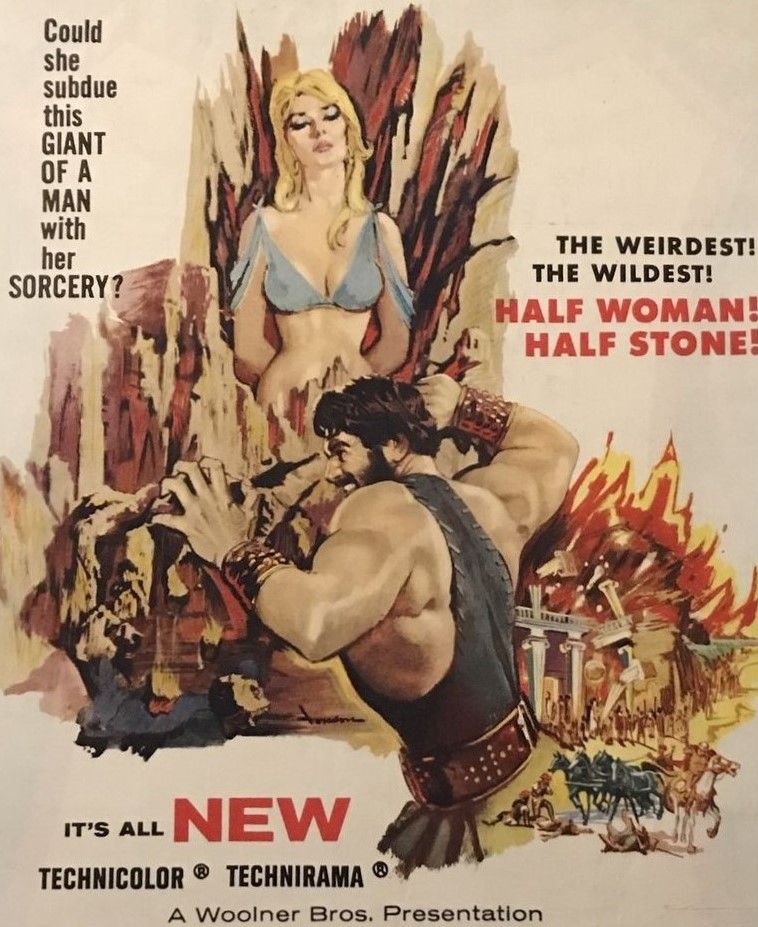
Something of a cult in the peplum vein in which Hercules (Reg Park), wanting to enjoy domestic life with his wife and son, is instead drugged by Androcles, King of Thebes (Ettore Manni), and spirited away by ship to Atlantis whose Queen Antinea (Fay Spain) is intent on global domination and the resurrection of the dethroned god Uranus to his rightful place in the heavens.
This isn’t your normal Hercules, not that keen on demonstrating his physical prowess, preferring to sleep or lie around. It’s not your normal ship either. Androcles, unable to persuade his Senate to properly fund the expedition, has crewed his vessel with renegades who are inclined to abandon Hercules on the nearest island And unbeknownst to Hercules, his son has come along for the ride.
Of course, nothing goes according to plan and Hercules is soon shipwrecked on an island where he finds Ismene (Laura Efrikian) imprisoned in rock as a sacrifice to the gods. Rescue never being simple, Hercules has to first withstand fire then tackle in quick succession snake, lion, eagle and a giant lizard. Ismene turns out to be Antinea’s daughter and the Queen, rather than being delighted at her return, is appalled, for, according to the way the ancient world works with all its prophecies and religious ritual, the girl must be sacrificed to prevent the destruction of Atlantis.
Nor is Atlantis your usual kingdom. Even setting aside the peculiarities that mark the Greek world, this is a place where abnormality rules. Hercules finds Androcles, whom he believed died in the shipwreck, but it turns out to be a vision, or some kind of shape-shifting being. The Queen believes she can subjugate nature and has a tendency to throw those who disappoint her into an acid bath. There is a fiery rock that controls life and death.
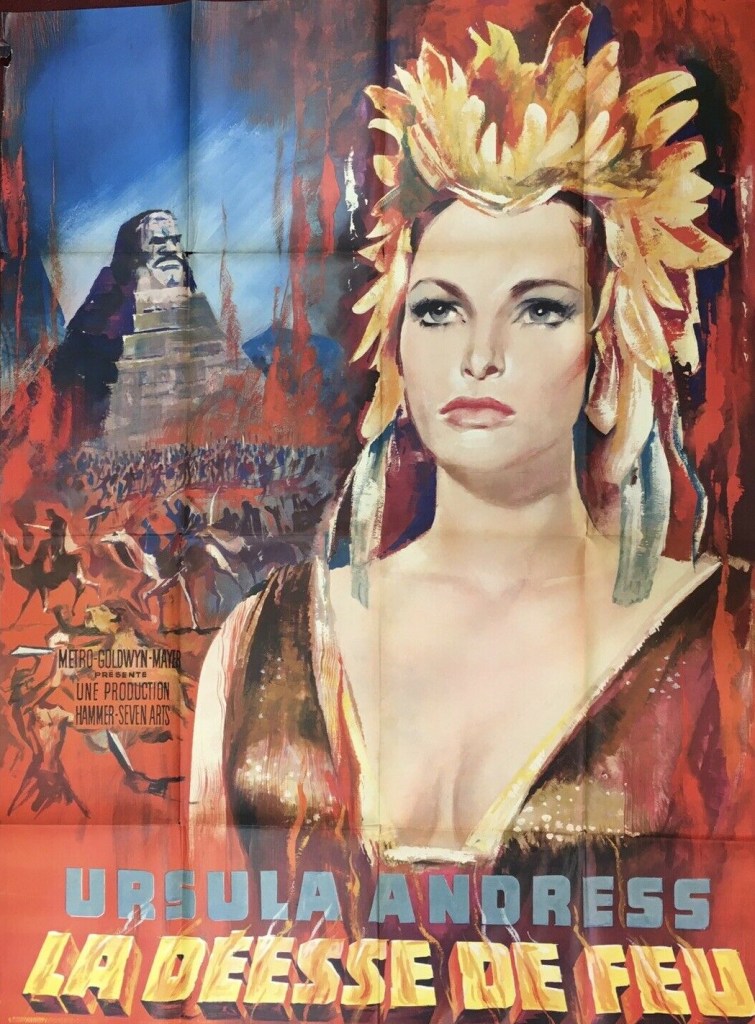
Like most of the peplum output, you have to accept a standard of production lower than the Hollywood norm, and the terrifying beasts sent to test the hero are not at all convincing, but on the plus side are feats of imagination that mainstream American studios would never conjure up, unless it was something that fitted into the swashbuckling genre. You pretty much have to go with the flow and accept what is offered in terms of narrative oddity. Bear in mind, too, that there is no one dressed in as skimpy or revealing a costume as suggested by the poster.
You also need to be get hold of a good copy. Several versions are available, some for free, where the colors are so washed out you can hardly determine what is going on never mind enjoy the costumes, creatures and sets as intended. This was filmed in Technirama 70, shot in 35mm but blown up to70mm widescreen for exhibition, so should generally be of a high technical standard – this was the process used by Spartacus (1960).
It’s not a film to fit into the so-bad-it’s-good category, but of course imagination too often exceeds budget which renders the filmmaking somewhat random at times and like the bulk of the peplums acting skill is not at a premium. As you might expect, the British-born Reg Park was a bodybuilder first – three times winner of the Mr Universe title – and an actor second. He played Hercules another three times and Maciste once but outside this narrow comfort zone made no other films. But he was Arnold Schwarzenegger’s inspiration, so that was probably enough.
American Fay Spain (The Private Life of Adam and Eve, 1960) never got beyond bit parts as a B-movie bad girl and television, although she was seen in The Godfather: Part II (1974). Italian Laura Efrikina made her debut here and you would later spot her as Dora in the Italian television mini-series David Copperfield (1966).
Director Vittorio Cottafavi was steeped in peplum, from The Warrior and the Slave Girl (1958) to Amazons of Rome (1961) but although he worked consistently in television made only one other piocture, 100 Horsemen (1964).
While sharing similarities to Black Widow with family to the fore, warring siblings, understated love interest and greater emphasis on character than action, this is a bolder origin story. Shang-Chi (Simu Liu), living as a car valet driver in America under the pseudonym Shaun, is drawn home by his father Xu Wenwu (Tony Leung), who gave up global domination for love. Shang-Chi is somewhat surprised to discover that the mother he believed dead is instead being held prisoner.
Family reunion is complicated by the fact that Shang-Chi shamed his father and abandoned his sister Xialing (Meng’er Zhang). Shang-Chi’s not-quite-girlfriend Katy (Awkwafina), when not aiding exposition, mostly provides comic relief until superceded in that department by wacky thespian Trevor (Ben Kingsley). As the story picks up it also drops back to explain the family dynamics but without losing any tension. On paper the tale sounds a tad overcomplicated but it works like a dream on screen and we only really enter Marvel territory filled with mythical Chinese creatures in the last reel. So on the one hand it works as an interesting drama while on the other delivers innovative bang for your buck.
There’s a brilliant sequence on a runaway bus in San Francisco, Shang-Chi battling a group of thugs led by the appropriately-named Razor Fist (Florian Munteanu) while Katy tries to control the vehicle. Then there’s a terrific battle on skyscraper scaffolding. Throw into the mix a drive through a terrifying forest and a return to their mother’s village to confront the evil that threatens the world. And in keeping with Marvel dynamics pendants that hold the secret of finding the hidden village.
The set-up is particularly well-done with clever twists to audience expectations, what appear at first to be expository voice-overs turning into conversations, the undefined Shang-Chi/Katy relationship causing grief among parents and friends, their driving skills put to superb use in the plot, while the father’s backstory, lust for power being assuaged by love, is not given short shrift. The story more than toys with the audience in other ways, setting up different expectations which prove unfounded.
All the main characters have great story arcs – Xu Wenwu from ruthless villain to romantic softy and back to ruthless when training his son, Shang-Chi from apparent waster to unwillingly accepting a different path, Xialing the girl who had to learn skills her father refused to teach her, and, her driving apart, Katy from mere observer in action scenes to participant.
Primarily a television actor and stuntman Simu Liu makes massive impact in the leading role, adding a fresh face to the MCU. Asian superstar Tony Leung (Infernal Affairs, 2003) makes a comfortable leap into the Hollywood big time. The relatively unknown Meng’er Zhang (In the Mood for Love, 2019) comes up trumps and rapper Awkwafina (Jumanji: The Next Level, 2019) brings a welcome touch of normality to the proceedings. Look out for Michelle Yeoh (Crouching Tiger, Hidden Dragon, 2000), Florain Munteanu (Creed II) and Benedict Wong (Doctor Strange, 2016). Oscar-winner Ben Kingsley almost steals the show.
Destin Daniel Cretton (Just Mercy, 2019) does a brilliant job of marshalling not just the visuals but the drama and brings clarity to the storyline. Special mention to an unusual score by Joel P. West.
Sequels boomed in the 1960s mainly thanks to multiple spy spin-offs in the James Bond/Matt Helm/Derek Flint vein but for every From Russia with Love (1963) and In Like Flint (1967) there was a more tepid entry like Return of the Seven (1966). One of the prerequisites of the series business was that the original star reappeared. But Ursula Andress who played the title character in Hammer’s She (1966) declined to reprise the role.
John Richardson did return from the first picture but in a different role, as the immortal Killikrates within the lost city of Zuma. So Hammer brought in Andress lookalike statuesque Czech blonde Olinka Berova (The 25th Hour, 1967), even emulating the Swiss star’s famous entrance in Dr No (1962), although instead of coming out of the sea Berova is going in and substituting the bikini with bra and panties, but the effect is much the same.
Story, set in the 1960s, has supposed Scandinavian Carol (Berova) mysteriously drawn south against her will driven by voices in her head conjuring up the name Ayesha. We first encounter her walking down a mountain road in high heels only to be chased through the woods by a truck driver. It transpires she has unusual powers, or someone protecting her has, for the lorry brake slips and the truck crushes the driver. Next means of transport is a yacht owned by dodgy drunken businessman George (Colin Blakely) and before you know it she is in Algeria, assisted by Kassim (Andre Morrell) who attempts to forestall those trying to control her mind, but to no avail.
Philip (Edward Judd), whose character is effectively “handsome guy from the yacht,” follows as she continues south and eventually the pair reach Kuma, where she is acclaimed as Ayesha aka She. Kallikrates’ immortality depends upon her with some urgency crossing through the cold flames of the sacred fire. There’s a sub-plot involving high priest Men-hari (Derek Godfrey) promised immortality for returning Ayesha to Kuma and further intrigue that comes a little too late to help proceedings. You can probably guess the rest.
There’s no “vengeance” that I can see and certainly no whip-cracking as suggested in the poster. Berova, while attractive enough, lacks the screen magnetism of Andress and the mystery of who Carol is and where she’s headed is no substitute for either pace or tension and Berova isn’t a good enough actress to convey the fear she must be experiencing. The script could have done without weighting down the Kuma high priests with lengthy exposition explaining the whys and wherefores. Neither a patch on the original nor the expected star-making turn for Berova, this is strictly Saturday afternoon matinee fare and the slinky actress, despite her best sex-kitten efforts, cannot compensate.
Director Cliff Owen (A Man Could Get Killed, 1966) assembles a strong supporting cast, headed by Edward Judd (First Men in the Moon,1964) and Colin Blakely (a future Dr Watson in Billy Wilder’s The Private Life of Sherlock Holmes, 1970). You can also spot Andre Morrell (Dark of the Sun, 1968), George Sewell (who later enjoyed a long-running role in British television series Special Branch, 1969-1974) and television regular Jill Melford.
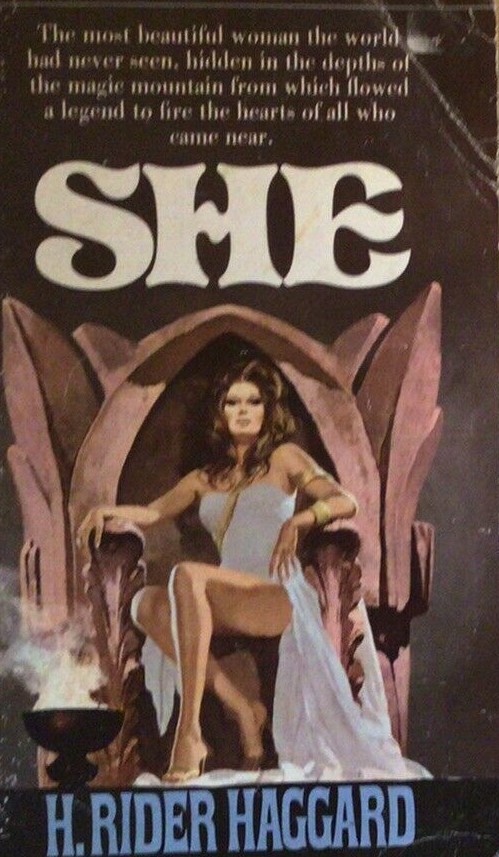
Hammer made a substantial number of changes for its version of She. For a start, H. Rider Haggard’s novel was published in 1886, three decades before the time in which the film which took place at the end of World War One. While the three main characters – Horace Holly (Peter Cushing in the film), his manservant Job (Bernard Cribbins) and the younger Leo (John Richardson) – remain the same, their relationships are significantly different, in that in the book Holly is the legal guardian of Leo.
The book is far more Indiana Jones than sheer adventure, the journey into the unknown instigated by a piece of parchment and a translation of a potsherd from the fourth century B.C. In the film the spur towards the journey into the unknown is a vision. But in the book the adventurers already know before they set off that ancient Egyptian high priest Kallikrates found Ayesha and the sacred flame and was killed by her because he loved another.
Unlike the film the book has no trek through the desert either which renders them hungry, thirsty and exhausted and leads to visions of Ayesha for Leo. Instead, they are shipwrecked. And their peril comes from swamps and wild animals such as lions and crocodiles. In fact, the filmmakers clearly resisted the opportunity to include one of the tropes of jungle adventure, namely a wild animal battle, in this case crocodile vs. lion, which was a feature of the book.
While they shoot a water buck for food, nonetheless they do later face exhaustion, only rescued by the sudden appearance of an Arab, who mentions She-Who-Must-Be-Obeyed and arranges for them to be transported in litters to a mysterious land in the heart of African darkness. This land is rich and fertile, with herds and plenty of food.
Two important elements introduced here shape the book but are ignored in the film. The first is that Leo, seriously ill at this point – and not capable of being strung up for the movie’s sacrifice – remains ill for the rest of the book so that it is Holly who enjoys most of the encounters with Ayesha. Secondly, and a rather advanced notion for the times, the women in this country are independent, neither considered chattels nor subordinate to men, and are free to choose their own lover. But it is only now that Leo meets Ustane (Rosenda Monteros) rather than in the film which brought them together almost immediately. Here, they also meet Billali (Christopher Lee) whom Holly rescues from a swamp.
With Leo still ill, it is Holly who first encounters Ayesha, who dresses as she will in the film, in a gauzy white material. In the writer’s eyes her beauty lay in her “visible majesty” as well as more obvious physical features, which could not be dwelt on at such length in a Victorian novel. Holly falls in love with her on the spot, even though he is “too ugly” to be considered a potential suitor, and learns of the fate of the earlier Killikrates and also catches a glimpse of her bemoaning her fate, imprisoned in immortality for two thousand loveless years.
“It is hard for a woman to be merciful,” proclaims Ayesha as she puts to death the villagers. Throwing them down the pit was invented by the screenwriters. By this point Leo is nearly dead and only saved by a phial administered by Ayesha. She also decrees that Ustane must die because “she stands between me and my desire.” In the film it is Leo who intervenes to attempt to save Ustane. But in the book it is Holly. He blackmails Ayesha, threatening to reveal her secret, that she had killed Killikrates in the past. Ustane claims she has taken Leo as her common-law husband. Ayesha promises to spare Ustane if she will give up her claim to Leo and go away. But Ustane refuses. In the book, there is an astonishingly visual and terrifying scene where, in revenge, Ayesha claws at Ustane’s black hair, leaving there the imprint of three white fingers.
It is the film that introduces the element of palace intrigue, with rebellious subjects and Billali believing he is entitled to immortality. That is not in the book.
When Leo finally wakes up, he is reunited with Ustane, but Ayesha catches them and kills Ustane, not by throwing her down the pit, but by her magic power. Despite being appalled, Leo cannot resist Ayesha. Even so, he is fully aware of his predicament, believing he has been “sold into bondage” and forced to love a murderess. But when she enters the sacred flame – naked, it has to be said, in the book, which was an exceptionally daring image for that era – she dies.
Holly in the book is more a narrator than a protagonist and shifting the emphasis more squarely back to Leo suits the film’s dramatic purpose. There was no real reason the film could not have followed the thrust of the book except that it would perhaps cost more costly to bring a jungle and swamps to life than a desert and arid mountains. More importantly, perhaps, was the need to introduce the physical Ayesha more quickly than in the book.
It is worth pointing out that the concept of She-Who-Must-Be-Obeyed was not so alien to British readers. After all, when the book was published, the country was ruled by a woman, Queen Victoria. And although democracy had reduced elements of her absolute power, the people still had to bow down before her. In addition, the British celebrated the rule of a previous female monarch, Queen Elizabeth I, who had been an absolute ruler, in the days before there was any notion of democracy and Parliament, and in those days anyone who opposed such a figure was liable to meet as swift a death as that meted out by Ayesha.
Dr No (1962) had only enjoyed moderate success in the United States so it was far from given that Ursula Andress meant much to American audiences. The first Bond outing had finished 43rd in the annual box office rankings and Andress had not exactly swept Elvis Presley off his feet in her only Hollywood offering so far, Fun in Acapulco. However, she was the immediate beneficiary of one of the most extraordinary pieces of luck to fall to a barely-known star.
The gargantuan success of Goldfinger (1964) had sent studio United Artists back to the vaults to resurrect the first two films in the Bond series and put them out in a double bill – the first of many such Bond pairings – in April 1965, a couple of months before She hit the big screen in the U.S. Dr No/From Russia with Love was a record-breaking sensation, attracting three times the numbers that had attended the first release of Dr No. So outstanding a performer was the double bill that it hit number five on the annual box office chart. So by the time She was launched Ursula Andress’s iconic bikini-clad entrance in Dr No was fresh in audience memories.
MGM, the U.S. distributor of the Hammer picture, had wisely not counted on the unexpected resurrection of Dr No and had a stack of other promotional wheezes up its sleeve. The 12-page A3 Pressbook kicked off with a “phone stunt” whereby exhibitors would set up a message on a telephone line purportedly from “She-Who-Must-Be-Obeyed.” The statuesque figure of Ursula Andress in figure-clinging costume was a natural for a standee in a cinema lobby as was the setting up of an artificial flame.
There were any number of ideas for competitions held in conjunction with a radio station or local newspaper: famous women who had ended up as film titles – Cleopatra and so on; famous female rulers; or a list of “love goddesses” to whose ranks it was decreed Andress deserved a place – in posters MGM had no hesitation is calling the actress “the most beautiful woman in the world.”
Journalists were to be hooked into running editorial pieces by a variety of interesting facts that could be cobbled together for an interesting article. The luxurious furs used to decorate the queen’s inner sanctum had been insured for $300,000. Andress had worn a total of nine gowns, designed by Cal Tomms, but none weighed more than a few pounds, the gossamer-like material both free-flowing and clinging to her natural assets. The crown weighed 3lb, a heavy object to carry around on your head for a week, as Andress had. Her cloak contained 3,000 feathers. No doubles were used for the duel between John Richardson and Christopher Lee, both being accomplished swordsmen.
There were human interest items as well. Both Andress and Richardson had previously signed contracts with major studios without ever being given any roles. Andress, shy in real life, had learned to claim to be someone lese when approached by fans. Filming Dr No, she was grateful it was shot in Jamaica: “I didn’t want anyone to see what a fool I might be making of myself,” she said.
However, she was certainly self-assured in general. Interviewed exclusively for the Pressbook, she said, “Beauty gets you everywhere. It is a gate opener. It takes a long time to discover a good mind, but a beautiful woman attracts attention right away. Only stupid people think that a woman who is attractive must be silly.”
She added: “I will give you a list of the qualities that are most important for a woman – emotional range, beauty, intelligence, education and talent. Emotions are the most important, the ability to feel and love. Beauty next, and intelligence after that. Education is less important than intelligence because if you have the latter you’ll acquire education.
“I have never made a study of acting,” she explained. “I just do it if and when I feel like it. I have no desire to work on the stage and what I do in front of the camera is instinctive and spontaneous. My best takes are the first. Repetition distracts from the quality of my performance. Ayesha in She was a difficult part because this mysterious queen is 2,000 years old and I had to be very stylized.”
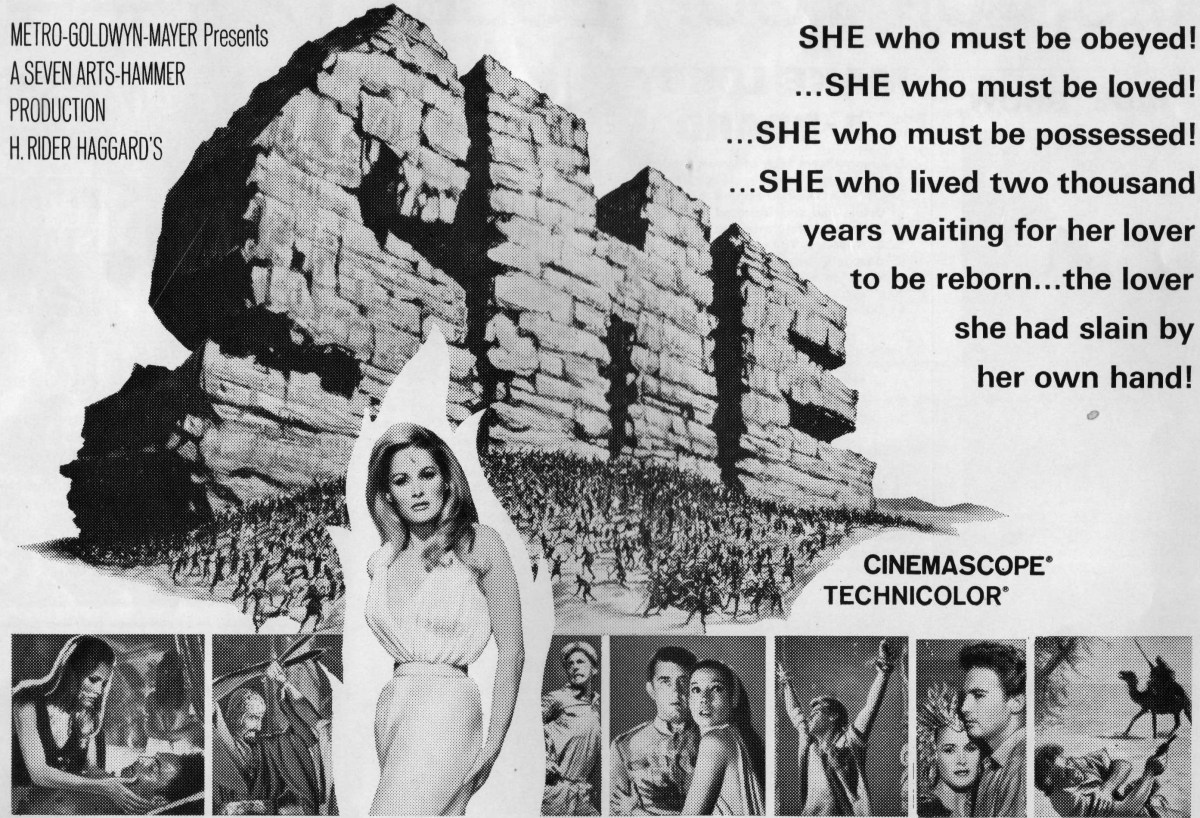
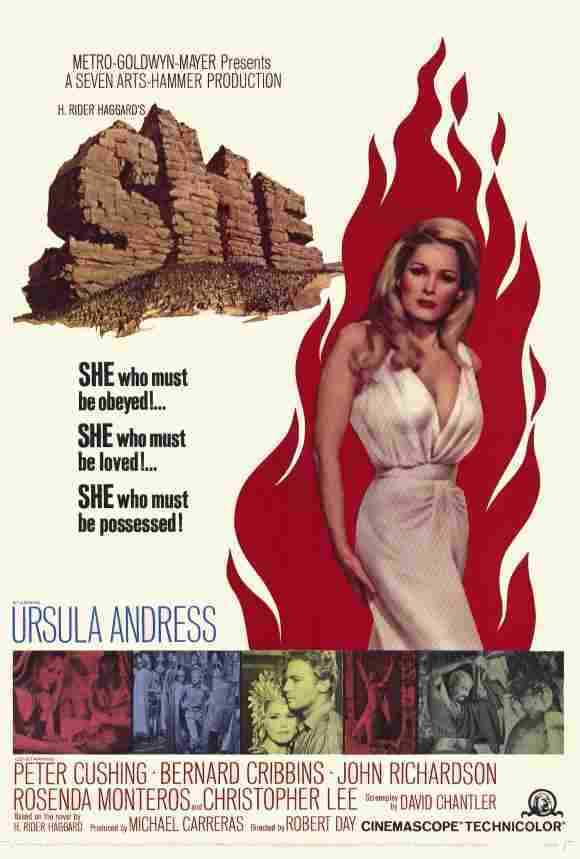
Andress was central to the advertising campaign and although there were a number of different adverts, the actress featured in all, the only difference being her position on the poster, left, right or central. “She had waited 2,000 years waiting for her lover to be reborn – the lover she had slain by her own hand.” To whet audience appetite, a variety of scenes were included at the foot of some posters.
To grab the attention of the exhibitor, and ensure full cooperation in selling the picture, MGM was offering a treasure chest of rewards for the best local campaign – a total of $10,000 in prize money. To gain additional publicity there was a single record and, more important, a new tie-in edition of the famed novel by H. Rider Haggard, which had already sold 20 million copies in America.
Ursula Andress certainly knows how to make an entrance. Emerging out of the sea in a bikini in Dr No (1962) proved a Hollywood calling-card but failed to put her center stage. She fixed that with She and dominates this superior adventure hokum. Studio Hammer lucked into a solid piece of storytelling, a classic, and all it had to do – with the help of a bit more finance than was usual for their productions courtesy of MGM – was not muck it up.
Three soldiers are celebrating the end of the First World War in a Palestinian night club and while archaeologist Holly (Peter Cushing) and his bowler-hatted valet Job (Bernard Cribbins) are tripping the light fantastic with belly-dancers, blond-haired Leo (John Richardson) is seduced away by Ustane (Rosenda Monteros) because he bears a stunning resemblance to an ancient medallion. Encountering a vision of Ayesha (Andress) he is urged to embark on a dangerous journey to the lost city of Kuma where she awaits.
Despite the theft of their camels and loss of water, the trio trek exhausted across desert and mountains, Leo sustained by his vision, by the fact that he seems to know the way and with the assistance of Ustane. But a savage tribe reckon Leo would make an ideal sacrifice to the gods. Just as the tribe are driving themselves into ritualistic frenzy, high priest Billali (Christopher Lee) comes to the rescue, escorting the explorers into Kuma.
The regal Ayesha is as beautiful in the flesh as in the vision, but more ruthless, condemning slaves to a terrible death for disobedience and, noting the attraction between Leo and Ustune, planning also to rid herself of her rival. Leo’s arrival will fulfil an ancient prophecy with the Englishman attaining immortality, and he seems to be able to “float through the sea of time” and remember events from two thousand years ago. However, Ayesha has a dubious past, providing one of several unexpected twists.
Most films of this sub-genre rely on improbable mumbo-jumbo and are loaded down with wearying amounts of exposition. But here is nothing but clarity, the ancient backstory tale told with minimum visuals and verbals and the intellectual sparring between Holly and Ayesha on the one hand and the archaeologist and the high priest on the other are intelligently-put, presenting opposing options for the development of civilisation, absolute monarchy vs. democracy and immutability vs. change.
But that takes place within a highly-charged drama, the enfolding romance between Ayesha and her chosen man both touching and perilous, while the battle for the life of Ustane is brilliantly presented. Lack of reliance on special effects and art direction utilizing the MGM millions – the mountain-sized statue outside Kuma (prefiguring perhaps Game of Thrones) and the set for Ayesha’s room especially magnificent, as is her golden crown – prevents the picture falling into the camp camp. Instead, it emerges as an adventure classic.
Ursula Andress (4 for Texas, 1963) is stunning, every inch a goddess and yet believably mortal. Her looks tended to mask her abilities and while she rarely received credit for her acting she holds her own in some redoubtable company. John Richardson (Black Sunday, 1960) doesn’t quite step up and remains more a creature of adoration. But the supporting cast more than compensates. Peter Cushing (The Skull, 1965) has had a persona transplant, replacing his normal grim demeanor with fun and enthusiasm, not lacking courage where required, and delivering a very fine performance. Bernard Cribbins (Crooks in Cloisters, 1964) provides the humor. And we still have Christopher Lee (The Gorgon, 1964), filled to bursting with self-entitlement, in malevolent form, Andre Morell (The Vengeance of She, 1968) and Rosenda Monteros, scandalously under-used in films since The Magnificent Seven (1960). It’s interesting to see Cushing and Lee, who dealt with immortality in the Dracula series, engage in conflict without coming to blows.
Director Robert Day (Tarzan’s Three Challenges, 1963) keeps up a brisk pace at the same time as focusing on character and provides Hammer with a marvelous adventure template for the future. Five features and two shorts had already been adapted from the H. Rider Haggard classic, but the last was in 1935, starring future U.S. House of Representatives member Helen Gahagan. This version presents the best shot at visual interpretation of the classic.
Catch-Up: Ursula Andress was reviewed in the Blog for 4 for Texas (1963), The Blue Max (1966) and The Southern Star (1969). Christopher Lee pictures already reviewed are: The Devil-Ship Pirates (1964), The Gorgon (1964), The Skull (1965), The Brides of Fu Manchu (1966), Five Golden Dragons (1967) and The Curse of the Crimson Altar/The Crimson Cult (1968).
It’s better to come at this as a drama rather than the thriller it was marketed as. That the name of George Schaefer, the last to make a movie of the directors who shot to fame in television in the 1950s, is attached should be indication that this is character- and issue- rather than action-driven. It’s more about people being sucked into the system, about the vulnerable members of society, who, whether cop or criminal, have no recourse to some kind of higher power to sort their lives out. As such, it’s a satisfying drama.
A-list male stars playing emotionally vulnerable characters was a growing trend in the late 60s. Think of Burt Lancaster in The Swimmer (1968) and Kirk Douglas in The Arrangement (1969) – all reviewed in the Blog, incidentally. Here top Washington detective Frank Matthews (George Peppard) goes through the personal and professional wringer, suspecting wife Adele (Jean Seberg) of an affair then becoming a suspect himself in a murder case. Underlying these plot-driven aspects is an exploration of the political issue of civil liberties, in particular the constitutional rights of criminals, setting this up as one of the earliest law’n’order movies, a trope that would take center stage in films like Dirty Harry (1971).
At a peak of professional success, having been awarded a medal and promoted to consultant on a subcommittee on Law and Order headed by Senator Augustus Cole (Paul McGrath), Matthews’ ethics come under scrutiny when alleged murder/rapist Paul Sanderson (Robert F. Lyons), whom Matthews had arrested, is freed on a technicality thanks to the efforts of civil liberties attorney Woodrow Wilson King (Richard Kiley).
Matthews appears distracted much of the time trying to keep track of his wife’s whereabouts. After delivering a speech in Baltimore, he walks the streets in a fug of depression. Meanwhile, King is disturbed by the fact that a man he clearly believes guilty refuses to seek psychiatric help. The question in the audience’s mind is where he will strike next. There’s an excellent scene in King’s office where his secretary Liz (Marj Dusay), delighted at the lawyer’s success in overturning Sanderson’s case, instinctively pulls away from the freed man.
When Adele and lover are murdered in Matthews’ bed, he finds himself on the opposite side of the law, undergoing the kind of treatment he has meted out to so many criminals, quickly aware that circumstantial evidence could find him guilty. Front-page news himself now, suspended from his job by a quick-to-judge senator, emotionally isolated and a laughing stock, he retreats further inside himself. Naturally, he evades subsequent arrest, setting out to track down the killer himself, that leads him into the murkier depths of society from which emotionally-abused villains easily spring.
Other issues are explored in passing, the independent woman for a start, whether it is wanting to have her own career and not play the stay-at-home wife or considering it fair game – as with Gwen (Faye Dunaway) in The Arrangement – to upturn accepted morality and take a lover.
But the focus remains squarely on Matthews struggling to cope with life running away from him, falling deeper into despair and into the maw of the criminal justice system which has the knack of bending its own rules. He has never been the saintly cop and there are moments where violence seems the best option, although not the vicious kind later espoused by Inspector Harry Callaghan. It’s ironic that the only solid detection the cop does in the first part of the film is tracking down his wife’s whereabouts.
George Peppard (Tobruk, 1967), generally a much-maligned actor, excels in a part where he can neither charm his way into an audience’s heart, nor confide in someone else about his marital problems, nor resort to action to define his character. That his pain is all internalised shows the acting skills he brings to bear. Oddly enough Jean Seberg (Moment to Moment, 1966), a specialist in emotional pain, takes a different path, coming across as a devious minx, keeping Matthews on the hook while enjoying relations with an ex-lover, whose career, as it happens, has panned out a lot better than her husband.
I only knew Richard Kiley, an American theatrical giant and primarily in the 1960s a television performer, through that mention in Jurassic Park (1993), but he is solid as the attorney who has qualms about releasing a prisoner he knows is guilty. Robert F. Lyons, making his movie debut, brings jittery danger to the unbalanced criminal. Look out also for Charles McGraw (The Narrow Margin, 1952) as the cop determined to take Matthews down and Frank Marth (Madigan, 1968) as the subordinate who gives the suspect too much leeway – to his cost. Madeleine Sherwood (Hurry Sundown, 1967) is excellent as the disturbed, needy mother.
George Schaefer, at this point a four-time Emmy award-winner, specialized in thought-provoking drama such as Inherit the Wind (TV, 1965) and Elizabeth the Queen (TV, 1968). This fits easily into that pattern. The title is a giveaway, too, referring to the pendulum swinging, “perhaps too far,” from all-powerful police to the rights of the accused taking prominence.
This was the only screenplay from Stanley Niss, who died shortly after the film’s release. He was also the producer. And better known as the writer-producer of television series like Jericho (1966-1967) and Hawaiian Eye (1959-1961).
Catch-Up: George Peppard pictures reviewed in the Blog are Breakfast at Tiffany’s (1961), Operation Crossbow (1965), The Blue Max (1966), Tobruk (1967), and P.J. / New Face in Hell (1968).
As we saw with Stillwater, great performances can rescue films. And there are two stunning performances on show in this alternative road trip, one from star Timothy Spall (Mr Turner, 2014) and another in a blink-and-you’ll-miss-it scene from supporting actress Grace Calder. The story here is pretty slim, Tom, aged over 90, sets out on 800-mile pilgrimage by bus from John O’Groats at the very top of Scotland to Land’s End at the very south of England. The trip’s purpose is concealed until the climax but hardy cinemagoers will easily guess it. He has various encounters along the way. That’s it, pretty much.
Most films about the old have redeeming features, a charming character and if grouchy with a last chance at redemption, and if played by a star generally bring with their performance a whole parcel of screen memories that have an audience rooting for them. Tom ain’t like that. He’s old the way really old people are old. He’s not an attractive sight. His bottom lip sticks out most of the time like an aged trout. He shuffles along, in battered old clothes clutching a battered old suitcase. Most of the time he’s out of his depth, occasionally rescued by passersby, occasionally not.
The most you can say about him is he has grit, standing up to a drunk abusing a Muslim, fixing a broken-down bus, offering a shoulder to cry on to a weeping teenager. In another time, in another place, such characteristics would have propelled a story. Here, they are mere makeweights. He’s so self-effacing he’s easy to ignore.
Scottish director Gillies Mackinnon (Whisky Galore, 2016) takes the bold decision not to make him overly sympathetic. Scenes that would have been played for all they were worth in any other film almost pass without comment, just minor ingredients in a larger tapestry. The most Tom achieves is retaining dignity at a time when body and mind are starting to betray him.
That this is just the smallest of small pictures is amply demonstrated when, trapped between a bunch of rowdy boys enjoying rowdy banter with a hen party, he starts singing “Amazing Grace.” Tom doesn’t have an amazing voice. He doesn’t even seem to recognise that he gradually attracts an audience. He is in a world of his own. And the director lets him stay there.
I was so convinced by Timothy Spall’s performance that I hoped they had used a stunt double to film a scene when he has to gingerly negotiate a path down rugged rocks. I had not realised that Spall is only 64 and not close to the aged specimen I had been watching. Spall has that quiet genius of the great actors even though rarely given a leading role and if you recognise him at all, unless you are an arthouse devotee, it will be from The Last Samurai (2003) or Vanilla Sky (1999).
What of Grace Calder? Occasionally I deliver lectures on film and in one of these I use the final scene of Greta Garbo in Queen Christina (1933) to demonstrate the power of female close-ups, how women far more than men are capable of a greater range expression, showing a shifting series of emotions through their eyes. And I saw that same astonishing quality in Grace Calder (Love Sarah, 2020). She appears as the lover of an arrogant male who taunts Tom in a B&B. As she reins her lover in, her eyes rapidly change in a matter of seconds to conveying a depth of different emotions. None of the other actors, who are all fleeting two-dimensional cameos, come anywhere close in a part that was not a part until she made it so memorable.
Most critics have been pretty sniffy about The Last Bus and you can see why. Television writer Joe Ainsworth making his movie debut tries too hard for diversity, the social media trope sticks out like a sore thumb, affords overmuch footage of glorious Scottish landscape to recompense Creative Scotland for its financial input, and never quite resolves the question of how a 90-year-old guy who can hardly manage a bus pass manages to work out a convoluted route in at least a dozen local buses to retrace a route he took 70 years before.
But it is all held together by a stunning performance by Spall.
A genuine curiosity, disowned by all concerned, removed from star Burt Reynolds’ Wikipedia page, the first picture to be directed by nobody, tarred with the infamous Alan Smithee director credit. Equally infamous as one of those “we can make two films at the same time” numbers.
Hard to see what got everyone so angry since, though on the lightweight side, and with an over-fondness for montage, it is a small town romance played out on a very mundane, not glossy, Hollywood location shoot, and of immense interest for demonstrating what Burt Reynolds could do before he fell down the “good ol’ boy” rabbit hole.
Story is simple enough and, of course, from the romantic perspective, age-old. Boy meets girl, then what? Rob (Burt Reynolds) is an unglamorous sheep rancher in a little place called Moab who takes a temporary job as a driver when the producers of a real-life Hollywood picture called Blue (1968) – itself an infamous western starring Brit Terence Stamp and Joanna Pettet – descend on the area for a location shoot. Jean (Barbara Loden) is pretty, but equally unglamorous, with a behind-the-scenes role in the picture as an editor. Rob is a notorious local womanizer so initially Jean is seen as just another notch on his belt. But then things get serious and in a surprise twist it becomes clear that it is he who is the notch on the belt, a casual pick-up for an out-of-town girl.
There’s a lot of interesting stuff here for the movie buff. The boring reality of how films get made, for a start, all shown in passing, fake horses, guys knee deep in a river pushing the mounted camera along, set decoration, the ever-present megaphone, watching the dailies. And there’s a few nuggets, a couple of quick lessons in the art of editing.
As if auditioning for a beefcake picture, Reynolds takes every opportunity to reveal his muscular torso, naked in a river (twice), out in the fields, but in reality showing quite a different side to the later tough guy persona, quite sweet, really, in many ways, with moments where the actor summons up deep feelings. He’s charismatic but in a gentle fashion. In the way of small towns, the romance is played out over coffee cups, pinball machines, ten-pin bowling alleys and rodeo with little in the way of sparkling dialog although hardly a sunset goes by without being pointedly utilized.
There’s a wonderful romantic score by Ken Lauber (Heart of the West, 1975) which I must mention because there’s hardly a foot of film without any music. But that’s not to this film’s detriment. It’s unashamedly an old-fashioned love story (not the one where someone dies, though). There’s some lush cinematography from Willam A. Fraker (The Fox, 1967) Some directorial technical aspects are worth mentioning, too, a credit sequence that cleverly uses a rearview mirror, a five-minute montage central to the romance and a one-minute montage composed of still shots a full year before George Roy Hill adopted the same idea for Butch Cassidy and the Sundance Kid, and in a nod to John Ford the final shot echoes the opening.
Director Jud Taylor worked his entire career in television (episodes of Dr Kildare and the original Star Trek among his 68 credits) and no doubt saw this as his bid for the big-time. But studio Paramount didn’t like his original version of the movie and he didn’t like what happened when it was re-edited, so he took his name off it. The rules of the Directors Guild of America prevented a movie being released minus a directorial credit so a compromise was reached whereby the name of “Alan Smithee” was employed.
The movie was stuck in the vault and shown on television in 1973 – in the wake of Deliverance (1972) – which accounts for that being taken as the official release date by imdb. (It’s also down as a western by imdb so you can discount that as well, unless Reynolds watching irrigation counts.)
Burt Reynolds had mixed feelings about the movie. At the time he was a potential rising star and not much more with only the little-seen Operation C.I.A. (1965) and Navajo Joe (1966) in the locker but 100 Rifles (1969) on the horizon. At various times he was reported as wanting to buy it to prevent it being shown and other times clearly regarding it as a little gem. Perhaps it was experience of a film going off the rails that inspired Barbara Loden to make sure she had complete control over her next picture – she was writer-producer-director of Wanda (1970).
In retrospect, it’s hard to see what the furore was about. It’s hardly god-awful. This is a nice wee film with interesting performances by both Reynolds and Loden and of course the opportunity to see Reynolds in a chrysalis, the macho man held at bay, allowing the sensitive performer to emerge.
Hard to find as you can see from the attempt at a link way below but it does crop up on ebay and here and there on television – in Britain you might be able to catch it on the Talking Pictures channel – and here’s an 80-second snippet from it.










 The Magnificent 60s