Hostile Witness (1968) ***

Shoddy initial release means this is unlikely to have been on your radar, but this entertaining courtroom drama plays on madness, involves minimal sleight-of-hand, employs some notable reversals as a defence strategy sinks under the weight of its own misplaced ambition.  Courtroom dramas were a scarce commodity in the 1960s, the sub-genre almost killed off by U.S. television hits like Perry Mason (1957-1966) and The Defenders (2961-1965).  Although, technically, Inherit the Wind (1960), Judgement at Nuremberg (1961) and To Kill a Mockingbird were of the same ilk, they did not rely on last-minute intervention or the normal twists and turns of legal dramas as evidenced by Witness for the Prosecution (1957). Hostile Witness only saw the light of day because Oscar-winner Ray Milland had starred in the Broadway version of the British play, author Jack Roffey experienced in the mechanics of this kind of fare after British television series Boyd Q.C. (1956-1964).

Daughter dead in a tragic car accident, top-notch Q.C. Simon Crawford (Ray Milland) is accused of killing the man he believed deliberately responsible. Unable to defend himself, he relies on his junior Sheila Larkin (Sylvia Syms). Circumstantial evidence links him to the crime. Questions surround his mental health, which disintegrated following his daughter’s death, especially after he cannot prove claims that would exonerate him. Casting around for the potential killer leads to a cul de sac, each clue that could absolve him rapidly dissolves and as he is soon fighting for his life. And as tension mounts, the defence team is soon in disarray, Sims quitting on a point of principle. Like all the best court cases the proof is in front of his eyes if only he could see it, and the traditional last-minute witness and twist does not disappoint. 
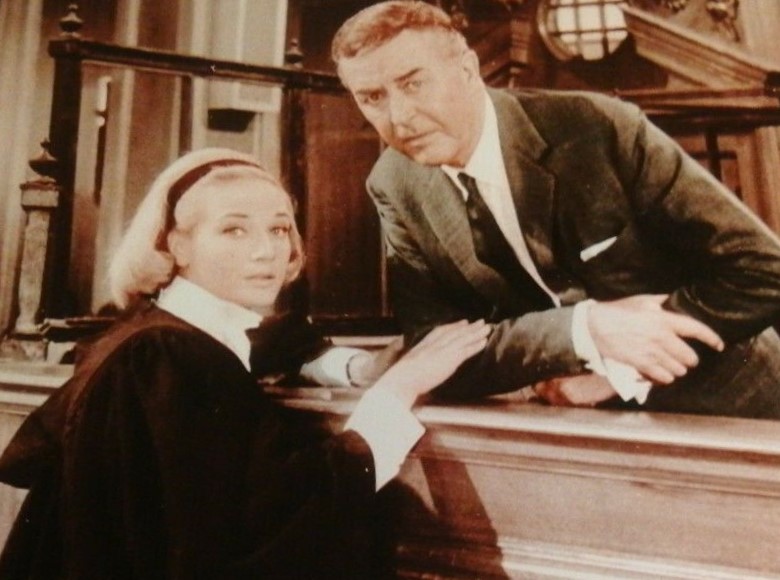
The courtroom aspect is very well done, great banter between the lawyers and swift and witty put-downs by the presiding judge (Felix Aylmer). While the story demands that Crawford remains off centre-stage at times, his presence, as a tense observer of proceedings that could spell his fate, calls on Milland to display probably the widest set of non-verbal reactions you will ever encounter. Syms (East of Sudan, 1964) is excellent in a role that offers greater scope than her usual female lead and while carrying a torch for Crawford she is more than capable to standing up to him and is ruthless in cross-examination. Geoffrey Lumsden (A Dandy in Aspic, 1968) tickles as a befuddled major and Raymond Huntley (later a success in Upstairs, Downstairs) sparkles as the grumpy prosecutor. To some extent, the picture plays on the film noir ethos that good guys often turn out to be anything but and Milland has the undoubted gift of looking both villain and hero dependent on the time of day.

By this point Welsh-born Milland was an odd refugee from Hollywood’s Golden Age, fallen far below the box office peaks of Billy Wilder’s The Long Weekend (1948) and noir turns like The Big Clock (1948). Apart from Dial M for Murder (1954) he was mostly became a television stalwart – the eponymous Ray Milland Show (1953-1955) and Markham (1959-1960) – and turned his hand to occasional direction. An unexpected dip into horror – The Premature Burial (1962), Panic in the Year Zero (1962) and The Man with the X-Ray Eyes (1963) failed to revive his mainstream career and prior to Hostile Witness had only appeared in one other movie.
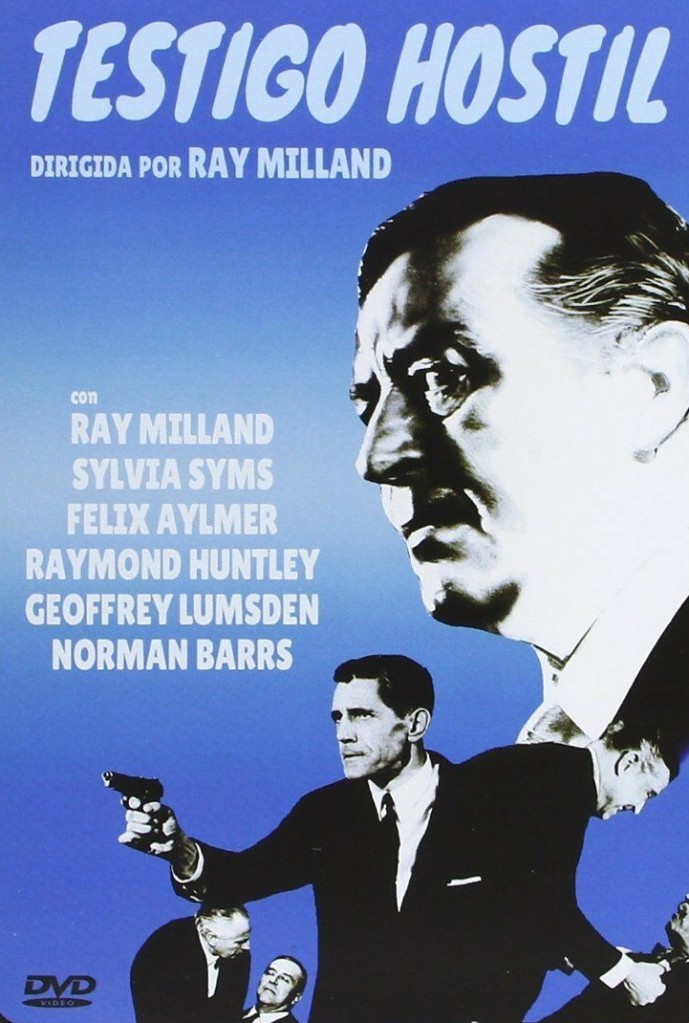
For a time Hostile Witness did look as if he would put him back on top after taking up an offer to make his Broadway debut in the play. Although not a stand-out hit, it ran for a decent 157 performances, then went on tour in the U.S. and later Australia, leaving Milland with the impression that, with himself directing to cut costs and running to a tight 24-day shooting schedule in Britain, it might just be the correct vehicle. Unfortunately, it was probably the staid direction that put paid to any prospect of box office success. A director like Billy Wilder or Hitchcock would have concentrated far more on character ambiguity and  made more of the unreciprocated romance and either tightened or opened up the original play to add more tension. Even so, it is pleasant enough viewing, not a dud by any means.

Book Review – Dreams of Flight: “The Great Escape” in American Film and Culture

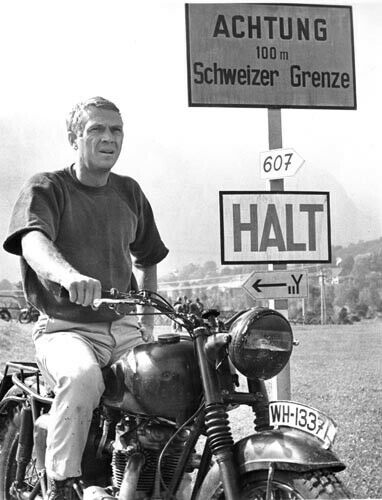
In the history of rousing action cinema few movies are as revered or have produced such a collective cinematic response as John Sturges’ World War 2 POW picture The Great Escape (1963) starring Steve McQueen, James Garner and Richard Attenborough and a host of upcoming stars including The Magnificent Seven alumni James Coburn and Charles Bronson,  

Dana Polan’s rich assessment of the film’s making coupled with a superb analysis of the film itself, script, style, themes and directorial bravura is filled with informative nuggets. Eschewing the standard star bio approach, Polan goes much deeper to detail how earlier adaptations for American television and Australian radio (made by novelist Morris West’s company and with Rod Taylor as a German guard) affected the film, how it fitted into the British POW tradition (The Colditz Story etc) and the influence of an American offshoot like Stalag 17.

You might already be familiar with the work of Dana Polan since he has written books on Pulp Fiction, The Sopranos and Jane Campion and another half-dozen books besides. This is an excellent addition to his impressive portfolio.

Paul Brickhill, author of The Great Escape (and other war classics The Dam Busters and Reach for the Sky) had been an inmate at Stalag Luft III so drew on personal experience – including that of tunnel digger – and sketches made at the time of the tunnels to turn out, as co-writer, a precursor Escape to Danger. It was either interviews relating to this or a magazine article or condensation that alerted neophyte director Sturges in 1945/1946 to a potential film. The book, published in 1950, sold a million copies in paperback in the UK alone and was a huge global success. And for independent producers Mirisch, for whom Sturges later made The Magnificent Seven, buying the rights was integral to the director’s pact with that company in 1957 and indeed The Great Escape was mooted as his debut picture for them. When finally greenlit, it was intended to be shot in the U.S. with only 10 per cent taking place in Europe. That it went the other way was due to an unusual set of circumstances.

In his analysis of the picture, Polan makes other interesting connections, first of all to the caper picture where each character has a specific task to contribute to the overall effort. Unusually for a heroic film, he points out that courage is continually undercut, each uplifting moment leading to defeat, the film itself having an essentially downbeat ending, the only true victory found in defiance. And in some respects The Great Escape created a bridge between the gung-ho war films of the 1950s and the more cynical approach to war envisioned in The Deer Hunter and Apocalypse Now.

Being British, it had never occurred to me how important the baseball glove was to American culture, the glove representing for many a “certain brand of American problem-solving in the face of adversity” although far more universally accepted would be the premise of the motorcycle escape representing the triumph of the spirit even as it results in a more down to earth resolution.

Tracing Sturges’ stylistic development back to post-WW2 B-movies made for Columbia explains the importance of the trademark parabolic shot in driving action forward. Yet for all his stylistic bravura, Sturges was very grounded when it came to the work required to make pictures, for example here adopting coloured index cards to shuffle around pieces of action to best effect.

The script went through various hands – William Roberts and Walter Newman, both integral to The Magnificent Seven, but was finally credited to crime writer W.R. Burnett (who had worked with Sturges on Sergeants 3, 1962) and James Clavell (who adapted The Satan Bug, 1965), himself a POW in a Japanese camp with British writer Ivan Moffat (Giant, 1956) coming in at the last minute as script doctor. A breakdown of the various scripts attributes the Hilts’ cooler baseball bouncing to Moffat who also wrote the scene that changed Hilts from loner to participant.

In a terrific appendix you can discover exactly the problems facing the real escapees and who came up with the book title (clue – not the author) four years after the idea originally surfaced. There’s a fascinating coda about the film’s impact on Hollywood and general culture and Polan takes time out to reflect on the experience of various fans on their virgin encounter with the picture. The movie was a big hit and so well received that when critic Bosley Crowther wrote a negative review the “New York Times” postbag was filled with complaints. Written with tremendous authority and great style, this is one book you would want to find in your Xmas stocking.

Dreams of Flight: The Great Escape in American Film and Culture by Dana Polan is published by University of California Press at $24.95 / £20 in both paperback & ebook.  ISBN 9780520379305. It is available on Amazon and Kindle.

https://www.ucpress.edu/book/9780520379305/dreams-of-flight

Selling Religion – “The Shoes of the Fisherman” (1968)

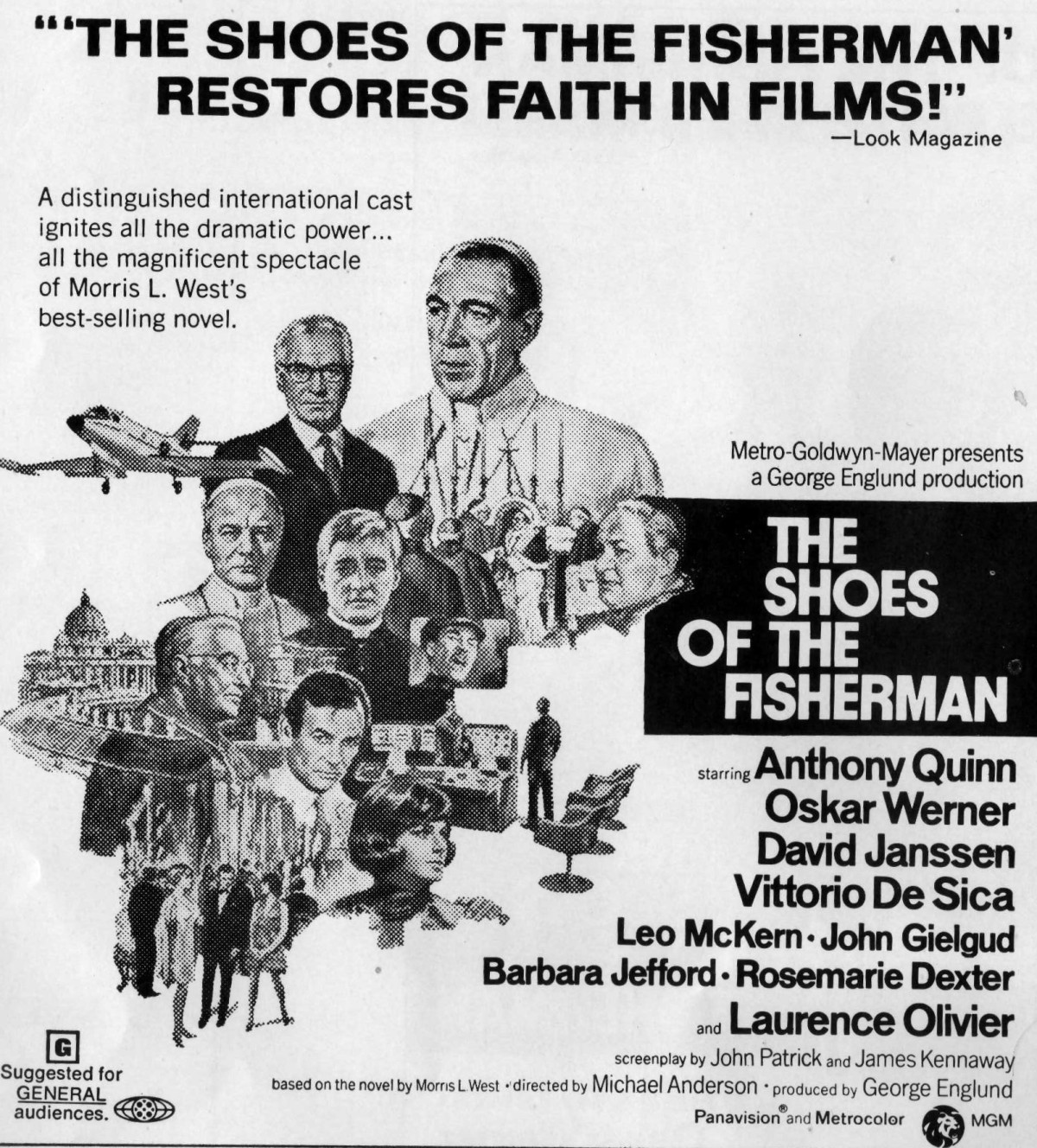
The Pressbook for The Shoes of the Fisherman is almost reverential in approach. For a start there is a complete lack of the madcap schemes designed by marketing men to promote the picture to the exhibitor. Nor is there any mention of the tie-ins that did exist – the book had sold seven million copies and the soundtrack by Alex North was already being acclaimed – it would be nominated for an Oscar. And there are very few of the titbits that might appeal to a local journalist.

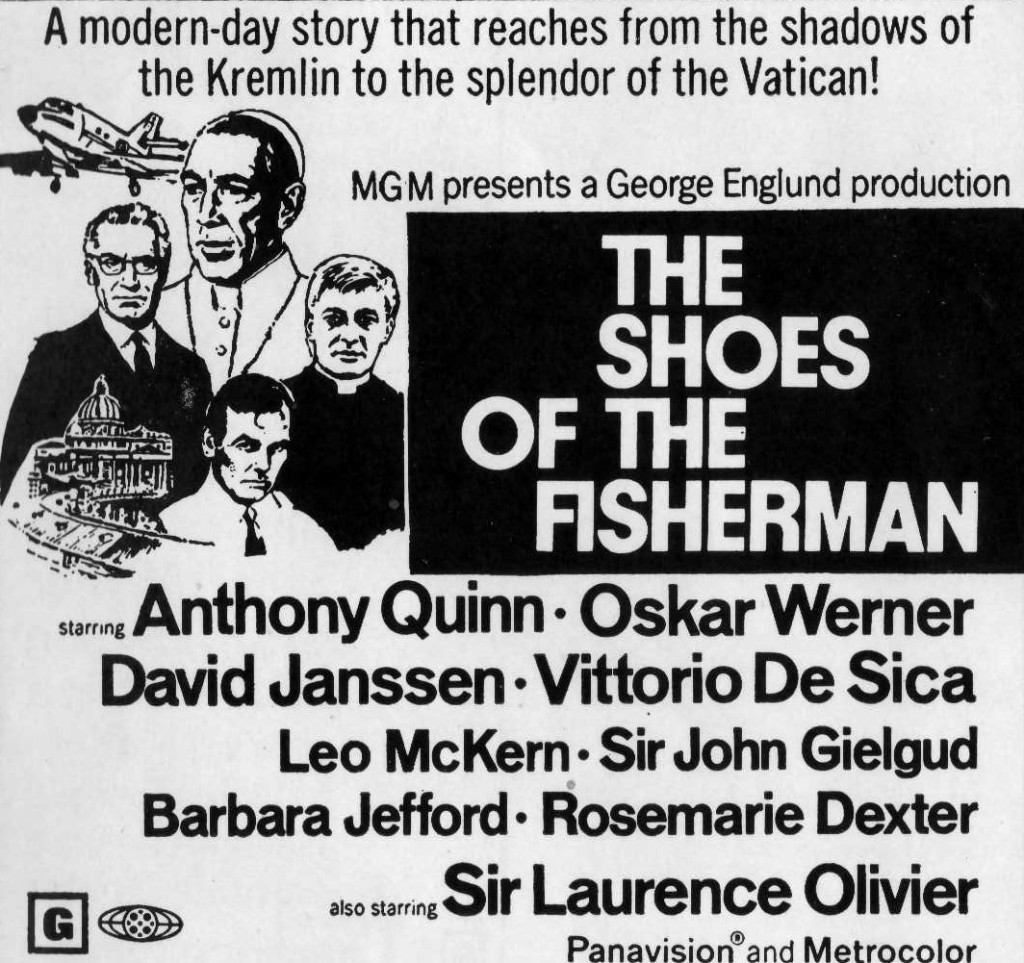
There is only one piece of artwork, although a truncated version provides a secondary opportunity for advertising and combined with a scene from the film material for a third ad. Taglines are equally scarce. “A distinguished international cast ignites all the dramatic power…all the magnificent spectacle of Morris L. West’s best-selling novel” is all there is apart from a puff from Look magazine puff that espouses “The Shoes of the Fisherman restores faith in films.”

The better tagline, in the sense that it sold an actual story rather than promoted the ingredients, was: “A modern-day story that reaches from the shadows of the Kremlin to the splendor of the Vatican.” One further tagline gave away more of the plot: “In a last desperate attempt to prevent World War III, a secret meeting is arranged. One man is called upon to succeed where all the world leaders have failed. That man was once a prisoner in a Russian labour camp. He is now the Pope.”

So what’s left, you might ask. Well, as promised in the tagline, the “distinguished international cast” and “magnificent spectacle.” The cast was awash with Oscars. The stars included four-time Oscar winner Vittoria De Sica, two-time Oscar winner Anthony Quinn, Oscar winner Laurence Olivier and Oscar nominated Oskar Werner.

The sets were of the no-expense-spared variety. Barred from using the Vatican itself, the producers used a mixture of real locations and sets at Italian studio Cinecitta to create the necessary backdrops. The Sistine Chapel set measured 133 feet by 45 feet and the paintings that dominate the altar including “The Last Supper” were copied in Hollywood and transported piece by piece. This set actually functioned and was accurate down to the tiniest detail. The only major touch omitted from the sets was the steps leading to the altar, since that would have necessitated cumbersome ramps to track the movement of the cardinals as they cast their votes.   

Oher buildings were appropriated for modern scenes – the Palazzo dello Sport for the secret peace conference. Cardinals arriving to vote were filmed at Fiumicino airport and Stazione Termini railroad station. Other locations included the Palazzo Farnese at Capranola used for scenes of the breaking of the old Pope’s seals, the Church of San Andrea della Valle for the interior of St Peter’s for the papal coronation, and Castello San Angleo, Biblioteca Vallicelliani and Palazzo Barberini.

Incidental information, the kind that journalists could use to augment their material, was scant. Author Morris L. West had once been a monk; bit part actor Clive Revill had been knifed in his previous film by Burt Kwouk; stage actress Barbara Jefford was appearing in only her third film and her role as a cerebral wife was in stark contract to her debut as the sensual Molly Bloom in Ulysses (1967); small-screen star David Janssen of The Fugitive played a small-screen reporter; and Oskar Werner had turned down over a 100 screen roles if they interfered with his commitment to the stage.

Mentioned in Dispatches

Unless your books are selected for review, authors of books about the movies are very rarely mentioned in the major media, so it was with some delight I noticed that a new article on the making of The Guns of Navarone had chosen to mention me and the book I had written on the film.

Tom Fordy in British national upmarket daily newspaper The Daily Telegraph in an extensive article on Friday, November 5, entitled “The Guns of Navarone: how David Niven’s epic blew up the war movie” argues that “sixty years later the spectacle still blows any Marvel-made CGI smackdown out of the water” and that the film set news standards for special effects, star-studded casts and seriously dangerous stunts.”

It’s a very good article and apart from myself calls on contemporary reports from the likes of Cosmopolitan magazine, David Niven’s memoirs,and Steven J. Rubin author of Combat Films.

He quotes from my and my book:

As detailed by Brian Hannan in his book on the film, MacLean’s novel was one of several from British books snapped up by Columbia – part of a drive to make more films in Britain and take advantage of the Eudy Levy tax break.

But the film needed US stars. As Brian Hannan wrote: “Americans did not like British war movies. They never had. No matter how well British war movies did on home soil, they just did not survive the journey across the Atlantic.” Potential stars included Cary Grant, William Holden, and Dean Martin. Carl Foreman scored huge publicity for the film by casting opera singer Maria Callas – and got yet more publicity when Callas quit the production.

The original novel was all-male, but Foreman changed two of the characters into women – two Greek resistance fighters (played by Irene Papas and Gia Scala) who join forces with the men – to draw female viewers to the cinemas.

Peck was sold on the film instantly. Brian Hannan details how casting Peck – a booming, square-jawed pillar of classic Hollywood – was a risk, with fewer box office hits in the Fifties than in the decade previous, 10 years since his last Oscar nomination, and industry criticism for making films abroad for the tax perks. His career at the time, said Hannan, was “patchy”. Biographer Gary Fishgall made a similar assessment, but maintained that to the public, Peck was still a major star.

Carl Foreman considered making the film in Cyprus, but the country was in a politically turbulent moment – on the brink of civil war. Foreman instead turned to the Greek island of Rhodes and met with the Greek prime minister, Konstantinos Karamanlis, for support. Greece supplied 1,000 troops as extras. But Rhodes was a demilitarised zone, so amendments had to be made to a treaty between Greece and Turkey, allowing the Greek troops to land there for the production.

Foreman even persuaded authorities to remove scaffolding from the acropolis at Lindos to capture some of the film’s grandest shots. The Greek military supplied more personnel and hardware: specialist mountain-climbing corps, destroyers, planes, helicopters, launches, armoured vehicles, tanks, howitzers, mortars and machine guns. An abandoned German fortress was also repurposed. “Virtually the entire manpower, and senior commanding officers, of the Greek army and navy were at the film’s disposal,” wrote Hannan. There were British advisors too, including Brigadier DST Turnbull, who had commanded raiding operations in the Aegean Sea.

You can find the full article here:

https://www.telegraph.co.uk/authors/t/tk-to/tom-fordy/

The Shoes of the Fisherman (1968) ****

Thought-provoking drama with a surprisingly contemporary slant set against the grandeur of the Vatican amid geo-political turmoil. At a time of global crisis, dissident Russian archbishop Lakotov (Anthony Quinn) is unexpectedly freed from a labour camp by the Russian premier (Laurence Olivier). Arriving at the Vatican, he is promoted to cardinal by the dying Pope (John Gielgud) before becoming an unexpected contender for Papal office.

The spectacular wealth of the Catholic Church is contrasted with the spectacular poverty of China, on the brink of starvation due to trade sanctions by the United States, nuclear war a potential outcome. The political ideology of Marxism is compared to the equally strict Christian doctrine, of which Lakotov’s friend Father Telemond (Oskar Werner) has fallen foul. There is a sub-plot so mild it scarcely justifies the term concerning television reporter George Faber (David Janssen) torn between wife Ruth (Barbara Jefford) and younger lover Chiara (Rosemary Dexter).

Lakotov is drawn into the Russian-Chinese-American conflict and the battle for the philosophical heart of the Christian faith while bringing personal succour to the lovelorn and performing the only modern miracle easily within his power, which could place the Church in jeopardy, while condemned to the solitariness of his position.

The political and philosophical problems addressed by the picture, which was set 20 years in the future, are just as relevant now. The film’s premise, of course, while intriguing, defies logic and although the climax has a touch of the Hollywood about it nonetheless it follows an argument which has split the Church from time immemorial.

You would not have considered this an obvious candidate for the big-budget 70mm widescreen roadshow treatment, but MGM, after the Church not surprisingly refused access to the Vatican, spent millions of dollars on fabulous sets, including the Sistine Chapel. The roadshow version of the picture, complete with introductory musical overture and an entr’acte at the intermission, is leisurely and absorbing, held together by a stunning – and vastly under-rated – performance by Anthony Quinn (The Lost Command, 1966) who has abandoned his usual bombastic screen persona in pursuit of genuine humility and yet faces his moments when he questions his own faith.

Ruth has a pivotal role in bringing Lakotov down to earth but George has the thankless task, setting aside the quandaries of his love life, of talking the audience through the sacred ceremonies unfolding sumptuously on screen as the cardinals bury one Pope and elect another.

You wouldn’t think, either, that Hollywood could find room in such a big-budget picture for philosophical discussion but questions not only of the existence of God but whether he has abandoned Earth are given considerable scope, as are discussions about Marxism and practical solutions to eternal problems. None of these arguments are particularly new but are given a fair hearing. There is a hint of the Inquisition about the “trial” Telemond faces. Oskar Werner (Interlude, 1968) carries off a difficult role.

David Janssen (Warning Shot, 1967) is mere window dressing and Rosemary Dexter (House of Cards, 1968) mostly decorative but Barbara Jefford (Ulysses, 1967) is good as the wounded wife. Laurence Olivier (Khartoum, 1966) is the pick of the sterling supporting cast which included John Gielgud (Becket, 1964), Burt Kwouk (The Brides of Fu Manchu, 1966), Vittorio de Sica (It Happened in Naples, 1960), Leo McKern (Assignment K, 1968), Frank Finlay (A Study in Terror, 1965), Niall McGinnis (The Viking Queen, 1967) and Clive Revill (Fathom, 1967). In a small role was Isa Miranda, the “Italian Marlene Dietrich,” who had made her name in Max Ophuls Everybody’s Woman (1934) and enjoyed Hollywood success in films like Hotel Imperial (1939) opposite Ray Milland.

Michael Anderson (Operation Crossbow, 1965) directed with some panache from a script by veteran John Patrick (The World of Suzie Wong, 1960) and Scottish novelist James Kennaway (Tunes of Glory, 1960) based on the Morris West bestseller.

I found the whole enterprise totally engrossing, partly because I did not know what to expect, partly through Anderson’s faultless direction, partly it has to be said by the glorious backdrop of the Vatican and the intricacy of the various rites, but mostly from the revelatory Quinn performance. And even if the plot is hardly taut, not in the James Bond clock-ticking class, it still all holds together very well. From the fact that it was a big flop at the time both with the public and the critics, I had expected a stinker and was very pleasantly surprised.

The Harder They Fall (2021) * – Seen at the Cinema

Here’s the set-up: a cavalry officer, who has looted a town and slaughtered its population, apparently, is given the task of transporting notorious outlaw Rufus Buck (Idris Elba) by train from one jail to another for no particular reason, but a higher-up soldier has hired the remainder of Buck’s gang, led by Trudy Smith (Regina King) and Cherokee Bill (LaKeith Stanfield), to attack the train and kill this officer and in return Buck is granted is freedom. The train driver is so dumb that seeing a horseperson astride the track he simply stops the train, obviously not realising what time period he is in, and that in the lawless West, this person is not taking up this position because they missed their stop. When Buck returns to Redwood, a town no bigger than a postage stamp, he discovers it is actually extremely rich, source of wealth not explained either, except the money has been stolen by his associate Wiley Escoe (Deon Cole), leaving Buck to somehow recover the $50,000 that has been lost.

Buck has been on a losing streak, his own gang having been robbed of $25,000 by another gang led by Nat Love (Jonathan Majors), whose family, incidentally, has been slaughtered by Buck who carved a cross in the young Nat’s forehead, making him of course far too instantly recognisable for such a chosen profession, but that doesn’t seem to bother him.  

And that’s before it gets complicated with Love trying to get the drop on Buck, Buck trying to regain his stolen cash, rival gunslingers wanting to demonstrate their quick-draw skills, and rival saloon keepers Trudy and Mary Fields (Zazie Beetz). Fields is another contender for the dumb-and-dumber award after thinking the best way to scout the postage-sized town of Redwood is not just to sneak up in darkness and have a looksee but instead to pretend she’s moseyed into town with the intention of buying up the saloon and not having the sense to work out that Buck is just going to capture her and use her as bait. Oh, and just in case in case you do get lost, geographically, the titles of the various locations are splashed over the screen in ginormous letters.

Not only is the story a mess but it’s awash with songs, some of which appear thematically or historically relevant, but most are not and one of which written by director Jeymes Samuel (making his feature debut) was chosen as the ideal accompaniment for the climax. You might as well have called this picture Anachronism City, which is a shame because all the leading characters were real people. It was maybe a stretch to find a historically-accurate story in which to feature real people, but surely it could not have been so difficult as this.

And don’t get me started on the money – $25,000 / $50,000. Really? Don’t remember Butch Cassidy or Jesse James earning that amount. Where’s all this meant to come from? Did nobody on this picture have any idea how much people earned – and therefore could save – or how much might be in a bank vault? This is pluck-an-idea-out-of-the-air screenwriting.

There’s definitely a good deal of energy on show but mostly of the music video kind. There’s explosive violence of course. And occasionally there is a decent piece of composition. And you can’t fault the acting despite the failings of the script and the tendency towards Tarantino philosophizing. But it’s pretty much a complete misfire, especially if you like your westerns.

Uptight (1968) ****

While a misplaced attempt to relocate John Ford’s Oscar-winning The Informer (1935) to Cleveland, Ohio, after the funeral of Martin Luther King, director Jules Dassin more than makes up for it with his exploration of black militancy and racial conflict. The basic story of unemployed alcoholic Tank (Julian Mayfield) trying to regain the favor of local activist committee led by B.G. (Raymond St Jacques) is less interesting than the revolutionary backdrop.

Dassin was suited to uncovering the seamy side of life having helmed film noirs Brute Force (1947) and The Naked City (1948) and while in the 1960s concentrating on dramas he remained best-known for heist pictures Rififi (1955) and Topkapi (1964) so it was almost a given that this movie would feature a robbery.  Tank was supposed to be part of a team, led by Johnny Wells (Max Julien), hijacking guns, but he’s too drunk to help, and during the robbery after a guard is killed the finger points at Johnny. 

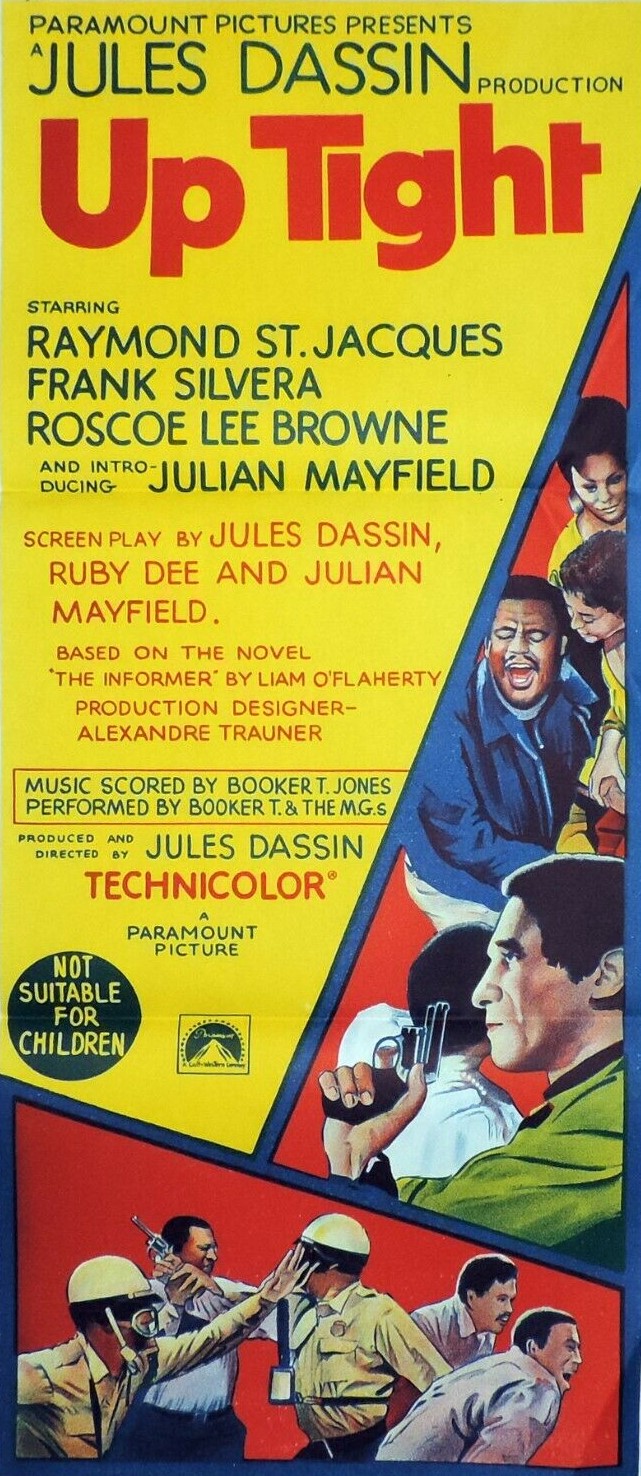
Above: American poster. Below: the French version.

Assailed for his lack of maintenance by Laurie (Ruby Dee), mother of his kids, who subsists on welfare and prostitution, Tank considers informing on Johnny and picking up the $1,000 reward. So the story becomes a question of whether he will succumb to temptation.

But that’s really just a MacGuffin for an insight into the problems facing the poverty-stricken black population and the armed response many feel is the only way to resolve such issues. Several outstanding scenes depict the raw emotions of people trapped in this lifestyle. The opening scene, showing the funeral of Martin Luther King, became a clarion call for violence. Laurie is humiliated by a welfare officer. Police attempting to arrest Johnny are met with a fusillade of bottles.

The case for armed insurrection is made abundantly clear. The black population is continually oppressed, not just by police violence, but being told they lack the skills for a rewarding job. “When you’re born black, you’re born dead.” B.G. rejects the offer of assistance of white civil rights activists. Not all the locals are underdogs. Clarence (Roscoe Lee Brown), with an apartment lined with bookshelves and wearing fine clothes, does very well out of his arrangements with the police and the black welfare officer clearly gets a kick out of his power to possibly disbar Laurie from receiving financial assistance. While it might have proved more incendiary at the time, it’s impossible to miss the injustice portrayed. It was almost a wake-up call for the ruling authorities that there existed a growing underground force determined to achieve equality through violence if necessary. The idea of an organised group, rather than a shambolic mob, is the other clear message.

Any actor would baulk at the prospect of matching the Oscar-winning performance of Victor McLaglen in the Ford original and surely no director would entrust the task to an inexperienced actor like Julian Mayfield whose only previous screen credit was a decade before in Virgin Island (1958). Mayfield finds it impossible to conjure up the pathos required and mostly appears as a bumbling fool.

This is despite the movie going out of its way to make Tank appear more sympathetic. He could easily claim he was blackmailed into informing by wealthy stool pigeon Clarence who holds compromising photographs. But, equally, the brotherhood, should it become aware of Clarence’s activities, would surely come down on him hard. Johnny absolves Tank of responsibility for not participating in the robbery, recognizing that while the man’s bulk was useful in the past, he lacks the mind-set for robbery. And he must stay away from Laurie otherwise she will lose her welfare.

But the rest of the cast is outstanding. Raymond St Jacques (If He Hollers, Let Him Go, 1968) stands supreme as an imposing Malcolm X figure. Roscoe Lee Brown (Topaz, 1969) is persuasive as a confident gay informer. Activist Ruby Dee (The Incident, 1967) is good, too. And there is strong support from Frank Silvera (Guns of The Magnificent Seven, 1969), Max Julien, best known later for The Mack (1973), and in her movie debut Janet MacLachlan giving a hint of the acting skills that would win her an Oscar nomination for Maurie (1973)

Perhaps the most important element of the picture was the screenplay, a collaboration between Julian Mayfield, Ruby Dee and Jules Dassin, the involvement of the first two ensuring that the main targets were well and truly hit. Dassin ensures that the movie never loses its way, tension kept high by the hunt for Johnny, the personal dilemma of Tank and the various confrontations with B.G. Great contemporary score by Booker T.

This is a movie that still stands up, not just because of its fearless delineating of the times, but from the suspicion that not enough has changed in the abject poverty to which so many are condemned.

There’s a very decent print available on Youtube.

The Last Letter from Your Lover (2021) *** – Seen at the Cinema

Oddly enough, this is also straddles 1965 and the present time and falls victim to the same problems of following two storylines. In fact, this is a tad complicated in that not only is present-day journalist Ellie Haworth (Felicity Jones) investigating a romantic mystery from the past but the subject of her inquiry Jennifer Stirling (Shailene Woodley) is also investigating her own romance. Confused, you bet. Jennifer is suffering from that old Hollywood romantic standby – amnesia – and is alerted to her own mysterious past by the discovery of the letters that turn up half a century later in the hands of Ellie.

So really, there’s three storylines to keep up with: the contemporary exploration of the past, Stirling’s journey of self-discovery and in a series of flashbacks in the same period her forbidden romance – given she is already married – with charmer Andrew (Callum Turner). This 1960s is full-throttle glamour, playing out in the classy French Riviera, both Stirling and Andrew looking like they’ve just walked off a catwalk.

That it works surprisingly well is due to the three stories never getting mixed up (as in Last Night in Soho) and that in each period it is driven by detective work. People often forget there is nothing more satisfactory to solve than a romantic mystery rather than tracking down an ubiquitous serial killer. Three of the characters – Andrew, Ellie and her co-opted  investigative partner Rory (Nabhaan Rizwan), an archivist, are absolutely terrific, the actors delivering star turns. Andrew comes over as attractive but deep, a committed financial journalist. On the other hand Jennifer is pretty much a spoiled brat, and in the hands of Shailene Woodley over made-up and looking ill-at-ease in her glad rags. Amnesia has the unfortunate effect of making her wooden.

The 1960s romance follows pretty much the standard Hollywood template that is somehow going to hit an iceberg. By comparison the contemporary slow-burning romance between Ellie and Rory is a joy. She is outgoing, spunky, sexually confident – in a neat reversal she can’t remember the name of the boy she wakes up in bed with – while Rory is an old-fashioned stuck-in-the-mud whom she manages to warm up.

Felicity Jones has been through the Hollywood wringer – earnest roles such as The Theory of Everything (2014) and On the Basis of Sex (2018) mixed in with blockbusters of the Inferno (2016) and Rogue One (2016) variety – but here she is just delightful, playing a very rounded character. Nabhaan Rizwan (The Accident tv series, 2019) is wonderfully endearing. They play exceptionally well off each other, a sort of latter-day Andie McDowell-Hugh Grant.

It would have been a very quiet cinemagoing week for me to end up watching this and I wasn’t going to review it at all except for being reminded of dual-time settings by Last Night in Soho. I have to say I was happily surprised, the various mysteries enough of a hook, the Jones-Rizwan tag team exhibiting true charisma. Hats off to director Augustine Frizzell (Never Goin’ Back, 2018) for recognizing their potential and for keeping the whole enterprise chugging along. It’s one of the few Netflix productions to deliver.

Last night in Soho (2021) ** – Seen at the Cinema

Genre mish-mash – sci-fi time travel time (sort of) and horror – just doesn’t come off and Anya Taylor-Joy blows the acting kudos she acquired for the Queen’s Gambit Netflix series. Honestly, we don’t care how people are transported to the past or the future but the journey has to be somehow worthwhile. If there is a such a thing for a fashion student, Eloise (Tomasin McKenzie) is somewhat on the nerdy side and when she ends up in an attic flat near London’s Soho she begins to inhabit the body of wannabe singer Sandie (Anya Taylor-Joy) whose ambitions over half a century previously took her no further than the seediest pockets of seedy crime. Eloise’s visions of recreating 1960s glamour disintegrate and she’s soon slap-bang in the middle of a horror story with leering men bursting out of the walls.

It’s always difficult to keep focus on two storylines, even when they appear to converge, but when they are over half a century apart the constant jumping back and forth is just irritating. The seediness is realistic enough, punter response to learning Sandie’s real or fake name is invariably “that’s a nice name.”  There’s a dodgy boyfriend (Matt Smith), mean girl (Synnove Karlsen) and an odd landlady (Diana Rigg) and that’s about as far as this stretches in terms of characterization. And if your bag is to spot the old-timer, then you will get glimpses of Terence Stamp (The Collector, 1963) and Rita Tushingham (The Knack, 1965) not to mention The Avengers (BBC, 1965-1968) television series reincarnation Rigg.

It’s not scary enough, fashionable enough, seedy enough, or 1960s enough – only a token nod to the period with a soundtrack from the decade and a few scenes with characters in the correct clobber or cars. It might just have worked if it had been the one actress playing both female parts because that at least might have been interesting to observe. Thomasin McKenzie (Old, 2021) is passable as the naïve young thing called upon to mostly look petrified. Anya Taylor-Joy (The New Mutants, 2020) brings nothing to a role that is just a cliché. Point the finger at Edgar Wright, whose Baby Driver (2017) I thought was a sign of him having turned a corner from previous misfires.

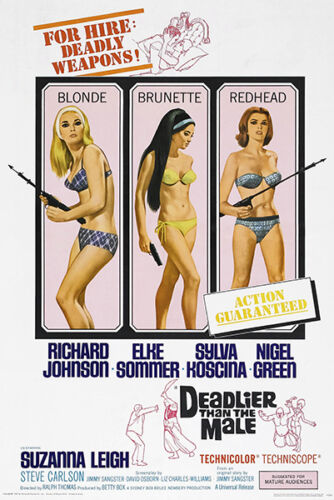
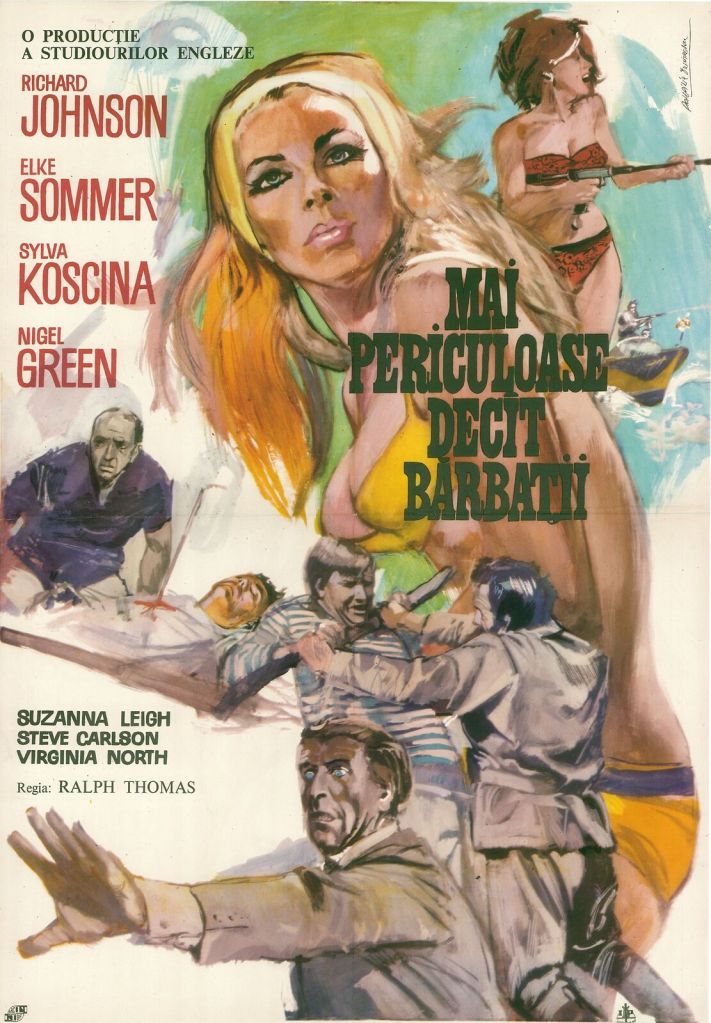
Deadlier than the Male (1967) ****

Now revealed as the first film seen by Quentin Tarantino – at the age of five.

For a movie intended to set up a series character in the vein of James Bond, it was ironic that it was the women who stole the show, not just from their tendency to turn up in bikinis but for their outrageous villainy. Irma (Elke Sommer) and Penelope (Sylva Koscina) are the seductive assassins in the hire of Carl Petersen (Nigel Green) who has designs on an Arab oil empire. On her own Irma dispatches mogul Henry Keller (Dervis Ward) then the pair – emerging from the sea like a pair of latter-day Ursula Andresses – harpoon his colleague Wyngarde (John Stone).   

Soon Hugh Drummond (Richard Johnson), investigating the death of Wyngarde, becomes a target  and that sets him off, with nephew Robert (Steve Carlson) in tow,  to the Mediterranean and the yacht of oil-rich King Fedra (Zia Mohyeddin) where, of course, the girls lie in wait.

Dispensing with the gadgets – except for one item employed by the villainesses – and gimmicks of Bond, but retaining the quips, this is a fun ride with a more down-to-earth leading man – like the early Bonds – smarter girls, a more old-fashioned mystery, a hefty thug Chang (Milton Reid)  in the Oddjob mold, a castle doubling as the villain’s lair, a suave master criminal, some detective work, and a super scene involving giant robotic chess men.

The bickering between Irma and Penelope, who is not just a tad sadistic but a kleptomaniac especially as far as her partner is concerned, coupled with their overweening confidence, makes them much more human than any Bond Girl and the character traits explored have a pay-off at the climax. Equally interesting are the mind games, Drummond vs. Peterson but also Drummond vs. Irma. And that the female baddies see it as points on their scoreboard to seduce Drummond rather than the other way round.

Drummond is every bit as capable a seducer as Bond and equally ruthless, stripping a suspect naked. Petersen is also a clever character, faking his own death and running a very smooth operation, and certainly his recruitment techniques are second to none.

Some ideas were certainly ahead of their time, the chess men are the equivalent of a modern computer game while the human bomb has, unfortunately, entered the modern lexicon and there are enough female serial killers around to prevent anyone believing they are always (to use an outmoded sexist phrase) the gentle sex. However, in the middle 1960s, the concept that women would be partial to murder and torture not to mention repeatedly seducing males went so much against the grain of the male authority figures that the British censor slapped an X-certificate on the movie.

Shakespearian actor Richard Johnson was a one time MGM contract player, but his only previous top-billed outing was the Italian-made The Witch (1966). He certainly made a splash with this character, investing it with a great deal more gravitas than Flint or Helm. The Teutonic Elke Sommer (The Venetian Affair, 1966) is brilliant as one half of the assassin tag-team with a batch of one-liners for every occasion. Sylva Koscina (A Lovely Way To Die, 1968), nose always put out of joint, almost steals the show.  Nigel Green (Tobruk, 1967), while his usual sardonic self, has the playfulness of the rich and powerful.

Steve Carlsen, in his movie debut, doesn’t make much of an impact in a largely lame role. Zia Mohyeddin has a more interesting part as the oil kingpin wanting to help his people. As you can expect in a spy picture there are a host of beautiful women – Suzanna Leigh (The Lost Continent, 1968) a defector, Virginia North, also making her debut, Justine Lord (Night after Night after Night, 1969), and Didi Sydow in her only screen appearance.

The light comedy experience of director Ralph Thomas (Doctor in Distress, 1963) comes is very handy, as his sense of comic timing is excellent, but, perhaps learning from his previous brush with espionage in Agent 8¾ / Hot Enough for June (1964) brings a bigger punch to the action scenes. And it’s a bold ploy to start with an action sequence revolving around Irma and Penelope rather than our star man.

The screenplay was a team effort – Jimmy Sangster (The Devil-Ship Pirates, 1964), taking a break from Hammer duties, David D. Osborn (Maroc 7, 1967) and Liz Charles-Williams, making her screen debut  – all involved.  This was familiar territory for composer Malcolm Lockyer (Five Golden Men, 1967). British pop act The Walker Brothers had a hit with the theme tune.

This is more fun than camp, not a send-up of the genre like Derek Flint and Matt Helm, but a spy picture with a believable leading men and excellent villains. But the plot is more centred on filthy lucre rather than global control and there is a genuine understanding of how businesses work – takeovers, mergers, dirty dealings – though small wonder Petersen would like to be shot of pedantic boardroom nuisances like Bridgenorth (Leonard Rossiter) – wouldn’t we all?

Bulldog Drummond was an international crime-buster invented by “Sapper,” the pen-name of H.C. McNeile. Bulldog Drummond had been a Hollywood mainstay for over four decades, the twenty-plus pictures attracting stars like Ronald Colman (Bulldog Drummond, 1929, and Bulldog Drummond Strikes Back, 1934), Ray Milland (Bulldog Drummond Escapes, 1937), Walter Pidgeon (Calling Bulldog Drummond, 1951) and a young Ralph Richardson (The Return of Bulldog Drummond, 1934). But the notion, in the Swinging Sixties, of tagging any leading man by the moniker of ‘Bulldog’ did not seem like a good idea, so the character underwent wholesale reinvention and his nickname is never mentioned.  

The title comes from a line in a poem by Rudyard Kipling, The Female of the Species. That was the original title of the film and also of a Sapper book.

You can get his on a double bill with the sequel Some Girls Do from Network at a very reasonable price. Will be reviewing Some Girls Do next.

Discover WordPress

A daily selection of the best content published on WordPress, collected for you by humans who love to read.

The Atavist Magazine

by Brian Hannan

WordPress.com News

The latest news on WordPress.com and the WordPress community.