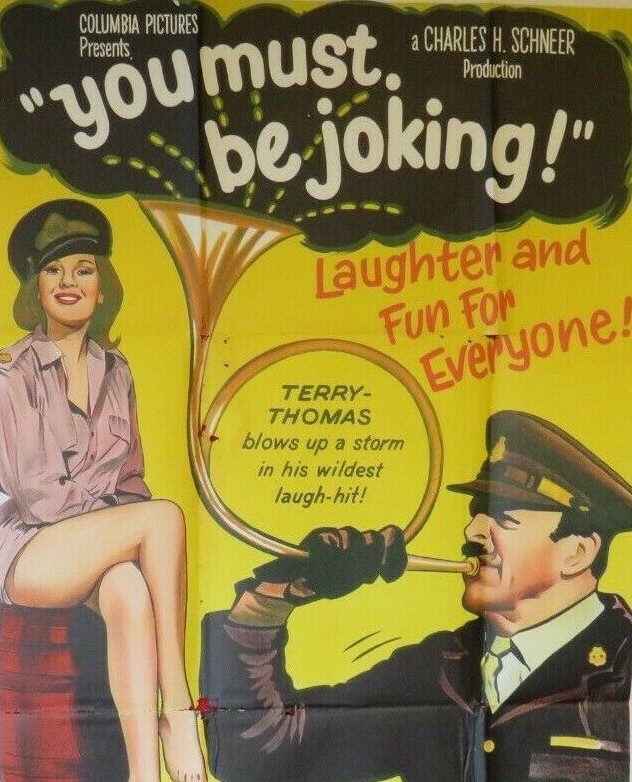
You Must Be Joking! (1965) ***

British thriller specialist Michael Winner (Death Wish, 1974) learned all about structure churning out low-budget comedies like this unusually contemporary number. A precursor of the reality television trope of a variety of characters in competition to complete a series of odd tasks, this has a military set-up, aiming to find, oddly enough in an organisation where strict hierarchy dominates, people capable of bending the rules. Initiative, in other words.

Some of the motley crew, of course, have no intention of bending any rules if they can get everyone else to do the work for them, namely upper-class Capt Tabasco (Denholm Elliott) who gets the game rolling by calling in a helicopter as a favor from an old school chum to rescue him from a maze, the first task. He spends most of the time pampered in a hotel suite while dispatching girlfriend Poppy (Tracy Reed) on various expeditions.

Saved by the double bill: Winner’s comedy found a bigger audience
by being booked as the support for hit “Cat Ballou.”

There’s a Yank involved, of course, to target the all-important American market, Lt Tim Morton (Michael Callan) also using assistance in the form of upmarket girlfriend Annabelle (Gabriella Licudi) whose specialty is causing vehicle pile-ups. We’ve got a whisky-drinking Scot, Sgt Major MacGregor (Lionel Jeffries), stiff upper back rather than stiff upper lip with his constant snapping to attention, and two graduates from the Army Hapless Division in Sgt Clegg (Bernard Cribbins) and Staff Sgt Mansfield (Lee Montague). Directing proceedings are Major Foskett (Terry-Thomas) and General Lockwood (Wilfred Hyde-White), at opposite ends of the character arc, the former frantic, the latter laid back.

A couple of the five tasks involve unravelling clues, finding a particular rose, for example, but the whole purpose of the exercise is to have the soldiers constantly getting in each other’s way, trying to outwit one another, falling into bizarre scenarios – a fox hunt the cleverest – and generally getting all muddled up one way or another, so that initiative is the last thing they display.
What the movie does have in abundance is imagination, otherwise how to explain the involvement of a seductive housewife, pop star, television show, tunnelling, Lloyd’s of London, Rolls Royce and a greyhound racetrack. On the other hand this might be a smaller-scale precursor to If It’s Tuesday, It Must Be Belgium (1969) in shovelling together all sorts of British institutions and tourist attractions. And certainly Capt Tabasco with his love of the finer things of life demonstrates just how much fun it can be to be British if you’re upper class, wealthy, went to the right school and are not above a bit of blackmail.

As you might expect, the pace is hectic, which is just as well, because if you stopped to think about what was going on you might well throw in the towel. That’s not to say it’s not enjoyable in a riotous sort of way, running jokes almost in a separate competition of their own, and if you always hankered to see Michael Callan’s dance moves this is for you – suffice to say he’s not in the Fred Astaire class. But everyone here is there to be made a fool of, except Capt Tabasco, who rises above it all in classy fashion and when he’s out for the count appears blessedly delighted.

Denholm Elliott (Station Six Sahara, 1963) comes off best, testing out his lazy scoundrel, but  the top-billed Michael Callan (The Interns, 1962) might never have signed up if he’d known the consequence was being relegated to television for seven years. However, given we are well accustomed to the shtick of the likes of Bernard Cribbins (The Railway Children, 1970), Lionel Jeffries (First Men in the Moon, 1964), Terry-Thomas (Bang! Bang! You’re Dead! 1966) and Wilfred Hyde-White (The Liquidator, 1965), he does at least have the advantage of standing out, if only as a novelty.

And just in case the goings-on don’t hold your attention, Winner has recruited a platoon of top British stars in bit parts including Leslie Phillips (Maroc 7, 1967) and James Robertson Justice (Guns of Darkness, 1962) and rising stars such as Tracy Reed (Hammerhead, 1968), Gabriella Licudi (The Liquidator) and Gwendolyn Watts (The Wrong Box, 1966) and future British television treasures Clive Dunn (Dad’s Army, 1968-1977), Richard Wattis (Copper’s End, 1971) and Peter Barkworth (Telford’s Change, 1979). So if you get fed up trying to work out what’s what you can play who’s who.

Alan Hackney (Sword of Sherwood Forest, 1960) wrote the screenplay based on a story by director Winner.

Not non-stop hilarity but definitely non-stop something with a good few chuckles thrown in.
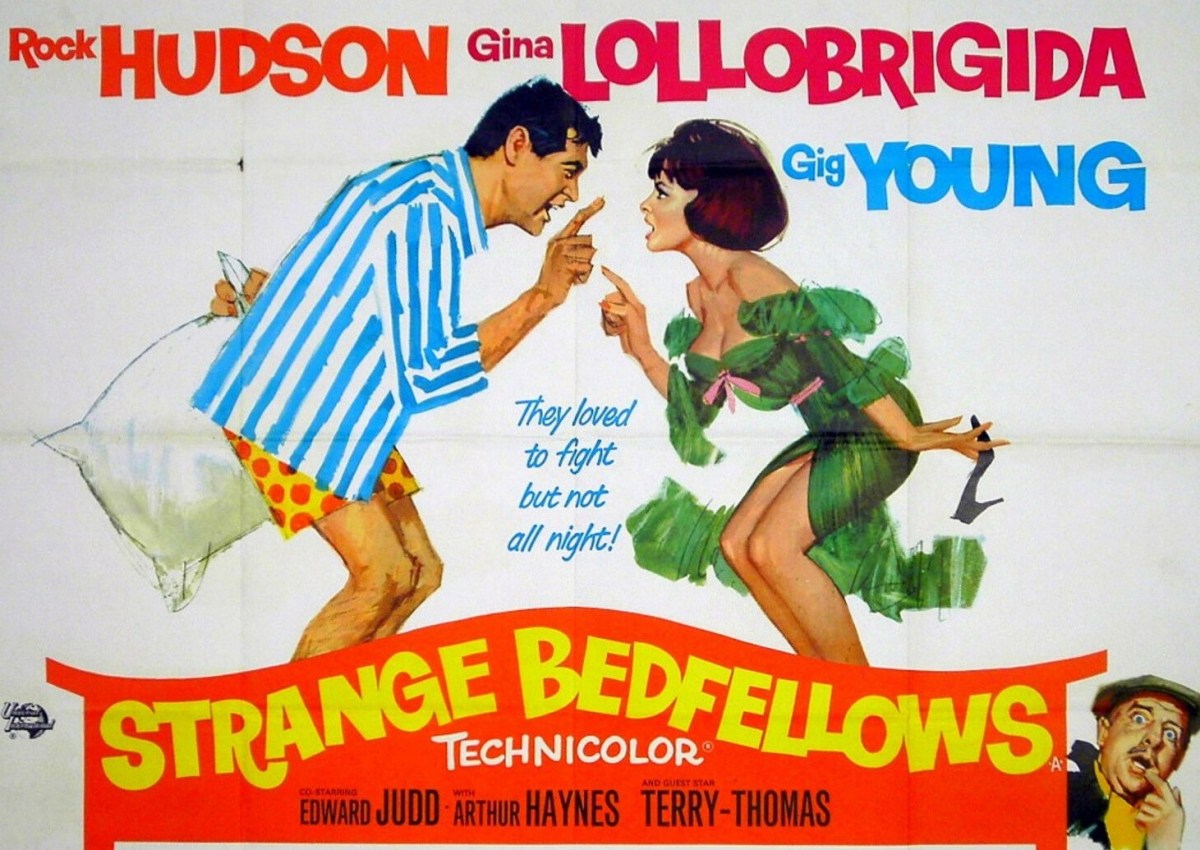
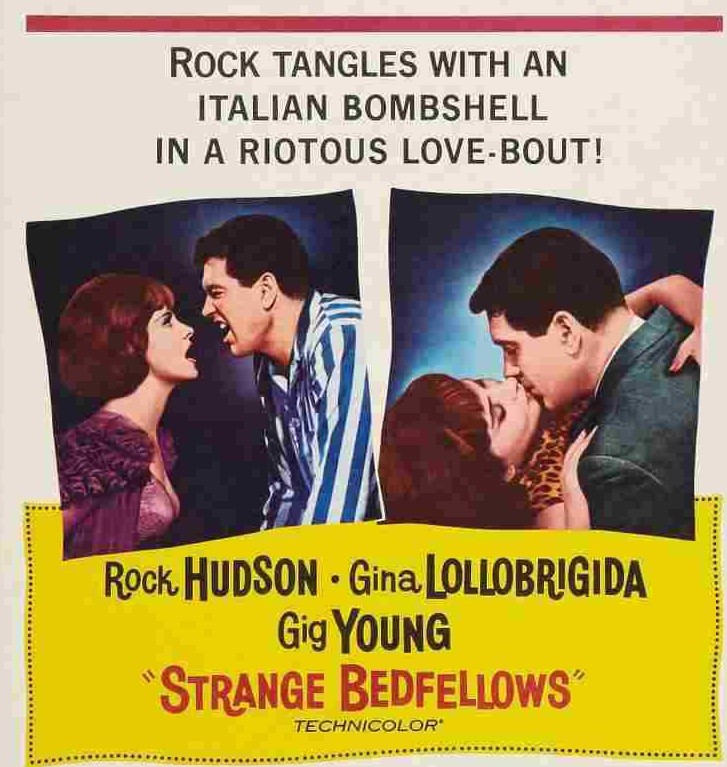
Strange Bedfellows (1963) ****

I had my first belly-laugh within seconds, a wonderful sight gag, and was chortling all the way through this London-set battle-of-the-sexes comedy. Rock Hudson is a high-flying businessman who needs to win back long-estranged wife Gina Lollobrigida in order to gain promotion in a family-conscious oil company. Initially, Hudson re-discovers the reasons he had first fallen in love with her but then, of course, only too bitterly, why they split. Hudson and La Lollo had previously teamed up for Come September (1963) and Hudson had spent most of the early 1960s in romantic mishap with Doris Day so he could call on an extensive range of baffled and enraged expressions. Lollobrigida is an artist-cum-political-firebrand which sets up hilarious consequence. Gig Young is on hand to act as referee.

There’s some marvelous comic invention,  a conversation between the two principals relayed through taxi controllers turns into a masterpiece of the misheard and misunderstood. Complications arise from Lollobrigida’s fiance Edward Judd (First Men on the Moon, 1964), also an activist, but on the pompous side, and an Italian lothario. Taking advantage of the less than congenial London weather, there are jokes aplenty about umbrellas and in a nod to farce occasions for Hudson to lose his trousers and share a bed with the fiance. Smoldering sexual tension also kindles many laughs. By the time the film enters its stride it’s one comedic situation after another. It being England, naturally enough Lady Godiva is involved.

Hudson in suave mode trying to cope with the feisty Lollobrigida is an ideal comedy match. Costume designer Jean Louis has swathed the actress in a stunning array of outfits, some of which leave little to the imagination. When Doris Day got angry you tended to laugh, not quite believing this was anything more than a moderate hissy fit, but if you crossed Lollobrigida you were apt to get both barrels and it never looked like acting, she was a very convincing when she switched on the fury engine, plus, of course, whatever she threw added both to the comedy and her character’s conviction.   Both have terrific comic timing.

Writer-director Melvin Frank was something of a comedy specialist, a dab hand at suiting comedy to screen persona having previously set up Road to Hong Kong (1962) and Mr.  Blandings Builds a Dream House (1948). Terry-Thomas makes an appearance as a comic mortician and there are parts for English comedian Arthur Haynes and Dave King. Hudson and Lollobrigida exude screen charisma and while not in the class of Come September this delivers enough laughs to make you wonder why they don’t make them like that anymore.

You should find this in Amazon Prime.

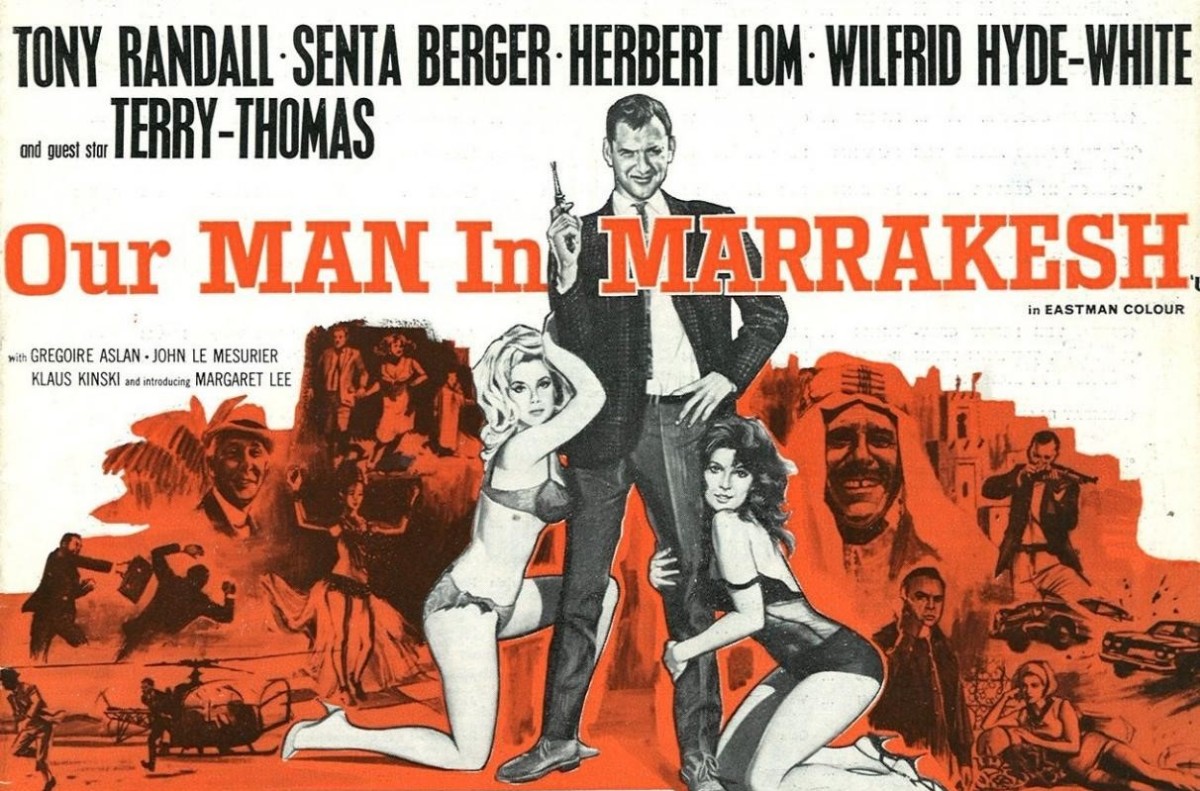
Our Man in Marrakesh aka Bang! Bang! You’re Dead! (1966) ***

All hail Senta Berger! Another from the Harry Alan Towers (Five Golden Dragons, 1967) portfolio, this is a spy-thriller mash-up with a bagful of mysteries and a clutch of corpses. At last given a decent leading role, and although you wouldn’t guess it from either poster, Senta Berger steals the show from the top-billed Tony Randall (as miscast as Robert Cummings in Five Golden Dragons) and a smorgasbord of European  talent including Herbert Lom (The Frightened City, 1961), Terry-Thomas, Klaus Kinski (Five Golden Dragons), John Le Mesurier and Wilfred Hyde-White (Carry On Nurse, 1959). In this company, the glamorous Margaret Lee (Five Golden Dragons), as Lom’s cynical lover (“you are never wrong, cherie, you told me so yourself,” she tells him) is an amuse-bouche.

A more comedic approach to the movie when it was re-titled for U.S. release. At least here it did not try to sell itself as a Bond-type picture.

Six travellers – including oilman Randall, travel agent Le Mesurier, salesman Hyde-White and tourist Berger, meeting her fiancé – board a bus from Casablanca airport to Marrakesh. One is carrying $2 million as a bribe to ease through a vote in the United Nations, but bad guy Lom doesn’t know which one it is. When Berger’s fiance’s corpse tumbles out of Randall’s cupboard, the pair become entangled. Berger is a marvellous femme fatale, trumping Randall at every turn. 

With no shortage of complications, the tale zips along, directed on occasion with considerable verve by Don Sharp (The Devil-Ship Pirates, 1964). There are some inventive double-plays – with a body in the boot Berger and Randall are stopped by a cop who tells them their boot is open. An excellent rooftop chase is matched by a car chase. And there’s a terrific shootout. Kinski is at his sinister best and Terry-Thomas a standout in an unusual role as a Berber.

The film was shot on location including the city’s souks, the ruined El Badi Palace and La Mamounia hotel (featured in The Man Who Knew Too Much, 1956). But Berger seamlessly holds the whole box of tricks together, at once glamorous and sinuous, practical and tough and exuding sympathy, and it’s a joy to see her for a large part of the picture leading Randall by the nose. Quite why this did not lead to bigger Hollywood roles than The Ambushers (1967) remains a mystery.

Discover WordPress

A daily selection of the best content published on WordPress, collected for you by humans who love to read.

The Atavist Magazine

by Brian Hannan

WordPress.com Blog

News, Tips & Website Tutorials