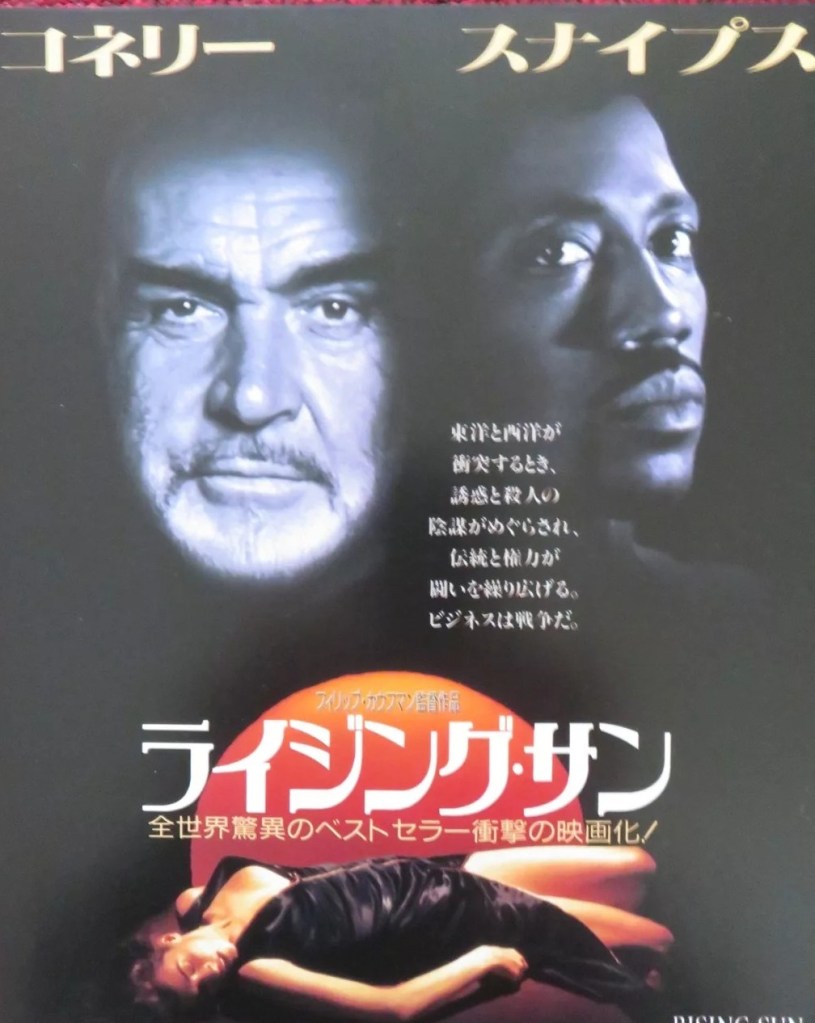
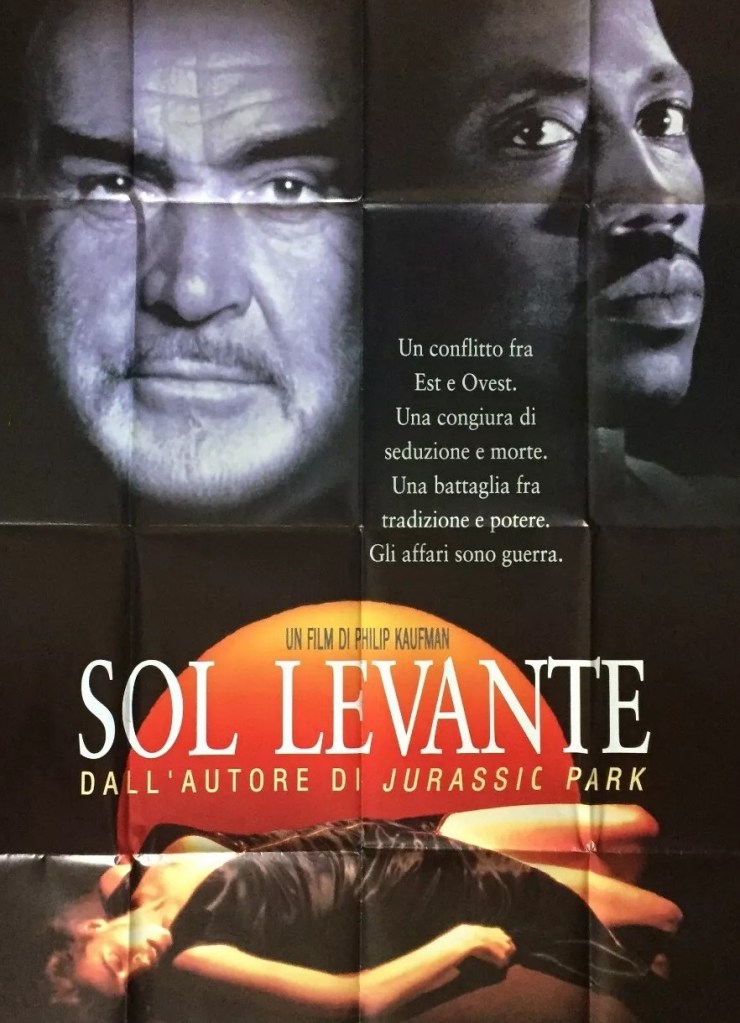
Rising Sun (1993) ****

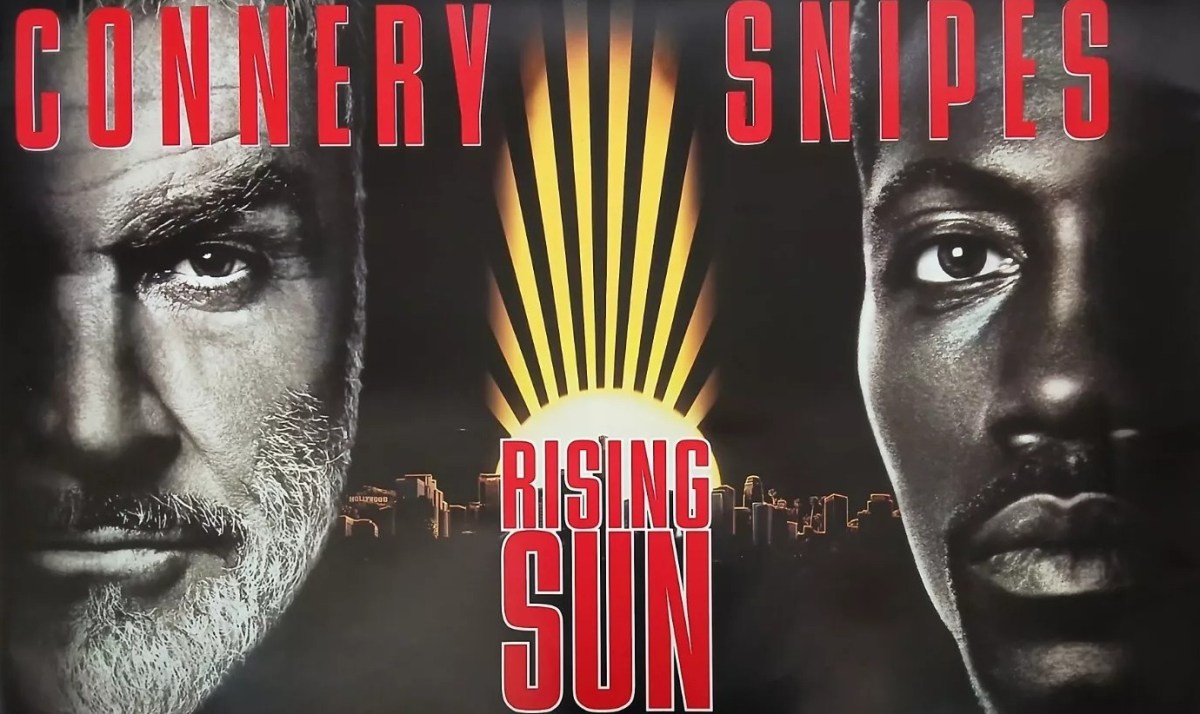
Will instantly connect with the contemporary audiences for two unusual reasons. First off, it’s the initial depiction of deepfake. Secondly, a major plot point concerns an aspect of the roughest kind of sex, erotic asphyxiation. These days you’ll find many women complaining that a partner’s addiction to porn has forced them into such dangerous experiment. Here, lending fire to the idea that it’s nothing but fun, is the notion that it’s the woman who’s desperate for such.

There used to be a standard Hollywood ploy of sticking a younger rising star alongside an established bigger name. After Top Gun (1986) Tom Cruise proved the best exponent of this, working with Paul Newman in The Color of Money (1986) and Dustin Hoffman in Rain Man (1988). The idea is that the younger fella will learn from the older (Newman and Hoffman proved top-class tutors, both winning Oscars).

And in fact the narrative here actually takes up such an idea. Semi-retired cop Capt. John Connor (Sean Connery) plays mentor to Lt. Webster Smith (Wesley Snipes) when both are called out to act as liaison between investigator Tom Graham (Harvey Keitel) and the top brass of Japanese corporation Nakamoto where a murder has been committed. The death was initially dismissed as a sex game that went too far and as scarcely worth anyone’s time given the victim was a sex worker, Cheryl (Tatjana Patitz), sometime girlfriend of Japanese playboy and fixer Eddie Sakamura (Cary-Hiroyuki Tagawa).

Matters are complicated because Nakamoto is bidding to take over a key American computer manufacturer and because Senator John Morton (Ray Wise), who initially opposed the deal, is now in favor of a merger. Connor begins to suspect the Japanese have manipulated video recordings of the murder. Single father Smith, objecting to Connor’s involvement, is compromised by a secret past, exposure of which could potentially stop the investigation in its tracks. Slippery American fixer Bob Richmond (Kevin Anderson) is desperate to get a deal over the line.

While the intricate investigation is engrossing in itself, what really makes this fly, beyond another excellent performance by Connery, are the business machinations and the insights into Japanese culture. On the face of it, you might think this is an attack on the Japanese business machine, rampant at the time, but, in reality, my guess is the Japanese would love it for the way it shows American companies in their thrall.

In Japan “business is war” and companies gird themselves for battle by forming alliances that would be outlawed in America. An adept screenplay manages to seed a rich background, featuring elements of Japanese society that are both positive (criminals are generally caught plus caring for employees and “fixing the problem, not the blame”) and negative (racism is widespread). Connor, steeped in Japanese culture, able to move in the highest business circles, calling in favors, is our guide, but that’s never to the detriment of the overall picture, and instead adds welcome depth.

There’s a certain subtlety at work, too, the introduction of the single dad (treated seriously rather than for comic effect) a bit of a thematic coup for the times and Connor’s relationship with Jingo (Tia Carrere) is more fluid than you might expect, the older man leaving the “cage door open” should his younger lover find someone of her own age.

Three decades on from the cultural appropriation of A Majority of One (1961) when Hollywood elected Alec Guinness to play a Japanese man, there’s no shortage of players of Japanese descent  to supply the movie with more authenticity. Mako had been Oscar-nominated for The Sand Pebbles (1966) while Stan Egi (Come See the Paradise, 1990), Clyde Kusatsu (In the Line of Fire, 1993) and Nelson Mashita (Darkman, 1990) flesh out the ranks.

Beard aficionados will welcome Connery’s stylish cut which, once again, serves as a shortcut to character – this is a confident, fashionable man. Sean Connery (The Man Who Would Be King, 1975) drives the movie, he’s always one step ahead even when the bad guys think they have him beat. Another top-notch performance from Sean Connery. Wesley Snipes (Passenger 57, 1992) wasn’t paying much attention to the free acting lessons handed out by Connery, not learning to rein it in, and, presumably to maintain his action cojones, is permitted some unlikely karate kicking. That last wasn’t in the book. There were only two other major changes from the book – adding a couple of early scenes with the victim and giving Connors a relationship with  Jingo. Some of the book is heavily truncated for obvious reasons – you’ll wonder just what the heck is the purpose of Willy the Weasel (Steve Buscemi).

The screenplay by author Michael Crichton (Jurassic Park, 1993), director Philip Kaufman and Michael Backes in his debut, manages to fully convey the novel at the same time as squeezing in as many bon mots as possible without losing sight of the drama.

Philip Kaufman (Fearless Frank, 1967) makes the most of the rich material.

Connery scores once again.

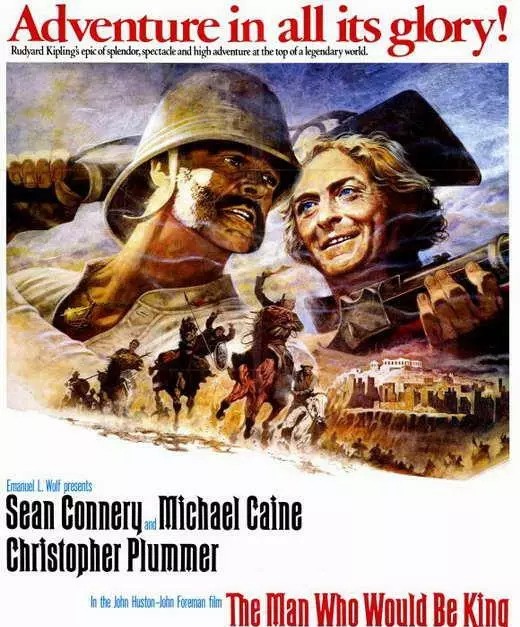
The Man Who Would Be King (1975) ****

Variation on the director’s earlier The Treasure of the Sierra Madre as a pair of British ex-military cheekie chappies whose reach exceeds their grasp come unstuck when confronted by powerful religious elements. Enticingly presents a marvellously ironic puzzle – you can have everything your heart desires except anything that would make you human. And elevated less by John Huston’s cinematic achievement than by terrific performances by the two stalwarts of the British film industry at the time, Sean Connery and Michael Caine, the former taking the acting kudos by a nose as the less intelligent of the duo. Given Connery’s standing at the time, this was somewhat playing against type. Yes, he exudes screen charisma and is a macho as ever, but nonetheless not quite as quick on the uptake as the more calculating Caine.

Story is told in flashback after a maimed Peachy Carnehan (Michael Caine) turns up as the offices of journalist Rudyard Kipling (Christopher Plummer). They originally met when Peachy had stolen the writer’s watch, returning it on realizing they were fellow freemasons. With buddy Daniel Dravot (Sean Connery), they attempt to enlist Kipling in a blackmail scheme and in due course the soldiers set off to make their fortunes in the forbidding land of Kafiristan, at the top of the Indian sub-continent, where no white man has set foot since Alexander the Great.

Their scheme is simple – to hire themselves out as mercenaries to various tribes, bringing modern warfare skills and weaponry to primitive society and ascending the ranks of power. When Daniel appears unhurt after plucking an arrow out of his chest, the natives confer on him the status of god, and so he is elevated to kingshippery and all the gold he could want. But in this Garden of Eden there is a humdinger of a Catch 22, the apple he must not touch.

He can’t take a wife.

You can see the logic. As a god you should be above base earthly desires. A god could not possibly wish such intimacy with a human. Otherwise he would lose his otherworldly sensibilities, not to mention that the chosen woman would expect to physically explode. While the more sensible Peachy has been all the time calculating just how he’s going make a getaway with as much gold as he can carry, Daniel becomes trapped in the notion that he can have his cake and eat it.

The religious hierarchy says otherwise and it doesn’t end well.

Audiences may well have been disappointed at the lack of action. There’s only one battle and it’s over in a minute, albeit that there’s a timeout to make the point about the power of religion. And although our boys endure a momentous trek it’s fairly standard stuff and Huston lacks the vision of a David Lean to turn the journey into anything more dramatically or visually memorable. A whole bunch of indigenous background material – including the ancient version of polo where the ball is a human head – doesn’t make up.

What does transform this relatively slight tale is the playing. Connery and Caine are a delight, the kind of top-of-the-range double act on a par with the cinemagical pairing of Paul Newman and Robert Redford in Butch Cassidy and the Sundance Kid (1969) and The Sting (1973). They spark each other off just a treat. Caine, surprisingly, is the one in charge, Connery adrift in  matters of arithmetic, strategy and, when it comes down to it, common sense even though when called up to judge on civil matters proves himself relatively astute and fair.

The writing, too, seems to understand implicitly how to get the best out of the characters. When they fall out, it is so subtle you would hardly notice. Caine scarcely bristles when Connery explains that Caine really should be falling in line with the rest of his subjects and bowing his head, but if you are astute reader of an acting face you can see the chasm that has opened up in their relationship.

To employ a Scottish phrase, Connery gives it “laldy” – acts with gusto – when playing the part of a madman, whirling around like a demented dervish, but mostly reins it in.

The intricacies of freemasonry would wait a few decades before called to the cinematic altar in The Da Vinci Code (2006) but here the mumbo-jumbo proves less important than, as with the Dan Brown epic, a symbol, and, again with the lightest of narrative strokes, we are left considering its mystic origins.

John Huston (Sinful Davey, 1969) back on top form but he’s more than helped by exceptional acting by Sean Connery (The Hill, 1965) and Michael Caine (Play Dirty, 1968) with Christopher Plummer (Nobody Runs Forever / The High Commissioner, 1968) in unusually subtle form as well. Gladys Hill (Reflections in a Golden Eye, 1967) and Huston were Oscar-nominated for the  the screenplay based on the Kipling short story.

Impressed by this performance I should warn you I feel a Sean Connery binge coming on.

The Russia House (1990) ****

The amateur spy – the innocent caught up in espionage malarkey – had scarcely graced the screen for a couple of decades, Hot Enough for June/Agent 8¾ (1964) or Masquerade (1965) possibly the highpoints of that subgenre. That it turns up at all is probably due to spymaster John le Carre’s Cold War comfort zone evaporating following glasnost and perestroika in Russia in the late 1980s. Of course, the West didn’t entirely trust the Soviets to reform, and had no intention of pensioning off its battalions of secret agents.

The plotline is largely irrelevant here, acting more as a MacGuffin than anything else, because audiences will have long forgotten what was sacred to the West three decades ago. And the picture is devoid of the usual car chase and there’s not even the kind of foot-race that became de rigeur to prove our ageing superstars could still physically hack it – Clint Eastwood in In the Line of Fire (1993) or Liam Neeson in Taken (2008).

So what we’re left with is probably what le Carre was hoping for in the first place – a character study. It may have passed your notice that among the highest ranks of the superstars only Sean Connery could match Tom Hanks in actually changing his appearance – different hairstyle, different beard (yep, you didn’t think that could define character, did you) – to depict character. Of course, nobody was expecting Stallone or Schwarzenegger to alter their look; Harrison Ford got a buzzcut once; but Paul Newman, Burt Lancaster, Kirk Douglas, even going further back to James Stewart, Gary Cooper, their hairstyle remained untouched, and until Connery made it part of his persona Hollywood believed that moustaches were box office disaster.

Barley (Sean Connery) is an upmarket publisher whose business is on the slide, so much so that he doesn’t attend an annual book fair in Moscow. So when Russian single mother Katya (Michelle Pfeiffer) turns up looking for him, she ends up handing a manuscript to Penguin’s representative who, naturally, turns it over to MI6.

Takes a while what with interrogation and flashback to work out why Barley has been selected. Unwittingly, on a previous sojourn to Russia, he had made the acquaintance, over a drunken dinner, with Dante (Klaus Maria Brandauer) who turns out to be Katya’s long-ago first love and, more importantly, a nuclear scientist with secrets to sell or give away. Barley is hooked into returning to Russia to gain the confidence of both Katya and Dante and provide access to secrets  the British Secret Service and their Yank counterparts desire.  

That it doesn’t go the way the high-ups want is because Barley is a “decent human being” and when he realizes he has compromised Katya, and endangered the lives of her two young children, he turns traitor and trades their safety for secrets.

Given the plot and counter-plot thesis, and the various axes that need to be ground over nuclear weapons accumulation and inherent corruption, this cinematic enterprise could have proved way too unwieldy for a contemporary audience. Instead, the very fact that much of the background is now meaningless clears the way for the movie to stand on its own two feet, as yet another wonderful character study in the largely unheralded Sean Connery (The Hill, 1965) portfolio. And with Michelle Pfeiffer turning in a Golden Globe-winning performance, the  movie hinges more on the characters than the espionage.

There’s a fabulous scene where the initial narrative is just turned on its head. You’re already thinking MI6 must be hard put to be even thinking of employing Barley, given he’s a bit of a boozer, the kind of guy who knocks one whisky straight down before sipping the next. Katya, attempting to establish his bona fides and suspicious that he’s actually a spy, asks him, “Are you alone?” Meaning, has he come alone, is he acting independently?

Barley takes a different meaning from the question. “Never been more alone,” he replies, barely concealing the despair in his eyes. “I let people down,” he confesses at another point.

His life is headed in all the wrong directions. He’s fluffed too many lines and no guarantee he’s even capable of looking for redemption. And Katya’s way too wary. He’s like an enthusiastic schoolboy when he falls in love with her. When he dives in for a kiss, she tilts her head so he can only kiss her cheek in the Russian fashion.

His romancing comes unstuck when instead of responding to his ardor she recounts her experiences with Dante. It’s her scene and yet Connery steals it with his slow-burn despair. Her wariness shows in her face. The purported new freedoms her country promotes mean little more than citizens can more freely complain.

While you might not go along with his self-deprecating description of himself as a “large unmade bed” – his physical grace always going to make this unlikely – nonetheless he is a shambles of a man. Even Connery can’t make fashionable the duffel coat, his perennial outfit of choice, an item of clothing that to generations epitomized the unfashionable, a garment worn by those who couldn’t care less about their appearance.

Connoisseurs of Connery’s hair and beard will notice a certain rumpled element compared to the stylish beard he wore in Rising Sun (1993) or the confident full version of The Hunt for Red October (1990).

Outside of the Connery-Pfieffer axis, although the narrative stumbles in accommodating their manoeuvring, the movie boasts a phalanx of interesting supporting actors, some fallen from the marquee heights like Roy Scheider (Jaws, 1975) and James Fox (Thoroughly Modern Millie, 1967), others who would make their mark in television like John Mahoney (Frasier, 1993-2004), Martin Clunes (Men Behaving Badly, 1992-2014), David Threlfall (Shameless, 2004-2013) and Michael Kitchen (Foyle’s War, 2002-2015) and topped up with a wild-eyed indulgent performance from director Ken Russell (Billion Dollar Brain, 1967).

Rather devoid of screenwriter Tom Stoppard’s (Shakespeare in Love, 1998) trademark humor except in a couple of aural jokes about odd sounds emanating from hidden microphones. The first movie to be filmed in Russia after glasnost so a bit more authentic location work than usual. To his credit director Fred Schepisi (The Chant of Jimmie Blacksmith, 1978) allows Connery and Pfeiffer full rein rather than getting bogged down in the inescapable politics and office backstabbing.

Watch it for Connery and Pfeiffer.

Be warned: I feel a Connery binge coming on.

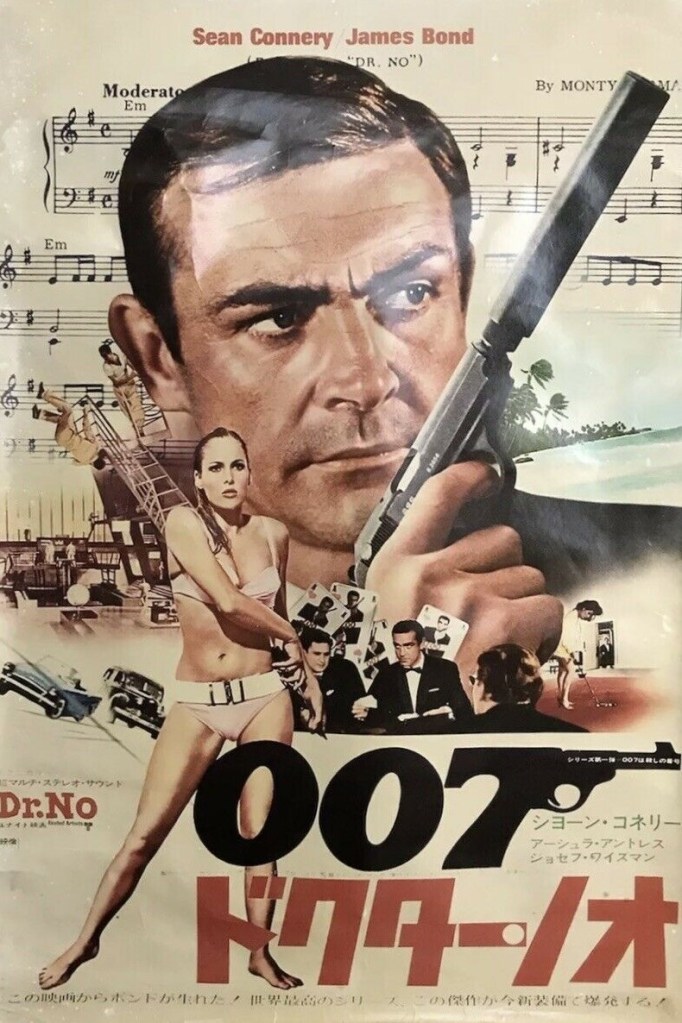
Dr No (1962) *****

Minus the gadgets and the more outlandish plots, the James Bond formula in embryo. With two of the greatest entrances in movie history – and a third if you count the creepy presence of Dr No himself at the beds of his captives – all the main supporting characters in place except Q, plenty of sex and action, plus the credit sequence and the theme tune, this is the spy genre reinvented.

Most previous espionage pictures usually involved a character quickly out of their depth or an innocent caught up in nefarious shenanigans, not a man close to a semi-thug, totally in command, automatically suspicious, and happy to knock off anyone who gets in his way, in fact given government clearance to commit murder should the occasion arise. That this killer comes complete with charm and charisma and oozes sexuality changes all the rules and ups the stakes in the spy thriller.

 Three men disguised as beggars break into the house of British secret service agent Strangeways (Tim Moxon) and kill him and his secretary and steal the file on Dr No (Joseph Wiseman). A glamorous woman in a red dress Sylvia Trench (Eunice Gayson) catches the eye of our handsome devil “Bond, James Bond” (Sean Connery) at a casino before he is interrupted by an urgent message, potential assignation thwarted.

We are briefly introduced to Miss Moneypenny (Lois Maxwell) before Bond is briefed by M (Bernard Lee) and posted out immediately – or “almost immediately” as it transpires – to Jamaica, but not before his beloved Beretta is changed to his signature Walther PPK and mention made that he is recovering from a previous mission. But in what would also become a series signature, liberated women indulging in sexual freedom, and often making the first move, Ms Trench is lying in wait at his flat.

Another change to the espionage trope, this man does not walk into the unknown. Suspicion is his watchword. In other words, he is the consummate professional. On arrival at Jamaica airport he checks out the waiting chauffeur and later the journalist who takes his picture. The first action sequence also sets a new tone. Bond is not easily duped. Three times he outwits the chauffeur. Finally, at the stand-off, Bond employs karate before the man takes cyanide, undercutting the danger with the mordant quip, on delivering the corpse to Government house, “see that he doesn’t get away.” 

Initially, it’s more a detective story as Bond follows up on various clues that lead him to Quarrel (John Kitzmiller), initially appearing as an adversary, and C.I.A. agent Felix Leiter (Jack Lord) before the finger of suspicion points to the mysterious Dr No and the question of why rocks from his island should be radioactive. Certainly, Dr No pulls out all the stops, sending hoods, a tarantula, sexy secretary Miss Taro (Zena Marshall) and the traitor Professor Dent (Anthony Dawson) to waylay or kill Bond.

But it’s only when our hero lands on the island and the bikini-clad Honey Rider (Ursula Andress) emerges from the sea as the epitome of the stunning “Bond Girl” that the series formula truly kicks in: formidable sadistic opponent, shady organization Spectre, amazing  sets, space age plot, a race against time. 

It’s hard not to overstate how novel this entire picture was. For a start, it toyed with the universal perception of the British as the ultimate arbiters of fair play. Yet, here was an anointed killer. Equally, the previous incarnation of the British spy had been the bumbling Alec Guinness in Our Man in Havana (1959). That the British should endorse wanton killing and blatant immorality – remember this was some years before the Swinging Sixties got underway – went against the grain.

Although critics have maligned the sexism of the series, they have generally overlooked the female reaction to a male hunk, or the freedom with which women appeared to enjoy sexual trysts with no fear of moral complication. Bond is not just macho, he is playful with the opposite sex, flirting with Miss Moneypenny, and with a fine line in throwaway quips.

Director Terence Young is rarely more than a few minutes away from a spot of action or sex, exposition is kept to a minimum, so the story zings along, although there is time to flesh out the characters, Bond’s vulnerability after his previous mission mentioned, his attention to detail, and Honey Rider’s backstory, her father disappearing on the island and her own ruthlessness. The insistently repetitive theme tunes – from Monty Norman and John Barry – was an innovation. The special effects mostly worked, testament to the genius of production designer Ken Adam rather than the miserable budget.

Most impressive of all was the director’s command of mood and pace. For all the fast action, he certainly knew how to frame a scene, Bond initially shown from the back, Dr No introduced from the waist downwards, Honey Rider in contrast revealed in all her glory from the outset. The brutal brief interrogation of photographer Annabel Chung (Marguerite LeWars), the unexpected seduction of the enemy Miss Taro and the opulence of the interior of Dr No’s stronghold would have come as surprises. Young was responsible for creating the prototype Bond picture, the lightness of touch in constant contrast to flurries of violence, amorality while blatant delivered with cinematic elan, not least the treatment of willing not to say predatory females, the shot through the bare legs of Ms Trench as Bond returns to his apartment, soon to become par for the course.

Future episodes of course would lavish greater funds on the project, but with what was a B-film budget at best by Hollywood standards, the producers worked wonders. Sean Connery (The Frightened City, 1961) strides into a role that was almost made-to-measure, another unknown Ursula Andress (The Southern Star, 1969) speeded up every male pulse on the planet, Joseph Wiseman (The Happy Thieves, 1961) provided an ideal template for a future string of maniacs and Bernard Lee (The Secret Partner, 1961) grounded the entire operation with a distinctly British headmaster of a boss.

Masterpiece of popular cinema.

The Red Tent (1969) ***

If you’re unfamiliar with the abortive Italian airship expedition to the North Pole led by General Umberto Nobilo (Peter Finch) in 1928, you’ll find this an absorbing tale. If you are familiar then you will probably appreciate the film-makers’ attempts, via an unusual framing device, to carry out a post-mortem and to apportion blame for the disaster. If you know your history, you’ll also be aware both poles had been conquered, American Robert Peary first to the North Pole in 1909, Norwegian Roald Amundsen (Sean Connery) claiming South Pole bragging rights two years later.

So you’re also probably wondering what was the point nearly two decades later of the Nobilo operation? But the sled-led efforts of Peary and Amundsen were feats of endurance i.e. man vs.  nature. This was science vs. nature. The dirigible was the apex of aviation advancement and nations still battled for exploration glory. So to travel in some comfort and fly over the North Pole in a few days would be a demonstration of scientific supremacy. Conquest of one of the most inhospitable places on earth was almost a PR exercise. With no intention of landing it was also a glorified tourist trip.

However, the science was flawed. Nobody had counted on the build-up of ice. The airship crashed and since this was a joyride nobody was equipped to walk their way out. Just surviving would be difficult enough. Loss of radio transmission (science) indicated a problem so rescue airplanes were deployed. But without a location to pinpoint the survivors, searchers had about two million sq km to cover. Luckily, a brilliant scientific deduction by expedition member Finn Malmgreen (Eduard Martsevich) saves the day and a ham radio user (amateur science) picks up the location. Game on!

Except airplanes are too easily thwarted by blizzards, fog and the inhospitable. Home base, set up simply to welcome home a successful jaunt, is not capable of organizing a proper rescue. A Russian ice-breaker joins the rescue attempt. Taking greater risks is aviator Einar Lundborg (Hardy Kruger), fired up by the promise of sex with desperate nurse Valeria (Claudia Cardinale), who happens to be Malmgreen’s girlfriend, and a bounty from Nobilo’s insurers. The redoubtable Valeria does not have to sell her body to persuade the more highly-principled Amundsen to join the rescue effort.

So it’s gripping clock-ticking-down stuff, action shown in considerable detail, almost over-populated in one sense as director Mikhail Kalatozov (The Cranes Are Flying, 1957) covers multiple storylines, the various disjointed rescue efforts, the survivors weakening by the day, imperiled by marauding polar bears and the ice cracking up beneath their feet.

In the main it’s a true story, Valeria the only fictional element, inserted for genuine cinematic purpose, to give the audience someone to emotionally root for back on land and for her character to guide us in an almost contemporary touch through the ghoulish carnival onshore as thousands gather to witness first-hand news of disaster.

What’s obviously patently untrue is the framing device, given that it shows the still-living Nobilo summoning up the ghosts of others involved in the event for a post-mortem, in which his guilt drives him into the position of sacrificial lamb. Although on first encounter it appears a bizarre idea, that, too, soon achieves dramatic purpose. Clearly there was intense discussion at the time and in the immediate aftermath by those who survived the disaster and there must have been high-level talks behind closed doors that usually excluded the main characters of the kind that was played out in a host of historic pictures made during the decade. Lawrence of Arabia (1963) and Khartoum (1965) had many such set-pieces where reputations were shredded.

This approach permits opportunity for all the principals to come together for confrontational purposes in the one room. Not all of that discussion follows the expected path and there is an interesting argument between Nobilo and Amundsen about leadership. From an audience perspective, it is, of course, quite satisfying to see Sean Connery (The Hill, 1965) facing off against Peter Finch (The Sins of Rachel Cade, 1961) with Hardy Kruger and Claudia Cardinale (The Professionals, 1966) embroiled in the debate.

There is the bonus of fabulous cinematography of the majestic Arctic, the icy waste, and breaking up of ice floes and collapsing icebergs has never been captured in such widescreen glory. Further pluses are in the performances, especially Connery as an aged Amundsen, Finch as the glorious pioneer bewildered the sudden turn of events and Cardinale as a woman willing to go to any lengths to save her lover. Ennio Morricone provided the score.

However, you are best going into this aware that while Finch has a goodly amount of time onscreen, Connery and Cardinale (the ostensible stars judging by the credits) are not seen so frequently. That said, the movie works well as an account of the disaster. The version I saw was just a shade over two hours – cut by about 30 minutes from original release.

Streaming channel Sweet TV has the longer version but I couldn’t find a workable link.

Behind the Scenes: Sean Connery, Robert De Niro, Kings of the Flop

Big names were rarely immune to box office upset. Top stars like Sean Connery, Robert Redford, Jack Nicholson, Meryl Streep, Al Pacino and Sylvester Stallone had their fair share of clinkers while the careers of the likes of the much-touted Mickey Rourke fizzled out in the face of audience indifference. Of course, it was the supposed marquee pull of big stars that got them attached to sometimes dodgy projects in the first place, the idea that their presence would be sufficient to generate box office heat.

You’ll probably be surprised to discover that Highlander (1986) – especially given its cult status and the various sequels – was an out-and-out flop in the U.S., rentals of just $2.8 million on a budget of $17 million. But that was a comparative hit compared to other Connery items, Fred Zinnemann’s Five Days One Summer (1982) with only $100,000 in the kitty on a $15 million budget. The Red Tent (1969) was covered in so much red ink it could have qualified as a horror picture, a return of $900,000 on a $10 million cost. Martin Ritt’s mining saga The Molly Maguires (1968) dug out only $1.1 million, around 10 per cent of its budget. Comparatively speaking, Meteor (1979) was a success, $6 million taken in on a $20 million budget.

Connery wasn’t the only big name cashing in on the disaster picture only to encounter disaster at the box office. Income from When Time Ran Out (1980), another in the $20-million range, barely covered Paul Newman’s fee. Other than a big fat check who knows what Jack Nicholson saw in an octet of calamities. The Border (1982) generated just $4.6 million rentals from a $22 million investment, the joke was on Martin Scorsese for King of Comedy with $1.2 million from $19 million, and even the $30 million Midnight Run (1988) failed to cross the line with just $18 million. Prayers and good reviews couldn’t save The Mission (1986) its $8.3 million take barely one-third of its cost, Angel Heart (1987) took about the same level of hit, $6.5 million from an $18 million expenditure.

A dream teaming with Oscar fave Meryl Streep proved a nightmare, not once but twice, Ironweed (1987) smoking out $3.5 million from $27 million, Falling in Love (1984) marginally better with $5.8 million out of $14 million, but all hope dashed on Once Upon a Time in America (1984), $2.5 million retrieved from $30 million spent. Streep on her own, and even with a dark wig, could do little to save A Cry in the Dark (1988) from picking up a paltry $2.5 million from a $15 million undertaking.

When you realize Angel Heart was one of Mickey Rourke’s better performers you can guess at the scale of his problem. The heavily-touted 9½ Weeks (1986) went straight down the plughole, recovering a distant $2.5 million from hot $17 million. Crime didn’t pay either, Michael Cimino’s Year of the Dragon (1985) flamed out at $7.3 million, less than one-third of cost.

Few were exempt. Richard Gere might as well have worn a crown of thorns in King David (1985) – $2.5 million return on $22 million forked out. And he was impotent to revive Sidney Lumet’s Power (1986), $1.7 million from a $14 million handout. Al Pacino served up $200,000 for Revolution (1985), a $28 million turkey. Burt Reynolds was stuck on $3.4 million for his directorial debut the $22 million Stick (1985). Steve Martin billed just $2.3 million for Lonely Guy, a $14 million no-hoper.

Even Clint Eastwood could not always work his box office magic, The Dead Pool (1988), his fifth iteration on Dirty Harry, coming up $1 million shy of its $20 million budget. Bruce Willis in Sunset (1988) lost $17 million. Sylvester Stallone was down $30 million for Rambo III (1988) and $16.7 million for Over the Top (1987).

Michael Keaton in The Squeeze (1987) lost $21 million, Sidney Poitier and River Phoenix in Little Nikita (1988) lost $14.3 million, The Adventures of Baron Munchausen (1988) lost a colossal $48 million hit, Heaven’s Gate (1980) $34.5 million, Honky Tonk Freeway (1981) $23.5 million, Bette Midler in the appropriately-named Jinxed (1982) $13.1 million. The Big Town (1987) starring Matt Dillon lost virtually all its $17 million budget, as much as prehistoric drama Clan of the Cave Bear (1986). Sheena (1984) roped a $23.1 million loss, Supergirl (1984) $24 million, the original Dune (1984) $25.4 million

Francis Coppola will be hoping his forthcoming self-financed $120 million Megalopolis doesn’t go the way of The Cotton Club (1984) – $12.9 million in rentals from $51 million – or One from the Heart (1981) – $400,000 back out of $26 million.

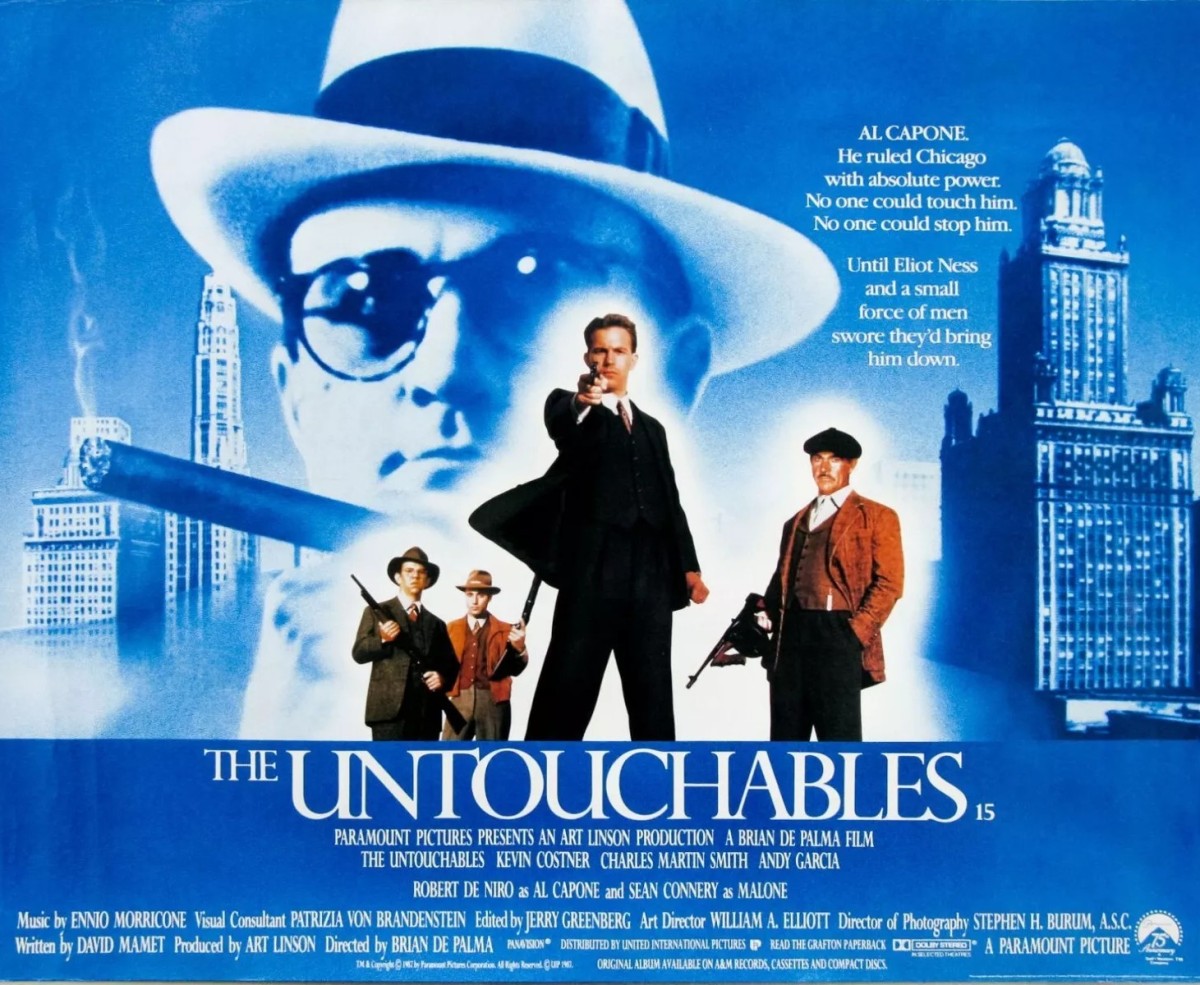
Of course, the best stars have longevity, a bad run doesn’t always spell the end. Connery bounced back big style with The Untouchables, The Hunt for Red October, Indiana Jones, Rising Sun and The Rock. Stallone went back to basics and drew on more Rocky and Rambo and flexed his muscles with The Expendables franchise.

SOURCE: “Film Costs vs Rentals,” Variety, February 21, 1990.

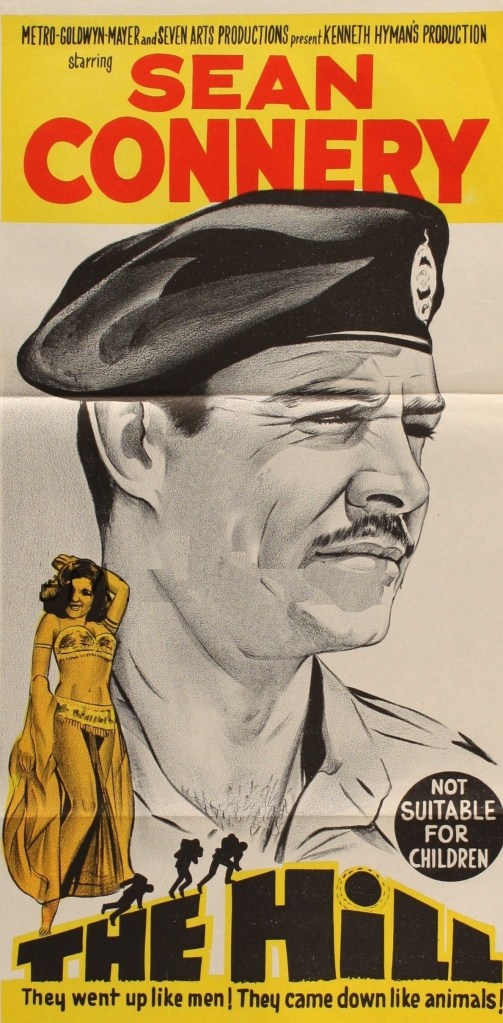
The Hill (1965) ****

Set in a British Army prison camp in North Africa during World War Two ruled by sadistic Sgt Wilson (Harry Andrews) who believes himself above the regulations he forces others to follow, The Hill is a parable about the hypocrisy of totalitarian rule. And much of what is shown would be offensive to modern sensibilities.

Although the commandant and medical officer (Michael Redgrave) are his superior officers, Wilson runs the unit by force of personality. He believes his ruthless treatment of the prisoners turns them into proper soldiers. Into his fiefdom come five new prisoners including coward Joe Roberts (Sean Connery), spiv Monty Bartlett (Roy Kinnear), African American Jacko King (Ossie Davis) – a “different colored bastard” – another Scot Jock McGrath (Jack Watson) and weakest link George Stevens (Alfred Lynch).

Most films about prisons emphasize imprisonment, most scenes taking place in cells or other places of confinement. Sidney Lumet (The Pawnbroker, 1964) directs this film as though it is a paeon to freedom with incredible shots of the vista within which the men are contained. He uses some of the most bravura camerawork you will ever see outside of David Lean.

The film opens with a two-minute crane shot credit sequence that pulls back from a prisoner collapsing on the titular hill to reveal the entire encampment and follows with a one-minute reverse tracking shot of Wilson striding through his domain. And while the camera controls what we see, our ears are constantly assailed by the constant drumbeat of other marching prisoners. 

Climbing the hill in full pack would break any man and those who collapse are roused by buckets of water. The first to crack is Stevens who is constantly tormented by homophobic jibes. Continuous racist abuse is heaped on Jacko King “you blacks don’t have brains – you got it downstairs, we got it upstairs” until driven to the point of madness he begins to behave like a gorilla which frightens the life out of his superiors.

Obeying orders, says Joe Roberts, is “like a dog picking up a bone.”  RSM Wilson is out of control, the commandant spending his nights with a prostitute, the medical officer clearly sent here as punishment for some previous misdemeanor. Of the senior staff only Harris (Ian Bannen) comes away with any dignity, constantly trying to thwart the worst bullying.

When Stevens dies suddenly, the film changes tack and becomes a battle for survival among those who could be blamed for causing his death and those who dare to point the finger.  Wilson has no problem stitching up his colleagues and blackmailing the medical officer while Roberts is beaten up for his effrontery in standing up to authority.

But the astonishing presence and self-confidence and, it has to be said, courage of Wilson lords it over everyone, and there is an extraordinary scene where he forces the entire battalion of prisoners to back down when they are on the brink of open rebellion.

Connery is superb in what is his first dramatic role in a bread-and-butter dramatic production rather than the glossier Marnie (1964) and Woman of Straw (1964) and while he has his moment of defiance he gives enough glimpses of vulnerability and fear to ensure we do not mistake him for his alter ego James Bond. Ian Bannen delivers a touching, assured, performance, far removed from the nasty sarcastic personalities he portrayed in his other desert pictures, Station Six Sahara (1963) and the Flight of the Phoenix (1965). 

Ossie Davies (The Scalphunters, 1968), as defiant as Connery, is brilliant as the man who works out a way to beat the enemy by confusing them; the scene in the commandant’s office where he treats the officer as his inferior is a tour de force.   

Although the Army is meant to run according to established regulation, where obedience to a superior is paramount, it is equally apparent that it can also become a jungle if those who are the fittest assume control. Sgt Wilson demands unquestioned discipline even as he is breaking all the rules in the book. But he retains his authority not just by bullying, but by intelligence, exploiting weakness, coolness under pressure and by welcoming confrontation, his personality as dangerous as any serial killer.   

Harrowing, superb, true.

Marnie (1964) *****

Arguably Alfred Hitchcock’s most difficult film and with some attitudes that will not sit well with today’s audiences nonetheless this is an assured work and the completion of an unofficial trilogy that tries to explain the unexplainable. The director had not been making what might be termed traditional Hitchcock pictures for well over half a decade if you take North by Northwest (1959) as the anomaly in a sequence that began with the obsessive Vertigo (1958). You could argue that Hitchcock had turned a bit “north by northwest” himself, the “hero” of Psycho (1960) a mother-obsessed serial killer, the “bad guys” in The Birds (1963) the titular rapacious creatures who besiege the leading characters and set the world on an apocalyptical course.  

Attempts are made in both Psycho and The Birds to explain the actions of the predators, but such explanations are external, remote, and with Marnie Hitchcock takes the bold step of attempting to explain what makes such a devious, compulsive, frigid liar tick. Hitchcock called the movie a “sex mystery” but it was unclear whether he was just once again trying to tantalize his audience or whether he believed it was film about the mystery of sex, what causes attraction between two people while others steadfastly refuse to consider the concept.  To embellish his thesis he chose one of the world’s most beautiful actresses (Tippi Hedren) and the actor (Sean Connery) who could easily lay claim to being the world’s sexiest man (as he was later anointed in various polls).

It seemed almost an indecent proposal to deny the bed-hopper-par-excellence – as viewed from the James Bond perspective. And it certainly took all the charm Connery could muster to prevent audiences baulking at the almost perverse scientific aspects of his character, an amateur zoologist who welcomed a known criminal into his world for the chance to examine her at close quarters.  The audience is constantly kept at one remove. In the first section we watch enthralled as Hedren carries out her bold thefts, as if she is capable of wrapping the entire male population around her little finger by the simple device of adjusting her skirt.

But in the middle section, it is Connery who is in control and the trapped Hedren who is twisting and turning searching for an escape route. In the final section, when it is clear that is the lover, not the scientist, in Connery that tries to find a way round the problem, the tension is at its height because we have no idea whether she will run true to form and manage to steal and lie her way out or whether Connery’s patience will snap and he will throw her to the wolves who are certainly by this point circling.

The central device on which Hitchcock hooked an audience was the moviegoer demand for a happy ending. He duped cinemagoers in Psycho, slaughtering the heroine halfway through. In The Birds Rod Taylor and Tippi Hedren underwent a harrowing physical assault and while clearly romantically involved by the end Hedren was a wreck. Here, the assaults are mental. There is none of the romantic banter that defines the greatest of his traditional works. Hedren and Connery are together because he has forced the issue and loving though his blackmail is it is still an unequal relationship and one from which she will seek to escape at every opportunity. Hedren’s compulsive character is a mystery that appears insoluble as she resists every attempt to break down the wall she has erected to protect herself from her past.

The story is straightforward with few of the twists of other pictures. We meet Hedren as she escapes with nearly $10,000 stolen from her employers. We learn quickly that she is a master of disguise, has several social security cards up her sleeve, can turn from brunette to blonde, and is so practiced in her deception that she can convince an employer to take her on without references. As the employer is spelling out his predicament to the police, an amused Sean Connery, a customer of her employer, appears. Hedren runs off to a bolt-hole, an upmarket hotel, close to the stables where she keeps a horse, Forio.

Shifting back to Hedren we find her visiting her mother in a tawdry street near the docks. The artifice of confidence is shredded away. She is jealous of the attention her mother gives a little girl whom she looks after. She wants love that her mother is unable to give. When she lays her head on her mother’s lap waiting for the soothing stroke of a hand all she receives is rebuke for leaning too heavily on her mother’s sore leg. The mother in North by Northwest was played for comedy, in Psycho an occasion for murder, and here a means of control. Here, too, we witness the color red sparking an inexplicable and frightening experience.

When Hedren applies for a new job it is at Connery’s firm, where he is the coming man. He watches amused as she is interviewed, intervenes to ensure she is hired. They have in common that they are widowed. Hedren is already planning her next big score, discovering that the combination to the safe is kept in a drawer to which her employer’s secretary has the key.

But he is ready for her and it seems almost perverse that he does not let her know he is aware of her true identity. Instead, under the guise of asking her to work overtime, he gives her an academic paper to type. The subject is predators, “the criminals of the animal world” in which females feature. His gentle pressure is almost sadistic and she is saved by a sudden storm which triggers another bad subconscious reaction.  

Her theft of money from the office is a classic Hitchcock scene. It begins in complete silence. The screen is divided in two, the office and the corridor. Seeing a cleaner appear, Hedren removes her shoes to make her getaway. Almost as she reaches the safety of the stairs, a shoe falls out of her pocket and clatters on the floor. The cleaner does not look up. She is very hard of hearing.

But Connery is again prepared and when she disappears tracks her to her bolt-hole, confronts her, questioning her again and again until he thinks he is close to the truth. He can’t turn her in because he has fallen in love. The choice is stark – him or the police. Soon they are married. But the honeymoon, despite his patience, is a disaster, she cannot “bear to be handled” and they return home further apart than ever.

Meanwhile, figures from her past begin to appear. Lil (Diane Baker) who lusts after Connery brings peril to their door. Connery persists with trying to get Hedren to open up.

Eventually, there is a break in her compulsive syndrome, brought on by love, and we head back to her mother’s to get to the root of the problem. Even when the problem is solved her mother remains distant, still won’t stroke her hair. If there is a happy ending it is like that of The Birds, an immediate problem solved but who knows when or if the crows will return, and there is a similar resolution here, Hedren learns the source of her nightmares but it would be a very blind person who did not see terrible ramifications for the future.

There are certainly a few jarring moments, Hitchcock’s insistence on back projection for a start, but then you didn’t really think in North by Northwest that the director was allowed to film in front of the United Nations. Rather than a technical flaw, the back projection seems to fit another purpose, a device to make the audience stop and examine what is going on for much of it occurs when Hedren is in her fantasy world. And you would have to take exception to Coonery’s actions in the bedroom on honeymoon, no matter how gentle his caresses at other times. And certainly, the psychological assumptions ring hollow given our current knowledge of such conditions, but despite that make for tense viewing.

But the meat of the movie is self-deception. Hedren is convinced she can get away with a series of thefts. Connery is convinced her can cure her. His constant interrogation is what passes for lovers’ banter. In aligning himself as her moral guardian and perhaps her savior, “dying to play doctor,” Connery has entered a nightmare of his own making. Only an arrogant man would believe all women would fall at his feet and Hitchcock clearly makes a connection with Connery’s ongoing incarnation as James Bond where that is exactly the case. Connery is every bit as flawed, as obsessive, as Scottie in Vertigo, determined to shape a woman into perfect form, and that, yes, expecting to eradicate the imperfect past.

Connery emanated such ease, such amazing grace, on the screen that it backfired. Critics often didn’t believe he was putting much into his acting when in reality he was acting his socks off. This is a tremendously difficult part, walking the tightrope between looking a deluded fool and retaining audience empathy and coming across badly when he pushed a vulnerable woman too hard. This is a very rounded character, a gentle adoring lover in the main, but not one to be crossed. His interrogations are intense and yet still you can see that it will kill him if he is double-crossed. The casual amusement with which he greeted her appearance at his office is replaced by fear at her sudden departure.

Hedren, too, whose acting ability was often called into question, carries on where she left off from in The Birds. By the end of that picture her nerves had been shredded. Here, her emotions, which she cannot as easily control as the rest of her life, too often fly off into a high pitch. Half the time she is the cool collected customer of The Birds, the rest of the time she is demented.  Except in The Birds she was self-confident around men. Any self-assurance she has now is skin deep. There was always a fragility about Hedren, hidden behind the glossy exterior and fashionable outfits, and here it is exposed. The touching scenes with her mother, the mouth tightened in jealousy over the little girl, are perfectly played. A little girl lost in wolf’s clothing. And trapped, she is almost snarling at her captor, the submissive dialog concealing the mind hard at work looking for an exit.

The interrogative scenes between Connery and Hedren are extremely difficult to pull off. It would have been easier if Connery was not in love with her, and to some extent pulled his punches. It would be easier for her if he was an out-and-out predator who could be paid in kind to shut up and go away. Instead, they both have to walk a verbal tightrope and only actors of some excellence can pull off that trick without losing the audience.
The Frightened City (1961) ***

Sean Connery in an early role as a gangster is not the only reason for watching this brisk British thriller about a London protection racket. Primarily told from the point-of-view of the bad guys, this explores how a ruthless Mr Big builds up a criminal empire. Waldo (Herbert Lom), a bent accountant, brings together the six major gangs involved in extorting money from pubs and stores into a democratically-run syndicate.  He then moves on to demanding bigger sums from bigger enterprises such as construction businesses. However, when the gangsters fall out they go to war.  

This film is way ahead of the game in presenting gangsters as displaying any intelligence. Generally, they were depicted as brutes who ruled by force. But criminality at the top level demanded as much organization as in a legitimate business. Personalities had to be harnessed to work together rather than shoot each other on sight. Such skills had to exist in order for gangsters to operate on any scale. This picture examines how this was done.

The cops led by Det Insp Sayers (John Gregson) are almost a sub-plot and the story would have adequately run its course without their involvement. Sayers sails close to the wind in hoping to “tilt the scale of justice in our direction for a change.” Paddy (Sean Connery) doesn’t appear until about 20 minutes as a karate-expert cat-burglar turned enforcer. Paddy’s involvement with the syndicate ends when his code of honor is breached and he turns on his employers. His code is not so sacrosanct that it prevents him cheating on girlfriend Sadie (Olive McFarland). But he does display the virility to fill James Bond’s shoes.

There’s far more violence that would be expected in a British crime picture of the era. Night clubs, shops and pubs are wrecked and there’s plenty of fisticuffs and when the gangsters go head-to-head they upgrade to grenades. There’s a bit more plot than the running time can deal with so director (and producer and co-writer, along with Leigh Vance of Crossplot, 1969, fame) John Lemont occasionally resorts to cliché devices like newspaper headlines. Canadian Lemont – most famous for writing the first serial on ITV, Sixpenny Corner – was an auteur of the old-fashioned (and unheralded) kind, and previously writer-director of The Shakedown (1960). 

Top billing was a step up for Herbert Lom (Gambit, 1966) and he made the most of it, delivering a suave villain among the thugs. John Gregson (Night of the Generals, 1967) Table, 1959) was a solid British star and ideal cop material (he was later British television’s Gideon). Yvonne Romaine, as Connery’s new squeeze, a nightclub singer exploited by Lom more for her looks than her voice, was known to audiences after Curse of the Werewolf (1961). This was a sophomore outing for Scottish television actress Olive McFarland (So Evil So Young, 1961). Unusually, for a British picture at this time, the theme tune written by Norrie Paramour was covered by The Shadows and turned into a hit.

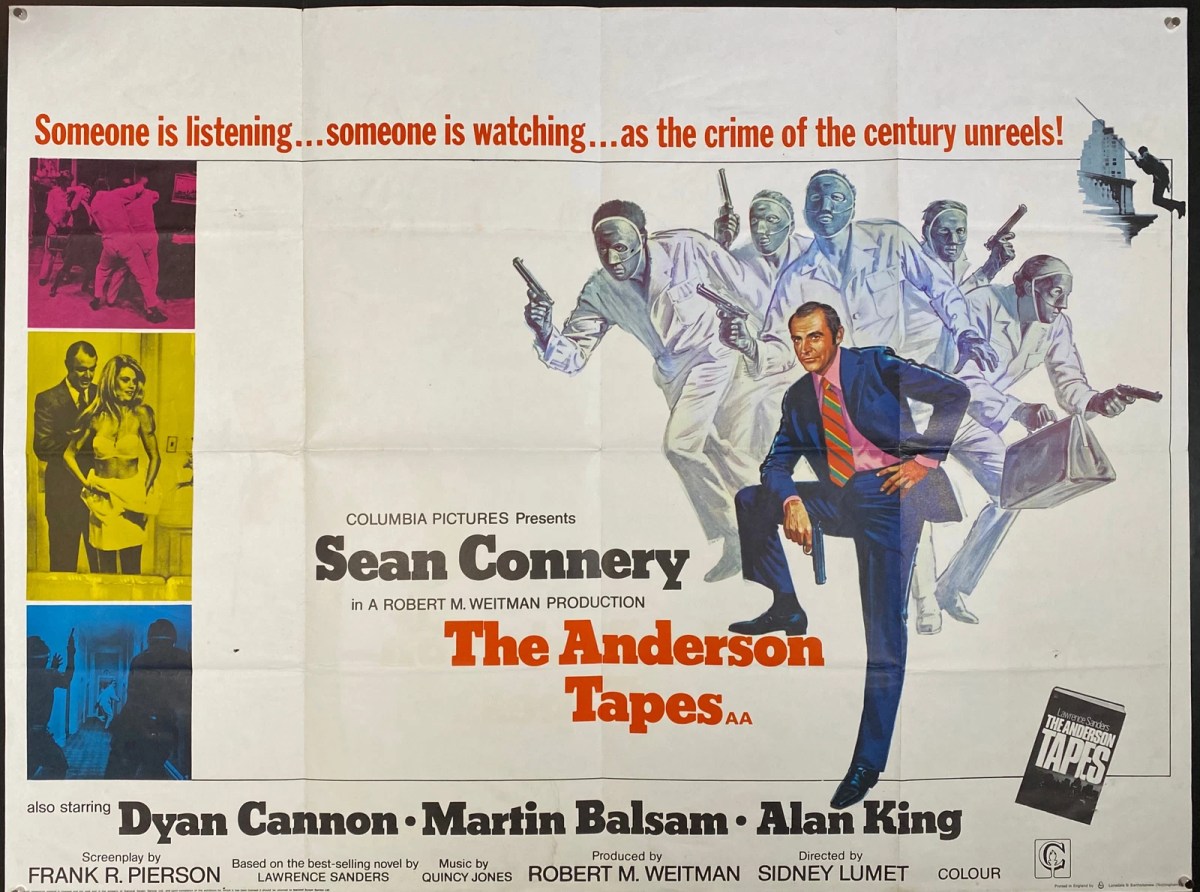
At this point in his career, Connery had already had two bites of the cherry without much success – romancing Lana Turner in Another Time, Another Place (1958) and Disney’s Darby O’Gill and the Little People (1959). He would make another three films before his breakthrough with Dr No (1962) but the Pressbook showed signs that he was headed for the heights.  Co-star Yvonne Romaine (and her distinctive body measurements) were accorded three separate stories in the Pressbook, compared to one each for Lom and Alfred Marks, at that point better known as a comedian. While no articles about Connery were featured, when it came to the advertising campaign Connery (and Romaine) outshone their co-stars.  

Producers were contractually bound in relation to the size of credits that appeared on any advertising. But there were no such regulations regarding the visuals of an advert. Although top-billed, Lom is not shown on any of the adverts. Given greatest prominence was Yvonne Romaine. There were thirteen different ads and she appeared in them all. Although Connery was third-billed and she was two rungs below in the credit stakes, he was the junior partner when it came to the artwork. While, Connery appeared in eleven in only one did he overshadow Romaine and in another they were visually-speaking accorded roughly the same status. But otherwise, she hogged the adverts.  

The Pressbook was small by American standards, consisting of six A3 pages, the bulk of which was given over to adverts. But what it lacked in pages it made up for in taglines – of which there were six main types.

The picture was not seen much in the United States, sent out in first run as the lower half of a double bill in only a handful of big cities, so there’s a fair chance it’s completely unknown except to Connery completists. It later appeared on the reissue circuit when Connery was a bigger name.

Worth a look as an example of the British crime movie trying to break out of the confines of the genre, and even more so as an early example of the Connery screen charisma.

A Fine Madness (1966) **

Let’s start with the Hollywood happy ending. Poet Samson (Sean Connery) slugs pregnant second wife (Joanne Woodward). He’d have punched her lights out before if only she hadn’t been so good at diving out of the way. As it is he manages to throw her down the stairs. The film kicks off with him ill-temperedly whacking her over the head with a pillow.

This is the kind of film where violence against women is treated as a running gag.

Let’s try to sell it as a wacky comedy.

Lydia (Jean Seberg), wife of psychiatrist Dr West (Patrick O’Neal) treating Samson for writer’s block, doesn’t have the courage to make it plain to his creepy colleague Dr Vorbeck (Werner Peters) that she doesn’t fancy him when he endlessly paws her and slaps her rear so he takes this as the green light to attempt to rape her. That’s another running gag.

Surly loud-mouthed bully Samson gets a free pass because he’s an artist, a poet with one poor-selling volume of poetry, and unable to find the time or space to complete his masterpiece. He would have more time if he didn’t spend so much of it chasing women.

At my count, he gets through at least four – Lydia, office secretary Miss Walnicki (Sue Ann Lngdon), a client (he cleans carpets for a living) Evelyn (Zohra Lampert), and Dr Kropotkin (Collen Dewhurst), another colleague of Dr West, not to mention the current wife he drives demented and the previous wife for whom he is being aggressively pursued for alimony.

You can see how director Irvin Kershner was a shoo-in for The Flim-Flam Man/One Born Every Minute (1967) because at every opportunity he tries to turn simple dramatic confrontation that enhance the story into needless chases that divert it and extract slapstick from material that in no way suggests it’s ripe for such an approach.

Trivia lovers note: The John “Redcap” Thaw in the supporting feature “Dead Man’s Chest” is the same John Thaw from “The Sweeney” and “Morse“.

There’s a story in here somewhere and a pretty barmy one at that if you set aside the poor poet’s endless battle against a world that fails to understand his genius and his dodging of the alimony. Rightfully diagnosed as some kind of sociopath by yet another of Dr West’s colleagues, the needle-happy Dr Menken (Clive Revill), he is admitted to a psychiatric hospital initially as a way of dodging his creditors and providing him with space and time to write.

Again, his most creative use of his time is to make out with Lydia and Krokoptin. But since he is spotted in a hydro-bath/ripple bath with  naked Lydia, the vengeful husband gives the go-ahead to perform some kind of lobotomy on the poet, on the assumption it will dull his violent tendencies. (It doesn’t work.) The opportunity to satirise the psychiatric profession takes second place to another opportunity for a chase.

Anomalies abound. Samson’s character is clearly drawn on Welsh poet Dylan Thomas who exploited his fame and made his money on recital tours. Performing is against the broke Samson’s principles and he turns viciously on his audience of appreciative women. Despite demanding center stage, when offered it he turns it down. He lambasts middle-aged women but has little against those younger members of the species more susceptible to his charms. He only has to tell Miss Walnicki she has “pouty lips” and she falls into his arms.

All this has going for it are the performances. Sean Connery (Marnie, 1964), it has to be said, certainly exhibits screen charisma though this is not as far removed as he would like from the macho James Bond. Joanne Woodward (From the Terrace, 1960) – switching from her normal brunette to blonde – is excellent as the downtrodden waitress wife, but on the occasions when she is spiky enough to put him in his place soon regrets her temerity.

Jean Seberg (Pendulum, 1969) – switching from blonde to brunette and paid more ($125,000 to Woodward’s $100,000) – is good as the sexually frustrated rich housewife. And Patrick O’Neal (Stiletto, 1969) looks as if he is desperate to throw a punch. Elliott Baker (Luv, 1967) wrote the screenplay based on his own novel.

You do sometimes wonder at the knuckle-headedness of stars. Was this all that was offered to Connery at his James Bond peak? Or was it a pet project? I doubt if it would have been made with another big star – you couldn’t see even the macho Steve McQueen entering this territory and the likes of Paul Newman wouldn’t go near it.

Theoretically, studio head honcho Jack Warner gets the blame for this. He didn’t like Kershner’s cut and ordered it re-edited but I’d be hard put to see how his hand could be any less heavy than that of the director.

That’s two stinkers in a week. If you want proof of just how rampant sexism was in Hollywood check out a double bill of this and A Guide to a Married Man (1967).

An insult.

Discover WordPress

A daily selection of the best content published on WordPress, collected for you by humans who love to read.

The Atavist Magazine

by Brian Hannan

WordPress.com News

The latest news on WordPress.com and the WordPress community.