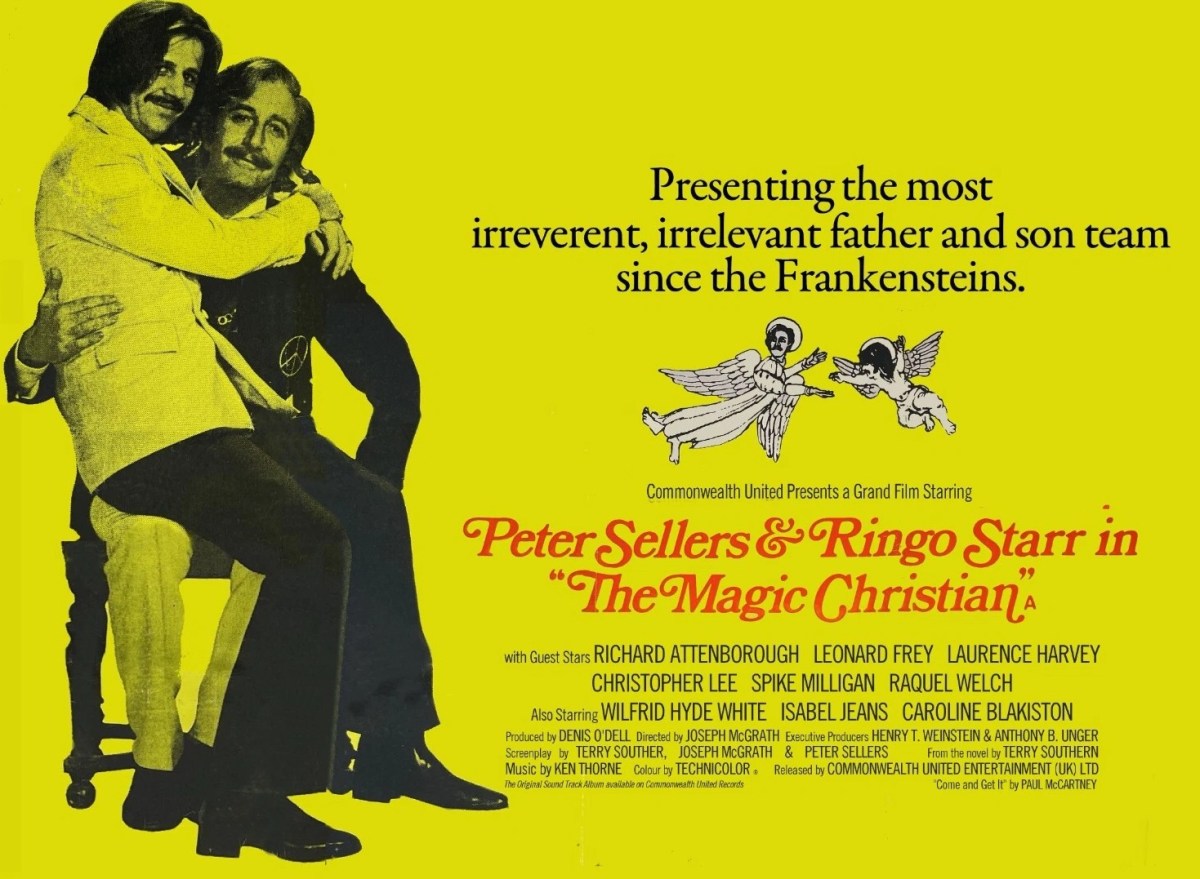
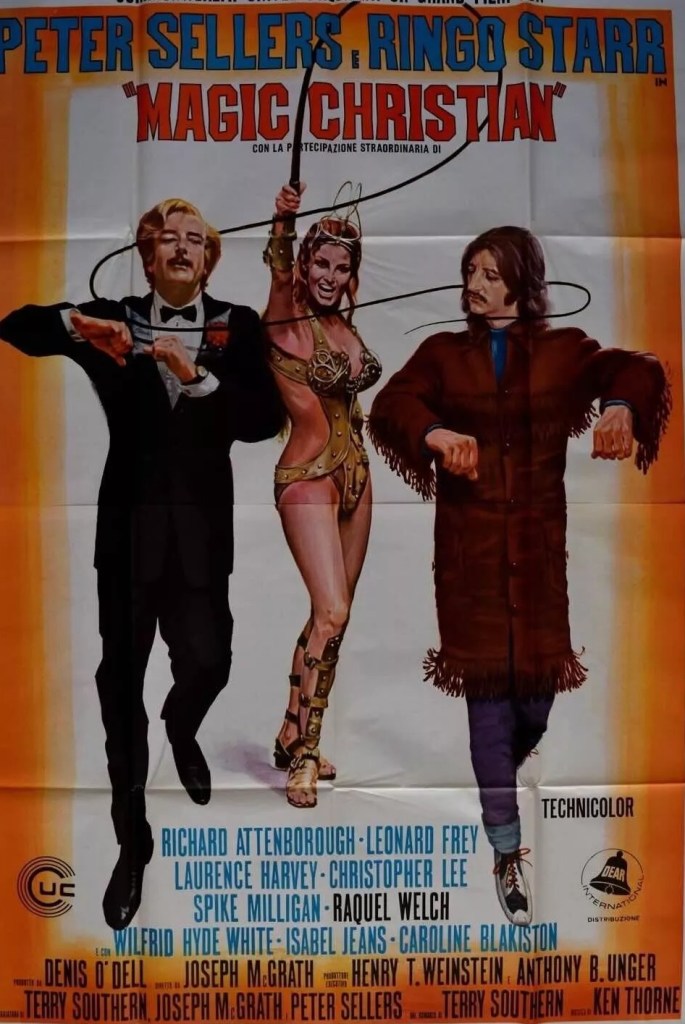
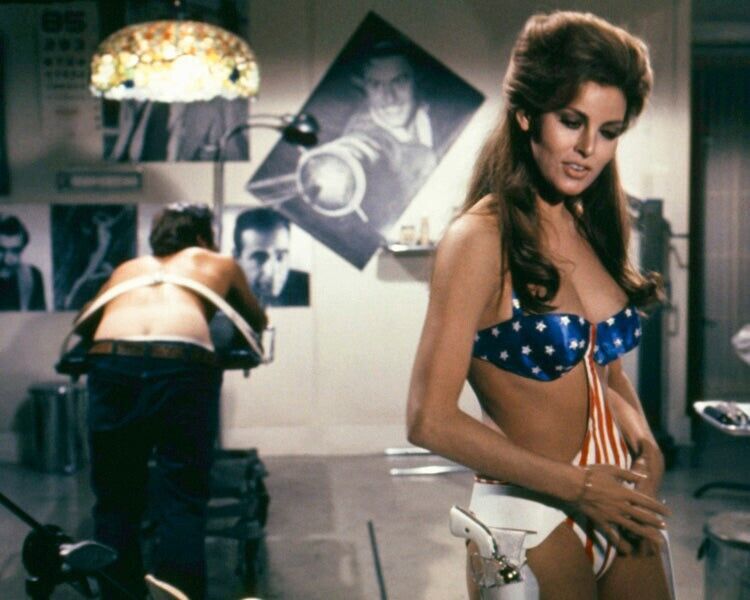
Substitute contemporary artwork/installation/performance art for practical joke and this will come up trumps. Taken in the artistic sense, where artists are pillorying society, there are gems – a stage Hamlet performing a striptease, feeding scraps of money to the ducks, ship passengers experiencing an apparent voyage when the vessel hasn’t left land, cutting up a famous work of art. Although I have to point out this will inevitably be remembered by some for a bikini-ed Raquel Welch cracking the whip over a galley of topless oarswomen.
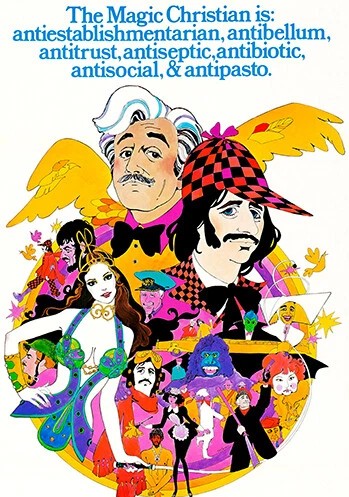
Effectively a series of comedy skits loosely tied together under the theme of money, mostly in the form of bribery. Billionaire Sir Guy Grand (Peter Sellers) sets out to teach adopted son Youngman (Ringo Starr) just what money can buy. Could you pay one of the teams sufficient dough in the annual Boat Race for them to ram the other? Would a parking warden (Spike Milligan) eat the parking ticket he has just issued? In the spirit of fair play is it okay to down a pheasant with an anti-aircraft gun?
When the going slows down, surrealism enters the equation: ship’s captain kidnapped by a gorilla, vampire waitperson, black head on white body, urine-soaked banknotes given away to a crowd, the occasional nun or Nazi, newspapers where apologies are written in Polish.
Plot-wise, there’s not much to it and the satire is merely repetitive as Sir Guy embarks on educating Youngman on the perverse uses of money. It has the feeling not of following a storyline but of “what can we get up to next” and attempting to layer shock upon shock in the manner, it has to be said, of some contemporary directors.
But there’s neither sufficient bite to the satire nor punch to the shock so it remains an elaborate series of disconnected sequences. Luckily, nobody’s having to pretend to put in an acting shift which is just as well because Ringo Starr proves he can’t act.
And it’s not much helped by a host of cameos – Laurence Harvey (A Dandy in Aspic, 1968), Richard Attenborough (Guns at Batasi, 1964), Christopher Lee (Dracula, Prince of Darkness, 1965), Raquel Welch (Bandolero!, 1968), director Roman Polanski (Rosemary’s Baby, 1968), Wilfred Hyde-White (P.J. / New Face in Hell, 1967), comic Spike Milligan and various members of the future Monty Python team including John Cleese (A Fish Called Wanda, 1988) and Graham Chapman. Harvey and Welch make the biggest splash.
Excepting Dr Strangelove, Hollywood had failed to capture the essence of offbeat novelist Terry Southern (Candy, 1968) and despite input from Chapman, Cleese and Sellers, this never really gets off the ground.
Peter Sellers (The Pink Panther, 1963) was in something of a career rut where very little struck home at the box office and he would continue a dismal losing streak until resuscitating The Pink Panther franchise in 1975.
Director Joseph McGrath’s (The Bliss of Mrs Blossom, 1967) record was spotty. Best known for music videos for The Beatles, he was only well served when his cast was filled with strong actors.
No more than an occasionally humorous trifle with an equally occasional target hitting the bullseye.
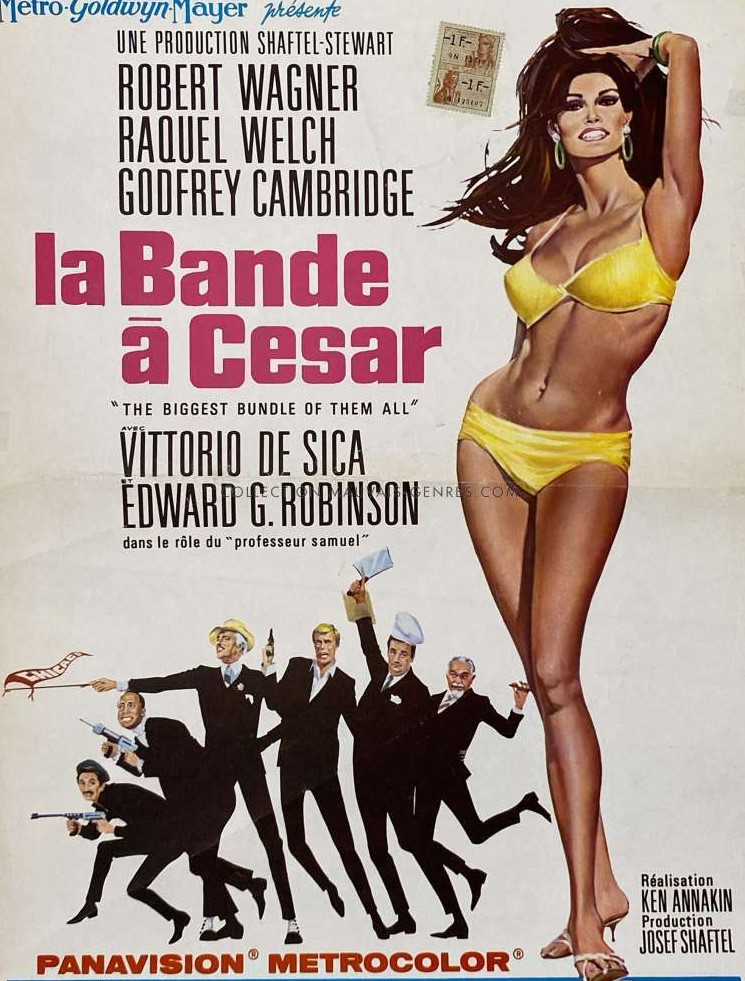
Bunch of incompetent crooks kidnap an impoverished Mafia boss who pays his ransom by setting up a major heist. By a stroke of casting alchemy this brings together Cesare (Vittorio De Sica), the epitome of old world Italian charm, knock-out gangster’s moll and scene-stealer-in-chief Juliana (Raquel Welch) replete with scanty knock-out outfits and criminal mastermind Professor Samuels (Edward G. Robinson). In order to acquire the funds necessary to steal $5 million of platinum ingots from a train – the plan involving a tank and an WW2 bomber – the crew, initially headed by American Harry (Robert Wagner), need to carry out smaller jobs.
Problem is, none of them are any good, not even Cesare, who has lost his flair and botches an attempt to rob an old flame of her jewels. They can’t even carry out a simple theft from a restaurant. The heist itself is pretty spectacular and innovative. And the movie is quirky, with a darker edge. While there are few belly laughs, the light tone is enough to carry the gentle humor, mostly inspired by the misplaced team, amateurs for various reasons, not necessarily outright lawbreaking, on the run. These include London Cockney mechanic Davey (Davy Kaye), chef Antonio (Francesco Mule) distracted by hunger at every turn, cowardly violinist Benny (Godfrey Cambridge) and Joe (Mickey Knox) with a helluva brood to feed.
The story does a good bit of meandering, as does the camera, much of its focus on the voluptuous charms of Juliana, but the hurt pride of Cesare and the grandiose machinations of the professor keep it on course. The Italian settings, incorporating grand villas and ruins, do no harm either. The heist is terrific and there is a final twist you may or may not see coming. The interplay of characters works best when it involves Juliana, who attempts to twist Cesare around her little finger, that tactic mutual it has to be said, who keeps the professor on his toes by dancing with him in a disco, and it soon becomes apparent that she has the upper hand over loverboy Harry.
You could be forgiven for thinking the title refers to Raquel Welch – a cinematic infant at this stage with only One Million Years B.C (1966) in her locker – especially when her cleavage and looks receive such prominence, but the caper is classy and different. As well as being obvious she is both sinuous and seductive and clearly has a mind of her own, possibly the most criminally intent of the entire outfit, with weapons the others lack. By this point, she had invented the pop-out bikini, pictures of which had flooded Europe, making her the pin-up par excellence, but those who came to simply gawp quickly realised there was talent behind the body.
De Sica (The Shoes of the Fisherman, 1968) constantly plays around with the idea of being a defunct godfather and Robinson (Grand Slam, 1967) is the antithesis of the gangster roles on which his fame relied. Robert Wagner (Banning, 1967) is less effective, miscast and out of place in such august acting company and losing out to welch in every scene.
This was a considerable change of pace for British director Ken Annakin after Those Magnificent Men in Their Flying Machines (1965) and Battle of the Bulge (1965) and he brings to this the comedy of the former coupled with the narrative complications of the latter, wrapping everything up in an easy inviting style that makes the most of his stars and the locations. Screenwriter Sy Salkowitz was a television veteran (Perry Mason, The Untouchables et al) , this marking his first venture into the big screen.
While perhaps best remembered these days as the debut film for Raquel Welch (One Million Years BC, 1966), the rest of the film is worth a look.
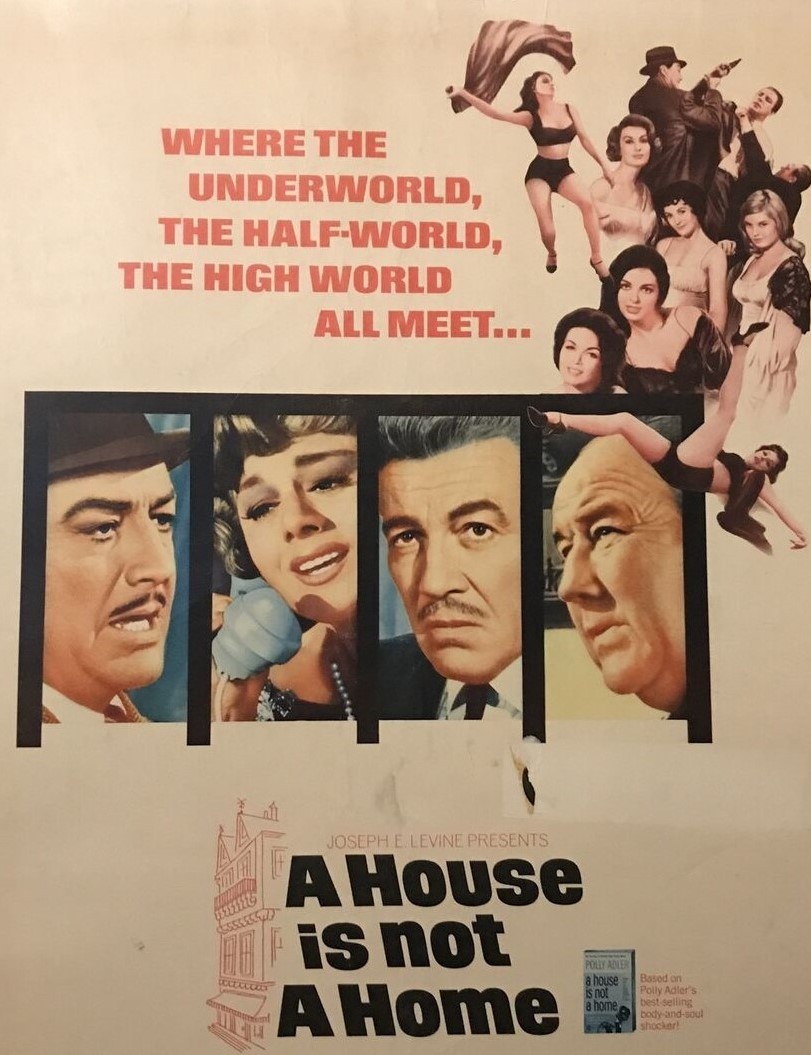
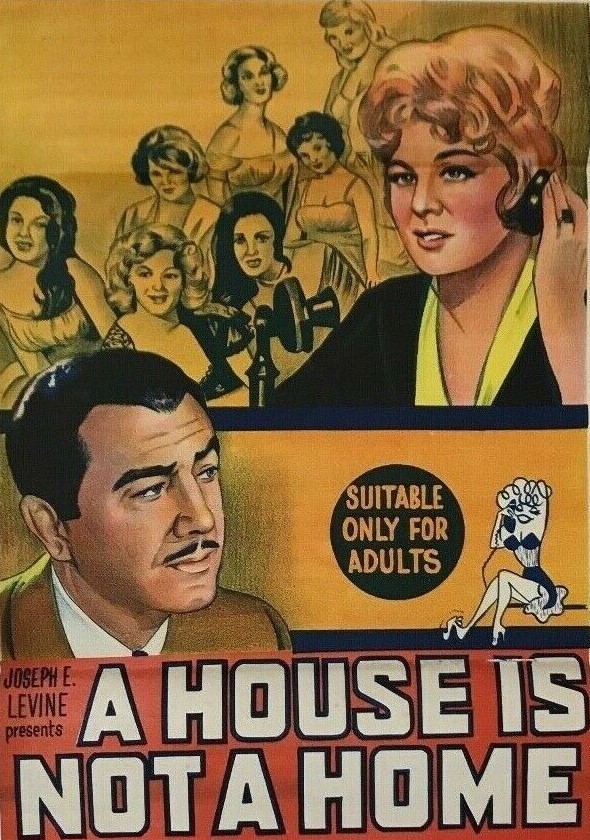
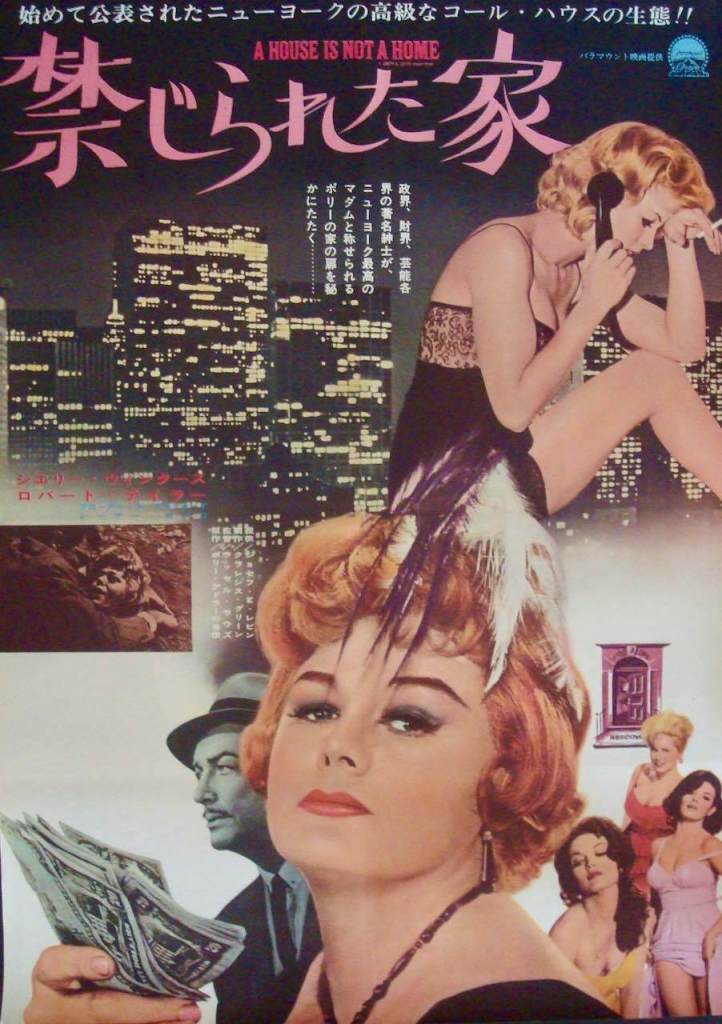
Hypocrisy had its heyday in The Roaring 20s when prohibition made bootleggers millionaires, helped bankroll other criminal activities like prostitution and encouraged cops and politicians to seek their share of the loot. The biography of real-life madam Polly Adler (Shelley Winters) covers all elements of corruption.
Thrown out of her own home after being raped, she finds a knight in shining armor in the shape of bootlegger Frank Costigan (Robert Taylor) and is soon, at first apparently innocently, pimping out her friends. The reality of what becomes her profession is not ignored, the word “whore” bandied around, with one girl, Madge (Lisa Seagram), turning junkie as a result, another, Lorraine, committing suicide. Like Go Naked in the World (1961) Polly realizes that true love has no place in her world, a relationship with musician Casey (Ralph Taeger) unsustainable.
Adler, in her many voice-overs, explains why vulnerable women become sex workers – poverty, lack of family and lack of hope is her take on it – and she professes to view it as a business and preferable to working in a factory for pitiful wages, but the movie is at its best in linking the nether worlds of infamy and showing that the woman is always the loser.
While any attempt to properly portray the period is hampered by lack of budget, it does provide an array of interesting and occasionally real-life characters, Lucky Luciano (Cesar Romero) for example. A brothel proves an ideal location meeting place for crooks and politicians, the latter easily bought by contributions to their campaign funds. Nor are cops shy about asking for donations to their Xmas funds, or using the facility.
The Adler operation puts a glossy shine on the shady business since all her girls are glamorous. But still the movie pulls no punches except in the case of the madam herself, presented too often as an innocent and as a person who never sold her own body and who saw nothing wrong in taking as much advantage of the vulnerable girls in her employ as the clients who paid for them.
Oscar-winner Shelley Winters (The Chapman Report, 1962), more often a supporting player at this point in the 1960s than the star, grabs the role with both hands and although unconvincing as the younger girl delivers a rounded performance minus the blowsy affectations that marred much of later work. One-time MGM golden boy Robert Taylor, pretty much in the 1960s reduced to television (The Detectives, 1959-1962) and low-budget pictures, shows a glimpse of old form as the smooth bootlegger.
Cesar Romero (Oceans 11, 1960) and Oscar-winner Broderick Crawford (All the Kings Men, 1949) head up a checklist of old-timers filling out the supporting cast. Future director Lisa Seagram (Paradise Pictures, 1997) as the junkie hooker makes the biggest impact among the girls.
A flotilla of wannabes made up Polly’s girls. Apart from Raquel Welch, the only one to break into the big time was Edy Williams (Beyond the Valley of the Dolls, 1970). In the main they comprised beauty queens – Amede Chabot (Miss America), Danica d’Hondt (Miss Canada) and Leona Gage (Miss Universe) who had a small part in Tales of Terror (1962). Otherwise Sandra Grant became the most famous – for marrying singer Tony Bennett. Patricia Manning had the most screen experience, second-billed in The Hideous Sun Demon (1958), bit parts in television shows, and fourth-billed in The Grass Eater (1961). Inga Nielsen would later turn up as bikini fodder in The Silencers (1966), In Like Flint (1967) and The Ambushers (1967).
Director Russell Rouse (The Fastest Gun Alive, 1956) was better known for the screenplay of D.O.A. (1949) and had a story credit for Pillow Talk (1959). In fairness, although the film has no great depth, Rouse keeps it ticking along via multiple story strands although occasional lapses into comedy do not work. Written by Rouse and Clarence Greene (The Oscar, 1966) based on Adler’s autobiography.
Traditionally, this is an opportunity for me to blow the trumpet on behalf of my loyal and growing band of readers. But this time out I’m also taking the opportunity to blow my own trumpet or in the patois of my home city “bum ma load.” I began this blog in June 2020 and my monthly viewing figures scarcely topped a few hundred in the first year. Now I’m hitting 10,000 views a month. Being a self-effacing kind of guy, I thought the world should know.
Now, back to the main task in hand. It’s been a major aspect of the Blog to see which films are most favored by my readers. As regular readers will know, I run this feature every six months.
It’s worth pointing out that for such a testosterone-driven decade the Top Ten is dominated by female stars with Ann-Marget and Angie Dickinson in the ascendancy. Raquel Welch, Hayley Mills and Jean Seberg also make a splash. As well as top male figures like Frank Sinatra, John Wayne, Robert Mitchum and Dean Martin readers have been highly appreciative of underdogs like Alain Delon, Richard Johnson and Alex Cord.
Surprisingly high number of new entries include Young Cassidy, Fathom, The Appointment, Diamond Head, The Family Way and The Venetian Affair.
The figures in brackets represent the previous year’s position.
(1) The Swinger (1966). Queen of the Blog Ann-Margret in bouncy sex comedy that manages a sprinkling of innocence.
(2) Stagecoach (1966). Double whammy from Ann-Margret in this more than acceptable remake of the John Ford western with the male lead taken by Alex Cord, another star in need of reassessment.
(4) Fraulein Doktor (1969). German spy Suzy Kendall out-foxes Kenneth More in this World War One adventure with surprisingly grisly battle scenes and a superb score from Ennio Morricone.
(3) Jessica(1962). Angie Dickinson as a young widow incurring the wrath of wives in a small Italian town.
(7) Once Upon a Time in the West (1969). For many, including myself, the greatest western ever made. Sergio Leone fashions a masterpiece from a stunning cast of Claudia Cardinale, Henry Fonda and Charles Bronson and that fabulous Morricone score.
(6) Fireball XL5. (1962) The height of a television cult. Famous British series from Gerry and Sylvia Anderson, now colorized. “My heart will be a fireball…”
(5) The Sins of Rachel Cade. (1961) Angie Dickinson (again) as African missionary falling foul of the natives and commissioner Peter Finch. Roger Moore in an early role.
(10) Vendetta for the Saint. (1968) More television cultism. Movie made by combining two episodes of the series featuring the immortal Simon Templar. Roger Moore tackles the Mafia.
(12) TheSisters (1969). Complicated French love triangle featuring Nathalie Delon and Susan Strasberg.
(11) Baby Love (1969). Controversy was the initial selling point but now it’s morphed into a morality tale as orphaned Linda Hayden tries to fit into an upper-class London household.
(13) Pharoah (1966). Sensational Polish epic set in Ancient Egypt centering on the battle between the country’s ruler and the religious hierarchy.
(9) Moment to Moment (1966). Hitchcockian-style thriller set in the south of France with Jean Seberg caught out in illicit love affair. Co-starring Honor Blackman.
(21) Go Naked in the World (1961). Steamy drama with Gina Lollobrigida discovering that her profession (the oldest) and true love (with rich Anthony Franciosa) don’t mix. Great turn from Ernest Borgnine as a doting father.
(8) The Secret Ways (1961). The first of the Alistair MacLean adaptations to hit the big screen features Richard Widmark trapped in Hungary during the Cold War. Senta Berger has a small role.
(36) In Harm’s Way (1965). Otto Preminger’s Pearl Harbor epic sets John Wayne and Kirk Douglas at each other’s throats.
(20) The Golden Claws of the Cat Girl (1968). Genuine French cult film with Daniele Gaubert as a sexy cat burglar.
(14)Can Heironymus Merkin Ever Forget Mercy Humpe and Find True Happiness? (1969) Self-indulgence reaches new heights as singer Anthony Newley invokes his inner Fellini that somehow involves bedding lots of women. Then-current wife Joan Collins co-stars.
(New Entry) Young Cassidy (1965). Rod Taylor and Julie Christie in Jack Cardiff’s Irish drama. He took over from an ill John Ford.
(22) Pressure Point (1962). No escape for racist patient Bobby Darin when psychiatrist Sidney Poitier is around.
(New Entry) The Appointment (1969). Complete change of pace for Omar Sharif in unusual Italian drama directed by Sidney Lumet. Anouk Aimee is the tantalizing female lead.
(New Entry) Fathom (1967) Raquel Welch swaps her skydiving kit for the more comfortable environs of a bikini in thriller. Anthony Franciosa co-stars.
(22) Pendulum (1969). Cop George Peppard accused of murdering unfaithful wife Jean Seberg.
(New Entry) The Family Way (1966). Hayley Mills grows up – and how – in marital drama with new British star Hywel Bennett.
(New Entry) Diamond Head (1962). Ruthless hypocritical land baron Charlton Heston causes chaos in Hawaii. With Yvette Mimieux and George Chakiris.
(26) A Dandy in Aspic (1968). Cold War thriller with Laurence Harvey as a double agent who wants out. Mia Farrow co-stars.
(New Entry) The Venetian Affair (1966). Robert Vaughn turns in a terrific performance as an ex-alcoholic spy dealing with former lover Elke Sommer in slippery Venice-set thriller.
(21) The Best House in London (1969). That’s a euphemism for a brothel, let’s get that straight. David Hemmings tries to do right by the sex workers.
(25) Lady in Cement (1969). Frank Sinatra reprises private eye Tony Rome with mobster’s moll Raquel Welch as his client.
(31) The Girl on a Motorcycle / Naked under Leather (1968). Heavily-censored in the U.S., erotic drama with singer Marianne Faithfull as the titular fantasizing heroine. Alain Delon co-stars.
(New Entry) Genghis Khan (1965). Omar Sharif as the all-conquering Mongol chieftain. Stephen Boyd, James Mason, Eli Wallach, Telly Savalas and Francoise Dorleac lend support.
(New Entry) The Chalk Garden (1964). Hayley Mills again, being brought to heel by governess Deborah Kerr with a hidden secret.
(New Entry) Plane (2023). Gerard Butler channels his inner Bruce Willis as he attempts to avoid dying hard on an island inhabited by rebels.
(23) Oceans 11. Frank Sinatra heads the Rat Pack line-up, inspiring an industry of remakes and with everyone starting with Tarantino ripping off one scene.
(New Entry) Five Card Stud (1968). Surprising mix of feminism and noir in revenge western. Dean Martin, Robert Mitchum and Inger Stevens topline.
(34) The Misfits (1960). Last hurrah for Clark Gable, fabulous turns from Montgomery Clift and Marilyn Monroe in John Huston tale of losers.
(28) Once a Thief (1965). Change of pace for Ann-Margret as working mother whose ex-jailbird husband Alain Delon is forced into another job.
(27) Deadlier than the Male (1967). Espionage with a sting in the tale as venomous female villains including Elke Sommer and Sylva Koscina target Bulldog Drummond
(35) Rage (1966). Glenn Ford and Stella Stevens combat pandemic in Mexican town.
(New Entry) Blonde (2022). Ana de Armas in stylized biopic of Marilyn Monroe
(33) She Died with Her Boots On / Whirlpool (1969). Sleazy British film from cult Spanish director Jose Ramon Larraz sees kinky photographer Karl Lanchbury seduce real-life MTA Vivien Neves.
Due some unexpected reverence after being chosen by Quentin Tarantino for his inaugural eponymous festival that kicked off at the Dobie theater in Austin, Texas, in 1996. I thought I’d throw that in since my opinion alone may not have swayed you as to this film’s merits. Ken Annakin (Battle of the Bulge, 1965) wasn’t first choice as director. It was initially on the slate of Jack Cardiff (The Girl on a Motorcycle, 1969) and should have also made waves as the first big British-Indian co-production. After his World War Two tank epic, Annakin’s career unexpectedly stalled.
He backed out of a project to make a Las Vegas version of Grand Hotel (1931), another, the $1.5 million The Fifth Coin, written by Francis Coppola and to star George Segal, got snarled up on the starting grid. He balked at Texas Across the River (1966) – when the females leads were going to be Shirley MacLaine and Catherine Deneuve – due to concerns about the schedule. He actually shot half of The Perils of Pauline (1967) with Terry-Thomas, Pat Boone and Pamela Austin, wife of super-agent Guy McIllwhaine, before being fired, for reasons that were unclear. Still, he remained in demand and was immediately off to Italy to shoot Raquel Welch heist picture The Biggest Bundle of Them All – not released until two years later as explained in my Behind the Scenes blog on that movie.
However, before jetting off to Italy, he had been sounded out by British producer Sydney Box who had a commitment from Yul Brynner and Trevor Howard to star in the $3 million The Long Duel being financed fifty-fifty by British studio Rank and fourteen Indian investors taking advantage of a tax-shelter deal. Annakin was in line for his biggest-ever fee. For Rank it was a brave new world. The British studio after years of relative inactivity was back on the production front foot, initially in co-production deals with American majors and British investment outfits like the National Film Corporation. It planned to invest $12 million in eight pictures. Initially, its stake in The Long Duel was limited to 60 per cent at a time when the movie was budgeted at $2.3 million. This was “particularly surprising because it came at a time when Britain was caught in a severe economic freeze” although the surprise success of the Bond pictures suggested the country’s movie industry was, in contrast, riding the crest of a wave.
Things turned sour on the location scouting trip to India. A “bottomless pit” of laborers was on standby to build a rope bridge across as soon as the money came through. Timber had been ordered to build a fort on a plateau with stunning views of snow-capped mountains, but nothing would arrive until money changed hands. While Rank had committed three-fifths of the finance with the rest coming from the release of blocked rupees guaranteed by a Maharajah, without any immediate cash and with the stars on pay-or-play contracts, there was no option but for Rank to pick up the entire cost and seek out alternative locations. That meant it was the single biggest British production financed domestically without a foreign partner.
Matters worsened when producer Sydney Box suffered a heart attack, triggering his departure from the business, in which he had been a mainstay for 33 years, movies ranging from The Seventh Veil (1945) to Accident (1966). In addition, Annakin was negotiating to make a permanent move to France while his wife was at home in England dealing with an adopted new-born baby. Annakin – acting also as producer for the first time – gambled on shifting the movie to Spain.
After the success of Doctor Zhivago (1965), Spain was fast being viewed as an ideal terrain, Custer of the West (1967), Camelot (1967), Fathom (1967) and The Bobo (1966) jostling for space. Having made a couple of movies there, Annakin assured the backers, the terrain was “not dissimilar” to the locations he had viewed in India. “I believe we can make Spain into India, so long as the crowds are dressed as Indians, which will cost quite a lot more because it means providing all the costumes whereas in India they already exist,” he explained. He had three weeks before the actors were due.
Yul Brynner and Trevor Howard would have seemed best buddies by now, having appeared in three films together over the past two years – Morituri (1965), The Poppy Is Also a Flower (1966) and Triple Cross (1966). Brynner’s career had revived thanks to Return of the Seven (1966). He was considered poor box office in the U.S. but made up for it with his global marquee appeal. Howard had been on an unexpected box office roll following Father Goose (1964), Operation Crossbow (1965), Von Ryan’s Express (1965) and The Liquidator (1965).
Annakin turned to the Sierra Nevadas to double as the Himalyas, located the rope bridge in a ravine near Ronda, the villages transplanted to the dusty Andalusian plains, and found sufficient horse-riding extras among the gypsies of Dacoit country. The Alhambra was called in to action for part of the Indian palace. A steam train of sufficient vintage was found.
Brynner supplied his own motor home, one of the most luxurious on the market, but required considerable assistance to move it around, especially on narrow country roads linking locations. Over 300 horses were required, with complications when the animals had to be moved in the dark. The major scenes required extensive lighting and nobody had taken into account the fierce winds which nearly blew everything away. The dancing bear was supplied by Chipperfield Zoo near Windsor, England. In the scene where Brynner returns to find his tribe massacred, the bear is also a victim. But, when the bear was knocked out by an injection, it didn’t wake up again. Cast and crew were so shocked that filming was abandoned for the day.
Howard’s alcoholism was another issue, liable to leave the actor so disoriented during the shooting of dangerous scenes that his close-ups were often shot at a later date, though, eventually informed of this accommodation, the veteran sobered up. If you felt when watching the movie that the female stars were out of place, you wouldn’t be far wrong. In the original tale there was no significant female role. But acceding to the demands of studio and distributor required various love interests. Suzanna Leigh (Subterfuge, 1968) turned down the lead, providing Charlotte Rampling (Three, 1969) with a worthy role.
Convinced it was onto a winner, Rank took out adverts in the trades claiming “all signs point to it being…among the greats” and it took the bold step of launching it in roadshow at the Odeon Marble Arch simultaneous with continuous performance at the Odeon Leicester Square in London’s West End.
SOURCES: Ken Annakin, So You Wanna Be a Director (Tomahawk Press, 2001) p186-189, 197-206; “Sydney Box $10-Mil Prod Program,” Variety, January 26, 1966, p14; “Rank Now Measuring Up,” Variety, July 27, 1966, p25; Advert, Variety, August 24, 1966, p27; “$3-Mil Rank Duel May Be Costliest British Film Ever,” Variety, October 26, 1966, p5; Advert, Variety, November 9, 1966, p27; “Sydney Box Quits Film Posts,” Variety, August 7, 1967, p2.
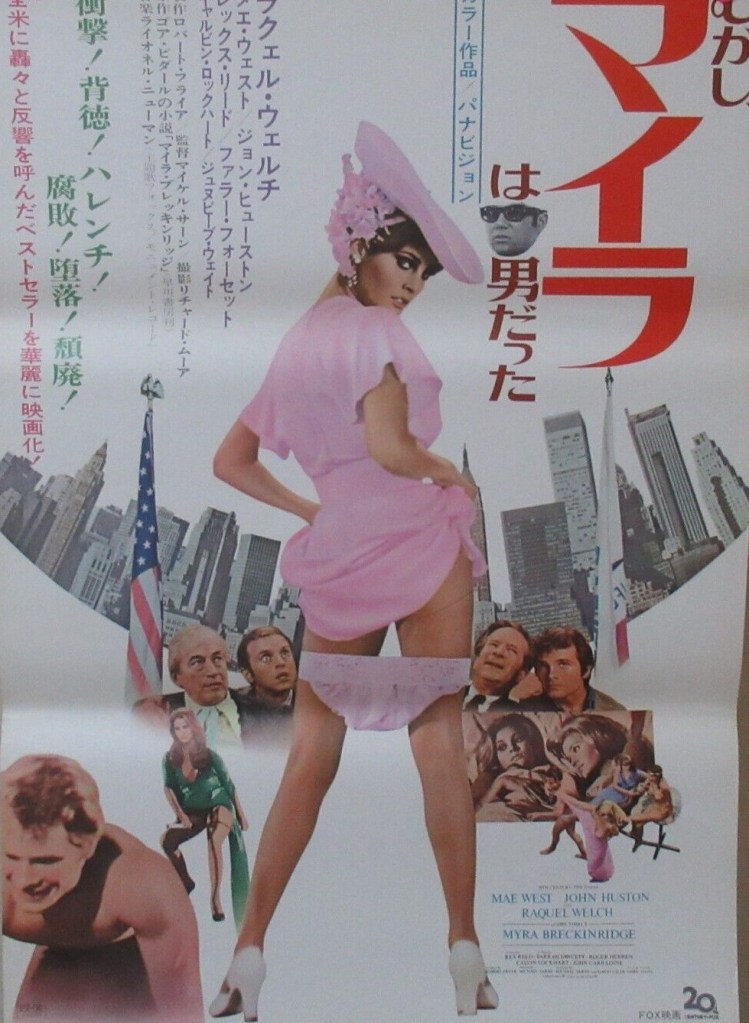
In 2012, Raquel Welch was accorded a ten-film tribute at the prestigious Film Society of the Lincoln Center for the Performing Arts in New York and turned up in person to be interviewed on stage prior to various screenings. One of these was Myra Breckenridge (1970). Though interviewer Simon Doonan kicked off proceedings by mistaking her for Ann-Margret (yep). Graceful as our star was, she didn’t storm off the stage.
She admitted she wasn’t first choice for the picture. “I didn’t get a call,” she explained. “I had heard about the movie. I had read the book. The book was absolutely hysterical, so funny, and I thought it was very innovative because it was the first time I had seen somebody like Gore Vidal, who was really a genius, deal with the duality of the nature of both the male and the female. I never saw that before.
Is that a gun or a are you just pleased to see me?
“I was interested in how they were going to do this movie and then I heard through the trade that Anne Bancroft (after the success of The Graduate, 1969) had turned it down. So I thought, hmmm, I wonder what they’re going for. A little bird told me to call Dick Zanuck (head of 20th Century Fox) so I called Dick, who I was in contract with, and asked what kind of actors they were looking for in this role. I was thinking if a guy was going to change his sex and wanted to be like a movie star kind of girl, don’t you think he might want to look like me? And he said, oh my god, that’s a thought, let me talk to David – that was David Brown (later, producer of Jaws, 1975) and I’m sure Helen Gurley Brown (his wife and editor-in-chief of Cosmopolitan) got in on it too. And then I did get the call and they asked me to come in and talk to them and they gave me the role.
“I had not seen the script, it’s true. As much as I loved doing Myra, I was kind of disappointed in the outcome of the movie because the narrative never did really string together. It was very disjointed and it didn’t really tell the story of Myron the film critic who was enamored of all the very very strong swashbuckling women of the golden age of film from Joan Crawford to Bette Davis and Myrna Loy.
“He wanted really to be one of those superwomen and I think that’s where the superwomen thing started because it was women then who used to go to the movies. They used to bring the guys to the movies. That was the way it went then more than it does now…The dialog was both male and female and I felt like now I’m playing the girl’s part. Rex Reed is playing Myron and there’s really hardly any relationship between the two. They’re not one person so there’s no idea of the duality and nature. One minute she likes girls and the next minute she likes studs and the older men are just to use and abuse.”
Asked about how she developed her character, Raquel replied: “The real thing – I know this is going to sound very shallow – but Theodora Van Runkle (who had swept to national fame by starting a fashion trend with her outfits for Bonnie and Clyde, 1967) did these beautiful period costumes which did emulate all of the great film stars…I felt these clothes kind of evoked this attitude.
“I did want to meet Mae (West). I did go out and research her and find out all about her and it turned out she had never made a color movie before. I asked for an audience. (In her apartment) I noticed all her furniture was white and also noticed all these 25-watt pink bulbs (to keep the room dim).”
Raquel had observed of movie stars, “There’s a screen persona and a real side. Mae didn’t have a real side. She was wearing a long peignoir and lots of eyelashes. This was noon. She didn’t bring the chimps out (she was rumored to have a menagerie of them…and young men, and neither were in evidence).”
(On set) “The other thing that got to me a little bit was that Mae never worked before 5pm. Also she never really moved by herself. (The limousine that had driven her to the studio) also brought her on to the set. I kissed her hand and one false fingernail fell to the floor and then I thought I’m getting a vibe, I think she’s a man. She refused to appear in the same frame as me. At 77 (Mae’s age) all bets are off and you’re not going to be able to doll it up that much.”
While stars being able to veto a director and perhaps refuse to work with certain other stars was still a perk for the highest-paid movie actors, Welch discovered that Mae West had a very distinctive unheard-of perk. She had costume approval. Van Runkle had designed a Garbo-esque black dress that Raquel was looking forward to wearing. But when it came time for that particular scene she discovered it had been “confiscated….nobody got to wear non-color (West was always dressed in white) except Mae.”
“Very early on (I realized) this isn’t Gore’s book. Nobody’s going to undertsand it…they hired Michael Sarne who’s only claim to fame was Joanna (1969), a visual montage kind of thing and that’s what he did to this movie. The fact that it had dialog was secondary. He used to carry round this little rectangular box and he used to say, I’ve got this little box for you, Raquel.
“It was sad fun, I didn’t want to make a movie that didn’t make any sense. I thought we were going to make something that was revolutonary. I did think it was kind of a landmark that said it’s very likely that world culture will change from this point on.”
You can catch this interview and another one discussing The Three Musketeers on Youtube.
Proof that time can be kind to even the unholiest of unholy messes. Previously only appreciated/mocked for its camp values, the thin story this has to tell suddenly carries contemporary weight. Not so much the transgender elements but now revealed as the first picture to bring the MeToo agenda to light.
While it’s still terrible, with a tendency towards the really really obvious and, when that doesn’t work, bombard the audience with a That’s Entertainment smorgasbord of sexual innuendo. In fairness, even in those more feminist-awakening times, you probably still had to batter the viewer over the head to get them to accept any of the points being made.
Candy-striped oufit pure invention of the poster designer.
The first, while theoretically in a theoretical twist tranposed to the female, was the sexual predator, closely followed by the notion that every woman wanted “it”, regardless of them expressing otherwise. Even the dumbest cinemagoer could not have failed to see that putting an exclusively male casting couch at the disposal of Hollywood agent Leticia (Mae West) was actually a clever way of showing just how the movie business at its worst worked, though in reverse, the females queuing up (apparently) for the kind of sexual transaction that could give them a shot at stardom.
That it’s Myra (Raquel Welch) herself who spends most of the movie degrading men (anal rape anyone?), and women indiscriminately (I’m surprised the posters didn’t scream “Raquel Goes Lesbian”), it’s again just a play on what went on in the virtually exclusive male enclave of Hollywood. Just as pointedly it points the finger at the way Hollywood has destroyed the American Dream, snaring thousands of hopefuls who spend fortunes, whittle away their lives and prostitute themselves (and still do) in the vain hope that taking acting lessons for an eternity will somehow provide them with a talent they weren’t born with.
The narrative – what narrative? – concerns Myron (Rex Reed) having a sex-change operation to become the aforesaid Myra and then claiming an inheritance, on exceptionally spurious grounds, from her kinky uncle Buck (John Huston). And trying to part hunk wannabe Rusty (Roger Herren) from his wannabe girlfriend (Farrah Fawcett, the Major came later). You might argue that the continuous loitering presence of Myron is a distraction but occasionally it’s welcome as the movie runs out of punchbags.
And in case you didn’t get the message in what passes for dialog, Myra takes to just delivering straightforward lectures on the male-dominant Hollywood that posited the notion that women were there for the taking if you were just male enough to take them and that any women who showed the slightest ounce of onscreen intelligence and the ability to swat away predatory males was just a predatory male in disguise.
Nobody comes out of this with any dignity and though it destroyed the career of director Michael Sarne (Joanna, 1969) and Roger Herren, John Huston (The Cardinal, 1963) was inclined to self-indulgence on-screen if not restrained by a strong director, while Farrah Fawcett and, in a bit part, Tom Selleck survived to become television legends. The less said about wooden Rex Reed the better.
Quite where this left Raquel Welch is anyone’s guess. While she held the narrative together in convincing fashion, as an actress she wasn’t provided with enough material beyond the sensational to convince as a dramatic actress of anything more than middling caliber. Yet, it was an incredibly brave career decision. The contemporary likes of Joanne Woodward, Jane Fonda, Maggie Smith et al would have balked at the thinness of the material, and would have run a mile from expressing themselves in such sexual terms, despite probably recognizing what the movie was attempting to achieve.
It needed someone larger than life to play the part and, possibly with higher expectations than seemed plausible, the bold Raquel stepped up to plate. Perhaps the element that appeared most to her was that she took revenge on Rusty because (shock, horror) he didn’t fancy her at a time when she was presented as the most fanciable woman on the planet.
So discretion left at the door, blunderbuss in full operational mode, but even now it’s that approach that is wakening the industry up to the sexual misbehavior of many of its to male personnel. What was once top of the so-bad-it’s-good tree is now revealed as not too bad after all, if you swap the phantasmagoria for the stinking reality underneath.
As demonstrated in Madison Avenue (1961), the “big build-up” was code for inflicting on an unsuspecting public an unlikely candidate for acclaim. Of course, for decades, Hollywood hacks had been bombarding fan magazines, weeklies, glossy monthlies and dailies with beefcake and cheesecake photos of promising new talent. But the hook was that these actors were shortly appearing, albeit in a bit part, in a few months’ time in a forthcoming movie.
Modelling was another device to attract the attention necessary to generate a screen career. Sometimes, these (predominantly female) models would be making their first throw of the dice, hoping that some producer in an idle moment might catch a glimpse. Or, they could be women who made a living from selling such snaps to such media.
But, usually, it was one thing or the other: gratis photos handed out by grateful studio marketing teams or photos that an editor paid for in the hope they would increase circulation (in the days when there was no such thing as a giveaway magazine). La Welch appears to have fallen into the latter category.
But it was a heck of a long-term build-up given that with the exception of the virtually unseen Swingin’ Summer (1965), in which she has a bit part, Raquel Welch did not appear in a movie until September 1966. By that point, modelling a skintight number in Fantastic Voyage – it was December before that iconic fur bikini in One Million Years B.C. set male hearts pumping – it seems that magazine editors the world over were prone to giving her space in the years prior covering 1964-1966 when she was effectively an unknown.
Esquire splash.
Which would go some way to explaining why by the time her first movies hit the screen she was already a familiar face (and body, it has to be said) to many (and not exclusively male) in the audience. The promotional push was supplied by Twentieth Century Fox which had signed her to a five-picture contract, making her, perhaps in their own words, one of the most sought-after actresses in Hollywood.
But deals with studios for new talent were ten a penny, no guarantee the studio would keep its side of the bargain, nor that the contract would run to term, nor that the actress would be handed anything but bit parts. Still, it probably cost relatively little to start pumping out promotional photos with “new rising talent” as the lure. Magazines seemed happy to accept on face value that she was a rising star even though there was no proof that she had the talent to match.
Life magazine proved something of a stepping stone. She was featured in a bikini in its Oct 2, 1964, issue. But you could just as easily have caught her in a leopard-skin dress draped across a cocktail stool, one of several cheesecake pictures taken to promote the starlet. Parade magazine, in Britain, something of a lower-grade male magazine, far removed from the likes of the glossier Playboy, was among the first to take the bait, in December 1964 (see above) handing the young potential star its front cover. (Her surname was misspelled as Welsh – and her Christian name was misspelled as Rachel when she featured again in March 13, 1965.)
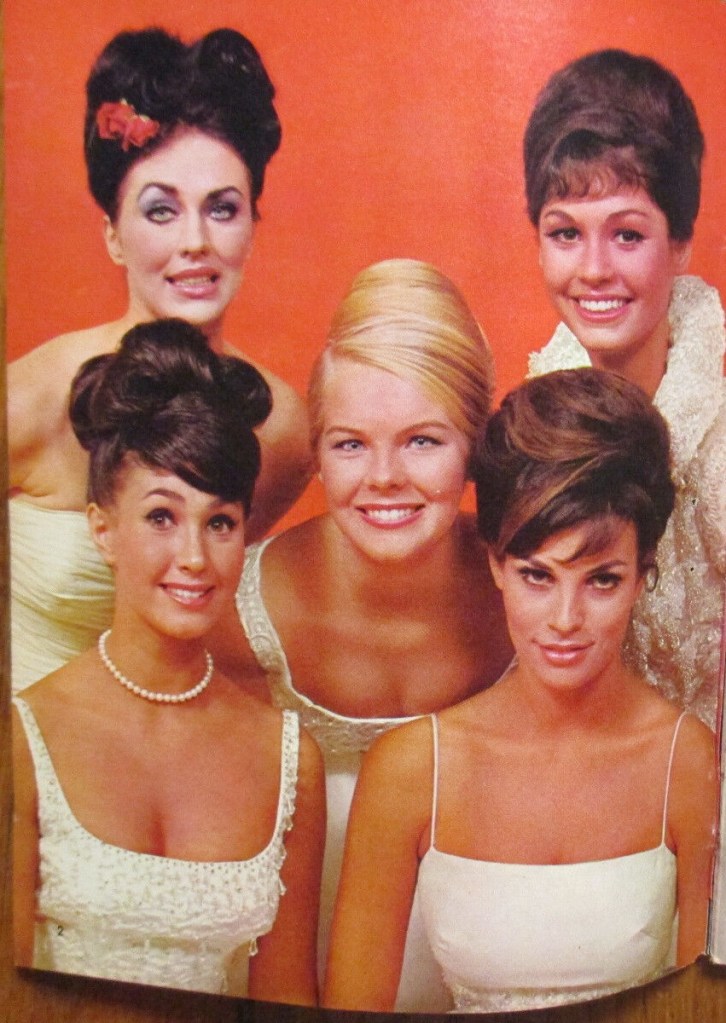
Five of the 10 chosen Deb Stars of Tomorrow. See if you can spot our gal.
But the real boost came at the end of December 1964. That month she was one of ten potential female stars featured in the Dec 27 issue of New York Journal-American under the title “TV’s Magic Wand Taps Girls As Stars of Tomorrow.” She had been chosen to appear on ABC TV’s “Debs Stars of 1965” programme. This show claimed an 85 per cent success rate in picking potential stars, with Kim Novak, Tuesday Weld and Yvette Mimieux among previous winners.*
In April 1965, the distinctly more upmarket – and not male-appealing – McCalls in the U.S. came calling, but that front cover dispensed with the sexy look, presenting her wearing spectacles. By September 1965, the Fox marketeers had been hard at work and won for her – a full year before Fantastic Voyage opened – the front cover and an inside spread in the British edition of movie fan magazine Photoplay. The next month brought another iconic photograph, the “nude” spread in U.S. upmarket monthly Esquire, accompanied by a full-page interview that treated her as the next big thing, again on the word of Fox, nobody having as yet seen so much as an inch of the footage of the sci-fi picture.
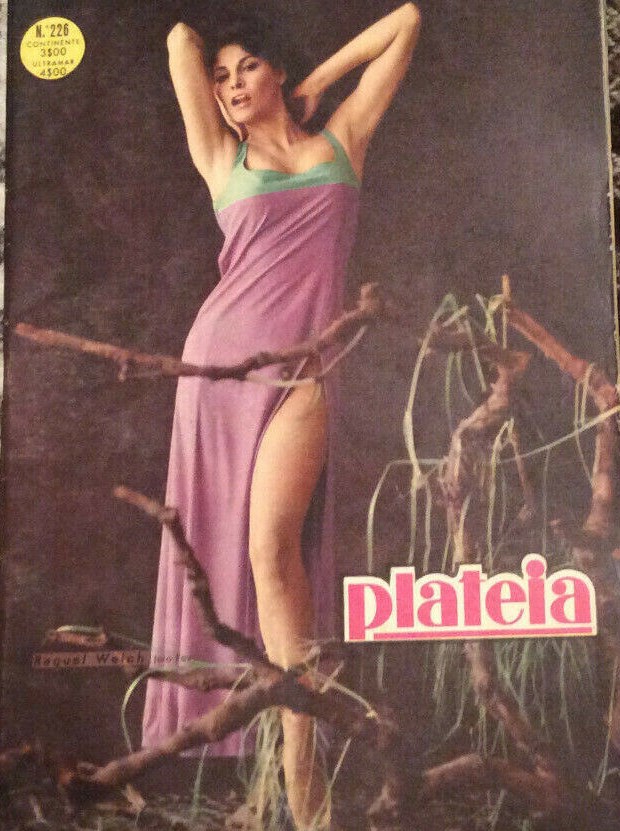
The same month in trademark bikini she was on the front cover of U.S. Camera and Travel magazine (surname again misspelled), photographed by Don Ornitz and described as “a rising young actress with many screen and TV credits to her name” without specifying that in fact these were mostly uncredited or in bit parts. Also during 1965 she featured in Turkish magazine SES and Portuguese magazine Plateia.
But there was also the grind. She advertised Wate-On slimming in Screen Stories in 1965, was the cover model for True Love in September 1965 while for Midnight magazine – and surely this was a story dreamed up by a publicity hound – her front cover picture was accompanied by the heading “Adultery Can Save Your Marriage” and inside she was quoted as saying “A Wife Should Let Her Husband Cheat.”
The big build-up went into overdrive in 1966. She modelled bikinis in two more front covers in Parade (all name errors corrected) in January and July. Australians preferred a more demure – or at least non-bikini – look. In Australian Post (June front cover) she was photographed wearing a “dress of ten thousand beads” from her unnamed next picture (neither Fantastic Voyage nor One Million Years B.C. obviously). There was a slinky pink number for the Australian edition of Photoplay (August, front cover and full-page photo inside) and a quote “I think its important for a girl to exploit her physical attractions – but with restraint.”
She also graced Hungarian magazine Filmvilag and Showtime, both in August. Perhaps the most prescient feature ran in Woman’s Mirror in April 1966. For once she was not granted the cover, but featured on a two-page spread inside under the heading “A Star Nobody Has Seen But Everybody Is Looking For.”
Most of her figure was hidden on the front cover of Pageant (July). SES had something of a scoop in its April edition with some behind-the-scenes photos of Welch in her fur bikini for One Million Years B.C. and she made the cover of German magazine Bunte (June).
Exactly how busy and successful Welch – and her promoters – had been could be gauged from the photo that appeared in the Aug 26, 1966, issue of Life, in which she was pictured in front of a wall of over 40 of front covers she had adorned in the previous two years. Pictorial proof that she was in demand and that magazine editors, long before the public had the chance to witness her screen performance, could recognize a certain kind of charisma. (She was featured in Life again in Dec 1966, in a bikini, but seen sideways, bent over and with her hair in pigtails – and on the cover of its Spanish edition on Nov 21.)
And there was another kind of accolade coming her way in Britain. She was chosen as the first cover model for the first issue of men’s magazine Mayfair in August 1966, the same month as she was positioned in the same prominent spot on Adam, another men’s magazine, and in the more sedate British magazine Weekend, in which she was promoting Fantastic Voyage.
But she would soon be forever associated with the fur bikini, posters of which were soon plastered over the walls of teenage boys. The fur bikini more than anything else broke the mold in the presentation of a new star, and luckily for Welch, the ground work had been done courtesy of the long-range big build-up.
*The other nine Deb Stars of Tomorrow were Barbara Parkins (Valley of the Dolls, 1967), Mary Ann Mobley (Istanbul Express, 1968), Margaret Mason (no movies but some television), Wendy Stuart (couple of bit parts), Beverley Washburn (Pit Stop, 1969), Tracy McHale (nothing), Laurie Sibbald ( a few television episodes), Janet Landgard (The Swimmer, 1968) and Donna Loren (a few television episodes). No prizes for guessing who won that particular Deb Star competition.
Says everything about Raquel Welch’s position in the global box office firmament that she was chosen to head up the launch of a new production company formed by J. Ronald Getty, son of the billionaire oil tycoon. Given she was a lot more affordable than the likes of John Wayne, Paul Newman and Doris Day, nonetheless in terms of audience recognition and fanboy delight, Welch was, thanks to endless magazine spreads, just about the best-known star on the planet, with a popularity among editors that came close to emulating Elizabeth Taylor at her Cleopatra-controversy height. While still the most popular cover star of the popular magazine, she also featured in a 10-page spread in Vogue.
Welch was at a box office peak. The success of One Million Years B.C. (1966) and Fantastic Voyage (1966) had catapulted her into the marquee stratosphere. Bandolero (1968), Lady in Cement (1969) and 100 Rifles (1969) consolidated her position and her involvement guaranteed her films opening in countries that weren’t so keen on private eye capers or even Frank Sinatra for that matter.
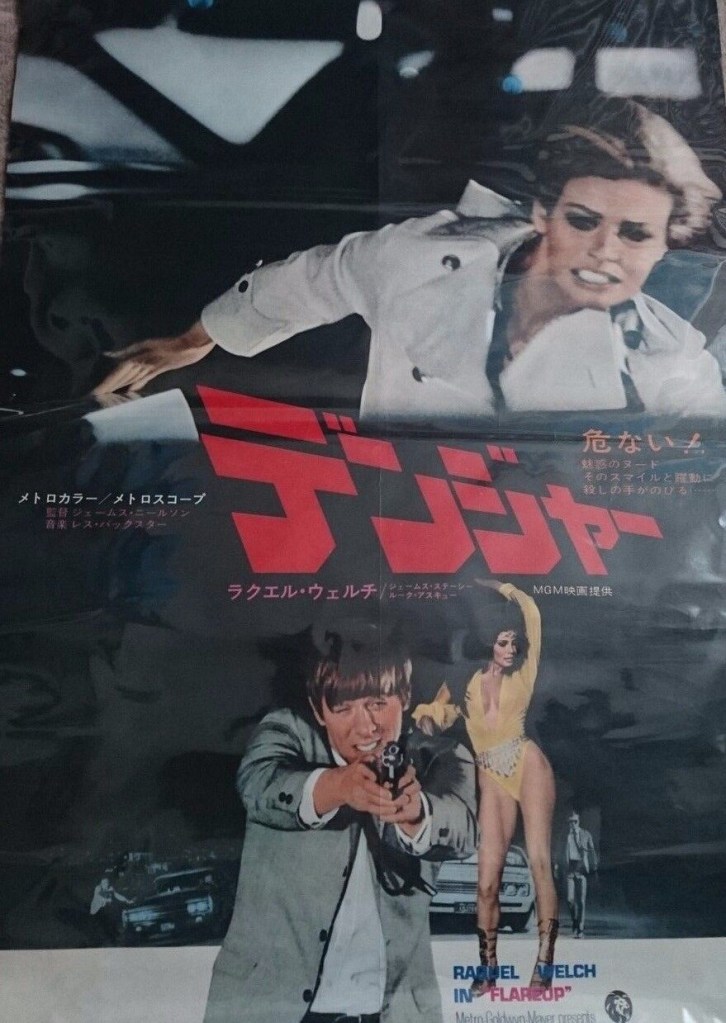
Not more artistic license! Suffice to say, Welch doesn’t don this outfit.
She was high on the wanted list for major studios – 20th Century Fox had signed her up for Myra Breckenridge (1970) and Columbia for Dubious Patriots (renamed You Can’t Win ‘EmAll, 1970, but minus her presence). Italian producer Franco Cristaldi had her in mind for An Average Man (not made either after she dropped out) with Karl Malden and Peter Falk.
Commonwealth United, another major start-up, had joined forces with her husband Patrick Curtis to make Tilda, based on the novel by Elizabeth Kate (Patch of Blue, 1965). And Curtwel, the Welch-Curtis production arm, had also set her to star in Laurie Lee in Movies, “a vicious Hollywood love story” to be directed by actor Robert Culp (Bob and Carol and Ted and Alice, 1969).
It didn’t seem odd at the time for someone more familiar with the oil business to be jumping into the Hollywood nest of vipers. The takeover splurge of the 1960s had seen traditional conglomerates such as Gulf & Western enter the movie business. In fact, Getty was viewed as representative of “one of the most significant developments in the current trend of investment by leading industrial and financial figures.”
Getty (aged 34) teamed up with accountant Richard McDonald and veteran producer Leon Fromkess (57) to form GMF. Best known for Edgar Ulmer film noir Detour (1945), from an industry perspective Fromkess, a former production executive for Eagle Lion and Samuel Goldwyn, was admired for turning out low-budget numbers like Ramar of the Jungle (1952). Getty was determined not to plough a huge chunk of money into risky ventures.
“We intend to become a dominant factor in the industry,” he proclaimed. And like many outsiders considered Hollywood too bloated for its own good. “Sound business practices are equally applicable everywhere. Small hard-hitting outfits with a short chain of command can run rings round (the) major complex studio structures.”
Fromkess averred, “We are convinced that there is always a marketplace for films which are made independently, economically and in tune with today’s entertainment requirements.”
Welch and GMF turned out to be well-suited. The actress wanted to move away from the cheesecake roles on which her fame was based. And while the majors would have rejected the idea of Welch not spending an entire film in skimpy costume, or rolling around in bed with a co-star, or otherwise exuding sex by the inch, a newcomer would be more likely to allow concessions.
A budget of just $1.3 million, a substantial chunk of which ended up in her pocket, did not extend to providing her with a name co-star, so she was happy to be reunited with James Stacy, leading actor in her debut picture A Swingin’ Summer (1965), whose laid-back persona made a change from the testosterone heavy Jim Brown and Burt Reynolds and Hollywood veterans like James Stewart and Frank Sinatra.
In this film she would not be viewed as an adornment, and in fact was able to exert her authority, demanding that the company change the ending so that she drives away on her own rather than end up as prospective wife. A woman who had just dispatched the villain by dousing him in petrol and setting him alight was hardly going to settle for hearth and home. (The cliché ending, it has to be said, was what made it into the final picture. But the finale chosen by the producers, rather than the one Welch assumed had been agreed, was an expression of male dominance. Originally, the boyfriend had agreed to accompany her to Mexico but when he got cold feet she drove off. And I have to agree that seemed an apposite end. Except, for no reason at all, she turns back.)
The film was shot on location in Las Vegas and Palm Springs with interiors at the Goldwyn Studios. The zoo, focus of a womanhunt, was the original Los Angeles Zoo which had closed in 1966. Although the soundtrack suggested some animals had been left behind, that was a construct. The Los Angeles go-go club featured had been a favorite talent-scouting spot for soft porn king Russ Meyer.
GMF aimed to be self-funding, turning to the majors only for their distribution know-how. It says everything about Raquel Welch’s box office prowess that MGM ponied up for global distribution rights just four months after Flareup began shooting, the studio, at that time, not known for pick-ups. With the tiny budget, that probably spelled immediate profit.
Despite its poor box office in the United States – only one week on the Showcase circuit in New York, with Elvis vehicle The Trouble with Girls (1969) in support – her face on the poster guaranteed the movie opened globally. MGM wasted no time sticking it out on the reissue circuit as a support and it was heavily promoted in the 1972 television feature film season.
While it may have not achieved its aims at the box office, her performance was noted more favorably by critics than ever before. Box Office opined it “proved her dramatic ability,” Kine Weekly maintained that “Raquel Welch who normally is not asked to rely on anything but her looks adds some acting to her performance” and even Variety agreed she did “a good job.”
GMF soon had five more movies set to go – cop drama Brutes in Brass (later retitled Not Yet a Widow), comedy drama Charlie Olive, World War One adventures Zeppelin and Lion of Africa, and Sheila to star Brenda Sykes. In keeping with its lean operation, budgets remained modest. Just $1.2 million was set aside for Charlie Olive, $1.25 million for Sheila. Recreating World War One was perceived as more tricky financially, Zeppelin budgeted at $1.7 million but topping out at $2 million and Lion of Africa with $2.5 million. Warner Brothers had come on board as distributor.
While only two pictures – Zeppelin (1971) and Honky (1971, the former Sheila) of the initial five announced by GMF – went into production, Getty remained in the movie business, the company slimmed down to Getty & Fromkess for George C. Scott vehicle Rage (1972) and just to Getty Pictures for Jack Cardiff horror picture The Mutations (1974).
I thought I’d be taking one for the team in tracking down this much-maligned Raquel Welch number. Instead, I was pleasantly surprised. Oh, the movie’s nothing to write home about, desultory home invasion thriller that fails to come close to Kitten with a Whip (1964), Wait until Dark (1967) or The Penthouse (1967). But La Welch is something of a revelation.
Forget the Las Vegas go-go dancer come-on, this is more of a gentle romance. While attractive, Welch dispenses with the bra-busting outfits and overt sexiness, settling for a girl-next-door persona. In fact, you could have dumped the entire murder plot and had a more interesting picture, along the lines of Fade In (1969) where the normal hot-to-trot Burt Reynolds plays a gentler character.
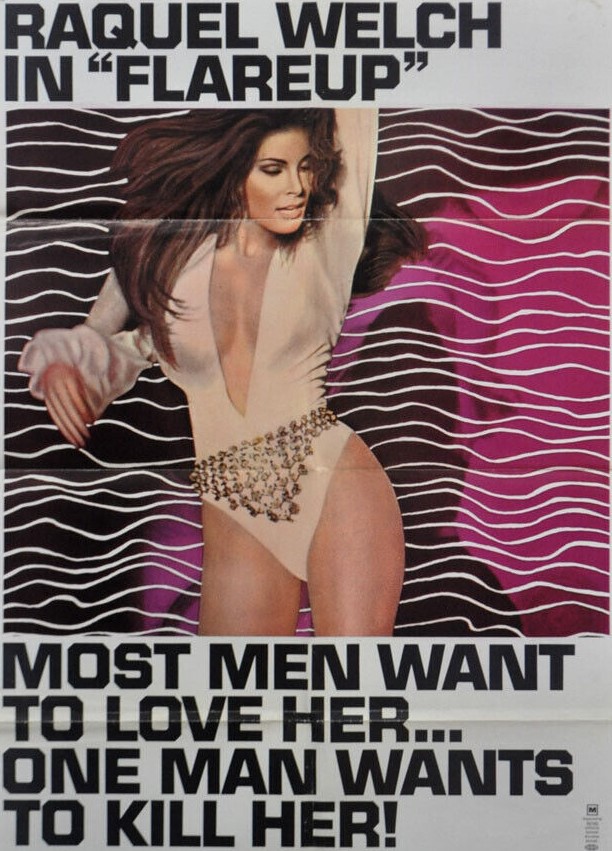
Artistic license taken to an extreme. Raquel Welch is a brunette not a redhead.
Since, (spoiler alert) in her sole dance number Welch keeps her attributes well-hidden, the producers felt obliged to stick in some topless dancers (quite how Welch is permitted to keep her clothes on in a topless go-go bar is never explained) which gives the picture a sleazy feel that runs counter to the tone of the romance.
So, Michele (Raquel Welch) is on the run from nutjob killer Alan (Luke Askew) who has bumped off his ex- Nikki (Sandra Giles) and her friend Iris (Pat Delaney). But why Michele is in the killer’s sights is never satisfactorily explained, except that she purportedly turned Nikki against him. Michele swaps Las Vegas for Los Angeles, finding work in another go-go bar and romance with Joe (James Stacy) whose interest in bull-fighting might have scared her off. But that’s tempered by his enthusiasm for flying model airplanes (an important plot point it transpires).
Cops are on the killer’s trail but not before he bumps off a guy who gave him a lift. Michele’s not hard to find, a drug addict employee of the Las Vegas operation points him in the right direction. There’s some desultory car chase footage and for no reason at all a chase on foot through an old zoo (presumably a genuine old zoo).
I had half-expected there might have been a lion or snake left behind to ramp up the thrill-quotient, but no such luck. What we do get, however, is a rarity in the chase department – exhaustion. Most people being chased on foot manage to drum up an insane amount of energy. Michele, on the other hand, is on the point of collapse.
But she’s not dumb. She might be rootless, not the questing soul of Easy Rider, but driven away by parental issues and, in gaining independence not keen on surrendering it to any passing male. And come the climax, she’s got a nasty weapon up her sleeve.
Essentially, she’s a sweet gal. Not the kind of character you’d expect La Welch to be playing, and perhaps that’s what attracted her to the script. It gives the actress the opportunity to escape from her sexy persona, and, while the tale is hardly weighty, the chance to prove she can do more than hide behind her particulars. Innocence isn’t something you’d associate with Raquel Welch, but here she exudes more of that than earthiness or sex appeal.
James Stacy (star of Welch’s debut picture A Swingin’ Summer, 1965) is a likeable boyfriend, not the kind trying to hustle her into bed. Luke Askew (The Devil’s Brigade, 1968) doesn’t do much except play mean.
James Neilson (The Moon-Spinners, 1964), while not able to jazz up a rancid plot, allows, as he did with Hayley Mills (an odd comparison indeed), Welch the chance to grow up on screen, defusing her sexuality but allowing her space to create a character so far removed from anything previously seen. But the tempo sags with over-reliance on dancing sequences, the Las Vegas backdrop and too much chasing that goes nowhere. Mark Rodgers (Let’s Kill Uncle, 1966) dreamt this up.
One perhaps for completionists. Lack of sexy scenes might be off-putting but, equally, you might want to see what Welch can do when playing against type.











 The Magnificent 60s