Cash on Demand (1961/1963) ***

Ideal crime B-picture. No femme fatale, but a tight one-location two-hander. Set a couple of days before Xmas in a rural English market town, while possessing sufficient twists to see it through, in the main it is a battle of wills between urbane thief Col Gore Hepburn (Andre Morell) and his victim, stuffed-shirt bank manager Harry Fordyce (Peter Cushing). Combines slick heist with An Inspector Calls mentality where the morally superior are taken down a peg.

Fordyce is the kind of martinet who makes his staff remove Xmas cards from display, nit-picks about the state of nibs (in the days when pens were dipped in ink) and threatens to sack chief clerk Pearson (Harry Vernon) over a minor error that he has worked up into potential embezzlement. So unpopular, he is not invited to the staff party.

Under the guise of carrying out a security inspection Hepburn sets up a robbery, tying Fordyce in moral knots, his unwilling collaboration ensured by threatening to stick electrodes to the bank manager’s wife’s head. Hepburn has done his research, aware of all aspects of security, but, more importantly, knows his man, how to exert pressure, how to keep Fordyce on edge. Hepburn reeks of self-assurance, Fordyce of insecurity, a friendless man who bullies his staff, living a life suffused with discipline and bereft of enjoyment.

Though there are a couple of red herrings, and an unexpected incident, what mostly endangers Hepburn’s bitingly clever plan is the unforeseen, that the cold-hearted bank manager will come apart under pressure.

Underlying the action is class conflict. But not the usual working- class vs upper class. Instead it is aspiring middle class vs assured well-educated upper class. Hepburn is the kind of well-dressed smoothie  who could talk his way into any company and out of any situation. He puts everyone at their ease, knows how to enjoy himself, would make any party go with a swing, could flirt convincingly with your grandmother, and you would trust within an inch of your life. Fordyce, on the other hand, is one of life’s scrapers, everything by the book, creeping into management painfully slowly, and once acquiring a position of authority letting everyone know who is boss and terrified of losing his standing in society. It’s “class” of another kind too, that of the winning personality versus the eternal loser.

Peter Cushing as the bank manager.

This plays against expectation. Normally, in a heist scenario, there’s one employee who’s trying to beat the baddies, some clever device or trick up their sleeve. That’s not the case here. Instead, we’re served up a character study, the supposedly upright pillar of the community revealed as a coward and moral bankrupt.

And the unexpected also comes in the casting. Both Peter Cushing and Andre Morell play against type. At this point they were best known as Sherlock Holmes and Dr Watson in The Hound of the Baskervilles (1959), an upright team on the side of the angels. Cushing, while often tight-lipped, generally exhibited a morally superior screen persona. Here, that trademark persona rapidly vanishes under pressure.

Quentin Lawrence (The Secret of Blood Island, 1965) directs within a very tight timeframe.

The movie had unusual origins. It was expanded from a short-lived series called Theatre 70 on British ITV, the number relating to time, the program running for 70 minutes rather than the usual hour. And it had just as unusual a release. Perhaps for copyright reasons, it didn’t see the inside of a cinema in the UK until December 1963 when it went out as the support to musical Bye Bye Birdie (1963) on the Odeon circuit. But it had already been released by Columbia in the US in 1961 as the support to Twist Around the Clock (1961).

M3GAN (2022) ****

Sharp psychological drama about attachment, abandonment and loss masquerading as sci fi/horror. Plays off riffs old – Ripley in Aliens and the elevator scene in The Shining – and new, the “Final Girl” trope aka last person standing of the horror film becomes “Final Child.” While not a slaughter-fest in the Halloween/Friday the 13th vein demonstrates ingenious methods of bumping people off.

The starting point is not, as the trailers and adverts might suggest, the invention of a toy robot companion that evolves beyond initial conception, but a young girl, Cady (Violet McGraw) orphaned in a snow plough accident, who is sent to live with workaholic robotics engineer Gemma (Allison Williams), the least maternal woman on the planet.

Knives out and not an onion in sight.

In her own mind Gemma has good excuse not to prepare for this sudden onset of parenting by buying some new toys or child-friendly food or creating a playroom. She is on a deadline having spent $100,000 inventing a new doll called M3GAN that, unfortunately, doesn’t work. So tough luck for the poor little orphan until Gemma can enrol the little girl as the test pilot for the Megan experience.

And that’s a hell of a boon for Cady since the cutely dressed doll, about the child’s size, empathizes with her human companion, actually listens to her, can record and store the child’s memories and seems like it’s about to kickstart a toy revolution. That is, until it develops an exceptionally high protectionist tendency.

When its charge is whacked by an unruly boy or menaced by the dog next door, Megan steps in to deal out fitting punishment. Except the doll has no “stop” button and is inclined to go on meting out punishment until there’s no life left in the victim.

It’s not long before Gemma twigs that the doll is turning into one of those mad parents you find in thrillers, or even like Celia (Lori Dungey), the annoying woman next door who cares more for her dog than her neighbors. The signs are there when Cady starts to run amok. Well, not quite amok, but handing out slaps to adults, and reacting badly when deprived, like a child of its computer game, of the companion.

Gemma, whose idea of commitment is Tinder, takes a very long time before she can put the needs of the child ahead of her career, and when it comes to a showdown finds she is not the match she thought she was for her invention, which, like HAL from 2001: A Space Odyssey (1968) or any other man-made monster since time immemorial, objects to being ended.

The grown-ups don’t come off well here, either idiotically bickering so much they cause the accident that renders the child parentless, or obsessed with dogs or work, and even social worker Lydia (Amy Usherwood) assigned to find out if Gemma is a fit mother seems unsuited for the work, inclined to take a rather robotic view herself of child engagement and certainly playing power politics.

Gemma’s boss David (Ronny Chieng) is a mean-minded insecure obsessive unaware an  underling is quietly harvesting his ideas for sale to a rival. All the adults view the child as a doll, a necessary adjunct to show how well the robot works.

Gemma fails to understand, as spelled out by the snotty social worker, that a child who has lost parents will attach herself to the nearest sympathetic person. But Cady, dealing with abandonment and loss, is not the only one with attachment issues. The robot has them in spades, chucked aside on a whim when her creator takes against her or when all attention is transferred to the child.

This all builds up to a tremendous climax when Megan cuts loose in the toy factory, slicing and dicing, and providing the kind of example of her prowess that would have sequel-makers salivating as they detect robot soldier opportunities. And when Gemma tries to bring her to heel finds that (to hell with the obvious pun) the boot is on the other foot.

You can see why this – and other horror thrillers like Barbarian (2022) or Black Phone (2022) that eschewed a conveyor belt of bloody thrills in favor of something deeper – has struck such a chord with the younger audience that makes up the bulk of the audience for Hollywood pictures. This is intelligent. Who hasn’t as a child dreamt of, or even invented, the ideal companion? Who as a child has not thought there must be a better way of being brought up than being left in the hands of parents with little aptitude or interest in the job.

None of these horror pictures has got the slightest chance of being nominated for Oscars while pictures with far bigger budgets, which have not the slightest chance of attracting an audience or are boring them to death, get all the critical hype.

I couldn’t make up my mind whether the doll, being so lifelike, was CGI or human and it turns out she was played by newcomer Amie Donald, though presumably either with a stunt double or a computer doing the crazy dancing. Whatever, the doll is very convincing. As it has to be said, are Allison Williams (Get Out, 2017) and Violet McGraw in her movie debut.

But the star of the show is undoubtedly director Gerard Johnstone, also a movie newcomer, who had the guts to opt for  slow-burn rather than visceral fright and develop themes that would resonate with any adult. Screenplay honors go to Akela Cooper (Malignant, 2021) while director James Wan (also Malignant) cops the story credit.

Virtuoso thriller. Can’t wait for the sequel.  

Pirates of Tortuga (1961) ***

In the absence of A-list swashbuckling talent like Errol Flynn (Captain Blood, 1935), Tyrone Power (The Black Swan, 1942) and Burt Lancaster (The Crimson Pirate, 1952) or spitfires in the mold of Maureen O’Hara (The Black Swan) and Jean Peters (Anne of the Indies, 1951) this sidesteps casting issues and in the kind of reversal that sent Pirates of the Caribbean on its merry way for the most part takes the comedic route of putting pirate moll Mg (Leticia Roman) center stage and twisting the usual blockade narrative so that it’s Privateer of the Century Henry Morgan (Robert Stephens) controlling the high seas.

Charge with stopping the pirate is sea captain Bart (Ken Scott). But most of the running in the first half is made by Meg, a thief turned stowaway, whose efforts to acquire the standing of a lady are initially mocked by the crew until they soften towards her, in part with seduction in mind and in part out of pity. But after landing in Jamaica, and mistaken for a Lady, she steps up to the plate, and manages to catch the romantic eye of the Governor before readjusting her sights and snaring Bart.

Bart and his crew infiltrate the buccaneer kingdom and spy out its flaws before arranging for a full-out attack. Boldly rewriting history, something of a surprise since Morgan the Pirate had appeared a year earlier, this Morgan is a shifty alcoholic. Once the action gets going, including a clever ambush of one pirate ship, it has enough swordfights to keep a regular swashbuckling enthusiast happy. There are some nice touches, Pee Wee (Dave King), the de facto fencing instructor, is lefthanded and wears a black glove whose use is historically accurate. The ships in full sail are impressive, the locations work well and it makes good use of Cinemascope color while Meg remains larcenous throughout rather than the good moll of previous entertainments. Though you might not be so impressed by the bear wrestling.

Ken Scott makes the best of a thin script, ignoring Meg’s wiles, and outwitting Morgan. Apart from Roman, who steals the show, British comedian Dave King (Strange Bedfellows, 1965), in his movie debut, is the pick, a jocular personality with lechery a stock-in-trade. I better point out you can spot John Richardson (One Million Years B.C, 1965) otherwise he is so insignificant a performer you would scarcely know he is there.  Robert Stephens (The Prime of Miss Jean Brodie, 1969) turns Morgan into a scallywag rather than a threatening villain.

Worth noting was just how long it took a graduate of the Twentieth Century Fox talent school to graduate – at the end of a five-year contract Ken Scott (Desire in the Dust, 1960) finally achieved leading man status.   Leticia Roman (The Spy in the Green Hat, 1967) was a bit more savvy and turned down a Fox contract in favor of Hal B. Wallis who cast her instead in G.I. Blues (1960). Technically belonging to the European import category of actress so popular during the decade, she never worked in her homeland before being scouted by Wallis. Though she was born in Italy her father, a costume designer, had moved to the U.S. in the late 1950s.  

Producer Sam Katzman, who had just signed a four-picture deal with Fox, made 239 films in every genre,  including Tim McCoy westerns, the Leo Gorcey Bowery Boys series,  Bela Lugosi as The Ape Man (1943), Jungle Jim (1948), Paul Henreid in Last of the Buccaneers (1950),  Mysterious Island (1951), 3D Fort Ti (1953) and Rock Around the Clock (1956) as well as a slew of 1960s Presley musicals.  

On a miserly budget of just $675,000, the sea scenes were shot in the Fox water tank. Robert D. Webb (The Cape Town Affair, 1967) directed.

A harmless trifle with decent action and Leticia Roman turning upside-down the genre female lead.

No need to fork out on a DVD. You can catch this on YouTube.

Skidoo (1968) *

Hubris can only get you so far. Unfortunately, it’s all downhill. Whatever possessed Otto Preminger (In Harms Way, 1965) to believe he could deliver a contemporary satirical comedy beats me. And it beat him, too.

Despite the comedic input of Jackie Gleason (The Hustler, 1962) and Groucho Marx there’s nary a single laugh, except, sadly, at the director’s expense as he attempts to shine a coruscating light on social mores and instead ends up fluffing his lines. The highlights (!!) are gangster Tony Banks (Jackie Gleason) having a bad trip, his daughter Darlene (Alexandra Hay) falling in with a bunch of hippies and having her body painted, his wife Flo (Carol Channing) trying to seduce another gangster Angie (Frankie Avalon) and some attempted gags at the expense of technology.

There’s even the old one of kids making out beside a parking meter and when busted complaining they are not getting their allotted time. And there’s an ongoing “joke” of Flo tussling with various men for control of the television set through rival remote controls.

The story, if you can call it that, has Tony infiltrating a prison in order to bump off inmate Packard (Mickey Rooney) who plays the stock market, complete with ticker tape, inside. Flo and Darlene, trying to find his whereabouts, end up at Angie’s hi-tech pad. Then all the hippies go back to the family house where Flo washes their hair.

You can imagine where hippies come into all this, making with the hip talk, and trying to set up an alternative world to the Establishment.

Carol Channing makes her feelings known by donning pirate garb.

In the style of It’s A Mad, Mad, Mad, Mad World (1963) the main attraction are the cameos, Peter Lawford (Ocean’s 11, 1960), John Philip Law (Hurry Sundown, 1967), Burgess Meredith (Rocky, 1976), George Raft (Five Golden Dragons, 1967), Mickey Rooney (24 Hours to Kill, 1965)  and Frankie Avalon (The Million Eyes of Sumuru, 1967). But they will all cringe at their participation.

Channing, only just Oscar-nominated for Thoroughly Modern Millie (1967) makes the worst career choice of her life, Alexandra Hay (Model Shop, 1969) not far behind, though with less marquee value to play around with.

Every acclaimed director has an off day, taking on a project through poor judgement or, more likely, financial necessity. But Preminger was still a Hollywood high-roller and this just looked like a dose of career suicide.

The Night of the Iguana (1964) ****

The eponymous reptile is a rather obvious metaphor for characters trapped by quixotic decisions. Regardless of the Rev Dr. T Lawrence Shannon (Richard Burton) being a defrocked priest, he was always going to lead a dissolute life, alcohol the least of his temptations. This heady drama begins with comedy about a man with ideas above his station ending up as an incompetent tourist guide.

And if his behaviour is not scandalous enough for current coach party, middle-aged Baptist ladies, he leads them to a hotel in Mexico run by former lover Maxine (Ava Gardner) who has two younger lovers on the go. And as is the way with author Tennessee Williams there’s a posse of fascinating characters, led by spinster Hannah (Deborah Kerr) who ekes out an itinerant living selling paintings while her aged grandfather (Cyril Devalanti) recites poetry. Raising the moral stakes is under-age Charlotte (Sue Lyon) who has taken a fancy to Shannon, partly in rebellion against her frosty chaperone Judith (Grayson Hall).

For a movie with no great narrative drive, there’s no shortage of drama, whether it’s the Reverend under constant attack from his charges, Charlotte making advances, Shannon succumbing or trying to fight his addictions, Maxine succumbing then rejecting his advances, and Hannah on the sidelines trying to work out why her entire life has been lived in the shadows.

A simple dramatic fuse has been lit, disparate group with secrets set to explode, and you just sit back and enjoy the ride. Exceptionally daring, even if in discreet fashion, for the time, not just the Lolita-style Charlotte, but the middle-aged Maxine cavorting with not one but two men young enough to be her sons, so effectively a Cougar (before the term was invented) in a threesome, a woman in full command on her sex life not at the whim of a male. There’s as overt a gay woman as you would find in this era. And that’s before we come to Hannah, one of whose two sexual experiences involved averting her eyes while her male companion masturbated on a piece of her clothing. That was taking it way beyond the limits of acceptable on-screen behaviour of the day.

Characters are either engulfed by their passions or weaknesses or trying to come to terms with them, sometimes both. Over everything hangs poignancy at the self-deception practised, redemption scarcely a possibility, communication a minefield, acceptance the best anyone can hope for. Quality acting prevents this disappearing down a sinkhole of self-pity.

Richard Burton (Becket, 1964) was on a roll, one brilliant performance after another either with or without Elizabeth Taylor, essaying a wide range of characters. This is one of his best. You should despise the sham he has become, relying on charm to dig himself out of a hole, relying far too much on the kindness of strangers whose sympathy is exhausted. Yet the loss of the only position, a clergyman, for which he was possibly suited, thrown out for committing unforgiveable sin while preaching sanctity, makes him a very relatable human being. This isn’t Days of Wine and Roses reborn, but someone trying to win the pinch of oxygen required to keep his soul alive, and stir the energy inside. And he would be furious if you ever made the mistake of feeling sorry for him.

Ava Gardner (Mayerling, 1968) is superb, staring age in the face, unrepentant, sex an acceptable substitute for love, underlying sadness admirably restrained. But Deborah Kerr (The Chalk Garden, 1964), brings a refreshing dash to her introspective character, a woman with practical solutions except to her own emotional emptiness. Sue Lyon (Lolita, 1962) is only briefly scandalous and the movie’s conclusion suggests she is capable of settling down and not giving into the base desires that afflict all the others.

Just as with The Misfits (1961), director John Huston allows his characters to breathe. It would have been very easy to allow Shannon to have a more heroic or stoic stature, instead of someone stumbling around. Tinges of comedy and wit lighten the load. Huston and Anthony Veiller (The List of Adrian Messenger, 1963) wrote the screenplay from the Tennessee Williams play.

Mozambique (1964) ***

Here’s a great idea for a movie. A pair of nubile young girls sign on for a yacht trip with a renowned Hollywood lothario. A couple of days in the star dies. Neither of the girls knows anything about sailing. The boat drifts. If this was a Hollywood movie there would be circling sharks and at least a squall. But it’s not, the girls are picked up 10 days later complete with festering corpse. Witness the sad end of Steve Cochran.

He never made it as a big star, Sometime top-billed in B-movies, but mostly supporting roles, so it was somehow ironic that producer Harry Alan Towers, on the look-out for any kind of name who didn’t mind spending a couple of weeks on location in a remote African spot, gave him his first starring role in six years as down-on-his-luck pilot Brad sent to infiltrate a smuggling gang in the eponymous country.

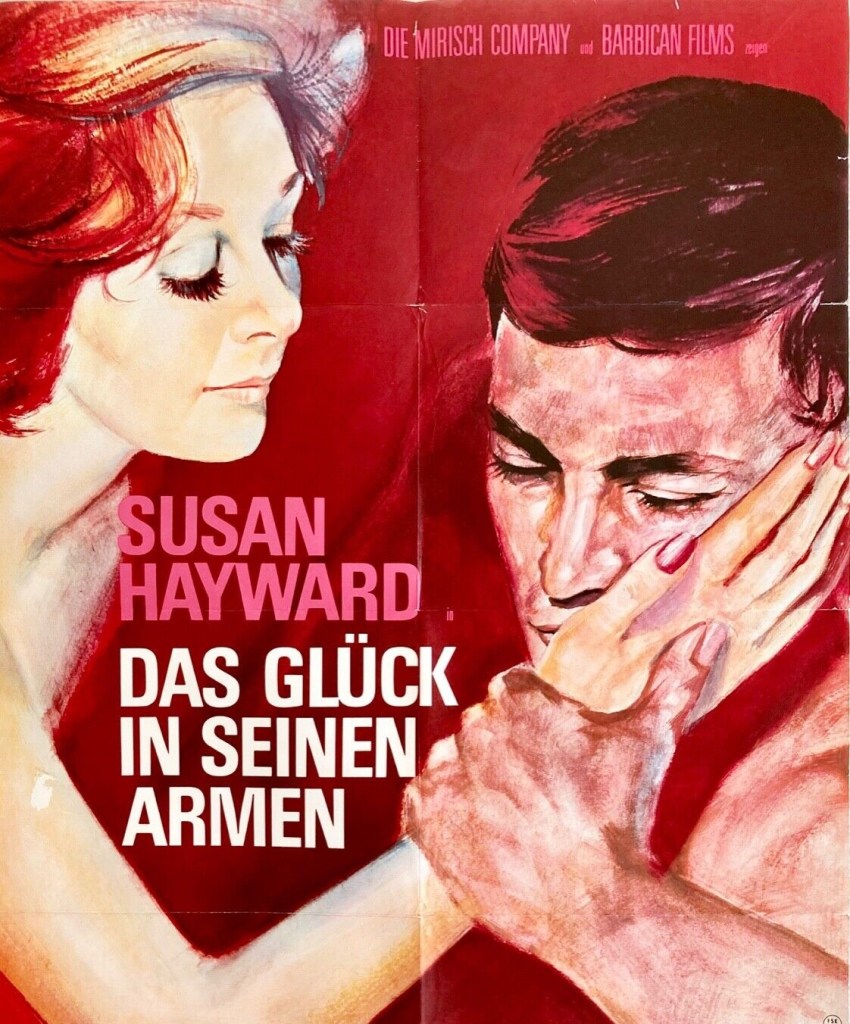
In the German market, the Germans were the stars, Steve Cochran relegated below the title.

And this would have been a fitting send-off because, in among the sleaze, there’s a decent story and some pretty good lines. But it really needed the dry delivery of a Rod Taylor to give those lines the zest they required.

There’s a sudden contemporary feel courtesy of former kickboxing champ and influencer Andrew Tate, arrested in Romania for alleged human trafficking, because the underlying story here is white slave trade. Or, put another way, the one-way ticket. The prospect of a job, any job, anywhere, is sometimes enough, no time, or need, to think how you will get back home. Here, a place of dreams for those running out of anything else that might fit the bill, might become home.

Christine (Vivi Bach) is one such dreamer, a singer. What she doesn’t realise is that in the club where she is employed the girls are part of the deal, a commodity. Her one-way ticket is destination human trafficking. What used to be called in those sensationalist times as the “white” slave trade, as if any other type of slave trade was acceptable or less worrisome. She is sold to an Arab sheik (Gert can den Bergh), to form part of his harem.

Luckily for Christine, Brad has taken a shine to her so when the Arab appears on his smuggling radar their paths converge. But trafficking is a sub-plot. Brad has been hired as a pilot for Col Valdez but he has died intestate so his wife Ilona (Hildegarde Knef), in this corrupt country, is also up for grabs and has to (literally) sing for her supper before segueing from black widow to femme fatale. Standing in Ilona’s way are her husband’s associate Da Silva (Martin Benson) and his one-time business rival Henderson (Dietmar Schonherr) and quickly those two guys are in Brad’s way too.

So it’s a solid old-fashioned tale, Brad digging up the dirt, pausing for a bit of romance, chasing the villains. Smashing the human trafficking isn’t part of his brief, so that’s put to one side, but a missing will, which could rescue Ilona from her impoverished situation, runs parallel to the plot.

The exotic locale was typical Harry Alan Towers. But this has a better plot than most of the ones reviewed so far in the Blog, it’s not rammed with cameos (Five Golden Dragons, 1967) or a star out of his depth (Bang! Bang! You’re Dead!, 1966) or a story that takes forever to come to the boil (24 Hours to Kill, 1965).

And, discounting the tribal dancers shaking their booty in a nightclub, it displays some finesse and comedic touches. Stonewalled by Da Silva on arrival, Brad insists on seeing his employer only to be led into a funeral parlor. A waiter knocks back unfinished drinks. “Nobody’s seen her since last night,” is followed by “then, we’d better stop looking for her, hadn’t we?” And did I mention the snake on the plane?

But Towers always got his money’s worth. Although making a (plot) point, there was another reason for Ilona singing. Knef had relaunched her career in the early 1960s as a singer, so her voice was a welcome interlude, and an improvement on that of Vivi Bach, married to Dieter Schonherr, so perhaps hired as a package.

Steve Cochran (The Deadly Companions, 1961) really only requires masculinity to see this through, though has a way with throwaway lines. Hildegard Knef (The Lost Continent, 1968) adds a touch of class but Vivi Bach (Assignment K, 1968) is merely competent.

Robert Lynn (Dr Crippen, 1963) directed from a script by Peter Yeldham (The Liquidator, 1965).

More topical than most Towers’ pictures and in fact one of his best.

Custer of the West (1967) ****

Far grittier than I expected for a portrayal of one of America’s greatest, if flawed, western heroes. Far darker, with a two-fisted take on the endemic corruption at the highest level that fuelled the Indian Wars. Revisionism with a punch. And bold enough to turn Cinerama tropes on their head.

We should deal with the last first because that reveals the extent of the bitterness that seeps through a biopic in which a soldier’s great skills are put to unwarranted use. You may recall that from its earliest days, Cinerama relied on thrills of a specific nature, one that like 3D put  viewers in the driver’s seat, only to scare the pants off them. You were always racing towards danger, whether that be down the rapids in How the West Was Won (1962) or downhill along twisting roads in The Battle of the Bulge (1965). There always seemed a runaway train to hand. Whatever, it was just a thrill ride, occupants escaping unhurt.

Not so here. The men on the runaway wagon have been tied to it. It careens downhill all right, at one point from an upside down point-of-view, but it ends up over the cliff, no escape for the men. A soldier rides a log river to escape Native Americans. He manages that but is killed on dry land by an arrow all the same. A runaway train falls into a burning bridge. The normal thrills, then, with a realistic edge.

The reward for the great hero, Custer (Robert Shaw), gallant leader of sixty dashing cavalry charges during the Civil War, is a commission with the 7th Cavalry in the Dakotas on a mission described by General Sheridan (Lawrence Tierney) as “plain robbery,” the blatant theft of land from Native Americans.

That’s virtually the first scene, a brutal analysis on the American West, greedy land-guzzling settlers requiring protection, a soldier in obeying orders tacitly agreeing to wage an unholy crusade, not a justified war against slavery.

And Custer doesn’t inherit your John Ford cavalry unit, where every drunk has redeeming features, if only to provide some comedy. His second-in-command, Major Reno (Ty Hardin) is an alcoholic, nearly an entire battalion of malingerers on sick parade. Although later spouting chivalrous nonsense about hating machines, it’s the cannon Custer brings to bear on the enemy that provides initial victory, permitting the boast that 255 men conquered the Cheyenne nation. But, of course, such triumphalism proves premature, the Cheyenne and Sioux taking revenge on defenceless towns.

Custer is presented with ambivalence, but granted something of a free pass given his intolerance of alcohol, antipathy to the war and whistleblowing that points the finger at government officials and corrupt businessmen. On the other hand he is the chief marketeer of his own image, vainglorious, not least in his determination to win the Battle of the Little Big Horn on his own, arriving a day ahead of other assigned forces.

He is both ruthless and comforting. Instead of upbraiding a mutinous soldier for stealing water during a trip over the desert, he tells him to wait till sundown when his thirst will be quenched. But, despite repeated broken treaties, he lacks sympathy for Native American chief Dull Knife (Kieron Moore) for failing to comprehend that a superior power will always win. There’s a bit too much crammed into a relatively short running time. A Russian appears to point out that the United States is negotiating to buy Alaska. Railroads enter the equation and an early version of a tank. An anonymous prospector has gold teeth because he likes “the taste of gold.” Robert Ryan makes a cameo appearance as a deserter.

All that is redundant when the venality confronting Custer is dealt with in one brilliant scene when gold prospectors start digging up the fort in the hope of finding the precious mineral.

I’m no expert on the historical accuracy but by and large whether this portrayal of the life and times of General Custer is actually true it certainly rings true.

British actor Robert Shaw (Battle of the Bulge), with his mean shifty eyes and trademark tight-lipped side-of-the-mouth delivery, doesn’t quite bring enough shade to the characterisation, but possibly that’s the fault of the screenplay, which has cast him, outside of the final calamitous engagement, as even more heroic in the political arena than on the battlefield. As his wife, Mary Ure (Where Eagles Dare, 1968) appears only fitfully and has little to do. Lawrence Tierney (Reservoir Dogs, 1992) is excellent as the self-serving Sheridan. Just like the later Cinerama epic Krakatoa East of Java (1968) this suffers from lack of recognizable stars.

Director Robert Siodmak (The Crimson Pirate, 1952) creates a literate, revisionist, western that ensures intelligence is not swamped by action. Bernard Gordon (Krakatoa East of Java) and Julian Zimet (Circus World/The Magnificent Showman, 1964) are credited with the screenplay.

A worthy attempt to use a legend to explore the greater issues of the day.

The Enforcer (2022) *** – Seen at the Cinema

After pulling double worthy duty with Empire of Light and Till as the starting points for my Monday multiplex triple bill it was something of a welcome relief to finish with an unpretentious pretty serviceable actioner that traded on Taken, The Equalizer and The Mechanic.

Ex-con Cuda (Antonio Banderas) has taken up his old job of debt collector/enforcer for bisexual mob boss Estelle (Kate Bosworth). Through happenstance he acquires streetfighter  protégé Stray (Mojean Aria). Cuda’s daughter won’t speak to him so he’s partial to coming to the aid of homeless 15-year-old Billie (Zolee Griggs). To get her off the streets he puts her up in a motel. But, of course, no good deed goes un-punished and the motel manager arranges for her kidnap by Freddie (2 Chainz), a rising gangster who threatens Estelle’s dominance.

Meanwhile, Stray falls for dancer/hooker Lexus (Alexis Ren) who works for Estelle and may well be her main squeeze, though the consensuality of that relationship may be in question.

There’s none of the pavement-pounding hard-core detective work or even nascent skill undertaken by the likes of Taken’s Bryan Mills before Cuda tracks down Billie’s whereabouts and it doesn’t take long for the various strands to coalesce, resulting in a variety of fights and shootings.  Given it’s a perky 90-minutes long, there’s very little time for subplots anyway or to find deeper meaning. That’s not to say there aren’t patches of clever dialog – Estelle compares the blood in her veins to that of the marauders in ocean depths whose blood has evolved to be extremely able to withstand parts of the sea where the sun never shines. (She says it a bit neater than that).

And there’s no time wasted on sentimentality either. Neither Cuda’s ex-wife or daughter want anything to do with him and thank goodness we’re spared a scene of him emerging from jail with nobody to greet him. The movie touches on the most venal aspects of modern crime, paedophilia, webcam pornography, kidnap, sexual violence, and of course Freddie bemoans the fact that Estelle is so old-fashioned she wants her tribute paid in cash not cryptocurrency.

It’s straight down to brass tacks, Cuda not seeing the betrayal coming. Thanks for bringing me fresh blood, Cuda, says Estelle, would you like one bullet or two with your retiral package. The only element that seems contrived at the time, that the battered and bloodied Stray can fix Cuda’s broken down car, actually turns into a decent plot point. And where Bryan Mills seems to be living on Lazarus-time, here it’s clear that the ageing Cuda is not going survive these endless beatings and shootings, so if there’s going to be a sequel it will be on the head of Stray.

I had half-expected Antonio Banderas (Uncharted, 2022) to sleepwalk through this kind of good guy-tough guy role but in fact his mostly soft-voiced portrayal is very effective, and his occasional stupidity lends considerable depth to the character.  Kate Bosworth (Barbarian, 2022) has been undergoing a transition of late and is very convincing as a smooth, if distinctly evil, bisexual gangster.

I’ve never heard of Mojean Aria though if I’d kept my ear closer to the ground I might have ascertained he was a Heath Ledger Scholarship recipient. He had a small role in the misconceived Reminiscence (2021) and took the lead in the arthouse Kapo (2022). Judging on his performance here, I’d say he is one to look out for. He has definite screen presence, action smarts and can act a bit too.

And just to show my ignorance I was unaware that Alexis Ren is one of the biggest influencers in the world. This is her second movie and she doesn’t really have much of a part beyond compromised girlfriend. Zolee Griggs (Archenemy, 2020) is another newcomer. But you remember that old Raymond Chandler saying that when the plot sags have a man come through the door with a gun. Well, here, there’s a different twist – it’s a woman, in fact both these women turn up trumps when it comes to rescuing the guys.

This is the directing debut of Aussie commercials wiz Richard Hughes and, thankfully, there’s none of the flashiness than would have drowned a tight picture like this. He keeps to the script by W. Peter Iliff who’s been out of the game for some time but who you may remember for Point Break (both versions), Patriot Games (1992), Varsity Blues (movie and TV series) and Under Suspicion (2000).

Undemanding action fare, for sure, but still it delivers on what it promises. It doesn’t have a wide enough release or a big enough marketing budget to even qualify as a sleeper but I reckon it will keep most people satisfied. I had thought this might be DTV but that’s not so. Although it’s not been released in the States it’s had a wide cinema release in Europe. However, this looks like it’s already on DVD but been thrown into cinemas to coincide with the launch of Puss in Boots.

Becket (1964) *****

Two stars in impeccable form, an intriguing tale of betrayal and redemption, and a sharp reminder that Britain was once a conquered nation. Given the original play was written by a Frenchman, Jean Anouilh, I wondered how much of the experience of France being occupied by Germany during World War Two informed the work.

Becket (Richard Burton) is dabbed a collaborator for having anything to do with King Henry II (Peter O’Toole), not just in his gainful employ and rising to positions of enormous power, but in accepting his friendship being viewed as a traitor to his countryman. England then, 100 years after the invasion of William the Conqueror, was divided into Normans, who ruled, and Saxons, the indigenous population, who obeyed. The only source of rebellion was through the Catholic Church which could claim, in its prime allegiance to God, to place religion above ruler.

Initially, it’s the story of two unprincipled men, who drink and lust to their heart’s content, until Henry, misreading his friend’s personality, appoints him Archbishop of Canterbury, the most important religious leader in the country, assuming that Becket would continue in his hypocritical ways and bring the clergy to heel. Unfortunately, in taking on the position, Becket takes to heart everything it stands for and instead of extending his power Henry finds it challenged.

It’s classic narrative, fast friends turned bitter enemies, the American Civil War in a nutshell. The more Becket sticks to his guns, the more his life is imperilled. Since the story is based on historical actuality, anyone who saw it at the time would be aware of the famous outcome, but the teaching of history and English history at that, either having fallen in abeyance or being given the revisionist treatment, viewers coming at afresh will be surprised at the political and moral twists and turns.

Nor is it of the “thee” and “thou” school of historical drama. The language is modernised, it is filled with humor, and spiced through with irony. Caught in a downpour during a hunt and sheltering, wet and bedraggled, in a peasant hut in a wood, Becket explains to the king that anyone who dared light him a fire would be hanged for taking precious wood out of the forest, a law laid down by Henry to make more money from his forests.

Likeable though Henry is, full of energy and fun, he is also sly and mean. On the basis of what’s mine is yours, he passes on a peasant lass to Becket, but in demanding the favour returned insists that Becket allow him to have sex with his fiancee, who promptly commits suicide rather than submit.

Henry wheedles as much as he demands, needing to keep his nobles in line if they are to fund his lifestyle and wars. There is always the tricky business of making alliances with untrustworthy rivals. This almost a template for Game of Thrones, the business of ruling as much about the velvet glove as the iron fist, negotiation and concession as important as outright demonstrations of strength.

Even when in an inferior position, there is always diplomatic recourse. The French king (John Gielgud), deliberately keeping waiting a British contingent, explains that the delay will allow them time to be measured for some fashionable French clothing. Now that is a barb served in silk.

It’s possibly as big a surprise to Becket, as indulgent in drinking and whoring as the king, to discover that he has principles. The clergy was known for abusing its power and, despite taking a vow of poverty, living high on the hog. So he stuns both his fellow priests and bishops as much as the king when he gives away all his possessions to fulfil that basic vow. There’s almost an element of naivety. Having played the game so far, suddenly he refuses, to the consternation of everyone in power.

For a time it becomes a battle of wills and that eternal question of who is more important, the invisible God or the human king, and Becket to some extent becomes a pawn.

And it’s brilliantly acted. In his first role since coming to global attention with Lawrence of Arabia (1964) Peter O’Toole creates a more down-to-earth conniving ruthless character. Richard Burton (Cleopatra, 1963), trying to prove he can attract an audience without the help of Elizabeth Taylor, matches him every step of the way. The fiery oratory is replaced by introspection.

Director Peter Glenville (The Comedians, 1967) resists the temptation to open up the stage play, which he also helmed on Broadway (where it won the Tony for Best Play), and for a historical picture set in warring times it’s surprisingly lacking in battles. But it’s easily one of the best historical pictures ever made and it’s a travesty that the Oscar for Best Actor went to neither O’Toole nor Burton, both nominated who split the vote, but to Rex Harrison for My Fair Lady. John Gielgud (The Charge of the Light Brigade, 1968) was a whimsical quirky delight, so different to his normal screen persona.

Out of 12 Oscar nominations, it won only for screenplay, by Edward Anhalt (The Satan Bug, 1965).

Does what historical movies so rarely accomplish: thoughtful, stylish, brilliantly structured with superb acting and direction.

The Borgia Stick / F.B.I vs Gangsters (1967) ****

Happily married after five years Tom Harrison (Don Murray) turns to wife Eve (Inger Stevens) and asks: “Who are you?” No, we’re not tumbling down some existential rabbit hole. Reiterating his love for her, he continues, “Don’t you want to know who I am?”

They’re living an effective lie, nice house in the suburbs, Tom catching the train every morning with neighbor Hal (Barry Nelson), joshing with Hal’s youngest son about the giraffe that took the elephant’s seat one morning, Eve a contented housewife, cocktails and sex at the ready, charity work to occupy her idle day.

Since nobody knew what money-laundering was in the 1960s and any mention of Borgia took audience minds in a historical direction it was best to play safe in the title department.

They work for The Company aka The Mob. Nothing nasty though. He’s not in the drugs/enforcement/prostitution departments. He’s a money launderer. He goes round the country opening accounts in obscure banks and helping deposit Mafia cash as a means of buying other companies. “It’s not illegitimate, but it’s legal,” he’s informed.

This isn’t the Mafia that Coppola and Scorsese would later invest with grandeur, it’s closer to the faceless corporation of Point Blank (1967) but taking the business aspect to a higher level. There’s computerisation for a start, personnel files appear as a printout, and some hefty degree of organisation required to keep tabs of the $100 million-plus that enters legitimate business each year. And you would think they were spies, everyone uses code names, “Borgia Stick” being Tom’s, telephones have particular numbers, even conversation is some kind of code.

Trouble is, what was supposed to be an arrangement with benefits has turned into true love, and Tom wants to find a way out, live a different life, have kids. Eve backs off from that kind of commitment. But eventually the decision is taken out of their hands. A guy called Prentice (Ralph Waite) comes snooping around, claiming he knew Tom as Andy Mitchell from Toledo.

“Murder Syndicate” in one country translated into “Gangster Syndicate” in another, no mention of the FBI.

Cover potentially blown, Tom’s boss Anderson (Fritz Weaver) plans to give him a new life – his employers are not “unfeeling monsters” after all – pack him off to Rio with $83,000 to get him started. But only Tom. Eve is sent back to her old life, to prove she can be trusted, the life she was trying to keep from her husband. She is put to work in a clip joint.

Of course, it doesn’t work out that way and there are about a dozen twists before we reach an unexpected climax, especially given the opening scene which I won’t disclose.

Although The Godfather is seen as the high point of humanising the Mafia, in that picture Michael’s constant concealment from his wife of his true life means it avoids the real drama of the situation. Here, that drama is the crux. A clever big boss would try to avoid a marital mismatch. The wrong kind of love match can endanger the Family – just look at Meghan and Harry – and it’s a pretty clever device to splice two souls rescued from potential prison and a more sordid life, give them life’s trappings, assured that a woman who has sold herself to so many different men might be grateful just to be assigned a single one, and that a man who otherwise might have been a dull banker could receive, almost as an “extra,” a glamorous wife.

That they might have feelings for each other may well have been calculated into the equation. What would that matter? Surely, it would only benefit the relationship. Every manager knows that an employee with a happy home life is one less problem to worry about.

As long as company loyalty remained uppermost. Eve reminds Tom he’s no less guilty in helping the company get rid of tainted money than the guys on the ground who made it in the first place. Quite why Tom has a stab of conscience and hasn’t the smarts to work out that gangsters can be happily married is never made clear. However, once he sets rolling the particular ball of quitting the Mafia, it can only end in trouble.

Director David Lowell Rich (A Lovely Way To Die, 1968) does an exemplary job, spinning emotion and angst, humanising a couple we should really despise, and every now and then throwing in a corker of a twist. Unlike the experience of Lee Marvin in Point Blank, the employers are shown to be far from rigid, with an apparent touching regard for their employees.

Rich even manages to slip in a couple of scenes that provide greater insight. One of Tom’s co-workers  talks like any successful salesman about the pressure of hitting his targets. And he fears the effect of computerisation, that it could make the Mafia vulnerable to Government investigation (rather than, as would later transpire, harnessing it to massive financial effect). And there’s a little nugget about how 200 businesses who controlled the entire U.S. economy in 1932 held the country to ransom for a year by refusing to accede to the wishes of President Roosevelt.

Inger Stevens (Firecreek, 1968) is the pick here, by turn confident, vulnerable, loving, hating, and with a terrific scene as she tries to control her emotions when tossed back into bargain basement of prostitution. Don Murray (The Viking Queen, 1967) spent his entire career trying to live up to the promise shown in Bus Stop (1956), for which he was Oscar-nominated, without quite getting the roles consistently enough that he deserved. But he is pretty convincing here.

This was television regular Barry Nelson’s first movie role in a decade. Fritz Weaver (The Maltese Bippy, 1969) is good as the boss whose game face is “understanding” and you might spot John Randolph (Seconds, 1966). George Benson wrote the songs for the nightclub sequence.

If you’ve never heard of this, it’ll be because David Lowell Rich is a very under-rated director and because it started life as a made-for-television movie in the heyday of that particular notion, but, as was often the norm with such projects, was released as a movie abroad under the alternative title.

Terrific little film, well worth a look. Way ahead of its time regarding money-laundering, sexual business arrangements (Homeland, 2011-2020), the pressures of working for the Mafia (The Sopranos, 1999-2007) and quitting that organization (Stiletto, 1969). You can catch it on YouTube but be warned this was filmed on video so the quality ain’t great.

Discover WordPress

A daily selection of the best content published on WordPress, collected for you by humans who love to read.

The Atavist Magazine

by Brian Hannan

WordPress.com News

The latest news on WordPress.com and the WordPress community.