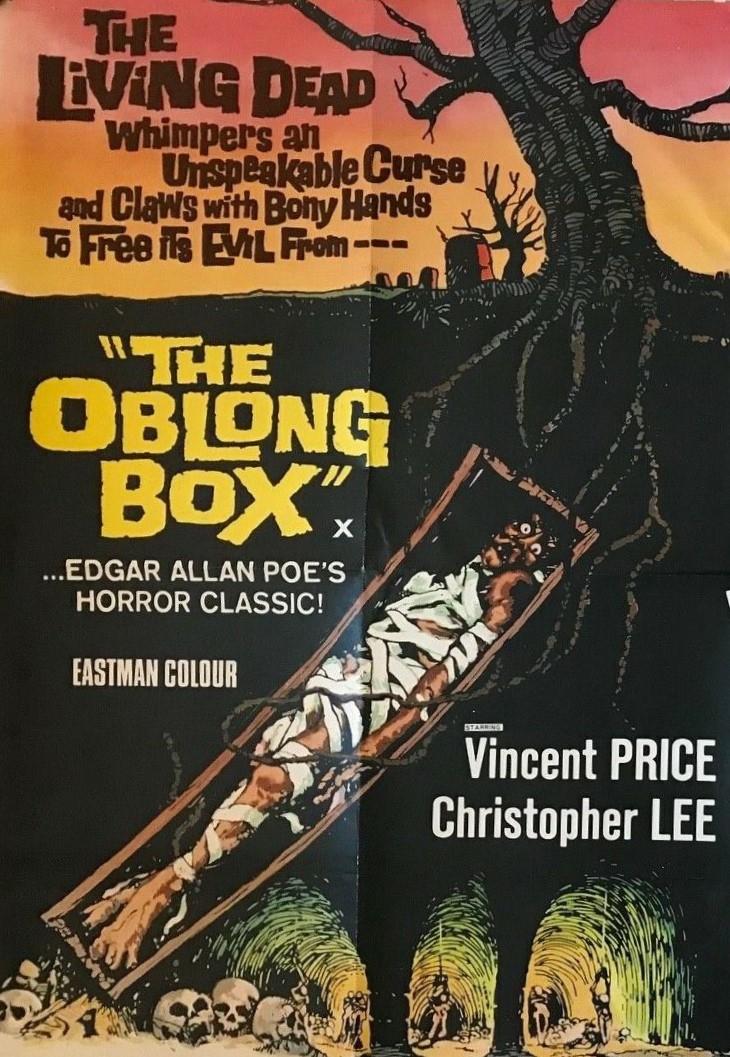
Vincent Price and Christopher Lee – two scions of 1960s horror – together, yet anyone expecting a clash of the giants would be sorely disappointed as they only share one short scene. This is a typical American International Pictures venture, based even more typically on an Edgar Allan Poe story, with some stylistic direction – the extreme close-up never more effectively utilized – from Gordon Hessler in his third feature.
Given that German-born Hessler (Catacombs/The Woman Who Wouldn’t Die, 1965) was a last-minute substitute for English director Michael Reeves (Witchfinder General, 1968), he made an exceptionally good job of a complicated plot. The production was even more complicated than that since it was originally intended as a Spanish co-production to be shot in Spain. And at one point writer Lawrence Huntingdon (The Vulture, 1966), who did have form as a director (Death Drums Along the River, 1963), was reportedly also carrying out producer-director duties.
What seems like a mishmash of different stories – African sorcery, grave-robbing, disfigurement, forgery, blackmail, lifetime imprisonment, medical experiment, buried alive, a monster in a scarlet mask – soon comes together in a tense tale of retribution and revenge.
Nineteenth century English aristocrat Julain Markham (Vincent Price) has withdrawn to his country manor, for unknown reasons distancing himself from his fiancée Elizabeth (Hilary Dwyer), but in reality to conceal from the world the fact that he has locked up his own brother, Sir Edward (Alister Williamson). When the brother, a disfigured monster, escapes he embarks on a murder spree.
The various storylines keep the narrative sufficiently entangled to sustain tension. Despite what may appear to a modern audience as primitive special effects, several scenes are bone-chilling largely through directorial manipulation. The Gothic look – graveyards, castles, the village – adds to the atmosphere. The violence was trimmed in America to avoid an “R” rating, but led to the film being banned in Australia.
There is more overt sexuality than normal, a scheming whore Heidi (Uta Levka) tempting a man with her bare breasts, and maid Sally (Sally Geeson) entranced by the monster.
The various plot strands appeared to confuse critics at the time and even now the film receives comments that it is “vague” but at a time when Hammer’s output usually comprised a straightforward – and somewhat limited narrative – I found AIP’s approach to this picture a welcome development. The slowly emerging story set the film up as much as a thriller as a horror.
It’s a bit of a reversal for Vincent Price (Witchfinder General, 1968) to be playing the good guy but that works to the movie’s advantage because you spent most of the time thinking this is just a scam and at some point he will show his true colors. Hilary Dwyer (Witchfinder General) is excellent and Sally Geeson (What’s Good for the Goose, 1969) is an example of the type of woman attracted to rather than revulsed by a killer.
Well worth a look if only to enjoy the distinctive Hessler style.
Movies can break all sorts of rules but they can’t cheat.
A film has to stick to an internal logic. For example, it can’t portray a photographer so obsessed with his calling that he even takes a camera with him to an antique shop and starts shooting off roll and after roll capturing the area’s rundown streets but then the one time he really could do with a camera – to prove there is a corpse at his feet – he is somewhat remiss. Especially when that the movie turns on that plot point.
Setting aside what’s a somewhat contrived snapshot of “Swinging London” there’s a lot to admire here. The absence of music for one thing. Most of the movie runs without musical accompaniment, a bold move since so often we rely on the soundtrack to provide guidance for a scene or an overlay for the entire film. Here, Michelangelo Antonioni (Zabriskie Point, 1970) makes us falls back on our own interpretation.
David Hemmings (The Charge of the Light Brigade, 1968), all mop-top and intense stare, is a high-flying high-living fashion photographer in the David Bailey mold (casual sex with wannabe models a perk) who turns investigator on being confronted in a park by Vanessa Redgrave (Hemmings’ adulterous love interest in The Charge of the Light Brigade) after taking snaps she wants back. Tension is sustained by her sudden appearance at his studio, willing to pay with her body for the return of the photos, and then by Hemmings’ careful, photo-by-photo blow-up-by-blow-up analysis that slowly comes closer to the truth.
Everything in his world is judged through a lens, as if he can capture elusive truths, and he has aspirations to being more than a mere fashion adjunct, having spent time taking portraits of down-and-outs. He judges Redgrave as he would a model, she has a good stance and sitting posture. Even by the standards of the permissive society, he is a bit of sexual predator, taking advantage of two giggly model wannabes – Jane Birkin (Wonderwall, 1968) and Gillian Hills (Three, 1969).
But the photography scenes are well done and Antonioni captures the intimacy between model and photographer that create the best images. If you want to see what a model brings to modeling check out real-life model Veruschka posing in an outfit held together by the thinnest of threads, bringing to life the much-touted notion that a model makes love to a camera. If you can get past the cheat and the deliberate obtuseness this creates – and the tsunami of artistic interpretations it inspired about the director’s intent – then it remains intriguing.
This isn’t Hemmings’ greatest work – Fragment of Fear is much better – but it certainly provided him with a marketable movie persona. Redgrave is excellent as the nervy woman willing to do what is required and the movie might have worked better had she had been allocated more screen time and their duel had continued through other scenes. But then that would have been Hitchcock and not Antonioni.
Sarah Miles (The Ceremony, 1963), Peter Bowles (The Charge of the Light Brigade) and John Castle (The Lion in Winter, 1968) have small parts. The film certainly captures the electricity of a photo shoot between a skilled photographer and pliant model, but it also works as an extended metaphor about the elusiveness of cinematic truth.
Despite my misgivings about the “cheat,” an intriguing and satisfying exploration of an artist seeking to jettison the fripperies of his art yet unable to avoid the temptation of enjoying the easy sexual benefits.
Now this is what you’re looking for when you take an unguided tour into the British B-movie. A tight gripping thriller with a parcel of twists, clever character perspective, some stunning cinematography, and pivoting on perception of insanity.
The opening is a cracker. Teenager Janet (Jennie Linden) stumbles along a dark prison-like corridor with little light hearing someone call her name. Entering a door, she spies a woman in a white nightgown lurking in the corner. She responds to the gentle calling. But once she lets the door close behind her and can’t get out, the woman screams that now they are both mad. And that’s just the first, atmospherically brilliant, nightmare.
Janet is soon removed from her posh boarding school, her constant nightmares too frightening for the other pupils. Driven home in a Rolls-Royce, accompanied by teacher Mary (Brenda Bruce) she passes the asylum where her mother is an inmate, but is surprised to find her legal guardian, charming lawyer Henry (David Knight), isn’t there to greet her. Instead there’s a nurse, Grace (Moira Redmond).
We soon learn she’s been effectively orphaned by her mother, who killed her father, Janet, eleven at the time, witnessing the murder. But without any proper home life, looked after primarily by kindly chauffeur John (George A. Cooper) and maternal maid Anne (Julie Samuel) and with the married Henry often absent, there’s little done to quieten down her obsession that she will follow her mother into madness.
The movie takes her perspective, watching her watching out for mystery, or in her point of view as she catches fleeting glimpses of a woman in white. The apparition looking only too realistic, not dashing out of view but turning and apparently beckoning Janet on and it doesn’t take much to push a disordered mind further out of kilter, leading to attempted suicide. Imagining Henry’s wife is the ghost, she stabs her to death.
End of Act One. Start of Twist No 1. You would expect the movie to follow Janet to the asylum where she would be reunited with her mother, knowing she had inherited those terrible genes, trapped in her insanity. But it goes somewhere more delicious instead.
Turns out nice Henry is not very nice at all. He contrived a situation to be rid of his wife and marry lover Grace instead. But, once married, it is Grace who becomes disturbed and the movie follows a similar arc in the second half. Unexplained goings-on. She believes Henry has another, secret, lover and is trying to drive his new wife crazy. She finds strange cigarettes in his pocket, a barman at a hotel recognizes him even though he claims never to have been there before.
The marriage quickly deteriorates although she stands her ground, telling him in no uncertain terms that she won’t put up with any philandering and slapping his face. He is charm itself, easily turning aside her insinuations and from his casual and disarming manner it’s easy to believe he is perfectly innocent. Of course, that’s before Janet’s doll turns up and locked doors open and there’s an apparition.
The beauty of this picture is the atmosphere, the intensity of the camera, the concentration on two vulnerable females, convinced by genuine or imagined guilt that they will succumb to the madness that appears to pervade this particular house. You think it’s going down one route and are annoyed you didn’t see the next twist coming.
There’s the kind of cinematic repetition that enamored critics of more critically acclaimed pieces like The Searchers (1956). It’s almost as though there’s a beam of insanity identifying the next victim. And that’s helped immeasurably by the lighting which allows no shadow on faces. Like an inverted film noir, where the light has nowhere to go, no atmospheric shadow to create, except to land square on the faces of those involved. This would be the Old Dark House except never has a building been so illuminated, not bright throughout, the illumination predisposed to land on faces rather than rooms.
There are a couple of finely composed scenes, one viewed through a staircase, neat revelations, visual and verbal, a fabulous ending with one character screaming and a telephone dangling off the hook.
You might be astonished to discover this is a Hammer picture. Nary a monster in sight. But then little is scarier than what happens inside the mind, when imagination runs riot without external assistance. That the victim is a teenager, prone to the mood swings of that age, makes it easier for Jennie Linden (Women in Love, 1969) to ramp up the emotions without her seeming too barmy from the outset. David Knight (The Devil’s Agent, 1962) is excellent, conniving he may be but the general demeanor of bonhomie never slips into stage villain. But Moira Redmond (The Limbo Line, 1968) is the pick as she morphs from accomplished accomplice to prospective victim.
Tightly written by Jimmy Sangster (Maniac, 1963), characters fully evolved, twists cleverly concealed, and with excellent direction by Freddie Francis (The Skull, 1965), not just the visuals but in drawing out of a fairly standard set of actors exactly what he needs to make this tick.
Tracking down forgotten B-pictures it’s easy to convince yourself you’re going to uncover an under-rated gem. Sadly, despite mixing film noir with espionage and a treasure hunt, this fails dismally at getting over the line.
And that’s a shame because the credits roll over a background of long shadows, recalling instantly to mind not a film noir trope but the later famed poster of The Wild Bunch (1969). And there’s an excellent repetitive theme by Martin Slavin (Sherlock Holmes and the Deadly Necklace (1962), an interesting striptease involving a bear, and a superb chase sequence where the pursuer is in a wheelchair. Otherwise, it’s got such a convoluted storyline you wished someone could get on top of it sooner rather than dragging the audience from Trieste to Dubrovnik to Somaliland.
Femme fatale No 1 Anita West literally in a hole with John Bentley.
In his final movie British star John Bentley, who brought to life both Paul Temple and The Toff, plays Steve, a drifter of unspecified means, who saves cabaret singer/stripper Tina (Anita West) from assassination. Hired by her as bodyguard/detective, he learns her father was a German spy who has left her a list of names and a map to hidden treasure and strangely enough she has been receiving regular anonymous donations of cash. It soon becomes obvious to Steve that blackmail is the source of this unexpected bounty. And that he is caught in the middle. Some people want to pay him off, others to kill him off.
It doesn’t help that he is seduced by both Tina and Nadia (Faten Hamamah), daughter of Litov (Vladimir Leib), one of those being blackmailed but now confined to a wheelchair.
Along with Mario (Ferdy Mayne) and Michel (John Gabriel) they are all soon convinced that the solution to all their problems will be joining Steve on a trip to Somaliland to find the hidden treasure, cash the father was reportedly carrying to pay his team of spies.
Femme fatale No 2 Faten Hammamah looking disgruntled.You could say the same about Bentley.
Usually, with any kind of picture involving hunting for treasure, the audience is invited to be baffled by various clues, but here none are offered and the audience simply remains baffled. Once in Africa, of course, the action hots up, courtesy of stock footage of stampeding elephants and a variety of dangerous animals and by the double-crossing that appears essential to such schemes. Eventually, they end up in a cave, where the only bit of treasure detecting actually takes place. Assume more double cross and you’re just about there.
Director George P. Breaksaton (The White Huntress, 1954) must take full responsibility for this mess since he was also the writer and producer. Apart from the various sequences previously mentioned, he has little idea of narrative drive or even narrative. None of the characters connect with each other and certainly not with the audience.
John Bentley does his best but that’s mostly down to frowning and grunting and trying to get a share of everyone’s spoils. He’s intended as some kind of James Bond lounge lizard given the movie begins simply because he follows an attractive woman in a nightclub. But he really has very thin material to work with. Neither of the femme fatales, Anita West (Shadow of Fear,1963) and Egyptian star Faten Hamamah, has enough in the smouldering department and if they did weren’t inclined to waste it on the likes of Steve.
Hardly a fitting end to Bentley’s career. More of a curiosity than an entertaining watch.
Perhaps it was something in the ether that this very under-rated Kafkaesque examination of fractured identity emerged the same year as John Frankenheimer’s equally maligned Seconds and the year after the more successful Mirage. A superb opening sequence transports us to a world of alienation and discordance, often the only sound that of a man’s footsteps.
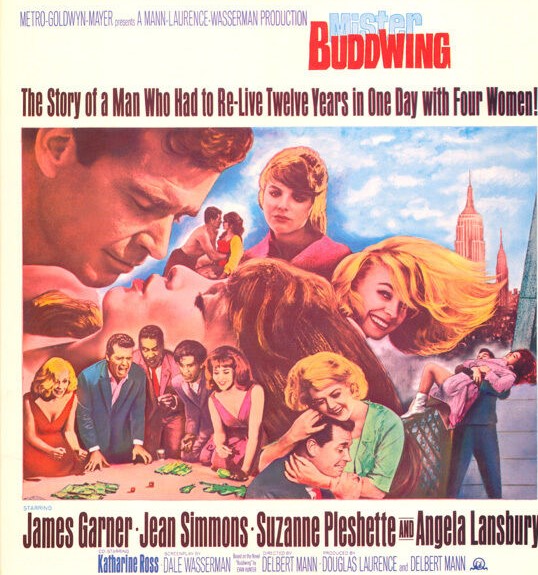
Face unseen, yet camera in his point of view, in the early morning a man (James Garner) examines the pockets of his suit, pulling out some pills and a piece of paper with a telephone number, pulls off a ring with the inscription “from G.Y.” He begins to walk, shakily, camera still in his POV until he arrives at an upscale New York hotel and sees himself in the mirror. That doesn’t help. He still doesn’t recognize himself. Using the lobby phone, he calls the telephone number.
It’s a woman called Gloria (Angela Lansbury). She calls him Sam. She gives him her address because that, too, has slipped his memory. Visual stimuli outside make him think his name is Buddwing. Sam Buddwing has a reassuring feel to it.
But when arrives at Gloria’s apartment, she doesn’t recognize him. Though married, she “puts out” so he could be a casual sexual acquaintance. When she pours him coffee, unable to remember how he takes it, he bursts into tears.
And so begins a disturbing odyssey, “a tug of war in his mind,” as he tries to piece together his memory and find his lost self. Memory is triggered by the sight of a woman across the street getting into a cab. Instinct tells him this is Grace. He follows in another cab, encountering a disgruntled customer who tells him an odd tale about taking a drunken woman to Oyster Bay. She disappears inside Washington Square College. He thinks he might be the escaped mental patient Edward Volloch mentioned in a newspaper headline. Unasked, a man called Schwarz sits down at this table in a cafeteria and suggests he must be Jewish.
He finds “Grace” (Katharine Ross) on a park bench. Even though she fails to recognize him and tells him her name is Janet, he drifts back to his time with the real Grace who cuts his hair on a beach, runs from a downpour into a church. He tells her he wants to become a composer.
When Janet evades him he is confronted by a cop but, of course, has no proof of identity. The scene turns ugly and uglier still when chased by a vagrant and he starts to see double.
And so it goes on. He finds two more versions of Grace. On hearing of his condition, the first, an actress (Suzanne Pleshette), encourages him to “be what you want to be” while Buddwing opines “we are all impersonating an identity.” The second, a drunk (Jean Simmons) appears to be the source of cab driver’s story
The actress attempts suicide after becoming pregnant, the drunken woman takes him to a crap game, where, taking turns rolling the dice, they win a heap of cash.
All in all it’s a brilliant jigsaw, avoiding the sci-fi elements of Seconds and the thriller aspects of Mirage, but with the brooding atmosphere of both. But where the character in the Frankenheimer makes a deliberate decision to change identity and Gregory Peck in Mirage is able to put together the various pieces of his life, Buddwing simply stumbles along, totally unconvinced of his identity – at one point he is “nobody” – building up an idea of his life only as an adjunct to the mysterious Grace who keeps changing shape and personality until it seems completely incongruous that the first innocent Grace (Ross) could merge into the more blustery, sexually aggressive, Grace (Simmons).
Of course, when he does discover the truth, by random connection, that’s as shocking as anything else, shattering the somewhat idealized picture of the self he has contrived from the various jumbled meetings with the various disconnected women. Equally, the ending could be another illusion.
This might also play out as a metaphor for the screen life of James Garner (The Americanization of Emily, 1964) who had been trying to rid himself, not entirely successfully, of his previous persona as Maverick in the television series. His company, Cherokee, co-produced the picture, which smacks of the same determination to be taken more seriously as Rock Hudson with Seconds, a move that did not go down well for either with public or critics. But Garner is every bit as good as Hudson and he spends much of the film either in hollow-eyed bafflement or in idyllic circumstance on the cusp of turning sour.
Once Angela Lansbury appears, you get the sense this is going to be episodic and that the female cast will appear in the reverse order of their billing. But Katharine Ross (Tell Them Willie Boy Is Here, 1969) apart, a newcomer, the other three more experienced actresses rip up their screen personas. Angela Lansbury (Harlow, 1965) is an addled woman of easy virtue. Suzanne Pleshette (A Rage to Live, 1965) takes her character to suicidal levels while Jeans Simmons (A Rough Night in Jericho, 1968), especially notable, essays her inner dirty-mouthed drunken Elizabeth Taylor.
And this is hardly the stuff director Delbert Mann (Fitzwilly, 1967) is made of, despite an Oscar for Marty (1955) better known for light comedy. But he never takes the easy way out, sticking it to Buddwing as a man endlessly tormented by himself. Dale Wasserman (Quick Before It Melts, 1964) wrote the tantalizing script from the bestseller by Evan Hunter (Last Summer, 1969).
A mesmerizing watch and time it was given the same retrospective treatment as the cult Seconds.
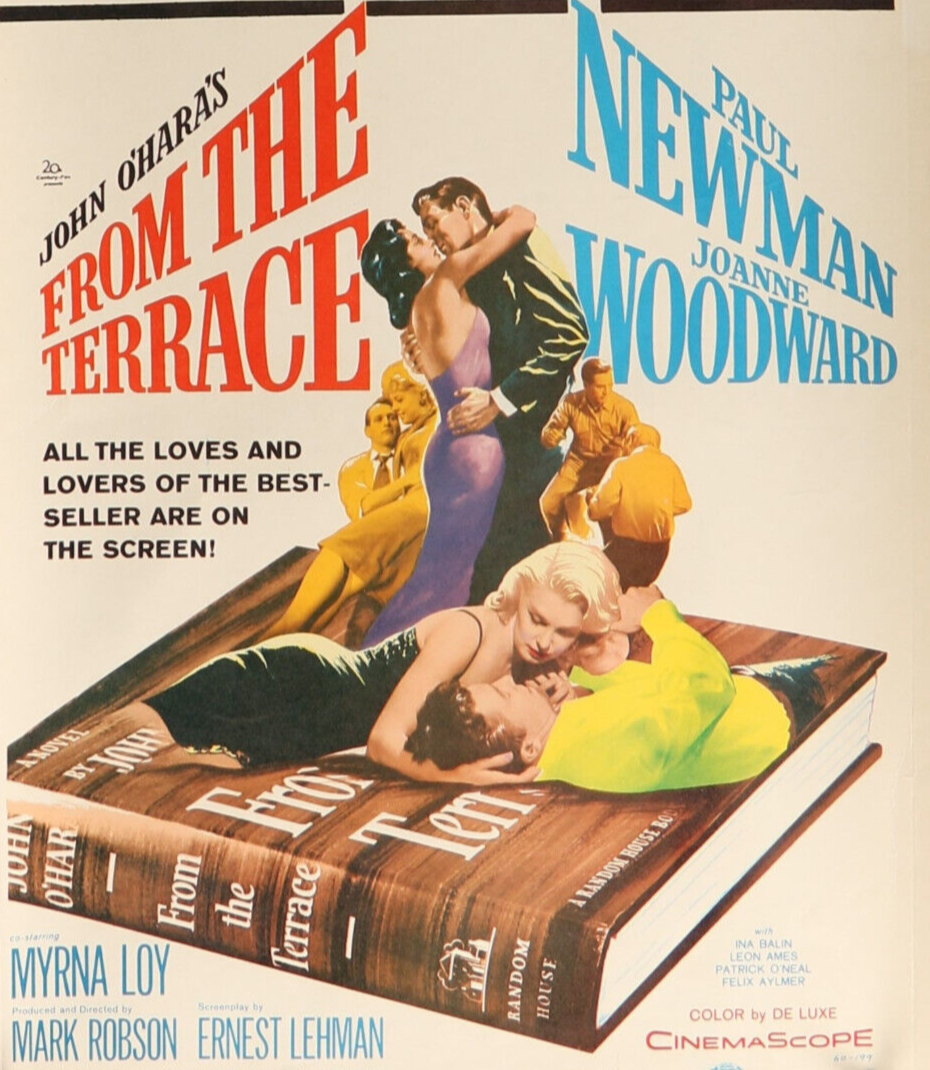
When your plot pivots on the hero diving into an icy pond to save the grandchild of a Wall St multi-millionaire – and reaping the career benefits – you are kind of in trouble. Not as much, though, as having a self-righteous hypocritical prig of a hero who lacks the self-awareness, a mark of the John O’Hara bestseller on which the film is based, to realize he is turning into a carbon copy of his father.
But it is handsomely-mounted and a decent enough melodrama with an excellent cast, though you would have to say, given the better material, Joanne Woodward (A Big Hand for the Little Lady, 1966) out-acts husband Paul Newman (The Prize, 1963), adding a rather contemporary element of a free-loving wife who manipulates the constraints of an era (post WW2) when divorce in high society was highly frowned-upon.
It’s a shame it drifts into predicable melodrama because the initial stages are niftily put together. A woman (Myrna Loy) is found dead drunk on a train, steel magnate husband Samuel (Leon Ames) ensuring he is not at home for her return, both actions meaning nobody is there to welcome only son David Alfred Eaton (known as Alfred at the start of the film and David at the end for odd reasons) when he returns from the war.
A few quick scenes establish that: the father holds a grudge against the living son because he has not got over his dead son; he has ignored his wife in favor of his career; he bullies his staff; the wife has embarked on an affair.
David Alfred’s character is quickly established: he refuses to be stiffed by a cab driver; is adored by the household staff; refuses to work in his father’s business; and beats up his mother’s lover.
After that, for all the emotional shifts through the gears, it slows down, not so laborious as devoting too much time to the inner workings of high society – O’Hara’s metier – rather than the new small-plane-building business into which David Alfred pours his energy. That is, if he has much energy left over after stealing Mary (Joanne Woodward) from fiancé Jim (Patrick O’Neal), a psychiatrist.
You are probably already aware that society operates in various strata. A mill owner is only on the verge of society and looked down upon by the likes of Mary’s wealthier parents who in turn are no match for the grand life enjoyed by the aforementioned Wall St broker MacHardie (Felix Aylmer). Snobbery is rife and money talks. And if you lack the dough you’ve got no say in anything as David Alfred discovers in an aeronautical business venture, his partner Lex (George Grizzard), who has put up all the money, excluding him from key decisions.
Luckily, while driving in the countryside there’s a drowning child to be rescued and a grateful grandfather willing to set you up in his business. But that means sacrifice. David Alfred is away from home so much his neglected wife instead of turning to alcohol merely turns to men. There’s a wonderful scene when after a telephone call with her husband promising not to see Jim again (at this point no impropriety apparently committed as far as David Alfred is concerned), Mary lies down on the bed and turns to an unseen figure and says, “You’re not to come up here any more.”
But there are too few scenes so slickly written. On a job in Pennsylvania David Alfred falls for industrialist’s daughter Natalie (Ina Balin), and as though this is key to their romance tells her to call him David rather than Alfred. As his stock rises in the company, he maintains a hypocritical front with his wife, who he knows is now engaged in various affairs, denying her suspicions that he is having a fling with Natalie. Mary is quite happy to maintain an open marriage since her status depends on her husband’s position and she still quite fancies him now and then.
You can see how this is going to end, but self-righteousness allows David Alfred to ignore that he is merely repeating the mistakes of his father. In sharp contrast to his wife who is all too conscious of her failings but contrives to make the best of the situation, and would happily continue in an unhappy marriage if only he would play ball. Although nothing is made of this, it’s obvious that David Alfred, despite his progress in the Wall St company, doesn’t have the business cojones of his father. He quit the plane business because Lex wanted to spend more time perfecting the prototype rather than rushing to the market in order to make money quickly. By following his own instinct, Lex is later proved correct, the business grown so big it attracts the attention of MacHardie.
There’s a sense here of Paul Newman pulling his shots. Though he is ruthless in making wife play second fiddle to career, and has no qualms really about playing away from home, nor about edging out MacHardie’s ineffectual son-in-law from the business, he lacks the killer instinct. The ruthlessness and amorality that made The Hustler (1961) and Hud (1962) so enjoyable is sadly missing. Handsome box office idols – the likes of William Holden apart – were reluctant to play the devious.
Mark Robson (Von Ryan’s Express, 1965) directs as if this is an upmarket Peyton Place and can’t resist at least one close-up of Newman’s baby blues. The script by Ernest Lehman (The Prize) only occasionally sparkles but I suspect there was a lot to trim from the O’Hara doorstopper. As I said, Joanne Woodward is the stand-out and you will be surprised to learn that Patrick O’Neal is also minus his later ruthless screen persona. Felix Aylmer (Masquerade, 1965) and Ina Balin (The Commancheros, 1961) are the pick of the supporting cast.
An interesting more than a riveting watch, mostly to see Newman before he reached screen maturity.
Having just read the Nevil Shute novel on which this movie is based, I was keen to see how it transferred to the screen. It got off to a great start with the casting. James Stewart was several classes above the author’s description of the main character, but Marlene Dietrich more than fitted the bill of the Hollywood star as a passenger in the early days of Transatlantic air travel.
Widowed aeronautics research engineer Dr Honey (James Stewart), accent explained by him being a Rhodes Scholar who stayed on in Britain, is so absent-minded that he tries to enter a neighbor’s house and when he gets angry in a discussion with a visitor to his own house puts on his hat and coat and decides to leave. He has discovered a potential flaw in a new range of British airplanes and is despatched by boss Dennis Scott (Jack Hawkins) to Canada to examine the remains of a crashed prototype, the accident previously ascribed to pilot error.
It was called “No Highway” in Britain as that was the title of the novel.
However, once on board, he discovers the plane is perilously close to the danger level of flying time his research indicated. In between frightening the life out of stewardess Marjorie (Glynis Johns) and star Monica (Marlene Dietrich) with his predictions of doom and instructing them where best to hide in the plane in the event of crash-landing in the ocean, he tries to get the pilot to turn back. When that fails, he inadvertently charms the life out of stewardess and star.
When the plane lands, even closer to the danger zone in terms of flying hours, and still no one listening to his concerns, he manages to render the plane unflyable. The aeroplane company refuses to fly him home, leaving him stranded. That provides enough time for Monica and then Marjorie to turn up unannounced at his home in England to help look after his young daughter Elspeth (Janette Scott). When Honey finally returns, he faces an inquiry, and looks set to lose his job, virtually unemployable thanks to his antics in Canada. At the last minute, he is reprieved, fresh evidence from the crashed plane proving his research correct.
Meanwhile, Monica, forced to return to Hollywood, loses out in the battle for Honey’s affections. Marjorie, a former nurse and imminently more practical, is in any case better placed to help look after a growing girl, and eventually Honey sees sense and asks her to marry him.
Really well done with terrific performances all around, but vastly helped by the screenwriters who dumped three sub-plots in order to stick to the knitting of the tale. Honey, far removed from the man in the street persona that saw James Stewart through his Frank Capra movies, attracted female interest through his principled stand. Most importantly, the writers removed the section where Elspeth is seriously ill in her father’s absence. Secondly, in the book Scott was sent to Canada to find the crashed plane, involving a trek through perilous terrain, but that’s been excised, the search completed off-screen by others, the vital information relayed by letter. Thirdly, the remains of the tail, which had previously not been found, were located in the book by supernatural means, Elspeth being called upon to use a planchette to help find it.
In removing all this material, the movie is re-shaped partly as a Capra movie, with the downtrodden Honey achieving success through persistence, but, more importantly, allowing the movie to focus on the potential love interest. Needless to say that is determinedly old-fashioned, both women having forged successful careers now viewing work that was initially exciting rapidly pall. The book sets Monica thinking how much better life would have been if as a humble office girl she had married the kind but not handsome man who had caught her eye instead of now being thrice-divorced. Marjorie is even more old-fashioned, seeing a genius who needs looked after as much as his daughter requires a mother.
So there’s no point going anywhere near this if you’re not willing to accept a past where a woman’s role was primarily seen as a home-maker. But don’t jump to pointing the finger at the author as being equally old-fashioned because a later book, A Town Like Alice, not only turns the main character into a war hero but depicts her as a successful entrepreneur.
James Stewart (The Rare Breed, 1965) takes a considerable chance on playing the absent-minded professor but his endless well of screen charm allows him to pull it off brilliantly. Marlene Dietrich, top-billed when teamed with Stewart for Destry Rides Again (1939), has an excellent role as a rueful prima donna. Glynis Johns (Lock Up your Daughters!, 1969) is equally at home with a part that calls for her not to just fall at Honey’s feet. She was one of handful of British rising stars. Jack Hawkins (Masquerade, 1965) was on the cusp of being named Britain’s biggest box office attraction while Kenneth More (The Comedy Man, 1964) was a few years away from receiving that honor. Janette Scott (Day of the Triffids, 1963) gave notice of her talent.
As much as James Stewart’s career was linked to Frank Capra and Alfred Hitchcock, Henry Koster (Mr Hobbs Takes a Vacation, 1962) made five pictures with the actor, all excepting this comedies, including Harvey (1950). He does a fine job of keeping Stewart from spinning away too much in the direction of the geek professor and keeping the story pinned down.
Nevil Shute was an engineer to trade – he had worked in the British airship industry – so his books tend to be peppered with the scientific. That’s easy to digest when reading, but harder to absorb when watching a movie. R.C. Sheriff (The Dam Busters, 1955) and Oscar Millard (Angel Face, 1952) do an excellent job of condensing the novel, finding cinematic ways of getting across important material.
I had come at this, as I said, mainly to see how the author’s work was translated to the screen, but came away totally absorbed in a fine picture. What was left out helped the picture while the author’s later A Town Like Alice (1956) lost half its power by ending halfway through the original story which later saw the courageous heroine go onto to become a serial entrepreneur in a male-dominated society in Australia.
Obviously, I’ve deviated from my chosen field of 1960s pictures, but this is well worth a watch.
You can catch it on YouTube in a number of versions – the original, a colorized version, one with English subtitles and one where a musician has made his own edit and dubbed his own modern score on the picture.
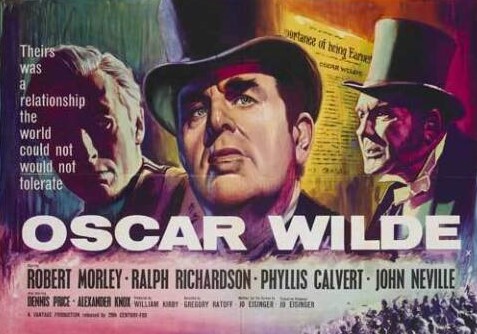
You might be surprised to learn there were two Oscar Wildes. Not the famed writer and a doppelganger of course but two films on the same subject that were released in the same month. This is the low-rent version, costing a fraction of the rival The Trials of Oscar Wilde directed by Ken Hughes. It’s easy to be disdainful of the cheaper effort, with little cash available for scenery and costumes, but somehow it rises above budget limitations. Structurally, both movies focus on the trial – or in the case of The Trials of Oscar Wilde the three trials he endured – but the glossier pictures it has to be said glosses over a great deal.
While I enjoyed it at the time, I now find that in trying to make a modern martyr out of Oscar Wilde, the Ken Hughes picture built him up so much that it was difficult to find any flaw in his character. We never find out what was the actual slur the Marquis of Queensbury made on Wilde, resulting the playwright taking him to court for libel. And that version begins with Wilde and Alfred Lord Douglas (“Bosie”), son of the Marquis, already deep into their affair.
On the other hand, Oscar Wilde, the final film of Hollywood veteran director Gregory Ratoff (Intermezzo, 1939), starts at the beginning of their relationship with greater emphasis on Wilde’s practicality rather than his wit and Bosie’s (John Neville) tortured relationship with his hypocritical father (Edward Chapman) who, while taking the moral high ground, keeps a mistress. On Wilde (Robert Morley) being described as a sodomite by the Marquis, Bosie’s desire to see his father humiliated in court verges on revenge. “You weren’t looking for a friend,” Wilde astutely tells his lover, “You were looking for a weapon.” Bosie is big on humiliation – he is the one to break the news of Wilde’s duplicity to the author’s wife (Phyllis Calvert). So determined is he on the court case that he fails to tell Wilde that his father has private detectives scouring London to find evidence.
While in court Wilde can keep the jury in stitches with his epigrams, he soon comes up against the Marquis’s formidable lawyer Sir Edward Carson (a quite stunning performance by Ralph Richardson). From Carson we learn a great deal more of Wilde’s practices, some of which nowadays would be termed grooming. Essentially, Carson paints a portrait of a predator, an older man (Wilde was 41) whose uses his wealth and wit to court many lovers, mostly aged around 20, but some as young as 16, barely the age of consent.. And when he felt his secret life was in danger of being exposed, he went so far as to pay for the passage to America of one of his lovers, Alfred Woods, to get him out of the way.
No matter that Wilde at the start can gloss over his promiscuity, complaining that Carson is misinterpreting innocent gestures of friendship, the cunning attorney soon has the author tied in knots as he wheels out one by one information regarding the various lovers.
It’s quite odd to realise that The Trials of Oscar Wilde in presenting the more accurate truth – that the author underwent three trials – fails to provide little more than a surface treatment of the man’s real-life affairs. Oscar Wilde perhaps delves too deeply for audiences brought up to consider the author a martyr who deserves the free pass allocated all writers of genius. I found Oscar Wilde the more riveting watch because, of course, I already knew the outcome, but the sight of the famed writer, encouraged by the vengeful Bosie, hung out to dry by his own hubris, and for a man of such wit to be outwitted in the courtroom by Carson was an exceptional watch.
Of course, the imprisonment of Wilde for the crime of being a homosexual is detestable. Even at the point this film was made homosexuality was a crime. So it’s fascinating to see how much The Trials of Oscar Wilde skirts round issues that Oscar Wilde had little problem in spelling out.
I was surprised how much I enjoyed Robert Morley’s performance. I may be wrong, but I think this was the only time he was accorded leading man status. Mostly, he was a supporting actor (The African Queen, 1951, say, or Genghis Khan, 1965) and often just playing a version of his self. Of course, he is outshone by a simply brilliant Ralph Richardson (Khartoum, 1966). John Neville (A Study in Terror, 1965) presents a more in-depth performance than in the rival picture. One-time British box office star Phyllis Calvert (The Golden Madonna, 1949) does well in a small but pivotal role. You might also spot Dennis Price (Tunes of Glory, 1960) and Alexander Knox (Mister Moses, 1965).
Lacking a budget to do much more, Gregory Ratoff sticks to the detail and draws out two superb performances, aided by a tight script by Jo Eisinger (Gilda, 1946; Cold Sweat, 1970) based on the play by Leslie and Sewell Stokes and the work of Frank Harris. As swansongs go, this is hard to beat.
Vastly underrated.
Catch it on YouTube.
NOTE: Oscar Wilde appeared in first run in Glasgow at the La Scala cinema in June 1960 one week ahead of The Trials of Oscar Wilde at the first run ABC Regal and ABC Coliseum.
Still astonishing that the two movies that rocked sci-fi to its core came out the same year. Initially beloved mostly by dopeheads 2001: A Space Odyssey quickly achieved ultra-academic status. But it’s difficult to ignore the fact that that Planet of the Apes had the greater long-term effect, given it spawned umpteen sequels and two sets of remakes.
You could also argue that the concept is even bolder than the Kubrick, not just man’s treatment of animals, but the idea of man being subject to a superior species, and inside an action-packed picture there’s plenty of time to digest the unimaginable and engage in debate about the nature of man. The elevator pitch might have been: “Take Hollywood’s strongest hero and torture him one way or another.”
Part of the movie’s genius is the unsettling opening, swirling, almost deranged, camerawork, a discordant score, the confident occupants of a spacecraft heading into the unknown finding the kind of unknown that fills them with dread rather than awe. Two thousand years into the future a spaceship doesn’t gently touch-down on a strange planet, but crashes into it, luckily landing in a lake, the three survivors escaping the sinking craft.
The audience knows a great deal more than they do, that the arid desert in which they find themselves stretches everywhere. But then they realize, with supplies that will last only three days, the soil here will not support life. But they are quickly upbeat when they find a small plant followed by substantial greenery. The sight of crucified figures on a hill is put to one side when they hear running water and rush to dive naked into a pool, confidence restored that they won’t die of thirst and should at least be able to eat vegetable matter.
The pool is a clever reversal. Usually open water is there for a female to disport herself. Now we’re seeing Charlton Heston’s bare backside. And another reversal: when clothes disappear it’s usually so a female has to come out of the water exposed.
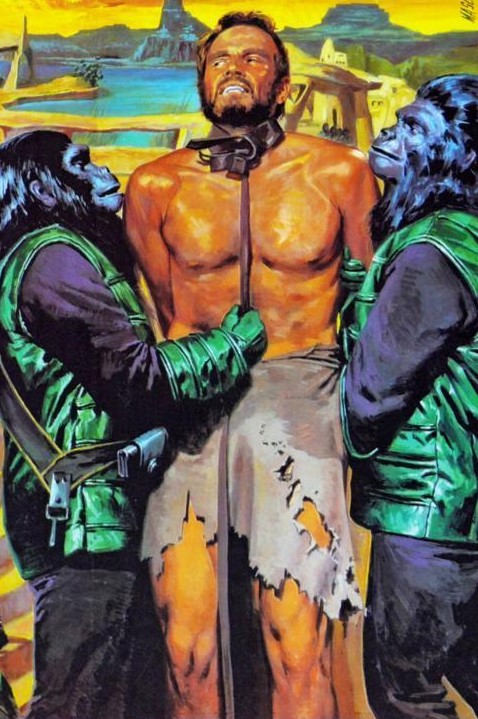
But from the sight of the crucified apes, for the next seven minutes, their world is completely turned upside down. Chasing after their clothes they find inhabitants, automatically assumed to be inferior because they are mute and dressed like cavemen. But then the tribe hears a noise and panics. We see horses hooves, the tops of the flailing sticks used to beat prey out from the undergrowth, rifles, the natives, like dumb beasts, being driven into nets.
Then the first sight of an ape astride a horse wielding a gun. There can’t have been a more astonishing image, not even from the mind of Stanley Kubrick, in the whole of Hollywood sci-fi. Man is not just an alien in a world ruled by apes, but treated like an animal and only kept alive for scientific experiment. That man is rendered mute is hardly surprising because the apes don’t expect their captives capable of uttering an intelligent word.
From then on we’re in familiar and unfamiliar territory. There’s little more cliched than a captive trying to escape, success and failure the next beats. There’s little more cliched than a captive striking up a relationship with an imprisoned female, the pair contriving to achieve freedom.
Where this breaks new ground is that, in addition to making a connection with Nova (Linda Harrison), Taylor (Charlton Heston) woos a female ape scientist Zira (Kim Hunter) who tries to help him become accepted by her people. In the opening section, Taylor had opined, “somewhere in the universe there must be something better than man” but in the arrogance of humanity had assumed he be treated as an equal rather than an inferior.
So it becomes a duel of words. Taylor forced into being told how terrible humans are, and it’s hard to argue with the ape conclusion, while at the same time making the case for mankind, and especially himself, as a special type of species. There’s more than enough meat in the script, riddled with brilliant lines, to make audiences think deeply about the impact of man on the world. You could cast your mind back to the slaves of Spartacus (1961), trying to be accepted as equals, forced into revolt when that is denied. And to some extent that’s the imagined set-up here: Taylor will escape and establish some kind of resistance movement.
But that’s not what director Franklin J. Schaffner (The War Lord, 1965) has in mind at all. He’s been leading us by the nose to the most stunning ending in all of sci fi, and one of the most astonishing climaxes in the entire history of the movies, a shock wrung through with irony.
The movie is a supreme achievement, in springing its multitude of audience traps, turning the world upside down. Jarring soundtrack and discomfited camerawork add to the stunning images. The ape world is revealed as complex, filled with engaging characters.
Outside of Number One (1969), this is Charlton Heston’s best performance as he moves through a range of emotions, cocky, puzzled, confident, baffled, captive, pleading, arguing the case for humanity, before spilling out into straightforward heroic mode of escapee. For the first time ever Hollywood now had a genuine box office star to headline sci-fi pictures and Heston would carry the torch for The Omega Man (1971) and Soylent Green (1973)
Kevin Billington’s debut benefitted from a brief fad for classical music soundtracks, Elvira Madigan kicking off the fashion the year before, 2001: A Space Odyssey, which opened at the same time as Interlude, trumping everything in sight. And as luck would have it, this was not the only movie about an orchestra conductor, Counterpoint with Charlton Heston released in America a couple of months before this one opened in Britain.
What makes the movie so enjoyable is that overlaying the sumptuous love story is the angst of a mistress. It’s sweetly set in wonderful British locations, riverside inns, olde worlde hotels, trendy restaurants, a few flashes of swinging London, luxurious mansions. The solid backdrop for something as fragile as romance.
There could not be two more opposites to attract, the rich Oskar Werner (Jules and Jim, 1962) in full-on arrogant mode, all dark glasses and leather gloves with enough petulance to sink a barge, and journalist Barbara Ferris (off screens since the lamentable Catch Us If You Can three years before) who lives in a bedsit with a goldfish called Rover. He drives a Rolls-Royce convertible, she a Mini.
There are some very good touches. We first see the characters in mirrors. He plays a “concerto for wine glass and index finger.” There is the very serious British business of whether milk goes in first to a cup of tea.
The screenplay by Lee Langley and Irish playwright Hugh Leonard is sharp and often witty. “I want to marry you,” says Ferris, before conceding, “I just don’t want to be your wife.” There is clear realization of the nature of his personality in her remark, “Instead of being what you want, I’ll be what you’ve got.”
Even when emotion is expressed there is a feeling that a lot is still suppressed. Ferris goes from high excitement to high dudgeon and carries within the seed of fear, a character who spends as much time in terror as in love. This is exacerbated when she spots of Werner’s wife, stoically played by Virginia Maskell, at the hairdressers and “all of the sudden” the wife who has existed in her imagination “has a face.”
John Cleese and Donald Sutherland have decent cameos, the former in a bit of an in-joke as a PR man wanting to get into comedy (“satire – that’s my field”), the latter as the womanizing brother of Werner’s wife.
Oddly enough, the music – Beethoven, Tchaikovsky, Mozart, Dvorak, Brahms and Rachmaninov – acts in the same manner as Easy Rider the following year, as extensive interludes to the developing drama. Perhaps it is where Dennis Hopper got the idea.
It is very rounded for a romance, the acting excellent and the undernote of despair well-wrought.










 The Magnificent 60s