Psycho (1960) *****

Even though critically reviled at the time – “up to his clavicle in whimsicality” (Variety) /   “fairground sideshow” (Films and Filming) –  Hitchcock blasted wide open the doors to what would be deemed acceptable in modern American cinema. Made on a low budget in black-and-white following the sumptuous color of North by Northwest, it seemed a perverse choice. No studio wanted it. Hitchcock had to fund it himself, Paramount merely the distributor.

On paper, and based on a real-life case, it was certainly an unappealing prospect, leading actress murdered halfway through by a maniac with a predilection for dressing up as his mother. Using the crew from his television series, Hitchcock made it quickly for just over $800,000, a quarter of the cost of North by Northwest. An initial stab at the script from James Cavanaugh was discarded and working with Joseph Stefano (Black Orchid, 1959) the director shifted the focus of the Robert Bloch novel.

Instead of a fat, middle-aged, alcoholic, Norman Bates would become young and attractive like the character from French thriller Les Diaboliques (1959). The story itself changed from “Norman and the role Marion plays in his life…(to) the redemptive but ultimately tragic role Norman plays in her life.”  Although Hitchcock openly claimed he detested filming, having already worked out the entire shoot in his head, this was never entirely true. Some ideas just did not work. In Psycho, for example, the director had planned a helicopter shot tracking into Marion and Sam’s hotel room but “high winds kept jiggling the camera” and it was changed to three separate shots.

Also, by using two cameras, he allowed the opportunity to choose a different shot than originally imagined and, in a change from the shooting script, the post-shower focus changed from Sam to Lila, making her the focus of the film’s final section where she confronts the killer.

Nor is Marion Crane (Janet Leigh) a typical Hitchcock villain. She is not cut out for the work. Alone in his repertoire, she regrets her action, tortured by, not so much her conscience, as the thought of getting caught. Having stolen $40,000 she is so jittery she turns a harmless highway cop suspicious.

Once more, Hitchcock has us rooting for the bad guy or, in this case, the bad girl. In Vertigo (1958), the drive is silent, but here the silence is punctuated by imagining what people are saying about her, knowing pursuit is inevitable. By the time she reaches the Bates Motel, she is repentant, planning to return and face the music, “I stepped in a private trap back there and I’d like to go back and pull myself out of it.” 

Unfortunately, Norman Bates (Anthony Perkins) has other plans. In Rear Window (1954) the peeping tom is a good guy, here he’s anything but. Although Bates is presented as fighting his demons, he always gives in, while Crane never hears a voice urging her on, telling her she will get away with it. Crane has a working conscience, Bates a defunct one.

Bernard Herrmann’s strings-only score behind the jarring opening credits is only the first in a series of taboos broken. In the opening scene beefcake Loomis (John Gavin) is shirtless, nothing unusual there for a male star, but to show an actress three times in her underwear and more flesh glimpsed in the shower is novel.

Killing her off is, obviously, not the done thing either, that scene a colossal shock at the time. Effectively, she is the bait, the sexiest MacGuffin ever, leading us to the mystery of Bates.

There are many brilliant scenes: Crane’s car sinking in the swamp, the murder of private detective Arbogast (Martin Balsam), the shrieking music as the strings hit their topmost register, the discovery by Crane’s sister Lila (Vera Miles) of the corpse of Bates’ mother, the motel’s neon sign flickering in the dark, the spectral house behind the motel filled with strange voices and, of course, the enigmatic Bates, alternating eager smile with defensive reaction. There are a host of great lines: “The first customer of the day is always trouble,” says the salesman; “We’re quickest to doubt people who have a reputation of being honest,” says Arbogast; and the immortal, “A boy’s best friend is his mother.”

On release, the director engineered a publicity coup by insisting nobody be allowed into the cinema after the start. This was an illogical demand for what did it matter if a patron missed the opening 10 or 20 minutes? But it certainly got the public’s attention – for a different reason entirely. It was an assault on their basic rights as theatergoers.

In those days people went into a film 30 minutes, 50 minutes after the start and left when the film came full circle. When it opened, long queues outside the box office, the best kind of word-of-mouth, attracted interest, thus alerting people who might otherwise have simply passed by. Even drive-ins were forced to comply. Trade advertisements showed Hitchcock pointing to his watch, exhorting, “Surely you do not have your meat course after your dessert at dinner?” Exhibitors were promised a special manual, “The Care and Handling of Psycho.” As well as smashing box office records, it demolished another convention by showing in local New York theaters while still playing at major first run theaters in Manhattan. 

The film has enormous visceral power. The shower scene has, rightly, achieved legendary status, every frame dissected by scholars, some images, the curtain wrenched loose, the hand reaching out, the dead eye, the blood draining away, imprinted on the universal brain, and the music unforgettable. The acting from Anthony Perkins (Pretty Poison, 1968) and Janet Leigh (The Manchurian Candidate, 1962) is excellent, Leigh nominated for a Best Supporting Actress Oscar, Perkins not so lucky, ending up typecast. For collectors of trivia, Hitchcock’s daughter, Patricia, plays Crane’s office colleague.  And for academics, especially those with auteur on their minds, this was a good place to start.
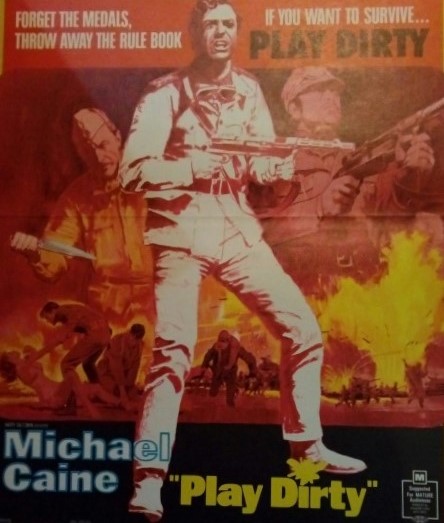
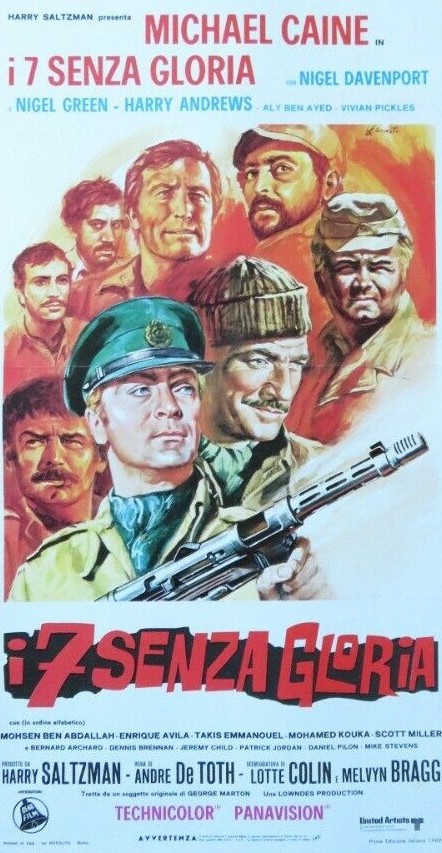
Play Dirty (1969) ***

Heroism is a handicap in this grimly realistic, brutally cynical, ode to the futility of war. David Lean would have struggled to turn this stone-ridden desert into anything as romantic as his Lawrence of Arabia (1962) though he might have recognized the self-serving glory-hunting superior officers.

There’s a murkiness at the outset that is never quite clarified. You could easily assume that the long-range bunch of saboteurs led by Captain Leach (Nigel Davenport), with the peculiar habit of losing new officers, was involved in something more nefarious rather than doing its utmost to disrupt Rommel’s supply lines in North Africa during World War Two.

Brigadier Blore (Harry Andrews) appoints raw officer Captain Douglas (Michael Caine) to take charge of the next mission – a 400-mile trek to blow up a fuel dump.  Col Masters (Nigel Green), in overall charge of the commandos, bribes Leach to ensure Douglas comes back alive. Blore is using this small unit as a decoy before deploying a bigger outfit to complete the mission with the singular aim of snaffling the glory for himself.

Leach proves insolently disobedient, forcing Douglas at one point to draw his weapon on his crew. But when it comes down to a question of heroism vs survival, Leach takes control at knifepoint, preventing Douglas going to the aid of the larger outfit when ambushed by Germans.

It’s mostly a long trek, somewhat bogged down by mechanics of desert travel. You’ll be familiar with the process of rescuing jeeps buried in sand dunes and of personnel sheltering from sandstorms, so nothing much original there. What is innovative is the terrain. Stones aren’t conveniently grouped together, edges softened by time, as on a beach. They’re jagged- edged and less than a foot or so apart so as to more easily shred tires. So there’s a fair bit of waiting while tires are replaced.

Some decent tension is achieved through sequences dealing with mines – threat removed in different fashion from Tobruk (1967) or, for that matter, The English Patient (1996) – and in crawling under barbed wire.  But that’s undercut by the sheer brutality of the supposed British heroes slaughtering an Arab encampment and viewing a captured German nurse as an opportunity for rape.  

A couple of twists towards the end raise the excitement levels but it’s less an action picture than a study of the ordinary soldier at war. Captain Douglas, the only character worth rooting for, soon loses audience sympathy by foolish action and behavior as criminal as his charges.

A few inconsistencies detract. For a start, there’s no particular reason to assign Douglas to this patrol. Primarily a backroom boy, he’s put in charge because he was previously an oil executive. But it hardly takes specialist knowledge to lob bags of explosives at oil drums. And the ending seems particularly dumb. I can’t believe Douglas and especially the canny Leach, both dressed in German uniforms, would consider walking towards the arriving British forces waving a white flag rather than stripping off their uniforms and shouting in English to make themselves known to the trigger-happy British soldiers.

And a good chunk of tension is excised by the bribery. Why not leave the audience thinking that at any moment the bloody-minded Leach would dispatch an interfering officer rather than offering him a huge bounty (£75,000 at today’s prices) to prevent it?

It suffers from the same affliction as The Victors (1964) in that it sets out to make a point and sacrifices story and character to do so. That individuals will be pawns in pursuit of the greater good or glory is scarcely a novel notion.

Having said that, I thought Michael Caine (Gambit, 1966) was excellent in transitioning from law-abiding officer to someone happier to skirt any code of conduct. There’s no cheery Cockney here, more the kind of ruthlessness that would emerge more fully grown in Get Carter (1971). Nigel Davenport (Life at the Top, 1965) adds to his portfolio of sneaky, untrustworthy characters.  Equally, Harry Andrews (The Charge of the Light Brigade, 1968) has been here before, the kind of upper-class leader who behaves like a chess grandmaster.

In his first picture in half-a-decade Andre de Toth (The Mongols, 1961) produces a better result than you might expect from the material – screenplay courtesy of Melvyn Bragg (Isadora, 1968) and in her only known work Lotte Colin, mother-in-law of producer Harry Saltzman – and creates some exceptionally tense scenes and the occasional stunning image.

Anti-war campaigners line up here.

Young Cassidy (1965) ***

I’m assuming MGM adjudged that a film about a playwright, no matter how famous, and even if directed by John Ford (Cheyenne Autumn, 1964), would not be enough to attract an audience. And that a better physical match for said writer would have been a weedy actor of a Tom Courtenay  disposition. So, I came to this with no idea it was about world-famous Irish playwright Sean O’Casey since his name is never mentioned and the main character is called John Cassidy (Rod Taylor).

Which was just as well because I was wondering what kind of lad Cassidy was when despite his obvious brawn he was an inept labourer, requiring instruction on how to properly use a spade. That this working-class fellow has any inclination towards authorship is not obvious until halfway through the picture, by which time he has demonstrated qualities more appropriate for brawling, revolution and sex. 

Technically, this was a John Ford film as he was the producer.
The French chose not to point out he was not the director.

It probably says a lot about me that I was unaware of the significance of the title of O’Casey’s most famous play – The Plough and the Stars (1926 and, incidentally, filmed a decade later by Ford). By the time I was cogniscent of the country – early on, I assure you, as my grandfather was an Irish immigrant – the Irish flag was the tricolor made up of green, white and orange. I hadn’t known that the flag created by rebels two years before the Easter Uprising of 1916 was a representation of the plough and the stars, hence public outrage when O’Casey blithely adopted it as the title for his breakthrough play.

But you only need a vague idea of history to appreciate the movie. A couple of stunning scenes provide the background of dissent and poverty. The brutality of soldiers and police in quelling a riot is matched by striking transport workers tossing a scab into the river, his drowning ensured by the wagon that follows him in. Cassidy’s true position in the hierarchy is best shown when he is given a cheque rather than cash from a publisher. Lacking a bank account, not only does he fail to cash the cheque but is treated dismissively by clerks at the bank. His joy at rising above his station in receiving such a payment is immediately destroyed by feeling out of place and unwelcome in a bank.

Because, otherwise, Cassidy is quite the confident young fellow, winning over almost any young woman who falls within his compass, varying from upmarket prostitute Daisy (Julie Christie) to meek bookshop assistant Nora (Maggie Smith) and casual acquaintances.

Writing isn’t presented in the romantic manner of David Lean in Doctor Zhivago out the same year (with Julie Christie in a much bigger role), no stunning imagery and no close-up of soulful eyes, just Cassidy sitting at a table working through the night. But there is no indication as to why he chose plays as his metier, especially when the main theatre in Dublin, the Abbey, was the fiefdom of the middle- and upper-classes.

Ironically, Cassidy is tested more when his situation improves than as a downtrodden worker joining the revolutionary cause. As a worker his fists, brawn, brain and looks see him through. But once he steps up into the intellectual class, he is adrift, his new occupation driving a wedge through relationships.  

Not aware that this was a biopic of a playwright, I had little need to question the narrative, and just took each incident as it came. I never had the impression of a condensed biopic, crammed full of cameos. More of an interesting story set  against the background of rising Irish nationalism.

There’s a certain amount of “Oirishness” to contend with – the accents vary – the poverty is never as bleak as you might expect, and once the story heads out of Dublin you might think it’s going to go all the way to The Quiet Man country. But then you have to bear in mind that working-class poverty, as long there was employment available, was not quite of the slum kind, and that once you get out of Dublin you do indeed hit beautiful countryside.

Rod Taylor is good as the brawler-turned-playwright. In the duel of the rising stars, Maggie Smith (The Prime of Miss Jean Brodie, 1969) wins by a nose from Julie Christie, but then, though further down the credits, she has the bigger role. Michael Redgrave (Assignment K, 1968) as poet W.B. Yeats (responsible for the phrase “a terrible beauty is born”) makes the most of choice lines, Edith Evans (The Chalk Garden, 1964) is a quirky, mischievous  Lady Gregory, co-founder of the Abbey. It’s top-heavy with talent including Sian Philips (Becket, 1964), Flora Robson (55 Days at Peking, 1963), Jack MacGowran (Age of Consent, 1969) and T.P. McKenna (Perfect Friday, 1970).

Turns out John Ford was too ill to direct more than few minutes and that role fell to Jack Cardiff (Dark of the Sun, 1968) and I would have to say he does an agreeable job. John Whiting (The Captain’s Table, 1959) drew from O’Casey’s autobiography to write an intelligent script.

The Extraordinary Seaman (1969) **

It wouldn’t be the first time that a director, disgruntled by his fee or some snit with the producer, was wrong in his summation. But John Frankenheimer’s pronouncement that it was “an absolute disaster from beginning to end” is only slightly off the mark. It only really comes apart mid-section when you discover what makes the British Lt. Commander Finchhaven (David Niven) anything out of the ordinary.

Up till then it resembles a decent enough riff on The African Queen (1951), the bearded Finchhaven perennially drunk though not wild-eyed and disorderly like Humphrey Bogart, and take your pick from Lt Krim (Alan Alda) or Jennifer (Faye Dunaway) as the character trying to keep him on the straight and narrow. Instead of being sharp-tongued, Jennifer is a sharp-shooter.

And if anyone’s in the habit of communing with God, it appears to be the British captain. And it’s a bit more upscale, Finchhaven in charge of a ship – the oddly named HMS Curmudgeon, which should give you a hint all is not fine and dandy –  rather than a small steamboat.

But he’s stranded on a Philippine island towards the end of World War Two when rescued by four U.S. Marines who themselves have been uncommonly detached from their vessel during a lifeboat exercise in the fog.

But there is more than enough talent assembled to keep any seagoing yarn shipshape. You wouldn’t discount an immediate return to form, despite flopping with The Fixer (1969), by director John Frankenheimer, a huge name after The Manchurian Candidate (1962), Seven Days in May (1964) and Grand Prix (1966) though you might have worried a tad since comedy did not appear to be his forte.

David Niven, whose war movie credentials were still held in high regard after The Guns of Navarone (1961), had resurrected a fading career with unexpected hits The Impossible Years (1968) and Prudence and the Pill (1968) while Faye Dunaway was riding extremely high in Hollywood following the double whammy of Bonnie and Clyde (19670 and The Thomas Crown Affair (1968) and a pre-Mash Alan Alda was a rising star.  

Cut off from contact with either British or American forces, and unaware of Hiroshima turning the tide in the Far East, Finchaven and Co (Krim has three buddies) set off in pursuit of the enemy. If anybody is the odd one out at this point in proceedings, you would put your money on Krim who is liable to fall overboard with every turn of the wheel.

But before they get anywhere near the kind of action that typified The African Queen or the later The Sea Wolves (1980 – also starring Niven), there’s the big reveal. Krim is puzzled that the captain never seems to eat and continues to drink constantly despite no sign of any obvious supplies, doesn;t require sleep or to launder his uniform. Krim would never get his detective’s badge, his suspicions are only really raised when he discovers an old photograph of the captain, dated 1914, and when Finchhaven’s empty whisky bottle miraculously refills.

Finchhaven is a ghost. Yep. Have you ever? Nope. The dumbest notion ever to set sail or be funded by a major studio. His back story is worth the price of admission alone if you have your heart set on the so-bad-it’s-good fraternity. He died, wait for it, at the start of World War One, when he fell overboard drunk on this very ship and is condemned, so it would appear, to a hellish life of captaining the ship.

Well, after that, you just couldn’t care less.

You might have already begun to get itchy feet by the constant barrage of newsreel or stock footage interjections, presumably offered as social and/or comic commentary, or perhaps to augment the length which stands at a very neat 80 minutes, somewhat short of the standard feature. Or the fact that after demonstrating her shooting skills, Dunaway gets nothing more to do.

On the plus side, which is still stretching it a bit, David Niven makes a believable ghost, not existing in an imaginary world of his own making, behaving in every way as a normal ship’s master. And Alan Alda gives glimpses of his somewhat unique screen persona. This might have worked on paper – the source is a novel by Phillip Rock – but Frankenheimer makes a pig’s ear of translating it to the screen.

I’m still toying with giving this a one-star review.

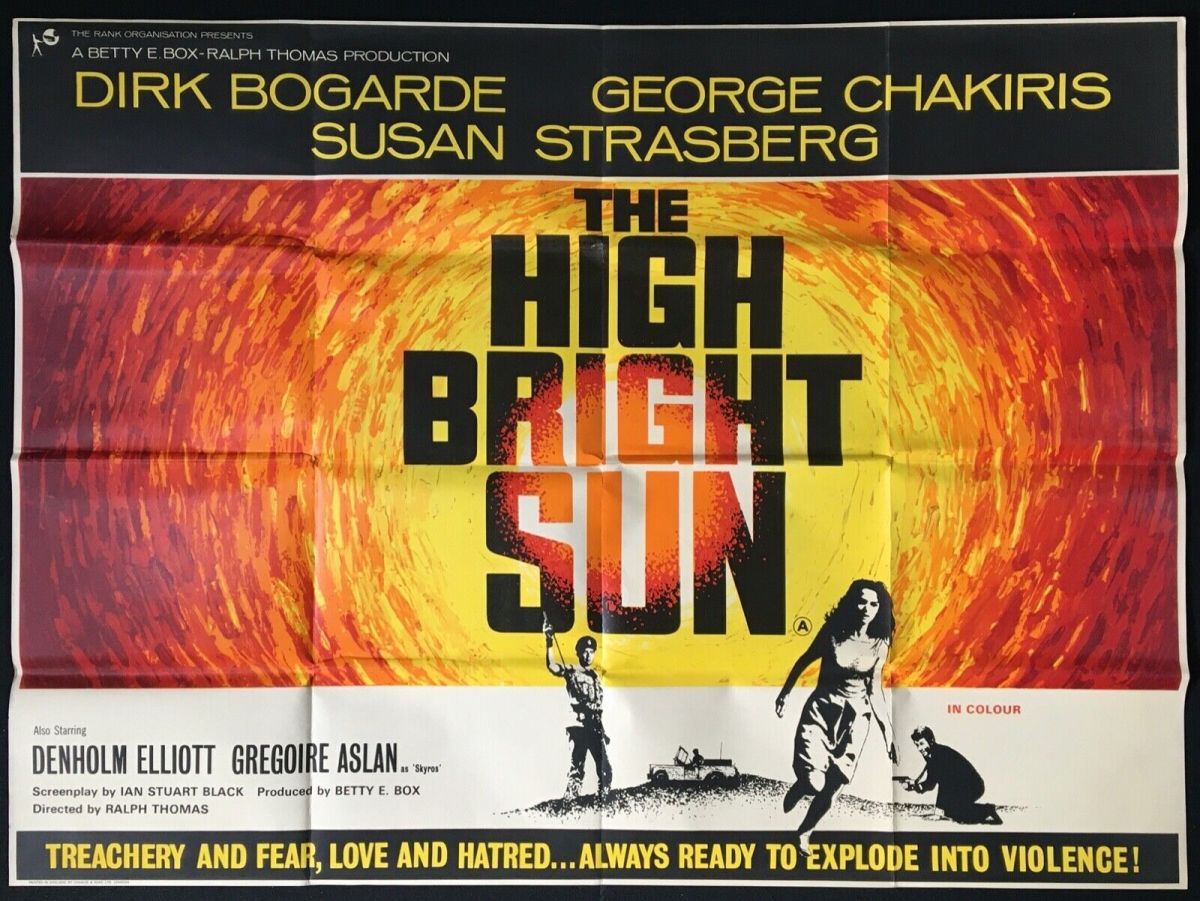
The High Bright Sun / Maguire, Go Home (1964) ****

Surprisingly good thriller about loyalties in war time. Elevated above the norm by a series of stunning scenes often turning on the psychological. And taking a helluva bold risk as far as the billing is concerned. In dramatic and structural terms top-billed British star Dirk Bogarde (Justine, 1969) and rising American star George Chakiris (Diamond Head, 1962) take second place to the third-billed Susan Strasberg (The Sisters, 1969), although Bogarde’s stiff upper lip is tested in just about the most despicable fashion.

Also derives an interesting agency from differing audience perspectives. The British audience will view Major Maguire (Dirk Bogarde) as a hero trying to keep the peace in terrorist-racked Mediterranean island Cyprus. But virtually everyone else will side with Haghios (George Chakiris) and his bunch of freedom fighters in what was effectively a war of independence. Stuck in the middle, and expecting to be given a free pass, is Juno (Susan Strasberg), a young geologist staying with family friends named Andros but who, as an American, would be viewed as a neutral.

However, she has witnessed the arrival at the Andros home of terrorists, not just Haghios but General Skyros (Gregoire Aslan), leader of the Resistance. Not wanting to get her friends in trouble, and assuming they are not involved in terrorism, she resists the attempts of Maguire to get her to name names. But it’s only the cooler head of the general and the youngest member of the Andros clan, son Emile (Colin Campbell), that prevents her being shot dead on the spot.

Bluff and double bluff are the order of the day. She’s a prisoner – and a shocked one at that having witnessed British soldiers murdered by terrorists – but if she is seen to be prevented from leaving the house it will give the game away. So Maguire comes up with an acceptable ploy to get her out so that, in a calmer situation, he can gently interrogate her.

Unfortunately taking her out to dinner backfires, as they are spotted by Haghios who, assuming they are romantically involved, realises she can’t be trusted and signs her death warrant.

But she’s far from the plucky female and no good at playing the game of being hunted. In a brilliant sequence she takes all the wrong actions and it’s only happenstance and sacrifice that prevent her capture. And this is followed by an even edgier scene when she hitches a ride late at night with a lascivious local. But that’s nothing to her treatment by Maguire who, furious at her refusal to talk, parades her in the streets “like a sitting duck.”

There’s a whole strata of soldiers in open rebellion of a different kind. Maguire mocks his commanding officer, the inept Col Park (Nigel Stock), and he in turn is mocked by his junior, Lt Baker (Denholm Elliott) who taunts him about the affair he had with Maguire’s wife. And there are any number of stings in the tail. Believing she has finally escaped, Juno is confronted by Haghios and no Maguire in sight to come to her aid.

But the central tale is given over to Juno, the innocent caught up in bloody warfare, forced to witness barbarity at first hand, and unless she hankers after personal sacrifice inevitably  induced to take sides.

Susan Strasberg is simply superb. At no time is she the feminine hero springing into reluctant action in some espionage or wartime drama. Instead, she is the innocent bystander who at any moment will turn into collateral damage. And she’s too confused even to summon up outrage at betrayal by both sides.

Dirk Bogarde looks as if he is playing your standard British officer of high breeding who can trade barbs and bullets with the enemy but mostly tries to extract information by gentler means. But he turns out to be just as savage in his ideals as the opposition. And his armour is pierced not only by having an adulterous wife but having to take abuse from her lover.

It was a typical Hollywood ploy to stick an innocent American in a war zone in order to expose a situation or attract audience sympathy either for the underdog or the oppressors – think Jack Lemmon in Chile in Missing (1982) or Sally Field in Iran in Not Without My Daughter (1991) – but I doubt if director Ralph Thomas was as naïve or politically-inclined to attempt that here and instead he treads a finer line of personal decision as he would later do in The High Commissioner/Nobody Runs Forever (1968).  Sticking to the storyline and relying on actors who never resort to emotional extremes pretty much does the trick.

George Chakiris is wasted and I can only assume this was a sign of his career going downhill.

Not just far better than I expected, but bordering on the excellent.

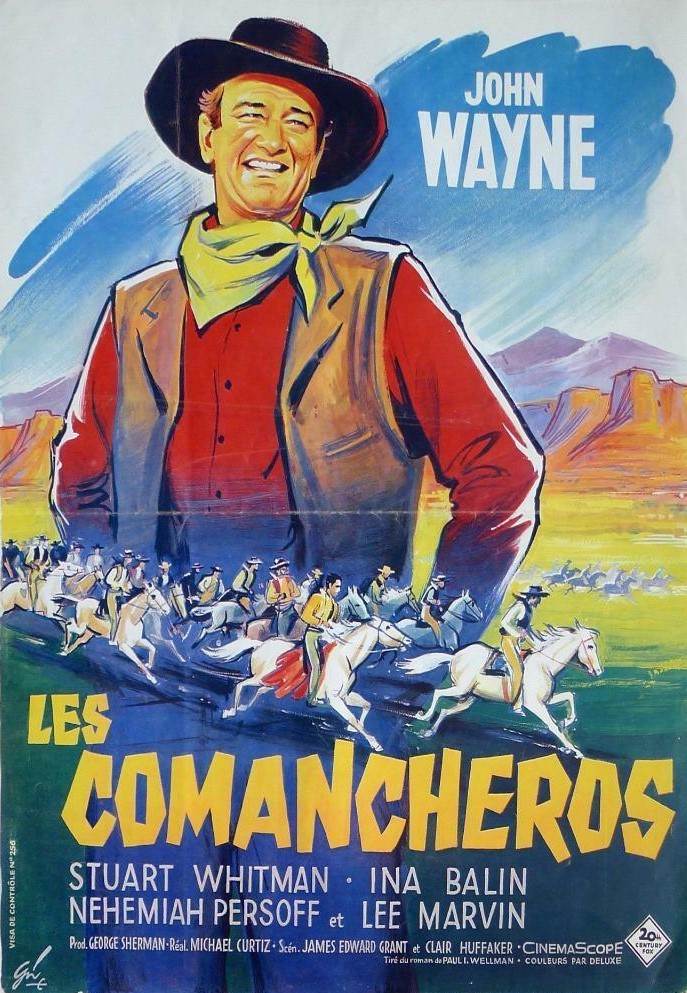
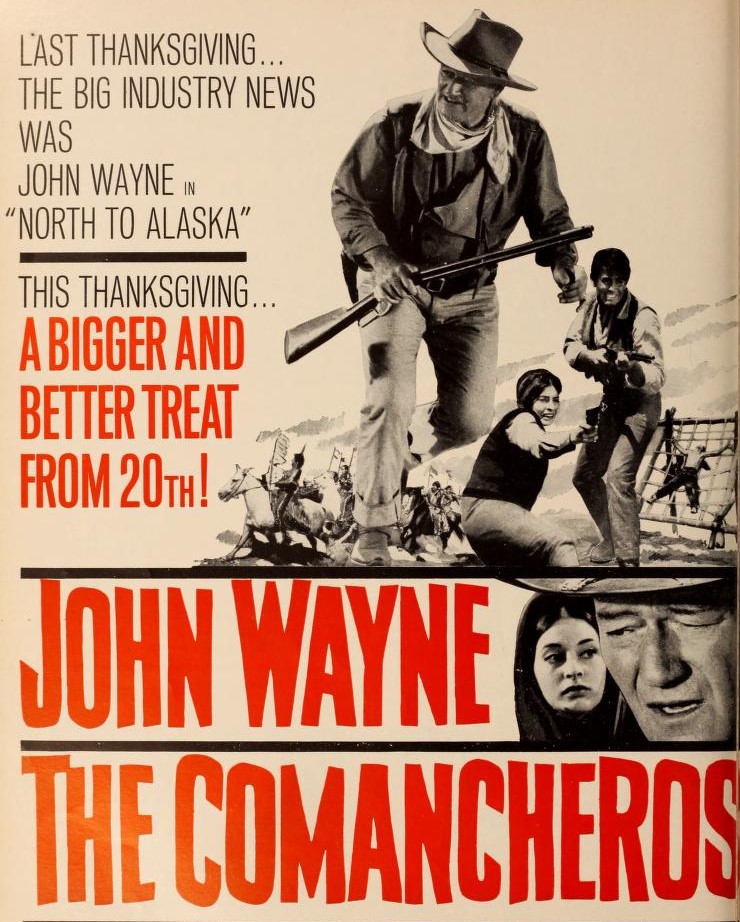
The Comancheros (1961) ****

You can always tell a studio is piling a lot behind a rising actor when the top-billed star is absent, except for a fleeting moment during the credits, for the first 10 minutes. In this case, Twentieth Century Fox was showcasing two new talents, Stuart Whitman (Murder, Inc. 1960) and Ina Balin (From the Terrace, 1960).

I’m sticking my neck out a little on this one, not considered as top-notch as Duke’s other great westerns of the decade – The Man Who Shot Liberty Valance (1962), El Dorado (1967) and True Grit (1969) – but it’s an unusual story, hardly following a standard narrative, has a great score by Elmer Bernstein but most importantly because it’s real old-school film-making with the emphasis on the classic long shot and the horizon line.

And it takes a surprisingly feminist approach with gypsy Pilar (Ina Balin) making the running in the seduction stakes. Indeed, should she be willing to surrender an iota of her hard-won independence for a long-term relationship sticks to the view that in love there is always a dominant one and a subservient one, with no question about which she is. Plus, although the nickname “Pilgrim” became a famed element of The Man Who Shot Liberty Valance this is where the nickname notion began when lawman Jake (John Wayne) assigns prisoner Paul Regret (Stuart Whitman) the appellation “Monsoor” because he’s of French heritage.

Meshes effortlessly three storylines – Jake taking prisoner Regret back to base, Regret turning from western tenderfoot to accomplished hand, and Jake and his captive infiltrating the Comancheros of the title, a secret society of white men who utilize Comanche power to its own ends. You could argue this is ushered in the “buddy” movie, the repartee between the two principals a delight. Plus, you would have to take note that legendary director Michael Curtiz (Casablanca, 1942), in his final picture, has done something remarkable in getting the Duke to speak proper, not hi-hat English, but without that Wayne trick of breaking up his sentences so it appears he’s thinking.

Curtiz is pretty nifty when it comes to setting up scenes, interrupting gentle moments with elements of stunning ferocity. When Jake arrives at a ranch, the camera tracks back from his arrival to reveal the corpses hanging upside down under the ranch gateway. Later, Jake is tucking into a meal at the home of another rancher when that man’s pregnant wife in the background suddenly sits up and from her point-of-view we see through a window as big as the entire screen a band of renegades in attack mode charging through a river.

Regret isn’t one to hang around either when he can escape during the ensuing melee, but no sooner has he gone than he returns with a bunch of Texas Rangers, thus redeeming himself in Jake’s eyes. And there’s a great cut between Jake being knocked unconscious in the blazing sun and waking up in the pouring rain.

And it’s chock-full of reversal, not just that Pilar dumps her pick-up Regret when their riverboat docks at Galveston, but Regret, forced to ride a mule in handcuffs to prevent his escape, gets the jump on his captor at the saddest scene in the picture, the burial of a family killed by Comanches. Later, after taking on the alias McBain, he encounters Regret at a poker table and the wanted man does not give him away.

After a bit of legal chicanery, Regret is a free man, although with the proviso he teams up with Jake to go undercover into the Comancheros camp. This doesn’t work out too well, the pair strung up by suspicious crippled leader Graile (Nehemiah Persoff) until rescued by, surprise, Pilar. Love works its mysterious way and soon Pilar is on Regret’s side, resulting in a classy finale.

Along the way we encounter Lee Marvin (Raintree County, 1957) having another scene-stealing ball as the Comancheros contact.  Clever screenwriters James Edward Grant (Circus World/The Magnificent Showman, 1964) and Clair Huffaker (Hellfighters, 1968) find an entirely believable method of getting him out of the way. And in passing we learn that Jake’s wife died “two years, two months and 13 days” ago and without an ounce of revealing dialog between them that Jake would like to take up with widow Melinda (Joan O’Brien). Meanwhile, initially presented as a man of such honor that he will fight a duel to protect such notions of nobility, Regret goes from gambler, wanton lover, and prisoner to revert to his original state.  

Expect chunks of western lore – don’t give a hot horse water until it has cooled down is one takeaway. And men who swear by an unwritten code. Here, it’s “words are what men live by.” What’s so refreshing is that lore and code alike arequickly punctured. The follow-up to the code annoncement to which Regret shows indiference is a pronouncement from Jake: “You must’ve had a real careless upbringing. ” that’s not forgetting characters remembering to be characters in the midst of all the uproar as with the bedridden pregnant wife instructing her husband to make sure Jake eats off the “best china.”

It’s not only a well-structured movie but it’s filled with moments that reveal character and even when Curtiz feels duty bound to include standard tropes such as the bar-room brawl or the drunk there are enough twists to have you believe the clichés have been bitten in half.

A superb ending to Curtiz’s career, terrific performances all round, great double act from Wayne and Whitman, with the latter afforded considerably more leeway acting-wise than any time in his career, and Ina Balin in a prize role.

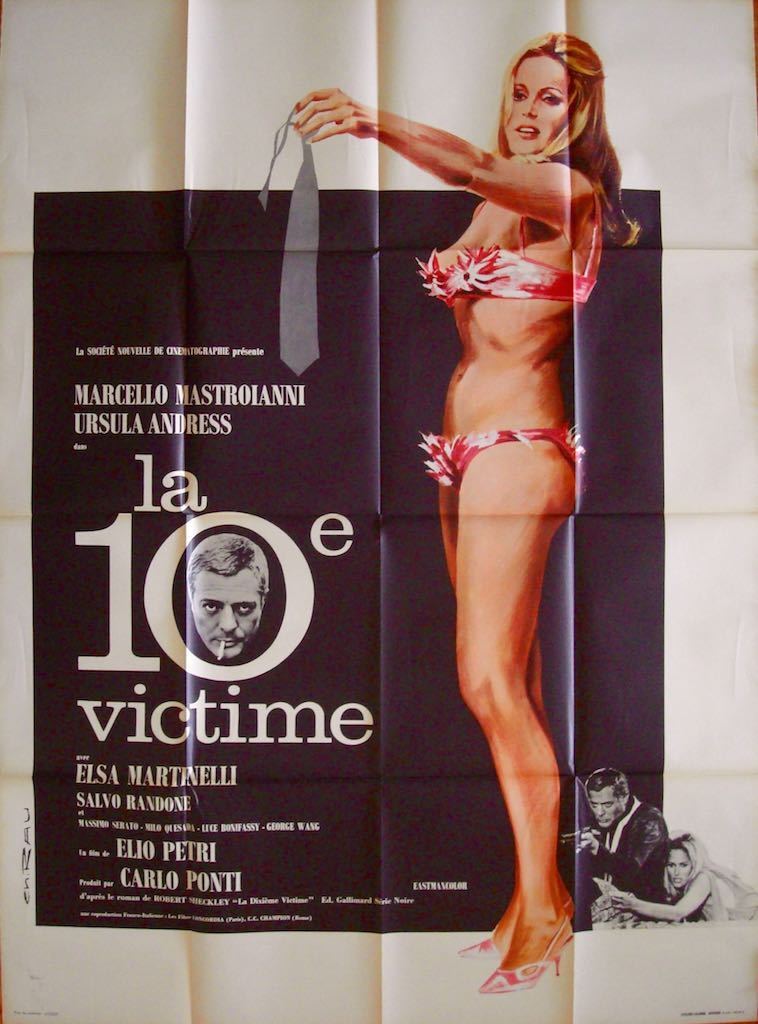
The 10th Victim (1965) ****

Sexy, stylish, sci-fi that spawned a host of imitators. Its key issue, population growth, has only  worsened since the movie appeared though killing for sport goes back to the Roman gladiators and government-sponsored killing – aka genocide – is hardly so novel. And it sets up a feminist perspective – the female killer is deadlier than the male, experience counting for everything in the assassination game.

None of the villainous females in the decade’s myriad spy films, not even the vicious pairs that gave Bulldog Drummond such a headache, could match the lethal striptease performed by authorized huntress Caroline (Ursula Andress) which culminates in a volley of bullets from her bra. Caroline is hoping to strike gold with her tenth killing, which not only brings a hefty financial bonus (and retirement) in itself, but could bring a massive bounty if captured on television and to that end she has negotiated a sponsorship deal with the Ming Tea Company, and adopts the façade of TV reporter.

Her potential victim is Marcello (Marcello Mastroianni) who would be rich enough from his six killings except his earnings have been squandered by ex-wife Lidia (Luce Bonifassy) and mistress Olga (Elsa Martinelli), not to mention the upkeep of his parents who he, illegally, has kept alive. To maintain his lifestyle he is the face of a cult worshipping the setting of the sun, but that gig is threatened by a rival cult of moon worshippers.

Set in 2079 in the aftermath of World War Three “The Big Hunt” is viewed as a legitimate method of curbing the instincts of those with violent tendencies, just the type to thirst for a fourth global conflagration. Participants must switch between being killer and potential victim, five times in each role. Naturally, victim can also take down assassin.

While attracted to Caroline, Marcello is nonetheless suspicious of the sexy reporter who in the course of claiming to be doing a story on the sexual habits of Italian men attempts to entice him to the ancient Temple of Venus in Rome where, naturally enough, sexy dancers in sexy costumes will be part of the show.

Assassination pictures are always complicated – check out The Manchurian Candidate (1962) or The Mechanic (1972) a decade later – and here the unexpected factor is love. But in the old love vs. money dynamic there’s a considerable twist, both protagonists seemingly more intent on worldly gain than enriching their souls. So it’s a twisty picture as killer and victim seek to outwit the other by any means, romance considered an acceptable weapon.

Stylistically, it’s a visual delight as director Elio Petri (A Quiet Place in the Country, 1968) meshes the burgeoning Pop Art movement with the classical architecture of ancient Rome, and the Colosseum, dismissed in the film as a unsuitable locale, though a reminder of the origins of single combat. Clever without being pretentious, sexy without veering on the side of voluptuousness, the approach is mostly ironic and can easily be viewed as a social and political commentary. Every serious element is undercut, even post-killing some bureaucrat rushes in with an official judgement on the murder. And how could you possibly take seriously the blond barnet of Marcello Mastroianni (A Place for Lovers, 1968)? That’s almost an ironic play in itself.

Austin Powers (1997) in comedic fashion took this as its stylistic cue, while other movies as wide-ranging as Death Race 2000 (1975), The Running Man (1987), Battle Royale (2000) and The Hunger Games (2012) emphasized the violence and/or political undertones. 

But none of these boasted such a stunning cast. Mastroianni performs these disaffected roles so well, while as a more than worthy adversary the generally-underrated Ursula Andress is in the form that made The Southern Star (1969) such a pleasure. Throw in Elsa Martinelli (Maroc 7, 1967) and what else could you ask for. Based on the short story The Seventh Victim – later novelized – by Robert Sheckley.

A fun ride that still makes you think.

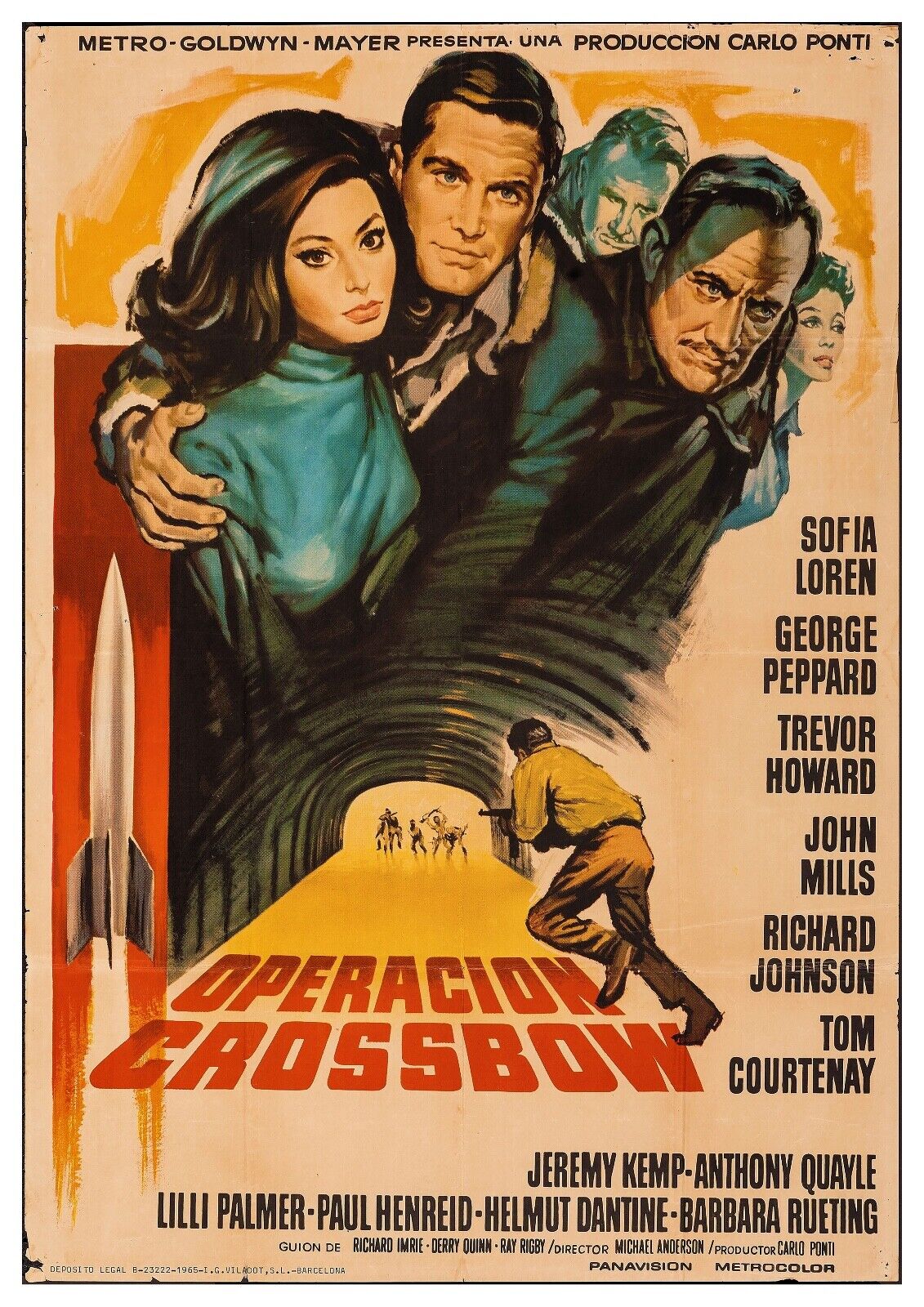
Operation Crossbow (1965) ****

A clever mixture of detail and derring-do, World War Two picture Operation Crossbow (1965) – based on the true story of Allied infiltration of a German rocket factory – was a surprising hit at the British box office. The picture took a risk in keeping star George Peppard hidden from view for the first 28 minutes (top-billed Sophia Loren took nearly another 20 minutes to show up). Prior to their appearances the opening sequences were loaded up with a roll-call of British stars familiar with the genre in the vein of John Mills (Ice Cold in Alex, 1958), Trevor Howard (Cockleshell Heroes, 1955) and Richard Todd (The Dam Busters, 1955). Anthony Quayle, who puts in a later appearance, was also a war movie veteran after turns in Battle of the River Plate (1956), Ice Cold in Alex and The Guns of Navarone (1961).

Most war films relating to destroying a vital enemy base involved bombing  (The Dam Busters633 Squadron, 1964), sinking (Sink the Bismarck!, 1962) or blowing things up  (The Guns of Navarone, 1961). Operation Crossbow falls into the last-named category. The story breaks down into four sections: the discovery towards the end of the war by the British that the Germans are forging ahead with building V1 and V2 rockets; the recruitment and training of spies to parachute into Occupied France; a tense sequence abroad where complications arise; and, finally, attempts to obliterate the rocket plant.  

Director Michael Anderson (The Dam Busters) switches through the genres from docu-drama to spy film to action adventure, further authenticity added by bold use (for a mainstream picture) of subtitles, all characters speaking in their native tongues. Various real-life characters are portrayed, among them photo reconnaissance expert Constance Babington Smith (Sylvia Sims), German aviatrix Hannah Reitsch (Barbara Rutting) and Duncan Sandys (Richard Johnson) who was on the British War Cabinet Committee.

Trevor Howard, at his irascible best, is the scientist pouring scorn on the idea of rockets – until they start raining down on London. Volunteers – Peppard, Tom Courtenay (Billy Liar, 1963) and Jeremy Kemp (who appeared with Peppard the same year in The Blue Max) – trained to spike the new weapon are recruited primarily on their language skills. Character is sketchy, Peppard designated a womaniser because he arrives in a taxi with two women.

But the operation has been assembled in such haste that not enough attention has been paid to the identities assumed by the agents. Courtenay’s character turns out to be wanted for murder. Peppard is accosted by his character’s divorced wife (Loren). So the mission faces immediate exposure. Although Loren’s role in terms of screen time amounts to little more than a cameo, she delivers a powerful emotional performance to a picture that could as easily have got by on tension alone. The harsh realities of war are shown in abundance. Twists come thick and fast in the second half, not least that Peppard’s face has become known, before the movie reaches a thrilling denouement.

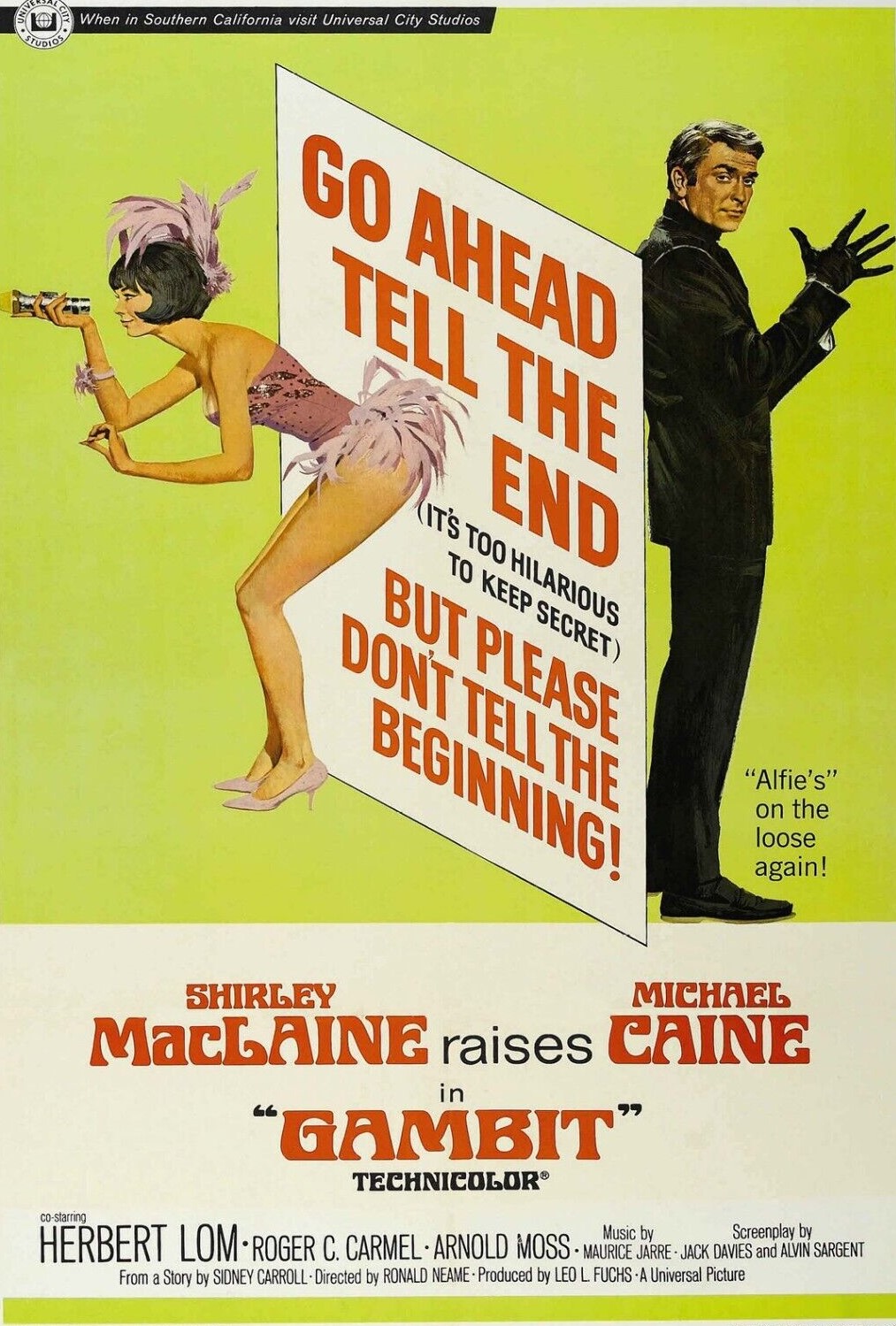
Gambit (1966) ****

The heist movie – as epitomised by The Asphalt Jungle (1950), The Killing (1958) and Jules Dassin’s Rififi (1955) and Topkapi (1954) – had tended to be a relatively low-budget affair. Top-ranking stars steered clear because complicated plot often got in the way of character development  In the highly polished and entertaining Gambit British director Ronald Neame’s riff on the genre involved a narrative shift worthy of Christopher Nolan, Quentin Tarantino and, of course, Akira Kurosawa who had with Rashomon (1950) single-handedly invented the complex point-of-view.

Neame brought another couple of other aces out of the deck. First of all, there was the fun of watching over-confident thief Michael Caine’s apparently foolproof plans come unstuck. Secondly, in a romantic dynamic in the vein of It Happened One Night (1934) the less accomplished female (Shirley MacLaine) proves more accomplished than the male.

Gambit was also a clear demonstration of the power of the female star not just in the plot complications but from the fact that Caine owed his big Hollywood break to MacLaine, the actress having the power of veto over the male lead and, equally, the contractual right to choose her co-star.

The movie had gone through an interesting development phase. The original script by director Bryan Forbes (King Rat, 1965) had Cary Grant in the central (i.e MacLaine) role. Rewritten by Jack Davies (Those Magnificent Men in Their Flying Machines, 1965) and in his movie debut Alvin Sargent (The Stalking Moon, 1968) the main character underwent a gender shift.

After Psycho (1960) audiences had become used to being messed around. Stars could be killed off halfway through or not appear (Operation Crossbow a classic example) until well into the movie. Neame was not quite so bold but what audiences made of the usually garrulous MacLaine being rendered mute during the early part of the picture was anybody’s guess, perhaps the dumb show was a joke in itself.

But lack of dialogue did not prevent MacLaine from stealing the show and proving what an adept comedienne she was, a barrage of submissive looks enough to send an audience into hysterics.

In essence, Caine plays two characters. In the opening segment he is the brash, cocky  English gentleman-thief at the top of his game, bossing MacLaine around, gulling his mark (Herbert Lom) with an audacious plan to steal an expensive sculpture. In his version of events his plan goes off without a hitch. But when we switch to the MacLaine perspective, in which nothing goes according to plan, his cool demeanour is sorely tested and he turns into a frustrated idiot.

Watching the movie now, you can almost imagine that the MacLaine character, with a host of useless facts at her fingertips, was making fun of Caine’s well-known love of trivia, but that predated the actor’s acknowledgement of this aspect of his real-life character.

What makes the movie so much fun is that both parts of the film work and for the same reasons: believable characters; exciting heists and plenty of twists. The initial premise is that Caine recruits Hong Kong dancer MacLaine due to her startling resemblance to the late wife of Arab billionaire Herbert Lom as part of a ploy to relieve him of a priceless artefact.

While Lom is falling for MacLaine, Caine moves in for the kill with an ingenious heist. Mission accomplished he pays her off. But in the real version of the story, as seen through her eyes, Lom does not fall for the ridiculous scam, Caine’s plan fails to work until MacLaine comes to the rescue. Meanwhile, MacLaine has fallen for Caine, but does not want to be in love with a criminal. Although Caine initially resists his own emotions, he, too, takes the romantic plunge except that to win her he may have to lose what he prizes more.

As I mentioned it is awash with twists and the heists themselves are exceptionally well done but the screen chemistry between the two leads is terrific. Caine, who had otherwise been in control in his previous starring roles as the upper-class officer in Zulu (1963), spy Harry Palmer in The Ipcress File (1965) and the womanising Alfie (1966) – The Wrong Box (1966) was an ensemble item – was taking a chance in playing a character who would effectively play second fiddle to the star and in terms of the thief often appears out-of-control. MacLaine was more obviously in her safety zone. Hollywood spent a lot of time investing in screen partnerships, mostly failing, but this pairing certainly succeeded.

The Fortune Cookie / Meet Whiplash Willie (1966) ***

It’s the miracle of cinema. A supporting actor whom you might have glimpsed in a variety of roles over the preceding years suddenly appears as if by magic in a new screen persona and is hailed as a new star. One such was Walter Matthau. From the lecherous neighbor in Strangers When We Meet (1960), good guy in Lonely Are the Brave (1962), bad guy in Charade (1963) and Mirage (1965) and tetchy arrogant analyst in Fail Safe (1964), as if undergoing metamorphosis he creates the slimy, grouchy, crouchy, greedy lawyer duping his brother-in-law in Billy Wilder’s too-obvious satire The Fortune Cookie, beating the top-billed  Jack Lemmon (How To Murder Your Wife, 1965) into a cocked hat.

It doesn’t help Lemmon that this most physical of actors is physically constrained for the bulk of the picture, trussed up within an inch of his life as the key ingredient in a million-dollar insurance scam. And Matthau makes the most of the opportunity, dominating the screen not just with his octopus-like arms, but with his facial expressions, his snarling and growling and snapping, as if this was in fact a one-man movie. He’s so dominant that you almost forget Lemmon, an unavoidable force in most of his movies, is there.

And it’s true that television cameraman Harry Hinkle (Jack Lemmon) is a patsy, duped by his adulterous wife Sandy (Judi West), conned by ambulance-chasing lawyer Willie Gringrich (Walter Matthau) into believing that exaggerating the injury he suffered from colliding with pro football player Boom Boom (Ron Rich) will bring her scurrying back. Never mind that while on the phone apparently going with her ex-husband’s fantasies, we can see her current boyfriend in the background lying abed or taking a shower.

But then Willie has everyone figured out. He can play highball or lowball, he knows every trick in the book and if you try to challenge him he can quote chapter and verse on every personal injury claim over the last century that would favor the victim. And he expects his opposite numbers to play dirty too, and uses to his own advantage the microphones and cameras they have planted in the apartment where Harry is purportedly recuperating.

There’s not much more to the picture than to enjoy Willie hoodwinking everybody in sight. But he’s such a performer to watch that you will be rooting for him rather than his sad sack brother-in-law who you know has paid-up membership of the Suckers Union.

Not for the first time, foreign distributors felt they were saddled with an unworkable title so in
the UK it became Meet Whiplash Willie even though the idea of the con of the whiplash
injuries in supposed car accidents was more prevalent in the US than Britain.

There’s some neat observations of the way law firms work, and the way medical experts refuse to commit in case they are later sued for a wrong diagnosis, and there’s some cute stuff about nuns with the gambling habit and seeing Boom Boom fall apart with guilt. But given the movie’s running time and the talent involved – script by Billy Wilder and I.A.L. Diamond (Some Like it Hot, 1959) and directed by the said Wilder –  it’s not as funny as it could be and sometimes it feels like they’re scraping the barrel to squeeze out an unfunny joke.

But it hardly matters. This could be Fail Safe and with this Walter Matthau persona on the loose you wouldn’t care tuppence if the Russians bombed the hell out of everyone as long as Matthau was in the middle of the action, working out how to chisel a bigger piece for himself, and playing everyone for the dumb schmucks they are.

After this Walter Matthau – as unlikely a mainline star as Lee Marvin or Charles Bronson – never looked back. Unlike other major stars he never had to be completely trustworthy and was almost virtually responsible for bringing a severe dose of cynicism to the forefront of American acting. He could charm you if he set out to do so, but you better keep your wits about you because the chances are he would be robbing you blind.

If The Odd Couple (1967) set the seal on one of Hollywood’s greatest comedy partnerships, The Fortune Cookie was where it all began. Lemmon isn’t bad, just out-acted, and we’ve seen his whiny/forlorn/dumb act many times before. Judi West (A Man Called Gannon, 1968) has the other plum role as the blonde who is anything but dumb and would have proved an ideal partner for Gringrich except he would have seen through her too easily. Ron Rich (Chubasco, 1968) plays the only other character who isn’t spun out of a cliché.

Below par Wilder redeemed by heavenly performance by Matthau.

Discover WordPress

A daily selection of the best content published on WordPress, collected for you by humans who love to read.

The Atavist Magazine

by Brian Hannan

WordPress.com News

The latest news on WordPress.com and the WordPress community.