Isadora / The Loves of Isadora / The Incomparable Isadora (1968) ***

We’re two years away from the 100th anniversary of the death of feminist icon and pioneering dancer Isadora Duncan, but this movie has been in cold storage virtually since its release, so I’m wondering whether its sudden appearance on Amazon will trigger any interest in this long-forgotten, heavily edited, commercial flop of a movie.

Due to the clumsy structure it’s occasionally heavy going. We start off in Nice in the South of France where Isadora (Vanessa Redgrave) is dictating her memoirs to journalist (not lover) Roger (John Fraser) and the whole picture is rendered in flashback. And there’s something morbid about this structure, because essentially we’re waiting for her to die. Unfortunately, what she is most remembered for is getting her trademark long scarf tangled in the wheels of a moving Bugatti and snapping her neck. So we’re sitting around waiting for her to hop into a passing Bugatti with a Bugatti (Vladimir Leskovar).

The rest of her life was somewhat fractured, consisting of her leaping from one lover/husband – Gordon Craig (James Fox), Paris Singer (Jason Robards), Romano Romanelli, Sergei Essenin (Ivan Tchenko) – to the next so characters appear and then disappear. Never mind her rebellious nature and determination to forge her own way  and reinvent dance, her life was peppered with tragedy – all three of her children died, two drowning in the Seine (a fact repeated in a variety of ways to get the full emotional punch) – so there’s more than enough angst.

Her dancing is exuberant and uninhibited – she wore flowing dresses which looked as though any minute they would slip off her slender frame and there was scandal at one point when she bared her breasts during a performance. The first time she hits the stage is exceptionally ho-hum because it’s in a Paris nightclub and she’s a conventional, if very attractive, dancer of the ooh-la-la persuasion. But when she gets into her stride as a serious dancer, then visually it’s a treat, as she commands the stage – and screen- in a series of sexually provocative sinuous movements.

But, unfortunately, once is enough. You’d have to know a lot more about artistic dance than I do – and I guess the bulk of the original and contemporary cinematic audience – to know what changes she implemented and how, apart from her individual style (she danced solo not as part of an ensemble), her act developed and how it impacted on dance. She ran her own dance schools which probably liberated a ton of young women who were in the mood to be liberated.

But, as a biopic, even with 30 minutes knocked out, it’s way too long at the remaining 140 minutes, and the rest of the cast struggle to offer any competition to the lustrous Isadora.

Vanessa Redgrave, Oscar-nominated, is the best reason to watch and she is certainly compelling and, oddly enough, though there is plenty of incident and drama it somehow isn’t dramatically compelling.

She is generally naïve in her politics and her innocence in this department works to the advantage of the character. But mostly, we flit like a mobile time capsule through different periods, each well defined cinematically, and even though it’s clearly much harder to (in visual terms on film) convince as a genuine dancer than as, for example, a pianist, unless you were an expert on dance you wouldn’t know what to complain about.

You end up with a biopic about an interesting woman rather than a fascinating biopic. Vanessa Redgrave (Blow-Up, 1966) delivers another of her flawed characters and holds the screen effortlessly. The same cannot be said of the insipid males, James Fox (Thoroughly Modern Millie, 1967) and a miscast Jason Robards (Hour of the Gun, 1967).

Hard to know what the plans were of director Karel Reisz (Morgan!/Morgan, A Suitable Case for Treatment, 1966) because this isn’t his 168-minute version (the one that was released in the U.S. after disastrous opening weekend was trimmed to 128 minutes and in the UK to 140 minutes). Written by Melvyn Bragg (Play Dirty, 1969) and Clive Exton (10 Rillington Place, 1969) from a number of sources.

Sheds an interesting, but not enough, light on a legendary character.

Thunderbolt and Lightfoot (1974) ***

There’s a reason this has largely slipped from view, why it’s rarely included in any examination of the Clint Eastwood canon. For the most part it’s plain dull. When the best thing in it for large periods of time is the screen composition, then you know this is going to be an odd, not to mention tough, watch.

It’s confused as hell. Starts out as a road movie – and a desultory one at that – with a side hustle of a shaggy dog story, straightens out enough to fit into the nascent buddy movie genre before settling down into a heist. And all the time director Michael Cimino, with his use of widescreen and traditional arranging of the sometimes majestic scenery into thirds, thinks he is making a western.

Let’s play the phallic symbol card.

None of the characters seems to be much good at what they do. Thunderbolt (Clint Eastwood), on the run, doesn’t appear capable of evading the pursuing Red (George Kennedy), not a cop or bounty hunter as you’d expect, but an irate member of Thunderbolt’s former gang. And while Red seems excellent at tracking down his quarry, whose shifts of direction are almost whimsical, and even though he’s armed with the modern-day equivalent of a Gatling gun, he makes the basic mistake of not getting close enough to his target to make the bullets count.

The only one who comes out on top in the too-long opening section is Thunderbolt’s happy-go-lucky sidekick Lightfoot (Jeff Bridges) who has the knack of pulling the ladies and can drive. But their relationship is desultory, no zap, no funny lines in the vein of Butch Cassidy and the Sundance Kid (1969), and while clearly like the pair in Midnight Cowboy (1969) inclined to hold onto each other in the absence of anyone else it lacks the emotional power of the latter.

It takes forever to get to the point. Or the three narrative triggers, one of which involves Eastwood committing the most grievous sin a major star can ever commit – to be the one who carries the exposition. And boy does he go on. Anyways, he’s a bank robber and he planked his haul in a small two-room schoolhouse. But, blow me down, someone’s demolished the schoolhouse, without presumably happening upon the cash, and built a brand new one in its place.

Clint Eastwood…Bruce Lee…Together!

Then, just to annoy Thunderbolt, the police, because this is just how cunning they can be, have given out that they recovered the loot. Red hasn’t fallen for this ploy, believing Thunderbolt has duped the gang and made off with the stash. Eventually, Red and Thunderbolt reconcile and Lightfoot suggests they hit the bank that was originally robbed because nobody would expect it.

Thunderbolt has acquired his nickname because his idea of a heist is not to bring on board some clever dick safecracker and employ an ounce of patience but merely to barrel through any obstacle with the help of 20mm cannon.

So now – at last – we have a story, but that’s over halfway through the picture and way too late to save it. So, yes, there’s some decent action and excitement, a double cross, car chase, shoot-out, and just to complete the shaggy dog element one of the robbers is killed by a dog.

Once it gets going it’s within the Eastwood bailiwick. At the time there was a mini-trend, started off by Easy Rider (1969), for road movies so moviegoers back in the day would probably accept this more than a contemporary audience who, like me, is sitting there wondering when the heck are they going to get on with it.

Something of change of pace for Eastwood, in that he plays his age, the older man, one in not so good physical shape at that, and not catnip for the ladies. Jeff Bridges (The Big Lebowski, 1998) certainly brightens up the screen, but George Kennedy (Cool Hand Luke, 1967) overacts.

Writer-director Michael Cimino, in his debut, exhibits the strengths that would elevate The Deer Hunter (1978) and the self-indulgence that would cripple Heaven’s Gate (1980).

A long haul.

Que La Bete Meure / This Man Must Die (1969) ****

Heavily-layered Claude Chabrol revenge thriller that concentrates as much on the tricks the human mind can play rather a string of unusual twists. Self-justification and redemption go hand in hand. The director sucks us in to sympathize with an obsessed killer on the grounds that his victim deserves to die and then at the end makes us question everything we’ve been led to believe.

As usual, with this director, there’s more than enough atmosphere and his exposure of small-town life in France and the flaws in families and relationships almost serve to turn this into more of a drama than a thriller. But then that is Chabrol’s distinctive trademark.

When the police fail to track down the hit-and-run driver who has killed the young son of Charles Thenier (Michel Duchaussoy), the father, an author, determines to find the killer and, as he confides in his diary, not report him to the authorities, but finish him off himself. He makes the smart deduction that since there was no trace of a repair to a damaged car, the killer must own a garage. By a stroke of luck, he discovers a well-known actress Helen Lanson (Caroline Cellier) was a passenger in the car. Hiding behind his pen-name Marc, he seduces Helene, who has been hit by depression as a result of the incident, and discovers the driver was her brother-in-law Paul (Jean Yanne).

Convincing her to allow him to accompany her on a visit to his sister, his self-justification rises a notch as he notes that Paul is exactly the kind of guy who might well come to a sticky end given the detestable way he treats his wife Jeanne (Anouk Ferjac) and teenage son Phillippe (Marc Di Napoli) and is a womanizer to boot. While Charles bonds with Phillippe, who reveals he wants to kill his father, his relationship with Helene takes a knock when he discovers she’s had a brief affair with her brother-in-law.

So Charles plans to stage an accident at sea but Paul is one step ahead. The driver has found Charles’ diary and has taken a gun on the sailing trip to defend himself. But after Charles and Helene leave, Paul is discovered dead by poisoning. Charles’ diary makes him a suspect. And while he argues that it would be foolish of him to disclose his plans to a diary that is in the dead man’s possession, the police take the view that that would exactly what a clever murderer would do to deflect suspicion.

The police can’t find the poison so Charles is released. Phillippe confesses to the murder. But there is a further twist. The tale on which this is based was called The Beast Must Die, and from the various revelations we would be assuming that the beast in question, the remorseless despicable hit-and-run driver with not a single redeeming feature would be the most likely to fit this category.

But on reflecting on his own obsession, Charles clearly realizes that he is as likely a candidate to be termed a “beast.” It turns out he has let the son take responsibility for the murder and now he sets out to make amends, confessing to Helene that he did it and then heading off to sea presumably to jump overboard at a suitable spot.

Justified killing is never, it turns out, justifiable because in reality it turns the innocent into the guilty, and there’s little distinction between killers. When we cast our minds back, we become aware, as he does, that Charles has transitioned from grieving father to ruthless seducer of a vulnerable woman, preyed on a youngster who in consequence of their supposed friendship is happy to carry the can so Charles can escape, and is in any case going to complete his plan regardless of the cost to others.

Michel Duchaussoy (La Femme Infidele, 1969) steps up to the plate. The supporting cast are excellent. After the abysmal Road to Corinth (1967), Claude Chabrol established his name as the inheritor of the Hitchcock mantle after this and La Femme Infidele. Written by the director and Paul Gegauff (More, 1969) from the novel by Nicholas Blake (the pen-name of Irish poet Cecil Day-Lewis, father of Oscar-winning actor Daniel Day-Lewis).

No shortage of tension, upends your expectations, totally involving.

Carry On Spying (1964) ***

The potential for leering – given the squads of bikinied beauties, cleavage abounding and partial nudity a prerequisite in the standard James Bond picture  – could have gone into the stratosphere. So it’s to the producer’s credit that they opted to drop ogler-in-chief and Carry On perennial Sidney James from this enterprise. So, automatically, there’s more of a gentler  Ealing or Doctor in the House vibe to the satire.

Given the propensity for inuendo and said ogling, there’s a general perception that doesn’t stand up to scrutiny that women in this series are portrayed as objects existing solely for the pleasure of men. However, as here, women are often in charge and certainly more sensible than the males.

Here dumb Desmond Simpkins (Kenneth Williams), dumber Harold Crump (Bernard Cribbins) and dumbest Charlie Bind (Charles Hawtrey) are easily put in the shade by fellow spy Daphne Honeybutt (Barbara Windsor), she of the photographic memory, and deadly enemy Dr Crowe (Judith Furse) who has the sense to steer clear, unlike James Bond’s deadliest enemies, of cats and heads up an organization called STENCH.

And while generally the focus of the fun is the James Bond series – of which only two at this point had been made – the movie also draws on antecedents such as The Third Man (1949) and, dare I say it, Casablanca (1942) and film noir. And there’s an acceptance that Britain has not shot to the top of the espionage premier league courtesy of one bed-hopping spy but is more likely to drown in officialdom and inefficiency.

We begin with a particularly British joke that a milkman would have access to even the most top-secret laboratories simply because every living person in the country can’t do without their daily hand-delivered pint of milk, thus permitting an enemy secret agent in the most simple of disguises to nip in and steal a top secret formula and blow up the lab.

The four agents are despatched to Vienna, primarily so the movie can take advantage of jokes about sewers and zithers a la The Third Man, and prove how inadequate our quartet actually are. From there, they hare over to Algiers, because that’s the kind of locale where Crump and Honeybutt can infiltrate a club disguised as belly dancers. Naturally, they are captured by STENCH and while enemy agents are often as comfortable in bikinis and the cleavage-showing malarkey here the females, while wearing skintight outfits, reveal no flesh, and there’s – shock! horror! – no ogling.  

Typical British small town cinema requiring three changes of program a week to survive. Generally, horror pictures were limited to single showing on a Sunday, but that was when cinemas screened oldies. This one was contemporary and yes that’s Roy Scheider from “Jaws.” The movie expected to be most lucrative played the weekend. Public response to “Paris When it Sizzles” was as poor here as anywhere else, thus the midweek slot.

There’s a very humorous twist on the trope of a spy eating top secret material wherein our quartet need soup and bread to help it go down. However, there’s a clever reversal when Honeybutt’s photographic memory, allowing her to instantly recall the secret formula, makes her prey to Dr Crowe.

There’s a stab at romance, although hapless males Simpkins and Crump are ill-prepared to deal with the advances of, respectively, double agent Lila (Dilys Laye) and Honeybutt. Pratfalls are limited though Inspector Clouseau would have welcomed the comic relief afforded by doors.

This was Barbara Windsor’s first Carry On venture. Most of the rest of the cast were series regulars and pretty much played the characters they always play.

Cleaner fun than it might have been had Sid James headed the cast. One of the better spoofs in the series. Directed as usual by Gerald Thomas and written by Talbot Rothwell (Three Hats for Lisa, 1965) and Sid Colin (Up Pompeii, 1971).

Well up to standard.

Wake Up Dead Man: A Knives Out Mystery (2025) ** – Seen at the Cinema (out on Dec 12 on Netflix)

An unholy mess. Serve Netflix right for once again indulging one of their “visionary” directors. I’m assuming either director Rian Johnson is a true believer or he’s embarked on a spoof that doesn’t work. Either way it’s a bone-headed venture filled with the dullest characters you would ever come across and testing audience patience to the limit by keeping the star of the show, private detective Benoit Blanc (Daniel Craig), out of the picture for the first 30 minutes, dumping all the exposition on Fr Jud Duplenticy (Josh O’Connor), the most cliched priest this side of Bing Crosby and relying on the “locked room” conceit, handled with some deadly ham-fistedness, to see the audience through an extremely trying time.

Once you work out that the title relates to the Resurrection of Jesus Christ and that we’re entombed in a flummery of Christian jargon, you start hoping this is going to head down the satirical route and that at least you’ll get a few laughs for your hard-earned bucks. But, no, it’s so straitlaced it might as well have called on a corset to design the narrative. In order to help the director out of a whole series of cinematic cul de sacs everyone overacts and we skip over inconvenient plotholes.

The priest is sent to help out in a rundown parish run by nutcase Monsignor Jefferson Wilks (Josh Brolin) whose idea of fun is to relate in detail, under the guise of confession, how many times, and how, he has masturbated that week. There’s a godforsaken subplot about lost treasure and a mysterious child who you’ve guessed from the off is the son of Wilks.

When Wilks is done to death in church in a small room off the altar, then we get the standard roll-call of suspects. These include church manager Martha (Glenn Close), who specializes in letting out blood-curdling screams, alcoholic doctor Nat (Jeremy Renner), barmy novelist Lee (Andrew Scott), suffering from the opposite of writer’s block who can’t stop spewing out an interminable book, Vera (Kerry Washington) who’s been put in charge of bringing up mysterious boy Cy (Daryl McCormack), now a failed influencer, and crippled Simone (Caillee Spainey) who Wilks has bled dry. Every now and then local cop Geraldine (Mila Kunis) turns up to listen in awe to Blanc.

Fr Jud is the main suspect for no apparent reason that I could see except the writer says so and he’s the most handsome guy around and wouldn’t it be great if Blanc could recruit a priest sidekick in the way of the television series of yore.

So first of all we get a lecture on the “locked room” thesis with reference to Golden Age of Crime novelist John Dickson Carr who invented the term and then to the likes of Agatha Christie and others who took up the challenge.  A variety of theories are presented by Blanc with the sole purpose of showing everyone how clever he is by knocking them all down.

Once we enter Resurrection territory it gets downright stupid, the dead man rising again on the third day in the manner of a certain religion, and then there’s another murder and because we’ve run out of things with which to add genuine tension a lot of the action now takes place in pouring rain and Fr Jud who looks like he is in the clear gets once again targeted as the main suspect.

And then we’re into scene after scene after scene of exposition and a ton of talk about “free will” and “grace” – religious terms you understand. Confession, you might not be surprised to learn, plays a key role.

This might have been more acceptable with a better cast. This is nothing like an all-star cast such as used to decorate Hercule Poirot epics and helped out with keeping an audience engrossed in the first two in the series. This is populated by over-the-hill stars like Glenn Close (Hillbilly Elegy, 2020), Mila Kunis (Bad Moms, 2016) and Jeremy Renner (Avengers: Endgame, 2019) and actors who wouldn’t be considered stars except in television like Andrew Scott (Blue Moon, 2025). Josh O’Connor (Challengers, 2024) is out of his depth. Josh Brolin (Weapons, 2025) would be closest we’ve got to what might constitute a genuine star but he was second-billed in that and only then because everyone else was a nobody.

The role of the star is to enliven a picture and those with an undiluted screen presence give audiences something to hang their hat on or direct their sympathies to. But none of this bedraggled lot, every character underwritten, would you care a fig for.

Rian Johnson ruins his own creation.

The Maltese Bippy (1969) *

The start is promising. Three decent laughs in the first three scenes, all jests at the expense of Hollywood. But when the movie settles down to a werewolf spoof, there’s a nary a chuckle to be found. It was rare in the 1960s for television shows to be given a big-screen outing, but it did occasionally happen. This came two years into the six-year run of Rowan and Martin’s Laugh-In television show, an innovative mixture of gags, punchlines and sketches stitched together in random fashion. A huge hit in the U.S., it was considered a slam dunk to turn it into a movie. Perhaps if they had stuck to the same format it might have worked.

Sam Smith (Dan Rowan) and Ernest Grey (Dick Martin) are down-on-their-luck soft-porn movie makers living in a mansion on the edge of a cemetery. After suffering a bite on the neck, Dick turns into a werewolf. You can see the comic possibilities, I’m sure. Either Rowan and Martin failed to find them or lacked the expertise to turn the material into laughs. Sure, there’s a creepy family, the Ravenswoods, next door who could be auditioning for The Munsters but that goes nowhere except the obvious and certainly not in the direction of laughs.

A few good actresses – Carol Lynley (Danger Route, 1967),  Julie Newmar (Mackenna’s Gold, 1969) and Mildred Natwick (Barefoot in the Park, 1967) – were snookered into this alongside Fritz Weaver (To Trap a Spy, 1964) without hope of redemption.  It was almost as though the picture was conceived as a piece of merchandising that Rowan and Martin just had to put their names to and not do much else.

It was strange it was so awful because director Norman Panama had a track record in comedy. Among other pictures he had made The Court Jester (1955) starring Danny Kaye – “the vessel with the pestle” – displayed an abundance of great comic timing and in some respects was a spoof of the historical genre. He had also directed Bing Crosby and Bob Hope in The Road to Hong Kong (1962) so you would expect him to be familiar with the workings of screen comedic partnerships.

The laughs were meant to be supplied by Everett Freeman (The Glass Bottom Boat, 1966)  and Ray Singer, a specialist in television sitcom and creator of Here’s Lucy (1968-1974). But either they couldn’t come up with sufficient gags or Rowan and Martin’s delivery was out of key with the lines. Or something.

Maybe nostalgia was what was missing from my viewing of the picture. I don’t recall holding any particular affection for the television show, though I was aware it provided a star-making platform for performers like Goldie Hawn (Cactus Flower, 1969), Judy Carne (All the Right Noises, 1970) and Lily Tomlin (Nine to Five, 1980) and that John Wayne put in a guest appearance.

But don’t take my word for it. Variety called the picture “as zany and fast a funfest as has come down the pike in years” and a “ cinch for heavy box office reception.” Mainstream critics were less kind, four out of the most prominent five giving unfavorable reviews. Even though the stars made the cover of Life magazine and the film received a seven-page spread inside, the movie barely made a ripple with audiences, a total of just $22,000 garnered in its opening week in two cinemas in New York with a total capacity of over 2,000 seats. British kids film Ring of Bright Water made more at a 360-seater.

The expected audience did not materialize, either from poor word-of-mouth or because customers resisted paying for something they could get for free every week on the small screen. So poorly did it perform that its initial run was truncated and a few weeks later when it went wide in a Showcase opening in New York MGM stuck on a reissue of Grand Prix (1966) as the support. Variety estimated it barely took $1 million in rentals (the amount returned to studios once cinemas take their share of the box office). Final proof of its unpopularity was being sold to television a couple of months after its debut.

After the Fox (1966) ****

There’s a classic MacGuffin in here somewhere, but I can’t make out if it’s the heist serving the satire on movies or the satire on movies serving the heist. Whatever, this is about the funniest picture you’ll watch on the movie business (much better than Paris When It Sizzles two years earlier). You can keep your royalty and your top politicians dropping in from every corner of the globe, but it’s hard to beat Hollywood landing on your doorstep to transform everyone into a sycophant. To facilitate filming, individual streets and solid blocks will be closed and even businessmen whose businesses are threatened will stick their nose out into the road in the hope of being captured by a stray camera. Everyone wants to be in the movies and how brazenly the movies exploit such naked need.

Before we get to the movie part of the story, we find imprisoned top criminal Aldo Vanucci aka “The Fox” (Peter Sellers) escaping from confinement so that he can assist robber Okra (Akim Tamiroff) transport 300 solid gold bars from a heist in Cairo to Italy. Though the heist is deceptively simple (and might even have influenced The Italian Job, 1969), for a time it looks as if this will canter along going nowhere fast while we get bogged down in a subplot concerning the burgeoning acting career of Vanucci’s sister Gina (Britt Ekland). There’s a whole bunch of standard Italian comedy tropes – the dominant Mama, the incompetent crooks and the brother too controlling of his sister.

But once Vanucci hits on a movie shoot as the ideal way to disguise the bringing ashore of the loot into the Italian island of Ischia, he strikes pure comedy gold. The townspeople who might otherwise easily see through a con man are putty in his hands. The local cop comes onside when persuaded he has the cheekbones of actor. Aging vain star Tony Powell (Victor Mature) wearing a trademark trench coat like a latter-day Bogart is an easy catch once you play upon his vanity and even hard-nosed agent Harry (Martin Balsam) is no match for the smooth-talking Vanucci.

Vanucci has mastered the lingo of the film director and can out-lingo everyone in sight. The very idea that he has a hotline to Sophia Loren goes undisputed and Powell is even persuaded that Gina, who has never acted in her life, is the next big thing.

Pick of the marvelous set-pieces is the scene in a restaurant where Vanucci is astonished to find a peach of a girl (Maria Grazia Buccella) speaking in a deep male voice because while she’s opening her mouth the words are being supplied by Okra seated behind her. Not all the best scenes involve Vanucci. Harry tartly batting away Tony’s vanities is priceless while the theft of film equipment while a film director (played by the movie’s director) calls for more dust in a sandstorm is great fun.

Also targeted is the self-indulgence of the arthouse filmmaker determined to add meaning to any picture. Vanucci’s versions of such tropes as lack of communication or a man searching for identity and running away from himself are a joy to behold and one scene of Tony and Gina sitting at opposite ends of a long table at the seashore just about sums the kind of pointless but picturesque sequence likely to be acclaimed in an arthouse “gem.” And you might jump forward to villagers hiding the wine in The Secret of Santa Vittorio (1969) for the sequence where townspeople load up gold into a van, singing jauntily all the time.

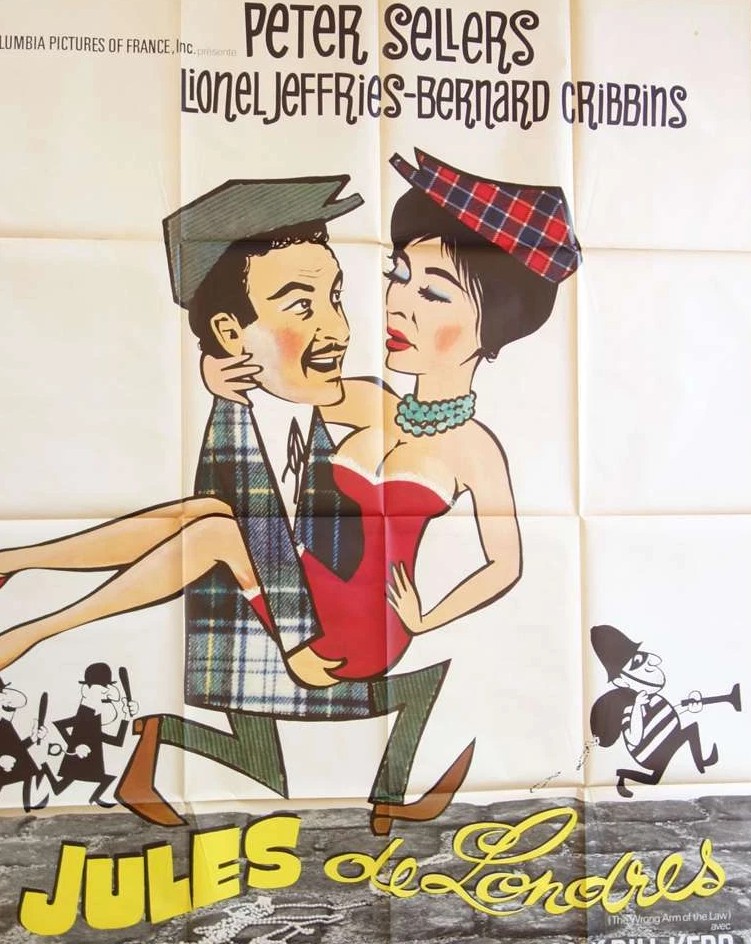
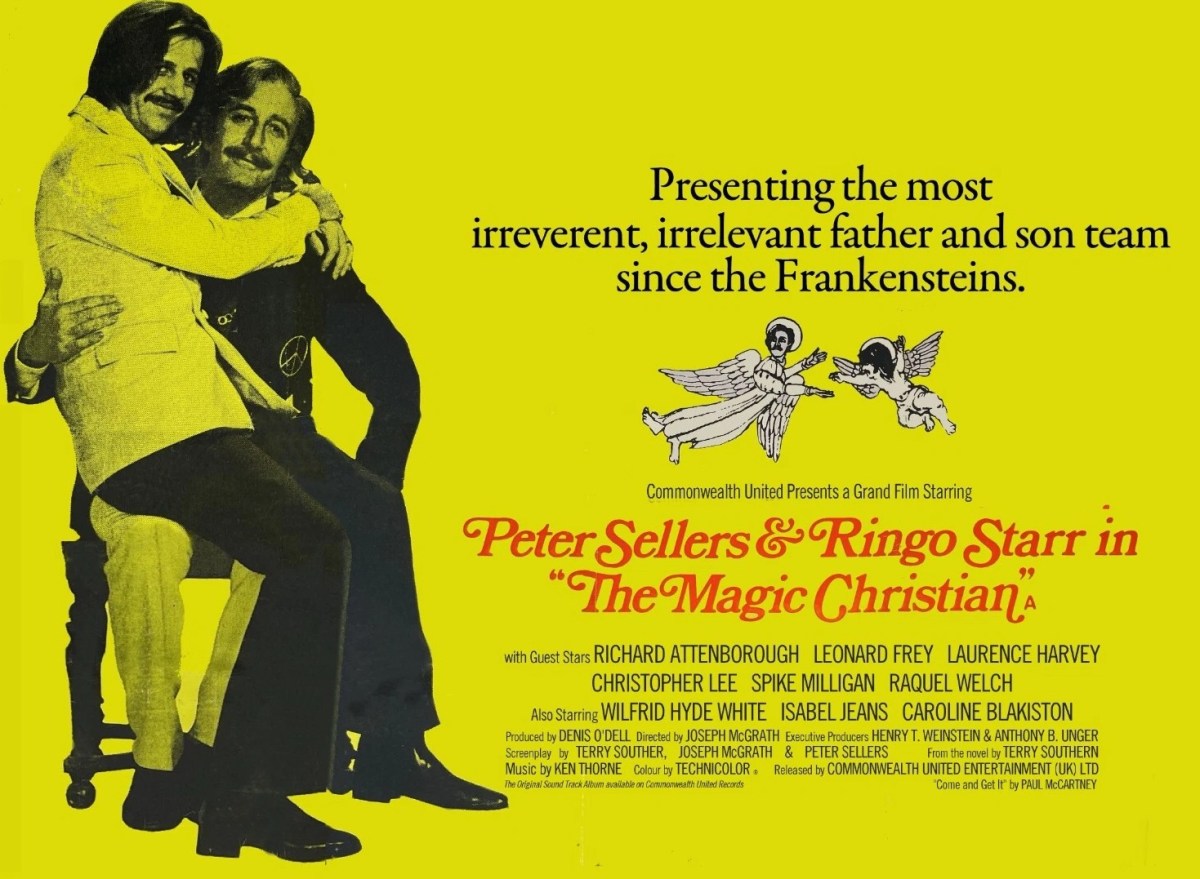
Most of all Sellers (A Shot in the Dark, 1964) hits the mark without a pratfall in sight – the only pratfall in the picture is accorded Harry. Unlike The Pink Panther, Sellers doesn’t have to improvise or be funny. He just follows the script and stays true to his character and the one he has just invented of slick director. There’s even a great sting in the tail.

Sellers shows what he can do with drama that skews towards comedy. Though criticized at the time for, effectively, some kind of cultural appropriation – she was a Swede playing an Italian, what a crime! – Britt Ekland (Stiletto, 1969) is perfectly acceptable. Victor Mature (Hannibal, 1960) has a ball sending up the business as do Akim Tamiroff (The Vulture, 1966) and Martin Balsam (The Anderson Tapes, 1971).

Vittorio De Sica (A Place for Lovers, 1969) does pretty well to merge standard Italian broad comedy with several dashes of satire. The big surprise is that Neil Simon (Barefoot in the Park, 1967) wrote the script, helped out by De Sica’s regular collaborator Cesare Zavattini (A Place for Lovers).

I saw this and A Shot in the Dark on successive nights on Amazon Prime. I hadn’t seen either before. They had been received at either ends of the box office spectrum, the Clouseau reprise a big hit, the Hollywood satire a big flop, so I expected my response might reflect that. But, in reality, it was the other way round. I appreciated this one more.

Go figure.  

Paris When It Sizzles (1964) ***

Screen charisma can only get you so far. The pairing of William Holden and Audrey Hepburn must have seemed certain to create a box office tsunami given they had worked together before on the hit Sabrina (1954) and were coming off hits, the former in The World of Suzie Wong (1960) and the latter having reinvented herself as a ditzy fashion icon in Breakfast at Tiffanys (1961). But clearly studio Paramount knew something about the outcome of this production that it was keeping to itself, otherwise how to explain that a movie completed in 1962 languished on the shelves for nearly 18 months.

By the time it appeared Hepburn was still a big box office noise after Hitchcockian thriller Charade (1963) but Holden’s flame was dying out following three successive flops, The Devil Never Sleeps, The Counterfeit Traitor and The Lion all released in 1962. Had the studio played an even longer waiting game and held off release until the end of 1964 when Hepburn was enjoying sensational success with My Fair Lady, audiences might have been more likely to be suckered in to this romantic comedy. Although whether they’d be any more appreciative is doubtful.

Problem is, the narrative hardly exists. And what remains is too clever by half. It might have appealed as an insight into how Hollywood works, but it lacks backbone and is more of a series of spoofs as we wait inevitably for the two stars to fall in love.

Alcoholic Richard Benson (William Holden) has writer’s block and having frittered away his time drinking, traveling and romancing, now has two days to deliver a screenplay for producer Meyerheim (Noel Coward) – who incidentally seems to spend his time in the sunshine drinking and surrounded by beautiful women. Benson hires typist Gabrielle (Audrey Hepburn) both to speed up the process and have someone to bounce ideas off.

Primarily a two-hander and virtually contained on a single set, his swanky apartment in Paris, it only ventures out to assist his imagination by playing out various concepts in which the pair act out various scenes in what turns into a relatively ham-fisted satire of the movie business. The only really interesting Hollywood expose is when Benson explains the tricks of the screenwriting trade, the various reversals (they were called “switches” in those days) and conflicts to keep the audience on their toes and prevent the potential lovers getting to the actual loving stage too quickly.

So we watch Gabrielle initially fending off his moves before becoming entranced and ridding herself of a carapace of dustiness before transforming into a flighty fun lass. But when the dialog often centers on arguments over the meanings of words there’s not a great deal for the audience to get its teeth into.

The concept, such as it is, allows Richard and Gabrielle to act out various scenarios, rattling through the genres – spies, musical, the jungle, horror, whodunit and western – while they manage to find a way to turn his title The Girl Who Stole the Eiffel Tower into a movie.

Even though the last thing this needs is further levity – any more froth and it would disintegrate – Tony Curtis (The Boston Strangler, 1968) has a recurrent role in a variety of cameos and you can spot an uncredited Marlene Dietrich (Judgement at Nuremberg, 1961) and Mel Ferrer (Brannigan, 1975). Perhaps the most unusual angle was that it was a remake of the French La Fete a Henriette (1952) directed by Julien Duvivier. Or that it was the first screen credit for Givenchy, who devised Hepburn’s clothes.

While both Holden and Hepburn are very easy on the eye, the actor often topless, and Hepburn  going through the fashions, it only works if you want to see screen chemistry at work and are not remotely interested in narrative or if you are so unaware – and of course genuinely interested – in the screenwriter’s craft that you are  find out how words on paper are translated into images on the screen. It might well be an audience’s first encounter with such gems as “Exterior:Day.”

Oddly, both Holden and Hepburn are good and it’s solidly directed by Richard Quine (The World of Suzie Wong) from a script by George Axelrod (Breakfast at Tiffany’s) adapting the previous film.

A harmless trifle, you might say, but just too bad that with the talents involved it doesn’t even rise to a soufflé.

The Way West (1967) ****

How this crispy-told beautifully-mounted character-driven western ever languished among the also-rans is beyond me. I suspect the specter of John Ford hung heavily over it in the eyes of critics at the time but it more correctly belongs to the cycle of Cecil B. DeMille westerns that told stories with a true historical bent. Often detrimentally compared to How the West Was Won (1963), which told a similar tale of endeavor, this movie deliberately lacks that movie’s inflated drama in which every incident was built up, not least influenced by the need for Cinerama effect, rather than seeking an authentic truth.

Plainly put, the difference is here there are no charges, no races, no fording of rivers in the wrong places. Native Americans are treated with respect. Above all, an epic crossing of the continent with fully-loaded wagons is necessarily going to be slow, risk avoided at all costs, and yet this is not without incident or character arc. In fact, the script is terrific, not just dialog that rings true, but among the elements brought into play are male rivalry, clash with authority, guilt, young love, revenge, vision, justice, America in embryo. That the movie maintains a stately pace, no fistfights descending into brawls, and a shock ending indicate a director in charge of his material.

Based on A.B. Guthrie’s Pulitzer Prize-winning novel set in 1843, the first wagon train heads for Oregon under the iron rule of Senator William Tadlock (Kirk Douglas) and guided by a scout with failing eyesight in Dick Summers (Robert Mitchum), both men widowed and in emotional limbo, and in the cantankerous company of Lije Evans (Richard Widmark) and his glamorous wife Rebecca (Lola Albright). There’s a stowaway (Jack Elam), a preacher who can’t afford the price of transportation, an illicit love affair between the vibrant and lusty Mercy (Sally Field) who “hankers after any three-legged boy” but makes eyes at married man Johnnie Mack (Michael Witney), and enough obstacles to keep less determined settlers from reaching their promised land.

Tadlock is the visionary, a politician suffering from an overblown estimation of his self-worth,  who “might have been President except for a woman,” ruthless, valuing only his own ideas. “Point the way,” he tells Summers, “don’t gall me with opinions.” For fear it might interfere with his role as commander, he hides his vulnerability. There’s a plaintive moment when he shares his vision of a city with Rebecca, on the one hand full of his own importance, on the other clearly needing the pat on the back. Later, an occasion of death sees him falling prostate with grief on a grave and on breaking his own laws demands to whipped. The over confident blustering individual is by the end almost suicidal. What is a leader if there is no one to lead?

Summers stoically accepts his infirmity, constantly dropping his head so his eyes are hidden from sight under his hat as if his ailment could be easily detected, mourning the loss of his Native American wife, and while full of Western lore as easily passing on gentle wisdom about love, and his “lucky necklace” to an unrequited lover, but still accused of unworldliness, “for a smart man you ain’t got a lick of sense.”  Evans bristles at any authority, believing independence means he goes his own way, especially if that permits the freedom to get drunk at a time of his choosing, and especially once he realizes such lack of inhibition riles the repressed Tadlock. But his fondness for alcohol triggers an incident that almost costs his son his life.

Celebrations he started catch the attention of the nearby Sioux and in the communal drunkenness a Native American child is accidentally killed. In the best scene in the film battle Sioux seeking justice and intent on attack are thwarted only by the “sacrifice” of the killer.

The picture is packed full of incident, many characters coming alive in a single shot or with one line of dialog. A woman tramps on her husband’s foot to prevent him challenging Tadlock’s authority. A woman with a baby retorts that she is afraid when bolder settlers facing potential Native American attack assert the opposite. The bravest man in the camp, the first volunteer to be lowered down a canyon, dies when his rope snaps.  

There are any number of reversals. Buffalo, instead of being a danger and prone to stampede, create a dust cloud to hide behind. Rivers are crossed at sensible points, rapids avoided. An African American whips a white man. A boy becomes a man through honor rather than violence. Stories, large and small, play out in a succinct script.  

Kirk Douglas (The Arrangement, 1969) is superb as a man whose iron core deserts him. Robert Mitchum (Secret Ceremony, 1969), in almost a supporting role, excellent in full awareness that the sight on which his reputation and job depend will vanish, brings a subtlety to his performance that would be recognized as ideal for Ryan’s Daughter (1970). Richard Widmark (The Bedford Incident, 1965), who is generally simmering, gets to mix in a bit of fun in with the simmering.

Lola Albright (A Cold Wind in August, 1961) swaps seductiveness for sense. In her debut Sally Field (Smokey and the Bandit, 1977), filled with zip and zest, sparkles as the lusty young woman and it’s astonishing to realize she would not make another movie for nearly a decade while another debutante Katherine Justice (Five Card Stud, 1968) finds her inner fire when it’s too late.  There’s supporting talent a plenty – Jack Elam (Once Upon a Time in the West, 1968), Stubby Kaye (Cat Ballou, 1965), Harry Carey Jr. (The Undefeated, 1969) and William Lundigan (The Underwater City, 1962) in only his second film of the decade.

Director Andrew V. McLaglen (The Rare Breed, 1966) captures the correct tone for the film, making up for the essential slow pace with brilliant use of widescreen, coaxing great performances from all concerned. Screenwriters Ben Maddow (The Chairman, 1969) and Mitch Lindemann (The Careless Years, 1957) compress Guthrie’s tome with considerable skill.  

Woefully underrated at the time and since, this deserves reassessment. This is a truer version of how the west was won. And I surely can’t be alone in demanding that McLaglen’s talent be more properly recognized.

You might be interested to know there are two other articles on this film – a “Behind the Scenes” and a “Book into Film.”

Pit of Darkness (1961) ****

Occasionally I get to wondering when one of these British crime B-pictures is exceptionally well-plotted, refreshing and above all logical, whether it might have benefitted from grander treatment Hollywood-style. You could easily see Cary Grant or Gregory Peck wriggling around in this one and with a Grant or Peck involved they’d be accompanied by a glamor puss of the Sophia Loren, Deborah Kerr vintage. And that would put the whole movie in an entirely different light and ensure it wasn’t lost for decades, as was the fate of this one.

What struck me most about the opening section here, an attitude maintained for about half the picture, was that the actress wife Julie (Moira Redmond) of amnesiac Richard (William Franklyn) didn’t believe for a minute his story that he couldn’t remember where he’d been for the last three weeks. There wasn’t an ounce of sympathy. That struck me as an entirely believable reaction. Rather than going all soppy at his return, she reckoned he’d run off with another woman and only came back because the affair had gone sour.  

And it doesn’t help his case that he was found unconscious on a piece of London waste ground where four days before the private detective she had hired to find him was discovered murdered. Then there are the suspicious phone calls, leaving him to deny the existence of anyone called Mavis.

But just when we start to believe him, suddenly we don’t. He seems to be too familiar with the Mavis who calls him and agrees to meet her at a remote cottage. And then we’re back on his side, as he just avoids being blown up in the cottage. But he leaves his hat behind.

And he doesn’t own up to Mavis about being nearly killed and gives a spurious reason for buying a new hat and not keeping the old one. So we’re on her side, something is going on for sure. And then back on his, when someone tries to sideline him in a hit-and-run accident.

In turn, he’s suspicious of everyone, including his wife, and his colleagues at work, especially Ted (Anthony Booth) who seems an unlikely candidate to have won the heart of his delectable secretary Mary (Nanette Newman).

He works for a firm that makes safes and whatever’s going on appears to be linked to a burglary that occurred in his absence involving one of the safes the company made. Eventually, Julie comes round to his way of thinking. Clues lead him to a nightclub, whose mysterious owner Conrad (Leonard Sachs) somehow seems familiar. He encounters Mavis, a dance hostess, and she agrees to help him but when he goes round to her apartment finds a corpse. There’s something distinctly odd going on in the building across the street from his office. On further investigation, he uncovers an assassin. Luckily, our man is armed with the office pistol and the villain is chucked from the roof.

But, still, nothing makes much sense, even though bit by bit memory is returning. He realizes he shouldn’t have been found unconscious on the waste ground, but dead, murder only interrupted by the sudden arrival of a gang of boys.

But in retracing his steps in order to unlock the lost memories he finds himself undergoing a perilous process a second time. He works out that he was kidnapped and locked in a cellar in the club. When he confronts Conrad, that instigates a repeat.

Conrad locked him away and when bribery and the seductive wiles of Mavis didn’t work, Conrad convinced Richard that his wife was in danger if he didn’t go along with the burglary. And Conrad isn’t one to let a good opportunity go to waste, so second time around, using the same threat that worked the last time, he forces Richard to commit another burglary. But this time there’s a catch and one that Richard’s secretary hasn’t known about to pass on to Ted.

So the bad guys are caught, and in the way of the obligatory happy ending the audience is left to assume that the police will ignore his part in the robbery and the death of the man on the roof.

Not just exceptionally well-plotted, but the addition of the marital strife, the suspicious wife, adds not just to the tension but makes it all the more believable and turns the amnesia trope on its head.

Having wished for a Cary Grant or a Gregory Peck, I have to confess I was more than satisfied with William Franklyn (The Big Day, 1960) who managed to look innocent and guilty at the same time. Certainly Deborah Kerr would have managed more in the acerbic look department than Moira Redmond (The Limbo Line, 1968) but I have no complaints.

Interesting support cast at the start of their careers, so Anthony Booth (Corruption, 1968) displays just a hint of his later trademark sarcastic snarl and there’s no chance for Nigel Green (The Ipcress File, 1965)  to put his steely stare into action or effect his drawl. Nanette Newman (Deadfall, 1968) has little to do except look fetching. Leonard Sachs was taking time off from presenting TV variety show The Good Old Days (1953-1983).

More kudos for the script than the direction this time for Lance Comfort (Blind Corner, 1964).

Given it’s from the Renown stable. I would normally have expected to come upon this picture on Talking Pictures TV, so I was surprised to find it as one of the latest additions to Amazon Prime.

First class.

Discover WordPress

A daily selection of the best content published on WordPress, collected for you by humans who love to read.

The Atavist Magazine

by Brian Hannan

WordPress.com News

The latest news on WordPress.com and the WordPress community.