The Strip Tease Murder (1961) ***

A treat in so many ways. A killer who could be the evil twin of Q, James Bond’s gadget supremo. A denouement worthy of Hercule Poirot. A femme fatale whose villainous boyfriend thinks he’s in charge until he learns, to his cost, she’s far smarter. A hero who’s just an ordinary bloke, derided for the most part, who enjoys none of the brio of the good guy who wins out because he can’t get over his loss.

And all this packed into an exceptionally slim running time once you deduct time for half a dozen striptease routines. Given the era the title is bait-and-switch, not much to see here that the censor of the times would permit.
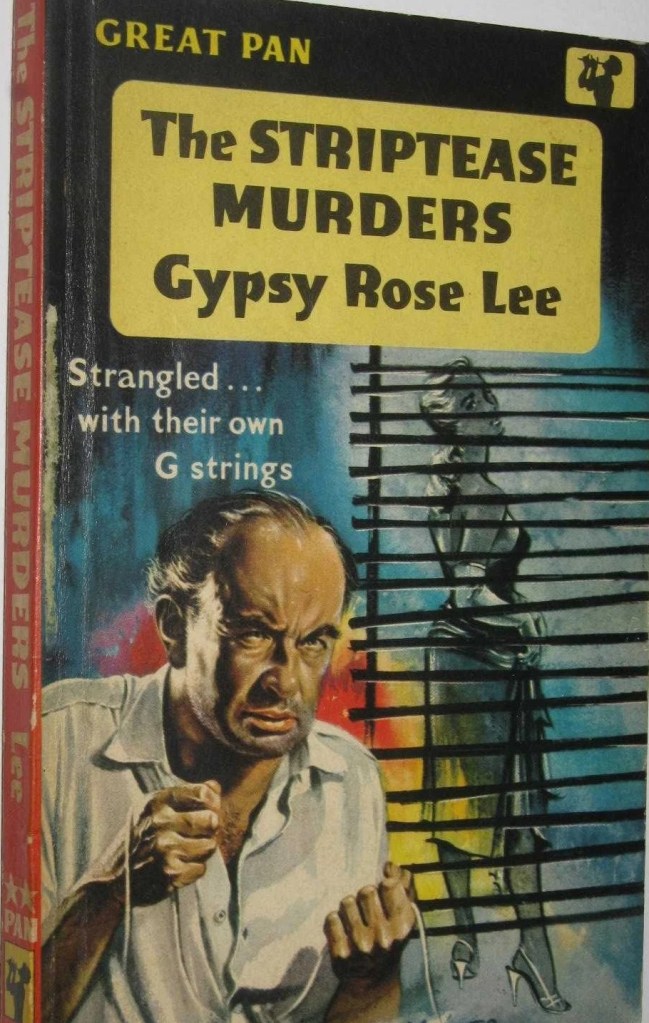
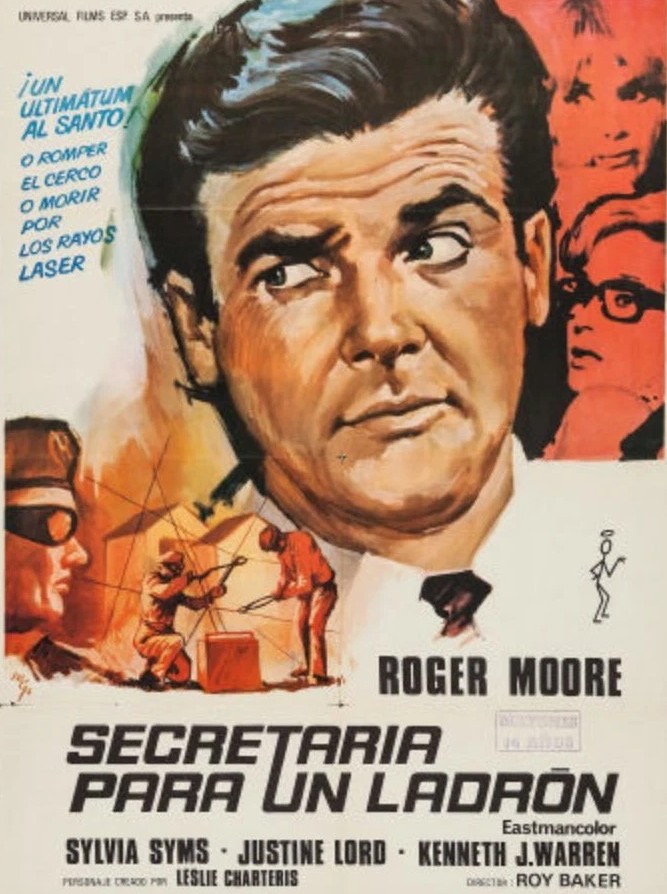
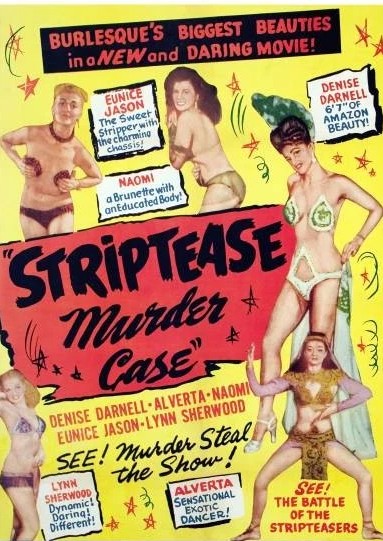
I confess to having employed a bit of bait-and-switch. Neither this illustration – by the world’s most famous stripper – nor the poster at the top are anything to do with this film. In my defence, I couldn’t find a poster or lobby card in color and feared the review would be ignored for that reason.

In The Flamingo Club in London’s Soho, businessman Branco (Kenneth J. Warren) is being blackmailed by former mistress Rita (Ann Lynn), a stripper. What he doesn’t know is that she’s set her sights on more than blackmail and she’s not become his mistress for the few scraps of nice clothing and fancy jewels he can bestow on her. She’s set out deliberately to seduce him so she can get the inside gen on his operation with a view to moving in.

Branco, sensing imminent threat, goes to sound engineer Perkel (Peter Elliott) for the answer. Perkel, in a manner that would delight Q, has rigged up a mic that, via a transistor and remote control, will electrocute the singer at the switch of a button. Only problem is, inadvertently, he kills the wrong girl, Diana (Jean Muir), wife of hapless M.C. Bert (John Hewer), an alcoholic former comedian down on his luck.

The cops aren’t interested in his theories of dirty dealing especially when the autopsy returns a verdict that suggests nothing untoward except bad luck for someone so young. But Bert’s found something unusual. Diana’s corpse is cold except for her ear, which is warm, which gets him to thinking. He tracks down Diana, only to be beaten up by her boyfriend Rocco (Carl Duerring), but when he calls on his inner Poirot he alights on Perkel.
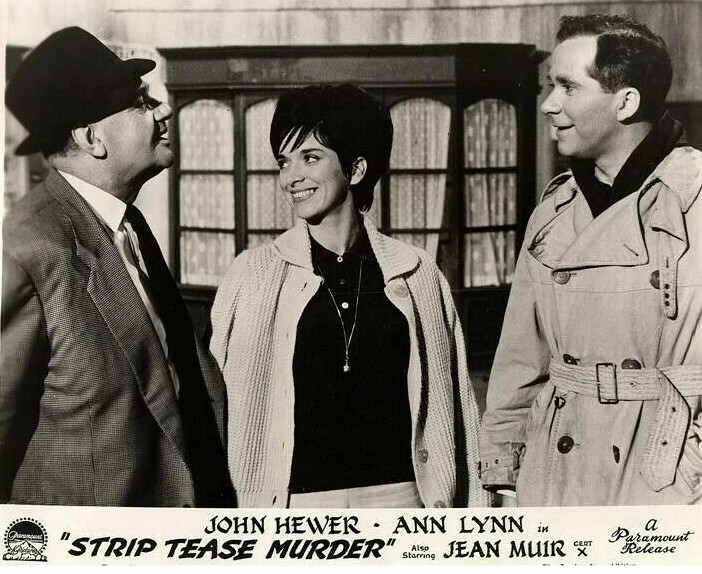
This is the real thing.

Diana reveals her true plan to the astonished Branco, who is shot by Rocco, with the entrepreneurial woman taking over his drug-running operation. Then with the help of the strippers and waiters at the club, Bert brings the villainous trio to the club where he enacts a potential second killing with the cops looking on.

So some very well-drawn characters make this worth more than the meager plot suggests. Perkel is a beaut. It’s worth remembering that Q was hardly a harmless inventor, and that most of his gadgets were meant to kill the enemy, such actions deemed justified because the bad guys are Russians or intent on global domination. Perkel is of the same boastful persuasion as Q, demanding that his ingenuity be recognized, willing to carry out murder for free just for the opportunity of proving that his weapon can kill more than snakes or horses. He is easily flattered and even when being arrested believes the cops are more interested in his invention – who knows, maybe it would end up in Q’s laboratory.

Diana, too, is something of a surprise, shifting from being apparently nothing more than a gangster’s moll to becoming the kind of ambitious gangster her boyfriend could not hope to emulate and more ruthless.

And Bert, while dogged for sure, and dumping the booze after his wife’s death, never finds a moment’s solace. Solving the murder won’t bring back the victim. Unusually, in this respect, reality intrudes in the world of crime fiction.

John Hewer (Three Spare Wives) went on to become a British television fixture, ironically as an M.C., host of variety show The Pig and Whistle (1965-1977). Ann Lynn (Piccadilly Third Stop, 1960) had a more varied career in television and film with a notable turn as the wife with lesbian tendencies in Baby Love (1969). Kenneth J. Warren was the bad guy with too much imagination in The Saint: The Fiction Makers (1968). Peter Elliott (Village of Daughters, 1962) steals the show as the meek killer who thinks genius excuses murder.

This was put together by the Danzigers, American producer brothers, who were prolific creators of B-pictures designed for the supporting feature slot in the days when audiences demanded double bills. Directed by Ernest Morris (Echo of Diana, 1963) from a script by Paul Tabori (Doomsday at Eleven, 1962).

Had this been made today, with hopefully the stripper element not played for exploitation, critics would have been pointing to the unusual depth of character.

It’s short enough to be well worth a look.
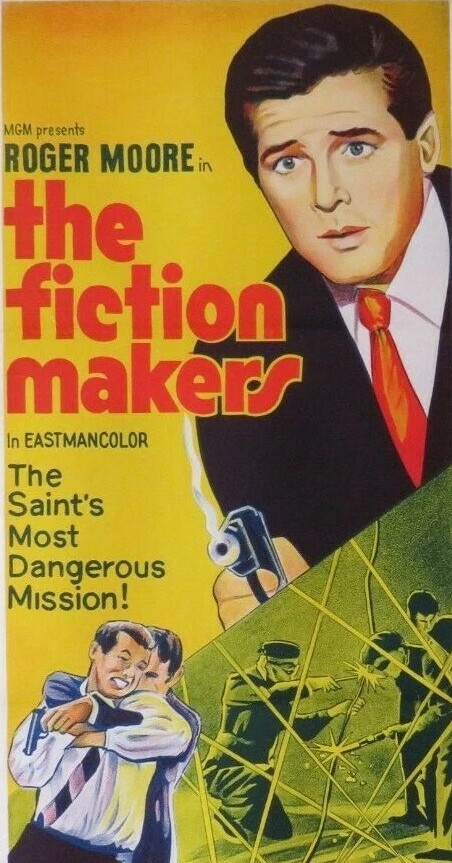
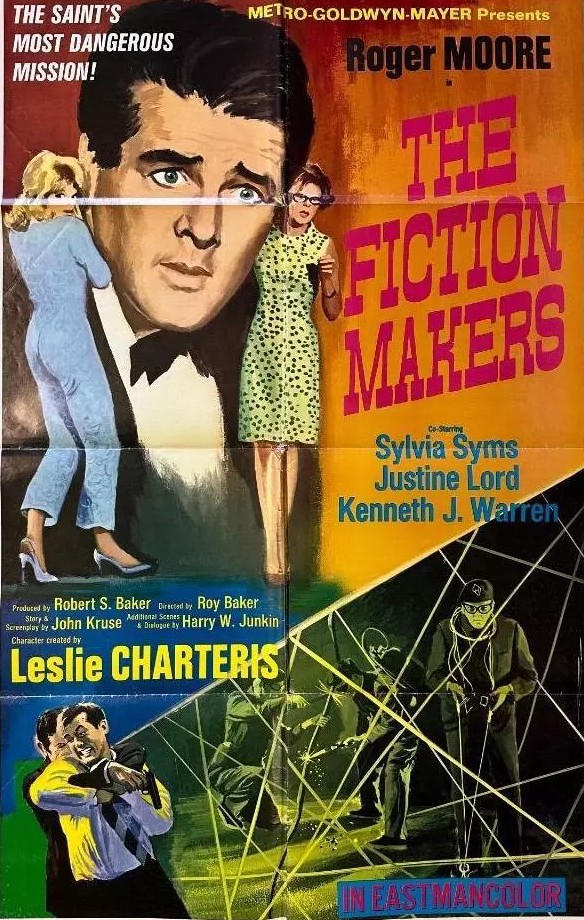
The Saint: The Fiction-Makers (1968) ****

Hugely enjoyable. Takes high concept to the Moon and back. Deliriously wild idea that, as with the best of movies that riff on the imagination, sticks to its own internal logic. The notion sounds so barmy it shouldn’t work – but it does. I enjoyed it even more than Vendetta for the Saint (1969), which it preceded, because it’s a lot more fun.

A criminal mastermind has taken the work of mysterious bestselling thriller author Amos Klein and not only adopted the characteristics of the author’s characters but follows the plot of the books and utilizes many of the clever ideas. For example, the author has invented a second ignition starter button for cars. And also invented a way to stop cars by fitting them with a technological device. People are so taken with being characters in these books that they want to know what happens to them next. I know, shouldn’t have worked, but it does, and it’s not even really set up as fitting into the sci-fi genre any more than James Bond with all its out-of-this-world machines and gadgets is.

Simon Templar (Roger Moore), aka The Saint, is hired to protect Amos Klein whose publisher believes the author is in danger. It doesn’t help that Klein lives in such anonymity that nobody knows the real name, not even the publisher. Turns out she’s a woman (Sylvia Syms), presumably adopting a male name because she writes such male-oriented books, filled with ingenious ideas.

She nearly shoots Templar because he arrives in the middle of her testing out scenarios for her new book – everything she writes has to work and she’s the one that tries them out. Anyway, Templar proves to be little defense against Warlock (Kenneth J. Warren), who has adopted the main villain of her book who runs a criminal organization called S.W.O.R.D. Warlock assumes Templar is Amos Klein and that she is his secretary.

The members of Sword, excepting Warlock, are an indifferent bunch apart from femme fatale Galaxy Rose (Justine Lord) who not only, following the premise of the books, intends to seduce Templar but believes that he, as the author, can alter her future, by making it a plot point in an as-yet-unwritten book that they fall in love that she will then marry him and live happily ever after.

Using Klein’s imaginative brain, Warlock wants the author’s help to plot a major heist from Hermetico, a giant secret vault which is to diamonds what Fort Knox is for gold. Hermetico is thief-proof, packed with amazing security devices including infra-red beams.

Although watched via CCTV cameras, Templar and Klein make a decent attempt at escape from Warlock’s mansion, tunneling upwards if you like, through the ceiling and the roof, clambering down a drainpipe and escaping in the car containing the second starter button, but also the one, it transpires, with the tech device that can stop it.

When they turn up at a remote cottage covered in mud and seeking help, the inhabitants think they are lunatics and delay them long enough till Warlock and his gang arrive to sedate them. Klein is kept prisoner, threatened with laser extinction, so Templar is coerced in assisting in the heist. In fact, Klein has come up with an ingenious method of ensuring they can find their way through the maze of infra-red beams.

This sequence is really well done, especially the method of getting all the gang through once Templar has negotiated it. Using an oxy-acetylene torch, they cut the top off an extractor vent and enter the vault, overcome the guards, and using another clever device one person manages to do something that usually requires two people.

Naturally, Templar is intent on spoiling the operation, which he does, but then has to get back to the mansion before the alarm is raised and Klein is incinerated. There’s a fisticuffs climax and a very fitting payoff for the villain.

I never thought this would work. It seemed such an improbable idea. But then Hollywood’s full of those. The fact that the S.W.O.R.D. gang are entirely believable as physical incarnations of Klein’s imagination is what makes it work. Plus Klein herself. Instead of being the standard moll or helpless heroine of so many spy pictures, she’s central to the story, and halfway between slinky and sensible.

Roger Moore (Vendetta for the Saint) – and his raised eyebrows – is, as usual, excellent in a role that very much suits his screen persona, and Sylvia Syms (Run Wild, Run Free, 1969) has a ball. Kenneth J. Warren (A High Wind in Jamaica, 1965) is given a more varied character than the normal villain while Justine Lord (Night after Night after Night, 1969) exerts a winsome appeal outside her overt sexiness.

Directed by Roy Ward Baker (Moon Zero Two, 1969) from a script by John Kruse (Vendetta for the Saint) and Harry W. Junkin (Vendetta for the Saint) adapting a novel by Leslie Charteris.

This was originally conceived as a two-parter for television that was then released as a movie instead of someone just editing together two random episodes as was usually the case with The Man from U.N.C.L.E.

Talking Pictures has this so check it out.

Discover WordPress

A daily selection of the best content published on WordPress, collected for you by humans who love to read.

The Atavist Magazine

by Brian Hannan

WordPress.com News

The latest news on WordPress.com and the WordPress community.