“MeToo” Warning – The Pressbook for “Claudelle Inglish” (1961)

Unusually timely in today’s MeToo era, the 10-page A3-size Pressbook had a warning for young actresses 60 years ago about the sex predators operating in Hollywood. On the subject of “coping with an amorous male,” star Diane McBain commented: “The first months in Hollywood are likely to be dreadfully discouraging to any girl trying to gain a foothold as an actress. She needs an older person in whom she can confide.” In other words, get yourself a chaperone to fend off the men.

This was somewhat at odds with the tone of the film itself, which suggested that Claudelle Inglish was a male magnet.

The marketing team took the easy way out in selling this picture. Sleaze was the hook with  copy lines and images as the big come-on. Pick of the copy lines: “When she was seventeen there wasn’t a man she’d let near her…When she was eighteen there wasn’t one she’d keep away.”  More in keeping with the actual film was: “She liked boys looking at her…and thinking…and then she’d take her delicious kind of revenge on them all!”

The promotional people did not have much else in the way of ideas, beyond a glamor portrait of star Diane McBain as a means of stimulating a newspaper poll under the title “The Screen’s Most Beautiful Woman?” Another idea was a contest to list movie titles comprising a female name such as Mildred Pierce, Gigi etc. Probably the most original notion was a tie-up with a shoe store since the film’s main character had a predilection for red shoes.

Otherwise the emphasis was on the provocative. Exhibitors were encouraged to use a sidewalk stencil of the “voluptuous young girl”  or arrange a lobby display of all the gifts Claudelle had received from her suitors. Slightly more complicated was getting restaurants involved in a contest where the letters of the character’s name could be used to part-spell out the titles of Erskine Caldwell books.

Author Erskine Caldwell, the all-time best-selling writer in America at that point with  41 million copies in print, was another big selling point. He had also authored other steamy yarns like God’s Little Acre and Tobacco Road and another 36 books besides so his novels were likely to command prime space in a bookstore. Signet had printed a movie tie-in edition that would go on sale in 100,000 outlets.

In terms of star push, the Pressbook concentrated on Diane McBain, promoted as a newcomer, despite having already appeared in Ice Palace (1960) and Parrish (1961) and with an ongoing role in television series Surfside 6 (1960-1962). Exhibitors were informed that McBain had “soared to stardom in little more than a year.” But also that her legs had given her a “big lift up the ladder of stardom” with several scenes revealing those attributes. McBain was only 20 at the time of the film’s release, born in 1941 in Cleveland, Ohio, but already earning money as a model at college. A Warner Brothers talent scout had spotted her on a modelling assignment which led to a role as the grand-daughter of Richard Burton in Ice Palace.

At the other end of the fame ladder, five-time Oscar nominee Arthur Kennedy appeared content to acknowledge that he was “rarely recognized in public” and if so was usually mistaken for someone else. Constance Ford, who played his wife in the picture, had already been paired with the actor three times, previously, twice on stage – Death of a Salesman and See the Jaguar – and in A Summer Place (1959).

There is a sad postscript to this which was pointed out to me by one of my readers. Sexual assault on women is not restricted to the movie industry. In 1982, Diane McBain was raped and attacked in her garage on Christmas Day after she had returned from a party. The culprits were never found. And although she began a second career as a rape victim counselor, she told the Los Angeles Times eight years later: “The shock of what happened caused loss of memory, inability to concentrate and I’m still startled out of all proportion.” (Gerald Peary, “In Search of…Diane McBain,” LA Times, May 27, 1990, 23).

Selling Dick Van Dyke – The Pressbook for “Divorce American Style”

There was a curious dichotomy at the heart of promotional efforts for this picture. On the one hand, theater managers were encouraged to make contact with those affected by divorce, on the other to make a great play of weddings and marriage.

So theater managers were told to contact groups such as Parents without Partners, Children of Divorce, Divorce Reform Groups, Alimony Payers and Family Counsellors. Divorce Parties and Divorce Breakfasts were suggested as other sources of publicity. Free screenings were aimed at couples who could prove they were divorced – presumably, that is, if they could still stand the sight of each other.

“Wedding rings can make a very positive contribution” to a promotional campaign was the other side of efforts to sell the movie. That meant possibly offering a wedding ring as a prize in a competition for divorced couples planning to re-marry…”re-marriage might take place at your theater…but it is not mandatory.” Free tickets could be given to jewelers to hand out to anyone buying an engagement or wedding ring. Another idea was a newspaper article on what divorced women did with their wedding rings after they had split from their partner.

Dick Van Dyke had been named “Screen Father of the Year” by the National Father’s Day committee and he had made a national tour in support of the picture meeting the media in New York, Chicago, Miami, Atlanta, New Orleans. Oklahoma City, Rochester, Washington, Syracuse, Boston and Philadelphia so journalists in those localities were already primed to support the efforts of cinemas. In Dallas, he was met by 1,000 people and later presented with a plaque from the Domestic Relations Court because “the ideals of the film serve as a deterrent to divorce.”

Unusually, the fashion boost this time focused on the male. Jason Robards had turned himself into a male model for Ratner California Clothes with advertisements appearing in Gentlemen’s Quarterly. Equally unusual was a suggestion to tie up with a local hypnotist – a scene in the picture involves Pat Collins’ nightclub act.

Van Johnson played a used car dealer in the film so they were also targeted for joint promotions or car parades. Bowling alleys, too, since that form of leisure activity featured in the film. On a more straightforward note Popular Library had produced a novelization and United Artists the original soundtrack album by Dave Grusin.

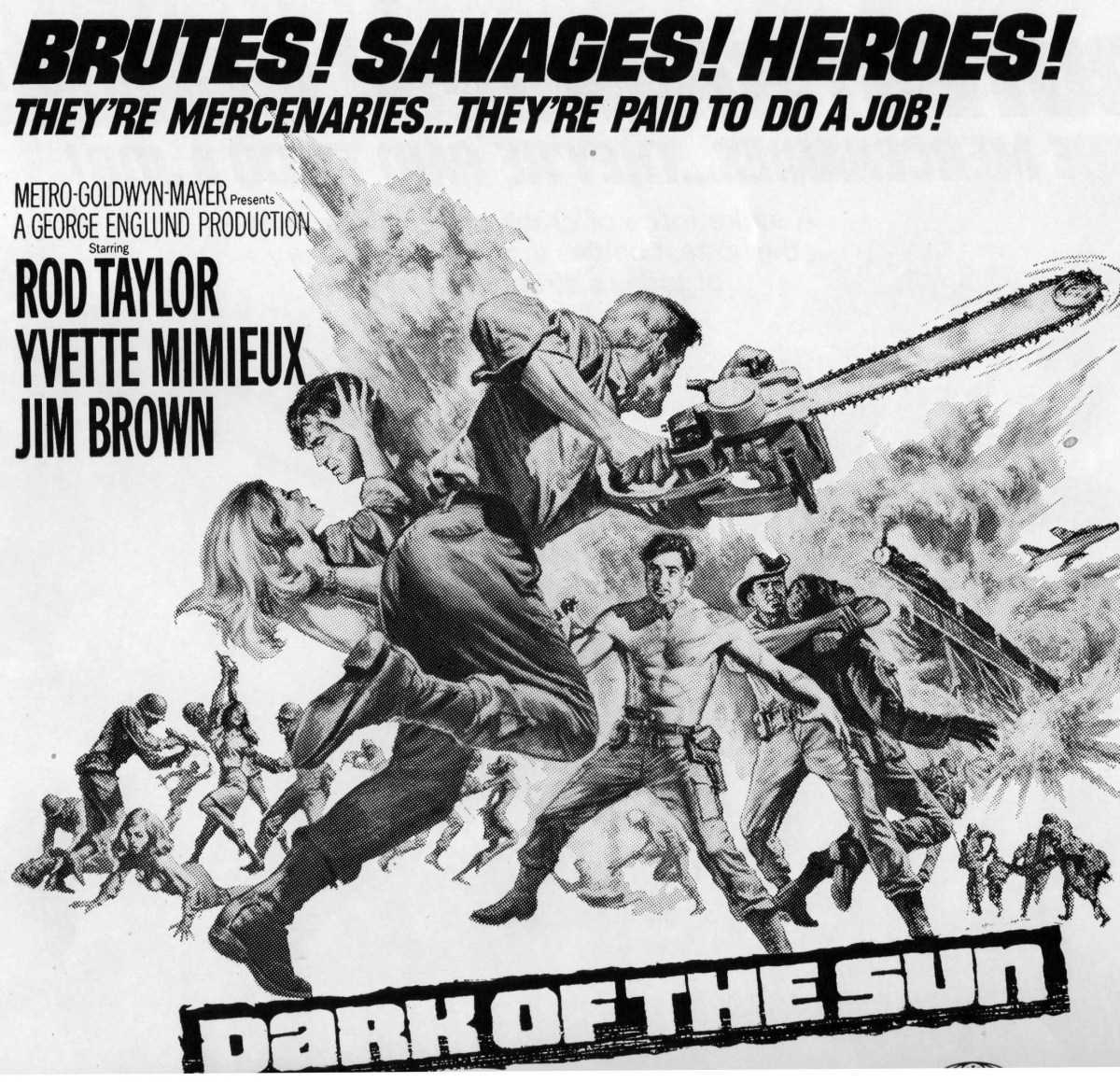
Behind the Scenes: Selling Tough Guys – The Pressbook for “Dark of the Sun”

Mercenaries rampaging through strife-ridden Africa, chainsaw the weapon of choice, marketing to The Dirty Dozen crowd a formality, but how do you interest the rest of the paying public?

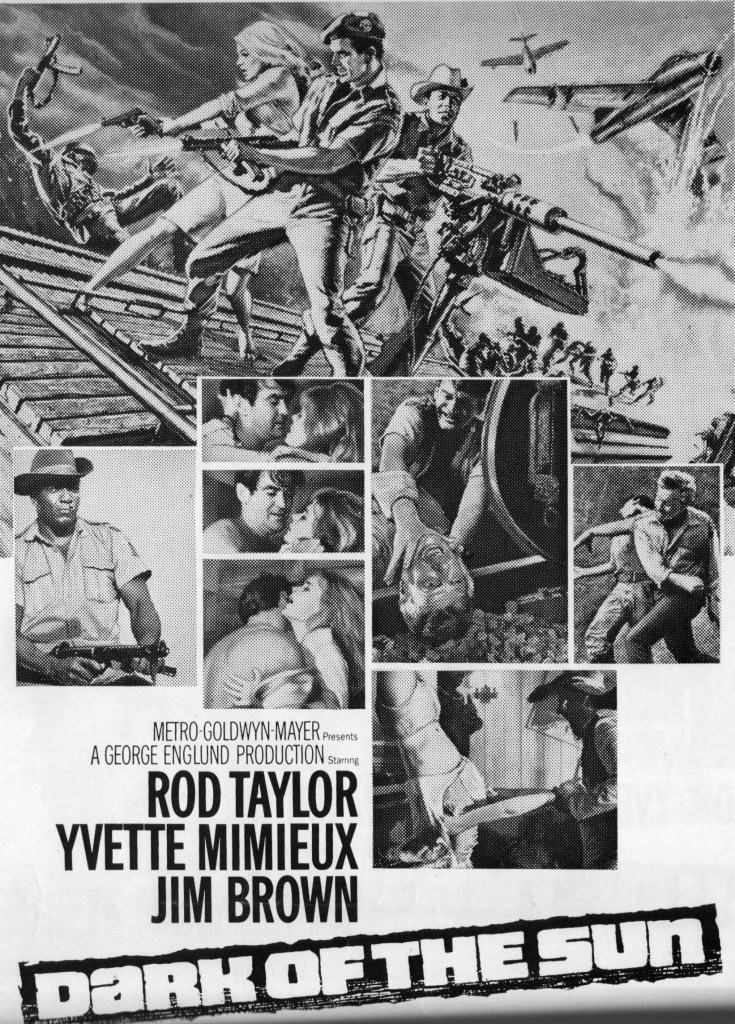
“Bright ideas to boost your box office” as computed by the MGM marketeers in the Pressbook fell into four categories: fashion, jungle, diamonds, and military. Oddly enough, the pick of the bunch was fashion. And not what the chic mercenary was wearing. Instead, the focus was on Yvette Mimieux who “took time off” filming to “model sensational creations by Dorothy McNab of Jamaica Fashions.” This picture is set in the Congo and Jamaica is about 3,000 miles away across an entire ocean so where did Jamaica come into it? Well, it was shot in Jamaica and that appeared excuse enough, and it was hoped that cinemas would link up with department stores showing the seven outfits modelled ranging from casual to elegant evening wear.

Creative license was used here for Mimieux never fought side by side with Taylor and Brown on the top of the train.

The jungle seemed a safer bet so managers were encouraged to kit out doormen and usherettes in jungle outfits while tropical plants and foliage and possibly tropical birds could turn the lobby into a jungle paradise. Local military Army reserve or National Guard units could be persuaded to lend military equipment to add to the display and, as a longer shot, recruitment agencies might choose to get involved. Since the main thrust of the picture involves diamonds the marketeers suggested linking up with large jewelry store chains to give away cheap industrial diamonds prior to launch or as a competition.

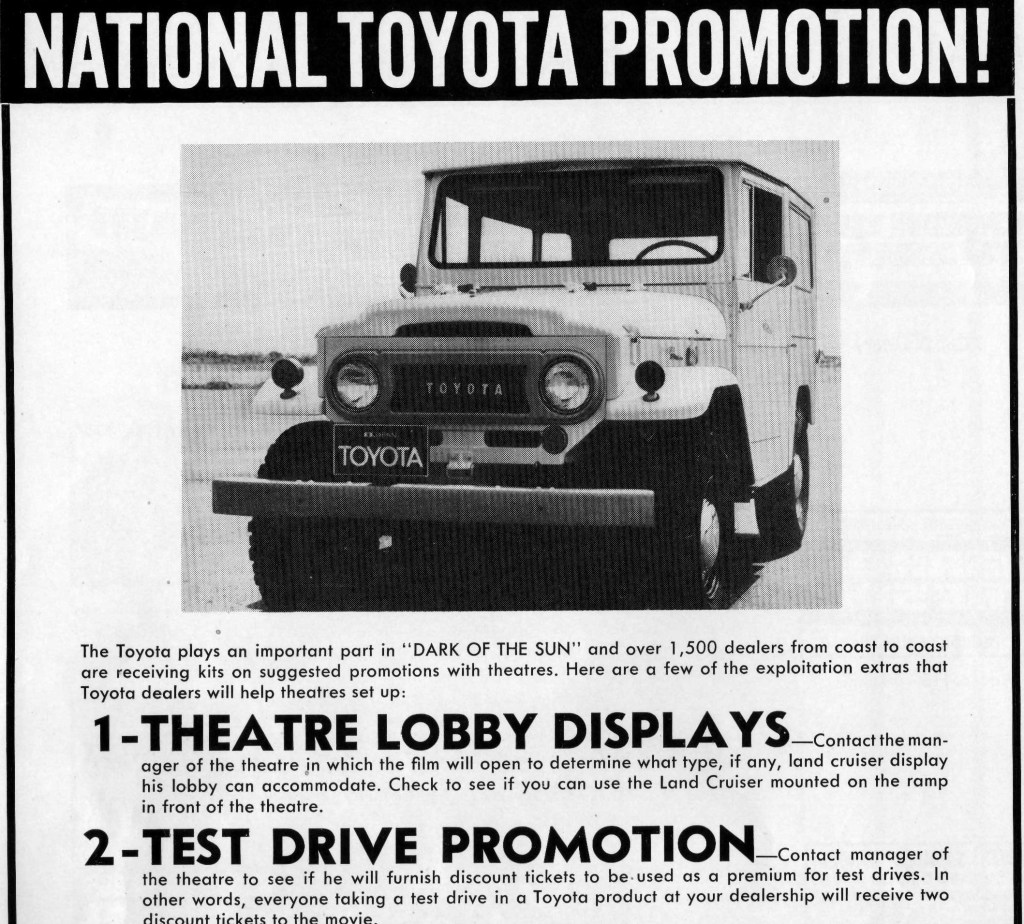
Since Toyota land cruisers play a significant part in the movie, MGM had set up a promotional tie-in with 1500 dealers coast to coast with the potential for one of the vehicles mounted on a ramp in front of the theater drawing attention both to the picture showing inside and the car itself. In addition, discounted tickets to members of four-wheel drive clubs might bring in customers. More standard material included an original soundtrack album and a paperback book.

Much of a Pressbook’s job was to provide snippets of information that could be fed to local journalists. Former boxer Rod Taylor did some of his own stunts, 6-foot 3-inch 240lb former gridiron star Jim Brown needed his own bed flown in to location, the temperature was so high the actual film had to be cooled down in giant vats of ice, and certain sequences used live bullets. The giant steam locomotive was a “55” built in 1902 and brought out of retirement.

And there was no shortage of usable quotes. “I don’t believe in love at first sight,” commented Mimieux; “I was warned off directing by some of the finest directors in the business,” said director Jack Cardiff.

Discover WordPress

A daily selection of the best content published on WordPress, collected for you by humans who love to read.

The Atavist Magazine

by Brian Hannan

WordPress.com News

The latest news on WordPress.com and the WordPress community.