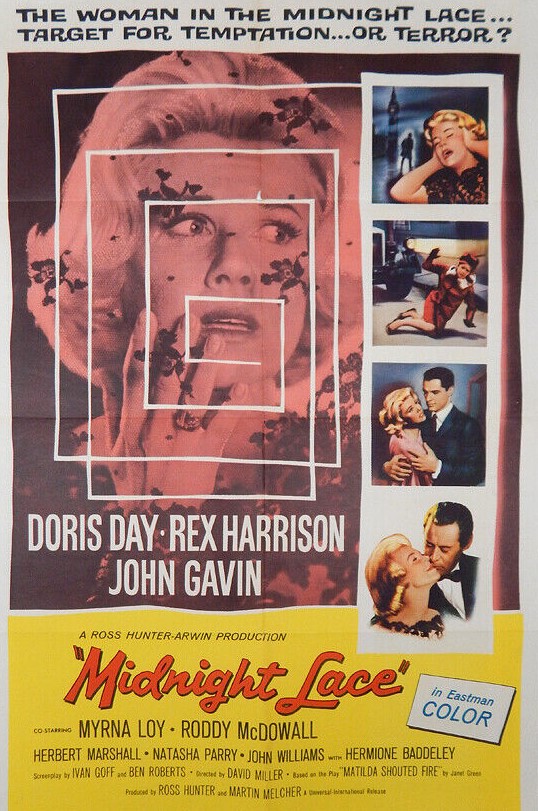
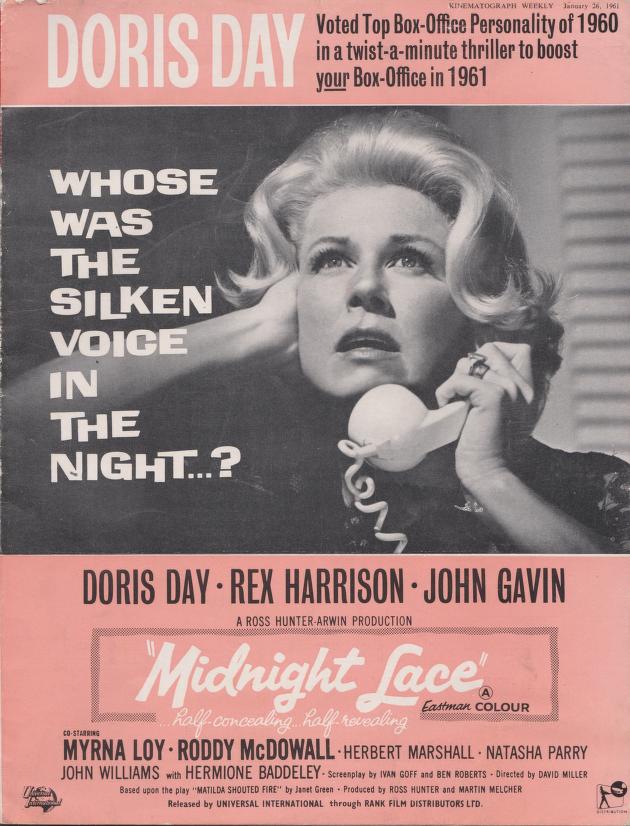
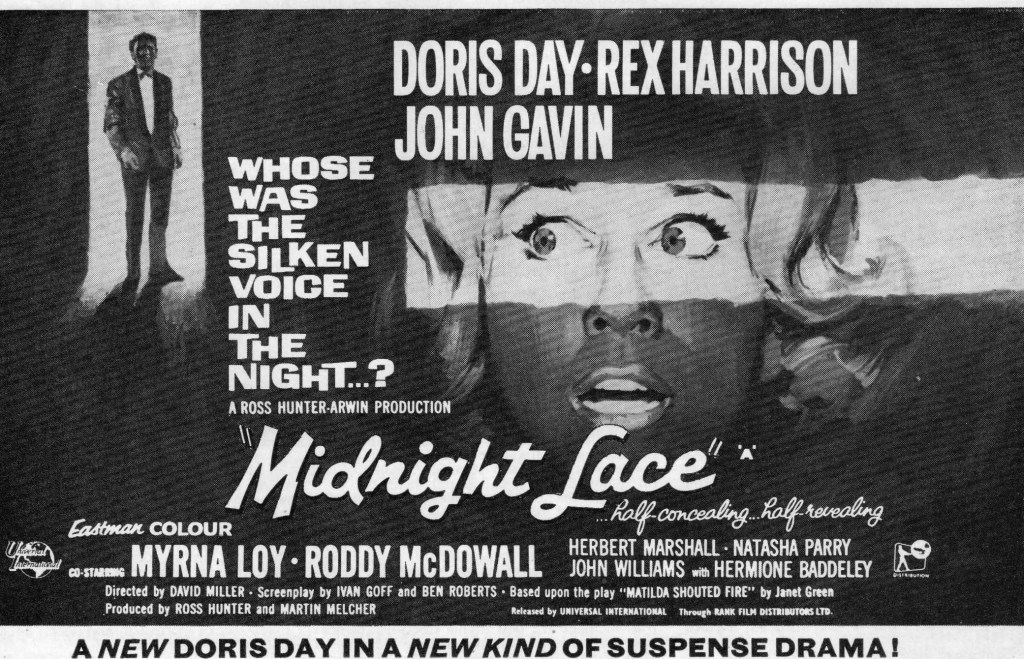
Works for the very reason that it shouldn’t – Doris Day’s off-the-scale hysteria. The actress junks her usual screen persona of spunky occasionally lovelorn heroine and channels her abundant physical energy into an exceptionally good portrayal of a woman on the verge of a nervous breakdown.
And, unlikely as it sounds, this a companion piece to David Miller’s later Lonely Are the Brave (1962),which equally presents a discordant character at odds with their surroundings whose inability to settle into the norm precipitates downfall.
Heiress Kit (Doris Day) is being hounded mainly over the telephone by a creepy stalker with a high-pitched voice, threatening to kill her. Before you can say Gaslight, you are casting a suspicious eye on millionaire businessman husband Anthony (Rex Harrison). But that only lasts for as long as it takes for a whole bunch of other suspects to hove into view.
The sinister man in black hat and coat appears too obvious a contender. Others have something off about them or appear at the wrong time and wrong place. Unemployed ne’er-do-well Malcolm (Roddy McDowell) who sponges off his mother, attempts unsuccessfully to tap Kit for funds and makes it plain he won’t be doffing his cap to her. Builder Brian (John Gavin) is over-friendly and, we overhear, makes a lot of phone calls.
And you wouldn’t count out gambler Charles (Herbert Marshall), an executive in Anthony’s firm, which, by the way, has uncovered a bit of fraud. Nor happily-married Peggy (Natasha Perry), Kit’s friend, who turns up in a bus queue the very moment Kit nearly ends up under the wheels of a London bus. And then there’s Aunt Bea (Myrna Loy) who’s arrived from America and seems determined not to take Kit’s side.
Naturally, nobody can allay Kit’s suspicions. The police are the first to suggest she’s going off her head, seeking attention because neglected by her husband.
But this is so well done, Kit jumping at the slightest noise, that you are pretty much convinced it’s going to be one of those films where every incident is imagined, especially since that would be a helluva coup to have an actress of the lightweight caliber of Doris Day to play her.
Whenever anyone else answers the phone it’s to an innocent caller. And when Kit persuades Peggy to pretend she heard the voice, discovery of that ruse appears to seal her doom.
When we’re not stuck in Kit’s head, there are sufficient tense moments to keep the plot ticking along, trapped in an elevator, shadows on a ceiling, faces glimpsed in windows, voices appearing out the fog, whispers behind her back, friends turning against her, every police ploy a dead end.
Quite why she’s such a giddy character to begin with is never explained, except of course being a millionairess, three months married, with nothing better to do with her time than waltz around in one stunning fashionable outfit after another, life a succession of expensive treats, and whisked off her feet, when he can spare the time, by adoring hubby.
So maybe it’s something as simple as a loved-up wealthy woman finding cracks appearing in her perfect life and in trying to ascertain the cause whirling round faster and faster. There’s certainly no sense of a solid character who could sit down and give herself a good talking-to or transform herself into an amateur sleuth. When the façade breaks, it’s a dam burst.
If at the beginning Doris Day seems already too-wound-up it doesn’t really matter, her lust for life turns very quickly into abject fear as the terrorization becomes only too real. This is a fantastic performance from the actress, woefully under-rated, and the scene where she collapses on the stairs is only too believable.
Rex Harrison (The Happy Thieves, 1962) is excellent in a custom-made role, handsome adoring husband, but every time he clasps her in a sympathetic embrace, the camera lingers on his eyes showing growing fear at her condition. The roster of supporting stars each brings something distinctive to their role, from the wheedling Roddy McDowell (Five Card Stud, 1968), in only his second movie role after eight years of solid television, the too-good-to-be-true John Gavin (Back St, 1961) and old-timers Myrna Loy (The Thin Man, 1934) as the doubting aunt and Herbert Marshall (The Letter, 1940) as the impecunious gambler.
Director David Miller (Captain Newman, M.D., 1963) moves the camera in disconcerting fashion. You think you’re settled in for a stage-style scene when suddenly the camera whirls away and focuses on one character. The scene in the elevator is exceptionally well-done as is the finale, but possibly his biggest attribute is encouraging Doris Day to just go for it rather than reining in her character the way Hitchcock did for The Man Who Knew Too Much (1956).
The team of Ivan Goff and Ben Roberts (Portrait in Black, 1960) put together the screenplay from the hit Broadway play Matilda Shouted Fire by Janet Green.
I came at this with low expectations, not imagining Doris Day could pull off such a difficult role, and I came away wondering why she had not in consequence been given other opportunities to show off her dramatic skills.
Poverty is hardly an attractive movie subject. But in the light of Where the Crawdads Sing being accused of Hollywoodizing poverty, this is far grittier reminder of the grim reality.
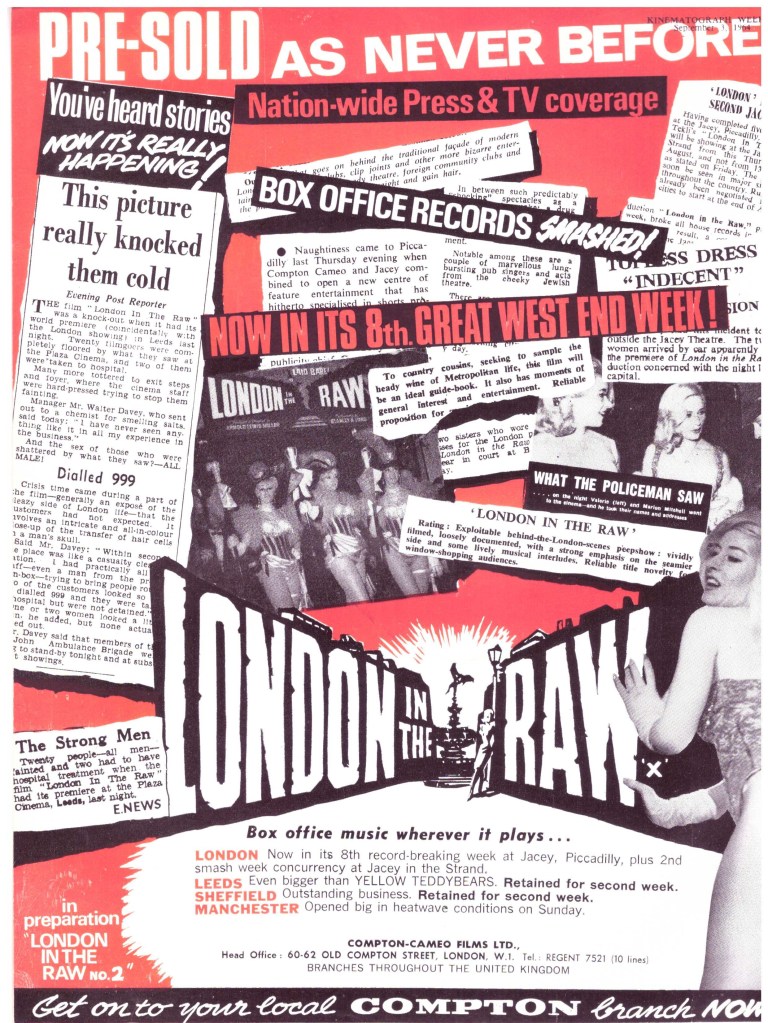
Unexpectedly, documentaries hit a rich box office seam in the 1960s. But these were not the earnest features of the Man of Aran (1934) variety that elated the arthouse crowd or even Disney’s humor-leavened True-Life animal tales. No, documentaries in this decade mainlined the exploitative vein. West End Jungle (1961), Mondo Cane (1962) and London in the Raw (1964) had a very high cost-to-profit ratio.
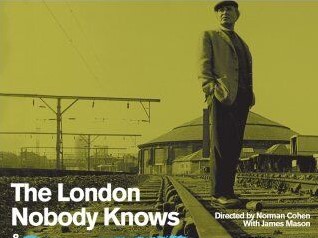
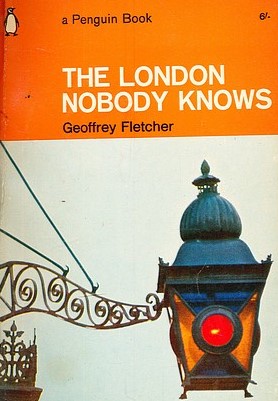
The London Nobody Knows does not appeal to the prurient. It is a gritty riposte to the Swinging Sixties tourist-bedazzled London of Carnaby St fashion, pop music, red buses, Buckingham Palace and Big Ben. But to lure in an audience the camera intially focuses on the kind of travelogue that purports to show the different side to a well-known locale, before it delves into the terrible poverty which sections of the population could not escape.
Fronted by an actor – unusual then but standard now – in James Mason (Age of Consent, 1969) it begins with a diatribe against the way modern soulless architecture has destroyed significant parts of traditional London, ignoring for the most part that it swept away slums. The actor, bedecked in tweed jacket, polished brown shoes, flat cap and rolled-up umbrella, is in sharp contrast to the often decayed parts of the capital he strolls round.
Initially, what he turns up is almost quiz-question material. A victim of Dr Crippen who had a connection to the abandoned Bedford music hall theatre, home to giants like Marie Lloyd and where artist Walter Sickert was an avid attendee, the backyard in Spitalfield where Jack the Ripper disposed of one of his victims. We visit Clink St, site of a famed prison, which gave its name to “the clink,” and the Roundhouse Theater, originally a turntable for railway engines. Near the Savoy a man goes through the act of lighting a street gas lamp.
There’s a now-defunct egg-breaking plant, a business that carried out that chore on an enormous scale for chefs, and various bustling markets a-brim with the range of fresh food – eels squirming in their tanks, piles of fruit and vegetables – we only see these days in European or Asian markets. And there’s a look in passing at the type of fashions on parade when people don’t have a personal dresser, strange mixtures of outfits that were all the rage.
And then we come to the grim heart of forgotten London, a land of forgotten people, the homeless or near enough. Homelessness was not the issue it is now. The BBC play Cathy Come Home (1966) made a star out of Carol White, triggering a debate on the issue, highlighted by the formation the same year of homeless charity Shelter. But Cathy Come Home hardly touched the surface and after all it was fronted by a glamorous star.
There’s nothing glamorous about the awful, defeated often toothless faces here. Loss never looked so raw. Some don’t even find a park bench to spend the night but sprawl on the grass or fall asleep standing up leaning against a wall. Nothing so temporary as even a cardboard box available.
Others eke out a living as buskers – again, not the acceptable occupation it is now – a man dressed in a pirate outfit doing a demented tap dance. Some are not quite homeless, living in a shared dormitory on bunk beds in a Salvation Army hostel for six shillings and sixpence a night (a third of one pound sterling) or if they are flush a private room for 63 shillings a week.
Mention when seeking employment that your abode is the Salvation Army Hostel and you’ll never be offered a job. It’s a stigma. The sole perk here – what with spitting and drinking and gambling outlawed – is breakfast, but comprising porridge or fried egg, tea and two slices of toast, a meager repast by Full English standards.
The alcoholics drink something blue – methylated spirits probably – but the last vestiges of hope disappeared long ago except for one forlorn aged tramp who aims “to see if I could better myself…in a better way.”
The camera lingers on lived-in faces as though this was not a motion picture but the work of a photographer recording for posterity lives long worn away.
Oddly enough, there’s none of the self-pity that would predominate today. And there’s no blaming either. Circumstances are not investigated, though it’s obvious most took a wrong possibly alcoholic turn in their lives, were once gainfully employed but through unemployment were at the mercy of a system that didn’t yet exist to sustain them through this kind of tribulation.
Irish director Norman Cox had previously worked uncredited on London in the Raw, but the success of his mainstream breakthrough, the movie adaptation of television comedy series Till Death Us Do Part (1968), probably gave him carte blanche to undertake this though nothing else in his later portfolio – Confessions of a Pop Performer (1975), Stand Up Virgin Soldiers (1977) – approached this depth. Geoffrey Fletcher wrote the screenplay based on his own book published in 1965.
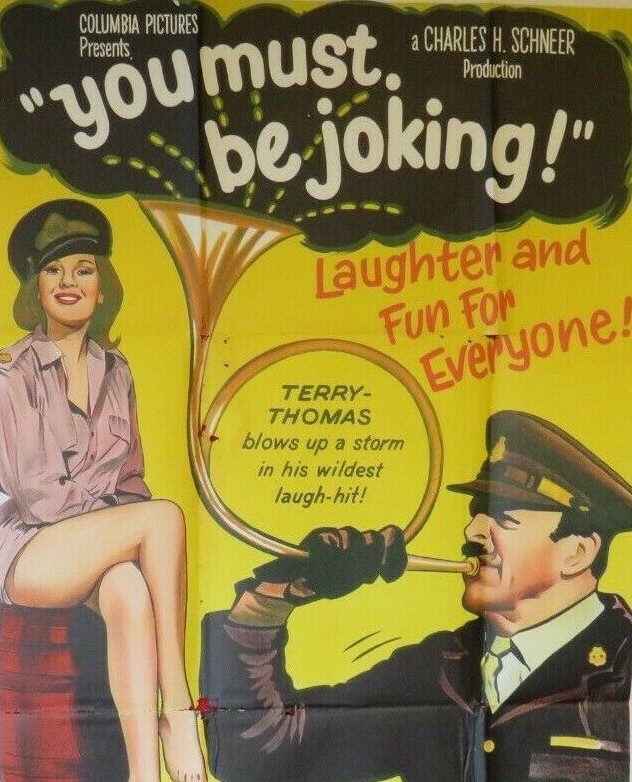
British thriller specialist Michael Winner (Death Wish, 1974) learned all about structure churning out low-budget comedies like this unusually contemporary number. A precursor of the reality television trope of a variety of characters in competition to complete a series of odd tasks, this has a military set-up, aiming to find, oddly enough in an organisation where strict hierarchy dominates, people capable of bending the rules. Initiative, in other words.
Some of the motley crew, of course, have no intention of bending any rules if they can get everyone else to do the work for them, namely upper-class Capt Tabasco (Denholm Elliott) who gets the game rolling by calling in a helicopter as a favor from an old school chum to rescue him from a maze, the first task. He spends most of the time pampered in a hotel suite while dispatching girlfriend Poppy (Tracy Reed) on various expeditions.
Saved by the double bill: Winner’s comedy found a bigger audience by being booked as the support for hit “Cat Ballou.”
There’s a Yank involved, of course, to target the all-important American market, Lt Tim Morton (Michael Callan) also using assistance in the form of upmarket girlfriend Annabelle (Gabriella Licudi) whose specialty is causing vehicle pile-ups. We’ve got a whisky-drinking Scot, Sgt Major MacGregor (Lionel Jeffries), stiff upper back rather than stiff upper lip with his constant snapping to attention, and two graduates from the Army Hapless Division in Sgt Clegg (Bernard Cribbins) and Staff Sgt Mansfield (Lee Montague). Directing proceedings are Major Foskett (Terry-Thomas) and General Lockwood (Wilfred Hyde-White), at opposite ends of the character arc, the former frantic, the latter laid back.
A couple of the five tasks involve unravelling clues, finding a particular rose, for example, but the whole purpose of the exercise is to have the soldiers constantly getting in each other’s way, trying to outwit one another, falling into bizarre scenarios – a fox hunt the cleverest – and generally getting all muddled up one way or another, so that initiative is the last thing they display.
What the movie does have in abundance is imagination, otherwise how to explain the involvement of a seductive housewife, pop star, television show, tunnelling, Lloyd’s of London, Rolls Royce and a greyhound racetrack. On the other hand this might be a smaller-scale precursor to If It’s Tuesday, It Must Be Belgium (1969) in shovelling together all sorts of British institutions and tourist attractions. And certainly Capt Tabasco with his love of the finer things of life demonstrates just how much fun it can be to be British if you’re upper class, wealthy, went to the right school and are not above a bit of blackmail.
As you might expect, the pace is hectic, which is just as well, because if you stopped to think about what was going on you might well throw in the towel. That’s not to say it’s not enjoyable in a riotous sort of way, running jokes almost in a separate competition of their own, and if you always hankered to see Michael Callan’s dance moves this is for you – suffice to say he’s not in the Fred Astaire class. But everyone here is there to be made a fool of, except Capt Tabasco, who rises above it all in classy fashion and when he’s out for the count appears blessedly delighted.
Denholm Elliott (Station Six Sahara, 1963) comes off best, testing out his lazy scoundrel, but the top-billed Michael Callan (The Interns, 1962) might never have signed up if he’d known the consequence was being relegated to television for seven years. However, given we are well accustomed to the shtick of the likes of Bernard Cribbins (The Railway Children, 1970), Lionel Jeffries (First Men in the Moon, 1964), Terry-Thomas (Bang! Bang! You’re Dead! 1966) and Wilfred Hyde-White (The Liquidator, 1965), he does at least have the advantage of standing out, if only as a novelty.
And just in case the goings-on don’t hold your attention, Winner has recruited a platoon of top British stars in bit parts including Leslie Phillips (Maroc 7, 1967) and James Robertson Justice (Guns of Darkness, 1962) and rising stars such as Tracy Reed (Hammerhead, 1968), Gabriella Licudi (The Liquidator) and Gwendolyn Watts (The Wrong Box, 1966) and future British television treasures Clive Dunn (Dad’s Army, 1968-1977), Richard Wattis (Copper’s End, 1971) and Peter Barkworth (Telford’s Change, 1979). So if you get fed up trying to work out what’s what you can play who’s who.
Alan Hackney (Sword of Sherwood Forest, 1960) wrote the screenplay based on a story by director Winner.
Not non-stop hilarity but definitely non-stop something with a good few chuckles thrown in.
How is that the British, way down now in the rankings of global movie production, have come up with a successful genre all of their own – the national treasure. Maggie Smith and Helen Mirren to be sure first came to prominence in the same year, 1969, with The Prime of Miss Jean Brodie and Age of Consent respectively, but whereas Hollywood has turned its back on the ageing female contingent, the British film industry has wrapped its most famous stars in cotton wool and proceeded to give them roles they can take to the Oscar bank.
Mirren was in her early 60s when she romped home in The Queen (2006); you only have to say Downton Abbey and Smith, already two Oscars to the good, is regarded as screen royalty. And that’s before Judi Dench enters the equation, a few years older than Mirren when she nabbed the Oscar for Shakespeare in Love (1998). You can pretty much count on getting funding for any picture if you can rustle up any of this trio. Want to bring back the older crowd? Dangle these carrots!
Elevated into this category now is Lesley Manville, the 66-year-old star of the delightful Mrs Harris Goes to Paris. While largely escapist, there’s enough of a contemporary vibe, a Paris redolent of filth, the downtrodden going on strike, to provide an edge, and a narrative that continually punctures dreams any time fantasy looks like running away with itself. Set in 1950s London and Paris where the poor know their place, and are rigidly kept in it by the arrogant rich, but where aspiration can at any moment take flight.
Cleaner Mrs Harris, dreaming of buying a £500 dress – we’re talking the best part of £14,000 these days – scrimps and saves, and through a couple of more than fortuitous events, finds her way to the House of Dior where she is despised by haughty manager Claudine (Isabelle Huppert), adored by philosophic model Natasha (Alba Baptista) for having such aspirations, and manages to cast a spell, although not for the reasons expected, over rich widower the Marquis de Chassagne (Lambert Wilson).
There’s not much plot. She has to remain in Paris for a fortnight for fittings and whiles away the time helping along the romance between under-manager Andre (Lucas Bravo) and Natasha, assisted by their existentialist leanings, eventually overcoming hostility and putting everything to rights in the Dior empire. But you don’t need plot when you’ve got charm. The English notion of fair play initially comes a cropper when facing French egalitarianism out of whack, when the rich can jump the queue and basically make everyone jump to their tune. But when a character like Mrs Harris settles for second best you can be sure she’ll come up trumps. Whether it’s icing on the cake or to make a rubbish-strewn Paris more palatable, there’s a good ten minutes of oo-la-la devoted to parading the latest fashions.
Not content with conquering one city, Mrs Harris developed sequelitis and headed for New York.
And there’s not just a philosophical undertone – people not what they appear on the surface – but a feminist one, women holding the world together while men whistle. But by and large it’s joyous entertainment, a confection straight out of the Hollywood top drawer, a poor woman having her day in the sun through sheer strength of character.
Unless you’re British or a big fan of arthouse director Mike Leigh or noticed her Oscar nomination in the largely unnoticed The Phantom Thread (2017) Lesley Manville will probably have passed you by. She nabbed a cult following as the dumped-upon lead in comedy series Mum (2016-2019) and picked up a wider audience as Princess Margaret in The Crown, but mostly she’s known for a certain kind of acting, where she can change expression 20 times in a minute without ostensibly doing anything different. Just like her predecessors, Smith, Dench and Mirren.
You can’t take your eyes off her, which is quite feat when she’s up against French screen royalty (perhaps a “tresor national”) Isabelle Huppert (Elle, 2016). Alba Baptista (Warrior Nun series) could well be the breakout star here though Lucas Bravo definitely runs her close. I saw Bravo in Ticket to Paradise (2022) and the characters there and here could not be more different. Ellen Thomas (Golden Years, 2016), Lambert Wilson (Benedetta, 2021), Anna Chancellor (For Love or Money, 2019) and Jason Isaacs (Operation Mincemeat, 2021) have smaller roles.
Director Anthony Fabian (Skin, 2008) adds deeper issues to a movie that was crying out to be all surface. He co-wrote the screenplay with Carroll Cartwright (What Maisie Knew, 2012) based on the classic Paul Gallico novel.
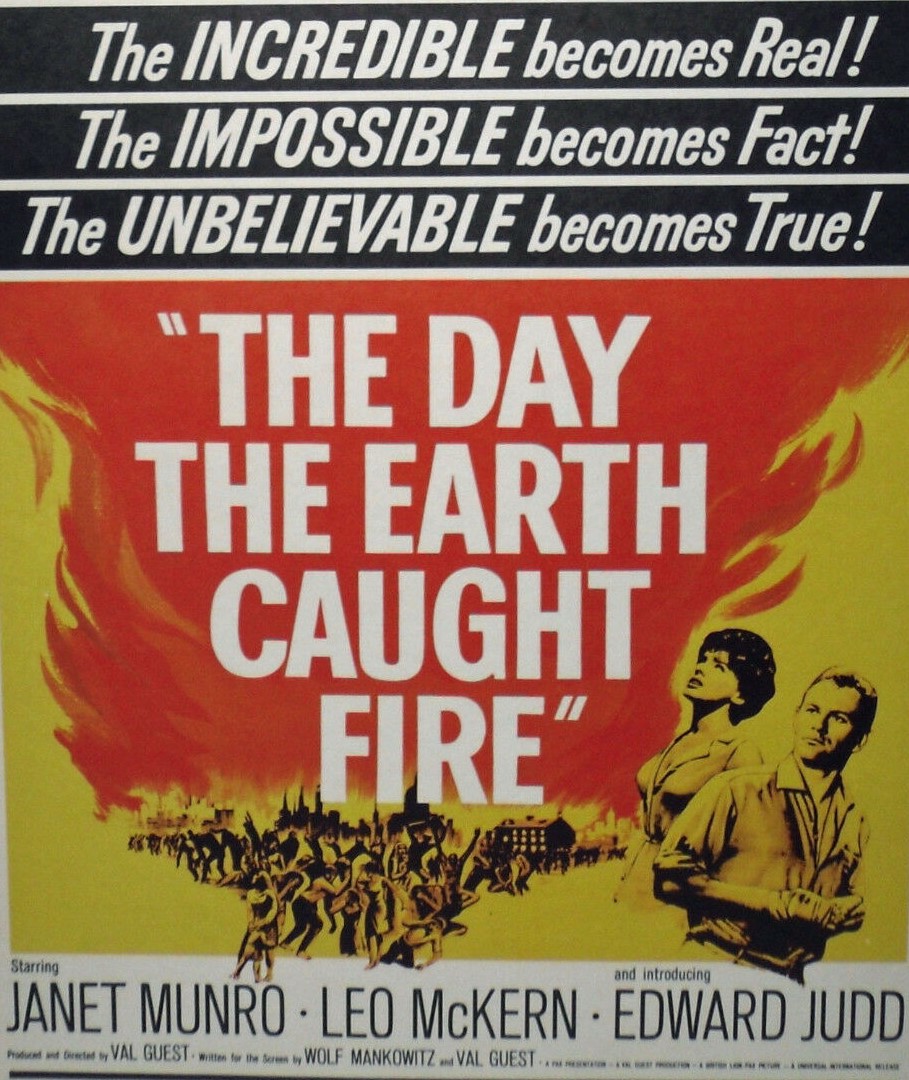
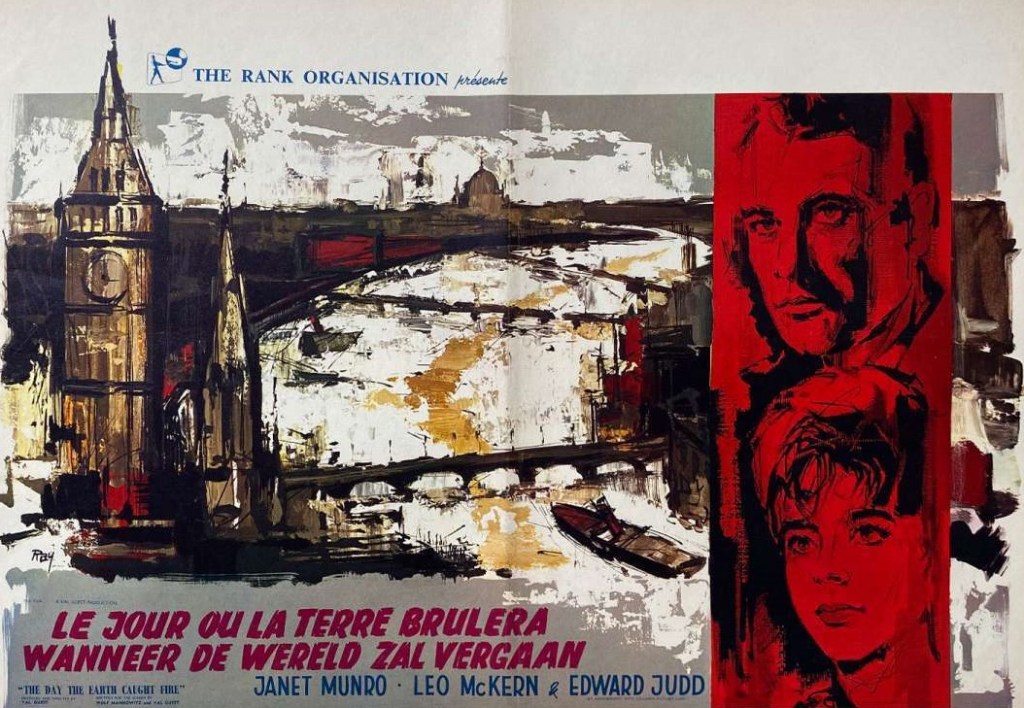
A more prescient picture you couldn’t find, tapping into a contemporary audience’s greatest fear – global warming. Its bold cliff-hanger ending would also appeal to a modern audience often left dangling at the climax of a blockbuster. And it cleverly skims on the special effects, relying on the more easily achieved downpours, thick fog, constant sweating, newsreel footage of natural disasters, water rationing and end-of-the-world riots than anything bigger.
But what surprised me more was the sheer pace. Not just a story moving at a frenetic pace but the British characters acting like they had been injected with a heavy dose of New York zap, talking over each other, hardly getting a complete sentence in before interruption, like Howard Hawks had taken command instead of a mere Englishman like Val Guest (Assignment K, 1968), a former journalist.
Front cover of the Pressbook.
It channels the director’s experience into creating the most realistic newspaper office you will ever come across, beating out All the President’s Men (1974) in its representation of how journalism really works, as concerned as much with the general fodder of unheralded stories as the scoops that normally drive such a narrative. And for a story that started off as pure pulp, the dialog is superb, so good it won the Bafta award.
It certainly helped that an actual newspaper editor, Arthur Christiansen (of the Daily Express) lent a guiding hand, playing the role of the editor of this downmarket daily. The summoning of copy boys (actually grown men), the demand for 500 words, the printers ready to switch the front page at a moment’s notice, the inevitable diet of pie and pint, and the emotional casualties as marriages crumble under the strain of a husband more concerned with this next story than wife or children, all serves to ground the film.
And yes, the narrative plays into the usual journalistic tropes, ambitious newspaperman Peter (Edward Judd), career on the line, uses typical wiles, duping lowly scientific secretary Jeannie (Janet Munro) into revealing more than she should. It’s a meet-cute of the old-fashioned variety, she hates him on sight.
Peter is as off-kilter as the world, knocked off its axis by the simultaneous explosion of nuclear devices, unable to come to terms with his divorce, finding solace in the time he spends with his child, and it seems fitting that much of that is spent diving into the darkness of the ghost train ride, the fog equally thematic as he wanders round in circles in that, as aimless as in his life, while a bath is just as cinematically important, not just for the obvious semi-nude scene but as a place of refuge from impending terror.
These journalists know how to sniff out a story, how to separate the what from the chaff of the official line, digging deeper, and with global connections able to put two and two together far swifter than officialdom. It helps that Peter’s guardian angel Bill (Leo McKern) has a scientific brain and is able to work out the source of the infernal rising temperature.
It’s axiomatic of how clever the screenplay is that Peter and Jeannie come together over a lost child, although Peter, cynical and bitter, but more vulnerable than most, remains a conniving character, happy to risk their burgeoning relationship for the sake of a scoop.
Like Quatermass and the Pit (1967) it’s one revelation after the other as the world hurtles towards oblivion, though not before ending up as the biggest barbecue of all time. The film acknowledges the anti-nuclear demonstrations of the time before piling on proof that man has sown the seeds of destruction on a four-month countdown to doomsday.
We have been here before with end-of-the-world scenarios but this story unfolds not in scientific or official offices, and there’s no President around to add gravitas or take the blame, but in the minds of the dogged journalists, soon appalled by their discoveries, and for once a scoop is unable to save the day or give the villain his just deserts. Whoever is behind the catastrophe remains nameless, although the outcome of superpowers duking it out for supremacy is never in doubt.
Edward Judd (First Men on the Moon, 1964) delivers a star-making performance as the jaded, jagged, journo capable of emotional depths while Janet Munro (Hide and Seek, 1964) escapes Disney tomboy servitude with a very adult role. Leo McKern (Assignment K) has the solid acting chops that would, two decades before television fame as Rumpole of the Bailey, see as a formidable heavyweight addition to any film and a threat to any co-star through jis charismatic ability to steal scenes.
But the film belongs to Val Guest, who constantly turns up the emotional heat and the terror scale, getting the most out of the riveting, sparkling screenplay he co-wrote with Wolf Mankowitz (The 25th Hour, 1967).
Kind of film that needs sold on word-of-mouth and a slow platform-release rather than being bundled out to fill the distribution gap. Let the audience sing its praises first before slinging it out in wide release. Because this is a definite audience-pleaser, a fun whodunit. Though a limiting factor might be that appeal may be restricted to those of a certain age familiar with The Mousetrap. I wouldn’t bet my last dollar, either, on modern young audiences even having a clue who Agatha Christie was, or responding to a picture set in dull, dull, Britain in a year -1953 – when there was a significantly more glorious event that might have suited better the average Downton Abbey moviegoer: the coronation of the recently-deceased Queen Elizabeth II.
Delightful pastiche on the detective story, too much to suggest it’s a piss-take on Knives Out or the latest big-screen veneration of Hercule Poirot, but it certainly has enough going for it even if none of those connections are eventually made. Certainly, there’s some sly humor in scoring points for mentioning, a la Murder on the Orient Express, that the initial murder could have been committed by all the suspects.
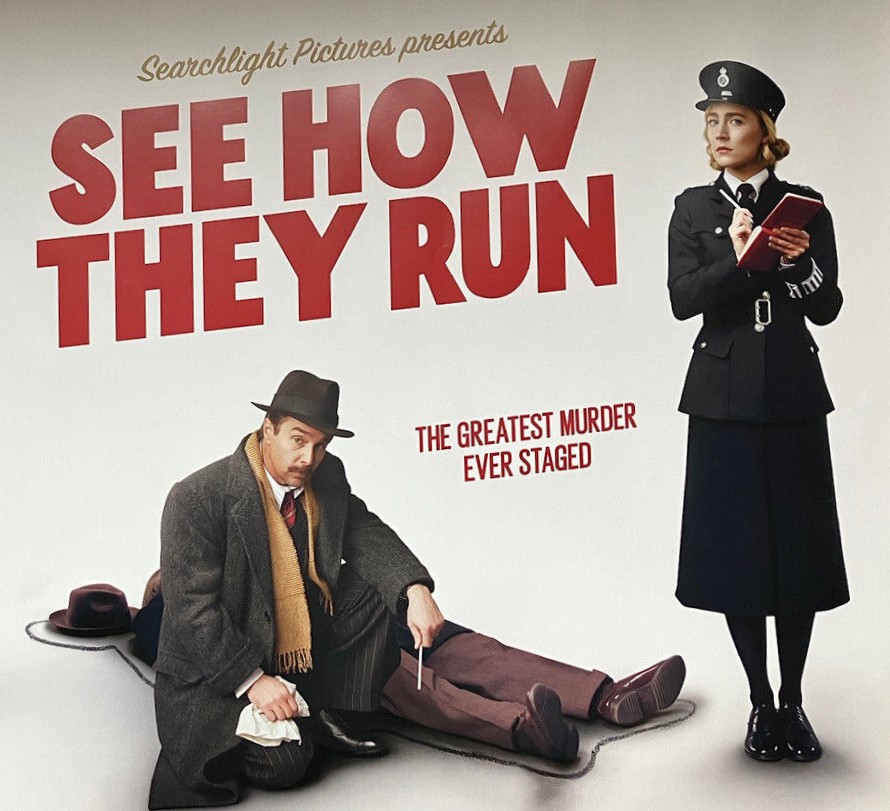
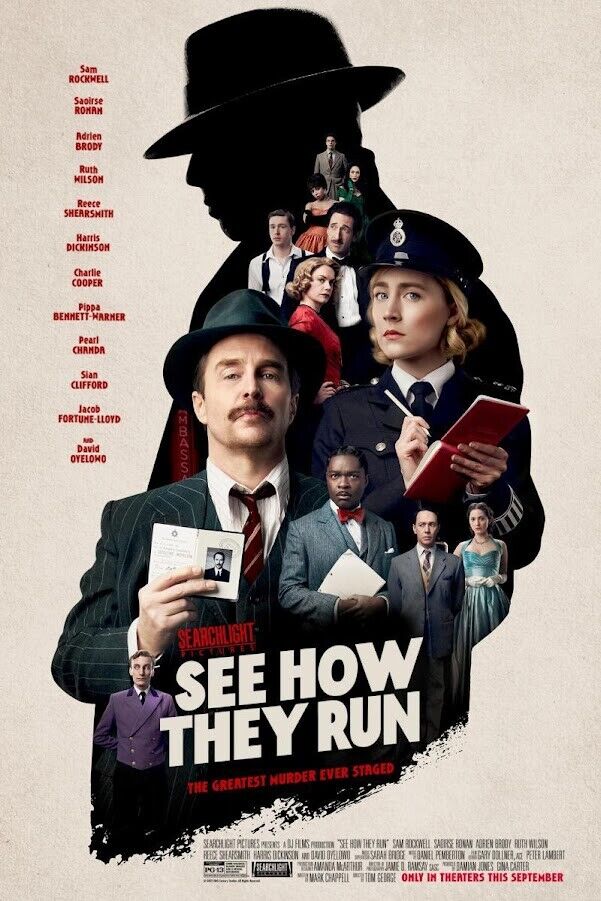
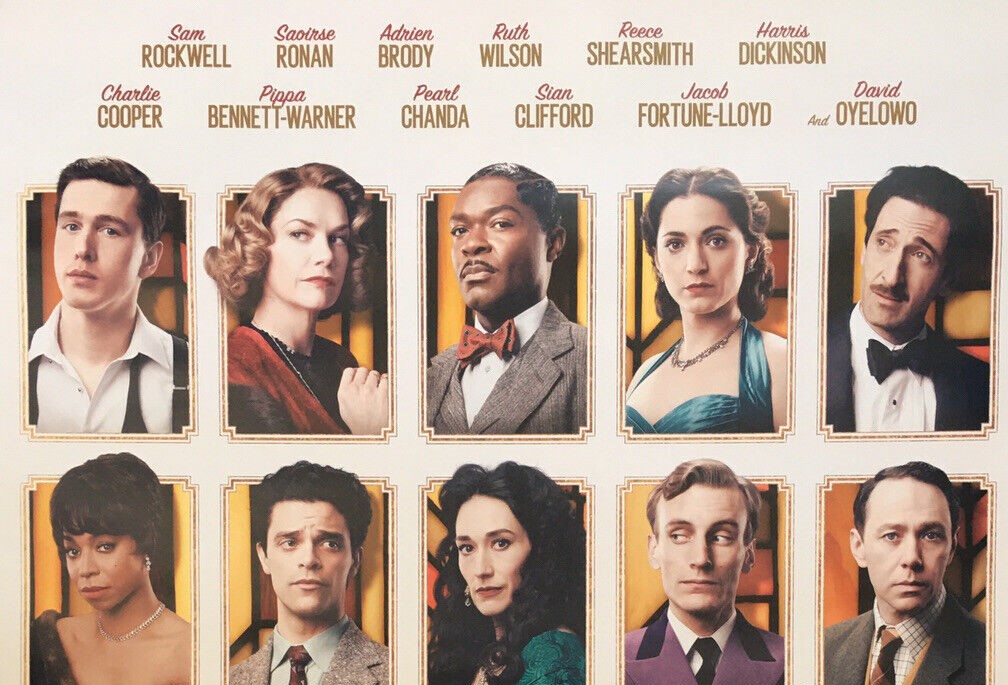
Basically, out of favor war hero and alcoholically-inclined cop Inspector Stoppard (Sam Rockwell) is saddled with rookie Constable Stalker (Saoirse Ronan) – two in-jokes right there, John Stalker being a very prominent British cop, playwright Tom Stoppard the author of The Real Inspector Hound – to investigate the death of Yank Leo Kopernick (Adrien Brody), in London to turn Agatha Christie’s famed play into a movie for real-life producer John Woolf (Reace Shearsmith) who made The African Queen (1951).
Virtually everyone associated with the play becomes a suspect. These include pompous playwright Mervyn Cocker-Norris (David Oyelowo), the play’s petulant producer Petula “Chew” Spencer (Ruth Wilson), real-life actor Richard Attenborough (Harris Dickinson) and even Agatha Christie (Shirley Henderson) is not above a bit of poisoning. Throw into the mix that the cops have assigned the bulk of their resources to tracking down the 10 Rillington Place serial killer – another in-joke, Attenborough playing the murderer in that movie.
One of the movie’s delights is that whereas both Stoppard and Stalker have considerable personal issues, we discover them in passing, and neither character makes a meal of them. Instead, their screen charisma works a treat, Stoppard dogged and the earnest Stalker inclined to jump the gun.
Even the “all-star-cast” is a spoof on films like “Death on the Nile.” The title was a popular one, movies in big-screen or small using it in 1955, 1964, 1984, 1999 and 2006.
The stage shenanigans are a hoot, puffed-up pride and ruthless machinations powering many of the sub-plots. There’s some pretty clever sleight-of-hand not to mention occasional cinematic avant-garde and there’s no shortage of laughs and that out-dated comedy fall-back – slapstick. The climax is particularly excellent, in part because it is a notion immediately discarded as the denouement of the proposed movie version of the play, one that succinctly critiques the differences between British and Hollywood approaches to movie-making.
Red herrings and cul-de-sacs abound, flashbacks remove any plot-holes, while managing to ram in a country-house finale takes some brio. And in among all the jokes, you might be surprised to find a serious point being made about reality vs fiction. Full marks to the virtually laugh-a-minute screenplay by Mark Chappell (The Rack Pack, 2016) and director Tom George in his movie debut who brilliantly shuffles the deck.
Dramatic heavyweight pair Sam Rockwell (Three Billboards, Outside Ebbing Missouri, 2017) and Saoirse Ronan (Mary, Queen of Scots, 2018) prove a double-act to cherish. In gentle comedic roles at odds with virtually their entire portfolios, a wise producer might already be sizing them up for a re-run. Everyone else gets to be bitchy/scheming/ruthless to their heart’s content and certainly in those categories Adrien Brody (The Grand Budapest Hotel, 2014) and Ruth Wilson (His Dark Materials, 2019-2022) win hands-down. But spare a thought for excellent performances from David Oyelowo (The Bastard King, 2020), Reace Shearsmith (of League of Gentlemen TV fame), Lucian Msamati (The Bike Thief, 2020) as the imperturbable Max Mallowan, husband of the distinctly perturbed Agatha, played with venomous glee by Shirley Henderson (Greed, 2019).
I went to see it not expecting much at all and came out singing its praises. Definitely worth a whirl.
Five million dollars. That’s roughly the budgetary difference between Hammer’s Quatermass and the Pit and Twentieth Century Fox’s Fantastic Voyage. Although the protagonists in the latter face the unexpected, the movie is (as would be 2001: A Space Odyssey, 1968) an exercise in awe, in controlled exploration of wonder, whereas Quatermass, lacking the money for special effects, concentrates more on story and human impact. The government funds the experiment in Fantastic Voyage while Professor Quatermass (Andrew Keir) finds nothing but obstruction from his superiors.
Quatermass and the Pit is a masterpiece of stealthy exposition. Virtually every minute brings another development, gradually building tension, stoking fear. The principals – Dr Roney (James Donald), Barbara Judd (Barbara Shelley) and the professor – are cleverly kept apart during the early stages. A human skull discovered on a building site for a London Underground station is followed by a skeleton. Palaeontologist Roney determines it is five million years old, older than any previous find.
A metallic object is found nearby. First guess is an unexploded bomb from the Second World War. But it’s not ticking. And a magnet won’t stick to it. Col Breen (Julian Glover) is called in along with hostile rocket expert Quatermass. They have been locking horns from the outset.
There’s a whole bunch of apparent red herrings, mostly of the demonic variety. The location, historically associated with weird occurrences, is a nickname for the Devil. A pentagram is detected. Touching the object can give you frostbite. Col Breen argues it’s a leftover German propaganda machine from World War Two. A hideous dwarf and other spectral images are sighted. Telekinesis is involved. And tremendous vibrations.
Some people, such as Barbara, have a more receptive brain and can play memories millions of years old that reveal the alien truth. But this is an alien race with genocidal tendencies and able to unleash psychic energy.
The genre requires the scientists to discover an improbable solution which of course they do. Given the miserly budget, the special effects are not remotely in the Fantastic Voyage league. But that hardly matters. The movie coasts home on ideas, marrying sci-fi, the demonic, dormant and institutionalized evil, the militarization of the Moon and the ancient infiltration of Earth by Martians, no mean achievement, and a vivid narrative.
Director Roy Ward Baker (aka Roy Baker) provides many fine cinematic moments as he chisels away at the story, finding clever methods of revealing as much of the aliens as the budget will permit, focusing on very grounded characters, concentrating on conflict, and human emotions, mainlining fear rather than awe, building to an excellent climactic battle between man and monster.
Barbara Shelley (The Gorgon, 1964) is the pick of the stars, in part because she is at such a remove from her normal Hammer scream-queen persona, but more importantly because she brings such screen dynamism to the role. It’s refreshing to see her step up, as she carries a significant element of the story. Oddlyenough, although she has as good a movie portfolio as Andrew Keir and is certainly superior to James Donald, the denoted star, in that department, she is only billed third.
While Andrew Keir (The Viking Queen, 1967), warm-hearted for an intellectual, and James Donald (The Great Escape, 1963), trying to keep a cool head in the middle of inclination to panic, are good, they don’t bring anything we haven’t seen before. Julian Glover (Alfred the Great, 1969) is never anything but imperious and/or irascible, so ideal casting here.
The innovative electronic music was down to Tristram Cary and the unsettling credit sequence deserves some recognition. Nigel Kneale, who originally explored similar ideas for the character on television, came up with the screenplay.
A genuine all-star cast goes off-piste in what used to be called – and maybe still is – a comedy of manners. A chance encounters at the stately home owned by Victor (Cary Grant), an Earl who makes ends meet by opening up his home to tourists, sees his wife Lady Hilary (Deborah Kerr), who helps make ends meet by selling home-grown mushrooms, fall in love with American oil millionaire Charles (Robert Mitchum).
Victor is far too English and posh to go off in the deep end and after considering allowing her to indulge in an affair until she gets bored, comes up with a strategy to ensure it’s her lover who is shooed away. Hilary’s best friend, the glamorous and often barmy Hattie (Jean Simmons), all Dior outfits and full-on make-up, meanwhile, steps in to attempt to rekindle her romance with former lover Charles.
Needless to say, this scene does not exist in the film.
While it’s peppered with epigrams and clever lines and several twists, what’s most memorable is the acting, the initial scene between Charles and Hilary a masterpiece of nuance, what’s shown in the face opposite to what they say. And there’s another peach of a scene where the most important element is what’s conveyed by a sigh. And by Robert Mitchum of all people, an actor not known for nuance.
But it’s let down by the staginess – it was based on a hit play – the very dated by now notion of showing the comic differences between British and Americans and the pacing. The theatrical element, thankfully, doesn’t resort to farce but with a whole bunch of entrances at unexpected moments you occasionally feel it’s heading in that direction. There are minor attempts to open up the play, a scene in the river, some location work in London and upmarket tourist haunts, but mostly it’s a picture that takes place on a couple of sets.
The British vs American trope just becomes tiresome after a while except that essentially the two men trade cultures, Victor exhibiting the kind of ruthlessness you might expect (in the old cliched fashion) from an American while Charles displays the kind of subtlety you would more likely find in an Englishman.
The pacing’s the biggest problem. The actors deliver lines at such speed that no time is allowed for the audience to laugh. The three British characters are almost manic in their urgency, while the Yank so laid-back he might belong to a different century.
Late on, a couple of subplots brighten up proceedings, a joke played on Hilary by Victor over the contents of a suitcase that she has devised an elaborate cover story to explain, and a betrayal of Hilary by her friend. Devilishly clever though it is, the duel scene almost belongs to a different picture. There’s also an amusing butler Sellers (Moray Watson), a wannabe writer, who believes, as is obvious, he is being under-employed, and pops up when the movie requires straightforward comic relief.
It starts off, via the Maurice Binder (Goldfinger, 1964) credits with babies, occasionally in the buff, unspooling film and indulging in other humorous activities. The only characters established before the plot kicks in are the Earl and the butler, Victor shown as tight-fisted, literally counting the pennies (although, literally, these are actually half-crowns, the price of admission to the stately home), the efficient Sellers revealed as otherwise baffled by life. The joke of a wealthy couple forced to rely on the income from visitors was not even much of a joke by then.
Perhaps what’s most interesting is that this movie essentially about immorality failed to click with U.S. audiences while an equally immoral picture The Apartment (1960) did superb business, the difference less relating to star quality than directorial ability, Billy Wilder’s work always having a greater edge than the confections of Stanley Donen.
It’s the supporting cast – if stars can be so termed – who steal the show. Robert Mitchum (Man in the Middle/The Winston Affair, 1964) is just marvelous, one of his best acting jobs, relying far more on expression to carry a scene. He delivers a masterclass in how little an actor needs to do. Jean Simmons (Rough Night in Jericho, 1967) is also excellent for the opposite reason, an over-the-top mad-as-a-hatter conniving ex-lover with an eye on the main chance. That’s not to say Cary Grant (Walk, Don’t Run, 1966) and Deborah Kerr (The Arrangement, 1969) are not good, just overshadowed, and Kerr’s first scene with Mitchum, where she, too, realizes she is falling instantly in love is remarkably underplayed.
Stanley Donen (Arabesque, 1966) should have done more, pre-filming, to tighten up the script and expand the production. Hugh Williams and Margaret Vyner adapted their own play. It’s entertaining enough but I was more taken by the acting than the picture.
Julie Andrews could not have made a more controversial choice in her bid to prove she was more than a Hollywood goody two-shoes as introduced in her debut Mary Poppins (1964). In the months leading up to release, The Americanization of Emily movie made all the wrong sort of headlines, aligning the innocent Andrews with the unsavory matter of producer Martin Ransohoff (The Cincinnati Kid, 1965) challenging the all-powerful Production Code, the self-censorship system in operation in the United States until the late 1960s.
Ransohoff demanded the right to include four scenes of substantial nudity in the film, at a time when any flashes of skin in mainstream pictures were taboo. He argued that the scenes were “necessary for the farcical overtones of the picture.” But more to the point, he was annoyed that foreign filmmakers, who did not have to abide by the stringent rulings of the Code, could show nudity, sometimes even condoned by censor Geoffrey Shurlock who accepted their artistic validity. Ransohoff railed: “We are losing our market because we allow pictures that are full of nudity done in an artistic manner to play our top houses but we can’t get into them because the Code robs us of our artistic creativity.”
I’m not sure exactly when MGM dropped the “Americanization” element from the title and made Julie Andrews the star by promoting her image more than that of top-billed James Garner.
Faced with a lawsuit from studio MGM for delivering a movie not fit for the Code, Ransohoff conceded he had gone “overboard” with the nudity and that Judy Carne – who later sprang to fame in Rowan and Martin’s Laugh In (1969-1973) – in particular, was “over exposed.” Other actresses named as revealing too much were Janine Gray (The Pumpkin Eater, 1964) and Kathy Kersh in her movie debut. The women were identified in the movie credits as, disgracefully, “Nameless Broad.”
At the outset, such agitation would not have preyed so much on Andrews’ mind as a possibly limitation in her future career, Mary Poppins not due to be unveiled until the summer and few members of the public aware of what a game-changer that would prove for studio and star alike. But once Mary Poppins hit the box office heights, there was every chance the star would quickly lose the adoration of the public if seen to play the female lead in a steamy picture. Ransohoff complicated matters by failing to come out and say whether Andrews was involved in the nude scenes, no matter they were considerably toned down by the time the movie hit cinemas in October 1964. (Had he delayed the picture’s release six months, his approach might have been deemed more acceptable, as, by that time, a flash of breasts had been passed by Shurlock for The Pawnbroker.)
It had been a troubled picture from the start. As early as 1962, Oscar-winner William Holden (The World of Suzie Wong, 1960) had been signed up to star and the movie was due to go before the cameras in London in July 1963 and, following a slight delay, re-scheduled for the next month under the direction of Oscar-winner William Wyler (Ben-Hur, 1959). Production was not quite settled because Andrews was only hired in September 1963. But when Wyler pulled out a month later he was quickly followed by Holden. Andrews was such an unknown quantity that when she signed up, the news did not even receive a headline in Variety, just a few lines at the bottom of a page.
And there were screenplay issues. Norman Rosten had begun work on the adaptation of the William Bradford Huie bestseller in April 1962 only for, 10 months later, the author to be drafted in. But scripting problems would continue until after shooting was complete (see below) with the filmmakers unable to make up their mind about the tone of the picture.
Despite Rosten being assigned, a story later emerged that the book had struggled to reach Hollywood. Huie contended that it had, after all, not been sold to Ransohoff in 1962 and that the sale only occurred later after the author had written the screenplay on spec and sold it to the producer. He tied this up with another contention, little borne out by fact, that producers had turned against buying blockbuster novels in favour of original screenplays.
At that point Ransohoff was on a roll as one of the biggest independent producers in Hollywood, on his slate The Sandpiper, which would appear in 1965, Topkapi (1964), The Loved One (1965), The Wheeler Dealers (1963) and The Americanization of Emily, a fantastic batting average for a neophyte producer. Emily would be his third production, The Sandpiper, with two of the biggest stars in the world, Elizabeth Taylor and Richard Burton, his fourth.
James Garner, who had blown his entire fee of $100,000 from three years’ work on television series Maverick on getting out of his contract with Warner Brothers, had been given a helping hand by Ransohoff, winning second billing behind Kim Novak in Boys Night Out (1962) and Lee Remick in The Wheeler Dealers. Ransohoff gambled Garner was ready to make the jump up to top billing in The Americanization of Emily.
In fact, it would take several years before Garner was considered a proper star, thanks to Support Your Local Sheriff (1969), with the kind of marquee appeal that produced box office commensurate with his fees. In fact, James Coburn was considered a better prospect with a seven-picture deal with Twentieth Century Fox – for whom he would make his breakthrough movie Our Man Flint (1966) – a five-film deal with Ransohoff and Major Dundee (1965) on the starting grid with Columbia.
The three-minute sequence of the D-Day beach landing cost $250,000. It was shot in California, sixty miles north of Hollywood, on a public beach though anyone happening upon the site would possibly be put off by signs proclaiming “Explosives next ½ mile.” The shoot involved 5,000lb of explosives, mostly dynamite and black powder, planted in iron tubs buried in the sand and connected by wires to a central control board. The complicated set-up involved four cameras rolling simultaneously with a 250ft high crane lifting a camera platform into the sky for aerial shots. Another platform was sited in the surf. Special effects expert Paul Byrd was on hand to point out to participants where explosions would occur. Eighty smoke pots were lit, each in an assigned position. Rehearsals soaked James Garner and while he waited for the scene to be set up again he lay down on the beach, still in n his wet clothes, but covered in a towel.
Preparing the segment had taken four months with bulldozers clearing the area. Ransohoff himself climbed into a camera platform to test the rig. Camera positions were selected to capture close-ups of the actors going ashore. To maximize daylight the lunch break was limited to 30 minutes.
Ransohoff, as much a maverick in marketing as in production, took out a double-page advertisement in Variety in July 1964 – nearly four months before the movie opened – to promote the response of the preview audiences. And although the comment cards returned easily promotable lines like “you have a blockbuster on your hand” and “one of those rare films that combine tragedy, comedy and drama properly,” Ransohoff was clearly intending to continue to court controversy by including quotes along the lines of “I’m broadminded but this time you’ve gone too far” and “a disturbing and terrible thing.”
But you couldn’t argue with Ransohoff seeking an alternative marketing strategy with such a recalcitrant publicist as Garner. The actor had a marked aversion to talking about his private life, which, of course, meant the focus would have to shift to his dubious star quality or the controversial scenes. Nothing infuriated journalists more, especially in those days when the media was not so tightly controlled, than to turn up for an interview with an actor who had nothing to say. “My private life is just that and I’ll keep it that way,” he averred.
Quite why the movie took so long to open is not really a mystery. Sneak previews might be followed by a little tweaking but the film would expect to be in cinemas within a month or so, the previews intended to build public awareness and word-of-mouth buzz rather than tell the director where he had gone wrong. But clearly Ransohoff held back in order to capitalize on the box office of Mary Poppins. Despite the wrangling with the Code being over and done with by March 1964 and the preview taking place three months later, the film did not open until October, going wide at Xmas, with the additional purpose of aiming for Oscar voters.
Even as Ransohoff was adding the finishing touches to the advertising campaign, there were doubts about what kind of picture the public would be shown. Four endings were considered, two filmed with Edison (James Garner) dead which turned the movie into a straightforward black comedy, but the other two retained the romantic ending.
The black comedy approach dictated that the unsuspecting Edison (James Garner) was lured to his death on Omaha Beach by the glory-hunting Cummings (James Coburn). With no return from the dead, this left Emily (Julie Andrews) in one version to carry the movie to a dutiful conclusion, commiserating with Admiral Jessup, who had been committed to a mental asylum, while a parade commemorating Edison’s sacrifice and led by the treacherous Cummings took place in the background. This was junked when the parade prove too expensive an addition.
All the other endings kept Edison alive, but in one, partly filmed, Cummings was banished to the North Pole, the producers going as far as to film Coburn with penguins.
The major adjustment in all versions was to present Jessup as off his head when he conceived the plan. That meant the Navy could not be blamed for outrageous publicity-seeking, with the finger instead pointed at a maverick officer, whose decisions could be tempered by his temporary instability.
SOURCES: “Holden’s Americanization,” Variety, May 23, 1962, p11; “Screenplay (Ready to Shoot) Cost-Conscious Producers Goal in Retreat from Pre-Sold,” Variety, January 30, `1963, p3; “Emily Screenplay to Be Done by William Bradford Huie,” Box Office, February 11, 1963, pW1; “Ransohoff’s Big Spurt of Features,” Variety, February 17, 1963, p3; “Ransohoff To Start Five Films in 6 Month Period,” Box Office, June 17, 1963, p27; “Julie Andrews,” Variety, September 11, 1963, p16; “Bill Holden Follows Wyler in Leaving Emily,” Box Office, October 7, 1963, pW2; “Garner Gets Emily Lead,” Box Office, October 14, 1963, p9; Michael Fessier Jr., “Can’t Be Americanized With Duds On,” Variety, November 20, 1963, p5; “Martin Ransohoff To Seek Production Code Seal,” Box Office, November 26, 1963, p6; “Emily and Her Attire Settled,” Variety, March 25, 1964, p5;“Nudies In Emily Are Cut to Get MPAA’s Seal,” Box Office, March 30, 1964, pW4; “Advertisement,” Variety, July , 1964, p14; “Admiral’s Glory Seeking Is Final Ending of Metro’s Emily,” Variety, November 4, 1964, p5; “Mad Film Promotion,” Variety, November 4, 1964, p15; “Promo Credo of Hollywood Actor,” Variety, November 4, 1964, p15; Action on the Beach (1964) MGM promotional featurette.
Initially, much more of a character study than murder mystery or spy tale. And like the previous John Le Carre adaptation The Spy Who Came in from the Cold (1965) directed by an American, there Martin Ritt, here Sidney Lumet. Although as repressed as the main character in Lumet’s The Pawnbroker (1964) and sharing with it remembrance of the Holocaust, master spy Charles Dobbs (name changed from George Smiley due to Paramount’s rights from the earlier film) is far more capable of expressing his feelings and taking action than the pawnbroker.
Dobbs sleeps in a separate bedroom, his wife Ann (Harriet Andersson) indulging in so many affairs she is considered a nymphomaniac. Although resigned to this behavior, he is nonetheless shocked when her latest amour turns out to be his old friend and colleague Dieter (Maximilian Schell) and even attempts to offer him advice, the politeness of the English at its best. “In any other country,” retorts Dieter, “we wouldn’t be on speaking terms.” This kind of betrayal Dobbs can manage, but the other kind, of a professional nature, has him rushing to the bathroom to throw up.
If you’ve come to admire the character of George Smiley (aka Dobbs) as played by Alec Guinness in BBC TV series Tinker, Tailor, Soldier, Spy (1979) and its sequel where he is generally a passive character you might get a shock when here the man springs into action.
Dobbs comes up against the Establishment when his boss (Max Adrian) refuses to investigate the suicide of a low-level agent Fennan (Robert Flemyng), a former Communist cleared of suspicion of being a double agent by Dobbs himself. Dobbs resigns in order to go his own way enlisting retired policeman Mendel (Harry Andrews), a pet lover and prone to falling asleep at inopportune moments. Although it is essentially a murder story, it’s Mendel who does most of the detecting, using his resources to track relevant pieces of information – typewriters, wake up calls, theatre tickets fall into his purview – and very much the old-school cop, not above a bit of burglary and beating up a suspect.
There are leaks within the secret service, Dobbs tailed, a blond man Harek (Les White) hovering into view long enough to tamper with witnesses, including dodgy car dealer Scarr (Roy Kinnear), a bubbly character with “two wives.” Key to the investigation is Fennan’s wife Elsa (Simone Signoret), a Jewish refugee from the concentration camps, and committing the cardinal sin of not offering Dobbs a cup of tea when he comes to visit, though pouring herself one. “I’m a battlefield for your toy soldiers,” she proclaims, another in le Carre’s stream of innocents unwittingly caught up in the “game.”
This is dingy rather than tourist London, Battersea power station on the horizon, rain prominent, a murky Embankment, the Thames a river of sludge, dubious pubs in unsavory locations, except for a very English spurt of theatre (a plot point) involving characters with very jolly accents. In The Spy Who Came in from the Cold, the spy’s downfall is “minor human weakness” i.e. falling in love and so it is here, Dobbs’ mental health taking a beating by not just his wife’s unfaithfulness but by remaining faithful to her. Of course, he wouldn’t be the first man to have married out of his league and be unwilling to surrender his prize.
Lumet’s gaze is anything but sentimental. In fact, as much as Dobbs is a master of the spy game, he is a dunce at the game of love, and Lumet does not let him off lightly. Any man who commiserates with his wife’s lover on the grounds that he (said lover) will be hurt when the woman ultimately abandons him, is straight from idiot school.
So this is a far more complex, and human, reflection on the spy game, and it’s not so much about paying the price of being a spy, as occurred with Alec Leamas, than the folly of marrying the wrong woman. You can see how easily Dobbs was seduced by the insane prospect that a beautiful woman had fallen in love with him, rather than, as he must have been trained to do, examining her reasons.
Of course, it’s not unusual for detectives to have miserable home lives and end up as loners, but this was part of a trend (see The Quiller Memorandum, 1966) to see spies not as bed-hoppers of the James Bond variety but as human beings with normal failings. One oddity is that, in line with the Paramount dictat on names, Dobbs’ boss is called “The Adviser” rather than “Control” (although apparently there was such a title in le Carre’s version of the secret service prior to this book).
James Mason (Age of Consent, 1969) is excellent as brilliant spy/bewildered lover. Harry Andrews (The Hill, 1965) has a ball in a change from his normal taciturn characters. Oscar-winner Maximilian Schell (Topkapi, 1964) is equally convincing but I found Harriet Andersson (Through a Glass Darkly, 1961) too much one-note certainly compared to the riveting performance by Simone Signoret (Is Paris Burning? 1966).
You can spot a string of future stars in a supporting cast led by Lynn Redgrave (Georgy Girl, 1966), Corin Redgrave (The Girl with a Pistol, 1968) and Kenneth Haigh (A Lovely Way to Die, 1968) among older hands like Robert Flemyng (The Blood Beast Terror, 1968), Roy Kinnear (The Hill) and Max Aitken (Henry V, 1944).
Paul Dehn (The Spy Who Came in from the Cold) wrote the screenplay based on John le Carre’s novel Call for the Dead, which was written before the book which made the author famous.







 The Magnificent 60s