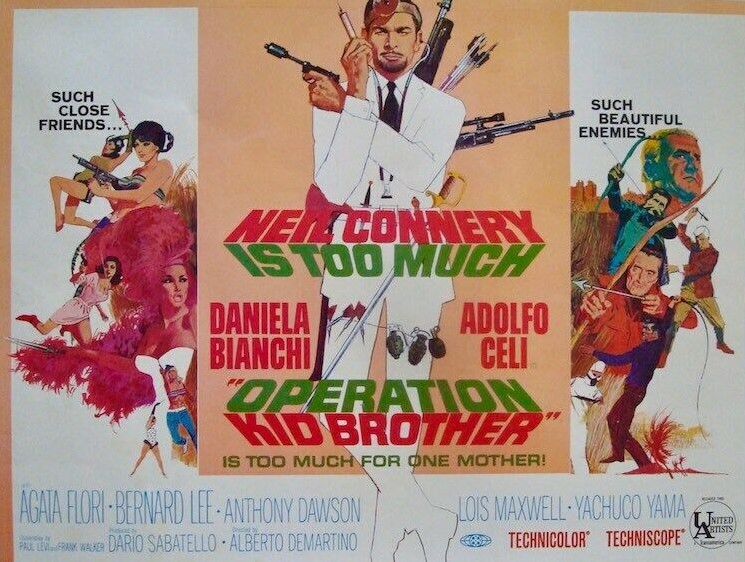
Operation Kid Brother / O.K Connery (1967) ***

Half a century ago it would have blasphemy to do anything but mock this oh-so-obvious James Bond rip-off. That was the year, if you remember, when another bigger-budgeted spoof, Casino Royale, took an almighty chunk out of the box office of You Only Live Twice.  Where the former had a multitude of Bonds, Operation Kid Brother settled for the premise that its main character was the brother of the famed secret agent.

Far from being a disaster, it is, to use the alternative title, “O.K.”, and in parts more than acceptable, especially in its anticipation of ideas that would later become Hollywood tropes: packages concealed in the brain (Total Recall, 1990 and Johnny Mnenomic, 1997), driverless cars (from The Love Bug, 1968, to Tomorrow Never Dies, 1997, and beyond), electronic global blackout and its current equivalent the gravity wave (Moonfall, 2022), and even a poison ploy that popped up in The Princess Bride (1987). Perhaps you could also reference The Bourne Identity (2002), the newspaper weaponized there could be traced back to the harmless belt here. And if you want to get really contemporary – the hero has a superpower: hypnotism. Bear in mind too that sly references to “the other guy” were made in On Her Majesty’s Secret Service (1969), the first in the series not to feature Sean Connery.
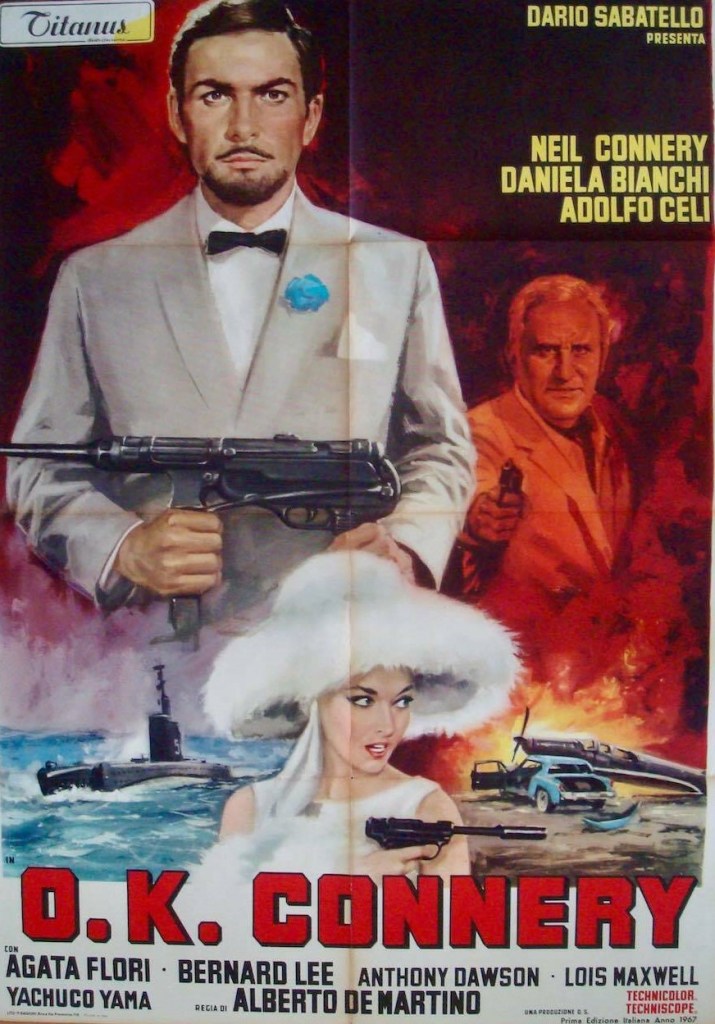
Dr Neil Connery (Neil Connery) belongs to the sub-genre of innocents caught up in espionage (Hot Enough for June, 1964). As with the main character, this is more of an affectionate pastiche of the Bond films than any attempt to make fun of the series. This Connery is a plastic surgeon from Edinburgh (birthplace of his real-life brother Sir Sean) who has invented a method that permits secrets to be carried inside the brain – in essence viewed as an “impregnable safe.”

Bond alumni include Adolfo Celi (Largo in Thunderball, 1965), Daniela Bianchi (From Russia with Love, 1963), Anthony Dawson (Blofeld in From Russia With Love), Bernard Lee (M in the original series) and Lois Maxwell (Miss Moneypenny). Apart from a villainous female gang masquerading as the Wild Pussy Club, a reference to Pussy Galore in Goldfinger (1964) and a few sly references to the brother, the film is played straight.

Megalomaniacs Alpha (Anthony Dawson) and Beta (Adolfo Celi) belong to secret organization Thanatos intent on global domination by stealing atomic nuclei that will send magnetic waves across the world. Using intellect more than brawn, and with a sideline in lip-reading, Connery becomes involved because he can unlock the secrets hidden in the mind of Yachuko (Yee-Wah Yang), who is then kidnapped by Maya (Daniela Bianchi).

In Britain it was inexplicably released with a film that had an “adults only” certificate.

The costumes are slightly outre, Beta out of his depth in red leather, Maya in a hazard suit, Connery susceptible to kilts while Beta’s female yacht crew are decked out (pardon the pun) in tartan mini-skirts and pompoms. There is clever reversion to old-fashioned weaponry as archers assemble to assault the lair.

But all in all it is enjoyable. Yes, some of the pleasure derives from the twists on the Bond clichés, but Connery, complete with his brother’s pursing of the lips, is a decent enough stand-in. Daniela Bianchi (Special Mission Lady Chaplin, 1966), Adolfo Celi (In Search of Gregory, 1969) and the no-longer-deskbound Lois Maxwell (The Haunting,1963) join in the fun without making fun of the concept.

The direction by Alberto De Martino (Dirty Heroes, 1967) is competent but in the absence of a bigger budget perhaps exhilaration is too big an ask. The typical Italian production technique of lip-synching once the movie is completed does distance the picture.  Three writers stitched the enterprise together – Frank Walker, in his only screenplay, Stanley Wright (Marenco, 1964) and Paulo Levi (Seven Guns for the MacGregors,1967).

Ebay is your best bet for a DVD of this one.

Check out also the “Behind the Scenes” article on this picture.
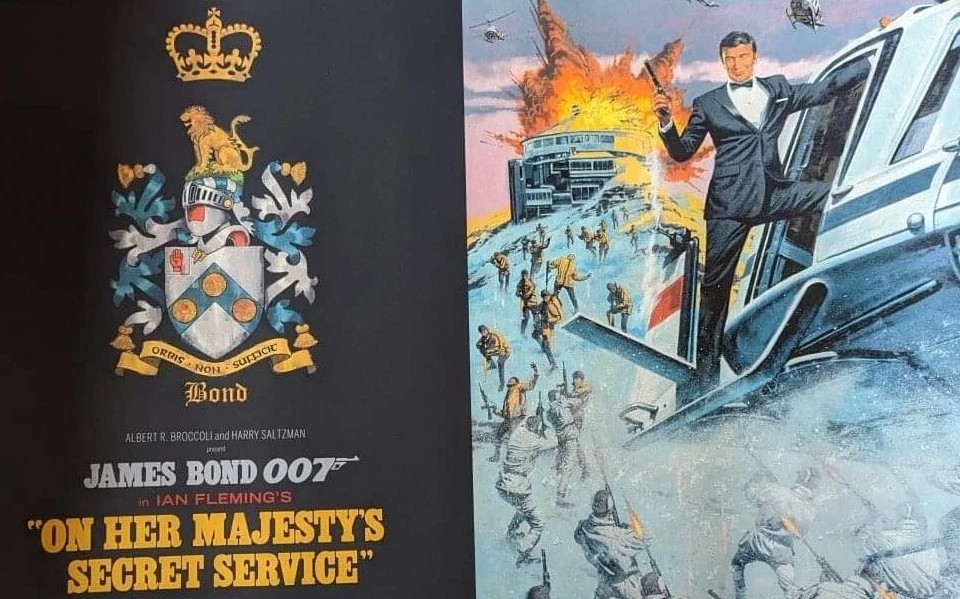
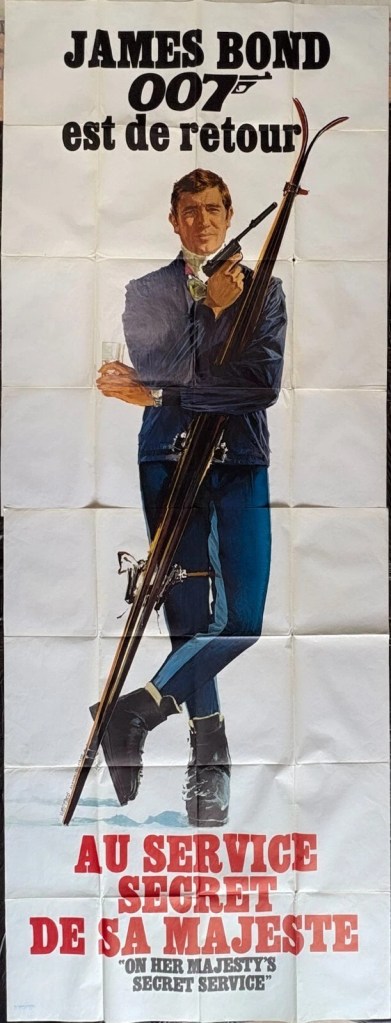
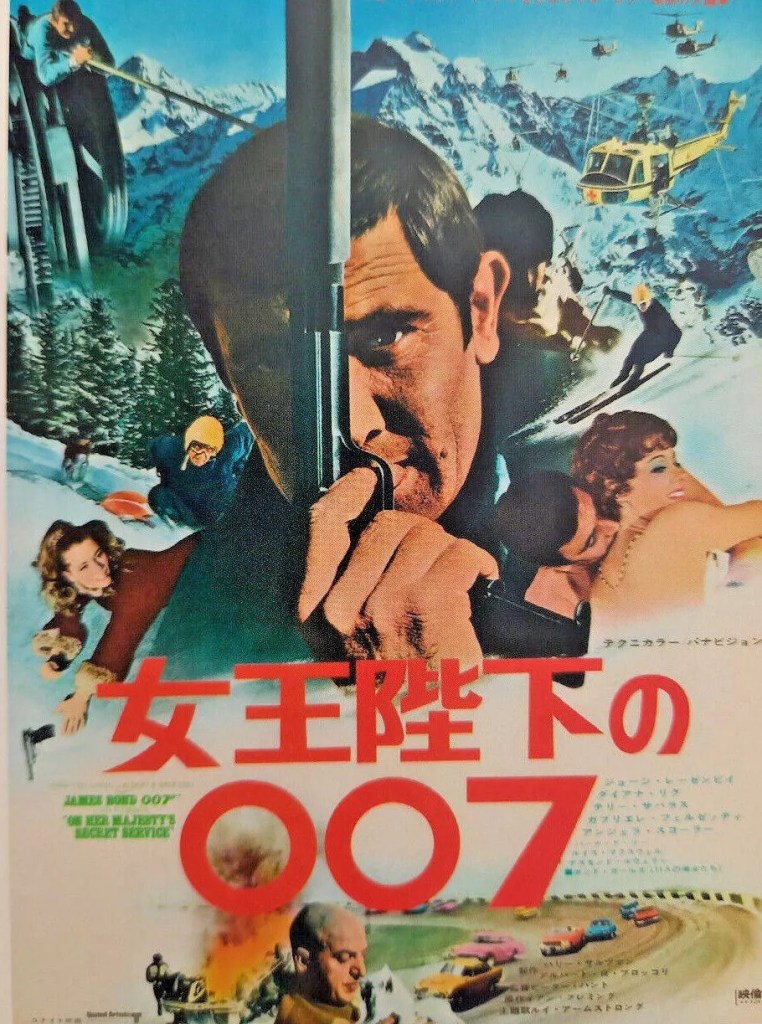
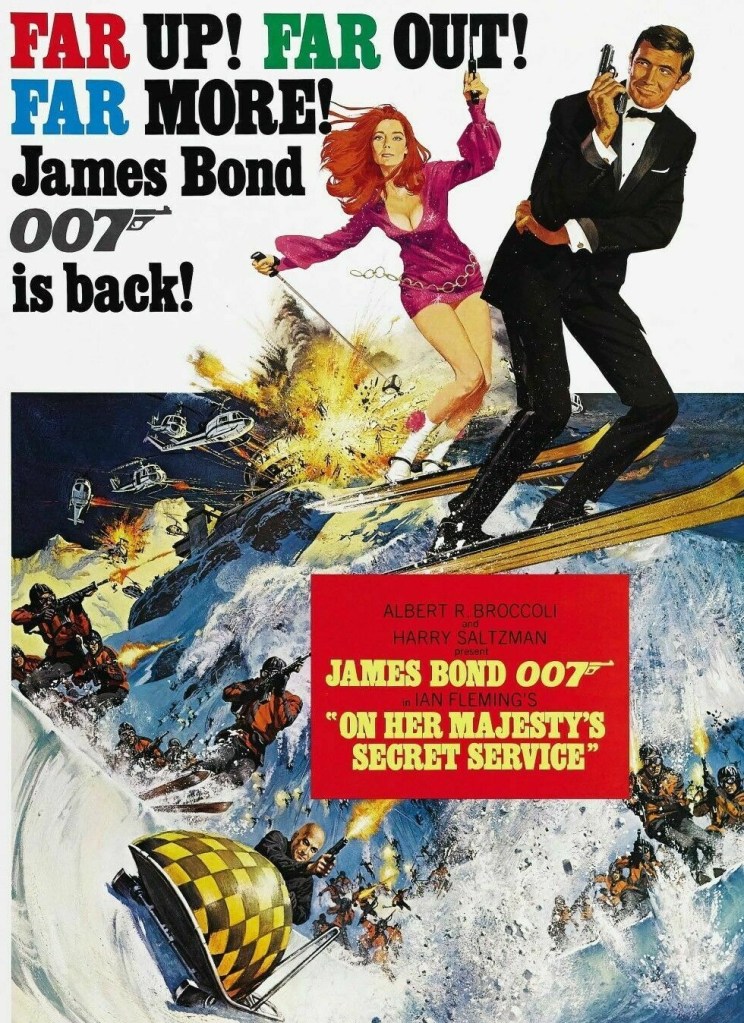
On Her Majesty’s Secret Service (1969) ***

Holds a special place in my movie heart because it was the first James Bond film I ever saw and the first soundtrack I ever bought. Having, by parental opposition, been denied the opportunity to see any of the previous instalments and therefore having little clue as to what Sean Connery brought to the series I wasn’t interested in the fact that he had been replaced. I can’t remember what my younger self thought of the downbeat ending but on the current re-view felt that a rather cursory storyline was only saved by the stunning snow-based stuntwork, two races on skis, one on a bobsleigh, car chase on ice and the kind of helicopter framing against the sun that may well have inspired Francis Ford Coppola in Apocalypse Now (1979).

The heraldic subplot bored me as much to tears as it did the assorted dolly birds (to use a by-now-outlawed phrase from the period) and I was struggling to work out exactly what global devastation could be caused by his brainwashed “angels of death” (the aforementioned dolly birds). This is the one where Bond threatens to retire and gets married. Given the current obsession with mental health, the bride has a rather more contemporary outlook than would have been noted at the time. We are introduced to her as a wannabe suicide. Good enough reason for Bond to try and rescue her from the waves, and her mental condition not worthy of comment thereafter.

Turns out she’s the feisty spoiled-brat daughter Tracy (Diana Rigg) of crime bigwig Draco (Gabriele Ferzetti) and Bond persuades that Mr Big to help him snare the bigger Mr Big Blofeld (Telly Savalas), hence the convoluted nonsense about heraldry. There’s the usual quotient of fisticuffs and naturally James Bond doesn’t consider falling in love with Tracy as a barrier to seducing a couple of the resident dolly birds.

I takes an awful long time to click into gear but when it does the stunt work – perhaps the bar now having been raised by Where Eagles Dare (1968) – is awesome. Apart from an occasional bluescreen for a close-up of Bond, clearly all the chases were done, as Christopher Nolan likes to say, “in camera.” And there’s about 30 minutes of full-on non-stop action.

Pre-empting the future eyebrow-raising antics of Roger Moore, I felt George Lazenby was decent enough, bringing a lighter touch than Connery to the proceedings without his inherent sense of danger (which Moore also lacked). Diana Rigg, I felt was miscast, more of a prissy Miss Jean Brodie than a foil for Bond, even if this one was a substitute for the real thing. It was a shame Honor Blackman in Goldfinger (1964) had taken the slinky approach but that would have worked better to hook Bond than earnestness.  

I’m not entirely sure how Blofeld planned to employ his angels of death but the prospect of a gaggle of dolly birds gathering in fields or rivers and being capable of distributing enough toxic material to destabilize the world seems rather ill-thought-out.

Theoretically, this is meant to be one of the better ones in the series but that’s mostly based on the doomed romance and the downbeat ending and I guess that Diana Rigg (The Avengers, 1965-1968) supposedly brought more acting kudos than others in the female lead category. Adopting something close to her Avengers persona would have been more interesting but I guess she was fighting against being typecast.

If you get bored during the endless heraldry nonsense, you can cast your eye over the assortment of Bond girls who include Virginia North (The Long Duel, 1967), Angela Scoular (The Adventurers, 1970), Joanna Lumley (Absolutely Fabulous, 1992-2012), Catherine Schell (Moon Zero Two, 1969), Julie Ege (Creatures the World Forgot, 1971), Anouska Hempel (Black Snake, 1973) and Jenny Hanley (Scars of Dracula, 1970), who, as graduates from this particular talent school, made a greater impact in entertainment than many of their predecessors.

Second unit director Peter Hunt made his full directorial debut but focussed more on his speciality – action – than the drama. Written by series regular Richard Maibaum (Dr No, 1962) and Simon Raven (Unman, Wittering and Zigo, 1971) and more faithful than usual to the Ian Fleming source novel.

Top marks for the action, less so for the rest.

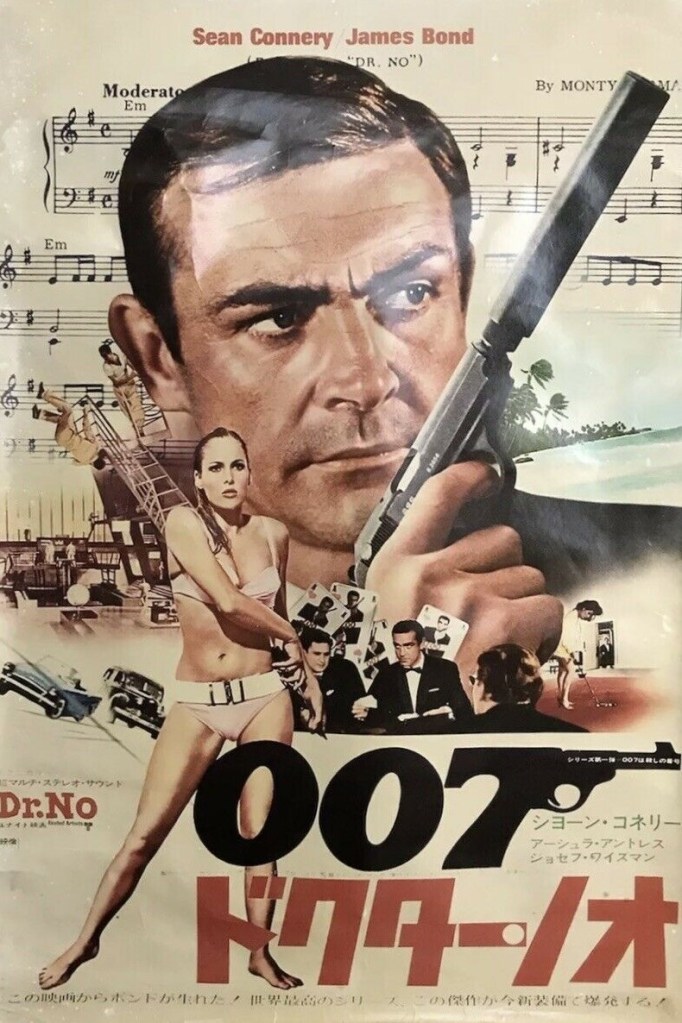
Dr No (1962) *****

Minus the gadgets and the more outlandish plots, the James Bond formula in embryo. With two of the greatest entrances in movie history – and a third if you count the creepy presence of Dr No himself at the beds of his captives – all the main supporting characters in place except Q, plenty of sex and action, plus the credit sequence and the theme tune, this is the spy genre reinvented.

Most previous espionage pictures usually involved a character quickly out of their depth or an innocent caught up in nefarious shenanigans, not a man close to a semi-thug, totally in command, automatically suspicious, and happy to knock off anyone who gets in his way, in fact given government clearance to commit murder should the occasion arise. That this killer comes complete with charm and charisma and oozes sexuality changes all the rules and ups the stakes in the spy thriller.

 Three men disguised as beggars break into the house of British secret service agent Strangeways (Tim Moxon) and kill him and his secretary and steal the file on Dr No (Joseph Wiseman). A glamorous woman in a red dress Sylvia Trench (Eunice Gayson) catches the eye of our handsome devil “Bond, James Bond” (Sean Connery) at a casino before he is interrupted by an urgent message, potential assignation thwarted.

We are briefly introduced to Miss Moneypenny (Lois Maxwell) before Bond is briefed by M (Bernard Lee) and posted out immediately – or “almost immediately” as it transpires – to Jamaica, but not before his beloved Beretta is changed to his signature Walther PPK and mention made that he is recovering from a previous mission. But in what would also become a series signature, liberated women indulging in sexual freedom, and often making the first move, Ms Trench is lying in wait at his flat.

Another change to the espionage trope, this man does not walk into the unknown. Suspicion is his watchword. In other words, he is the consummate professional. On arrival at Jamaica airport he checks out the waiting chauffeur and later the journalist who takes his picture. The first action sequence also sets a new tone. Bond is not easily duped. Three times he outwits the chauffeur. Finally, at the stand-off, Bond employs karate before the man takes cyanide, undercutting the danger with the mordant quip, on delivering the corpse to Government house, “see that he doesn’t get away.” 

Initially, it’s more a detective story as Bond follows up on various clues that lead him to Quarrel (John Kitzmiller), initially appearing as an adversary, and C.I.A. agent Felix Leiter (Jack Lord) before the finger of suspicion points to the mysterious Dr No and the question of why rocks from his island should be radioactive. Certainly, Dr No pulls out all the stops, sending hoods, a tarantula, sexy secretary Miss Taro (Zena Marshall) and the traitor Professor Dent (Anthony Dawson) to waylay or kill Bond.

But it’s only when our hero lands on the island and the bikini-clad Honey Rider (Ursula Andress) emerges from the sea as the epitome of the stunning “Bond Girl” that the series formula truly kicks in: formidable sadistic opponent, shady organization Spectre, amazing  sets, space age plot, a race against time. 

It’s hard not to overstate how novel this entire picture was. For a start, it toyed with the universal perception of the British as the ultimate arbiters of fair play. Yet, here was an anointed killer. Equally, the previous incarnation of the British spy had been the bumbling Alec Guinness in Our Man in Havana (1959). That the British should endorse wanton killing and blatant immorality – remember this was some years before the Swinging Sixties got underway – went against the grain.

Although critics have maligned the sexism of the series, they have generally overlooked the female reaction to a male hunk, or the freedom with which women appeared to enjoy sexual trysts with no fear of moral complication. Bond is not just macho, he is playful with the opposite sex, flirting with Miss Moneypenny, and with a fine line in throwaway quips.

Director Terence Young is rarely more than a few minutes away from a spot of action or sex, exposition is kept to a minimum, so the story zings along, although there is time to flesh out the characters, Bond’s vulnerability after his previous mission mentioned, his attention to detail, and Honey Rider’s backstory, her father disappearing on the island and her own ruthlessness. The insistently repetitive theme tunes – from Monty Norman and John Barry – was an innovation. The special effects mostly worked, testament to the genius of production designer Ken Adam rather than the miserable budget.

Most impressive of all was the director’s command of mood and pace. For all the fast action, he certainly knew how to frame a scene, Bond initially shown from the back, Dr No introduced from the waist downwards, Honey Rider in contrast revealed in all her glory from the outset. The brutal brief interrogation of photographer Annabel Chung (Marguerite LeWars), the unexpected seduction of the enemy Miss Taro and the opulence of the interior of Dr No’s stronghold would have come as surprises. Young was responsible for creating the prototype Bond picture, the lightness of touch in constant contrast to flurries of violence, amorality while blatant delivered with cinematic elan, not least the treatment of willing not to say predatory females, the shot through the bare legs of Ms Trench as Bond returns to his apartment, soon to become par for the course.

Future episodes of course would lavish greater funds on the project, but with what was a B-film budget at best by Hollywood standards, the producers worked wonders. Sean Connery (The Frightened City, 1961) strides into a role that was almost made-to-measure, another unknown Ursula Andress (The Southern Star, 1969) speeded up every male pulse on the planet, Joseph Wiseman (The Happy Thieves, 1961) provided an ideal template for a future string of maniacs and Bernard Lee (The Secret Partner, 1961) grounded the entire operation with a distinctly British headmaster of a boss.

Masterpiece of popular cinema.

Behind the Scenes: The Box Office Bump Part Two – Foreign Saves the Day

In previous decades, box office outside of the U.S., while a growing part of the ancillary equation, only in very rare circumstances outscored domestic. The general expectation, in part due to tougher competition for screens and extra distribution costs, was on average studios could expect to earn about half of domestic revenues.

There was one obvious exemption to this rule. James Bond overseas blew all the competition out of the water. And so it proved in the early 1970s from an examination of United Artists books for the period. Live and Let Die (1973) was the standout performer, knocking up $27 million in rentals (the studio share of the overall box office gross) from foreign cinemas compared to $16.4 million at home. Diamonds Are Forever (1971) did equally well – $22 million abroad, $20 million domestic.

James Bond was such a cash cow that surprised no one. Last Tango in Paris (1973) was considered an anomaly, controversy stoked by UA four-walling the picture when it couldn’t find enough screens. It came in third in the foreign market league, adding $16 million to domestic $21 million.

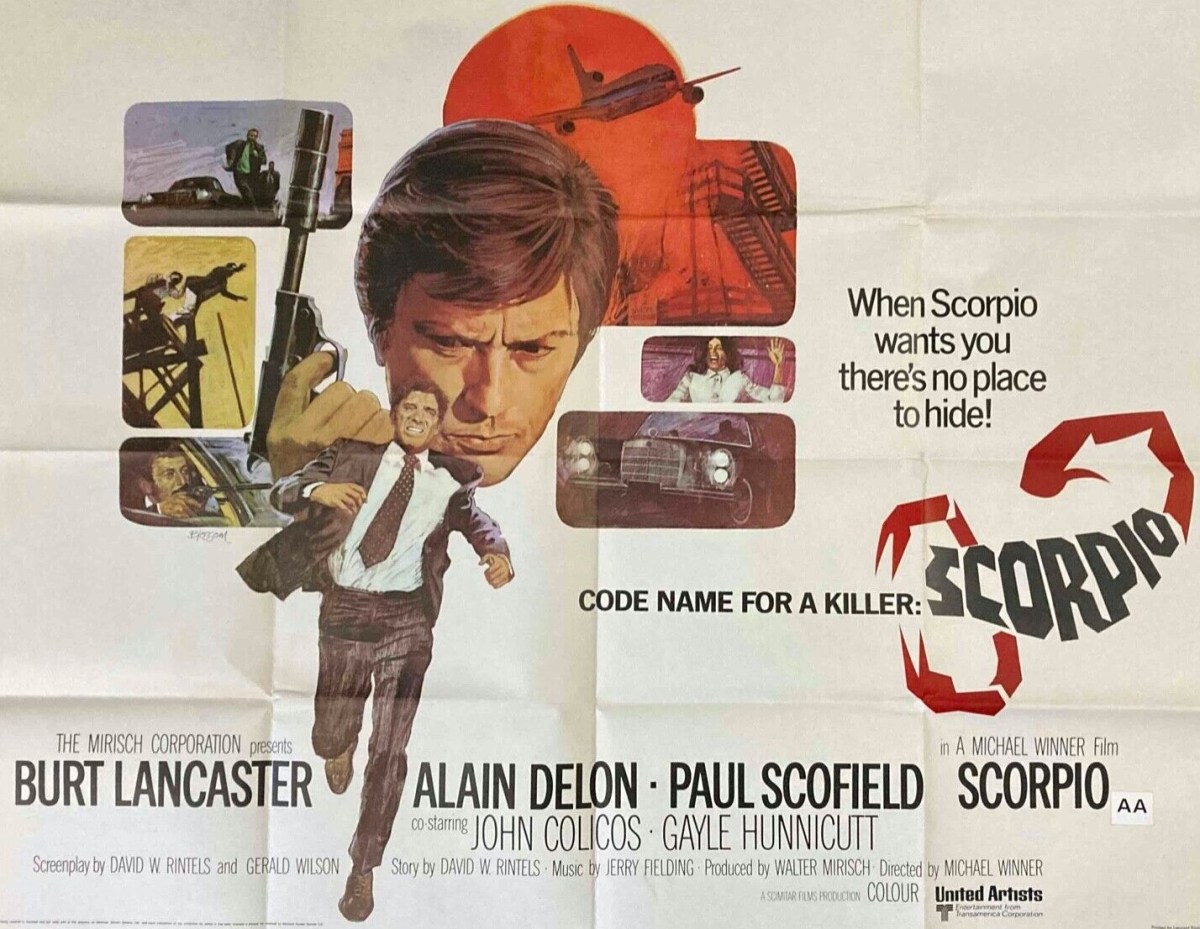
What did take Hollywood’s breath away was how often under-performers – flops even – at the U.S. ticket wickets did gangbusters elsewhere. The biggest winner was the aptly-named Michael Winner, director of westerns Lawman (1971) and Chato’s Land (1972), hitman thriller The Mechanic (1972) and spy drama Scorpio (1973). Total American rentals a shade over $7 million, total foreign rentals three times as much a colossal $21.8 million.

There was hardly a greater example of the disparity between American audience tastes and the rest of the world. And it made Hollywood studios more adventurous when it came to choosing subject matter, and in backing stars, aware that they could make their investment back – and more – from foreign markets.

It was probably astonishing to any studio executive that Burt Lancaster – for over two decades a high-flying marquee name from action-oriented fare like The Crimson Pirate (1952) and controversial drama From Here to Eternity (1953) to his Oscar-winning turn as Elmer Gantry (1960) and hardnosed western The Professionals (1966) – had lost his domestic audience especially after he had fronted up disaster movie smash Airport (1970).

But Lancaster could only scrape up $1.35 million at home for Scorpio, $2.1 million for Lawman and $2.8 million for another western Valdez Is Coming. Scorpio was the biggest hit abroad, with a massive $7 million, over five times domestic, while Lawman shot up $3.2 million (50 per cent above domestic) and Valdez Is Coming $2.65 million.

Charles Bronson was another beneficiary of foreign largesse. The Mechanic, too, targeted $7 million abroad, nearly three times the domestic tally of $2.6 million. Chato’s Land (1972) only delivered $1.27 million in the U.S. but $4.6 million abroad.

Westerns were a mixed bag. Oliver Reed-Candice Bergen-Gene Hackman number The Hunting Party (1971) was an almighty flop at home, just $800,000 in the kitty, but rallied somewhat abroad, not enough to turn profit but at least add a sheen of respectability, with $2.4 million elsewhere, three times domestic. The Magnificent Seven Ride! (1972), proof the sequels had outstayed their welcome, brought in just $750,000 domestically but again did triple the business abroad with $2.15 million and given the paltry budget enough to sit in the black.

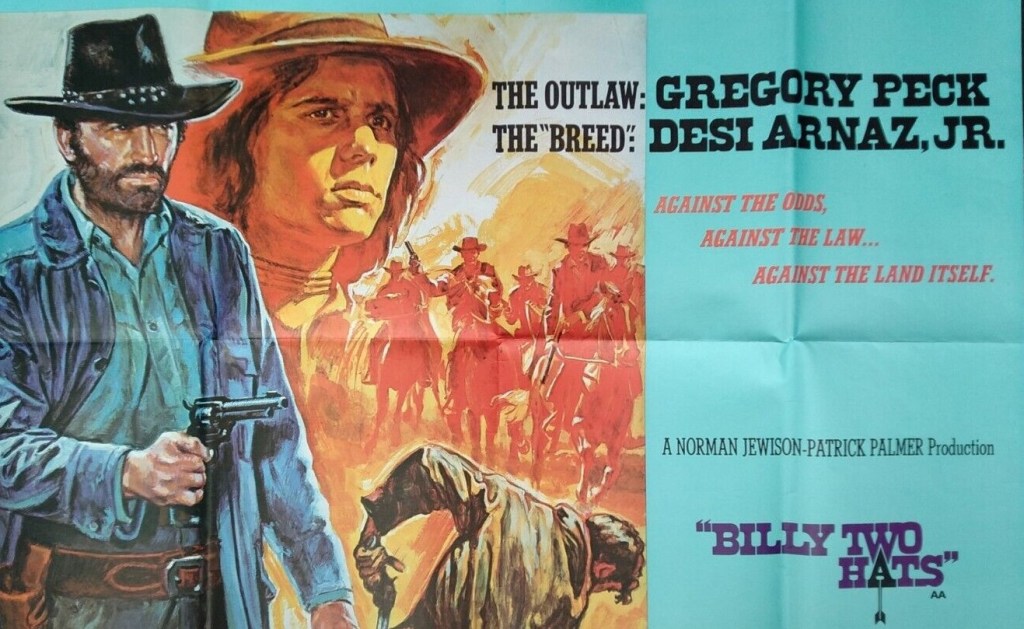
Revisionist effort Billy Two Hats (1974) starring Gregory Peck added $900,000 abroad to a miserable $440,000 at home – foreign revenues not enough to save it from flop. But foreign couldn’t save the second remake of the Gunfight at the OK Corral legend, Doc (1971) with Stacy Keach and Faye Dunaway which moseyed along to $1.35 million abroad to add to $1.8 million domestic. And another western sequel Support Your Local Gunfighter (1971) notched up just $970,000 abroad compared to $2.1 million. Modern western The Honkers (1972) with James Coburn managed just $550,000 abroad and $1 million at home.

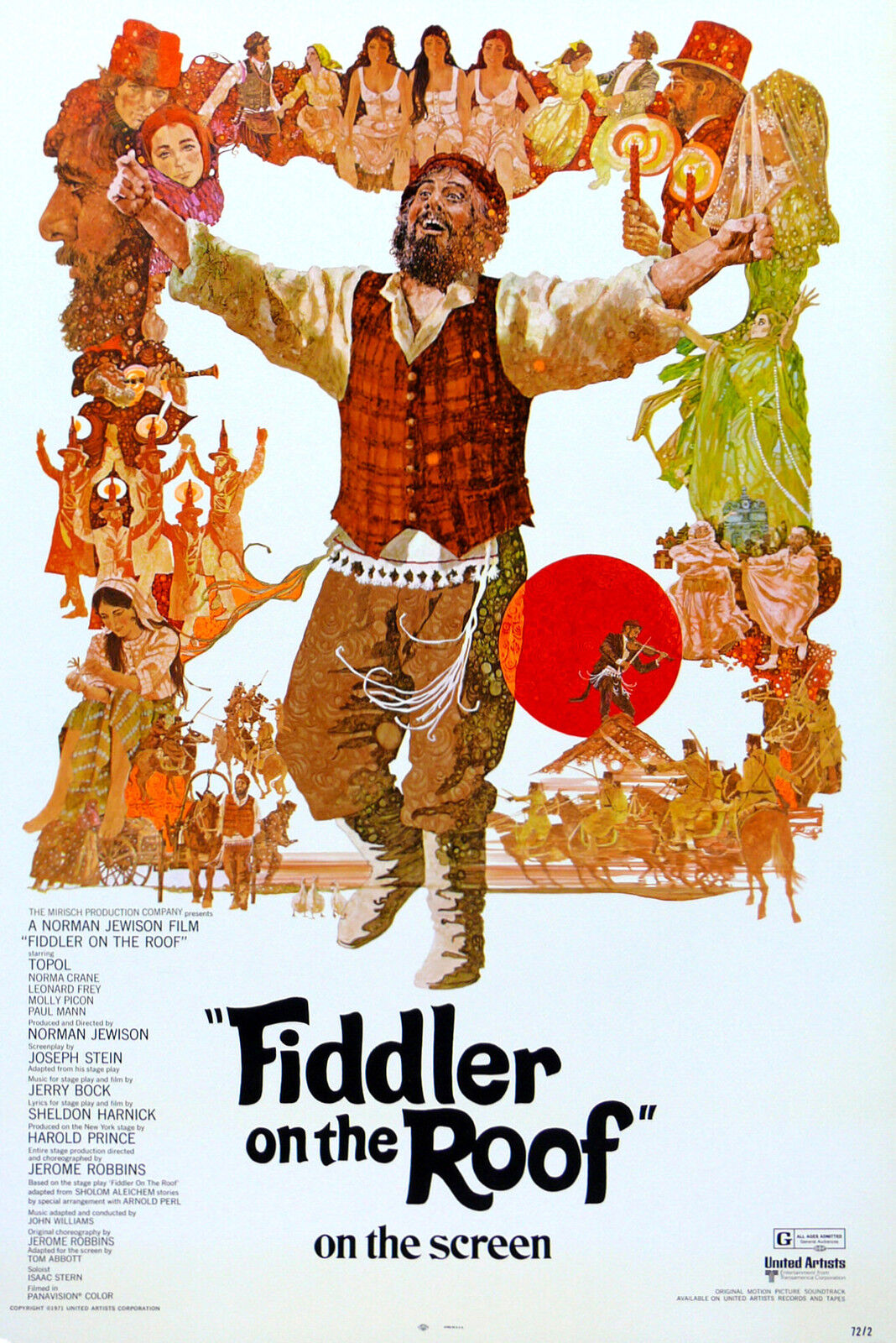
It didn’t really matter that Michael Caine comedy thriller Pulp (1972) did better abroad, figures everywhere nothing to write home about, $600,000 in total, five-sixths of that abroad. Fiddler on the Roof (1970), for other reasons, underwhelmed but nobody was going to complain too much when foreign audiences stuck $10 million in till, about a quarter of domestic.

There were some conundrums in the foreign-domestic share-out. Typically, American comedies didn’t travel. But Billy Wilder’s Avanti! (1972) starring Jack Lemmon, perhaps because of the Italian setting, did better abroad – $2.5 million to $1.6 million. Glenda Jackson British-made menage a trois Sunday, Bloody Sunday (1970) not surprisingly did better abroad, but only just, $1.8 million to $1.77 million.

Sidney Poitier in second sequel The Organization (1971) tapped into $2.9 million abroad and $2.45 million at home but generally too-specifically-American features struggled overseas, The Hospital (1971) snaring only $1.9 million compared to $9 million, White Lightning (1973) snagging $1.8 million compared to $6.9 million, Fuzz (1972) holstering $1.7 million against $3.1 million.

Behind the Scenes: The Box Office Bump

Ancillary – the famed “long tail” – has all but disappeared. Used to be movie studios could count on up to 90 per cent of a picture’s overall earnings coming after it had completed its initial run in the cinemas. Until streaming cut off ancillary at the pass,  that long tail consisted of an extraordinary number of revenue streams. Once a film was out of the cinemas, and assuming it wasn’t going to return in a steady reissue pattern like the James Bond or Disney movies or blockbusters such as Star Wars, its ancillary journey would begin with VHS/DVD (of which there were several sub-streams), then television (again, sub-divided into network, cable, syndication, and specialist operations like Turner) and then you could still be talking remake. Plus, you could bunch up an entire library of old pictures and sell them on again. The beauty of the system was that when movies hit whatever ancillary segment, there was rarely any such thing as an outright buy. Movies were leased. That meant every three or four years they could be sold all over again.

The forerunner of ancillary was network television. Television had begun mopping up old movies by the bucketload in the 1950s, and in such quantities that the attraction of old movies on the small screen prevented audiences seeking out new movies on the big screen and in part accounted for the steady decline of the moviegoing habit. By the 1960s, networks were beginning to fork out big bucks for individual pictures – Cleopatra (1963) going for several million.  

By the 1970s, the income from a television showing of a movie could exceed what it had made at the cinema. For United Artists, in the period 1970-1972 (this covers the dates films were made not when released), television sales, calculated on an overall annual basis, brought in at least an extra 24 per cent on top of revenue from cinema release. That figure came from 1970, but in 1971 that shot up to 38 per cent and the following year dipped slightly to 37 per cent. And that was just for the United States. Although other countries tended to pay a lot less for movies, they still paid something and in total might bring in half as much again.

The ancillary gold mine had started to pay off big time. In the 1960s, the amounts networks ponied up for television rights depended very much on initial box office, the assumption being there was some obvious correlation between the numbers who would go to see a particular movie at the cinema and the size of the subsequent television audience. And while it was true the biggest cinematic blockbusters tended to attract the biggest television audiences, it was soon equally clear that television audiences were as segmented as much as cinema ones and therefore the amounts paid by networks for individual movies began to show sharp  divergence.

There was no doubting that James Bond ruled the television roost as far as UA was concerned in 1970-1972. Diamonds Are Forever and Live and Let Die, regardless of U.S. box office – the former earning $20 million in rentals (the studio’s share of the box office), the latter $16.2 million – were each sold to American television for the same, princely, sum of $5.2 million, by far and away the most any movie pulled in.

Not far behind was Fiddler on the Roof which netted $5.12 million. But here’s the kicker – the musical earned more than both Bonds put together, a colossal $37 million in rentals. but in terms of attracting a television audience was considered a weaker proposition than both. But musicals were believed to be somehting of a golden goose for television, otherwise how to acocunt for Tom Sawyer which cost networks $2.76 million. Comparatively speaking, that made no logical sense because it had only taken in $5 million in rentals. But family-friendly fare was so rare it had networks duking it out for the rights. A third musical Man of La Mancha went to television for $1.7 million having racked up just$3.7 million at the cinema.

Conversely, networks weren’t remotely interested in films with a sex theme, no matter how well they had done at the box office. Last Tango in Paris had harnessed a colossal $16 million in rentals but was worth only $120,000 (yes, that’s right, $120,000) to any television station willing to show it (heavily cut of course). It didn’t even matter if you took a comedic approach to sex. Woody Allen’s Everything You Wanted To Know About Sex hauled in $8.2 million at the cinema but only $130,000 from television. But maybe Woody Allen was the problem. Bananas, with a highly-profitable $3.3 million at the box office, could only manage less than half a million from television, the comedian perhaps considered an acquired taste which not enough of the public had acquired.

But television, rather than being viewed as the perennial enemy, was often seen as salvation for under-performing movies, maybe not recouping the entire negative costs but going some way to stem the flow of red ink. And perhaps the more interesting statistics relate to those pictures which earned more from television than they did in their entire U.S. cinema run.

Michael Winner espionage thriller Scorpio headlined by Burt Lancaster and Alain Delon notched up $1.35 million at the cinema but $1.56 million from television. Similarly, Robert Altman’s critically-acclaimed The Long Goodbye with Elliott Gould as the iconic private eye picked up a mere $1 million at the U.S. cinema compared to $1.51 million from a network. Another private eye caper, Hickey and Boggs, teaming Robert Culp (who also directed) and Bill Cosby from a Walter Hill script, had snapped up just $900,000 from cinemas but $1.2 million from television. Cops and Robbers hoisted $1.32 million in small screen larceny as against $1.2 million elsewhere.

Westerns The Magnificent Seven Ride, the fourth in the series, and Ted Kotcheff’s Billy Two Hats starring Gregory Peck and with a script from Scotsman Alan Sharp, both did better financially from television than cinema. The former’s small screen take was $1.16 million compared to $750,000 from the cinema, the latter $1.15 million compared to $440,000. But for The Hunting Party with a top-line cast of Gene Hackman, Candice Bergen and Oliver Reed it went the other way, the $460,000 from television going hardly any way to offset the paltry $800,000 from cinemas.

It’s possible that star power, and weighted towards veterans, counted more in television. As well as Scorpio, Lancaster westerns Valdez Is Coming and Lawman tucked away $1.47 million and $1.5 million, respectively, from their television outings.

SOURCE: “Results of Distribution of Released Pictures (by production year),” MCHC 82, Box 1, Folder 8, The United Artists Archive, University of Wisconsin.

Behind the Scenes: When “Worldwide” Didn’t Exist – Global Box Office Part One

Box office fans, excited no doubt at how Avatar: The Way of Water (2022), is charging up the all-time charts, might be surprised to discover that the concept of “worldwide” box office figures didn’t exist in the 1960s. Although foreign markets had proved important to Hollywood since the 1940s, there was no accepted way of measuring their impact.

Box office results in certain countries – Italy, France, Brazil, Australia etc – were reported only on an occasional basis and were never considered front page news. Global box office figures were more likely to appear courtesy of one of the profit participants. Star William Holden’s share of Bridge on the River Kwai (1957) and producer Sam Spiegel’s earnings on Doctor Zhivago (1965), for example, were widely reported. Or a studio might want to defray rising investor discontent by pointing how well a Stateside flop such as The Magnificent Seven (1960) had performed overseas.

But these were one-offs and it was impossible to get a handle on the worldwide results for an entire year of Hollywood output. The kind of global box office reporting we take for granted did not appear until the 1990s and often even then, for many pictures, it was only as a year-end figure.

However, during my digging into hordes of records for my book The Making of “The Magnificent Seven” I came upon a tranche of reports on foreign box office figures relating to United Artists for the years 1965 to 1969. And they make for fascinating reading, not least to discover which Stateside hits did poorly abroad and, conversely, what flops in the domestic market made up for it in foreign countries.

Volume of production at UA more than doubled over the period, from 17 pictures in 1965 to 38 in 1969, but the average budget came down from $3.68 million per movie to $2.14 million. 

You won’t be surprised to learn that James Bond pretty much reigned supreme, taking three of the top four spots. But you might be taken aback to discover just how profitable this series was – over $100 million in rentals (the studio share of box office once cinemas have taken their cut) for three movies mentioned here – more than four times what they cost to make, and that would not take into account the colossal revenues accruing from merchandising.

The 1965-1969 worldwide winner by some margin was Thunderball (1965), clocking up $48 million in worldwide rentals. In second place was You Only Live Twice (1967) on $36 million. but the prospect of a cosy one-two-three was nipped in the bud by Oscar-winning Midnight Cowboy (1969) on $26 million with On her Majesty’s Secret Service (1969,) hampered by losing the services of Sean Connery, settling for fourth after pulling in $23 million.

Fifth spot went to big-budget roadshow Hawaii (1966) starring Julie Andrews and Max von Sydow which sank $18.8 million worldwide followed by Norman Jewison’s low-budget crime story In the Heat of the Night (1967) on $16 million helped by Sidney Poitier at a box office peak and Rod Steiger, courtesy of an Oscar, at a career one. Placing seventh was big-budget all-star British World War Two epic The Battle of Britain (1969) which soared, largely on foreign grosses, to $15.5 million. Next, on $14.8 million, came roadshow musical Chitty Chitty Bang Bang (1968) starring Dick Van Dyke. 

Biggest surprise of the year was the performance of family melding comedy Yours, Mine and Ours (1968) with out-of-favor stars Lucille Ball and Henry Fonda which closed in on $13 million. Rounding out the Top Ten was George Stevens’ Biblical roadshow The Greatest Story Ever Told (1965). However, its global figures of $12.1 million were a disappointment given its budget topped $21.2 million.

Just behind, on $12 million worldwide, setting another comedic hot pace, was Clive Donner’s What’s New Pussycat (1965). Despite having no roadshow credentials it boasted an all-star cast consisting of Peter O’Toole, Peter Sellers, Woody Allen, Ursula Andress, Romy Scheider and Paula Prentiss. Comedy also accounted for twelfth – the unfancied, though timely, Norman Jewison effort The Russians Are Coming, The Russians Are Coming (1966) starring Alan Arkin and Eva Marie Saint which coasted in with $11.8 million.

Thirteenth was Steve McQueen-Faye Dunaway romantic thriller The Thomas Crown Affair (1968) directed with considerable elan also by Norman Jewison. That flew in with $11.25 million, a cool million ahead of the second picture, Help!, by British pop sensation The Beatles.

Fifteenth place went to the final picture in the Sergio Leone trilogy The Good, the Bad and the Ugly (1968) starring Clint Eastwood which crested $10.2 million. John Frankenheimer’s World War Two thriller The Train (1965) with Burt Lancaster trying to outfox Paul Schofield tracked $9.75 million. But, as if to emphasize Clint Eastwood’s growing box office power, his first American western Hang ‘Em High came next on $9 million worldwide.

Second World War mission picture The Devil’s Brigade (1968) starring William Holden and Cliff Robertson in a Dirty Dozen-style knock-off paraded $8.6 million for eighteenth position. Comedy filled out the final two places in the Top 20. Jack Lemmon scored a suprise hit in Richard Quine’s How To Murder Your Wife (1965). Co-starring Virna Lisi and Englishman Terry-Thomas it romped away with $8.4 million. Although The Graduate (1967) had been a massive global success, United Artists only held the rights to certain territories but that was enough to pull in $7.7 million worldwide.

There wasn’t actually an informal Top 20 reported by United Artists over this five-year period. I’ve concocted it out of the reports below.

SOURCE: “United Artists Corporation and Subsidiaries Motion Picture Negative Costs for Pictures Released in the Year Ended 1965;” “United Artists Corporation and Subsidiaries Motion Picture Negative Costs for Pictures Released in the Year Ended 1966;” “United Artists Corporation and Subsidiaries Motion Picture Negative Costs for Pictures Released in the Year Ended 1967;” “United Artists Corporation and Subsidiaries Motion Picture Negative Costs for Pictures Released in the Year Ended 1968;” “United Artists Corporation and Subsidiaries Motion Picture Negative Costs for Pictures Released in the Year Ended 1969,” United Artists Files, Wisconsin Center for Film and Theater Research, University of Wisconsin.

Riding the Bond Reissue Bandwagon

The 60th Anniversary celebration of the James Bond phenomenon in British cinemas that has been running for a few months now sent me back to examine the extent of the James Bond Reissue Double Bill.

As I mentioned a few weeks back, the Dr No (1962)/From Russia with Love (1963) revival in 1965 kicked off the biggest-ever demand for a screen character, one of whom the public never seemed to grow tired, certainly for the next decade until the first of the series were sold to television. Prior to United Artists’ approach with the Bonds, unless a picture had Oscar-driven box office power it would not even be considered for revival for around seven years, considered a generation in audience terms.

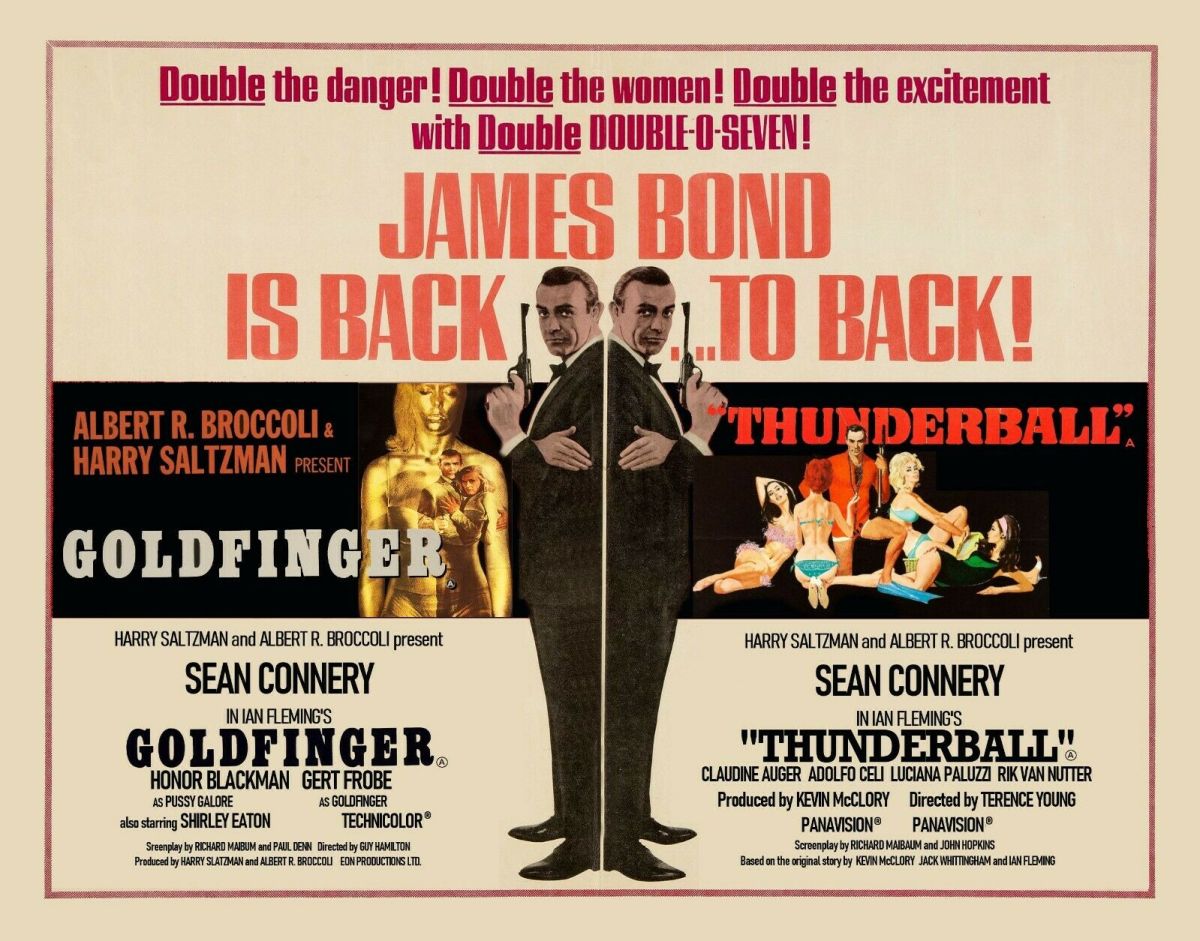
In Britain, the movies were guaranteed circuit releases on the Odeon chain. However, contrary to the approach in the United States, the movies were not thrown back into circulation right away and it wasn’t until three years later that the next double bill – Goldfinger (1964)/Thunderball (1965) – put in an appearance. But thereafter, there was no stopping the Bond bandwagon. In 1969 You Only Live Twice (1967) went out with either From Russia with Love or Dr No (cinemas could choose their preferred pairing).

In 1970, United Artists took a break from the Sean Connery reissue business by concentrating on the studio’s other big male star Clint Eastwood, doubling up For A Few Dollars More (1965) with A Fistful of Dollars (1964).  But by 1971 it experimented with playing Connery and Eastwood together, first pairing You Only Live Twice/A Fistful of Dollars and later the same year Goldfinger/For a Few Dollars More. But in 1972 the studio reverted to type with Thunderball/Dr No and the following year Diamonds Are Forever (1971)/From Russia with Love.

In 1974 it was You Only Live Twice/Thunderball and  few months later Dr No/Goldfinger. Come 1975 it was time for two of the later offerings to enter the revival business – Live and Let Die (1973) and On Her Majesty’s Secret Service (1969) followed at the end of the year by The Man with the Golden Gun (1974) and Live and Let Die. The next year brought a programme change – Diamonds Are Forever teamed up with new Bond Roger Moore in the non-Bond adventure Gold (1974).

In 1977, for the first time in nearly a decade the Bond reissue was absent from British cinemas although the following year saw a re-teaming of Live and let Die and The Man with the Golden Gun. But that pretty much spelled the end of the annual James Bond double bill, television by now too quickly eating up new product.

The British approach was almost conservative compared to the way the Bond revivals were handled in the US. After the sensational performance of Dr No/From Russia with Love in 1965 U.S. exhibitors had to wait only a year for Goldfinger/Dr No. United Artists showed little restraint, following a policy of “play them till they drop,” and launching the Connery/Eastwood combo in 1968 with You Only Live Twice/The Good, the Bad and the Ugly (1967) plus a straightforward Connery item Thunderball/From Russia with Love the same year followed by Goldfinger/Dr No in 1969.

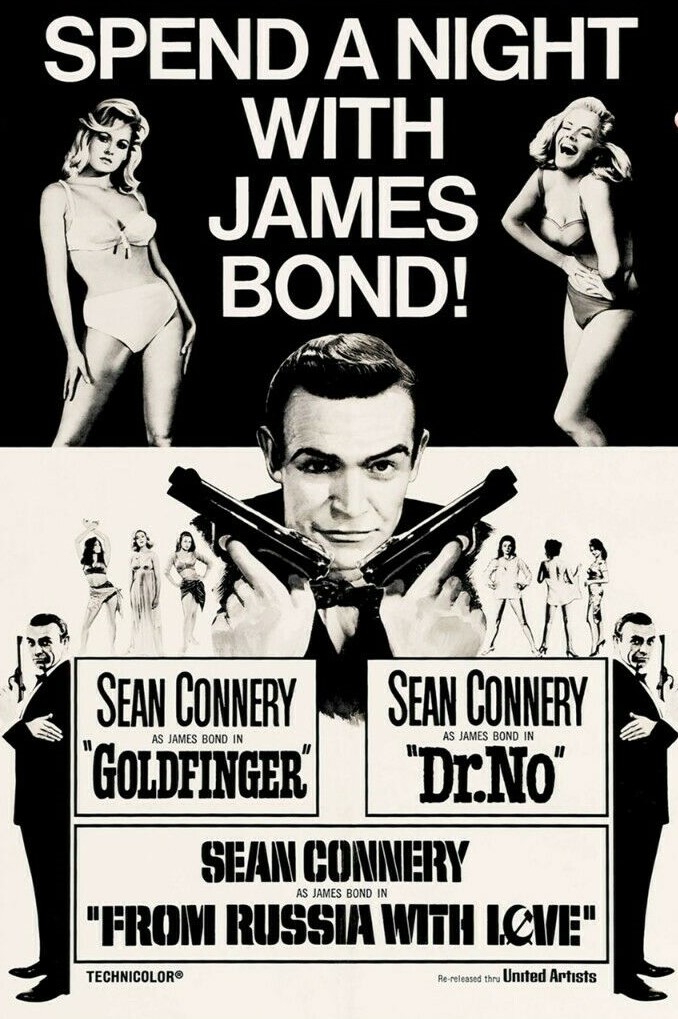
In the U.S. the year of the missing Bond reissue was 1970. But in 1971 United Artists reissued two Bond dualers six months apart. First out was Thunderball/You Only Live Twice and then Dr No/From Russia with Love. Ahead of the television premiere of Goldfinger in September 1972, UA brought back Goldfinger/From Russia with Love and then the triple bill (“Spend a Night with James Bond!”) of Goldinger/Dr No/From Russia with Love plus a double bill of Thunderball/You Only Live Twice, the last program incidentally knocking up a colossal gross of $122,000 – equivalent to $853,000 now – from 14 houses in New York in its opening week.

But the bonanza came to an end when television ponied up $17.5 million – equivalent to $126 million today – for the first seven pictures in the series. And this was before residuals kicked in from VHS, television resale and syndication, DVD, cable and streaming. Even when the MCU can guarantee billion-dollar revenues from many of its movies it’s doubtful if any one of its blockbusters made as much money as the best of the Bonds in their lifetime, much of that extra revenue coming from the way the revivals proved the enduring popularity of the series.  

SOURCES: Allen Eyles, Odeon Cinemas 2: From J. Arthur Rank to the Multiplex (Cinema Theatre Association, 2005) p211-220; Brian Hannan, Coming Back to a Theater Near You (McFarland, 2016) p147-151, 175-177, 227.

Selling James Bond – Pressbook for “From Russia with Love” (1963)

United Artists had two concepts in mind when it came to marketing the second in the James Bond series From Russia with Love (1963). The first, and quite audacious notion, was to tell anyone who hadn’t seen Dr No (1962) much they had missed. Producers Cubby Broccoli and Harry Saltzman reckoned 69 million moviegoers across the world had seen Dr No, but America only accounted for a small fraction of that total. So their mission was to ensure that American audiences did not miss out again on the “throbbing world of hot-blooded excitement.”

To target that marketplace, the adverts were more like a relaunch, not a sequel, and the taglines began with “Meet James Bond, Secret Agent 007.” And then, “For those unlucky few who missed Dr No…You are unprepared for the sophisticated mayhem and polished lovemaking. The James Bond bug has not bitten you. But take heart! There is still time to jump on the Bond bandwagon with the second James Bond adventure From Russia with Love. See it and we guarantee – you will be hooked for good.” The final exhortation: “Don’t you think it’s time you met secret agent 007?”

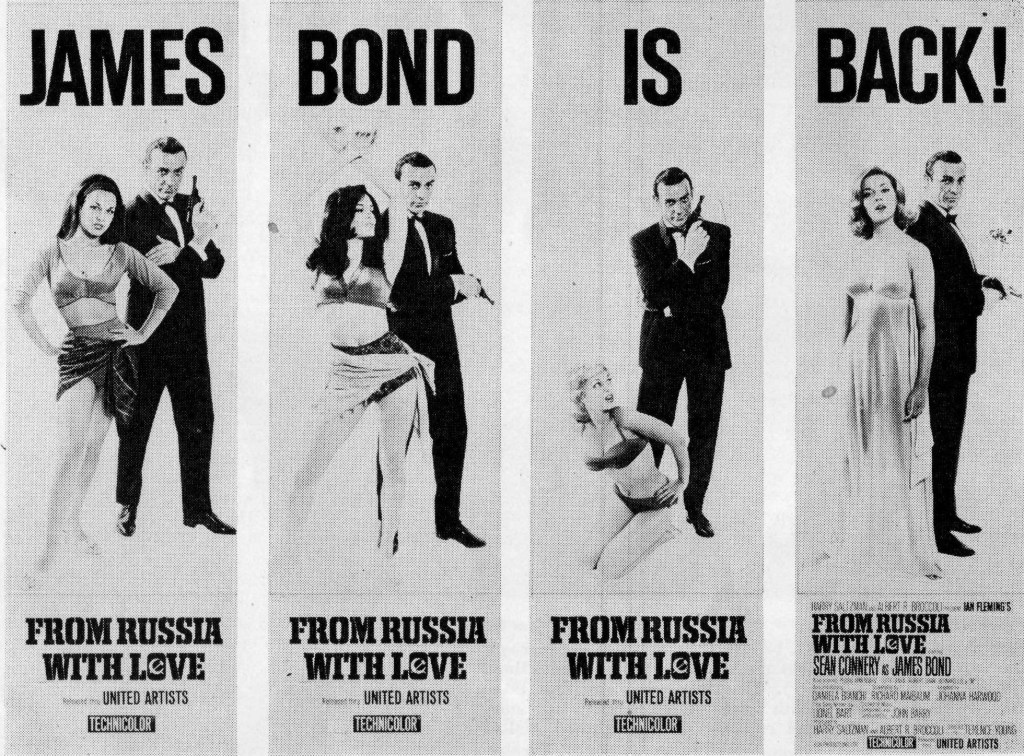
But of course James Bond already had some kind of fan club in the States. “James Bond Is Back!” screamed the alternative advertisements. For both, however, the emphasis was on the new. “His incredible new women! His new incredible enemies! His new incredible adventures!”

“Target: the unkillable James Bond 007. Blast him! Seduce him! Bomb him! Strangle him!” The tone of the adverts suggested something entirely new. While heroes in thrillers could expect to face danger at every turn, and while a romance might sweeten the pot, there would not be a selection of alluring scantily-attired women. “For those who saw Dr No, consider yourself fortunate. Now you are prepared for the further fantastic adventures of that master of intrigue and women, secret agent 007 James Bond, join him in his new thriller From Russia with Love.

To whet the appetite of local newspapermen there was a host of snippets. Oxford University had organized an 007 Society whose members included three lords and the heir to one of the the country’s largest department stores. While James Bond never uses a Windsor knot in his ties, Sean Connery does. Ian Fleming’s Bond novels had sold 30 million copies including six million of From Russia with Love. Four Istanbul mosques featured in the new film as well as an underground cistern a millennium old.

Door posters five feet high.

Beauty queens were always a good bet for coverage – Miss Universe runner-up Daniela Bianchi  won the role of James Bond’s girlfriend after a screen test and former Miss Israel Aliza Gur and former Miss Jamaica Martine Beswick played the fighting gypsy girls. Lotte Lenya was married to Kurt Weill who, with Berthold Brecht, wrote The Threepenny Opera. Sean Connery was fitted out by his own Savile Row tailor Anthony Sinclair and during filming got through ten customized shirts, eight suits, two top coats and a dress suit.

Highly sought-after these days in the memorabilia market are the door panels – measuring 20 inches x 60 inches – which exhibitors would stick to lobby doors but which could also be utilized as displays in stores. Signet brought out a movie tie-in paperback which came with its own promotional material. As there were already other books in the series, booksellers would be inclined to set up a Bond display. As well as the John Barry original soundtrack album, other artists recording material from the film included Matt Monro, Jackie Gleason, Kenny Ball, Al Caiola and Si Zetner, all creating promotional tools.

“Bondmanship” was the overall name given to lifestyle items worn by Bond or which he might wear so tie-ups with fashion stores and retailers were encouraged “no direct endorsement is necessary.” So, for example, restaurants were encouraged to offer “ a menu good enough for James Bond.” It didn’t matter that Bond did not wear a manufacturer’s shoes, ties or suits in the film, just that he might wear them if they were of sufficient quality.

The marketeers came up with a simple stunt: send a set of keys to a newspaper, turn up the next day with a dispatch box handcuffed to your wrist, open it and find inside various promotional items. Or the keys don’t open the case and you need to send for a locksmith. Either way it was important to have a photographer to hand.

The Box Office Equalizer: Part Three

Trade magazine Variety’s innovative weekly Top 50 based on grosses that had begun in April 1969 changed the way exhibitors regarded box office. Instead of waiting till the appearance of the magazine’s year-end round-up which was limited to around the top 100 movies, cinema owners now got a week-by-week snapshot of how new movies were playing. All box office figures had previously concentrated on the big movies of the day – the roadshows and pictures with big stars – that opened at the first run city center houses that were easier for Variety to track. The switch to a computerized system made it more feasible to examine the takings from hundreds of cinemas not necessarily showing the big movies sucking up all the publicity oxygen.  

An examination of the films hitting the coveted number one position in the weekly chart illuminated the changes in the business. For a start, to reach number one a movie had to be showing on over 30 cinemas, but this could rise to 100-plus, and began to show the benefits of the wider first run release. This was also really the beginning of the per-screen average.  High figures could be achieved by recruiting a large number of screens but exhibitors could easily disseminate the information and decide whether the number of screens massaged the figures or showed how successful a film really was. And this was the start of another promotional ploy, the business of a movie holding onto to the top spot for a second, third or even fourth week, proof a movie had “legs.”

The Year’s weekly Top Ten performers make interesting reading. The biggest figures posted in any one week during 1969 were for On Her Majesty’s Secret Service which hauled in a massive $1.22 million (equivalent to $9.6 million today) from 99 screens – a $12,323 screen average. This was followed by Goodbye, Columbus with $935,000 from 65 screens, a higher screen average of $14,384. Next came The Love Bug with $724,000 from 76 houses ($9,526 average). Another week of Goodbye, Columbus shouldered $681,000 from 60 ($11,350).

The Love Bug had a further two weeks at the top, pinching $658,000 from 117 ($5,623) and $633,000 from 44 ($14,386).  Seventh-best week was taken by The Killing of Sister George with $621,000 from 70 ($8,871). Snatching eighth spot was Fanny Hill with $625,000 from 49 ($12,755). Ninth was Krakatoa, East of Java with $621,000 from 68 ($9,132). Last place in the top ten went to I Am Curious, Yellow with $594,000 from 52 ($11,423).

From the exhibitor perspective there were two notable points. The first was the per-screen average. Secondly, cinema bookers could not fail to notice not only that two of the top ten in weekly gross and three of the top five films in terms of screen averages went to sexploitation pictures.

It was soon abundantly clear that producers could sell their pictures to sometimes doubting exhibitors by the simple process, not so much of bombarding them with adverts and Pressbooks extolling a film’s potential, but of getting a movie into sufficient theatres for the box office figures to tell their own story.

Although the other big films expected to top the weekly chart did achieve that aim – among them True Grit (twice), Butch Cassidy and the Sundance Kid (also twice), Ice Station Zebra, Easy Rider (three times), Midnight Cowboy, Oliver! and Paint Your Wagon – there were as many unfancied movies perching atop the weekly pile.

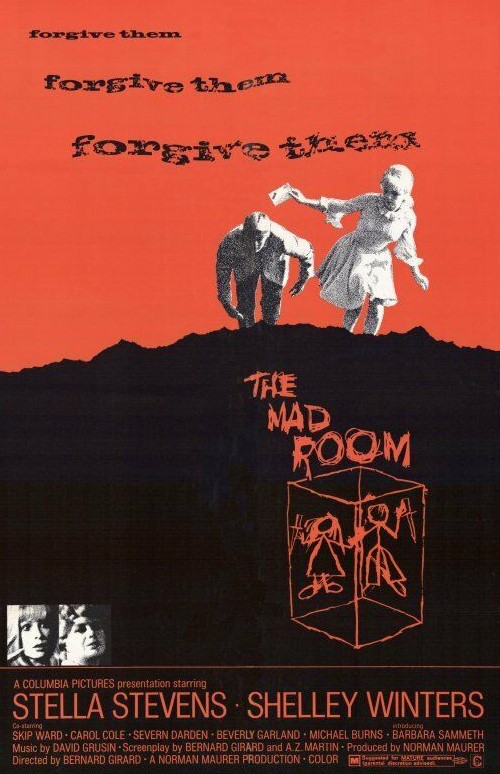
Apart from the sexploitation films and The Killing of Sister George, others holding down the number one spot for a week were British star Carol White in Mark Robson thriller Daddy’s Gone A-Hunting ($544,000 from 71), What Ever Happened to Aunt Alice ($540,000 from 48), Gordon Parks’ bittersweet drama The Learning Tree ($401,000 from 49), Stella Stevens and Shelley Winters in horror film The Mad Room ($283,000 from 38) and reissues Bonnie and Clyde/Bullitt ($546,000 from 81) and The Longest Day ($501,000 from 76).

Distributors of low-budget pictures used to have to take ads out in the trades to prove to potential customers that their movies were pulling in decent business. Now they had better proof, from the most important source of all, Variety, whose box office figures were scanned by every cinema manager in the country. Once a week without a distributor putting a hand in their advertising pocket there was all the promotional evidence they needed.  

This was the second sea change in the way cinema owners perceived the business, the first being the opening up of the collection of box office figures through Variety’s annual report on upwards of 1,000 titles. To have figures at your finger tips for the price of a subscription to a newspaper was a game changer.

But there was yet another game changer to come. 

SOURCES: The Top 50 Grossers chart appearing weekly in Variety from April to December 1969.

Behind the Scenes: “Operation Kid Brother / O.K. Connery” (1967)

A new episode in the James Bond legend began on February 23, 1966, when a plasterer from Scotland made an audacious bid for movie stardom. His name was Neil Connery, currently earning $10 a week, shooting for a $5,000 payday as he took part in a screen test in Rome for producer Dario Sabatello (Seven Guns for the MacGregors, 1966) for a film entitled Operation Casbah that would later be tagged Operation Kid Brother (O.K. Connery in Italy).

Sabatello was an experienced producer beginning with The Thief of Venice (1950) starring Hollywood legend Maria Montez. Connery was a skilled laborer living in the four-year shadow of elder brother Sean and with little intention of moving out of that shadow. However, as a result of a work-related incident, he became the subject of a newspaper article and then a radio interview. Nobody was much interested in the reason for the interview – stolen tools – but everyone was impressed by the sound of Neil’s voice. “Sean’s brother spoke exactly like him.”

Archers Assemble! Connery on the bowstring.

The newspaper interview caught the eye of Sabatello, who noted the actor’s likeness to his brother and who flew over to Edinburgh to interview Neil and in so doing becoming aware of his athletic attributes, height and good looks. A month later came an invite for the screen test. Neil’s agent, who had no right to make such a claim, promised that if Neil got the part big brother Sean would play a cameo. For the test, Connery had to “embrace a girl, sing, dance and finally end up in  a hand-to-hand fight with a guy with a knife.” However, the test was so successful that the presence of Sean was not required. Sabatello signed the neophyte actor to a six-picture deal that would generate a six-figure salary if the film turned the Scot into a star.

Italian production giant Titanus sold the world rights (except for Italy) to United Artists, ironically the distributor of the James Bond pictures, thus securing the funding for the $1.2 million three-month shoot that kicked off in Cinecitta in Rome on December 14, 1966. Locations were scheduled to include Monte Carlo, San Remo, Turin, Barcelona, Malaga and Tetuan.

The supporting cast was dominated by actors with a Bond connection including Adolfo Celi, Daniela Bianchi, Anthony Dawson, who had all worked with director Alberto De Martino on Dirty Heroes (1967) and Lois Maxwell and Bernard Lee. Ennio Morricone, another De Martino aficionado, was brought in to do the score.

Affiliates Assemble! Connery with Bond regulars Bernard Lee and Lois Maxwell.

Connery’s boxing training in the British Army came in handy when he had to become an archer. Pulling a bow takes considerable physical exertion. Target practice was held at Adolfo Celi’s house outside Rome. “I had remembered everything about putting the bow down, bringing it up, pull and push, as there was quite a pull on it,” he said. Celi’s arrow managed just a few yards but Connery hit the target. His luck did not hold when filming the real thing in Monte Carlo. Celi’s shot did not go far again but this time Connery’s arrow missed the target.

Although Connery had read the script he was only given his lines in the morning as he went into make-up. He acquitted himself well in the fight scenes, except for one scene which ended with him being taken to hospital.   

The film opened in Britain at the Pavilion in London’s West End on April 25, 1667, with a general release slated for May 5. But it didn’t get a circuit release. That is, it didn’t go out on either of the two main cinema chains, ABC or Odeon, or the lesser Gaumont circuit, so its bookings would have been restricted. It didn’t appear in the United States until November, 1967, having been reviewed without much enthusiasm in Variety which posited “at best the film deserves bottom half bookings”, i.e. the bottom half of a double bill, which means it would play for a fixed rental rather than a percentage.

It did open in first run in a number of city center picture houses in November and December, to occasionally decent but hardly lush box office. Its $20,000 week in Chicago was deemed “good”, as was the $4,000 in Providence, while $13,000 in Philadelphia was considered “brisk” but $5,000 in St Louis considered only “fair.”  There was a first run showing in New York but only at a 600-seater arthouse.

But when it went wider in “Showcase” releases the box office collapsed. In New York it managed only $67,000 from 25 theatres compared to, in the same week, British film The Family Way on $223,000 from 26, and the second week of Point Blank with $145,000 from 25. Business was worse in Los Angeles, just $49,000 from 26 compared to $125,000 from 29 for Barefoot in the Park, and it was dire in Kansas City, only $9,000 from eight houses.

Given the relatively low budget, the film globally may well have broken even but it certainly did not send Neil Connery’s box office status into the stratosphere. He had small parts in two more low-budget movies, The Body Stealers (1969) and Mad Mission 3: Our Man from Bond St (1984) plus some television.

SOURCES: Brian Smith, “Bond of Brothers,” Cinema Retro, Vol 4 Issue 12 2008, p13-19; Allen Eyles, Odeon Cinemas  2, (CTA 2005), p212; Allen Eyles, ABC (CTA, 1993), 123-124; Allen Eyles, The Granada Theatres (CTA 1998)’ p247; Allen Eyles, Gaumont British Cinemas, (CTA 2005), p197; William Hall, “Big Brother Is Watching Him,” Photoplay, June 1967; “International Soundtrack,” Variety, February 23, 1966, p33; “Titanus Sets Pre-Prod Deals for Two UA Pix,” Variety, December 14, 1966, p24; “International Soundtrack,” Variety, December 21, 1966, p24; “Hollywood and British Production Pulse,” Variety, December 28, 1966, p17; Advertisement, Variety, January 4, 1967, p65; “Connery Pix a Family Affair with UA,” Variety, March 8, 1967, p24;  Review, Variety, October 11, 1967, p22; “Picture Grosses,” Variety November 1, November 8, November 15, November 29, December 13, 1967.  

Discover WordPress

A daily selection of the best content published on WordPress, collected for you by humans who love to read.

The Atavist Magazine

by Brian Hannan

WordPress.com News

The latest news on WordPress.com and the WordPress community.