On Her Majesty’s Secret Service (1969) ***

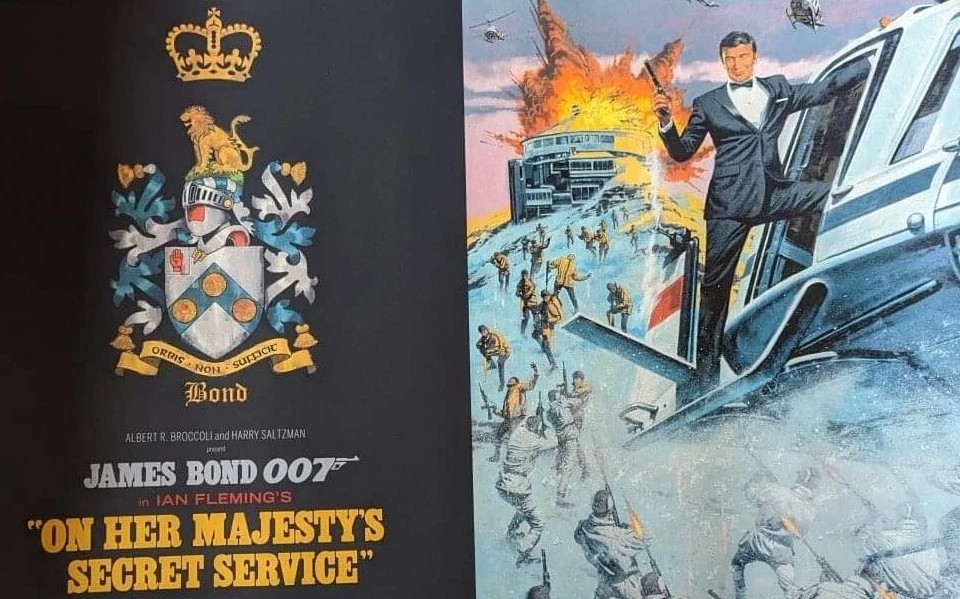
Holds a special place in my movie heart because it was the first James Bond film I ever saw and the first soundtrack I ever bought. Having, by parental opposition, been denied the opportunity to see any of the previous instalments and therefore having little clue as to what Sean Connery brought to the series I wasn’t interested in the fact that he had been replaced. I can’t remember what my younger self thought of the downbeat ending but on the current re-view felt that a rather cursory storyline was only saved by the stunning snow-based stuntwork, two races on skis, one on a bobsleigh, car chase on ice and the kind of helicopter framing against the sun that may well have inspired Francis Ford Coppola in Apocalypse Now (1979).
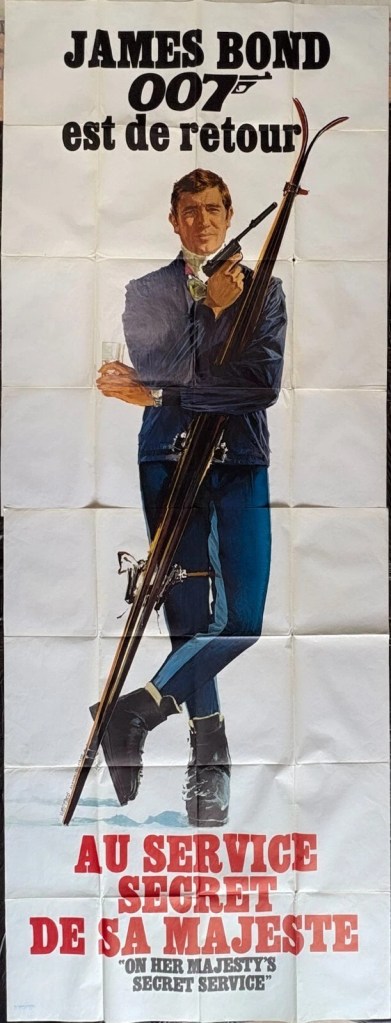
The heraldic subplot bored me as much to tears as it did the assorted dolly birds (to use a by-now-outlawed phrase from the period) and I was struggling to work out exactly what global devastation could be caused by his brainwashed “angels of death” (the aforementioned dolly birds). This is the one where Bond threatens to retire and gets married. Given the current obsession with mental health, the bride has a rather more contemporary outlook than would have been noted at the time. We are introduced to her as a wannabe suicide. Good enough reason for Bond to try and rescue her from the waves, and her mental condition not worthy of comment thereafter.

Turns out she’s the feisty spoiled-brat daughter Tracy (Diana Rigg) of crime bigwig Draco (Gabriele Ferzetti) and Bond persuades that Mr Big to help him snare the bigger Mr Big Blofeld (Telly Savalas), hence the convoluted nonsense about heraldry. There’s the usual quotient of fisticuffs and naturally James Bond doesn’t consider falling in love with Tracy as a barrier to seducing a couple of the resident dolly birds.

I takes an awful long time to click into gear but when it does the stunt work – perhaps the bar now having been raised by Where Eagles Dare (1968) – is awesome. Apart from an occasional bluescreen for a close-up of Bond, clearly all the chases were done, as Christopher Nolan likes to say, “in camera.” And there’s about 30 minutes of full-on non-stop action.
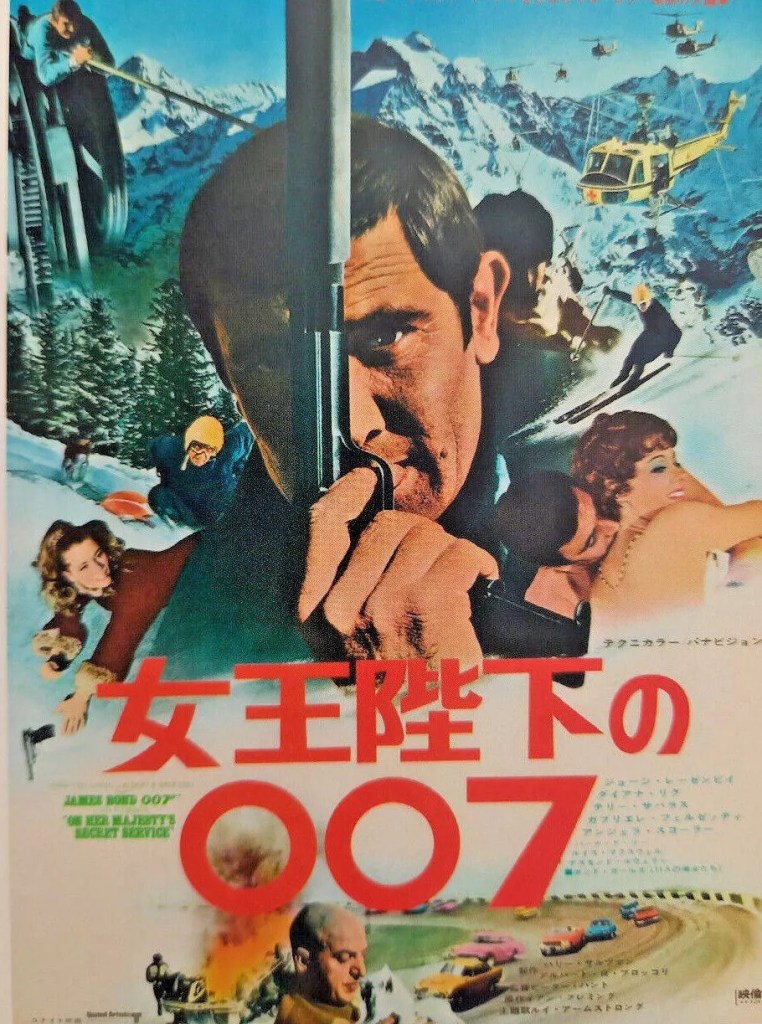
Pre-empting the future eyebrow-raising antics of Roger Moore, I felt George Lazenby was decent enough, bringing a lighter touch than Connery to the proceedings without his inherent sense of danger (which Moore also lacked). Diana Rigg, I felt was miscast, more of a prissy Miss Jean Brodie than a foil for Bond, even if this one was a substitute for the real thing. It was a shame Honor Blackman in Goldfinger (1964) had taken the slinky approach but that would have worked better to hook Bond than earnestness.  

I’m not entirely sure how Blofeld planned to employ his angels of death but the prospect of a gaggle of dolly birds gathering in fields or rivers and being capable of distributing enough toxic material to destabilize the world seems rather ill-thought-out.

Theoretically, this is meant to be one of the better ones in the series but that’s mostly based on the doomed romance and the downbeat ending and I guess that Diana Rigg (The Avengers, 1965-1968) supposedly brought more acting kudos than others in the female lead category. Adopting something close to her Avengers persona would have been more interesting but I guess she was fighting against being typecast.

If you get bored during the endless heraldry nonsense, you can cast your eye over the assortment of Bond girls who include Virginia North (The Long Duel, 1967), Angela Scoular (The Adventurers, 1970), Joanna Lumley (Absolutely Fabulous, 1992-2012), Catherine Schell (Moon Zero Two, 1969), Julie Ege (Creatures the World Forgot, 1971), Anouska Hempel (Black Snake, 1973) and Jenny Hanley (Scars of Dracula, 1970), who, as graduates from this particular talent school, made a greater impact in entertainment than many of their predecessors.

Second unit director Peter Hunt made his full directorial debut but focussed more on his speciality – action – than the drama. Written by series regular Richard Maibaum (Dr No, 1962) and Simon Raven (Unman, Wittering and Zigo, 1971) and more faithful than usual to the Ian Fleming source novel.

Top marks for the action, less so for the rest.

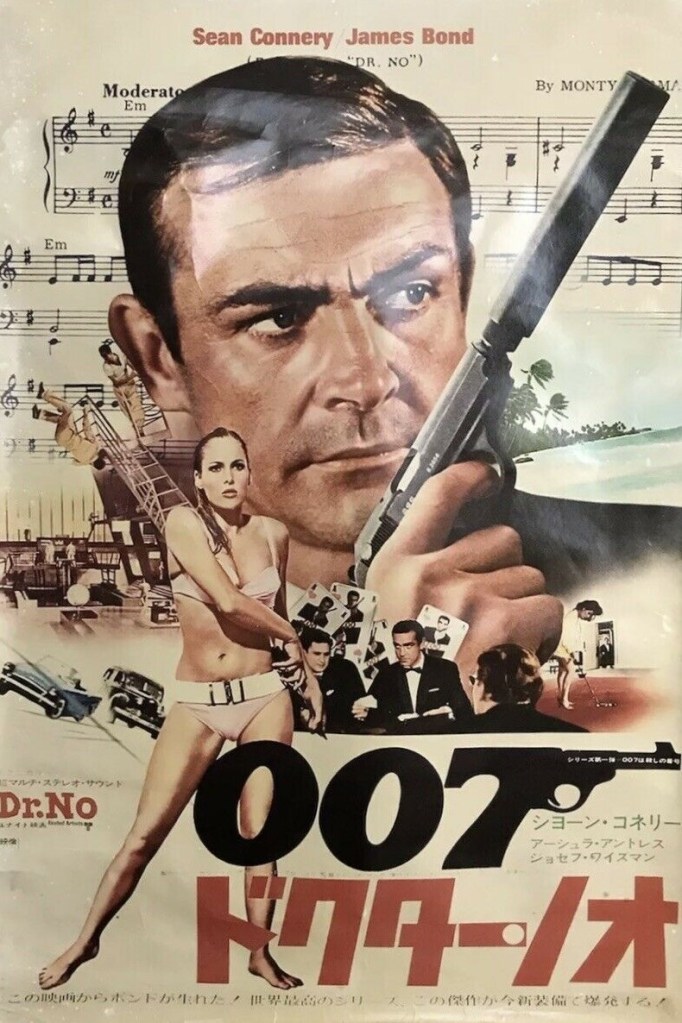
Dr No (1962) *****

Minus the gadgets and the more outlandish plots, the James Bond formula in embryo. With two of the greatest entrances in movie history – and a third if you count the creepy presence of Dr No himself at the beds of his captives – all the main supporting characters in place except Q, plenty of sex and action, plus the credit sequence and the theme tune, this is the spy genre reinvented.

Most previous espionage pictures usually involved a character quickly out of their depth or an innocent caught up in nefarious shenanigans, not a man close to a semi-thug, totally in command, automatically suspicious, and happy to knock off anyone who gets in his way, in fact given government clearance to commit murder should the occasion arise. That this killer comes complete with charm and charisma and oozes sexuality changes all the rules and ups the stakes in the spy thriller.

 Three men disguised as beggars break into the house of British secret service agent Strangeways (Tim Moxon) and kill him and his secretary and steal the file on Dr No (Joseph Wiseman). A glamorous woman in a red dress Sylvia Trench (Eunice Gayson) catches the eye of our handsome devil “Bond, James Bond” (Sean Connery) at a casino before he is interrupted by an urgent message, potential assignation thwarted.

We are briefly introduced to Miss Moneypenny (Lois Maxwell) before Bond is briefed by M (Bernard Lee) and posted out immediately – or “almost immediately” as it transpires – to Jamaica, but not before his beloved Beretta is changed to his signature Walther PPK and mention made that he is recovering from a previous mission. But in what would also become a series signature, liberated women indulging in sexual freedom, and often making the first move, Ms Trench is lying in wait at his flat.

Another change to the espionage trope, this man does not walk into the unknown. Suspicion is his watchword. In other words, he is the consummate professional. On arrival at Jamaica airport he checks out the waiting chauffeur and later the journalist who takes his picture. The first action sequence also sets a new tone. Bond is not easily duped. Three times he outwits the chauffeur. Finally, at the stand-off, Bond employs karate before the man takes cyanide, undercutting the danger with the mordant quip, on delivering the corpse to Government house, “see that he doesn’t get away.” 

Initially, it’s more a detective story as Bond follows up on various clues that lead him to Quarrel (John Kitzmiller), initially appearing as an adversary, and C.I.A. agent Felix Leiter (Jack Lord) before the finger of suspicion points to the mysterious Dr No and the question of why rocks from his island should be radioactive. Certainly, Dr No pulls out all the stops, sending hoods, a tarantula, sexy secretary Miss Taro (Zena Marshall) and the traitor Professor Dent (Anthony Dawson) to waylay or kill Bond.

But it’s only when our hero lands on the island and the bikini-clad Honey Rider (Ursula Andress) emerges from the sea as the epitome of the stunning “Bond Girl” that the series formula truly kicks in: formidable sadistic opponent, shady organization Spectre, amazing  sets, space age plot, a race against time. 

It’s hard not to overstate how novel this entire picture was. For a start, it toyed with the universal perception of the British as the ultimate arbiters of fair play. Yet, here was an anointed killer. Equally, the previous incarnation of the British spy had been the bumbling Alec Guinness in Our Man in Havana (1959). That the British should endorse wanton killing and blatant immorality – remember this was some years before the Swinging Sixties got underway – went against the grain.

Although critics have maligned the sexism of the series, they have generally overlooked the female reaction to a male hunk, or the freedom with which women appeared to enjoy sexual trysts with no fear of moral complication. Bond is not just macho, he is playful with the opposite sex, flirting with Miss Moneypenny, and with a fine line in throwaway quips.

Director Terence Young is rarely more than a few minutes away from a spot of action or sex, exposition is kept to a minimum, so the story zings along, although there is time to flesh out the characters, Bond’s vulnerability after his previous mission mentioned, his attention to detail, and Honey Rider’s backstory, her father disappearing on the island and her own ruthlessness. The insistently repetitive theme tunes – from Monty Norman and John Barry – was an innovation. The special effects mostly worked, testament to the genius of production designer Ken Adam rather than the miserable budget.

Most impressive of all was the director’s command of mood and pace. For all the fast action, he certainly knew how to frame a scene, Bond initially shown from the back, Dr No introduced from the waist downwards, Honey Rider in contrast revealed in all her glory from the outset. The brutal brief interrogation of photographer Annabel Chung (Marguerite LeWars), the unexpected seduction of the enemy Miss Taro and the opulence of the interior of Dr No’s stronghold would have come as surprises. Young was responsible for creating the prototype Bond picture, the lightness of touch in constant contrast to flurries of violence, amorality while blatant delivered with cinematic elan, not least the treatment of willing not to say predatory females, the shot through the bare legs of Ms Trench as Bond returns to his apartment, soon to become par for the course.

Future episodes of course would lavish greater funds on the project, but with what was a B-film budget at best by Hollywood standards, the producers worked wonders. Sean Connery (The Frightened City, 1961) strides into a role that was almost made-to-measure, another unknown Ursula Andress (The Southern Star, 1969) speeded up every male pulse on the planet, Joseph Wiseman (The Happy Thieves, 1961) provided an ideal template for a future string of maniacs and Bernard Lee (The Secret Partner, 1961) grounded the entire operation with a distinctly British headmaster of a boss.

Masterpiece of popular cinema.

Book into Film – “Dr No” (1962)

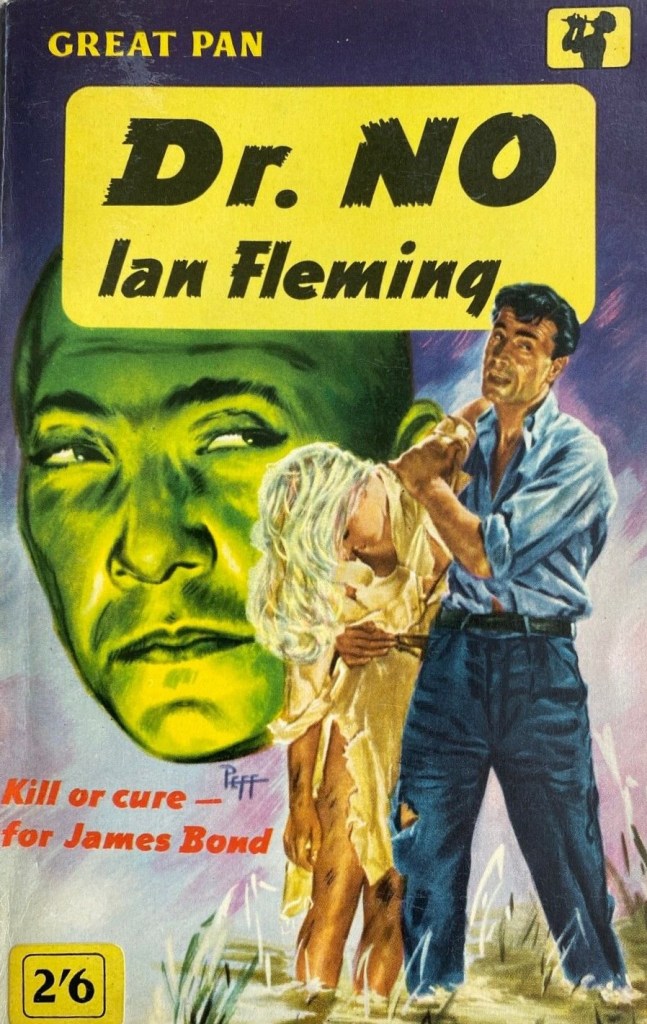
If the screenwriters had faithfully adapted the book it would be death by centipede that faced James Bond in his bed. Never mind that a centipede would be nobody’s idea of a scary creature, the insect would have been impossible to replicate on screen. The idea of a poisonous spider being slipped under Bond’s covers was filched from Honey Rider’s past. In the film she recounts how she killed a rapist with a knife, but in the book she employed a black widow spider.

Nor would the idea of Dr No making his fortune from bird shit (guano) seem to carry much appeal, so that was changed for the film, and that forced an alteration to the ending as well for Ian Fleming has the villain drowning in a pile of guano. And in that context, Strangways’ investigation of the island relates to rare spoonbills (a type of birds) not rocks.

Original British paperback edition prior to the movie being made

So the myriad team of screenwriters –Richard Maibuam (The Day They Robbed the Bank of England, 1960), Johanna Harwood (Call Me Bwana, 1963), Berkely Mather (The Long Ships, 1964), Wolf Mankowitz (The Day The Earth Caught Fire, 1961) and director Terence Young – chopped, changed and invented to turn the sixth James Bond novel into the first James Bond film. In publication sequence, this followed From Russia with Love in which Bond had a particularly dangerous encounter with Rosa Klebb, and at the start of the Dr No episode has been recuperating from being poisoned. The Jamaican mission is seen as something of a convalescence, a way to ease Bond gently back into the field, a trip so lacking in urgency that three weeks have passed since the disappearance of Strangways and his secretary.

Naturally, the scriptwriters have to cut to the chase more quickly than that, hence Bond being despatched immediately. Needless to say, there is no dalliance with a certain Ms Trench, that being a screenwriters invention, along with the scene in the casino, inserted in order to punch up the Bond screen legend. Not only is there no dodgy chauffeur waiting for Bond at the airport but Quarrel is introduced immediately as an ally not an opponent. While the female photographer is a genuine freelance, she does scrape Quarrel’s face with a broken flashbulb and delivers a warning about Dr No.

Bond’s tradecraft extends to closely examining the basket of fruit in his room and sending off samples for analysis, and finding they contain cyanide. But the book contains no Professor Dent, Felix Leiter or Miss Taro, and no other attempts (beyond the centipede) on Bond’s life  so the story in some respects moves more straightforwardly towards the mysterious island.

Original U.S. paperback edition prior to the movie being made

As with the film, Bond arrives on the island with Quarrel. But Honey Rider does not appear in dazzling style out of the waves. Bond first catches sight of her from the back. But she is nude and has a broken nose, two provisos that would not go down well either with the censor or a cinematic audience. Much of their dialogue, including the stuff about learning from encyclopedias comes from the book, but her backstory is completely different. Instead of her father being a marine zoologist, he is dead and her once-wealthy family destitute, leaving her to fend for herself, and considering entering prostitution to make a decent living.

The arrival of Dr No’s speedboat and the ensuing gunfire, the destruction of her boat, the chase and the “Dragon” all come from the book, as does Dr No’s million-dollar aquarium, his steel hand, and the opulence of the prisoners’ accommodation. However, there being no radiation in the plot for the book, there is no requirement for them to be stripped naked once captured.

But in the matter of the clear sexual attraction between Bond and Rider, the book and the film are at variance. In the original Fleming version, Rider, although initially resisting his overtures to the extent of dumping cold beans on his hand, is soon making the running, inviting him to share her sleeping bag, an offer which he rejects. Surprisingly, the usually rampant Bond further resists her allure once inside the Dr No compound on the grounds that he has to “stay cold as ice to have any chance of getting out of this mess.”

The screenwriters come up with completely different plot for the climax while incorporating some elements of the book’s ideas. While Dr No remains the same power-mad maniac, his plan is to turn the island into the most important technical intelligence center in the world with the ability to take control of  U.S. rockets and point them at London.

Deeming Bond and Rider as mere irritants, Dr No intends to use them for a sadistic experiment, pegging out Rider in the path of a swarm of crabs and putting Bond through a terrifying obstacle course. Although Bond does escape through a grille and encounter both heat and water, in the book he also has to cope with a giant tarantula and squid before stealing a crane, sending Dr No to his doom and shooting his way out. 

In the film we briefly see Rider tethered to stakes awaiting the crab onslaught before Bond races to the rescue. But, in reality, in the book Dr No’s assumption that death by crabs would be a terrifying ordeal is somewhat misplaced. As Rider points out, she never felt in any danger because crabs are simply not carnivorous. But both book and novel are agreed – they do have sex at the end.

While the screenwriters use elements of the book it is primarily their inventions that turn the novel into an instant screen classic, defining Bond for generations to come. You can almost count the action beats, whether a chase or a fight or mere confrontation, with sex or humor providing welcome respite, but all moving in the same direction of creating a feel for a new type of character and a new kind of film.

Bestseller Hollywood, Part One – How Hollywood Cannibalized Hit Fiction

A 1960s novelist lucky enough to hit the bestselling jackpot could generally count upon another financial bounty when Hollywood came calling. Bestsellers came with the double bonus of a ready-made story and a ready-made audience. From the outset the industry had recognised the benefit of making pictures out of properties that had already gained a wide readership, hence the continual adaptation of Shakespeare and Dickens from the silent era onwards.

The combined hardback and paperback sales in the U.S. could amount to a couple of million copies, with double that number or more overseas, and of course some books hit the stratosphere – Gone with the Wind, The Grapes of Wrath, Peyton Place and Valley of the Dolls, for example. Publishers had learned to slap one of two taglines – either “Now a major motion picture” or “Soon to be a major motion picture” – on new paperbacks which appeared to give a book greater status among the reading public while at the same time acting as advance buzz for a movie, paving the way for an onslaught of movie tie-ins.

Alfred Hitchcock became the main selling point for “Marnie” once his name
was attached to the film of the book.

In the 1960s, there were not only many more bookstores than there are now, but paperbacks were also widely available in department stores, newsagents, corner shops and kiosks. In fact, it was estimated there were as many as 125,000 outlets for books. Much as they had done with fan magazines Hollywood latched on to anything that would act as free marketing, book covers in shop windows provided a free promotional boost, in effect the publishers doing the studios’ job for them. As the cost of marketing continued to rise, movies made from bestsellers, with their significant public awareness, were seen as a very effective investment.

For a studio, books were often a cheaper investment than an original screenplays. Although some books were sold for substantial sums a good number were purchased for relatively small fees prior to publication with the author receiving further sums dependent on book sales and/or audience figures – Valley of the Dolls was sold in this fashion much to author Jacqueline Susann’s later chagrin.

From the Annual Top Ten Bestsellers, every year except 1965 the number one bestseller was turned into a movie. About four books a year on average from the top ten were made into pictures. The best year for books into films was 1962 when nearly three-quarters of the books achieving an annual top ten ranking ended up on the big screen. These were Ship of Fools (film released in 1965), Youngblood Hawke (1964), Fail Safe (1964), Seven Days in May (1964), The Prize (1963), The Agony and the Ecstasy (1965) and The Reivers (1969).

Bestsellers clearly created their own momentum and studios snatching up the movie rights tended to strike while the iron was hot, all except one of these 1962 bestsellers being filmed within three years of publication.

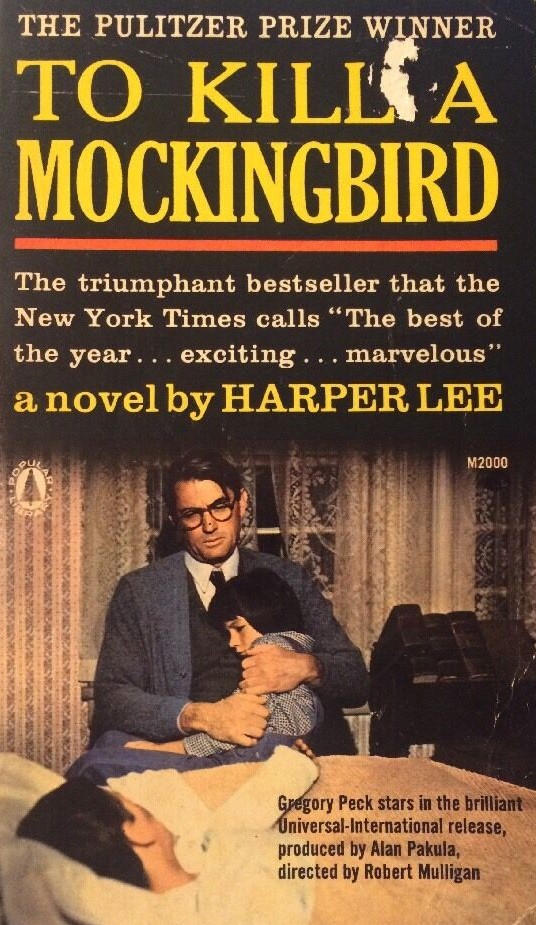
Sales of the third best-selling novel of 1961 were boosted the following year by the addition of Gregory Peck’s photo on the front cover. The gap between initial hardover publication, first paperback publication and the movie tie-in edition suited publishers who felt they would get a third bite of the cherry with the movie edition. The movie edition would usually be published several weeks prior to a film’s
release serving as a teaser for the picture.

Six films were adapted in 1965 and five in 1963. Most went into speedy production. Of the 1963 contingent – The Shoes of the Fisherman (released in 1968), The Group (1966), Caravans (1978), The Sand Pebbles (1966) and The Battle of the Villa Florita (1965) – three fell into the three-year bracket while one took five years to hit the screen and Caravans, although taking more than a decade to reach the screen, was actually on MGM’s production list for most of the 1960s.

Half those from the 1965 Top Ten list were as promptly made into pictures – Up the Down Staircase (1967), The Green Berets (1968) and Arthur Hailey’s Hotel (1966). Taking a slower route were John Le Carre’s The Looking Glass War (1970), Ian Fleming’s The Man with the Golden Gun (1974) and Morris West’s The Ambassador (1984). 

Of course, there was no guarantee that moviegoers would respond to a film of a bestselling book or in the quantities required to turn a profit. Even being the year’s number one bestseller could not shield a property from the vagaries of the movie business. Advise and Consent (filmed in 1962), The Agony and the Ecstasy and The Shoes of the Fisherman – all the top-selling books of their particular year – failed to make much of an impact at the box office. On the other hand, Valley of the Dolls (1968) and Airport (1970) most certainly did.

It is also worth noting that with the sole exception of Cleopatra (1963), none of the number one films at the box during the 1960s was an original screenplay. They all originated in another medium, either publishing or Broadway.

The movie tie-in was a different aspect of the publishing business and will be covered in a future Blog. And so might be novelizations.

Book Into Film – The Venetian Affair

Sometimes I wonder if studio executives ever read a book before they purchase the rights or whether they just rely on the assumption that a bestseller must have a storyline worth adapting for the movies. I always had the impression that in many instances producers were simply buying up what they saw as a ready-made audience, that if a novel sold a few million copies enough of those satisfied readers would turn up to see the adaptation which would more than pay for what the book cost to buy (not counting the automatic marketing bounty that came from bookstore displays). These days we are used to films rigidly following the storylines of bestselling novels, even expanding the movie version into two parts to accommodate it.

But that was far from the case in the 1960s. As shown previously in this Blog, some films – Fathom (1967) a classic example – bore little resemblance to the source material while others such as The Flight of the Phoenix (1965) were more faithful renderings and others (example: The Quiller Memorandum, 1966) built on what the author had originally created. I often wondered at the reaction of a screenwriter handed an adaptation of a bestseller. Is he/she instructed to junk the whole thing and start again, retaining only the title, or asked to see what they can make of it, making other stuff up as they go along?

Sales of Helen MacInnes books increased as the 1960s wore on with The Double Image in 1966 and The Salzburg Connection in 1968 both making the annual Top Ten list, the latter the last of her books to be filmed.

In this case, producer E. Jack Neuman hired himself as the writer so I’m guessing he already knew that, beyond a simplified version of the storyline and some of the characters, he was going to dump virtually every aspect of the Helen MacInnes novel.

There were two explanations for this. The first was Neuman’s record as a creative force and it occurred to me he saw his version of the MacInnes leading man as a potential movie series character. This was his movie screenwriting debut but he had been churning out episodes of television series – including Wagon Train, The Untouchables and The Twilight Zone – for over a decade. More importantly, he was showrunner of three series – two dramas Sam Benedict (1962-1963) and Mr Novak (1963-1965) and a western A Man Called Shenandoah (1965-1966) which between them clocked up over 100 episodes – so he knew how to keep a good character going.

The second issue was the difficulty in adapting the work of MacInnes. The Scottish writer had been turning out bestselling espionage novels long before Ian Fleming, Alistair MacLean and John le Carre picked up a pen, but only two had ever been turned into pictures. And the reason was simple. The plots were anything but simple. Not so much twist after twist but complication after complication. The Venetian Affair is dense and in particular, consists, in many scenes, of exposition with characters explaining to other characters what the hell is going on.

In fact, the plot for The Venetian Affair is so obtuse – although strangely enough, quite contemporary – that it would never have worked on film. The C.I.A. are trying to get hold of a fake letter that will implicate the U.S. and Britain in a plot to assassinate French President Charles de Gaulle (fake news in today’s parlance). So that was never going to work in a movie. Preventing an assassination, yes, but, of course, what a preposterous idea to think anyone could kill de Gaulle without having a time machine that could flash forward to Day of the Jackal. In any case, the C.I.A. only find out about the letter’s existence because someone picks up the wrong overcoat – so that’s not going to play either.

However, what the book does have is a good title. Venice is an excellent locale for a spy movie. The only problem is only half the novel is set there. The first half takes place in Paris. What else the book has from a screenwriter’s perspective is that the ex-wife, Sandra Fane (Elke Sommer), of the central character Bill Fenner (Robert Vaughn) is a Communist defector who is considering defecting back and to achieve that requires the presence of her former husband.

So that formed the emotional heart of the film, potential reunion or further betrayal, that Fane is just going to dupe him a second time. And that’s about as much as Neuman takes from the book. The rest of the plot – the bombing, Fane disguised as a nun, virtually all the action, the bad guy, the brainwashing, the mouse sequence – is the invention of Neuman.

In the book Fenner is not an alcoholic but it’s more dramatic in the film if he is. Some of the characters from the book such as hard ass CIA boss Rosenfeld (Edward Asner) appear on screen much as described. Others have characters enhanced – Vaugiround (Boris Karloff) here a global kingpin is a mere moral philosopher in the book. The character of Claire Connor (Felicia Farr) is hardest done by. In the book, she is a central figure, the widow of an agent, teamed up with Fenner in a pretend romance that turns real. But in the film, she has become the mistress of a diplomat.  

I had already enjoyed the movie but my appreciation of the creative endeavor that went into its making increased by reading the original material screenwriter Neuman had to work with.  

Discover WordPress

A daily selection of the best content published on WordPress, collected for you by humans who love to read.

The Atavist Magazine

by Brian Hannan

WordPress.com News

The latest news on WordPress.com and the WordPress community.