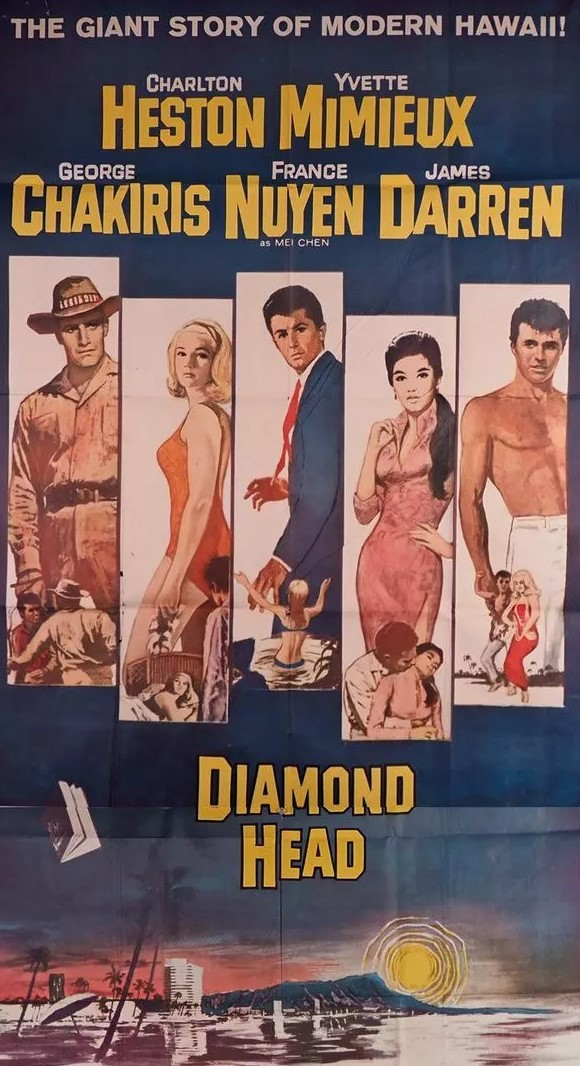
Behind the Scenes: “Diamond Head” (1962)

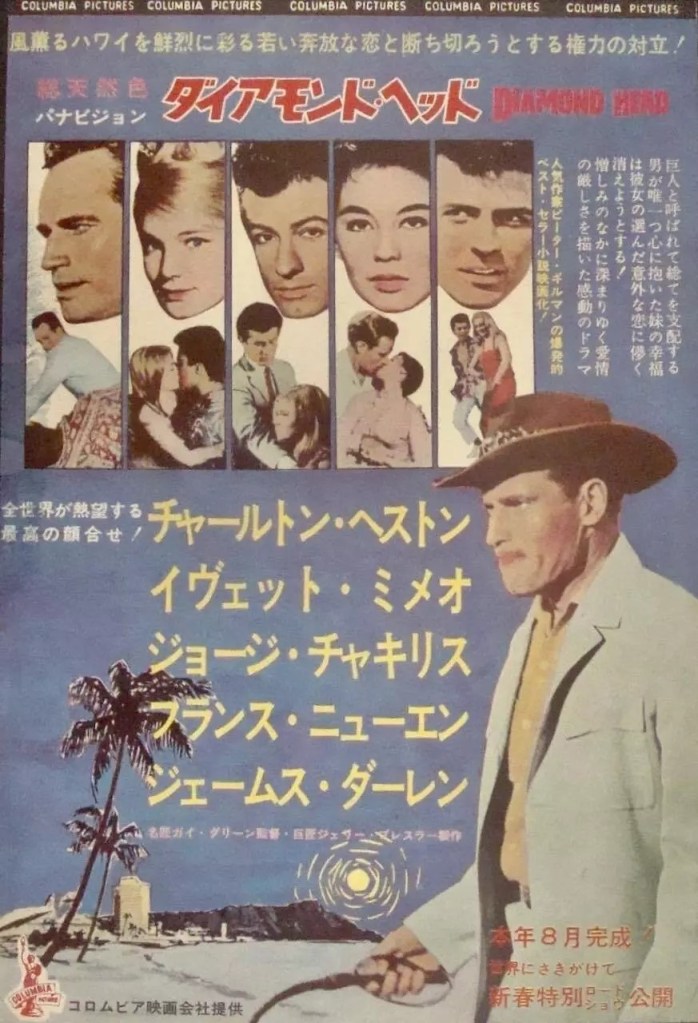
Charlton Heston was as hot as they come. He was coming off what would prove one of the biggest pictures of all time – and tucked away an Oscar as well – with Ben-Hur (1959) and followed it up with another hit El Cid (1961). He had no shortage of offers. He had pulled out of The Comancheros (1961), part of proposed three-picture deal with Twentieth Century Fox but with an unknown director rather than veteran Michael Curtiz who later helmed it with John Wayne. He had turned down Let’s Make Love (1960) with Marilyn Monroe and a remake of Beau Geste to co-star Dean Martin and Tony Curtis.

He entered into discussions with Nicholas Ray to film the bestseller The Tribe That Lost Its Head (never made) and The Road of the Snail (never made), rejected William the Conqueror (never made) and Cromwell (1970). He was turned down in turn by Otto Preminger for Advise and Consent (1961). “Zanuck’s man called from Paris,” he notes, “they have a new role for me in The Longest Day (1962).” That was another false lead.
In due course he signed up for Easter Dinner for producer Melville Shavelson (Cast a Giant Shadow, 1966) released as The Pigeon That Took Rome (1962). By this point he was being pursued by Samuel Bronston. “I had no idea how determined Sam was to have me follow El Cid with another film for him.” Bronston eventually got his wish. “No sooner had I turned down The Fall of the Roman Empire (1964) than they shoved it back a year on their schedule and began work on 55 Days at Peking (1963), converting the enormous and half-built set representing Rome into an equally enormous and even more beautiful set representing Peking.”

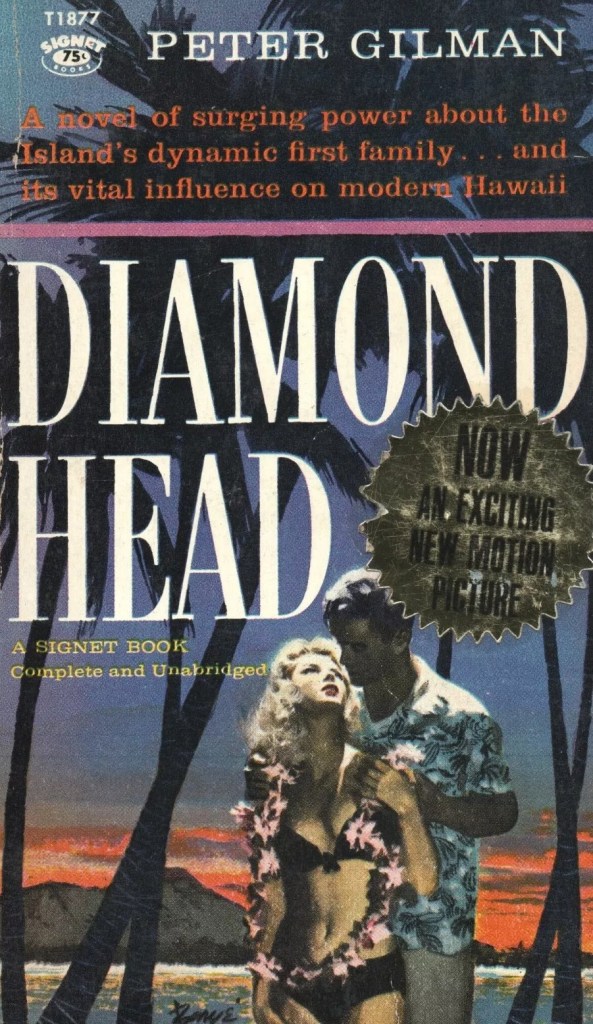
But that meant delay while the massive Bronston machine kicked into gear. In the meatime Heston was “attracted a bit by the opening pages” of Diamond Head with Columbia. “A good part in an overwritten and melodramatic script,” he observed, concluding, “If it’s treated with great care, it might work out all right.”

The project moved along apace. A couple of weeks after receiving the script in December 1961, he was in London meeting director Guy Green (Light in the Piazza, 1962) and producer Jerry Bresler, “an amiable man” though Sam Peckinpah might beg to differ after his experiences on Major Dundee, 1965. “He seems a very intelligent fellow,” Green observed, but queried, “how could a man refer with pride to the fact he had made a film called Gidget Goes Hawaiian?”
George Chakiris (hot after West Side Story, 1961) was already fixed as second male lead and Yvette Mimieux (Light in the Piazza) was being chased for female lead. She wasn’t available but Heston wasn’t keen on second choice Carroll Baker. Luckily, it turned out Mimieux could do the picture. “On the basis of what we saw in Light in the Piazza, she’s ideal for the part.”

But Heston reckoned the script needed work. He was also disgruntled with the costumes for Diamond Head, complaining, “Why is it designers like to costumes instead of clothes? It’s a grievous fault in a period film, but there’s no excuse in a modern story.”

By March, a few months after committing to the picture, he was out in Hawaii, on the island of Kauai, though the trip itself was not without incident, Heston “sick enough to call a doctor.” They were met with unseasonal rain. They were assured this was very unusual. But it wasn’t. In consequence, the first day’s filming was scrapped, filling the actor with the conviction “the whole project was doomed.” It was another three days before filming commenced – the shoot was plagued with rain.

While Heston was impressed enough with the director (“Guy Green works carefully and thoughtfully”) he was distracted by the lighting.

“Those brutes and reflectors loom larger in my mind…One of the banes of my career has been  acting in exterior locations with arc lights and reflectors focused in my eyes, which are very light sensitive. (Dark-eyed actors have an unfair advantage, I’ve always felt.) Most people have no idea of the dimensions of this problem. They always ask you how you can remember the lines…they should wonder instead how you can concentrate on the scene when your every nerve is straining simply to keep your eyes open.” Negotiation with the cinematographer ameliorated the situation.

Similarly, Heston found the director responsive to his concerns. For a key scene with Mimieux, he believed “we can both do better” and taking this on board the director agreed on a reshoot the next day. “I have to project Howland’s need to be loved, though he conceals it. You can’t play this, of course, but it has to be in the scene, in the whole film, if we’re going to bring it off.”

As well as a multitude of media – Hawaii at this stage still a rare location, public interest boosted by the publication of James Michener’s Hawaii in 1958, and to a lesser extent, Diamond Head, a more modest bestseller. Swelling the ranks of visitors to the set was John Ford, obliquely sounding Heston out for an unspecified film, possibly Young Cassidy (1965).

Another issue proved to be the horse-riding. While Heston was an accomplished rider, others were not. “Anxious horse-riding…makes for anxious acting.” Even so, Heston found his mount “harder to handle than I figured.”

Heston’s last day of work was May 18. “I waited round most of the day to do one piddling shot from the dream. No dialog, just my face looming up out of the fog. It’s hard to tell what I think now  except that I’m still high on Green. He may have made a film that rises above the melodramatic qualities of the script. He didn’t push me as hard as I should be pushed, but he gave me a lot all the same.”

It was October before Heston viewed the completed picture. His verdict: “Diamond Head looks very slick, smooth, not terribly real, and as though there might be some money in it.” Ever the critic, he added, “I have acted better.”

I’ve mentioned in other Blogs the part played by foreign markets in a star’s appeal – Clint Eastwood and Charles Bronson both owed their breakthroughs to foreign box office. Turns out that Heston was in the same league, though an established name when first discovering the size of his fan club abroad.

“My films did invariably well in the Far East and throughout Southeast Asia. Films that flopped elsewhere did fairly well, those that were hits elsewhere did incredibly. The fact that this pattern has continued unchanged accounts in no small degree for my continued viability in films.”  Apparently, this was because he represented the Confucius virtues of responsibility , justice, courage and moderation. As if to emphasize his overseas appeal, Diamond Head opened first in Japan, in December 1962.

SOURCES: Charlton Heston, The Actor’s Life, Journals 1956-1978 (Penguin, 1980).
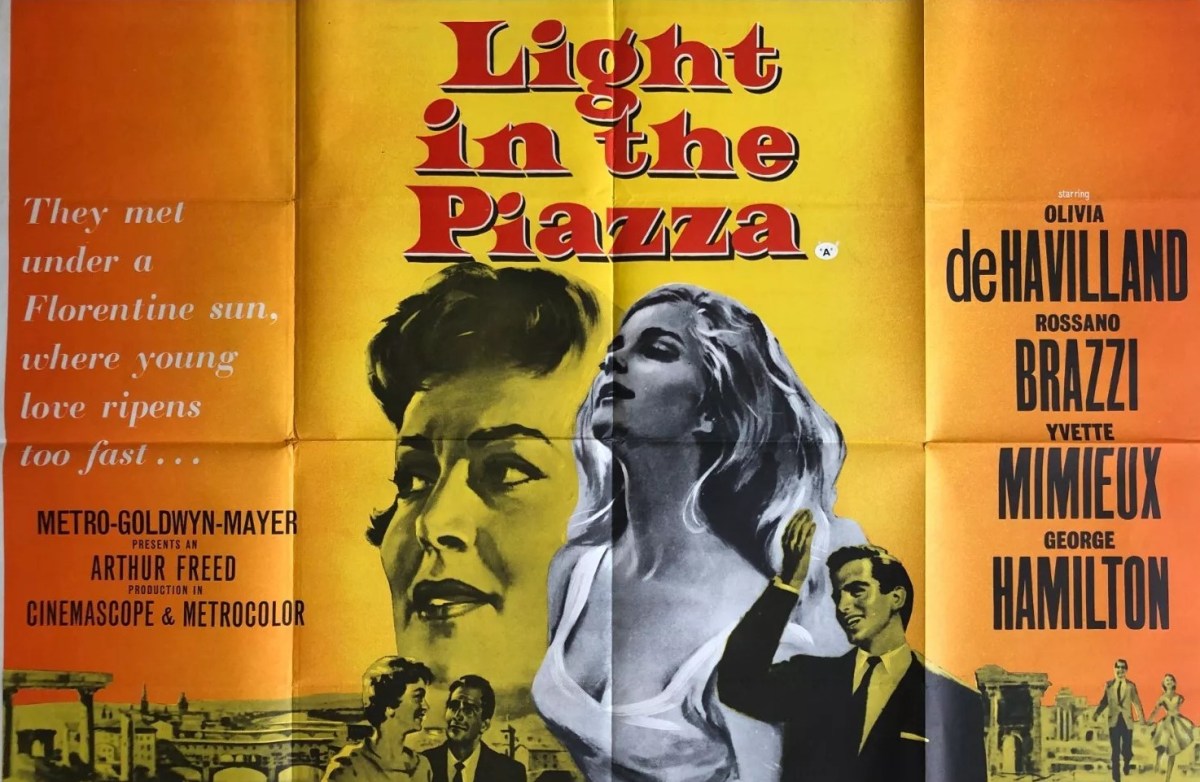
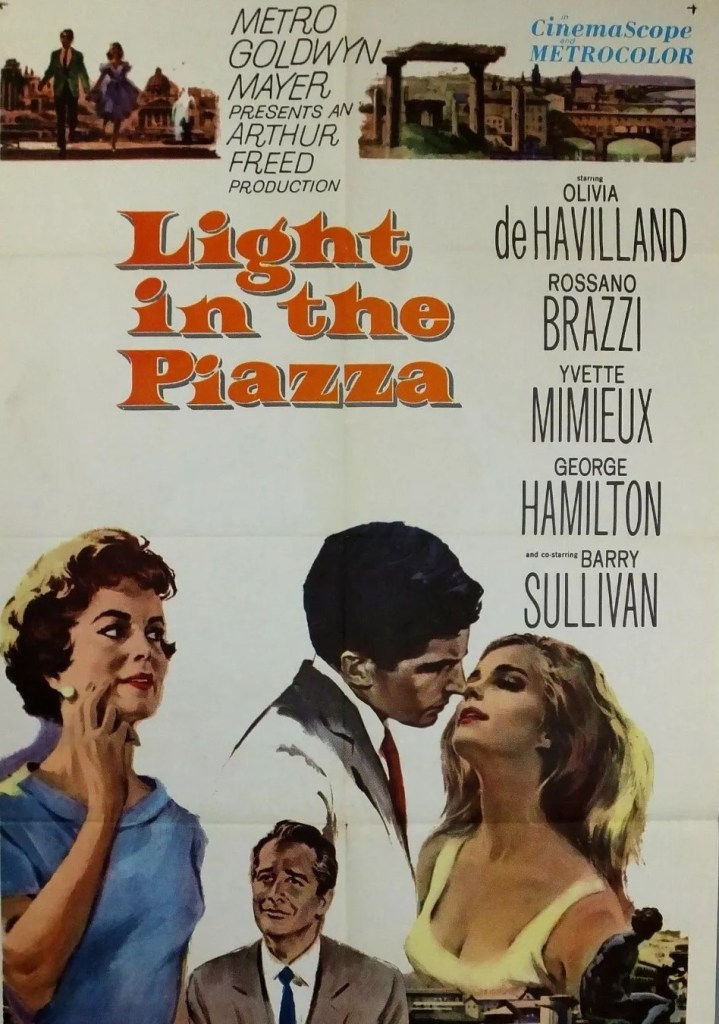
Light in the Piazza (1962) ****

Will resonate more strongly today. Never intended as a light-hearted confection, despite the obvious premise of young love catching fire in Italy, this was a bold picture in its day and a more subtle examination of the wider impact of mental illness than those later movies set in institutions such as Lilith (1962) or Shock Treatment (1964). Bold, too, of Olivia de Havilland to take on a role that is so transparently maternal. Instead of her middle-aged character succumbing to romantic opportunity as the billing might suggest, to a holiday affair with a rich handsome Italian, she is first and foremost a mother.

Initially, standard romance meet-cute as young Italian Fabrizio (an unlikely George Hamilton) catches the runaway hat of young blonde Clara (Yvette Mimieux) in a piazza in Florence. His ardent pursuit is thwarted at every turn by Clara’s mother Meg (Olivia de Havilland). At first this appears to be for the most obvious of reasons. Who wants their naïve daughter to be swept away by a passionate Italian with heartbreak and possibly worse consequence (what mother does not immediately conjure up pregnancy?) to come.

Sure, Clara seems flighty and a tad over-exuberant and perhaps prone to tantrums but then back in the day this was possibly just an expression of entitlement by rich indulged young women. Turns out there’s a more worrying cause of her sometimes-infantile behavior. She was kicked in the head by a pony and has the mental age of a child of ten. If she is not protected, she might end up as prey to any charming young man.

Clara needs tucked up in bed with a stuffed toy, and her mother to check the room for ghosts and read her a bedtime story before she can go to sleep. Even when Fabrizio’s credentials check out – his father Signor Naccarelli (Rossano Brazzi) vouches for his good intentions, but, in the way of the passionate Italians, would not want to stand in the path of true love.

Clara’s father Noel (Barry Sullivan) is the one who spells out the reality. That pony didn’t just kick his daughter in the head it “kicked the life out of” his marriage. His wife lives in a dreamland, hoping for a miracle, and if that is not forthcoming quite happy to live with a daughter who never grows up. He wants to send her to “a school,” convincing himself it’s “more like a country club.”

Meg fights her own feelings that she knows better than her daughter and that love will not provide the cure, at the same time as batting away the affections of the elder Naccarelli. When she finally gives in to her daughter’s desire, wedding plans fall apart at the last minute when Naccarelli Snr discovers that his 20-year-old son is marrying not, as he imagined, a woman of roughly the same age or slightly younger, but actually someone six years older. Eventually, the wedding goes ahead. Meg convinces herself she did the right thing in permitting the marriage to go ahead.

But this is one of those happy ever afters that don’t quite wash and you might find yourself wondering exactly how it played out when the husband discovered exactly what kind of wife she had. Her instability isn’t genetic so no danger of a subsequent child encountering the same issue. And having to care for someone other than herself might well bring out the same level of maternity as her mother shows, but equally clearly Fabrizio is unaware of exactly what he’s taking on. How will he feel when asked to read her a bedtime story or scour the cupboards for imaginary monsters.

The movie didn’t do well enough to warrant a sequel – audiences expecting romantic confection were disappointed – and just hope Clara didn’t turn into the kind of inmate seen in Lilith and Shock Treatment.

Still, takes a very realistic approach to the problems of someone with such problems maturing into adulthood.

The Oscar-garlanded Olivia de Havilland  (two times winner, three times nominee), in her first picture in three years, clearly didn’t want to see out her maturity in those May-December roles that others of her age fell prey to. She is excellent here, no attempt to dress herself up as a sex bomb, and refreshing to see her approach. Yvette Mimieux (Diamond Head, 1962) is excellent as the confused youngster. George Hamilton  (The Power, 1968) lets the side down with his speaka-da-Italian Italian but Rossano Brazzi (The Battle of the Villa Fiorita, 1965), who is Italian, has no trouble with the lingo or with being a smooth seducer.

Director Guy Green (Diamond Head, 1962) adds in some unusual Florentine tourist color, but doesn’t shirk the difficult storyline. Julius J. Epstein (Casablanca, 1942) wrote the script.

Worth a look

55 Days at Peking (1963) ***

Imperialism is hard to stomach these days but at the start of the twentieth century it was rampant and not restricted to the main culprit, the British. China was Imperialism Central, round about a dozen nations including the USA and Russia claiming control of sections of the country or its produce. So they had all set up diplomatic shop in Peking. And the film begins with an early morning roll call of national anthems before this domination by outside interests is shattered by rebellion.

Just as hard to stomach, of course, was the movie mainstream notion in those days that all rebellions must perforce be put down regardless of how put-upon the peasant classes were. Audiences had to rally round people in other circumstances they would naturally hate. So one of the problems of 55 Days at Peking is to cast the rebels (known as Boxers) and the complicit Chinese government in a bad light while ensuring that those under siege are not seen as cast-iron saints. There’s no getting round the fact that the rebels are shown as prone to butchery and slaughter while the Chinese rulers are considered ineffective and traitorous.

So it’s left to the likes of Major Mark Lewis (Charlton Heston) heading up the U.S. Marines stationed in the city to bring some balance to proceedings. “Don’t get the idea you’re better than these people because they can’t speak English,” he expounds. British Consul Sir David Robertson (David Niven) tries to keep this particular league of nations onside while negotiating with one hand tied behind his back – “we must play this game by Chinese rules” – with the Chinese Dowager Empress Tzu-Hsi (Flora Robson) while knowingly endangering his wife Lady Sarah (Elizabeth Sellars) and two children. Unscrupulous Russian baroness Natalie Ivanoff (Ava Gardner) exhibits little loyalty to her home country.

The picture is one-part action, one-part politics and one-part domesticity, if you include in the last section the major’s romance with the baroness, the consul’s guilt when his son is wounded in an attack and Lewis’s conflict over a young native girl fathered by one of his own men who is then killed. Two of the best scenes are these men coping with parental obligation, Sir Arthur managing a wounded son, Lewis finding it impossible to offer succor to the child.

The action is extremely well-handled. The siege goes on longer than expected when the expected troops fail to arrive, tension rising as casualties mount and supplies fall low. As with the best battle pictures, clever maneuvers save the day. Two sections are outstanding. The first has Lewis marshalling artillery to prevent the Chinese gaining the high ground. The second is a daring raid – Sir Arthur’s idea, actually – through the city’s sewers to the enemy’s ammunition dump. Personal heroism is limited – Lewis volunteers to go 70 miles through enemy territory to get help but has to turn back when his men are wounded or killed.

There’s a fair bit of stiff upper lip but while Lewis, in familiar chest-baring mode, has the baroness to distract him, Sir Arthur is both clever, constantly having to outwit the opposition and hold the other diplomats together, and humane, drawn into desperation at the prospect of his comatose son dying without ever having visited England.  The baroness  moves from seducer to sly traitorous devil to angel of mercy, wapping glamorous outfits for a nurse’s uniform, at the same time as changing her outlook from selfish to unselfish.

Charlton Heston (Diamond Head, 1962), David Niven (Eye of the Devil, 1966) and Ava Gardner (The Angel Wore Red, 1960) acquit themselves well as does Flora Robson (Eye of the Devil) in a thankless role. In supporting roles are John Ireland (The Swiss Conspiracy, 1976), Harry Andrews (The Charge of the Light Brigade, 1968) and Leo Genn (Ten Little Indians, 1965).

This was the third of maverick producer Samuel Bronston’s big-budget epics after King of Kings (1961) and El Cid (1961) with a script as usual from Philip Yordan – sharing the credit with Robert Hamer (Kind Hearts and Coronets, 1949) and Bernard Gordon (Custer of the West, 1967) – and directed by Nicholas Ray (King of Kings) who also had assistance from Guy Green (Diamond Head).and Andrew Marton  (Africa: Texas Style, 1967)

All in all it is a decent film and does not get bogged down in politics and the characters do come alive but at the back of your mind you can’t help thinking this is the wrong mindset, in retrospect, for the basis of a picture.

The Mark (1961) ****

Despite an exceptional and Oscar-nominated performance by Stuart Whitman (Rio Conchos, 1964) , I suspect modern audiences will take less kindly to this tale of convicted child molester trying to come to terms with his feelings. At least it’s considerably more honest than the creepier May December (2023) where the criminal steadfastly contended her innocence.

And I suspect, too, that Whitman’s square jaw and muscular physique got in the way of his attracting the parts for which the depths of vulnerability he was able to exhibit were most suited. He came to this straight after an action role, as the charming bad-good-guy of The Commancheros (1961) where, as far as audiences were concerned, what he did with his fists was more important that what he expressed through his eyes.

There’s a bit of a grey area that lends the convicted Jim Fuller (Stuart Whitman) the benefit of the doubt. He was found guilty of intent not of actual molestation and a goodly part of the picture is spend on examining why he went down that route, either in a group exercise in prison or one-on-one with a psychiatrist, chain-smoking Irishman Dr McNally (Rod Steiger) in both instances.

I’m not sure how the psychiatric evidence adds up, but basically, with a dominant mother who bullied his father, he grew up frightened of women, despite being attracted and attractive to them, and sought out someone with whom he felt more comfortable, less challenging, leading him to spend too much time watching children at play and eventually buying a young girl an ice cream and going out on walks with her.

It would have been too much for audiences of the time – as it even was with May December – to go into the technicalities of what he intended to do so we are left to trust his own word that he never intended to instigate anything sexual, though why kidnap a child in the first place. The second element that would fill modern audiences with alarm is that though he manages to begin a sexual relationship with a woman of his own age, secretary Ruth Leighton (Maria Schell), she is a widow with a young daughter. Most people would instantly come to the conclusion he was using mother to groom daughter.

However, the film takes the tack that he’s using the daughter to explore a normal relationship with a child, the joy of having a daughter, and the delight and happiness that a young person can bring into a dour repressed life. Dr McNally keeps on banging on that Fuller is “cured” but it’s a very uneasy watch trying to work out if he is or not.

In the event, the first time he’s alone with the girl he is photographed by a local journalist who sticks the photo on the front page, destroying the life Fuller has carefully rebuilt. He has found employment as an accountant with a sympathetic business owner Andrew Clive (Donald Wolfit), fitting in so well he is promoted, though at odds with another senior employee Roy Milne (Paul Rogers). He is chucked out of his accommodation, loses his job and although Ruth initially stands by him the minute she sees Fuller with her daughter her instincts are hostile.

There would be no point in an actor trying to gain sympathy for such an unsympathetic character by playing to the gallery with bouts of temper or floods of self-pitying tears, but even so, the vulnerable husk Whitman presents, his struggles with his self-contempt, his understanding of the feelings he must invoke, his determination to live as quietly as possible, almost in that determined English manner of never being heard nor seen, is what makes this film. Interestingly, he replaced Richard Burton, who pulled out at the last minute (as did Jean Simmons) and you could easily imagine with those trademark quick intakes of breath and deep growls how that actor would have played the part.

Whitman doesn’t go near any grandstanding. It’s just a heartfelt performance of a man who’s lost his way and knows he might never find his way back, haunted by his past, unable to trust himself, unable to believe that he is, in fact, cured. Probably, the biggest issue is that the movie comes down on his side, especially when he becomes one of the usual suspects in another crime involving children, though he did not commit that, and tries to suggest that a child molester will find salvation through living with a mother and child in the normal fashion. As I said, this is not my subject of expertise, thankfully, and that may be well what’s advocated rather than staying away from children altogether.

While the approach might be considered a shade naïve at the same time it does examine issues surrounding reintegration and avoids the obvious trap of attempting some kind of character redemption.

Apart from Whitman, there are good performances all round. Maria Schell, whose career within a decade would go from roadshow blockbuster Cimarron (1960) to WIP epic 99 Women (1969), subsumes her normal more glamorous persona to play a believable working mother. With his chain-smoking, Rod Steiger (The Pawnbroker, 1964) is allowed to fidget to his heart’s content but even such obvious scene-stealing only places more emphasis on the quieter Whitman. Donald Wolfit (Life at the Top, 1965), too, reins in his usual bluster.

Guy Green (The Magus, 1968) directed from a screenplay by Sidney Buchman (The Group, 1966) and Stanley Mann (The Collector, 1965) from the bestseller by Charles E. Israel.

In this instance, given the Oscar nom, Stuart Whitman could hardly be considered under-rated but over the years seems to have disappeared from sight.

Worth a look to see what he could do with the right material.

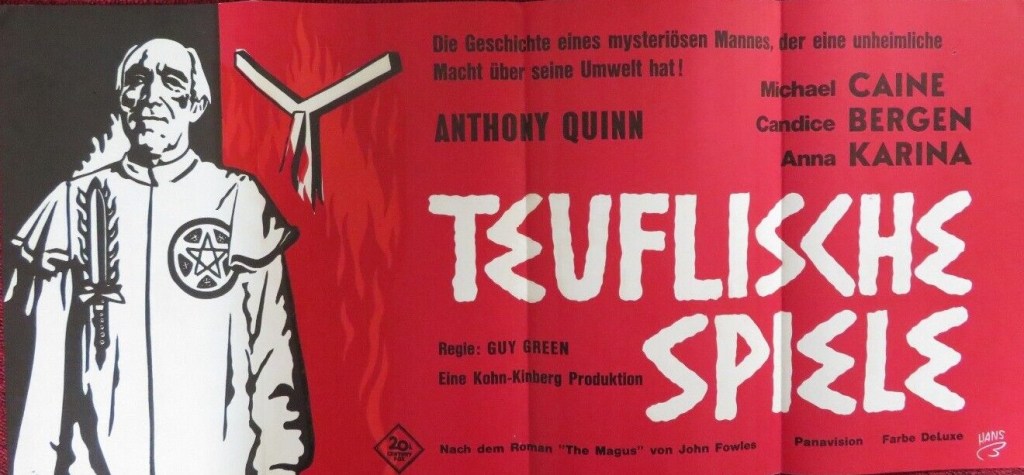
The Magus (1968) ***

Mind-games and unreliable narrators give this considerable contemporary appeal. Throw in Anthony Quinn back in Zorba the Greek (1964) territory and Michael Caine as a lothario in the Alfie (1965) mold plus Candice Bergen (Soldier Blue, 1970) in preppy mode and you have nothing short of ideal casting.

Nicholas (Michael Caine), escaping a failed romance with Anne (Anna Karina) by teaching English at the Lord Byron School on a Greek island, becomes entangled with millionaire Conchis (Anthony Quinn). The action primarily takes place on Conchis’s fabulous villa stuffed full of art treasures.  Conchis initially presents himself as a psychic who can summon up the past, namely in the shape of Lily (Candice Bergen) who talks and dresses like the young girl Conchis previously loved.

But every time Nicholas rumbles a ruse he is presented with a different version of Conchis’s self. These include a psychiatrist, conjurerer-up of the mythic past and Second World War  collaborator. All of these identities carry sufficient personal truth for Nicholas to doubt his doubts.

Is he the victim of some elaborate game, one which caused the mysterious death of his predecessor? Is he smart enough to expose the millionaire as a dangerous fantasist? Is Lily genuinely falling in love with him and will this be yet another romance which makes him feel trapped? Is he actually put on trial in front of the entire village or is that all a dream? Is Conchis intent on stripping him of his core identity? And if so, why?

It should have been a cracking film but somehow misses the target. In theory, this is because Michael Caine is miscast. Caine is usually in charge and here is anything but. But actually, flipping over an actor’s screen persona, especially this cocky one, works. You might keep on wishing the real Michael Caine would stand up, and the fact that he doesn’t gives the film its strength.

Anthony Quinn initially overdoes the flamboyance to the point of being hammy – what magician is not – but you can see the point of that when he turns into the sober mayor forced to deal with invading Germans during World War Two and faced with making life-or-death decisions. The general consensus is Candice Bergen is the weak link, but I’d challenge that too since she is playing a role, that of an easily-duped actress.

The main problem is the picture is loaded down with flashbacks. And all to do with the various reinventions of Conchis’s life. In keeping with the film’s style you are never sure how much of this is true. Caine’s character has little to do except ask questions. (A modern film would have him chasing after physical clues to uncover a riddle.) So it becomes very stagey, with Conchis like a frustrated teacher with an aberrant pupil.

Of all the misleading ads! This lost a fortune for Fox.

John Fowles adapted his 300,000-word cult novel, removing the bulk of the philosophizing, but not realizing that what works in a book, especially in the hands of a gifted narrator, is not so easily translated onto the screen. For the adaptation of his previous bestseller The Collector (1965), director William Wyler brought in screenwriters to make the book work as a film.

Either screenwriters balked at the problems of dealing with a masterpiece or Fowles insisted on writing the screen version or director Guy Green (Pretty Polly/A Matter of Innocence, 1967) believed him the best person to reconstitute his work. Quinn, rather than Caine, has the movie’s pivotal sequence, forced into an action on a par with Sophie’s Choice (1982) and it might have helped if that element had been brought in sooner.

As it is, the movie is no more than interesting when it should have been fascinating.

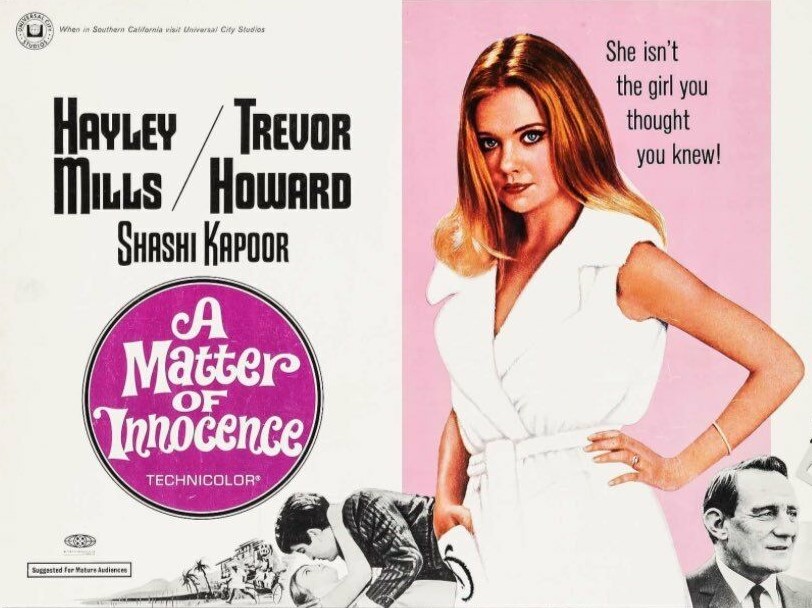
A Matter of Innocence / Pretty Polly (1967) ***

Dramatically undernourished coming-of-age tale over-reliant on “authentic” travelogue and continuing the transformation of Hayley Mills from child to adult star, although that change had been clearly wrought by her previous outing in  The Family Way (1966) which had contained her first nude scene. While there’s definitely way more sex here it’s all off-screen.

In Singapore, family black sheep Robert (Trevor Howard) tries to stifle romance blossoming between his ugly duckling niece Polly (Hayley Mill) and local king of the fixers Amaz (Shashi Kapoor), to quote from list of the clichés the screenplay happily summons up. Polly is the bespectacled, dowdy, shy travelling companion to snippy aunt (Brenda de Banzie) – Robert’s sister not wife – who resides in a magnificent suite in Raffles Hotel, consigning her niece to a hovel of a room. When said aunt drops dead in the swimming pool, Polly, wasting no time on mourning, is free to turn butterfly, channeling her inner Brigitte Bardot with bouffant hairstyle and tight red dress.

The genial Amaz is on hand as a guide, in sexual matters as well as tourist, until huffing-and-puffing plantation manager Robert threatens to intervene and smarmy American Critch (Peter Bayliss) attempts to sweep her off her feet. And that’s about it, plot-wise. The meandering story provides insights into different aspects of local culture –  Whicker’s World was the only globe-trotting television series available at the time so all this would probably have entranced moviegoers rather than, as now, bored them to death.

Perhaps what’s most interesting is what’s left unsaid or never dwelt upon, of the posh English girl having sex with a native of Singapore. In previous movies – Bhowani Junction et al – miscegenation would have been the sole plot point with Brits up in arms at the suggestion of it. Here, the only objection to Amaz is that he’s a bit of a Casanova, practised seducer in the main of older women. While Amaz falls in love, Polly is considerably more objective, viewing their relationship in terms of rite-of-passage, rather an un-British approach, more in keeping with the attitudes those bold females exhibited in pictures like The Group (1966).

Polly is a pretty cool-headed kid, with a good head for booze, not staggering in gutters or throwing up after imbibing too much, alert to the intentions of Critch and more than capable of putting her uncle in his place. Despite her delight at enjoying sex Polly is more independent than you might imagine and the film’s actually a character study of a woman refusing to be defined – or trapped – by love and its obvious consequence marriage and viewing this new freedom as merely the starting point of her life.

For Hayley Mills fans, of course, her career divides sharply into Disney and post-Disney. Few child stars ever manage to take the first steps to an adult career never mind sustain one, but the actress made a good stab at throwing off her previous precocious screen persona by taking on challenging roles that perhaps upset her core followers. But the film would have benefitted from a better storyline and minus the distracting tourist elements been a lot tighter.   

The career of Trevor Howard, long-time second male lead, was on a bit of an upswing after sterling roles in Von Ryan’s Express (1965) and The Long Duel (1967) and although he remained the scowler supreme he brings more vulnerability to this role. Bollywood heartthrob Shashi Kapoor had come to prominence as far as the English-speaking countries were concerned through arthouse director James Ivory’s The Householder (1963) and Shakespeare-Wallah (1966) but this was his mainstream debut. He certainly has a screen presence and enjoys the best character arc, going from the cynicism of sex to the innocence of love. I’m sure the title is intended to refer to Polly but she is innocent, in screen shorthand terms, for about two seconds. Pretty Polly, the title of the short story on which the film is based, was not usable in certain countries because the name was the trademark of a popular brand of hosiery.

This was the final film of Brenda de Banzie (The Man Who Knew Too Much, 1956) and the second for British television stalwart Patricia Routledge (Keeping Up Appearances, 1990-1995), while for Chinese star Kalen Liu (Welcome to Hard Times, 1967) it was both her second and last picture.

This was perhaps an odd choice for director Guy Green (A Patch of Blue, 1965) but he was mired in the on-again off-again saga of proposed MGM roadshow epic Forty Days of Musa Dagh and compared to those travails this may have been welcome light relief. Keith Waterhouse and Willis Hall (Lock Up Your Daughters, 1969) developed the screenplay from Noel Coward’s short story.

The Greatest Movie Never Made

Forty Days at Musa Dagh was a strong contender by the end of the 1960s for The Greatest Movie Never Made. By then an eye-watering one million bucks had been spent without a foot of film being shot.

I came across it while writing my book about “The Making of The Guns of Navarone.” That  film’s producer Carl Foreman was slated in the early 1960s to write what I soon discovered was a legendary lost project. It was subsequently fated to become the most high-profile casualty of MGM’s financial problems at the end of that decade.

Forty Days of Musa Dagh was based on the debut novel written in German by Prague-born poet Franz Werfel (who later wrote The Song of Bernadette filmed in 1942). It concerned the infamous Armenian genocide carried out by the Turks in World War One.

The novel had such advance buzz that news of its imminent publication in Germany in 1933 quickly crossed the Atlantic. After studio representatives read the book in the original German, MGM wunderkind Irving Thalberg bought the rights in 1934, prior to its American publication, for $35,000 (equivalent to $650,000 now).

Thalberg promised “one of the most staggering  production undertakings of all motion picture history.” With Clark Gable and William Powell heading the cast (there would be 63 roles) and director William Wellman (Call of the Wild, 1935) assigned a million-dollar budget, an enormous amount for the time, and with screenwriter Talbot Jennings (Mutiny on the Bounty, 1935) on board, Thalberg was intent on delivering a prestige product. In publicity material, MGM boasted: “What a picture it will make.” 

The novel was a huge success with 170,000 copies sold in hardback even though, priced at $3, it was 50 cents or a dollar more expensive than other bestsellers. It was simultaneously snapped up by the Book of the Month Club and the Catholic Book club and only kept off the top of the bestseller lists by James Hilton’s Lost Horizon.

However, publication was shrouded in controversy. It was banned in Germany shortly after publication. In America, publisher Viking and the author faced a $200,000 libel lawsuit brought by Harutian Nokhudian and the case went to the U.S. Supreme Court in 1936 – where it was dismissed. But that was only the beginning of its troubles.

Thalberg had not counted on opposition from Turkey. Or if such a possibility had been considered, it had been dismissed since that country was not a profitable outlet for Hollywood product. However, Turkey had very strong trading relationships and threatened to instigate a ban on all MGM releases in these European countries as well as the entire Muslim world, an action which if successful would put a huge hole in the studio’s foreign receipts.

For the first time studios “had begun to pay attention to foreign repercussions” after Paramount had been forced to withdraw from Spain and many other markets the final Josef von Sternberg-Marlene Dietrich collaboration The Devil Is A Woman  (1935) when that movie ruffled the feathers of foreign powers. Unwilling to go ahead with a picture that might cost them heavily at the foreign box office, Thalberg shelved the movie (along with two others).

The idea remained dormant for 15 years until revived by independent producer Walter Wanger (Joan of Arc, 1948) who had originally competed with MGM for the rights and had Paramount waiting in the wings to provide backing should the Thalberg deal fall through. But even a seasoned a producer such as Wanger had no more success in placing it on the launch pad and it struggled along in development hell for another decade until, out of the blue, in 1961 MGM hooked writer-director Carl Foreman.

This was a considerable surprise because Foreman had an exclusive and lucrative deal with Columbia (they split profits on his films down the middle) but as he was coming off that studio’s most successful picture of all time The Guns of Navarone (1961) with a high-octane cast of Gregory Peck, David Niven and Anthony Quinn the studio cut him some slack.

Foreman did not come cheap. In addition to his $27,500 fee for writing the script, Foreman was entitled to 2.5 per cent of the gross after MGM had taken in twice the negative cost. After an arduous four-year slog delivering The Guns of Navarone, Foreman described his new venture as “a bit of a rest” which seemed an odd choice of phrase given that MGM was under pressure to greenlight the picture in 1962. 

It was firmly in MGM’s production sights for most of the 1960s. In 1963 it was seen as one of the studio’s biggest upcoming projects along with Doctor Zhivago, the adaptation of James Michener’s Caravans and musical Say It with Music. By the following year it had been allocated a $7.5 million budget – the same as Zhivago – and was on course to be made in Greece in the spring of that year.

By 1965 it landed in the lap of Oscar-nominated British director Guy Green who had nurtured the $1.2 million A Patch of Blue (1965) starring Sidney Poitier into a substantial hit. Although the budget had by now dropped to $5 million it had attracted Omar Sharif, one of four big stars set. There was a new script by Scottish Oscar-winner Neil Paterson (Room at the Top, 1959) and best of all there was a top-flight producer in Pandro S. Berman (Father of the Bride, 1950)  with over two decades experience at MGM. Filming, however, though still in Greece, had been pushed back to 1966.

Although Guy Green appeared to have the most solid lock on the project, other names associated with the movie included producer Carlo Ponti (Doctor Zhivago, 1965) and directors William Wyler (Ben Hur, 1959),  Henri Verneuil  (The 25th Hour, 1967) and Elia Kazan (On the Waterfront, 1954), the last two both born in the former Ottoman Empire now known as Turkey.

It was listed as being on the MGM production schedules for every year till the end of the decade with names like Yul Brynner and Charlton Heston bandied about until it joined a massive bonfire of other expensive projects. By the end of the decade it had racked up over a million dollars in producer and screenwriter fees. According to Variety it was “the most off-again on-again major literary property in the history of American motion picture.”

But it was not alone in being dumped by a studio. Towards the end of the 1960s Hollywood was awash with abandoned projects. The rights to Broadway musical Coco had cost $2.25 million. Fred Zinnemann’s adaptation of Andre Malraux’s Man’s Fate had a $12 million budget before the plug was pulled. A record $600,000 had been spent on acquiring the rights to William Styron bestseller The Confessions of Nat Turner.

Other high-priced acquisitions lumped in production limbo included The Spy Who Came in from the Cold (1965) author John Le Carre’s A Small Town in Germany, Armageddon by Leon Uris of Exodus (1960) fame, Bullet Park by John Cheever who had written The Swimmer (1968), Caravans despite the success of the author’s Hawaii (1966) and The Inheritors by Harold Robbins who had churned out The Carpetbaggers (1964).

Hit plays were no more successful in reaching the starting grid – Arthur Miller’s After the Fall had George Cukor lined up to direct and Faye Dunaway as star and a total of $350,000 had been spent on Tom Stoppard’s  Rosencrantz and Guildenstern Are Dead.  

And there, surely, Forty Days of Musa Dagh should have been laid to rest. Of all these expensive projects, only Caravans would eventually see the light of day. But against all odds, interest in Forty Days of Musa Dagh remained high. Fresh from success with Where Eagles Dare (1968) producing team Elliott Kastner and Jerry Gershwin took a stab at the project, setting their sights on a new script and a 1970 start date. But the duo could not turn the idea into reality. And once again it sank to the bottom of the pile.

Armenian businessman and sometime producer John Kurkjian (The Tears of Happiness, 1974) picked up the rights through his vehicle High Investment and wooed MGM. And in 1976 the project was revived by the studio as a co-production with James B. Harris (Paths of Glory, 1957) overseeing production based on a new script by South African playwright Ronald Harwood (One Day in the Life of Ivan Denisovich, 1970). This was viewed as “the last attempt to revive it” and for a time it appeared as if the project would at last see the light of day. But MGM’s optimism barely lasted the year and, concluding the movie was too rich for its blood, dropped out.

Kurkjian continued to try to interest other studios and was confident. With a new script by Clarke Reynolds (Shalako, 1968), he was convinced he could get the movie off the ground with the backing of the Yugoslavian government were the film to shoot there. United Artists announced the movie would be on its release slate for 1977-1978. But that, too, proved a false dawn.

Redemption came from the most unlikely of sources –  American B-picture production outfit Cannon which had been taken over in 1979 for just $500,000 by Israeli writer-director Menahem Golem and his cousin Yoram Globus. Although this pair specialized in low-budget action pictures such as Death Wish sequels and martial arts efforts like Enter the Ninja (1981), they had artistic pretensions, borne out by The Magician of Lublin (1979) directed by Golan and starring Alan Arkin. That same year, a new version of Forty Days of Musa Dagh took shape, part-funded by High Investment and the West Berlin Senate. Charles Bronson was lined up as star. The budget was set at $10 million.

In the end, there was no Bronson and no $10 million budget, but the movie did get made in 1982 for $4 million by Transcontinental Picture Industries with the less stellar cast of Indian star Kabir Bedi (Sandokan mini-series, 1976), American television actress Ronnie Carol and character actor Guy Stockwell  (Beau Geste, 1966). It was directed by Israeli Sarky Mouradian (Tears of Happiness). It did not reach the United States for another five years. And it was no epic, coming in at a trim 94 minutes. Nor was it a huge box office success. And it’s pretty impossible to find on DVD.

Footnote: The Promise (2016) covered the same ground. Directed by Terry George, it starred Chistian Bale, Oscar Isaac and Charlotte Le Bon. It was funded by Kirk Kerkorian.

SOURCES: “Double Pan for Reich,” Variety, Feb 27, 1934, 58; “Literati: Best Sellers,” Variety, Jan 1, 1935, 58; “Wellman’s Chore,” Variety, Apr 10, 1935, 2; Advertisement, MGM, Variety, Jun 12, 1935, 25-28; “Foreign Rights Bugaboo,” Variety, Nov 27, 1935, 2; “Thalberg’s Eight; Four at $1,000,000,” Variety, Dec 25, 1935, 4; “H’Wood Foreign Jams,” Variety, Mar 25, 1936, 3; “MGM Scraps Witch of Timbuctoo and Musa Dagh,” Variety Mar 25, 1936, 3; “Film Industry Watching Blockade as B.O. Cue on Provocative Themes,” Variety, Jun 22, 1938, 1; “Carl Foreman to Metro on Loan,” Variety, Feb 1, 1961, 3;  “Columbia Waives Rights to Foreman for 40 Days,” Variety, Feb 8, 1961, 59; “Foreman’s Commitment: Doing 40 Days for MGM, Strength for Columbia,” Variety, Jul 5, 1961, 11; “Positive Side of Negatives,” Variety, May 30, 1962, 5; “Berman, 22-Year Man, Stays on MGM Lot,” Variety, Aug 1, 1962, 3; “Upcoming MG Slate May Number 30 Pix,” Variety, Jan 1, 1964, 16; “1965-1967 Will Be Roadshow Years” Variety, Sep 16, 1964, 4; “Pictures: Omar Sharif,” Variety, Dec 9, 1964, 21; “Guy Green Next Helms Musa Dagh,” Variety, Apr 14, 1965, 20; “Musa Dagh Nearer,” Variety, Jul 7, 1965, 9; “MGM Keeps Pledge of 26 Prods,” Variety, Aug 10, 1965, 5; “MGM’s (Hopefully) Final Loan,” Variety, Sep 14, 1966, 3; “3 Ponti Films on Metro O’Seas Slate,” Variety, Apr 19, 1967, 65; “Forty Days (and 34 Years) of Musa Dagh,” Variety, Apr 16, 1969, 19; “Acceptable Script As Invisible Cost Before Production,” Variety, Jul 14, 1971, 3; “Big Investment in Story Values Which Have Not Yet Been Filmed,” Variety, May 9, 1973, 28; “Werfel, After 40 years,” Variety, Jul 28, 1976, 6; “United Artists Looks Ahead; 13 from Metro Inventory,” Variety, Sep 22, 1976, 3; “Shepherd, As MGM Producer, Details Plans, Dropped Films, ” Variety, Dec 15, 1976,3; “Golan-Globus to Film 40 Days of Musa Dagh,” Variety, Feb 14, 1979, 27; “TPI Carves Out Sales Niche,” Variety, Oct 26, 1983, 69; “Film Review,” Variety, Nov 25, 1987, 19; “Cannon Completed Versus Unmade Films,” Variety, Oct 5, 1988, 52.

Discover WordPress

A daily selection of the best content published on WordPress, collected for you by humans who love to read.

The Atavist Magazine

by Brian Hannan

WordPress.com News

The latest news on WordPress.com and the WordPress community.