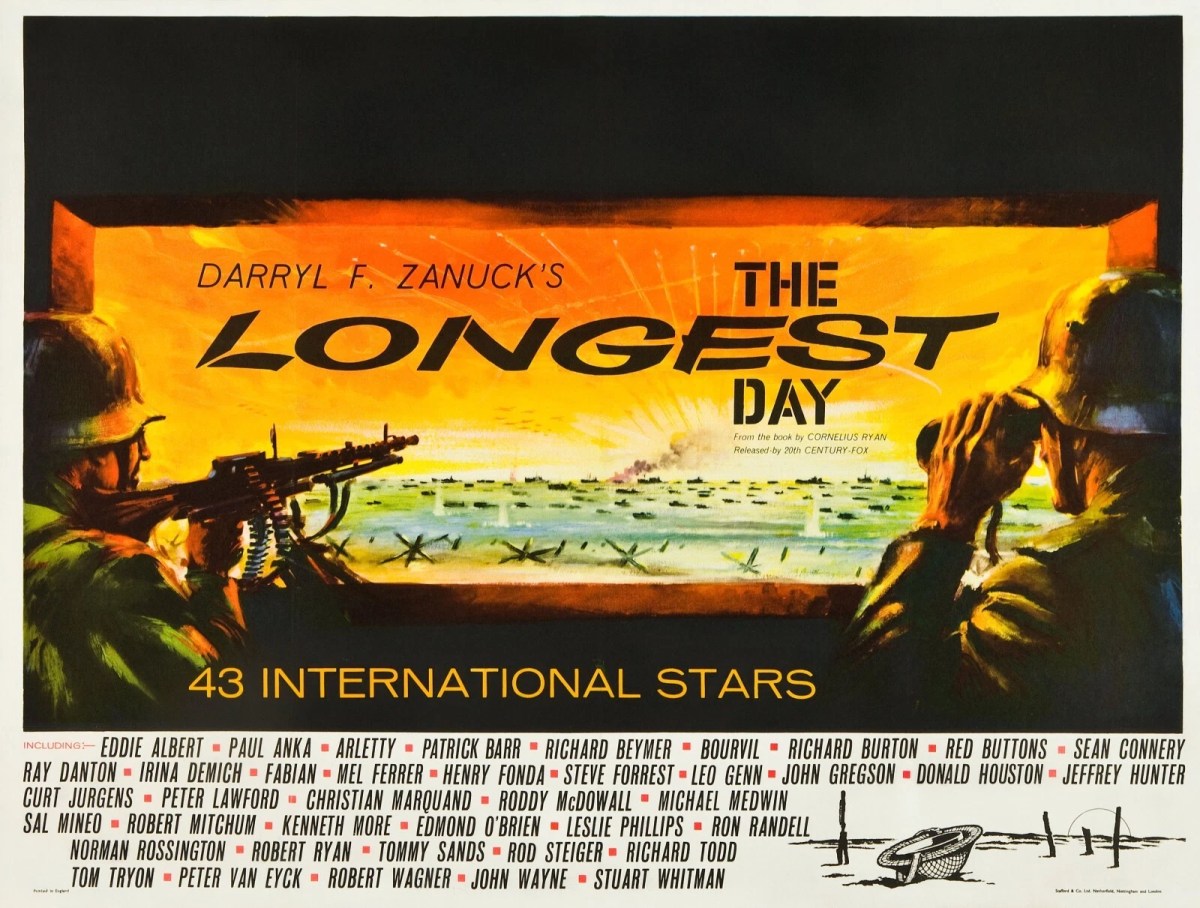
The Longest Day (1962) *****

When critics applauded the inspired use of a reaction shot via Omar Sharif to convey the horror of a massacre on the Mocow streets in Doctor Zhivago (1965), they omitted to mention that the technique had been used to similar stunning effect – and twice – in The Longest Day. The first comes when the camera cuts to Red Buttons dangling from a parachute down a building witnessing a massacre in the square below. The second, oddly enough, in virtually the same locale, when John Wayne arrives and views the aftermath.

Emotion was generally not considered a requisite of this epic war picture about the D-Day landings. The general consensus these days is that at best it’s a docudrama or at worst a star-a-minute mess with a dozen storylines vying for supremacy. In fact, it’s neither, but a surefooted and even-handed depiction of a complex battle, concentrating as much on the backroom staff as the soldiers in the line of fire.
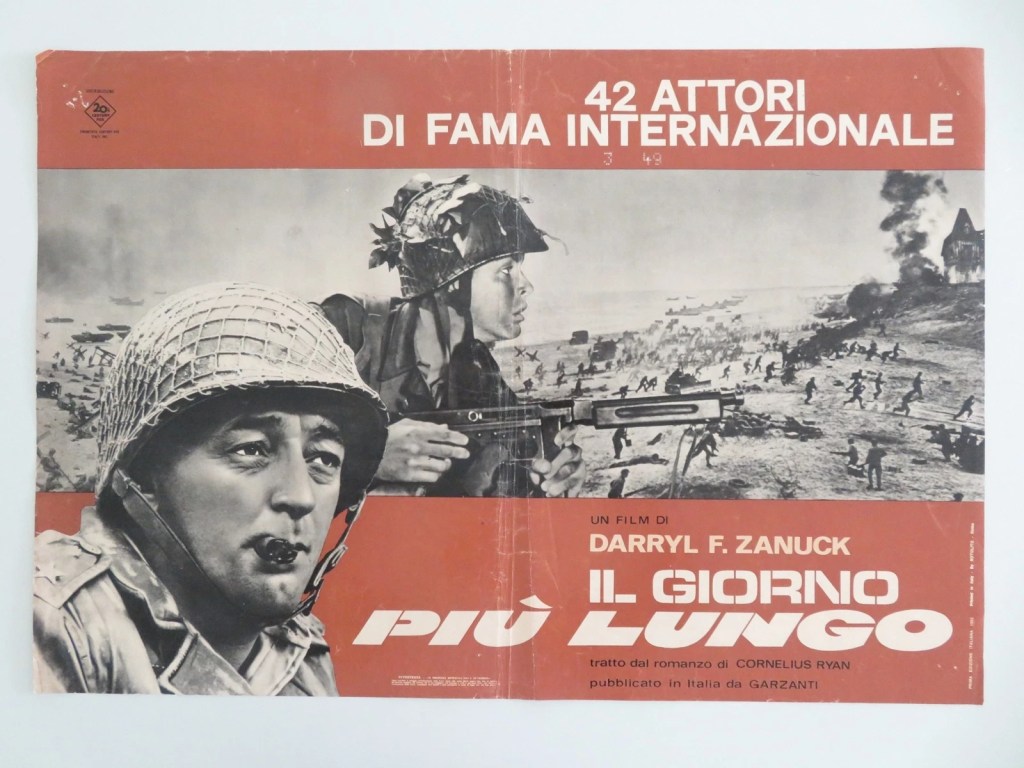
Except for German complacency, the Allied forces would have faced fiercer opposition. The German troops had no air cover except for two planes and the Panzers had been pulled back in reserve. High-ranking officers had high-tailed it out of German HQ to enjoy a night on the town. Yes, the Germans expected the invasion to come from Calais rather than Normandy, but once their mistake became obvious, they did little to counter the attack, spending too much time arguing with each other and being too frightened to wake Hitler from his beauty sleep to trigger the tanks and planes.

Producer Darryl F. Zanuck covered his back by enrolling 40 stars for his venture. While most had varying marquee appeal, he had drawn on leading actors and actresses from countries other than Britain and the USA. And there was clearly a calculated decision to make audiences wait for the two major stars, John Wayne and Robert Mitchum, to put in an appearance. It’s a good 15 minutes before we spot Wayne, that time spent setting up the event from British, French, German and American perspectives.

Unusually for major stars, Wayne and Mitchum are not averse to carrying exposition, something generally left to the supporting cast, Wayne in particular spelling out the pitfalls of his particular parachute drop situation. Incidentally, two of the best sequences took a good less time to show – as later explained in feature-length detail in A Bridge Too Far – the dangers inherent in parachuting into enemy territory and trying to capture and hold vital bridges.

The picture could easily have been titled A Gamble Too Far because Zanuck was betting the future of Twentieth Century Fox, facing a financial burnout, on its box office outcome.

While covering the planning for the landings in sweeping terms, the movie concentrates on three major actions – Omaha Beach and the scaling of the impenetrable Pointe du Hoc featuring the Americans headed up by Brig General Norman Cota (Robert Mitchum), a British commando raid led by Major John Howard (Richard Todd) on the Pegasus Bridge and the parachute drop led by Lt Col Benjamin Vandervoort (John Wayne).   

By today’s standards the bloodletting is non-existent but the brutality of combat hits hard. Flight Officer David Campbell (Richard Burton) heads up the victims, knowing he is going to die but trying to keep up his spirits. French peasant Janine (Irina Demick) distracts German soldiers with her beauty. Lord Lovat (Peter Lawford) goes into battle accompanied by bagpipes and beachmaster Capt Maud (Kenneth More) tries to keep troops moving on the beach.. Comic interludes are provided by Private Flanagan (Sean Connery) and his buddy and German Sgt Kaffekanne (Gert Frobe).

Many of the commanders that would feature in later World War Two pictures –  Lt Gene Omar Bradley (Patton, 1970) and Brig General James Gavin and General Sir Bernard Montgomery (A Bridge Too Far, 1977), played respectively by Arthur Hill, Robert Ryan, and Trevor Reid. German General Rommel had already had his shot at Hollywood fame through The Desert Fox (1951) and Desert Rats (1953) and was the American nemesis in Patton.

Given the amount of rubbernecking by the audience, it’s worth noting the number of actor in small parts who eventually made good including Sean Connery (Dr No had just appeared by the time The Longest Day opened in the U.K.), Christian Marquand (The Corrupt Ones/The Peking Medallion, 1967), George Segal (Bridge at Remagen, 1969), Tom Tryon (The Cardinal, 1964) and Robert Wagner (Banning, 1967).

You could do an entire review just listing who played who. But in spreading the field and covering French and German activities alike Zanuck brings a wider understanding of the proceedings.

Five directors were involved and unlike most anthology pictures where individual styles clash, here everyone follows the same playbook. Ken Annakin (Battle of the Bulge, 1965), Andrew Marton (Africa, Texas Style, 1967), Gerd Oswald (Agent for H.A.R.M, 1966), Bernhard Wicki (The Visit, 1964) and Darryl F. Zanuck all took a turn at the helm.

While author Cornelius Ryan (A Bridge Too Far) was credited with the screenplay he received help in the shape of Frenchman Romain Gary (Birds in Peru, 1968) , American novelist James Jones who wrote From Here to Eternity, and British screenwriters  David Seddon and Jack Pursall (The Blue Max, 1966). Remains an awesome experience, one I’d just love to see in 70mm

55 Days at Peking (1963) ***

Imperialism is hard to stomach these days but at the start of the twentieth century it was rampant and not restricted to the main culprit, the British. China was Imperialism Central, round about a dozen nations including the USA and Russia claiming control of sections of the country or its produce. So they had all set up diplomatic shop in Peking. And the film begins with an early morning roll call of national anthems before this domination by outside interests is shattered by rebellion.

Just as hard to stomach, of course, was the movie mainstream notion in those days that all rebellions must perforce be put down regardless of how put-upon the peasant classes were. Audiences had to rally round people in other circumstances they would naturally hate. So one of the problems of 55 Days at Peking is to cast the rebels (known as Boxers) and the complicit Chinese government in a bad light while ensuring that those under siege are not seen as cast-iron saints. There’s no getting round the fact that the rebels are shown as prone to butchery and slaughter while the Chinese rulers are considered ineffective and traitorous.

So it’s left to the likes of Major Mark Lewis (Charlton Heston) heading up the U.S. Marines stationed in the city to bring some balance to proceedings. “Don’t get the idea you’re better than these people because they can’t speak English,” he expounds. British Consul Sir David Robertson (David Niven) tries to keep this particular league of nations onside while negotiating with one hand tied behind his back – “we must play this game by Chinese rules” – with the Chinese Dowager Empress Tzu-Hsi (Flora Robson) while knowingly endangering his wife Lady Sarah (Elizabeth Sellars) and two children. Unscrupulous Russian baroness Natalie Ivanoff (Ava Gardner) exhibits little loyalty to her home country.

The picture is one-part action, one-part politics and one-part domesticity, if you include in the last section the major’s romance with the baroness, the consul’s guilt when his son is wounded in an attack and Lewis’s conflict over a young native girl fathered by one of his own men who is then killed. Two of the best scenes are these men coping with parental obligation, Sir Arthur managing a wounded son, Lewis finding it impossible to offer succor to the child.

The action is extremely well-handled. The siege goes on longer than expected when the expected troops fail to arrive, tension rising as casualties mount and supplies fall low. As with the best battle pictures, clever maneuvers save the day. Two sections are outstanding. The first has Lewis marshalling artillery to prevent the Chinese gaining the high ground. The second is a daring raid – Sir Arthur’s idea, actually – through the city’s sewers to the enemy’s ammunition dump. Personal heroism is limited – Lewis volunteers to go 70 miles through enemy territory to get help but has to turn back when his men are wounded or killed.

There’s a fair bit of stiff upper lip but while Lewis, in familiar chest-baring mode, has the baroness to distract him, Sir Arthur is both clever, constantly having to outwit the opposition and hold the other diplomats together, and humane, drawn into desperation at the prospect of his comatose son dying without ever having visited England.  The baroness  moves from seducer to sly traitorous devil to angel of mercy, wapping glamorous outfits for a nurse’s uniform, at the same time as changing her outlook from selfish to unselfish.

Charlton Heston (Diamond Head, 1962), David Niven (Eye of the Devil, 1966) and Ava Gardner (The Angel Wore Red, 1960) acquit themselves well as does Flora Robson (Eye of the Devil) in a thankless role. In supporting roles are John Ireland (The Swiss Conspiracy, 1976), Harry Andrews (The Charge of the Light Brigade, 1968) and Leo Genn (Ten Little Indians, 1965).

This was the third of maverick producer Samuel Bronston’s big-budget epics after King of Kings (1961) and El Cid (1961) with a script as usual from Philip Yordan – sharing the credit with Robert Hamer (Kind Hearts and Coronets, 1949) and Bernard Gordon (Custer of the West, 1967) – and directed by Nicholas Ray (King of Kings) who also had assistance from Guy Green (Diamond Head).and Andrew Marton  (Africa: Texas Style, 1967)

All in all it is a decent film and does not get bogged down in politics and the characters do come alive but at the back of your mind you can’t help thinking this is the wrong mindset, in retrospect, for the basis of a picture.

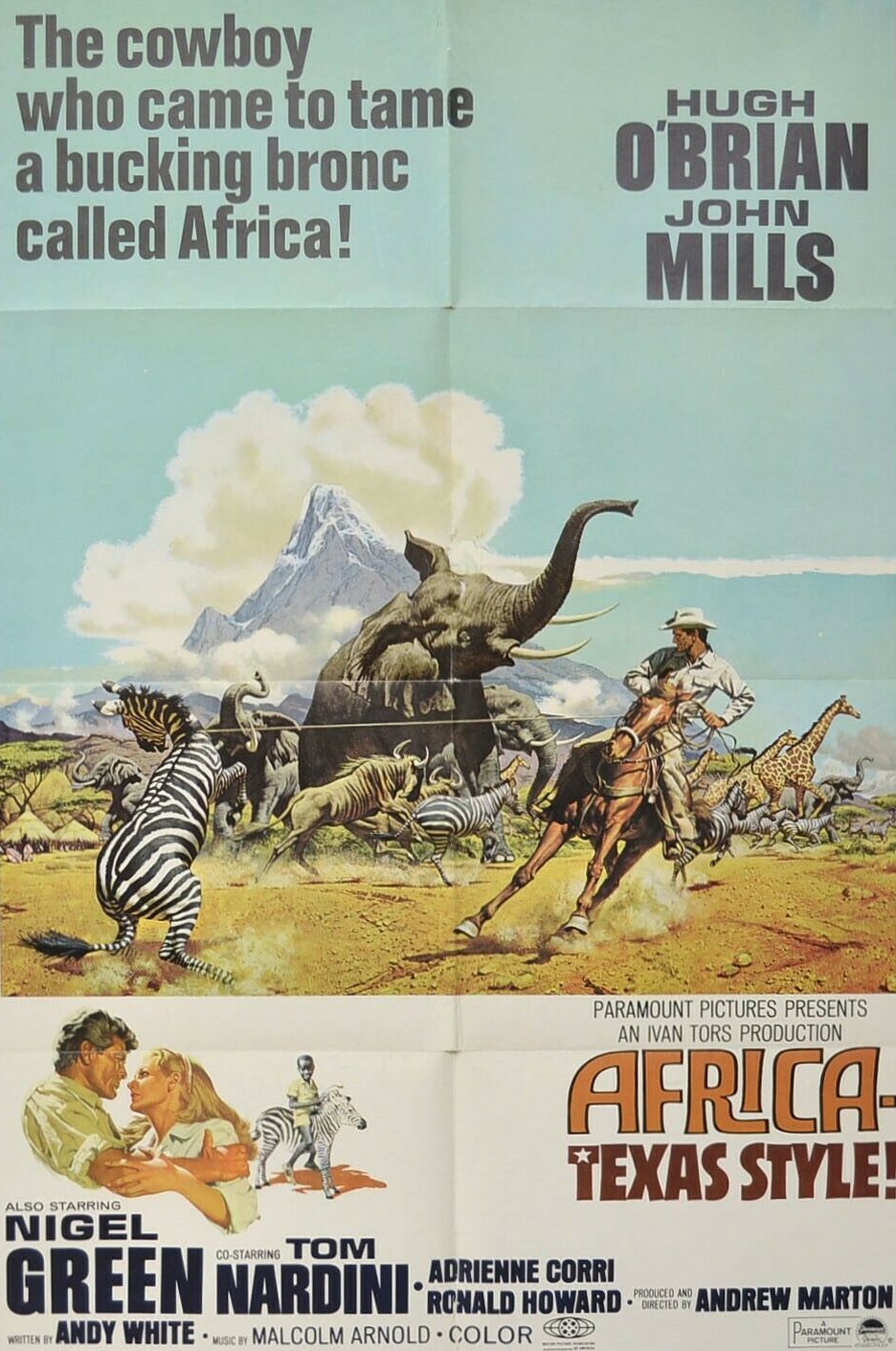
Africa – Texas Style (1967) ***

Falling into the unusual category of Saturday afternoon matinee with a message, American cowboy Jim Sinclair (Hugh O’Brian) and sidekick Jim Henry (Tom Nardini) hightail it across the Atlantic to help the wildlife conservation efforts of game rancher Wing Commander Hayes (John Mills) who faces sabotage at every turn by another rancher Karl Bekker (Nigel Green). It combines Hatari!-style action and interesting storylines with Disney-animal-cuteness (a domesticated zebra called Pyjama Tops).

To get the conservation element out of the way – Hayes is concerned that letting animals roam free will result in overgrazing, turning the countryside into a dustbowl and endangering a variety of species. That Hayes is already talking about animals becoming extinct is way ahead of the common perception of Africa at the time. His plan is to round up the wild animals and fence them in, this kind of ranching preventing foodstocks becoming depleted. Bekker’s objection is that wild animals carry infections such as East Coast Fever that will endanger his herd.  

Romantic interest is supplied by the already-engaged nurse Fay Carter (Adrienne Corri) while orphan Sampson (Charles Malinda) tugs at the heart strings. There is a fair measure of authenticity, glorious aerial shots of elephants and buffalo and other species, tribal dances by the Masai while the Sinclair/Henry rodeo-style method of catching wild animals, with lasso rather than giants nets as in Hatari!, ramps up the excitement quotient, not least when Sinclair goes one-on-one with an enraged rhino. As you might expect, there is also ample opportunity for Sinclair to encounter a deadly snake and crocodile and it wouldn’t be an African picture without a stampede.  

Although villainous, Bekker is not without logical argument, not just the fear of infection which would decimate wildlife as much as soil erosion, but his own concerns that taming wild animals would upset the balance of nature, and, on a personal level, the lack of respect for territorial rights. Of course, when push comes to shove, he resorts to rifle and fist to settle  arguments.

Atmospheric, well-made, engaging and at times exciting, there is enough going on here to keep the picture ticking along – a hunt for a lost and bewildered Sinclair, questions about home, and the spectacular wildlife rodeo show. Unlike Born Free (1966) and any other animal picture for that matter although wildlife takes narrative center stage we are not subjected to countless cute four-legged specimens.

Hugh O’Brian (Ambush Bay, 1966) could be a latter-day Tarzan (or more correctly Jungle Jim since he is never in loincloth) but Scottish actress Adrienne Corri (The Viking Queen, 1967) is less jungle adventuress more principled counter to his easy manner. With every chance to rely on the stiff-upper-lip of an English war hero, John Mills (The Family Way, 1966) does anything but and turns in another engaging performance and if you are looking for a decent chap to deliver a conservation message he is definitely your man without being obsessively annoying. Nigel Green (The Skull, 1965) adds to his portfolio of interesting characters as a smooth-talking rough-edged bad guy while Tom Nardini (Cat Ballou, 1965) impresses. Look out for a fleeting glimpse of Hayley Mills  at the start.

Director Andrew Marton, who had been involved in helming The Longest Day (1962) and second unit director of Ben-Hur (1959) and Cleopatra (1963), was something of a wild animal specialist with Clarence, the Cross-Eyed Lion (1965) in the kitty as well as a dozen episodes in total of television series Flipper (1965) and Daktari (1966). But he is at home as much with the human aspects of the story as with the animal. Producer Ivan Tors was a sometime rival to Walt Disney in the family film market with Flipper (1963) and Zebra in the Kitchen (1965) as well as small-screen Flipper and Daktari.

Mistakenly described on imdb as a TV pilot, this was a genuine feature film that happened to produce a television spin-off series Cowboy in Africa. It was screened for the trade in the U.S. on May 5, 1967, reviewed in the feature film section of Variety on May 17, and its U.S. box office figures can be tracked through Variety – opening in 1967 in San Francisco and Kansas City in June, for example, Baltimore in July, Detroit in August and Boston and Louisville in September. In some situations it was double-billed with El Dorado (1967).

CATCH-UP:  John Mills’ versatility can be seen from movies already reviewed in the Blog: The Truth About Spring (1965), Operation Crossbow (1965), The Wrong Box (1966) and The Family Way (1966).

Discover WordPress

A daily selection of the best content published on WordPress, collected for you by humans who love to read.

The Atavist Magazine

by Brian Hannan

WordPress.com News

The latest news on WordPress.com and the WordPress community.