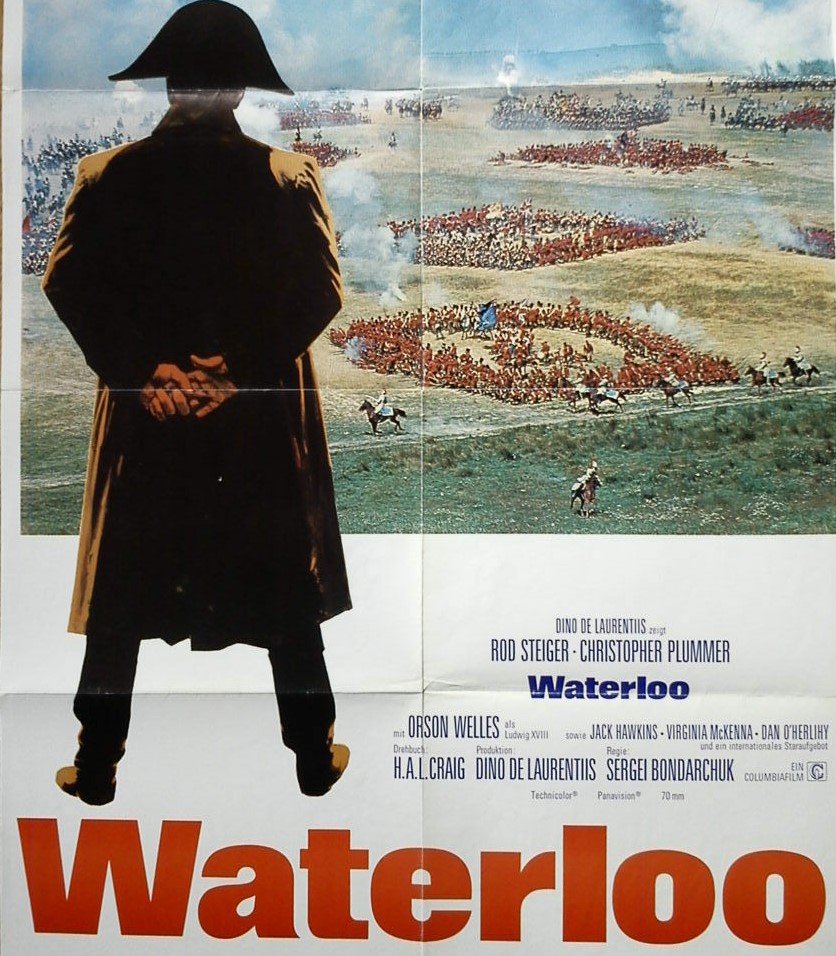
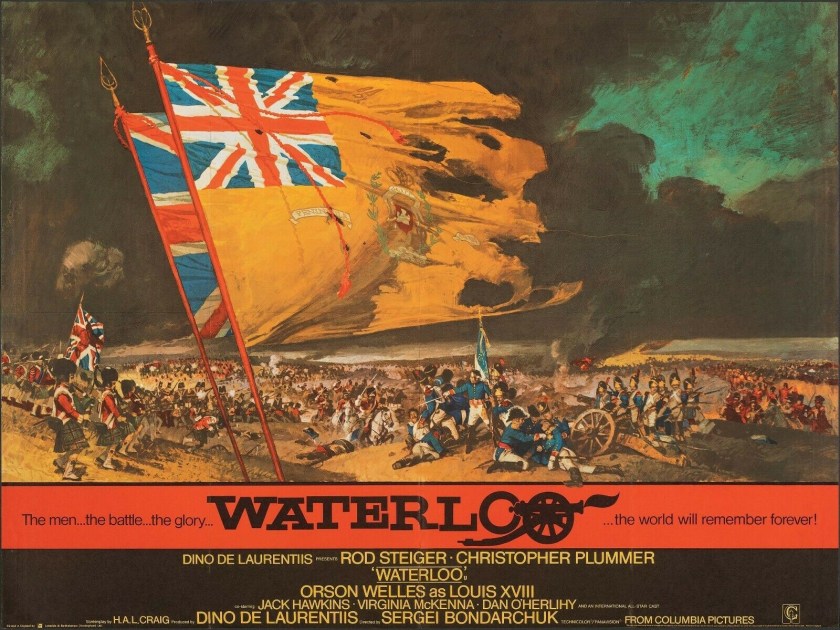
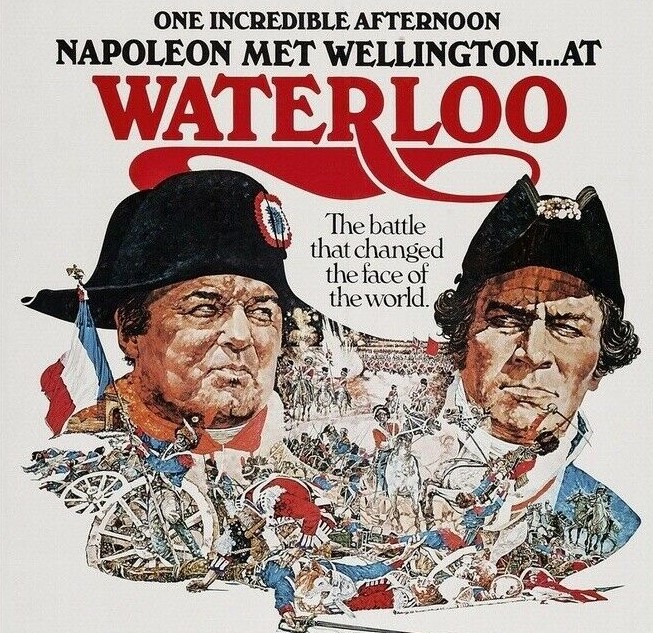
Behind the Scenes: “Waterloo” (1970)

As dramatic a box office flop as this movie scarcely deserves a book as superb.

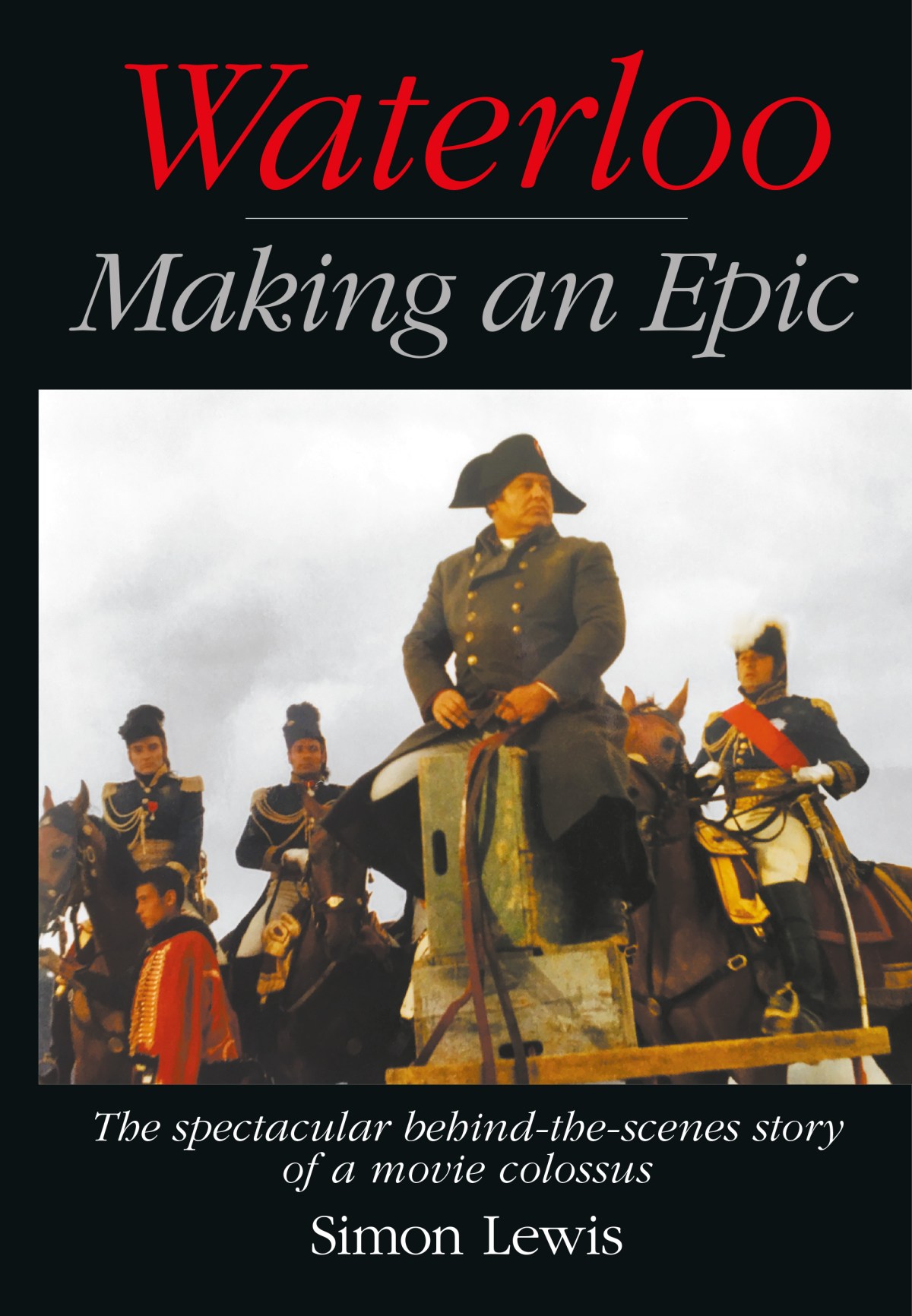
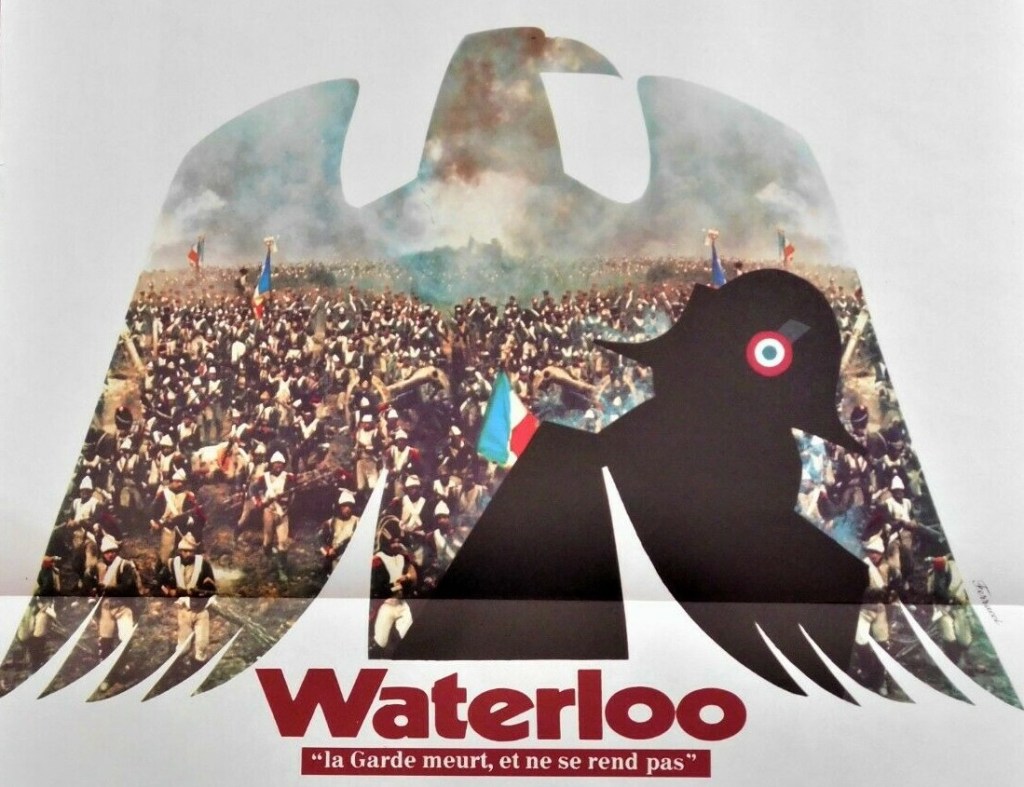
In quite extraordinary detail, author Simon Lewis discusses every aspect of the making of the film, from initial set-up to release, by way of analysis of dozens of separate scenes through to rarely discussed elements like the editing and mixing, and even the myth of the missing longer version and the importance of wooden boxes (as illustrated by the front cover).  It might have helped the movie’s commercial chances, and not put too much of a dent in the ultimately massive budget of $26.1 million, if producer Dino De Laurentiis has snagged original dream team of Richard Burton (Napoleon) and Peter O’Toole (Wellington), both of whom carried much greater box office marquee than Rod Steiger and Christopher Plummer.

Burton was never really a possibility but by 1968 O’Toole was “practically set” although turning it down because he thought it would flop. John Huston, who had just completed The Bible (1966) for De Laurentiis, was original choice for director and got so far as being involved in the screenplay being written by H.A.L Craig (Anzio, 1968). When he dropped out, Gilles Pontecorvo (The Battle of Algiers, 1966) was briefly in the frame. However, a six-hour version of War and Peace (1965) put Sergei Bondarchuk in pole position.  

Requiring thousands of properly trained and preferably “celluloid-seasoned” troops to carry out disciplined manoeuvres rather than extras, De Laurentiis was in negotiation with Turkey, Hungary, Yugoslavia and Bulgaria before plumping for Russia, whose production arm Mosfilm pumped in $8 million (later rising in line with budget increases). Paramount and Columbia contributed a combined $7 million with worldwide rights selling for a total of $25 million. Once filming began, Paramount chiefs Charles Bludhorn and Robert Evans, watching elements of shooting, were so taken with what they saw they wished they had invested more. Evans was reportedly “enthralled by hours of film material.” Craig’s screenplay was augmented by the director and Vittorio Bonicelli as well as uncredited contributions by Jean Anouilh (Becket, 1964), Samuel Marx and Edward O. Marsh, not to mention additions by the two main actors. Steiger pocketed $385,000, Plummer $300,000, Craig $121,000 but Anouilh only $21,000. Gordon Highlanders pipers and drummers picked up £7 a day.

Lewis is at his best when forensically examining particular scenes, for example, the Duchess of Richmond Ball which used 4,000 candles inserted into candelabras, the slightest draught causing these to melt and drip wax on performers, a carpet used to get camera shots from a very low level.

Steiger played Napoleon almost as a dead man walking, having got hold of a copy of the French Emperor’s autopsy which revealed advanced cirrhosis and gonorrhoea. Steiger and Bondarchuk met the night before to iron out ideas for the following day but Steiger was not above forcing the director’s hand by in one instance the actor removing his trousers to ensure he could only be shot in close-up. Orson Welles matched Steiger in trickery. Only hired for two days, Welles extended his employment by insisting on doing his own make-up which of course was never up to scratch and required amendment. And in terms of movie trickery, Steiger was required to sit on a wooden box on his horse to ensure he could be kept in focus. Jack Hawkins dispensed with the horse altogether – he was either atop a box or on top of stilts, as he was unsteady on an animal.

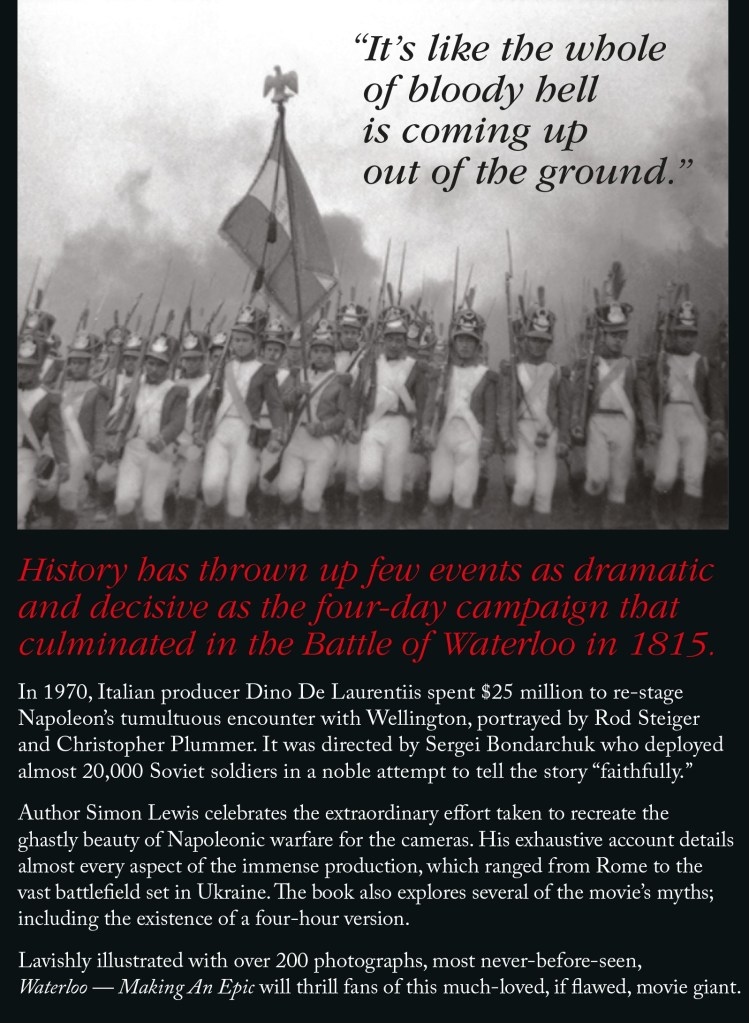
In the absence of CGI of the kind Ridley Scott could employ for his battle scenes, the real soldiers were occasionally augmented by mannequins. Five thousand were made, two real soldiers at either end of a row held eight mannequins in place by the use of a single wooden plank which “allowed all regiments to march forward.” Among the many wonderful candid pictures in this lavishly illustrated tome – 200 photographs, many never seen before – is one of three girls staring at the mannequins as well as photos of Steiger and Hawkins on their boxes.

The Waterloo battlefield had one of the biggest sets ever built. A total of 17,000 soldiers, mostly from Siberia and  including 2,000 cavalry, lived in a tented city a mile away. Steiger noted: “It would have taken assistant directors three days to put untrained men, mere extras, into position. When they broke for lunch it would be another three days to arrange them again. These guys are superb.” Real soldiers working with their actual commanders was the difference between waste and superb. Having a general in charge of the troops often created issues. Bondarchuk would select the horses he wanted based on the effect he wished to achieve with the light, demands often obstructed by the commander if it meant the chosen horses had not been properly fed. “I will order soldiers – but how do I order animals?” was the dry comment from the army chief. .

Although the battlefield was primarily authentic  – mud for one scene created by pumping two days’ worth of water into the soil before cavalry churned up the area – there were occasions when filming conformed to the Hollywood norm. “The use of fiery explosions had been cinematic shorthand for battle scenes long before Waterloo” when in reality these would be minimal. “Most ammunition that was fired comprised large iron balls and so low was its speed it was possible to watch their progress.”

 The famous charge of the Scots Greys was described thus in the script: “they came straight into camera – like centaurs in their magnificence.” The sight of 350 Arabian mounts travelling at breakneck speed was captured by use of a specially constructed railway powered by a diesel locomotive. Five cameras were sited in different positions on the train. The famous slow-motion effect – possibly the most exhilarating moment in the picture – was achieved by over-cranking the camera at 100 frames per second which slowed down what you saw by a factor of four.

Perhaps the best reveal regarding movie trickery was the moon above Wellington as he rode past the carnage. It comprised “special silver paper for front projection – 3M – like shark skin. You put one light on it and it reflects ten times brighter.” The moon was shown as one quarter less than full since the effect of a full moon would be harder to carry off. “Blue ink made some spots as moon craters.” The fake moon was suspended with one wire on top and two left and right to prevent it from moving, then one light was projected onto it.

Back cover of the book.

Lewis rebuts the myth of the missing longer version. He reckons this probably came about because over 300,000 feet of film – 55 hours – was shot and the first rough cut was five hours long. The final cut was 133 minutes – not much longer than if you had worked out the length by counting the pages of the screenplay – and release cuts varied because, for example, the British censors cut out 28 seconds of horse falls and the ending includes 50 seconds of music over the credits. It was never shown with the intermission which was de rigeur at the time for longer roadshows and would have, artificially, inflated the running time.  There was some confusion over the final print because a novelisation by Frederick E. Smith included some scenes that didn’t make it into the final print, and Smith’s book, written of necessity before the film appeared, would have used as its main reference tool the screenplay. But Lewis spends a whole chapter explaining why a longer cut never existed.

The world premiere was held on 26 October 1970 in London where the movie released as a roadshow (i.e. separate performances) was a huge success. It ran for a few weeks short of an entire year in the London West End, breaking box office records at the Odeon Leicester Square and the Metropole where it opened on December 3rd, 1970, before shifting to the Columbia on June 17, 1971, and then a final week at the Odeon Kensington from September 30 1971. But audience appeal in the United States was at the other end of the spectrum. It went from a strong opening week of $25,436 at the Criterion in New York to just $1,775 in its fourth week, and nationwide racked up only $1.4 million in rentals (the studio share of the box office). It was derided in France in part because the film was about the defeat of a legend and the French could not come to terms with the idea that it was directed by a Russian.

Where most “making of” books concentrate on the stars and the director, Lewis goes into fantastic detail about all aspects of the production, the chapter on editing and mixing an education in itself. There’s a chapter on how historically accurate the film actually was. The author was helped by the discovery of a diary kept during production by actor Richard Heffer who played the small part Mercer. But Lewis also managed to make contact with Dino De Laurentiis’s daughters, Raffaella and Veronica, and around two dozen people connected with the film in some way, and clearly examined every scrap of information available on the picture. The Notes are another mine of information.

Even if the film is not at the top of your must-watch list, this book should go to the top of your must-read list.

Waterloo, The Making of An Epic, The Spectacular Behind-the-Scenes Story of a Movie Colossus  by Simon Lewis is published by Bear Manor Media, 534 pages, illustrated (B&W), Hardback, Paperback & Ebook, ISBN  978-1-62933-832-3 .

Behind the Scenes: “Operation Kid Brother / O.K. Connery” (1967)

A new episode in the James Bond legend began on February 23, 1966, when a plasterer from Scotland made an audacious bid for movie stardom. His name was Neil Connery, currently earning $10 a week, shooting for a $5,000 payday as he took part in a screen test in Rome for producer Dario Sabatello (Seven Guns for the MacGregors, 1966) for a film entitled Operation Casbah that would later be tagged Operation Kid Brother (O.K. Connery in Italy).

Sabatello was an experienced producer beginning with The Thief of Venice (1950) starring Hollywood legend Maria Montez. Connery was a skilled laborer living in the four-year shadow of elder brother Sean and with little intention of moving out of that shadow. However, as a result of a work-related incident, he became the subject of a newspaper article and then a radio interview. Nobody was much interested in the reason for the interview – stolen tools – but everyone was impressed by the sound of Neil’s voice. “Sean’s brother spoke exactly like him.”

Archers Assemble! Connery on the bowstring.

The newspaper interview caught the eye of Sabatello, who noted the actor’s likeness to his brother and who flew over to Edinburgh to interview Neil and in so doing becoming aware of his athletic attributes, height and good looks. A month later came an invite for the screen test. Neil’s agent, who had no right to make such a claim, promised that if Neil got the part big brother Sean would play a cameo. For the test, Connery had to “embrace a girl, sing, dance and finally end up in  a hand-to-hand fight with a guy with a knife.” However, the test was so successful that the presence of Sean was not required. Sabatello signed the neophyte actor to a six-picture deal that would generate a six-figure salary if the film turned the Scot into a star.

Italian production giant Titanus sold the world rights (except for Italy) to United Artists, ironically the distributor of the James Bond pictures, thus securing the funding for the $1.2 million three-month shoot that kicked off in Cinecitta in Rome on December 14, 1966. Locations were scheduled to include Monte Carlo, San Remo, Turin, Barcelona, Malaga and Tetuan.

The supporting cast was dominated by actors with a Bond connection including Adolfo Celi, Daniela Bianchi, Anthony Dawson, who had all worked with director Alberto De Martino on Dirty Heroes (1967) and Lois Maxwell and Bernard Lee. Ennio Morricone, another De Martino aficionado, was brought in to do the score.

Affiliates Assemble! Connery with Bond regulars Bernard Lee and Lois Maxwell.

Connery’s boxing training in the British Army came in handy when he had to become an archer. Pulling a bow takes considerable physical exertion. Target practice was held at Adolfo Celi’s house outside Rome. “I had remembered everything about putting the bow down, bringing it up, pull and push, as there was quite a pull on it,” he said. Celi’s arrow managed just a few yards but Connery hit the target. His luck did not hold when filming the real thing in Monte Carlo. Celi’s shot did not go far again but this time Connery’s arrow missed the target.

Although Connery had read the script he was only given his lines in the morning as he went into make-up. He acquitted himself well in the fight scenes, except for one scene which ended with him being taken to hospital.   

The film opened in Britain at the Pavilion in London’s West End on April 25, 1667, with a general release slated for May 5. But it didn’t get a circuit release. That is, it didn’t go out on either of the two main cinema chains, ABC or Odeon, or the lesser Gaumont circuit, so its bookings would have been restricted. It didn’t appear in the United States until November, 1967, having been reviewed without much enthusiasm in Variety which posited “at best the film deserves bottom half bookings”, i.e. the bottom half of a double bill, which means it would play for a fixed rental rather than a percentage.

It did open in first run in a number of city center picture houses in November and December, to occasionally decent but hardly lush box office. Its $20,000 week in Chicago was deemed “good”, as was the $4,000 in Providence, while $13,000 in Philadelphia was considered “brisk” but $5,000 in St Louis considered only “fair.”  There was a first run showing in New York but only at a 600-seater arthouse.

But when it went wider in “Showcase” releases the box office collapsed. In New York it managed only $67,000 from 25 theatres compared to, in the same week, British film The Family Way on $223,000 from 26, and the second week of Point Blank with $145,000 from 25. Business was worse in Los Angeles, just $49,000 from 26 compared to $125,000 from 29 for Barefoot in the Park, and it was dire in Kansas City, only $9,000 from eight houses.

Given the relatively low budget, the film globally may well have broken even but it certainly did not send Neil Connery’s box office status into the stratosphere. He had small parts in two more low-budget movies, The Body Stealers (1969) and Mad Mission 3: Our Man from Bond St (1984) plus some television.

SOURCES: Brian Smith, “Bond of Brothers,” Cinema Retro, Vol 4 Issue 12 2008, p13-19; Allen Eyles, Odeon Cinemas  2, (CTA 2005), p212; Allen Eyles, ABC (CTA, 1993), 123-124; Allen Eyles, The Granada Theatres (CTA 1998)’ p247; Allen Eyles, Gaumont British Cinemas, (CTA 2005), p197; William Hall, “Big Brother Is Watching Him,” Photoplay, June 1967; “International Soundtrack,” Variety, February 23, 1966, p33; “Titanus Sets Pre-Prod Deals for Two UA Pix,” Variety, December 14, 1966, p24; “International Soundtrack,” Variety, December 21, 1966, p24; “Hollywood and British Production Pulse,” Variety, December 28, 1966, p17; Advertisement, Variety, January 4, 1967, p65; “Connery Pix a Family Affair with UA,” Variety, March 8, 1967, p24;  Review, Variety, October 11, 1967, p22; “Picture Grosses,” Variety November 1, November 8, November 15, November 29, December 13, 1967.  

Behind the Scenes: “The Biggest Bundle of Them All” (1968)

Films that reach the screen two years after filming was completed are generally stinkers. Ken Annakin caper movie The Biggest Bundle of Them All wrapped production in summer 1966 and was not released until January 1968. But the reason was not the usual.

The cause of the unseemly delay was a temper tantrum by Oscar-winning uber-producer Sam Spiegel (Lawrence of Arabia, 1962) who had been working on a similar project about incompetent amateurs kidnapping a gangster kingpin – The Happening (1967) starring Anthony Quinn (previously reviewed in the Blog). After bringing a charge of blatant plagiarism, Spiegel was mollified by being permitted to bring his movie out first, with an inbuilt eight-month gap  between both releases, the deal sweetened by a 15% cut of The Biggest Bundle’s profits and the right to vet the script.

Despite success with Those Magnificent Men in Their Flying Machines (1965) and Battle of the Bulge (1965) British director Annakin was at a career impasse. The Fifth Coin written by Francis Ford Coppola and starring George Segal failed to get off the ground. He turned down western Texas Across the River (1966) at a time when Catherine Deneuve and Shirley Maclaine were slotted in for the female roles and was fired from The Perils of Pauline (1967). The Italian Caper as it was then known, recalled Annakin, “did not seem a world-shattering movie but I found the caper fascinating and the cast irresistible.” 

Let them eat cheesecake.

It marked the movie debut for producer Josef Shaftel of The Untouchables television fame and for screenwriter Rod Amateau (The Wilby Conspiracy, 1975), also then a television regular although the final script was attributed to another neophyte Sy Salkowitz. The film made the most of Italian locations, Naples and Rome, as well as the South of France and Provence. Annakin caught pneumonia just as shooting was to commence. Shaftel took over for five days only for his material to prove unusable.

Both veteran actors proved easy to direct. “Robinson was like putty in my hands, completely trusting.” And while Vittorio De Sica was every bit as amenable he was inclined to fall asleep on the set as the result of entertaining his mistress the night before. Di Sica was also a compulsive gambler and at one point lost half his salary in a casino.

Raquel Welch, in only her second picture after One Million Years B.C. (1966) – which contained minimal dialogue – was initially a handful. Primarily, this was due to inexperience and her desire to present herself in as alluring a fashion as possible, with impeccable hairstyles and make-up. After she had kept the crew waiting once too often Annakin threatened to eliminate her close-ups unless she respected the shooting schedule.

“On the whole I was quite pleased with the results because she really applied herself and so long as one broke up the scenes into a couple of lines at a time she became able to handle them quite adequately…I was getting along excellently with Raquel – even to the extent of trying to find another picture with her,” Annakin noted in his autobiography. Since this was written three decades after the movie was made, it would have given him ample time to get rid of any latent hostility to the actress. This reaction, it has to be said, is contrary to much of what has been written about Welch’s behavior on the picture. At the time of filming he reported that “she has a marvelous flair for comedy.”

But it appeared that Annakin was the only one who spotted her star potential. “The rest of the cast, especially Bob (Robert Wagner), regarded her as a pin-up girl on the make…none of them thought she was particularly sexy at this time.”

Otherwise, the only other trouble came from Godfrey Cambridge who “had a chip on his shoulder” and from Robert Wagner’s insistence on wearing false eyelashes. Problems arose over the cinematographer’s determination to employ powerful lights even at the height of a Mediterranean  summer and a massive dust storm interrupted filming of the final scenes.  Annakin also benefitted from the locations and using his experience was able to shift 35 pages of script from interiors to outdoors, completely altering the look of the picture. This made the $2 million movie “look like it cost three or four million,” according to Annakin. 

At this point Welch, best known for having been sued by her publicist, was in the process of turning herself into a star in demand. In 1966 Welch was something of a Hollywood secret. She had three pictures in the bank, was working on a fourth and had signed up for a fifth before any of her movies had been released. On the other hand, she was fast becoming one of the most famous faces (and bodies) in the world, on the cover of of hundreds of magazines in Europe, many for the fourth or fifth time.

Having set up a company, Curtwel, managed by husband Patrick Curtis, she would earn $15,570 a week on loan to MGM for a second film Italian movie Shoot, Loud…Louder, I Don’t Understand (1966), considerably more than through her contract with Twentieth Century Fox. A year later she collected £100,000 for two weeks on portmanteau picture The Oldest Profession (1967).

Curtwel was also moving into the production arena, in 1965 attempting to set up No Place for the Dead and the following year optioning the musical comedy The Opposite Sides of the Fence and taking a quarter share in the mooted The Devil’s Discord to star Peter Cushing and Edd Byrnes under the direction of Michael Reeves (Witchfinder General, 1968). None of these ventures materialzed.

As well as having to contend with audience disinterest in the clumsy crook scenario as witnessed by the flop of The Happening, the enforced time gap allowed a second picture featuring bungling criminals called Too Many Crooks (1967) to reach cinemas prior to The Biggest Bundle. However, by January 1968, Welch was a much bigger name on movie marquees, having appeared on 400 international magazine covers and selected by U.S. exhibitors for the International Star of the Year Award while The Biggest Bundle had been preceded by another seven pictures including hits One Million Years B.C. and Fantastic Voyage (1966).

SOURCES: Ken Annakin, So You Wanna Be a Director, (Tomahawk Press, Sheffield 2001), pages 187-194; “Raquel Welch and Manager Form Curtwel Co,” Box Office, May 3, 1965, pW3; “Raquel Welch, Pat Curtis Form Curtwel Prods,” Box Office, October 5, 1965, pSE6; “Toutmasters Sue for 5% of Raquel Welch,” Variety, October 6, 1965, p14; “Raquel Welch in Rome,” Box Office, April 25, 1966, page SE1; “MGM’s Bundle Wrapping at Nice, Orders On Set in 3 Languages,” Variety, July 6, 1966, p7; “8 Pix for 2 Unseen Actresses,” Variety, August 17, 1966, p5; “Businesswoman Side of Raquel Welch,” Variety, November 2, 1966, p20; “Oldest Profession Gets New Locale in West Berlin, Raquel Welch’s 100G Job,” Variety, January 18, 1967, p24; “Columbia-Spiegel Holds 25% Share of MGM’s Bundle,” Variety, December 6, 1967, p3.

Behind the Scenes – “The Picasso Summer” (1969) Crisis

The making of The Picasso Summer was an odyssey in itself but what happened to the picture on completion generated a crisis in Hollywood.

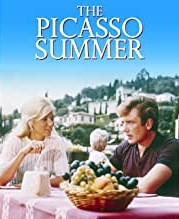
Pablo Picasso in the early 1960s had apparently given “an enthusiastic endorsement” to American layout artist Wes Herchendson to animate some of his paintings. Some time afterwards, Hershendson came across sci-fi writer Ray Bradbury’s short story In a Season of Calm Weather about an American tourist meeting Picasso on a beach. Developing the scenario with the author, the pair turned the idea into an American couple attempting to meet the artist in the south of France.

Originally, the project was modest. It would run only an hour and be shown on television, sponsored by an airline company to promote foreign travel. But once the idea attracted the likes of British star Albert Finney (Tom Jones, 1963) , who had recently filmed Two for the Road (1967) in France, and Yvette Mimieux (The Time Machine, 1960), who had a percentage of the picture, it became bigger. It was the first film for a fledgling production company part-owned by Bill Cosby and when Warner Brothers-Seven Arts stumped up $1.6 million – a reasonable budget since a WB picture three years averaged just $1.75 million – it turned into a full-length feature intended for theatrical release. Filming began in November 1967 in San Francisco and France without a finished screenplay, working in almost improvisational style to a sketchy 20-page treatment.

Herchendson took care of the animated sequences with  the “live-action” section in the hands of Oscar-winning French director Serge Bourguignon. Although making his name with the French arthouse-oriented Sundays and Cybele (1962) he had also made mainstream western The Reward (1965) starring Mimieux and Max von Sydow and romantic drama Two Weeks in September (1967) with Brigitte Bardot, so his credentials appeared strong enough.

But something went very badly wrong. “The resulting footage was completely unsatisfactory,” went one report. Another claimed it was “incomprehensible.” So WB-7 Arts scrapped the first version and, because the movie, often filmed outdoors, had taken  advantage of the seasons, the film was pushed back a year to ensure footage matched. WB hired a new director Robert Sallin to salvage the picture with the principals returning for reshoots.

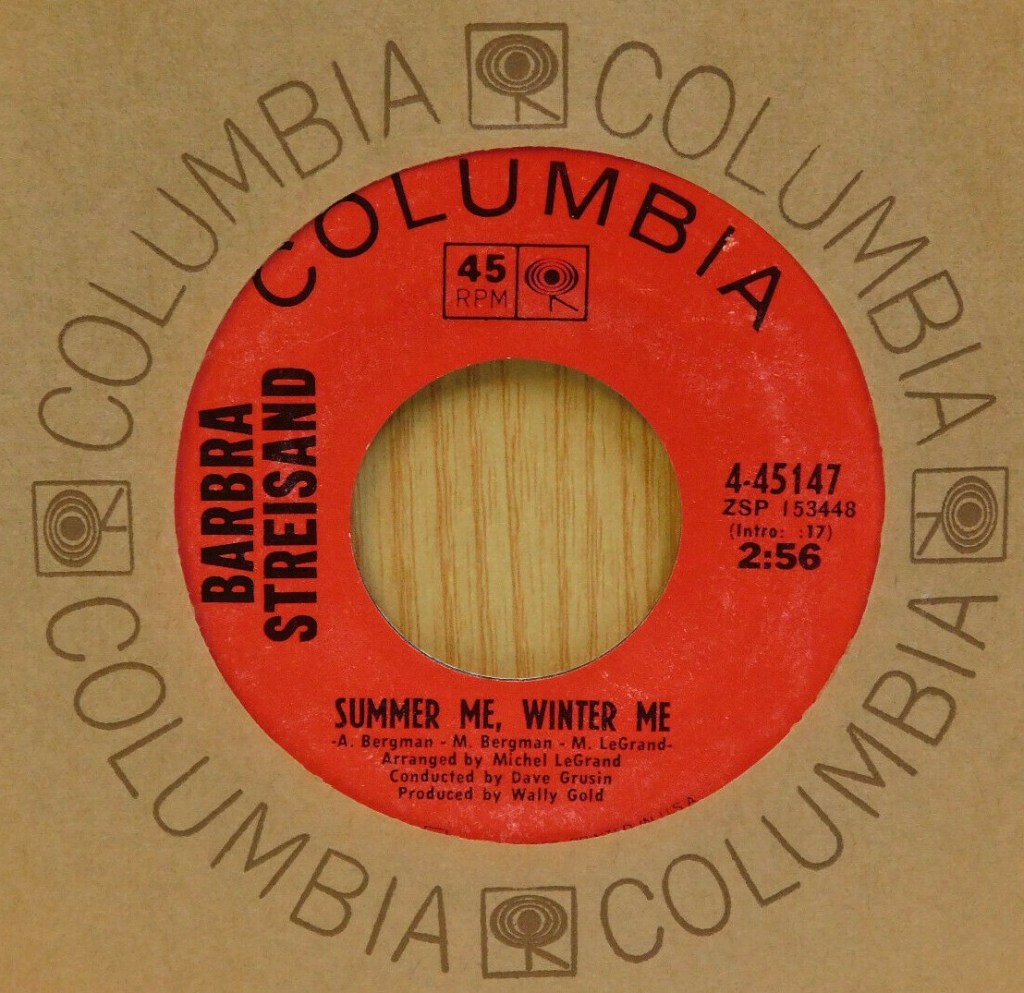
Initially, that appeared to have done the trick. WB announced it was considering launching the film as part of a big junket aimed at journalists in February 1969, and then screening it “in whole or in part” at a major conference in June with a view to a late 1969 release. A launch date was pencilled in for December 1969 – the original “X”-certificate issued in the same week as Easy Rider by that time had been amended to an “M” – with the intention of “finally getting it on the market.” And there was the signs of some promotional tie-ins with Barbra Streisand recording the theme tune “Summer Me, Winter Me.” But it didn’t appear. Officially, it was on the shelf.

The shelf, at that time, was not necessarily a bad place to be. Many pictures had been held back for a more convenient release spot during the 1960s, even more had been forcibly delayed when successful movies ate up preferential first run movie theatre space. It was nothing, for example, for The Biggest Bundle of Them All (1968) to wait eight months to be released.

But there was waiting and there was waiting. It soon became apparent that The Picasso Summer was not going to find a release date any time soon and that it was, officially, in limbo. Which was an astonishing state of affairs at the end of one troubled decade and the beginning of another. The hundreds of millions lost in big budget roadshows had seen a dramatic cutback in production. Cinemas were crying out for product, anything with a star, rather than being forced to make do with a flood of imports, spaghetti westerns of the here-today-gone-tomorrow variety and sexploitation vehicles featuring unknowns.

Hollywood had been known for routinely throwing stinkers into the marketplace and while exhibitors might complain about poor quality generally they had little option but to screen what was available because there was nothing else. But the harsh financial climate facing studios meant that every dollar spent had to be weighed up. Releasing a bad movie cost as much as releasing a good one with no guarantee that further expenditure in advertising, promotion and prints would generate profit. No point throwing good money after bad.

So Warner Brothers did the unthinkable. Even as Albert Finney recovered his box office status after Scrooge (1970) and Yvette Mimieux starred in hit sex comedy Three in the Attic (1969) and The Delta Factor (1970) the studio kept The Picasso Summer in the vaults. Even throwing it out in a wide release with no premiere or a trial run in an arthouse was considered too risky.

The number of movies that were completely unrelease-able, as opposed to being withdrawn after failing to attract an audience or turning into big flops during their run, was actually very small – Fade In (1967) coming closest to achieving that notoriety even though it had been occasionally shown in cinemas, and it was also low-budget.

But, suddenly, at the end of the 1960s that number started growing. MGM’s The Appointment (1969) was also shelved. And that had more apparent box office cachet with  Oscar-nominated director Sidney Lumet (The Pawnbroker, 1964) and featuring Oscar-nominated Omar Sharif (Doctor Zhivago,1965), an even bigger star than Albert Finney, and Anouk Aimee (Justine, 1969) also Oscar-nominated with greater box office clout than Yvette Mimieux. After it was booed at Cannes, MGM cancelled the American release after one U.S. test date .

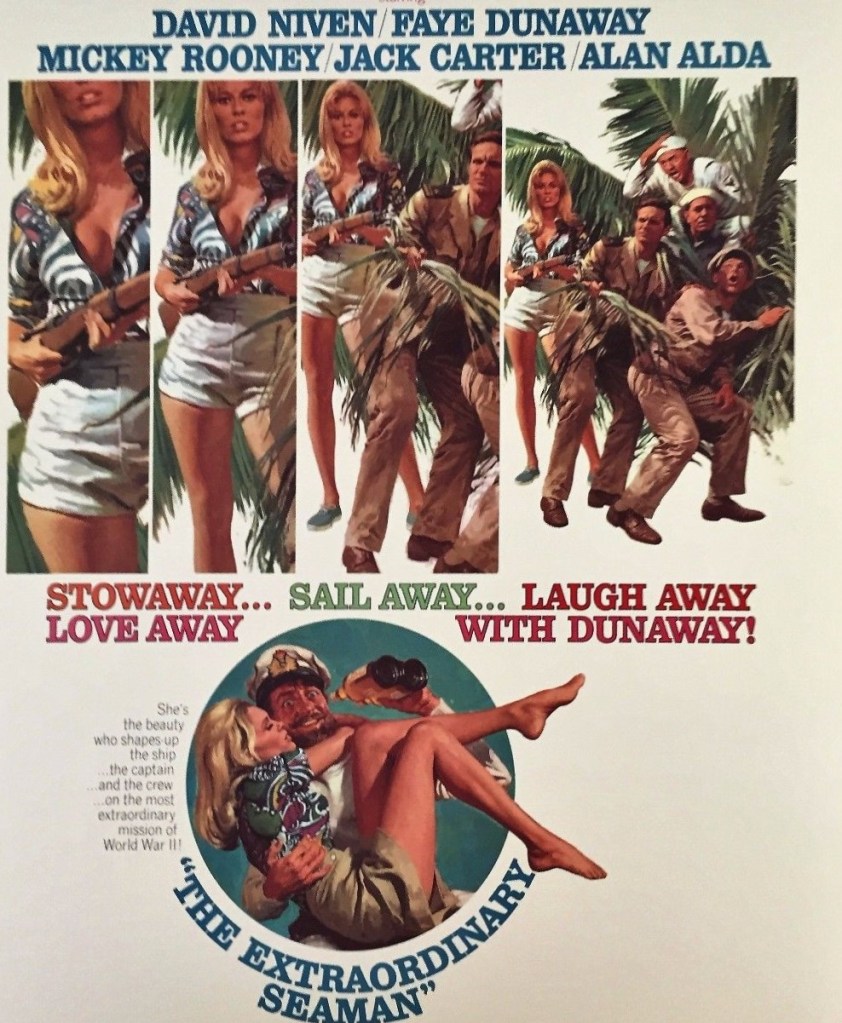
But the trickle of shelved movies was becoming a flood. Into that category fell John Frankenheimer’s The Extraordinary Seaman (1969) starring Faye Dunaway (Bonnie and Clyde, 1967) and Oscar-winner David Niven fresh from hit comedy The Impossible Years (1968). Courtroom drama Hostile Witness (1969) starring another Oscar-winner Ray Milland (Dial M for Murder, 1954) was denied a release as was comedy western A Talent for Loving (1969) with Richard Widmark, on a career high after Madigan (1968), and Adam’s Woman (1970) with Beau Bridges, who would strike a box office mother lode with Gaily, Gaily (1969) and John Mills (The Family Way, 1967). Swelling out the list was Crooks and Coronets / Sophie’s Place (1969) starring Telly Savalas (The Heroin Gang, 1968) and Hammer sci-fi Moon Zero Two (1969).

At a 1970 press conference, questioned about the shelving of The Picasso Summer, a Warner Brothers executive admitted: “We don’t know what to do with it, but not in the sense marketing is a problem; completion into a releasable form would seem to be the nub.”

By 1971, The Picasso Summer was not alone in failing to meet expectations. Some 80 movies funded by the majors had either still to be screened or had already been yanked off screens after poor test showings or minor playoffs failed to garner an audience. A year later Warner Brothers alone had ten completed movies on its books that would never see the light of theatrical day.

There had been one get-out clause for under-performing movies – television. A sale to the networks could bring in a substantial amount, sometimes enough to balance the books. But television was beginning to look askance at product that, in subject matter and in relation to violence and nudity, did not suit the Big Three channels. It was soon obvious that the networks had “lost their omnivorous feature film appetite.”

But there a light on the horizon. One network was interested in more unconventional fare and pictures that it could present as U.S. “premieres.” The CBS  “Late Night Movie” slot airing on a Thursday aimed to attract an adult audience seeking more adult material. The conventions of television would still minimize nudity but the films themselves would have an adult theme. Thus, in 1972 The Picasso Summer, The Appointment, The Extraordinary Seaman and Adam’s Woman were shown on CBS.   

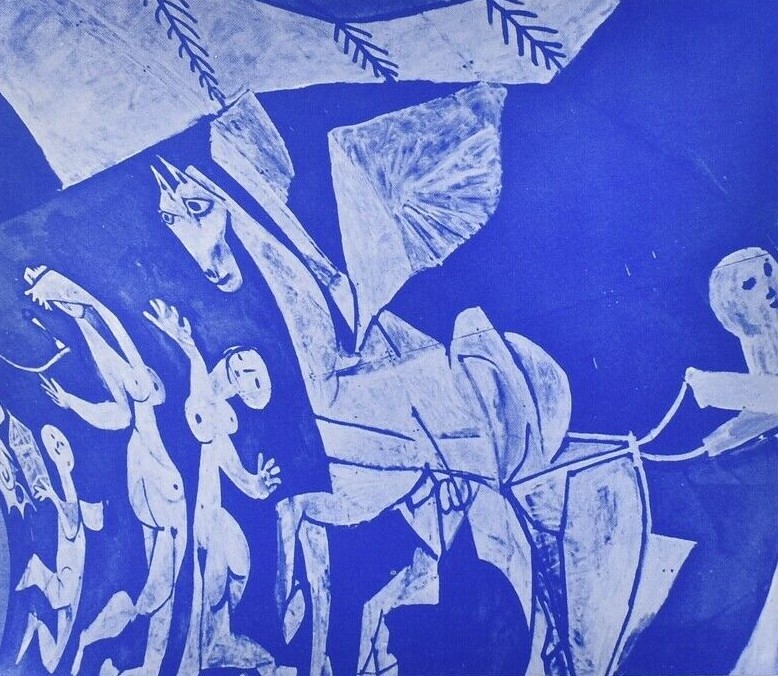
The version of The Picasso Summer shown on American television was not the completed version. Herchendson complained to CBS about the “massacre of my film.” The network had deleted the entire bullfight sequence, the entire animated Eroica sequence and “chopped up the War and Peace” section. In fact it was well known in advance that one of the four animated sequences, the one considered “more sensual than erotic,” would go.

But there was one big plus for Warner Brothers. CBS paid $1.6 million for the movie, making it, according to one wag, the most expensive made-for-television movie. That turned a potential loss into break-even.

SOURCES: Quentin Falk, Albert Finney in Character, (Robson Books, 1992) p122-124; “WB Pacts Cosby Company,” Variety, January 17, 1968, p7; “Yvette Mimieux: Many-Phased Career,” Variety, February 5, 1969, p24; “W-7 Bahamas Junket,” Variety, February 26, 1969, p3. “WB-7 Arts First Global Sales Conference in LA June 8-14,” Box Office, April7, 1969, pW1; “Not Just Passing, WB Bets,” Variety, November 5, 1969, p7; “No “X” for Xmas,” Variety, December 3, 1969, p7; “Press Peek at Calley,” Variety, April 22, 1970, p7; “Unsalvageable Cupboard Item Lucky for WB,” Variety, August 19, 1970, p[3; “Pix in the Shortage Era,” Variety, December 22, 1971, p21; “TV-Bearish WB Cupboard,” Variety, March 29, 1972, p3; “Cannes Jeered Pic Recut By MGM,” Variety, July 19, 1972, p7; “Picasso Summer Twice Shelved  Will Be Seen AT Last, CBS Aug 4,” Variety, August 2, 1972, p22.

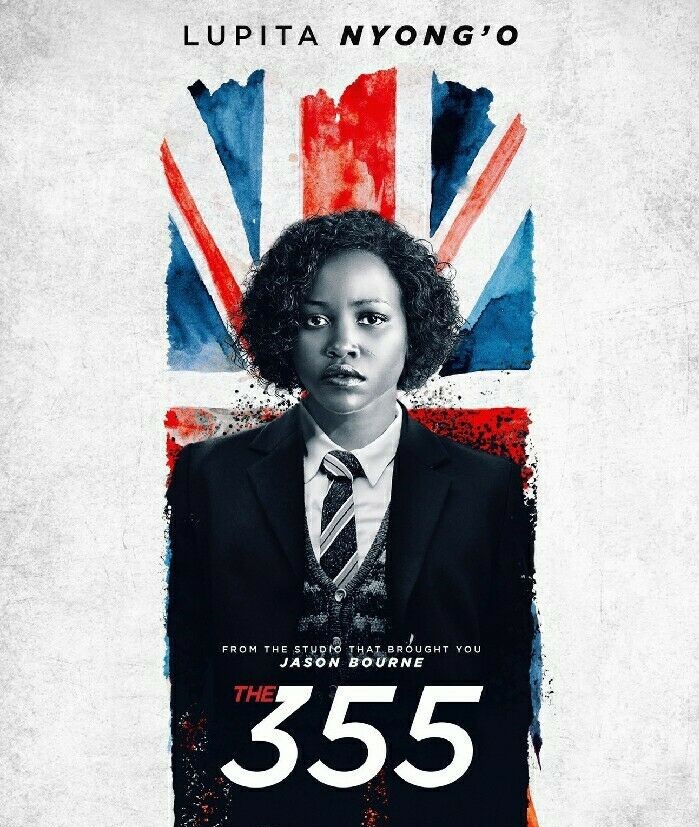
The 355 (2022) *** – Seen at the Cinema

Serviceable actioner but proof that if you don’t have a star big enough to front  a shoot-‘em-up then sticking in another three – or four – actresses of equal, middling, or up-and-coming, status won’t do the trick, not if the characters lack the originality of a Bourne or Bryan Mills (Taken, 2008). There’s plenty of bang for your buck, but the story hangs on the old trope of an electronic device that can blackout the world.

I am not sure why Jessica Chastain has never become a bigger box office star. She certainly has the kudos – two Oscar nominationss – and is not shy of taking on difficult subjects (Miss Sloane, 2016) and she’s certainly enjoyed the occasionally leg-up from a series (The Huntsman: Winter’s War, 2015; It Chapter Two, 2019) to boost her box office credentials. But her last venture into the action arena (Ava, 2020) was a box office flop, though possibly you could put the blame on the pandemic. By my count she has been the top-billed star (excluding her X-Men appearance) in her last eight pictures and none have been a hit.

Her presence in the credits would encourage me to stump up my money at the box office but apparently I am in the minority. I could say the same about Penelope Cruz (Parallel Mothers, 2021), the second biggest star here, and while she certainly retains top-billed status in her native Spain, otherwise she is occasionally a female lead but more likely a supporting player.

If I had been putting my money on anyone to take the action box office by storm it would be Diane Kruger who has the meanest stare this side of Lee Van Cleef. But she’s gone down this route to no commercial response before in The Operative (2019) and The Infiltrator (2016), neither fulfilling the promise she showed in Liam Neeson crackerjack Unknown (2011). Bingbing Fan, (Cell Phone 2, 2019) another X-Men alumni, has only recently achieved box office success, but in limited markets. Mexican Oscar-winner Lupita Nyong’o – here billed fourth and sporting a British accent – may well have the biggest fan base of the lot having clocked up appearances in three Star Wars pictures, taken top billing in Us (209) and third billing in Black Panther (2018).

But back to our story. On the run from the C.I.A. Mace (Jessica Chastain) teams up with Marie (Diane Kruger), a loner working for the German secret service, and Khadjiah (Lupito Nyong-o), a digital wizard formerly of the British secret service. Bing, who turns up later, represents the Chinese good guys. Graciela (Penelope Cruz) is the rank outsider, a therapist just caught up in the shenanigans. The action rattles through Paris en route to Marrakesh before a final stop in Shanghai. As you might expect, traitors lurk in various corners.

There are plenty shootouts and opportunities for the team to show off their hand-to-hand skills, but the action is slowed down by soap opera, having to spell out all the backstories of the principals, only one of whom, Marie, has anything worth listening to. Far be it for me to complain about too much emotion, but it took us over a dozen movies to learn anything significant about James Bond’s past, Bourne had no idea who he was, and at the other end of the scale Bryan Mills was so emotionally driven from the outset it formed the film’s core. Here, emotional quandary pops up when convenient. A bit of mystery would have helped more and cut a good 15 minutes off an overlong playing time.

As to the title, that is the only thing that is kept hidden to the end and when the revelation is made you realize it won’t mean a damn thing to the vast majority of the audience. As an origin story, I doubt the current box office receipts are sufficient to spawn future episodes. Which is a shame because having dumped all the emotional baggage in this picture, the characters could have focused more straightforwardly on action and story in the next.

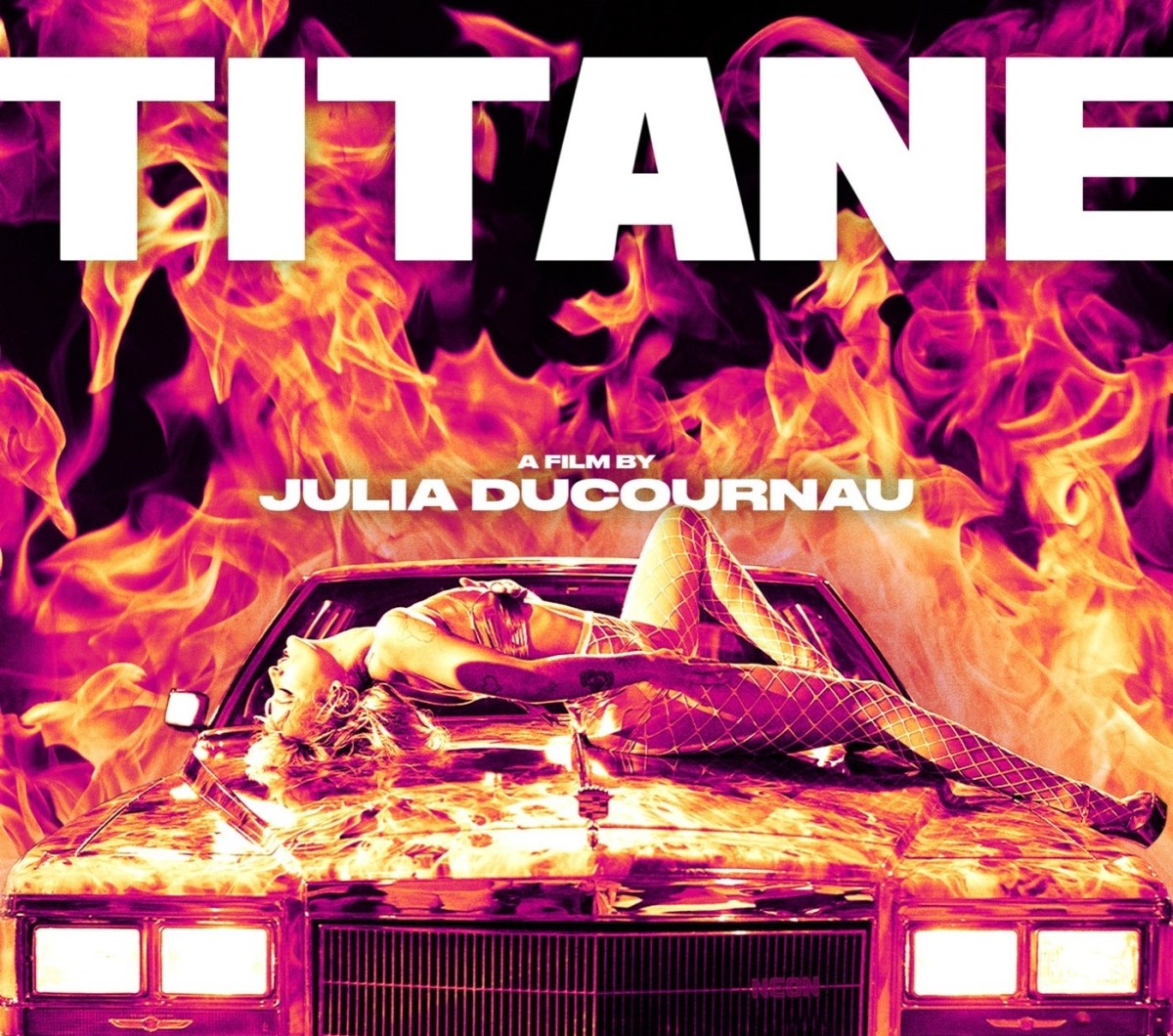
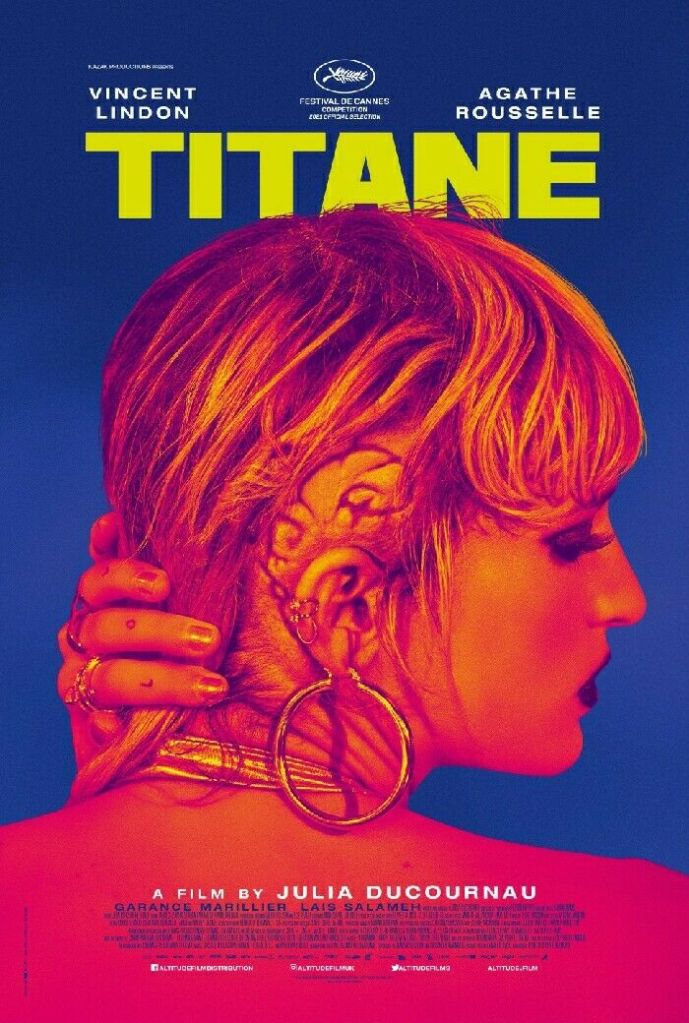
Titane (2021) *****

Perhaps the most unforeseen development of this startling picture is that ruthless serial killer Alexia (Agathe Rousselle) develops a caring relationship with an anguished fire chief father (Vincent Lindon) when masquerading as his long-lost son.  Even when it becomes increasingly clear he is harbouring an imposter his naked need for familial intimacy forces continued acceptance. Of course, given Alexia has been impregnated by an automobile, the cinematic wild ride is hardly over. Not just that the father is inclined to pump himself full of steroids to maintain his failing virility and the firemen let off steam by dancing, with no homoerotic overtones, of dancing among themselves.

But tension never slackens due to the off-the-wall off-the-scale opener that saw her enter the realms of the serial killer and the fact that her nipples start leaking oil. A relationship that could have been creepy and/or unbelievable becomes incredibly tender especially when the so-called boy, as teenagers will, causes his father major embarrassment only this time by revealing a more feminine side to his dancing.

While exploring similar territory to David Cronenberg’s Crash (1996), this shifts into a completely league. With the exception of what she undertakes to create the transformation into a boy, binding her breasts and breaking her nose, the violence is less about self-harm  than straight-out murder, weapon of choice being a handy hatpin. The most bizarre aspect about the enterprise is not the victims mounting up, but the hilarity the film engenders. When Alexis discovers that she has chosen the wrong locale for one of her killings and with a shrug of frustration has to embark on hunting down an entire household you can’t help but laugh. And the meet-cute with a female model is one of the funniest ever put on the screen.

We never find out what has turned her into a murderer especially as she is not gender-specific in this department. A car accident as a child that resulted in her being fitted with some metal has clearly created some affinity with vehicles and she earns a living as a bikini model who drapes herself over motors at car shows to the delight of leering men. Automobiles are more generally seen as expressions of male eroticism so it’s something of a twist that Alexia takes such love to the ultimate extreme.

Outside of superhero and fantasy movies, it’s rare to find a picture that creates its own world and maintains it in consistent fashion. What we learn about this vicious killer is that she needs care as much as anybody else. As the movie shifts from her selfish enjoyment to filling a gap in the fireman’s life it takes us on quite a different journey to that initially suggested.

Director Julia Ducournau (Raw, 2016) presents an unflinching vision that may be too brutal for most tastes. It won the Palme d’Or at Cannes but looks like being ignored by the Oscar fraternity. But the surface is deceptive. If the ending comes as a shocker then you haven’t been paying attention because enough hints are provided as to the potential outcome. And it also means you’ve been ignoring the film’s development which is heading in the direction of togetherness and paternal understanding rather than individual insanity.

In her movie debut Agathe Rousselle is quite astonishing, giving herself up to the needs of a picture that forces tremendous physical demands. It’s a tour de force in what it means to be a committed actor, action driven by character. Oscars have been handed out for a lot less and what makes her characterisation stand out is the transition from woman trapped by a fetish whose only emotional outlet is murder to someone accepting love without question or vicious rejection.

Vincent Lindon (Rodin,2017)  is at the other end of the career scale, with nearly three decades in the business, highlighted by a previous Cannes and Cesar win for The Measure of a Man/ La Loi du Marche (2015). His is a thankless role, at the very least a willing dupe, as much a self-harmer judging from the bruises on his exterior, as likely to be lost and flailing in his jab – a sequence of a forest fire is outstanding – as in his empty emotional life. Hats off also to Lindon, as one of France’s biggest stars, for supporting this project. Without his involvement, funding would have been more difficult.

Titane is a true original with surprising emotional depth.

Year-End Round-Up: Top 30 Films Chosen by You

Top 30

This isn’t my choice of the top films of the year, but yours, my loyal readers. This is a chart of the films viewed the most times over the full calendar year of January 2021 – December 2021.

  1. The Secret Ways (1961). Richard Widmark in spy thriller set in Hungary during the Cold War and adapted from the Alistair MacLean novel. Senta Berger has a small role.
  2. Ocean’s 11 (1960). Frank Sinatra, Dean Martin and the Rat Pack embark on an audacious Las Vegas robbery.  
  3. Pharoah (1966). Epic Polish picture about political shenanigans in ancient Egypt.
  4. Age of Consent (1969). Helen Mirren stars as the nubile muse of jaded painter James Mason returning to his Australian roots.
  5. The Venetian Affair (1966). Robert Vaughn hits his acting stride as a former CIA operative turned journalist investigating suicide bombings in Venice. Great supporting cast includes Elke Sommer and Boris Karloff.
  6. The Golden Claws of the Cat Girl (1968). Cult French movie  starring Daniele Gaubert as a sexy cat burglar.
  7. Moment to Moment (1966). Jean Seberg is caught up in a Hitchcockian murder plot in the French Riviera. Also features Honor Blackman.
  8. It’s Not All Rock’n’Roll (2020).  Ageing rocker Dave Doughman aims to mix a career with being a father in this fascinating documentary.
  9. 4 for Texas (1963). Frank Sinatra and Dean Martin face off in a Robert Aldrich western featuring Ursula Andress and Anita Ekberg with Charles Bronson in a smaller part.
  10. Once a Thief (1965). Trying to go straight ex-con Alain Delon is coerced into a robbery. Ann-Margret is a revelation as his wife. Jack Palance, Van Heflin and Jeff Corey add up to a great supporting cast.  
  11. Stiletto (1969). Alex Cord as a Mafia hitman wanting to retire is pursued by tough cop Patrick O’Neal. Britt Ekland heads a supporting cast which includes Roy Scheider, Barbara McNair and Joseph Wiseman.
  12. Subterfuge (1968). C.I.A. operative Gene Barry is called to London to uncover a mole in M.I.5. Joan Collins provides the romance. Richard Todd, Tom Adams, Suzanna Leigh and Michael Rennie lend a touch of class.
  13. The Swimmer (1968). Burt Lancaster delivers a superlative performance as a man whose life is falling apart.
  14. The Rock (1996). Blistering thriller starring Sean Connery as an ex-inmate of Alcatraz helping Nicolas Cage infiltrate the island to prevent mad general Ed Harris destroying San Francisco. Michael Bay directs.
  15. The Sicilian Clan (1969). Alain Delon joins forces with Jean Gabin to pull off an daring jewel heist with tenacious cop Lino Ventura on their trail. French thriller directed by Henri Verneuil.
  16. The Naked Runner (1967). With his son held hostage, Frank Sinatra is forced to carry out an assassination in East Germany.
  17. A House Is Not a Home (1965). Biopic of notorious madam Polly Adler (played by Shelley Winters) who rubbed shoulders with the cream of Prohibition gangsters.
  18. Pressure Point (1962). Prison psychiatrist Sidney Poitier must help racist Nazi Bobby Darin.
  19. Genghis Khan (1965). Omar Sharif plays the legendary warlord who unites warring Mongol tribes. Stellar cast includes Stephen Boyd, James Mason, Francoise Dorleac, Eli Wallach, Telly Savalas and Robert Morley.
  20. A Twist of Sand (1968). Beleaguered smuggler Richard Johnson spars with Jeremy Kemp in thriller about hidden diamonds in Africa. Honor Blackman is along for the voyage.
  21. Jason and the Argonauts (1963). Ray Harryhausen special effects dominate this legendary tale of the hunt for the Golden Fleece.  
  22. Dr Syn Alias the Scarecrow (1963). Disney movie that was turned into a mini-series in the U.S. starring Patrick McGoohan as the eponymous Robin Hood-type character who assists smugglers.
  23. The Hitman’s Wife’s Bodyguard (2021). Ryan Reynolds and Samuel L. Jackson reunite for wild sequel also featuring Salma Hayek and Antonio Banderas.
  24. Dark of the Sun / The Mercenaries (1968). Rod Taylor leads a private army into the war-torn Congo to rescue a cache of uncut diamonds. Jim Brown, Yvette Mimieux and Kenneth More co-star. Based on the Wilbur Smith bestseller.
  25. The Guns of Navarone (1961). Classic war mission picture with an all-star cast of Gregory Peck, David Niven, Anthony Quinn, Stanley Baker, Irene Papas and Gia Scala. Adapted from the Alistair McLean bestseller.
  26. Maroc 7 (1967). Gene Barry infiltrates a gang of jewel thieves in Morocco operating under the cover of a fashion shoot. Dazzling female cast includes Elsa Martinelli, Cyd Charisse, Tracy Reed and Alexandra Stewart.
  27. The Satan Bug (1965). John Sturges adaptation of Alistair MacLean pandemic thriller stars George Maharis, Richard Basehart and Dana Andrews.
  28. Five Golden Dragons (1967). Cult thriller with Robert Cummings as the playboy caught up in an international crime syndicate. Klaus Kinski and Christopher Lee head an exceptional supporting cast that also includes Margaret Lee, Brian Donlevy, George Raft, Dan Duryea and Maria Rohm.
  29. Claudelle Inglish (1961). Diane McBain as the poor farmer’s daughter who wants to get rich quick.
  30. Jessica (1962). Angie Dickinson plays a young widow who turns so many heads in a small Italian town that their wives seek revenge.

The Road to Corinth (1967) ***

Top-class cast and occasional stylish direction get in the way of a thriller that can’t make up its mind whether it is in reality just a spoof. On the one hand we have a killer in a white suit complete with straw boater and a secret service boss who sells Turkish Delight, on the other hand a story not so much from James Bond but from Bond imitators.

Agent Robert Ford (Christian Marquand) is on the trail of black boxes that prevent missiles launching. When wife Shanny (Jean Seberg) is framed for his murder she determines to uncover the real killer, aided by Dex (Maurice Ronet), and find the maker of the boxes.

But that’s an over-simplification of an over-complicated plot so it’s best to concentrate on the highlights. For example, when customs officials stop a magician they find white rabbits and doves in his vehicle and, despite severe interrogation, he can, magically, release himself from his bonds enough to swallow a concealed cyanide pill. Instead of the usual cute children that proliferate in these kind of films, there’s a really annoying one. Shanny, imprisoned, has to make dolls. Greek Orthodox priests play a significant role.

Throw in kinky secret service boss Sharps (Michel Bouquet) who relishes being slapped for his inappropriate overtures to Shanny, a porn film starring Madame Phiphi, the heroine dangled from a crane and later lashed down to a dumper, and a villain willing to give up his villainy for the love of a good woman.

But mostly it’s a picture in a rush. There are chases galore and nods to Hitchcock and lush Greek scenery.

It would be easy to assume that in eye-catching outfits Jean Seberg (Moment to Moment, 1966) is mostly there to provide eye candy but she does manage to outwit her pursuers from time to time although she seems equally to have a knack for being caught. Maurice Ronet (Lost Command, 1966), Christian Marquand (The Corrupt Ones, 1967) and especially Michel Bouquet (La Femme Infidele, 1969) bring an air of quality to the proceedings.  

Apart from the occasional stunning image, this is not the Claude Chabrol (Les Biches, 1968) that lovers of his thrillers would expect.

There’s a print of this on Youtube. Amazon Prime has this for certain regions. Otherwise it will be Ebay.

Fraulein Doktor (1969) ****

Surprisingly good World War One spy yarn full to bursting with clever ruses and pieces of deception and ending with a stunning depiction of carnage on the Western Front.  Loosely based on the life of Elsbeth Schragmuller, it fell foul on release to British and American hostility over the Germans actually winning anything.

The film breaks down into three sections: the unnamed Doktor landing at the British naval base in Scapa Flow in Orkney to plan the death of Lord Kitchener; a flashback to France where she steals a new kind of poison gas; and finally on the Western Front where, disguised as a Red Cross nurse, she masterminds an attempt to steal vital war plans. She is hampered by her emotions, romance never helpful for an espionage agent, and her addiction to morphine.

Duelling spymasters the British Colonel Foreman (Kenneth More) and the German Colonel Mathesius (Nigel Green) both display callousness in exploiting human life. The films is so full of twists and turns and, as I mention, brilliant pieces of duplicity that I hesitate to tell you any more for fear of introducing plot spoilers, suffice to say that both men excel at the outwitting game.

I will limit myself to a couple of examples just to get you in the mood. Foreman has apprehended two German spies who have landed by submarine on Scapa Flow. He knows another one has escaped. The imprisoned Meyer (James Booth) watches his colleague shot by a firing squad. Foreman, convinced Meyer’s courage will fail at the last minute, instructs the riflemen to load up blanks. Before a shot is fired, Meyer gives up and spills the beans on the Doktor only to discover that Foreman faked the death of his colleague.

And there is a terrific scene where the Fraulein, choosing the four men who will accompany her on her final mission, asks those willing to die to step forward. She chooses the ones not willing to die. When asking one of these soldiers why he stayed back he replied that she wouldn’t want to know if he could speak Flemish if he was so expendable.

The Fraulein is always one step ahead of her pursuers, changing clothes and hair color to make redundant any description of her, and knowing a double bluff when she sees one. In France as a maid she turns seductress to win the trust of scientist Dr Saforet (Capucine) who has developed a new, deadlier, strain of poison gas. It’s unclear whether, appalled at the potential loss of life to her fellow Germans, this is her motivation to turn spy or whether at this point she is already an accomplished agent. In the final section she takes command of the entire operation.

What distinguishes this from the run-of-the-mill spy adventure is, for a start, not just the female spy, how easily she dupes her male counterparts, and that the British are apt just to be as expedient as the Germans, but the savage reality of the war played out against a British and German upper class sensibility. When a train full of Red Cross nurses arrives at the front, the wounded men have to be beaten back; Foreman thinks it unsporting to use a firing squad; a German general refuses to award the Fraulein a medal because Kitchener was a friend of his; and the Doktor’s masquerade as a Red Cross nurse goes unchallenged because she adopts the persona of a countess.

Far from being an evil genius, the Doktor is depicted as a woman alarmed at the prospect of thousands of her countrymen being killed and Germany losing the war. In order to cram in all the episodes, her later romance is somewhat condensed but the emotional response it triggers is given full vent. And there is tenderness in her affair with Dr Saforet, hair combing a prelude to exploring feelings for each other.

Apart from King and Country (1964), The Blue Max (1966) and Oh, What a Lovely War (1969), depictions of the First World War were rare in the 1960s, and the full-scale battle at the film’s climax is exceptionally well done with long tracking shots of poison gas, against which masks prove little deterrent, as it infiltrates the British lines. The horror of war becomes true horror as faces blister and, in one chilling shot, skin separates from bone and sticks to the barrel of a rifle.

If I have any quibbles, it’s a sense that there was a brilliant film to be made here had only the budget been bigger and veteran director Alberto Lattuada (Matchless, 1967) had made more of the suspense. Suzy Kendall (The Penthouse, 1967) easily carries the film, adopting a variety of disguises, accents and characters, yet still showing enough of her own true feelings. Kenneth More (Dark of the Sun, 1968), in more ruthless mode than previous screen incarnations, is excellent as is counterpart Nigel Green (Deadlier than the Male, 1967) but James Booth (Zulu, 1963) has little to do other than look shifty. Capucine (North to Alaska, 1960) has an interesting cameo.

Ennio Morricone (Once upon a Time in the West, 1969) has created a masterly score, a superb romantic theme at odds with the discordant sounds he composes for the battles scenes. Collectors of trivia might like to know that Dita Parlo had starred in a more romantic British version of the story Under Secret Orders (1937) with a German version, using the same actress, filmed at the same time by G.W. Pabst as Street of Shadows (1937), both revolving around this infamous secret agent.

This is far from your normal spy drama. Each of the main sequences turned out differently to what I expected and with the German point-of-view taking precedence makes for an unusual war picture. I enjoyed it far more than I anticipated.

Another freebie on YouTube. I could not find a DVD so you might need to check out secondhand dealers on Ebay.

Sisters (1969) ****

Erotically-charged, symbolically-heavy French drama of siblings trying to re-establish the intense relationship they enjoyed as teenagers. After a nervous breakdown and on the point of divorce, blonde translator Diana (Nathalie Delon) seeks respite at the home of younger sister Martha (Susan Strasberg), a brunette happily married to the wealthy and indulgent Alex (Massimo Girotti).

Initially, the more worldly Diana, the more flamboyant dresser, appears the superior but it soon transpires she is the more fragile. The apparently timid Martha allows her husband to control her life to the point of buying all her clothes and she confesses to feeling as if she is on “a perpetual cruise.” While on the surface, it seems as if she has given up too much, in reality she disapproves of disorder and seeks perfection. She comes across as needing protection, and believes the woman’s role is to sacrifice, but in fact has managed to arrange her life to her own satisfaction.

Their competitive streaks emerge in different ways, Diana in obvious fashion, seeking to beat her sister while out horse-riding, Martha in more subtle and sensual manner, flaunting her sexual relations with her husband, almost offering her sister to her husband, and having a lover (Lars Bloch) on the side. There is a sense of each attempting to impose their world view on the other. Diana gives her sister a make-over, a new look which Alex adores, Martha hates it. There’s a sense of a chess game, males the obvious pawns.

Sensuality is never far away. Diana nuzzles her sister’s neck to smell her perfume. Alex is photographed, encouraged by Martha, in almost intimate mode with Diana. Dario (Giancarlo Giannini) is brought in to tempt Diana. And a scene where the girls experiment with colorful scarves suggests libertarianism. 

But it is clear that both sisters live empty lives devoid of true love and equally obvious as the picture progresses that both have arrived at the conclusion that they were at their most happiest when together. There are subtle hints of incest, comforting each other in bed, the sensuality electric and the film begins to examine whether this taboo can be crossed and, if so, will it provide the necessary escape.

Despite Martha’s apparent subjugation, there is more than an inkling of feminism, the girls involved in a complicated scenario in which males are either rejected or made to look fools. While not fulfilled, Martha has turned as much as possible to her own advantage and Diana seems perfectly capable of taking what she wants.

Alex provides the symbolism. He cultivates rare plants in a greenhouse that need to hide from the sun, lengthy exposure to whose atmosphere would be fatal to humans. He endlessly photographs them because they won’t last long. And in similar fashion provides a haven for the apparently vulnerable Martha.

Nathalie Delon (When Eight Bells Toll, 1970), married at this point to Alain Delon, shows a subtlety of expression that is rare for someone appearing in just her third film, and effects a gradual character transition throughout. Susan Strasberg, daughter of famed acting coach, Lee Strasberg, inventor of the Method Style of Acting, was one of the boldest actors of her generation, appearing in drug pictures The Trip (1967) and Psych Out (1968). She delivers an excellent portrait of a woman who manages to keep her true personality hidden, and for whom sexuality has few barriers.

This is the puppy-fat version of Giancarlo Giannini (Swept Away, 1974), barely recognizable as the future arthouse superstar whose physical appearance relied on gaunt, angst-riddles features.  Massimo Girotti (Theorem, 1968) is good as the husband who thinks he has everything, not realising how little he has.  

Although this was an accomplished directorial debut from Roberto Malenotti, he only made one more movie. Perhaps he made enough from directing the famous Coke commercial I’d Like To Teach The World To Sing (1971).

Always intriguing, revelations continually undercutting what we think we know of the characters, but delivered in subtle European tones rather than employing Hollywood shock, each of the four main people involved changing considerably due to their interaction with the others. While certainly skirting close to the borders of what was permissible at the end of the 1960s, it does so without exploiting the actresses.

Not an easy one to find, your best bet is a secondhand copy on Ebay.

Discover WordPress

A daily selection of the best content published on WordPress, collected for you by humans who love to read.

The Atavist Magazine

by Brian Hannan

WordPress.com News

The latest news on WordPress.com and the WordPress community.