The idea of opening a “summer” picture in the middle of winter would have appeared anathema to movie distributors. A movie that relied on sun, sea and sand might prove a bit of brightness in the gloom of a British winter, but a movie that relied for its effect on that critical element of summer, that thousands of people would have be happy to swim in the sea and potter around on boats, might have lost a considerable part of its market by such poor timing. Except the movie in question was Jaws.
Although it opened in the summer in the United States, it didn’t reach British shores until December 1975, one of the greatest examples of building on the phenomenon of the longer you make an audience wait the bigger the response. By 1975 in Glasgow, Scotland – as with everywhere else in the U.K. – the new era of movie distribution was long consolidated. Big movies were held over in the city center’s biggest cinemas until fully played out, and only then moving into the suburbs or the surrounding towns. But as much as Jaws followed the new distribution path, it also broke the rules.
Paramount had decided not so much to limit the movie’s exposure at the ABC1 but to temper it. It could carry on at that cinema as long as it wished, but after a 13-week run in 1976 (it had opened a few days before the end of 1975) at the ABC1, other cinemas were permitted to book it. But on one condition. They had to agree to an unprecedented four-week run. That didn’t stop the ABC1 trying to milk more from the golden goose and it continued there for another five weeks.
By this point, Glasgow was accustomed to blockbuster movies playing like gangbusters. In 1974, The Sting re-teaming Paul Newman and Robert Redford had lasted 15 weeks at the ABC1, while the La Scala had hosted 13-week runs of both The Exorcist and Papillon starring Steve McQueen and Dustin Hoffman (all three pictures, it should be pointed out, had opened in the U.S. the previous year. Swashbuckler The Three Musketeers had enjoyed 10 weeks at the Odeon complex. Notching up seven weeks were Robert Redford as The GreatGatsby at the ABC2 and an unexpected hit, the double bill of Busting/IEscaped from Devil’sIsland at the Odeon.
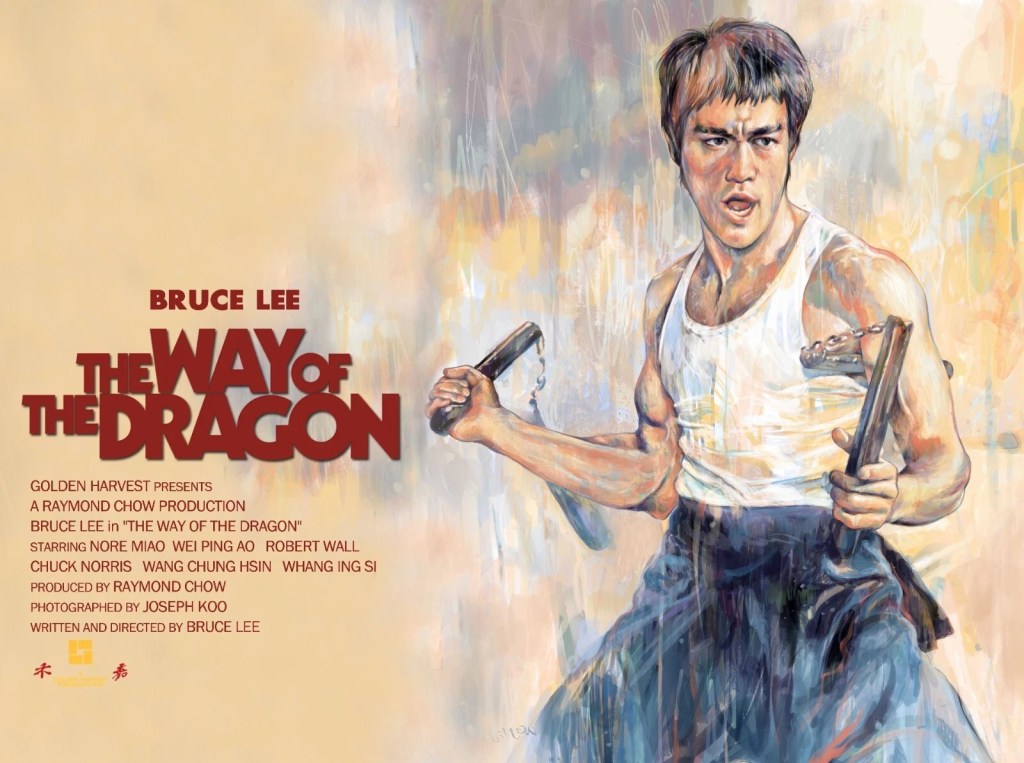
Clint Eastwood’s first Dirty Harry sequel Magnum Force raced to six weeks at the ABC1, as did compilation feature That’s Entertainment at the ABC2 and Disney’s new animated feature Robin Hood and, separately, a reissue of Peter Pan (1953) at the Odeon. Hitting the five week mark in 1974 in Glasgow were movies as diverse as Don’t Look Now starring Donald Sutherland and Julie Christie doubled up with The Wicker Man at the Odeon 1, Bruce Lee epic Way of the Dragon at Odeon 2, Barbra Streisand comedy For Pete’s Sake at the Odeon 1, Roger Moore in Gold at the Odeon 2, and another in Odeon 3 sexploitation category Secrets of a Door to Door Salesman/Climax.
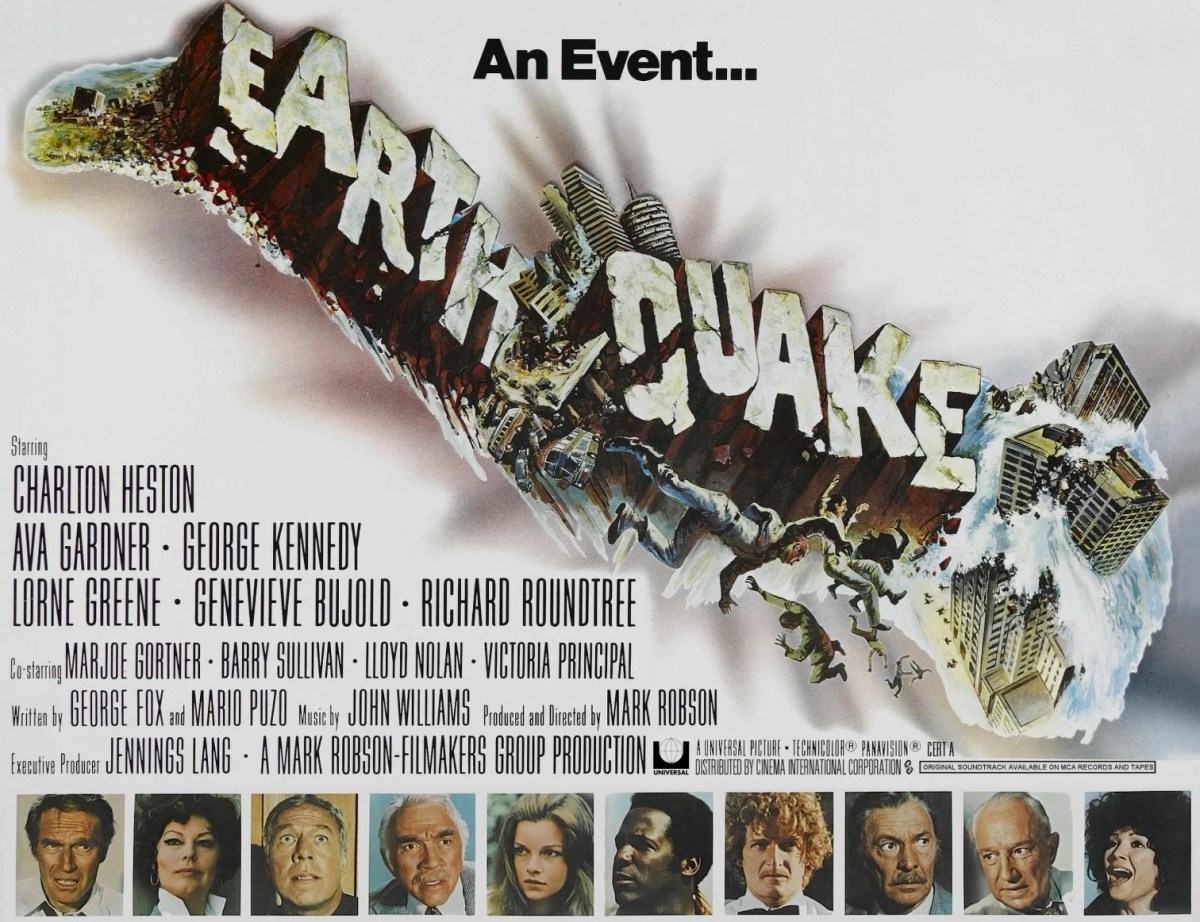
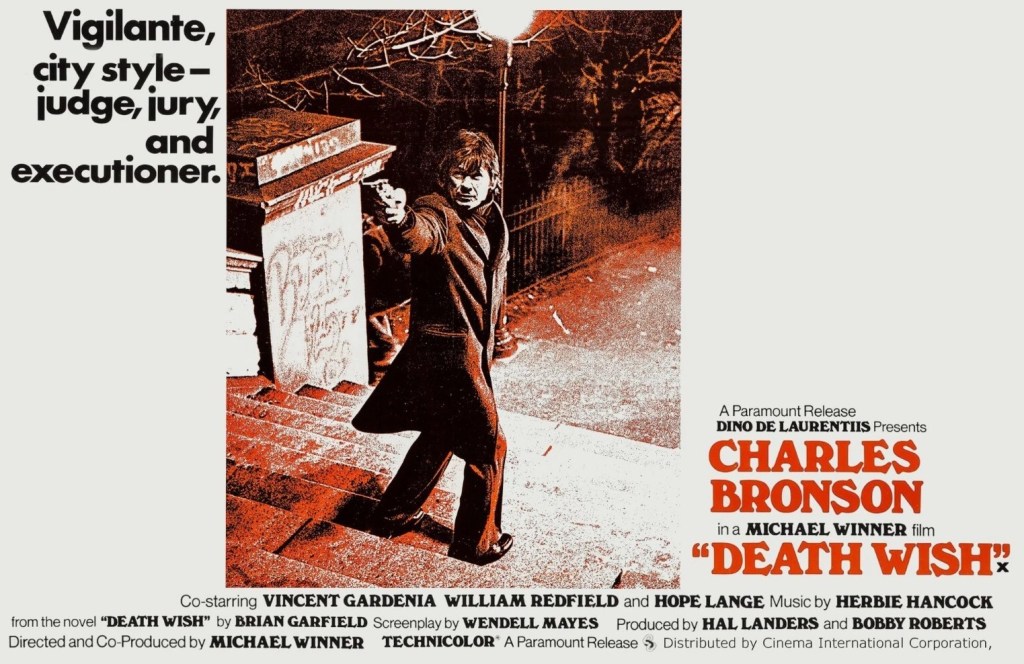
Prior to the arrival of Jaws, the notion of the extended long run had been established in Glasgow thanks to the short-lived disaster movie boom. Earthquake, in Sensurround, starring Charlton Heston and Ava Gardner and an all-star support attracted audiences for 30 weeks at the ABC2 while it was 21 weeks at the ABC1 for Paul Newman and Steve McQueen fighting The Towering Inferno with William Holden and Faye Dunaway providing even more stellar support. Charles Bronson’s vigilante killer in Michael Winner’s Death Wish shot up 12 weeks at the La Scala while The Who’s rock opera Tommy directed by Ken Russell with an all-star cameo cast notched up three fewer weeks there.
Charlton Heston headed up another disaster movie, sequel Airport 1975, which crash landed for eight weeks at the ABC1. The latest James Bond opus The Man with the Golden Gun in Odeons 1 and 2 lifted seven weeks. The Odeon 3 drafted in further dubious movies – The Night Porter with artistic aspirations and starring Dirk Bogarde and Charlotte Rampling, and, separately, The Devil Within Her with no artistic credentials and the unlikely casting of Brits Juliet Mills and Richard Johnson for seven-week stints. Norman Jewison’s violent sci fi Rollerball starring James Caan hit six weeks at Odeon 1. At the five-week level were Albert Finney as Hercule Poirot and an all-star cast in Murder on the Orient Express (ABC2), Mel Brooks’ Blazing Saddles (La Scala), sequel The FourMusketeers (Odeon 1), a second Mel Brooks’ offering Young Frankenstein (Odeon 3), John Wayne as Chicago cop Brannigan let loose in London (Odeon 1), another Disney reissue Lady and the Tramp (1955) and Mandingo (ABC1).
Jaws was not, in fact, the longest-runner in Glasgow city center in 1976. That honor went to Jack Nicholson’s Oscar-winning turn in One Flew over the Cuckoo’s Nest which clocked up 23 weeks at the Odeon. An unusual long-run contender appeared out of left field. Low-budget weepie The Last Snows of Spring without any marquee names ran for an unprecedented 14 weeks at the Classic. The 70mm reissue of Gone with the Wind (1939) returned in style to the ABC2 for a further 10 weeks. Robert Redford and Dustin Hoffman investigating All the Presidents’ Men scored seven weeks at ABC2 and then a further five at the Scala 2 (the La Scala having been twinned and renamed the Scala.)
Demonic adventure The Omen with Gregory Peck and Lee Remick stung the Odeon 1 and Odeon 2 for a total eight weeks. A rerun of The Exorcist lingered for seven weeks at Scala 2. Lee Marvin and Roger Moore in Shout at the Devil were good for six weeks at Odeon 1, as was Charles Bronson as The Streetfighter at the Odeon 1 and 2 combined, Clint Eastwood western The Outlaw Josey Wales at ABC1 and Dustin Hoffman thriller Marathon Man at ABC2. King Kong five weeks plux X from previous year.
Five-weeks runs were achieved by Peter Sellers vehicle The Return of the Pink Panther at Odeon 1 and another crime spoof Murder by Death at the Odeon 3
Taking three weeks as the definition of the long-run, this form of exhibition had grown exponentially during the decade. In 1970 only three movies enjoyed runs of three weeks or more. The following year the number had jumped to 11 and then nudged upwards to 13 in 1972. Growth in 1973 remained modest – a total of 17 movies hitting the target or better. But by 1974 the number was 25 and the following year it rocketed to 35, with 36 the total in 1976.
It’s only according to film historians and movies like Babylon (2022) that the transition to sound in 1927 was instantaneous. Maybe from a contorted academic perspective, but not for audiences and not for exhibitors. That The Jazz Singer (1927) proved momentous required not one revolution, but two. For it was responsible for nothing less than the beginnings of the wide release.
There had been sporadic attempts at day-dating, day-and-date, simultaneous openings, saturation bookings, whatever you wanted to call it, from 1913 to 1920. You might find an occasional picture released all at once into 20 houses in New York, but more likely it was a picture that showed up on two or three screens in Detroit, San Francisco or St Louis. In 1921 there were 300 day-and-date bookings for Chaplin’s The Kid with 70 prints allocated to New York and 40 to Chicago. But wide release remained rare.
In 1924 in Cleveland 65 nabes signed up to day-date Let Not Man Put Asunder and First National attempted to interest 100 theaters in day-dating Lilies of the Field. In 1927 MGM promoted Greta Garbo-John Gilbert in Love as opening, without specific dates, in “approximately” 100 theaters while Fox claimed 90 had signed up for Colleen Moore in Her Wild Oat (1927).
However, “simultaneous” was widely open to interpretation, not necessarily meaning day-dating. The kind of release system we know today remained rare and sporadic. Wide release did not take off because there was no reason for it to do so.
While The Jazz Singer single-handedly thrust Warner Brothers into the higher echelons of the industry, it did not herald a tidal wave of talkies. Despite its success, the jury was still out – was it a gimmick or a revolution? Without the complications of sound, movies were a $1.5 billion ($25 billion today) business and the idea that theater owners would cotton on to the potential of sound and rush to become “wired” was soon demolished. Predictions of 350 sound installations by the end of 1927 proved wildly optimistic, less than 100 theaters obliging.
Exhibitor antipathy could be laid in large part at the studio door. Owners had to pay the cost of changing to sound – plus a weekly royalty to Vitaphone of 10 cents per seat – with no guarantee that the trend would last or, more importantly, that it would iron out existing inequalities. Studios and exhibitors were at war. Exhibitor anger against studios was demonstrated by the volume of complaints to the 32 Film Boards of Trade, over 23,000 in 1925-26 – more than one for every theater in existence – wrongs righted to the tune of $4.6 million in damages.
The studios had their own complaints against exhibitors: of the $650 million paid by the public for theater tickets in 1926, only $185 million found its way into their coffers as rentals, around 28 per cent of the gross, remarkably low by modern standards. With profit margins on film production hovering around 15 per cent, studios, preparing to invest $159 million in movies in the 1927-1928 season, could be forgiven for believing they were taking all the risk, with exhibitors hiving off so much profit they could afford more – $250 million – in theater construction.
Exhibition was a sore point for studios since they had so little share of it. By the end of 1926, they owned around five percent of the total. Neither studio-owned chains nor independent circuits had anything approaching a monopoly, or even a dominant share, most being regional-based rather than nationwide. The biggest theaters were the most important. Super-theaters on Broadway and big city downtown areas could charge $2.20 admission compared to the national average of 28-35 cents. In 1927, 68 of these behemoths generated a total of $47 million ($790 million in today’s figures), the 5,450-seat Capitol in New York alone nabbing $2.7 million ($45 million).
The traditional method of releasing silent features depended on, effectively, withholding them. Each sector of exhibition obediently waited its turn while competition for new pictures between rival exhibitors served to stoke bids. The release system was littered with gaps of up to three weeks clearance, during which movies did not play at all as they worked their way down the ladder, this being the accepted method to ensure that the public still flocked to the more expensive houses rather than holding off till they turned up in a cheaper nabe, the waiting theaters prohibited from even advertising in advance such forthcoming attractions in local newspapers.
Studios also used hits as a way of enticing theater owners to commit to annual contracts. In theory, New York, Chicago and Los Angeles would get the biggest movies first. In reality, because big hits were allowed to run as long as first run theaters wanted them, it was virtually impossible to arrange the simultaneous release, on any scale, of a new feature. The long runs were permitted in part because of the grosses that could be achieved and in part because the amount of money taken in first run was the measure by which rental rates were set for further down the line.
A movie that ran for months at top prices (“a $2 hit”) in New York would attract higher rental prices in smaller cities than one lasting a week or two. Some runs were exceptional: The Big Parade (1925) and Ben-Hur: A Tale of Christ (1925) ran on Broadway for a year, Mare Nostrum (1926) and The Scarlet Letter (1926) for seven months, The Merry Widow (1925) for six months and La Boheme (1926) for four months.
Even had studios desired it, length of run, dictated by different exhibitor circumstances and public reaction in various cities, conspired to make simultaneous first run openings well nigh impossible. Fifteen cities constituted the peak of movie first run box office in 1926: Baltimore, Boston, Buffalo, Chicago, Kansas City, Los Angeles, Milwaukee, Minneapolis, New Orleans, New York, Philadelphia, Portland, Providence, San Francisco and Washington.
But it proved impossible throughout that year for a single picture to complete a run in all of these cities. The Big Parade opened in New York, Los Angeles and Washington on the same day, January 2, but in no other city in this list that year, its simultaneous opening therefore limited to just 20 per cent of first run in these major cities. Ben Hur also opened on January 2 in New York but did not reach Philadelphia, its only other port of call that year, until June. Aloma of the Seven Seas managed 80 per cent penetration, but it was a lengthy enterprise, beginning on May 22 in New York and ending on November 20 in Washington. The Sea Beast opened in only six cities within a four-month period.
So it was entirely feasible that, following the combined restraints imposed by both exhibitors and studios, The Jazz Singer may have taken as long as any of these features to traverse the country and still, within year of its premiere, not been seen in all the major cities. In the first few post-premiere months, only three of the key fifteen cities showed it.
So a movie that was a sensation in New York remained a New York sensation only. There was nothing immediate, as film scholars have suggested, as regards the rest of the nation’s audiences and exhibitors.
However, Warner Brothers, using the prospect of immediate payback to entice theater owners to install sound, broke with tradition and unleashed an unprecedented release onslaught.
In so doing, the studio invented the modern wide release.
In March 1928 The Jazz Singer opened simultaneously in 235 theaters natonwide. But that was not all that was revolutionary. For a start, exhibitors had to contract to pay a percentage of the receipts, on a sliding scale from week one, rather than a flat rental. Secondly, the studio dictated the length of run, rather than the exhibitor, Warner Brothers demanding a minimum eight-week run. Thirdly, the studio expanded the initial day-and-date idea into second- and third-run bookings, triggering a series of simultaneous multiple releases in the nabes. After first runs were completed, large numbers of nabes took part in wider day-dating programs, in Philadelphia, for example, after twelve weeks in first run, twenty other houses throughout the city lined up for simultaneous wide release, a situation repeated across the country. Fourthly, those theaters way down the release chain that normally played a split week had to commit to a full weeks.
In one fell swoop, Warner Brothers challenged the existing order. Multiple release meant that studios would no longer be held to ransom by giant picture houses determining not just when a major movie played but, unintentionally perhaps, the restrictions that followed in its wake. By dictating minimum length of run, Warner Brothers took back control of “exclusive” engagements. Clearance stipulated that the theater at the top of the release hierarchy had exclusive rights to exhibition and could hold onto the movie for as long as it wished. Obviously, studios were not averse to this as the biggest theaters attracted the biggest audiences. But if a movie was a sensation, the studio could not cash in on media attention by yanking it from downtown and sending it out wider while public interest was at a peak.
With The Jazz Singer, Warner Brothers guaranteed exclusivity, but on its terms. A big city first run theater had to cede control over length of run in order to show the picture. On the other hand theaters all over America would have access to new movies in a way that, heretofore, had been virtually forbidden. The arrival of sound spurred studios to shorten release patterns and widen openings in order to reassure those installing the new equipment that it was going to be worthwhile and, also, that they would not have to wait ages to receive a return on their investment.
Simultaneous opening became the way forward both in first run and in nabes, the size of saturation varying enormously from those who topped The Jazz Singer theater count to those who came nowhere near, and not just for sound. In fact, The Jazz Singer saturation record barely lasted a month, beaten by new silent comedy Speedy starring Harold Lloyd at Easter in 250 theaters nationwide.
The main limitation to simultaneous opening was the shortage of prints. Studios and independents produced 800 pictures a year and the average life of a print was 59 showings (around 100 working days). Typically, an ordinary feature would require 150, increasing to 200-250 for studio “specials,” roadshows receiving 300-plus (although this included prints for overseas), so, annually, a studio might have upwards of 7,500 prints of new films in circulation. With prints costing 4 cents per foot, around $280 for a seven-reel movie, Hollywood’s annual expenditure was in the millions.
Sound necessitated an increase in prints. Availability rather than restricted access was key, so studios were forced to place sound pictures in those houses which could play them, and that incurred a faster play-off than before. But since relatively few cinemas were wired, movies appeared in silent and sound versions. For Two Lovers (1928) starring Ronald Colman only 55 of the 320 prints were specified as sound, a similar ratio for DeMille’s King of King.
By now, whether exhibitors were complicit or not, studios were committed to sound, having set aside $5 million for sound stages, although, in cautious contradiction, leasing equipment rather than buying it. For the 1928-1929 season Paramount scheduled up to 50 movies with synchronized sound, Warner Brothers 30, of which five (Lights of New York, The Desert Song, The Terror, Conquest and Home Towners) would be all-talkie, First National 31, and Universal nine. MGM and Columbia were slower to respond, MGM’s first talkie White Shadows in the South Seas not available till late summer 1928, Columbia’s talkie debut The Lone Wolf’s Daughter not ready until the following year
By summer 1928 only 400 theaters had switched to sound – barely four percent of the total – hardly suggesting a revolution had taken hold. In some areas, the availability of sound was negligible or non-existent, only five wired theaters in West Virginia, four in South Carolina, three in Maine, Utah and Nebraska, two in Louisiana, one in Delaware, Vermont and Wyoming, but none at all in New Hampshire or Nevada.
Theaters which had managed the conversion encountered a dearth of new sound product. In an era when most theaters got through up to two hundred features a year, the bulk of what was on offer sound-wise was dominated by shorts comprising comic and dramatic monologues and dialogues or featuring bands, orchestras, and operatic or semi-operatic numbers. Talkie feature production was less straightforward than silent, considerable gaps between movies. It took Warner Brothers six months after Lights of New York to bring out another all-talking picture, The Terror, which hit Broadway as a two-a-day roadshow on August 15, 1928.
The slow uptake from exhibitors was not just due to natural caution but fear about making the wrong choice. There was a baffling array of equipment to assist in the conversion to sound, ten versions of what were termed “sound picture devices” and nearly as many “synchronization devices.” Installation cost was substantial, $2,500 for a 2,000-seater for Qualitone, for example ‘Uncertainty, unrest, indecision’ choked the business. Cities like Memphis, Minnesota and Omaha and entire areas like the northwest and the Cornbelt simply refused to countenance sound.
The impact on the existing inventory was catastrophic. Exhibitors stopped renting new films, in what amounted to a “buying strike” in 1928 especially of companies which only made silents. The boycott affected all films and continued through 1929 as exhibitors were “now wary of signing up for product too far in advance lest revolutionary developments are in store again.’
With booking paralysis threatening the industry, studios took coherent action. Warner Brothers focused on increased accessibility; ‘day-dating with Broadway’ became an integral element of Warner Brothers launches. In order to rouse theaters from their torpor, Hollywood took the unusual step of creating a generic campaign, promoting talkies to the public. ‘How to focus the attention of the public,’ was a tall order when there was ‘no precedent to fall back on.’
Studios realized theaters would be more susceptible to public pressure and in August 1928 Paramount promoted the concept of sound through “the greatest advertising campaign in the history of pictures” to the 100 million readers of 695 newspapers in 413 cities while a month later Warner Brothers launched a million-dollar advertising campaign promoting sound via 125 daily newspapers.
During 1929 other studios followed the Warner Brothers example of day-dating with Broadway and to find a way round the Broadway logjams, new movies were launched away from New York, Fox, for example, opening Sunnyside Up starring the popular duo of Janet Gaynor and Charles Farrell in Cincinnati, Louisville, Indianapolis and Milwaukee long before it reached New York. United Artists’ Trespasser starring Gloria Swanson only found its way to New York after a string of bookings including Buffalo, Omaha, Atlanta, Detroit and Cincinnati. Paramount “pre-released” Close Harmony (‘Hear Charles Buddy Rogers and Nancy Carroll Sing and the Whole Cast Talk!’) in five cities, but not Chicago and New York.
Exasperated by exhibitor inertia regarding sound, which had threatened to throttle the burgeoning technology, and wishing a bigger share of the overall pie, studios had also embarked on a theater-buying spree, acquiring both first run theaters and chains of nabes, the “Big Six” studios now in control of 3,800 houses.
But in 1929 Warner Brothers remained king of the wide release, setting a new simultaneous multiple release opening record, the 558 theaters involved in the launch of Queen of the Night Clubs ‘on or about March 16’ more than doubling the previous high-water mark. And it charged ahead with unprecedented numbers of simultaneous openings to satisfy demand (5,000 houses wired by August, 43 per cent using Vitaphone), maintain its position as the market leader in sound, build market share, drive up its stock price, and to capitalize on profits from the exhibition sector now that the company had invested more in that field.
But it had taken a full two years since The Jazz Singer for the industry to reach a turning point. The schedules for 1929-1930 revealed that for the first time the production of talkies outweighed that of silents, 504 vs. 403. Such volumes would more than satisfy the needs of the average theater.
So, yes, the slowest recorded revolution in history. And it took another revolution in wide release to make it possible.
SOURCE: Brian Hannan, In Theaters Everywhere, A History of the Hollywood Wide Release, 1913-2017 (McFarland, 2019) p11-21. There are over 100 references for these pages so I’m not going to print them all here. You can get them in the book if you so desire.