Texas Across the River (1966) ****

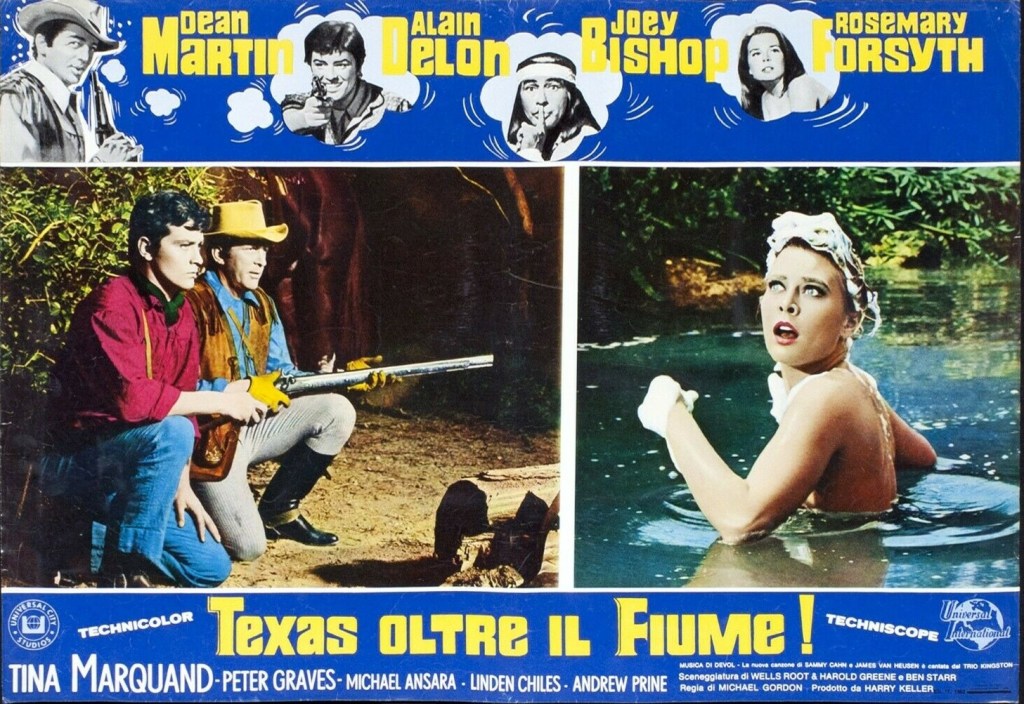
Excellent comedy western mixing dry wit and occasional slapstick to joyous effect. The wedding between Spanish duke Don Aldrea (Alain Delon) and Louisiana belle Phoebe (Rosemary Forsyth) is interrupted by her previous suitor Yancy (Stuart Cottle) who is killed in the resulting melee. Escaping to Texas, Don Aldrea’s marksmanship leads settler Sam (Dean Martin) to recruit him to help fight raiding Commanches. Romantic entanglement ensues when the Don rescues Native American Lonetta (Tina Marquand) and Sam has more than a passing interest in Phoebe.

It is so tightly structured that nothing occurs that doesn’t have a pay-off further down the line. Bursting with terrific lines – including a stinger of a final quip – and set pieces, it pokes fun at every western cliché from the gunfight, the cavalry in hot pursuit, and fearsome Native Americans to the snake bite and the naked bathing scene. Incompetence is the order of the day – cavalry captain Stimpson (Peter Graves) issues incomprehensible orders, chief’s son Yellow Knife (Linden Chiles) cannot obey any.

The Don, with his obsession with honor and his tendency to kiss men on the cheeks, is a comedy gift. Despite his terrific head of hair, he is stuck with the moniker “Baldy” and every time he is about to save the day he manages to ruin it. Sam is the kind of guy who thinks he is showing class by removing his spurs in bed while retaining his boots. His sidekick Kronk (Joey Bishop), a mickey-take on Tonto, mostly is just that, a guy who stands at the side doing nothing but delivering dry observations.

Lonetta is full of Native American lore and has enough sass to keep the Don in his place. “What is life with honor,” he cries to which she delivers the perfect riposte, “What is honor without life?” Phoebe is a hot ticket with not much in the way of loyalty.

Two sequences stand out – the slapping scene (whaat?) and a piece of exquisite comedy timing when Sam, Phoebe and the Don try an iron out a complicated situation.

Good as Dean Martin (Rough Night in Jericho, 1967) is the picture belongs to Alain Delon (Once a Thief, 1965) and I would argue it is possibly his best performance. Never has an actor so played against type or exploded his screen persona. Delon was known for moody, sullen roles, cameras fixated on his eyes. But here he is a delight, totally immersed in a role, not of an idiot, but a man of high ideals suddenly caught up in a country that is less impressed with ideals. If he had played the part with a knowing wink it would never have worked.

Martin exudes such screen charm you are almost convinced he’s not acting at all, but when you compare this to Rough Night in Jericho it’s easy to see why he was so under-rated. Joey Bishop (Ocean’s 11) is a prize turn, with some of the best quips. Rosemary Forsyth (Shenandoah, 1965) is surprisingly good, having made her bones in more dramatic roles, and Tina Marquand (Modesty Blaise, 1966) more than holds her own. Michael Ansara (Sol Madrid, 1968) played Cochise in the Broken Arrow (1956-1958) television series. Under all the Medicine Man get-up you might spot Richard Farnsworth. Peter Graves of Mission Impossible fame is the hapless cavalry leader.

Director Michael Gordon (Move Over, Darling, 1964) hits the mother lode, the story zipping along, every time it seems to be taking a side-step actually nudging the narrative forward. He draws splendid performances from the entire cast, knowing when to play it straight, when to lob in a piece of slapstick, and when to cut away for a humorous reaction, and especially keeping in check the self-indulgence which marred many Rat Pack pictures – two of the gang are here, Martin and Bishop. There’s even a sly nod to Sergio Leone spaghetti westerns when the electric guitar strikes up any time Native Americans appear. Frank De Vol (Cat Ballou, 1965) did the score.

Rough Night in Jericho (1967) ****

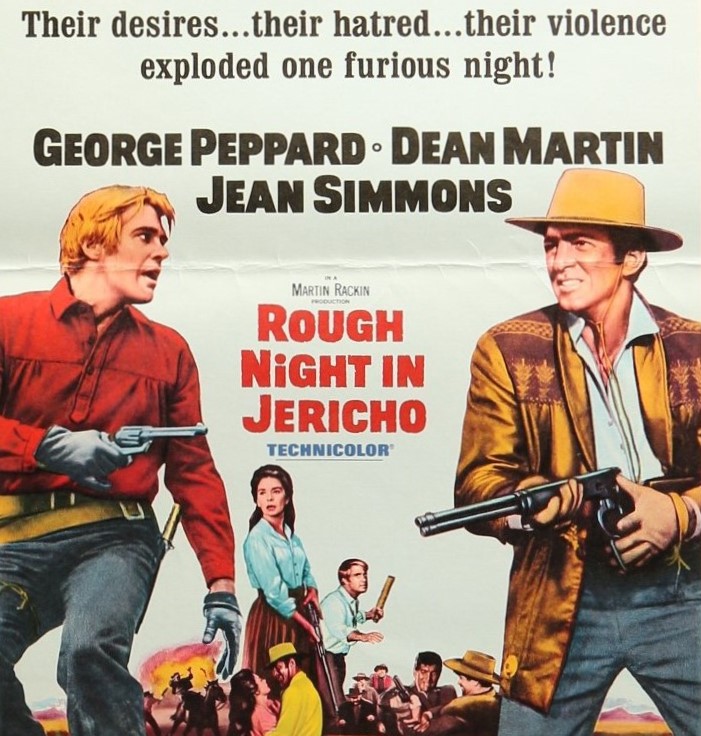
Woefully under-rated western with three A-list stars at the top of their game in a taut drama with an explosive ending. Not surprising it was overlooked at the time with John Wayne duo El Dorado and The War Wagon, Paul Newman as Hombre and an onslaught of spaghetti westerns garnering more attention at the box office. Though a rewarding watch, be warned this is more of a slow-burn drama than a traditional western and both male leads play against type.

Former lawmen Dolen (George Peppard) and Ben Hickman (John McIntiyre) have invested in a stagecoach business owned by twice-widowed Molly Lang (Jean Simmons), just about the only business in Jericho in which Alex Flood (Dean Martin) does not have a controlling interest. Dolen’s first reaction on surmising Flood’s power is to quit, “stepping in’s a habit I outgrew.” And it’s not a bad approach given that Flood is judge, jury and executioner and apt to leave victims strung up to dissuade dissent.

Dolen and Flood have a great deal in common, moving from ill-paid law enforcement into business, Flood, having cleaned up the town, staying on the reap the profit. While Dolen avoids confrontation, Molly aims to stir up opposition, invoking ruthless reaction.

What’s unusual about this picture is it’s mostly a duel of minds, Dolen and Flood testing each other out, neither backing down even while Dolen intends quitting and when he happens to win a bundle in a poker game with Flood you have the notion that was somehow an inducement to help him on his way.  It’s a power game of sorts, too, between Dolen and Molly, she determined to give no quarter to the point of drinking him under the table.

But when violence occurs it is absolutely brutal, Flood’s knuckles bloodied raw as he batters a man foolish enough to challenge his rule of law, Dolen taking an almighty whipping from Yarbrough (Slim Pickens), Molly viciously slapped around by Flood for daring to look at Dolen. When Dolen does move into action it is with strategic skill, gradually reducing the odds before the inevitable shoot-out between respectable citizens and gangsters.

A good half century before the notion took hold, this is a movie as much about entitlement, about those doing the hard work receiving just reward, Flood, having risked his life to tame the town, deciding he should be paid more than a sheriff’s monthly salary. And the western at this point in Hollywood development had precious few female businesswomen in the vein of Molly.

Cover of the Pressbook

Both Dean Martin and George Peppard play against type. An unexpected box office big hitter through the light-hearted Matt Helm series, Martin explodes his screen persona as this vicious thug, town in his thrall, contemptuous of his victims, turning politics to his advantage, but still happy to hand out a beating when charm and chicanery fail. This is one superb, and brave, performance.

For Peppard, this picture is the bridge between the brash persona of The Blue Max (1966) and Tobruk (1967) and the thoughtful introspective characters he brought to life in P.J. / New Face in Hell (1968) and Pendulum (1969). Perhaps the most telling difference is a little acting trick. His blue eyes are unseen most of the time, hidden under the shade of his wide-brimmed hat. He is not laid-back in the modern sense but definitely unwilling to plunge into action, movement both confined and defined, a man who knows his limits and, no longer paid to risk his life, unwilling to do so.

Jean Simmons (Divorce American Style) is in excellent form, neither the feisty nor submissive woman of so many westerns, but clever and determined, perhaps setting the tone for later female figures like Claudia Cardinale in Once Upon a Time in the West (1969) and Raquel Welch in 100 Rifles (1969).

And this is aw-shucks Slim Pickens (Major Dundee, 1965) as you’ve never seen him before. John McIntire had spent most of the decade in Wagon Train but he punches above his weight as a mentoring lawman. If you are trying to spot any other unusual figures keep an eye out for legendary Variety columnist Army Archerd  who was a walk-on part as a waitperson.

More at home in television, director Arnold Laven took to the big screen on rare occasions, only twice previously during the decade for Geronimo (1962) and The Glory Guys (1965), but here he handles story and character with immense confidence and considerable aplomb. The direction is often bold – major incidents occur off screen so he can concentrate on the reactions of the main characters. There is a fabulous drunk scene, one of the best ever – plus an equally good hangover sequence –  the violence is coruscating, all the more so because it is not delivered by gun.

The screenplay by Sidney Boehm (Shock Treatment, 1964) and Marvin H. Albert (Duel at Diablo, 1966) swings between confrontation and subliminal menace.

4 for Texas (1963) ****

To my mind the best of the Frank Sinatra-Dean Martin collaborations, outside of the more straightforwardly dramatic Some Came Running (1958), and for the simple reason that they are rivals rather than buddies. The banter of previous “Rat Pack” outings is given a harder edge and it is shorn of extraneous songs.

I came at this picture with some trepidation, since it did not receive kind reviews, “stinks to high heaven” being a sample. But I thought it worked tremendously well, a delightful surprise, the ongoing intrigue intercut with occasional outright dramatic moments and a few good laughs.

It’s unfair to term it a comedy western since for a contemporary audience that invariably means a spoof of some kind, rather than a movie that dips into a variety of genres. In some respects it defies pigeonholing. For example, it begins with a dramatic shoot-out, stagecoach passengers Zack Thomson (Frank Sinatra), a crack shot with a rifle, and pistolero Joe Jarrett (Dean Martin) out-shooting an outlaw gang headed by Matson (Charles Bronson). When director Robert Aldrich (Sodom and Gomorrah, 1962) has the cojones to kill off legendary villain Jack Elam in the opening section you know you are in for something different.

After out-foxing Matson, Jarrett attempts to steal the $100,000 the stagecoach has been carrying from its owner Thomas. Jarrett looks to be getting away with it until he realizes he is still in range of Thomas’s rifle. Then Thomas looks to have secured the money until Jarrett produces a pistol from his hat. And that sets the template for the movie, Thomas trying to outsmart Jarrett, the thief always one step ahead, and the pair of them locking horns with corrupt banker Harvey Burden (Victor Buono), in whose employ is Matson.

The movie is full of clever twists, cunning ruses, scams, double-crosses, reversals and sparkling dialog. Whenever Jarrett and Thomas are heading for a showdown, something or someone (such as Matson) gets in the way. While Thomas has the perfect domestic life, fawned over by buxom maids and girlfriend Elya (Anita Ekberg), Jarrett encounters much tougher widow Maxine (Ursula Andress) who greets his attempts to invest in her riverboat casino by shooting at him.  

Take away the comedic elements and you would have a plot worthy of Wall Street and ruthless financiers. The story is occasionally complicated without being complex and the characters, as illustrated by their devious intent, are all perfectly believable.

It’s a great mix of action and comedy – with some extra spice added by The Three Stooges in a laugh-out-loud sequence – and it’s a quintessential example of the Sinatra-Martin schtick, one of the great screen partnerships, illuminated by sharp exchanges neither lazily scripted nor delivered. Even the blatant sexism is played for laughs.

Sinatra and Martin, especially, are at the top of their game. Forget all you’ve read about Aldrich and Sinatra not getting on. Sinatra never got on with any director. But an actor and director not getting on does not spell a poor picture. Sinatra brings enough to the table to make it work, especially as he is playing against type, essentially a dodgy businessman who is taken to the cleaners by both Martin and Buono.

The only flaw is that Ursula Andress (Dr No, 1962) does not turn up sooner. She has a great role, mixing seductiveness and maternal instinct with a stiff shot of ruthlessness, not someone to be fooled with at all, qualities that would resonate more in the career-making She (1965).  Anita Ekberg (La Dolce Vita, 1960) on the other hand is all bosom and not much else. Charles Bronson (The Magnificent Seven, 1960) demonstrates a surprising grasp of the essentials of comedy for someone so often categorized as the tough guy’s tough guy.

The biggest bonus for the picture overall is the absence of the other clan members – Sammy Davis Jr, Peter Lawford and Joey Bishop – who appeared in previous Rat Pack endeavors Oceans 11 (1960) and Sergeants 3 (1963). Without having to laboriously fit all these other characters in, this film seems to fly along much better. As I mentioned, the fact that Sinatra and Martin play deadly enemies provides greater dramatic intensity.

Robert Aldrich was a versatile director, by this point having turned out westerns (Vera Cruz, 1954), thrillers (Kiss Me Deadly, 1955), war pictures (The Angry Hills, 1959), Biblical epic Sodom and Gomorrah (1962) and horror picture Whatever Happened to Baby Jane? (1962). But 4 for Texas called for even greater versatility, combining action with quickfire dialog, a bit of slapstick and romance and shepherding the whole thing with some visual flair.

If you are a fan of Oceans 11 and Sergeants 3 you will probably like this. If you are not, it’s worth giving this a go since it takes on such a different dynamic to those two pictures.

Catch-Up: Previously reviewed in the Blog: Oceans 11 and Sergeants 3; Frank Sinatra in The Naked Runner (1967); and Ursula Andress in The Blue Max (1966) and The Southern Star (1969).

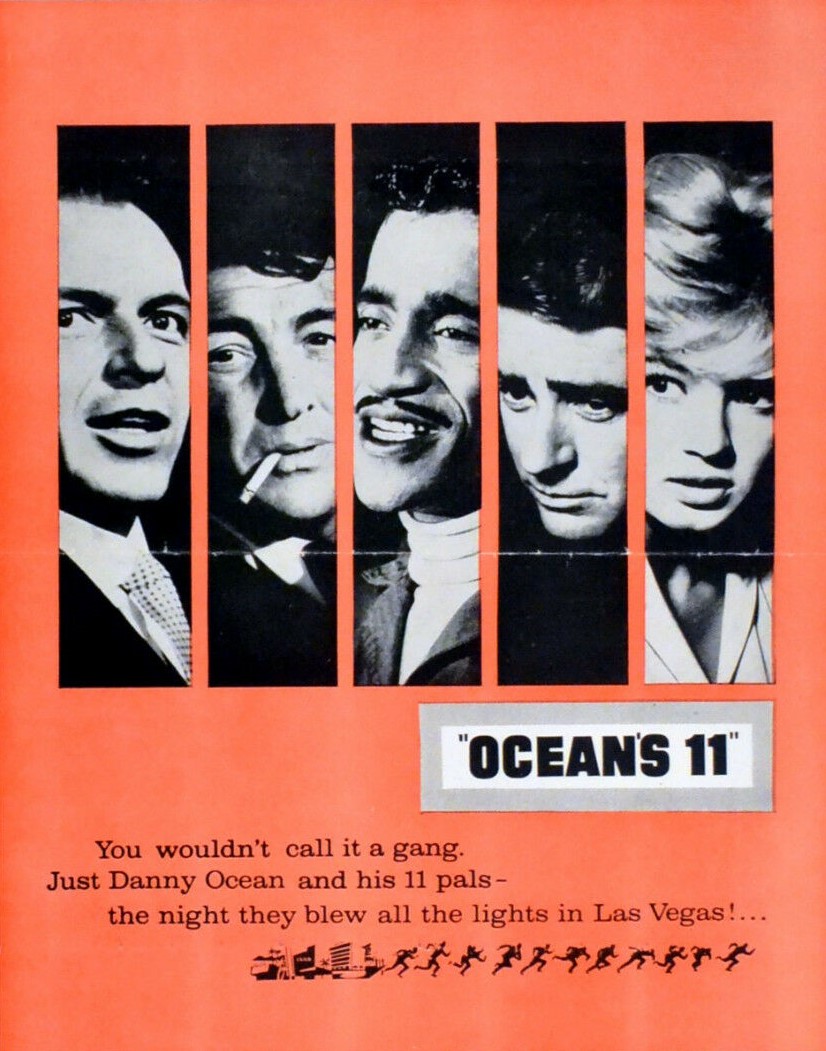
Ocean’s 11 (1960) ***

Heist pictures break down into planning, execution and reprisal. Here the planning stage moves at a leisurely pace, a bit of recruitment, and setting up bitebacks that will cripple the military-precision plan by ex-army buddies to rob five Las Vegas casinos of millions of dollars on New Year’s Eve. There’s a bit of reversal, Mr Big (Akim Tamiroff) is a collection of nervous tics, Jimmy Foster (Peter Lawford) a rich guy seeking financial independence from a possessive mother, Sam Harmon (Dean Martin) having second thoughts about the operation, and Danny Ocean (Frank Sinatra) trying to win back estranged wife Beatrice (Angie Dickinson) who surmises he prefers danger to intimacy. Mostly, it’s repartee between Harmon and Ocean while Foster makes a chump out of his mother’s next potential husband Duke Santos (Cesar Romero).

There’s not much hi-tech about the audacious plan, knocking out the electricity supply to the casinos, the switch to auxiliary power allowing the gang access to the inner sanctum where the cash is held, finding their way in and out of the darkness by nothing more sophisticated than luminous spray paint, and with a clever ruse to get the money out once all hell breaks loose.

The fun starts when one of the team (Richard Conte) drops dead post-raid and it transpires Santos is a big-shot underworld figure who investigates the robbery on behalf of the casinos and starts tracking the gang down, leading to a pay-off you don’t see coming.

Given the comedy element, there’s no great tension but it’s a pleasant enough diversion and Sinatra and Martin display an easy camaraderie that lights up the screen. It could have been funded by the Las Vegas Tourist Bureau so much attention is given to the wonder of the casinos, at a time when gambling was still only otherwise legal on racetracks, and with snippets of floorshows and the deluxe atmosphere. Add in a couple of numbers delivered a couple of times by Dean Martin (“Ain’t That a Kick in the Head”), legitimately since he is a cocktail bar singer, and Sammy Davis Jr. (“Eee-O-11”), somewhat shoehorned-in given he is a truck driver.

There’s a couple of neat reversals: Ocean’s dumped girlfriend Adele (Patrice Wymore) gets short shrift from Beatrice when she reveals the affair; casino bosses offered a double-or-quits gamble refuse to consider such a dangerous notion. Red Skelton and George Raft have credited cameos, Shirley MacLaine does not. As well as Richard Conte, Henry Silva (The Secret Invasion, 1964) has a small part as does Norman Fell (The Graduate, 1967).

Although there are on occasion outdated sexist attitudes, there is also a strong anti-racist statement in the hiring of Sammy Davis Jr., showcasing his talents in a big-budget picture, and clearly making the point that he has been welcomed by stars as big as Sinatra and Martin.  

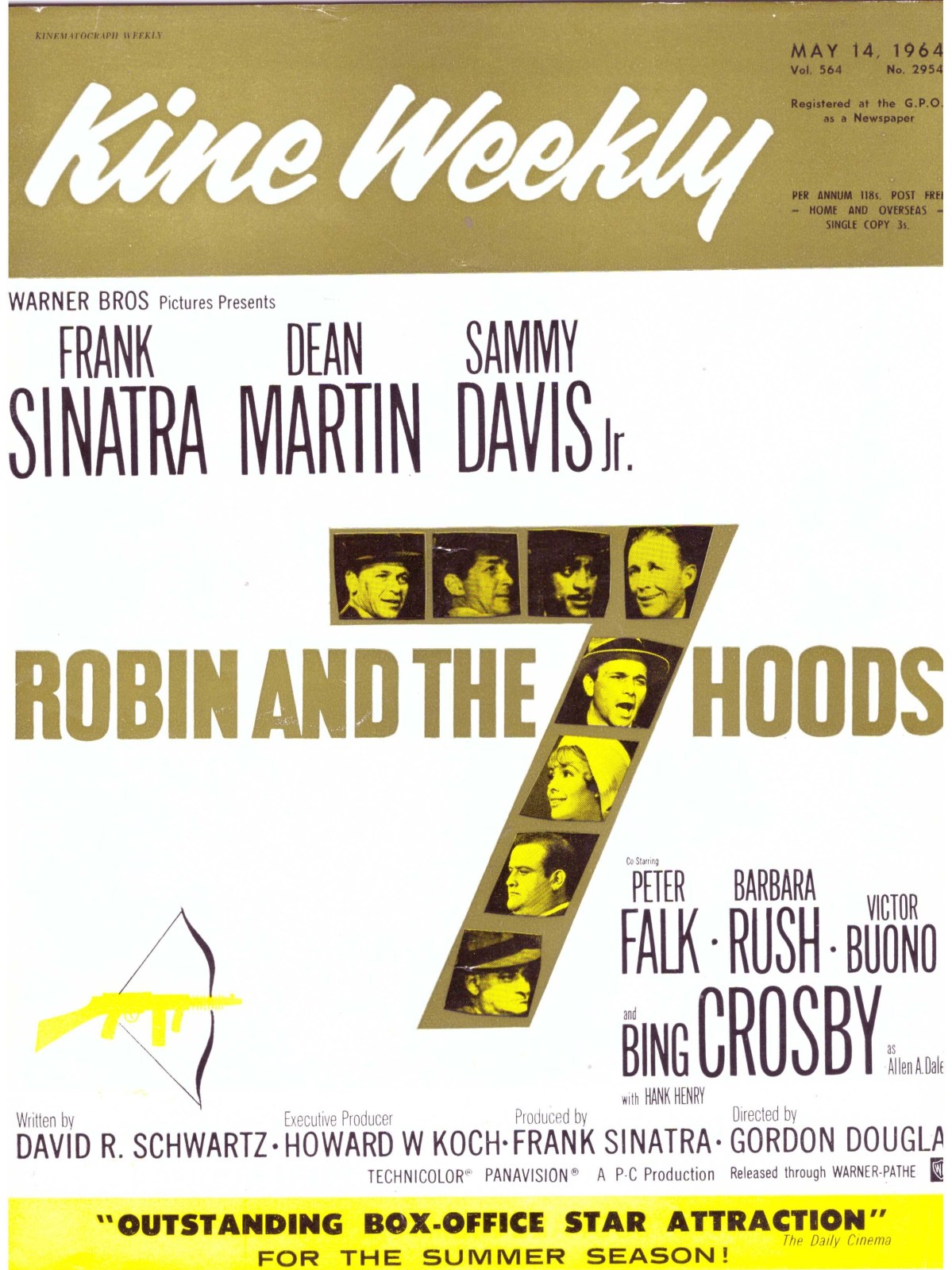
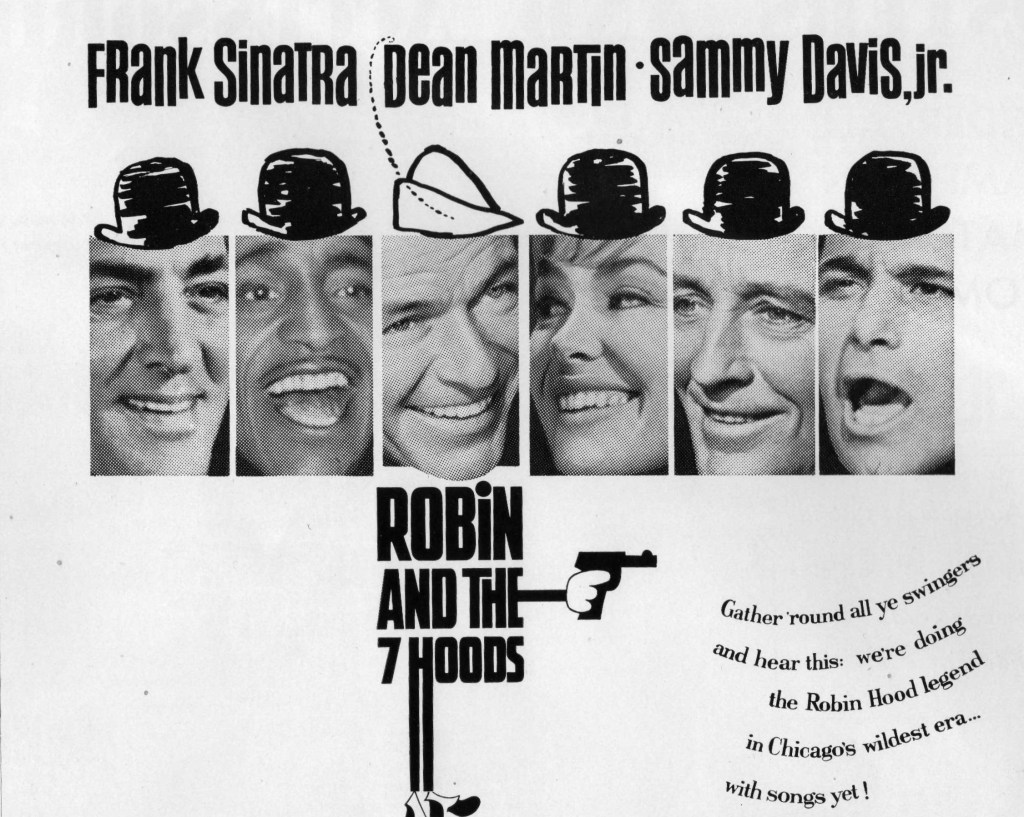
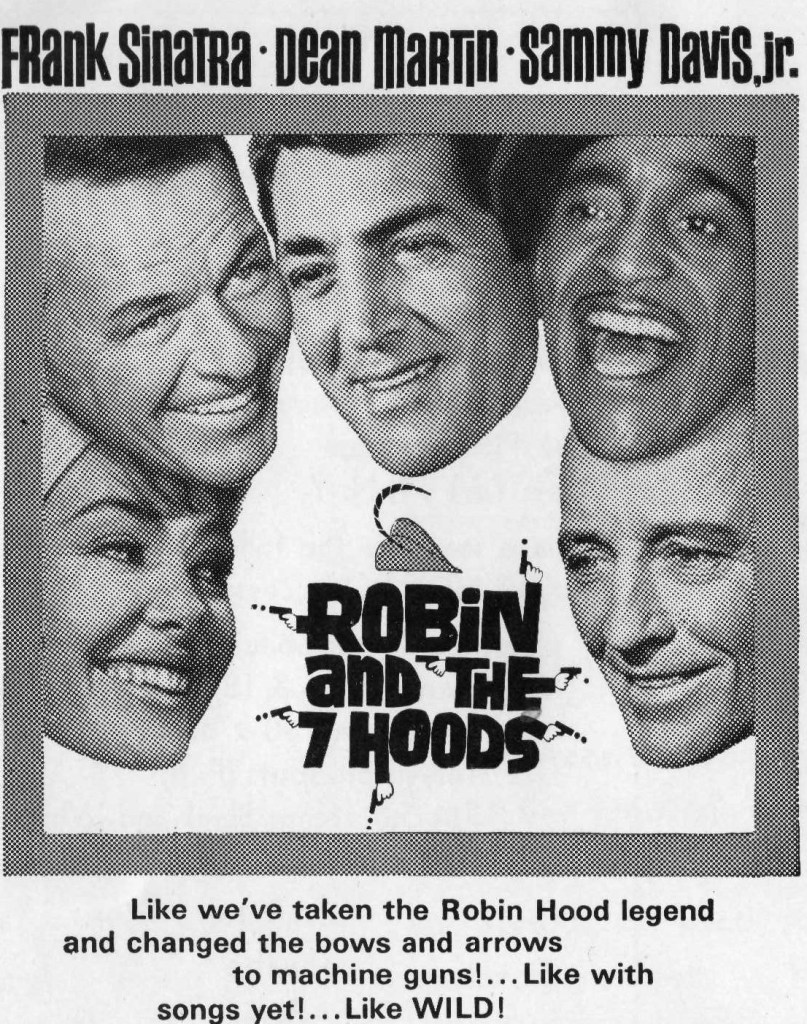
And it’s worth also considering the picture in terms of early-onset brand management.  The “Rat Pack” was a loose group of entertainers which not only became a well-known stand-alone entity in its own right that celebrated what was considered “hip” at the time (assuming you excluded Elvis and his ilk), but as individuals supported each other on television and in live performance. They would make another two pictures as a team and another dozen or so where two or more of the players appeared. The principals were all major attractions at the nascent Las Vegas so they were also promoting their home patch. During the day they made the movie, at night they wove in and out of each others’ acts, creating an entertainment sensation. On top of that, Sinatra had his own record label Reprise – among the early acts Dean Martin and Sammy Davis Jr. So, in a sense, all this cross-promotion was money in their pockets.

Also of note are the opening and closing, the former for the credits devised by Saul Bass, the latter for the famous shot later appropriated by Quentin Tarantino for Reservoir Dogs. Ironically, Lewis Milestone, who devised the original shot, and long before that won two Best Director Oscars, is less well regarded these days than Tarantino.

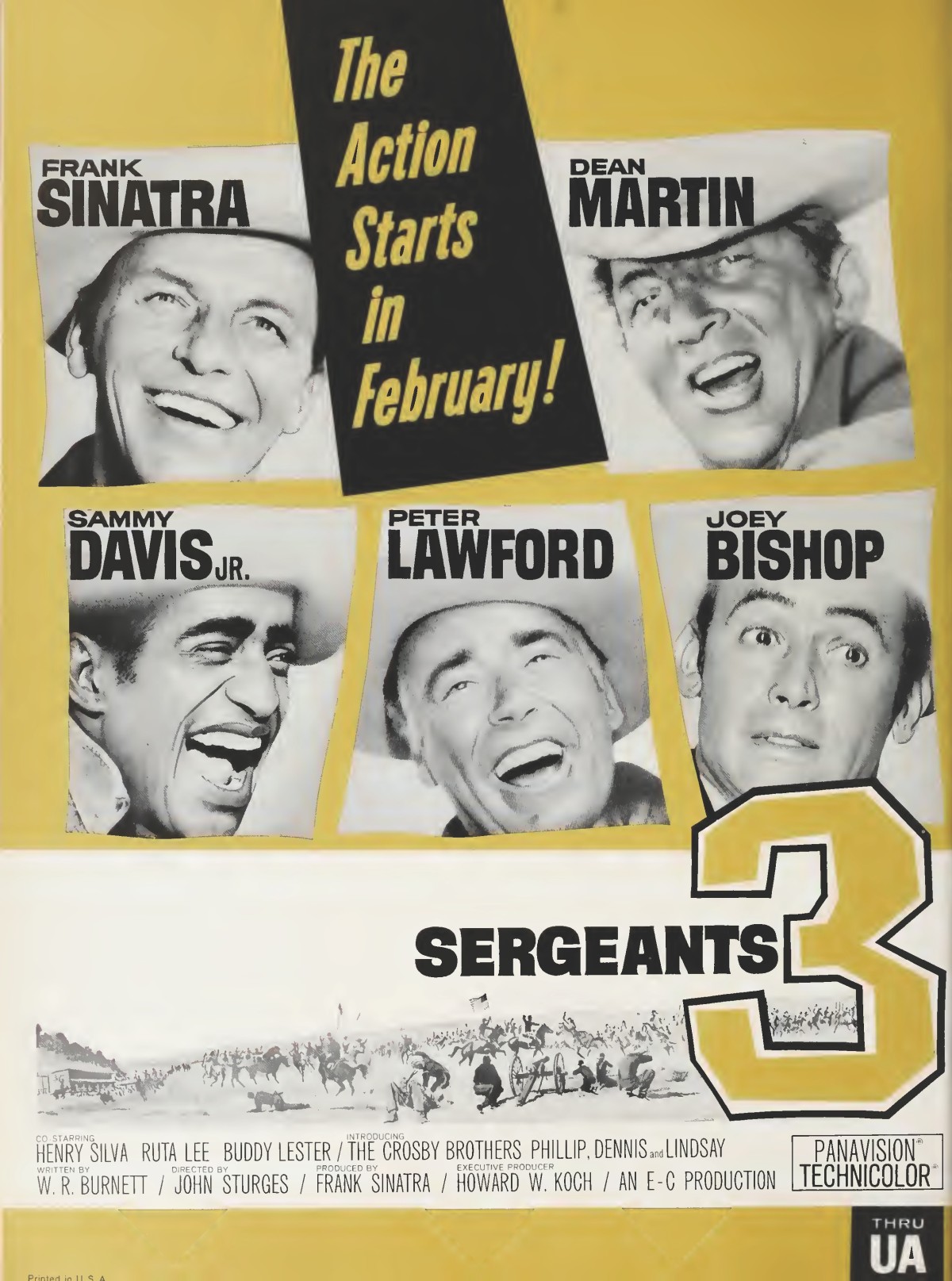
Sergeants 3 (1962)***

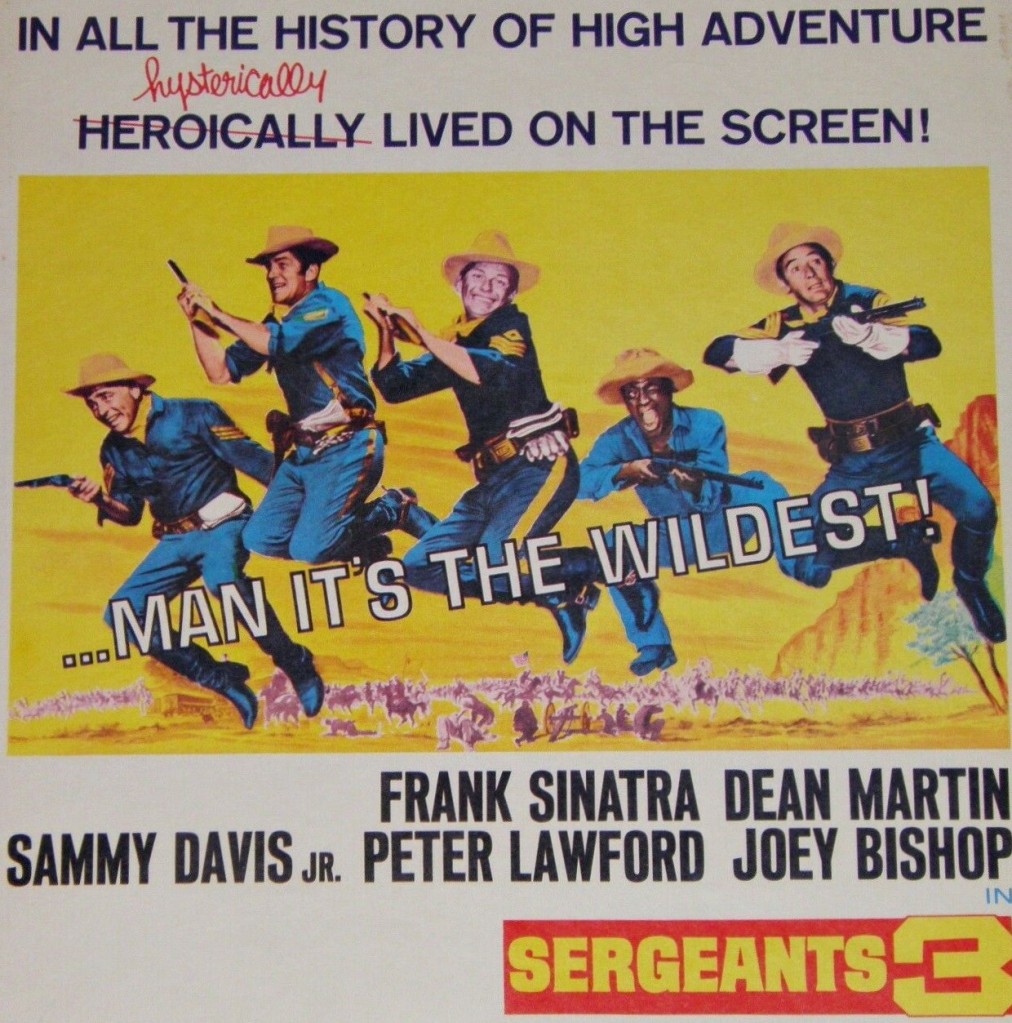
There’s a terrific western directed by John Sturges (The Magnificent Seven, 1960) inside this Rat Pack offering, the second of four in the series. On the plus side are plenty twists on traditional scenarios, Frank Sinatra and Dean Martin displaying a certain kind of easy screen charisma, and three exceptional and well-choreographed battle scenes. Sinatra, Martin and Peter Lawford play the eponymous sergeants, Lawford committing the cardinal sin of wanting to quit the regiment to get married, with Sammy Davis Jr. as a former slave, bugler (an important plot point) and horse-lover wanting to sign up, and Joey Bishop (television star and occasional movie actor) as their sergeant-major boss.

A fair bit of time is spent on the usual Rat Pack shenanigans, getting drunk, brawling, playing tricks on each other, and exploring odd comic notions such as playing poker with a blacksmith’s implements as chips. But when it gets down to proper western stuff, it fairly zings along, with a decent plot (a Native American uprising) and excellent action scenes. You could have had William Goldman writing the script for the number of reversals, where the picture keeps one step ahead of audience expectation. For a start, rather than flushing out outlaws from a town, the troopers have to remove Native Americans who have taken it over. Instead of the cavalry pursuing Native Americans, it is mostly the other way round. It is the soldiers rather than the Native Americans who attack a wagon. Sinatra finds himself employing a bow-and-arrow and then a tomahawk rather than being on the receiving end of such weaponry.  Instead of dynamite, the good guys make do with fireworks. Where Native Americans are usually pinned down, this time it is Sinatra’s merry band. And when it comes to resorting to serious violence, that, too is usually the remit of the Native Americans, not as here, Sinatra chucking man off a cliff.

When it sticks to action, the picture is very well done and involving. When Sinatra has to take charge instead of larking about, the movie has focus. Both Sinatra and Martin were undertaking serious roles around this time, the former in The Manchurian Candidate (1962), the latter in political drama Ada (1961) so this might have appeared welcome relief. The comedy isn’t along the laugh-out-loud lines of Support Your Local Sheriff (1969) or Blazing Saddles (1973) and when the action is so full-on you wonder why anybody thought this required comedy at all, although there is a pretty good punchline ending. Action aside, it’s almost the equivalent of easy listening. The Rat Pack was a particular 1960s institution, the members joining each other on stage in Las Vegas or featuring in television programs, but there’s no real modern correlative.

Discover WordPress

A daily selection of the best content published on WordPress, collected for you by humans who love to read.

The Atavist Magazine

by Brian Hannan

WordPress.com News

The latest news on WordPress.com and the WordPress community.