All In A Night’s Work (1961) ***

What wouldn’t Hollywood give now for a pair of personable players who could take as slight a piece of fluff as this and through sheer force of screen personality turn it into an enjoyable experience.  Based entirely around misconception, misunderstanding, characters at cross purposes and mild business satire this would have been hailed as a classic had it appeared in the golden age of the screwball comedy.  

Playboy Tony Ryder (Dean Martin) inherits a publishing empire from his uncle but discovers an unsavoury fact about his relative’s demise that could severely damage the business. A naked woman was seen running from his hotel room. When hotel house detective Lasker (Jack Weston) identifies her as Katie Robbins (Shirley MacLaine), a lowly employee in the company, the suspicious minds of big business surmise that she intends to blackmail them.

The plot, such as it is, concerns Ryder and Co’s attempts to avoid this, by bribing her to shut up and at the same discrediting her. Ryder is conflicted, in part because he fancies her rotten, in part because he doesn’t quite believe she could be so duplicitous, and in part because he can’t afford to risk believing her. For some reason, as a researcher, she is involved in union negotiations, giving him the opportunity to get to know her better, as part of a “sub-committee of two” established to examine union claims more thoroughly.

So it’s basically one set-piece after another. A flashback explains why Katie came to be in the uncle’s bedroom – to escape in the same hotel the lustful attentions of the elderly wealthy guest Kirby Hackett (Johnstone White) whom she saved from drowning. Her behaviour at the uncle’s funeral suggests she is stricken by his death. And unfortunately, she is the recipient from the grateful Hackett of a mink coat worth thousands of dollars which, on her meagre salary, she can’t explain.

Katie is dithering over her planned wedding to dull vet Warren Kingsley Jr. (Cliff Robertson) and, aiming to discredit her with him, Ryder plants the seed that actually she is a showgirl on the side, arranging for her to receive five star treatment at various nightclubs, inciting suspicion from her fiancé and his extremely conventional parents. In order to get to the bottom of everything, Ryder agrees to be bugged for a private meeting with Katie. You can imagine how that goes. But the outcome is never in doubt of course.

What the audience knows but the participants do not is that this couple is well-suited. Ryder is far from the playboy of his reputation, having started at the bottom of a rival publishing empire and worked his way up to the top, so he turns out to be a more astute businessman than the sycophants on the board anticipate – “you may not be much but you’re all we’ve got” typical of the welcome he receives. Far from being a good-time girl, Katie is a woman of principle, refusing to take the mink coat as a gift and determining to pay it off at the rate of $10 a week.

The humour derives almost entirely from the cross-purpose nature of the plot and the set-pieces work out well, especially when Ryder kidnaps a sheepdog as an excuse to visit the vet, and stumped for a reason comes up with the notion the animal is suffering from amnesia. “He gives me that ‘who are you’ look,” Ryder explains. As the tale unfolds Kingsley becomes more insufferable by the minute.    

There’s a romantic subplot involving Katie’s outgoing office chum Marge (Norma Crane) and the shy detective and some satirising of big business but that all plays out in relation to the main story.

If you remember Dean Martin from heavyweight dramas like The Young Lions (1958), Some Came Running (1958), Rio Bravo (1959) or the breezy Rat Pack comedies and the equally breezy Matt Helm spy pictures will probably not be aware he started his career in comedy, as one half of the Dean Martin-Jerry Lewis combo, a box office sensation in the early to middle 1950s. So, although he was primarily the straight man to the more obviously comedic Lewis, he was still well versed in the nuances of the genre. Nothing is ostensibly played for laughs, but he gets the laughs nonetheless.

Martin was always badly under-rated, in part because of the perma-tan, in part down to the his television show, and in part because he just wasn’t Frank Sinatra. But he was an accomplished actor, as this proves. One of the aspects of his performance I liked was that he moves with purpose. In most movies, characters cross a room or change position simply because a director calls the shots. But here, every time Martin moves it’s for a designated reason, to touch something, admire something, maneuver himself closer to someone else.

Shirley MacLaine is also refreshing, considerably less conniving or lovelorn than in her breakthrough role in The Apartment (1960), and coming to believe in her screen presence. She inhabits this character’s innocence very well, is suitably baffled on occasion, and exhibits a screen persona that simply lights up the screen. Together they are a great screen couple and in the charisma-starved Hollywood of today would be very welcome.

Cliff Robertson (The Honey Pot, 1967), almost unrecognizable without that hefty hunk of hair and the grandstanding he often effected, plays his small role to perfection. Norma Crane (Penelope, 1966) and Jack Weston (The Cincinnati Kid, 1965) – minus the screen tics he later exhibited – are quietly effective. Veteran Charles Ruggles (The Parent Trap, 1961) puts in a decent shift.    

Confident direction by Joseph Antony (The Rainmaker, 1956) in just his fourth film out of a grant total of five makes you forget this was based on a hit play by Margit Veszi and Owen Elford. The screen transition was down to Maurice Richlin (The Pink Panther, 1963), Edmund Beloin (Donovan’s Reef, 1963) and future bestselling author Sidney Sheldon (Billy Rose’s Jumbo, 1962).  

The real beauty of this piece is how effortless it all looks. The characters are grounded and believable, viewed from varying perspectives the plot remains logical, and there is enough daft invention to tickle your fancy.
The Devil’s Brigade (1968) ***

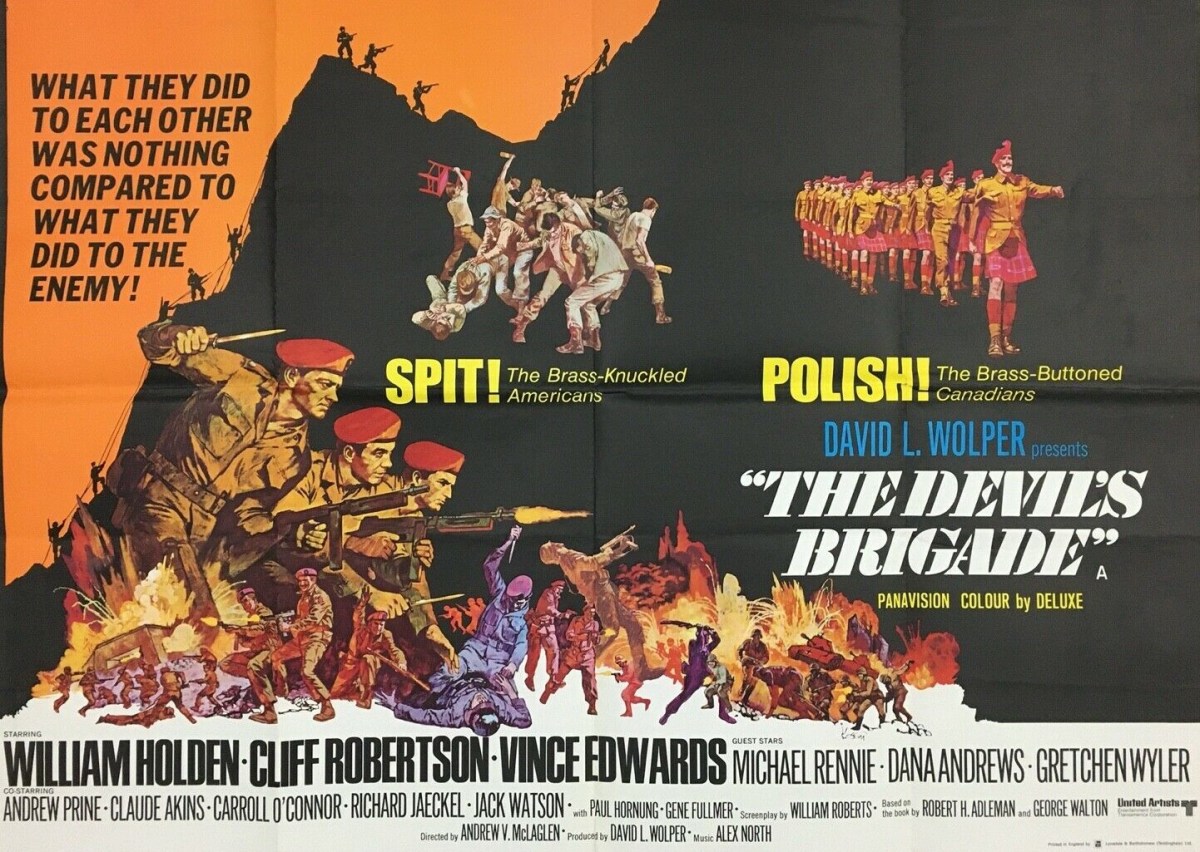
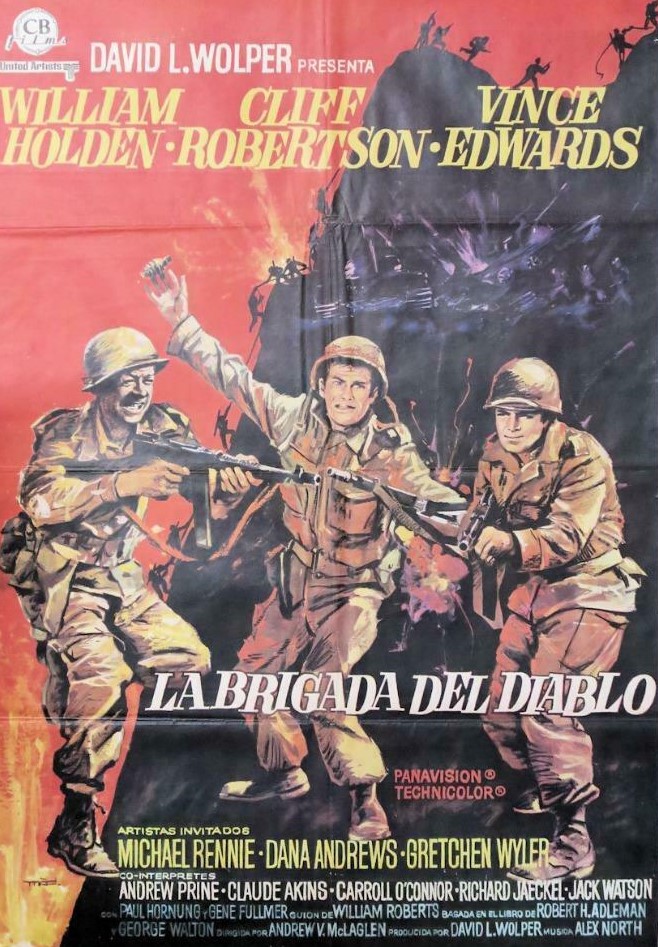
I couldn’t get my head around the idea of the U.S. Army recruiting a bunch of undisciplined misfits, many with jail time, in order to link them up with a crack Canadian outfit. Turns out this part of the film was fictional, the Americans in reality responding to advertisements at Army posts which prioritized men previously employed as forest rangers, game wardens, lumberjacks and the like which made sense since the original mission was mountainous Norway.  I should also point out the red beret the soldiers wear is also fictional and while depicted on the poster sporting a moustache commanding officer Lt. Col. Frederick (William Holden) is minus facial hair in the film.

But, basically, it follows a similar formula to The Dirty Dozen (1967), training and internal conflict followed by a dangerous mission. The conflict comes from a clash of cultures between spit-and-polish Canucks and disorderly/juvenile Yanks though, as with the Robert Aldrich epic, the leader taking some of the brunt of the discontent.  Collapsible bunk beds, snakes under the sheets and a tendency to fisticuffs are the extent of the antipathy between the units, which is all resolved, as with The Dirty Dozen, when they have to take on people they jointly hate, in this case local bar-room brawlers in Utah.

The movie picks up once they are sent to Italy. Initially employed on reconnaissance, Frederick challenges Major-General Hunter (Carroll O’Connor) who wants to do things by the book and sets out to take an Italian position by trekking two miles up a riverbed, creeping into town by stealth and capturing the location without firing a shot. 

Next up is the impregnable Monte la Difensa. Taking a leaf out of the Lawrence of Arabia playbook, in a brilliant tactical move, the Americans attack the mountainous stronghold from the rear by way of a mile-high cliff.  But that’s the easy part. The rest is trench-by-trench, pillbox-by-pillbox, brutal hand-to-hand fighting.

The battle scenes are excellent and the training section would be perfectly acceptable except for the high bar set by The Dirty Dozen. That said, there is enough going on with the various shenanigans to keep up the interest, but we don’t get to know the characters as intimately as in The Dirty Dozen and there is certainly nobody in the supporting cast to match the likes of Telly Savalas, Charles Bronson, Jim Brown and John Cassavetes. That also said, the men do bond sufficiently for some emotional moments during the final battle.

At this point William Holden’s career was in disarray, just one leading role (Alvarez Kelly, 1966) and a cameo (Casino Royale, 1967) in four years, and although his screen persona was more charming maverick than disciplined leader he carries off the role well, especially solid when confronting superiors, exhibiting the world-weariness that would a year later in The Wild Bunch put him back on top. Ironically, Cliff Robertson was coming to a peak and would follow his role as the strict disciplinarian Major Crown, the Canadian chief, with an Oscar-winning turn as Charly (1968). Vince Edwards (Hammerhead, 1968) as cigar-chomping hustler Major Bricker makes an ill-advised attempt to steal scenes.

This was the kind of film where the supporting cast were jockeying for a breakout role that would rocket them up the Hollywood food chain – as it did with The Dirty Dozen. Jack Watson (Tobruk, 1967) is the pick among the supporting cast, but he has plenty of competition from Richard Jaeckel (The Dirty Dozen), Claude Akins (Waterhole 3, 1967), Jeremy Slate (The Born Losers, 1967), Andrew Prine (Texas Across the River, 1966), Tom Stern (Angels from Hell, 1968) and Luke Askew (Cool Hand Luke, 1967). Veterans in tow include Dana Andrews (The Satan Bug, 1965) and Michael Rennie (Hotel, 1966).

William Roberts (The Magnificent Seven, 1960) adapted the bestselling book by Robert H. Ableman and George Walton. Director Andrew V. McLaglen (Shenandoah, 1965) was more at home with the western and although there are some fine sequences and the battle scenes are well done this lacks the instinctive touch of some of his other films.

The Interns (1962) ***

Patients are a nuisance to be tolerated on the route to wealth in this superior soap opera that sees young doctors wrestling with ambition and ethics. Although also concluding that impending lofty status will snare them an attractive bride, they find women less biddable than expected, romance proving the trickiest of all procedures.

The main cast of four men and one women are played by a roster of hotly-tipped newcomers, including future Oscars winners and nominees and the elusive Haya Harareet (The Secret Partner, 1961). Director David Swift, accustomed to handling multiple characters in the likes of Pollyanna (1961), keeps the pot boiling and although some storylines lead to obvious conclusions the screenwriters bring sufficient imagination to the various strands.

The story unfolds over the one year the doctors spend in a general hospital, where the patients are liable to be drunk and obstreperous, before taking up residencies elsewhere. As you might expect, the main characters divide into the good and the arrogant. Heading the latter are Alec Considine (Michael Callan) who cheats on girlfriend Mildred (Anne Helm) with older nurse Vicky (Katharine Baird) in order to gain through her connections a residency at a highly prestigious hospital. Matching him in the cocky stakes is John Paul Otis (Cliff Robertson), charming to old ladies but willing to risk his career to bed movie actress Lisa (Suzy Parker). The good guys are Lew Worship (James MacArthur) who is seduced into the supposed backwaters of obstetrics and Sid Lackland (Nick Adams), an all-round good egg who falls for patient Loara (Ellen Davalos).

The most interesting of the young doctors, however, is single mother Madolyn Bruckner  (Haya Harareet) who takes on surgeon Dominic Riccio (Telly Savalas) at every turn. Riccio spends his time berating his charges and in particular has a downer on female doctors. At every encounter, despite his vicious tongue, she refuses to back down.

But it is the patients, in particular Arnold Auer (Peter Brocco) and Loara, who blow a hole in the myth of hospitals. In the best scene in the film, Auer, suffering from a degenerative illness that will turn him into a vegetable, takes over from the doctor in giving his own awful diagnosis. His pleas for clemency from his ordeal, in essence assisted suicide, create an ethical dilemma for the young doctors who did not realize that modern medicine would prolong rather than curtail patient suffering. Auer’s anguished wife Emma (Angela Clarke) flits in and out of the picture as she buttonholes any doctor willing to listen to a new cure she has discovered. While the more hard-hearted doctors can inure themselves to his agony, a savage turn of events finds them all caught up in a situation that could jeopardize their future careers.

Racy image of Olga (Carroll Harrison) adorns the cover of the soundtrack album with music by triple-Oscar-nominee Leith Stevens (“The Five Pennies,” 1959).

Although Loara has an incurable disease and has more or less given up, Lackland’s effervescent good humor and determination that surgery can resolve all health issues brings her hope. If you were in her condition possibly the last thing you would want would be a cheerleading doctor on your side, but in this instance it brings succor and in the doctor’s case forces him to rethink his priorities.

Probably the last thing the doctors – and the audience – expected was to come up against such stubborn free-thinking women. While Bruckner appears to fly the flag for female independence, she has solid support from Lisa who spends most of the picture rejecting Otis’s advances on the grounds that even when he becomes rich he will be too poor for her liking. Eventually, Vicky forces Considine to choose. Shy nurse Gloria (Stefanie Powers) shocks Worship by putting global travel ahead of marriage. But she’s not as shocking as the bespectacled inhibited Olga (Carroll Harrison) who makes a spectacle of herself by losing her inhibitions in flamboyant style at a wild New Year’s Eve party, her disheveled state a key element of promotional artwork.

Although, theoretically, a film about young doctors having a romp, in reality it is a thoughtful and thought-provoking picture, tackling issues that would have been taboo at the time and removing the submissive tag that daunted most movie female characters in the movies.

Those who succeeded in later winning Oscar favor were Cliff Robertson, Best Actor for Charly (1968), and Nick Adams and Telly Savalas, both nominated for Best Supporting Actor, the former in Twilight of Honor (1963) and the latter in The Birdman of Alcatraz (1962). Robertson was the pick of the bunch, a star in his own right graduating from 633 Squadron (1964) and Masquerade (1965) to J.W. Coop (1971) which he also directed. But largely, the stars did not fulfil initial promise. The peak of Michael Callan’s movie career was reprising his role in The New Interns (1964), star in British director Michael Winner’s You Must Be Joking! (1965) and second male lead in Cat Ballou (1965). James MacArthur had a steady movie career before an epic run in television series Hawaii Five-O (1968-1979). Nick Adams switched between film and television before his premature death in 1968.  Haya Harareet made only one more film, The Last Charge (1962).

Although primarily in television, the less-heralded stars enjoyed greater ongoing success. Mainly a strong supporting actor, Telly Savalas had only one stab at a starring role (Land Raiders, 1970) before achieving worldwide fame as Kojak (1973-1978).  Stefanie Powers was television’s The Girl from U.N.C.L.E. (1966-1967) and later Hart to Hart (1979-1984). Buddy Ebsen (who plays the older Dr Sidney Wohl) went straight into a nine-year run of The Beverley Hillbillies

Discover WordPress

A daily selection of the best content published on WordPress, collected for you by humans who love to read.

The Atavist Magazine

by Brian Hannan

WordPress.com News

The latest news on WordPress.com and the WordPress community.