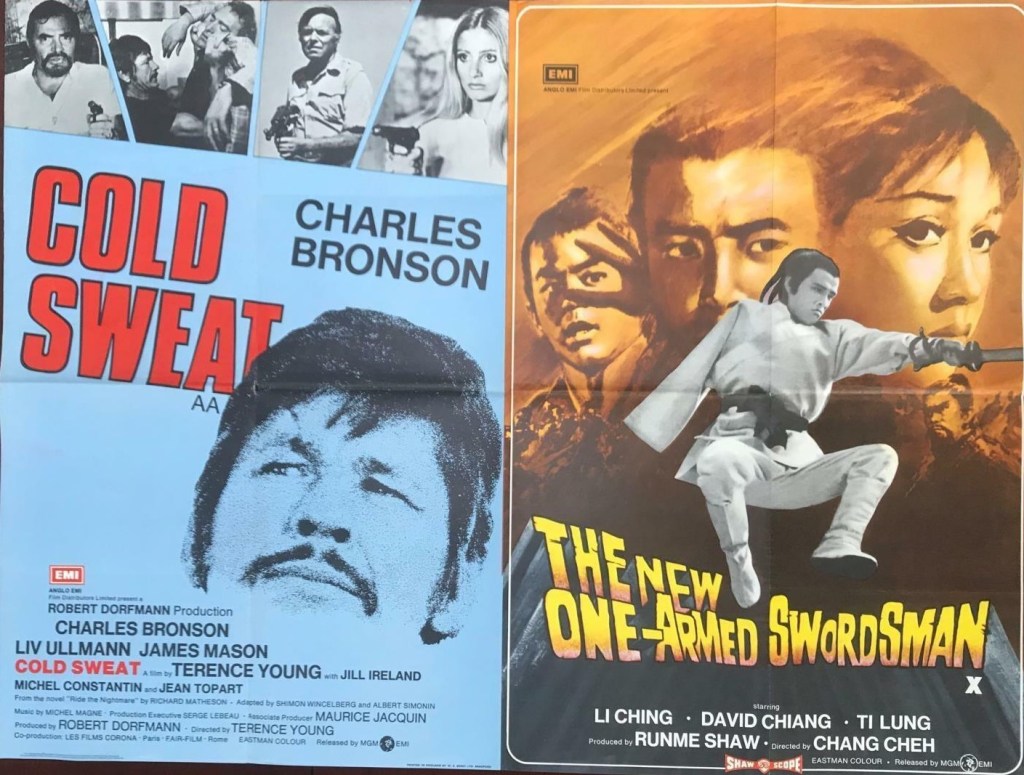
One great scene doesn’t make a great movie, but I’ll tell you about it anyway and we can all wonder what went wrong with the rest of the picture. Through a swinging louvre door we catch glimpses of Joe (Charles Bronson) putting a headlock on a thug. The motion of the door slows down as the villain is slowly choked to death. As the door closes we cut to Joe’s terrified wife Fabienne (Liv Ullman) and watch her reaction as she hears the neck snap.
Pretty good, eh? If only the rest of the movie were in that class. Except for a rollicking good car chase, it’s hampered by an over-complicated plot, kidnappings in retaliation for kidnappings, a dippie hippie (Jill Ireland) and one of the worst accents you will ever hear – quite why director Terence Young (Mayerling, 1969) wasn’t able to tell James Mason that his American South impersonation didn’t cut it is anybody’s guess.
Made before Bronson was a major global star, there’s a fair chance the kung fu picture was a stronger attration.
Joe charters out a yacht in the south of France, but prefers gambling and drinking to spending evenings with his wife. But then his past catches up with him. Cue complicated backstory – he was a soldier who got mixed up in a robbery but ran away from the theft when the going got tough and was the only one who escaped a jail term. Now his old buddies want revenge but will accept instead Joe doing another job for them.
Joe doesn’t agree so Captain Ross (James Mason) kidnaps his wife and child. So Joe kidnaps the captain’s girlfriend Moira (Jill Ireland), stashing her away in a remote cabin filled with creepy-crawlies where she has “nothing to eat but money.” So they do a trade, except Ross reneges, and then gets shot, potentially leaving wife and child at the mercy of his creepy sidekick.
There’s a fair bit of action, and when Joe is beating people up or driving like crazy over inhospitable terrain, it makes like a thriller but when he’s left to try and lift a flare gun up with his foot it’s on shakier territory. The two elements of the story split too quickly and while wife and daughter make the most of being scared out of their wits, terrified women aren’t what people come to see a Bronson picture for.
So it’s too much of a mixed bag. To compensate for the dire Mason (A Touch of Larceny, 1960), Liv Ullman offers a fresh perspective on the female lead in a Bronson picture, an actress who can actually act, her extremely expressive features meaning she doesn’t need to over-act. In her first mainstream picture, Ullman junks the Ingmar Bergman angst and comes across as a normal wife and mother thrown into a desperate situation. Her presence lightens up Bronson, though at this stage in his career, as evidenced by Someone Behind the Door (1970), Violent City / Family (1970) and Red Sun (1971), he presents quite a different screen persona to the grimacing/growling that was his post-Death Wish (1974) trademark.
Young seems caught between the action of his James Bond trilogy and the emotion-led drama of Mayerling and falls between two stools and hadn’t quite worked out how to get the best out of Bronson, a problem he rectified in Red Sun. Based, theoretically, on a novel by Richard Matheson (The Devil Rides Out, 1968), the screenplay has gone through too many hands, four at the last count, which probably accounts for the dodgy plot.
Not Bronson at his best, probably not a highlight of Ullman’s career either, and definitely a low point for Mason.
For Bronson completists only.
NOTE: There’s a vicious rumor going round, spread on Imdb, that this movie ended up on television only three days after cinematic release. Total nonsense of course. It was released in Britain in July 1973, gaining a two-week London West End run at the ABC-2 (“West End Soars, Variety, July 25, 1973, p19) and going out on a circuit release. It failed to find a U.S. distributor until 1974 in the wake of the success of Death Wish whne it was given a PG certificate by the Motion Picture Code and Rating Program and subsequently distributed by independents like Marcus Film and Emerson. It premiered in Denver – seen as a testing ground for difficult pictures, the city viewed “as a good barometer” of how movies will perform nationwide – in May 1974 (“Denver Used As Testing Ground For New Movies,” Box Office, May 20, 1974, pW4). Total rentals were estimated at around $250,000 (“Variety Chart Summary,” Variety, May 7, 1975, p134) and it placed 247th in the chart. It made its U.S. television debut on ABC in February 1975. (“Only ABC Enters Second Season With Quantity of First-Run films,” Variety, January 29, 1975, p43) but didn’t score highly with viewers finishing in 119th place for the year (“Theatrical Movie Rankings 1974-1975,” Variety, September 17, 1975, p40).
Of all the lazy, incompetent streamers this has to take the biscuit. Not content with branding as new films made over half a century ago, now we have films being screened which clearly nobody has bothered to watch even once. Otherwise, how to explain a picture where the language lapses into Italian at critical moments without the benefit of sub-titles.
Which is a big shame because, confusing through the movie is, it takes an unique approach to the femme fatale angle and serves up a noted screen tough guy as one whose heart is genuinely broken – suck that up, pale imitators going by the name of Stallone, Schwarzenner, Willis et al.
Post-Bullitt (1968) but pre-The French Connection (1971) we open with a dazzling car chase where the pursued race up stairs rather than down as is the current trope and batter their way through closely-packed streets in the Virgin Islands. That’s before wannabe retired assassin Jeff (Charles Bronson) is gunned down, although he’s still capable of diving under a burning car to escape immediate detection.
Jeff is on the lam with lover Vanessa (Jill Ireland). Dumped in jail with time to repent (no, strike that), mull over his circumstances, in the meantime dodging a tarantula (a real one!) crawling over his body, and coming to the conclusion that the moll has set him up and has returned to her previous lover, ace racing driver Coogan (no idea who plays him, imdb doesn’t know either). Despite having abandoned his profession, Jeff, not getting the hang of the broken-hearted moping malarkey, decides he’ll come out of retirement for the usual one last job, this time laying waste to Coogan.
But someone spots him and he’s blackmailed by Mafia chief Weber (Telly Savalas) into continuing his murderous ways. But here’s a sting in the tail – a wonderful twist to end all twists: Weber is Vanessa’s husband. She’s not a femme fatale at all just a sexual butterfly who dances from one lover to the next with Weber’s tacit approval.
But, in fact, in another twist, she is, after all, the femme fatale to end all femme fatales, setting up Jeff to bump off Weber so that she and attorney lover (what, another one) Steve (Umberto Orsini), Jeff’s best buddy, can take over her husband’s organization now that it has gone legit. And in the final twist to end all twists this ends with Jeff’s broken heart turning him suicidal (beat that Schwarzenneger, Stallone, Willis et al).
This is a very down’n’dirty Italian thriller, dashing from deadbeat locale to Southern Belle balls, from rusting riverboats to swampland, from factories to fashion shoots, the confusion factor infused further by the sudden incursions into Italian, often in mid-scene, as if this was some kind of artistic coup, determined to leave the viewer baffled.
Despite going the whole nine yards in the broken-heareted department, Jeff isn’t quite the full-blown romantic, an attempted rape of Vanessa in New Orleans only interrupted by (wait for it) three thugs beating another character to death. Naturally, Jeff isn’t the kind of good bad guy who intervenes, and these characters, even more naturally, have nothing to do with the plot (except as Jeff points out it’s a violent city after all). But what the hell, it’s that kind of film.
I’ve cutting Amazon Prime a big break here with my rating, because despite the language problems, it’s a cut above your normal thriller, and Charles Bronson (Red Sun, 1971) before being typecast by Death Wish (1974) gives a very good account of himself, certainly a lot more to do than just grimace, and, heck, you even feel sorry for him twisted inside out by emotion. Telly Savalas (A Town Called Hell, 1971) is a bit more polished and emotionally aware than his usual villain.
You might be tempted to call Jill Ireland (Rider on the Rain, 1970) the stand-out. She still can’t act for toffee, but she is well suited to playing this kind of jinxed minx, whose beauty snags dupes well below her league. And (spoiler alert) she does let it all hang out, indulging in copious nudity.
Directed with some flair by Sergio Sollima (The Big Gundown, 1967) and extra marks for coaxing unusual performances from the three principals. Six screenwriters (can’t you tell) put this together including Lina Wertmuller (The Belle Starr Story, 1968). Great score by Ennio Morricone.
Given I couldn’t understand half of what was going on thanks to streamer disinterest in sub-titles, I was still very impressed. Worth a watch.
NOTE: Amazon Prime has this under the title Family but once the credits roll it switches to original title Violent City.
Reminder of just how good an actor Charles Bronson was before he went all monosyllabic in The Valachi Papers (1972) and Death Wish (1974) and growled and grimaced his way to superstardom. Realistic western filled with anti-heroes except for the least likely hero in the shape of a Japanese swordsman.
In the early days of the multi-national co-production, the idea was to headline the picture with stars who could sell the picture in their domestic country, although Bronson did double duty, a Yank who was a far bigger star in France than in his home land. Frenchman Alain Delon (Texas Across the River, 1966) also doubled up, a reliable performer in U.S. markets as well as in his home patch. Toshiro Mifune (Hell in the Pacific, 1968), huge commercially in Japan, also appeal to the global arthouse mob. Ursula Andress (She, 1965), though technically Swiss, held sway over male hormones in wide swathes of Europe. And if that wasn’t enough, for good measure, there was another French beauty in Capucine (The 7th Dawn, 1964).
Interspersed with bouts of action of one kind or another, the story is mostly of the immoral kind, double-crossing to the fore, seduction merely a tool, but arriving at a surprisingly moral conclusion. Usually, pictures that focus on adversarial characters forced to work together pivot on a gender clash, romance going to find a way. But here, the outlaw and the swordsman are mostly at odds and, to top it all, outlaws, swordsman and seducer have to band together to save the day at the end.
Story is slightly complicated in that Link (Charles Bronson) begins as a bad guy, in league with Gauche (Alain Delon), to rob a train and doesn’t really stop being a bad guy, and is very self-aware about the consequences of his chosen profession, even when, double-crossed and left for dead, he seeks revenge on his partner. The opening section has a heist-like quality, you know the kind, where clever machination is required. Here, it’s how to empty the train of the soldiers helping escort a Japanese ambassador. But once that’s accomplished and the small matter of $400,000 swiped, only greed cues the complication, in that Gauche also nabs a Japanese ceremonial sword, and Kuroda (Toshiro Mifune) is honor-bound to recover it.
Gauche is also the kind of outlaw who doesn’t appreciate his team’s efforts, not only attempting to murder Link but finding occasion to bump off other members of the gang. Link becomes Kuroda’s prisoner and spends a good chunk of time trying to escape and even when they supposedly come to an agreement can’t resist the odd double-cross. The quarrel is mainly over who gets to kill Gauche.
Anyway, eventually, they end up in a small western town big enough to contain a whorehouse run by Pepita (Capucine), sometime lover of Link, where lies potential bait in the shape of Christina (Ursula Andress), Gauche’s girlfriend. When Gauche doesn’t take the lure, they have to saddle up and seek him out, hoping to trade the girl for at least some of the loot and the sword. Christina is as untrustworthy a prisoner as Link and gets them into trouble with the local Commanche, thus setting up a finale in a blazing cornfield.
The tasty exchanges between the Yank and the Japanese, more than the culture clash, drive the picture, though the eastern obsession with cleanliness is a new one for the western. You wouldn’t say the pair end up buddies but they certainly hold each other in healthy respect.
Charles Bronson isn’t easy-going but he’s much more natural, with a welcome grin, plenty dialog, and ready for most eventualities (except the first one, obviously). Mifune brings in the wider audience that gave Hell in the Pacific the thumbs-down. This could have been a swashbuckler had he been more cavalier in character, and perhaps the most telling difference between east and west is his venerating approach to a sex worker. Mifune is a fine match for Bronson.
Delon and Bronson go way back to Farewell, Friend / Adieu L’Ami (1968), the movie that turned Bronson into a giant star in France and in which they were the adversarial buddies. Delon here plays both sides of his screen person, the charming gallant and the ruthless gangster, and it’s a rare sight indeed to have three actors at the top of their game appearing in scenes together. Ursula Andress also plays against type, as a conniving seductress, with a complete lack of the self-awareness that typifies Bronson. Mostly, she’s just nasty.
On the face of it, the eastern western should be nothing more than a marketing gimmick but in the capable hands of Terence Young (Mayerling, 1968) it works a treat. More talky than audiences might have expected but that adds meat to the raw bones of a revenge picture. Took three screenwriters to pull it off – William Roberts (The Magnificent Seven, 1960), Denne Bart Petitclerc (Islands in the Stream, 1977) and Laird Koenig (Bloodline, 1979). Great score by Maurice Jarre (El Condor, 1970).
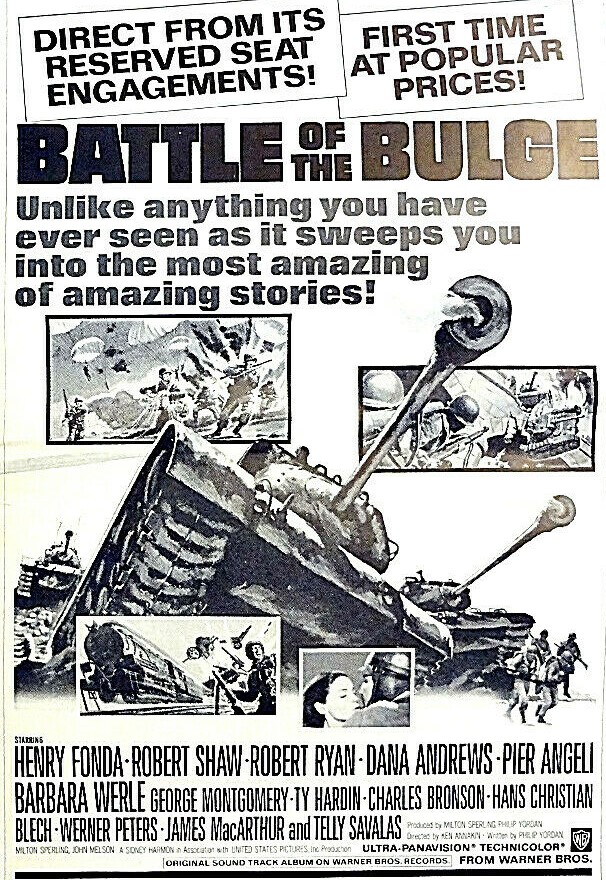
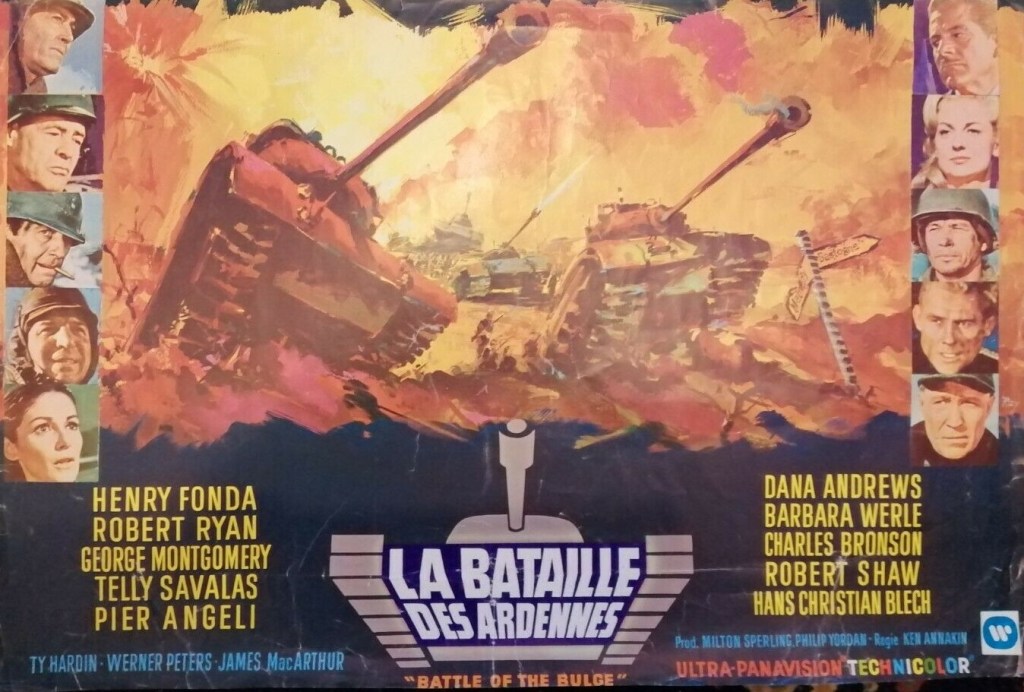
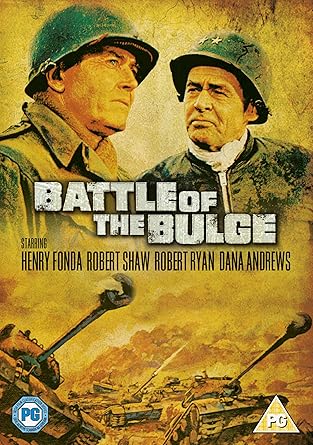
It was Hollywood’s worst nightmare. Two major studios – Columbia and Warner Brothers – were competing to make films about the Battle of the Bulge, one of the most famous episodes of the Second World War. Rival movies on similar or the same subject – classic examples You Only Live Twice (1967) vs Casino Royale (1967) or Deep Impact (1998) vs. Armageddon (1998) – risk cannibalising each other, each entry eating into the prospective audience of the opposition.
At first it seemed like the Columbia entry had the upper hand. Writer-producer Anthony Lazzarino had spent four years preparing The 16th of December: The Story of the Battle of the Bulge (the date referring to the start of the battle). Lazzarino’s project was endorsed by the U.S. Department of Defense which offered exclusive cooperation. Advisors were of the top rank – General Omar Bradley, General Hasso E. von Manteufel who had commanded the Panzers during the battle, British generals Sir Francis de Guingard and Robert Hasbrouck and Colonel John Eisenhower plus the cooperation of Eisenhower himself and Field Marshal Montgomery.
With a budget in the $6 million – $8.4 million range, and shooting was set to start in winter 1965, William Holden was lined up to play General Eisenhower and Kirk Douglas for General Hasso. Although initially intending to film in the Ardennes and Canada, ultimately the producers settled for the cheaper option of Camp Drum, one of the largest military installations in the U.S, a remote area in upper New York where the buildings could stand in for Bastogne, around which much of the real battle revolved, production there feasible because the Camp closed for winter. .
But that meant it would already be behind the eight-ball since Battle of the Bulge intended opening at Xmas 1965. Richard Fleischer (The Boston Strangler, 1968) was originally signed to direct. But he had become embroiled in a lawsuit with producer Samuel Bronston (El Cid, 1961, The Fall of the Roman Empire, 1964) whose production outfit had gone bust, killing off a deal for Fleischer to make The Night Runners of Bengal. The director was seeking g $910,000 in compensation.
Warner Brothers had enlisted Cinerama as co-producer, the studio’s first involvement in the stunning widescreen process and the first time war was considered a subject. The process had been utilised in other Hollywood pictures most notably MGM How the West Was Won (1962), but that has been as a supplier of the equipment, and taking a small share of the profits. But now Cinerama planned to enter the production business and had contracted with WB to shoot the film in the single-lens process instead of the more complicated three-camera approach which had led to vertical lies on screens.
Neither company was in great shape. Cinerama had posted a $17.9 million loss in 1964, WB $3.8 million. But whereas WB had My Fair Lady on the horizon, Cinerama was less reaons for optimism. Its income stream relied on sales of its equipment, either for filming or projection, and a levy from every cinema using the process. Expansion was seen as key to renewal. With only 67 cinemas equipped to show Cinerama in the U.S. and only 59 overseas, a major program was underway to reach 230 by 1967. Setting up a production division would ensure there were enough films to feed into Cinerama houses, and since such films were intended as roadshows, they would keep the cinemas product-secure for months on end.
Cinerama planned to spend $30 million on five films – John Sturges western The Hallelujah Trail (1965) budgeted at $5 million, Battle of the Bulge ($.75 million) while $6.5 million had been allocated to an adaptation of James Michener bestseller Caravans, $6 million for Beyond the Stars which became 2001: A Space Odyssey (1968) and $7 million for Grand Prix (1966). Added to the list was epic William the Conqueror, due to film in England in early 1966 with Robert Shaw taking top billing.
The WB-Cinerama project, which had taken a year to negotiate, was to be filmed in Spain under the aegis of producer Philip Yordan, one time associate of Bronston who had built a mini-Hollywood there. Yordan, Bronston’s chief scriptwriter, had written the screenplay along with his co-producer Milton Sperling. Instead of seeking official support or reproduce the battle in documentary detail, Yordan and Sperling aimed for a fictional account that took in the main incidents. The cast would include “ten important stars.”
Just what constituted an “all-star cast,” one of the key ingredients of the roadshow phenomenon of the 1960s, was open to question. While The Longest Day (1962) boasted stars of the pedigree of John Wayne, Robert Mitchum, Richard Burton and Sean Connery, it was also liberally sprinkled with actors of no marquee value. David Lean in Lawrence of Arabia (1962) had loaded his film with the likes of Oscar winners Alec Guinness, Anthony Quinn and Jose Ferrer to offset unknowns Peter O’Toole and Omar Sharif as the leads. While The Great Race (1965) could boast Jack Lemmon, Tony Curtis and Natalie Wood, It’s A Mad, Mad, Mad, Mad World (1963) only had Spencer Tracy amid a host of television comedians.
But none of the stars of Those Magnificent Men in Their Flying Machines (1964) had successfully opened a major picture. Of the Battle of the Bulge contingent only Henry Fonda could truly be called a current star, although his box office star had considerable dimmed since the days of The Grapes of Wrath (1939) and Fort Apache (1948). Former stars Robert Ryan and Dana Andrews were now supporting actors, Ty Hardin was best known for television, Charles Bronson (The Great Escape, 1963) had not achieved top billing and while James MacArthur had done so that was in youth-oriented movies. Initially, Italian prospect Pier Angeli (Sodom and Gomorrah, 1962) was announced as “the only principal female role” – playing a Frenchwoman – for a touching scene showing the effect of war on innocent women caught up in the conflict.
Just before filming was about to start, Fleischer pulled out, citing differences of opinion with the producers. Yordan turned to British director Ken Annakin, who had helmed the British sequences in The Longest Day and Those Magnificent Men in Their Flying Machines. There was soon a double whammy. Realizing he was losing ground, and hoping to sabotage its progress, Larrazino sued WB for $1 million, claiming that “another film, less accurate, would be confused with his picture.” Just as filming of the Battle of the Bulge got underway in January 1965, it was hit by a temporary restraining order. While failing to shut down the production, it imposed a marketing blockade. WB was prevented from publicising its picture, a potentially major blow given how dependent big budget roadshows were on advance bookings which could only be generated by advance publicity.
Annakin’s immediate response to the opportunity was delight. He commented that he had a “lot of toys to play with.” He found inspiration for his approach from an unusual source, the Daleks (“an apparently irrevocable onslaught of metal monsters”) from the BBC television series Dr Who. He decided he would use Cinerama as “a kind of 3D, shooting in such a way that the tanks would loom up as monsters against humans whom I would make small and puny.”
Although he had no influence in the casting, Annakin was already familiar with some of the actors, James MacArthur from Swiss Family Robinson (1960) and Werner Peters and Hans Christian Blech from The Longest Day. He did not receive such a warm welcome from Robert Shaw whom he had rejected for a role in The Informer.
He found Fonda “a remarkable professional…always on time, patient, eager to get to work, and always knew his lines.” He confessed to being a reluctant movie actor, preferring the stage, and had not been a big office draw since his work with John Ford in the 1930s and 1940s. Even critical successes like Twelve Angry Men (1957) had lost money, some of it the actor’s own, and prestige movies like The Best Man (1964) and Fail Safe (1964) failed to attract sufficient audiences. “In the theatre,” he said, “the actor achieves fulfilment from beginning to end. But on a picture you create a minute here and a minute there over a twelve-week period. When it’s finished there’s no recollection of what you did…Films are a director’s medium.” Battle of the Bulge was his 59th picture, after completing a supporting role in Otto Preminger’s In Harm’s Way (1965) and taking second billing to Glenn Ford in modern western The Rounders (1965).
There was a stand-off with Bronson on his first day after the actor kept the crew waiting while fiddling too long with his costume. Ty Hardin (television’s Bronco, 1958-1962) was accident-prone, tumbling into a frozen river in full kit, and whacking the director’s wife in the face with his helmet. Dana Andrews had a drink problem so that in some scenes Fonda and Ryan would be surreptitiously holding him up. But such veteran actors could improvise their way round scenes and “give me hints and lead me into changes.”
Andrews was enjoying career resurgence. His movie career was at a standstill, a ong way from a peak like Laura (1944). But his last significant top-billed parts were over a decade gone. “I was starting to get nothing for a while but offers came swarming in when I told my agent to go ahead and try from Walter Huston parts.” After only televisions roles in the four years since Madison Avenue (1961), Battle of the Bulge would mark his eighth role in 1965, including The Satan Bug and In Harm’s Way.
Winter in Spain was cold which meant it provided the ideal backdrop for the WB version. The chosen location, 4,500ft high in the mountains of Segovia provided identical conditions to the actual battle. Spain had provided 80 tanks including Tigers mounted with 90mm guns and Shermans. Half of the 20-week shoot would be spent in Segovia with interiors filmed at studios in Seville and the Roma facility in Madrid. The WB adviser was General Meinrad von Lauchert, a divisional tank commander during the battle. He hoped the picture would show the German solider “as he was, brave and good” rather than clichéd presentation and not give the “impression that the American Army had nothing to do but walk into Germany.”
He wanted the film to reflect the truth that the “Americans had to pay a high price for every yard.
Extras were drawn from the Spanish village of El Molar, with a population of just 2,400, which specialised in that supply. Locals could earn 200 pesetas a day. A pair of tavern owners had established this lucrative side-line, demand so high at this point that “they can play Russian World War One Deserters for Doctor Zhivago (1965) one day and shipped to World War Two the next for Battle of the Bulge.” Whenever Annakin found himself in trouble with the script he turned to the senior actors, Fonda, Ryan and Andrews who could improvise their way round scenes and “give me hints and lead me into changes.”
For the first scene, a week’s worth of white marble dust, representing snow, had been spread over the ground before 40 tanks emerged from a pine forest. But just as the cameras begun to turn, unexpectedly, against all weather forecasts, it began to snow. While initially a boon, when it continued to fall for five weeks the snow turned into a liability. Nobody was prepared for snow, not to the extent of snowploughs or even salt and it was a three-mile hike uphill to reach the tank location until army vehicles could be used to transport the crew. The tanks churned up so much mud that three or four cameras were required to catch the action.
“It was a director’s feast,” recalled Annakin, salivating about the prospect of a “vast panoramic” employing the entire array of tanks. To speed production, he had two units one hundred yards apart and jumped from one to the other, thus achieving 30-40 set-ups a day while the effects team exploded tubes and burned rubber tyres to create a fog of black battle smoke. A small town, already wrecked and shelled from the Spanish Civil War, added an air of realism when standing in for Bastogne.
Midway through shooting the producers realised the movie lacked a theme and from then on Annakin was faced with daily rewrites as new scenes were added to bring out the humanity implicit in war. Then Cinerama boss William Foreman arrived and demanded the insertion of the type of shot he believed his audiences were expecting, the equivalent of the runaway train and the ride through the rapids in How the West Was Won. He angled for a jeep racing downhill or a plane spinning and diving and happy to stump up any extra costs.
Such a request was more easily accommodated than his insistence that a role be found for his girlfriend Barbara Werle. a bit part actress Tickle Me (1965). While Yordan, wearing his producer’s hat, was willing to keep one of his main funders happy, the director and Robert Shaw were not. Shaw refused to do the scene until Foreman pleaded with both, explaining that in a vulnerable period of his personal life – when, in fact, he had been imprisoned – Werle had helped him out and he owed her a favour.
In Annakin’s opinion Werle was “willing but completely dumb…as though you had picked a girl straight from the cash desk of a supermarket.” Her one scene, as a courtesan offered to Robert Shaw by a grateful superior, was used to mark out the German commander as a man of honour when he rejection such temptation out of hand.
To overcome problems of matching earlier Panzer footage with the climactic battle to be shot on the rolling hills of Campo – in the earlier shots the ground was covered in snow, but now it was summer and the ground was scorched by the sun – Annakin relied on aerial shots, shooting downwards, “keeping as close as possible so as not to reveal what the terrain actually looked like” while on the ground two units shot close-ups of the action. The action was augmented by 30 model shots with miniature explosions.
When shooting was completed, there was a race to get the movie ready for its schedule launch, on December 16, 1965, the 21st anniversary of the start of the battle. There were ten weeks left to do post-production. Four editors had already been working on the material but Yordan asked Annakin, who had not been near a moviola for two decades, to personally edit the climactic battle scene. The director found the experience exhilarating: “matching my location footage with miniature shots; a four-foot helicopter (i.e. aerial) shot cut with a couple of feet of a U.S tank rounding rocks to face a Panzer; a shot of Telly Savalas at his gun site yelling ‘Fire’ intercut with a miniature tank blowing up.” But all his intricate work never made it into the final cut. Another editor fiddled around with the material and since no one had thought to make a dupe of Annakin’s original it was lost.
Although the challenge from Lazzarino had died away, the Pentagon was unhappy with the amount of time allocated to the German perspective. Yordan had the perfect riposte, pointing the finger at Annakin and saying “see what happens when you get a limey director.”
Werle had the last laugh. She was billed sixth in the credits (Angeli came fifth) but in the same typeface as Fonda, Shaw, Ryan and Andrews, and above the likes of Bronson, MacArthur and Hardin who not only all had substantially greater screen experience but had a bigger impact in the movie.
With the smallest part of all the listed stars, nonetheless she managed to turn the experience to her advantage, introduced to the press part of the marketing campaign and attending the world premiere at the Pacific Cinerama on December 16, 1965 in Los Angeles and the New York premiere the following day, brought forward four days, at the Warner Cinerama. In Los Angeles she arrived in true style at the head of a marching brigade of 100 service men.
SOURCES: Ken Annakin, So You Wanna Be A Director (Tomahawk, 2001) p167-181; “Du Pont, Bronston, Co-Defendants,” Variety, July 22, 1964, p4; “Schenck-Rhodes Roll Battle of Bulge at Camp Drum in U.S.” Variety, July 22, 1964, p42; “German Military Sensitivity,” Variety, September 23, 1964, p32; “Columbia Will Distribute Battle of Bulge Film,” Box Office, September 28, 1964, p18; “Plan Battle of Bulge As Cinerama Film,” Box Office, November 23, 1964, p4; “Tony Lazzarino To Produce The 16th of December,” Box Office, December 16, 1964, p4; “Rival Battles of Bulge; Bill Holden Up for Ike in Lazzarino Version,” Variety, December 16, 1964, p5; “Warner Reports Loss of £3,861,00,” Variety, December 23, 1964, p5; “L.A. Court Has Its Battle of Bulge Hearing, 27th,” Box Office, January 25, 1965, pW-2; “Dana Andrews Strategy: Regain Momentum,” Variety, March 10, 1965, p3; “Battle of Bulge Now Being Lensed in Spain,” Box Office, March 15, 1965, pNE2; “Winter in Spain Cold But Correct for Bulge Pic,” Variety, March 17, 1965, p10; “Cinerama Plans Five Films to Cost $30 Mil,” Box Office, April 19, 1965, p13; “For Actor Satisfying Legit Still Beats Pix, Reports Henry Fonda,” Variety, May 3, 1965, p2; “London Report,” Box Office, May 3, 1965, p8; “One Girl in WB Bulge,” Variety, May 5, 1965, p20; “Battle of Bulge Pic May Roll Next Winter,” Variety, May 5, 1965, p29; “El Molar, Spain’s Village of Extras,” Variety, May 12, 1965, p126; “Cinerama Report Loss,” Variety, May 13, 1965, p15; Advert, Box Office, July 12, 1965, p22; “WB To Film Cinerama Epic in England,” Box Office, October 11, 1965, p11; “Introduce Barbara Werle,” Box Office, October 18, 1965, pE3; “Battle of Bulge Opens N.Y. Now Dec 21,” Box Office, October 18, 1965, p10; “Actress To Attend Bows of Bulge in L.A., N.Y.,” Box Office, December 6, 1965, pW4.
Cinerama was the IMAX of the day and far superior in my view in many aspects not least the width of the screen. IMAX goes for height but I’m not convinced that compensates for lack of the widest screen you could imagine. So the chance of seeing this in the original Cinerama print, 70mm and six-track stereo, at the annual Bradford Widescreen Festival yesterday was too good to miss. And so it proved. A thundering experience. Much as I enjoyed it on DVD, this was elevated way beyond expectation.
Superb even-handed depiction of war, far better than I remembered. Most war films of this era and even beyond showed the action primarily from the view of the Americans/British – even the acclaimed The Deer Hunter (1978) and Apocalypse Now (1979) show nothing of the skills of the Vietnam forces that would prove victorious. And while The Longest Day (1962) shows reaction to the invasion, the Germans are revealed as caught on the hop. Given the basis for this picture is the unexpected German offensive in the Ardennes, France, in December-January 1944-1945, you might expect the Germans to be accorded some attention. But hardly, given as much of the picture as this, so that in the early stages the Germans are portrayed as powerful, clever and patriotic while the Americans are slovenly and complacent, their greatest efforts expended on preparing for Xmas.
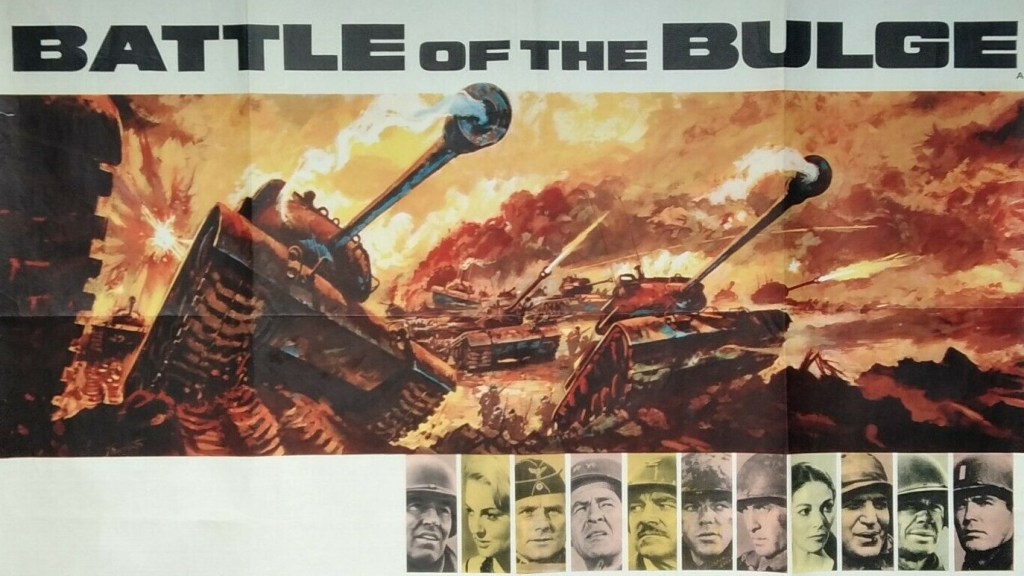
With tanks the main military focus, Cinerama is deployed brilliantly, the ultra-wide screen especially useful as the unstoppable vehicles rampage through forests and land and allowing true audience involvement when opposing armies meet head-to-head. Of course, it being Cinerama, there are a couple of scenes that play to the strength of this particular screen, a car careening round bends and a train racing along twisting tracks, the kind of scenes that previously would have had the audiences out of their seats with excitement, but here mainly used to raise the tension in the battle.
It’s to the film’s benefit that the all-star cast doesn’t feature a single actor who is truly a star in the John Wayne/Gregory Peck/Steve McQueen mould so that prevents the audience rubbernecking to spot-a-star that afflicted The Longest Day. The biggest name, technically, is Henry Fonda, and although he received top billing in many pictures, you would have to go back to The Wrong Man (1956) to find an actual box office hit. The only previous top billing for Robert Shaw (From Russia with Love, 1963) had been in The Luck of Ginger Coffey (1964), a flop few had seen. And the top-billing days of Robert Ryan (Horizons West, 1952) and Dana Andrews (Laura, 1944). In fact, the actor with the biggest string of hits was Disney protégé James MacArthur (Swiss Family Robinson, 1960). Anybody who had seen The Magnificent Seven (1960) and The Great Escape (1963) would recognise Charles Bronson in a supporting role. So fair is the movie that it’s the blond-haired Shaw who steals the show with a dynamic performance.
So it helped the almost documentary-style of the film that it was filled with familiar faces rather than dominant stars and the director was not bound to give a star more screen time or provide them with one brilliant scene after another, or establish a redundant love story in order to provide them with more emotional heft. In fact, the only romance goes to a sly black marketeer who views his relationship more as a business asset.
Initially, the role of Lt. Col. Kiley (Henry Fonda), a former cop, seems only to be to rile his superiors General Grey (Robert Ryan) and Colonel Pritchard (Dana Andrews), his pessimistic view contrasting with the accepted notion that the Germans are well and truly defeated and the war would be over soon. On airplane reconnaissance he takes a photograph of an officer later identified as Panzer tank genius Colonel Hessler (Robert Shaw). While Grey and Pritchard over-ride his conclusions, the movie concentrates on the German build-up, their discipline, efficiency, leadership and determination juxtaposed to the American inefficiency and sloppiness.
Where the Americans just want to get home, Hessler – more charismatic than any of the dull Yanks – is in his element, wanting the war to never end, convinced at least that a tank-driven assault would drive a wedge between the Allied forces, and reaching the target Antwerp in Belgium in the north would extend the war by another year by which time Germany’s V2 rockets would give them greater firepower. The Germans also have a clever idea, the type that the British were always coming up with and would make a film of its own, of parachuting American-born Germans behind enemy lines, dressed in American uniforms to carry out vital sabotage and hold crucial bridges across the River Meuse.
In one of the best scenes in the film, his tank commanders spurt spontaneously into a patriotic song with much stamping of boots. And while Hessler’s immediate superior (Werner Peters) , ensconced in a superior bunker, can enjoy a comfortable lifestyle, no more illustrated by the fact that he has courtesans to hand, one of whom, offered to Hessler, is furiously dismissed. And the clock is ticking, the Germans have limited supplies of fuel and must reach the enemy’s supply dumps before they run out of gas.
The maverick Kiley manages to be everywhere – the River Meuse bridge, in the air in the fog determinedly hunting for the panzers he believes are hidden, is the one who realises how critical the fuel situation is for the enemy, and at the fuel depot for the movie climax. Otherwise, the picture uses its cast of supporting characters to cover other incidents, the massacre of prisoners of war at Malmedy, the chaos as the Germans over-run American-held towns.
Best of all is the human element. It would be easy on a picture of this scope to lose emotional connection, as you would say was the prime flaw of The Longest Day. Not only is Kiley the outsider trying to beat the system, but we have the cowardly Lt Weaver (James MacArthur) who would rather give up without a fight than lose his life, the weaselly Sgt. Guffy (Telly Savalas) representing the worst instincts of the grunts, the confused General Grey can’t make up his mind how to respond to the sudden attack, and Hessler’s driver Conrad (Hans Christian Blech) who is fed up with paying the price of war.
The action scenes are outstanding. If you’ve never been up against a tank in full flight, you will soon get the idea how fearsome these metal battering rams are, as the rear up, crash over trees, race across open fields, and either with machine gun or shells wreak havoc. As with the best war films, you are given very precise insights into the battles, the tactics involved, the ultimate cost. Wolenski (Charles Bronson) is in the thick of the fighting.
While Robert Shaw is easily the biggest screen personality, Henry Fonda is solid, and holds the various strands of the picture together, while Charles Bronson enjoys a further scene-stealing role. But the pick of the acting, mostly thanks to bits of improvisation, is Telly Savalas (The Slender Thread, 1965) as the thieving Guffy. In one memorable scene he kicks out in resentment at his collection of hens and in another shakes his body at the tanks. No one else, beyond Shaw, comes close to his infusing his character with elements of individual personality.
Pier Angeli (Sodom and Gomorrah, 1962) as Guffy’s mistress and Barbara Werle (Krakatoa, East of Java, 1968) as the courtesan are inexplicably billed above Charles Bronson, Telly Savalas and James MacArthur perhaps in a ploy to deceive audiences into thinking there was more female involvement.
Full marks to British director Ken Annakin (The Biggest Bundle of Them All, 1968) for visual acumen and for simplifying a complicated story and peppering it with human detail. His battles scenes are among the best ever filmed. Credit for whittling down the story into a manageable chunk goes to Philip Yordan (The Fall of the Roman Empire, 1964), Milton Sperling (The Bramble Bush, 1960) and John Melson (Four Nights of the Full Moon, 1963).
A genuine classic, with greater depth than I ever remembered.
It’s Angie Dickinson vs Ann-Margret at the top of the All-Time Top 40. The two female stars take four of the top seven spots with Ann-Margret’s The Swinger replacing at the top long-time favorite The Secret Ways. These two have been duking it out over the past year, in which time the top spot has changed hands four times, with Jessica and Once Upon a Time in the West also taking a turn in the premier position. It’s also noticeable that women are top-billed in seven of the pictures in the Top Ten.
I started this Blog three years ago in June. Last year it was being read in 120 countries but that’s now gone up to 182 (out of the 193 recognized by the United Nations plus the Vatican state and the State of Palestine). Reviews have also increased and I’m now approaching 7,000 views a month, so thanks to you all.
I’ve been doing an Annual Top 40 since I started so this is the third iteration of that idea based on those reviews – out of the 900-plus posted so far – which have attracted the most attention over the three-year period. This isn’t my choice of the top films in the Blog, but yours, my loyal readers. The chart covers the films viewed the most times since the Blog began, from June 1, 2020 to July 31, 2023. (Yeah, it should have been May 31, but I’ve been remiss.)
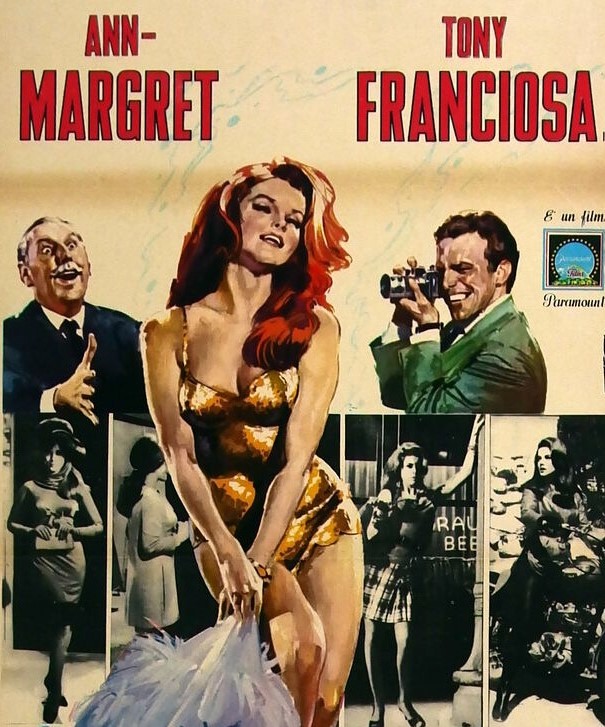
(7)The Swinger (1966). Ann-Margret struts her stuff as a magazine journalist trying to persuade Tony Franciosa she is as sexy as the characters she has written about.
(-) Once Upon A Time in the West (1968). Rated the top western of all time, Sergio Leone’s operatic epic with Claudia Cardinale, Henry Fonda and Charles Bronson and the astonishing Ennio Morricone score.
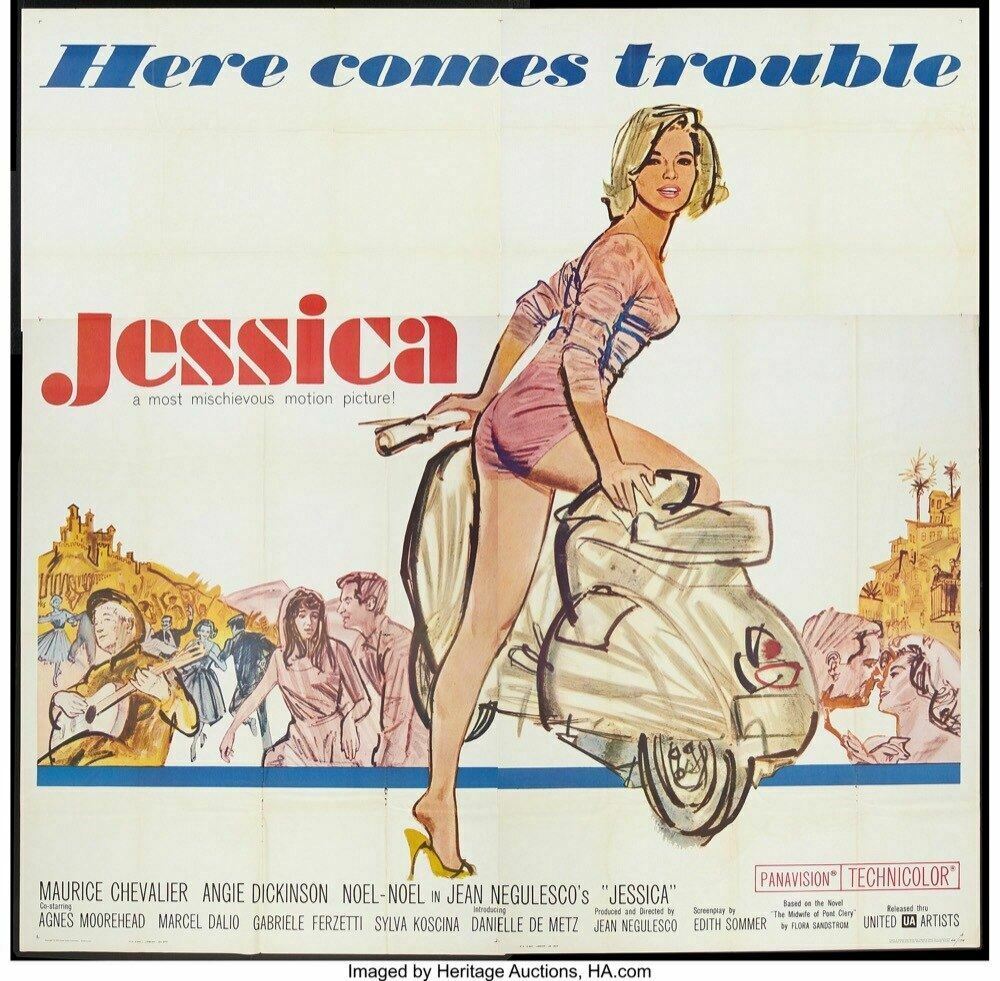
(2) Jessica (1962). Innocently gorgeous widow Angie Dickinson finds her looks turn so many male heads in a small Italian town that the female population seek revenge.
(5)Fraulein Doktor (1969). Suzy Kendall in the best role of her career as a sexy German spy in World War One.
(-) Stagecoach(1966). Ann-Margret, Alex Cord and Bing Crosby in decent remake of classic John Ford western.
(1) The Secret Ways (1961). Richard Widmark exudes menace in this adaptation of an early Alistair MacLean spy thriller set in Hungary during the Cold War. Senta Berger has a small role.
(-) The Sins of Rachel Cade (1961). Angie Dickinson as a missionary who falls in love with Peter Finch in war-torn Africa.
(-) Gerry Anderson’s Fireball XL5. Colorized version of the famed sci fi television show.
(11) Moment to Moment (1966). Hitchcockian-style thriller with Jean Seberg caught up in murder plot in the French Riviera. Also features Honor Blackman.
(3) Ocean’s 11 (1960). In the Rat Pack debut Frank Sinatra, Dean Martin, Sammy Davis Jr. et al plan an audacious Las Vegas robbery.
(17)Can Heironymous Merkin Ever Forget Mercy Humpe and Find True Happiness? (1969). Off-the-wall musical awash with nudity and Fellini-esque cavorting, directed by star Anthony Newley. Has to be seen to be believed. Joan Collins pops up.
(4) Pharoah(1966). Priests battle kings in Polish epic set in ancient Egypt. Fabulous to look at and thoughtful.
(-) Sisters (1969). French drama bordering on the incestuous starring Nathalie Delon and Susan Strasberg.
(-) Vendetta for the Saint (1969). Feature length version of the television show sees Roger Moore and Rosemary Dexter battling the Mafia in Sicily.
(6) The Golden Claws of the Cat Girl (1968). Cult French movie starring Daniele Gaubert as a sexy cat burglar.
(-) Baby Love (1969). Orphan Linda Hayden finds herself in a predatory middle-class London household.
(-) Pendulum (1969). The under-rated George Peppard as a cop accused of murdering cheating wife Jean Seberg.
(-) Lady in Cement (1969). Frank Sinatra reprises private eye Tony Rome as he tangles with Raquel Welch.
(15) Subterfuge(1968). C.I.A. operative Gene Barry hunts an M.I.5 mole in London. Intrigue all round with Joan Collins supplying the romance and a scene-stealing Suzanna Leigh as a villain.
(-) Plane (2023). Gerard Butler goes Die Hard as stranded pilot outwitting terrorists on a remote Pacific island.
(18) Pressure Point (1962). Prison psychiatrist Sidney Poitier must help racist Nazi Bobby Darin.
(31) Fade In (1968). Long-lost modern western with Burt Reynolds serenading low-level movie executive Barbara Loden whose company is actually filming Terence Stamp picture Blue.
(16) A House Is Not a Home (1965). Biopic of notorious madam Polly Adler (played by Shelley Winters) who rubbed shoulders with the cream of Prohibition gangsters.
(19) Deadlier than the Male (1967). Richard Johnson as Bulldog Drummond is led a merry dance by spear-gun-toting Elke Sommer and Sylva Koscina in outlandish thriller.
(-) The Girl on a Motorcycle (1968). Marianne Faithful dons – and slips out of – leathers in erotic drama with Alain Delon.
(-) Some Girls Do (1969). Daliah Lavi and Beba Loncar get tough with Bulldog Drummond in sequel to Deadlier than the Male.
(-) Beat Girl / Wild for Kicks (1960). London teenager heads for shady Soho. Starts out in milk bars, ends up in strip clubs.
(-) Sodom and Gomorrah (1962). Robert Aldrich biblical epic sees Stewart Granger giving way to temptation in the infamous locale.
(-) A Dandy in Aspic (1968). Director Anthony Mann died during shooting of spy picture so star Laurence Harvey took over. Mia Farrow co-stars.
(-) The Brotherhood (1968). Martin Ritt’s Pre-Godfather take on the Mafia starring Kirk Douglas and Alex Cord as duelling brothers.
(23) Once a Thief (1965). Ann-Margret (again) is a revelation in crime drama with ex-con Alain Delon coerced into a robbery despite trying to go straight. Supporting cast boasts Jack Palance, Van Heflin and Jeff Corey. .
(-) Uptight (1968). Jules Dassin remake of John Ford classic The Informer set among black revolutionaries.
(9) A Place for Lovers (1969). Faye Dunaway andMarcello Mastroianni in doomed love affair directed by Vittorio De Sica.
(-) The Misfits (1961). Stunning last hurrah for Marilyn Monroe and Clark Gable in John Huston tale of ageing cowboys.
(-) Father Stu (2022). Biopic of boxer-turned-priest with Mark Wahlberg and Mel Gibson.
(-) Blonde (2022). Andrew Dominik’s controversial take on the life of Marilyn Monroe with Ana de Armas.
(12) 4 for Texas (1963). Frank Sinatra and Dean Martin face off in a Robert Aldrich western featuring Ursula Andress and Anita Ekberg with Charles Bronson in a smaller part.
(-) Istanbul Express (1968). Gene Barry, John Saxon and Senta Berger involved in nefarious dealings on the other famous trans-European express.
(33) P.J./New Face in Hell (1968). Private eye George Peppard is duped by shady millionaire Raymond Burr and mistress Gayle Hunnicutt in murder mystery.
(10) The Venetian Affair (1966). Robert Vaughn hits his acting stride as a former C.I.A. operative turned journalist investigating suicide bombings in Venice. Great supporting cast includes Elke Sommer and Boris Karloff.
Dropping out of the Top 40
The surge of new entrants and other films attracting a vast new audience has meant some previous favorites tumble out of the Annual Top 40. (Previous year’s position shown in brackets).
(8) It’s Not All Rock’n’Roll (2020). Ageing rocker Dave Doughman aims to mix a career with being a father in this fascinating documentary
(13) Age of Consent (1969). Helen Mirren stars as the nubile muse of jaded painter James Mason returning to his Australian roots.
(14) The Double Man (1967). Yul Brynner chases his doppelganger in the Swiss Alps with Britt Ekland adding a touch of glamour.
(20) Valley of Gwangi (1969). Special effects genius Ray Harryhausen the star here as James Franciscus and Gila Golen encounter prehistoric monsters in a forbidden valley.
(21) The Naked Runner (1967). With his son held hostage, Frank Sinatra is forced to carry out an assassination in east Germany.
(22) Orgy of the Dead (1965). Bearing the Ed Wood imprint, mad monster mash-up with the naked dead.
(24) The Sicilian Clan (1969). Stunning caper with thief Alain Delon and Mafia chief Jean Gabin teaming up for audacious jewel heist with cop Lino Ventura on their trail. French thriller directed by Henri Verneuil. Great score by Ennio Morricone.
(25) Dark of the Sun / The Mercenaries (1968). More diamonds at stake as Rod Taylor leads a gang of mercenaries into war-torn Congo. Jim Brown, Yvette Mimieux and Kenneth More co-star. Based on the Wilbur Smith bestseller
(26) Stiletto (1969). Mafia hitman Alex Cord pursued by tough cop Patrick O’Neal. Britt Ekland as the treacherous girlfriend heads a supporting cast including Roy Scheider, Barbara McNair and Joseph Wiseman.
(27) Maroc 7 (1967). Yet more jewel skullduggery with Gene Barry infiltrating a gang of thieves in Morocco who use the cover of a fashion shoot. Top female cast comprises Elsa Martinelli, Cyd Charisse, Tracy Reed and Alexandra Stewart.
(28) The Rock (1996). Former inmate Sean Connery breaks into Alcatraz with Nicolas Cage to prevent mad general Ed Harris blowing up San Francisco. Michael Bay over-the-top thriller with blistering pace.
(29) The Swimmer (1968). Burt Lancaster’s life falls apart as he swims pool-by-pool across the county. Superlative performance.
(30) Hour of the Gun (1967). James Garner as a ruthless Wyatt Earp and Jason Robards as Doc Holliday in John Sturges’ realistic re-telling of events after the Gunfight at the O.K. Corral.
(32) Dr Syn Alias the Scarecrow (1963). The British movie version of Disney American television mini-series sees Patrick McGoohan as a Robin Hood-type character assisting local smugglers.
(34) Sol Madrid/The Heroin Gang (1968). In his second top-billed role David MacCallum drags hooker Stella Stevens to Mexico to capture drugs kingpin Telly Savalas.
(35) A Twist of Sand (1968). Diamonds again. Smugglers Richard Johnson and Jeremy Kemp hunt long-lost jewels in Africa. Honor Blackman is along for the voyage.
(36) Genghis Khan (1965). Omar Sharif plays the legendary warlord who unites warring Mongol tribes. Stellar cast includes Stephen Boyd, James Mason, Francoise Dorleac, Eli Wallach, Telly Savalas and Robert Morley.
(37) Interlude (1968).Bittersweet romance between famed conductor Oskar Wener and young reporter Barbara Ferris.
(38) Woman of Straw (1964). Sean Connery tangles with Gina Lollobrigida in tangled tale of the killing of wealthy uncle Ralph Richardson.
(39) Bedtime Story (1964). Marlon Brando and David Niven are rival seducers on the Riviera targeting wealthy women.
Dvorak would be turning in his grave at the audacity of using his New World Symphony (Ridley Scott used it with more subtlety for the Hovis advert a couple of years later) as the score for a Charles Bronson picture. But you could argue this really isn’t a Charles Bronson movie. He’s not the tough guy. He doesn’t come out all guns blazing. He doesn’t slap people around.
This is probably the biggest reversal of screen persona in Bronson’s career (if you exclude The Sandpiper, 1965, where he plays an artist, and you could probably chalk it off anyway because he wasn’t a star at that point). This is so far from the Bronson you guess it must be a cruel hoax.
Here, Bronson is the dupe, the patsy, the stooge.
Come again?
He’s not even dignified with a name, just “The Stranger.” In fact, this could be a remake of Rider on the Rain (1970) with Bronson playing the bad guy not the mysterious cop.
The Stranger, found standing in the road and no idea how he got there, ends up the patient of neurosurgeon and psychoanalyst Laurence (Anthony Perkins). The Stranger is suffering from amnesia so being the good guy he is, and always interested in another scalp for his casebook, Laurence takes him home – in Folkestone on the English south coast, next to Dover – and helps him begin the process of unravelling his identity.
Laurence is a bit cross, it has to be said, because he’s discovered his wife Frances (Jill Ireland) is having an affair with a French journalist Paul Damien. Laurence brings in his brother-in-law to break her alibi of always staying with him.
From a suitcase found on the nearby beach, whose clothes fit The Stranger, it’s conceivable this might be the very same Paul. But he could as easily be an escaped madman. Or he could be the chap who’s raped and murdered a blonde on the beach.
The Stranger, mightily confused, begins to suspect, especially when he finds a photo of a naked Jill in his pocket, he might indeed be Paul. And to even things up, he has reason to be jealous. If he is Frances’s lover, it could very well be Paul Damien to blame.
Naturally, Laurence has arranged for there to be gun handy. And gradually he twists the facts and works inventively to convince The Stranger that he should be very hot and bothered should, as appears likely, at any moment Frances and Paul walk through the door, allowing Laurence to take revenge and get off scot-free.
Whether The Stranger is ill or not, he is clearly easily led and pretty much accepts the situation Laurence presents. Any time he queries anything, Laurence has a ready answer.
So what you have really is two parallel tales of cat-and-mouse. On the one hand you have Laurence snaring The Stranger in a spider’s web of possibility and drawing a tighter noose around his wife and her lover (whoever that may be). But you also have, in his debut, clever-dick Hungarian director Nicolas Gessner (The Little Girl Who Lived Down the Lane, 1976) playing with audience expectation. At any moment, in the first parallel tale, you expect The Stranger will come to his senses, memory recovered, and putting an end to the nasty plan. Equally, at any moment, you expect the real Charles Bronson to stand up, take control and blast everyone to hell.
But neither of these possibilities occurs. The Stranger looks lost for the most part, diminished, outwitted, twisted around like an impotent puppet. Rather than concealing the difference in height between the principals ( that a big star is never smaller than anyone else seems set in the Hollywood Bible of Audience Deception), Bronson always appears to be cowering in front of Perkins.
Not falling back on his screen persona, in fact staying as far away from it as is possible (beyond showing off his torso from time to time to placate his female fans), Bronson delivers a more than believable performance as the little boy lost. This may not be an Oscar-winning elements performance, but in the Bronson portfolio this may well be his finest.
Sure, there a couple of implausible moments, but that’s par for the course in this kind of thriller.
And the coup de grace is that when, finally, Bronson does break loose of his shackles, it’s to act in a way no fan would like to see, when he commits a heinous act.
Bronson was far from the big Hollywood star at this point. While French audiences had certainly taken to him, that wasn’t reciprocated much elsewhere and despite being tossed into films like You Can’t Win ‘Em All (1970) opposite Tony Curtis and an international cast in eastern-western Red Sun (1971) he was still some way short of the top of the Hollywood tree. It would take another year before stardom was validated by the double whammy of The Valachi Papers (1972) and The Mechanic (1972) and another couple of years before Death Wish crowned him a superstar.
So it was an incredibly bold move to make such a shift away from creating a tough-guy screen persona. More so, to pull off such diffidence and weakness.
Interestingly, this isn’t the Anthony Perkins of Psycho (1960) either. He’s not the tic-ridden jumpy quavery-voiced individual that had appeared to be his screen persona.
Very much worth a look. Unless of course you don’t want to disturb your image of Bronson.
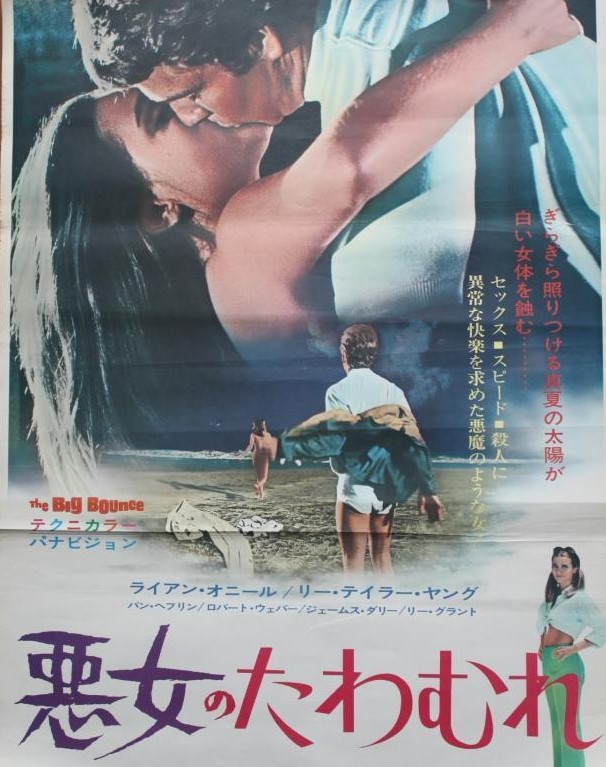
A seminal example of the art of screenwriting, setting aside for the moment that in the future disgruntled novelist Elmore Leonard deemed it “an awful movie.” Which it isn’t, by the way. Not great, but far from awful.
Screenwriter Robert Dozier (The Cardinal, 1963) had his work cut out trying to make something cinematic out of the author’s debut crime novel. At that point Leonard had not been acclaimed as inheriting the mantle of Raymond Chandler and Dashiell Hammett. In fact, as far as critical acceptance went, he was pretty much an unknown. Six novels in nigh on two decades was not guaranteed to attact attention. If he had any reputation at all it rested on providing the source material for the Paul Newman hit Hombre (1967).
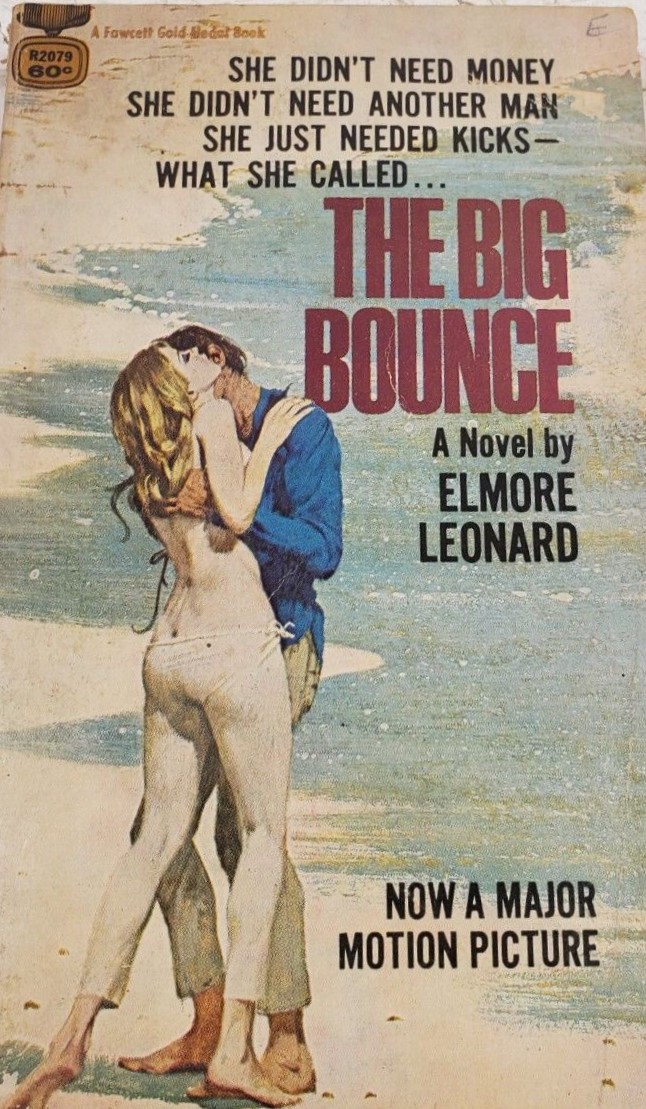
One of the reasons he remained so much under the critical radar was that he hadn’t written a novel in eight years, and all his previous output fell into the western category, a genre staunchly ignored by critics, and heavily reliant, commercially, on the pulp paperback. The Big Bounce wasn’t heralded on arrival, no hard cover printing, just a paperback movie tie-in that didn’t even go to the trouble of using a scene from the film or pictures of the stars.
Once again, the foreign distributor produces a better title than the original.
It was up to Robert Dozier to make the source material acceptable to the moviegoer. The book, as written, would never fly. Leonard’s novel lacked a Vietnam veteran, sex in the graveyard, and a nude statue. They were all Dozier’s inventions to bring a character to life who for the most part existed in the novelist’s backstory.
When the novel opens Nancy (Leigh Taylor Young) is due in court to answer the charge of dangerous driving. So rather than leaving that in her backstory, to be dealt with by dialog, Dozier makes that a key element of the film, the episode where Jack (Ryan O’Neal) wonders if he is in over his head as Nancy, annoyed by some pranksters, proceeds to drive a car off the road.
Nor in the book does Jack enjoy a brief dalliance with Joanne (Lee Grant), the single mother renting one of cabanas at the hotel where Jack works as a handyman. In fact, once he knows she has a child in tow, he pointedly avoids making any moves on the mother. His target, as far as the female holidaymakers go, is a single woman Virginia whose look of terror as he seduces her he mistakes for wild passion. The act isn’t consummated as she is struggling too much and it’s only on reflection that Jack, misreading the signals, realizes he had been on the point of raping her.
Jack has been fired from his job as pickle laborer, but he has no Army record. So all the talk about what it’s like to be at war is the screenwriter’s invention. Jack is a failed baseball player (a movie cliché – so that’s left out) and when he loses his job on the pickle farm and prior to hotel handyman turns to a spot of burglary.
He does get a job with hotel owner Sam (Van Heflin) who is also the Justice of the Peace. But Sam’s surname is not Mirakian. It’s – wait for it – Mr Majestyk. Hold on, was there not another movie featuring a guy with that name, starring Charles Bronson? Yep, that appeared in 1974, with Bronson as a melon farmer taking on The Mob. Maybe Robert Dozier thought it was too odd a name for a supporting character, maybe Leonard thought it too good a name to let go. Whatever, Mr Majestyk was left to fight another day.
Where Dozier has been exceptionally clever – rather than just sexing up the movie – is to take sections of the book (as with the car crash scene) and replant them to greater effect. In the book Nancy isn’t pimped out to a Senator by her wealthy lover Ray, but the line that it would take him “oh, a week” to find a replacement mistress comes from the book. In the book Nancy doesn’t swim naked in front of lustful married man Bob (Robert Webber). But she does swim naked in front of a character in the novel who is trying to blackmail her and he envisages holding out a towel to her naked body as she wraps her arms, to pay off her blackmailing debt, around him, rather than that being further teasing of the hapless Bob as in the film.
Dozier has rightly worked out the blackmailing angle would be a sub-plot too many. But it’s the blackmailer she shoots instead of Jack rather than the Comacho (Victor Paul) that Jack has hospitalized at the start of the movie and comes, rather late in the day in the movie, looking for revenge.
Quite a lot of dialog – because Leonard was hot on dialog, and it’s where much of his reputation derives – was taken intact from the book. But there was no way without lots of tedious dialog telling us what we already knew from her teasing Bob and running naked through a graveyard and driving cars off the road that Nancy was a piece of work who took enormous pleasure out of using her sexuality to get the better of men.
The novel explains that as a teenage babysitter she used to come on to the fathers driving her home and if they responded in any way she would blackmail them. One other time when there weren’t enough kicks in letting the neighbors’ kids see her naked, she took fifty bucks apiece from them to have sex with her. And she was always on the look-out for the “big bounce,” the action that would both be exciting and risky and also make her rich.
The Jack in the book is good bit less dumb than in the movie. He is aware that she is using him. He balks at the idea of carrying a gun because that would turn a simple burglary or heist into armed robbery for which, if caught, the sentence was much stiffer.
So, going back to Elmore Leonard’s critique of the movie, I’d be inclined to revise that to an “awful difficult book” to turn into a movie.
This is not the Charles Bronson you think you know, the mean, truculent, monosyllabic persona who turned into a box office powerhouse later in the decade. It took the French to recognize the leading man qualities Hollywood determinedly ignored. God forbid, he is actually pretty charming, although his methods for squeezing information out of a suspect are, well, suspect. And he turns up pretty late in the picture, just when you think the focus is going to be on the suspect, Mellie (Marlene Jobert) and it’s going to be one of those pictures where an innocent woman is suspected of a crime and the man has to clear her name.
Except Mellie isn’t innocent. She’s killed a rapist who broke into her house and then dumped his body over the cliff. And she isn’t, officially at least, a suspect, local cop Inspector Toussaint (Jean Gaven) more interested in getting a loan from her husband, pilot Tony (Gabriele Tinti), to pay off gambling debts. Needless to say, any time the cop does knock on her door, she jumps out of her skin.
And she would have got away with the murder, except for the arrival of Dobbs (Charles Bronson). He turns up at a wedding, ensures she gets to see a newspaper headline of the murder, insinuates his way into her life, not too difficult once her husband heads off on another flight. She runs a bowling alley with her mother Juliette (Annie Cordy) who scarcely has a maternal bone in her body.
Rather than helping the cops solve the case, Dobbs is more interested in the red bag the rapist was carrying. But when she hands over the bag, it doesn’t contain the $60,000 Dobbs wants. We never see what Dobbs gets up to when he’s not with Mellie. But we hear it. His investigations may be carried out off screen but he’s tailing her – knows she bought a ton of newspapers – and tells her what he’s found out by speaking to cops and neighbors. Even though she’s replaced the cartridges in the shotgun she used to kill the rapist, he knows the gun has been fired. When she claims she was aiming at rats in the cellar, he points to the marks on the wall, too high for even the most acrobatic rat.
Mellie is trapped in a claustrophobic world, assailed by her own guilt and a jealous husband with too much unexplained loose cash (drug smuggling is the implication), turns against her best friend, boutique owner Nicole (Jill) who had an affair with her husband, and against her mother whom as a child she caught in bed with another man, causing her father to dump the mother.
They started to get tricky with double bills in the 1970s, trying to suggest the films were equally attractive, ignoring the fact that if they had been such hits they wouldn’t have been paired in the first place.
Most of the tension is self-inflicted but Dobbs has thing about nuts and soon is whizzing shells across rooms, some trick where they break on impact with a window, but the noise is like a shot, too close to the blast of the shotgun.
Every twist ratchets up the tension. And by concentrating on the suspect the police are ignoring and making Dobbs, by default, the chief investigator, and nobody to turn to, Mellie is turned inside out by his mere presence, never mind, when exasperated, he employs his own interrogation method, akin to waterboarding, except the liquid is alcohol, forced down her throat until her lungs are full to bursting.
The last act is a bit murky, as the locale shifts to Paris, involving a brothel owner and a set of gangsters who are even more intent on humiliating Mellie. With echoes of Charade (1963) and Moment to Moment (1966), it’s superbly directed by Rene Clement (Is Paris Burning? 1965), who doles out clues and twists like he’s playing a hand at cards.
In spite of the concentration on tension, he takes the time to build up his characters. A series of emotional flashbacks show the fault-lines in Mellie’s character, no matter that she initially appears confident with fashionable short hairstyle and white outfits bound to attract attention. Dobbs’ obsession with suddenly chucking nut shells around maintains the tension and his cavalier tone, especially his jocular use of a nickname, suggests an interesting personality behind the tough guy pose.
Like his script for The Sleeping Car Murder (1965), screenwriter Sebastian Japrisot is as concerned with ordinary life as with the thriller elements.
Charles Bronson (Farewell, Friend / Adieu L’Ami, 1968) delivers the best performance of his entire career, tough guy with a charming underbelly, kind of Cary Grant with muscle. Marlene Jobert (Catch Me a Spy, 1971) is excellent as the victim turned suspect, and even Jill Ireland, for whom a part was always found in husband Charlie’s movies, shows a different side to her screen persona.
As is by now traditional (well, it’s the second full year) this isn’t my choice of the top films of the year, but yours, my loyal readers. This is a chart of the films viewed the most times over full calendar year of January 2022 – December 2022.
Jessica(1962). Angie Dickinson plays a young widow who turns so many heads in a small Italian town that their wives seek revenge. The film had debuted at No 30 in the previous year’s chart so showed remarkable staying power.
Once Upon a Time in the West (1969). Sergio Leone’s masterpiece now acclaimed as the greatest western ever made. Top class cast – Claudia Cardinale, Charles Bronson, Henry Fonda and Jason Robards – and one of the greatest scores ever written courtesy of Ennio Morricone.
The Swinger (1966). Ann-Margret sparkles as author reinventing herself by writing a sex novel.
Fraulein Doktor (1969). Suzy Kendall as German spy outwitting the British during World War One.
Can Heironymus Merkin Ever Forget Mercy Humpe and Find True Happiness? (1969). Fellini-esque musical with abundant nudity as writer-director-star Anthony Newley tries to unravel the meaning of life.
Father Stu (2022). Under-rated biopic with Mark Wahlberg as unlikely priest.
Blonde(2022). Andrew Dominik’s controversial reimagining of the life of Marilyn Monroe with Ana de Armas
For a Few Dollars More(1965).Sergio Leone re-teams with Clint Eastwood in the second in the spaghetti western trilogy with Lee Van Cleef as a rival bounty hunter.
A Place for Lovers(1968). Faye Dunaway and Marcello Mastroianni in Vittorio De Sica doomed romance.
Fade In(1968). Burt Reynolds disowned this romance filmed against the backdrop of making the Terence Stamp western Blue but it’s better than he thinks.
The Secret Ways (1961). Richard Widmark in spy thriller set in Hungary during the Cold War and adapted from the Alistair MacLean novel. Senta Berger has a small role. Top film for 2021, so demonstrating the ongoing popularity of films based on the author’s works.
The Sisters (1969). Complicated menage a trois that borders on the semi-incestuous starring Nathalie Delon and Susan Strasberg.
Pharoah (1966). Epic Polish picture about political shenanigans in ancient Egypt. Another film with legs – it was No 3 in the 2021 annual chart.
Water Gate Bridge / Battle at Lake Changjin II (2022). Another epic, non-stop action from the Chinese point-of-view in a sequel to one of the most famous battles of the Korean War.
Harlow (1965). Carroll Baker as the blonde bombshell who rocketed to fame in 1930s Hollywood.
Baby Love (1969). Morality tale as orphaned Linda Hayden tries to fit into an upper-class London household.
Moment to Moment (1966). Hitchockian thriller set in the South of France with adulterous Jean Seberg suspected of killing her lover.
Secret Ceremony (1968). Elizabeth Taylor, Mia Farrow and Robert Mitchum in atmospheric Joseph Losey drama.
Lady in Cement (1969). Gangster’s moll Raquel Welch steals the show in Frank Sinatra’s second outing as private eye Tony Rome.
Subterfuge (1968). Suzanna Leigh steals the show as a sadistic henchwoman trying to prevent Gene Barry uncovering a mole in M.I.5.
P.J. / New Face in Hell (1967). George Peppard taken to the cleaners as down-on-his luck private eye.
The Golden Claws of the Cat Girl (1968). Cult French movie starring Daniele Gaubert as a sexy cat burglar. This was No 6 last year.
The Gray Man (2022). Spectacular Netflix misfire with Ryan Gosling and Chris Evans as rival assassins and Ana de Armas adding some spice.
The Brotherhood (1968). Martin Ritt Mafia drama sees siblings Kirk Douglas and Alex Cord falling out.
Some Girls Do (1969). Richard Johnson returns as Bulldog Drummond battling archvillains Daliah Lavi and Beba Loncar.
Pressure Point (1962). Prison psychiatrist Sidney Poitier treats racist patient Bobby Darin. Very unusual imagery.
The Double Man (1967). C.I.A. operative Yul Brynner battles Russian espionage in Switzerland with Britt Ekland providing the glamor.
Operation Mincemeat (2022). Re-telling of “The Man Who Never Was” World War Two plot that duped Hitler over Sicilian invasion plans.
Orgy for the Dead (1965). Bizarre cult horror tale where most of the female characters appear to be auditioning for a nudie film.
Texas Across the River (1966). Alain Delon acts against type in Dean Martin comedy western.










 The Magnificent 60s