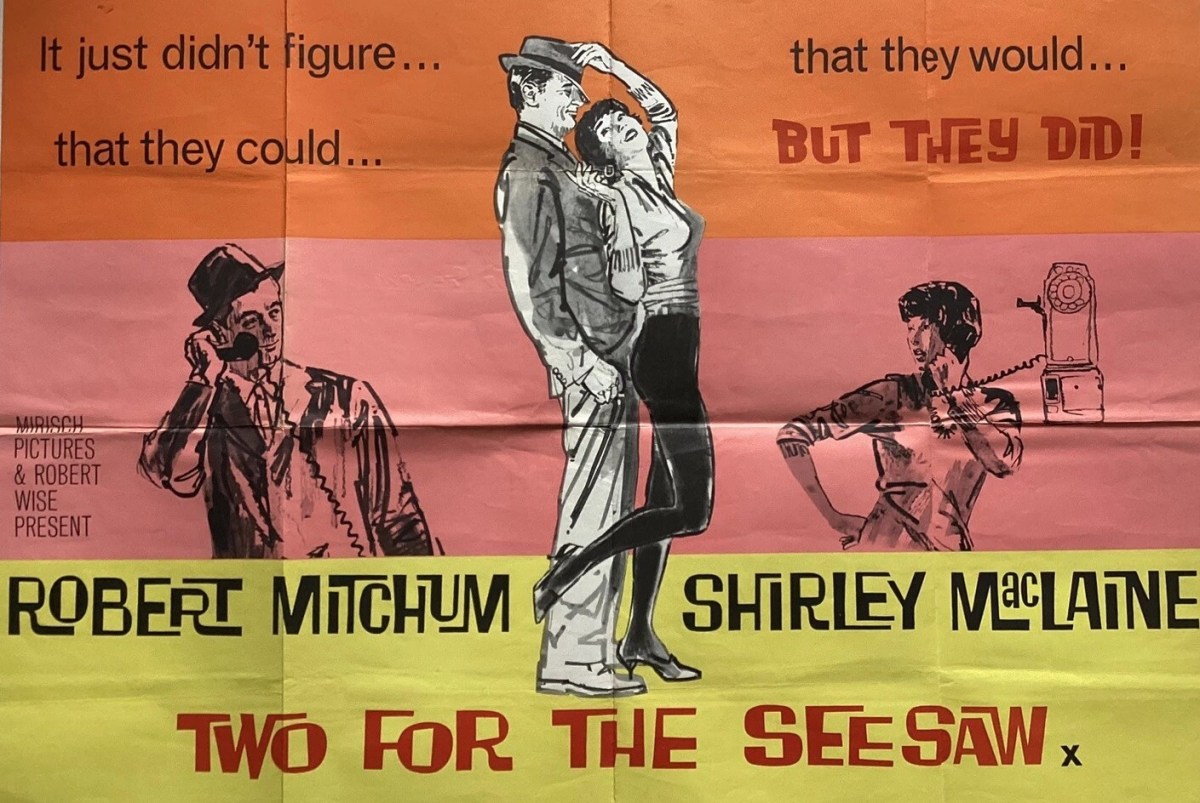
Had already cost a bundle before one foot of film was shot. Mini-major Mirisch Bros, flush from the commercial success of West Side Story (1961), had forked out $600,000 (plus a percentage) for the screen rights to the Broadway hit by William Gibson. (this was $250,000 more than West Side Story fetched). Between another $500,000 (plus percentage) for star Elizabeth Taylor and likely $250,000 for Gregory Peck, the producers were already well over a million bucks out of pocket.
The play had run for nearly two years on Broadway, earning a $570,000 profit, a remarkable sum in those days, and also set records for a touring production. It marked the Broadway debut of both Anne Bancroft, who won a Tony, and writer William Gibson. They re-teamed for The Miracle Worker both on Broadway and in the 1962 film.

Over-runs on Cleopatra (1963) put paid to Taylor’s involvement, Peck pulled out, temporarily replaced by Paul Newman. Producer Walter Mirisch presumably didn’t think Henry Fonda and Anne Bancroft who’d played the parts on stage had sufficient marquee heft, nor was he keen on Broadway director Arthur Penn, and instead pursued Shirley MacLaine who he’s turned into a star thanks to The Apartment (1960) with Robert Mitchum stepping in for Newman (leaving him free to make the first of his iconic pictures, The Hustler, 1961) Robert Wise, director of West Side Story and looking for a less onerous gig, signed on to direct.
Despite being filmed on a 60-day schedule, the bulk of it on a sound stage, the budget had rocketed to $3 million, around half of which went on the main players and the screen rights.
Mitchum wasn’t too keen on the role, believing himself miscast from the outset. The lighter touch of James Garner, also considered for the role, might have worked better. Mitchum had turned down the movie twice, suggesting Mirisch would be better off with William Holden or Glenn Ford, for whom repression was a given.
MacLaine was on a roll, signed to a four-picture deal with Mirisch. She was given not one but two roles previously advertised with huge fanfare to have starred Elizabeth Taylor. As well as Two for the Seesaw, Taylor had been primed for Irma La Douce. The Taylor deal came unstuck in part due to her illness but also was attributed to her insistence that a role be found for her husband Eddie Fisher.
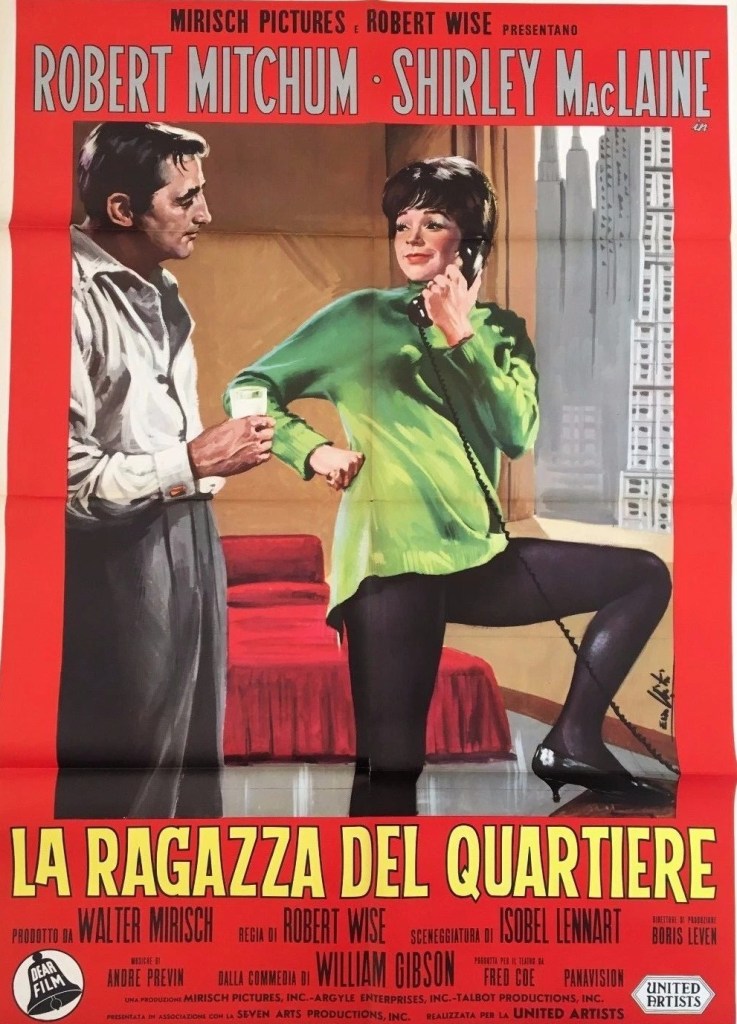
Wise and Mitchum had worked together earlier in their careers, in western Blood on the Moon (1948). And, no, this wasn’t the director hankering after working again with the actor. Noted Wise, “It was one of the few times I went on to a picture where the cast was already set. I don’t think Mitchum was quite right for the part. He was more believable in rougher, outdoor kinds of stuff.”
When they met at rehearsal, MacLaine was already a fan. Seventeen years younger than her co-star, she’d seen all his films, and was thrilled at working with one of her screen heroes. She was amazed at his photographic memory. He never had a problem with his lines. They certainly seemed to be getting on remarkably well for. Recalled Wise, “they got to ribbing and making jokes and making us all laugh so that the biggest problem we had was getting the two of them to settle down and get into the scene.” Added the director, “I had to have a closed set for a while. It was kind of embarrassed over what they were saying to each other. It was pretty spicy kidding, pretty ribald.2
Mitchum, apt to spout poetry, was revelation as a person far removed from his tough guy screen image. He was popular on set, very down to earth, mingling with all the crew and other actors. There was no entourage just a secretary bringing in lunch – and no hard liquor – for everyone.
What was going on between Mitchum and MacLaine was not obvious to everyone. Assistant director Jerome Siegel thought their light-heartedness was just a way of keeping tensions low on the set. “They were very subtle about it. You never saw anything where you could be sure there was a romance going on. but it didn’t surprise me when I did hear about it.” Needless to say, both actors were married at the time.
When Frank Sinatra and writer Malachy McCourt popped in to the set, Mitchum embarked on a drinking session that temporarily halted production, at least for the day. Wise infuriated his stars by using a stopwatch to time a kiss, one that was maybe going on too long with a pair of enamored characters. In his defense, Wise was just wary of the existing screen censorship, during which an overlong kiss would draw censure.
Wise had opened up the play with scenes set on Brooklyn Bridge and other parts accompanied by music suggesting the character was downcast. There’s a clever use of the split screen when the pair are on the telephone to each other.
The movie did well enough in first run New York and other big cities where the play had been performed but response outside those key sites and in the babes was muted. Most critics blamed the miscasting and Wise’s heavy direction.
SOURCES: Lee Server, Robert Mitchum, Baby I Don’t Cry (Faber and Faber, 2001); J.R. Jordan, Robert Wise, The Motion Pictures (BearManor, 2020); “Two Broadway Play Buys,” Variety, July 23, 1958; “Seasaw Earned $570,000 Profit,” Variety, November 4, 1959; “Shirley MacLaine’s Creamy roles,” Variety, October 26, 1960; “Two for Seesaw Budget at $3-Mil,” Variety, February 14, 1962.


