How is that the British, way down now in the rankings of global movie production, have come up with a successful genre all of their own – the national treasure. Maggie Smith and Helen Mirren to be sure first came to prominence in the same year, 1969, with The Prime of Miss Jean Brodie and Age of Consent respectively, but whereas Hollywood has turned its back on the ageing female contingent, the British film industry has wrapped its most famous stars in cotton wool and proceeded to give them roles they can take to the Oscar bank.
Mirren was in her early 60s when she romped home in The Queen (2006); you only have to say Downton Abbey and Smith, already two Oscars to the good, is regarded as screen royalty. And that’s before Judi Dench enters the equation, a few years older than Mirren when she nabbed the Oscar for Shakespeare in Love (1998). You can pretty much count on getting funding for any picture if you can rustle up any of this trio. Want to bring back the older crowd? Dangle these carrots!
Elevated into this category now is Lesley Manville, the 66-year-old star of the delightful Mrs Harris Goes to Paris. While largely escapist, there’s enough of a contemporary vibe, a Paris redolent of filth, the downtrodden going on strike, to provide an edge, and a narrative that continually punctures dreams any time fantasy looks like running away with itself. Set in 1950s London and Paris where the poor know their place, and are rigidly kept in it by the arrogant rich, but where aspiration can at any moment take flight.
Cleaner Mrs Harris, dreaming of buying a £500 dress – we’re talking the best part of £14,000 these days – scrimps and saves, and through a couple of more than fortuitous events, finds her way to the House of Dior where she is despised by haughty manager Claudine (Isabelle Huppert), adored by philosophic model Natasha (Alba Baptista) for having such aspirations, and manages to cast a spell, although not for the reasons expected, over rich widower the Marquis de Chassagne (Lambert Wilson).
There’s not much plot. She has to remain in Paris for a fortnight for fittings and whiles away the time helping along the romance between under-manager Andre (Lucas Bravo) and Natasha, assisted by their existentialist leanings, eventually overcoming hostility and putting everything to rights in the Dior empire. But you don’t need plot when you’ve got charm. The English notion of fair play initially comes a cropper when facing French egalitarianism out of whack, when the rich can jump the queue and basically make everyone jump to their tune. But when a character like Mrs Harris settles for second best you can be sure she’ll come up trumps. Whether it’s icing on the cake or to make a rubbish-strewn Paris more palatable, there’s a good ten minutes of oo-la-la devoted to parading the latest fashions.
Not content with conquering one city, Mrs Harris developed sequelitis and headed for New York.
And there’s not just a philosophical undertone – people not what they appear on the surface – but a feminist one, women holding the world together while men whistle. But by and large it’s joyous entertainment, a confection straight out of the Hollywood top drawer, a poor woman having her day in the sun through sheer strength of character.
Unless you’re British or a big fan of arthouse director Mike Leigh or noticed her Oscar nomination in the largely unnoticed The Phantom Thread (2017) Lesley Manville will probably have passed you by. She nabbed a cult following as the dumped-upon lead in comedy series Mum (2016-2019) and picked up a wider audience as Princess Margaret in The Crown, but mostly she’s known for a certain kind of acting, where she can change expression 20 times in a minute without ostensibly doing anything different. Just like her predecessors, Smith, Dench and Mirren.
You can’t take your eyes off her, which is quite feat when she’s up against French screen royalty (perhaps a “tresor national”) Isabelle Huppert (Elle, 2016). Alba Baptista (Warrior Nun series) could well be the breakout star here though Lucas Bravo definitely runs her close. I saw Bravo in Ticket to Paradise (2022) and the characters there and here could not be more different. Ellen Thomas (Golden Years, 2016), Lambert Wilson (Benedetta, 2021), Anna Chancellor (For Love or Money, 2019) and Jason Isaacs (Operation Mincemeat, 2021) have smaller roles.
Director Anthony Fabian (Skin, 2008) adds deeper issues to a movie that was crying out to be all surface. He co-wrote the screenplay with Carroll Cartwright (What Maisie Knew, 2012) based on the classic Paul Gallico novel.
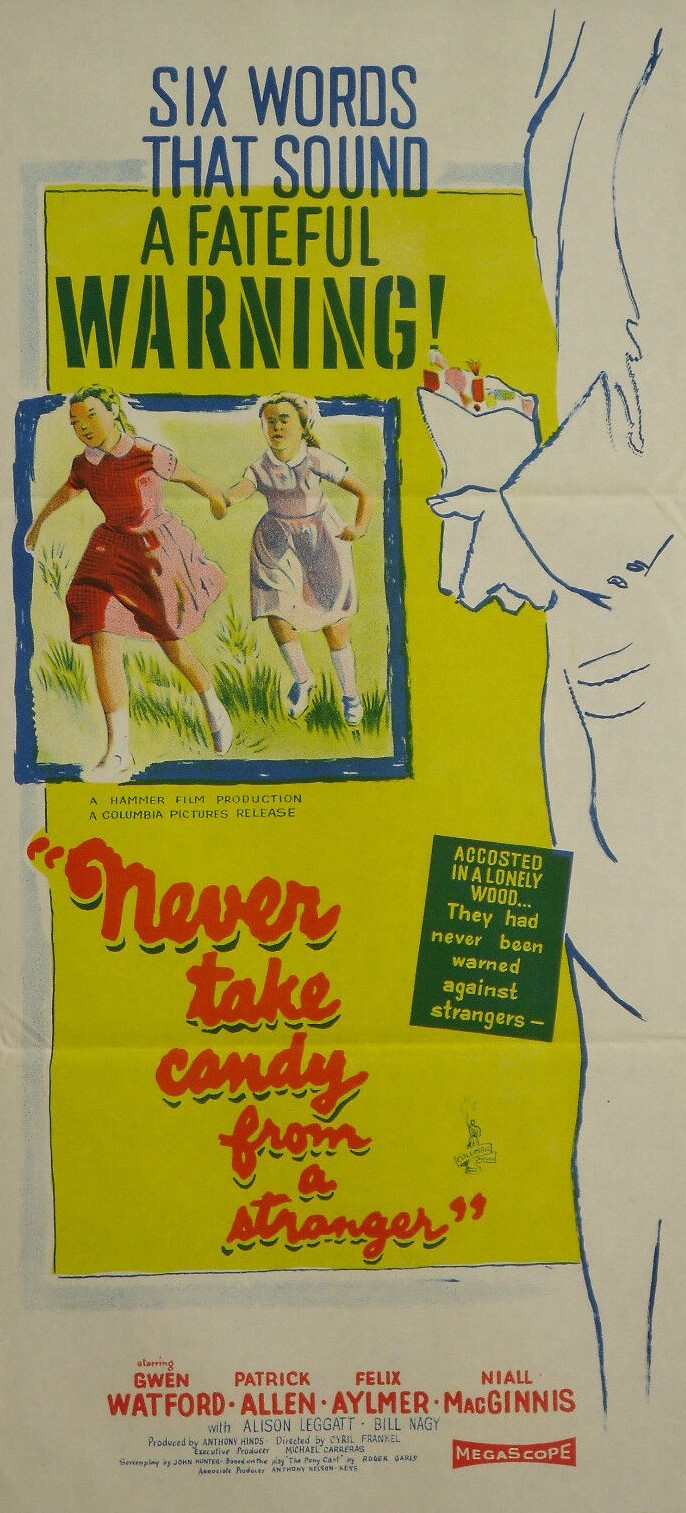
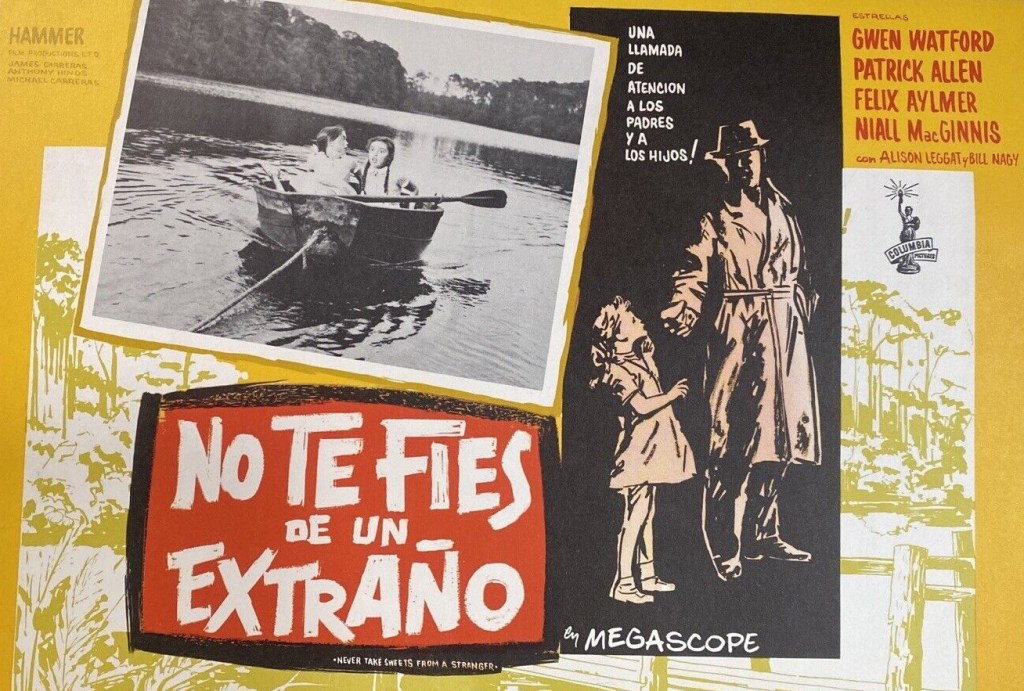
Banned in the U.S., box office flop in Britain, consigned to the vaults for over three decades, and when revived and you wonder how everyone could have been so wrong. A sensitive portrayal of a family caught up in local Canadian politics when their daughter accuses a dignitary of molestation, it carefully avoids the exploitation trap. At times tense, thrilling and heart-rending, with dynamic use of sound – sirens, footsteps, tracking dogs – it’s probably the best Hammer picture of the decade.
Young Lucille (Frances Green) takes her new friend Jean (Janina Faye), daughter of newly-arrived immigrants Peter (Patrick Allen) and Sally Carter (Gwen Watford), to visit an old man Clarence Olderberry Sr (Felix Aylmer). When the child returns home, not initially perturbed by what occurred, it transpires that, in return for a handful of candy (sweets in British parlance), she danced naked.
Sally’s mother Martha (Alison Leggatt), conscious of the disruption accusations might cause, tries to play it down. Sally reports the incident to the police chief Hammond (Budd Knapp) who is reluctant to pursue a case against the town’s most important person. Clarence Jr. (Bill Nagy) warns Peter of disastrous consequences. Lucille’s parents send her away so she cannot back up Jean’s story.
There follows trial by town, the whole family receiving the enmity of the local populace, while Jean is destroyed in the witness box by the prosecutor (Michael Gwynn), ending up so distraught her parents throw in the towel, the accused walking released scot free. Rancour is such Peter quits his job but as they prepare to quit the town, Jean goes off playing in the woods again with Lucille.
Stalked by the old man, they race terrified through the woods and into a rowing boat on the water only for the assailant to grab the tow-line and pull them back.
Movie tie-in by the author of the original play.
What could have easily pandered to the worst possible taste is incredibly well done. Strangers arousing the ire of a local populace is a trope as old as the hills so none of the consequence of their action was surprising. Nor, for the time, was the disgust expressed that such an accusation could be cast, not even if the old man has a history of mental illness, a voluntary patient whose records have conveniently vanished.
Whether the son has any inkling of the truth, or whether he is equally appalled, is never made clear as he is in any case duty bound to defend the family’s good name. But compromise is the name of the game. And whereas you can understand Lucille’s father not wanting to risk his job, Sally’s mother falls into a different category, the uptight Englishwoman who dare not challenge the existing order. There’s a terrific scene when she is suddenly made aware that she is in the wrong but is too frightened to admit it.
Jean’s experience could easily be repeated today, thousands of women refusing to accuse in case they end up slandered or defamed, or find themselves taking on powerful men with powerful friends. We all know how easy it is for an unscrupulous lawyer to embark on witness character assassination. Initial corruption of innocence can be heightened by testifying in a witness box.
The sub-text of the film, while never remotely explicit, is that adults were only too aware of the existence of paedophiles, regardless of trying to write them off as harmless as Martha does, and it was virtually impossible is those more innocent times to explain to a child the dangers of taking candy from a friendly stranger.
Director Cyril Frankel (Operation Snafu, 1961) has done an excellent job of opening up the stage play by Roger Garis, and yet imposed quite a claustrophobic feel to the enterprise. Having escaped a potential captor, Jean is a prisoner of consequence, initially disbelieved, paraded in front of a hostile town, belittled by the prosecutor, despised by the jury, and let down in the end by her fearful parents who, having put her through the court ordeal, decide it is too much. And when she is free it is only to fall prey once again.
Patrick Allen (The Traitors, 1962) is custom-made for this kind of principled role, but Gwen Watford (Taste the Blood of Dracula, 1970) makes the most of a rare top-billed part, caught between conscience and status quo, battling an entrenched male hierarchy, undone by her own mother. Janina Faye (Day of the Triffids, 1963), only a couple of years older than the character she was playing and hopefully had little knowledge of the background to her role, is excellent as the young girl who discovers that innocence has a guilty side.
Well worth a watch with, unfortunately, a story that still rings true today.
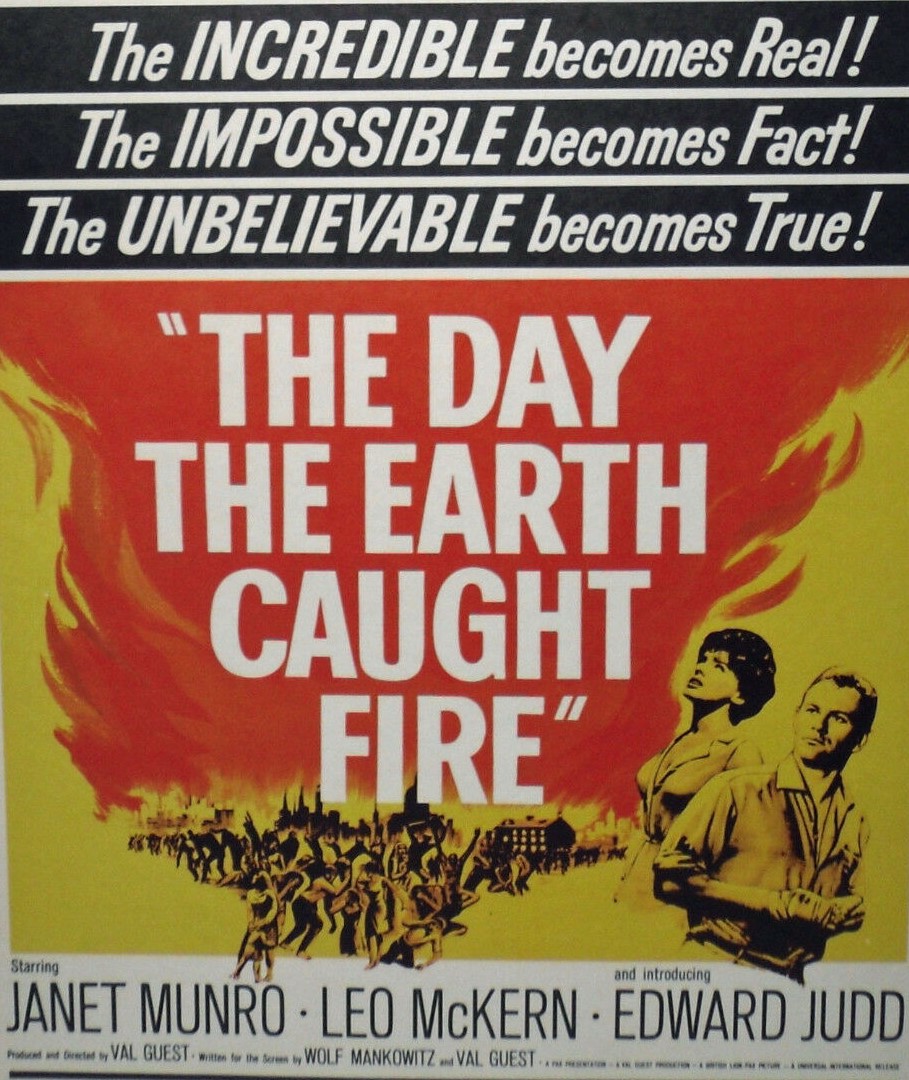
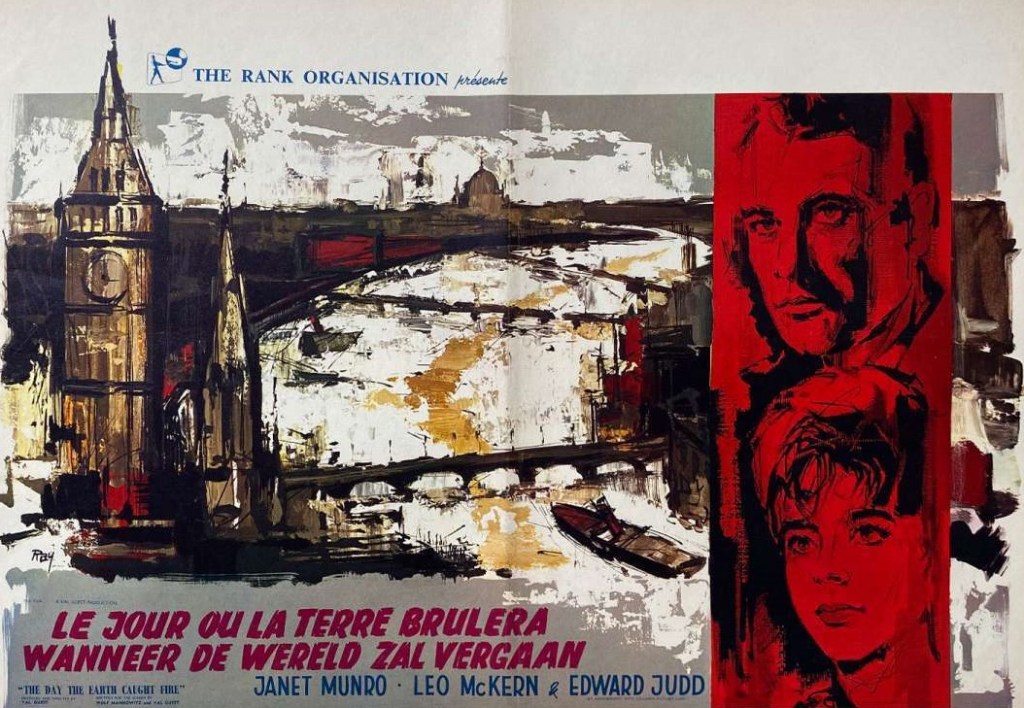
A more prescient picture you couldn’t find, tapping into a contemporary audience’s greatest fear – global warming. Its bold cliff-hanger ending would also appeal to a modern audience often left dangling at the climax of a blockbuster. And it cleverly skims on the special effects, relying on the more easily achieved downpours, thick fog, constant sweating, newsreel footage of natural disasters, water rationing and end-of-the-world riots than anything bigger.
But what surprised me more was the sheer pace. Not just a story moving at a frenetic pace but the British characters acting like they had been injected with a heavy dose of New York zap, talking over each other, hardly getting a complete sentence in before interruption, like Howard Hawks had taken command instead of a mere Englishman like Val Guest (Assignment K, 1968), a former journalist.
Front cover of the Pressbook.
It channels the director’s experience into creating the most realistic newspaper office you will ever come across, beating out All the President’s Men (1974) in its representation of how journalism really works, as concerned as much with the general fodder of unheralded stories as the scoops that normally drive such a narrative. And for a story that started off as pure pulp, the dialog is superb, so good it won the Bafta award.
It certainly helped that an actual newspaper editor, Arthur Christiansen (of the Daily Express) lent a guiding hand, playing the role of the editor of this downmarket daily. The summoning of copy boys (actually grown men), the demand for 500 words, the printers ready to switch the front page at a moment’s notice, the inevitable diet of pie and pint, and the emotional casualties as marriages crumble under the strain of a husband more concerned with this next story than wife or children, all serves to ground the film.
And yes, the narrative plays into the usual journalistic tropes, ambitious newspaperman Peter (Edward Judd), career on the line, uses typical wiles, duping lowly scientific secretary Jeannie (Janet Munro) into revealing more than she should. It’s a meet-cute of the old-fashioned variety, she hates him on sight.
Peter is as off-kilter as the world, knocked off its axis by the simultaneous explosion of nuclear devices, unable to come to terms with his divorce, finding solace in the time he spends with his child, and it seems fitting that much of that is spent diving into the darkness of the ghost train ride, the fog equally thematic as he wanders round in circles in that, as aimless as in his life, while a bath is just as cinematically important, not just for the obvious semi-nude scene but as a place of refuge from impending terror.
These journalists know how to sniff out a story, how to separate the what from the chaff of the official line, digging deeper, and with global connections able to put two and two together far swifter than officialdom. It helps that Peter’s guardian angel Bill (Leo McKern) has a scientific brain and is able to work out the source of the infernal rising temperature.
It’s axiomatic of how clever the screenplay is that Peter and Jeannie come together over a lost child, although Peter, cynical and bitter, but more vulnerable than most, remains a conniving character, happy to risk their burgeoning relationship for the sake of a scoop.
Like Quatermass and the Pit (1967) it’s one revelation after the other as the world hurtles towards oblivion, though not before ending up as the biggest barbecue of all time. The film acknowledges the anti-nuclear demonstrations of the time before piling on proof that man has sown the seeds of destruction on a four-month countdown to doomsday.
We have been here before with end-of-the-world scenarios but this story unfolds not in scientific or official offices, and there’s no President around to add gravitas or take the blame, but in the minds of the dogged journalists, soon appalled by their discoveries, and for once a scoop is unable to save the day or give the villain his just deserts. Whoever is behind the catastrophe remains nameless, although the outcome of superpowers duking it out for supremacy is never in doubt.
Edward Judd (First Men on the Moon, 1964) delivers a star-making performance as the jaded, jagged, journo capable of emotional depths while Janet Munro (Hide and Seek, 1964) escapes Disney tomboy servitude with a very adult role. Leo McKern (Assignment K) has the solid acting chops that would, two decades before television fame as Rumpole of the Bailey, see as a formidable heavyweight addition to any film and a threat to any co-star through jis charismatic ability to steal scenes.
But the film belongs to Val Guest, who constantly turns up the emotional heat and the terror scale, getting the most out of the riveting, sparkling screenplay he co-wrote with Wolf Mankowitz (The 25th Hour, 1967).
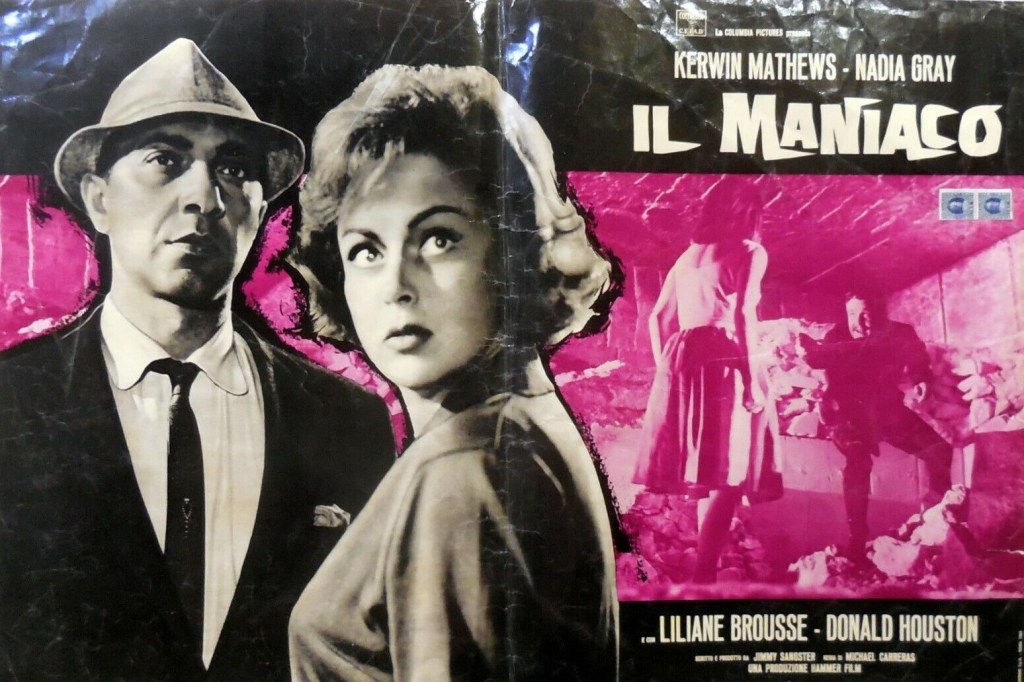
Such an ingenious thriller you just have to applaud. Opening with a close-up of a predatory eye, this scarcely draws breath as it dashes through a latter-day film noir maze, spawning out auditory and visual cues, beautiful woman luring dupe, twisting the expected narrative round her little finger.
Artist Jeff (Kerwin Mathews) setting up his easel in the Camargue, hardly one of the most tourist-friendly spots in France, eyes up Annette (Liliane Brousse), the daughter of a hotelier Eve (Nadia Gray), but, in extremely opportunistic style, settles for the mother. In true noir fashion she is using him, seducing him into a scheme to free her husband George (Donald Houston), incarcerated in a mental asylum for torturing and killing with a blowtorch the aforementioned predator who raped Annette four years before.
Eve convinces Jeff that in return for his freedom the madman will effectively give his blessing to their affair. It’s a deal only a besotted dupe would fall for. George has an ally inside the asylum, assisting his escape, but when George turns up, and Jeff drives him to Marseilles, he leaves behind the corpse of his criminal associate in the boot. Jeff dumps the body in the river.
Cue the start of a series of strange events. A fired-up blowtorch is discovered in the garage where Georges committed his initial crime. Annette, jealous of her mother’s relationship with Jeff, plans to leave and go with her father.
And I’m sorry to say that in order to explain the attraction of this neat little picture I’m going to delve into SPOILER ALERT territory.
All the while of course you are wondering whether George will keep to his side of the bargain, especially as Eve starts to get antsy with Jeff, and the investigating police inspector seems overly suspicious. And it being this kind of picture you expect a twist.
But not one this clever.
George, blowtorch at the ready, traps Jeff in the garage. He has fished the corpse out of the river. He plans to burn the garage to the ground, leaving behind two dead bodies, assuming the police will imagine that in a further bout of psychotic behavior the murderer gave in to his desires and killed again, but in the process accidentally killed himself.
But that’s not the final twist.
One of the victims survives. But which one? He is so badly mutilated as to be rendered unrecognisable and lies in a hospital bed covered head to foot in bandages. Has Eve’s plan backfired? Has she accidentally killed her lover?
But that’s not the final twist.
Eve knows who the man in the bed is. It’s not her lover. Because Jeff is just the dupe. The body dumped in the river was George. All the time Eve was visiting her husband in the mental asylum she was carrying on an affair with one of the guards. The guard killed George after the escape, retrieved the body from the river, left it in the garage and planned to kill off his competition at the same time. If you’re going to be tabbed a maniac, you better behave like one.
It’s a shame you can’t see the shock on the face of poor Jeff because he is encased in bandages. And this isn’t just the clever villain unable to stop herself boasting about how clever she has been. This is Eve getting into the murder racket. She switches off his oxygen.
But that’s not the final twist.
Jeff ain’t dead. He wasn’t even on a life-support machine. He was just trussed up to tempt Eve in revealing herself. He had escaped the garage inferno and told the police what was going on. So you can guess the rest, but even then there’s one other ironic twist. Just like Jeff, the imposter George is as taken with the daughter as the mother.
The twists are so well done, the narrative so compelling, that would be enough to make a convincing case for entry into the category of cult. What makes an undeniable case is the directorial style. Sights and sounds drive the story as much as anything. The eerie bright light in the garage, the sound of blood dripping on the floor, the bold close-up of the eye, the advancing blow torch, setting it in a bleak rather than scenic area of France, are cinematic notions belonging to classic movies, not to a tawdry B-picture.
Although The Devil Rides Out (1968) is generally considered the top Hammer picture of the decade, I would argue this runs it a close second, and possibly even tops it. Taking time off from his studio job Michael Carreras (The Lost Continent, 1968), later Hammer’s managing director, delivers a little masterpiece working to an effortlessly clever original screenplay by future director Jimmy Sangster (The Horror of Frankenstein, 1970).
It’s enough that Kerwin Mathews (The 3 Worlds of Gulliver, 1960) is playing against his screen persona as upright hero. The biggest advantage in casting Nadia Gray (The Naked Runner, 1967) was that she was unknown and didn’t have the kind of onscreen presence that might have you doubting her motives from the start. Liliane Brousse (Paranoic, 1963), in her penultimate movie, is initially too much all-arched-eyebrow and pout, only coming into her own when she becomes dutiful daughter rather than wannabe seducer. The pretend George, real name Henri, Donald Houston (A Study in Terror, 1965), hidden beneath dark glasses most of the time, is a dab hand at a pretend psychopath.
The unexpected U.S. box office success should have propelled star Kenneth More into the Hollywood firmament. The British box office champ of the previous decade, after comedies like Genevieve (1953) and Doctor in the House (1956), war movie Reach for the Sky (1956) and drama A Night to Remember (1958), he had been rewarded by a tie-up between British studio Rank and Twentieth Century Fox. That allowed him bigger budgets and bigger co-stars, pairing him with Jayne Mansfield in comedy western The Sheriff of Fractured Jaw (1958), and Lauren Bacall for historical adventure North West Frontier (1959).
While hits in Britain, they failed to raise his profile in America. That changed with Sink the Bismarck!, his performance highly praised, the movie a genuine and very profitable hit. It should have been the stepping-stone he needed to break into the Hollywood big time. And for a short time it looked as if he would.
He was scheduled to co-star with Gregory Peck in the big budget high adventure war picture The Guns of Navarone (1961), in the part that finally went to David Niven. He lost the role through petulance.
At a public event, he verbally tore into his boss, John Davis, head of Rank, to whom he was contracted and on whose goodwill he relied to loan him out to Columbia for this movie which would become the number one hit in the annual U.S. box office race. In revenge, Davis blocked the loan-out and in effect stymied his career. Few companies were going to invest in a star whose movies would automatically be blocked from being booked on the Odeon chain, owned by Rank, and one of the two biggest circuits in Britain. As a result of his intemperate, drunken, action, More’s career plummeted.
Oddly enough, Sink the Bismarck! also killed off the career of the German-born Dana Wynter, a rising Hollywood star, leading lady to Rock Hudson in Something of Value (1957) Robert Wagner in In Love and War (1958) and James Cagney in Shake Hands with the Devil (1959) and denoted star of Henry Koster’s Fraulein (1958). After Sink the Bismarck!, and On the Double (1961), she lost out on big roles until the low-budget If He Hollers, Let Him Go (1968).
It seemed almost a contradiction in terms that such a big hit as Sink the Bismarck! could produce no outright winners in the career stakes. And although director Lewis Gilbert had a stab at the Hollywood big budget picture with The 7th Dawn (1964) starring William Holden, he relied on later British pictures Alfie (1965) and You Only Live Twice (1967) to give his career the fillip it surely deserved.
Lewis Gilbert was virtually a veteran by the time Sink the Bismarck! appeared, 16 previous pictures including Reach for the Sky, another More-starrer Paradise Lagoon (1957) and Carve Her Name with Pride (1958).
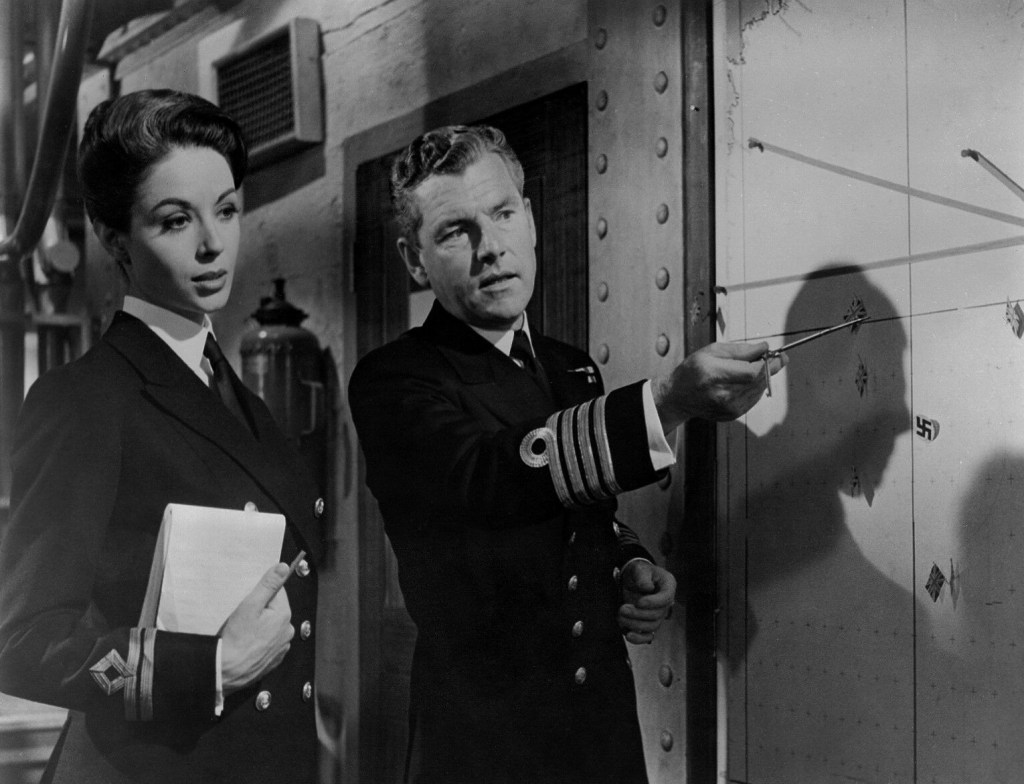
Kenneth More explaining details to Dana Wynter. In the movie they would have the most buttoned-down romance you could imagine, feelings not pronounced until the end.
Gilbert described Sink the Bismarck! as a “detective story set at sea,” and that’s the picture he determined to make, focusing on the hunt more than the normal World War Two heroics, the usual battleground endeavours taking second place to backroom tactics that resembled a “psychological chess game” between British and Germans. It was a change of pace for star Kenneth More, his screen persona the opposite of “someone so stiff and buttoned up.” A star of More’s caliber was all the movie needed to be funded.
The bigger problem was the hardware. “If we were to film on real ships, explode old ones even,” recalled Gilbert, “we would need the cooperation of the Admiralty.” Luckily, the wife of producer John Brabourne (Romeo and Juliet, 1968) was the daughter of Earl Mountbatten, the former Governor of India, who happened to be First Sea Lord (head of the Admiralty) who could put in a good word.
“Blowing up ships, or bits of ships, turned out to be not so hard,” explained Gilbert. Portsmouth’s naval shipyards contained many vessels whose active days were over and who were considered nothing more than scrap metal. So, prior to the commencement of shooting, Gilbert took a crew into the shipyard and began the blowing up. Because these were not models, the use of real ships “gave the film extra conviction.”
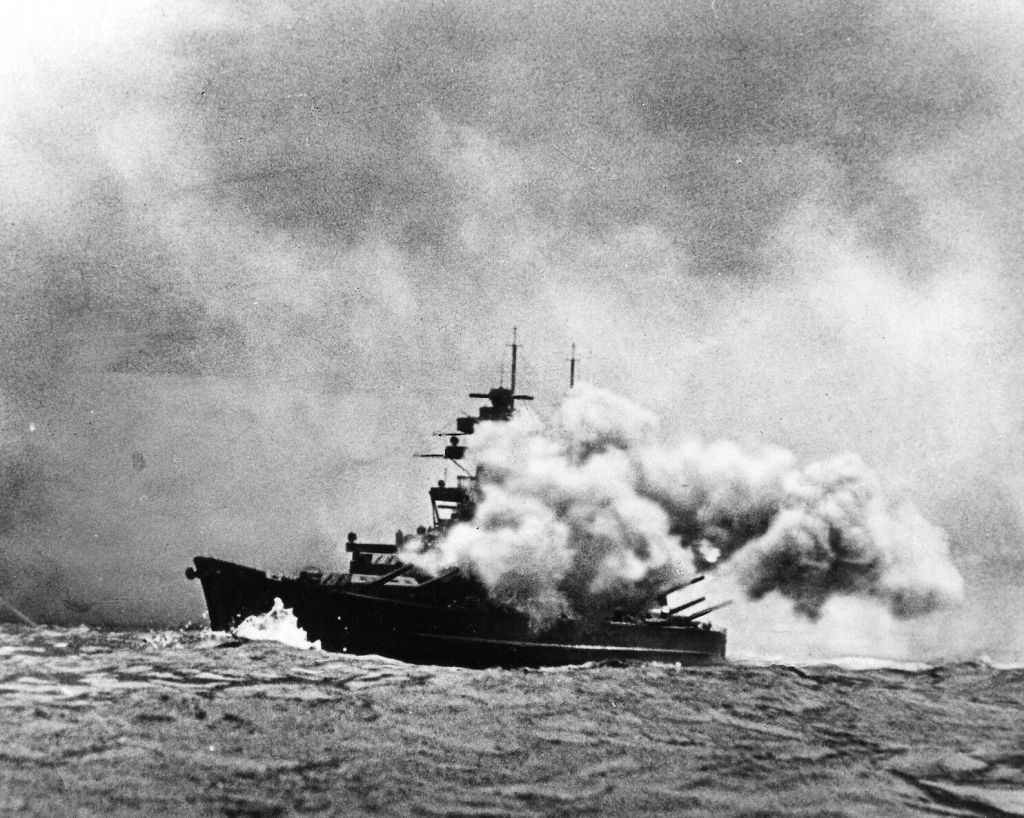
Gilbert also received permission to film on HMS Vanguard, the last British battleship of the era still on active duty although it too was due to be scrapped. That permitted filming the ship’s 15-inch guns in action. It doubled for scenes set aboard HMS Hood, Prince of Wales, King George V and the Bismarck, creating greater authenticity. HMS Belfast stood in for the pursuing cruisers including HMS Norfolk, Suffolk, Dorsetshire and Sheffield. A Dido-class cruiser provided the set for Bismarck’s destruction.
Aircraft carrier HMS Victorious played herself as well as HMS Ark Royal but any actual flying took place aboard HMS Centaur. The destroyers participating in the night-time attacks were HMS Cavalier and HMS Hogue. The bridge of the Prince of Wales was “reproduced down to the last detail.” One of the officers wounded in that attack was Esmond Knight, an actor on the film, who had virtually lost his sight, but from memory was still able to determine that the bridge was “a perfect replica.”
Three Fairey Swordfish biplanes with torpedoes were used. Three RAF jet pilots volunteered to the fly the biplanes in the movie for the experience of understanding the risks involved in diving at less than the top speed of 138 mph in a machine which was little more than wood and canvas to drop torpedoes on a highly-armed ship, but Gilbert had already hired specialist crews.
Top Hollywood model maker Howard Lydecker (The Underwater City, 1962) was recruited to build the 20ft model of the Bismarck, which, unfortunately, sank on launch. Raising it was not a problem. Long shots were filmed on the massive Pinewood water tank. It helped the production that during the battle the weather had been foul, so ships could be seen emerging from fog, or rendered invisible because of it.
Gilbert used his own wartime experience to render the battle realistic. He remembered sailing past the Scharnhorst, one of Germany’s three most powerful battleships, being unable to see it because of fog but aware of its presence from the sound of its guns. “We knew it from what we heard and felt, not from what we saw.”
Post-war the sinking of the Bismarck became a cause celebre. The British were accused of a war crime for nor picking up survivors. However, the British claimed that the presence of U-boats in the area rendered this too hazardous.
SOURCES: Lewis Gilbert, All My Flashbacks (Reynolds & Hearn, 2010) p 197-203; Brian Hannan, The Making of The Guns of Navarone (Baroliant Press, 2013) p67.
Hard to believe but outside of the Hollywood big-budget Bridge on the River Kwai (1957), this was the biggest British film at the U.S. box office in the previous decade. In fact, the British war films that did so well in the home territory, The Cruel Sea (1953) and Reach for the Sky (1956), sank like a stone when exported to in America while earnings for Ealing comedies, limited to arthouses, hardly made a dent in the box office.
What makes this so appealing is the very lack of Britishness and the intrusion of a Yank, famed reporter Edward R Morrow (playing himself), interrupting the action at various points to keep audiences up to speed. The fact that the sinking of the Bismarck, the biggest battleship ever built, was one of the few British actions at the start of the Second World War to be counted a success probably helped. Watching the Brits being lionized for defeat was not an attractive notion for global audiences.
But in the main it is a thrilling docu-drama, very much a departure for the genre, with every nuance of potential consequence spelled out. Dialog and models being moved across maps announce the risks inherent in the British attack: the superiority of the newly-built German battleship, the multiple options the Germans had in 1941 to escape, the difficulties in pinpointing the German vessel in the fog-bound waters of the North Sea, and the devastation the battleship could inflict on the beleaguered convoys on which Britain depended to stay afloat. In addition, even when targeted the Germans could flee to occupied France or potentially summon U-boats or air support.
So in the manner or Operation Crossbow (1965) or Day of the Jackal (1973) the audience is primed for a minute-by-minute enterprise, the battleship deemed so dangerous that the Admiralty is willing to risk its own scarce supplies of battleships, destroyers, cruisers and aircraft carriers in a bid sink the enemy. It is so much a documentary that the beyond the thrill of the hunt there is little room left for drama and certainly little of the stirring kind that had become such a byword for the British version of the genre – and such a turn-off for foreign audiences who could hardly make out what the actors were saying never mind work out why such-and-such a mission they had never heard of was so important.
In any case emotion is forbidden in the subterranean claustrophobic Admiralty War Office where new operational commander Capt Shepherd (Kenneth More) holds sway. A martinet, “cold as a witch’s heart,” on arrival he rids staff of what he sees as the rank indiscipline of addressing colleagues by forename rather than surname, eating sandwiches at a desk to which the workforce have been chained for hours and various minor offences against the strict code of a uniform.
It was inherent in this type of picture that the land-based unit suffer the casualties of war, husbands dead or missing in action, wives and children killed by German bombs. But the tightening of the stiff-upper-lip ensures that when such revelations become known, they appeared like emotional depth-charges on this otherwise staid ocean. And Capt Shepherd, through his choices, as would be true of many high-ranking officers, might be sending his own son to is death.
This is also one of the first instances in war pictures where the Germans are not treated as stock villains, but intelligent people, like Admiral Lutyens (Karel Stepanek) with his own vanity and a hunger for redemption, and Capt Lindemann (Carl Mohner), as valiant an opponent in the cat-and-mouse duel where outwitting the British enemy could wreak untold carnage and hasten – unusually from the German point-of-view rather than from the Allies – the end of the war.
A few months after launch the Bismarck is spotted leaving its home port, destination North Atlantic to feast on convoys travelling from America with invaluable supplies. There are four possible routes open to get round the top of Britain. To prevent the Germans reaching any of them British ships must be sacrificed, including HMS Hood – three survivors out of a crew of 1400.
It’s David vs Goliath except David is a terrier capable of inflicting tiny wounds that drain the battleship of some of its power, loss of fuel and rudder problems limiting movement. It’s a different kind of war picture, as well as the big guns blasting at each other over huge distances, the British employ biplanes loaded with torpedoes, a weapon also used in some instances by its ships.
To keep audiences more heavily involved, there are snippets of dialog involving characters on board the various ships, some in distinctly un-stiff-upper-lip mode, and montages of the various vessels getting ready for action, as well as shots of devastation should a shell find its target.
But basically it’s brilliantly-told tactic-heavy war picture that shows the shifting battleground, how the various ships are deployed, with no shortage of telling the audience how crucial success is and how crushing defeat. There’s no reliance on individual heroism, no snappy soldier defying authority, no hunch being played out, none of the usual cliches of the genre, instead, as with The Longest Day (1962) a clear explanation of what’s going on with superb battle scenes for the action-inclined.
It’s fair to say that even on the small screen, the models look a bit iffy, but this is more than compensated by other scenes on real warships, the use of newsreel footage, and fast cutting. That action never takes place under a clear blue sky but always in murky waters also adds to the realism.
In a role that would have been custom-made for Kenneth More (The Comedy Man, 1964), king of the stiff-upper-lip, rather than simply spouting his lines, he adds considerable emotional depth. Dana Wynter (Something of Value, 1957) is excellent as his equally buttoned-up assistant.
There’s a full crew of supporting British character actors including Michael Hordern (Khartoum, 1966), Laurence Naismith (Jason and the Argonauts, 1963), Geoffrey Keen (Dr Syn, Alias The Scarecrow, 1963) and Maurice Denham (Some Girls Do, 1969) while the Czech-born Karel Stepanek (Operation Crossbow, 1965) and Carl Mohner (Assignment K, 1968) inject humanity into the Germans.
Lewis Gilbert (The 7th Dawn, 1964) does a brilliant job of bringing this all together, adding touches of emotion and humour to what could have been a too-dry concoction, drawing on a screenplay by Edmund H. North (HMS Defiant/Damn the Defiant, 1962) which was based on the book by C.S. Forester of Hornblower fame.
Director William Wyler was “saved,” to use the term preferred by his biographer Jan Herman, from what turned out to be the biggest picture of all time (up till then) The Sound of Music (1965) by a piece of door-stepping by two determined young producers who presented him with a pre-publication copy of John Fowles’ novel The Collector.
Wyler had been well down the pre-production route for The Sound of Music. It was he who hired Julie Andrews, having seen her performance on Broadway in My Fair Lady, and been granted access to the rushes of Mary Poppins (1964). While he was an odd choice to direct, being more of an opera buff and hard of hearing, he would later nurse Funny Girl (1967) to box office and critical acclaim.
While instinct told the German-born director that The Sound of Music “would be a success” he was troubled that it was set in Austria at a time just before World War Two when the country was mostly whole-heartedly welcoming the Nazis. “I can’t bear to make a picture about all those nice Nazis,” he said.
So when novice producers Jud Kinberg and John Kohn, television writers who had set up Blazer Films, brought him what would turn out to be a sensational bestseller, actor Terence Stamp already under contract and a deal in place with Columbia, turned up on Wyler’s doorstep with a completed screenplay they gave him a reason to pull out of The Sound of Music. He ignored the screenplay in favor of devouring the book.
“I couldn’t put the book down and I’m a man who can put down books very easily,” he said. While not so enamoured of the screenplay by Stanley Mann, he signed up, and although since the 1950s he had either officially or unofficially acted as producer on his own movies, he agreed to allow Kinberg and Kohn to do the job this time, as long as they did not interfere with direction and that he, of course, had final say.
Despite critical acclaim for Billy Budd (1962), a part he won ahead of the likes of Warren Beatty, Terence Stamp had not made a film since, and begun to doubt whether he was cut out for stardom. He wasn’t short of media attention – the various women he squired seemingly all the time made sure of that – but he was distinctly lacking in movie offers.
He took on the role of the deranged Freddie – even though he loathed the character – primarily because he had no other choice. “I hadn’t gotten any new work in roughly a year,” he explained. “I knew the camera loved me, so I had confidence in that. But I just thought this Freddie character was beyond me.” And once Wyler was signed, Stamp felt he would not come up to the director’s high standards. Told that Wyler had no objections to his casting, the still dubious actor asked to take part in the screen tests the director was holding for actresses hoping to win the role of Miranda, the female lead, partly to feel his way into the part and partly to give Wyler an opportunity to fire him if he wasn’t up to the mark.
Without the director being present, he tested with Sarah Miles, whom he had played opposite in Term of Trial (1962) and Samantha Eggar (Doctor in Distress, 1963). Once Wyler saw the footage, with Stamp clad in his own notion of the character’s clothing he expressed his confidence in the actor and told him, “I’m not going to make the book. I’m going to make a modern love story.”
Samantha Eggar was fired three weeks into rehearsals, undermined by just how good Stamp was, unable in her inexperience to cope with his “nasty attitude,” a deliberate decision by the actor, remaining in character during shooting, in part because they had attended drama school together where he had a crush on her and could not allow himself to feel inferior to her. Although his character worshipped her in one sense, his level of entitlement made him feel superior to her in another.
It turned out Stamp was following Wyler’s instructions. The director didn’t want Stamp and Eggar mixing off-set. The actor was to be as cold to her in real life as the character was in the film.
There had been enormous press coverage over Eggar being chosen, one of those Gone with the Wind-style star hunts of which Hollywood was so fond, so the press would leap at the news that she had departed the picture without shooting a scene. Wyler, in the meantime, pursued Natalie Wood (Splendor in the Grass, 1961), a far more accomplished actress and certainly not going to be dominated on screen, or in real life for that matter, by the likes of Stamp. Columbia production head honcho Mike Frankovich intervened on Eggar’s behalf, a script read-through was arranged, and Eggar was back in, on condition she agreed to an acting coach, Kathleen Freeman, of Wyler’s choosing.
But it wasn’t just the humiliation of working with a coach – although Marilyn Monroe famously employed a coach, she was scorned for relying on one – that Eggar had to put up with. Eggar wasn’t permitted to leave the set during the day, or eat with the rest of the cast, forcing her to remain in the daunting isolation of her character.
“He wanted her in a constant state of terror and that’s really very difficult to act,” revealed Stamp, who agreed to conspire with the director to drag out of her the performance of her life. It felt to Stamp that they were torturing the young actress even if that extended to no more on his part than giving her the cold shoulder.
Wyler went further. He wanted her to feel defenceless. During the rain sequence, she had a bucket of water thrown in her face so she was absolutely drenched. And while her travails were not much compared to what, for example, Kate Winslet endured on Titanic, it has been viewed as yet another example of a director bullying a young actress.
I’m not so sure about that, to be honest. The scene called for Eggar to be soaked to the skin and whatever way that occurred she would need to be absolutely drenched. Whether she believed a gentle shower of rain from a sprinkler would achieve the same effect is unknown and you might consider whether Wyler took the bucket approach because he believed her incapable of registering the required look of shock.
It transpired that Eggar hadn’t a clue, beyond checking his credits, who Wyler was. She hadn’t been allowed to visit the cinema until she was 18. And “had no knowledge…of the history of film.” Directors scarcely made the gossip pages and the flurry of biographies and critical appreciations were a few decades away. And minus VHS or DVD there was no way to easily lay your hands on a director’s back catalogue. “I was very ignorant,” she admitted, “of the position that he held as a Hollywood icon.” It’s entirely possible she never even saw Ben-Hur, for she has never mentioned doing so.
During the love scene, she was kept nude while Stamp had his clothes on. “I kept wondering why I had to stand there with no clothes on when they were only shooting me from the waist up.” (And in keeping with the Production Code rules, no nudity was shown on screen). Eggar wondered if perhaps Wyler, who had a reputation as a ladies man and enjoying dalliances during shooting with some of his actresses, had taken a fancy to her. But he showed no signs of making any moves or even making the kind of remark that suggested he was in love with her, or ogling her body. It was just another device to keep her in character. (Thought it might have been better all round if she had been given some say in this approach.)
On the other hand, Wyler clearly went out of his way to help her. He reversed his own decision to use her. To help her remain in character and develop her role, ridding her gradually of the confidence she exuded in her earlier scenes, Wyler shot the film in sequence, as unusual a method in Hollywood as the other techniques mentioned here. And when a photographer hid in the gantry to get a shot of Eggar in the nude, Wyler raced to her defence, ripping the camera from the intruder’s hand, destroying the film and throwing the man out.
A later decision in the editing room enhanced her performance without the actress having to express single emotion, speak an extra line or give another look. The script called for her character to remember her lover, using his image to see her through her ordeal. But Wyler completely cut out actor Kenneth More playing the lover, leaving in just one shot of the back of his head, so that instead of appearing to rely on that memory and those feelings to combat the situation, she was presented instead as woman of great resilience. “It’s love keeping her alive,” Eggar would later say.
And there’s certainly no sense that Wyler was dissatisfied with her performance. However, like Stamp, she doubted her own skill. “At first I just felt I couldn’t do it. It took me five weeks to get on Wyler’s wavelength. When it’s over you realise you have done the best you could do. It’s very satisfying for an actress.”
Stamp saw a different side to Wyler. He recalls a director who didn’t even call “action.” He would “simply roll his hand” in order not to disturb an actor’s concentration. Unless, of course, an actor was not up to the mark: Maurice Dallimore, who played the nosy neighbor, felt the rough edge of the director’s tongue when he could not manage the necessary English accent.
Originally, Wyler intended to shoot the film in black-and-white. But when the cinematographer did a black-and-white test of Eggar he also did a color one that captured the magnificence of her red hair and skin. Wyler had feared that color would act as a distraction and “could be phony, exaagerated.” Except for some establishing shots in Britain, the picture was shot in Hollywood. The scene with the bathwater running down the stairs was not in the book and of course Wyler took quite a different approach to the novelist. Even so, John Fowles appeared pleased with the result.
Stamp changed his views of Wyler. Initially, he told Roger Ebert, “I don’t go much for Wyler.” But, contacted by Jan Herman for the Wyler biography, he claimed Wyler and Fellini were the two best directors he had ever worked with. “It was one of the great experiences of my life. He was just wonderful in a way I’ve never come across before,” he told Brian Raven Ehrenpreis.
SOURCES: Jan Herman, William Wyler, A Talent for Trouble (Da Capo Press, 1997) p418-428; Roger Ebert, “Interview with Terence Stamp,” New York Times, June 12, 1968; Brian Raven Ehrenpreis, “Get Your Sword!”, www.thequietus.com , August 25, 2018; “Collecting Life, An iIterview with Samantha Eggar, www.terrortrap.com ; Kathleen Carroll, “Redhead Mad for Pink,” New York Daily News, June 20, 1965.
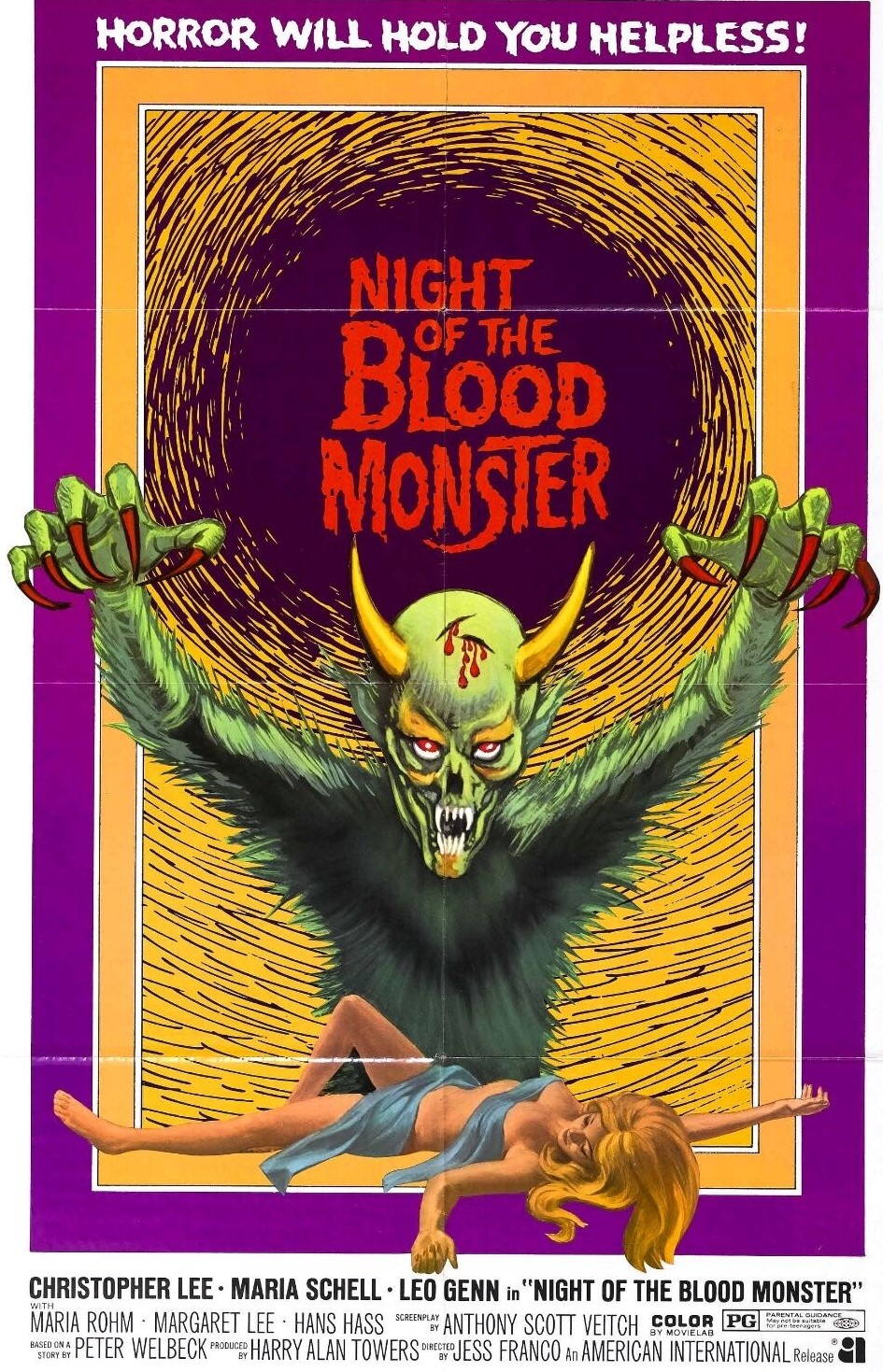
Handsomely mounted historical drama set in 17th century England on the brink of revolution meets Son of Witchfinder General. An uprising headed by the Duke of Monmouth in the south-west threatens to overthrow King James II. Involved in the plot are Harry Selton (Hans Hass), son of suspected agitator Lord Wessex (Leo Genn), whose beloved Mary Gray (Maria Rohm) is in the sights of Judge Jeffreys (Christopher Lee) after he has condemned her sister Alicia (Margaret Lee) to be burned as a witch.
The minute witchcraft enters the equation the narrative thrust is constantly interrupted by scenes of nudity, blood and torture, mostly involving women, but actually the film does attempt to cover the rebellion and its notorious aftermath when hundreds of rebels were executed, the “Bloody Assizes” with “Bloody Judge” Jeffreys to the fore. Conflating witchcraft with a genuine historical episode does not work very well and unlike Witchfinder General (1968), the murder of innocent women is more of a sideshow, despite the brutality involved, and you get the impression the story has been hijacked to accommodate supposed witch Mary in the interests of adding titillation.
Even as the story of the rebellion unfolds, the threat to the crown spelled out, the origins of the revolt mostly made clear (Monmouth being the illegitimate son of Charles II, and nephew to James II) although the sectarianism behind the rebellion is ignored, the narrative keeps jumping back to the witch element. Jeffreys connects the parallel narratives, hunting down rebels and witches, while handling most of the exposition. Given the budget, there’s a surprisingly good battle sequence, cavalry charging cannon. Given his later reputation, Jeffreys also reflects on the meaning of justice.
And while there are some camp moments – Jeffreys playing the organ while attired in grand robes, dancing girls sticking pins in his effigy – the twists and turns (Mary captured and rescued, captured again) are effective enough. Despite the copious nudity, there a couple of low-key love scenes and, oddly enough, a touching moment when Mary licks the blood from a dead prisoner. And for all the blood, that is effect rather than cause, nothing too gory.
But with the powerful all-mighty, and investigators able to plant evidence, and the innocent forced into immoral acts to save their loved ones, lawlessness is apparently next to godliness. But in reality the wicked did not get away with their crimes so various villains get their come-uppance.
Most peculiar sight is Christopher Lee in a love scene where he is not about to sink his incisors into a neck. Occasionally, the film bursts into German with English subtitles – as if various versions were pillaged to produce this copy – or has lines like “you turn me on.”
However, fans of Spanish cult director Jess Franco (The Girl from Rio) who expected something more along the lines of 99 Women (1969) and Venus in Furs (1969) may be disappointed that he spends so much time on the historical elements and less on the random T&A. You might not be surprised to learn of the involvement of ubiquitous producer Harry Alan Towers (Five Golden Dragons, 1967).
Sherlock Holmes vs Sherlock Holmes was the initial tantalizing casting prospect. Basil Rathbone, the most venerated actor to don the distinctive deerstalker, and Peter Cushing, just signed up by the BBC for a new 16-episode series, the former signed to play the villain, the latter his nemesis in a film that started out with the title of The Death’s-head Vampire, the first film by a new production shingle Tigon Films.
While Tigon was new, with a distinctive logo, its driving force was well-known British producer Tony Tenser who with partner Mike Klinger had initially specialized in exploitation pictures with titles such as Naked as God Intended (1961) and London in the Raw (1964). The pair split after the artistic and commercial success of Roman Polanski’s Cul de Sac, Tenser initially setting up under his own name for Mini-Weekend/Tomcat (1966), mining the exploitation vein as before, and The Sorcerers (1967) a new venture into the horror market. Expanding the business with fresh capital and new partners, Tigon was born.
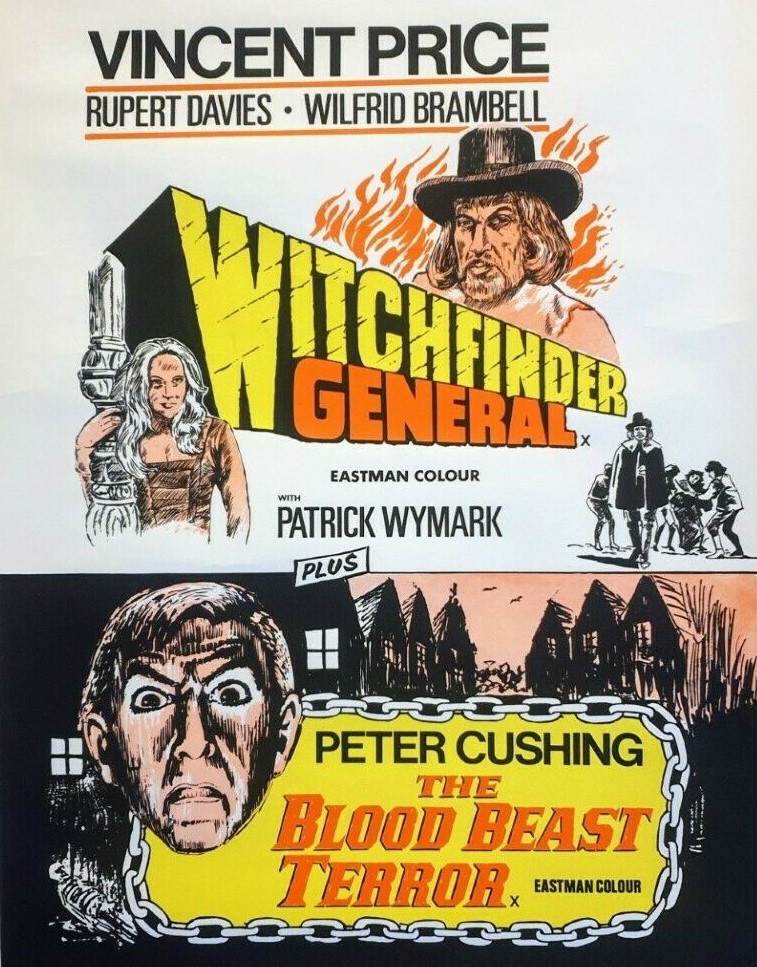
Supporting feature to “Witchfinder General” on ABC circuit release in Britain.
Explaining the new departure, Tenser said, “Films needs to be inexpensive. They need to sell, they need to appeal to an international audience, and one subject that always finds a market is horror.” Horror budgets were low, the genre did not require big stars, and the films had a surprisingly long shelf life.
First movie on the new company’s agenda was not The Death’s-head Vampire. Instead, Tenser had hooked Raquel Welch for a ghost story The Devil’s Discord to be produced by her husband Patrick Curtis, who had performed a similar task on The Sorcerers, and star Peter Cushing (The Skull, 1965). When that fell through, he held onto Cushing for a proposed Horror of Frankenstein and when that also bit the dust turned to him for The Death’s-head Vampire on a budget of just £40,000 (about $100,000). Offered the choice of playing villain Dr. Mallinger or Detective Inspector Quennell, the actor plumped for the “goodie,” Basil Rathbone lined up for the other role. The concept of older man/younger woman with action concentrated on an isolated house and the surrounding countryside was a horror trope.
Vernon Sewell (Strictly for the Birds, 1964), entering his third decade as a director, had worked with Cushing on Some May Live (1965) and was primarily known for low-budget and B-movies, and more importantly from Tenser’s perspective, sticking to a budget without any artistic pretensions or improvisation. He didn’t waste time on anything that would not be captured by the lens. He was calm on set, “nothing fazed him.” Cushing was a kindred spirit, never complaining, except famously, on this picture, when he told Sewell it was the “worst picture” he had ever made. The pair, however, had a very good working relationship to the extent that Sewell never offered Cushing any advice on the role –“he didn’t need my input.”
The Sherlock Holmes connection is promoted in this poster.
Just over two weeks before the August 1967 start date, Basil Rathbone died of a heart attack. Robert Flemyng, the last-minute replacement, was Cushing’s opposite, complaining all the time. The cast was rounded out by 32-year-old Doctor Who star Wanda Ventham (mother of actor Benedict Cumberbatch) and 18-year-old Vanessa Howard whose career highpoint thus far had been a duet with Cliff Richard for a television presentation of Aladdin (1967).
Interiors were shot at Goldhawk Studios, a converted three-story building in London’s Shepherd’s Bush, with exteriors at Grims Dyke, the former home of W.S. Gilbert, in north-west London. The 19th century manor house had lain empty since 1963.
Roger Dickens, who had cut his teeth on Thunderbirds Are Go! (1966) and worked on 2001: A Space Odyssey (1968) and would be later lionized for the mini-beast bursting out of John Hurt’s stomach in Alien (1979) was responsible for creating the monster. The model for the giant larvae was a much simpler task than creating a believable female giant insect. He took a mold of Ventham’s face, giving the features a repellant slant, using costume jewelry for the eyes, adding a furry cap and two-foot long antennae, a representation that would only really work if you scarcely saw the creature. For art designer Wilfred Woods his woods set turned into a disaster when the trees wilted and lost their leaves.
Opinions differ as to whether Tenser interfered with production. He saw his role during the film process to ensure that the project followed the script. “Sometimes you can put something in a film which will hinder the selling, sometimes you need to put something in which will help the selling.”
Comedian Roy Hudd, playing the morgue attendant, thought the script so awful he was delighted to work with Cushing on improvements.
When John Ford’s boast that he never shot an extra foot of film in order to prevent a producer turning in a different film has resulted in many a masterpiece, the same did not hold true for Sewell. Sticking so close to the script, not filming anything that was not absolutely necessary meant that the movie was too short. Editor Howard Lanning commented: “I put in everything that was available. Even with expanding the lecture scene and the amateur dramatics as long as possible, to the detriment of pace, the picture clocked in at just 81 minutes, not the length expected of a main feature.
To ensure the movie came in at the required length, Tenser added the African sequence at the beginning (an extra five minutes) and re-shot the morgue material (two more minutes), encouraging Cushing and Hudd to improvise. The final product was over-budget and a week late. The version shown to the censor was 87 minutes though the official running time was a minute longer.
Tenser now deemed the working title as insufficient, preferring “something catchy and something that told people what you were selling.” His first stab at a new title was Blood Beasts from Hell. But in the final analysis it was altered to The Blood Beast Terror. Hoping to sell it to a circuit as a main feature it was originally shown in a double bill with Castle of the Living Dead, but despite the supposedly attractive title, audiences were not interested. To cut his losses, the film was repackaged as the support to another Tigon production Witchfinder General (1967) which meant Tenser would not have to share receipts with another distributor.
The Blood Beast Terror did not prove so sellable overseas either. It was shelved in France until 1971, although, sold for a flat fee, it did well in South America. A.I.P. who had U.S. distribution rights to Witchfinder General – title altered to The Conqueror Worm – had no interest in The Blood Beast Terror but it was picked up by Pacemaker Pictures who were also in title-changing mood and released it in summer 1969 as Vampire Beast Craves Blood on a double bill with Curse of the Blood Ghouls (1964).
Tenser’s predictions of long shelf life were correct. In Britain, the movie was reissued on a late night double bill with The Secret of Blood Island (1961), and then was revived with The Devil’s Hand (1961) before being re-teamed with Witchfinder General on a Sunday’s-only screening. Although none of these would be circuit releases in the sense of a nationwide day-and-date opening, they were nonetheless likely to get reasonable bookings to fit specific engagement profiles. In the States where there was endless demand for horror triple- and quadruple bills and all-nighters, The Blood Beast Terror received ongoing bookings.
SOURCES: John Hamilton, “The Making of the The Blood Beast Terror,” Little Shoppe of Horror, Issue No 43, p67-91; John Hamilton, “Regretting Nothing: John Sewell, Little Shoppe of Horror, Issue No 43, p92-98.
Bizarre movie seeks cult audience! You might as well have stuck that on the poster. When I tell you the film climaxes like a Monty Python sketch with four successive men giving birth – from a variety of orifices – the first three to emerge different versions of the same character, the last the dead husband James (Paapa Essiedu) of Harper (Jessie Buckley). And that men also appear fully naked, in the form of some kind of vegetation, and can survive despite having an arm spliced from elbow to fingers. And that James desperately wants her to feel guilty about his suicide, triggered by her demanding a divorce.
Of course, all this could be taking place in her tormented mind except that she steadfastly refuses to admit to torment over the suicide even though she does scream her head off in church. If any of this is remotely realistic it points to someone with a severe downer on men, since there is not a single likeable one in sight. Men, in fact, are just four-letter words (choose your own) whose sole purpose is to accuse women of not loving them enough. And women – cue symbolism – are all born of Eve and inclined to eat a forbidden apple.
None of this would be so bad if in attempting a psychological thriller and/or horror film (I am assuming horror because of the births and arms sliced in two) there was actually a shock or two or even a general sense of creepiness. On the plus side, should this ever achieve cult status – “makes Titane look like Paddington” (1 or 2, you choose) – then I am sure director Alex Garland will only be too happy to turn up for a tenth anniversary Q&A and explain his intentions and/or symbolism and if he’s very lucky find an audience composed of students who have written a thesis on the film.
So the story – or did you think there wasn’t one – sees Harper repair to a village in the country to a fantastic country house with all the trimmings including an Aga and a baby grand for two weeks holiday to recover from the suicide, her mind still so muddled that she’s not thought to change her married name. It’s the kind of village where there appears a considerable amount of inbreeding. The letting agent (Rory Kinnear) looks suspiciously like the long-haired vicar (Rory Kinnear) and the rude schoolboy (Rory Kinnear) and the policeman (Rory Kinnear) and the bollocks-naked stalker (Rory Kinnear).
Harper gets lost in the unfamiliar countryside and happens across a tunnel where the echo effects could have been created by Robert Fripp and is then chased by a man (Rory Kinnear anyone?) and then catches sight of the naked man who later appears in her garden looking like an rewilded exhibit from the Chelsea Flower Show. The various versions of the man appear at different points and even when the letting agent appears good (and brave) actually he is just as bad.
I felt sorry for the Oscar-nominated Jessie Buckley (The Lost Daughter, 2021) for having to put up with this script. I also felt sorry for Rory Kinnear (No Time to Die, 2021) with a movie career so far consisting of supporting roles who must have been convinced that the chance to channel his inner Alec Guinness/Peter Sellers and play multiple characters would have been his breakthrough.
I did not in the slightest feel any sympathy towards Alex Garland (Ex Machina, 2014) for dreaming up this pile of tosh. This is one those films that strides the critic/moviegoer divide. Around 70 per cent of critics on Rotten Tomatoes gave it a positive review but moviegoers disagreed and, as surveyed by Cinemascore, gave it a D score (on a rank from A to F).