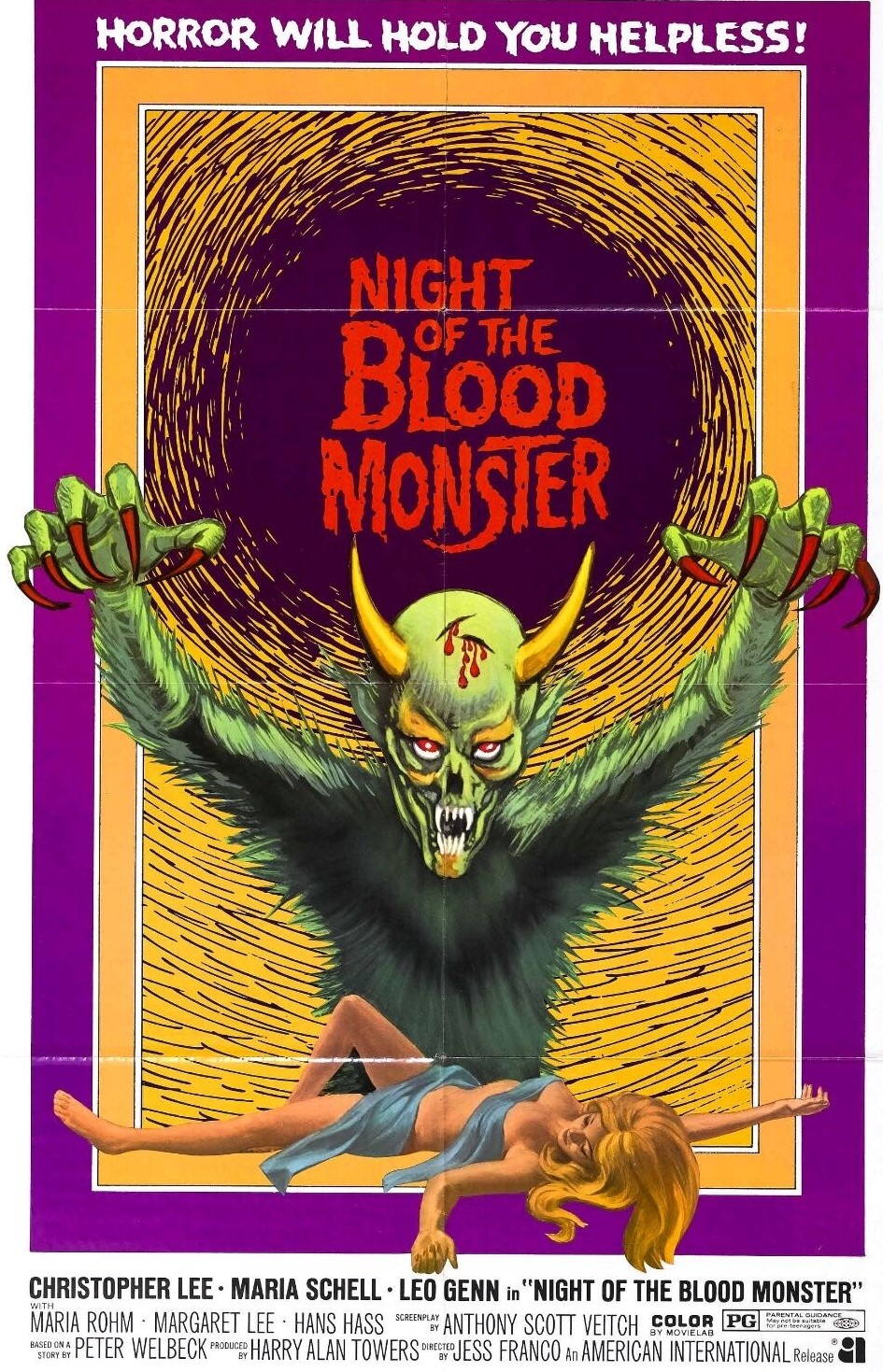
Handsomely mounted historical drama set in 17th century England on the brink of revolution meets Son of Witchfinder General. An uprising headed by the Duke of Monmouth in the south-west threatens to overthrow King James II. Involved in the plot are Harry Selton (Hans Hass), son of suspected agitator Lord Wessex (Leo Genn), whose beloved Mary Gray (Maria Rohm) is in the sights of Judge Jeffreys (Christopher Lee) after he has condemned her sister Alicia (Margaret Lee) to be burned as a witch.
The minute witchcraft enters the equation the narrative thrust is constantly interrupted by scenes of nudity, blood and torture, mostly involving women, but actually the film does attempt to cover the rebellion and its notorious aftermath when hundreds of rebels were executed, the “Bloody Assizes” with “Bloody Judge” Jeffreys to the fore. Conflating witchcraft with a genuine historical episode does not work very well and unlike Witchfinder General (1968), the murder of innocent women is more of a sideshow, despite the brutality involved, and you get the impression the story has been hijacked to accommodate supposed witch Mary in the interests of adding titillation.
Even as the story of the rebellion unfolds, the threat to the crown spelled out, the origins of the revolt mostly made clear (Monmouth being the illegitimate son of Charles II, and nephew to James II) although the sectarianism behind the rebellion is ignored, the narrative keeps jumping back to the witch element. Jeffreys connects the parallel narratives, hunting down rebels and witches, while handling most of the exposition. Given the budget, there’s a surprisingly good battle sequence, cavalry charging cannon. Given his later reputation, Jeffreys also reflects on the meaning of justice.
And while there are some camp moments – Jeffreys playing the organ while attired in grand robes, dancing girls sticking pins in his effigy – the twists and turns (Mary captured and rescued, captured again) are effective enough. Despite the copious nudity, there a couple of low-key love scenes and, oddly enough, a touching moment when Mary licks the blood from a dead prisoner. And for all the blood, that is effect rather than cause, nothing too gory.
But with the powerful all-mighty, and investigators able to plant evidence, and the innocent forced into immoral acts to save their loved ones, lawlessness is apparently next to godliness. But in reality the wicked did not get away with their crimes so various villains get their come-uppance.
Most peculiar sight is Christopher Lee in a love scene where he is not about to sink his incisors into a neck. Occasionally, the film bursts into German with English subtitles – as if various versions were pillaged to produce this copy – or has lines like “you turn me on.”
However, fans of Spanish cult director Jess Franco (The Girl from Rio) who expected something more along the lines of 99 Women (1969) and Venus in Furs (1969) may be disappointed that he spends so much time on the historical elements and less on the random T&A. You might not be surprised to learn of the involvement of ubiquitous producer Harry Alan Towers (Five Golden Dragons, 1967).
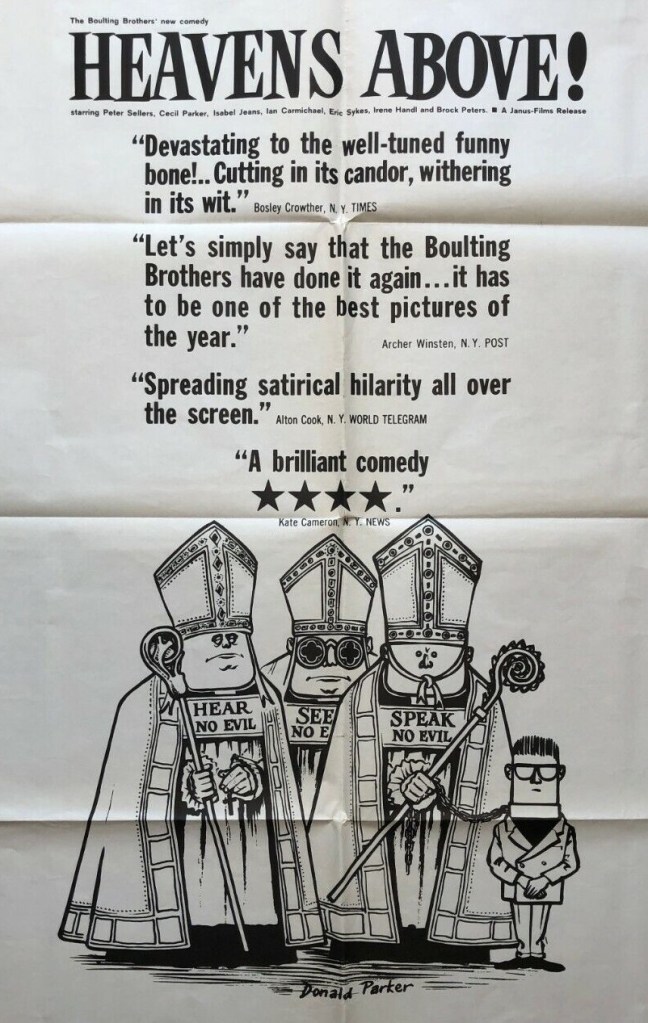
Surprisingly topical – food banks a key element – social satire. And a surprising box office smash – among the top 12 films of the year – in Britain, although the Boulting Brothers (I’m Alright Jack, 1959), often viewed as inheriting the Ealing mantle, had both commercial and critical form.
In a case of mistaken identity, simplistic prison chaplain Rev Smallwood (Peter Sellers) is sent to rich parish Orbiston Parva, virtually endowed by the Delpard family, owners of the Tranquillax business nearby. Smallwood, an advocate of the meek inheriting the earth and making it his mission to ensure the rich can enter the kingdom of Heaven other than through a needle, convinces Lady Delpard (Isabel Jeans) to spread her wealth. This takes the form of the Good Neighbour Fellowship, whereby she sets up a food bank whose popularity soon endangers the town’s retailers and merchants, the public, naturally enough, preferring to do their shopping at the free church outlet than spend money on a butcher or baker (possibly candlestick makers escaped the impact).
Meanwhile, to show he is up to scratch in the poverty ranks, Smallwood invites into his palatial manse the Smith family who are being evicted from their plot of ground to make way for an expansion of the Tranquillax factory. Despite ruffling feathers in the ministry, Smallwood can’t be turfed out, since religious law dictates he effectively owns the manse. However, once shops have to close for lack of trade and factories, for lack of goods being sold, make thousands redundant, Smallwood’s do-gooding backfires.
While Harry Smith (Eric Sykes) is an archetypal welfare swindler (taking home £90 a week) and inclined to siphon off items from the food bank for his own entrepreneurial purposes as well as stealing lead from the church roof, the rest of his enormous brood, led by the redoubtable Rene (Irene Handl) are converted to the joys of Christianity, enough so much so that baptism and marriage (between the couple) beckon.
Most of the humour is gentle, the biggest laughs – Smallwood inadvertently eating dog biscuits, a dog peeing on his leg, choirboy reading a dirty book, the butler initiating a miraculous intervention – are straight out of the Charlie Chaplin joke book. And the timing for many lines appears out of kilter, as though the laughs were not intended.
British films around this time often received rave reviews from U.S. critics which ensured reasonable business at the arthouses while not striking a box office chord with the general public. there.
Apart from Smallwood, his assistant Matthew (Brock Peters) and the converted Lady Despard you are hard put to find any Chistians. As one character observes “not enough decent Christians to feed one lion.” And the townspeople are generally shown as scroungers of one kind of another with the Smiths typical sex-obsessed chip-guzzling working class. The business owners, bishops, aristocrats and assorted politicians are similarly pilloried for greed and inefficiency so you could say the Boultings are being fair straight down the line.
The best scene, and the one that makes the most out of a comic situation, is when the real Rev Smallwood (Ian Camrichael) turns up, is treated as an imposter and locked up for displaying psychotic tendencies. And there’s a clever, even more topical ending, involving space exploration, which equally cleverly mimics an earlier scene. Actually, there are two scenes that echo earlier activities, and both are intelligently used.
The satire retains some of its bite. There are even more rich people around now who hold onto their wealth and there are more poor people in clear need of help, assistance that would extend far beyond food banks, a relatively recent phenomenon. You can be sure selfish big business will be as self-interested.
Peter Sellers, complete with regional accent, in pre-Pink Panther mode shows dramatic skills that he would rarely be allowed to exhibit until much later in his career and although I think he should have been permitted more leeway in his lines he doesn’t deliver them as though he is milking a joke which means dramatic intent is not diluted. He is perfectly believable as the quietly-spoken forgiving vicar surrounded by more grasping colleagues who appear to have forgotten the basics of Christianity, his immediate boss, for example, on holiday in Monte Carlo.
British television comedian Eric Sykes (The Liquidator, 1965), barely recognisable after abandoning his trademark stance and voice, is the standout as the conniver-in-chief. Brock Peters (The Pawnbroker, 1964) is effective as the bin lorry driving protégé and Isabel Jeans (A Breath of Scandal, 1960) a delight as Smallwood’s slightly dotty benefactor – her look as she realizes he has scoffed the dog biscuits worth a couple of laughs. The others, good as they are, are called upon to play little more than stock characters: Cecil Parker (The Comedy Man, 1964), Ian Carmichael (The Amorous Mr Prawn, 1962) and Irene Handl (The Wrong Box, 1966). Look out for Roy Kinnear (Lock Up Your Daughters!, 1969), the first Doctor Who William Hartnell and the future Miss Marple Joan Hickson.
Ably directed by Roy and John Boulting who easily hit all their targets, the screenplay is by Frank Harvey (I’m Alright, Jack), John Boulting and critic Malcolm Muggeridge.
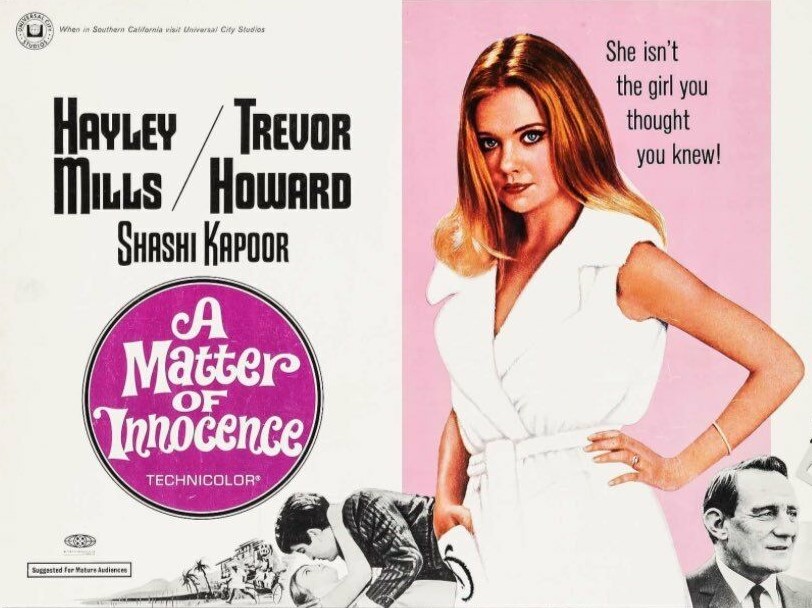
Dramatically undernourished coming-of-age tale over-reliant on “authentic” travelogue and continuing the transformation of Hayley Mills from child to adult star, although that change had been clearly wrought by her previous outing in The Family Way (1966) which had contained her first nude scene. While there’s definitely way more sex here it’s all off-screen.
In Singapore, family black sheep Robert (Trevor Howard) tries to stifle romance blossoming between his ugly duckling niece Polly (Hayley Mill) and local king of the fixers Amaz (Shashi Kapoor), to quote from list of the clichés the screenplay happily summons up. Polly is the bespectacled, dowdy, shy travelling companion to snippy aunt (Brenda de Banzie) – Robert’s sister not wife – who resides in a magnificent suite in Raffles Hotel, consigning her niece to a hovel of a room. When said aunt drops dead in the swimming pool, Polly, wasting no time on mourning, is free to turn butterfly, channeling her inner Brigitte Bardot with bouffant hairstyle and tight red dress.
The genial Amaz is on hand as a guide, in sexual matters as well as tourist, until huffing-and-puffing plantation manager Robert threatens to intervene and smarmy American Critch (Peter Bayliss) attempts to sweep her off her feet. And that’s about it, plot-wise. The meandering story provides insights into different aspects of local culture – Whicker’s World was the only globe-trotting television series available at the time so all this would probably have entranced moviegoers rather than, as now, bored them to death.
Perhaps what’s most interesting is what’s left unsaid or never dwelt upon, of the posh English girl having sex with a native of Singapore. In previous movies – Bhowani Junction et al – miscegenation would have been the sole plot point with Brits up in arms at the suggestion of it. Here, the only objection to Amaz is that he’s a bit of a Casanova, practised seducer in the main of older women. While Amaz falls in love, Polly is considerably more objective, viewing their relationship in terms of rite-of-passage, rather an un-British approach, more in keeping with the attitudes those bold females exhibited in pictures like The Group (1966).
Polly is a pretty cool-headed kid, with a good head for booze, not staggering in gutters or throwing up after imbibing too much, alert to the intentions of Critch and more than capable of putting her uncle in his place. Despite her delight at enjoying sex Polly is more independent than you might imagine and the film’s actually a character study of a woman refusing to be defined – or trapped – by love and its obvious consequence marriage and viewing this new freedom as merely the starting point of her life.
For Hayley Mills fans, of course, her career divides sharply into Disney and post-Disney. Few child stars ever manage to take the first steps to an adult career never mind sustain one, but the actress made a good stab at throwing off her previous precocious screen persona by taking on challenging roles that perhaps upset her core followers. But the film would have benefitted from a better storyline and minus the distracting tourist elements been a lot tighter.
The career of Trevor Howard, long-time second male lead, was on a bit of an upswing after sterling roles in Von Ryan’s Express (1965) and The Long Duel (1967) and although he remained the scowler supreme he brings more vulnerability to this role. Bollywood heartthrob Shashi Kapoor had come to prominence as far as the English-speaking countries were concerned through arthouse director James Ivory’s The Householder (1963) and Shakespeare-Wallah (1966) but this was his mainstream debut. He certainly has a screen presence and enjoys the best character arc, going from the cynicism of sex to the innocence of love. I’m sure the title is intended to refer to Polly but she is innocent, in screen shorthand terms, for about two seconds. Pretty Polly, the title of the short story on which the film is based, was not usable in certain countries because the name was the trademark of a popular brand of hosiery.
This was the final film of Brenda de Banzie (The Man Who Knew Too Much, 1956) and the second for British television stalwart Patricia Routledge (Keeping Up Appearances, 1990-1995), while for Chinese star Kalen Liu (Welcome to Hard Times, 1967) it was both her second and last picture.
This was perhaps an odd choice for director Guy Green (A Patch of Blue, 1965) but he was mired in the on-again off-again saga of proposed MGM roadshow epic Forty Days of Musa Dagh and compared to those travails this may have been welcome light relief. Keith Waterhouse and Willis Hall (Lock Up Your Daughters, 1969) developed the screenplay from Noel Coward’s short story.
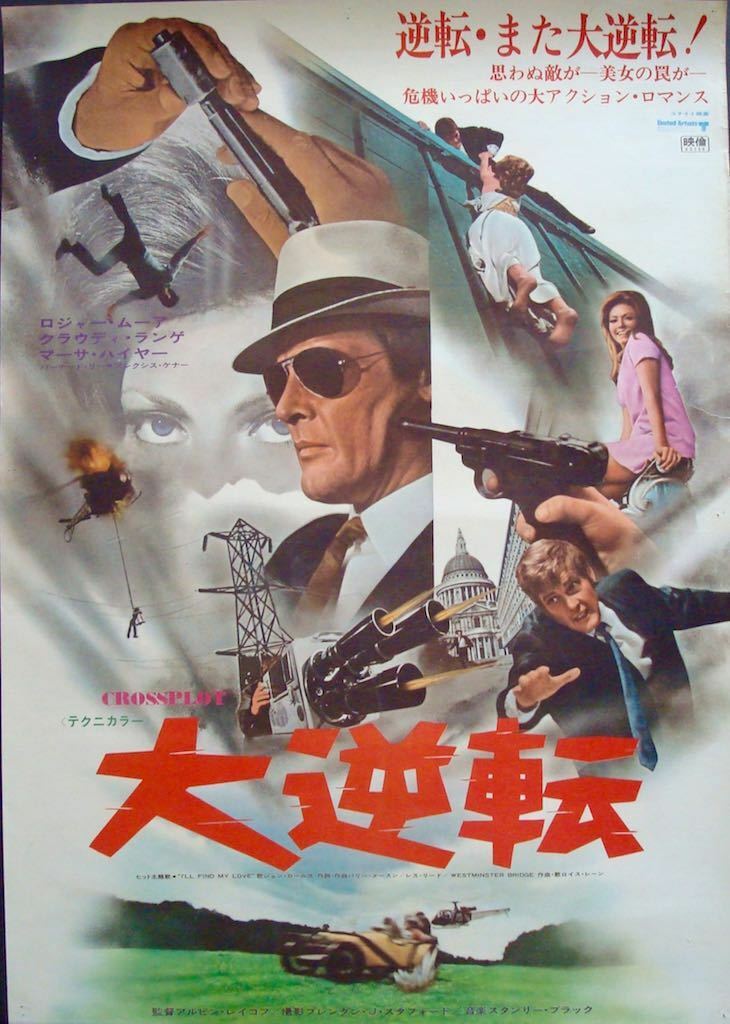
Roger Moore – in his first movie in seven years – almost auditioning for James Bond with his lothario instinct, light touch for dialogue, a nice side-line in double takes, and enough action to show that even in his early 40s he was still nimble enough. Not in the Charade (1963) or Arabesque (1966) league and over-reliant on the Swinging Sixties and other “Tourist Britain” clichés and a plot that takes far too long to get going, it takes all the actor’s charm to make it watchable.
After one of his staff Warren (Dudley Sutton) switches the photo of a model in his portfolio, ad-man Gary (Roger Moore) finds himself on the trail of Marla (Claudia Lange), a sometime fugitive hiding out on a houseboat. Meet-cute is prompted when she pushes him into the Thames. On leaving he is knocked out and framed on a dope charge and once he manages to get her into the photographic studio Warren attempts to throw her off the roof, the would-be killer himself eliminated by his boss Ruddock (Francis Matthews) who in a marvelous piece of quick-thinking throws his gun to Gary who instinctively catches it, further implicating himself.
After going all round the houses (including a stately home), evading pursuit via an antique car race and a wedding, Gary finally gets to the bottom of why Marla is in such danger – she overheard a conversation between her aunt Joe (Martha Hyer) and Ruddock. Only problem is – she can’t remember it. And it takes even more time for Gary to figure it out, (not realizing, how could he, that the clue is in the title, in fact two clues in a crossword puzzle). You can imagine how it goes from then.
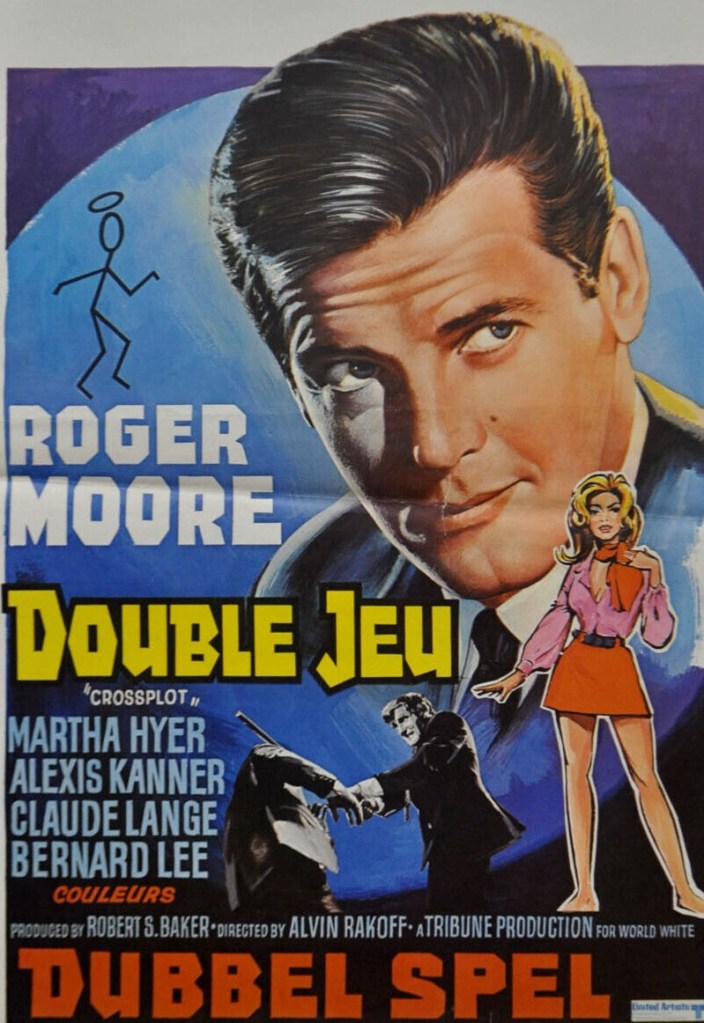
This poster takes the easy route by trying to sell the picture on the back of “The Saint.”
On the plus side is mostly Roger Moore. “I come from a long line of hippopotamuses,” isn’t the sort of line you can deliver without some skill. But Moore’s performance lifts what is for the most part a shaggy dog story, and he’s game enough to do all the running and fighting required, even the heavy lifting (of his eyebrows), to keep the story moving. It’s far from as funny as it thinks and not as funny as it needs to be, but there are still some good stabs at humour, a pistol held to Gary’s head discovered to be a toy gun, Gary turning the tables in a shower on Marla, telling the bride that her groom is a bigamist, and a running joke about the Marla being perennially hungry.
The politics barely touches on the conspiracy aspects that Hollywood would have pounced upon and made a better fist of, although the idea that Britain could be undermined by civil strife was not far off the mark for the times. It needed some smarter thinking, though, for that element to work.
A much better attempt at selling a thriller with scenes from the film, including the toy pistol pointed at Roger Moore’s head.
The rest of the cast are game enough. Claudie Lang (The Gatling Gun, 1968) is no Sophia Loren or Audrey Hepburn but nobody is pretending she is and she just about gets away with the dumb model approach. Martha Hyer (The Chase, 1966) delivers a glamorous villain and the suave Francis Matthews (Rasputin: The Mad Monk, 1966) her ideal match.
There’s quite a supporting cast: Veronica Carlsen (Dracula Has Risen from the Grave, 1968), Gabrielle Drake (Suburban Wives, 1972), Dave Prowse (Star Wars, 1977), Bernard Lee (You Only Live Twice, 1967), Alexis Tanner (The Ernie Game, 1967), Ursula Howells (BBC’s The Forsyte Saga, 1967) and Dudley Sutton (Rotten to the Core, 1965).
If Alvin Rakoff (The Comedy Man, 1964) is in charge of the material he doesn’t have enough material to work with. He does enough to keep it on course but would have benefitted from a a tighter screenplay from Leigh Vance (The Frightened City, 1961). Both had done better in the past, but it is easy to be seduced by the romantic thriller format, almost a mini-genre in itself, assuming it is easier to pull off than it looks. The likes of Alfred Hitchcock (North by Northwest, 1959) and Stanley Donen (Charade) made it look easy but they had the advantage of big stars in Cary Grant and Audrey Hepburn who possessed the ability to make the lightest confection work.
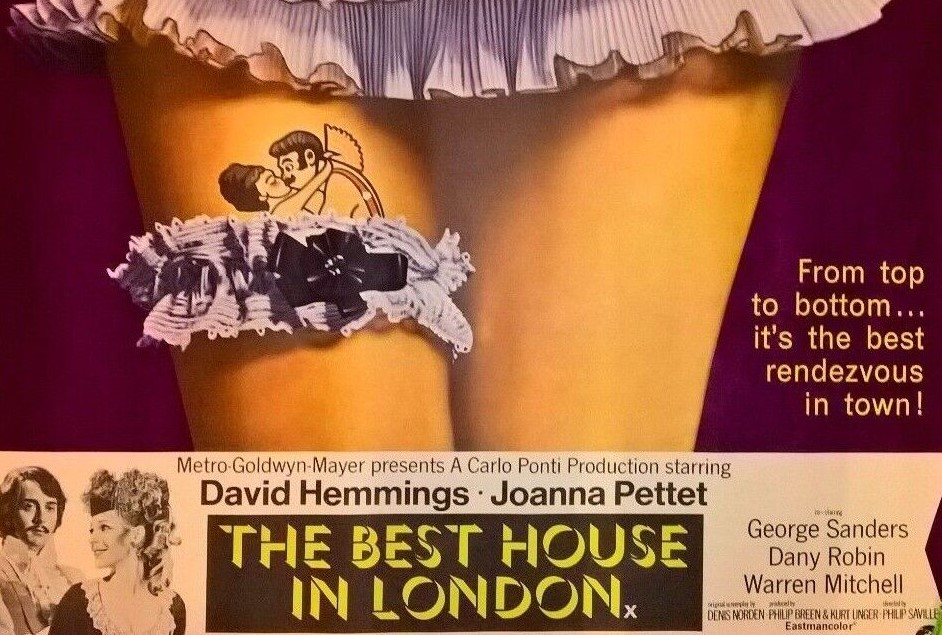
One of the worst – and certainly among the most repellent – films ever made. A hymn to misogyny under the guise of the not very difficult task of exposing Victorian hypocrisy, it labors under the bizarre thesis that all women want to be prostitutes. Screenwriter Denis Norden’s befuddled sense of history is awash with the same kind of contempt for audiences. Elizabeth Barrett (of Wimpole St fame) rubs shoulders with Lord Alfred Douglas (Oscar Wilde’s illicit lover) even though they lived half a century apart, the Chinese Opium Wars and The Indian Mutiny feature despite being separated by 15 years.
Sex workers had proved the basis for many good (and occasionally excellent) pictures in the 1960s ranging from Butterfield 8, Never on Sunday, Irma la Douce and Go Naked in the World at the start of the decade to Midnight Cowboy at its end, but these all featured well-rounded characters facing understandable dilemmas. But here the cynical and demeaning plot – more Carry On Up the Brothel than political satire – makes you wonder how this concept was perceived as either plausible or an acceptable subject for comedy
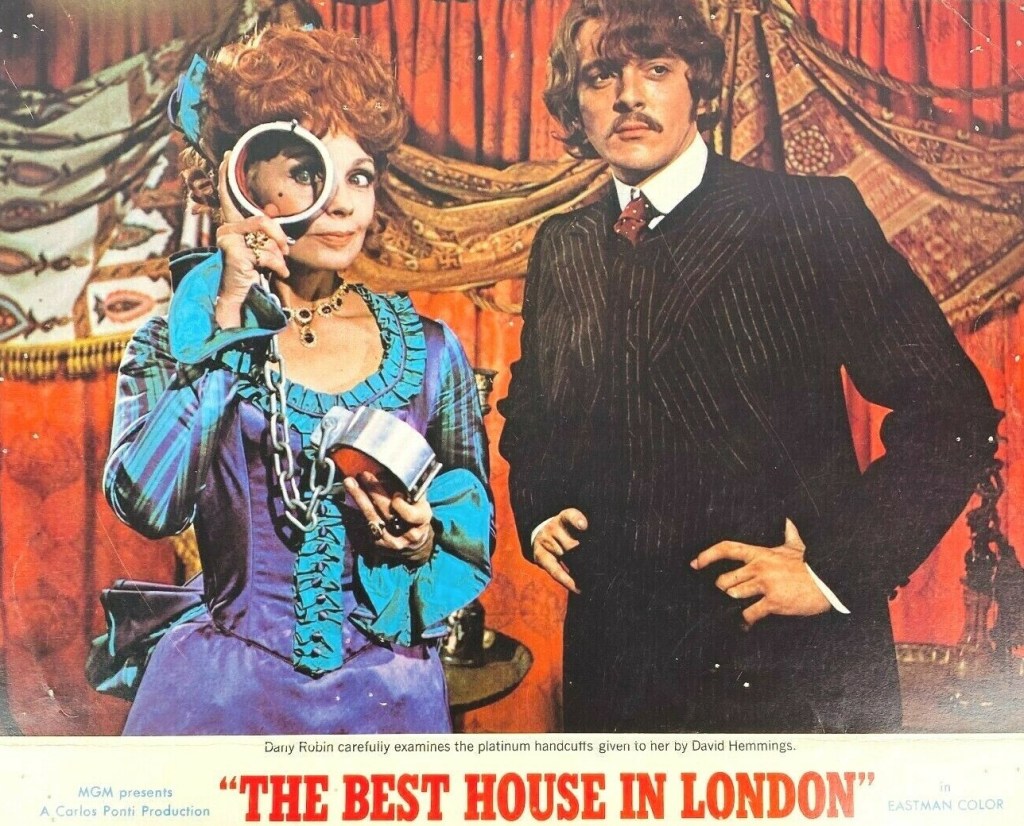
The monocle joke. Dany Robin sports the manacles her idiotic girls were supposed to wear rather the monocles they did wear.
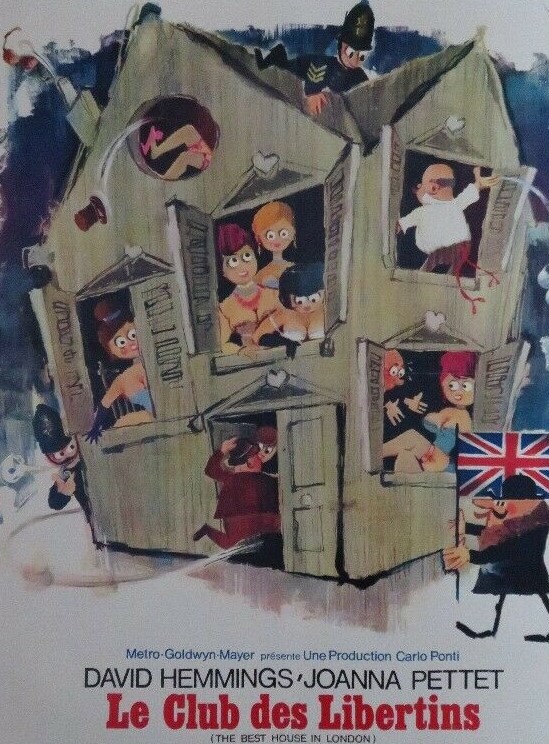
Feminist philanthropist Josephine Pacefoot (Joanna Pettet) – a character based on the real-life campaigner Josephine Butler – has set up the Social Purity League to rescue fallen women. Walter Leybourne (David Hemmings) is hired as a publicist to bring the issues raised to a wider audience. When Josephine inherits the fortune of Uncle Francis (George Sanders) the pair come up against the nefarious Benjamin Oakes (also played by Hemmings), her cousin and his half-brother, who has purloined his uncle’s mansion in Belgravia as the premises for London’s first brothel – The Libertine Club. This venture is backed by the Home Secretary (John Bird) as a way of getting streetwalkers away from upmarket shopping streets where their presence discourages wealthy females. Josephine also has to deal with a caricatured “evil” Chinaman (Wolfe Morris) through her uncle’s investment in opium. There’s also for no particular reason apoplectic airship inventor Count Pandolfo (Warren Mitchell).
All the women rescued from the oldest profession by Josephine are soon recruited by Oakes and a good chunk of the middle section of the movie involves various excuses to give the viewers intimate glimpses of what goes on in the brothel, involving an abundance of nudity. Oakes also aims to seduce Josephine while the shy Walter struggles to entice her into romance.
Excepting Josephine and Oakes’ mistress Babette (Dany Robin), the women are uniformly stupid. The story begins with Oakes’ duping a woman in a hot air balloon into removing her clothes on the grounds that it was the only way to reduce height enough to land. And it does not get any better. Women supposedly forced onto the streets after bad experiences with men turn out to be the seducers. Walter has the devil’s own job getting any of the girls to agree they had been raped. Walter, hoping to sell a story to The Times, is no less crass: “I can get five columns for a good rape.” Flora (Carol Friday), rescued much to her displeasure, is “gagging” for it. And there’s just an awful scene where a young girl sings about her “pussy” which even in the 1960s surely raised adverse comment.
The humor is largely of the sniggering variety. The brothel girls wear monocles instead of manacles, the only game on display in the Card Room is strip poker, and naturally there is a peeping tom, lawyer Sylvester (Willie Rushton).
As if to display his erudition, but without raising the laughter quotient, Norden chucks in literary cameos by the score – Charles Dickens (Arnold Diamond), Alfred Lord Tennyson (Hugh Burden), the aforementioned Elizabeth Barrett (Suzanne Hunt) and Lord Alfred Douglas (George Reynolds), Sherlock Holmes (Peter Jeffrey) and Dr Watson (Thorley Walters), plus explorer David Livingstone (Neil Arden) and department store entrepreneurs Fortnum (Arthur Howard) and Mason (Clement Freud).
That the movie actually gets one star is thanks to a number of excellent visual jokes: one scene of Uncle Francis defying the mutineers by raising the Union Jack cuts to the blood-splattered flag decorating his coffin; Sylvester frustrated at the keyhole but still hearing the moans of seducer-in-chief Oakes is followed by the sight of the wannabe lover struggling to get out of his bonds, having been attacked by Chinamen.
There’s not much difference, beyond hair color, between the characters essayed by David Hemmings (Alfred the Great, 1969). Both are one-dimensional, the pop-eyed virgin astonished by the goings-on at the brothel, the suave villain who might as well be twirling his moustache for all the depth he brings to the role. Thankfully, Joanna Pettet (Blue, 1968) is at least believable though even she could not act her way out of scenes where she was suspended by the Chinaman above a vat of boiling acid.
George Sanders (Sumuru, Queen of Femina aka The Girl from Rio, 1969) has a ball as the hypocrite-in-chief who knows how to monetize vice while Dany Robin (Topaz, 1969) brings some finesse to an otherwise one-dimensional part. But everyone else is a cipher which is a shame given the talent on show – John Bird (A Dandy in Aspic, 1968), John Cleese (A Fish Called Wanda, 1988), Warren Mitchell (The Assassination Bureau, 1969), Bill Fraser (Masquerade, 1965) and Maurice Denham (Some Girls Do, 1969). Among the girls, you might spot Veronica Carlsen (Dracula Has Risen from the Grave, 1968) , Margaret Nolan (Goldfinger, 1964) and Rose Alba (Thunderball, 1965).
Director Philip Saville (Oedipus the King, 1968) should have known better and certainly made amends later in his career with among other projects BBC series Boys from the Blackstuff (1982). But Denis Norden (Buona Sera, Mrs Campbell, 1968) never wrote a more misguided piece in all his life.
For sure, a film like this is not going to do down well in these times but I was surprised how vilified it was on release, critics like Roger Ebert insulted by its endless attacks on women, the public no less hostile and it died a death at the box office.
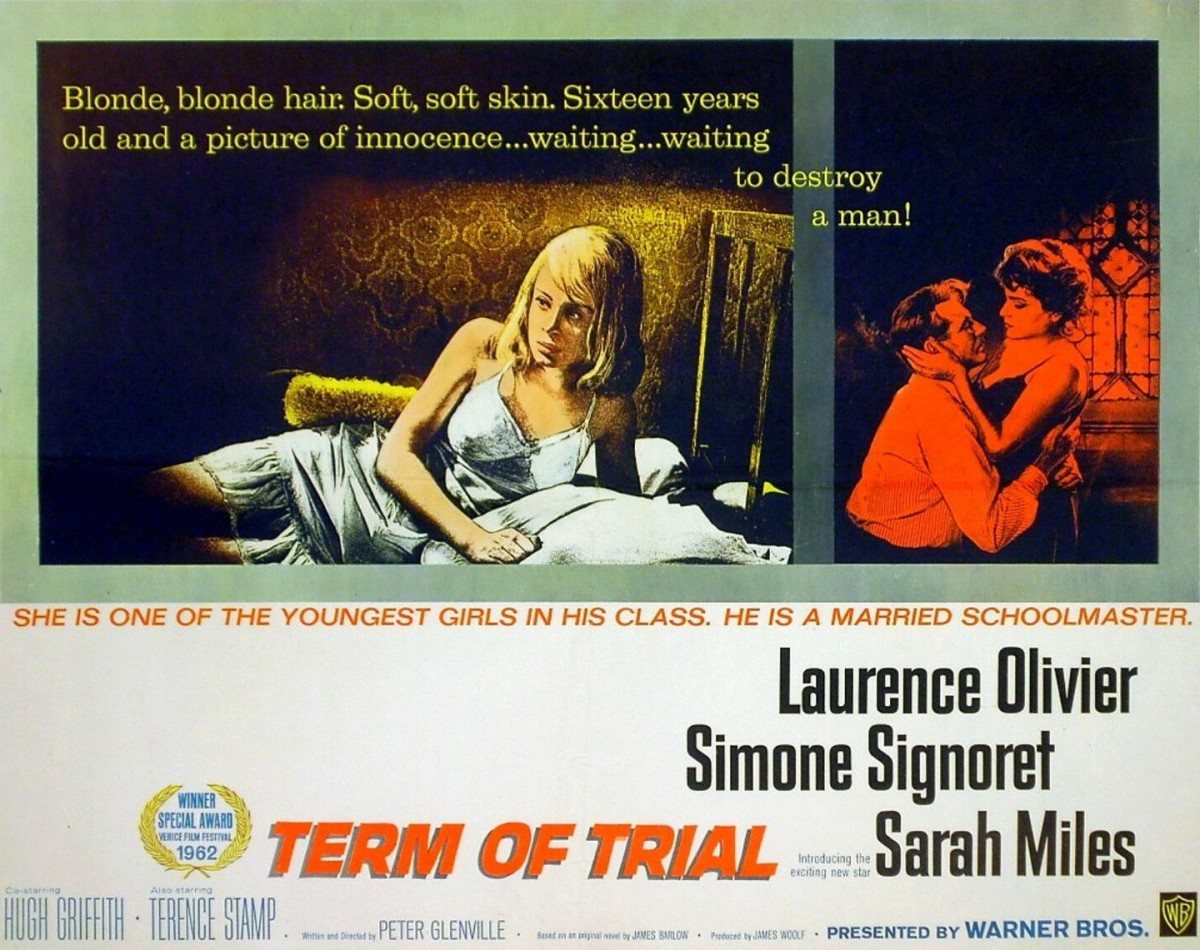
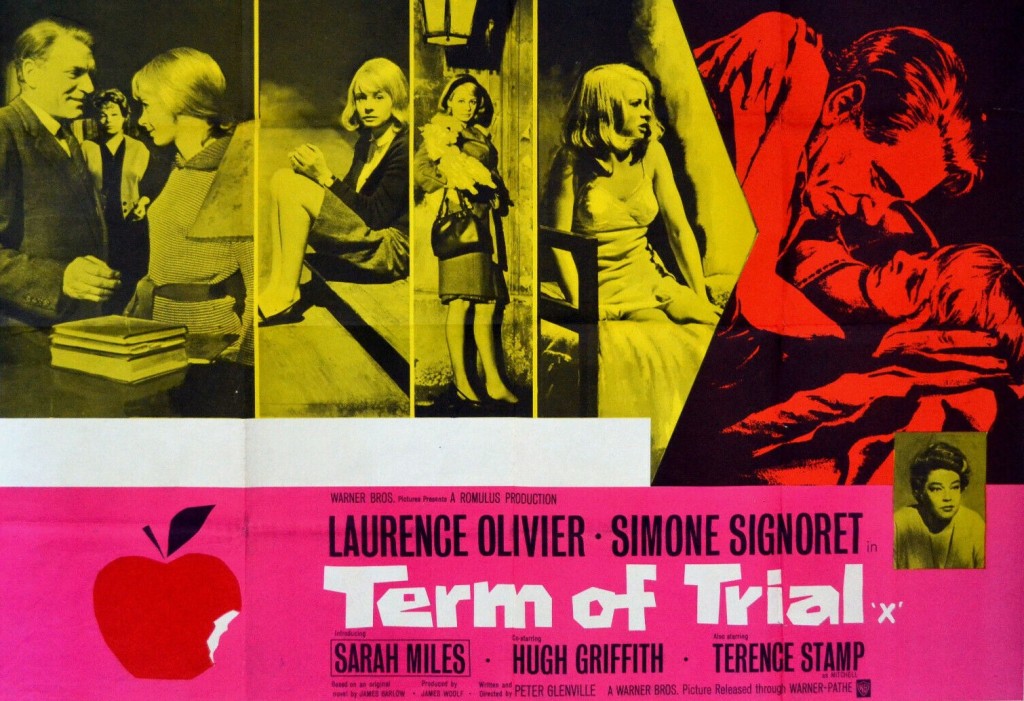
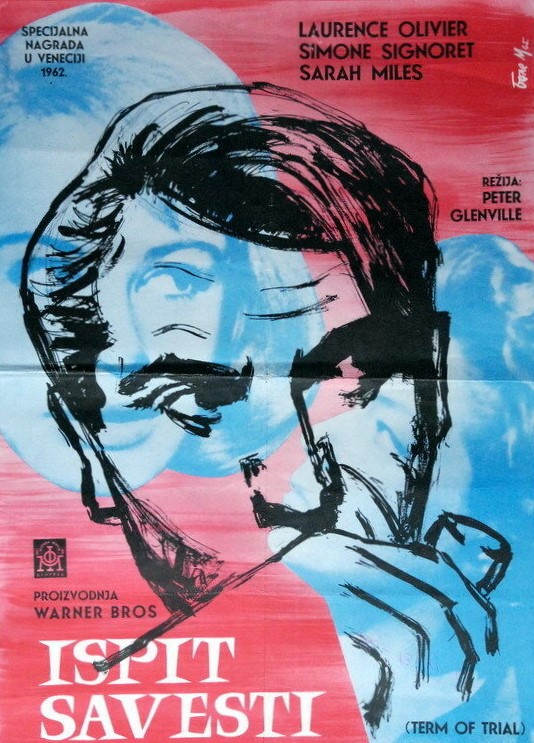
Notable for the debuts of Sarah Miles (Ryan’s Daughter, 1970) and Terence Stamp (The Collector, 1963) and an ending that even in those misogynistic times was wince-inducing. The halcyon era of dull English schoolteachers being celebrated (Goodbye, Mr Chips, 1939) or finding redemption or even just managing to overcome pupil hostility (The Browning Version, 1951) were long gone, replaced by a more realistic view of the casual warfare endemic in education establishments, not quite in The Blackboard Jungle (1956) vein but running it close, with bullying, sexual abuse and ridicule running riot.
Self-pitying Graham Weir (Laurence Olivier) has failed to achieve his ambitions in part due to alcoholism, in part to antipathy to his conscientious objection during World War Two. And although he has a sexy French wife Anna (Simone Signoret) in the days when any Frenchwoman was deemed a goddess, she is embittered that the future he promised has not materialized. Like To Sir, with Love (1967) his classroom is filled with no-hopers so that he responds to the meek and innocent wishing for educational betterment.
Weir’s only defence against endless indignity is a stiff upper lip and slugs of whisky. His lack of character contrasts with a young lad who takes revenge against constantly being chucked out of his house by his mother’s lover (Derren Nesbitt) by blowing up the man’s sports car.
Spanning the twin cultures of religion and the razor, one falling out of favor, the other holding violent sway, opportunity to rise above kitchen-sink England lies with the self-confident such as thug Mitchell (Terence Stamp) who smokes in class, gives the teachers lip, takes photographs of girls in their underwear in the toilets, physically threatens classmates and when his target is bigger gets older men to give him a good thumping.
A somewhat unlikely development is an end-of-term trip to Paris where the infatuated Shirley (Sarah Miles), who the good-hearted Weir has been giving free private tuition, ends up in the teacher’s bedroom and later accuses him of abuse. The impending court case and threat of imprisonment scupper Weir’s chances of promotion, make him consider suicide, and Anna to leave him.
The court scenes allow a number of famous character actors a moment of acting glory. Laurence Olivier (Bunny Lake Is Missing, 1965) must in part have been attracted to the role by a terrific court monologue. The movie is very downbeat in a country universally known never to enjoy an ounce of sunshine justifying the black-and-white movie rendition. If there is liveliness in the streets, cinemas, shops, it never translates into any of the main adult characters, all determined to uphold ancient values and endure constricted lives.
Exploiting audience expectation for verbal fireworks, the tension in Laurence Olivier’s finely judged performance comes from his untypical, unshowy delivery. You can almost hear him grinding his teeth. Simone Signoret (The Sleeping Car Murder, 1965) also acts against the grain, battening down her inherent sexuality, and her very presence speaks of lost hope, the fact that she was once attracted to Weir indicating he was once a very different prospect.
Sarah Miles excels as the wannabe seducer, that hesitant voice that would become her hallmark, struggling here to turn innocence into lure, expressing her adoration in heart-breaking simplicity, and yet aware that to catch Weir would require more than just the submission a guy like Mitchell requires. While hers is a stunning debut, I’m at a loss to see what marked out Terence Stamp’s typical surly teenager for speedier stardom.
Oscar-winner Hugh Griffiths (The Counterfeit Traitor, 1962) is the pick of the supporting roles. A remarkable scene-stealer, a shift of his head, a flicker of his eyelashes is all he needs while sitting in the background to attract the camera from another character in the foreground. Look out for Barbara Ferris (Interlude, 1968), Derren Nesbit (Where Eagles Dare, 1968), Allan Cuthbertson (The 7th Dawn, 1964), Roland Culver (Thunderball, 1965) and Thora Hird (television’s Last of the Summer Wine, 1986-2003).
Surprisingly un-stagey direction from Peter Glenville (Becket, 1964) who was far better known as a theater director in London and Broadway. Probably in those days if you were setting a movie outside sophisticated London you had to present a gloomy version of Britain so you can’t really blame him for that and Olivier was hardly a major box office attraction so a budget trimmed of color would be a requisite. Although the older characters display grim determination, the younger ones have not had the spirit knocked out of them in the Saturday Night and SundayMorning (1960) manner and the location shots reveal a buzzy atmosphere.
Glenville also wrote the screenplay based on the bestseller by James Barlow.
Sherlock Holmes vs Sherlock Holmes was the initial tantalizing casting prospect. Basil Rathbone, the most venerated actor to don the distinctive deerstalker, and Peter Cushing, just signed up by the BBC for a new 16-episode series, the former signed to play the villain, the latter his nemesis in a film that started out with the title of The Death’s-head Vampire, the first film by a new production shingle Tigon Films.
While Tigon was new, with a distinctive logo, its driving force was well-known British producer Tony Tenser who with partner Mike Klinger had initially specialized in exploitation pictures with titles such as Naked as God Intended (1961) and London in the Raw (1964). The pair split after the artistic and commercial success of Roman Polanski’s Cul de Sac, Tenser initially setting up under his own name for Mini-Weekend/Tomcat (1966), mining the exploitation vein as before, and The Sorcerers (1967) a new venture into the horror market. Expanding the business with fresh capital and new partners, Tigon was born.
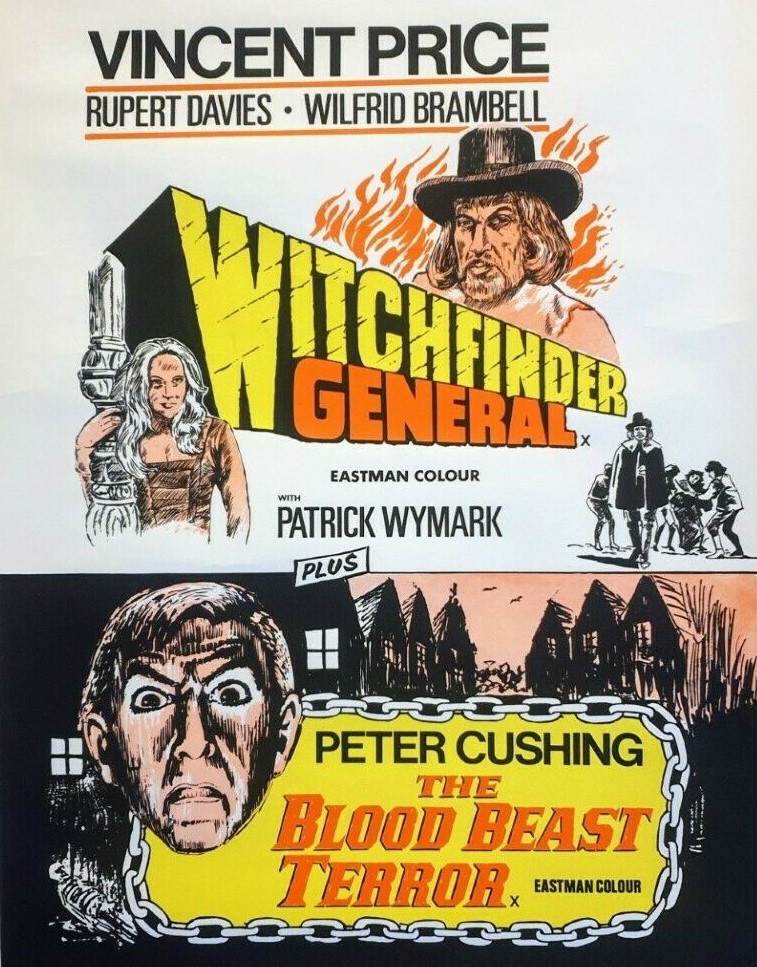
Supporting feature to “Witchfinder General” on ABC circuit release in Britain.
Explaining the new departure, Tenser said, “Films needs to be inexpensive. They need to sell, they need to appeal to an international audience, and one subject that always finds a market is horror.” Horror budgets were low, the genre did not require big stars, and the films had a surprisingly long shelf life.
First movie on the new company’s agenda was not The Death’s-head Vampire. Instead, Tenser had hooked Raquel Welch for a ghost story The Devil’s Discord to be produced by her husband Patrick Curtis, who had performed a similar task on The Sorcerers, and star Peter Cushing (The Skull, 1965). When that fell through, he held onto Cushing for a proposed Horror of Frankenstein and when that also bit the dust turned to him for The Death’s-head Vampire on a budget of just £40,000 (about $100,000). Offered the choice of playing villain Dr. Mallinger or Detective Inspector Quennell, the actor plumped for the “goodie,” Basil Rathbone lined up for the other role. The concept of older man/younger woman with action concentrated on an isolated house and the surrounding countryside was a horror trope.
Vernon Sewell (Strictly for the Birds, 1964), entering his third decade as a director, had worked with Cushing on Some May Live (1965) and was primarily known for low-budget and B-movies, and more importantly from Tenser’s perspective, sticking to a budget without any artistic pretensions or improvisation. He didn’t waste time on anything that would not be captured by the lens. He was calm on set, “nothing fazed him.” Cushing was a kindred spirit, never complaining, except famously, on this picture, when he told Sewell it was the “worst picture” he had ever made. The pair, however, had a very good working relationship to the extent that Sewell never offered Cushing any advice on the role –“he didn’t need my input.”
The Sherlock Holmes connection is promoted in this poster.
Just over two weeks before the August 1967 start date, Basil Rathbone died of a heart attack. Robert Flemyng, the last-minute replacement, was Cushing’s opposite, complaining all the time. The cast was rounded out by 32-year-old Doctor Who star Wanda Ventham (mother of actor Benedict Cumberbatch) and 18-year-old Vanessa Howard whose career highpoint thus far had been a duet with Cliff Richard for a television presentation of Aladdin (1967).
Interiors were shot at Goldhawk Studios, a converted three-story building in London’s Shepherd’s Bush, with exteriors at Grims Dyke, the former home of W.S. Gilbert, in north-west London. The 19th century manor house had lain empty since 1963.
Roger Dickens, who had cut his teeth on Thunderbirds Are Go! (1966) and worked on 2001: A Space Odyssey (1968) and would be later lionized for the mini-beast bursting out of John Hurt’s stomach in Alien (1979) was responsible for creating the monster. The model for the giant larvae was a much simpler task than creating a believable female giant insect. He took a mold of Ventham’s face, giving the features a repellant slant, using costume jewelry for the eyes, adding a furry cap and two-foot long antennae, a representation that would only really work if you scarcely saw the creature. For art designer Wilfred Woods his woods set turned into a disaster when the trees wilted and lost their leaves.
Opinions differ as to whether Tenser interfered with production. He saw his role during the film process to ensure that the project followed the script. “Sometimes you can put something in a film which will hinder the selling, sometimes you need to put something in which will help the selling.”
Comedian Roy Hudd, playing the morgue attendant, thought the script so awful he was delighted to work with Cushing on improvements.
When John Ford’s boast that he never shot an extra foot of film in order to prevent a producer turning in a different film has resulted in many a masterpiece, the same did not hold true for Sewell. Sticking so close to the script, not filming anything that was not absolutely necessary meant that the movie was too short. Editor Howard Lanning commented: “I put in everything that was available. Even with expanding the lecture scene and the amateur dramatics as long as possible, to the detriment of pace, the picture clocked in at just 81 minutes, not the length expected of a main feature.
To ensure the movie came in at the required length, Tenser added the African sequence at the beginning (an extra five minutes) and re-shot the morgue material (two more minutes), encouraging Cushing and Hudd to improvise. The final product was over-budget and a week late. The version shown to the censor was 87 minutes though the official running time was a minute longer.
Tenser now deemed the working title as insufficient, preferring “something catchy and something that told people what you were selling.” His first stab at a new title was Blood Beasts from Hell. But in the final analysis it was altered to The Blood Beast Terror. Hoping to sell it to a circuit as a main feature it was originally shown in a double bill with Castle of the Living Dead, but despite the supposedly attractive title, audiences were not interested. To cut his losses, the film was repackaged as the support to another Tigon production Witchfinder General (1967) which meant Tenser would not have to share receipts with another distributor.
The Blood Beast Terror did not prove so sellable overseas either. It was shelved in France until 1971, although, sold for a flat fee, it did well in South America. A.I.P. who had U.S. distribution rights to Witchfinder General – title altered to The Conqueror Worm – had no interest in The Blood Beast Terror but it was picked up by Pacemaker Pictures who were also in title-changing mood and released it in summer 1969 as Vampire Beast Craves Blood on a double bill with Curse of the Blood Ghouls (1964).
Tenser’s predictions of long shelf life were correct. In Britain, the movie was reissued on a late night double bill with The Secret of Blood Island (1961), and then was revived with The Devil’s Hand (1961) before being re-teamed with Witchfinder General on a Sunday’s-only screening. Although none of these would be circuit releases in the sense of a nationwide day-and-date opening, they were nonetheless likely to get reasonable bookings to fit specific engagement profiles. In the States where there was endless demand for horror triple- and quadruple bills and all-nighters, The Blood Beast Terror received ongoing bookings.
SOURCES: John Hamilton, “The Making of the The Blood Beast Terror,” Little Shoppe of Horror, Issue No 43, p67-91; John Hamilton, “Regretting Nothing: John Sewell, Little Shoppe of Horror, Issue No 43, p92-98.
Bizarre movie seeks cult audience! You might as well have stuck that on the poster. When I tell you the film climaxes like a Monty Python sketch with four successive men giving birth – from a variety of orifices – the first three to emerge different versions of the same character, the last the dead husband James (Paapa Essiedu) of Harper (Jessie Buckley). And that men also appear fully naked, in the form of some kind of vegetation, and can survive despite having an arm spliced from elbow to fingers. And that James desperately wants her to feel guilty about his suicide, triggered by her demanding a divorce.
Of course, all this could be taking place in her tormented mind except that she steadfastly refuses to admit to torment over the suicide even though she does scream her head off in church. If any of this is remotely realistic it points to someone with a severe downer on men, since there is not a single likeable one in sight. Men, in fact, are just four-letter words (choose your own) whose sole purpose is to accuse women of not loving them enough. And women – cue symbolism – are all born of Eve and inclined to eat a forbidden apple.
None of this would be so bad if in attempting a psychological thriller and/or horror film (I am assuming horror because of the births and arms sliced in two) there was actually a shock or two or even a general sense of creepiness. On the plus side, should this ever achieve cult status – “makes Titane look like Paddington” (1 or 2, you choose) – then I am sure director Alex Garland will only be too happy to turn up for a tenth anniversary Q&A and explain his intentions and/or symbolism and if he’s very lucky find an audience composed of students who have written a thesis on the film.
So the story – or did you think there wasn’t one – sees Harper repair to a village in the country to a fantastic country house with all the trimmings including an Aga and a baby grand for two weeks holiday to recover from the suicide, her mind still so muddled that she’s not thought to change her married name. It’s the kind of village where there appears a considerable amount of inbreeding. The letting agent (Rory Kinnear) looks suspiciously like the long-haired vicar (Rory Kinnear) and the rude schoolboy (Rory Kinnear) and the policeman (Rory Kinnear) and the bollocks-naked stalker (Rory Kinnear).
Harper gets lost in the unfamiliar countryside and happens across a tunnel where the echo effects could have been created by Robert Fripp and is then chased by a man (Rory Kinnear anyone?) and then catches sight of the naked man who later appears in her garden looking like an rewilded exhibit from the Chelsea Flower Show. The various versions of the man appear at different points and even when the letting agent appears good (and brave) actually he is just as bad.
I felt sorry for the Oscar-nominated Jessie Buckley (The Lost Daughter, 2021) for having to put up with this script. I also felt sorry for Rory Kinnear (No Time to Die, 2021) with a movie career so far consisting of supporting roles who must have been convinced that the chance to channel his inner Alec Guinness/Peter Sellers and play multiple characters would have been his breakthrough.
I did not in the slightest feel any sympathy towards Alex Garland (Ex Machina, 2014) for dreaming up this pile of tosh. This is one those films that strides the critic/moviegoer divide. Around 70 per cent of critics on Rotten Tomatoes gave it a positive review but moviegoers disagreed and, as surveyed by Cinemascore, gave it a D score (on a rank from A to F).
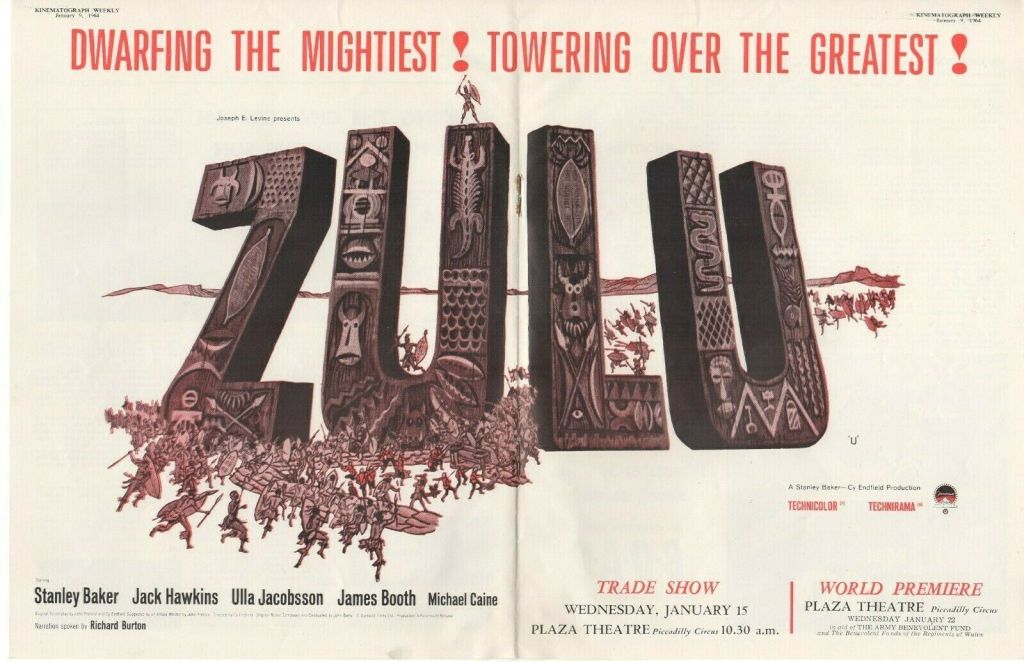
Producer Joseph E. Levine was so carried away by the sensational performance of Zulu (1964) in Britain that he earmarked a million-dollar marketing budget for its U.S. launch. Levine was already doing the rounds of U.S. exhibitors in January 1964 and it was reviewed that same month in Variety – which predicted it would be a “sturdy box office prospect” – leading observers to believe its launch was imminent. That it was held back till the summer suggested interest from the trade, not as fascinated by an obscure war in Africa as the British, was not as high as the producer would have liked. Even then Box Office magazine reckoned it “should be a box office smash” to emulate the $589,000 it had taken in nine weeks in the first run Plaza in London’s West End coupled with two weeks in 29 houses on the British ABC circuit.
But somewhere along the line Levine had lost heart and promoted it as if was Hercules all over again, 500 simultaneous bookings in a month, little time to build on the decent box office it attracted in New York in two weeks at the first run Palace. The drubbing Zulu (1964) received at the American box office – it did not even attract the $1 million in rentals needed to place it in the Variety annual box office chart – made trade journalists, while recognizing Michael Caine’s initial promise, reserve judgement on his future, observing that he “still has some ground to cover before he becomes as familiar to filmgoers as Sean Connery.”
Michael Caine is way down the cast list.
Despite Zulu’s failure, Variety predicted that Caine’s performance had “won this blond young man a swift passport to potential stardom” and even while The Ipcress File (1965) divided critics, the trade paper reported “there’s no disputing Caine’s personal impact…the sky’s the limit.”
To justify his deal with Harry Saltzman, Caine was committed to appearing in ten films in five years, although the producer was not only happy to loan him out to other studios but share the spoils. That was an unusual trait, given that stars as varied as Sandra Dee, Carroll Baker and Rock Hudson bristled at what they saw as exploitation, when their paymaster retained the entire amount gained from loaning their services to other studios, often pocketing a hefty profit in the process. Caine, on the other hand, “kept the major share of any loan-out loot.”
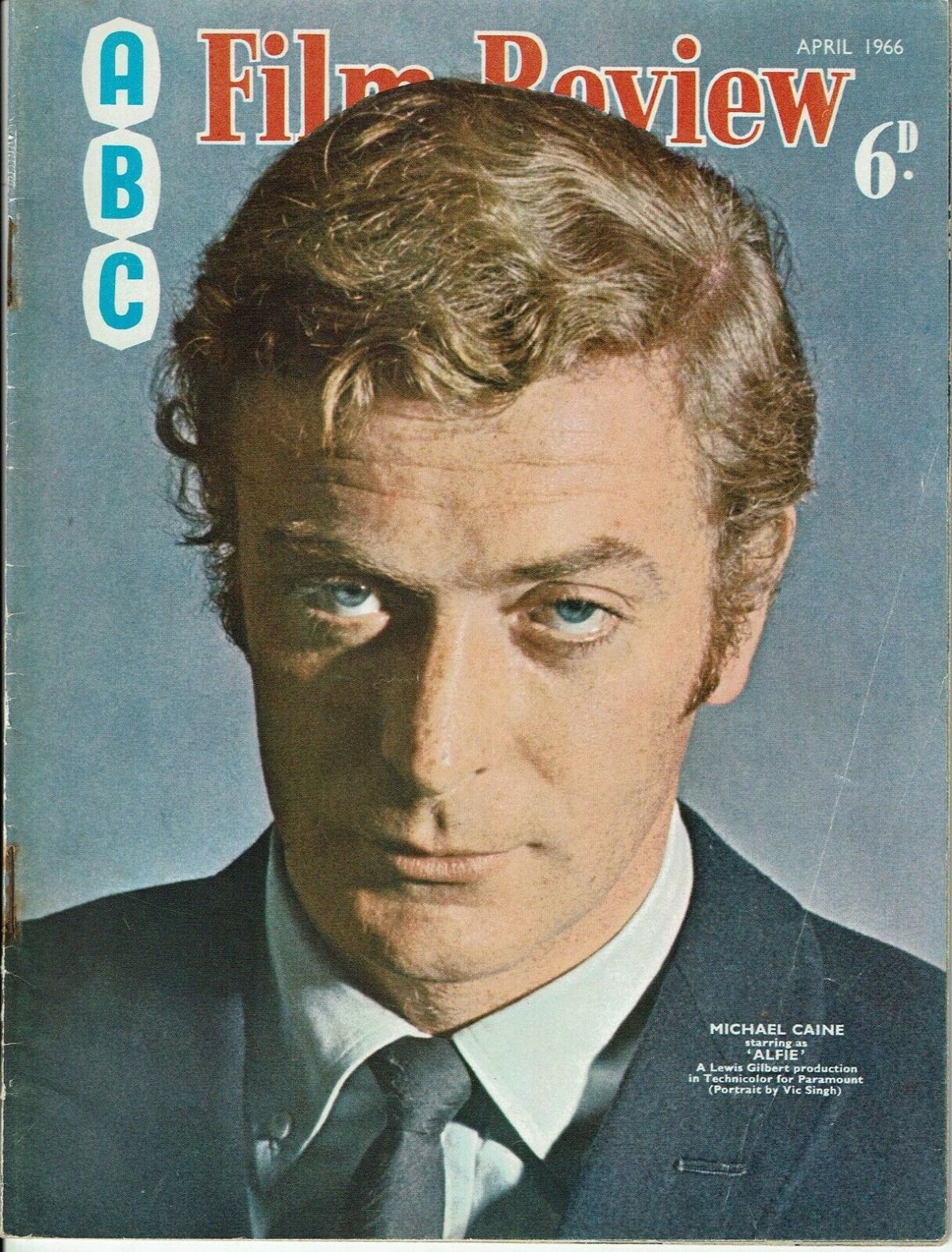
After The Ipcress File, Caine would have five films released in the U.S. in the space of eight months from July 1966 to February 1967, an output that could make or break him. In order of U.S. launch these were: black comedy The Wrong Box (1966), ribald sex drama Alfie (1966), caper movie Gambit (1966), a second outing for Harry Palmer in Funeral in Berlin (1966) and big-budget steamy Otto Preminger drama Hurry Sundown (1967) not to mention a reissue in 1967 of Zulu to capitalize on his growing fame.
The breadth of acting skills Caine brought to these diverse movies caught the attention, by and large, of the critics as well as the industry. The National Association of Theater Owners, proclaimed him their Future Star of the Year in September 1966 with the ringing endorsement of “never has a newcomer to films so fully and immediately captured the imagination of the world audience.”
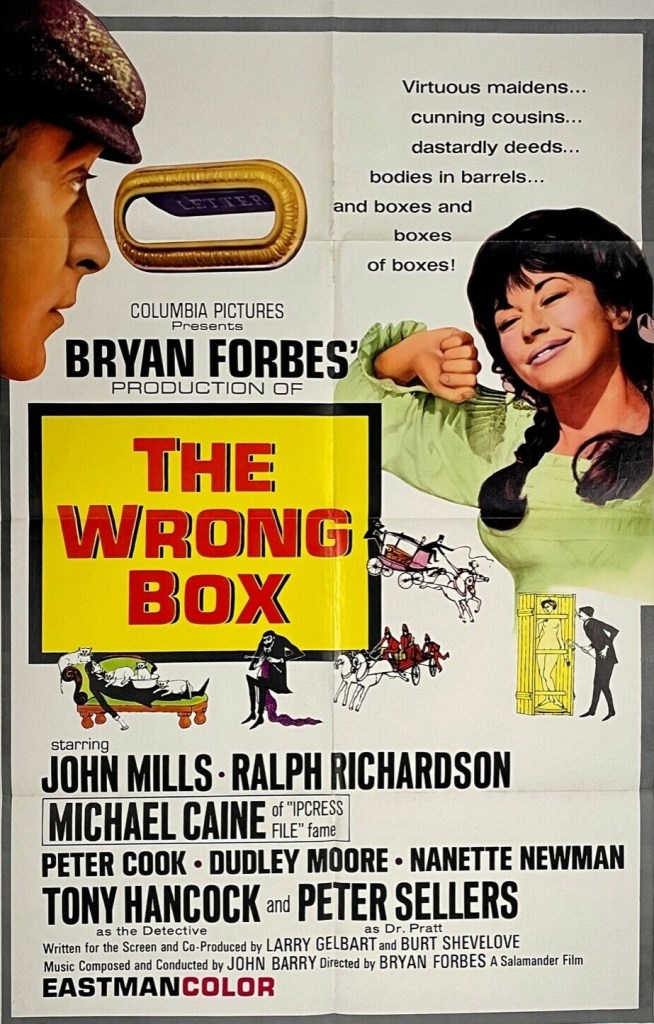
Oddly enough, there was no better follow-up as far as America was concerned to The Ipcress File than The Wrong Box in which he was a last-minute replacement for American actor George Hamilton. The Wrong Box (1966) presented Caine as the timid romantic opposite of the lothario of Alfie and the accomplished seducer of The Ipcress File (1965) but it was the kind of role to make critics sit up and wonder what else he had in his acting box of tricks.
But the release strategies employed by the various distributors, Columbia for The Wrong Box, Universal for Gambit and Paramount for the other three, ensured that the movies did not go down the Levine saturation-release route that had done for Zulu. Limited openings in prestigious arthouse-style cinemas allowed for slow build. In fact, it was almost tantamount to creating ‘sleepers’ out of every film. A film that remained for months at a time in one or two cinemas in a major city was the best way of driving up word of mouth. And during this hectic period whenever Caine was promoting one film, he was also being asked about all the rest.
It was almost inevitable that when a new picture opened, all the others were still playing. As a measure of how well this unplanned strategy worked, at Xmas 1966 his films were playing in six first run cinemas in New York, far more than any other star, and far more than any other star in the history of Hollywood. Each new opening boosted the box office of all the rest and when Oscar consideration or Year-End Best Awards entered the equation they served notice that, through his other films, this was an actor with a wide range of skills.
What had become quickly apparent to studios was that they had no idea how to assess Caine’s box office appeal. Such reticence proved invaluable. The limitations imposed on his film launches ensured that audience demand would dictate the release pattern. Only after Universal had opened The Ipcress File to sensational business at the Coronet in New York at the start of August 1965 did it consider widening the movie out. Audience response gave the studio the confidence to book it towards the end of the following month into Grauman’s Chinese in Los Angeles for an “unprecedented booking.” The two cinemas could not have been more opposite – the New York house seating just 590, the Los Angeles venue nearly three times as much with 1,517 seats. The studio was “evidently convinced to go commercial with the picture nationwide as booking into Grauman’s indicates.”
Columbia almost copied that campaign to the letter. The Wrong Box opened in early July 1966 to an “amazing” $35,000 at the 700-seat Cinema One. What was just as astonishing was that it was pulling in $28,500 in its seventh week by which time it had begun first run engagements across the country – a “socko” $25,000 in Chicago, “wham” $25,000 in Philadelphia, “boffola” $20,000 in Boston, “boffo” $18,000 in Washington D.C.
Although distributed by a different studio, Alfie followed a similar pattern, opening in New York again at the Coronet and also at the 500-seat New Embassy, breaking all-time records at both cinemas. Alfie, however,was less of a risk. On the financial front, it had already recouped its $750,000 costs solely from its London run. On the critical front, the film had won the Special Jury Prize at Cannes.
Just as important was Paramount’s marketing backing. A 16-page A3 Pressbook began by detailing both the critical acclaim enjoyed by the picture on its New York opening and its subsequent commercial success. Every advertisement was garnished with critical quotes: “Alfie bubbles with impudent humor and ripe modern wit” (Bosley Crowther, New York Times), “delightful comedy” (Judith Crist, NBC Today Show), “you are going to enjoy Alfie very much” (Life). “There’s no question about it,” crowed the Pressbook, “Alfie has completely conquered New York…(and) is the new champ of the press.” The New York Times had run four separate articles on the film, major magazines lined up to profile the star, on publicity duties Caine had come across as charming and personable, and the movie’s theme song topped the charts.
Three pages of the Pressbook were devoted to Michael Caine, calling him “multi-talented” and setting out the proposition, “Will Alfie’s Michael Caine Become the Newest Teenage Idol?” Caine predicted, “I believe it takes at least five movies to make a star of anyone,” counting Zulu as his first, plus The Wrong Box and Alfie. Given Funeral in Berlin and Gambit were still to come, he was already well on the way to proving himself correct.
Alfie launched in New York a few weeks after The Wrong Box had already whetted appetites. The Coronet delivered a $43,000 opener and the New Embassy $33,400, both all-time non-holiday records. Second weeks were equally potent, $40,000 at the Coronet, $33,000 at the New Embassy.
So Paramount “nursed” the sleeper. It didn’t properly expand until Thanksgiving and even then was limited to 56 theaters which had to commit to 14-week runs that would see it safely past Xmas and New Year so as to be “in active exhibition” during Oscar season. Before the first Oscar nomination was in, Paramount had pulled in $3m million in U.S. rentals (the studio’s share of the box office gross) and about the same again overseas (including Britain). Winning five Oscar nominations – including Best Picture and Best Actor – boosted takings.
The Xmas 1966 unofficial “Michael Caine Season” saw a three-cinema New York opening for Funeral in Berlin (budgeted at $2.6 million) and one house for Gambit while Alfie was still playing in two houses. The Harry Palmer sequel rocked up with a “wow” $40,000 – equivalent to $356,000 today – opening week at the 813-seat Forum, an “amazing” $21,000 ($187,000 equivalent) at the 450-seat Guild (extra shows to cope with the demand) and $37,000 ($330,000 equivalent) at the 568-seat Tower East. Gambit knocked up a “smash” $20,000 at the 561-seat Sutton with Alfie bringing in a “wham” £21,000 in its 18th week at the New Embassy plus $14,000 in its first week at the 430-seat Baronet. The capacities of all these cinemas showed that, in reality, they were glorified arthouses rather than the bigger 1,000-plus-seaters where the big-budget pictures resided.
In Britain, a top box office draw, in America king of the arthouses.
How well his movies did outside that limitation depended on popularity and accessibility. Pairings with top female stars like Shirley MacLaine (Gambit) and Jane Fonda (Hurry Sundown) ensured that the actor’s transition into the Hollywood elite was painless. His career has had many ups and downs, and many fans know him only from his appearance in Christopher Nolan films, but in celebrating a career that encompasses nearly 70 years as a star, no one should forget the eight months that turned him into one.
SOURCES: “Levine Heads Zulu showmanship Meets,” Box Office, January 13, 1964, p8; “Big Zulu Whoop,” Variety, January 15, 1964, p3; Review of Zulu, Variety, January 29, 1964, p6; “Levine Sells His Theatres,” Box Office, February 10, 1964, pNE2; Advert for Zulu, Variety, April 29, p26-27; “Britain Bubbles with Talent,” Variety, April 29, 1964, p58; Review of Zulu, Box Office, June 22, 1964, pA11; Review of The Other Man, Variety, September 16, 1964, p41; Review of The Ipcress File, Variety, March 1965, p6; “Newcomer Talent in British Pix,” Variety, May 12, 1965, p57; Advertisement for Zulu, Box Office, Jun 15, 1964, p3; “Ipcress File Pre-Release in NY Aug 2,” Box Office, July 26, 1965, pE4; “Michael Caine No Bottled-In Bond,” Variety, September 15, 1965, p30; “Grauman’s Sets Extended Run of Ipcress File,” Box Office, September 20, 1965, pNC1; “Preminger Signs Caine,” Box Office, April 11, 1966, pE1; “Funeral in Berlin Budget $2,600,000,” Variety, April 27, 1966, p29; “Caine Is Able at B.O. with Five Star Roles in 33 Months since Zulu,” Variety, August 31, 1966, p2; “Michael Caine Named NATO Future Star,” Box Office, September 19, 1966, p3; “Par Nurses Its Alfie with Limited Playoff Through Holidays,” Variety, October 12, 1966, p21; “Michael Caine On Tour for Funeral in Berlin,” Box Office, November 21, 1966, pE2; “Embassy Reissues Three Caine, Belmondo Films,” Box Office, January 9, 1967, p10; “Alfie Could Be Par’s Tom Jones,” Variety, February 1, 1967, p3. Box office figures taken from the “Picture Grosses” section of Variety: July 20, 1966-September 24, 1966 and December 28, 1966.
“The Husband-Hunting Adventures of Moll Flanders” might have been a more accurate title and if you were seeking a template for a multi-character eighteenth-century Olde English picturing majoring on sexual shenanigans here would be a very good place to start, rather than the shambolic recently-reviewed Lock Up Your Daughters (1969). Of course, Tom Jones (1963) was the precursor but told the story from the male perspective and here it is from the more vulnerable female point-of-view. Despite the hilarity and the sexual proclivities on show, it remains abundantly clear that marriage remains a refuge, where the un-titled can gain either security or status, but also a contract, a means of further enrichment for the already wealthy.
So orphan housemaid Moll Flanders (Kim Novak) has a difficult time of persuading the elder brother (Daniel Massey) of her wealthy employer to marry her. Instead, he takes her as his mistress, leaving her no option but to marry the drunken fool of a younger brother (Derren Nesbitt) and instantly regret her decision. When he drowns, you would have thought that would solve her problems. But this was the eighteenth century and a widow with no fortune (and therefore power) of her own can easily be tossed out penniless.
A widowed banker (George Sanders) might be a prospect especially as she has the wits to prevent him being entirely robbed by highwayman Jemmy (Richard Johnson). Plans to marry him thwarted, she takes a job for food and lodgings with Lady Blystone (Angela Lansbury) and her husband, an impoverished Count (Vittorio De Sica), who are constantly pursued by debt collectors. Meanwhile Jemmy has taken the decision to marry a rich woman and become a kept man.
But this set of characters becomes enmeshed, rather than going off in sundry directions as with Lock Up Your Daughters, so the tale unfolds in classic fashion. Assuming Moll to be moneyed, Jemmy masquerades as the owner of three ships. Nothing, of course, works out for anybody, certainly not those pretending to be something they are not while aspiring to wealth beyond their reach, but it all concludes in propitious fashion as the actions of the various principals become embroiled.
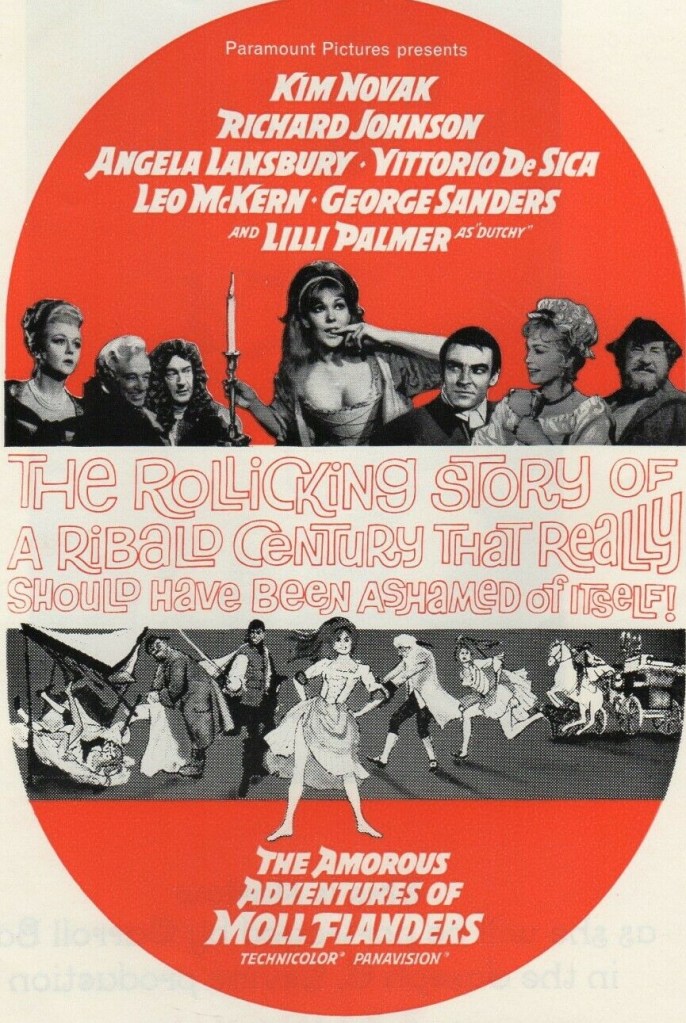
While certainly having an inclination towards the amorous, Moll wishes for that within the context of true love, rather than selling her physical wares to the highest bidder. So for a picture sold on immorality – the “rollicking ribaldry” of the poster – there is an unsung moral standpoint. Finding safe passage into affluence proves very tricky indeed. And what appears at first glance to be merely a picaresque episodic tale turns out to be very well structured indeed. And those looking for cleavage will find it here in abundance, as if some kind of rationing had been imposed on clothing, or that it was matters of economy that dictated that the area around the bosom be left unclothed. Being the lusted-after heroine it falls to Moll Flanders to shed even more of her attire from time to time.
You are more likely to laugh out loud at the moments of offbeat humour – a flotilla of ducks heading in Moll’s direction when she cries for help in a lake, the Count while acting as a butler demanding a tip – but it is more of a gentle satire. There is some of the expected bedroom farce but, mercifully, no recourse to a food fight. It is handsomely-mounted and meets the highest expectations of the costume drama.
Kim Novak (Of Human Bondage, 1964) easily passed the English-accent-test and carries the picture with ease. Richard Johnson (Deadlier than the Male, 1967) reveals a rakish side so far hidden in his more dramatic works to date. And there is a fine supporting cast including George Sanders (The Quiller Memorandum, 1966), Angela Lansbury (Harlow, 1965), Vittorio De Sica (The Shoes of the Fisherman, 1968), Lili Palmer (The Counterfeit Traitor, 1962) as Jemmy’s mistress, Leo McKern (Assignment K, 1968) as Jemmy’s sidekick going by the name of Squint, Daniel Massey (Star!, 1968) and Derren Nesbitt (Nobody Runs Forever/The High Commissioner, 1968). In bit parts looks out for Cecil Parker (Guns at Batasi, 1964), Dandy Nichols later of Till Death Us Do Part television fame and Carry On regular Peter Butterworth.
All directed with some style by Terence Young (Mayerling, 1968) and adapted from the lengthy Daniel Defoe novel by Denis Cannan (A High Wind in Jamaica, 1965) and Roland Kibbee (Valdez Is Coming, 1971).
An old-fashioned romp with, if you can bothered to look, a moral center. You catch this on Amazon Prime. I’m not sure why they have chosen a black-and-white illustration since the film is shot in glorious color.









 The Magnificent 60s