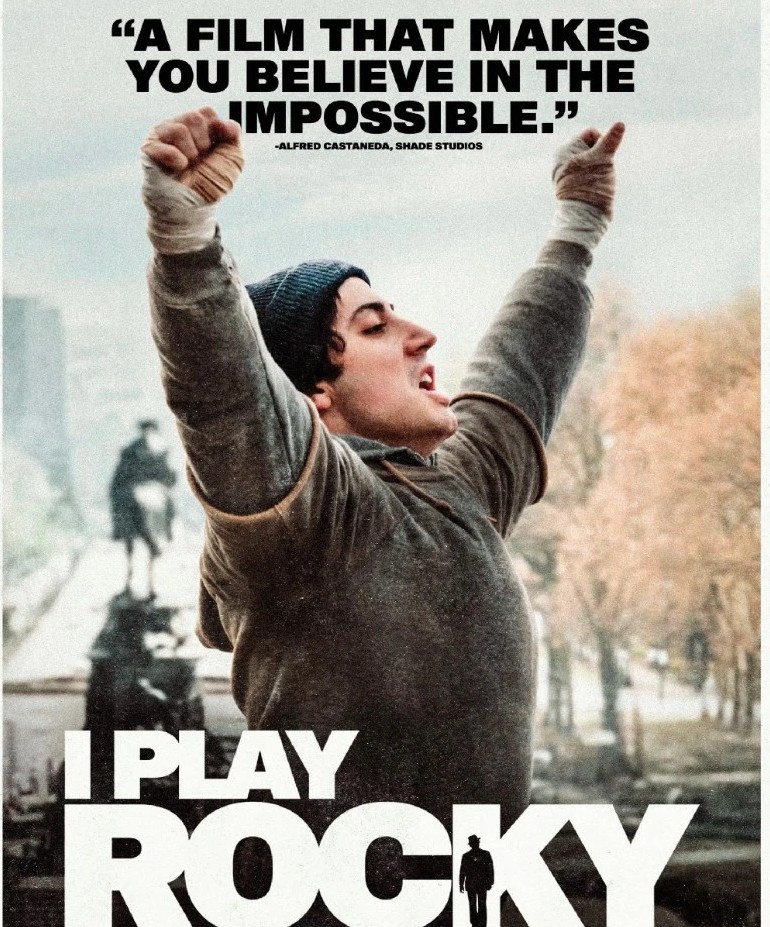
Of all the movie stars who might qualify for a biopic, I never thought I’d be watching The Sylvester Stallone Story. Nor enjoying it so much. Easily the best picture ever made about movie-making, in part because all the points it develops about the Hollywood process are drawn from real-life and not emanating from the fevered imagination of a screenwriter who has a point to prove or points to score.
I’ve not read Stallone’s autobiography which may well have covered this ground in print, so I came at with a fresh eye but also, I have to confess, a great deal of trepidation. I knew, of course, that the actor had famously held out to star in the movie he had written, but that was the extent of my knowledge.
Not the bad-mouthing of Stallone along the way, the fact that the budget was topped at just $1 million – a sum at the time barely sufficient for a B-movie – or that revolutionary use of the Steadicam was vital to the production, or that even such successful producers as Irwin Winkler and Robert Chartoff (with films as varied as They Shoot Horses, Don’t They, 1969, and The Mechanic, 1972, on their resume) were so beholden to the studio bosses.
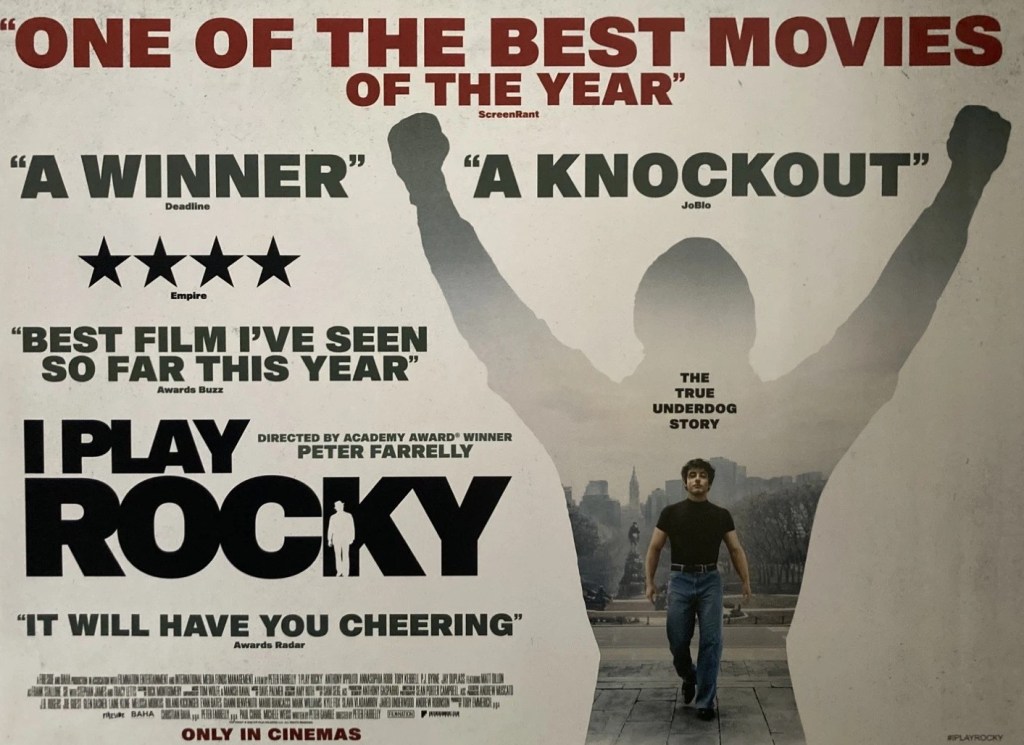
My guess this was as low-budget a picture as Rocky (1976) itself. It has no stars whatsoever and director Peter Farrelly hasn’t had a well-received movie in nearly a decade, not since Green Book in 2018). But it’s not just the story of the making of Rocky that plays out almost as well as the film itself, but that the acting verges on the exquisite. The emotion in the scene where Stallone (Anthony Ippolito) takes his girlfriend Sasha (AnnaSophia Robb) to meet his father (Matt Dillon) is carried through Sasha’s eyes.
Producers Winkler (P.J. Byrne) and Chartoff (Toby Kebbell) and director John Avildsen (Jay Duplass) are not just hard-nosed but very astute in movie-making and virtually every obstacle that Stallone meets is underlined by the realities of movie-making. There’s a fabulous scene when Avildsen explains to Stallone that he needs more from a particular scene without being able to explain what he wants except that the movie needs “the thing”, the undefinable acting element that makes a movie truly work.
Many scenes are the result of happenstance. Though initially set in New York, the story switched to Philadelphia because that was out of the reach of the unions. It’s Stallone who decides to dance around the top of the Philadelphia steps, Stallone who rejects the designated fight coordinator because the boxing scenes felt false, who breaks his hand because he didn’t realize that frozen meat was actually frozen so solid it was like punching cement. Neither Stallone nor Talia Shire (Kiki Seto) could ice-skate which put the kibosh on the way the scene was originally written.
I wasn’t aware either that movies Stallone made once he had the marquee power to make them, such as Paradise Alley (1978) and Fist (1978) were both written by him before Rocky and that the inspiration for making the boxing picture came from watching someone who shouldn’t have been in the ring with Mohammed Ali lasting so long in the ring that it roused the audience watching it on television in a bar.
This is just crammed with so many good moments that the narrative drive scarcely falters. The initial romance is endearing and well-written. Stallone’s recruitment for a soft porn feature is reflected through the eyes of the female casting director who views him as male eye candy. The scenes with the dog that could have easily tripped off into sentiment are dragged out of it by reality. Studio head honcho Maddox (Tracy Letts) is driven by envy and revenge and clearly hopes the movie will flop so he can say I-told-you-so.
There’s a fairy tale element to this that could turn it into the feel-good picture of the year driven by word-of-mouth.
Anthony Ippolito (who played Al Pacino in TV mini series The Offer, 2022, which as an examination of Hollywood I found much inferior to this) is just superb, not just catching the way Stallone speaks but also the way he moves. AnnaSophia Robb (Rebel Ridge, 2024) matches Stallone for emotional power. P.J. Byrne (The End of Oak Street, 2026) and Toby Kebbell (Salvable, 2025) are a superb double act, Jay Dupless (Other Mommy, 2026) exudes directorial steel and I could watch Tracy Letts (Ford v Ferrarri, 2019) all day long.
Peter Farrelly is back on top form and screenwriter Peter Gamble (Office Uprising, 2018) has turned in a compulsively-viewable movie.
Without stars to provide marketing heft, this is ging to rely on word-of-mouth. It’s got my support for sure.

