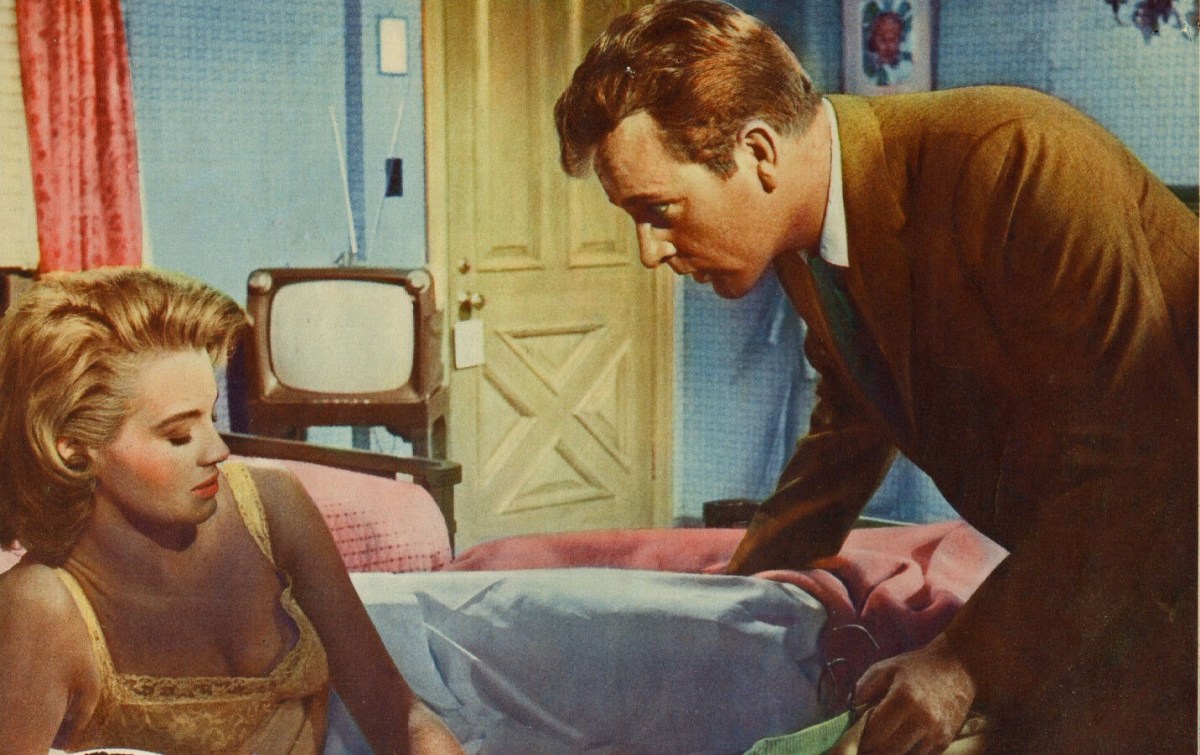
Behind the Scenes – “This Sporting Life” (1963)

Star Albert Finney and director Karel Reisz of Saturday Night and Sunday Morning (1960) turned it down. Director Lindsay Anderson, screenwriter David Storey, author of the novel on which the film was based, and star Rachel Roberts all suffered from massive doubt in their own abilities.

Anderson was the last of a generation that included Reisz and Tony Richardson (Tom Jones, 1963) to make a movie. He was better known as film critic and theatre director. As far as the screen went, he had got only as far as five episodes of The Adventures of Robin Hood for television, and some documentaries and shorts. If he was going to make a movie it almost certainly depended on finance from British production outfit Woodfall which had backed Reisz and Richardson. However, Woodfall was outbid for the rights to This Sporting Life and Anderson only came into the frame when Reisz rejected the idea of directing the movie in favor of turning producer and giving Anderson his opportunity.

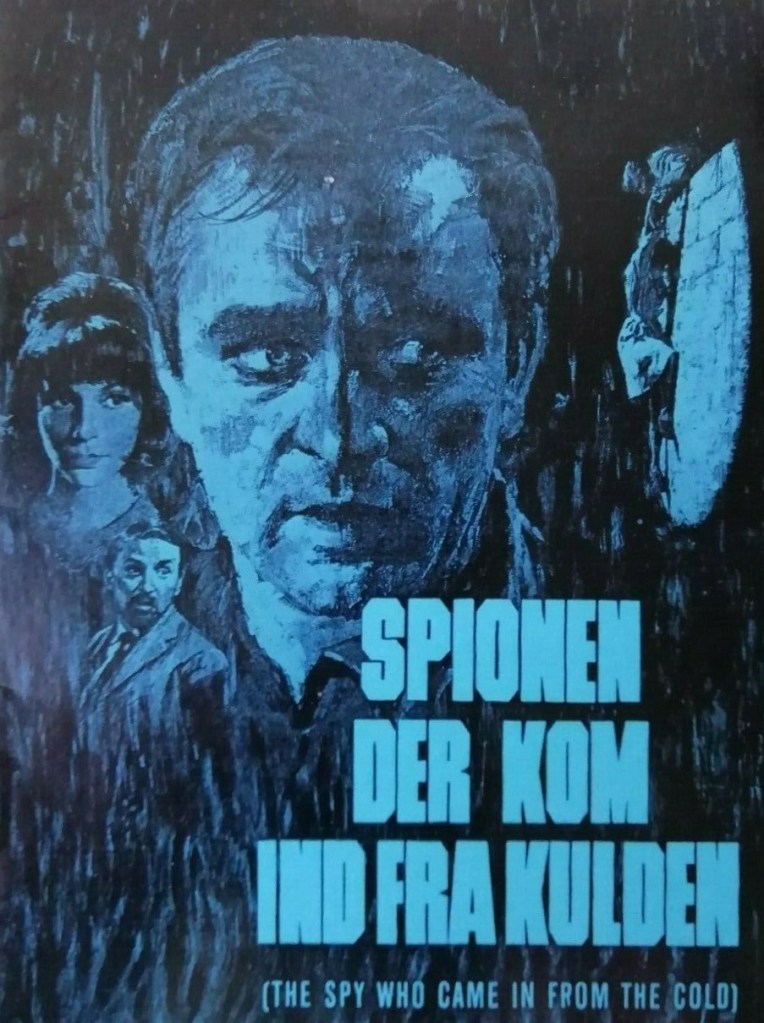
Cover of the Danish program.

“I was not sure I was up to it,” confessed Anderson. Theoretically a tale of a rugby footballer Frank Machin’s (name changed from the Arthur Machin of the book) rise and fall, Anderson wanted to explore the novel’s “dark poetry” and the ambiguities of the a central character who was by turn overbearing and sensitive and involved in a “tortured, impossible relationship.”

However, Storey, also making his movie debut, struggled with the script. Until the sudden success of This Sporting Life, the aspiring artist had lived a debt-ridden life as a supply teacher (17 schools in three-and-a-half years) in poverty-stricken London boroughs, writing his novels on train journeys north to fulfill his contract to play professional rugby. Reprinted prior to publication This Sporting Life, his debut novel, received excellent reviews and won the inaugural U.S. MacMillan Award worth $7,500.

When the film industry came sniffing Storey took tea with Stanley Baker at the Dorchester Hotel, lunched with Tony Richardson at the Trocadero and was wooed by director Joseph Losey at his Knightsbridge flat. Initial expectations were that the rights would go for £3,000, but a bidding war between Woodfall and Rank sent the bill up to £10,000 with the latter emerging victorious. Karel Reisz agreed to become producer on condition he could choose director, writer and cast. He introduced Storey to Anderson and to an initially interested Albert Finney.

Cover of the first edition of the British hardback.

Storey, a working-class son of a coal miner, and Anderson stood at different ends of British class divide. Initially suspicious of each other, they had opposite temperaments. “Lindsay was an optimist,” explained Storey,” I was a reclusive, and when in doubt, morbid.” Even after Storey completed a treatment and the pair went north to scout locations, the project remained in doubt, in part because Anderson did not understand the book and had a “curious lack of confidence” and in part because Storey resisted reshaping the material into something “new.” In fact, Anderson’s lack of confidence was so deep it took several months before he actually signed his contract.   

Storey, too, suffered from revisiting the area where he had grown up. The death of a sibling  cast a devastating shadow over the rest of his life, the Wakefield rugby ground in fact “scarcely a stone’s throw “from the child’s grave. “Wakefield was being opened up to me in a way I had never known before,” explained Storey, referring to the grand houses visited as possible locations whose exteriors he had glimpsed while working as a marquee laborer.  

Despite “exhaustive consultations” with Anderson and Reisz, the script failed to gell. “I felt the authority I wanted was not there,” commented Anderson. Although actors are often decried for interfering with the script, in this case it was star Richard Harris who arrived at the solution.

British paperback film tie-in.

Anderson had been attracted to Harris from seeing him in the stage adaptation of J.P. Donleavy’s The Ginger Man.  The director flew off to Tahiti where Harris was filming Mutiny on the Bounty (1962) to be met at the airport at five in the morning by the actor, “ his 18th century seaman’s hair down to his shoulders, bursting to tell me what he thought of the script we had sent him.”

Anderson recalled, “Within ten minutes we were at it…we talked and argued right through the day. I quickly realized he was right…we had lost what was most unique and brilliant in the novel…it was Richard, who, with passionate intransigence, brought us back to the book…in the evening after his shooting on the Bounty we sat in his bungalow going through the script and his own heavily-annotated copy of the novel…and slowly a conception emerged which began to satisfy us.”

Storey agreed with the new look which basically followed a subjective point-of-view rather than being cluttered by the novel’s flashbacks. “With an unequivocal endorsement of the book and the rejection of a script which had wearied me more than I’d imagined, I found rewriting the script in the manner in which the book had been written, from the inside looking out rather than the outside looking in, a surprisingly exhilarating task…Once Richard Harris had become identified with the part …the material was no longer a problem.”

Retaining that subjectivity was Anderson’s biggest issue  An Oxford scholar, he had little innate understanding of Frank Machin’s world and in consequence “was liable to slip into an objective view of scenes that needed to be presented through Machin’s own temperament.” Harris proved instrumental in keeping the director on course.

Rachel Roberts twice turned down the role – Mary Ure (Look Back in Anger, 1959) was also in the frame with four other actresses – and failed to turn up for a screen test. Karel Reisz once commented how odd it was that “the two films that made this great-hearted flamboyant woman best-known (the other being Saturday Night and Sunday Morning) were ones in which she played withdrawn, bleak, ungiving women. Rachel’s great talent was to sink her personality into the part without losing access to her own sensuality. You felt the tension.”

Of This Sporting Life, Reisz added, “She had great doubts about her ability to play Mrs Hammond because she’s a very held back, undemonstrative woman. A passionate person, certainly, but someone who’s turned puritanical through so much constant repression of her feelings. Rachel was afraid of this: she didn’t know out of which part of herself to play the role.”

Lindsay Anderson was as unsure as Roberts: “She didn’t appear to me to be the Mrs Hammond character…Rachel was anything but repressed.” Actress Sybil Williams remembered finding a whole sheaf of notes in Rachel’s script about “the Mrs Hammond character she appeared to be playing so intuitively.” Said Anderson, “Richard Harris was bit awed by Rachel. She could acquit herself with a first-rate reading in just a couple of takes. Richard took a few more to feel he had got it right. Rachel’s security as an actress made him feelmore respectful towards her.”

The scenes between Harris and Roberts were endlessly rehearsed, involving a full 10 days prior to shooting and then during evening and weekends while in production. Roberts was playing a woman “whose feelings, though fierce, are almost continually suppressed: the relationship deepens without self-explanation…through incessant conflict…It called for an actress of exception ‘interior’ quality with real wildness within as well as the capacity for an iron restraint.”

Somewhere in the BBC archive is a programme, never aired, about the making of the film shot for its Monitor arts strand, although Storey was interviewed later on the show by Huw Wheldon, later BBC managing director.

Although Lindsay Anderson only made four more movies, the most memorable being If…(1968), and David Storey never wrote another screenplay, the pair achieved considerable success together when the author turned to writing plays such as Home (1970) and The Changing Room (1971), set in a rugby club.  

If This Sporting Life appears to have two main characters driven by demons, part of the explanation as to how such creatures emerged from David Storey’s imagination can be found in his riveting memoir A Stinging Delight  which traces a core of depression from his earliest days through to the times in later life when he was in and out of mental hospitals. Rachel Roberts also suffered from mental illness and committed suicide in 1980.

SOURCES: Lindsay Anderson, “Sport, Life and Art,” Films & Filming, February 1963, pages 17-20; David Storey, A Stinging Delight (Faber, 2021), pages 217-218, 221-223, 227-231, 233, 240-242; No Bells on Sunday, The Journals of Rachel Roberts, Edited with a documentary biography by Alexander Walker, Pavilion, 1984, pages 37, 55, 56, 58.

This Sporting Life (1963) ****

What began as the last gasp of the British New Wave working class kitchen sink drama has now after a six-decade gap resolved into a struggle over political and sexual ownership. Macho athlete Frank Machin (Richard Harris) jibes against his paymasters at a Yorkshire rugby league club – in similar fashion to Charlton Heston in Number One (1969) –  while trying to hold sway over widowed landlady Margaret (Rachel Roberts). While documenting the class divide over which British writers and directors obsess, Lindsay Anderson’s debut takes a wry look at power.

Machin belongs to the Arthur Seaton (Saturday Night and Sunday Morning) class of loudmouth boors, determined to take as much as they can, riding roughshod over anyone who gets in their way, even attacking players of his own team. Although a fan favorite, his position at the club still requires backing from the moneyed directors, support that appears go awry when he rejects overtures from Mrs Weaver (Vanda Godsell), wife of a board director (Alan Badel). While Margaret eventually succumbs, her actions fill her with shame, the presents he buys making her feel like a kept woman.

Both Machin and Margaret are the rawest of creatures, forever appearing ready to topple into some emotional crevasse of their own making. At a time when marriage was the rock of society and women had little independence, a woman could dwindle away in face of scorn from neighbours, while a man lacking emotional intelligence would crumble in the face of his own fears.

The non-linear narrative blurs some aspects of the story. There is no reference to Machin’s background save that he was once a miner and still works somewhere unspecified to supplement his footballer’s income. He rejects the paternalism of ageing scout Johnson (William Hartnell) while appears to be seeking to resolve maternal issues, the widow with two small children at least a decade older, and although he could easily afford better accommodation refuses to move out.

His obsession with Margaret is never properly explained, except by her, who sees him as acting like an owner. Equally, Margaret is the opposite of the women in virtually every movie of the period, for whom marriage is the sole ambition. Whether she still grieves over the loss of her factory worker husband, who may have committed suicide, or loathes Machin’s dominant nature is never explained. It might have been better if they had married for unhappy husbands and wives tend to give each other both barrels, emotions never concealed. Or she could be in the throes of an undiagnosed depression – author David Storey suffered from this all his life – expressed as anger.

Machin is the other side of the British Dream – the assumption that anyone who escapes going down the pits or the mindless grind of the factory will automatically enjoy happiness. While Machin revels in his celebrity, he has no idea how to make his life happier. This is in contrast to the other footballers who either enjoy womanizing and drinking or are married or engaged and accept the unwritten rules of the game rather than fighting everyone.

There is plenty grime on show, and the football field has never been so pitilessly portrayed, and as a social document the movie fits in well to the small sub-genre of films depicting working class life, but the picture’s thrust remains that of two opposites who will clearly never meet except in the delusional head of Machin.

Power is demonstrated in various ways. Weaver has the clout to give Machin a hefty signing-on fee against the wishes of the board, Weaver’s wife takes her pick of the footballers to satisfy her sexual needs, Machin believes he is entitled to berate waiters in an upmarket restaurant, while Margaret is demeaned by accepting his present of a fur coat.

As ever with these films of the early 1960s there is a wealth of acting talent. Both Harris and Roberts were Oscar-nominated. Others making a splash in the cast were Alan Badel (Arabesque, 1966), Colin Blakely (The Vengeance of She, 1968), Jack Watson (The Hill, 1965), and if look closely you will spot double Oscar-winner Glenda Jackson (Women in Love, 1969). Future television stalwarts included William Hartnell (the first Doctor Who), Arthur Lowe (Dad’s Army, 1968-1977), Leonard Rossiter (Rising Damp, 1974-1978), Frank Windsor (Softly, Softly, 1966-1969) and George Sewell (Paul Temple, 1969-1971).

Lindsay Anderson (If… 1969) no doubt believed he was making an excoriating drama about the class struggle, but in fact has delivered a classic thwarted love story. David Storey wrote the screenplay based on his own novel.

The Scorpio Letters (1967) ***

Desultory spy thriller with over-complicated story that’s worth a look mostly for the performance of Alex Cord (Stiletto, 1969). I can’t say I was a big fan of Cord and I certainly didn’t shower him with praise for his role as a disillusioned Mafia hitman in Stiletto. But now I’m wondering if I have been guilty of under-rating him.

Normally, critics line up to acclaim actors if they deliver widely differing performances – Daniel Day-Lewis considered the touchstone in this department after Room with a View and My Beautiful Launderette opened in New York on the same day in 1985. But usually screen persona rarely changes, amounting to little more than a heightened or amalgamated version of the actor’s character or features. Once Charles Bronson, for example, started wearing his drooping mustache he was never seen without.  Actors may grow old, but never bald.

The macho mustachioed Cord of Stiletto is nowhere in sight. In fact, in The Scorpio Letters minus moustache and resisting attempts to reveal his musculature, he is almost unrecognizable. In this picture Joe Christopher (Alex Cord) is flip, resentful, thoughtful, occasionally pedantic, more natural than many of the crop of Hollywood new stars being unveiled at the time, and for once as a transplanted American in London rather scornful of British traditions. There’s a realistic flourish here, too, he is so poorly paid – and on a temporary contract – that he has to take the bus. And although he is an ex-cop fired for brutality, that level of violence ain’t on show here. Virtually the opposite of the character Cord created for Stiletto, I’m sure you’ll agree. So full marks for versatility and talent.

Unfortunately, the rest of the movie is not up to much, at the very bottom of the three-star review category, almost toppling into two-star territory. Christopher is investigating the death of a British agent who was the subject of a blackmail attempt. By coincidence – or perhaps not – another part of British Intelligence is investigating the same death and this brings Christopher into contact with Phoebe Stewart (Shirley Eaton) and eventually they work together to unravel a list of codenames and uncover the conspiracy with a bit of risk to life and limb.

But the pay-off doesn’t work despite all the exposition attempting to build it up and you’re left with a kind of drawing-room drama rather than exciting spy adventure. It’s determinedly London-centric with red buses, red postboxes, Big Ben, and The Horse Guards all putting in an appearance. The scene shifts to Paris and Nice without a commensurate heightening of tension. Despite a couple of neat scenes – a chase held up behind a wedding party, an irate German chef, an interrogation in a wine cellar – it’s much too formulaic.

Cord apart, Shirley Eaton (Goldfinger, 1964) adds some glamour, but her rounded portrait depicts a character with warmth rather than oozing sex. This is the kind of film that should be awash with character actors and up-and-comers but I recognized few names except for Danielle De Metz (The Karate Killers, 1967), Oscar Beregi (Morituri, 1965) and Laurence Naismith (Jason and the Argonauts, 1963).

One-time top MGM megger Richard Thorpe (The Truth about Spring, 1965) was coming to the end of a distinguished career which had included Ivanhoe (1952) and Knights of the Round Table (1953). This was his penultimate film. The appropriately-named Adrian Spies (Dark of the Sun, 1968) wrote the screenplay based on the Victor Canning thriller. Making his movie debut was composer Dave Grusin (Divorce American Style, 1967)

Albeit made on a budget of just $900,000, MGM intended the picture for theatrical release but with a short cinema window to make it available for a speedy showing on ABC TV. It was originally scheduled for a May 1967 theatrical release but MGM, contractually obliged to deliver the picture within a specified time to television, could not fit in an American release. So it made its debut in the “Sunday Night at the Movies” slot on February 19, 1967, and was shown in cinemas abroad. Nor was it shown first on U.S. television because the studio believed it to be a disaster. Reviews were positive. Variety (February 22, 1967, page 42) called it “very hip.”

Book into Film – “The Detective” (1968)

Screenwriter Abby Mann (Judgement at Nuremberg, 1961) had his work cut out adapting Roderick Thorp’s tombstone of a novel that ran to over 500 pages. The first job was to make the book – set mostly in the 1940s – contemporary. The book’s fictional locations of Port Smith and Manitou were transposed to New York. Joe Leland was younger in the book – in his mid-30s compared to the 50-plus Frank Sinatra.

And while the principals remained the same, the screenwriter employed some distinctive structural sleight of hand to keep apart the two investigations occupying Leland, the murder of a homosexual and the apparent suicide of a businessman. In the book the first investigation takes place in the past and is told in a long, detailed, flashback, while the suicide case takes up the present. For the film Mann relocated both crimes to the same timeframe, with the suicide simply following on to the murder.

But there was one distinct change. When Leland in the book investigates the suicide, he is doing so as a private eye, not a cop. He had resigned from the force after seeing a criminal sent to the electric chair. A minor alteration was also involved in the suicide case in that the widow Norma (Jacqueline Bisset in the film) was six months pregnant in the book.

More significantly was the swapping over of the sexual characteristics of Leland’s estranged wife (Lee Remick in the film) and the widow. In the film Remick is the nymphomaniac. In the book, it is the other way round, although Norma, after marriage, has that tendency under control.

Although Leland is a decent enough policeman, he makes none of the overt pitches for decency that occur in the film. That is all Abby Mann’s invention. And the scene in the picture where Leland objects to the stripping of a suspect is lifted from another episode in the book, one in which Leland has no involvement. While incorporating minor aspects from the book such as the annoying politician and civic corruption, Mann invented the atmosphere of the police station, the friction between the various cops and Leland’s ruthless ambition.

As I noted in my Blog on the novel A Cold Wind in August (published in 1960), fiction writers had far greater flexibility as regards sexuality than movie makers and Thorp’s 1966 novel reflects that trend. Although the book falls into the category of police procedural, and Thorp himself worked for his father’s detective agency, the sprawling canvas offers as much insight into human relationships as crime and investigative processes.

In some respects this is a textbook adaptation, stripping away the various layers of a dense book to focus on the essential narrative, then both trimming and expanding the main relationships to suit the new plotline. Virtually unspoken in both book and film are Leland’s reaction to the situations that have arisen as a result of his action, not because the writer in either circumstance was dodging the issues, but because both reader and moviegoer could work it out for themselves without introducing melodrama where it was not required.

The Detective (1968) ****

Perhaps the boldest aspect of this raw look at the seamier side of life as a New York cop is that perennial screen loverboy Frank Sinatra plays a cuckold. Prior to what is always considered the more hard-hitting cop pictures of the 1970s – Dirty Harry (1971), The French Connection (1971), Serpico (1973) etc – this touched upon just about every element of society’s underbelly. Despite an old-school treatment, more a police procedural than anything else, homosexuality, nymphomania, corruption, police brutality, and a system that ensured poverty remained endemic all fell into its maw. And, for the times, several of these issues were dealt with in often sympathetic fashion.

Joe Leland (Frank Sinatra), an ambitious but principled detective gunning for promotion, investigates the murder of a prominent homosexual while dealing with the disintegration of his marriage to Karen (Lee Remick) and colleagues on the take. When other cops want to beat confessions out of suspects or strip them naked to humiliate them, Leland intervenes to prevent further brutality. He is not just highly moral, but takes a soft approach to criminals, not just playing the “good cop” part of a good cop/bad cop double-act but genuinely showing sympathy. Not only does Leland leap to the defense of those he feels unfairly treated, but he trades punches with those meting out such treatment. In addition, he clearly feels guilt over sending to the electric chair a man he believes should be treated in a mental institution.

Although at first glance this appears a homophobic picture, it is anything but, Leland showing tremendous sympathy towards homosexual suspect Felix (Tony Musante) – whom his  colleagues clearly despise – to the extent of holding his hand and gently cajoling him through an interview. Later, rather than condemn a bisexual the film shows empathy for his torment. Certainly, some of the attitudes will appear dated, especially the idea of sexual expression as a brand of deviancy, but the film takes a genuinely even-handed approach. Through the medium of Leland’s perspective, it is clearly demonstrated that it is other police officers who have the warped notions.  

Having solved the first murder, Leland takes up the case of an apparent suicide at the behest of widow Norma McIver (Jacqueline Bisset), only for this to lead not only to civic corruption on a large scale but back to the original investigation. Leland also has a wider social perspective than most cops and there is a terrific scene where he berates civic authorities for creating a system that perpetuates poverty. The ending, too, casts new light on Leland’s  character.

By this point, most screen cops were defined by their alcoholism and ruined domestic lives, but this is altogether a more tender portrait of an honest cop. Leland’s relationship with Karen is exceptionally well done. Normally, of course, it is the man who usually strays. This reversal in the infidelity stakes adds a new element. Karen has more in common with an independent woman like the Faye Dunaway character in The Arrangement (1969).

While playing the good cop would come relatively easy to an actor like Sinatra, carrying off the role of the hurt husband is a much tougher ask. Coupled with his sensitive approach to criminals, this is acting of some distinction, a mature performance by a mature star.  This is the last great Hollywood role by Lee Remick (No Way to Treat a Lady, 1968) and she brilliantly portrays a woman trapped by her self-destructive desires.

Jacqueline Bisset (Bullitt, 1969) leads an excellent supporting cast that includes Jack Klugman (The Split, 1968), Ralph Meeker (The Dirty Dozen, 1967), Robert Duvall (The Godfather, 1972), Lloyd Bochner (Point Blank, 1967) and Al Freeman Jr. (Dutchman, 1966).

While Gordon Douglas (Claudelle Inglish, 1961, and Tony Rome, 1967) was viewed very much as a journeyman director, he brings an inventive approach and some surprising subtleties to the picture. He opens with a very audacious shot. It looks like you are seeing skyscrapers upside down, as if a Christopher Nolan sensibility had entered a time warp, until you realize it is the city reflected off a car roof. There are some bold compositions, often with Sinatra appearing below Remick’s sightline, rather than the normal notion that the star must be taller or at least the same height as everyone else.

Oscar-winning Abby Mann (The Judgement at Nuremberg, 1961) adapted the bestseller by Roderick Thorp who achieved greater fame much later for writing the source novel for Die Hard (1988) – Nothing Lasts Forever, a sequel to The Detective. For the Bruce Willis film Joe Leland became John McClane. Sinatra, although 73 at the time, was offered that role first as part of his original contract for The Detective.

In The Detective Sinatra’s wife Mia Farrow was initially contracted to play the part of Norma McIver but pulled out when Rosemary’s Baby (1968) overshot its schedule. Partly in revenge, Sinatra sued her for divorce.

The Devil’s Brigade (1968) ***

I couldn’t get my head around the idea of the U.S. Army recruiting a bunch of undisciplined misfits, many with jail time, in order to link them up with a crack Canadian outfit. Turns out this part of the film was fictional, the Americans in reality responding to advertisements at Army posts which prioritized men previously employed as forest rangers, game wardens, lumberjacks and the like which made sense since the original mission was mountainous Norway.  I should also point out the red beret the soldiers wear is also fictional and while depicted on the poster sporting a moustache commanding officer Lt. Col. Frederick (William Holden) is minus facial hair in the film.

But, basically, it follows a similar formula to The Dirty Dozen (1967), training and internal conflict followed by a dangerous mission. The conflict comes from a clash of cultures between spit-and-polish Canucks and disorderly/juvenile Yanks though, as with the Robert Aldrich epic, the leader taking some of the brunt of the discontent.  Collapsible bunk beds, snakes under the sheets and a tendency to fisticuffs are the extent of the antipathy between the units, which is all resolved, as with The Dirty Dozen, when they have to take on people they jointly hate, in this case local bar-room brawlers in Utah.

The movie picks up once they are sent to Italy. Initially employed on reconnaissance, Frederick challenges Major-General Hunter (Carroll O’Connor) who wants to do things by the book and sets out to take an Italian position by trekking two miles up a riverbed, creeping into town by stealth and capturing the location without firing a shot. 

Next up is the impregnable Monte la Difensa. Taking a leaf out of the Lawrence of Arabia playbook, in a brilliant tactical move, the Americans attack the mountainous stronghold from the rear by way of a mile-high cliff.  But that’s the easy part. The rest is trench-by-trench, pillbox-by-pillbox, brutal hand-to-hand fighting.

The battle scenes are excellent and the training section would be perfectly acceptable except for the high bar set by The Dirty Dozen. That said, there is enough going on with the various shenanigans to keep up the interest, but we don’t get to know the characters as intimately as in The Dirty Dozen and there is certainly nobody in the supporting cast to match the likes of Telly Savalas, Charles Bronson, Jim Brown and John Cassavetes. That also said, the men do bond sufficiently for some emotional moments during the final battle.

At this point William Holden’s career was in disarray, just one leading role (Alvarez Kelly, 1966) and a cameo (Casino Royale, 1967) in four years, and although his screen persona was more charming maverick than disciplined leader he carries off the role well, especially solid when confronting superiors, exhibiting the world-weariness that would a year later in The Wild Bunch put him back on top. Ironically, Cliff Robertson was coming to a peak and would follow his role as the strict disciplinarian Major Crown, the Canadian chief, with an Oscar-winning turn as Charly (1968). Vince Edwards (Hammerhead, 1968) as cigar-chomping hustler Major Bricker makes an ill-advised attempt to steal scenes.

This was the kind of film where the supporting cast were jockeying for a breakout role that would rocket them up the Hollywood food chain – as it did with The Dirty Dozen. Jack Watson (Tobruk, 1967) is the pick among the supporting cast, but he has plenty of competition from Richard Jaeckel (The Dirty Dozen), Claude Akins (Waterhole 3, 1967), Jeremy Slate (The Born Losers, 1967), Andrew Prine (Texas Across the River, 1966), Tom Stern (Angels from Hell, 1968) and Luke Askew (Cool Hand Luke, 1967). Veterans in tow include Dana Andrews (The Satan Bug, 1965) and Michael Rennie (Hotel, 1966).

William Roberts (The Magnificent Seven, 1960) adapted the bestselling book by Robert H. Ableman and George Walton. Director Andrew V. McLaglen (Shenandoah, 1965) was more at home with the western and although there are some fine sequences and the battle scenes are well done this lacks the instinctive touch of some of his other films.

Book into Film – “Dr No” (1962)

If the screenwriters had faithfully adapted the book it would be death by centipede that faced James Bond in his bed. Never mind that a centipede would be nobody’s idea of a scary creature, the insect would have been impossible to replicate on screen. The idea of a poisonous spider being slipped under Bond’s covers was filched from Honey Rider’s past. In the film she recounts how she killed a rapist with a knife, but in the book she employed a black widow spider.

Nor would the idea of Dr No making his fortune from bird shit (guano) seem to carry much appeal, so that was changed for the film, and that forced an alteration to the ending as well for Ian Fleming has the villain drowning in a pile of guano. And in that context, Strangways’ investigation of the island relates to rare spoonbills (a type of birds) not rocks.

Original British paperback edition prior to the movie being made

So the myriad team of screenwriters –Richard Maibuam (The Day They Robbed the Bank of England, 1960), Johanna Harwood (Call Me Bwana, 1963), Berkely Mather (The Long Ships, 1964), Wolf Mankowitz (The Day The Earth Caught Fire, 1961) and director Terence Young – chopped, changed and invented to turn the sixth James Bond novel into the first James Bond film. In publication sequence, this followed From Russia with Love in which Bond had a particularly dangerous encounter with Rosa Klebb, and at the start of the Dr No episode has been recuperating from being poisoned. The Jamaican mission is seen as something of a convalescence, a way to ease Bond gently back into the field, a trip so lacking in urgency that three weeks have passed since the disappearance of Strangways and his secretary.

Naturally, the scriptwriters have to cut to the chase more quickly than that, hence Bond being despatched immediately. Needless to say, there is no dalliance with a certain Ms Trench, that being a screenwriters invention, along with the scene in the casino, inserted in order to punch up the Bond screen legend. Not only is there no dodgy chauffeur waiting for Bond at the airport but Quarrel is introduced immediately as an ally not an opponent. While the female photographer is a genuine freelance, she does scrape Quarrel’s face with a broken flashbulb and delivers a warning about Dr No.

Bond’s tradecraft extends to closely examining the basket of fruit in his room and sending off samples for analysis, and finding they contain cyanide. But the book contains no Professor Dent, Felix Leiter or Miss Taro, and no other attempts (beyond the centipede) on Bond’s life  so the story in some respects moves more straightforwardly towards the mysterious island.

Original U.S. paperback edition prior to the movie being made

As with the film, Bond arrives on the island with Quarrel. But Honey Rider does not appear in dazzling style out of the waves. Bond first catches sight of her from the back. But she is nude and has a broken nose, two provisos that would not go down well either with the censor or a cinematic audience. Much of their dialogue, including the stuff about learning from encyclopedias comes from the book, but her backstory is completely different. Instead of her father being a marine zoologist, he is dead and her once-wealthy family destitute, leaving her to fend for herself, and considering entering prostitution to make a decent living.

The arrival of Dr No’s speedboat and the ensuing gunfire, the destruction of her boat, the chase and the “Dragon” all come from the book, as does Dr No’s million-dollar aquarium, his steel hand, and the opulence of the prisoners’ accommodation. However, there being no radiation in the plot for the book, there is no requirement for them to be stripped naked once captured.

But in the matter of the clear sexual attraction between Bond and Rider, the book and the film are at variance. In the original Fleming version, Rider, although initially resisting his overtures to the extent of dumping cold beans on his hand, is soon making the running, inviting him to share her sleeping bag, an offer which he rejects. Surprisingly, the usually rampant Bond further resists her allure once inside the Dr No compound on the grounds that he has to “stay cold as ice to have any chance of getting out of this mess.”

The screenwriters come up with completely different plot for the climax while incorporating some elements of the book’s ideas. While Dr No remains the same power-mad maniac, his plan is to turn the island into the most important technical intelligence center in the world with the ability to take control of  U.S. rockets and point them at London.

Deeming Bond and Rider as mere irritants, Dr No intends to use them for a sadistic experiment, pegging out Rider in the path of a swarm of crabs and putting Bond through a terrifying obstacle course. Although Bond does escape through a grille and encounter both heat and water, in the book he also has to cope with a giant tarantula and squid before stealing a crane, sending Dr No to his doom and shooting his way out. 

In the film we briefly see Rider tethered to stakes awaiting the crab onslaught before Bond races to the rescue. But, in reality, in the book Dr No’s assumption that death by crabs would be a terrifying ordeal is somewhat misplaced. As Rider points out, she never felt in any danger because crabs are simply not carnivorous. But both book and novel are agreed – they do have sex at the end.

While the screenwriters use elements of the book it is primarily their inventions that turn the novel into an instant screen classic, defining Bond for generations to come. You can almost count the action beats, whether a chase or a fight or mere confrontation, with sex or humor providing welcome respite, but all moving in the same direction of creating a feel for a new type of character and a new kind of film.

The Bond They Couldn’t Sell – “Dr No” (1962)

United Artists almost had to give away this picture in the United States in order to gain bookings. Astonishingly, it was the picture the studio felt it could not sell. And for good reason – the studio hated it. “To them it was a B-picture,” recalled producer Harry Saltzman. “They said Hammer made the same kind of picture for one-third of the price.”

Dr No, produced on a miserly budget of $840,000 – $40,000 over budget –  had triumphed in London after snagging an opening run in 1962 at the Leicester Square Theatre primarily because the cinema needed to fulfil its quota of showing British pictures. Although it set a London box office record that would stand for more than a decade and proved a huge draw throughout Britain, U.S. studio United Artists had been burned once too often by British films that did well at home only to flop spectacularly in America.

Since box office statistics began to be gathered in earnest in the 1930s only a handful of British pictures mustered the $1 million in rentals required for entry into the annual list of box office champions. The bulk of the Ealing comedies had not made the grade, nor had such diverse successes as Doctor in the House (1954), Reach for the Sky (1956), Room at the Top (1959) and Saturday Night and Sunday Morning (1960). American audiences rejected British films as too slow, technically backward, and with accents it was often impossible to understand. Putting together an advertising, public relations and marketing package for them could easily cost as much as the film itself.

“When we had an answer print ready there were about eight people from United Artists including (chairman) Arthur Krim who came to see it,” Saltzman told Variety a quarter of a century later. “We started the film at 10am and when it was over a few minutes before twelve the lights came up and nobody said anything except a man who was head of the European operation and he said, ‘the only good thing about the picture is that we can only lose $840,000.’ Cubby (Broccoli) and I were just shattered,” confessed Saltzman.

That didn’t stop Saltzman and Broccoli embarking on their own campaign to raise awareness. They went right to the heart of the American exhibition community, taking space at the annual Show-a-Rama event in Kansas City in March, bringing along Sean Connery and models to represent the Bond girls. In addition, around the same time UA held a sneak preview in New York attended by the likes of Johnny Carson, Zsa Zsa Gabor and Rudy Vallee i.e. not that high-falutin’ an audience but at least the festivities were filmed and broadcast on NBC Monitor and Armed Forces Radio. Sean Connery also featured in a 12-minute segment in the middle of ABC Sunday Night at the Movies.

The Bond promotional bandwagon set up shop for a couple of days each in New York, Chicago and Los Angeles between March 7 and March 15 and pulled in journalists from the surrounding areas. There was also a touring show comprising 150 stills. And the marketeers had some success in targeting exhibitors through the trade magazines although the two-page article featuring in Box Office attempted to interest exhibitors on the basis of a marketing campaign in Connery’s native Scotland, which hardly seemed to be ideally suited. Nor did the marketing team really care what tricks exhibitors pulled to bring in the customers – for no particular reason one cinema employed a safe-cracking stunt even though the film’s story did not lend itself to that.

Dr No’s biggest marketing tools were photos of Ursula Andress in a bikini and copies of the Ian Fleming novels which since 1961 had the endorsement of President John F. Kennedy. Cheap paperbacks sold in drug stores and newsstands had created greater awareness of the character as well as acting as unpaid advertising for the forthcoming film.

But, basically, that was as much – or as little – as the film had going for it. In effect, no great marketing energy.

As it happened, exhibitors were beginning to organise their own marketing programs – “box office building campaigns” – and the Bond team were able to convince exhibitors in the Midwest and Southwest to kick off the idea with Dr No.

That meant shifting away from the conventional release pattern where a film opened in one cinema in a big city and then fanned out week-by-week to smaller venues and towns. Instead it was everywhere all at once which meant it cannibalized its own audience since it could not be held over in any cinema for a further week because the prints were already scheduled elsewhere.

Although most historians pinpoint New York as the launch pad for Dr No, United Artists did not want to risk the picture potentially flopping in that territory.  According to Harry Saltzman the first commercial showing, effectively a trial run, was in Atlanta, Georgia, where it ran for eleven weeks and was considered a success. But not enough for UA to consider shifting its release strategy. A movie that launched anywhere other than New York was considered a dodgy proposition.

From May 8 it was launched in 450 cinemas in the Midwest and southwest. This was the same release strategy as had been employed on another film about which UA had its commercial doubts – The Magnificent Seven (1960) – and that had turned into a flop. It opened in New York in June in 18 cinemas including two in the city centre, the Astor and the Murray Hill, both arthouses.

But here’s the kicker.

In order to get the bookings, United Artists had to dramatically lower its asking price.

Normally new pictures were sold to exhibitors on a 50/50 basis – meaning the studio received 50 per cent of the gross. “The funny things is,” recalled Saltzman, “they booked it for 30 percent. The theaters took it at first because they got it for 30 per cent.” That meant UA sold Dr No to cinemas on the basis that any exhibitor booking the picture would retain 70 per cent of the gross.

This was not unheard-of. In fact, it was often the standard deal for foreign movies going into arthouses. But arthouse pictures with the occasional exception of a La Dolce Vita were usually hard sells to a very finite audience. James Bond was anything but.

As a result of this approach, the movie did not register particularly well on the annual box office rankings. In fact, it placed 42nd. Not a disaster, but not a particularly brilliant showing. However, that did not represent the film’s true appeal. Had it been sold on a 50/50 basis, the rentals would have been high enough to pitch it just outside the Top 20, which would been seen as a genuine success. On the other hand, if UA had not been so generous in handing the exhibitors the bigger share of the box office, perhaps it might have elicited far fewer bookings and the James Bond story might have been completely different.

SOURCES: “United Artists Sell Campaign in Its Dr No Film,” Box Office, February 25, 1963, p10;  “Festivities Mark Dr No Sneak Preview in New York,” Box Office, March 11, 1963, pE-2; “450 Situations Play Dr No at Opening,” Variety, April 3, 1963, 19; “Producer Saltzman Faces Big Decision on 2nd James Bond Thriller,” Variety, April 25, 1962, p13; “Feature Reviews,” Box Office, April 1, 1953 pA-11; “Showmandiser: Premiere Showmen Say Yes to Dr No, Ticket Buyers Too,” Box Office, April 29, 1963, pA1; “Harry Saltzman Recalls Early Coolness to Bond Features,” Variety, May 13, 1987, p57; “Dr No in 17 Theatres,” Box Office, May 27, 1963, pE-8; “Picture Grosses,” Variety, June 5, 1963, p10; “Smash Business General for 4-Day Holiday,” Box Office, June 10, 1963, pE-2; “Box Office Barometer,” Box Office, June 17, 1963, pA3; “Safe Crackers Invited,” Box Office, June 24, 1963, pA3.

The Interns (1962) ***

Patients are a nuisance to be tolerated on the route to wealth in this superior soap opera that sees young doctors wrestling with ambition and ethics. Although also concluding that impending lofty status will snare them an attractive bride, they find women less biddable than expected, romance proving the trickiest of all procedures.

The main cast of four men and one women are played by a roster of hotly-tipped newcomers, including future Oscars winners and nominees and the elusive Haya Harareet (The Secret Partner, 1961). Director David Swift, accustomed to handling multiple characters in the likes of Pollyanna (1961), keeps the pot boiling and although some storylines lead to obvious conclusions the screenwriters bring sufficient imagination to the various strands.

The story unfolds over the one year the doctors spend in a general hospital, where the patients are liable to be drunk and obstreperous, before taking up residencies elsewhere. As you might expect, the main characters divide into the good and the arrogant. Heading the latter are Alec Considine (Michael Callan) who cheats on girlfriend Mildred (Anne Helm) with older nurse Vicky (Katharine Baird) in order to gain through her connections a residency at a highly prestigious hospital. Matching him in the cocky stakes is John Paul Otis (Cliff Robertson), charming to old ladies but willing to risk his career to bed movie actress Lisa (Suzy Parker). The good guys are Lew Worship (James MacArthur) who is seduced into the supposed backwaters of obstetrics and Sid Lackland (Nick Adams), an all-round good egg who falls for patient Loara (Ellen Davalos).

The most interesting of the young doctors, however, is single mother Madolyn Bruckner  (Haya Harareet) who takes on surgeon Dominic Riccio (Telly Savalas) at every turn. Riccio spends his time berating his charges and in particular has a downer on female doctors. At every encounter, despite his vicious tongue, she refuses to back down.

But it is the patients, in particular Arnold Auer (Peter Brocco) and Loara, who blow a hole in the myth of hospitals. In the best scene in the film, Auer, suffering from a degenerative illness that will turn him into a vegetable, takes over from the doctor in giving his own awful diagnosis. His pleas for clemency from his ordeal, in essence assisted suicide, create an ethical dilemma for the young doctors who did not realize that modern medicine would prolong rather than curtail patient suffering. Auer’s anguished wife Emma (Angela Clarke) flits in and out of the picture as she buttonholes any doctor willing to listen to a new cure she has discovered. While the more hard-hearted doctors can inure themselves to his agony, a savage turn of events finds them all caught up in a situation that could jeopardize their future careers.

Racy image of Olga (Carroll Harrison) adorns the cover of the soundtrack album with music by triple-Oscar-nominee Leith Stevens (“The Five Pennies,” 1959).

Although Loara has an incurable disease and has more or less given up, Lackland’s effervescent good humor and determination that surgery can resolve all health issues brings her hope. If you were in her condition possibly the last thing you would want would be a cheerleading doctor on your side, but in this instance it brings succor and in the doctor’s case forces him to rethink his priorities.

Probably the last thing the doctors – and the audience – expected was to come up against such stubborn free-thinking women. While Bruckner appears to fly the flag for female independence, she has solid support from Lisa who spends most of the picture rejecting Otis’s advances on the grounds that even when he becomes rich he will be too poor for her liking. Eventually, Vicky forces Considine to choose. Shy nurse Gloria (Stefanie Powers) shocks Worship by putting global travel ahead of marriage. But she’s not as shocking as the bespectacled inhibited Olga (Carroll Harrison) who makes a spectacle of herself by losing her inhibitions in flamboyant style at a wild New Year’s Eve party, her disheveled state a key element of promotional artwork.

Although, theoretically, a film about young doctors having a romp, in reality it is a thoughtful and thought-provoking picture, tackling issues that would have been taboo at the time and removing the submissive tag that daunted most movie female characters in the movies.

Those who succeeded in later winning Oscar favor were Cliff Robertson, Best Actor for Charly (1968), and Nick Adams and Telly Savalas, both nominated for Best Supporting Actor, the former in Twilight of Honor (1963) and the latter in The Birdman of Alcatraz (1962). Robertson was the pick of the bunch, a star in his own right graduating from 633 Squadron (1964) and Masquerade (1965) to J.W. Coop (1971) which he also directed. But largely, the stars did not fulfil initial promise. The peak of Michael Callan’s movie career was reprising his role in The New Interns (1964), star in British director Michael Winner’s You Must Be Joking! (1965) and second male lead in Cat Ballou (1965). James MacArthur had a steady movie career before an epic run in television series Hawaii Five-O (1968-1979). Nick Adams switched between film and television before his premature death in 1968.  Haya Harareet made only one more film, The Last Charge (1962).

Although primarily in television, the less-heralded stars enjoyed greater ongoing success. Mainly a strong supporting actor, Telly Savalas had only one stab at a starring role (Land Raiders, 1970) before achieving worldwide fame as Kojak (1973-1978).  Stefanie Powers was television’s The Girl from U.N.C.L.E. (1966-1967) and later Hart to Hart (1979-1984). Buddy Ebsen (who plays the older Dr Sidney Wohl) went straight into a nine-year run of The Beverley Hillbillies

Book into Film – “The Cincinnati Kid” (1965)

Richard Jessup’s brilliant 1963 novel was so short – barely 150 pages – it was almost custom-made for the movies. While it built up the tension to the confrontation between young stud poker contender The Cincinnati Kid (Steve McQueen in the film) and the reigning world champ Lancey Hodges (Edward G. Robinson) and covered the on-off relationship between the Kid and Christian (Tuesday Weld), a large chunk of the novel was in effect an insider’s guide to the world of poker and its unwritten rules.

As appeared always to be the case in translating novels to films, there were some incidental changes. The Kid was 26 in the book, but clearly in his 30s in the film. Lancey’s surname became Howard. In the book he was thin, in the film well-upholstered. Melba (Ann-Margret), the girlfriend of Shooter (Karl Malden) is not given a name in the book. The book is set in St Louis, the film in New Orleans.

But the book lacks sub-plots. It’s a straightforward narrative. The Kid decides to take on Lancey and while waiting for the game to be fixed up, having effectively broken up with Christian, he takes a 20-hour bus journey out to see her at her farm, returns on his own and for the rest of the book is involved in the poker duel with Lancey. Incidental characters make an appearance, Shooter as the dealer, some others including Pig (Jack Weston) making up the poker table.

The book doesn’t open with the Kid hustling, playing in a run-down part of town against inferior players, being accused of cheating, getting involved in a punch-up and being chased across a railroad yard. That’s all the invention of the scriptwriters Terry Southern (Barbarella, 1968) and Ring Lardner Jr. (Mash, 1970). The young shoeshine boy who interacts with the Kid several times throughout the movie doesn’t appear in the book either. And there was no cockfight in the book, that was also added by the screenwriters.

These were small devices to develop screen character. The punch-up showed that the Kid could take care of himself. The scenes with the shoeshine boy suggested that the Kid had begun early as a compulsive gambler, always measuring himself against an older player. And those scenes also demonstrated that gambling was not a sport for the kind-hearted. An actor with less confidence in his screen persona than McQueen might have insisted that he did not take the boy’s losing bet. (Such considerations are not rare – Robert Redford, for example, refused to play lawyer Frank Galvin in The Verdict unless the character was changed from being an alcoholic). The cockfight revealed that the characters mostly lived in an illegal world – the cops might turn a blind eye to a poker game in a private room in a hotel but would frown upon a bloody and brutal sport like cockfighting.

Sometimes, the screenwriters had to embellish certain scenes to bring them alive. The sequence where the Kid won over Christian’s parents with his card tricks is nothing more than a sentence in the book and characters like Pig are fleshed out.

But the most significant alterations to the book were the additions of two sub-plots. The first had Shooter, while acting as dealer, risk his reputation by agreeing to flip the Kid an occasional good card. This comes from being blackmailed by wealthy businessman Slade (Rip Torn) who threatens to call in Shooter’s marker, his gambling debt. Not only is this idea a screenwriter creation, but the character of Slade does not exist in the book. In fact, the whole idea runs against the unwritten code of honor among big-time poker players. And it would be extremely unlikely that Shooter would stoop so low. Even if broke, he would be able to eventually win back a stake. But if caught facilitating cheating his name would be mud and he would never play poker again in his life.

The second sub-plot concerns Melba (Ann-Margret). She exists on the periphery in the book. But she is something of a character, a genuine class act among the women who follow the game or are in relationships with the players. In the book, she was believed to have had a college education because “she read thick books and she dressed New York”  and she attended arthouse cinemas. She was also admired for sticking with Shooter when his luck turned bad.

That’s not the character in the film. While not a gambler per se, she has a competitive streak and cheats at ordinary games – solitaire, jigsaw puzzles – where it makes no sense to cheat. In the book she is merely “beautiful;” in the film she turns into a man-eater, seducing the Kid, an action that went against her character in the book.

You would harldy argue that these sub-plots impaired enjoyment of the film. Perhaps those who read the  book first might object. But, as ever, in examining what happens to books once they are bought up for the movies, each film examined is an example of the difference between a book and a film and how screenwriters compensate for perceived flaws. Some books, Blindfold, for example, required wholesale changes. Here, while the key storyline works like a charm, what was missing were the extra beats to ramp up the tension, otherwise there would be too long a wait in hanging around for the poker game to start. As a result of the sub-plots, what is put in jeopardy is the Kid’s relationship with Christian and his purity of involvement in the game itself, not just that any hint of cheating would bar him from the game, but that he wanted to beat Lancey fair and square so that, should he achieve that ambition, he would never have cause to doubt how he managed it.

Discover WordPress

A daily selection of the best content published on WordPress, collected for you by humans who love to read.

The Atavist Magazine

by Brian Hannan

WordPress.com News

The latest news on WordPress.com and the WordPress community.