When Alistair MacLean Quit: Part Two

After the publication of Ice Station Zebra in 1963, Alistair MacLean’s adoring public had to wait three years for its successor – When Eight Bells Toll. As he done before, the author just quit. But unlike the previous disappearing act, when he continued to produce books under the pseudonym of Ian Stuart, this time nothing came down the prolific pipeline. The goose had laid its last golden egg.

After a five-year tax exile in Switzerland, MacLean had returned to Britain in 1962, setting up home first in Farnham, Surrey, followed by a brief hiatus in Ireland before settling down in a Georgian mansion with a two-acre estate in Haslemere, Surrey.

Film tie-in paperback of what might have been Alistair MacLean’s final book.

But as he delivered the manuscript of Ice Station Zebra to publisher Ian Chapman of Collins, he dropped a bombshell. He had made more than enough money. He was fed up with the high-and-mighty attitude of his editors. He was depressed by the sales of Fear Is The Key, which had been a writing breakthrough for him. He had written his last book. Now he was going to become a hotelier and to that end had bought the famous Jamaica Inn plus Bank House at Worcester and the Bean Bridge Hotel in Somerset.

The 400-year-old inn, immortalized by the Daphne Du Maurier book and Alfred Hitchcock film, was a solid going concern, takings from accommodation and food augmented by income from three bars and a souvenir shop. MacLean was a hands-on manager and felt immediately more at home dealing with real people than sitting in a lonely room pounding out his fiction. He had come to the conclusion that writing novels was “not a moral way of earning money.”

In dreaming the dream, he was especially particular, having inspected over 100 hotels before plumping for Jamaica Inn. He had the idea that hotel-keeping was in his blood. His younger brother Gillespie was a hotelier and since he could not afford a hotel of his own Alistair had bought him one near Fort William. Gillespie, however, was less than enthusiastic about the notion of operating three hotels far apart, and doubted his brother’s skills. Alistair showed little aptitude for running a business. He failed to understand the importance of stock-taking and before he could get to grips with the basics had already invested in a beer-making operation.

In despair he turned to his older brother Ian who was a high-flyer at Shell. Sensibly, Ian did not give up the day job but trying to keep an eye on a failing enterprise proved impossible. Alistair lacked people-management skills and was a poor judge of character. It was no surprise the hotels failed to flourish.

That Alistair MacLean returned to writing at all was the result of a leap of faith by producer Elliot Kastner who had parlayed $1,000 for the rights to Ross MacDonald novel The Moving Target and another $5,000 for a screenplay by William Goldman into a $3.3 million private eye picture Harper (1966) starring Paul Newman, along the way netting a cool half a million bucks for himself. In Britain to make Kaleidoscope (1966) with Warren Beatty, Kastner opened a production office at Pinewood. Aware that MacLean had no books to sell, his entire portfolio already snapped up and since his retirement nothing in the locker, he went down another route. He suggested MacLean write an original screenplay, offering $100,000 plus a share of the profits and the book rights.

Apart from the money they brought in, MacLean had not been too happy with Hollywood’s treatment of his novels. Richard Widmark had substantially altered The Secret Ways (1961), Carl Foreman had not only added characters to the film version of The Guns of Navarone (1961) but appeared to have appropriated the entire work and applied a possessive pronoun to the main title credits as if he had dreamed up the whole thing instead of just, as producer, putting the package together. The Satan Bug (1965), too, had been considerably changed and judging from the number of screenwriters hired for Ice Station Zebra, which had not gone before the cameras at this point, it was more than likely the producers had moved away from the Chayefsky treatment which MacLean had approved.

At least at the start, Kastner seemed trustworthy and his enthusiasm was flattering. After convincing the author that he had an ear for cinematic dialogue, and that his plots were ideal, Kastner handed MacLean some sample screenplays. Although MacLean was interested he told the producer he was too busy to commit right away. Assuming this was a reference to the hotels, Kastner was surprised to learn that, unbeknownst to Ian Chapman, MacLean had already renounced his retirement and was working on When Eight Bells Toll. A deal for Where Eagles Dare was struck on January 15, 1967. Eight weeks later MacLean delivered the screenplay.

Four years after apparently giving up writing forever, he had stumbled into a new career. And it wasn’t just Kastner queuing up to buy his work. Since “you can sell a picture just on the basis of his name,” Alistair MacLean remained a major attraction for filmmakers. By 1969 all 14 of his novels (up to Puppet on a Chain) had been bought for the movies, Ransohoff picking up the rights the previous year to The Golden Rendezvous, published in 1962, lining up MacLean for screenwriting duties.  Another seven original screenplays, with book deals pending, had also been purchased by producers including two sequels to When Eight Bells Toll, a pirate tale Swashbuckler and a western Deakin (renamed Breakheart Pass).

He never quit again.

SOURCES: Jack Webster, Alistair MacLean (Chapmans, London, 1992 paperback) p118-132; “New York Sound Track,” Variety, My 8, 1968, p30; “Film Slump No Problem for Alistair MacLean,” Variety, p35.

Behind the Scenes – “Ice Station Zebra” (1968)

Director John Sturges was not flying quite as high as when he had greenlit The Satan Bug. Since then two films had flopped – big-budget 70mm western The Hallelujah Trail (1965) and Hour of the Gun (1967). Two others had been shelved – Steve McQueen motor racing epic Day of the Champion and The Yards of Essendorf. But his mastery of the action picture made him first choice for Ice Station Zebra.

Independent producer Martin Ransohoff (The Cincinnati Kid, 1965) had snapped up the rights in 1964, initially scheduling production to begin the following spring. He financed a screenplay by Paddy Chayefsky (The Americanization of Emily, 1964). Judging by later reports MacLean appeared happy with the screenwriter’s approach, especially after being so annoyed with the way Carl Foreman had appropriated The Guns of Navarone. Ransohoff put together a stellar cast – The Guns of Navarone (1961) alumni Gregory Peck and David Niven plus George Segal (The Quiller Memorandum, 1966). But each wanted to act against type. Peck, having played a submarine commander in On the Beach (1959), wished the role of an American secret agent, Niven to play his British equivalent with Segal left to pick up the role of skipper. Then Peck objected to the way his character was portrayed.

Sturges, paid a whopping $500,000 to direct, was unhappy with the Chayefsky script commissioned by the producer so he hired Harry Julian Fink (Major Dundee, 1965) and W.R. Burnett (The Great Escape, 1963). But he hated the results so much he suggested MGM drop the entire project. That was hardly what Ransohoff, after forking out $650,000 on screenplays and $1.7 million on special effects, needed to hear. As a last resort, Sturges turned to Douglas Heyes (Beau Geste, 1966) who beefed up the Alistair MacLean story, completely changing the ending, introducing the U.S. vs U.S.S.R. race to the Arctic,  and a bunch of new characters including those played by Jim Brown and Ernest Borgnine, who had previously worked together on The Dirty Dozen (1967).

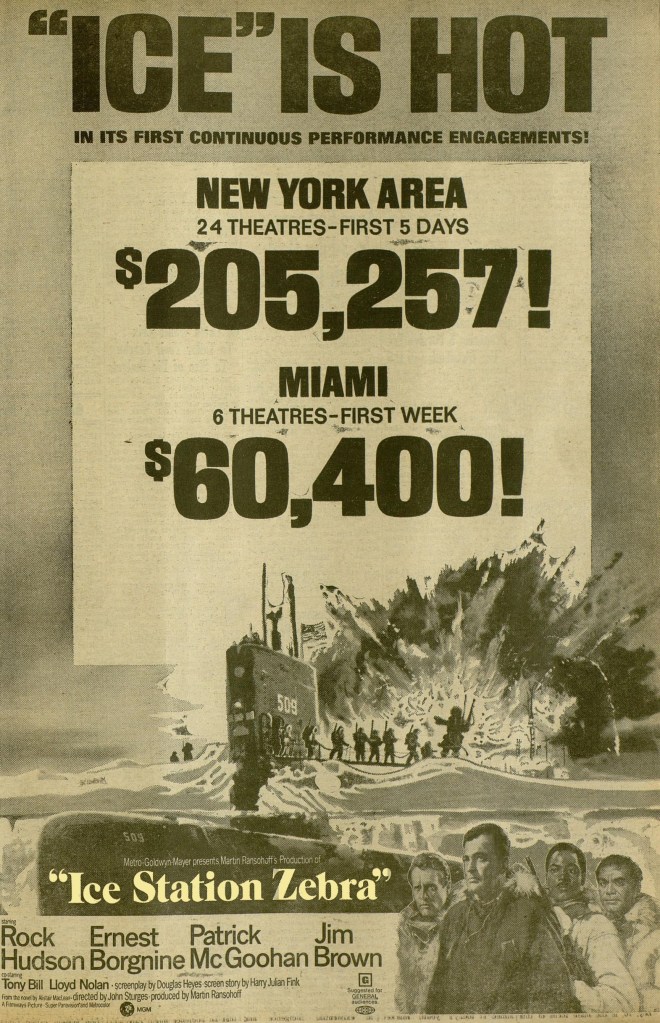
Six months after its roadshow engagement in New York, the picture went into
general release in continuous performance.

After a string of flops, Hudson, celebrating his 20th year in the business, chased after the role of sub commander. Although it has been reported that Laurence Harvey briefly came into the frame for the part that went to Borgnine, I could find no record of that. Confusion may have arisen because in 1964 Harvey was prepping another MacLean picture, The Golden Rendezvous, which he planned to direct in the Bahamas. Having landed the major supporting role in Who’s Afraid of Virginia Woolf (1966), Segal was the casting coup before he, too, jumped ship.

British star Patrick McGoohan (Dr Syn, 1963) who had not made a movie in five years, was an unlikely candidate for the second lead. Sturges saw him as the next Steve McQueen. But his inclusion only came about because of the sharp increase in his popularity Stateside after fans had bombarded the networks to bring back the Danger Man (1964-1967) television series (renamed Secret Agent for American consumption) after it had initially underwhelmed.  Increased public demand for the “old-fashioned hero with morals” became a feature of an advertising campaign. McGoohan received the accolade of a write-up in the New York Times. It seemed a cinch to have a denoted television secret agent star to play another spy in the film.

The all-male cast prompted the director to consider adding a hallucinogenic dream sequence involving women. Despite his penchant for action pictures, Sturges was a gadget nut and particularly interested in the space race, tracking by ham radio the launch of the Russian Sputnik 1, concerned that the Americans had been beaten. While moon landings remained some way off, the next battle for supremacy was nuclear submarines, of which Sturges was in awe.

Principal photography began in mid-June, 1967 and finished 19 weeks later. The $8 million budget topped out at $10 million. The non-nuclear U.S.S. Ronquil stood in for the book’s sub with U.S.S. Blackfin doubling in other shots. The vessel’s interiors dominated MGM’s soundstages with a 16ft superstructure as the centerpiece with hydraulics creating the tilting and rocking effects. Art director Addison Hehr’s commitment to authenticity saw his team buying real submarine effects from junk yards to fit out the interiors. The conning tower was almost as tall as a five-storey building and the submarine, built in sections, measured 600ft. The Polar landscape was created by draining the MGM tank, at the time the largest in Hollywood, of three million gallons of water and then mounted with snow and rocks and the burnt-out weather station.

While aerial shots of Greenland ice floes and fjords doubled for Siberia, to capture the wild ocean Sturges and cameraman John Stephens took a helicopter ride 30 miles out from the coast of Oahu where a 45-knot wind created “monumental” seas. A 10ft miniature in a tank permitted shots underwater and cameras attached to the Tronquil’s deck and conning tower achieved the unique sub’s-eye-view. The unconvincing Arctic landscape was shot on a sound stage.

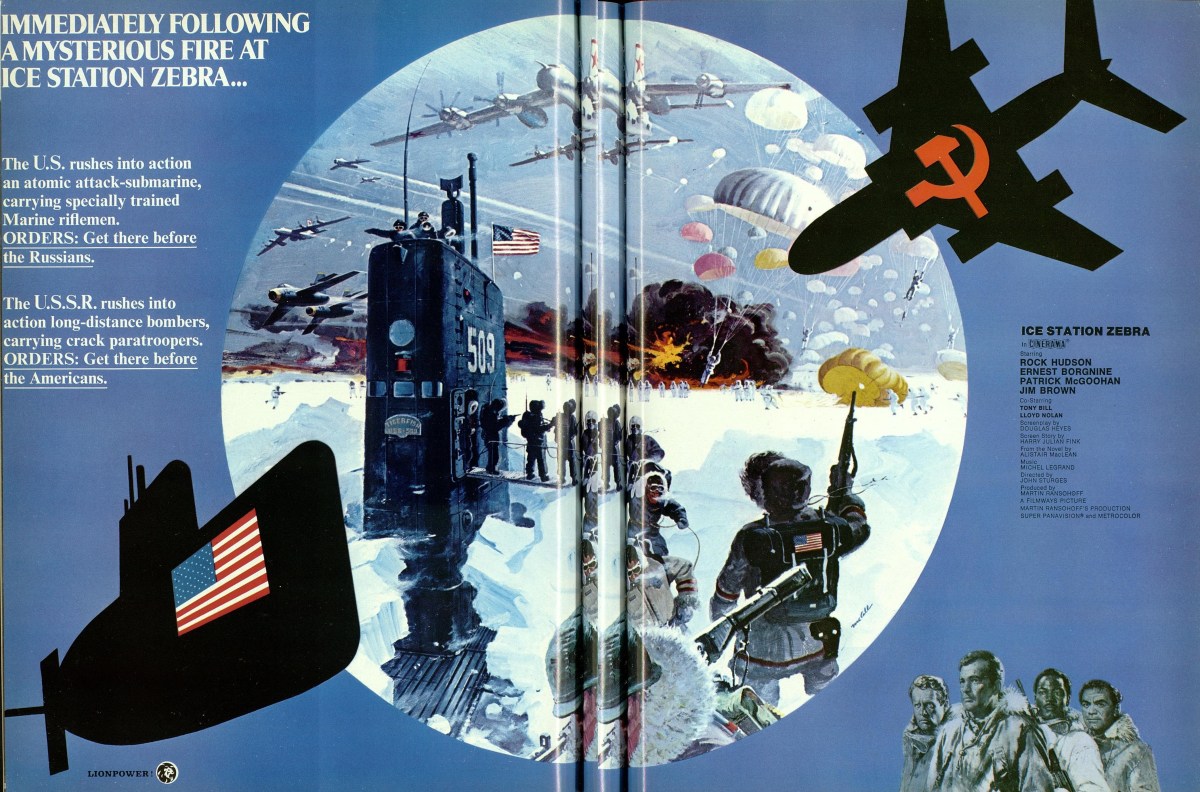
Early trade double-page advertisement (hence the lines in the middle).

Not only did screenwriter Douglas Heyes alter the original ending, but Sturges claimed improvisation was often the order of the day.  “We made it up as we went along,” he said, “adding a whole bunch of gimmicks – the homing device, the capsule in the ice, the blowtorch…I don’t think it had any political significance. It just dealt with an existing phenomenon in an interesting way.” (Note: the homing device was in the original novel.)

A major hitch hit the planned roadshow opening in New York, essential to building up the brand. MGM proved reluctant to whisk 2001: A Space Odyssey out of the Pacific East Cinerama theater while the Stanley Kubrick opus was still doing so well. So it opened in the Big Apple on December 20, over two months after its world premiere at the Cinerama Dome in Los Angeles, where MGM had decked out the lobby with a submarine measuring 20ft long and 12 ft high.  From the publicity point-of-view the delay was a drawback since New York critics – who attracted the biggest cinematic readership in the country – would not review the film until it had opened and should they take a positive slant their quotes would come too late for the national advertising campaign.

SOURCES: Glenn Lovell, Escape Artist, The Life and Films of John Sturges (The University of Wisconsin Press, 2008) p262-268; “Film in Focus, Ice Station Zebra,” Cinema Retro, Vol 17, Issue 51, 2021, p18-27; “Harvey Huddles with Maugham on Bondage,” Variety, May 15, 1963, p25; “New York Sound Track,” Variety, April 29, 1964, p18; “Ransohoff-Metro Prep Zebra Via Chayefsky,” Variety, January 20, 1965, p4; “Novelist, Producer Meet On Ice Station Zebra,” Box Office,  April5, 1965, pNE2;“George Segal,” Variety, April 28, 1965, p17; Advertisement, Variety, April 20, 1966, p44-45; William Kirtz, “Out To Beat Bond,” New York Times, Jun 23, 1966, p109;  “Ponti Seeks David Niven,” Variety, October 26, 1966, p3; “Cinerama Process for Metro’s Zebra,” Variety, May 17, 1967, p24;   Advertisement, Variety, June 21, 1967, p8-9;“26 Probable Roadshows Due in Next Two Years,” Variety, January 17, 1968, p7; “Poor Ratings But Film Plums Going To Pat McGoohan,” Variety, July 3, 1968, p3.”Premiere Display Built for Ice Station Zebra,” Box Office, October 14, 1968, pW2; “Ice Station Zebra Frozen, No N.Y. Cinerama Booking,” Variety, October 23, 1968, p12; “Ice Station Zebra in World Premiere,” Box Office, Oct 28, 1968, pW1; “No Zebra Shootout in N.Y. , Gets 2001 Niche, Latter Grinds,” Variety, October 30, 1968, p3; “Filmways Stake in Ten Features for $55m,” Variety, November 20, 1968, p7.

Ice Station Zebra (1969) ****

John Sturges’ Alistair Maclean Cold War thriller, released within months of the more action-oriented Where Eagles Dare, twists and turns as Americans in a nuclear submarine and the Soviet Union race to the Arctic to retrieve a fallen space capsule containing a deadly secret. Thoroughly enjoyable hokum filmed in Cinerama 70mm with an earworm of a booming theme from Michel Legrand and mostly outstanding special effects.

Nuke sub Commander Ferraday (Rock Hudson), despatched from Scotland, and believing he is only on a last-gasp mission to the save scientists at a stricken weather station, is somewhat surprised to be forced to carry as passengers arrogant British secret service agent David Jones (Patrick McGoohan) and Russian defector Boris Vaslov (Ernest Borgnine), the former refusing to divulge the reasons for being on board. From the outset the vessel is afflicted by sabotage and the cruel ice. Tensions mount further as they reach the Ice Station Zebra weather station. Since so much depends on mystery in a MacLean thriller, any other revelations would amount to significant plot spoilers.

So while there’s more than enough going on among the various characters and a plot that shifts like a teutonic plate, it’s the submarine section that proves the most riveting, the dives exhilarating. The underwater photography is superb in part thanks to an invention by second unit cameraman John M. Stephens which could film for the first time a continuous dive. Whether the sub is submerging, surfacing, puncturing the ice or in danger of being crushed to smithereens, it’s the nuke that takes centre stage, a significant achievement in the days before CGI.

Not all the effects are quite so top-notch, there’s some dodgy back projection, and the Arctic rocks look fake, but in general, especially with streamlined control panels, jargon spat out at pace, and sub interiors that appear realistic, the result of two years research, it’s a more than solid job, delivering the core of a Saturday night action picture.

The absence of a giant Cinerama screen does not detract from the movie – though if you get the chance to see it in 70mm, as I once did, jump at it – because the Super Panavision cameras capture in enormous detail the bow spray, the massive icebergs, the gleaming intricacy of the controls, and even the sea parting under the weight of the sub creates astonishing visuals. And there’s something inherently dramatic in the commander slapping down the periscope.

Rock Hudson (Tobruk, 1967) is back to straightforward leading man duty after his departure into paranoia in Seconds (1966) and he is burdened with both a chunk of exposition and having to develop a stiff upper lip in response to the secret agent’s reluctance to take him into his confidence. He comes more into his own in the action sequences. The tight-lipped brusque provocative McGoohan (Dr Syn, 1963) clearly has a ball as mischief-maker-in-chief, keeping everyone else on tenterhooks. Ernest Borgnine (The Wild Bunch, 1969) invests his character with wide-eyed charm at the same time as the audience doubts his credentials. Jim Brown (The Split, 1968) has little more than an extended cameo as the Marines’ chief and in smaller roles you can also spot future Oscar-winning producer Tony Bill (Castle Keep, 1969) and veteran Lloyd  Nolan (The Double Man, 1967).

This was the second MacLean adaptation for John Sturges (The Satan Bug, 1965) and he keeps a tighter grip on proceedings, a $10 million budget ensuring he could make the movie he envisaged, part-thriller, part-high adventure with well-orchestrated slugs of action.

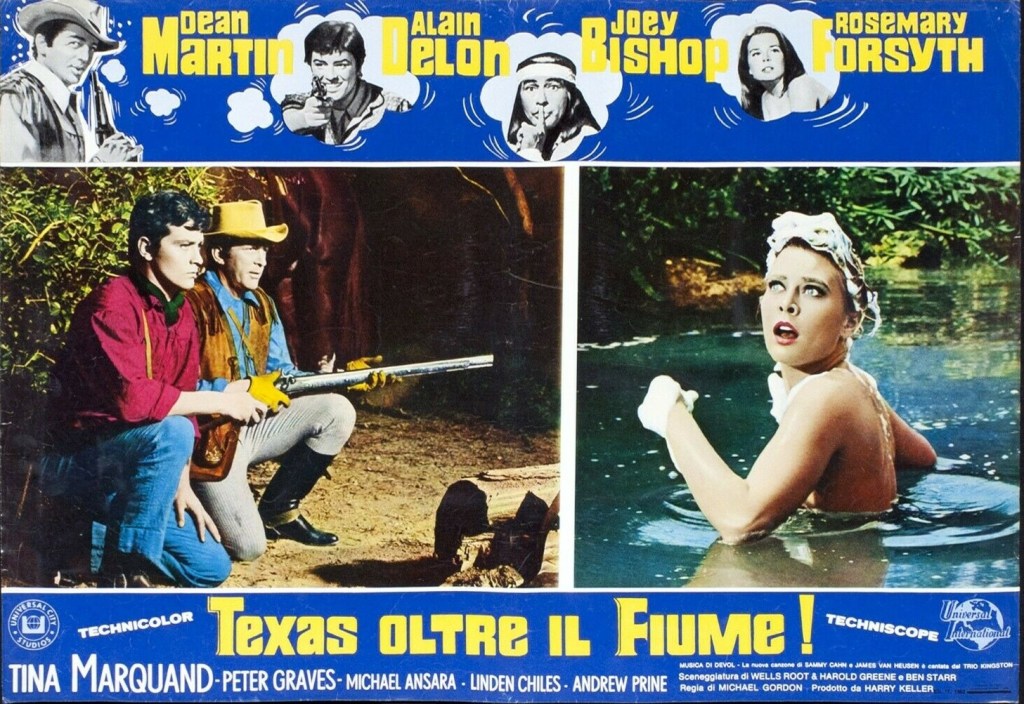
Texas Across the River (1966) ****

Excellent comedy western mixing dry wit and occasional slapstick to joyous effect. The wedding between Spanish duke Don Aldrea (Alain Delon) and Louisiana belle Phoebe (Rosemary Forsyth) is interrupted by her previous suitor Yancy (Stuart Cottle) who is killed in the resulting melee. Escaping to Texas, Don Aldrea’s marksmanship leads settler Sam (Dean Martin) to recruit him to help fight raiding Commanches. Romantic entanglement ensues when the Don rescues Native American Lonetta (Tina Marquand) and Sam has more than a passing interest in Phoebe.

It is so tightly structured that nothing occurs that doesn’t have a pay-off further down the line. Bursting with terrific lines – including a stinger of a final quip – and set pieces, it pokes fun at every western cliché from the gunfight, the cavalry in hot pursuit, and fearsome Native Americans to the snake bite and the naked bathing scene. Incompetence is the order of the day – cavalry captain Stimpson (Peter Graves) issues incomprehensible orders, chief’s son Yellow Knife (Linden Chiles) cannot obey any.

The Don, with his obsession with honor and his tendency to kiss men on the cheeks, is a comedy gift. Despite his terrific head of hair, he is stuck with the moniker “Baldy” and every time he is about to save the day he manages to ruin it. Sam is the kind of guy who thinks he is showing class by removing his spurs in bed while retaining his boots. His sidekick Kronk (Joey Bishop), a mickey-take on Tonto, mostly is just that, a guy who stands at the side doing nothing but delivering dry observations.

Lonetta is full of Native American lore and has enough sass to keep the Don in his place. “What is life with honor,” he cries to which she delivers the perfect riposte, “What is honor without life?” Phoebe is a hot ticket with not much in the way of loyalty.

Two sequences stand out – the slapping scene (whaat?) and a piece of exquisite comedy timing when Sam, Phoebe and the Don try an iron out a complicated situation.

Good as Dean Martin (Rough Night in Jericho, 1967) is the picture belongs to Alain Delon (Once a Thief, 1965) and I would argue it is possibly his best performance. Never has an actor so played against type or exploded his screen persona. Delon was known for moody, sullen roles, cameras fixated on his eyes. But here he is a delight, totally immersed in a role, not of an idiot, but a man of high ideals suddenly caught up in a country that is less impressed with ideals. If he had played the part with a knowing wink it would never have worked.

Martin exudes such screen charm you are almost convinced he’s not acting at all, but when you compare this to Rough Night in Jericho it’s easy to see why he was so under-rated. Joey Bishop (Ocean’s 11) is a prize turn, with some of the best quips. Rosemary Forsyth (Shenandoah, 1965) is surprisingly good, having made her bones in more dramatic roles, and Tina Marquand (Modesty Blaise, 1966) more than holds her own. Michael Ansara (Sol Madrid, 1968) played Cochise in the Broken Arrow (1956-1958) television series. Under all the Medicine Man get-up you might spot Richard Farnsworth. Peter Graves of Mission Impossible fame is the hapless cavalry leader.

Director Michael Gordon (Move Over, Darling, 1964) hits the mother lode, the story zipping along, every time it seems to be taking a side-step actually nudging the narrative forward. He draws splendid performances from the entire cast, knowing when to play it straight, when to lob in a piece of slapstick, and when to cut away for a humorous reaction, and especially keeping in check the self-indulgence which marred many Rat Pack pictures – two of the gang are here, Martin and Bishop. There’s even a sly nod to Sergio Leone spaghetti westerns when the electric guitar strikes up any time Native Americans appear. Frank De Vol (Cat Ballou, 1965) did the score.

Book into Film – “The Secret Ways” (1961)

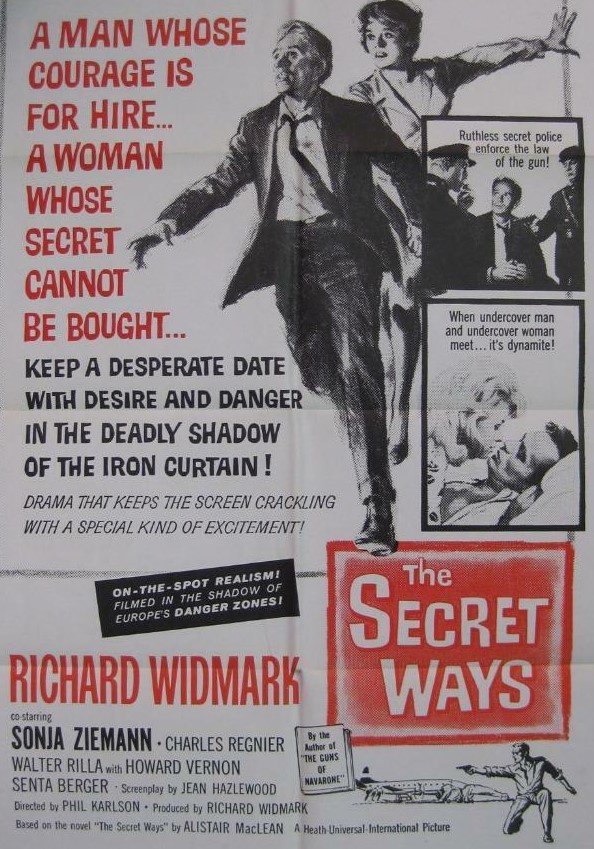
You might ask yourself why star Richard Widmark bought the rights to Alistair MacLean Cold War thriller The Last Frontier (title changed to The Secret Ways for American publication and the film) if he was going to ignore so much of the author’s brilliant story. In the original version hero Reynolds (the Widmark character) does not simply fly into Vienna as in the film, but has already crossed the Austrian border into Hungary in a blizzard after hitching a lift in a truck but now is stranded on foot in sub-zero temperatures, 30 miles from Budapest. This is not the only change authorized by Widmark, wearing his producer’s hat.

His Reynolds is a freelance gun for hire clearing a gambling debt and hired by an American spy ring compared to MacLean’s British secret service agent, intensely trained for 18 months for this mission. The mission in MacLean’s book is to rescue/kidnap British scientist Professor Jennings, the world expert on ballistic missiles, with the help of Hungarian resistance leader -Hungary at the time part of the Soviet bloc – Jansci (Wolf Rilla). Widmark eliminated all mention of Jennings. Instead, the task facing his Reynolds is to get Jansci out of Hungary. Widmark’s Jansci is still a resistance leader but doubling up as the professor albeit a straightforward scholar with nothing to do with missiles.  

Cover of the Doubleday U.S. hardback edition in 1959.

Combining characters was not unusual in the movie business and Widmark may have deemed it necessary to streamline the plot. But if the idea was to simplify the plot, that hardly explained the existence of Elsa (Senta Berger). She was not in the book. Her sole purpose may have been to provide Widmark with casual romance – a testament in Hollywood terms to his irresistible attraction – early in the story.

This was Alistair Maclean’s first shift away from the trio of war novels, including The Guns of Navarone, which had rocketed him into the bestseller class, and it proved to be a major change of style that created the non-stop thriller template that would underpin the later Fear Is the Key (published in 1961), When Eight Bells Toll (printed in 1966) and Puppet on a Chain (1969 publication), all of which were filmed, which saw loners or secret agents enduring horrific physical abuse as they battled the odds.

MacLean’s Reynolds enters Budapest a captive, rather than as in the Widmark version merely catching a train. Widmark meets Jansci’s daughter Julia (Sonia Ziemann) in Vienna. But in the book the secret agent meets Julia, along with her father, after he is captured by the resistance. In the book Reynold’s kidnap occurs in the first 20 pages, in the film at the halfway mark. From the outset Maclean thrusts his hero pell-mell into action with nary a let-up but in the film the action is punctuated by romance and various political meanderings.

Giving the game away No 1: the back cover of the Fontana paperback movie tie-in explains the plot – and it’s different from the one Widmark filmed.

Perhaps Widmark shied away from the MacLean plot due to budget constraints for the novel is certainly more intense and continually action-packed. Starting with the blizzard and ending with a perilous river crossing, the novel has several scenes which would have looked stupendous on screen. The story Widmark ignored involved the scientist in danger of being removed from Hungary to be returned to the Soviet Union, forcing Reynolds to effect a rescue on board a train, in a devil-may-care episode worthy of James Bond, by separating one car from the rest. There follows a 400-kilometer chase to the Austrian border where, pursued by Hungarian secret police, they cross the river Danube. In a final twist, while the professor and Julia are safe, Jansci refuses to leave his native country.

In various blogs covering the transition of novel into screenplay, I have mostly understood why a screenwriter would delete, alter or embellish plot, characters, time scale and even locale. Sometimes the screenwriter simply comes up with a more believable plot (as in Blindfold) or is required by the sheer length of the novel to make considerable changes. It’s rare for me to think that the screenwriter has taken the wrong approach. I thought The Devil Rides Out could have done with more of the occult background in the Dennis Wheatley novel. Here, it’s quite obvious that Maclean had a far better storyline than the film Widmark chose to make, the blizzard, train and river crossing scenes far more exciting than anything in the finished picture. As I noted, money may have been the issue.

Giving the game away No 2: the back cover of the Pocket Books paperback movie tie-in explains that Reynolds is a British secret service agent – but that’s not how Widmark played him.

However, it’s just as interesting that Widmark and Co. managed to make an enjoyable picture by not following the original story. The role of gambler-gone-bad was more appropriate to the Widmark screen persona than a secret service agent (outside of the humorous Our Man in Havana, there were not many of those around until a few years later). The film did introduce Senta Berger to a wider audience and the plot as it stands made a lot of sense.

The book was published in Britain in 1959 as The Last Frontier. In America the same year Doubleday renamed it The Secret Ways. There was a Victor Mature western called The Last Frontier in 1955 – and the title had also been used in 1932 and 1939 – so unless  Richard Widmark had purchased the film rights prior to American publication and announced a name change, then I have no idea why the book title changed.


Behind the Scenes – “The Secret Ways” (1961)

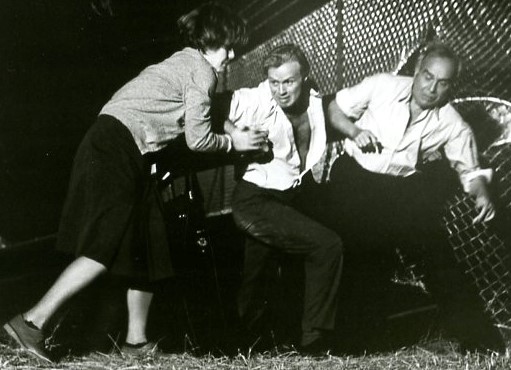
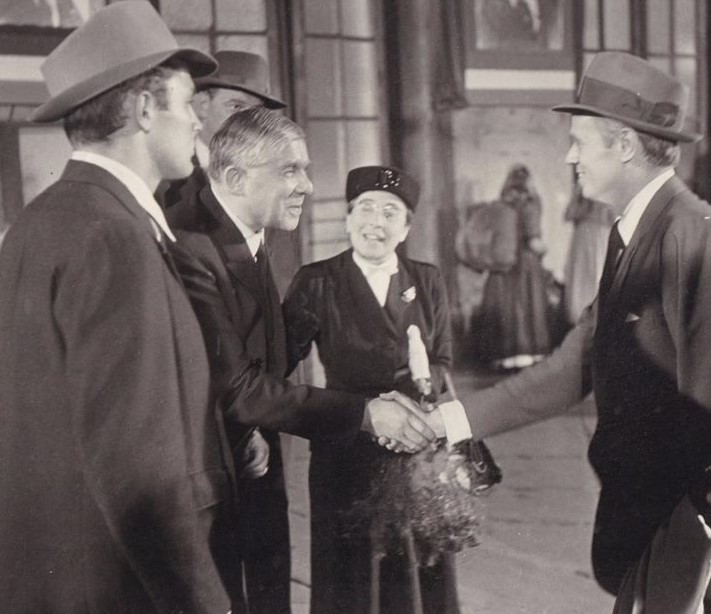
Since this is the most popular review on the Blog, I thought I might delve into the background to the picture.

“The reason I made The Secret Ways,” Richard Widmark told British film monthly Films and Filming, “is that I like spy thrillers. I’ve been in this business quite a long time and to survive you have to do all kinds of pictures, you can’t just specialize on just one kind.”

Widmark wasn’t just branching out into a different genre, he was developing a completely new set of skills – turning producer. His Heath Productions had cut its teeth on Time Limit (1957), a Korean war drama in which he starred with a strong supporting line-up in Richard Basehart, Dolores Michaels, Martin Balsam and Rip Torn. For a neophyte producer, Widmark went out on a limb in his choice of director, Karl Malden, better known as an Oscar-winning actor. So he had no problem taking chances. He had bought the property from Warner Brothers at a time when big studios were running shy of doing small pictures.

Widmark purchased the rights to The Secret Ways in March, 1959, one month after American publication by Doubleday, with the intention of beginning production before the year was out, putting him on target to produce three films in a year. Also on his production schedule were The Seven File for United Artists and bullfighting drama Wounds of Honor which he would direct but not star. Budget for The Secret Ways was set at $1 million.

“I enjoy production,” Widmark later claimed. “I like to act but over the years I find that I can do more and I enjoy setting things up and seeing them through.” But he could have hardly have been happy with his experience on The Secret Ways. Screenplay issues prevented Widmark meeting his initial start date. Peter Viertel (The Old Man and the Sea, 1958) had first crack followed by Scotsman William Templeton who having written the film adaptation of 1984 in 1956 was expected to understand the Cold War elements. But it was left to Widmark’ s wife Jean Hazelwood to take the screenwriting credit, even though this would be her movie debut and she never made another film.

Finalizing roles proved equally last minute. Female lead Sonja Zieman signed up only a few weeks before production rolled, Senta Berger a couple of weeks after. Obstacles arose once filming finally got underway on August 1, 1960. Rather than importing crews from Britain or America, Widmark chose the budget-conscious idea of utilizing a German-only team. Problems proved as much psychological as a culture clash of working principles.

Widmark recalled that it was “like fighting World War Two all over again – you have the Austrians and the Germans fighting like mad with the English and the Americans, they hated us.” Added to that were language barriers, technical obstacles and cultural difficulties, one example being that the foreign crews were not accustomed to going out into the street and shooting all night for five consecutive weeks. Nor, presumably, were they so keen to be filming so close to the borders. Much of the filming, according to assistant producer Euan Lloyd in a six-minute documentary, was “done directly under the guns of communist guards only yards away.”

Worse, star and director Phil Karlson were soon at odds, not helped by the fact that Widmark had little regard for directors. “There are to me about eight to ten efficient directors in the world,” he declared, not counting Karlson among that figure. When the director took ill for a week with a virus, rather than shutting down the production, the star took over the directorial reins. Three weeks later, the director quit, over creative differences regarding the ending. Widmark took up his seat again in the directorial chair.  

Release was delayed due to Widmark’s other commitments. Once he had completed his role in the film he was away from mid-October shooting John Ford’s Two Rode Together and not able to return to post-production until December

The biggest problem was avoiding making an overt political statement. “I was trying to make an adventure story, a sheer adventure story. But some of it (politics) just creeps in.” Hungarians in Detroit complained the movie did not go far enough in depicting the reign of terror. “They had been in contact with the Hungarian Secret Police,” said Widmark, “had gone through this torture, which seems corny with the dope, the needle and the steam room. But it’s not incredible, it goes on every day of the week there.”

Despite tepid box office, Widmark ploughed ahead with plans to make The Tiger’s Roar from the Jack Davies novel as a vehicle for Trevor Howard. But this and his other two features did not come to fruition and the star did not climb back into the producer’s chair until The Bedford Incident in 1965, which proved his last stab at production.

Working with Widmark inspired Zieman to set up her own production arm, announcing Next Stop Paradise, based on husband Marek Hlasko’s novel, in which she would star. But that did not get off the ground either.

SOURCES: “Widmark to Star Self in Secret Ways,” Hollywood Reporter, March 20, 1959, p18; “Viertel Secret Plottter,” Hollywood Reporter, October 2, 1959, p11; ”Widmark Projects Three Heath Prod’ns Next Year,” Hollywood Reporter, November 11, 1959, p2; “Bill Templeton Plots Secret Ways for U-I,” Hollywood Reporter, December 17, 1959, p1; “Widmark Signs Fem Lead,” Hollywood Reporter, July 11, 1960, p2; “ “Widmark Film Rolls,” Hollywood Reporter, August 1, 1960, p3; “Viennese Actress Set,” Hollywood Reporter, August 9, 1960, p3; “Phil Karlson resumes,” Hollywood Reporter, September 6, 1960, p2; “Karlson Exits Widmark Picture Over Different Endings,” Hollywood Reporter, September 22, 1960, p1; “Widmark Reports,” Hollywood Reporter, October 11, 1960, p3; “Widmark Back to U-I,” Hollywood Reporter, December 15, 1960, p2; “Crew Hazards Under Red Guns As Documentary for U’s Secret Ways,” Variety, March 1, 1961, p19; “New Role for Sonja,” Box Office, May 8, 1961, W2; Richard Widmark, “Creating Without Compromise,” Films and Filming, October 1961, p7-8.

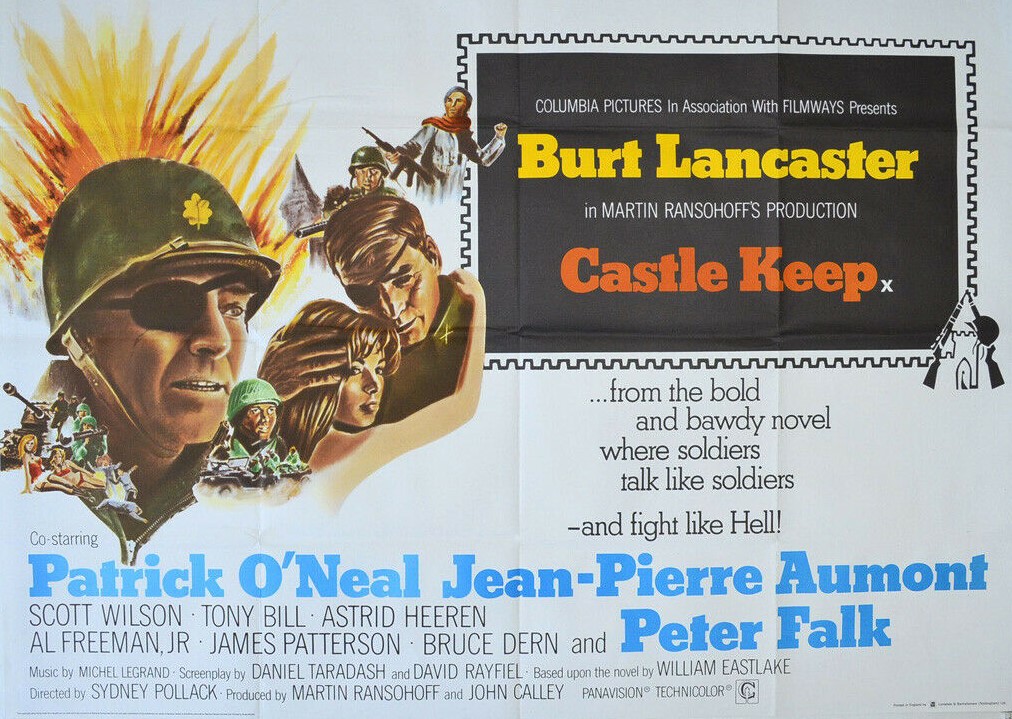
Castle Keep (1969) ****

A bit more directorial bombast and this could have matched Apocalypse Now (1979) in the surrealist war stakes. Never mind the odd incidents surrounding a small unit of G.I.s  taking over a magnificent Belgian castle towards the end of World War II prior to what turned out to be the Battle of the Bulge, this has on occasion such a dreamlike quality you wonder if it is all a figment of the imagination of one of the characters, wannabe writer Private Benjamin (Al Freeman Jr.). Throw in a stunning image, for the beleaguered soldiers at the start, of a horsewoman charging by in a yellow cloak, so out of place that it carries as much visual impact as the unicorn in Blade Runner (1982), and we are in definite cult territory.

One of the unusual elements is that, in this unexpected respite from battle, the soldiers are defined by character traits rather than dialogue or bravery as would be the norm. This ranges from baker Sergeant Rossi (Peter Falk) taking over the village boulangerie and bedding the baker’s wife (Olga Bisera), mechanic Corporal Clearboy (Scott Wilson) diving into a lake to rescue a Volkswagen he has adopted and the troops receiving a lecture on art history from Captain Beckman (Patrick O’Neal).

Commander Major Falconer (Burt Lancaster) is not only brilliant in the art of war, but calmly  mentors Beckman through a firefight with an enemy airplane, teaches local sex workers how to make Molotov cocktails and, evoking ancient aristocratic tradition, enjoys conjugal relations with the conquered countess (Astrid Heeren), whose impotent husband (Jean-Pierre Aumont) encourages the relationship since the castle needs an heir.   

There is wistful revelation, Beckman clearly hankering after his turn with the countess, a trainee minister who wishes he had the courage to join the boys in the brothel, the young soldiers there being treated as children rather than customers. And there are juvenile pranks – moustaches are painted on statues, wine bottles used for ten-pin bowling practice.

But the surreal moments keep mounting up. The Volkwagen, though riddled with bullets, refuses to sink in the lake, a hidden German reveals himself by playing the same tune on a flute as one of the enemy, the countess often appearing as an ethereal vision.

Through it all is rank realism. Falconer knows a German previously shared the countess’s bed. The count will do anything to safeguard his castle and maintain the family line, even to the extent of incest, since his wife is actually his niece. But above all, while his troops believe the war is at an end and enjoy the pleasures at hand, Major Falconer prepares for rearguard action by the Germans, filling the moat with gasoline, planning to pull up the drawbridge and control the high ground. The battle, when it comes, is vivid and brutal, the initial skirmish hand-to-hand in the village before the Germans advance to the castle.

Burt Lancaster (The Swimmer, 1968) is superb, far removed from his normal aggressive or athletic persona, slipping with pragmatic ease from the countess’s bed to battle stations. War films in the 1960s were full of great individual conflicts often won on a twist of ingenious strategy but seldom have we encountered a soldier like Falconer who knows every detail of war, from where and how the enemy will approach, to the details of the range of weaponry, and knows that shooting dead four soldiers from a German scouting mission still leaves one man unaccounted for.

Patrick O’Neal (Alvarez Kelly, 1966) also leaves behind his usual steely-eyed screen persona, here essaying a somewhat timid and thoughtful character. Peter Falk’s (Machine Gun McCain, 1969) baker is a beauty, a man who abandons war, if only temporarily, for a second “home,” baking bread, adopting a wife and child. In a rare major Hollywood outing French actor Jean-Pierre Aumont (Five Miles to Midnight, 1962) carries off a difficult role as a count willing to accept the humiliation of being cuckolded if it improves his chances of an heir. In one of only four screen appearances German actress Astrid Heeren (The Thomas Crown Affair, 1968) makes the transition from a woman going to bed with whoever offers the greatest chance of saving the beloved castle to one gently falling in love.

There is an excellent supporting cast. Bruce Dern (Support Your Local Sheriff, 1969) makes the most of a standout role as a conscientious objector.  You will also find Scott Wilson (In Cold Blood, 1967), Al Freeman Jr. (The Detective, 1968), future director Tony Bill (Ice Station Zebra, 1968) and Michael Conrad (Sol Madrid / The Heroin Gang, 1968).

Two top-name writers converted William Eastlake’s novel into a screenplay – Oscar-winning Daniel Taradash (Hawaii, 1966) and newcomer David Rayfiel who would work with Lancaster again on Valdez Is Coming (1971) and with Pollack on Three Days of the Condor (1973) and Havana (1990)

Sydney Pollack (This Property Is Condemned, 1966), who had teamed up with Lancaster on western The Scalphunters, 1968), does a terrific job of marshalling the material, casting an hypnotic spell in pulling this tantalising picture together, giving characters space and producing some wonderful images, but more especially for having the courage to leave it all hanging between fantasy and reality.

Expressions like  “we have been here before,” “once upon a time,” “the supernatural” and “a thousand years old” take solid root as the narrative develops and will likely keep spinning in your mind as you try to work out what it’s all about.

The Secret War of Harry Frigg (1968) ***

Except for an ingenious escape attempt and Paul Newman spoofing his Cool Hand Luke  persona, this World War Two POW number falls into the “sounded like a good idea at the time” category. Harry Frigg (Newman), the American army’s most notorious escapee (though from British military prisons), is promoted from buck private to two-star general and parachuted into northern Italy to organize a breakout of five one-star generals.

The premise that the war effort is hampered by embarrassment at the generals being captured seems far-fetched as is the notion that the quintet are hopelessly incompetent when it comes to doing anything that sounds like proper army stuff. Adding another offbeat element is that they are being held in effectively a deluxe POW camp, an ancient castle run by Colonel Ferrucci (Vito Scotti), a former Ritz hotel manager with a lapdog attitude to the rich and powerful.

Almost immediately Frigg discovers an escape route through a secret door but is disinclined to go any further since it leads into the boudoir of the countess (Sylva Koscina). New Jersey inhabitant Frigg feels out of the place with the high-falutin’ generals and proceeds to get himself a cultural education. Meanwhile, the countess, obtaining her position through marriage rather than birth, trying to bolster his confidence naturally triggers his romantic impulses.

The humor is of the gentlest kind – Frigg taking advantage of his superiority, Italians speaking tortured English – and not much in the way of bellylaffs either. Director Jack Smight, who collaborated so well with Newman in Harper (1966) and manages to achieve a tricky balance in No Way to Treat a Lady (1968), loses his way here, not least structurally, as the movie pingpongs between the generals, the commandant and Frigg and, thematically, issues of power. Crucially, he fails to rein in Newman.

The generals, squabbling among themselves for power, would be caricatures except that their characters are rounded out by the players, the pick being Charles Gray (The Devil Rides Out, 1968) as Cox-Roberts and Tom Bosley (Divorce American Style, 1967) as Pennypacker. The other generals are played by Andrew Duggan (Seven Days in May, 1964), John Williams (Harlow, 1965) and Jacques Roux (The List of Adrian Messenger, 1963). Representing the American top brass in England are James Gregory ( a repeat role in the Matt Helm series) and Norman Fell (The Graduate, 1967).

After her excellent turn as a mischievous and vengeful villain in Deadlier than the Male (1967), Yugoslavian Sylva Koscina comes down to earth with a less rewarding role as charming leading lady with a sly sense of humor rather than the femme fatale of A Lovely Way to Die (1968). Werner Peters (The Corrupt Ones, 1968) makes a late appearance as a Nazi and you might spot screenwriter Buck Henry (The Graduate) in a bit part.

The screenplay by Peter Stone (Arabesque, 1966) and Oscar-winner Frank Tarloff (Father Goose, 1968) is an odd mixture of occasional sharp dialogue and labored story. The set-up takes too long and you keep on wondering when it is going to get to the pay-off.

No doubt looking for some light relief after a quartet of heavier dramatic roles – Harper (1966), Torn Curtain (1966), Hombre (1967) and Harper (1967) – Newman acts like he has escaped the straitjacket of a considered performance and instead indulges in mugging and hamming it up, his body freeing up a barrage of mannerisms previously held in check.

Selling Crime – “King of the Roaring 20s” (1961)

Gambling dominates the 12-page A3-sized Pressbook with the legend of the sinister yet charming Arnold taking pride of place in the editorial section rather than, as would be usual, the actors. So we are given the inside story of the famous betting coup with Sidereal at a New York race track, but fleshing out the man shown on screen, exhibitors also learned that Rothstein was known as the “banker of the underworld,” how he won $600,000 in a poker game and a masterpiece painted by Sir Joshua Reynolds.

Not touched upon in the picture, but included here, was that he owned an art gallery, chartered ocean liners to transport liquor from Europe, ran protection rackets in the garment industry, and was instrumental in creating what became known as “The Syndicate.” In short, the Pressbook set out to built Rothstein up as even more fabulous figure than shown in the film.

As with Jessica, and as pointed out in my report on that Pressbook, the producers took the unusual step of sticking with the one dominant image in the poster of David Janssen (as Rothstein) leaning over a poker table with fistfuls of cash in his hand and Dianne Foster (Rothstein’s wife) at his back– although it’s possible in this instance the single-image approach was to reduce costs since this was in fact a glorified B-picture. The rest of the poster is an amalgamation of various scenes – racehorses, showgirls, people dancing the Charleston, a drive-by shooting. In the absence of one big star billed above the title, a total of 10 actors have their names below or their faces running down the side, almost giving the impression that it is an all-star ensemble picture.

After paying his dues in television with four years as Richard Diamond, Detective (1957-1960), David Janssen was a relative newcomer to a leading role although his performance in a second-billed role in war film Hell to Eternity (1960) had caused him to be touted as the new Clark Gable / Cary Grant. He was lucky that he had already been signed up for King of the Roaring 20s for his next picture after Here to Eternity was critical stinker and box office bomb Dondi (1961).

Other journalistic nuggets included that an Arab sheik once offered 100 camels for British star Diana Dors, Mickey Shaughnessey revealed as a Golden Gloves boxer, Dianne Foster previously taught modelling, and Keenan Wynn had a plate in his jaw. David Janssen’s sister Teri made her debut and their mother Berniece was an extra while Timmy Rooney, son of Mickey, was drafted in to play Johnny Burke as a youngster.

Not surprisingly several promotional ideas aimed at exhibitors revolved around gambling. One suggestion was to place a gambling wheel in the lobby with anyone landing on the numbers 7 or 11 winning a pair of guest tickets. Exhibitors were urged to get in touch with the local vice squad to see if they would donate confiscated gambling equipment for lobby display. Giving away cards that provided information on betting odds was another notion.

To get audiences into the mood of the era, cinema managers could run Charleston contests or a tie-in with a fashion store marketing clothes from the period or attire models as “flappers” to parade around town, especially in an open-top car from the era. More straightforward was a new movie tie-in paperback edition of The Big Bankroll, the book that inspired the picture, published by Cardinal.

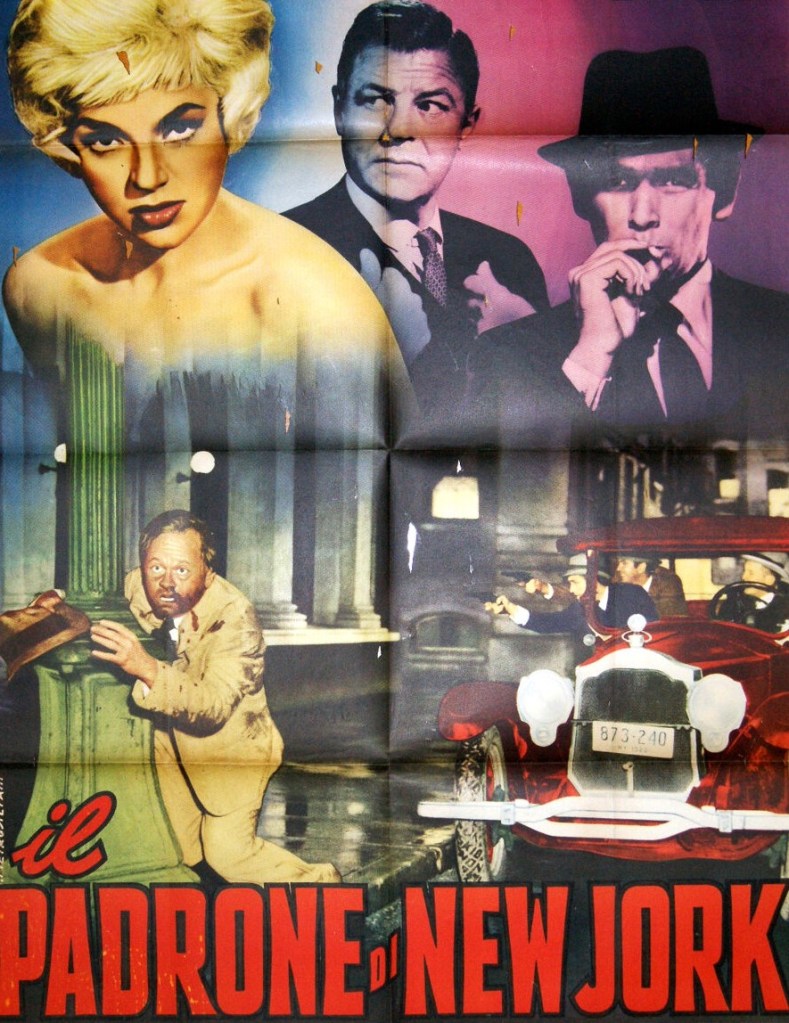
King of the Roaring 20s (1961) ***

Occasionally stylish B-picture purporting to tell the story of American Prohibition-era gangster Arnold Rothstein. It’s more of drama with various nefarious figures trying to outwit each other rather than a shoot ‘em up in the style of Al Capone (1959). David Janssen (Hell to Eternity, 1960) is ideal casting as the thoughtful, cold, calculating and possibly gambling genius Rothstein, the opposite of an intemperate crook like Capone.

The story is told essentially in two parts, Rothstein’s rise to power in partnership with childhood pal Johnny Burke (Mickey Rooney), initially running dice games in the street and  pulling the odd con before graduating to fly-by-night horse racing operations. When the opportunity arises to move into mainstream illegal gambling, he dumps Burke. Corrupt cop Phil Butler (Dan O’Herlihy) is a constant thorn in his side and showgirl fiancée Carolyn Green (Dianne Foster) views marriage as risky – “he’s the gambler but I’m the one that’s going to be doing the gambling.”

For whatever reason, the movie dodges what was believed to be Rothstein’s biggest coup, the fixing of the baseball World Series, but one long section is devoted to how he wins $850,000 (equivalent to $13 million today) on his horse Sidereal at odds of 30 to 1 at the New York Aqueduct track on July 4, 1921, through insider information and strategic betting. Inevitably, his gambling puts the kibosh on his marriage but by far the most interesting part of the picture is the chicanery as he shakes off one partner, battles another, and without compunction sets up Burke as patsy to settle his score with Butler.

In some respects Rothstein is a template for Vito Corleone (The Godfather, 1972) in terms of his business brain and ability to out-think and out-fox opponents and certainly his facial expressions and innate coldness bear comparison with what Al Pacino brought to his characterization of Michael Corleone. Except that he didn’t trust banks, and carried around wads of cash (hence the title of the biography on which this is based – The Big Bankroll), it’s hard to get a sense of the wealth the gangster generated or, given the minimal violence,  the world of imminent peril he inhabited. 

Period detail is cursory, limited to dancing the Charleston and pouring champagne into teacups. A better idea of the flavor of the times is the wholesale corruption endemic in police departments, untrustworthy lawyers and hypocrisy run wild.  It’s not really Janssen’s fault that it’s hard to warm to such a cold-blooded character, although you could point to The Godfather and The Brotherhood (1968) for that matter as examples of hoods who do elicit audience empathy.

With occasional bravura moments involving long tracking shots and overhead shots, and a terrific image of champagne bubbles seen through a pair of binoculars, director Joseph M. Newman (This Island Earth, 1955) shows stylistic flourishes that eschew his B-movie roots. Given Janssen is called upon to show as little emotion as possible, he does very well. Dianne Foster (The Last Hurrah, 1958), though initially demure, provides the fireworks. Jack Carson (The Bramble Bush, 1960) as kingpin Tim O’Brien matches Janssen in the cool stakes and proves a worthy adversary. Oscar nominee Rooney overacts but another Oscar nominee Dan O’Herlihy (The Night Fighters, 1960) relishes his dirty cop role.

In a rare Hollywood outing British sexpot Diana Dors (Hammerhead, 1968) puts in an unexpected and brief appearance as Carolyn’s cynical flatmate. The tremendous supporting cast includes Keenan Wynn (Point Blank, 1967), Mickey Shaughnessey (North to Alaska, 1960), Regis Toomey (The Last Sunset, 1961), Oscar-winner Joseph Schildkraut (The Diary of Anne Frank, 1959) and veteran character actor William Demerest.

Jo Swerling (It’s a Wonderful Life, 1946) delivers a pointed screenplay focusing on gangster conflict with some excellent observation of the deterioration of the Rothstein marriage and the nervousness of the usually ice-cold Rothstein when confronted by his father. This is one of those pictures that you think deserves a Netflix series, a dozen or so episodes to explore the myriad characters involved and especially to examine Rothstein in forensic detail. The movie gives a hint of that potential and on a tight budget does it well.

Hard to find unless you fancy paying $90 for a DVD or $24 for a VHS video, but you will find copies on the secondhand market.

Discover WordPress

A daily selection of the best content published on WordPress, collected for you by humans who love to read.

The Atavist Magazine

by Brian Hannan

WordPress.com News

The latest news on WordPress.com and the WordPress community.