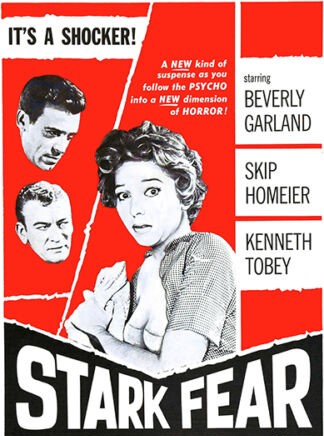
Interesting curiosity. Peak year for the genre, a dozen films from majors and indies alike, so by now full of alternative scenarios. But let’s start with Jon Hall. In the annals of actors turned director – Kevin Costner, Frank Sinatra, Clint Eastwood, John Wayne, Jon Favreau, Laurence Olivier – there’s nary a mention of one-time Hollywood superstar Hall. You’d never recognize the slim athletic actor in the Errol Flynn mold from the more rounded star of this picture.
Of Tahitian descent, he was a big noise in the 1930s/1940s, not just hot box office alongside Dorothy Lamour in The Hurricane (1937) and Aloma of the South Seas (1941) but a western star (Kit Carson, 1940), swashbuckler (The Prince of Thieves, 1948) and jungle hero after switching to television (Ramar of the Jungle, 1952-1954). But his movie career ground to a halt in the 1950s, and this was his debut as a director.
Tossing a few genres – beach party, noir femme fatale, and horror – into the blender, he comes out with quite an entertaining movie, in part because you don’t know which way it’s going to turn next. One minute the screen’s awash with jiggling and dancing, next minute there’s a monster on the loose, and before you know it we’re treated to some quite astonishing (for the period) surfing footage – a year before The Endless Summer – and a puppet (big hand for Kingley the Lion) plus a climactic car chase.
There’s a creepy stepmother Vicky (Sue Casey) making eyes at stepson Richard (Arnold Lessing) and heading out on adultery binges after telling scientist husband Otto (Jon Hall) that he got what he paid for. There’s a creepy limping sculptor Mark (Walker Edmiston), who hankers after Vicky, and whom you wouldn’t let any prospective model near, the limp a constant reminder to cocky Richard that he should have taken more care driving and not crashed his car.
And while the monster is laughable, actually there’s good reason for that, in a twist you may have seen coming. Pickled through this concoction is plenty family drama, the son who wants to get away from his science-obsessed father (and unspoken guilt for the accident he caused), the girlfriend Jane (Elaine DuPont) who fears he won’t, the sculptor whose relationship with the family is a shade too close, and the wife whose favorite pleasure is to see men wilt when she rejects them.
And this is an equal opportunities monster, victims male and female alike, and, despite the title, not concentrating on murdering innocent beach girls scarpering around in bikinis.
And this not being a haunted house movie, there’s even a cop involved, investigating the murders, who is detective enough to take a plaster cast of the strange footprints found around the corpse.
And it’s not full of simpering girlfriends either. Jane ain’t no walkover and the monster’s first victim Bunny (Gloria Neil) keeps her boyfriend in his place with her teasing. There’s the usual atomic-growth-spurt nonsense spouted by Dr Otto who contends the murderer is a monster fantigua fish. Monster is responsible one way or another for the deaths of surfer Tom, Vicky, Mark and Otto.
Worth noting: surf footage by Dale Davis (The Golden Breed, 1968); the surf-style score by Chuck Nagle; the dancers were recruited from Whisky-a-Go-Go; and Walker Edmiston did his own sculpting and created the puppet and the monster head. Actress-turned-screenwriter Joan Gardner (A Man for Hanging, 1972) dreamt it all up. Directorial debut for Jon Hall didn’t lead to much, just The Navy vs the Night Monsters (1966).
One of those films that, for sure, it would be far easier to laugh at if it wasn’t for the noir, femme fatale, surfing, and all the other elements that really should have no place in a beach picture.
Occasionally ingenious action-packed men-on-a-mission picture that teams reluctant hero Major Craig (Rock Hudson) with Captain Bergman (George Peppard) who heads up a team of Jewish German commandos (i.e good guys). Arthur Hiller (Promise Her Anything, 1966) directs with some skill and to increase tension often utilizes silence in Hitchcockian fashion. He meshes innate antagonism between the two principals and stiff-upper-lip British Col Harker (Nigel Green), two subplots that have a bearing on the final outcome, and explosive battle scenes. In addition, in supporting roles is a Sgt Major (Jack Watson) unusually solicitous of his troops and a grunt (Norman Rossington) with a fund of one-liners.
Craig is liberated by frogmen from a prisoner ship and flown into the Sahara on the eve of the Battle of El Alamein to guide a strike force 800 miles across the desert to blow up Rommel’s underground fuel tanks in Tobruk, Bergman’s outfit providing the perfect cover as Germans escorting British prisoners. “It’s suicide,” protests Craig. “It’s orders,” retorts Harker.
Most action pictures get by on action and personality clashes against authority, but this is distinguished as well by clever ruses. First off, hemmed in by an Italian tank squadron on one side and the Germans on the other, they fire mortars into each, convincing the enemy units to open fire on one another. Craig, on whose topographical skills the unit depends, goes the desert version of off-piste, leading the group through a minefield, personally acting as sweeper with a bayonet as his rudimentary tool, his understanding of how the enemy lays its mines allowing him to virtually explode them all at one. But, ironically, their cover is so complete that they are strafed by a British plane, and equally ironically, have to shoot down one of their own.
Along the way they pick up a stranded father-and-daughter Henry (Liam Redmond) and Heidy Hunt (Cheryl Portman) who are on another mission entirely, to help create a Moslem uprising against the British in Egypt. Their arrival reveals the presence of a traitor in the camp. Naturally, this isn’t the only complication and problems mount as they approach Tobruk and, finding it vastly more populated with German troops than expected, they now, in addition to tackling the virtually impenetrable fuel dumps, have to knock out the city’s radio mast and neutralize the German big guns protecting the beaches.
So it’s basically one dicey situation after another, ingenuity solving problems where sheer force is not enough, and twists all the way to the end.
All the battles are particularly well done, pretty ferocious stuff, flamethrowers especially prominent, but they are also adept at hijacking tanks, and in another brilliant ruse capturing one without blowing it up. The screenplay by Leo Gordon (The Tower of London, 1962) supplies all the main characters with considerable depth. While Craig isn’t exactly a coward, he is not interested in laying down his life for a cause. Although Harker seems a typical officious British officer, he, too, has surprising depths. But it is Bergman who is given the weightiest part, not just a German seeking revenge against his own countrymen for the treatment of Jews but a man looking to a future when Jews will fight for their own homeland in Israel.
Hudson had begun his career in action films, mostly of the western variety, before being seduced by the likes of Doris Day and Gina Lollobrigida in romantic comedies and this is a welcome return to tough guy form. George Peppard made it two Germans in a row after The Blue Max (1966) but this is far more nuanced performance. There are star turns from Nigel Green, Guy Stockwell (Beau Geste, 1966) as Peppard’s sidekick and the aforementioned Jack Watson (The Hill, 1965) and Norman Rossington.
This was pretty much dismissed on initial release as a straightforward gung-ho actioner and one that tipped Rock Hudson’s career in a downward spiral, but I found it both thoughtful and inventive and had much more of an on-the-ground feeling to it, with nothing going according to plan and alternatives quickly need to be found.
Another rich kid with mental health issues though without Orson Welles to offer expiation. The cause of this character’s illness is undetermined but it’s easy enough to spot the trigger to violence. The lad’s father is dead and his mother’s new husband, a wealthy banker, wants him out of the way, or at least out of the house, or at least, given he’s twenty-one, out working rather than mooning about the house all day.
And this was certainly the year for the movies exploring split personality – if such shallow treatment could be deemed investigation – what with Tony Curtis and Rod Steiger in serial murderous form in, respectively, The Boston Strangler (1968) and No Way to Treat a Lady (1968). And for movie fans it was an unexpecteldy speedy reteaming for Hayley Mills and Hywel Bennett after the humungous success of The Family Way (1967) in which the actress shed her child-star persona in no uncertain manner and the British film industry was, apparently, suddenly blessed with a duo with marquee appeal.
A poster that gives the game away.And an apostrophe issue.
This takes the Rod Steiger route of charming killer rather than a Tony Curtis puzzled and horrified by the demands of his ulterior personality. Given the emphasis on mental illness these days, Twisted Nerve is the hardest of the trio to take, since it’s effectively a play on an old gimmmick, deviousness concealed inside appeal.
Martin (Hywel Bennett) faced with expulsion from his house by overbearing substitute father Henry (Frank Finlay) pretends to scoot off to France but instead inveigles himself into the boarding house run by Joan (Billie Whitelaw) after tricking her librarian daughter Susan (Hayley Mills) into extending a sympathetic hand to his alter ego, the childish Georgie, whose behavior falls only a little way short of sucking his thumb and clutching a teddy bear.
Joan’s initial cynicism gives way to maternal feelings when he clambers into her bed in the middle of the night after a supposed nightmare. (And not with sexual intent.)
Occasionally, Martin cannot control his true feelings, despite Susan rebuffing his romantic overtures. Father is the first victim, substitute mother Joan the second and it’s only a matter of time before Susan becomes a target either for his stifled sexuality or his inner venom.
This would probably work just as well minus the schizophrenic element. In fact, there’s too much of tipping the nod to the audience. Eventually, Susan’s suspicions are aroused but director Roy Boulting (The Family Way) is no Alfred Hitchcock able to manipulate an audience. So, mainly, what we are left with is Hywel Bennett’s ability to pull off a double role rather than his victims’ susceptibility to his charms.
Hayley Mills’ character could do with fattening up, otherwise she’s just the dupe, bright, bubbly, self-confident and attractive though she is, although her mother, in passing, is given more depth, a lonely attractive widow prone to sleeping with her attractive guest Gerry (Barry Foster) and, unnerved to some extent by her daughter’s growing independence, wanting a son to mother.
It’s only un-formulaic in the sense that the director is playing with an audience who were not expecting anything like this as a story fit for their two newest adult stars so hats off especially to Bennett for considering a role that could as easily have typecast him for the rest of his career. As I said, setting aside the mental illness elements, Bennett is good fun, as he toys with both aspects of his character, adeptly dealing with those who would patronise him, and like Leopold and Lowe convinced he can get away with the perfect crime, whose planning and attention to detail is noteworthy.
As with the Chicago killers it’s only accident that gives him away, although the policeman here (Timothy West) is less dominant than his American counterpart.
Clearly filmmakers of the 1960s were beginning to grapple with mental illness but either lurching too far towards romance as a way of instigating tragedy as with Lilith (1964) or to the most violent aspects of the condition as with virtually anything else beginning with Psycho (1960).
Worth a look for Hywel Bennett’s chilling performance – template for Edward Norton’s turn in Primal Fear (1996) – and Hayley Mills fans won’t want to miss it. Strong performances by Billie Whitelaw (The Comedy Man, 1964), Barry Foster (Robbery, 1967) and Frank Finlay (The Shoes of the Fisherman, 1968) help enormously. There was quite an input into the screenplay. Along with Boulting, Leo Marks (Sebastian, 1968) doing the heavy lifting adapting work by Roger Marshall (Theatre of Death, 1967) and, in his only movie credit, Jeremy Scott. Great score by Bernard Herrmann.
If you’re unfamiliar with the abortive Italian airship expedition to the North Pole led by General Umberto Nobilo (Peter Finch) in 1928, you’ll find this an absorbing tale. If you are familiar then you will probably appreciate the film-makers’ attempts, via an unusual framing device, to carry out a post-mortem and to apportion blame for the disaster. If you know your history, you’ll also be aware both poles had been conquered, American Robert Peary first to the North Pole in 1909, Norwegian Roald Amundsen (Sean Connery) claiming South Pole bragging rights two years later.
So you’re also probably wondering what was the point nearly two decades later of the Nobilo operation? But the sled-led efforts of Peary and Amundsen were feats of endurance i.e. man vs. nature. This was science vs. nature. The dirigible was the apex of aviation advancement and nations still battled for exploration glory. So to travel in some comfort and fly over the North Pole in a few days would be a demonstration of scientific supremacy. Conquest of one of the most inhospitable places on earth was almost a PR exercise. With no intention of landing it was also a glorified tourist trip.
However, the science was flawed. Nobody had counted on the build-up of ice. The airship crashed and since this was a joyride nobody was equipped to walk their way out. Just surviving would be difficult enough. Loss of radio transmission (science) indicated a problem so rescue airplanes were deployed. But without a location to pinpoint the survivors, searchers had about two million sq km to cover. Luckily, a brilliant scientific deduction by expedition member Finn Malmgreen (Eduard Martsevich) saves the day and a ham radio user (amateur science) picks up the location. Game on!
Except airplanes are too easily thwarted by blizzards, fog and the inhospitable. Home base, set up simply to welcome home a successful jaunt, is not capable of organizing a proper rescue. A Russian ice-breaker joins the rescue attempt. Taking greater risks is aviator Einar Lundborg (Hardy Kruger), fired up by the promise of sex with desperate nurse Valeria (Claudia Cardinale), who happens to be Malmgreen’s girlfriend, and a bounty from Nobilo’s insurers. The redoubtable Valeria does not have to sell her body to persuade the more highly-principled Amundsen to join the rescue effort.
So it’s gripping clock-ticking-down stuff, action shown in considerable detail, almost over-populated in one sense as director Mikhail Kalatozov (The Cranes Are Flying, 1957) covers multiple storylines, the various disjointed rescue efforts, the survivors weakening by the day, imperiled by marauding polar bears and the ice cracking up beneath their feet.
In the main it’s a true story, Valeria the only fictional element, inserted for genuine cinematic purpose, to give the audience someone to emotionally root for back on land and for her character to guide us in an almost contemporary touch through the ghoulish carnival onshore as thousands gather to witness first-hand news of disaster.
What’s obviously patently untrue is the framing device, given that it shows the still-living Nobilo summoning up the ghosts of others involved in the event for a post-mortem, in which his guilt drives him into the position of sacrificial lamb. Although on first encounter it appears a bizarre idea, that, too, soon achieves dramatic purpose. Clearly there was intense discussion at the time and in the immediate aftermath by those who survived the disaster and there must have been high-level talks behind closed doors that usually excluded the main characters of the kind that was played out in a host of historic pictures made during the decade. Lawrence of Arabia (1963) and Khartoum (1965) had many such set-pieces where reputations were shredded.
This approach permits opportunity for all the principals to come together for confrontational purposes in the one room. Not all of that discussion follows the expected path and there is an interesting argument between Nobilo and Amundsen about leadership. From an audience perspective, it is, of course, quite satisfying to see Sean Connery (The Hill, 1965) facing off against Peter Finch (The Sins of Rachel Cade, 1961) with Hardy Kruger and Claudia Cardinale (The Professionals, 1966) embroiled in the debate.
There is the bonus of fabulous cinematography of the majestic Arctic, the icy waste, and breaking up of ice floes and collapsing icebergs has never been captured in such widescreen glory. Further pluses are in the performances, especially Connery as an aged Amundsen, Finch as the glorious pioneer bewildered the sudden turn of events and Cardinale as a woman willing to go to any lengths to save her lover. Ennio Morricone provided the score.
However, you are best going into this aware that while Finch has a goodly amount of time onscreen, Connery and Cardinale (the ostensible stars judging by the credits) are not seen so frequently. That said, the movie works well as an account of the disaster. The version I saw was just a shade over two hours – cut by about 30 minutes from original release.
Streaming channel Sweet TV has the longer version but I couldn’t find a workable link.
All studios believed in their brand name. That the sight of the MGM lion or the Twentieth Century Fox searchlight or the Paramount mountain represented a quality mark that would buffer expectation and reassure an audience they were not going to be rooked. That might have been the case decades before when the Warner Brothers logo might mean gangster pictures or socially aware movies or MGM, with more stars than there are in heaven, pictures with top-notch talent, or Universal determined to scare the pants of you with its horror catalog.
But that was no longer the case, most studios so desperate for survival that they would fork out for whatever trend seemed most likely to make money and the industry lurched from western to musical to adventure and back again whenever a big hit appeared. The only studio which still retained genuine marquee appeal was Disney. As studios dipped into more unsavory fare, according to the older generation, and the prospects of sending your children to the movies without having to check out the picture in advance diminished, a Disney film was a guarantee of fret-free entertainment.
Throughout the decade adults as much as kids swarmed to the Disney repertoire. In 1961 the studio scored a box office triple whammy when The Absent-Minded Professor, The Parent Trap and Swiss Family Robinson took three of the top four slots in the annual box office race. In the following years Bon Voyage (1962), Moon Pilot (1962), Son of Flubber (1963), In Search of the Castaways (1963), The Sword in the Stone (1964), The Misadventures of Merlin Jones and especially Mary Poppins (1964) kept the studio buoyant, not to mention the string of pictures starring Hayley Mills and a stack of animated classics it could reissue at the drop of a hat.
Disney ruled the lightweight world, its films often driven by a simple plot device. And as the rest of the industry coveted sex and violence, exhibitors relied on Disney to bring in the kids (and adults) during holiday periods. It would end the decade on a whopping high with The Love Bug (1969).
Here, the ploy is as old as the hills, a fish out of water, in this case an English butler. Disney had rung the changes on that particular sub-genre through the governess in Mary Poppins, steadfastly ignoring a trend towards more sinister servants as demonstrated by The Servant (1963) and The Nanny (1965). But Disney did have the ability to hook name actors for its child-friendly movies, here Roddy McDowall (Lord Love a Duck, 1966), Oscar-winner Karl Malden (Nevada Smith, 1966) and Suzanne Pleshette (A Rage to Live, 1965).
If you are expecting whiplashing escapades of the Indiana Jones variety, you will be in for a disappointment. Eric Griffin (Roddy McDowall) is the aforementioned butler escorting a child Jack (Bryan Russell) on a treasure hunt through the gold fever American West. When his charge runs away, Griffin finds the boy stowing away on a ship. The ever-genteel Griffin has skills that see him through any situation, working as cook on the ship, setting up his stall as barber on the mainland, and occastionally employing a devastating right hook to knock seven bells out of giant bully Mountain Ox (Mike Mazurki).
The plot, such as it is, revolves around recovering a treasure map stolen by swindler Judge Higgins (Karl Malden) and eventually when the movie needs some zap the feisty Arabella Flagg (Suzanne Pleshette), Griffin’s bankrupt employer who as it happens fancies the bulter, turns up.
There’s enough action to keep the picture on a steady keel, a storm at sea, a stagecoach hold-up, prizefight and a climactic town-wrecking fire. There are, perhaps surprisingly, a few choice lines.
But there’s a misinterpretation at the center of the movie so it’s as well its made with kids in mind. The fish-out-of-water notion would play better if historically movies fielded idiot butlers rather than ones who tended to take command when things get tough, though it’s unliklely kids would be aware of previous entries in the sub-genre. So, theoretically, it’s a surprise when Griffin outfights the lummox and outwits the swindler.
If the kid isn’t cute enough there are compensations elsewhere, a decent support in Harry Guardino (The Pigeon That Took Rome, 1962) and Hermione Baddeley (Harlow, 1965). Roddy McDowall at least is in a movie that suits his screen persona and deceptively languid acting style while Suzanne Pleshette takes a feminist slant to the Wild West. Whether British comedian Tony Hancock – he was sacked during filming – would have added much to the proceedings is open to debate.
It’s worth remembering that, outside of Hayley Mills offerings, Disney comedies of this period revolved around adults coping with bizarre situation. This doesn’t quite have the gimmicks that drove Son of Flubber, The Ugly Dachshund (1966, also headlining Pleshette) and Lt Robin Crusoe U.S.N. (1966).
Adequately directed by James Neilson (Dr Syn Alias the Scarecrow, 1963) from a screenplay by Lowell S. Hawley (Swiss Family Robinson) drawn from the novel The Great Horn Spoon! by Sid Fleischmann.
I remember seeing this as a kid and feeling pretty content coming out of the cinema, so since it did what it says on the tin, I’m loathe from an adult perspective to take it to pieces.
The “Behind the Scenes” articles have become increasingly popular in the Blog. As regular readers will know I am fascinated about the problems incurred in making certain movies. Perhaps one of the more interesting aspects of this category is that every now and there is out of nowhere massive interest in the making of a particular movie and it shoots up the all-time tree. Most of the material has come from my own digging, and sources are always quoted at the end of each article, but occasionally I have turned to books written on the subject of the making of a specific film.
As with the All-Time Top Movies section, the top 20 comprises the choices of my readers. Alistair MacLean still exerts an influence, which is reassuring because my next book is about the films made from his books.
While Waterloo remains firmly out in front there are some interesting new entries such as The Cincinnati Kid, The Appointment, Mackenna’s Gold, The Train, The Sons of Katie Elder and The Trouble with Angels while Man’s Favorite Sport has made a steady climb upwards.
(1)Waterloo(1970). No doubting the effect of Ridley Scott’s Napoleon in racketing up interest in this famous flop.
(2) Ice Station Zebra(1968). A complete cast overhaul and ground-breaking special effects are at the core of this filming of an Alistair MacLean tale.
(3)In Harm’s Way(1965). Otto Preminger black-and-white epic about Pearl Harbor and after.
(7) The Guns of Navarone (1961). Alistair MacLean again, setting up the template for the men-on-a-mission war picture with an all-star cast and enough production jeopardy to qualify for a movie of its own.
(6)The Satan Bug(1965). The problems facing director John Sturges in adapting the Alistair MacLean pandemic classic for the big screen.
(9) Man’s Favorite Sport (1964). Howard Hawks back in the gender wars with Rock Hudson and Paul Prentiss squaring off.
(4)Battle of the Bulge (1965). There were going to be two versions, so the race was on to get this one to the public first.
(5) Cast a Giant Shadow (1965). Producer Melville Shavelson wrote a book about his experiences and this and other material relating the arduous task of bringing the Kirk Douglas-starrer to the screen are told here.
(10) The Girl on a Motorcycle (1968). Cult classic starring Marianne Faithful and Alain Delon had a rocky road to release, especially in the U.S. where the censor was not happy.
(8) Sink the Bismarck! (1962). Documentary-style British WW2 classic with Kenneth More with the stiffest of stiff-upper-lips.
(11). Tora! Tora! Tora! (1970). Richard Fleischer dispenses with the all-star cast in favor of even-handed verisimilitude.
(New Entry) The Cincinnati Kid (1965). Once Sam Peckinpah was fired from the poker epic, Norman Jewison took over. Steve McQueen, Ann-Margret and Edward G. Robinson are top-billed.
(New Entry) The Trouble with Angels (1966). Hayley Mills causes trouble at a convent school where Rosalind Russell tries to rein her in.
(13). The Bridge at Remagen (1969). John Guillerman WW2 classic with George Segal and Robert Vaughn
(17). The Collector (1963). William Wyler’s creepy adaptation of John Fowles’ creepy bestseller with Terence Stamp and Samatha Eggar.
(New Entry) The Train (1964). Another director fired, this time Arthur Penn, with John Frankenheimer taking over in this cat-and-mouse WW2 struggle between Burt Lancaster and Paul Schofield.
(New Entry) The Appointment (1969). Sidney Lumet has his hands tied in Italian drama with Omar Sharif and Anouk Aimee.
(20) The Way West (1967). Kirk Douglas and Robert Mitchum face off in pioneer western.
(New entry) Mackenna’s Gold (1969). Producer Carl Foreman has his work cut out bringing home western Cinerama epic starring Gregory Peck and Omar Sharif.
(New entry) The Sons of Katie Elder (1965). Long-gestating Henry Hathaway western with John Wayne and Dean Martin as brawling brothers.
Curious about what happened to Haya Harareet, Charlton Heston’s leading lady in Ben Hur (1959), filmed in 70mm glorious color, I happened across this neat twisty British thriller filmed in standard ratio and black-and-white. Turned out to be put together by the Basil Dearden/Michael Relph combo and starring Stewart Granger, one-time star of MGM extravaganzas like King Solomon’s Mines (1951) and clearly now atoning for failing to hit the box office mark often enough for Hollywood’s liking.
Driven by a brilliant plot, whose resolution I defy you to guess, and climaxing with three stunning twists, the first story-driven but the others landing a no less effective emotional and human punch. I should warn you right away that Harareet is not in the picture as much as you would expect given that she took second billing. That’s no surprise, really, since on her first entrance, as wife Nicole, she walks out on husband John Brent (Stewart Granger) citing his illicit romantic liaisons.
Though driving a swanky car and living in a big house, Brent, a top-level shipping executive, is one harassed individual. What’s more he is being blackmailed by alcoholic dentist Ralph Beldon (Norman Bird). When the shipping company’s safe is robbed of £130,000 (equivalent to £3 million today), suspicion falls on Brent, one of only two employees with both keys and the combination. Enter about-to-retire chain-smoking Detective Superintendent Hanbury (Bernard Lee, shortly to achieve global fame as “M” in the Bond series).
Constantly wreathed in a cloud of smoke, Hanbury’s investigation leads to various suspects – the other keyholder Charles Standish (Hugh Burden) whose job is at risk, interior designer Clive Lang (John Lee) who is over familiar with Nicole, and friend Alan Richford (Conrad Philips) who is secretly in love with Nicole. All have good reason to be responsible for the theft, not least Nicole because of Brent’s habit of talking in his sleep and in trying to memorize ever-changing safe combinations constantly running them through his head, conscious or unconscious.
To add to the complications, Brent has a mysterious past. In addition, a masked gunman pops up from time to time. So, although Brent remains the prime suspect, Hanbury, with an investigator’s vigilance and attention to detail that Hercule Poirot would be proud of, uncovers clues that point elsewhere. Pretty soon, Brent is on the run, first to France, where he is arrested, and then, after escaping custody, through the murky streets of Soho trying to locate a girl to whom he might have given the combination while asleep. He, too, discovers some unpleasant truths far closer to home.
Basil Dearden (Victim, 1961) does a brilliant job of setting up the mystery, a dab hand, too, at serving up multiple red herrings, as well as a spot of sleight of hand, not least when the music intrudes too loudly in old-fashioned manner as if to point the finger, and the audience’s attention, in a misleading direction. Sure, it’s a low-budget affair by Hollywood standards and indeed by Dearden/Relph standards (big-budget roadshow Khartoum, for example), and the black-and-white photography is for financial rather than artistic reasons, but it is superbly done and keeps you guessing to the end.
Stewart Granger (The Last Safari, 1967) is at his suave best. Harareet, all fur coat and steely resolve, gives a good performance. Bernard Lee is an excellent British copper, hoping to end his career on a high note, patiently probing suspects, and there is a good turn from Norman Bird as the dodgy dentist and a fleeting appearance by Willoughby Goddard as an equally dodgy hotel manager. Written by David Pursall and Jack Seddon who went on to churn out MGM’s Miss Marple thrillers.
Two trends came together to create the ideal climate for the movie. The first was a fashion for filming comic books. By the mid-60s, Italy was at the forefront of this development thanks to the fumetti craze.
Mandrake, created in 1934 and first filmed in 1939, was being prepped by Duccio Tessari (My Son, the Hero, 1962). Though that stalled on the starting grid Dino De Laurentiis had bought the rights to Jean-Claude Forest’s Barbarella. He was also prepping Diabolik – at that point to be directed by Brit Seth Holt (Station Six Sahara, 1963) and fronted by Catherine Deneuve (Belle de Jour, 1967). Monica Vitti was being lined up to play Modesty Blaise (1966). For Barbarella De Laurentiis initially favored Franco Indovina (The Oldest Profession, 1967) in the director’s chair and Brigitte Bardot as the star.
The other element driving forth the venture was the involvement of Hollywood major Paramount in European production. Paramount had turned to Europe to “replenish its dwindled film vaults.” Formerly almost exclusively committed to U.S. production, by 1967 the studio was in the middle of a $60 million European spending spree, the cash spread over 30 movies made in the U.K. or mainland Europe where Italy took the lion’s share. Paramount struck a deal with De Laurentiis for Barbarella and Danger:Diabolik (1968) – eventually helmed by Mario Bava with John Philip Law and Marisa Mell – plus Arabella (1967) and Anzio (1968).
Paramount’s involvement should have excluded Vadim. He was persona non grata with the studio, having reneged on a previous three-picture deal, which he was paying off in $20,000 instalments. The budget of $3 million should have put the picture out his league. The Game Is Over had cost only $900,000 and none of his previous work suggested he might have the necessary skill to handle the special effects. And he was well known for declaring his opposition to studio interference.
But in terms of delivering sexy fare Vadim was in a class of his own. And God Created Women (1956) was the top-earning foreign picture in the U.S. He had made stars of Brigitte Bardot and Annette Stroyberg (Dangerous Liaisons, 1959) and he was in the process of turning the earnest Jane Fonda (In the Cool of the Day, 1963) into a sex symbol after plastering her nude body over billboards promoting La Ronde/Circle of Love (1964) and stills from La Curee/The Game Is Over in Playboy.
Still, she was far from first choice. Following Bardot’s refusal, De Laurentiis approached Sophia Loren, but she was pregnant, and he did a screen test of Ira von Furstenberg (Matchless, 1967). Fonda was not as nailed-down a star as you might expect. Her affair with Vadim kept her out of the country, making the kind of picture that was generally perceived as salacious arthouse material and not likely to raise her marquee value in the U.S. Cat Ballou (1965), which should have propelled her to the very top, instead performed that trick for Lee Marvin after he won an Oscar for the dual role. After meaty roles in The Chase (1966) and Hurry Sundown (1967) and top-billed in comedy hit Barefoot in the Park (1967), she should have been able to write her own ticket. But she did demonstrate independence in choosing to align with Vadim for Barbarella and though it didn’t win her any acting accolades it smoothed the path towards They Shoot Horses, Don’t They (1969) and Klute (1971), for which she won the Oscar.
Vadim was smarting from damage done to his reputation by censors and the authorities. “I have become a black sheep for censors and I’m paying the penalty in everything I make. Anything I direct is automatically suspect. I believe I’m the only director who must get censor clearance before I can begin filming.” He wasn’t – technically, this applied to every director working Hollywood since all scripts had to be cleared in advance of filming by the Production Board. But in Italy even when films like The Circle of Love (1964) and The Game Is Over (1966) cleared censorship obstacles, the films were seized by the police and threats laid of obscenity charges.
However, he believed this time round he would be immune from threat since the film would contain “no reference whatsoever to moral concepts as we know them. We’re dealing with life in the year 40,000. It would be difficult in the realm of science fantasy for any censor to discover objectionable scenes.” Clearly, he assumed mere nudity would not raise eyebrows.
Vadim admitted, “When I made Barbarella, I found the most difficult thing was the detail.”
Attracted by the “wild humor and impossible exaggeration” of the original material, he “wanted to make something beautiful out of eroticism” and intended to film it as if “a reporter doing newsreel…as though I had just arrived on a strange planet.” And had a camera on his shoulder. He viewed the character as a “lovely average girl” though not so average in that she possessed “a lovely body.”
Fonda was determined to keep her character “innocent,” rejecting the idea of playing her as a vamp, “her sexuality was not measured by the rules of our society,” and neither “promiscuous” or “sexually liberated.” Vadim interpreted her role somewhat differently, viewing it through the prism of a “shameless exploitation of her sexuality.”
With multiple writers on the project, the question of who wrote what has been open to argument. Impressed by their work on Danger: Diabolik – which employed a total of eight screenwriters – De Laurentiis parachuted in British pair Tudor Gates and Brian Degas. Original writer Terry Southern (Candy, 1968) claimed responsibility for the opening striptease and the doll robots. Uncredited screenwriter Charles B. Griffiths (The Wild Angels, 1966) came up with the notion of the millennia of peace, Barbarella’s clumsiness and the suicide room. Even co-star David Hemmings got in on the act, claiming he inspired the nonsense Fonda spouted during their sex scene.
Southern suggested Anita Pallenberg for the role of the Black Queen after encountering her while working with The Rolling Stones – her voice was dubbed by plummy English actress Joan Greenwood. Jane Fonda brought John Philip Law into the equation after working with him on Hurry Sundown (1967).
The director employed some sleight-of-hand. Just like the later Ridley Scott on Alien, he didn’t inform his actors in advance what was about to happen in some critical scene, such as those involving the Excessive Pleasure Machine. Vadim wanted a natural response from Fonda and Milo O’Shea so omitted to tell them “what a big explosion there would be. When the machine blew up, flames and smoke were everywhere, and sparks were running up and down the wires.” Fonda was “frightened to death” and O’Shea was convinced he “was being electrocuted.
And Vadim summoned his inner Hitchcock for the scene when Fonda was attacked by the hummingbirds (actually, substitute wrens and lovebirds). Not getting the effect he wanted, Vadim used a powerful fan to blow the flock onto the actress whose outfit was peppered with birdseed. There was an unexpected two-week hiatus between filming the bird attack and the striptease. Fonda contracted a fever, forcing the movie to shut down halfway through its 12-week schedule. On her return, Vadim filmed the striptease to be shown over the credits which was intended to “camouflage censorable flesh.” The set for the strip was upside down, Fonda performing on a pane of glass facing a camera in the ceiling.
The sensational aspects of the movie had attracted exceptional media interest. Over 200 journalists visited the set including representatives from Vogue,Playboy, Time, Life, McCall’s, Seventeen, Paris Match and UPI and AP. Paramount kept the pot boiling with some advertisements that were exceptionally full-on for the times: “It’s the year 40,000 A.D. A scantily-clad space adventuress battles 2,000 hummingbirds who rip off her clothes, two dozen shark-toothed dolls who rip off her clothes, 100 purple rabbits who don’t rip off her clothes and an army of leather giants who attempt to whip her to death. In between she makes love a lot.”
By the time the movie appeared, Paramount had invested in another development. It was the first studio to set up a marketing department, not just a catch-all under which promotional and advertising efforts were undertaken, but a unit that took a systematic, research-based, approach to release strategy. As a result Barbarella was one of the first movies to achieve a global simultaneous release, the bulk of movies taking a step-by-step approach, U.S. first and then major countries overseas, following a pattern that could take up to 18 months to complete.
According to research undertaken by the marketing department it was “judged as a picture which would have a sensational first few weeks everywhere it played because of the impact of the subject matter, star (Jane Fonda) and promotional pizzazz. But research indicated word-of-mouth might be poor. The decision was made to open the picture everywhere at once – and that meant worldwide since there was fear that any ‘bad word’ on such a highly-touted pic could spread from country to country. Here, too, the prognosis proved letter-perfect. As any exhibitor will confirm, Barbarella was the film this fall which started out great then dropped off. In view of this Paramount is thought to have maximized its gross via the global saturation playoff pursued.”
In the U.S. Paramount ordered a record number of trailers and space age fashion shows, like one at Alexanders Department Store in New York, were the order of the day. In Britain, there was a phenomenal ad spend (the second-highest ever), Mary Quant boots, tie-ins with shoe stores, and both a hardback and paperback book.
But Barbarella proved to be a slow-burn at the box office. Initially, it was deemed to have ranked a lowly 46th in the annual U.S. rentals chart with just $2.5 million in the kitty, falling far short of Paramount’s box office smashes that year – The Odd Couple (ranked fifth) with $18.5 million in rentals and Rosemary’s Baby (ranked seventh) on $12.3 million. But, in fact, it more than doubled its rentals the following year and ended up with a highly-respectable $5.5 million at the U.S. box office. (And I hereby apologize to anyone whom I challenged on these figures).
The global release paid off. It ranked eighth in France, seventh in Switzerland, third in Britain, 14th in Hong Kong and a big hit in Italy. However, the content denied it a sale to U.S. television. The movie was reissued in 1977 in the wake of Star Wars, and took a “handsome” $175,000 gross from 65 houses in New York. It was revived again after Flash Gordon (1980) and the following year when Paramount entered the laserdisk business among the first 30 oldies released it was the only one from the 1960s.
A sequel’s been on the cards since the film opened. Possibly rather tongue-in-cheek and with an element of the risqué sauce of the times, Paramount’s Robert Evans planned to trigger a second episode called Barbarella Goes Down, the title apparently relating to underwater adventures. Terry Southern was asked to write a sequel in 1990 while in the aftermath of Sin City (2005) director Robert Rodriguez came close to an $80 million version and Nicolas Winding Refn toyed with a television series. As of now, Sydney Sweeney (Anyone But You, 2023) appears most likely to hit the sequel button.
SOURCES: Patrick McGilligan, Backstory 3: Interviews with Screenwriters of the 60s, (University of California Press, 1997); Lisa Parks, “Bringing Barbarella Down to Earth”. In Radner, Hilary; Luckett, Moya (eds.). Swinging Single: Representing Sexuality in the 1960s, (University of Minnesota Press, 1999); Gail Gerber,and Gail Lisanti, Gail (2014). Trippin’ with Terry Southern: What I Think I Remember. McFarland, 2014); Roberto Curti, Diabolika: Supercriminals, Superheroes and the Comic Book Universe in Italian Cinema (Midnight Marquee Press, 2016); .Brian Hannan, Coming Back to a Theater Near You, A History of Hollywood Reissues 1914-2014 (McFarland 2016) p252; “Comic Strip Character Film Trend,” Variety, June 9, 1965, p23; “Vadim’s Autonomous Views,” Variety, August 24, 1966, p2; Gerald Jonas, “Here’s What Happened to Baby Jane,” New York Times, January 22, 1967; “Paramount Getting 6 Pix from Italy in Bid to Build Prod,” Variety, February 1, 1967, p16; “Par O’Seas Hatch By Dozen,” Variety, April 26, 1967, p5; “Italo Film Boom,” Variety, June 7, 1967, p20; “Barbarella Laid Low By Jane Fonda Virus,” Variety, August 16, 1967, p2; “I’ve Been A Black Sheep To Censor,” Variety, July 19, 1967, p22; Marika Aba, “What Kind of Supergirl Will Jane Fonda Be as Barbarella?” Los Angeles Times, September 10, 1967; Roger Ebert, “Interview with Jane Fonda,” October 15, 1967; “Paramount Stressing Sex and Visual Fantasy,” Variety, October 18, 1967, p26; “Space Age Fashion Show,” Box Office, September 2, 1968, pA2; “Record Teaser Trailer,” Box Office, September 9, 1968, p13; “Eyebrows Up – Here’s Barbarella,” Kine Weekly, October 19, 1968, p23; “Big Box Office Winners of 1968,” Kine Weekly, December 14, 1968, p6; “What Makes a Director?”, Variety, January 8, 1969, p26; “Big Rental Films of 1968,” Variety, January 8, 1969, p15; “Swiss B.O. Race,” Variety, January 15, 1969, p41; “Shaws Dominate HK,” Variety, January 15, 1969, p41 “Par Puts the Science into Sell,” Variety, February 5, 1969, p33; “Int’l Filmgoing Tastes Tres Complex,” Variety, February 5, 1969, p35; “CBS Bid for Baby Doll,” Variety, October 29, 1970, p78; “All-Time Film Rentals,” Variety, January 7, 1970, p27; “New York Showcases,” Variety, November 2, 1977, p8; “Paramount’s Home Video to Market Viddisks,” Variety, April 29, 1981, p54.
While sci-fi was being viewed through a serious glass darkly what with Fantastic Voyage (1966), 2001: A Space Odyssey (1968) and Planet of the Apes (1968) along came Roger Vadim’s little number to set up an alternative universe of camp fun. Had this been a box office smash in the nature of The Odd Couple ($18.5 million in U.S. rentals) rather than under a third of that there might have been less of the po-faced doomladen sci fi in the following decade.
But if you wonder where Star Wars got its vibe, setting aside the overt sexiness portrayed here, this is as good a place to start. Naïve adventurers, check. Ice planet, check. All sorts of weird creatures in strange otherworldly locales, check. A doomsday weapon, check.
It’s kind of newsworthy to be rewatching this given that star du jour Sydney Sweeney (Anyone But You, 2023) is going to be donning the Barbarella costume for a remake next year. And who knows to what Oscar-winning fare that might lead, if she were to follow the Jane Fonda template, given it was La Fonda’s follow-up that brought her serious attention from the Academy.
But it would be remiss of me if I didn’t bring up the testy matter of director Roger Vadim’s uncanny obsession with getting his myriad girlfriends to shed their clothes for the movies, Fonda being the latest example, and in no uncertain terms, the striptease performed during the opening credits certainly rivaling Kubrick and Spielberg for the most jaw-dropping opening to a sci-fi movie.
Whether it was Fonda or someone else and whether it was Vadim or someone else you couldn’t get away from the fact that Barbarella as a sci-fi icon was most definitely on the sexy side as determined by her creator Jean-Claude Forest, sharing like British comic strip heroine Jane a predilection for losing her clothes.
Barbarella shares something of the same innocent abroad personality, the kind who gets into one unexpected scrape after another, after being despatched from peace-loving Earth to save the world by finding Durand Durand (the pop band making homage to the movie dropped the final letter of this character’s name) and his doomsday machine.
So mostly, it’s one imaginative character or scene after another, delivered in disconnected episodic manner, and it sometimes has the feel of a jukebox movie, of the greatest hits of the comic strip writer strung together, with an occasional comment on the problems created by sex and a climactic gender-spinning twist. You’d have to remember what Pop Art was to chuck it into that short-lived category but if you think it belongs on the same planet as the more earthbound Modesty Blaise (1966) and Danger: Diabolik (1968), think again.
The best sections are truly terrific. The sharp-teethed menacing robot dolls are exceptionally scary as they nip chunks out of our heroine’s flesh and leave her blood-soaked. There’s a homage to The Birds (1963) where our plucky heroine is trapped in a cage with a flock of sparrows. You’ve also got the The Catchman, performing the same function but considerably scarier than the same year’s Child Catcher from Chitty Chitty Bang Bang. But no wonder the kids need caught because they are full of evil intent.
You’ve got a blind angel (John Phillip Law) who can’t fly, a problem mysteriously solved by sex with the ever-gracious Barbarella who, previously, has discovered, courtesy of The Catchman, the immense pleasure of the art of making love the old-fashioned way rather than just popping a pill. The angel also has no memory, permitting an ironic twist ending. You’ve got an incompetent rebel (David Hemmings). Sex is pretty much top of everyone’s agenda, even the villain (Milo O’Shea) who uses it to kill people via his own invention, which proves not much cop, since rather than murdering Barbarella with excessive pleasure, she makes it blow up.
Along the way there’s any number of interesting inventions: a manta-ray acts as the skis for a futuristic sailing ship, hollow robotic soldiers, a labyrinth.
Some of the special effects wouldn’t pass muster these days, but that’s a minor flaw compared to the rest of what’s on show. It’s not exhilarating in the real sense, but if you’re unfamiliar with the source material, it retains an endless fascination, more like a sexed-up version of the Ray Harryhausen world than anything that would have interested Kubrick. And, heck, just fun. What’s not to like.
Jane Fonda (They Shoot Horses, Don’t They, 1969) holds it all together, innocent rather than naïve, even her sexuality is innocent not exploitative, and possibly for a film deemed sexy makes greater comment on the dangers of lust than many a more self-important movie.
Great supporting cast with David Hemmings (Blow-Up, 1966), John Philip Law (Danger: Diabolik), Anita Pallenberg (Performance, 1970), Milo O’Shea (Ulysses, 1967) and Marcel Marceau.
Roger Vadim’s best film. Written by a huge squad of writers, nine in total, headed up by Vadim and Terry Southern (Candy, 1968).
Will probably be yanked out of circulation at the approach of the remake so now’s your chance to catch up on a fun sci fi.
Netflix would know how to sell this. Append the “based on a true story” credit and you’ll attract a global audience. I’ve no idea how true this tale is though I assume that at certain points in war using a pigeon may have been the most efficient method of communication. If this had been under the Netflix aegis there would surely have been a scene to explain that you can’t just point the bird in any old direction but that it automatically returns to its home, that aspect being pivotal to the movie, the reason it was made in the first place.
That is, if you believe in the rather fanciful notion, as shown in what appears to be an official newsreel, of said pigeon being presented with a medal for its part in the Allied invasion of Rome in World War Two. Luckily, there’s more to this picture than the intricacies of homing pigeons.
Not much more, I hasten to add, because the other significant plot point, which I suspect has a more substantial basis in truth, is that passing American soldiers had a tendency to impregnate (and abandon) Italian women. If you were to argue that Elsa Martinelli (who had just put John Wayne in his place in Hatari!, 1962) is what saves the picture you wouldn’t be far wrong. But you can’t complain about Hollywood churning out lightweight movies in the 1960s since a chunk of the current output falls into that category.
For no apparent reason, no espionage experience for example, Yank soldiers Capt MacDougall (Charlton Heston) and Sgt Angelico (Harry Guardino) are delegated to sneak into Rome, disguised as priests, and spy on the Germans. They are put up in the household of Massimo (Salvatore Baccaloni), an underground figure, but his daughter Antonella (Elsa Martinelli) takes against the pair since they are extra mouths to feed and if only the Americans would hurry up and enter the city the populace wouldn’t be starving. However, she makes nice when her sister Rosalba (Gabriella Pallotta) reveals she is pregnant by a previous Yank (whether he was the espionage business, too, is never revealed) and is desperate need of a husband.
The sergeant is quite happy to romance the girl since a couple smooching in the park makes good cover for him transmitting messages by radio. And when that form of transmission becomes too dangerous, the Americans rely on pigeons. Soon Angelico realises his feelings for Rosalba are real and proposes to her, even after she reveals her condition. But that means celebration to announce their forthcoming nuptials.
Short of any food, Antonella slaughters the pigeons, convincing MacDougall that the meal consists of squab. To cover up, the Italians steal a bunch of pigeons from the Germans. Of course, as you’ll have guessed, that means the pigeons will return to the enemy. But once MacDougall works this out, he starts sending the Germans false messages that prove (apparently) pivotal to the Germans hightailing it out of the city (hence the medal awarding).
Pretty daft and inconsequential sauce to be sure, but Antonella keeps matters lively, knocking back MacDougall at every turn, taking every opportunity to condemn men for starting wars, and presenting herself as something of a conniver, possibly willing to lead on the Germans in return for food (MacDougall when burglarizing a German villa comes across her naked in the shower). Her occasional swipes give the picture a harder edge than you’d expect, but, her fiance killed in the war, she leads MacDougall a merry dance in the manner of the romantic comedies of the day. Otherwise, the comedy is for the most part lame, the old hitting your thumb with a hammer one such moment.
Despite co-starring with Wayne and here Heston and later Robert Mitchum (Rampage, 1963), Martinelli didn’t fit into the Hollywood pattern of taking European stars and slotting them into the female lead opposite a succession of top male stars. Think Sophia Loren with Heston in El Cid (1961), with Gregory Peck in Arabesque (1966) and with Marlon Brando in The Countess from Hong Kong (1967) and headlining a few pictures on her own. Gina Lollobrigida led Rock Hudson by the nose in Come September (1961) and Strange Bedfellows (1965) and Sean Connery a merry dance in Woman of Straw (1964).
Martinelli seemed to fade too quickly from the Hollywood mainstream which was a pity because she’s the glue here. Charlton Heston (Number One, 1969) spends most of the time looking as if he wondered how he managed to allow himself to be talked into this. You want to point the finger, then Melville Shavelson’s (Cast a Giant Shadow, 1966) your man – he wrote, produced and directed it.