Alvarez Kelly (1966) ***

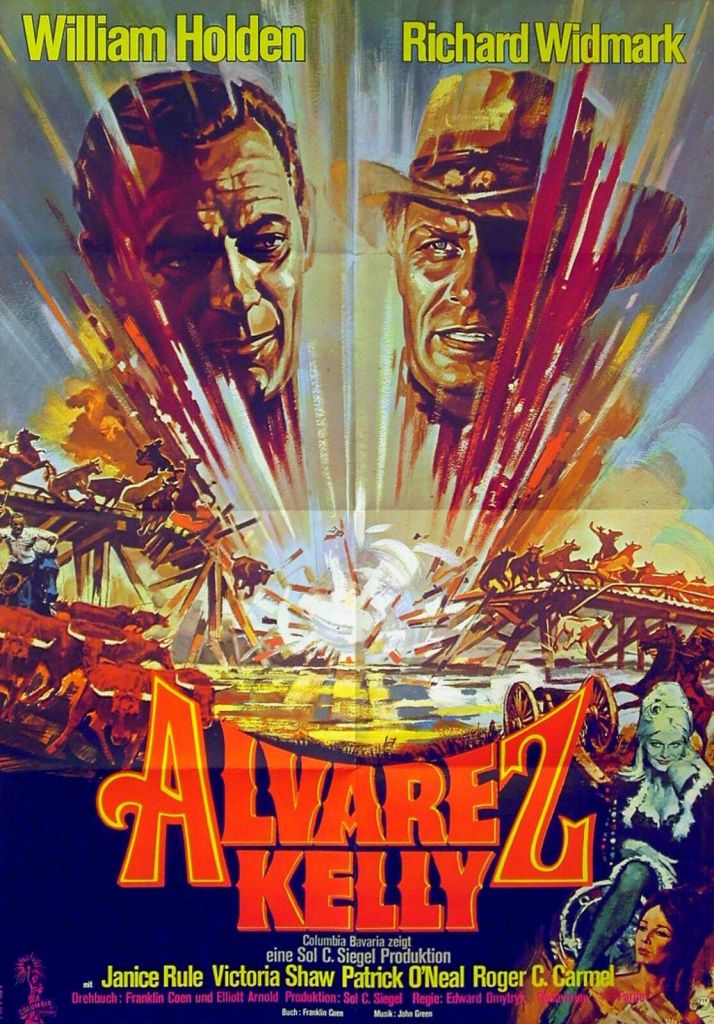
True stories do not always make good films. It says a lot about stardom that Oscar-winner William Holden virtually single-handedly redeems Edward Dmytryk’s Civil War western. And this was at a time when the actor’s career was in freefall, not having had a hit since The World of Suzie Wong (1960). Although his good looks personified him as a matinee idol, many of his best performances came when he was playing against type, as a shady character, such as in this instance

The essential narrative is that Holden has driven a couple thousand head of cattle from Mexico to deliver to Union troops. Holden plays an “Irish senor” (as defined in the title song) whose Mexican origins provide an excuse to consider the United States an enemy, positioning him as a neutral in the conflict, allowing him to justify his profiteering. Confederate colonel Richard Widmark plans to steal the herd.  Had Holden been a patriot the story would have knuckled down to him trying to thwart such plans, but since he’s a free agent with no allegiance except to himself the film has to take another route. So this involves Holden being captured by Widmark in a bid to turn the Confederate soldiers into cowboys capable of driving the stolen herd.

That would set the film down a fairly standard narrative route of training raw recruits such as Holden would follow in The Devil’s Brigade (1968). But this film evades such a simple format. All we ever learn about the intricacies of handling cattle is that you need a hat and have to be able to sing. Instead, this is a more thoughtful picture about honor versus self-interest, about the human casualties of war. Unlike most westerns it’s not about shoot-outs and fairly obvious good guys and bad guys. In the main it’s a drama about conflicting interests and often how good guys will do bad things in the name their beliefs.

The film doesn’t take sides. Do we root for the Union soldiers fighting to free slaves or the romantic version of the Confederacy? Do we root for the immoral selfish Holden because he’s had a finger shot off as a way of bringing him to heel or do our sympathies lie with the upstanding one-eyed Widmark who has given so much for his cause? 

Dmytryk whose career encompassed The Caine Mutiny (1954) and The Young Lions (1958) was on an opposite career trajectory to Holden after box office hits The Carpetbaggers (1964) and Gregory Peck thriller Mirage (1965). Between them, Holden and Dmytryk just about save what was a misconceived project, an original screenplay by Franklin Coen (The Train, 1964). That it was based on a true story did not make it any better an idea.

Holden is excellent, easing into the world-weary character he would project more fully in The Wild Bunch (1969). And I like his delivery, the pauses between words as if they are occurring to him for the first time rather than rattling them off as is the way of so many stars. Janice Rule (The Chase, 1966) is good as the errant girlfriend who feels let down by Widmark’s honor – and who is open to seduction by Holden – and has her own ideas about what she deserves from the war.  Although it’s tempting to say we’ve seen this craggy Widmark (The Secret Ways, 1961) characterization too many times before, here he adds a further emotional layer as a man who eventually faces up to the personal sacrifices he has been forced to make.    
A man convinced he is doing the right thing versus a guy who couldn’t care less about principle turns out to be an interesting concept though perhaps weighed in favor of the latter by the casting.

Had Widmark played the profiteer I doubt if we would have had such a balanced notion of right and wrong. Holden has the screen charm to get away with playing complicated characters, sometimes (The Counterfeit Traitor, for example) eventually tuning heroic. The idea that, in westerns, it’s not all black-and-white, and that bad guys could provide a moral core would be central to the genre a few years later when Butch Cassidy and the Sundance Kid (1969) and The Wild Bunch (1969) made heroes of outlaws and the lawman in True Grit (1969) sailed close to the wind.  

Action fans will be amply rewarded by the ending as Holden attempts to outwit Widmark.

CATCH-UP: William Holden films reviewed so far are The Counterfeit Traitor (1962), The 7th Dawn (1964) and The Devil’s Brigade (1968); Richard Widmark films featured so far are The Secret Ways (1961) – the Blog’s top-ranked film according to our readers – The Long Ships (1964), Flight from Ashiya (1964) and The Way West (1967).

Once Upon a Time in the West (1969) ***** – Seen at the Cinema

A masterpiece to savor. The greatest western ever made. Sergio Leone’s movie out-Fords John Ford in thematic energy, imagery and believable characters and although it takes in the iconic Monument Valley it dispenses with marauding Native Americans and the wrecking of saloons. That the backdrop is the New West of civilisation and enterprise is somewhat surprising for a movie that appears to concentrate on the violence implicit in the Old West. But that is only the surface. Dreams, fresh starts are the driving force. It made a star out of Charles Bronson (Farewell, Friend, 1968), turned the Henry Fonda (Advise and Consent, 1961) persona on its head and provided Claudia Cardinale (Blindfold, 1965) with the role of a lifetime. And there was another star – composer Ennio Morricone (The Sicilian Clan, 1969)

New Orleans courtesan Jill (Claudia Cardinale) heads west to fulfil a dream of living in the country and bringing up a family. Gunslinger Frank (Henry Fonda), like Michael in The Godfather, has visions of going straight, turning legitimate through railroad ownership. Harmonica (Charles Bronson) has been dreaming of the freedom that will come through achieving revenge, the crippled crooked railroad baron Morton (Gabriele Ferzetti) dreams of seeing the ocean and even Cheyenne (Jason Robards) would prefer a spell out of captivity.

The beginnings of the railroad triggers a sea-change in the West, displacing the sometimes lawless pioneers, creating a mythic tale about the ending of a myth, a formidable fable about the twilight and resurgence of the American West. In essence, Leone exploits five stereotypes – the lone avenger (Harmonica), the outlaw Frank who wants to go straight, the idealistic outlaw in Cheyenne, Jill the whore and outwardly respectable businessman Morton whose only aim is monopoly. All these characters converge on new town Flagstone where their narratives intersect.

That Leone takes such stereotypes and fashions them into a movie of the highest order is down to style. This is slow in the way opera is slow. Enormous thought has gone into each sequence to extract the maximum in each sequence. In so doing creating the most stylish western ever made. The build-up to violence is gradual, the violence itself over in the blink of an eye.

Unusually for a western – except oddities like Five Card Stud (1968) – the driving force is mystery. Generally, the western is the most direct of genres, characters establishing from the outset who they are and what they want by action and dialogue. But Jill, Harmonica and Cheyenne are, on initial appearances, mysterious. Leone takes the conventions of the western and turns them upside down, not just in the reversals and plot twists but in the slow unfolding tale where motivation and action constantly change, alliances formed among the most unlikely allies, Harmonica and Cheyenne, Harmonica and Frank, and where a mooted  alliance, in the romantic sense, between Jill and Harmonica fails to take root.

There’s no doubt another director would have made shorter work of the opening sequence in Cattle Corner, all creaky scratchy noise, in a decrepit railroad station that represents the Old West, but that would be like asking David Lean to cut back Omar Sharif emerging from the horizon in Lawrence of Arabia (1962) or Alfred Hitchcock to trim the hypnotic scenes of James Stewart following Kim Novak in Vertigo (1958). Instead, Leone sets out his stall. This movie is going to be made his way, a nod to the operatic an imperative. But the movie turns full circle. If we begin with the kind of lawless ambush prevalent in the older days, we end with a shootout at the Sweetwater ranch that is almost a sideshow to progress as the railroad sweeps ever onward.

No character performs more against audience expectation than Jill. Women in westerns rarely take center stage, unless they exhibit a masculine skill with the gun. There has rarely been a more fully-rounded character in the movies never mind this genre. When we are introduced to her, she is the innocent, first time out west, eyes full of wonder, heart full of romance. Then we realize she is a tad more mercenary and that her previous occupation belies her presentation. Then she succumbs to Frank. Then she wants to give up. Then she doesn’t. Not just to stay but to become the earth mother for all the men working on the railroad.

Another director would have given her a ton of dialogue to express her feelings. Instead, Leone does it with the eyes. The look of awe as she arrives in Flagstone, the despair as she approaches the corpses, the surrender to the voracious Frank, the understanding of the role she must now play. And when it comes to close-ups don’t forget our first glimpse of Frank, those baby blue eyes, and the shock registering on his face in the final shoot-out, one of the most incredible pieces of acting I have ever seen.

And you can’t ignore the contribution of the music. Ennio Morricone’s score for Once Upon a Time in the West has made a greater cultural impact than even the venerated John Williams’ themes for Star Wars (1977) and Jaws (1975) with rock gods like Bruce Springsteen and Metallica among those spreading the word to successive generations and I wonder in fact how people were drawn to this big-screen showing by the opportunity to hear the score in six-track Dolby sound. There’s an argument to be made that the original soundtrack sold more copies than the film sold tickets.

The other element with the music which was driven home to me is how loud it was here compared to, for example, Thunderball (1965), which as it happens I also saw on the big screen on the same day. Although I’ve listened to certain tracks from the Bond film on a CD where the context is only the listener and not the rest of the picture, I was surprised how muted the music was for Thunderball especially in the action sequences. Today’s soundtracks are often loud to the point of being obstreperous, but rarely add anything to character or image.

One final point, Once Upon a Time in the West was reissued not as some kind of retrospective for the director but in memory of the composer.  

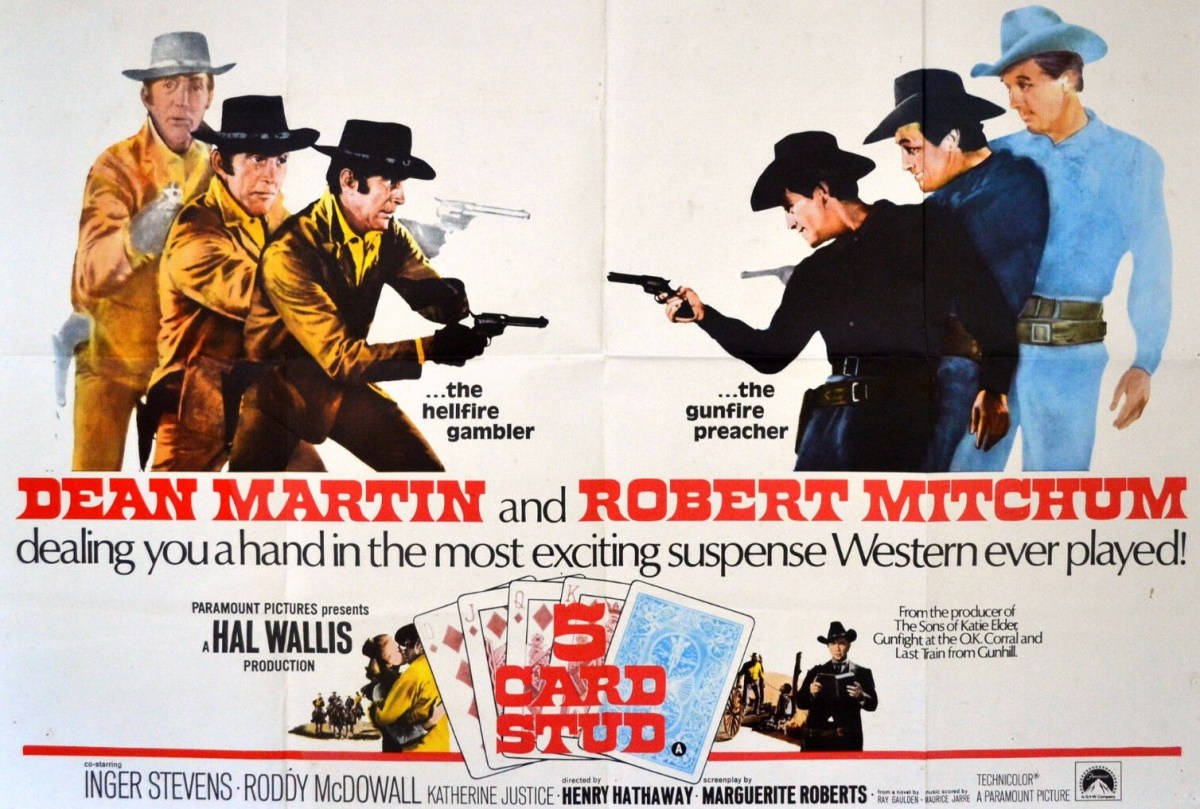
Five Card Stud (1968) ****

Another western in sore need of re-evaluation. Largely dismissed as a routine oater trading on the gimmick of a whodunit and packed with old stagers, this is in fact about a serial killer, a treatise on law and order, and almost acts as a conduit between the decade’s previous westerns when the good guys and the bad guys are easily defined to the end of the decade when such distinctions were muddied after The Wild Bunch (1969) and Butch Cassidy and the Sundance Kid (1969) invited audiences to root for the bad guys. In this rather well-structured picture, full of action and romance, we don’t know who the bad guy is.

The whodunit, however, is really a MacGuffin. The movie is more concerned with investigating the changing mores and hypocrisies of the West and predicting the inherent dangers in the proliferation of weaponry. It’s worth remembering that the movie came out at time when mass murderers such as Charles Whitman (the subject of Peter Bogdanovich’s Targets, 1968) who went on a killing spree in 1966 were becoming the norm.

A card sharp is lynched for cheating at poker in the quiet town of Rinchon where late-night gambling is the height of entertainment. One of the players, professional gambler Van (Dean Martin), attempts to stop the hanging but is beaten up for his troubles. No surprise then, that he ambles off to Denver. Sometime later the hangmen begin dying off and Van returns not just to solve the mystery but to ensure that his name isn’t on the list. “If someone is out to kill you, you don’t sit around and let him pick the time,” he concludes. With the number of killings, not to mention brawls and shoot-outs, it’s almost continuous action.

On his return, Van discovers, with a gold strike nearby, the incipient boom town has attracted unsavory elements, not just the high murder quotient but a whorehouse and loud music in the saloon. Acting as counterbalance is gun-toting preacher Jonathan Rudd (Robert Mitchum) who announces his presence by spraying bullets in the saloon floor, emerging as the self-proclaimed “conscience” of the town.

For a sometime protector of law and order, Van is rather lax in the morals department, unwilling to commit to main squeeze rancher’s daughter Nora (Katharine Justice) when the likes of Lily (Inger Stevens), the unlikely proprietor of a barbershop-cum-whorehouse, are on hand. Van is an interesting study. Once he becomes aware that the only people likely to end up in an early grave are the six men who played poker with the lynched individual, it doesn’t occur to him to fess up to Marshal Dana (John Anderson) which would ease the fears of the ordinary public. Awareness the only corpses belonged to the guilty would have prevented further outbursts of violence among a disaffected population. Interestingly, too, Dana makes no attempt to investigate the lynching.

At the core of this picture are a couple of amazing scenes as paranoia takes hold. One miner, without the slightest sense of irony, complains that in the old days a gunfight took place face to face, not by a murderer slinking round in the dark. Rudd adds some prophetic advice: “wear a gun and use it fast, wear a gun and use it slow – I say don’t wear a gun and you won’t use it at all.”

Van likes to think he has the measure of women, when in fact they have the measure of him. The story avoids the obvious lure of a love triangle, of jealous women competing for Van’s affections. Both the young Nora and the more mature Lily are pretty well grounded. “One wore-out no-account kiss” is Nora’s dismissive description of Van’s attempts at romance while Lily lets Van know she has taken a shine to him as a matter of convenience, he’s just a man and she hasn’t had one in three years. Expecting to be treated as a pariah, Lily, expressing the notion that “women don’t usually like women who like men,” strikes up a friendship with Nora.

Marshal Dana finds it increasingly difficult to maintain any kind of peace since as the death count mounts, paranoia grows rife, exacerbated by the kind of greed gold fever brings, resulting in citizens determined to challenge authority and take matters into their own hands.

The most antsy character is Nick (Roddy McDowall), Nora’s brother and the leader of the lynch mob. Nick seems to stir up bad feelings, provoking the ire of both his father and Van. The guilty are despatched in original ways, one man “drowns” in a barrel of flour, another strangled by barbed wire, a third wakes the town at night when the church bell to which his neck is attached starts ringing out. It’s not too hard in the end to work out who the killer is, but as I said, that is not the point of the picture, although the ending is satisfactory.

There a mass of small detail of the kind that director Henry Hathaway (True Grit, 1969) tends to work into his pictures. Van is a cut above. He travels to Denver and back by stagecoach not on horseback. Citizens can purchase Pocahontas Remedies and beer from the Denver Brewery. Shaves and haircuts at the Tonsorial Parlor are reasonably priced but “miscellaneous” comes in at $20. After the preacher shoots up her floor, saloon owner Mama (Ruth Springford) smooths out the holes.

And there is some distinctive direction. Rudd’s sermon that lasts nearly 90 seconds is delivered in virtually one take, a fistfight is conducted in silence except for a soundtrack punctuated by grunts and punches hitting their target, a dying man tries to leave a physical clue about the identity of the mysterious killer. And there is a superb main street gunfight with Van trying to rescue the marshal and Rudd striding down the street in old-fashioned gunslinger mode.  

Dean Martin (Rough Night in Jericho, 1967) and Robert Mitchum (The Way West, 1969), both with apparently easy-going but magisterial screen personas, come off well together. Inger Stevens (Firecreek, 1968)  always a great screen presence, an ethereal beauty, is vulnerable and strong at the same time. Katherine Justice (The Way West, 1967) is sassy and independent-minded and has a terrific facial response to coming across the first murder.  John Anderson (The Satan Bug, 1965) leads a fine supporting cast including Yaphet Kotto (Live and Let Die, 1973), Denver Pyle (Shenandoah, 1965) and Whit Bissell (Seven Days in May, 1964).

Screenwriter Marguerite Roberts, adapting the novel by Ray Gaulden, contributes some classic lines. “If that is a Bible, read it,” Van instructs Rudd, assuming the preacher has a gun planted in the Holy Book, “If it ain’t a Bible, drop it.” There’s a nod to a James Coburn scene in The Magnificent Seven (1960). Congratulated on his marksmanship in hitting the spinning wheels of a windmill six times out of six, Rudd protests his shooting was a failure since he was aiming for the spaces in between. It was ironic that her next assignment concerned a lawman who took much the same no-holds-approach to the criminal fraternity (True Grit, 1969) as the killer in this picture.

I was so intrigued by this picture, realizing it had much more to offer than a whodunit, that I watched it again within a few days and was pleasantly surprised by its depths.

Sergeants 3 (1962) ***

There’s a terrific western directed by John Sturges (The Magnificent Seven, 1960) inside this Rat Pack offering, the second of four in the series. On the plus side are plenty twists on traditional scenarios, Frank Sinatra and Dean Martin displaying a certain kind of easy screen charisma, and three exceptional and well-choreographed battle scenes.

Sinatra, Martin and Peter Lawford play the eponymous sergeants, Lawford committing the cardinal sin of wanting to quit the regiment to get married, with Sammy Davis Jr. as a former slave, bugler (an important plot point) and horse-lover wanting to sign up, and Joey Bishop (television star and occasional movie actor) as their sergeant-major boss.

A fair bit of time is spent on the usual Rat Pack shenanigans, getting drunk, brawling, playing tricks on each other, and exploring odd comic notions such as playing poker with a blacksmith’s implements as chips. But when it gets down to proper western stuff, it fairly zings along, with a decent plot (a Native American uprising) and excellent action scenes. You could have had William Goldman writing the script for the number of reversals involved as the picture keeps one step ahead of audience expectation.

For a start, rather than flushing out outlaws from a town, the troopers have to remove Native Americans who have taken it over. Instead of the cavalry pursuing Native Americans, it is mostly the other way round. It is the soldiers rather than the Native Americans who attack a wagon. Sinatra finds himself employing a bow-and-arrow and then a tomahawk rather than being on the receiving end of such weaponry.  Instead of dynamite, the good guys make do with fireworks. Where Native Americans are usually pinned down, this time it is Sinatra’s merry band. And when it comes to resorting to serious violence, that, too is usually the remit of the Native Americans, not as here, Sinatra chucking man off a cliff.

When it sticks to action, the picture is very well done and involving. When Sinatra has to take charge instead of larking about, the movie has focus. Both Sinatra and Martin were undertaking serious roles around this time, the former in The Manchurian Candidate (1962), the latter in political drama Ada (1961) so this might have appeared welcome relief.

The comedy isn’t along the laugh-out-loud lines of Support Your Local Sheriff (1969) or Blazing Saddles (1973) and the action of so full-on you wonder why anybody thought this required comedy at all, although there is a pretty good punchline ending. Action aside, It’s almost the equivalent of easy listening. The Rat Pack was a particular 1960s institution, the members joining each other on stage in Las Vegas or featuring in television programs, but there’s no real modern correlative.

It was interesting to see how the Rat Pack concept developed. This movie chucked out the idea of including a few songs as with Oceans 11 (1960) while the next one in the series, 4 for Texas (1963) was more of a serious straight western. But the final picture Robin and the 7 Hoods (1964) went in the opposition direction and was a full-on musical as if by the time they came to making that picture everyone had realized the film would make more sense if it played to their inestimable talents.

The series developed in other ways, too. Romance was minimal in Oceans 11, barely seen here, but was a major element of 4 for Texas – who would want to waste the talents of Ursula Andress and Anita Ekberg – but just as Andress is a smooth operator in 4 for Texas when it came to the last Rat Pack picture Barbara Rush was also a significant player for whom romance was merely a means to an end. You could also argue that the disappearance of Lawford and Bishop allowed the supporting roles to be played by actors who were not in on the joke.

CATCH-UP: the entire Rat Pack quartet has now been reviewed in the Blog with Oceans 11 (1960) and 4 for Texas (1963) also to be found here. Other Frank Sinatra films reviewed are Can-Can (1960), Cast a Giant Shadow (1966), The Naked Runner (1967) and The Detective (1968) while for Dean Martin the list, so far, comprises Texas Across the River (1966) and Rough Night in Jericho (1967).

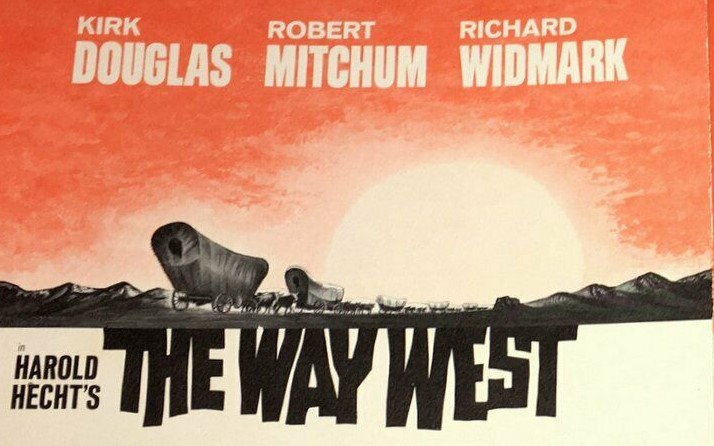
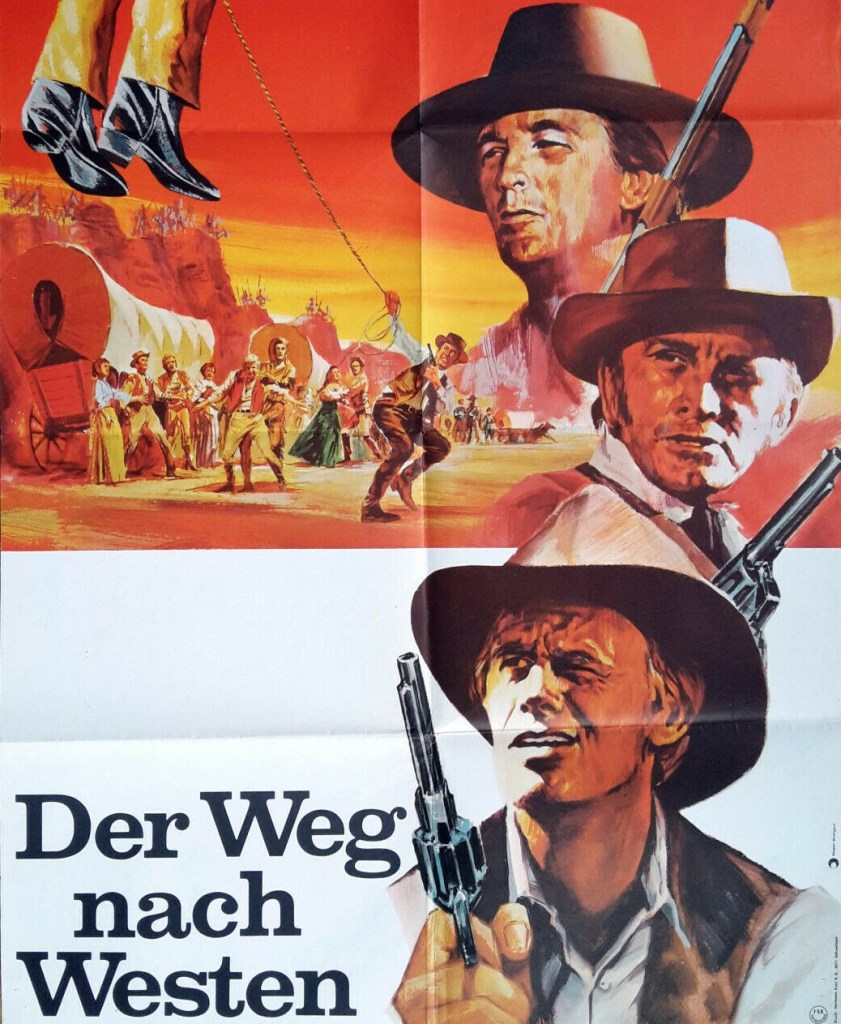
Behind the Scenes: “The Way West” (1967)

As you might expect with a title like this John Wayne was in the frame, at least at the start. But when Burt Lancaster’s production outfit Hecht-Lancaster bought the property that was the end of that casting idea. Hecht-Lancaster was at its peak in 1956, each of its first 11 pictures turning a profit, and just signed up to a $40 million three-year deal with United Artists. Biggest project on the table: $5 million for The Way West with a dream team of Lancaster, James Stewart and Gary Cooper and a script from Clifford Odets (The Sweet Smell of Success, 1957). But by 1959 the dream had soured, with $545,000 already shelled out on the western with no sign of a start date. A year later the project was shelved. When Harold Hecht split from Lancaster, the rights reverted to United Artists.

Hecht’s initial efforts as a solo producer had not paid off, Taras Bulba (1962), Flight from Ashiya (1964), both starring Yul Brynner, and Tony Curtis comedy Wild and Wonderful (1964) all covered in red ink, before suddenly resurfacing with the hit Cat Ballou (1965), making him imminently more bankable than before. However, given the impact music had in Cat Ballou, Hecht hankered after something in the same vein, except bigger, and bought the rights to Finian’s Rainbow, a Broadway hit from 1947. When casting issues caused delay, Hecht signed a one-picture deal with United Artists for The Way West. The studio had such high hopes for the movie that plans were made for its world premiere to be held at the Houston Astrodome, a first, and it was considered a natural for roadshow treatment.

A substantial rejig was required of the source material, the Pulitzer-Prize-winning novel by A.B. Guthrie, by screenwriters Ben Maddow and Mitch Lindemann, not least to ensure that the character played by Kirk Douglas remained with the wagon train until the end of the trail, unlike in the book. Andrew V. McLaglen, with three box office western hits behind him in McLintock (1963) starring John Wayne and Maureen O’Hara, Shenandoah (1965) with James Stewart and The Rare Breed (1966) co-starring Stewart and O’Hara, was first choice to sit in the director’s chair.

Charlton Heston (El Cid, 1961) was approached to play the lead of Senator Tadlock. When he turned it down, Kirk Douglas signed on for his first western in five years – although his next would also be a western, The War Wagon (1967) with John Wayne – Robert Mitchum (Villa Rides, 1968) was offered the choice of either scout Dick Summers or firebrand Life Evans. At the end of a long lunch with Hecht and McLaglen, Mitchum could not make up his mind and the producer and director assigned him the role of the scout.

“I’m awfully glad it worked out the way it did,” recalled McLaglen, “because Widmark was perfect for the other part and Mitchum was perfect for the scout.” It might not have been Widmark because Max von Sydow was also reputedly offered a part. Von Sydow was too big a star to play any of the other supporting parts and the part assigned to Widmark was Scandinavian so in that sense an ideal fit.

While Widmark did not attempt a Scandinavian accent, Mitchum spoke Lakota, apparently with a decent accent, in several scenes where he had to communicate with Native Americans. He didn’t learn the language, as modern actors might do, but simply recited the words spoken to him off-camera.  Mitchum and Douglas had acted together in Out of the Past (1947), where the former had the larger role, and, while not sharing scenes, appeared in The List of Adrian Messenger (1963), where the billing was reversed. Although not in a directorial capacity McLaglen had worked with Mitchum on Blood Alley (1956) before the actor was fired.

It was an arduous shoot, virtually the whole picture shot as exteriors, in Tucson, Arizona, and in various locations in Oregon including Bend, Christmas Valley and the Crooked River Gorge. Around 400 members of cast and crew made the trek. In the absence of CGI, everything seen on the screen was achieved for real without any recourse to blue screen. The desert was real. When the river was forded, it was with real wagons and the cast. The wagons were raised and then lowered from the tops of cliffs using the old-fashioned methods that would have been available at the time, that is by rope-and-tackle.

In order to begin filming or play less arduous scenes on top of the cliffs, cast and crew went up in a ski lift. “You’re up there, hundreds of feet up, nothing but rocks to call on,” Jack Elam remembered. “If you had to go to the bathroom it was a matter of half an hour down and half an hour up.” When the wagons were lowered down the cliff all the actors at some point had to participate and according to Elam “some people landed in the hospital.” The river crossing was no less dangerous, with the potential for drowning a constant hazard.

“Andy McLaglen…was wonderful through the whole thing. Stayed calm through thick and thin,” said Elam. Added assistant director Terry Morse, “Nothing intimidated him…for all the difficulties he kept it right on schedule.”

Given three stars with reputations, it was not surprising there were flashpoints, Kirk Douglas, apparently, at the heart of most, accused of snatching newspapers out of the hands of supporting players and trying to usurp the director. Commented Harry Carey Jr., “He tried to take over the thing at some point. Widmark got furious at it, very agitated. He screamed, ‘You’re not directing this goddam movie.’ Really raised hell with Douglas.”

Said McLaglen, “Somebody like Kirk Douglas and somebody like Mitchum, they were poles apart in personality. Bob was an easygoing guy and Kirk was more volatile. But there was never a feud.” Just how easygoing Mitchum was – a production assistant was assigned to keep an eye on him just in case he got carried away with his predilection for fishing and was wading in the water when it was time for his next scene.

Kirk Douglas thought so little of the picture there’s not a single mention of it in his autobiography The Ragman’s Son.

The movie wrapped on August 29, two days ahead of schedule, which was quite remarkable given how tough the shoot had been. The fact that it took almost a year to reach screens suggested UA had problems with the finished product. Andrew McLaglen asserted that it had been shorn by nearly 30 minutes after the first round of cinema screenings, but that memory seems faulty given that the film Variety reviewed the movie in mid-May 1967 – a month before its world premiere in Eugene, Oregon, on June 13 – ran 122 minutes, the stated running time. Critics were not kind but the director thought it was “a terrific picture” and “one of the things I dream about today.”

SOURCES: Kate Buford, Burt Lancaster, An American Life (Aurum Press, 2000) p171,192, 194; Lee Server, Robert Mitchum, Baby I Don’t Care, (Faber and Faber, 2002), p491-495; Kirk Douglas, The Ragman’s Son (Simon & Schuster, 2012); “Largest Independent Motion Picture Deal,” Variety, April 13, 1956;  “Hollywood Report,” Box Office, November 15, 1965, p20; “Hecht’s Oncer for UA,” Variety, March 30, 1966, p5; “Astrodome May Show Hollywood’s Way West,” Variety, May 4, 1966, p12; “Hecht Finishes Production of UA’s The Way West,” Box Office, September 5, 1966, pW5; “Review,” Variety, May 17, 1967, p6.

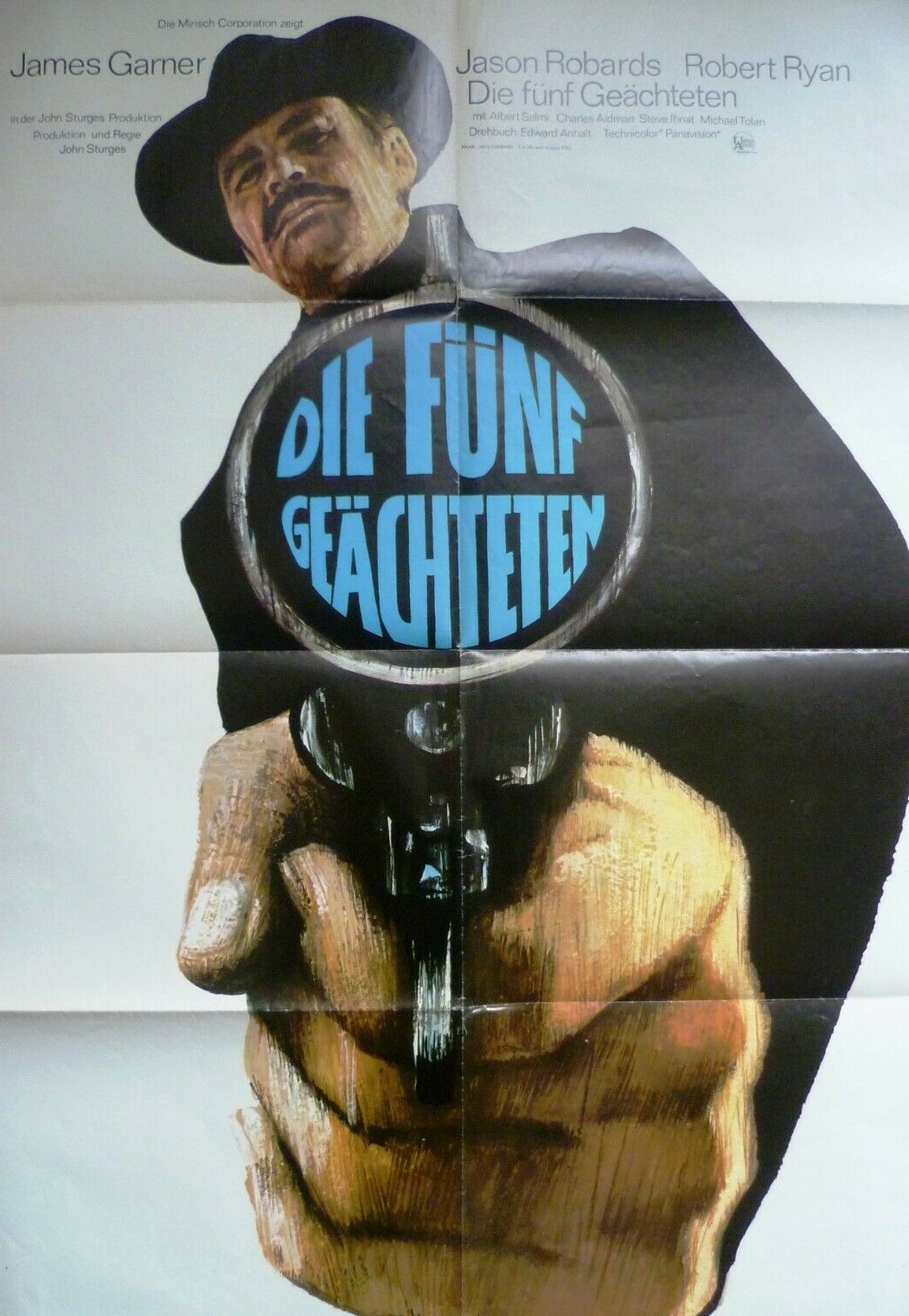
Behind the Scenes – “Hour of the Gun” (1967)

Blame Robert Wise for falling behind on The Sand Pebbles (1966), otherwise John Sturges  would have pressed ahead with Steve McQueen pet project Day of the Champion (later resurrected as Le Mans, 1970, though minus Sturges). Needing another hit after the consecutive box office failures of The Satan Bug (1965) and The Hallelujah Trail (1965), Sturges fell back on an equally favoured project, The Law and Tombstone, a revisionist and darker look at the Wyatt Earp legend, with “a few liberties taken so it doesn’t become a documentary.” Despite the failings of the last two films, Mirisch had just re-signed Sturges, expanding his current deal from two to four pictures.

“It seemed like a first-rate idea,” recalled producer Walter Mirisch, who had worked with Sturges on The Magnificent Seven (1960) and The Great Escape (1963). In his memoir he said, “If there was still a market for Western pictures, John Sturges was certainly the ideal director to test it.” (Mirisch’s memory is a bit hazy here regarding the commercial prospects for westerns – 1966 had seen box office success for El Dorado, Nevada Smith, The Professionals and The Rare Breed while 1967 would usher in The War Wagon and Hombre among others). The initial idea was to re-team Burt Lancaster and Kirk Douglas from Gunfight at the O.K. Corral, to which this was a sequel, but Paramount, which had made the original picture, nixed the notion.

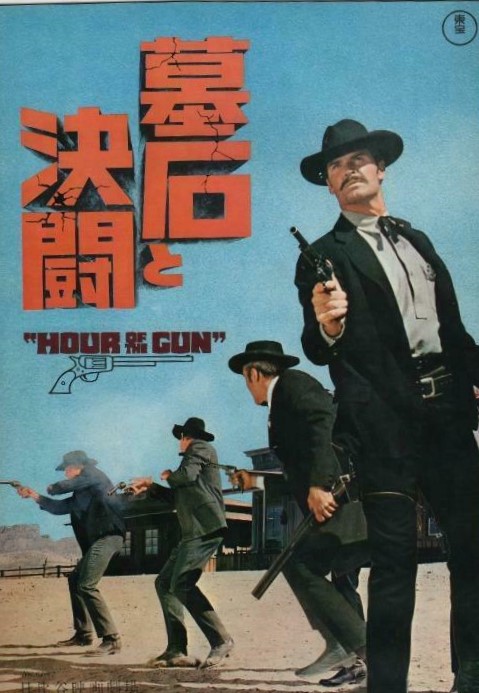
The image for the Japanese poster was taken from the initial shootout at the O.K. Corral that opened the picture.

James Garner came on board in the main because he still owed Mirisch, marking a decade in the business, a picture. He had originally worked for Mirisch in The Children’s Hour (1961). He was hired for “not much,” a straight salary, but credited Mirisch with kick-starting his career after his battle with Warner Brothers. Mirisch had also funded By Love Possessed (1962) in which Sturges had directed Jason Robards, “a brilliant actor though one with problems” (something of an understatement).

There was some surprise in Hollywood when Sturges returned to Mexico after the difficulties – censorship, threats to boycott the film, union issues – he had encountered shooting The Magnificent Seven there. Having vowed “never to make another picture” in that country, “one of the reasons we’re back here is because they’ve eased up on regulations.” Having expected to import most of the cast from Hollywood, the producers were delighted that “six of the ten other featured parts” went to Mexicans, as a result of extensive auditions. Although Lucien Ballard (The Wild Bunch, 1969) remained director of cinematography, a Mexican camera crew was hired with Jorge Stahl in charge.

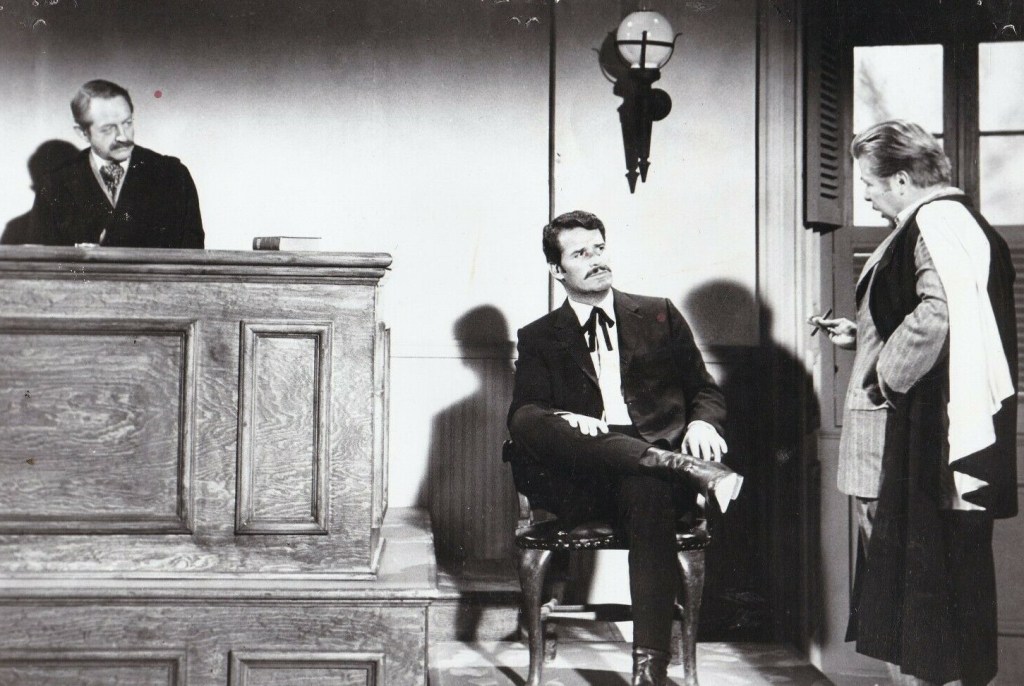
James Garner takes the stand in court defending himself against allegations of murder.

Shooting began on November 9, 1966, at Torreon, “a quiet little agricultural town with a single hotel and bar,” where a fake town had been built at a cost of $100,000. Filming shifted to Churusbusco Studios in Mexico City on December 20 and four weeks later production wrapped after exteriors at a hacienda near San Miguel de Allende for the face-off with Ike Clanton (Robert Ryan in the film).

James Garner (The Great Escape, 1963) was keen to be reunited with Sturges. “I was happy to play the character,” reminisced Garner, “because John always knew what he was doing. He would take five, six, seven factions in a story and bring them together.” Garner saw Earp as “a guy taken with his own power, who nobody could defy.” 

Jason Robards, as Doc Holliday, with a well-known wild side, was difficult to manage. Assistant directors were dispatched every morning to find out where, bar or brothel,  the actor had ended up the night before. Sturges rounded on him when Robards turned up at lunch for a scheduled 8am start. He was perfect after that. Unusually, Sturges would invite the cast to watch the dailies. Producers Mirisch were not happy with the title which was eventually changed to Hour of the Gun.

“My mistake,” rued Sturges, “was that I thought people would be fascinated by the real story about the quarrel between the Earps and the Clantons. You didn’t just shoot people, there were trials, lawyers, citizens’ committees…I got preview cards that said of all the stories told about Earp and Holliday this was the dullest. They (the audience) considered them fictional characters. They couldn’t have cared less that that’s the way it really was.”

As Variety pointed out in its review: “Probing too deeply into the character of folk heroes reveals them to be fallible human beings – which they are of course – but to mass audiences …such exposition is unsettling.”

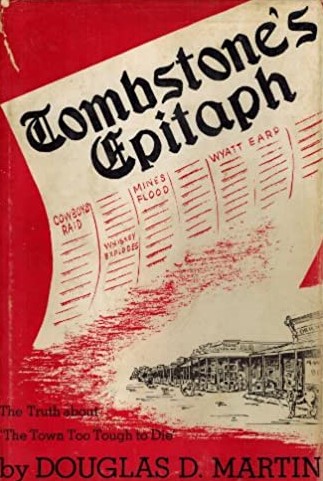
Edward Anhalt’s screenplay was based on this book published in the late 1950s.

There were clearly reservations about the project. Mirisch announced it was “ready for release” at the end of March 1967 but it did not see the light of day for another seven  months. Although the film was budgeted at just over $3 million – $1 million more than In the Heat of the Night (1967), another Mirisch project – and received tremendous support from the industry-wide “Fall Film Fair” promotional campaign (“commended…for excellence in entertainment”) it was a huge flop in the U.S. bringing in a miserable $900,000 in rentals (the amount studios receive once the cinemas have taken their share of the gross). It did better abroad with $1.5 million but the total was nowhere near enough to recoup the costs.

“Also playing a large role in the reaction to the picture was the continued loss of interest by audiences in Western pictures,” said Mirisch. “I was again guilty of thinking that this trend would reverse and that Westerns, led by a hit picture, would return to favour stronger than ever. I was wrong. As a new generation arose, their interest in westers had been satiated, probably by television, and they now embraced the so-called Easy Rider era of movie-making.”

This is another piece of faulty memory. The year after the release of Hour of the Gun   commercial success was enjoyed by Bandolero!, Hang ‘Em High and The Scalphunters to name a few and Will Penny and The Stalking Moon, both revisionist westerns, won critical favour. And, apologies for harping on about it, but, as I showed in my book The Gunslingers of ’69, that year proved a box office bonanza for westerns despite Easy Rider.

SOURCES: Glenn Lovell, Escape Artist (University of Wisconsin Press, 2008) p257-262; Walter Mirisch, I Thought We Were Making Movies, Not History (University of Wisconsin Press, 2008), p259-260; United Artists Archive, Appendix II, University of Wisconsin; “Mirisch, Sturges Revamp Pact for Two More Films,” Box Office, July 25, 1966, W-1; “James Garner Moves from Actor To Future Producer Status,” Variety,  October 5, 1966, 5; “Director John E. Sturges Returns to Mexico for Law and Tombstone,” Box Office, November 7, 1966, pW-2; “Mirisch Schedules Five Major Films,” Box Office, March 13, 1967, p10; “Film Title Changes,” Box Office, April 24, 1967, p18; Advert, Box Office, Aug 28, 1967, p4-5; Review, Variety, October 4, 1967, p16.

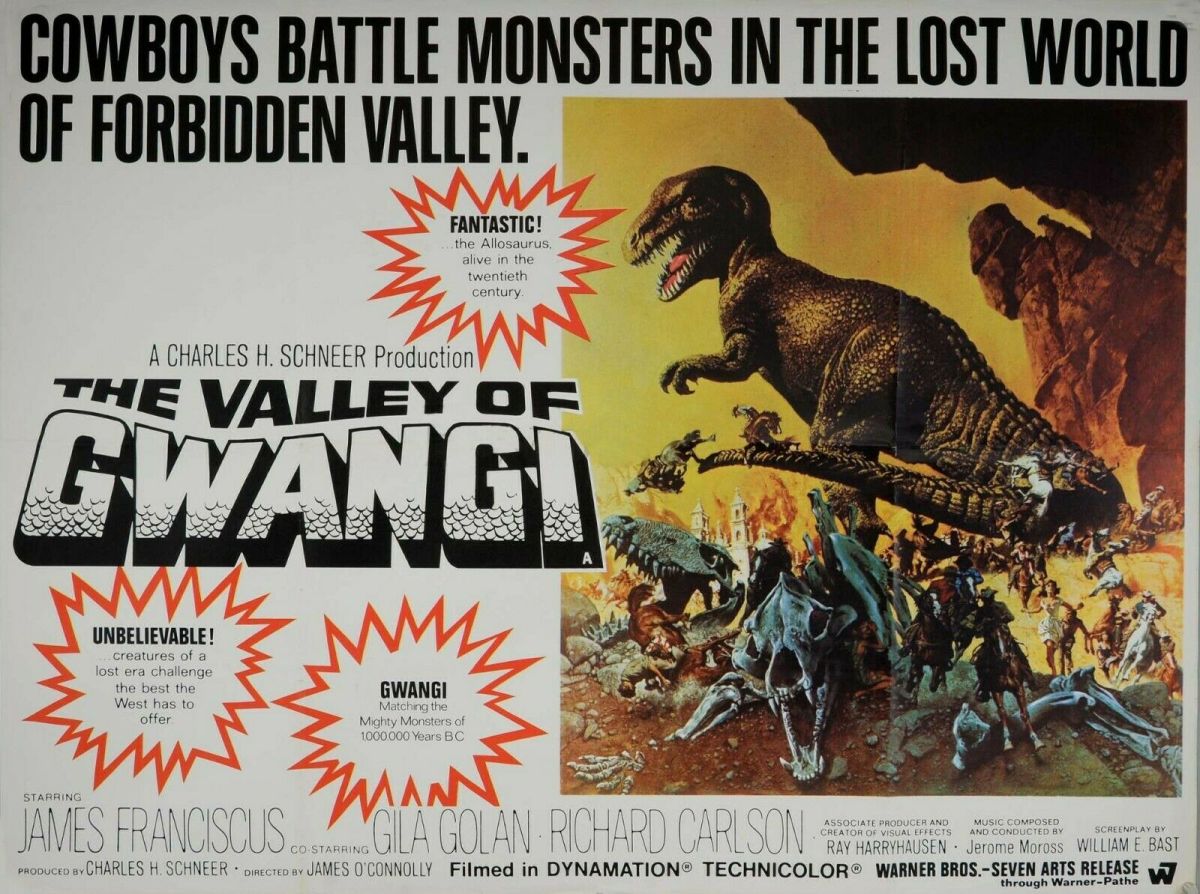
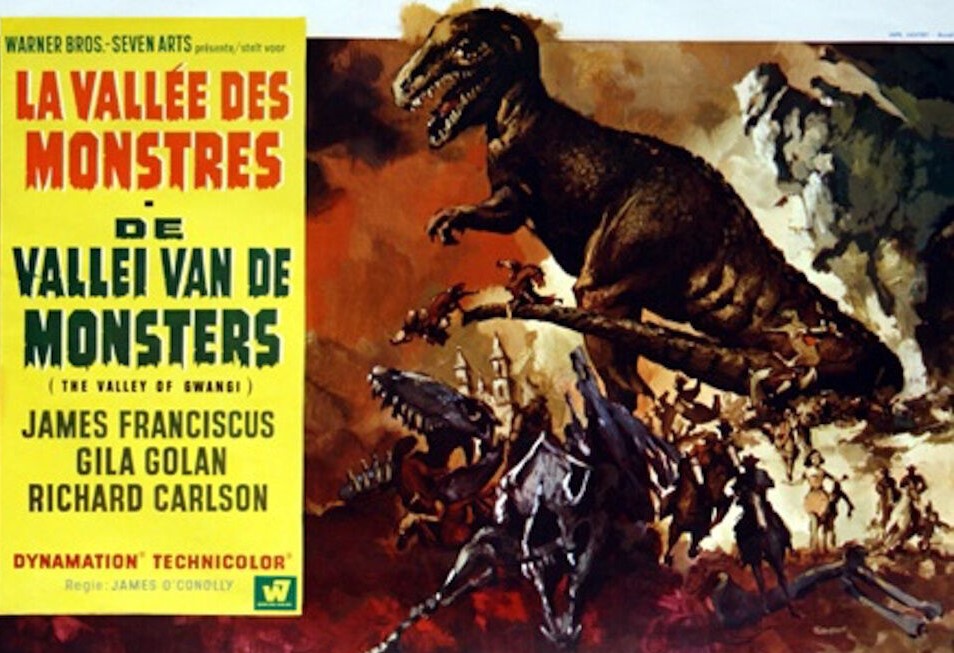
The Valley of Gwangi (1969) ****

The special effects are in the five-star range while the movie into which they fit is really worth no more than three stars so I’ve compromised, hence the four-star rating. Actually, the story and characters are interesting enough, and there are some stunning cowboy stunts,  though where is a fur-lined bikini when you need one. Although we are treated to prehistoric monsters, humans fail to have managed the transition to the hidden valley where the creatures have kept out of sight for millions of years. Instead, we are in turn-of-the-twentieth-century Mexico.

However, one specimen, a miniature horse, known as El Diablo, has been found and now resides in a rodeo, property of T. J. Breckenridge (Gila Golan) whose showstopping turn involves leaping on horseback from a high platform through a ring of fire into a pool of water.  Ex-flame and sleek salesman Tuck (James Franciscus) and archaeologist Professor Bromley (Laurence Naismith) follow gypsies who aim to return the horse to the Forbidden Valley. T.J. and a band of cowboys are in pursuit.

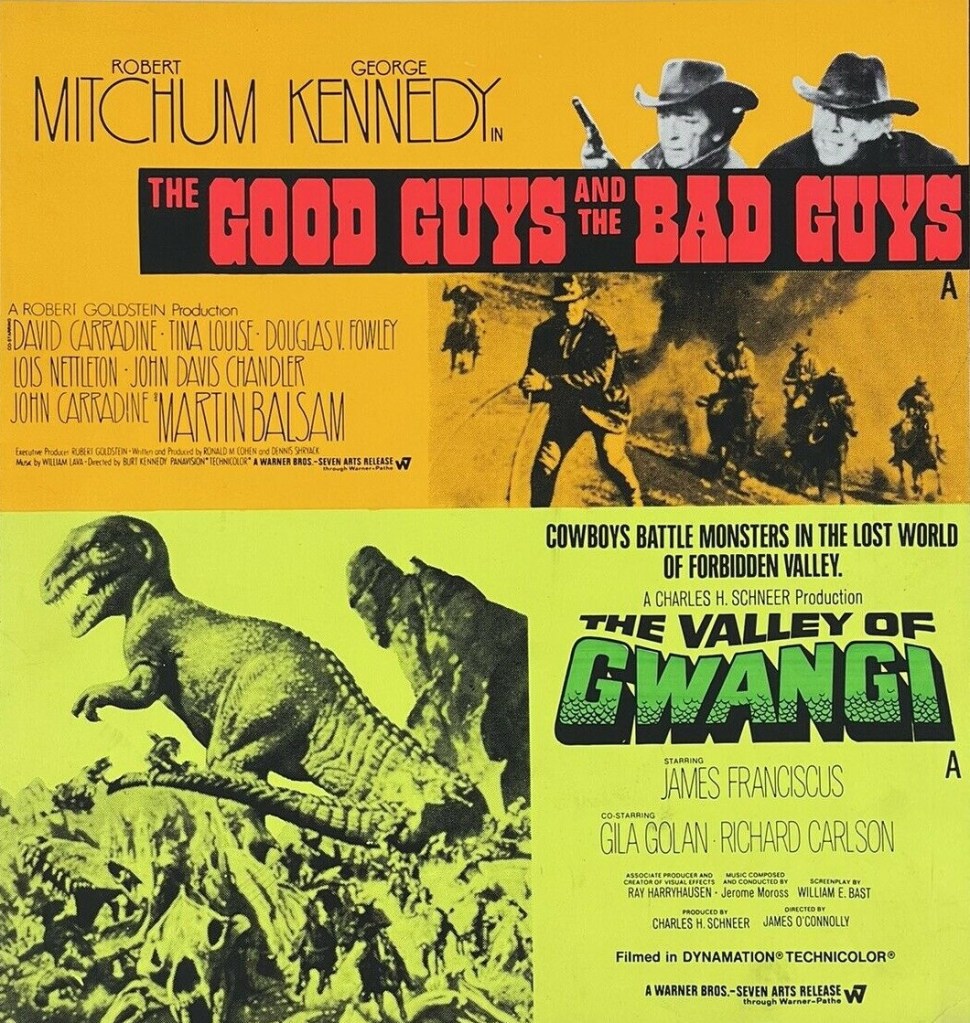
I saw this double bill in 1969 when it was shown on the ABC circuit in Britain.

Widening a tiny gap into the unknown world also of course means it’s not big enough for the monsters to escape. The valley is ruled by Gwangi, an Allosaurus, which to most of the audience looks remarkably like a T. Rex. Various battles ensure. A Pteranadon swoops down from the sky and captures one of the cowboys but is killed by Carlos (Gustavo Rojo). Gwangi fights an Ornithomimus and a Styracosaurus. Even if your knowledge of prehistoric monsters  isn’t up to identifying each creature, no matter, the fights are very well done, and a step up in terms of special effects from similar tussles in Harryhausen’s previous venture in One Million Years B.C. (1966) especially as we are less distracted by females attired in fur bikinis.

Naturally, the intent is to capture Gwangi and put him on show a la King Kong (1933) and it’s equally obvious how this particular maneuver is going to work out. That the story follows this particular angle is down to the fact that the movie was the original idea of Willis O’Brien, the special effects genius to created King Kong. After considerable development, RKO shelved the project on the assumption the public was not interested in dinosaurs.

Meanwhile, back in the human tale, the previously principled T.J. lets greed get the better of her and begins resisting Tuck’s overtures. Even if you can guess the finale, it is pretty well done.

Ray Harryhausen only had a limited fanbase in the 1960s, otherwise this picture would not have done the rounds as the supporting feature to Robert Mitchum western The Good Guys and the Bad Guys (1969). You can tell it lacked the budget of One Million Years B.C. because the creatures fail to remain a consistent color. Even so, this ranks as one of the top special effects achievements and these days Harryhausen’s work is much more appreciated.

Unless you are Raquel Welch, it’s difficult for an actor to compete with prehistoric monsters. At least here, the stars had decent dialogue and the tangled romance provides entertainment as do the host of stunning stunts in the rodeo and a bull running amok. Charlton Heston look-alike James Franciscus (Youngblood Hawke, 1964) is a plausible love interest who doesn’t let romance get in the way of a fast buck. The role of Gila Golan (Our Man Flint, 1966) extends to more than eye candy and there’s not a bikini in sight or disrobing of any sort. Richard Carlson (Creature from the Black Lagoon, 1954) was a sci-fi veteran and Laurence Naismith had appeared in Jason and the Argonauts (1963). British actress Freda Jackson (The Third Secret, 1964) plays a witch.

Director Jim O’Connolly (Vendetta for the Saint, 1969) keeps the human elements rolling along and once monsters join in the fun there’s scarcely time to draw breath. William Bast (Hammerhead, 1968) pulled together the human and monster elements for the screenplay.

Harryhausen fans will have a ball.

Texas Across the River (1966) ****

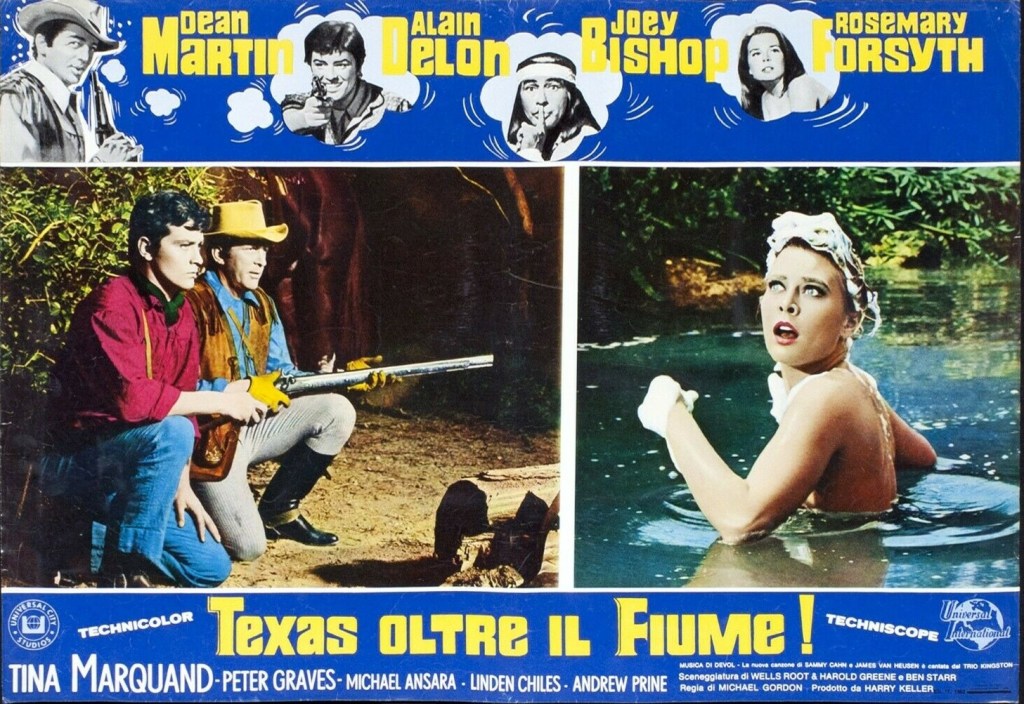
Excellent comedy western mixing dry wit and occasional slapstick to joyous effect. The wedding between Spanish duke Don Aldrea (Alain Delon) and Louisiana belle Phoebe (Rosemary Forsyth) is interrupted by her previous suitor Yancy (Stuart Cottle) who is killed in the resulting melee. Escaping to Texas, Don Aldrea’s marksmanship leads settler Sam (Dean Martin) to recruit him to help fight raiding Commanches. Romantic entanglement ensues when the Don rescues Native American Lonetta (Tina Marquand) and Sam has more than a passing interest in Phoebe.

It is so tightly structured that nothing occurs that doesn’t have a pay-off further down the line. Bursting with terrific lines – including a stinger of a final quip – and set pieces, it pokes fun at every western cliché from the gunfight, the cavalry in hot pursuit, and fearsome Native Americans to the snake bite and the naked bathing scene. Incompetence is the order of the day – cavalry captain Stimpson (Peter Graves) issues incomprehensible orders, chief’s son Yellow Knife (Linden Chiles) cannot obey any.

The Don, with his obsession with honor and his tendency to kiss men on the cheeks, is a comedy gift. Despite his terrific head of hair, he is stuck with the moniker “Baldy” and every time he is about to save the day he manages to ruin it. Sam is the kind of guy who thinks he is showing class by removing his spurs in bed while retaining his boots. His sidekick Kronk (Joey Bishop), a mickey-take on Tonto, mostly is just that, a guy who stands at the side doing nothing but delivering dry observations.

Lonetta is full of Native American lore and has enough sass to keep the Don in his place. “What is life with honor,” he cries to which she delivers the perfect riposte, “What is honor without life?” Phoebe is a hot ticket with not much in the way of loyalty.

Two sequences stand out – the slapping scene (whaat?) and a piece of exquisite comedy timing when Sam, Phoebe and the Don try an iron out a complicated situation.

Good as Dean Martin (Rough Night in Jericho, 1967) is the picture belongs to Alain Delon (Once a Thief, 1965) and I would argue it is possibly his best performance. Never has an actor so played against type or exploded his screen persona. Delon was known for moody, sullen roles, cameras fixated on his eyes. But here he is a delight, totally immersed in a role, not of an idiot, but a man of high ideals suddenly caught up in a country that is less impressed with ideals. If he had played the part with a knowing wink it would never have worked.

Martin exudes such screen charm you are almost convinced he’s not acting at all, but when you compare this to Rough Night in Jericho it’s easy to see why he was so under-rated. Joey Bishop (Ocean’s 11) is a prize turn, with some of the best quips. Rosemary Forsyth (Shenandoah, 1965) is surprisingly good, having made her bones in more dramatic roles, and Tina Marquand (Modesty Blaise, 1966) more than holds her own. Michael Ansara (Sol Madrid, 1968) played Cochise in the Broken Arrow (1956-1958) television series. Under all the Medicine Man get-up you might spot Richard Farnsworth. Peter Graves of Mission Impossible fame is the hapless cavalry leader.

Director Michael Gordon (Move Over, Darling, 1964) hits the mother lode, the story zipping along, every time it seems to be taking a side-step actually nudging the narrative forward. He draws splendid performances from the entire cast, knowing when to play it straight, when to lob in a piece of slapstick, and when to cut away for a humorous reaction, and especially keeping in check the self-indulgence which marred many Rat Pack pictures – two of the gang are here, Martin and Bishop. There’s even a sly nod to Sergio Leone spaghetti westerns when the electric guitar strikes up any time Native Americans appear. Frank De Vol (Cat Ballou, 1965) did the score.

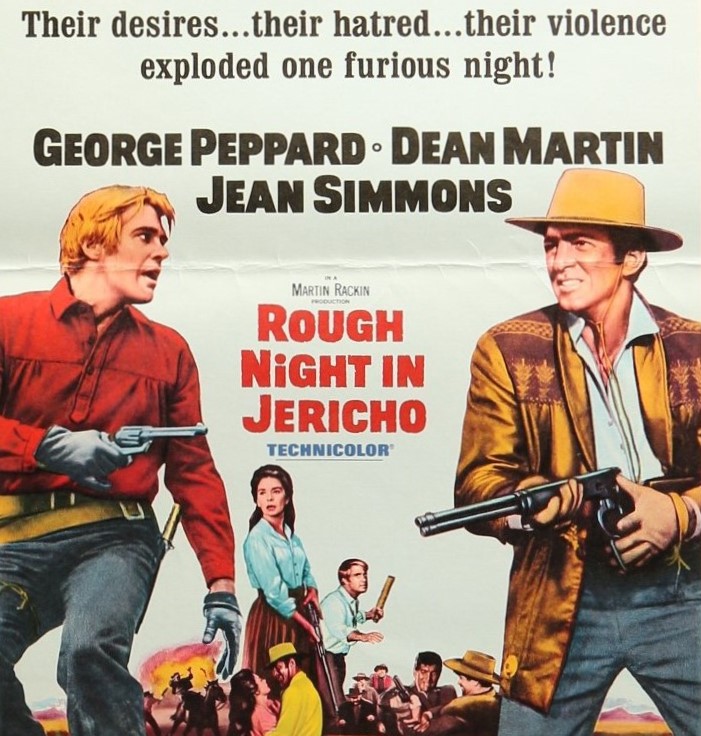
Rough Night in Jericho (1967) ****

Woefully under-rated western with three A-list stars at the top of their game in a taut drama with an explosive ending. Not surprising it was overlooked at the time with John Wayne duo El Dorado and The War Wagon, Paul Newman as Hombre and an onslaught of spaghetti westerns garnering more attention at the box office. Though a rewarding watch, be warned this is more of a slow-burn drama than a traditional western and both male leads play against type.

Former lawmen Dolen (George Peppard) and Ben Hickman (John McIntiyre) have invested in a stagecoach business owned by twice-widowed Molly Lang (Jean Simmons), just about the only business in Jericho in which Alex Flood (Dean Martin) does not have a controlling interest. Dolen’s first reaction on surmising Flood’s power is to quit, “stepping in’s a habit I outgrew.” And it’s not a bad approach given that Flood is judge, jury and executioner and apt to leave victims strung up to dissuade dissent.

Dolen and Flood have a great deal in common, moving from ill-paid law enforcement into business, Flood, having cleaned up the town, staying on the reap the profit. While Dolen avoids confrontation, Molly aims to stir up opposition, invoking ruthless reaction.

What’s unusual about this picture is it’s mostly a duel of minds, Dolen and Flood testing each other out, neither backing down even while Dolen intends quitting and when he happens to win a bundle in a poker game with Flood you have the notion that was somehow an inducement to help him on his way.  It’s a power game of sorts, too, between Dolen and Molly, she determined to give no quarter to the point of drinking him under the table.

But when violence occurs it is absolutely brutal, Flood’s knuckles bloodied raw as he batters a man foolish enough to challenge his rule of law, Dolen taking an almighty whipping from Yarbrough (Slim Pickens), Molly viciously slapped around by Flood for daring to look at Dolen. When Dolen does move into action it is with strategic skill, gradually reducing the odds before the inevitable shoot-out between respectable citizens and gangsters.

A good half century before the notion took hold, this is a movie as much about entitlement, about those doing the hard work receiving just reward, Flood, having risked his life to tame the town, deciding he should be paid more than a sheriff’s monthly salary. And the western at this point in Hollywood development had precious few female businesswomen in the vein of Molly.

Cover of the Pressbook

Both Dean Martin and George Peppard play against type. An unexpected box office big hitter through the light-hearted Matt Helm series, Martin explodes his screen persona as this vicious thug, town in his thrall, contemptuous of his victims, turning politics to his advantage, but still happy to hand out a beating when charm and chicanery fail. This is one superb, and brave, performance.

For Peppard, this picture is the bridge between the brash persona of The Blue Max (1966) and Tobruk (1967) and the thoughtful introspective characters he brought to life in P.J. / New Face in Hell (1968) and Pendulum (1969). Perhaps the most telling difference is a little acting trick. His blue eyes are unseen most of the time, hidden under the shade of his wide-brimmed hat. He is not laid-back in the modern sense but definitely unwilling to plunge into action, movement both confined and defined, a man who knows his limits and, no longer paid to risk his life, unwilling to do so.

Jean Simmons (Divorce American Style) is in excellent form, neither the feisty nor submissive woman of so many westerns, but clever and determined, perhaps setting the tone for later female figures like Claudia Cardinale in Once Upon a Time in the West (1969) and Raquel Welch in 100 Rifles (1969).

And this is aw-shucks Slim Pickens (Major Dundee, 1965) as you’ve never seen him before. John McIntire had spent most of the decade in Wagon Train but he punches above his weight as a mentoring lawman. If you are trying to spot any other unusual figures keep an eye out for legendary Variety columnist Army Archerd  who was a walk-on part as a waitperson.

More at home in television, director Arnold Laven took to the big screen on rare occasions, only twice previously during the decade for Geronimo (1962) and The Glory Guys (1965), but here he handles story and character with immense confidence and considerable aplomb. The direction is often bold – major incidents occur off screen so he can concentrate on the reactions of the main characters. There is a fabulous drunk scene, one of the best ever – plus an equally good hangover sequence –  the violence is coruscating, all the more so because it is not delivered by gun.

The screenplay by Sidney Boehm (Shock Treatment, 1964) and Marvin H. Albert (Duel at Diablo, 1966) swings between confrontation and subliminal menace.

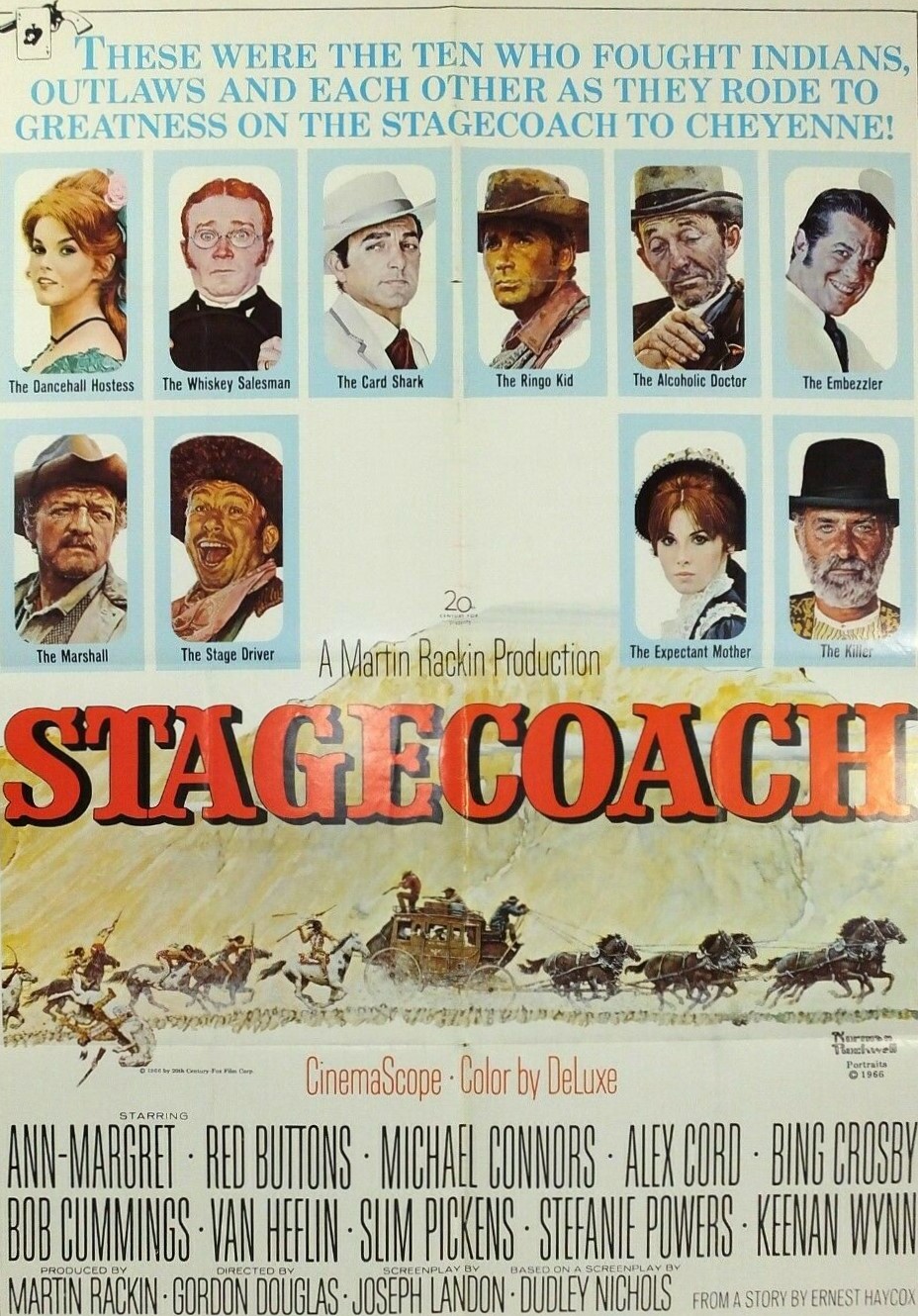
Stagecoach (1966) ****

It’s probably sacrilege to admit that I quite enjoyed this. Also it’s been so long since I’ve seen the John Ford original that I could remember very little of the specifics and I haven’t seen the remake before so this was just like watching a new movie.

Basically, it’s the story of a group of passengers taking the stagecoach to Cheyenne for different reasons who are joined by an escaped murderer and shepherded along by the driver and a town marshal. There is some excellent action but mostly it’s a relationship picture, how the characters react to one another and their response to crisis.

Good-time girl Dallas (Ann-Margret) is on the run, banker Gatewood (Bob Cummings) is hiding a stash of stolen money, alcoholic doctor Boone (Bing Crosby) is penniless, liquor salesman Peacock (Red Buttons) is a coward, gambler Hatfield (Mike Connors) has Civil War secrets, pregnant Lucy Mallory (Stefanie Powers) is meeting her cavalry husband in Cheyenne. Ornery Buck (Slim Pickens) is the driver. Curley (Van Heflin) is riding shotgun and when he comes upon stranded escaped murderer the Ringo Kid (Alex Cord) promptly arrests him.

The drama unfolds as the characters confront each other or their own weaknesses. Dallas, who had a high old time as a saloon girl, is way out of her depth in respectable company,  concealing the secret of her affair with the married Gatewood. Ringo coaxes her along, bringing her out of her shell, giving her back self-respect, and of course falling in love. Curley, with his eyes on the $500 reward for bringing Ringo in, has no intention of letting the gunslinger take his revenge in Cheyenne on Luke Plummer (Keenan Wynn) who killed his family. Boone and Peacock provide the fun, the doctor spending most of his time separating the salesman from his cargo of booze.

There are endless permutations with a story like this, the kind of material favoured in  disaster movies like Airport (1970) and The Towering Inferno (1974) where disparate characters battle for survival. The action is only part of the deal. The picture only truly works if the characters are believable. For that, you need a heap of good acting. The audience could certainly rely on old dependables like Bing Crosby (The Road to Hong Kong, 1962) in his big screen swansong, Van Heflin (Shane, 1953), Red Buttons (Oscar-winner for Sayonara, 1957), Robert Cummings (Saboteur, 1942) and cowboy picture veteran Slim Pickens to put on a good show. But the main dramatic load was to be carried by relative newcomers Ann-Margret and Alex Cord.

Ann-Margret has made her name with sassy light-hearted numbers like The Pleasure Seekers (1964) and had only just stepped up to the dramatic plate with Once a Thief (1965). This was Alex Cord’s sophomore outing after Synanon (1965), the odds stacked against him making any impact in the role which turned John Wayne into a star. 

Amazingly, the casting works. Ann-Margret moves from feisty to restrained, meek to the point of being cowed, and for most of the film, far removed from the false gaiety of the saloon, seeks redemption. The cocky trouble-making minx emerges only once, to knock the wind out of Mrs Mallory, but, after taking a tumble down the humility route, gradually steers her way towards a better self, preventing Gatewood from causing chaos, nursing Mallory and inching her way towards true feelings for Ringo. As in the best movies, it’s not for her to open up about her woeful life but for another character, in this case Ringo, to identify her predicament: “What you doin’ about your scars, you got ‘em even if they don’t show…when you goin’ to stand up and stop crawlin’?” When they finally kiss it is one of the most tender kisses you will ever see.  

My reservations about Alex Cord’s acting skills were based on his moustachioed performance in Stiletto (1969) but I reversed my opinion after seeing him in The Scorpio Letters (1967) and this is another revelation. As much as he can deliver on the action front, and sports on occasion a mean-eyed look,  it’s in the dramatic scenes that he really scores, gentle, vulnerable, caring. He certainly matches the Duke’s trademark diffidence in terms of romance. That the camera can mine depths of expression from both faces proves the calibre of their acting.

If director Gordon Douglas (Rio Conchos, 1964) had more critical standing, his bold long opening aerial tracking shot over rugged forest, mountain and plain before reaching the stagecoach would have received the acclaim accorded Stanley Kubrick for a similar shot in The Shining (1980). The opening also makes it clear how far removed this is from the original, not just in colour obviously, but (although filmed in Colorado) in a different locale, Wyoming, rather than the arid Arizona of Monument Valley. After a brief glimpse of the stagecoach, Douglas switches to a cavalry troop making camp. A soldier going into a wagon is met by a hatchet in the head. The camera tracks the corpse’s blood as it flows down a stream where it alerts another soldier washing clothes. Before he can raise the alarm, he gets a lance in the back.

Where the passengers have heard rumors, quickly dismissed (“nobody got scalped by an old rumor”) of the Sioux (Apaches in the original) on the warpath, the audience has seen the cavalry troop slaughtered, so (in effectively a Hitchcockian device) provides the movie with the tension the on-screen characters initially lack The passengers soon grasp reality when they come across another patrol dead at a staging post, and eventually are battling for their lives when ambushed. But prior to that there is a tense sequence of leading the stagecoach across a narrow mountain ridge during a storm.

There’s a clever reversal before the Sioux onslaught. The passengers think they have seen soldiers approaching, but it is the Sioux wearing cavalry uniforms. There is no river to cross as in the original, but the chase along a mountainous path is breathtaking, aerial and tracking shots given full rein, ending in a shoot-out without (as in the original) the cavalry riding to the rescue.

Douglas has his work cut out with the drama, as various characters confront their issues, and his staging is superb, characters always given reason to move. Screenwriter Joseph Landon (Rio Conchos) borrowed material from the Dudley Nichols original but added and subtracted quite a bit.

At the time critical deification of John Ford had not begun and Hollywood was in a cyclical remake mood – new versions of Beau Geste and Madame X appearing the same year – so Gordon Douglas didn’t quite face a critical backlash, although praise was generally sparse. Judging by the box office it received an audience thumbs-up – as it does from yours truly.

You can rent this on Amazon Prime.

Discover WordPress

A daily selection of the best content published on WordPress, collected for you by humans who love to read.

The Atavist Magazine

by Brian Hannan

WordPress.com News

The latest news on WordPress.com and the WordPress community.