Rough Night in Jericho (1967) ****

Woefully under-rated western with three A-list stars at the top of their game in a taut drama with an explosive ending. Not surprising it was overlooked at the time with John Wayne duo El Dorado and The War Wagon, Paul Newman as Hombre and an onslaught of spaghetti westerns garnering more attention at the box office. Though a rewarding watch, be warned this is more of a slow-burn drama than a traditional western and both male leads play against type.

Former lawmen Dolen (George Peppard) and Ben Hickman (John McIntire) have invested in a stagecoach business owned by twice-widowed Molly Lang (Jean Simmons), just about the only business in Jericho in which Alex Flood (Dean Martin) does not have a controlling share. Dolen’s first reaction on surmising Flood’s power is to quit, “stepping in’s a habit I outgrew.” And it’s not a bad approach given that Flood is judge, jury and executioner and apt to leave victims strung up to dissuade dissent.

Dolen and Flood have a great deal in common, moving from ill-paid law enforcement into business, Flood, having cleaned up the town, stayed on to reap the profit. While Dolen avoids confrontation, Molly aims to stir up opposition, invoking ruthless reaction.

What’s unusual about this picture is it’s mostly a duel of minds, Dolen and Flood sounding each other out, neither backing down even while Dolen intends quitting and when he happens to win a bundle on a poker game with Flood you have the notion that was somehow an inducement to help him on his way.  It’s a power game of sorts, too, between Dolen and Molly, she determined to give no quarter to the point of drinking him under the table.

But when violence occurs it is absolutely brutal, Flood’s knuckles bloodied raw as he batters a man foolish enough to challenge his rule of law, Dolen taking an almighty whipping from Yarbrough (Slim Pickens), Molly viciously slapped around by Flood for daring to look at Dolen. When Dolen does move into action it is with strategic skill, gradually reducing the odds before the inevitable shoot-out between respectable citizens and gangsters.

A good half-century before the notion took hold, this is a movie as much about entitlement, about those doing the hard work receiving just reward, Flood, having risked his life to tame the town, deciding he should be paid more than a sheriff’s monthly salary. And the western at this point in Hollywood development had precious few female businesswomen in the vein of Molly.

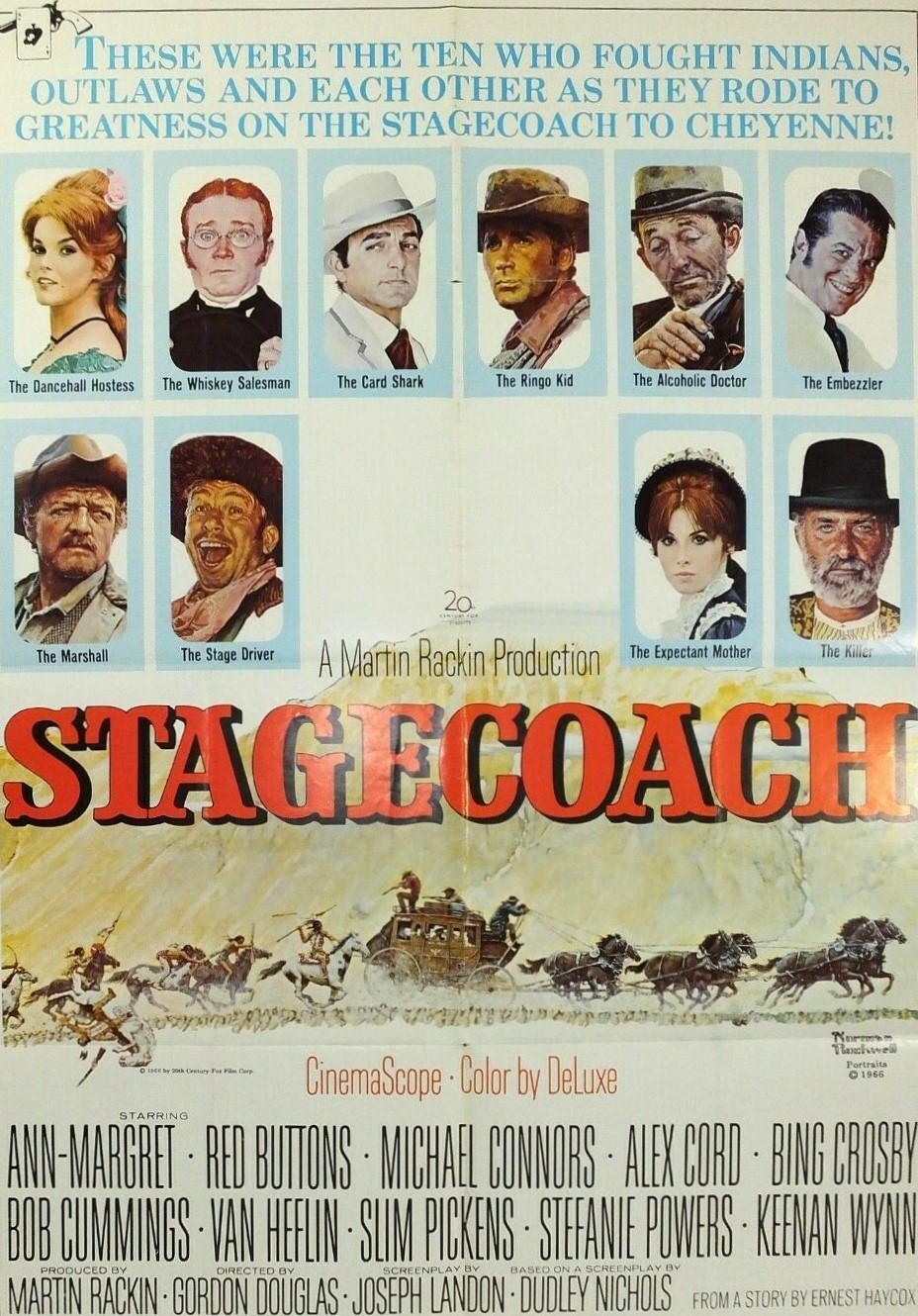
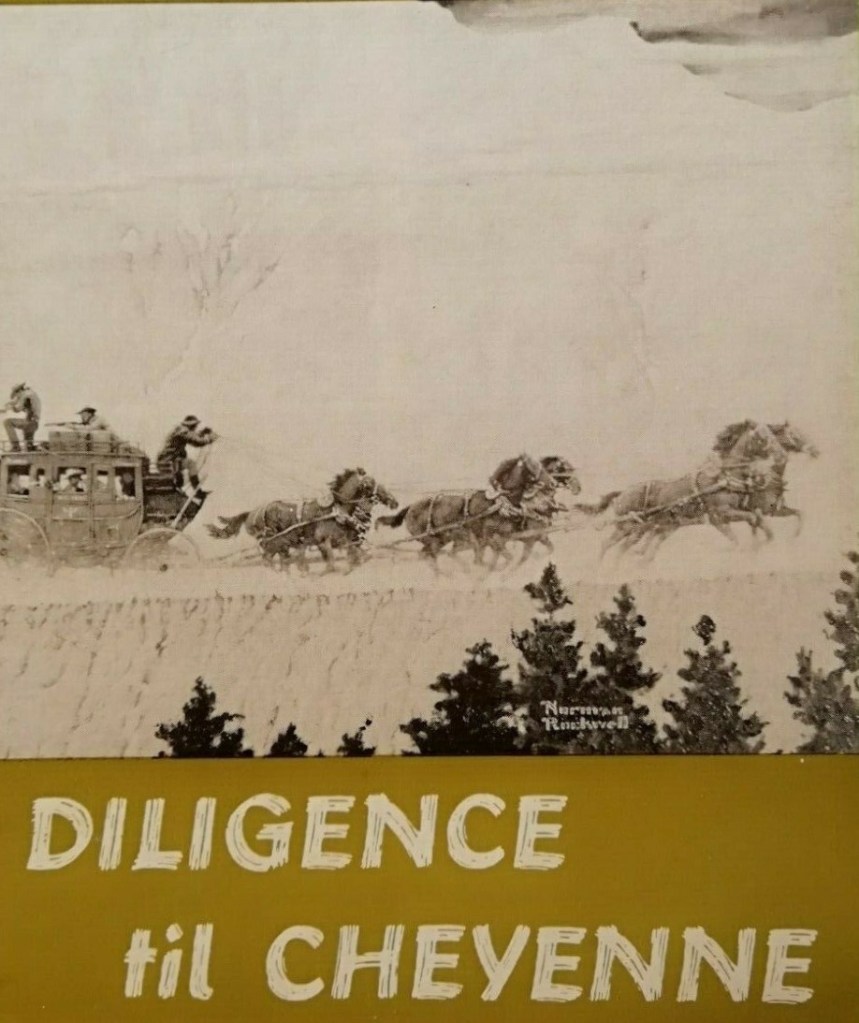
This bold image only appeared in the Pressbook. Maybe Don Siegel was watching and appropriated it for “Dirty Harry.”

Both Dean Martin and George Peppard play against type. An unexpected box office big hitter through the light-hearted Matt Helm series, Martin explodes his screen persona as this vicious thug, town in his thrall, contemptuous of his victims, turning politics to his advantage, but still happy to hand out a beating when charm and chicanery fail. This is one superb, and brave, performance.

For Peppard, this picture is the bridge between the brash persona of The Blue Max (1966) and Tobruk (1967) and the thoughtful introspective characters he brought to life in P.J. / New Face in Hell (1968) and Pendulum (1969). Perhaps the most telling difference is a little acting trick. His blue eyes are unseen most of the time, hidden under the shade of his wide-brimmed hat. He is not laid-back in the modern sense but definitely unwilling to plunge into action, movement both confined and defined, a man who knows his limits and, no longer paid to risk his life, unwilling to do so.

Jean Simmons (Divorce American Style, 1967) is in excellent form, neither the feisty nor submissive woman of so many westerns, but clever and determined, perhaps setting the tone for later female figures like Claudia Cardinale in Once Upon a Time in the West (1969) and Raquel Welch in 100 Rifles (1969).

And this is aw-shucks Slim Pickens (Major Dundee, 1965) as you’ve never seen him before. John McIntire had spent most of the decade in Wagon Train but he punches above his weight as a mentoring lawman. If you are trying to spot any other unusual figures keep an eye out for legendary Variety columnist Army Archerd  who has a walk-on part as a waitperson.

More at home in television, director Arnold Laven took to the big screen on rare occasions, only twice previously during the decade for Geronimo (1965) and The Glory Guys (1965), but here he handles story and character with immense confidence and considerable aplomb. The direction is often bold – major incidents occur off screen so he can concentrate on the reactions of the main characters. There is a fabulous drunk scene, one of the best ever – plus an equally good hangover sequence.  The violence is coruscating, all the more so because it is not delivered by gun.

There’s a great screenplay by Sidney Boehm (Shock Treatment, 1964) and Marvin H. Albert (Duel at Diablo, 1966) which swings between confrontation and subliminal menace.

This would have been Peppard’s picture, given he was demonstrating under-used acting skills, but he’s been to the draw by even better performances by Dean Martin as you’ve never seen him before and Jean Simmons.

A cracker.

Wild Rovers (1971) ****

An unlikely candidate for redemption. Savaged by studio MGM, thoroughly trashed by critics, and ignored by audiences. MGM, having just called time on Fred Zinneman’s big-budget Man’s Fate and alarmed by the budgetary excesses on Ryan’s Daughter (1970), wasn’t in the mood for a three-hour elegiac western about nothing much. Reputedly, there was a first version that went out at two hours seventeen minutes, but the trade critics reviewed the version that went out on  general release and came in 30 minutes shorter.

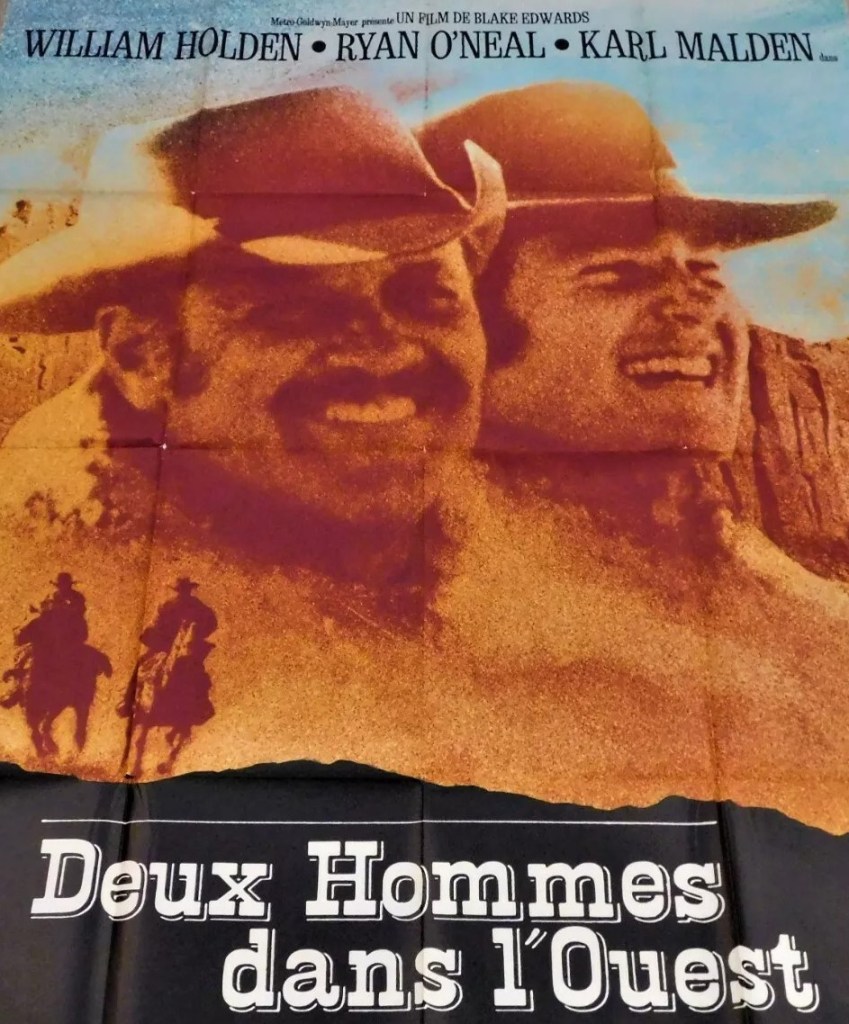
Scorn was the most common reaction. It seemed excessively indulgent to allow director Blake Edwards (The Great Race, 1965) anywhere near a western when his forte was gentle or slapstick comedy and the one time he had ventured out of his comfort zone – for musical Darling Lili (1970) –  he had turned in a commercial and critical disaster. The first poster for Wild Rovers, the stars cuddled up on a single horse, suggesting home-erotic overtones, was widely derided.

Hollywood was fearful of pictures without a female prominent in the cast. And while William Holden had revived his career with The Wild Bunch (1969), there wasn’t exactly a long queue for his services, not after the disaster that was The Christmas Tree (1969). By the time he had another hit, five years later, it was in a supporting role in Towering Inferno (1974).

There were question marks also over co-star Ryan O’Neal. Despite the commercial success of Love Story (1970), and an Oscar nomination to boot, it seemed insane to opt for what was in some regards a buddy picture sorely lacking in the crackling dialog and hip approach to the nascent genre that made Butch Cassidy and the Sundance Kid (1969) such a success.

This is a very small story on a not-much-bigger canvas. Sure the scenery is splendidly shot, but close-ups are scant, most of the movie filmed in long shot, faces covered by beards and hats pulled down. Unless you were familiar with his distinctive voice, you wouldn’t, for example, recognize Karl Malden. We’re back in the cowboy realism of Will Penny (1968) but where that narrative helped Charlton Heston by transforming him into a stand-up good guy coming to the aid of a widow and subtle romance thrown in, this just about has the dumbest plot ever conceived. 

What makes this work is that the characters ring true, no matter how dumb they appear. These are generally people at the end of the line, or at the beginning of one and realizing it’s going nowhere, or with their small patch in danger of being overrun.

The local sheriff holes up in the whorehouse, there’s a range war brewing – sheep farmers invading valuable pastures –  a cowboy could be killed in a flash, not from a rampant gunfighter, but from a spooked horse trampling him to death, the upstanding turn out to be corrupt.

Fifty-year-old Ross Bodine (William Holden), no wife or family to berth him, has hooked up with Frank Post (Ryan O’Neal), half his age. They live on a ranch, eating and sleeping in a communal bunkhouse, and when one of their colleagues suddenly accidentally dies, they take to brooding on the unachievable future, one that seems to be drifting fast away from the older man, still a brass ring within potential grasp for the younger.

They decide to rob a bank. But not in the normal fashion of bursting in with guns blazing in the middle of the day. Instead, they do it at night, Frank holding bank manager’s wife Sada (Lynn Carlin) hostage while her husband Joe Billings (James Olsen) fills Bodine’s pockets to the tune of $36,000. They should get away with it. By daybreak they should have put an enormous distance between themselves and any pursuers and once over the state line would be out of the jurisdiction of local sheriff or marshal. Probably, they’d throw a chunk of it away in gambling, women and booze but they still reckon on having enough left to stake themselves to a small ranch, hiring a manager to do the dirty work.

Not wanting to leave their employers out of pocket, Bodine hands the bank manager back £3,000 to return to ranch owner Walter Buckman (Karl Malden). But the money is diverted along the way by Sada. So Buckman attaches sons Paul (Joe Don Baker) and John (Tom Skerritt) to the posse with the instructions not to turn back at the state border. Walter remains behind waiting for the sheepmen to trespass.

Except for the elegiac scenery, the tone appears uneven at the start, and you might think this is going down comedy lines, what with our heroes being drenched with buckets of ordure and generally being knocked around slapstick fashion. But it quickly settles and you realize you’re watching a couple of losers every bit as believable as the pair in Midnight Cowboy (1969). They’ve got nowhere to go and in making the most of what they have liable to make a hash of it. They don’t win saloon brawls, are on the wrong end of a shoot-em-up, squeal like a pig, to coin a phrase, when called upon to be manly and stoical when a bullet needs dug out of a wound, stare into space after making love because they can sense the inevitable. I found myself warming to them much more than I expected.

Frank may be a mean shot and a heck of a gambler but he’s a little boy at heart, picking up a stray puppy while on ransom duty. There’s a fabulous scene – and my guess what attracted Holden to the picture – when Ross talks to his friend about their friendship. Hell, you think, that’s sailing close to the wind, don’t tell me these guys are getting all emotional. Until you realize the only time Ross could ever speak so openly is if his pal is beyond hearing. Because he’s dead.

Beautifully shot, as I mentioned, boldly envisioned with the emphasis on long shot, and in the end more moving than I expected. I’ve no idea what kind of masterpiece lurked in the lost three-hour version, but MGM may have done Edwards a service because this edited version hits the mark.

Written and directed by Edwards. Both Holden and O’Neal, who was generally panned, have never been better. Host of new talent in the wings includes Tom Skerritt (Top Gun, 1986), Joe Don Baker (Walking Tall, 1973), James Olsen (The Andromeda Strain, 1971), Moses Gunn (Shaft, 1971), and Victor French (Little House on the Prairie, 1974-1977). Unexpected appearances from British pair Rachel Roberts (Doctors Wives, 1971) and Charles Gray (The Devil Rides Out, 1968). 

Check this one out. Reassessment urgently required.

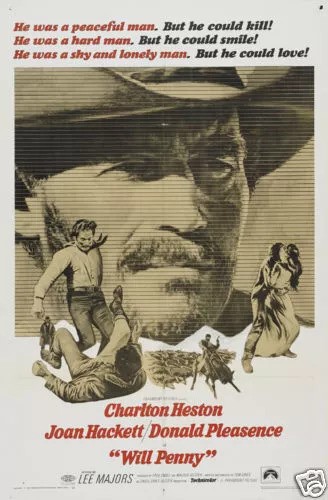
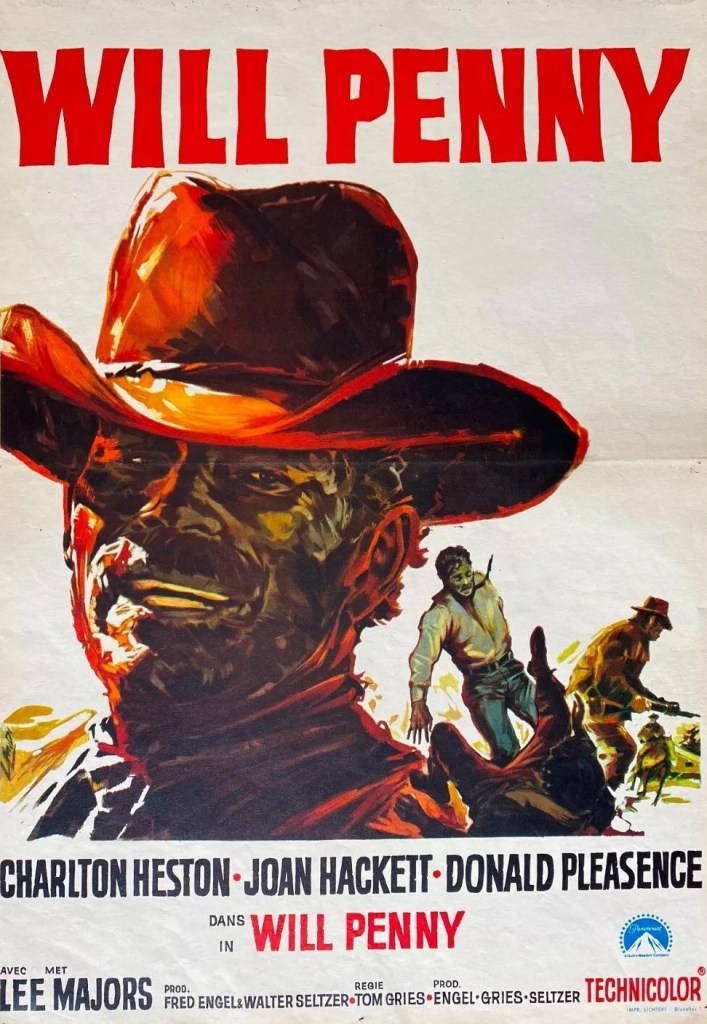
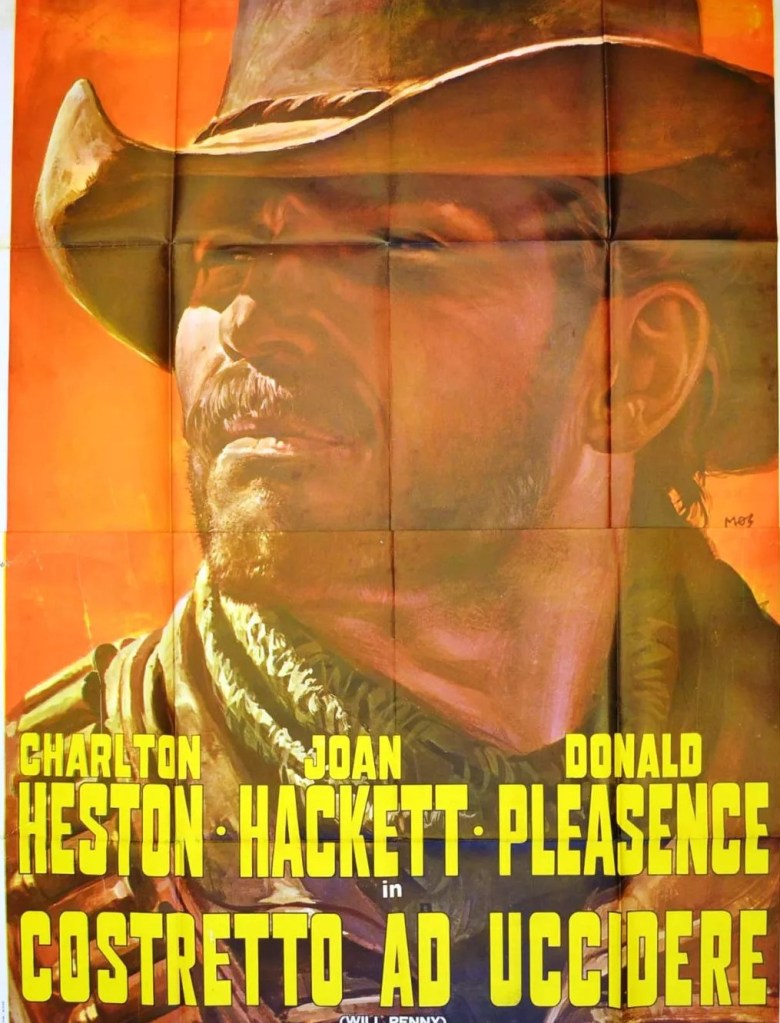
Will Penny (1968) ****

Tale of two westerns. On the one hand two undoubtedly fine performances contribute to an excellent realistic somewhat downbeat cowboy yarn. On the other hand a bunch of loonies jumping in every now and then as plot devices upset the wonderful tone.  There had to be some other way, surely, to ensure itinerant illiterate 50-year-old cowhand Will Penny (Charlton Heston) and educated single mother Catherine (Joan Hackett) spend the winter together, other than him being bushwhacked by mad-eyed Preacher Quint (Donald Pleasance) and left to die.

This kind of sub-plot, you know where it’s going to end, even though, in this case, it goes down a few bizarre routes. Luckily, the main narrative continues to surprise in interesting fashion.

Like its modern equivalent The Misfits (1961), this mostly revolves around simple-minded cowboys who enjoy simple pleasures, drinking and fornicating, at the end of a hard trail ride. Will looks no further ahead than his next job. He’s easily the oldest of the cowboys and we’re introduced to him getting a telling off for trying to steal a few biscuits from the trail cook. He’s constantly razzed by the younger guys, though he’s able to take care of himself. At trail’s end, he hooks up with Blue (Lee Majors) and Dutchy (Anthony Zerbe) who, unexpectedly, find themselves in a shooting match with Quint’s family.

Dutchy comes off worst, a bad gunshot wound accidentally self-inflicted. The next few sequences are terrific. Dutchy, thinking he’s going to die, wants to go out drinking gutrot whisky and telling tall tales of heroism to Catherine who they encounter at a tiny trading post. There’s generally a callous disregard for the wounded. Even so, Blue and Will take the wounded, now drunk, man to the nearest town where the Dr Fraker (William Schallert) doubles as the local barber.

Will finds a job tending an outlying herd but finds the cabin that goes with it inhabited by Catherine and son Horace (Jon Gries). Out on the job, he’s attacked, robbed and left for dead by Quint and sons Rafe (Bruce Dern) and Rufus (Gene Rutherford). He manages to find his way back to the cabin and is tended by Catherine. Horseless and not fit for work, he decides to hole up in the cabin, fixing it up to withstand winter.

They’re wary of each other, but he bonds with the boy, and gradually they warm to each other, despite the two-decade age gap. She’s been let down so often by men, husband, trail escort etc, that she clearly finds something admirable in his dependability.

And we would probably be headed for a heartbreak ending. We’ve already seen how easy it is to be injured in the cowboy game, and how unemployable that renders a man, so the prospects of an ageing cowhand, who knows no other existence, settling down with an idealistic younger woman seem remote.

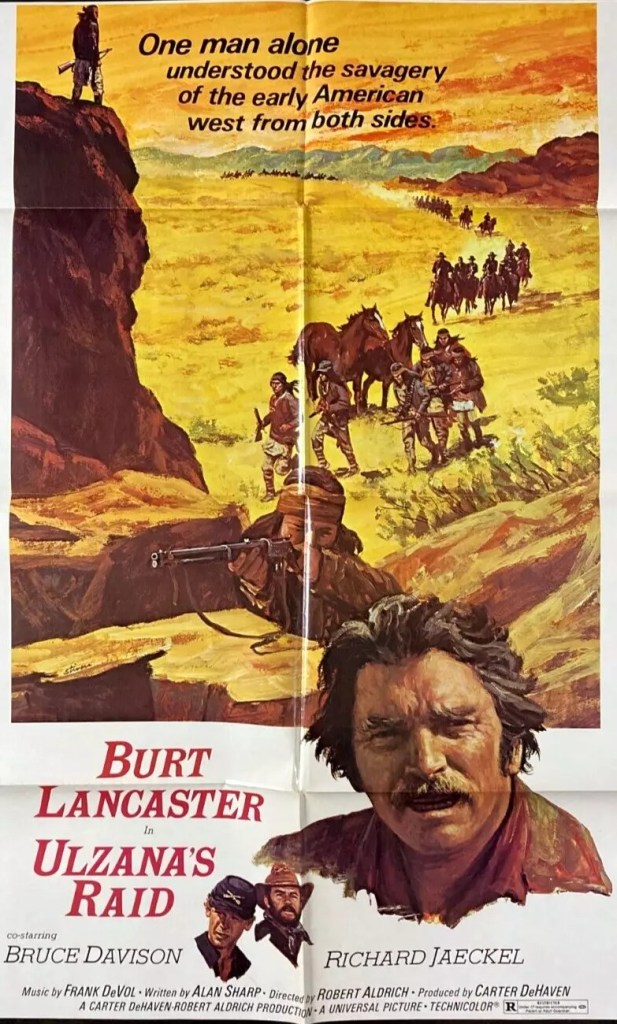
In any case, there’s a ways to go before that time comes since at Xmas the Quints reappear, beat Will up again and tie him up. You’d expect them to have their way with Catherine but there’s a twist in that Preacher has sized her up as a wife for one of her sons. While they are fighting over her, Will escapes.

Luckily, his old buddies come looking for him and he’s got a sack of sulphur (purpose never explained) so he smokes out the bad guys and they all get shot, leaving Will and Catherine with their heart-breaking moment.

As I said, two quite dfferent movies at odds with each other. Charlton Heston (Number One, 1969) is transformed. His trademark screen persona disappears under this quite different, diffident, awkward, character and there’s an argument to say this is his best-ever performance. The scenes where he tries to cover up his illiteracy, shies away from learning a Xmas tune, and explains his theories on the frequency of bathing are outstanding.

If you only know Joan Hackett from Support Your Local Sheriff (1969) you wouldn’t recognize her here, contained and watchful, rather than somewhat crazy in the James Garner picture.

While this pair gell, Donald Pleasance (Soldier Blue, 1970) et al stand out like a sore thumb as if they’ve decided to try and hijack the picture with some pointless over-acting. An excellent supporting cast includes Lee Majors (The Six Million Dollar Man) in his debut, Ben Johnson (The Undefeated, 1969), Slim Pickens (Rough Night in Jericho, 1967), Clifton James (Cool Hand Luke, 1967), Bruce Dern (They Shoot Horses, Don’t They, 1969) – in full chipmunk-teeth mode – and Anthony Zerbe (Cool Hand Luke).

Tom Gries (100 Rifles, 1969), as writer and director, makes an excellent impression.

The cowboy and homestead sections work incredibly well, what passes for action and plot drag it down. Still, on balance, well worth seeing.

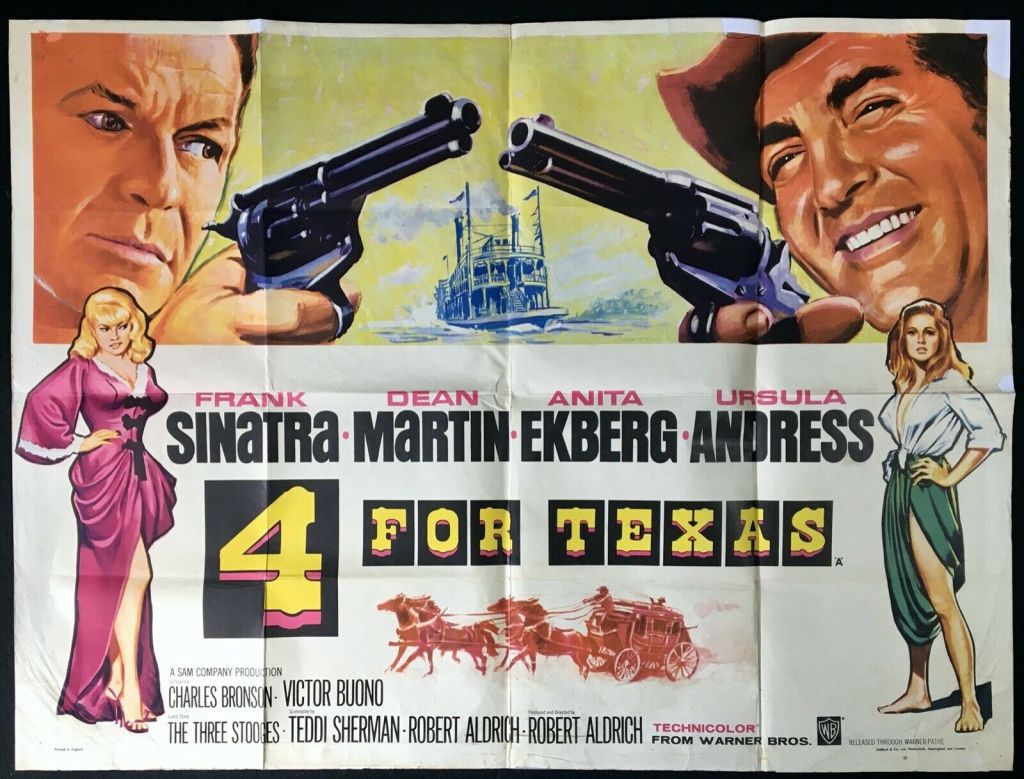
4 for Texas (1963) ****

To my mind the best of the Frank Sinatra-Dean Martin collaborations, outside of the more straightforwardly dramatic Some Came Running (1958), and for the simple reason that here the two stars are rivals rather than buddies. The banter of previous “Rat Pack” outings is given a harder edge and it is shorn of extraneous songs.

I came at this picture with some trepidation, since it did not receive kind reviews, “stinks to high heaven” being a sample. But I thought it worked tremendously well, the ongoing intrigue intercut with occasional outright dramatic moments and a few good laughs.

It’s unfair to term it a comedy western since for a contemporary audience that invariably means a spoof of some kind, rather than a movie that dips into a variety of genres. In some respects it defies pigeonholing. For example, it begins with a dramatic shoot-out, stagecoach passengers Zack Thomson (Frank Sinatra), a crack shot with a rifle, and pistolero Joe Jarrett (Dean Martin) out-shooting an outlaw gang headed by Matson (Charles Bronson). When director Robert Aldrich (Sodom and Gomorrah, 1962) has the cojones to kill off legendary villain Jack Elam in the opening section you know you are in for something different.

After out-foxing Matson, Jarrett attempts to steal the $100,000 the stagecoach has been carrying from its owner Thomas. Jarrett looks to be getting away with it until he realizes he is still in range of Thomas’s rifle. Then Thomas looks to have secured the money until Jarrett produces a pistol from his hat. And that sets the template for the movie, Thomas trying to outsmart Jarrett, the thief always one step ahead, and the pair of them locking horns with corrupt banker Harvey Burden (Victor Buono), in whose employ is Matson.

The movie is full of clever twists, cunning ruses, scams, double-crosses, reversals and sparkling dialog. Whenever Jarrett and Thomas are heading for a showdown, something or someone (such as Matson) gets in the way. While Thomas has the perfect domestic life, fawned over by buxom maids and girlfriend Elya (Anita Ekberg), Jarrett encounters much tougher widow Maxine (Ursula Andress) who greets his attempts to invest in her riverboat casino by shooting at him. 

Take away the comedic elements and you would have a plot worthy of Wall Street and ruthless financiers. The story is occasionally complicated without being complex and the characters, as illustrated by their devious intent, are all perfectly believable.

It’s a great mix of action and comedy – with some extra spice added by The Three Stooges in a laugh-out-loud sequence – and it’s a quintessential example of the Sinatra-Martin schtick, one of the great screen partnerships, illuminated by sharp exchanges neither lazily scripted nor delivered. Even the blatant sexism is played for laughs.

Sinatra and Martin, especially, are at the top of their game. Forget all you’ve read about Aldrich and Sinatra not getting on. Sinatra never got on with any director. But an actor and director not getting on does not spell a poor picture. Sinatra brings enough to the table to make it work, especially as he is playing against type, essentially a dodgy businessman who is taken to the cleaners by both Martin and Buono.

The only flaw is that Ursula Andress (Dr No, 1962) does not turn up sooner. She has a great role, mixing seductiveness and maternal instinct with a stiff shot of ruthlessness, not someone to be fooled with at all, qualities that would resonate more in the career-making She (1965).  Anita Ekberg (La Dolce Vita, 1960) on the other hand is all bosom and not much else. Charles Bronson (The Magnificent Seven, 1960) demonstrates a surprising grasp of the essentials of comedy for someone so often categorized as the tough guy’s tough guy.

The biggest bonus for the picture overall is the absence of the other clan members – Sammy Davis Jr, Peter Lawford and Joey Bishop – who appeared in previous Rat Pack endeavors Oceans 11 (1960) and Sergeants 3 (1963). Without having to laboriously fit all these other characters in, this film seems to fly along much better. As I mentioned, the fact that Sinatra and Martin play deadly enemies provides greater dramatic intensity.

Robert Aldrich was a versatile director, by this point having turned out westerns (Vera Cruz, 1954), thrillers (Kiss Me Deadly, 1955), war pictures (The Angry Hills, 1959), Biblical epic Sodom and Gomorrah (1962) and horror picture Whatever Happened to Baby Jane? (1962). But 4 for Texas called for even greater versatility, combining action with quickfire dialog, a bit of slapstick and romance and shepherding the whole thing with some visual flair.

If you are a fan of Oceans 11 and Sergeants 3 you will probably like this. If you are not, it’s worth giving this a go since it takes on such a different dynamic to those two pictures.

The Man Who Shot Liberty Valance (1962) *****

A mighty cast headed by John Wayne (True Grit, 1969), James Stewart (Shenandoah, 1965), Lee Marvin (The Dirty Dozen, 1967) and Vera Miles (Pyscho, 1960) with support from Edmond O’Brien (Seven Days in May, 1964) Woody Strode (The Professionals, 1966), Strother Martin (Cool Hand Luke, 1967) and Lee Van Cleef (The Good, the Bad and the Ugly, 1967) do justice to John Ford’s tightly-structured hymn to liberty and equality and reflection on the end of the Wild West. So tight is the picture that despite a love triangle there are no love scenes and no verbal protestations of love.

The thematic depth is astonishing: civilization’s erosion of lawlessness, big business vs. ordinary people and a democracy where “people are the boss.” Throw in a villain with a penchant for whipping and a lack of the standard brawls that often marred the director’s work and you have a western that snaps at the heels of Stagecoach (1939), Fort Apache (1948) and The Searchers (1956).

The story is told in flashback after Senator Ransom Stoddard (James Stewart) and wife Hallie (Vera Miles) turn up unexpectedly in the town of Shinbone for the funeral of a nobody, Tom Donovan (John Wayne), so poor the undertaker has filched his boots and gun belt to pay for  the barest of bare coffins. Intrigued by his arrival, newspapermen descend, and Stoddard explains why he has returned.

Now we are in flashback as, arriving on stagecoach, novice lawyer Ransom is attacked, beaten and whipped by outlaw Liberty Valance (Lee Marvin). He is found by horse-trader Donovan (John Wayne) and taken to a local boarding- house-cum-restaurant where Hallie (Vera Miles) tends his wounds. With a young man’s full quotient of principle, Stoddard is astonished to discover that local marshal Link Appleyard (Andy Devine) has ducked out of responsibility for apprehending Valance on the dubious grounds that it is outside his jurisdiction and that Valance has so mean a reputation he has the town scared witless. When Valance turns up, he humiliates Stoddard and only Donovan stands up to him, rescuing an ungrateful Ransom, who detests violence and any threat of it.

Stoddard soon turns principle into action, setting up his shingle in the local newspaper office run by Dutton Peabody (Edmond O’Brien) and on learning that Hallie is illiterate establishing a school for all ages. In the background is politics, but the push for statehood is inhibited by big ranchers who employ Valance to intimidate. Despite his aversion to violence and insistence that due legal process will eliminate the law of the gun, Stoddard practices shooting. When Donovan gives him a lesson and, to point out his unsuitability to confront such a mean character as Valance, covers him in paint, Stoddard floors him with a punch. 

That principle I mentioned has something in common with Rio Bravo (1959) – Howard Hawks’ riposte to High Noon (1952) – in that Stoddard, determined to fight his own battles, refuses to ask for help when targeted by Valance. The inevitable showdown is extraordinary, not least because it takes place at night and Ford, a la Rashomon (1951), tells it twice from different points of view.  

Precisely because it retains focus throughout with no extraneous scenes, as was occasionally John Ford’s wont, the direction is superb. As in The Searchers, to suggest emotional state-of-mind, the director uses imagery relating to doors. This time the humor is not so broad and limited primarily to one incident. Both main male characters suffer reversals, in the case of Stoddard it is physical but in the instance of Donovan it is emotional. Either way, action is character. In the romantic stakes, they are equals, dancing around their true feelings.

Upfront there is one storyline, the upholding of law and order whether against an individual such as Valance or against the attempts of big business to thwart democracy. But underneath is a subtly told romance. Donovan and Stoddard are allies but in terms of Hallie they are rivals. Neither has an ounce of sense when it comes to women. Neither actually protests their love for Hallie. Although Donovan brings her cactus roses and is, unknown to her, building an extension to his house to accommodate what he hopes is his future bride, his idea of romance is to mutter, in patronizing manner, the old saw of “you look pretty when you’re angry.”  He would have been wiser to have taken note of her spunk, because she can more than direct if need be.

Stoddard isn’t much better. Despite her growing feelings towards him being obvious to the audience, he assumes she prefers Donovan. Action drives the love element, the need to save or destroy.

All three principals are superb. This may seem like a typical Wayne performance, a dominant figure, comfortable with a gun and his abilities, but awkward in matters of the heart. But he shows as great depth as in The Searchers and the despair etched on his face at the possibility of losing Hallie eats into his soul. Stewart combines the man-of-the-people he essayed for Frank Capra with some of the toughness he showed in the Anthony Mann series of westerns. Vera Miles tempers genuine anger with tenderness and practicality. Unlike many Ford heroines she is not a trophy wife, but a worker, mostly seen running a kitchen. Lee Marvin cuts a sadistic figure, with an arrogance that sets him above the law, his tongue as sharp as his whip.

As well as Woody Strode, Strother Martin, Edmond O’Brien and Lee Van Cleef, you will spot various members of the John Ford stock company including Andy Devine (Two Rode Together, 1961) as the cowardly gluttonous marshal, John Carradine (Stagecoach), John Qualen (The Searchers) as the restaurant owner and Jeanette Nolan (Two Rode Together) as his wife.

Written by James Warner Bellah (X-15, 1961), Willis Goldbeck (Sergeant Rutledge, 1960) and Dorothy M. Johnson (A Man Called Horse, 1970).

SPOILER ALERT

Despite its five-star status, I am dubious about the famous “print the legend” conclusion and for two reasons. You could subtitle this picture The Good, the Bad and the Politician. In the first place, what Stoddart tells the newspapermen in the flashbacks is in fact a confession. He did not kill Liberty Valance. Donovan did. By this point in his life Stoddart has served two terms as a Senator, three terms as a governor and been the American Ambassador to Britain. And yet his career is based on bare-faced fraud. He took the glory for an action he did not commit. That is a huge scoop in anybody’s book. And I just can’t imagine a newspaperman turning a blind eye to it.

The second element is that Stoddart does not show the slightest sign of remorse. He built his entire career on this violent action, the antithesis of his supposed stance on the process of law.  He takes all the plaudits and fails to acknowledge Donovan, except when it’s too late, and Donovan has died a pauper, his rootless life perhaps engendered as a result of losing Hallie. Hallie’s character, too, is besmirched. She chose Stoddart precisely because he was a man of principle who risked his life to tackle – and kill – Donovan. Those two elements are indistinguishable. Had she known Stoddart had failed and was only saved by the action of Donovan it is questionable whether she would have chosen the lawyer.  

There are a couple of other quibbles, not so much about the picture itself, but about other quibblers, commonly known as critics.  Alfred Hitchcock famously came under fire for the use of back projection, not just in Marnie (1964) but other later films. That spotlight never appeared to be turned on the at-the-time more famous John Ford. The train sequence at the end of the film uses back projection and the ambush at the beginning is so obviously a set.

Don’t let these put you off, however, this is one very fine western indeed.

The Last Sunset (1961) ***

Too many hidden secrets turn this into a Peyton Place of a western. When the final unexpected zinger strikes home the movie has nowhere to go and undercuts the climax. Director Robert Aldrich also lets Kirk Duglas off the leash so there’s too much of him festering to put the outcome in any doubt. Strangling a vicious dog with your bare hands is usually a sign of heroism but here it just undermines Douglas’s character.   

Wanted murderer O’Malley (Kirk Douglas) has skipped to Mexico away from the long arm of the American law. Nonetheless, lawman Stribling (Rock Hudson) is in pursuit, presumably hoping to kidnap him and drag him back over the Rio Grande into U.S. jurisdiction. The story, in a major narrative flaw, finds another way to head O’Malley north.

Anyways, O’Malley is in Mexico not just to escape, but for a more sentimental reason, he wants to hook up again with first love Belle (Dorothy Malone). The fact that she’s married to limping ex-Confederate soldier Breckenridge (Joseph Cotten) appears to make no difference. And when O’Malley strikes up a deal to help Breckenridge drive his herd of cattle to Crazy Horse, a town over the Rio Grande, he tells the husband of his romantic intent.  

This would usually spell trouble except the narrative conveniently disposes of the husband. However, by this point the lawman has also thrown his hat into the romantic ring, having signed up to become trail boss. You can see the logic in Stribling’s decision. If O’Malley’s heading in the right direction then it makes it easier for Stribling to get him over the border.

What doesn’t make any real sense is Breckenridge’s hiring of O’Malley in the first place, or the deal the outlaw negotiates. O’Malley would go along in any case for a meal of beans a day just to keep track of Belle who’s the appointed cook for the ride. Instead, and with no cattle herding skills in evidence, he manages to get Breckenridge to agree to give him one-fifth of the herd as a bonus in addition to the normal pay of a dollar a day. Although the audience has already guessed O’Malley’s romantic purpose, he spells it out to the rancher, “I want your wife” the rider to the deal.

O’Malley takes little notice of Belle’s diffidence. The man who was once an enticing prospect to an inexperienced young girl is now presented in a different light. “You carry your own storm wherever you go,” she tells him. She no longer has a hankering to end up just “a survivor,” not convinced by his plan to settle down with the money from the sale of his share of the herd.

As usual, the trail ride has sufficient incident – lightning storm, stampede, a brush with Native Americans, saloon gunfight, a trio of no-goods hitching a ride, a sighting of St Elmo’s Fire and that old trope quicksand – to keep the story moving without the love triangle and what actually turns out to be a revenge tale.

The story takes some unexpected turns. Stribling is a pretty efficient cowboy, seeped in western lore, knows how to keep a herd in shape. He heads off a marauding tribe by trading some of the herd, in compensation for the innocent man O’Malley instinctively shot dead. Belle needs to kill a man to defend herself. And O’Malley, romantic ambitions thwarted by Stribling, starts wooing Belle’s daughter Missy (Carol Lynley) who, no surprises there, reminds him of Belle at a younger age.

As the secrets come spilling out, it becomes apparent that O’Malley has seduced Stribling’s sister whom the outlaw disses as an easy lay – “your sister was a free drink on the house” – and more importantly that his sister has hung herself after O’Malley killed her lover. Double revenge, I guess, to steal Belle and take O’Malley back to face justice.

You might have wondered how Belle ended up with Breckenridge in the first place and it’s not the soldier-wounded-in-battle routine. It’s because he made an honest woman out of her after – or maybe before – Missy was born out of wedlock. And when Belle sees how serious Missy is about O’Malley she reveals that he’s the father. Leaving O’Malley to do the right thing and not load his pistol when he heads for his shoot-out with Stribling once they have crossed the Rio Grande.

The ending smacks of star redemption. Kirk Douglas can play a mean guy better than most and he’s got no problem being tagged an outlaw but to lose a shoot-out would render him the loser whereas noble sacrifice turns him into some kind of winner. That notion doesn’t take into account that Stribling was guaranteed to win the shoot-out anyway since O’Malley’s weapon of choice is the Derringer, ideal for shooting someone standing right next to you, not a lot of good in a shoot-out where your opponent is twenty feet away.

The narrative twists and turns enough to keep you interested but with every secret revealed the flaws are only too apparent. Rock Hudson (Seconds, 1966) wins the duel of the big stars, a wider range of emotions on show but as tough as his rival and with western skills to boot. We’ve seen this brooding Kirk Douglas (The Arrangement, 1969) too many times before. Dorothy Malone (who had partnered Hudson in Douglas Sirk number The Tarnished Angels, 1957) is good as the woman who knows her own mind. Joseph Cotten (The Oscar, 1966) probably signed up not for the chance to show off his limp but for the scene in the saloon where his myth of Civil War heroism is cruelly exposed. Carol Lynley (Bunny Lake Is Missing, 1965) convincingly transforms from dutiful daughter with a Disney-esque affinity with animals to woman.

Robert Aldrich (The Flight of the Phoenix, 1965) looks hamstrung by the Dalton Trumbo (The Fixer, 1968) script based on the novel Sundown at Crazy Horse by Howard Rigsby.

Too convoluted to fly.

40 Guns to Apache Pass (1967) ***

Spent most of the time watching this wondering what depths Glenn Ford and Inger Stevens would find in this interesting script in which relationships come asunder through situation. Instead, we’ve got war hero turned movie actor – I hesitate to say star because his marquee was virtually always of the B-movie brigade – Audie Murphy (Bullet for a Badman, 1964) in his last starring role looking as wooden as ever and in a superbly-written conflicted role the equally ineffective Laraine Stephens (Hellfighters, 1968).  

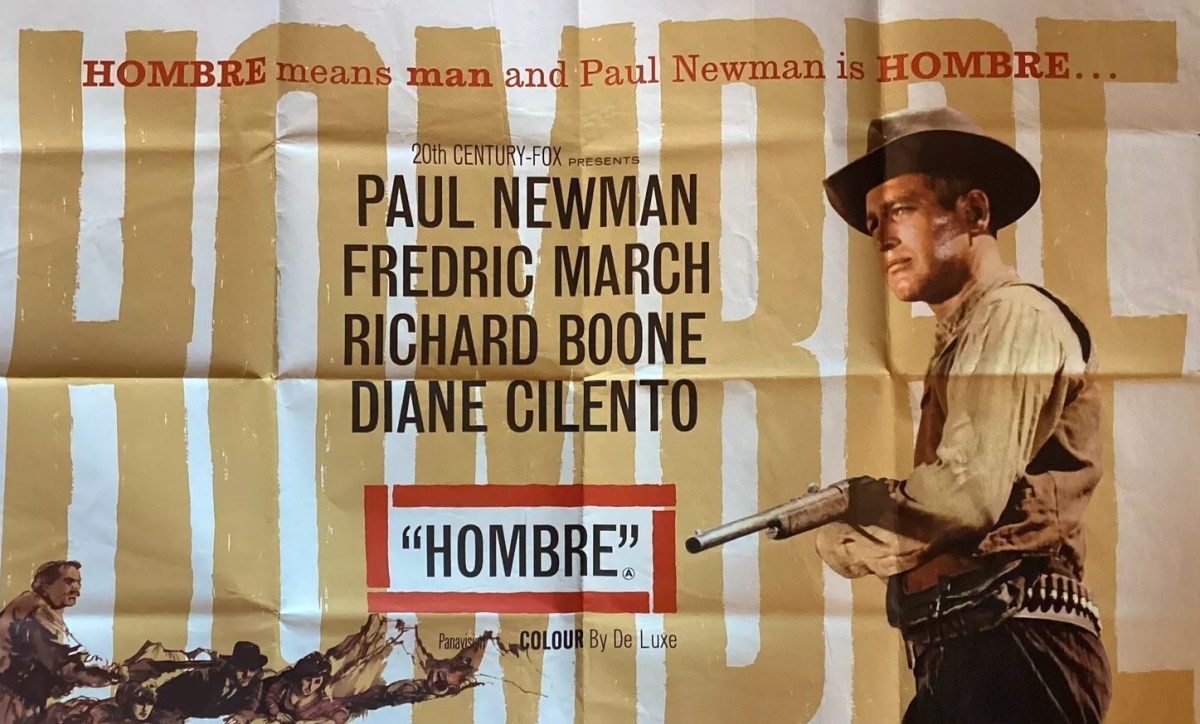
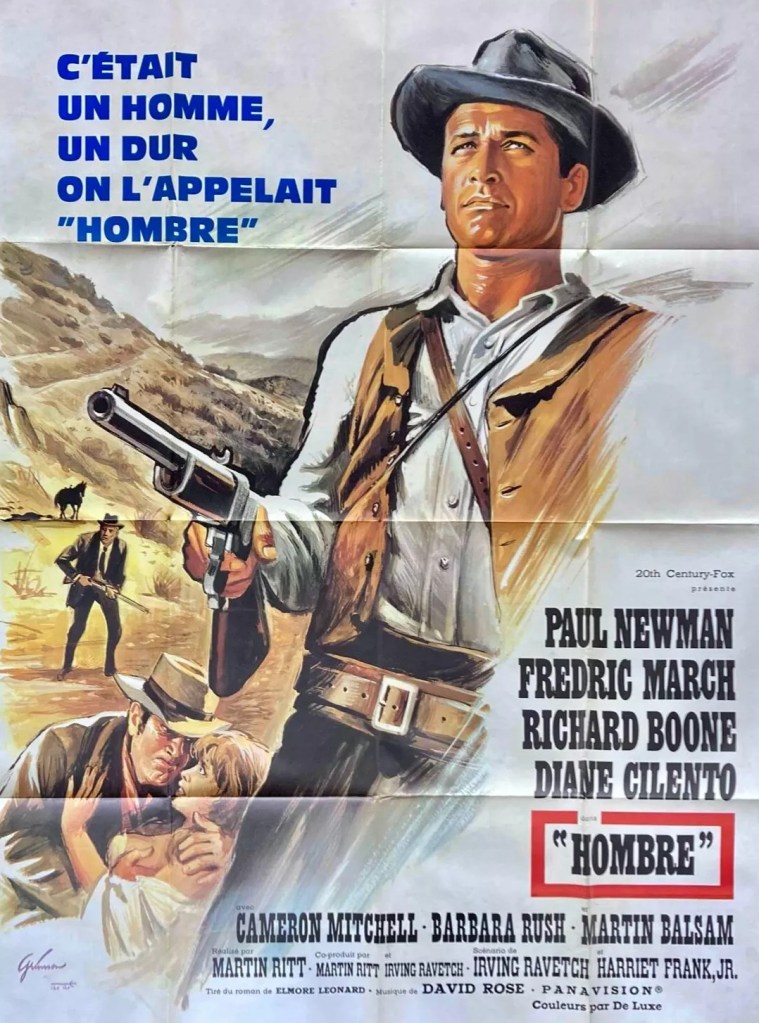
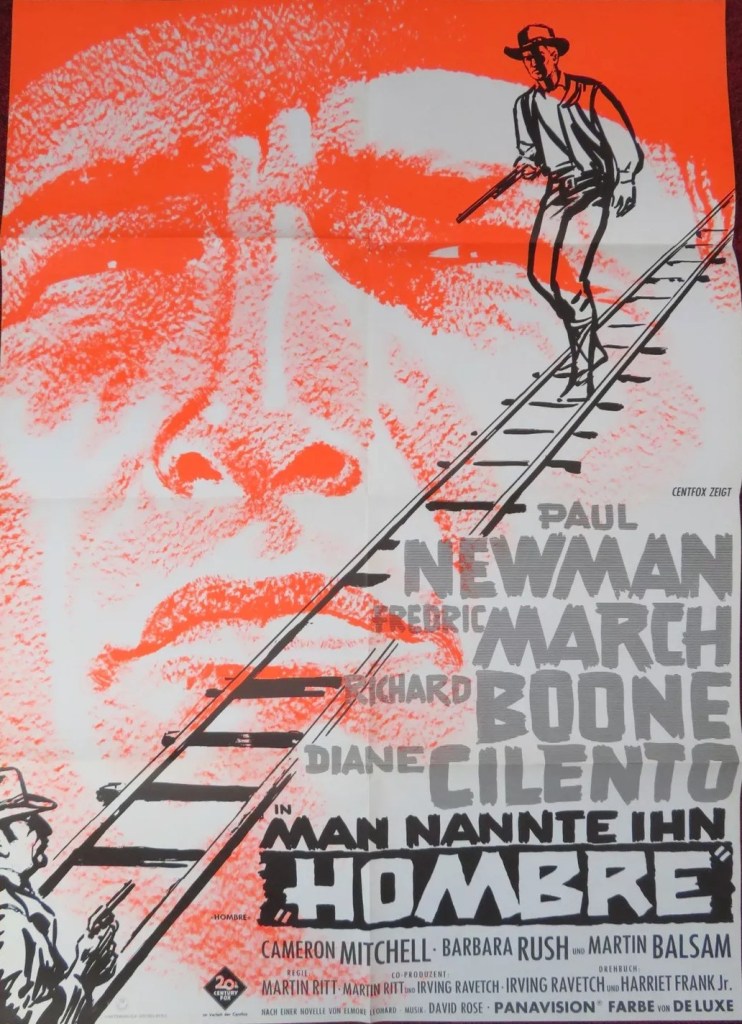
That there was still a market for the kind of western that refused to embrace the revisionism expressed by Cheyenne Autumn (1964) or Hombre (1967) was odd in itself. In fact, by this stage most of the best westerns steered cleared of the Native American issue,  preferring subjects like the Civil War (Shenandoah, 1965), errant gunslingers (Cat Ballou, 1965) or standard western tropes with standard villains (The Sons of Katie Elder, 1965, El Dorado, 1967, The War Wagon, 1967).

The title plays around with the more famous Battle of Apache Pass which took place in 1862, seven years before this movie was set. Despite the indifferent playing, the script by Willard W. Willingham and wife Mary (one of the exceptionally few female screenwriters plying their trade in Hollywood at the time) is lean and interesting. Apache chief Cochise is on the warpath and settlers have to abandon their homes and be brought to the safer environs of Apache Wells.

Ramrod stiff Captain Coburn (Audie Murphy) is in charge of the operation which includes bringing his romantic interest Ellen (Laraine Stephens) and her family to safety. There’s not much trouble doing that except rebellious Corporal Bodine (Kenneth Tobey), the kind of subordinate who’s always insubordinate, picks a fight with the officer. Against the ostensibly much tougher opponent, Coburn wins the tussle and beats the living hell out of his underling. But Ellen is of delicate stock and doesn’t take kindly to her potential husband’s violent streak.  

At the makeshift fort Col Reed (Byron Morrow) is driven to desperation by the lack of weaponry, awaiting a long-promised supply of the newest model of repeating rifles. The scouts delivering the titular 40 weapons refuse to risk taking the supply wagons so close to the Apaches so Coburn is designated to undertake the “mission” to secrue them, taking a team of ten men including two of Ellen’s brothers Doug (Michael Burns) and Mike (Michael Blodgett) and Bodine. Doug falters under fire and is responsible for his brother’s death.

Bodine steals the guns, planning to sell them for $1,000 each in Mexico, an enterprise that gains the support of the remaining troopers bar the captain and his sergeant. With a piece of exceptional cunning, Bodine plans for those two to be blown up in a manner that will look like they have sacrificed their lives rather than surrender the weapons. And it’s an equally clever trick indeed that allows Coburn to escape.

This section brings unexpected depth, character revelation the key. Bodine turns out to be a Johnny Reb, joining the Army, wearing the dettestable blue, as an alternative post-war to imprisonment. And he’s not going to ride over 1,000 miles to Mexico when he’s got potential purchasers, the Apaches, hardly any distance away at all. Cochise doesn’t take too kindly to a traitor, though he’s willing ostensibly to do business.

Coburn, it turns out, is anything but the ramrod straight officer he effects to be. He came up the hard way, mostly been a loser all his life, and knowing that he’s blown this chance for future promotion. Back at the fort, not only does he face court martial, but Ellen blames him for the loss of her brothers, one dead, the other heading towards summary execution should he be captured as a deserter.

So, naturally, the only way out of this pickle is for Coburn to steal a couple of horses and attempt to recover the weapons. He’s again got a clever plan, holding off the bad guys by placing a bunch of repeating rifles at crucial points in his retreat so he doesn’t need to stop and reload.

In better hands this would have been a cracker. The duty-bound Coburn undone by duty, Ellen undone by placing her trust in the wrong man, Bodine undone by thinking he could outwit the clever Cochise.

Director William Witney (Arizona Raiders, 1965) had over 100 directoial credits, virtually all low-budget movies or television series, so he knew how to get the job done. A better director would have better use of the situation, characters and physical setting – those enscarpments go to waste for sure.

Calling out as much for a Budd Boetticher as a Glenn Ford and Inger Stevens.  

The Adventures of Bullwhip Griffin (1967) ***

All studios believed in their brand name. That the sight of the  MGM lion or the Twentieth Century Fox searchlight or the Paramount mountain represented a quality mark that would buffer expectation and reassure an audience they were not going to be rooked. That might have been the case decades before when the Warner Brothers logo might mean gangster pictures or socially aware movies or MGM, with more stars than there are in heaven, pictures with top-notch talent, or Universal determined to scare the pants of you with its horror catalog.

But that was no longer the case, most studios so desperate for survival that they would fork out for whatever trend seemed most likely to make money and the industry lurched from western to musical to adventure and back again whenever a big hit appeared. The only studio which still retained genuine marquee appeal was Disney. As studios dipped into more unsavory fare, according to the older generation, and the prospects of sending your children to the movies without having to check out the picture in advance diminished, a Disney film was a guarantee of fret-free entertainment.

Throughout the decade adults as much as kids swarmed to the Disney repertoire. In 1961 the studio scored a box office triple whammy when The Absent-Minded Professor, The Parent Trap and Swiss Family Robinson took three of the top four slots in the annual box office race. In the following years Bon Voyage (1962), Moon Pilot (1962), Son of Flubber (1963), In Search of the Castaways (1963), The Sword in the Stone (1964), The Misadventures of Merlin Jones and especially Mary Poppins (1964) kept the studio buoyant, not to mention the string of pictures starring Hayley Mills and a stack of animated classics it could reissue at the drop of a hat.  

Disney ruled the lightweight world, its films often driven by a simple plot device. And as the rest of the industry coveted sex and violence, exhibitors relied on Disney to bring in the kids (and adults) during holiday periods. It would end the decade on a whopping high with The Love Bug (1969).    

Here, the ploy is as old as the hills, a fish out of water, in this case an English butler. Disney had rung the changes on that particular sub-genre through the governess in Mary Poppins, steadfastly ignoring a trend towards more sinister servants as demonstrated by The Servant (1963) and The Nanny (1965). But Disney did have the ability to hook name actors for its child-friendly movies, here Roddy McDowall (Lord Love a Duck, 1966), Oscar-winner Karl Malden (Nevada Smith, 1966) and Suzanne Pleshette (A Rage to Live, 1965).   

If you are expecting whiplashing escapades of the Indiana Jones variety, you will be in for a disappointment. Eric Griffin (Roddy McDowall) is the aforementioned butler escorting a child Jack (Bryan Russell) on a treasure hunt through the gold fever American West. When his charge runs away, Griffin finds the boy stowing away on a ship. The ever-genteel Griffin has skills that see him through any situation, working as cook on the ship, setting up his stall as barber on the mainland, and occastionally employing a devastating right hook to knock seven bells out of giant bully Mountain Ox (Mike Mazurki).

The plot, such as it is, revolves around recovering a treasure map stolen by swindler Judge Higgins (Karl Malden) and eventually when the movie needs some zap the feisty Arabella Flagg (Suzanne Pleshette), Griffin’s bankrupt employer who as it happens fancies the bulter, turns up.

There’s enough action to keep the picture on a steady keel, a storm at sea, a stagecoach hold-up, prizefight and a climactic town-wrecking fire. There are, perhaps surprisingly, a few choice lines.

But there’s a misinterpretation at the center of the movie so it’s as well its made with kids in mind. The fish-out-of-water notion would play better if historically movies fielded idiot butlers rather than ones who tended to take command when things get tough, though it’s unliklely kids would be aware of previous entries in the sub-genre. So, theoretically, it’s a surprise when Griffin outfights the lummox and outwits the swindler.

If the kid isn’t cute enough there are compensations elsewhere, a decent support in Harry Guardino (The Pigeon That Took Rome, 1962) and Hermione Baddeley (Harlow, 1965). Roddy McDowall at least is in a movie that suits his screen persona and deceptively languid acting style while Suzanne Pleshette takes a feminist slant to the Wild West. Whether British comedian Tony Hancock – he was sacked during filming – would have added much to the proceedings is open to debate.

It’s worth remembering that, outside of Hayley Mills offerings, Disney comedies of this period revolved around adults coping with bizarre situation. This doesn’t quite have the gimmicks that drove Son of Flubber, The Ugly Dachshund (1966, also headlining Pleshette) and Lt Robin Crusoe U.S.N. (1966).

Adequately directed by James Neilson (Dr Syn Alias the Scarecrow, 1963) from a screenplay by Lowell S. Hawley (Swiss Family Robinson) drawn from the novel The Great Horn Spoon! by Sid Fleischmann.

I remember seeing this as a kid and feeling pretty content coming out of the cinema, so since it did what it says on the tin, I’m loathe from an adult perspective to take it to pieces.

A movie that says – lighten up!

Horizon: An American Saga Chapter 1 (2024) **** – Seen at the Cinema

Unpacking Kevin Costner’s hefty portmanteau is a significant task since at times it veers into the unwieldy. But only once during the three-hour running time did I glance at my watch and that was over an hour in when I started to wonder when Costner in his capacity as star would appear. Anyone looking for anything heroic or iconic or in the vein of Dances with Wolves (1990) or even Wyatt Earp (1994) had better look elsewhere. This has more in common with the grimy westerns of the 1970s when heroes were hard to come by and the West was a cesspool of brutality. 

There’s a heck of an arthouse sensibility to this ensemble piece, characters and situations appear with little preamble and often little consequential explanation, and we switch geographically and psychologically at the drop of a hat. Theoretically, I should be waiting until Chapter 2 pops into view in a few weeks’ time before attempting summation because it’s clear that some sections are unresolved here, assuming the ending is more of a trailer for part two than a speeded-up finale.

At $100 million – and same again for Chapter 2 – this would have all the makings of an over-the-top vanity project, especially after Yellowstone was thrown out with the bathwater. In some senses it’s closer to a series of vignettes puncturing the myth of the West. The wagon train section, for example, focuses on an over-entitled English woman who breaks several golden rules and encounters a couple of peeping toms while the wagon master (Luke Wilson) finds out just how powerless he is in trying to enforce discipline.

Virtually all the women are schemers. Ellen (Jena Malone) attempts to murder her husband and flee with their child, takes up with another fella who’s trying to run some kind of gold strike scam but unfortunately runs into the sons of the man she tried to kill. Her child, meanwhile, is being cared for by sex worker Marigold (Abbey Lee) who gets her hooks into prospector Hayes (Costner) but only as long as she can dump him for another man and dump the child on another family. By comparison Frances (Sienna Miller) is saintly, having survived an Indian massacre, but she makes no bones about making a play for married cavalry lieutenant Trent (Sam Worthington).

And the older ones are just as savage. Mama Sykes sets her sons out for revenge and an elderly lady in the fort batters two soldiers for trying to steal a child-sized bed. The latter is another vignette, the old woman, mourning the loss of one child, being maneuvered by a clever sergeant (Michael Rooker) into semi-adopting another, and that lass, in the most touching (or sentimental if you like) vignette, sending soldiers into battle wearing flowers she has cut from a quilt.

There’s not much point being a child here if you can’t fire a weapon. Native American kids are only too ready to aim arrows at white men and one young massacre survivor buys a pair of Colts to effect his revenge.

The main thrust of the tale is the land rush of the 1860s, when settlers dashed from east to west in the hope of a better life and in the expectation that the Army would take care of any Native Americans who got in the way. Lt Trent does his best to dissuade settlers from picking land that’s too far away from a fort to defend. The Apache chief tries his best to dissuade his son Pionsenay (Owen Crow Shoe) from attacking the settlers, pointing out (somewhat improbably) that his tribe can find enough sustenance in the mountains.

From my own reading on the subject, namely The Earth Is Weeping by Peter Cozzens, this was true to life, the younger braves more likely to wage war, the older chiefs prescribing restraint and fearing consequence, and the rivalry between different tribes is cleverly dealt with, even though it’s hard to understand at the time the point of a lone Native American being hunted down and killed by a band of other Native Americans.

The titular “Horizon” is the name of a large swathe of land being sold back east to settlers as presumably a land of milk and honey, said settlers harnessing similar entrepreneurial spirit as the Pilgrims who crossed the Atlantic in search of same. Every now and then a character pops up to provided a potted history, Col Houghton (Danny Huston) one such, predicting the bloody end to the encroachment of land.

The biggest set piece is the massacre that interrupts another set piece, the kind beloved of John Ford and Michael Cimino, the local dance, that itself punctuated by other vignettes, the teenager too old to dance with his mother, another teenager playing with a loaded gun, until both teenagers are taught savage reality and this section ends with Frances hammering a shotgun through the earth to provide a source of air for her and her daughter trapped underground.

There’s a quirkiness here that would sit well with Robert Altman or the Coen Brothers or Yorgos Lanthimos. And the scene between Hayes and the younger Sykes gunslinger is pure Tarantino.

But there’s way too much hair. Authentic though it may be, the thickness of the beards makes  it virtually impossible at times to identify the actor underneath. But despite the running time it’s also been brutally edited, hard to work out how Hayes goes from being hunted by the Sykes Gang to working on the railroad.

So this is a warning as much as a straightforward review. Don’t go in expecting the usual. This isn’t an exploration of the West in the manner of How the West Was Won (1962) with big stars and a ton of set pieces and Cinerama to pump up the action and roadshow to make the whole enterprise seem somehow more worthy.

The women steal the acting honors, especially Sienna Miller (The Lost City of Z, 2016) and Jena Malone (The Neon Demon, 2016). Directed with some style by Costner from a screenplay by himself and Jon Baird in his debut.

Plenty to see here that’s worthy of praise if you set aside expectations.

A Big Hand for the Little Lady / Big Deal at Dodge City (1966) ****

An absolute delight. Thrilling too. Knocked sideways in the box office battle of the poker pictures by the purportedly classier The Cincinnati Kid (1965) with Steve McQueen in one of his most iconic roles facing off against Edward G. Robinson and underrated ever since. But this more than holds its own against the Norman Jewison number. In part because of terrific untypical performances from Once Upon a Time in the West alumni Henry Fonda and Jason Robards.

I get my daily movie fix late at night when the rest of the house is abed and disinclined to share my interest in old movies but when at a critical point my DVD gave out instead of, as would be more sensible, giving up and going to bed, I spent ten minutes frantically scouring YouTube for a copy, even glancing hopefully at one in a foreign language, and expended the same time again tearing apart my DVD collection, which at one point had been sensibly arranged alphabetically until too many additions made nonsense of that arrangement, until I found another copy. Finally, I settled down, even later at night, to watch an enthralling finale.

A more blatant example of artistic license you couldn’t find. The movie is set in Laredo, not Dodge.

Fielder Cook (Prudence and the Pill, 1968), with only a handful of movies to his name and generally considered no great shakes as a director, plays this hand brilliantly. It reeks of mystery, as a poker table should. We begin with an undertaker’s coach racing from town to town and  house to house collecting with urgency a disparate collection of people delivered to the backroom of a hotel in Laredo, Texas, where, nonetheless, the townspeople are excited beyond belief. It’s the long-awaited poker game between the five richest men in the territory.

As he stuffs more cash in the safe and pulls out bigger and bigger batches of poker chips, the hotel owner (James Berwick) is constantly badgered by his exuberant customers as to who is winning. He remains mute on that score until Doc Scully (Burgess Meredith), heading out to deliver a baby and a foal, asks the same question. Such is the medic’s local standing, the owner gives a reply. This means something to the onlookers but not to us because we have very little concept of the players.

And that remains largely the case beyond some good-humored and occasionally tense banter when we learn that Drummond (Jason Robards) abandoned his daughter’s wedding to get here and that lawyer Habershaw did likewise in court leaving his client to defend himself. And the game itself is boisterous, devoid of the cathedral-like atmosphere of The Cincinnati Kid.

But when a relatively impoverished newcomer Meredith (Henry Fonda) enters the fray the situation turns ugly as he is besieged by insult and verbal abuse as his paltry stake gets smaller and smaller. When he takes his last $3,000 – the whole sum intended to provide a new future for his wife and son on a farm near San Antonio (“San Antone” he quickly learns is the correct pronunciation) – he discovers that he is undone as his fellow gamblers raise the bidding beyond his amount.

At which point he collapses, potential heart attack. Doc Scully hauls him off on a makeshift stretcher. The money will be defaulted unless upstanding wife Mary (Joanne Woodward) of the anti-gambling fraternity can be called upon to play out his hand in a game of which she is completely ignorant and, more to the point, raise the cash to be allowed to continue.

The players sneer at what she has to offer. The richest men in the territory have no need, even at a cut-price offer, of a gold watch and a new team of horses and wagon. For a moment you think Mary, seeing her family fortunes going downriver, is going to offer herself as collateral, but instead, she decides to try and get a loan, based on the hand she holds, from the bank. You might as well try to get blood out of a stone from bank owner Ballinger (Paul Ford). Maybe she has something worth more to him as collateral than watch and wagon.

I won’t spoil it for you by revealing the ending but it’s well worth the wait and the mystery.

I was knocked out by Henry Fonda’s acting. Usually, he is gritty, upstanding, sometimes the last man standing, and his smile is often more of a grimace. Here, he is nervous, jumpy, anxious, and desperate, the reformed gambler unable to resist temptation, persuading himself that this one last game would be worth all the broken promises given his wife. His smile is so ingratiating you wouldn’t want anything to do with it. As regards the temptation facing addicts it’s on a par with the heroin victim of The Man with the Golden Arm (1955) and the alcoholics of Days of Wine and Roses (1962).

With him removed from the equation, the acting lot falls to Joanne Woodward (A Fine Madness, 1966). She’s the prim opposite and doesn’t overplay her hand, restraining as best possible her confusion and fear. And this is a very fine turn from Jason Robards, most commonly accused of over-acting or under-acting, and here he gets the balance just right, volubility matched by arrogance, and a determination not just to win but to demolish an opponent.

A raw truth is expored here. Winners don’t just like winning – the medal, the lap of honor, the pile of cash, all that jazz – but they enjoy more seeing the defeat of their opponent, savoring that disgrace. This ain’t the kind of game that ends in a handshake or embraces sportsmanship. This is real in a way that The Cincinnati Kid is not.

There are a couple of familiar faces, John Qualen (The Sons of Katie Elder, 1965), and Charles Bickford (Days of Wine and Roses) in his final movie. The rest of the cast is largely anonymous, there to add febrile excitement, with hollering and racing around, desperate to keep up with the action.

Screenwriter Sidney Carroll had been here before, the big stakes, no-hoper taking on the world in The Hustler (1961) but he and Cook had managed a small-screen rehearsal of this picture a few years before on U.S. television in the DuPont Show of the Week series.

Every now and then, as I’ve maybe mentioned before, one of the joys of this little odyssey into the world of the 1960s movie is that you come across a little gem.

This one sparkles.

Discover WordPress

A daily selection of the best content published on WordPress, collected for you by humans who love to read.

The Atavist Magazine

by Brian Hannan

WordPress.com News

The latest news on WordPress.com and the WordPress community.