The Extraordinary Seaman (1969) **

It wouldn’t be the first time that a director, disgruntled by his fee or some snit with the producer, was wrong in his summation. But John Frankenheimer’s pronouncement that it was “an absolute disaster from beginning to end” is only slightly off the mark. It only really comes apart mid-section when you discover what makes the British Lt. Commander Finchhaven (David Niven) anything out of the ordinary.

Up till then it resembles a decent enough riff on The African Queen (1951), the bearded Finchhaven perennially drunk though not wild-eyed and disorderly like Humphrey Bogart, and take your pick from Lt Krim (Alan Alda) or Jennifer (Faye Dunaway) as the character trying to keep him on the straight and narrow. Instead of being sharp-tongued, Jennifer is a sharp-shooter.

And if anyone’s in the habit of communing with God, it appears to be the British captain. And it’s a bit more upscale, Finchhaven in charge of a ship – the oddly named HMS Curmudgeon, which should give you a hint all is not fine and dandy –  rather than a small steamboat.

But he’s stranded on a Philippine island towards the end of World War Two when rescued by four U.S. Marines who themselves have been uncommonly detached from their vessel during a lifeboat exercise in the fog.

But there is more than enough talent assembled to keep any seagoing yarn shipshape. You wouldn’t discount an immediate return to form, despite flopping with The Fixer (1969), by director John Frankenheimer, a huge name after The Manchurian Candidate (1962), Seven Days in May (1964) and Grand Prix (1966) though you might have worried a tad since comedy did not appear to be his forte.

David Niven, whose war movie credentials were still held in high regard after The Guns of Navarone (1961), had resurrected a fading career with unexpected hits The Impossible Years (1968) and Prudence and the Pill (1968) while Faye Dunaway was riding extremely high in Hollywood following the double whammy of Bonnie and Clyde (19670 and The Thomas Crown Affair (1968) and a pre-Mash Alan Alda was a rising star.  

Cut off from contact with either British or American forces, and unaware of Hiroshima turning the tide in the Far East, Finchaven and Co (Krim has three buddies) set off in pursuit of the enemy. If anybody is the odd one out at this point in proceedings, you would put your money on Krim who is liable to fall overboard with every turn of the wheel.

But before they get anywhere near the kind of action that typified The African Queen or the later The Sea Wolves (1980 – also starring Niven), there’s the big reveal. Krim is puzzled that the captain never seems to eat and continues to drink constantly despite no sign of any obvious supplies, doesn;t require sleep or to launder his uniform. Krim would never get his detective’s badge, his suspicions are only really raised when he discovers an old photograph of the captain, dated 1914, and when Finchhaven’s empty whisky bottle miraculously refills.

Finchhaven is a ghost. Yep. Have you ever? Nope. The dumbest notion ever to set sail or be funded by a major studio. His back story is worth the price of admission alone if you have your heart set on the so-bad-it’s-good fraternity. He died, wait for it, at the start of World War One, when he fell overboard drunk on this very ship and is condemned, so it would appear, to a hellish life of captaining the ship.

Well, after that, you just couldn’t care less.

You might have already begun to get itchy feet by the constant barrage of newsreel or stock footage interjections, presumably offered as social and/or comic commentary, or perhaps to augment the length which stands at a very neat 80 minutes, somewhat short of the standard feature. Or the fact that after demonstrating her shooting skills, Dunaway gets nothing more to do.

On the plus side, which is still stretching it a bit, David Niven makes a believable ghost, not existing in an imaginary world of his own making, behaving in every way as a normal ship’s master. And Alan Alda gives glimpses of his somewhat unique screen persona. This might have worked on paper – the source is a novel by Phillip Rock – but Frankenheimer makes a pig’s ear of translating it to the screen.

I’m still toying with giving this a one-star review.

The High Bright Sun / Maguire, Go Home (1964) ****

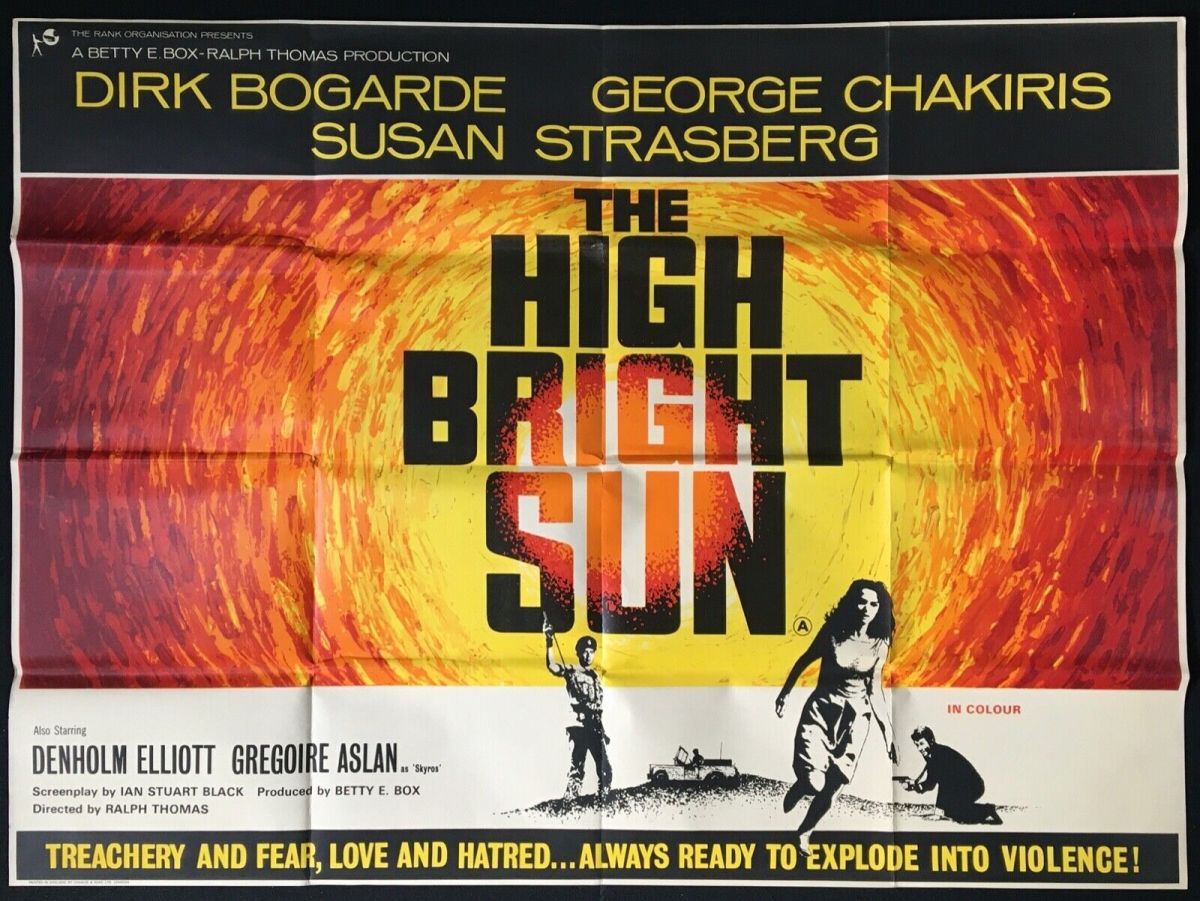
Surprisingly good thriller about loyalties in war time. Elevated above the norm by a series of stunning scenes often turning on the psychological. And taking a helluva bold risk as far as the billing is concerned. In dramatic and structural terms top-billed British star Dirk Bogarde (Justine, 1969) and rising American star George Chakiris (Diamond Head, 1962) take second place to the third-billed Susan Strasberg (The Sisters, 1969), although Bogarde’s stiff upper lip is tested in just about the most despicable fashion.

Also derives an interesting agency from differing audience perspectives. The British audience will view Major Maguire (Dirk Bogarde) as a hero trying to keep the peace in terrorist-racked Mediterranean island Cyprus. But virtually everyone else will side with Haghios (George Chakiris) and his bunch of freedom fighters in what was effectively a war of independence. Stuck in the middle, and expecting to be given a free pass, is Juno (Susan Strasberg), a young geologist staying with family friends named Andros but who, as an American, would be viewed as a neutral.

However, she has witnessed the arrival at the Andros home of terrorists, not just Haghios but General Skyros (Gregoire Aslan), leader of the Resistance. Not wanting to get her friends in trouble, and assuming they are not involved in terrorism, she resists the attempts of Maguire to get her to name names. But it’s only the cooler head of the general and the youngest member of the Andros clan, son Emile (Colin Campbell), that prevents her being shot dead on the spot.

Bluff and double bluff are the order of the day. She’s a prisoner – and a shocked one at that having witnessed British soldiers murdered by terrorists – but if she is seen to be prevented from leaving the house it will give the game away. So Maguire comes up with an acceptable ploy to get her out so that, in a calmer situation, he can gently interrogate her.

Unfortunately taking her out to dinner backfires, as they are spotted by Haghios who, assuming they are romantically involved, realises she can’t be trusted and signs her death warrant.

But she’s far from the plucky female and no good at playing the game of being hunted. In a brilliant sequence she takes all the wrong actions and it’s only happenstance and sacrifice that prevent her capture. And this is followed by an even edgier scene when she hitches a ride late at night with a lascivious local. But that’s nothing to her treatment by Maguire who, furious at her refusal to talk, parades her in the streets “like a sitting duck.”

There’s a whole strata of soldiers in open rebellion of a different kind. Maguire mocks his commanding officer, the inept Col Park (Nigel Stock), and he in turn is mocked by his junior, Lt Baker (Denholm Elliott) who taunts him about the affair he had with Maguire’s wife. And there are any number of stings in the tail. Believing she has finally escaped, Juno is confronted by Haghios and no Maguire in sight to come to her aid.

But the central tale is given over to Juno, the innocent caught up in bloody warfare, forced to witness barbarity at first hand, and unless she hankers after personal sacrifice inevitably  induced to take sides.

Susan Strasberg is simply superb. At no time is she the feminine hero springing into reluctant action in some espionage or wartime drama. Instead, she is the innocent bystander who at any moment will turn into collateral damage. And she’s too confused even to summon up outrage at betrayal by both sides.

Dirk Bogarde looks as if he is playing your standard British officer of high breeding who can trade barbs and bullets with the enemy but mostly tries to extract information by gentler means. But he turns out to be just as savage in his ideals as the opposition. And his armour is pierced not only by having an adulterous wife but having to take abuse from her lover.

It was a typical Hollywood ploy to stick an innocent American in a war zone in order to expose a situation or attract audience sympathy either for the underdog or the oppressors – think Jack Lemmon in Chile in Missing (1982) or Sally Field in Iran in Not Without My Daughter (1991) – but I doubt if director Ralph Thomas was as naïve or politically-inclined to attempt that here and instead he treads a finer line of personal decision as he would later do in The High Commissioner/Nobody Runs Forever (1968).  Sticking to the storyline and relying on actors who never resort to emotional extremes pretty much does the trick.

George Chakiris is wasted and I can only assume this was a sign of his career going downhill.

Not just far better than I expected, but bordering on the excellent.

Operation Crossbow (1965) ****

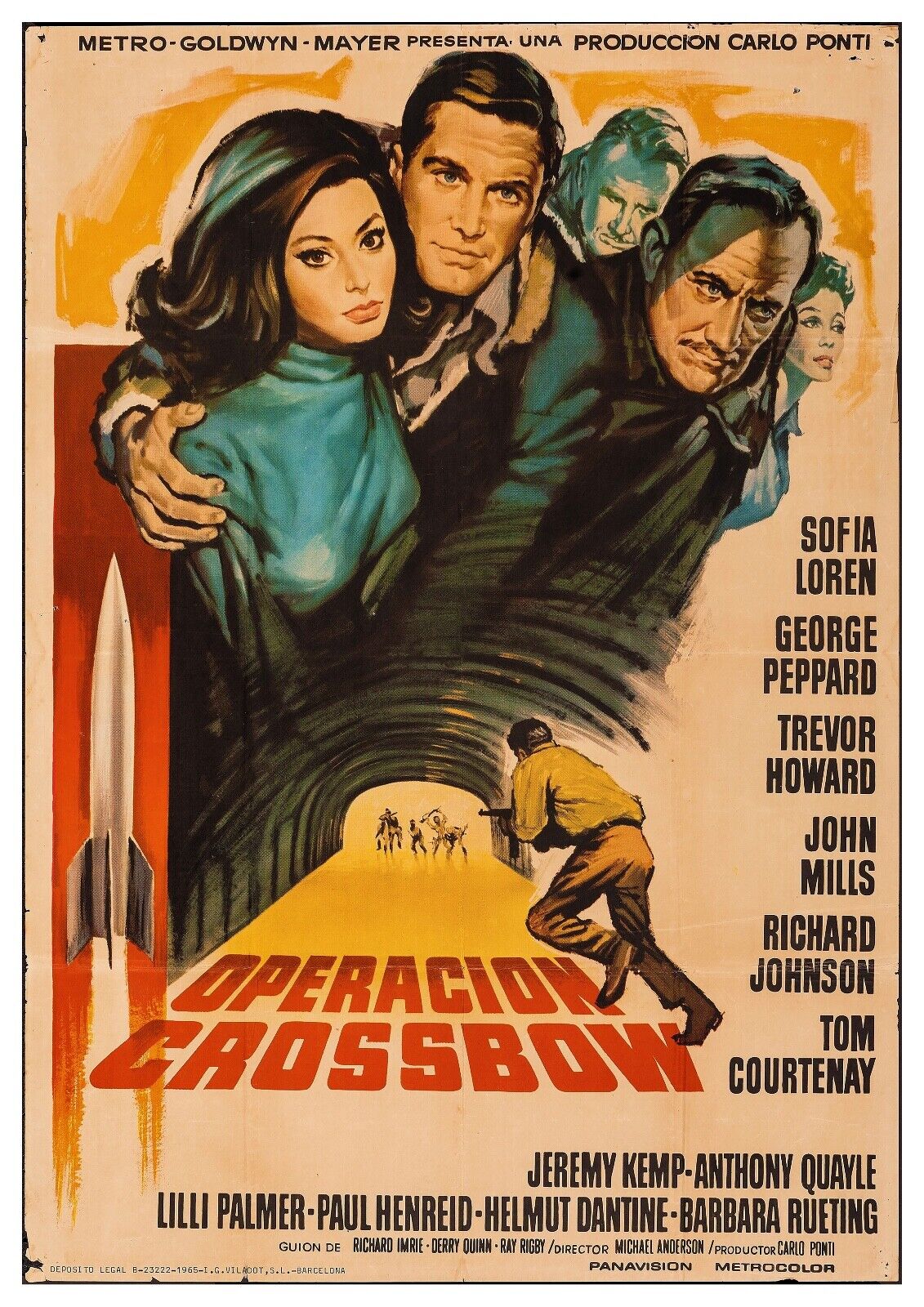
A clever mixture of detail and derring-do, World War Two picture Operation Crossbow (1965) – based on the true story of Allied infiltration of a German rocket factory – was a surprising hit at the British box office. The picture took a risk in keeping star George Peppard hidden from view for the first 28 minutes (top-billed Sophia Loren took nearly another 20 minutes to show up). Prior to their appearances the opening sequences were loaded up with a roll-call of British stars familiar with the genre in the vein of John Mills (Ice Cold in Alex, 1958), Trevor Howard (Cockleshell Heroes, 1955) and Richard Todd (The Dam Busters, 1955). Anthony Quayle, who puts in a later appearance, was also a war movie veteran after turns in Battle of the River Plate (1956), Ice Cold in Alex and The Guns of Navarone (1961).

Most war films relating to destroying a vital enemy base involved bombing  (The Dam Busters633 Squadron, 1964), sinking (Sink the Bismarck!, 1962) or blowing things up  (The Guns of Navarone, 1961). Operation Crossbow falls into the last-named category. The story breaks down into four sections: the discovery towards the end of the war by the British that the Germans are forging ahead with building V1 and V2 rockets; the recruitment and training of spies to parachute into Occupied France; a tense sequence abroad where complications arise; and, finally, attempts to obliterate the rocket plant.  

Director Michael Anderson (The Dam Busters) switches through the genres from docu-drama to spy film to action adventure, further authenticity added by bold use (for a mainstream picture) of subtitles, all characters speaking in their native tongues. Various real-life characters are portrayed, among them photo reconnaissance expert Constance Babington Smith (Sylvia Sims), German aviatrix Hannah Reitsch (Barbara Rutting) and Duncan Sandys (Richard Johnson) who was on the British War Cabinet Committee.

Trevor Howard, at his irascible best, is the scientist pouring scorn on the idea of rockets – until they start raining down on London. Volunteers – Peppard, Tom Courtenay (Billy Liar, 1963) and Jeremy Kemp (who appeared with Peppard the same year in The Blue Max) – trained to spike the new weapon are recruited primarily on their language skills. Character is sketchy, Peppard designated a womaniser because he arrives in a taxi with two women.

But the operation has been assembled in such haste that not enough attention has been paid to the identities assumed by the agents. Courtenay’s character turns out to be wanted for murder. Peppard is accosted by his character’s divorced wife (Loren). So the mission faces immediate exposure. Although Loren’s role in terms of screen time amounts to little more than a cameo, she delivers a powerful emotional performance to a picture that could as easily have got by on tension alone. The harsh realities of war are shown in abundance. Twists come thick and fast in the second half, not least that Peppard’s face has become known, before the movie reaches a thrilling denouement.

Fail-Safe (1964) *****

Given unexpected heft by current concerns over AI. Human error, it appears, is more simple to correct than computer malfunction. Once a course of action commences, machines have no way of checking it. And paranoia is the first casualty of truth. Bear in mind this was shockingly contemporary at the time it was made, the world in constant fear of nuclear war, the Cold War, that seemingly endless stalemate doing little to pacify terror.

Those whose job it ease the best outcome in the event of nuclear war were always inclined to rationalize staggering death tolls. So we begin with a late night discussion in which political analyst Dr Groeteschele (Walter Matthau) makes the argument that in the event of war, the country with the fewest casualties is the winner and in a nod to the ironic suggests the most likely survivors would be the worst type of convict, imprisoned underground, and office workers protected from the blast by being surrounded by filing cabinets crammed full of paper.

Just before the real drama begins there’s a neat scene where a women, turned on by a powerful man, makes a move on the doctor only to be slapped into place, sternly told by the prim analyst that he’s not of “her kind.” That’s not the only human element in the tale. the highest levels of secrecy may force top-level Army and Government executives to sacrifice families.

For no accountable reason, jets with nuclear warheads shift into an attacking position on the Russian border, the target if not stopped Moscow. The planes are unstoppable once they commence attack, unable to turn away from a strict sequence of pre-determined action. Not even the personal intervention by the President (Henry Fonda) of the United States can affect the outcome, the pilots already trained to ignore such an action on the grounds that the  enemy could be imitating the President’s voice.

When the planes fail to turn back, the only option is for the Americans to blow their own planes out of the sky, an action that appears not just inconceivable to the Army personnel but treasonable. High-rankings officers ruthless trained for battle and to observe the protocol of obeying orders find this unconscionable.

Three dramas take place at once. On the ground the Army chiefs try to explore every option to avoid the unthinkable while battling with their own consciences at what appears to be the only way out. The President on the hotline to the Russian premier has to circumvent natural suspicion that this is a cunning ploy by the Yanks and then come to some agreement with the Russians on the assumption that Moscow may yet come under attack. We, the audience, are playing out the third element in our minds, a series of terrifying what if scenarios with indescribable consequence.

I’m not going to reveal the shock ending because it came as a hell of a shock to me, given I’d not seen the picture in decades.

It’s brilliantly-made with almost futuristic sets and noir lighting and the President effectively physically imprisoned, and not just by his conscience, stuck in a featureless cell presumably in the pits of the White House arguing the toss with the Russian chief, his only companion the translator (Larry Hagman) whose face seems to get greyer and greyer as he transmits worse and worse news.

Dr Groeteschele makes matters worse, at least to a pacifist left-wing viewer (though an opposite view would be taken by the hawks), by urging the President to take advantage of computer error and “first strike” and blow Russia to pieces, assuming that indulging in the attack option will result in fewer casualties in America, and thus, following his earlier projections, not just win the war but rid the word of the fear of nuclear war.

While the style is documentary, it’s a riveting watch. The tension is unbearable. Some like Col Cascio (Fritz Weaver) succumb to the pressure while the commanding General Black (Dan O’Herlihy) retains a stolid soldierly presence.  

Sidney Lumet (The Pawnbroker, 1964) doesn’t put a foot wrong. Taking the line – rather than in The Bedford Incident (1965) of the wrong man with his finger on the button – of the right man trying to make the best of a botched job, he delivers a just superb picture. Walter Bernstein (The Magnificent Seven, 1960) does a terrific job in delivering a taut screenplay from a more meandering novel by Eugene Burdick and Harvey Wheeler.        

There probably couldn’t be a more prescient movie for today.

Night of the Generals (1967) ****

Impressive vastly underrated whodunit that breaks all the rules. Take the length for a start – just stopping short of two-and-a-half hours. The investigation covers multiple time periods – 1942, 1944 and 1965. The killer outwits the detective. Most important of all, the murder is clearly a MacGuffin to examine politics among the German officer class.

A Polish woman who turns out to be a German agent is viciously stabbed to death in Warsaw in 1942 during a period of staunch resistance by the inhabitants. General Tanz (Peter O’Toole), sent in to quell a potential uprising, is one of three generals on the suspect list compiled by Major Grau (Omar Sharif), the others being the alcoholic General Khalenberge (Donald Pleasance) and the philandering General von Seidlitz-Gabler (Charles Gray).

But Grau is no ordinary detective or, put another way, this not an ordinary investigation.

Grau lacks any of the powers we associate with an investigator. Yes, we expect obstruction, perhaps collusion, as the murderer tries to avoid detection. But Grau might well have been a sergeant for the disdainful treatment and lack of cooperation he receives. And there’s a fair chance he’s going to be shot at as he prowls the streets, and resistance fighters in tenement exchange fire with the invaders. None of the generals can account for their whereabouts on the night in question.

While Tanz is benign to children, ordering a hungry bunch fed from his own supplies, he is ruthless with adults, willing to employ flamethrowers (Phase Two of his plan) to drive snipers out of buildings and if that fails move onto Phase Three which simply uses tanks to obliterate everything. Like some knight of old, Tanz stands upright in his jeep directing operations in full view of the enemy, almost taunting them to kill him.

The most powerful image in the film – the one used in the posters – has Tanz standing (on the right of the screen) upright in his jeep with the world on fire behind him. What’s edited out of the poster is that Grau occupies the left side of the screen, standing like a servant awaiting his master’s orders.

That Grau makes no progress at all is down to the power of his superiors. Since he commits the cardinal sin of getting in the way, he is just shuttled out of Warsaw, promoted to Colonel and given other duties in Paris. So the scene shifts to the Parisian capital in 1944 after D-Day. The same three generals are on duty in the French capital, not supervising, as you might expect, the defence of the city against the encroaching Allies, but planning an attempt on the Fuhrer’s life (Operation Valkyrie). This time it’s Tanz, returning from the Russian front where his regiment has been decimated, who is shuttled to one side, ordered to take two days leave so he doesn’t get in the way of the saboteurs.

At this point, the movie boldly switches perspective, in part to encompass the assassination subplot, in part to focus more closely on Army politics, in part to follow Tanz, not just an alcoholic but a poster boy for OCD, as he tries to enjoy some downtime. He is accompanied on his tourist trip through the city and jaunts to visit museums by his chauffer/butler Corporal Hartmann (Tom Courtenay) whose other duties include spying on the general on behalf of the plotters. Grau, meanwhile, recruits French Inspector Morand (Phillippe Noiret) to assist in his investigation, which is otherwise being obstructed on all sides.

I won’t reveal the shocking ending which shows just how clever the murderer is because that’s not actually the ending and the story shifts to 1965 when the generals have been rehabilitated after the war, the case still open because a third woman has been killed in the same fashion.

I may have seen this back in the day and certainly remember it vaguely from a pan-and-scan version edited for television, but I had generally avoided it because of the poor reviews. I wonder how many critics just found it in poor taste, to be spending big Hollywood bucks on a story that treated German generals as pretty well ordinary human beings, the war itself so much in the background you would think it non-existent. Plenty critics sniped at the performance of the principles, perhaps because Peter O’Toole (Becket, 1964) and Omar Sharif (Genghis Khan, 1965) played so much against type. The image I mentioned of O’Toole with the world ablaze is an ironic one, not charged with the glory of David Lean’s vision of the actor in Lawrence of Arabia (1962). Similarly, not once does director Anatole Litvak (Five Miles to Midnight, 1962) rely on Omar Sharif’s soulful brown eyes the way Lean did in Doctor Zhivago (1965), in fact there is no such shot here at all. Sharif looks weary and jaded, kept going in the face of obstruction by his own convictions about justice. O’Toole is so wound up he likes like he’s about to explode and at times certainly teeters off-balance.

Critics seemed so intent on dishing out barbs that they missed two excellent performances, Sharif , in particular, unable to call on his romantic side, delivering very fine work. Donald Pleasance (Soldier Blue, 1970), devoid of his usual physical tics, is also memorable. And there is so much to enjoy from the direction. Litvak, in particular, makes superb use of the tracking shot. Often a scene begins with a close-up, tracks back to reveals others, allows them to deliver their lines, then tracks back into the original character, usually the one with most to lose at this moment. He allows time to develop the other characters. Without ever appearing drunk in the way of Tanz, Khalenberg is always pouring or drinking a shot of alcohol. Seidlitz-Graber is inhibited by family politics as his wife (Coral Browne) attempts to ease their daughter Ulrike (Joanna Pettet) into high society.  

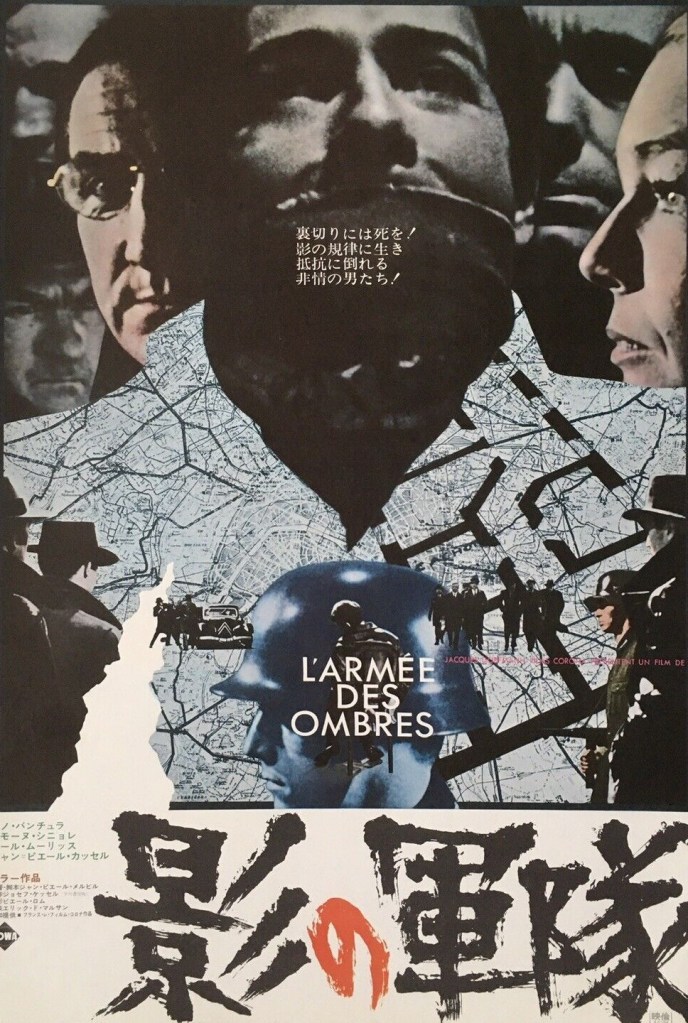
I must also mention the brilliant score and the pithy lines that shoot out from cynical mouths. “Making up one’s mind is one thing,” observes Seidlitz-Graber acidly, “speaking it is another.” On hearing of the assassination plot, Grau points out, “when things were going well, the generals enjoyed the war as much as Hitler.” Music came courtesy of Maurice Jarre (Doctor Zhivago) and the screenplay was a joint effort between Joseph Kessel (Army of Shadows, 1969) and Paul Dehn (The Spy Who Came in from the Cold, 1965) who hacked away at the H.H. Kirst novel, retaining only the opening.

Well worth watching.

The Secret of Santa Vittoria (1969) ***

Sounds like a treasure hunt picture, contemporary buccaneers or thieves in search of missing gold. But there’s nothing in the way of maps waiting to be discovered, no clues, no character unhinged by its pursuit. In fact, the valuable commodity here is wine, over a million bottles of it. Everyone in the hilltop town of Santa Vittoria is in on the secret. Because they hid it from prying Germans who have taken over the place after the death of Italian dictator Mussolini. And that element of the story, once we finally embark on it, doesn’t begin until halfway through.

Meanwhile, we are treated to the browbeaten drunk Bombolini (Anthony Quinn), too dumb to realize that being elected mayor – the previous incumbent kicked out for being a Fascist – is a poisoned chalice. However, taking a few tips from Machiavelli he works out that his survival depends on bringing together a council of more sensible heads. His new position cuts no ice with disgruntled wife Rosa (Anna Magnani) whose weapons of choice, vicious tongue apart, include copper pans and an elongated rolling pin.

But if you were desperate to know how to bury treasure, here’s your chance. A good quarter of an hour is spent on that element. I’m not entirely sure what fascinated director Stanley Kramer (Guess Who’s Coming to Dinner, 1967) about this. Because, clever though the scheme is of vanishing into thin air more than a million bottles, it takes little more than lining up the populace in rows close enough together so they can pass a bottle onto their neighbor, until the total amount – minus 300,000 bottles left behind to fool the Germans – is hidden in tunnels in the caves below the village.

Assuming of course the Germans fail to prod the stones concealing the tunnels and discover the cement is too fresh to be ancient. But Bombolini is in luck because German leader Captain von Prum is a “good German,” inclined to take things easy, coming down hard of any of his soldiers who pester female villagers, allowing the mayor to negotiate to retain some of the supply being handed over to the invaders, half his mind on the local Countess Caterina (Virna Lisi) with whom he fancies his chances, but in gentlemanly fashion of course, aiming to seduce her over dinner rather than resorting to force.

That matter is complicates because the widowed countess already has a lover, a wounded soldier Tufa (Sergio Franchi) whom she nursed. It’s only when the captain realizes that he has been duped by the apparent buffoon of a mayor and by the countess that things start ugly and soon you can hear cries of the torture echoing out over the piazza.

The odd mixture of comedy and reality fails to gel. Anna Magnani (The Fugitive Kind, 1960) doesn’t look as if she’s acting in showing her distaste of Anthony Quinn (Lost Command, 1966) possibly because he is over-acting, cowing and whimpering and using his hands to express every single word he speaks. But it looks authentic enough. Either Kramer has rounded up every aged extra left over from Once Upon a Time in the West (1969) or he has recruited scores of ordinary peasants to play the villagers.

Kramer’s usual earnestness has disappeared, and although his first movie was a comedy, and Guess Who’s Coming to Dinner, his previous picture, played on the comedic elements of the situation, his feeling for comedy is rusty at best, non-existent at worst. It’s hard to feel any particular sympathy, as would be the point, in the villagers outwitting the Germans and in the fact that they have changed from ostensible World War Two conquerors to the conquered once their erstwhile allies turned on them.  

You might consider this a feminist twist on The Taming of the Shrew, Rosa not only being a shrew who would never be tamed, not even by Germans, but actually the family breadwinner. While, until his election, her husband is a nonentity. And it might be viewed as a choice role for Anthony Quinn, a dramatic shift away from the heroic roles with which he was more often associated. Anna Magnani mostly looks as if wondering why she agreed to participate.

The best acting comes from Virna Lisi (How to Murder Your Wife, 1965), a widow realistic about the lack of true love in what sounds like an arranged marriage, and faced with having to keep the amorous captain sweet, and possibly doing whatever that takes in order to protect the townspeople. Hardy Kruger (The Red Tent, 1969) has also abandoned his normal arrogance, is uncomfortable with being a despot, wanting to maintain friendly relations with the villagers, and seeking solace in gentlemanly fashion from the countess. He has the best scenes, the look of superiority as he outwits, he thinks, Bombolini, and the look on horror on his face as he discovers the countess’s lover.

Based on the bestseller by Robert Crichton with a screenplay by William Rose (Guess Who’s Coming to Dinner) and Ben Maddow (The Way West, 1967)  it’s the kind of movie that raises a lot of questions without bothering to answer any of them.  

Tora! Tora! Tora! (1970) *****

Thankfully devoid of the empty triumphalism that marred In Harm’s Way (1965) and Pearl Harbor (2001) and the gritty backs against the wall heroism and snatching some kind of victory from the jaws of defeat of The Alamo (1960) and Zulu (1964), and with a documentary-style approach much more acceptable these days than then, there is an immense amount to appreciate and absorb in this last-gasp 70mm roadshow from a financially flailing Twentieth Century Fox.

Shorn, too, of the traditional all-star cast bar Jason Robards (Hour of the Gun, 1967) – who might not count – nor the regiment of rising talent stuffed into such epics in the hope one might catch the eye and float to the top. And there’s no room to ram in a distracting romance such as in the previous and future films focusing on the military disaster. Instead, stuffed with dependable supporting players like Martin Balsam (Harlow, 1965), E.G. Marshall (The Chase, 1966) and James Whitmore (The Split, 1968) stops audience rubber-necking in its tracks, unlike producer Darryl F. Zanuck’s previous The Longest Day (1962), in favor of forensic analysis of what went wrong in the defence and what went so brilliant right in the attack.

Like most of the best war epics – The Longest Day, Battle of the Bulge (1965), taking an even-handed approach in presenting both sides of the battle, except here you could argue considerably more time is spent with the Japanese, beginning with the opening credits where the camera floats in and around a giant battleship.  Despite the sudden attack which went against all the traditions of war – a timing error apparently – the Japanese are presented as honorable and even arguing against going to war as well as worrying about the consequences of poking the tiger.

And there is none of the endless owing and scraping and not attempting to rise above your station in the traditional Western-view of the Japanese. Here, from the outset, superior officers are questioned possibly in manner that would be permitted among the opposing forces.

The first half is given up to the superb organisation of the attack, including the bold use of using aerial torpedoes – proven to work by the British in an earlier assault on a harbor without the apparent depth of water required – and contrasting it with the general U.S. ineptness, bureaucracy, interdepartmental battles and overall lack of preparation even though several personnel believed an attack imminent. The Yanks had even broken the Japanese codes so could easily have taken heed of obvious omens, had working radar on site though its employment was handicapped by being limited to three hours a day and initially lacking a means of communicating findings. Someone had even worked out that the Japanese would need six aircraft carriers to mount an attack and that the ideal time would be early morning on a weekend, someone even predicting an attack down to the exact time except a week out.

Of course, the U.S. at this point was not at war and so could be excused switching off in the evening or being uncontactable in the morning because they were still out carousing from the night before or sedately riding a horse. While there is a growing sense of alarm, the chain of command is woefully stretched often in the wrong direction and at one point stops before it reaches the President.

Fearful of sabotage, the Americans shift planes away from the perimeter of airfields smack bang into the runway where they can be more easily destroyed. Perhaps the greatest irony is that in shifting the U.S. fleet from its home base in San Diego, the Americans made such an attack possible.

When it gets under way, the battle scenes are superb, especially given none of the CGI Pearl Harbor could call upon, and yet with the U.S. aircraft carriers by luck still at sea failed to deliver a killer blow for the Japanese.

It’s handled superbly by director Richard Fleischer (The Boston Strangler, 1968), Kinju Fukasaku (Battle Royale, 2000) and Toshio Masuda (The Zero Fighter, 1962).  The American flaws are dramatized rather than being dealt with by info-dump. Larry Forester (Fathom, 1967) and long-time Akira Kurosawa confederates Hideo Oguni (Ikiru, 1952) and Ryuzo Kikushima (Yojimbo, 1961) fashioned a sharp screenplay from mountains of material.

Long rumored to be a box office flop it turned out to have made a decent profit, albeit not in the U.S.

The documentary approach adds immensely to the movie and it remains one of the all-time greats precisely because of the lack of artificial drama.

The Battle of Britain (1969) *****

Fabulous aerial sequences countered by grim reality. Like The Longest Day (1962) and Battle of the Bulge (1965) even-handedly doesn’t treat the Germans as the evil enemy, but unlike those films victory is somewhat obscure, no rattling of spears as in Zulu (1964) to announce opposition departure, just clear skies indicating an absence of foe. Anyone going into this – persuaded by Dunkirk (2017) that this retreat was a triumph – and with little knowledge that after Hitler had overrun Europe invasion was imminent might be surprised to discover that this was a campaign lasting over three months rather than one conclusive battle.

That’s to the benefit of the movie, allowing it space to breathe, for characters to develop, rather than everything crammed in pell-mell. Given the situation changed from day-to-day, the one constant, which we’re scarcely allowed to forget, is that the British are heavily outnumbered in the sky. It’s a war of attrition. The Germans can lose hundreds of planes, the British nary a one.

But it’s far from gung-ho, the British coming in for criticism for their unpreparedness, surprised when the Germans bomb airfields, even more astonished when the opponent starts dropping bombs on London. Perhaps, given the relatively short running time for an epic – 46 minutes shorter than The Longest Day, 35 minutes down on Battle of the Bulge – it might have been better to avoid slipping in a section on the impact of the Blitz on Londoners, though that is counteracted by panic in Berlin when that city is also bombed.

But, by and large, it’s an engrossing tale. And bold, too, in the version I saw no subtitles for German dialog, leaving audience reliant on facial and body expressions. To slow down the action, I guess, and add some class, several scenes involve people walking down long corridors.

All the salient points are covered, pilots thrown into battle with barely a few hours experience of flying a Spitfire, the lack of pilots, in-fighting at the top, checkers moved across the board at mission control indicating German aerial advance, the inability of getting aircraft up quick enough or repaired quick enough. Above all, the reality of death is shown in astonishing detail; once the pilot was shot or the airplane destabilized, there was almost no escape, fire enveloped anyone inside, hatches failed to open, planes burst into flame or crashed into the sea. And it was the same death, regardless of nationality. And there were no scenes of  callous Germans shooting down a British pilot parachuting to safety.

The aerial sequences are quite astonishing. I’ve seen this on big screen and small, but even on a small screen, the camerawork is quite extraordinary, even getting this number of workable planes in the air must have been some feat, then flying in formation and peeling off in attack. It is kind of hard from time to time to work out who is shooting at who since the planes are all the same grey color and only distinguished when the camera is close enough to identify  them by RAF roundel or Nazi swastika. But the overall effect is a sense of sorrow rather than triumphalism, young lives of any nationality brought to a brutal close. There is no scene, as in Battle of the Bulge, of the over-zealous Nazi, the singing that made them appear such an implacable foe. Here, there’s no need to play up implacable. Unless they abandon the fight, the Germans, courtesy of superior numbers, will inevitably win. All the British can do is stave off defeat for as long as possible.

The all-star cast is only an all-star cast if you’re British. Without a Hollywood star in the vein of John Wayne, Robert Mitchum and Henry Fonda, and in the absence of British superstars like Sean Connery and Peter O’Toole, it’s an all-star cast by default. The biggest name, Michael Caine (Deadfall, 1968), has one of the smallest parts. But the equality of the cast works in its favor, there’s none of the rubbernecking that got in the way of The Longest Day.

Christopher Plummer (The High Commissioner/Nobody Runs Forever, 1968) has the biggest role as a squadron leader determined to force his wife out of the front line working on the airfields and into a safer position. But the best acting comes from Laurence Olivier as the dry Air Chief Marshal Sir Hugh Dowding who has no truck with interfering politicians. Accused of inflating figures of German casualties he replies that if he is wrong the Germans will be in London in a week.

But it’s a close-run thing between him and Susannah York (They Shoot Horses, Don’t They, 1969) as the aforesaid wife with a growing streak of independence and Ian McShane (The Pleasure Girls, 1965) as a lowly pilot called upon to express grief more than most. There’s certainly a sense of solidarity among the cast, no show-boating from the usual scene-stealing culprits like Trevor Howard (Von Ryan’s Express, 1965) and Robert Shaw (Battle of the Bulge) whose normal determination to bristle at the slightest opportunity is dropped for the good of the cause.

The great and the good appeared to be happy with the slightest role just to take part. The roll-call includes Ralph Richardson (Khartoum, 1966), Michael Redgrave (The Hill, 1965), Kenneth More (Dark of the Sun/The Mercenaries, 1968) and a hatful more.

Guy Hamilton (Goldfinger, 1964) directs with some distinction, his biggest achievement to concentrate on fact rather than flag-waving, no better demonstrated than by my realization that the stirring theme tune that I remembered so well by Ron Goodwin (Where Eagles Dare, 1968) does not make an appearance until the very end. The screenplay by James Kennaway (Tunes of Glory, 1960), Wilfred Greatorex (The High Commissioner) and, in his only movie work,  Derek Dempster, displays more finesse than you might expect.

Almost documentary in tone, a classic.

Hannibal Brooks (1969) ***

Gruff British star Oliver Reed shows his tender side in this entertaining offbeat POW escape picture. With local German men called up for war, Berlin Zoo relies on local prisoners-of-war to help look after the animals. Stephen Brooks (Oliver Reed) is detailed to look after an elephant (considerably more discreet in his toilette than those employed on Babylon). When Berlin is bombed, Brooks takes the elephant to Innsbruck in Austria.

His nickname is a bit of a misnomer. You would think he was going to emulate his famous predecessor and take the elephant over the Alps and into Italy, which would be possibly a safe destination because at this stage of the war the Americans have invaded and are marching north. But, instead, sadly, he only plans to make it as far as neutral Switzerland, where he would be equally safe.

Naturally he is pursued – and captured, and pursued and captured. But there always seems to be a convenient pile of logs that, a la Swiss Family Robinson, can be weaponised. And should you need any obstacle pulled down, well, an elephant comes in pretty handy on that score too.

Ineffectual American escapee Packy (Michael J. Pollard) turns up from time to time, usually in some piece of action that goes wrong, once to interrupt a romantic dalliance with Brooks’ occasional companion Anna (Maria Brockefhoff). And this being the Tyrol, it seems a shame not to halt proceedings every once in a while to take in a marching band or a traditional wedding or fair and for every damsel to have her cleavage on display.

Heading up the pursuit is Colonel von Haller (Wolfgang Preiss) although you might imagine he had more important things on his mind at this stage of the war than chase an elephant. Various troopers are so easily duped by Brooks they might have gone under the collective expression of “dolts.”

Where the elephant has to take the long way – he could as easily have been called “Slowly” – the Germans can travel by road, rail and cable car. It’s pretty episodic stuff, enlivened here and there by explosions and gunfights and the like and the question of whose side Anna is really on.

In some respects it’s a buddy picture. When the buddy is the elephant it works pretty well. Brooks is surprisingly tender and caring. But when Packy enters the equation and it’s the old question of three into two won’t go it becomes a bit lopsided. You get the impression it’s one of these picture that, to accommodate the budget, required an American star and Michael J. Pollard, with his already-established schtick, was nearest to hand.

It’s just as well Reed has toned down his scene-stealing growls and sideways glances because nobody can steal a scene like Pollard. If the elephant was ever in the slightest genuine danger, then you might have had a better picture, but nobody in those days was going to slaughter such a magnificent beast just to give a movie a harder edge.

Elephant is surplus to requirements in this action-based poster.

So the harder edge never comes, and it skips along uneasily between gentle comedy and action, with a potential screen partnership of unlikely personalities never quite gelling. If director Michael Winner had stuck with Reed and the elephant it would probably have worked much better. Or if the escapees had to blow up some vital factory or carry out another mission deep inside enemy territory it might have carried more narrative thrust.

It’s like two separate pictures, Reed and the elephant and Pollard and his bunch of generally hapless escapees. Harmless enough stuff and interesting mostly for seeing Oliver Reed upending his usual screen persona.

At this point in his career, Michael Winner (You Must Be Joking, 1965) was better known for comedy so perhaps this was his passport to suggesting to Hollywood he could handle action. Certainly, it suggested he could merit a bigger budget, for his next movie was The Games (1970) before stepping into the more comfortable territory of Lawman (1971).

I’d suggest this was equally a stepping stone for Reed (The Assassination Bureau, 1969). This film is largely ignored in assessments of the changes to his acting style that he made to accommodate the critically-acclaimed Women in Love (1969). And you can certainly draw a development line between the Michael J. Pollard of Bonnie and Clyde (1967) and his character in Little Fauss and Big Halsy (1970) where he successfully buddied up with Robert Redford. Dick Clement (The Jokers, 1967) devised the screenplay from a story by the director and Tom Wright, on whose own story of being a POW zookeeper this is based.

Most movies perceived as stepping stones are made of stronger material, and although this is more lightweight, it’s entertaining enough and certainly helped director and both stars switch career tracks.

Sgt Ryker (1968) ***

Universal pulled a fast one with this tidy courtroom drama. The studio resurrected a two-part television piece originally made as the The Case Against Paul Ryker five years before under the Kraft Suspense Theatre brand to capitalize on the unexpected box office success of Lee Marvin, the decade’s most unlikely new star after a straight run of hits from the Oscar-winning Cat Ballou (1965) through western The Professionals (1966) to The Dirty Dozen (1967).

Re-titled and hoping audiences would not notice the sleight of hand, this was thrown out into first run. By normal standards it would be deemed a flop for a star of Marvin’s newfound magnitude but the $1 million notched up in rentals Stateside and more overseas prove a handy cache of found money for the studio. Audiences might have smelled a rat when the star’s name came at the bottom of the opening credits with an “And” billing, which generally denoted guest – rather than main – star.

Still, despite being promoted as an actioner, posters show Ryker with machine gun in hand in the midst of a battle scene – there is such a scene but Marvin plays no part in it – it’s actually a decent drama, especially given the unusual background. Set in 1951 during the Korean War there’s nothing gung-ho about it. The Americans are retreating, evacuating Seoul, when army attorney Capt Young (Bradford Dillman) feels Ryker was short-changed during a trial that condemned him to death as a traitor.

Young and Ryker’s estranged wife Ann (Vera Miles) embark on a deadline-dogged mission – he’s due to be hanged in a couple of days’ time – to clear his name. Strafed by enemy planes during a trip from Tokyo to Seoul, there’s a hint of nascent romance. And when they are later caught together in a clinch, this adds to the murky atmosphere, Young facing court martial accused of the deadly sin of having an affair with a colleague’s wife and deemed a pariah by colleagues. He has another strike against his name – he dug up a grave.

The situation is exacerbated by high command caught between troops needing the morale-booster of seeing a traitor hanged and fearing scandal if they are found after the event to have sent an innocent man to the gallows. And there is the irony that Young, in his capacity as prosecutor, was the man who found Ryker guilty in the first place. He only ends up on the opposite side as punishment for exposing technical irregularities in the defence’s handling of the case.

Ryker doesn’t help himself by initially proving to be an unreliable witness, remembering in erroneous detail minor matters but not the one thing that could clear his name, whether his commanding officer, now deceased, had left a note clearing Ryker. The sergeant, caught behind enemy lines, had claimed he was acting under orders during a counter-intelligence mission.

So the odds are heavily stacked against Ryker, at the re-trial the sheer malevolence of his boss Major Whittaker (Peter Graves), and sex-obsessed pal Capt Appleton (Murray Hamilton) and what seems like ranks of generals barely concealed. The investigation focuses on finding missing items – watch, pen, notebook – of the dead officer, none of which it transpires helps the case.

The courtroom has plenty of the usual twists including a surprise witness proving Ryker fraternised before the war with a Korean general. So, with army politics and a downbeat take on war thrown into the mix it’s a generally absorbing drama.

Bradford Dillman (A Rage to Live, 1965), usually relegated to leading man or supporting star in the credits, one or two places below the star in the billing, gets the chance to shine, essaying both a man standing up for his principles against heavy opposition and a lover guilty of attempting to steal another man’s wife. Appearing in virtually every scene, he gives a better account of his acting skills than in most of his movies, far more than the often one-note performances to which he was consigned. One-time Hitchcock protegee Vera Miles (Hellfighters, 1968) doesn’t bring quite enough of the internal conflict to her role but she’s a reasonable sidekick.

Had any big studio been paying attention, Lee Marvin gave pretty good notice of his potential for star status especially the menace he could impart with just a glance rather than the showy over-acting to which he was inclined in previous villainous outings such as The Man Who Shot Liberty Valance (1962). He’s careful to allow the shiftier and gloomier elements of his character to come into play rather than playing the role as heroic innocent. There’s good back-up from Peter Graves and allowed, a little leeway from their normal movie personas, Murray Hamilton md Norman Fell (both from The Graduate, 1967).

Buzz Kulik (Villa Rides, 1968) directed from a screenplay by Seeleg Lester (Change of Mind, 1969) and William D. Gordon (Cotter, 1973).

At a crisp 85 minutes it doesn’t outstay its welcome as long as you’re not taken in by the still-misleading poster. A good example of the species with excellent performances.

Plus, you can catch if for free on YouTube.

Discover WordPress

A daily selection of the best content published on WordPress, collected for you by humans who love to read.

The Atavist Magazine

by Brian Hannan

WordPress.com Blog

News, Tips & Website Tutorials