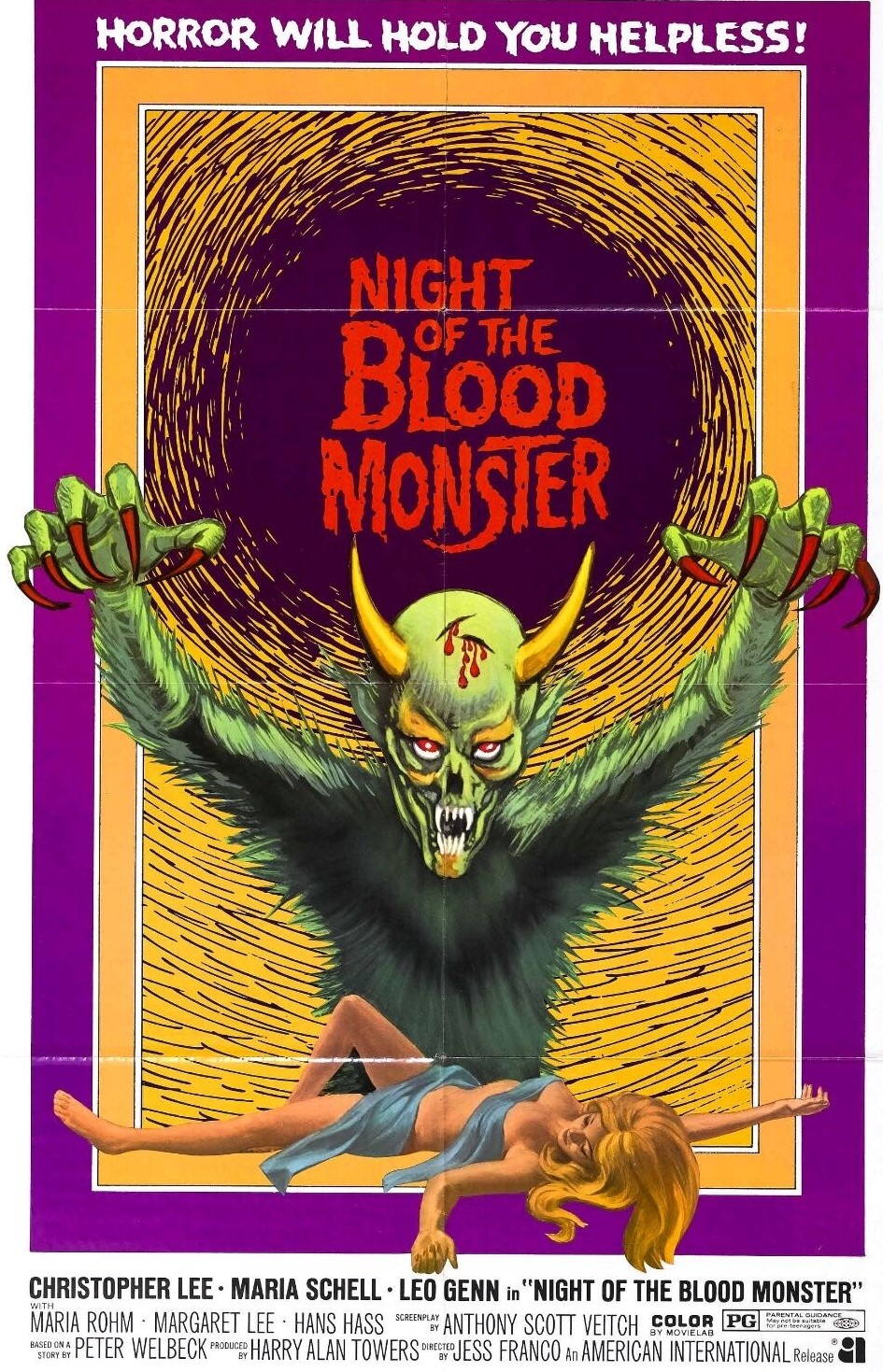
Handsomely mounted historical drama set in 17th century England on the brink of revolution meets Son of Witchfinder General. An uprising headed by the Duke of Monmouth in the south-west threatens to overthrow King James II. Involved in the plot are Harry Selton (Hans Hass), son of suspected agitator Lord Wessex (Leo Genn), whose beloved Mary Gray (Maria Rohm) is in the sights of Judge Jeffreys (Christopher Lee) after he has condemned her sister Alicia (Margaret Lee) to be burned as a witch.
The minute witchcraft enters the equation the narrative thrust is constantly interrupted by scenes of nudity, blood and torture, mostly involving women, but actually the film does attempt to cover the rebellion and its notorious aftermath when hundreds of rebels were executed, the “Bloody Assizes” with “Bloody Judge” Jeffreys to the fore. Conflating witchcraft with a genuine historical episode does not work very well and unlike Witchfinder General (1968), the murder of innocent women is more of a sideshow, despite the brutality involved, and you get the impression the story has been hijacked to accommodate supposed witch Mary in the interests of adding titillation.
Even as the story of the rebellion unfolds, the threat to the crown spelled out, the origins of the revolt mostly made clear (Monmouth being the illegitimate son of Charles II, and nephew to James II) although the sectarianism behind the rebellion is ignored, the narrative keeps jumping back to the witch element. Jeffreys connects the parallel narratives, hunting down rebels and witches, while handling most of the exposition. Given the budget, there’s a surprisingly good battle sequence, cavalry charging cannon. Given his later reputation, Jeffreys also reflects on the meaning of justice.
And while there are some camp moments – Jeffreys playing the organ while attired in grand robes, dancing girls sticking pins in his effigy – the twists and turns (Mary captured and rescued, captured again) are effective enough. Despite the copious nudity, there a couple of low-key love scenes and, oddly enough, a touching moment when Mary licks the blood from a dead prisoner. And for all the blood, that is effect rather than cause, nothing too gory.
But with the powerful all-mighty, and investigators able to plant evidence, and the innocent forced into immoral acts to save their loved ones, lawlessness is apparently next to godliness. But in reality the wicked did not get away with their crimes so various villains get their come-uppance.
Most peculiar sight is Christopher Lee in a love scene where he is not about to sink his incisors into a neck. Occasionally, the film bursts into German with English subtitles – as if various versions were pillaged to produce this copy – or has lines like “you turn me on.”
However, fans of Spanish cult director Jess Franco (The Girl from Rio) who expected something more along the lines of 99 Women (1969) and Venus in Furs (1969) may be disappointed that he spends so much time on the historical elements and less on the random T&A. You might not be surprised to learn of the involvement of ubiquitous producer Harry Alan Towers (Five Golden Dragons, 1967).
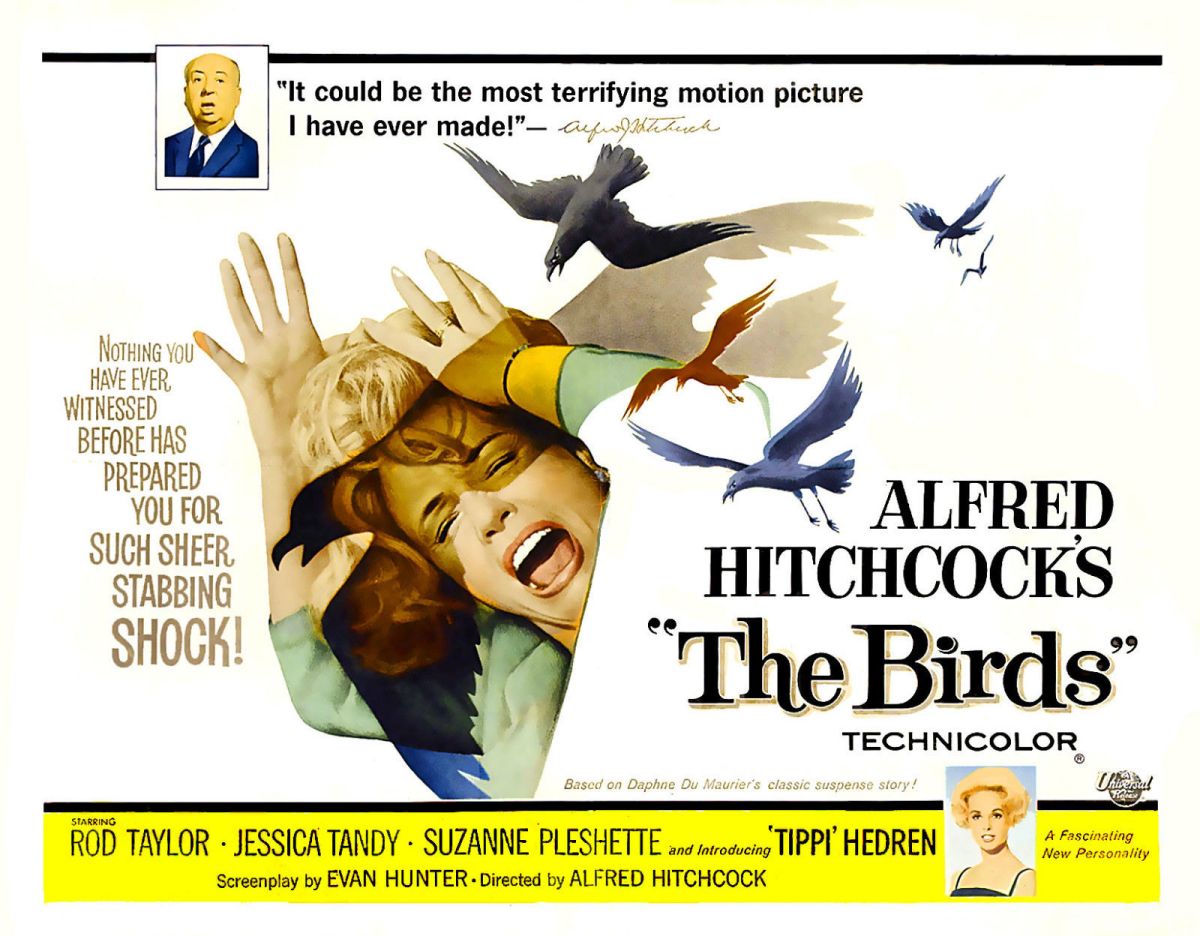
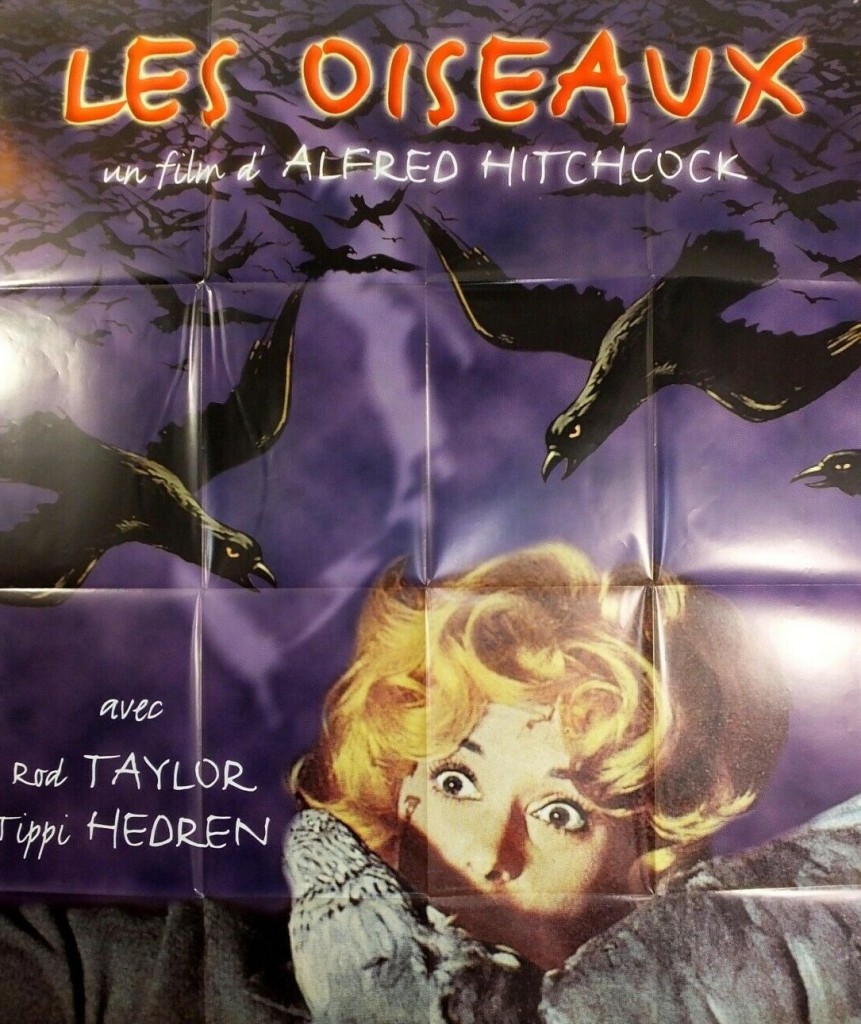
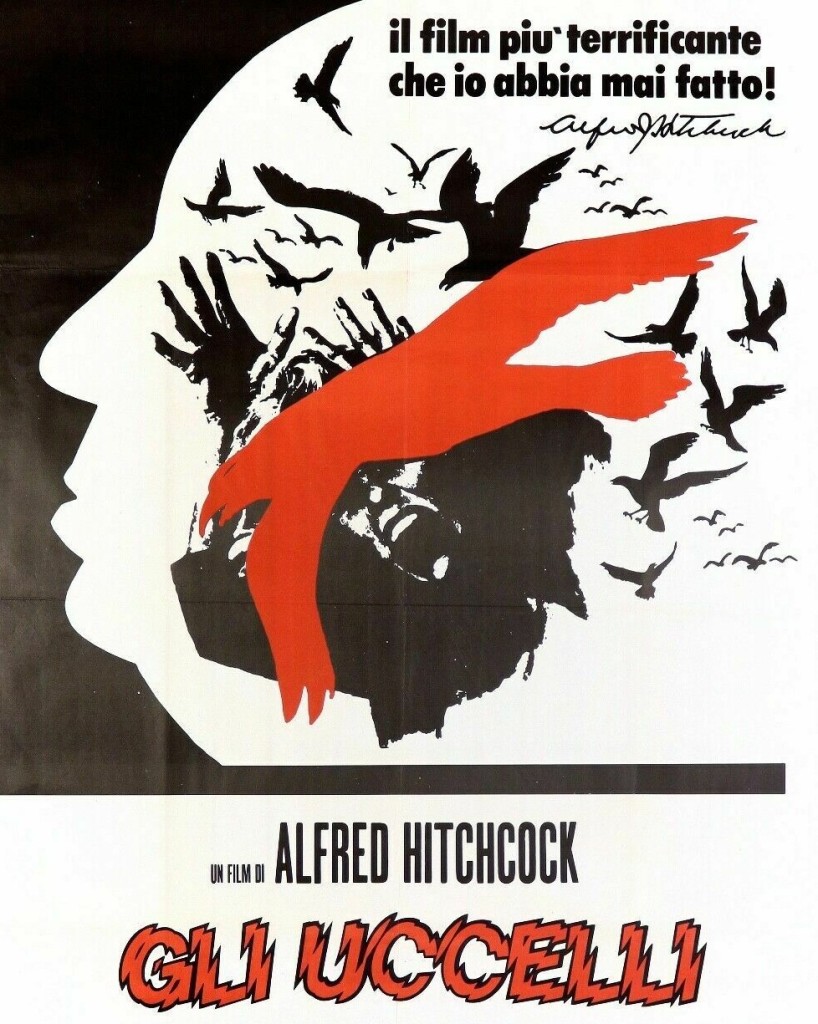
Years ago I was asked to write a book on the six best Hitchcock films and from those choose the one I considered his very best. My choice was The Birds (1963). And it is for these reasons.
Firstly, unusually in the master’s work, there is a proper meet-cute. In most of his films, the couple are either already together (Rear Window, 1954; Torn Curtain, 1966) or when they get together it is for a hidden reason, one is on the run, or being pursued by the other, and the getting together is a convenient way of reaching an ulterior goal. When Melanie (Tippi Hedren) and Mitch (Rod Taylor) meet in the pet shop it is a certainly a precursor for the future and ensures that Mitch gets in a stickier jam he would otherwise likely have avoided but in the true sense it is the traditional Hollywood boy-meets-girl.
Secondly, and now cutting more to the chase, this is where the modern action film was invented. You might think that honour rested with Dr No (1962) or any other of the Bond pictures or even as late as Bullitt (1968) with its epochal car chase. But although the Bonds are filled with derring-do and escape, there is nothing to match the scene when the birds attack the town, wave after wave, as if they were World War Two bombers. There is even the point-of-view from the air which Hitchcock also invented and has been repeated in airplane war films ever since, most famously Pearl Harbor (2001).
But the way in which full-scale disaster, with everyone rendered helpless, unfolds is a true first. People in the café can see the river of petrol and the match about to be discarded and can only observe as the river of flame reaches the petrol tanker and in a perfectly ordinary town setting – rather than a military base – there is an almighty explosion. It is terror for the sake of it. And there is no escape, no one racing to the rescue, just pure devastation,
Lastly is the ending. It is apocalyptic. In every other Hitchcock when the hero/heroine escapes from dire peril, that is the end of the matter, there is no final twist as with a film like Carrie (1976). But although the birds are now silent and the couple can pick their way through their lines, you know full well this is not the end and that the birds will soon be as inexplicably massing somewhere else.
That’s three reasons but there are many more. For a start, in other films where the hero/heroine is in danger, the peril is not relentless. And often it is the threat of danger or of being captured that provides the narrative spring. And if there is physical threat in that era it was not unrelenting. And it is with another character whom you can fight or at least attempt to outwit. Not just, later in this instance rather than sooner, realize that there is no way to defeat these marauding creatures, no way at all. So, compared to his other films, when attacks of one kind or another punctuate a film, here it is like a battery of machine-guns and not episodic but virtually non-stop for over 30 minutes.
The storyline since it is after all a meet-cute is excessively simple. Melanie and Mitch meet, trade remarks, she leaves him what would easily be interpreted as a love token, and they link up after she is attacked by a gull. Wherever they go now, there will be no escape. Gulls attack children playing outside. The same day sparrows invade Melanie’s home. There is another attack on children. In town the gulls swarm in wholesale, wreaking the devastation mentioned above. All his is just a prelude to the final overwhelming siege. Except in modern horror pictures where a body is dispatched every ten minutes or so, there is nothing to match the unremitting attacks. It is as though Mitch and Melanie are in the front line of battle, under siege, Zulu (1964) with birds perhaps, but with no hope of salvation. Unlike Zulu, there is no sign that in raising the siege, the birds are hailing their bravery.
Unusually, too, for a Hitchcock film, there is considerable back story that informs current action. Mitch has an overbearing mother who seems to hover over his life attempting to scare off any woman who comes near. Annie has been left behind precisely because he needed to escape his mother. For her part, Melanie’s mother ran off with another man and she is a spoiled socialite with a habit of getting into trouble, possibly attention-seeking behaviour as a result of abandonment issues. Full to the brim with sophistication. Melanie is the least likely candidate for motherhood, yet her maternal feelings rush to the fore when she has to care for a terrified child.
Tippi Hedren’s career when south when she parted company with Hitchcock so we only have this and Marnie (1964) to consider her worth as a star. This is easily her best performance, shifting from icy cold to playful to romantic to maternal and of course no one has quite emoted such shock and terror. This is Rod Taylor (Dark of the Sun, 1968) coming into his stride as a leading man. He always had the charm and certainly the brawn, but rarely displayed both in the one picture. You would not have picked the Rod Taylor of Seven Seas to Calais to lead a squad of mercenaries in Dark of the Sun but he might well be first pick after this performance.
Hitchcock got so many of his effects by laying on the tension, a man or woman on the run, an innocent framed, a man displaying dubious morality (Rear Window, 1954, and Vertigo, 1958) nonetheless being presented as hero, the question in every instance being whether they will escape their fate. Here, the barrage of devilry is so intense it is almost inconceivable that anyone could get out alive. That they sneak out by the skin of their teeth, watched by their silent conquerors, for me was only the prelude to The Birds Part Two.
Most original horror film since Jordan Peele’s Get Out (2017) and sharing that film’s ability to throw the audience off guard by constantly twisting expectations and slowly taking its time to reach an incredible denouement. Be warned, though, it is about child abuse and some of the scenes come down to the knuckle. But it is also, surprisingly, a coming-of-age picture.
In 1978 in a Denver suburb, Finney (Mason Thames) and younger sister Gwen (Madeleine McGraw) live with widowed alcoholic father (Jeremy Davies), prone to beating his kids with a belt. Although bullied by classmates, Finney always picks himself up. Gwen has dreams which may be real – her mother committed suicide after similar visions.
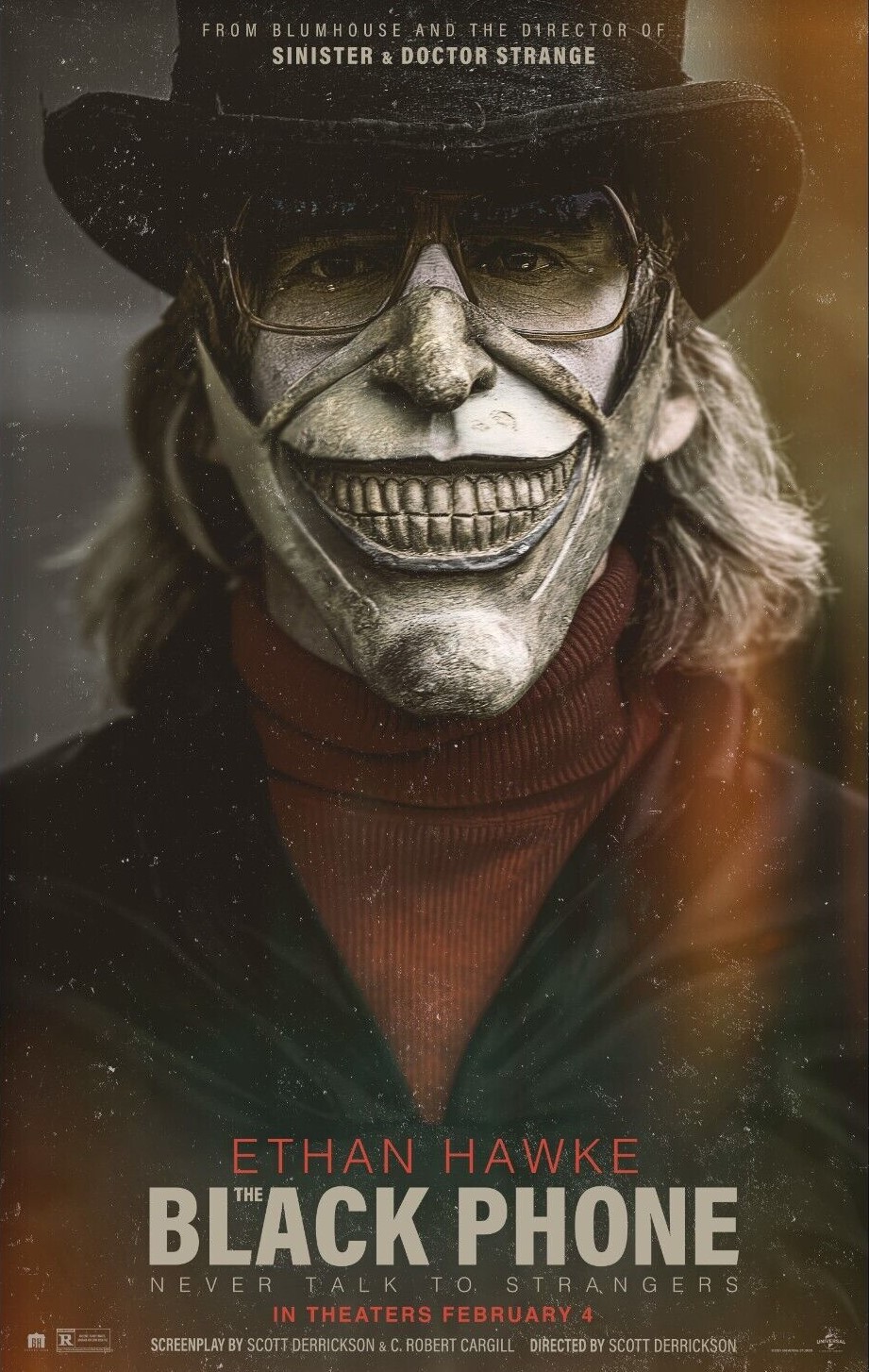
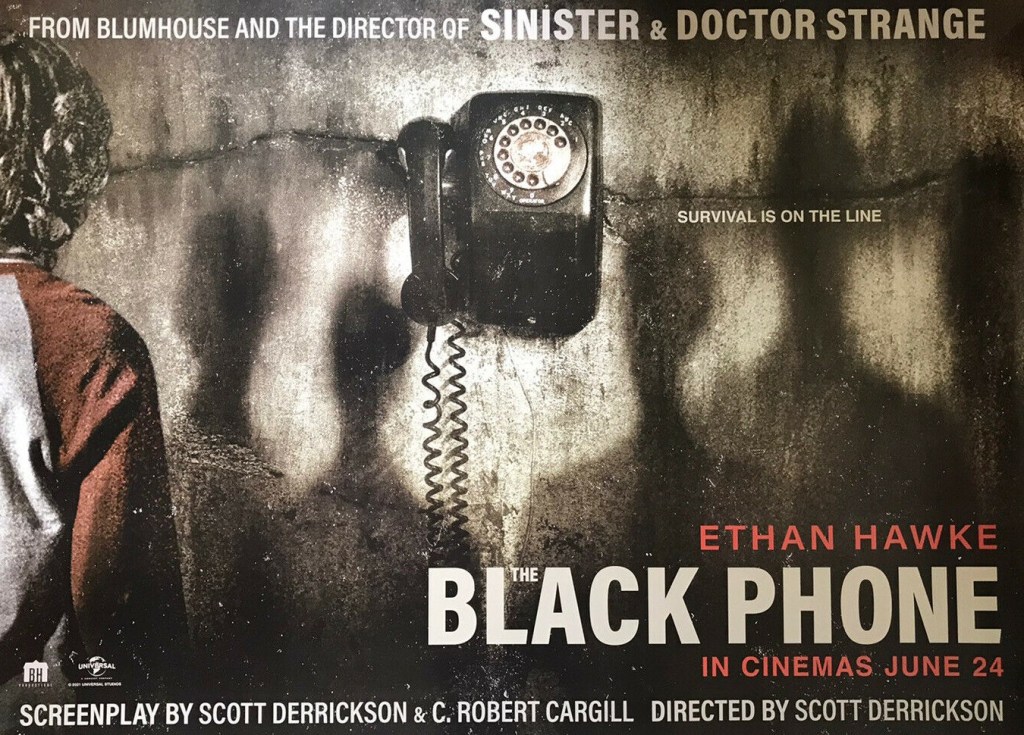
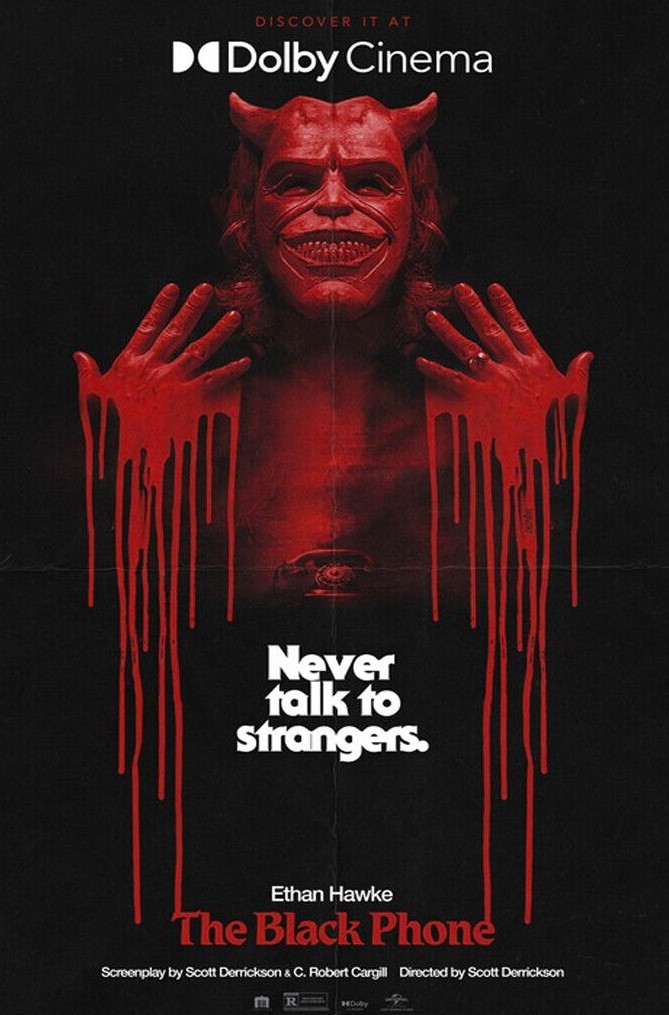
When Finney becomes the latest victim of masked serial child kidnapper The Grabber (Ethan Hawke) he finds himself trapped in a basement, empty except for a mattress and a phone that doesn’t work. The cops are baffled. Gwen attempts to reach her brother through dreams. When the phone mysteriously does ring it’s always one of the Grabber’s five previous victims offering practical escape advice. At the top of the stairs a half-naked masked Grabber sits in a chair gripping a leather belt waiting for his captive to become “naughty” so he can be punished.
I’m going to be in spoiler alert country if I tell you anymore but if you’ve seen the trailer be aware that’s far from the whole story. Part of what makes this so good is how realistic is the portrayal of the kids and the venal world they inhabit. They have no defence against the brutal father and in some respects expect adults to behave in horrific fashion. A boy who Finney helps with schoolwork acts as his protector but when he is kidnapped the bullies take revenge, handing out a bloody beating. Although brother and sister are close, there are few limits to their teasing. And Gwen has the lip of an adult in taking on a couple of unwary cops.
All the time you are left guessing. Is the Grabber behind the phone calls? Is it another of his elaborate games? Does he intend to offer escape, only to snatch it away? Can Gwen summon up spirits at will or will she flounder helplessly trying to save her brother. And if he disappears for ever, what prospect could be worse than living with her awful dad? Have the snippy cops got any leads at all? The father’s not out helping the hunt for his boy, so it possible he’s involved, especially since he wields a belt similar to the killer? Is Max, the visitor from out of state, possibly the killer, even though he appears to be a harmless cocaine-sniffing conspiracy nut?
And if five previous victims are gone, presumed dead, what chance has Finney, a vulnerable kid if ever? His protector was a very tough kid, one capable of beating a bully to a pulp, and if he can’t survive the kidnapping what chance does Finney have?
Over it all is the malevolent presence of the Grabber who wears two-piece masks (with devilish horns and long chin) that show different parts of his face but never the whole, who sometimes just sounds like a guy who has lost his way and means no real harm, if only he could sort out what’s gone wrong. His kidnapping ploy is to drop his shopping on the sidewalk and hope a nice kid is going to help, especially as he is a magician with a stack of black balloons, the kind of conjurer who might appeal to an edgy teenager who thinks The Texas Chainsaw Massacre the greatest film ever made.
Jump-out-of-your-seat shocks are few but this is a rare horror movie that has little reliance on such tricks. Tension is maintained with magnificent ease.
Mason Thames (Walker TV series 2021) and Madeleine McGraw (Secrets of Sulphur Springs, 2021-2022) are terrific as the kids, not putting a foot wrong as they move in the sometimes inexplicable adult world, but sharpening their teeth on vicious childhood. Sure the mask does a lot for Ethan Hawkes (The Northman, 2022) but his voice and his movements do the rest and this is a bold part to take on, way out of his comfort zone. Jeremy Davies (The House That Jack Built, 2018) is every bit as creepy.
While Scott Derrickson has dipped his foot into horror (The Exorcism of Emily Rose, 2005.) and for that matter the supernatural (Doctor Strange, 2016) before, he has never done so with such distinction, reining in the shocks in favour of escalating tension, never shifting focus away from the kids. He co-wrote the screenplay with Doctor Strange collaborator Robert Cargill based on the short story by Joe Hill (Horns, 2013).
Sherlock Holmes vs Sherlock Holmes was the initial tantalizing casting prospect. Basil Rathbone, the most venerated actor to don the distinctive deerstalker, and Peter Cushing, just signed up by the BBC for a new 16-episode series, the former signed to play the villain, the latter his nemesis in a film that started out with the title of The Death’s-head Vampire, the first film by a new production shingle Tigon Films.
While Tigon was new, with a distinctive logo, its driving force was well-known British producer Tony Tenser who with partner Mike Klinger had initially specialized in exploitation pictures with titles such as Naked as God Intended (1961) and London in the Raw (1964). The pair split after the artistic and commercial success of Roman Polanski’s Cul de Sac, Tenser initially setting up under his own name for Mini-Weekend/Tomcat (1966), mining the exploitation vein as before, and The Sorcerers (1967) a new venture into the horror market. Expanding the business with fresh capital and new partners, Tigon was born.
Supporting feature to “Witchfinder General” on ABC circuit release in Britain.
Explaining the new departure, Tenser said, “Films needs to be inexpensive. They need to sell, they need to appeal to an international audience, and one subject that always finds a market is horror.” Horror budgets were low, the genre did not require big stars, and the films had a surprisingly long shelf life.
First movie on the new company’s agenda was not The Death’s-head Vampire. Instead, Tenser had hooked Raquel Welch for a ghost story The Devil’s Discord to be produced by her husband Patrick Curtis, who had performed a similar task on The Sorcerers, and star Peter Cushing (The Skull, 1965). When that fell through, he held onto Cushing for a proposed Horror of Frankenstein and when that also bit the dust turned to him for The Death’s-head Vampire on a budget of just £40,000 (about $100,000). Offered the choice of playing villain Dr. Mallinger or Detective Inspector Quennell, the actor plumped for the “goodie,” Basil Rathbone lined up for the other role. The concept of older man/younger woman with action concentrated on an isolated house and the surrounding countryside was a horror trope.
Vernon Sewell (Strictly for the Birds, 1964), entering his third decade as a director, had worked with Cushing on Some May Live (1965) and was primarily known for low-budget and B-movies, and more importantly from Tenser’s perspective, sticking to a budget without any artistic pretensions or improvisation. He didn’t waste time on anything that would not be captured by the lens. He was calm on set, “nothing fazed him.” Cushing was a kindred spirit, never complaining, except famously, on this picture, when he told Sewell it was the “worst picture” he had ever made. The pair, however, had a very good working relationship to the extent that Sewell never offered Cushing any advice on the role –“he didn’t need my input.”
The Sherlock Holmes connection is promoted in this poster.
Just over two weeks before the August 1967 start date, Basil Rathbone died of a heart attack. Robert Flemyng, the last-minute replacement, was Cushing’s opposite, complaining all the time. The cast was rounded out by 32-year-old Doctor Who star Wanda Ventham (mother of actor Benedict Cumberbatch) and 18-year-old Vanessa Howard whose career highpoint thus far had been a duet with Cliff Richard for a television presentation of Aladdin (1967).
Interiors were shot at Goldhawk Studios, a converted three-story building in London’s Shepherd’s Bush, with exteriors at Grims Dyke, the former home of W.S. Gilbert, in north-west London. The 19th century manor house had lain empty since 1963.
Roger Dickens, who had cut his teeth on Thunderbirds Are Go! (1966) and worked on 2001: A Space Odyssey (1968) and would be later lionized for the mini-beast bursting out of John Hurt’s stomach in Alien (1979) was responsible for creating the monster. The model for the giant larvae was a much simpler task than creating a believable female giant insect. He took a mold of Ventham’s face, giving the features a repellant slant, using costume jewelry for the eyes, adding a furry cap and two-foot long antennae, a representation that would only really work if you scarcely saw the creature. For art designer Wilfred Woods his woods set turned into a disaster when the trees wilted and lost their leaves.
Opinions differ as to whether Tenser interfered with production. He saw his role during the film process to ensure that the project followed the script. “Sometimes you can put something in a film which will hinder the selling, sometimes you need to put something in which will help the selling.”
Comedian Roy Hudd, playing the morgue attendant, thought the script so awful he was delighted to work with Cushing on improvements.
When John Ford’s boast that he never shot an extra foot of film in order to prevent a producer turning in a different film has resulted in many a masterpiece, the same did not hold true for Sewell. Sticking so close to the script, not filming anything that was not absolutely necessary meant that the movie was too short. Editor Howard Lanning commented: “I put in everything that was available. Even with expanding the lecture scene and the amateur dramatics as long as possible, to the detriment of pace, the picture clocked in at just 81 minutes, not the length expected of a main feature.
To ensure the movie came in at the required length, Tenser added the African sequence at the beginning (an extra five minutes) and re-shot the morgue material (two more minutes), encouraging Cushing and Hudd to improvise. The final product was over-budget and a week late. The version shown to the censor was 87 minutes though the official running time was a minute longer.
Tenser now deemed the working title as insufficient, preferring “something catchy and something that told people what you were selling.” His first stab at a new title was Blood Beasts from Hell. But in the final analysis it was altered to The Blood Beast Terror. Hoping to sell it to a circuit as a main feature it was originally shown in a double bill with Castle of the Living Dead, but despite the supposedly attractive title, audiences were not interested. To cut his losses, the film was repackaged as the support to another Tigon production Witchfinder General (1967) which meant Tenser would not have to share receipts with another distributor.
The Blood Beast Terror did not prove so sellable overseas either. It was shelved in France until 1971, although, sold for a flat fee, it did well in South America. A.I.P. who had U.S. distribution rights to Witchfinder General – title altered to The Conqueror Worm – had no interest in The Blood Beast Terror but it was picked up by Pacemaker Pictures who were also in title-changing mood and released it in summer 1969 as Vampire Beast Craves Blood on a double bill with Curse of the Blood Ghouls (1964).
Tenser’s predictions of long shelf life were correct. In Britain, the movie was reissued on a late night double bill with The Secret of Blood Island (1961), and then was revived with The Devil’s Hand (1961) before being re-teamed with Witchfinder General on a Sunday’s-only screening. Although none of these would be circuit releases in the sense of a nationwide day-and-date opening, they were nonetheless likely to get reasonable bookings to fit specific engagement profiles. In the States where there was endless demand for horror triple- and quadruple bills and all-nighters, The Blood Beast Terror received ongoing bookings.
SOURCES: John Hamilton, “The Making of the The Blood Beast Terror,” Little Shoppe of Horror, Issue No 43, p67-91; John Hamilton, “Regretting Nothing: John Sewell, Little Shoppe of Horror, Issue No 43, p92-98.
As the title suggests there’s a vampiric element, and there’s not a great deal unusual in that, Hammer having successfully revived interest in bloodsuckers. What is unusual, however, and a couple of years before that studio’s The Vampire Lovers (1970) is the idea of female empowerment. Previously, the sole purpose of a damsel in a horror picture was to lay bare a convenient bosom for a passing thirsty creature, or, have their clothing disarrayed and let out a scream when a monster pounced.
The twist here is that the vampire is a woman, Clare (Wanda Ventham), and men who are the victims except on the occasions when her father Dr Mallinger (Robert Flemyng) hypnotizes young women in order to give the creature a blood transplant. The beast exists as a creature and then morphs into Clare. For a time it looks as if Clare is merely possessed, but in reality appears much more as if she is enjoying being the beast, abandoning the enforced respectability of the times, luring men into the forest to have her rapacious way with them, the men naturally thinking they are in for a romantic tryst rather than being targeted by a predator.
Continuing the theme of misleading the audience, this poster cleverly suggests that it’s a man who is the beast and the woman who are the victims.
There’s a wonderful scene that gives an insight into her mindset. Her friends put on a little play. Her role is the monster, a part she seizes with relish.
It’s one of those films you have to work out backward. In standard horror fashion it leaves the twist till close to the end and it would have been far more interesting if we had discovered at the outset that Clare was the beast, leading the men for the most part a merry dance, outwitting Inspector Quennell (Peter Cushing) and her adoring father Dr. Mallinger (Robert Flemyng).
The inspector, faced with a growing pile of corpses drained of blood, is baffled throughout, no Sherlock Holmes clever deductions here, and it naturally would not occur to any of the males, beyond Dr Mallinger who is in on the secret, to imagine a woman capable of not just committing such crimes but of exerting such power over a man. The story glosses over the genetics, it’s a version of Frankenstein obviously, but the background to it is missing, and I can see why. There has to be some mystery.
Hitchcock could not have done a better job of misleading the audience. For a start the story is told entirely through the male perspective. And it’s set up as a murder mystery, Quennell our lead as he dances from one corpse to the other, helped along in his information accumulation by lugubrious mortuary attendant (Roy Hudd), who is, ironically, as hungry as the beast, but for normal food rather than blood, always seen devouring something. Mallinger is not a mad professor either, but a distinguished one, celebrated in his field, giving lectures and attracting proteges like Britewell (William Wilde).
Initial British release double bill cleverly bringing together Peter Cushing and Christopher Lee – though in separate pictures.
Although his daughter acts as laboratory assistant, Mallinger is hardly aware that his daughter is sizing up every male visitor as a potential victim.
The posters give away that the creature is a giant moth, and by and large the special effects (no CGI available of course) pull this off, the creature usually just glimpsed or seen from the distance, and the possibility that Mallinger is aware of what he is harbouring apparent when he enters a cellar wearing a leather hood and carrying a whip.
Tony Tenser’s production company Tygon has acquired cult status, in part for having the temerity to take on British horror giant Hammer at the height of its powers in the 1960s, and in part from the distinction of its output, making such films as The Sorcerers (1967) with Boris Karloff, Peter Cushing as Witchfinder General (1968) and Karloff, Christopher Lee and Barbara Steele in The Crimson Cult/The Curse of the Crimson Altar (1968). Tenser ploughed a different furrow to Hammer at a time when that studio was also expanding into bigger-budgeted movies such as One Million Years B.C. (1966).
Capably not to say cleverly director by veteran Vernon Sewell (The Crimson Cult) it is miles ahead of its time and generally delivers the goods. Peter Cushing (The Skull, 1965) is excellent as usual, Robert Flemyng (The Deadly Affair, 1967) proves a more interesting scientist than usual, steering clear of any craziness.
Wanda Ventham in her first leading role provides a fascinating character study, but you have to work backwards as I said, to realize just how good she is, the way she has, for Victorian times, her father under her thumb, and the seductive glances she casts at men, not to mention the ease with which she assists her father in his diabolical experiments without him realizing why she is so enamored. Female monsters had evolved from creatures before – in Cat People (1942), Snake Woman (1961) and Hammer’s The Reptile (1966) – but this was a more rapacious example of the species. Vanessa Howard (Some Girls Do, 1969) has a small role and you can spot Scottish character actor Glynn Edwards (Zulu, 1963) and television comedian Roy Hudd in his movie debut.
Screenwriter Peter Bryan (The Brides of Dracula, 1960), something of an expert in the horror field, turns the whole genre on its head with the gender politics examined here.
Bizarre movie seeks cult audience! You might as well have stuck that on the poster. When I tell you the film climaxes like a Monty Python sketch with four successive men giving birth – from a variety of orifices – the first three to emerge different versions of the same character, the last the dead husband James (Paapa Essiedu) of Harper (Jessie Buckley). And that men also appear fully naked, in the form of some kind of vegetation, and can survive despite having an arm spliced from elbow to fingers. And that James desperately wants her to feel guilty about his suicide, triggered by her demanding a divorce.
Of course, all this could be taking place in her tormented mind except that she steadfastly refuses to admit to torment over the suicide even though she does scream her head off in church. If any of this is remotely realistic it points to someone with a severe downer on men, since there is not a single likeable one in sight. Men, in fact, are just four-letter words (choose your own) whose sole purpose is to accuse women of not loving them enough. And women – cue symbolism – are all born of Eve and inclined to eat a forbidden apple.
None of this would be so bad if in attempting a psychological thriller and/or horror film (I am assuming horror because of the births and arms sliced in two) there was actually a shock or two or even a general sense of creepiness. On the plus side, should this ever achieve cult status – “makes Titane look like Paddington” (1 or 2, you choose) – then I am sure director Alex Garland will only be too happy to turn up for a tenth anniversary Q&A and explain his intentions and/or symbolism and if he’s very lucky find an audience composed of students who have written a thesis on the film.
So the story – or did you think there wasn’t one – sees Harper repair to a village in the country to a fantastic country house with all the trimmings including an Aga and a baby grand for two weeks holiday to recover from the suicide, her mind still so muddled that she’s not thought to change her married name. It’s the kind of village where there appears a considerable amount of inbreeding. The letting agent (Rory Kinnear) looks suspiciously like the long-haired vicar (Rory Kinnear) and the rude schoolboy (Rory Kinnear) and the policeman (Rory Kinnear) and the bollocks-naked stalker (Rory Kinnear).
Harper gets lost in the unfamiliar countryside and happens across a tunnel where the echo effects could have been created by Robert Fripp and is then chased by a man (Rory Kinnear anyone?) and then catches sight of the naked man who later appears in her garden looking like an rewilded exhibit from the Chelsea Flower Show. The various versions of the man appear at different points and even when the letting agent appears good (and brave) actually he is just as bad.
I felt sorry for the Oscar-nominated Jessie Buckley (The Lost Daughter, 2021) for having to put up with this script. I also felt sorry for Rory Kinnear (No Time to Die, 2021) with a movie career so far consisting of supporting roles who must have been convinced that the chance to channel his inner Alec Guinness/Peter Sellers and play multiple characters would have been his breakthrough.
I did not in the slightest feel any sympathy towards Alex Garland (Ex Machina, 2014) for dreaming up this pile of tosh. This is one those films that strides the critic/moviegoer divide. Around 70 per cent of critics on Rotten Tomatoes gave it a positive review but moviegoers disagreed and, as surveyed by Cinemascore, gave it a D score (on a rank from A to F).
I first saw The Wicker Man in 1973, dismissed by critics on release, on the lower half of a double bill with Nicolas Roeg’s ecstatically-reviewed Don’t Look Now (1973), the films connected less by the horror elements than that they both made by British Lion. t’s now rubbing shoulders with the most superior kind of cult picture, the ones that the public will actually fork out hard-earned cash to see on the big screen, as was my experience this week. Some clever marketing person had the bright idea, given the picture concerns May Day activities of a dark nature, of running a special revival on May Day. What surprised me more was that the cinema was full (on a Monday night, no less), the audience was 20- and 30-year-olds and younger, and judging from overheard chatter afterwards they clearly enjoyed the experience.
What struck me most when watching this was the clarity of the pagan worship, compared to, for example, The Northman where I had no idea what they were worshipping beyond a rough notion. The procreation element was very well thought-out, the idea that such paganism should be taught in schools the way in the era when the film was made religion was on the curriculum. Most horror films do not take religion seriously, But here, even if it’s not your idea of true religion, the entire community invested in the symbolism of animals and trees and fertility rites such as jumping over a fire naked (otherwise your clothes would catch fire) in order to become pregnant. A naked woman weeps over a headstone in a graveyard. You can cure a cough by letting a toad sit in your mouth. And the entire soundtrack, often performed by folk singers in the pub, is filled with songs where the emphasis is on sex. But the detail is really quite extraordinary. Beyond The Wicker Man itself which I understand comes from the Druids, I’ve no idea if this is patchwork of other religions imbued with fictional elements, but it doesn’t matter because, no matter how fantastical it appears, it all rings true.
Policeman Sgt Howie (Edward Woodward) pilots a small seaplane to Summerisle to investigate the disappearance of a young girl, Rowan Morrison. At first the villagers deny knowing about the girl’s existence, and then provide conflicting reports, even going so far as to claim she is dead, or has transmogrified into the hare that lies in her supposed coffin. The villagers appear to either discreetly or openly mock him and certainly find much humor in his steadfast Christian beliefs. The schoolteacher Miss Rose (Diane Cilento) denies that the empty desk in her classroom belongs to Rowan. Island chieftain Lord Summerisle (Christopher Lee) debates Christianity. Landlord’s daughter Willow (Britt Ekland) and the librarian (Ingrid Pitt) are on seduction duty.
Frustrated, and threatening to return with more officers, Howie intends to leave but his airplane engine has broken down and soon he is convinced Rowan has been kept alive for ritual sacrifice on May Day as a way of providing rebirth for the island’s failing crops and fruit. In disguise as Punch, he joins the villagers in their parade only to discover that is the hunter who is hunted and that he has been tricked into coming onto the island. The climax is horrifying, in part because the lack of CGI or a bigger budget, in part down to the delight of the observers, has meant that most of what occurs is left to the imagination.
What at one point appeared an idyllic spot populated by relatively harmless if somewhat wayward people with a highly-developed sense of community and none of the infighting that might common in such a remote location. In another reversal to audience expectation there was none of the bloodlust surrounding the burning of a witch or monster. The smile on the face of a killer indeed!
The audience is brilliantly enmeshed. The investigation appears to drive the narrative, the various obstacles in the way of the policeman just par for the course in this kind of mystery. Just as we are beginning to become more enchanted by this community’s open attitude to sex especially when compared to Howie’s repressed Christianity, the story takes a sudden switch as the deeper level of meaning is revealed, that fertility actually means rebirth and that the ancient ways of achieving that are not for the faint-hearted.
Edward Woodward (File of the Golden Goose, 1969), making a debut as the star after hitting the television ratings heights as Callan (1967-1972), is excellent as the stern God-fearing policeman who gradually loses his power in a community where there is no tolerance for his kind of law. Christopher Lee (The Devil Rides Out, 1968) breaks out of his typecasting, especially with the wigs, with a very affable performance as a benevolent landlord. It’s hard to view him as an outright villain his actions are for perceived betterment. Britt Ekland (The Night They Raided Minsky’s, 1968) is convincing as the free-as-a-bird aphrodisiac-on-legs damsel with vulnerability to the fore. Diane Cilento (Negatives, 1968) and Ingrid Pitt (Where Eagles Dare, 1968) have little to do but keep the plot ticking.
Robin Hardy, on his debut, does a remarkable job of setting the seductive atmosphere although the film’s box office failure meant he only made two further films. Anthony Shaffer (Sleuth, 1972) adapted the novel Ritual by David Pinner.
The movie celebrates its 50th anniversary next year so look out for more showings especially if it becomes inextricably linked to the May Day festival the way Casablanca had been adopted by St Valentine’s Day marketeers.
Gordon Hessler (The Oblong Box, 1969) makes his directorial debut with this neat horror thriller. It starts with a twist exceptional for the times. Ellen (Georgina Cookson) is the shrewd and shrewish millionaire businesswoman, her husband Raymond (Gary Merrill), from whom she demands frequent sex, the eye candy, a kept man. “I married a lover, not a businessman,” she retorts when, bored out of his mind, he asks for the opportunity to play a role in her business. In a further twist on the norm of the damsels decorating 1960s movies by displaying cleavage or disporting themselves in bikinis, Raymond is often seen with his chest bared in all its hirsuteness. In a further gender twist her secretary is also male, Dick (Neil MacCallum), a former, unknown to her, jailbird.
Tall, beautiful, dominant and domineering Ellen appears to have occult power, able to read minds, which keeps the larcenous-minded Dick in check, and has command of her own physical frailty – she walks with a stick – and can put herself in a trance to overcome occasional pain from her injured hip.
Conspiracy of fear: Raymond (Gary Merrill) and Alice (Jane Merrow).
But when Raymond falls for Ellen’s niece Alice (Jane Merrow), an artist returned from a year in Paris, he puts into action a plan that had clearly only been a pipe-dream, blackmailing Dick into participating. It’s quite clever as murderous plans go. He hires an actress to impersonate Ellen, known to go off to Italy on her own for spa treatments and with a knack for reckless driving, various driving charges over the years. Meanwhile, he strangles Ellen, allows Alice at a distance from an airport viewing terrace, to see her aunt, complete with walking stick, climbing up the steps of a plane. Faked cables and postcards arrive from Italy purportedly showing Ellen enjoying herself, even visiting the famous catacombs. In Italy Dick fakes a car accident to kill the actress.
However, twist number one comes at the reading of the will. Raymond and Alice split the million-pound bounty but while the latter is given custody of the big house the former is condemned to live for life, on pain of forfeiting the inheritance, in the cottage, in whose potting shed Ellen’s body lies. Further twists naturally follow. The maid (Rachel Thomas) doesn’t quite so much smell a rat but adds to the killer’s incipient discomfort by proclaiming that with her hip problem and claustrophobia that Ellen would never descend into the catacombs.
Entitled “Catacombs” in the U.K. after the novel by Jay Bennett on which it was based, it was retitled “The Woman Who Wouldn’t Die” for the U.S. market.
And Raymond might have lived happily ever after with Alice except for his guilt. Several creepy incidents, knocking, tapping, door handles turning, shadows, a depression the shape of a body in a bed, cigarettes smoking in ashtrays, lights going on and off indicate to the already nervous Raymond and the visibly frightened Alice that Ellen may not be dead after all. Virtually the entire third act is the pair of them reacting to real or imagined fears. Alice has a good line in looking scared witless. But Raymond, while trying to contain his inner demons, is equally rattled.
As you might expect there are further excellent twists to come. In fact, they are soon piling up and even at the very end the screen freezes on a final twist.
Georgina Cookson (The Picasso Summer, 1969) steals the show as the imperious businesswoman, with everyone cowering under her glare and not above stating the obvious, “I bought you body and soul,” she reminds Raymond. I’m not sure Gary Merill (The Power, 1968) is quite as good in the second half as he is in the first. Initially, he exudes charm, physical prowess, and, while under his wife’s thumb, still emotes a certain measure of confidence. He doesn’t appear to me to quite frightened enough in the second half as his plans go awry. Jane Merrow (The Lion in Winter, 1968) is excellent as the young woman caught in a mental trap and Neil MacCallum (The Lost Continent, 1968) is surprisingly effective.
But this is a low-budget B-picture that was destined for the lower half of a double bill so there was no particular reason why it should be as good as it is. Except for the Italian sequence, the action takes place on just two sets and for most of the time it’s a three-hander. But Hessler has a keen eye for composition and in a number of critical scenes makes bold choices. For Ellen’s murder, he concentrates on Raymond’s face rather than the victim’s, only showing her feet. There’s one super-shocker with a mirror. But mostly he is content to built up the tension, either by the various noises or by the reactions of Raymond and Alice. An old-fashioned gem of a picture.
Succession has a lot to answer for. Even demons stuck in the attic are now looking for an heir. Even demons who either puke up or give birth to hairless bats – it’s unclear which. A lot is unclear here, deliberately opaque, artistically opaque or, worst, carelessly opaque, like someone who can’t be bothered to join up any dots. Horror films rich in atmosphere are often short of the elements that make a good horror film.
Eastern European (no clue as to which country) Tomas (Alec Secareanu) who was once a border guard (or two miles away from the border and no clue as to why two miles away from the border was important) is working on a London building site when a fire renders him homeless. Spotted on the street by Sister Claire (Imelda Staunton), she provides him with shelter in a run-down house inhabited by Magda (Carla Juri) on the assumption he can spruce the place up a bit. Although a handyman, he does nothing, doesn’t scrape down any walls, fix a roof, or anything sensible. Instead, he takes a chisel to the ceiling (reason unexplained) where he uncovers something only he can see.
Magda is clearly unhinged, though she is a good cook. The longer the film went on I was hoping she was secretly poisoning him because the movie takes too long to go anywhere and by that time you’re already far ahead of the film. One of the reasons the movie is so reluctant to engage in a proper narrative is that the director delights in loitering over images of a snail, or the inside of a gutted fish or pans with what appears longing to the tops of very tall trees.
Occasionally, we get a flashback. Let me tell you how important this guard post is. It’s in a forest road in the middle of nowhere (all right then, two miles from the border). Tomas guards it during the day, but at night anyone could walk past. He’s not one half of a shift. He spends his time reading philosophy which makes him an “interesting character.”
Given he’s got nothing else to do all day it eventually occurs to Tomas there’s something odd going on what with banging on the ceiling and the occasional eye appearing through the cracks and someone nasty stabbing Magda when she peers through a keyhole. Turns out she is “looking after” her dying mother, although her definition of care leaves a lot to the imagination. When not adding to the world’s supply of bats, her ancient crone of a mother crawls around in a bare attic.
Not surprisingly, the good nun turns out not to be even a bad nun but not a nun at all – who would have guessed it? But in on the whole Succession business.
All this would have been fine – many horror films are pure barmy – if there was even one tiny scare, even an inkling of one. Horror movies, in case anyone has forgotten, are meant to scare the living daylights out of you. Either you get to jump in the cinema or if it’s the more subtle kind of horror picture it keeps you up at night worrying about the potential implications. The amulet turns out not to be a red herring as such but definitely not up to scratch.
I’m sure Carla Juri and Alex Secareanu are good actors, but the material here is so scant you never get the chance to find out. I never believed for a minute that Imelda Staunton was a nun, whether good or bad.
I thought we might at least be able to blame the National Lottery, the British Film Institute, the BBC or Channel four – the most common funding sources for stinkers – but it seems this was independently made. Debut director Romola Garai can’t even blame the script since she wrote the damn thing. Her talent as an actor (Miss Marx, 2020) hasn’t been duplicated here though she may improve given a second chance and a better script or script editor.
In cinemas now – where I saw it. I should point out that I pay for my cinema ticket.
The cult of Ed Wood has a lot to answer for. A complete chapter is no doubt devoted to him in the history of the so-bad-it’s-good genre. His masterpiece, if you would call it that, was Plan 9 for Outer Space (1957) but more likely these days to attract attention for the cross-dressing Glen or Glenda (1953). Johnny Depp embellished the legend in the 1994 Tim Burton biopic.
Even so, little can prepare you for the likes of Orgy of the Dead, nowadays sold on Wood’s name, but to which he only contributed the screenplay based on his own novel. Not that, given his mesmeric incompetence, he would have done any better in front of the camera. It’s trash, but it’s a hoot, especially when The Mummy (Louis Ojena) and the The Wolfman (John Andrews) enter proceedings in costumes that would have been ridiculed on the domestic Halloween scene.
Bob (William Bates), a horror writer seeking inspiration, and girlfriend Shirley (Pat Barrington), drive out in the country. When their car crashes they end up in a cemetery and tied to stakes watch the dead, ruled by the Emperor (Criswell), come to life. Except the departed all look as they are auditioning for a job in a strip club. So what you get is one scene after another of nearly-naked girls gyrating for the camera. That’s pretty much it, until the sun comes up and the obvious occurs.
This marked the directorial debut of A.C. Stephens whose company Astra had started off with different intentions, buying up the rights to five films by French comedian Fernandel which would have been destined for arthouses. Criswell was a famed seer, appearing on countless television programs, who predicted the death of President Kennedy. Ed Wood – or Edward D. Wood Jr as he was known then – had made a television series Criswell Predicts (1953) and Criswell acted as narrator of Plan 9 from Outer Space.
Given the battles Hollywood had with introducing snippets of nudity in the 1960s I wondered how such blatant nudity got through the censor. Well, quite easily actually. Films with such high skin quotients simply did not apply for a rating. The Production Code was a self-funded censorship scheme operated by the studios. They submitted their films to this board and received an official rating. But if you did not submit your picture – foreign filmmakers also got round the censor by not applying – you didn’t get a rating and unless some officious local censor came after you then the pictures would play wherever cinemas would book them.
The case against wholesale nudity, such as the plethora of nudist camp movies that appeared in the 1950s, was torn apart by a ruling from the New York Court of Appeals in 1957 which declared, in relation to Garden of Eden (1954), that “nudity in itself” was not covered by “obscenity in law.” That opened the door for the likes of Russ Meyer and The Immoral Mr Teas (1959).
The drawback for moviemakers entering this new subgenre was the lack of movie houses willing to show such films. Arthouses that might take a racy Ingmar Bergman or Fellini drew the line at treating their patrons to such overt fare, although The Orgy at Lil’s Place (1963) set records at the 390-seat World arthouse in New York where it ran for 29 weeks taking an average $10,000 per week at a time when tickets cost around a dollar.
Tracking box office figures through Variety, I was surprised to discover that some major cinemas in major cities were happy to screen Orgy of the Dead. It played in Chicago at the 1,100-seat Monroe and pulled in a “merry” $6,000 in a double bill with Jungle Street Girls (1960) which, despite the title, was a B-picture crime drama starring David MacCallum and then-wife Jill Ireland.
Orgy of the Dead was far more popular in Boston where it played both the 1,909-seater Pilgrim and the 625-seat arthouse Symphony Two. In its first outing at the Pilgrim it collared $5,500, returning six months later supported by nudist feature Adam Lost His Apple (1965) to pull in another $5,000. It made more – $6,200 – on its third appearance there after another six months. Following that it ran for two weeks at the Symphony in a double bill with Russ Meyer’s Lorna (1964) for a grand total of just under $5,000.
SOURCES:Variety box office figures – December 14,1966, August 17 1966, February 1 1967, August 23 1967, October 4 1967, October 11 1967; “NY Art Sites Favor U.S. Pix,” Variety, May 12, 1965, p155; “Astra Gets Rights to Five Fernandel Films,” Variety, September 1, 1965, p16.