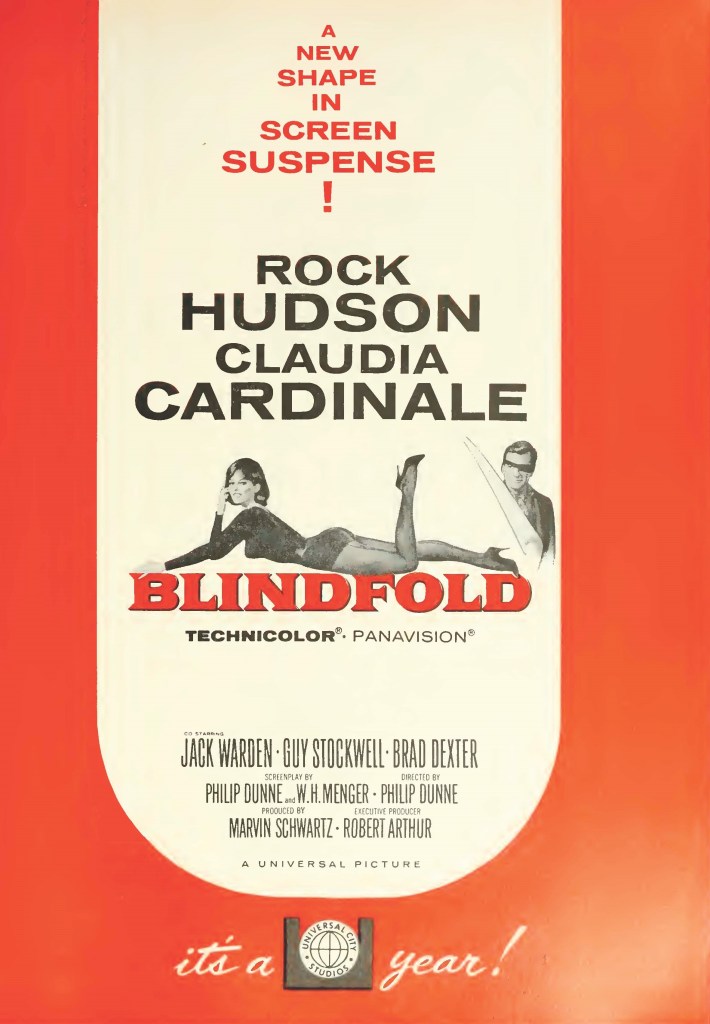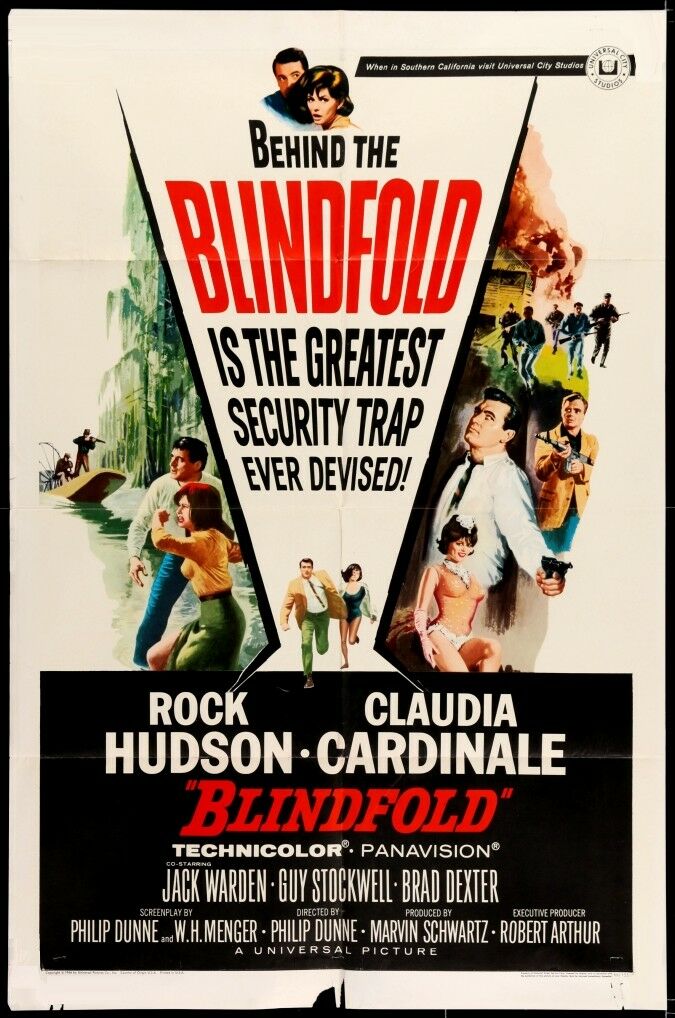
Blindfold (1965) *****

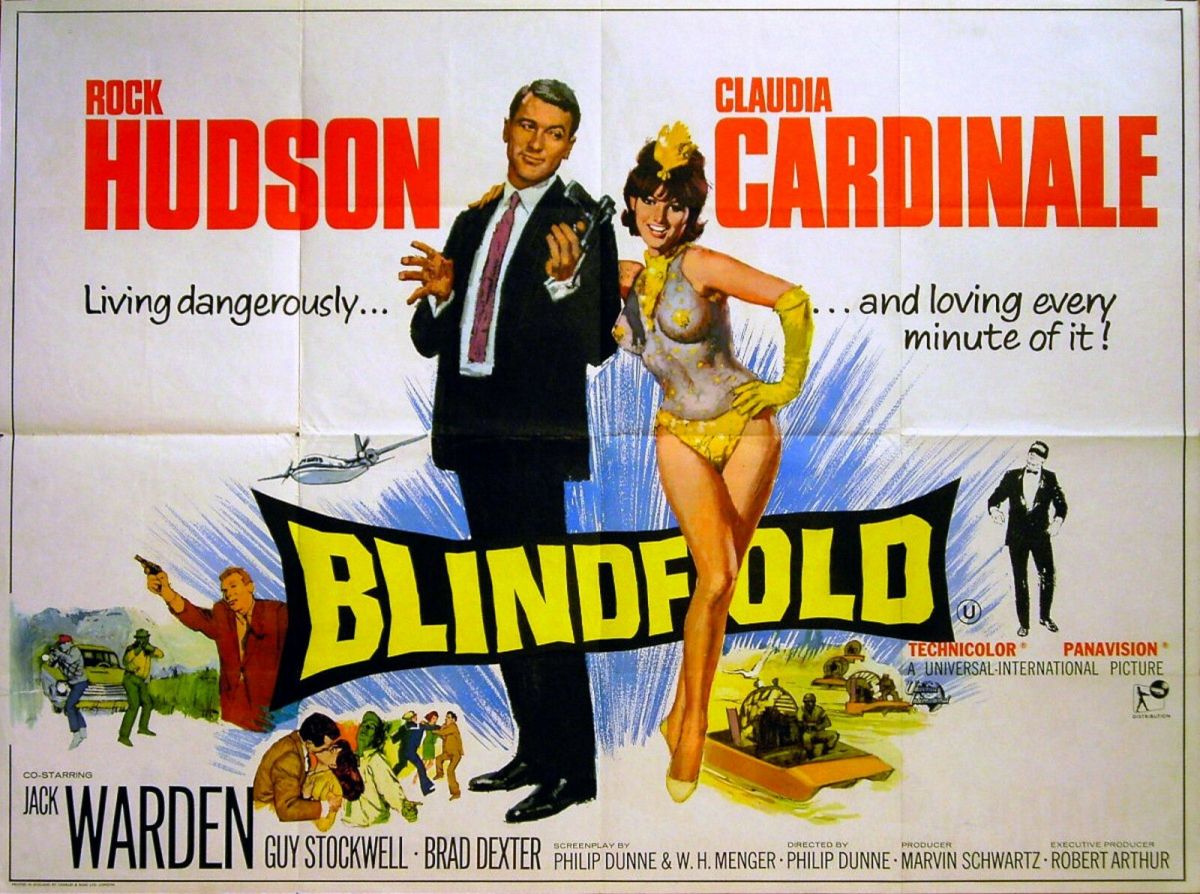
Hugely enjoyable superior addition to the romantic thriller genre with charismatic stars and a touch of screwball comedy. Dr Stone (Rock Hudson), a psychiatrist with such commitment issues he is dubbed “Bluebeard” by the media, is recruited by General Prat (Jack Warden) of the National Security Council to prevent former patient Arthur Vincenti (Alejandro Rey) falling victim to an international scientist-kidnapping ring. Getting to the patient, a plane and car ride away, requires the titular blindfold so Stone has no idea where he is. When Vincenti attacks Stone as a traitor, Prat explains the scientist has been brainwashed.

Ballet dancer Vicky (Claudia Cardinale) engineers an accidentally-on-purpose meet-cute in Central Park by running her bicycle into Stone’s horse but when, to nurse her injury, he carries her into his office she steals the scientist’s file. Turns out her artistic skills are somewhat lower than ballet, she is a go-go dancer, but she is the scientist’s brother whom she claims has been kidnapped. Stone is arrested and to get out of another sticky situation announces he is engaged to Vicky.

Complications are added when the C.I.A and F.B.I. enter the equation as well as a very suspicious cop Harrigan (Brad Dexter) with an inferiority complex, a couple of shady homburg-wearing hoods and new patient Fitzpatrick (Guy Stockwell), who, all, in one way or another, hound Stone and Vicky. The couple’s relationship is one of those on-again off-again romances which come with the territory. Soon, of course, Stone doesn’t know who to believe.

Bearing in mind we still have to get to the geese, the alligators and a mule called Henry, the witty, inventive script delivers on all fronts. Both Stone and Vicky are believable characters, and Stone’s psychiatric skills are not just window dressing – the kind of tony job associated with innocents thrust into peril. He uses his proficiency to get out of scrapes and eventually solve the mystery. Despite her glamor-girl persona, Vicky is the opposite of the sleek high-living characters often shoehorned into this kind of picture, a down-to-earth lass living in a brownstone with her mama and papa. Both leads turn out to be handy with their fists and in Vicky’s case her high-kicking feet.

And the comedy, rather than getting in the way or looking ridiculously out of place, aids and abets the storyline. It falls into three distinct camps. There is repartee not just between Stone and Vicky but Stone’s secretary (Anne Seymour) operates a sideline in dry quips. Slapstick comes mainly in the form of a fire extinguisher employed as a weapon and Stone nearly losing his trousers scaling a fence. Bureaucratic brick walls that hint of paranoia come close to classic black comedy. Not to mention some visual gags – “undie dummies” anyone – and some neat reversals.

This is Hudson at his very best and while often confused is never flustered, and without recourse to the double-takes that appeared so essential in any previous film with a comedic element. His character is assured, self-aware, thoughtful (he has to be to think things out), and very human. Cardinale is more than a match, a nice girl in the wrong line of work, passionate, determined and very warm. Director Philip Dunne find dramatic reasons to reveal her famous assets in body stocking, leotard and underwear, but in reality it is her smile that is the killer.

Dunne (Lisa, 1962) keeps up a cracking pace. He had a hand in the screenplay, adapted from the novel by Lucille Fletcher (Sorry, Wrong Number, 1948), one-time wife of composer Bernard Herrmann. Here, incidentally, the music is by Lalo Schifrin. Among the decade’s romantic thrillers this is out-ranked only by Charade (1963).

Nobody (2021) ****

Blistering stylish thriller in the Taken (2008) / John Wick (2014) tradition sees former secret service badass Hutch Mansell (Bob Odenkirk) trying to live a normal suburban life with wife Becca (Connie Nielsen) and two kids while working as a nerdy book-keeper in a small factory, the kind, should the need arise and with the right skill set, that can be turned into a fortress.  

Devised by John Wick writer Derek Kolstad, this is a more realistic twist on the sub-genre he helped create. Where John Wick and indeed Bryan Mills (Taken) tend to often escape pretty unscathed from violent episodes, Hutch is beaten black and blue. But like John Wick he wants to keep the past buried. And he would do except he gets mixed up with two inept burglars and from that encounter segues into a confrontation with the Russian mob, the head of which Yulian (Aleksey Serebryakov) is a candidate for the all-time gangster hall of fame as well as the oddball hall of fame since he fancies himself as a nightclub singer.  

Interestingly, it’s clear that living the boring life is guaranteed to turn your marriage stale and that relationship only recovers when Hutch gets his mojo back. Unusually, too, Hutch spends a good deal of his time trying to make or keep the peace, preferring compromise to a bullet tsunami. But you know what these Russians are like!

Like John Wick, we enter a completely new world of assassins and their codes and the way they operate – attacking a man in his own home a mortal sin – and Hutch can call on a bundle of characters who know their way around, including his father David (Christopher Lloyd) and unspecified relative Harry (RZA) not to mention a mixture of hard-asses like Eddie (Michael Ironside) and upper-class Brit with the usual unusual moniker in this case The Barber (Colin Salmon).

In his sophomore outing Russian director Ilya Naishuller (Hardcore Henry, 2015), while delivering a sufficient quota of fisticuffs and shootouts, brings a certain flair to the proceedings, Hutch as reliant on whatever pieces of metal prove handy as well as the normal selection of firearms and a more extensive supply of weaponry, committing violence to the unlikely accompaniment of classics from the American musicals songbook like “The Impossible Dream” and “You’ll Never Walk Alone.”

Naishuller has gathered a wonderfully eclectic cast with Connie Nielsen sprung back to leading lady status after bit parts in Wonder Woman (2017) and Justice League (2017). As if to remind myself of the emotional quality she brings to the movies, I happened to see her on the same day in a big-screen revival of Gladiator (2000) – part of my weekly cinematic triple bill. And you’re gonna love the reincarnation of Christopher Lloyd (Back to the Future, 1985), probably the only shotgun-toting inhabitant of an old folks home, off the big screen since 2018 and really without a decent movie role in nearly a decade.  

If you only know Bob Odenkirk from playing sleazeball lawyer Jimmy McGill in the television series Breaking Bad (2009-2013) and its offshoot Better Call Saul (2015-2021) and you wondered how he was ever going to break away from that typecasting, here’s the answer in spades. This is such a transformation you would forget he was ever McGill.

Nobody didn’t exactly hit the ground running when it was released in the U.S. in March during the pandemic but it will gradually build up a following on streaming and DVD and it’s almost certainly going to turn into a series. Remember, the first John Wick didn’t pack the commercial punch of the sequel. But once the word gets round, Nobody will attract a healthy fanbase.

Don’t miss this – highly recommended.

Not sure when the DVD is out but if you miss it in the cinema, you can get your order in now.

Dr Syn, Alias The Scarecrow (1963) ****

The mysterious masked Scarecrow was the creepiest character thus far put on celluloid by Disney. A lot of the action takes place at dusk so it is soaked in crepuscular atmosphere. Filmed against the sky, every horse seems to thunder past. Gallows swing ominously. Coupled with a strong storyline and clever ruses by alter ago the mild-mannered clergyman Dr Syn (Patrick McGoohan), this is one for the Under-Rated Hall of Fame.  

While the character has antecedents in folk-hero Robin Hood, the Scarecrow is more rooted in the brutal reality of Britain in the mid-1700s when to fund a host of foreign wars King George taxed already-impoverished peasants to the hilt, making smuggling essential to survival. The Scarecrow is not just the underworld kingpin but has operational skills a spy would be proud of, coded messages, secret rendezvous et al.  

Ruthless General Pugh (Geoffrey Keen), sent to rid the countryside of this menace, makes no bones about putting the squeeze on the wives of villagers to force them into providing the information he requires. Outwitted from the off by Dr Syn, the infuriated general begins torching houses. Helped unwittingly by local squire and judge Thomas Banks (Michael Hordern), the general acquires an informer Joseph Ransley (Patrick Wymark).

This is not the bucolic England of Robin Hood or other historical yarns of Hollywood invention featuring glorious scenery and ample female cleavage. Here, a barmaid is likely to use a meat cleaver to defend herself. This was also the era of press gangs, where government-appointed hoodlums would raid a village and carry off young men as unwilling recruits for the Royal Navy. It was a time of imminent insurrection, the King’s subjects in the North American colonies on the point of sedition. And when money – or its lack – infected every area of society.       

Although like any super-hero the Scarecrow occasionally comes to the rescue, the movie is distinguished by the fact that is more often Dr Syn who subverts the General through cunning subterfuge. Victory through force of arms is impossible since violence visited on the king’s troops would result in a multiplication of their numbers. So it is more a battle of wits. In addition, the Scarecrow faces a dilemma – how to punish a traitor with such severity his authority is never questioned again while at the same time upholding the principles of Dr Syn. Just how these issues and others are resolved make for a very involving picture.

Minor subplots – a romance between the squire’s daughter and an officer, a deserter from the Navy and the presence of an American (Tony Britton) – serve the main story. So the narrative remains taut. And, interestingly, that hangs upon what characters have to lose rather than gain. It is not about greed but survival.

For a Disney picture there is considerable directorial vigor, not just the depiction of the smuggling and pounding hooves accompanying peril or escape, but two terrific trial scenes, a masterly escape conducted in the complete absence of on-screen music and, of course, the terrifying vision of the Scarecrow himself.

The acting has a sterling quality. While Michael Hordern was a stage star, the film primarily called upon actors who later achieved fame on British television programs. Patrick McGoohan headlined The Prisoner (1967-1968), George Cole was in Minder (1979-1994), Patrick Wymark and Alan Dobie in The Plane Makers (1963-1965) Geoffrey Keen in Mogul (1965-1972), and Tony Britton in Robin’s Nest (1977-1981). McGoohan had a previous television incarnation as Danger Man  (1960-1961) and Cole had been a con man in the St Trinian’s films. You can also spot in small roles Kay Walsh, a former British leading lady, and a young Richard O’Sullivan, later star of Man About the House (1973-1976).

Director James Neilson was a Disney favorite, having helmed Moon Pilot (1962), Bon Voyage! (1962) and Summer Magic (1963). But these were all lightweight features and it is to his credit he met the challenge of turning Dr Syn, Alias the Scarecrow into a dramatic actioner. British writer Robert Westerby (The Square Ring, 1953), who also created the source material for Kali-Yug, Goddess of Vengeance (1963),  fashioned the screenplay from the books of William Buchanan and Russell Thorndike

Although Disney had cannibalized the Davy Crockett television series in the 1950s, stitching together episodes for feature films, this was something of a reversal. As part of its The Magical Wonderful World of Disney U.S. television program the studio had shown The Scarecrow of Romney Marsh as a three-part mini-series while Dr Syn, Alias the Scarecrow was released as a movie in Britain.  

You will need to go onto ebay or other secondhand sources to find the movie. The television mini-series can be found below.

Reboot Rodeo: Cruella (2021) ** and Spiral (2021)***

Cruella (2021)

Should have X-Certificate written all over it to prevent millions of kids being duped by a cynical marketing ploy that has nothing at all to do with the beloved children’s book or the animated version of 101 Dalmatians (1961) or even the 1996 live-action revamp. Under the pretense of an origin story for villainess Cruella De Ville that is more The Devil Wears Prada than Batman Begins, Disney throws a heap of cartoon characters at a big-budget picture in the hope that it can generate a new series.

Even Emma Stone’s characterization of Cruella sinks under a series of grimaces and clamped lips as she struggles to switch from put-upon orphan deserving of our sympathy to some kind of vengeful criminal mastermind. The two-dimensional earlier cartoon has a good bit more depth than this. Cruella’s nemesis The Baroness (Emma Thompson) is little more than a caricature of an English toff. Cruella is saddled with the comic henchmen from the book – Horace (Paul Walter Hauser) and Jasper (Joel Fry) – while the Baroness has a bunch of one-dimensional sycophants. and a trio of teeth-baring spotty dogs rewiring their inner rottweiler. For the most part there is more going on with the costumes than with the characters, but watching a face-off between dueling fashionistas , more image than substance, soon palls.

Once the comedy is reliant on searching dogshit for jewels, rats let loose at a party, and pulling hairs from people’s noses you can see a picture that has fast run out of ideas. And this is all a pity because there is a decent germ of an idea here since orphan Cruella turns out to be every bit as psychotic as her mysterious mother, presenting the character with the choice of which path to follow. The scenario would have worked a lot better if it had been a stand-alone picture and not one that had its genesis in 101 Dalmatians and just had the guts to go down the dark side that the story clearly requires.

And all of this basically to set up a sequel as this one ends with a composer tinkling out the “Cruella De Ville” theme tune from previous films and the dogs from the original novel, Pongo and Perdita, making an appearance as puppies. As it stands it’s a pantomime where you want to hiss the villain for spoiling a good story.

Spiral: From the Book of Saw (2021)

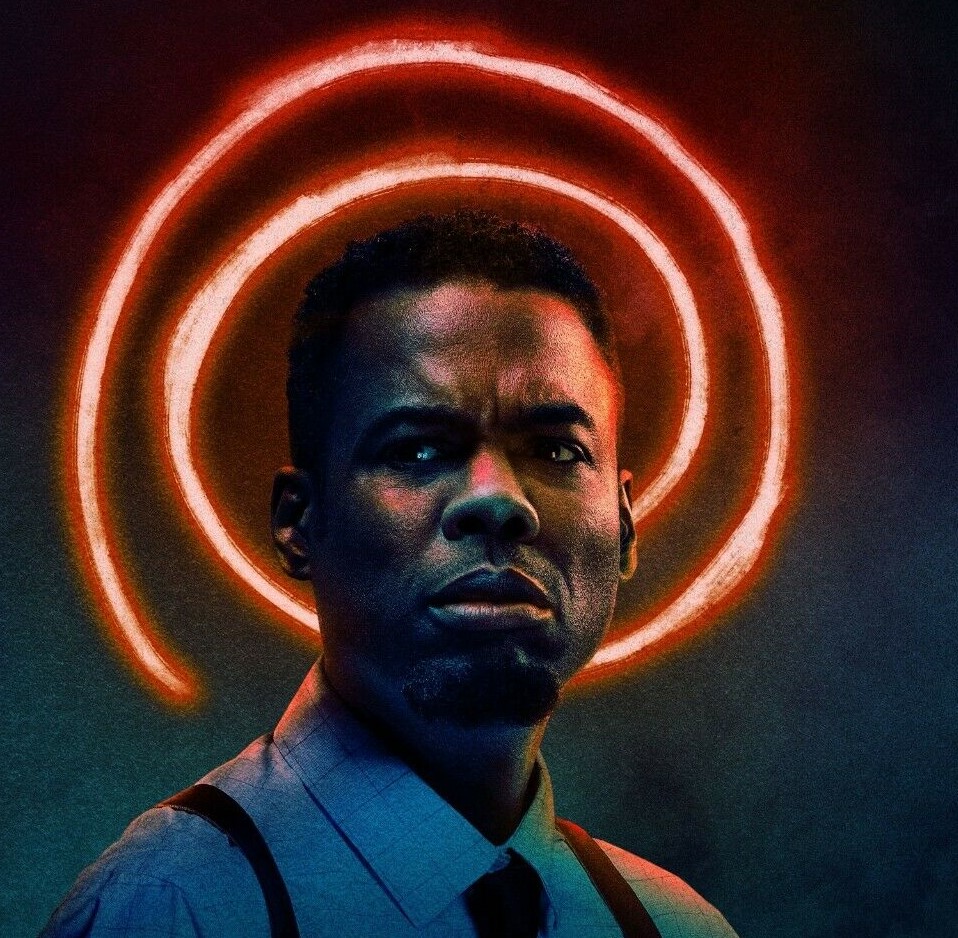
I was never a big fan of torture porn nor for that matter of Chis Rock, too loud and brash for my liking, but oddly enough they make a compelling combination in this unusual idea for a reboot. This is pretty much a police procedural, corruption the background beat, with torture – or at least the victims – providing the clues. I was astonished to realize Rock (Bad Company, 2002) is now in his mid-50s and that could certainly account for the loss of some of his manic energy but the rest I have to admit is down to the emergence of a genuine acting talent.

Like the Russell Crowe character in American Gangster (2000) or Al Pacino (1973) in Serpico he is what cops appear to hate – incorruptible – so he is loner detective Zeke Banks until newbie detective William Scheck (Max Minghella) is forced upon him. Whatever horrific crimes are now being committed appear to point to a past when Banks’s father Marcus (Samuel L. Jackson) was king cop. and to his relationship with Zeke’s current boss (Marisol Nichols).

You could view this as a cynical attempt to revive a series well past its best, and these genre mash-ups rarely work, but in this case, mostly thanks to Rock, it has all the makings of an entirely new series.

As ever, the deaths are inventive and gory. But the gory bits are well sign-posted so you can skip past them and catch up on the detective elements. Max Minghella (Horns, 2013), who has been off the movie screen for over half a decade, makes a good comeback and for once a Samuel L. Jackson character has some depth. Marisol Nichols makes a strong impression also, given that she had mostly been a television player. Perhaps as interesting as the jump taken by rock is that director Darren Lynn Bousman, who has three previous Saw outings in his portfolio, has not just managed to refresh the idea but devoted as much attention to the various detectives as to the gore.

The Woman in the Window (2021) *

I stopped watching this mid-drivel so don’t count on me for a balanced assessment. But it does point up the dangers of the current Netflix obsession. In the cinema, no matter how bad a picture, I would always stay to the end.  Particularly with Netflix’s movie joblot I found myself switching off in frustration that it was ever given the green light. I bet, though, Twentieth Century Fox were delighted to have been able to offload it onto Netflix, which provides no acceptable measure of audience response, rather than watching it sink like a stone at the movie box office.

It’s also a cautionary tale about the problems of snapping up a bestseller supposedly in the Gone Girl (2014) and The Girl on a Train (2016) vein, both featuring as here an unreliable narrator, without working out how such fiction might translate to the screen. Buying bestsellers is usually an astute piece of business from the Hollywood perspective. Both the novels mentioned sold in excess of 20 million copies. Even if only 10 per cent of the book buyers went to see the movie, you are talking about $20 million already at the box office. If it’s 20 per cent, then that’s a flat $40 million, and so on.

Bestsellers tended to get snapped up quickly, often in pre-publication, and although they might come with riders attached relating to copy sales, generally you are looking at a movie sales tag of around $1 million. That’s a tiny fraction of the cost of any movie budget with the double bonus that readers will more than offset the purchase price and that the bestseller angle provides an easy marketing hook.

I go to the movies once a week and watch at least two films and sometimes as many as four. And I pay to go. I buy my ticket rather than, as a movie critic, gaining free access. So I’m a sucker for almost anything and if you’ve been reading my Blog you’ll see that I have a pretty high tolerance level and enjoy a wide variety of pictures. So it takes a lot for me to get a downer on a particular movie.

So what’s gone wrong here? The book pivoted on the notion that the protagonist Anne Fox (Amy Adams), imprisoned by agoraphobia in her apartment, views the world through the prism of old Hollywood movies. So old pictures inform much of the writing, they are referenced all the time, almost in the sense of “what would Humphrey Bogart do.” That’s just not an option for a movie, so we are only given a few glimpses of films like Spellbound and they do not play any part in explaining her mental state.

So then it’s basically a re-run of Rear Window (1954) with instead of voyeuristic proclivities being deemed acceptable because it’s James Stewart doing the peeking we have what is effectively a creepy “cat lady” (minus the cats of course) who moons around her apartment drinking. She employs a psychiatrist but he’s redundant in movie terms because we already know she’s loopy and we don’t need to be told that, and that no matter what she did it’s not going to make us look upon her with any more kindness. Why? Because she has a singularly unattractive personality.

Amy Adams (Arrival, 2016) can normally be relied upon to deliver a good performance, but she is hopeless, generating not an ounce of sympathy for her predicament, not helped by going spare at kids doing nothing more dangerous than enjoying Halloween. But she’s not alone in producing audience antipathy. Of the couple across the street whom she spies upon, Jane Russell (Julianne Moore) has obnoxiousness down to a tee while husband Alistair (Gary Oldman) is over-the-top. And if an audience can’t find anyone to like it’s not going to like the film. 

For a film boasting two Oscar-winners – Gary Oldman for Darkest Hour (2017) and Julianne Moore (Still Alice, 2014) – plus six nominations for Adams and one for Jennifer Jason Leigh and stars Anthony Mackie and Wyatt Russell from current television mini-series The Falcon and the Winter Soldier (2021), this is a hatful of talent waiting for a rabbit to jump out and perform a miracle cure on a thriller with no thrills. A packet of exposition gets in the way of audience involvement and director Joe Wright (Pride and Prejudice, 2005) fails to make any headway in the Hitchockian department.

Perhaps the most bizarre aspect of his movie car crash is that its timing could not be more apposite. A film about not being able to go out during a pandemic that confined global populations to their homes should have struck some kind of chord. Of course, it’s been sitting on the Twentieth Century Fox (now rebranded as “20th Century Movies”) shelf since 2019 and it might have been better for all concerned had it stayed there.

Catch this on Netflix.

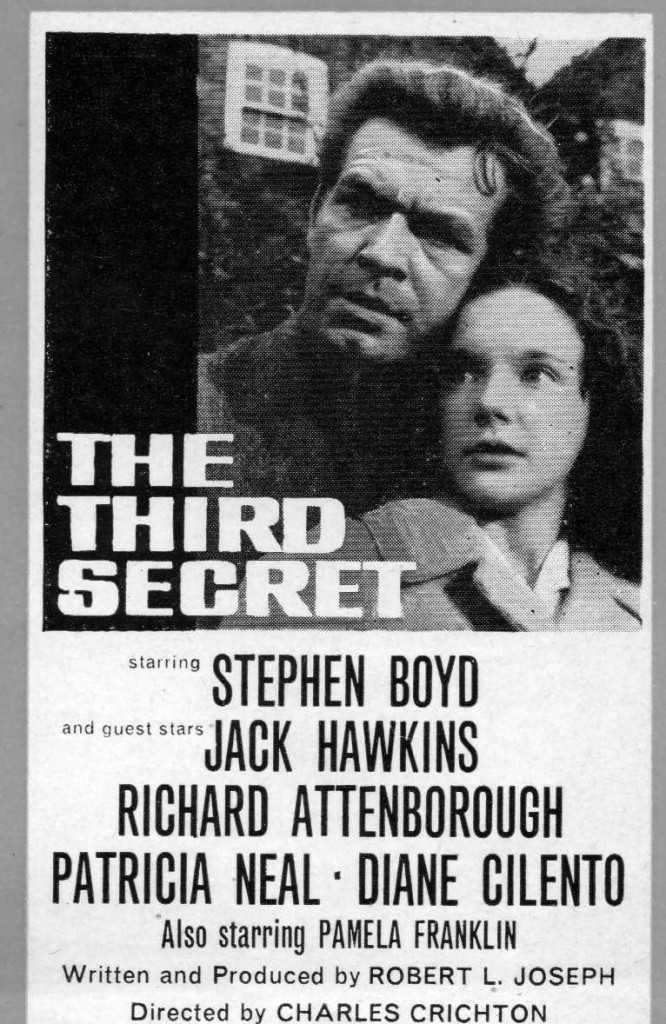
The Third Secret (1964) ***

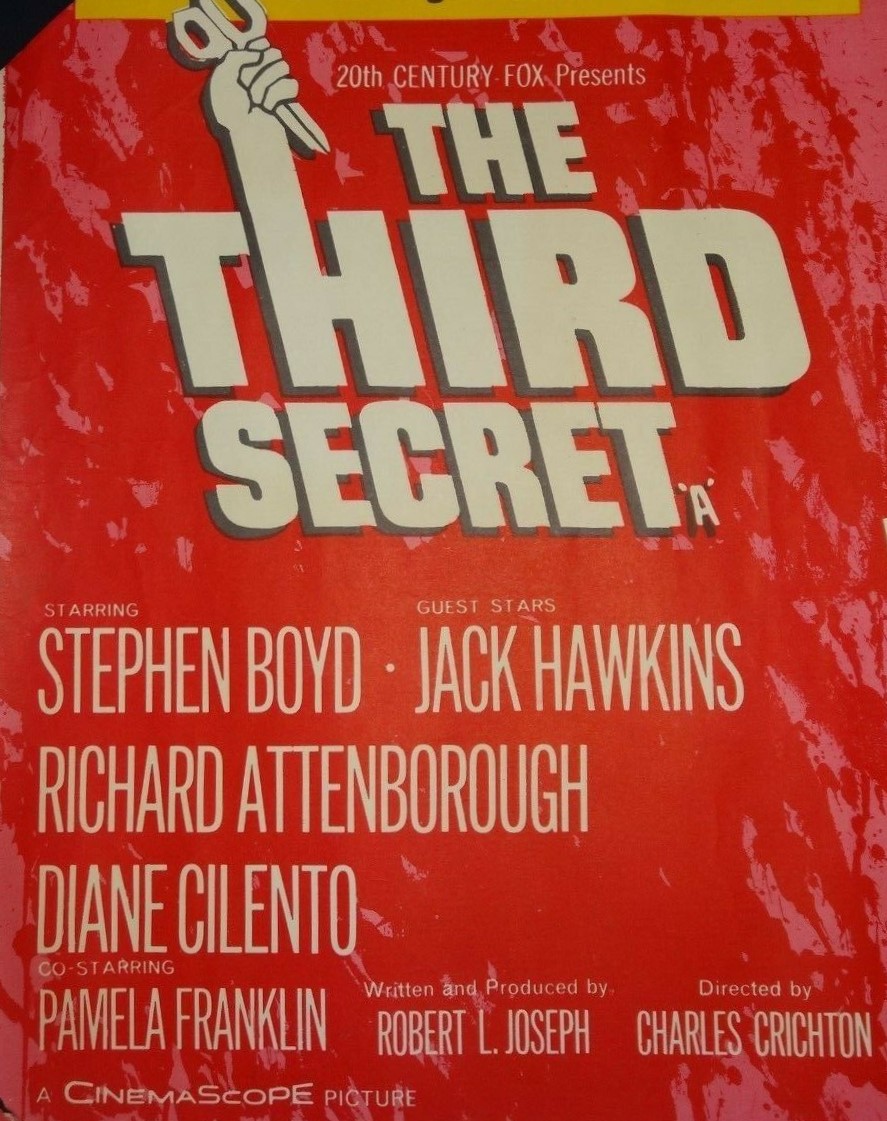
Non-exploitative films about the psychologically vulnerable were thin on the ground during the 1960s and although The Third Secret is a bit talky nonetheless it does explore issues normally dealt with in heavy-handed fashion. Catherine Whitset (Pamela Franklin) the young daughter of a famous psychiatrist convinces television journalist Alex Stedman (Stephen Boyd) to investigate her father’s supposed suicide. Whitset needs the murder verdict because otherwise she will lose her home (no insurance payout on suicide). Stedman, Whitset’s patient, wants a similar outcome because his world would be turned upside down if the psychiatrist had committed a deed which he appeared steadfastly opposed.

The main suspects are all patients of the dead doctor – judge (Jack Hawkins), gallery owner (Richard Attenborough) and secretary (Diane Cilento). Although all outwardly successful socially-functioning upstanding members of society each is mired in mental agony – anger management, sexual inadequacy, depression, low self-esteem among problems addressed – defenses against which are perilously thin. Under sustained pressure each of the individuals will crack to reveal the cowering creature underneath.

But are they the killer or just condemned to torment? With the one man who could keep them sane removed from their lives, who knows what carnage they can self-inflict. All, even Stedman – given to bouts of terrible rage and drunkenness – seem capable of murder and there is every likelihood (as any viewer will guess) that his investigation could lead back to himself.

Director Charles Crichton (The Lavender Hill Mob, 1951) might have been suffering from low self-esteem himself having been unceremoniously dumped from The Birdman of Alcatraz (1962) and certainly the atmosphere is one of severity, not just characters teetering on the brink, but the black-and-white photography rendering London a wasteland, the tide on the Thames always out so the shore is just mud. However, his compositions do have style. The title’s explanation by the way is that the first secret is what you keep from the public, the second is what you hide from yourself, but the third is the truth.

Boyd (Ben-Hur, 1959) and Franklin (The Innocents, 1961) appear often on the point of hysteria, the girl’s high-pitched voice set against his growling outbursts. Attenborough (fresh from the heroics of The Great Escape, 1963) plays against type as a hand-wringing wannabe artist stuck in a role he despises. Hawkins, too, more used to heroic roles, is convincing as a man trying to escape his past. The neurotic Cilento has the best scenes, touching in her efforts to cling to normality. Judi Dench makes her debut in a bit part. The investigation takes the form of character analysis rather than “where were you on the night of…” which gives the picture an unique flavor, but best to know that going in rather than complain about the slow pace. If the psychological does not keep you hooked, there are sufficient twists to keep you watching.

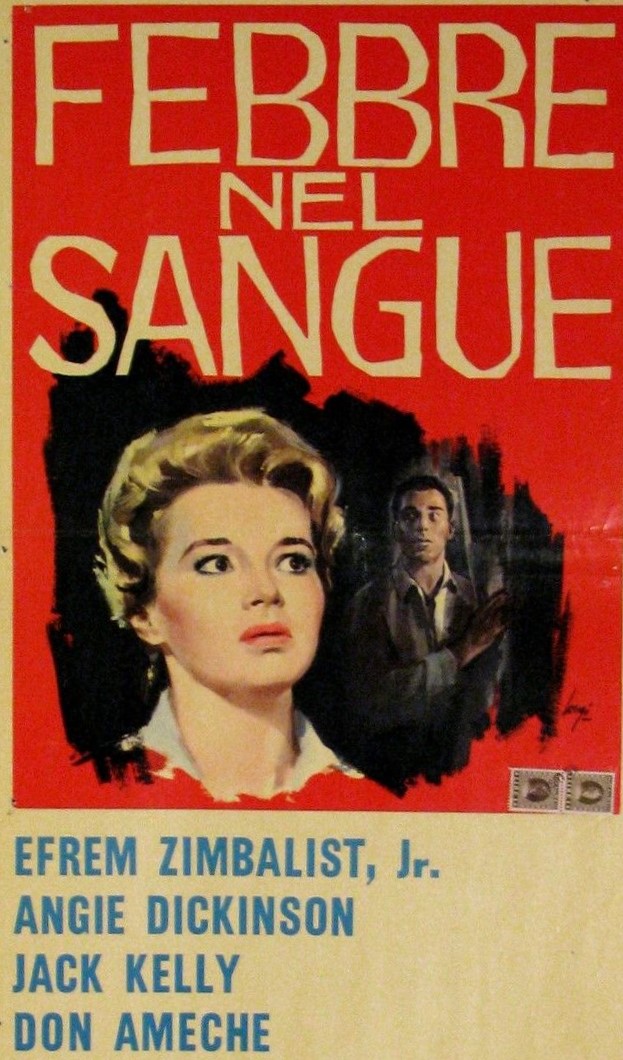
A Fever in the Blood (1961) ****

Blistering B-film from writer Roy Huggins (TV’s The Fugitive) that marries political chicanery to legal jiggery-pokery in a movie that races from one twist to another. In his role as producer Huggins calls upon actors he made stars from the television series he created – Efrem Zimbalist Jr. (77 Sunset Strip), Jack Kelly (Maverick) – and gives Angie Dickinson (Oceans 11) the female lead. Huggins’ brilliant premise is to ignore the dilemma of the man, Walter Thornwall (Rhodes Reason), nephew of a former Governor, wrongly accused of the murder of his wife. Instead the film concentrates on accuser District Attorney Dan Callahan (Kelly) and Judge Lee Hoffman (Zimbalist Jr), both of whom, running for the vacant Governor post, stand to make massive political capital from the publicity surrounding a sensational trial.

Former buddies, Callahan and Hoffman are now bitter rivals after the former had reneged on a promise to support the latter’s bid for the political post. Also throwing his hat into the ring is Senator Alex Simon (Don Ameche) whose wife Cathy (Dickinson) once had romantic yearnings for Hoffman. The only one of the trio who had anything approaching a conscience is Hoffman and that is immediately tested when the Senator offers him a bribe to stand down from the race, which the Judge, after an appeal from Cathy, does not report to the authorities. There is another ploy open to Hoffman. Should he find reason to declare a mistrial, that would sabotage Callahan’s bid since he would not be riding high in the media after convicting a celebrity killer.

The picture jumps from intense politics, the wheeling-dealing and the wrapping up of votes, to a  trial in a packed courtroom very much in the Perry Mason vein with surprise witnesses, shocks, objections sustained or overruled, clever arguments, dueling attorneys, and last-minute evidence. A witness has Thornwall running away from the scene of the crime and when his wife is painted as a nymphomaniac that provides ample motive.  Further evidence pushes the defendant into a worse corner. But all the while over the trial hangs the stink of political machination.

There are another half-dozen brilliant twists not least of which is Judge Hoffman letting conscience go hang and embarking on a couple of dodgy endeavors himself including what amounts to sheer blackmail. The District Attorney, one of the sharpest tools in the box, reacts to every setback with a cunning that would have been criminal had it not been legal. Also hanging there is potential adultery between Cathy and the widowed Hoffman.

The writer in Huggins is a past master at shifting the cards in the deck and this has so many twists and turns it feels like a whole series of The Fugitive crammed into one episode. There is as much self-awareness of the underbelly of politics as in Advise and Consent (1962), as much deceit and corruption, as much principle disguised as honor. But the plot here is so tight, the characters dealing with twists and turns that the movie has no requirement for the depth of characterization that would have been brought to the picture by a Henry Fonda or Charles Laughton. Huggins proves you can have just as much fun without the big boys. None of the stars with the exception of Angie Dickinson made a dent on the Hollywood A-list but they are all perfectly acceptable, and once Huggins tightens the screws plot-wise the last thing on your mind is wishing for a better cast.   

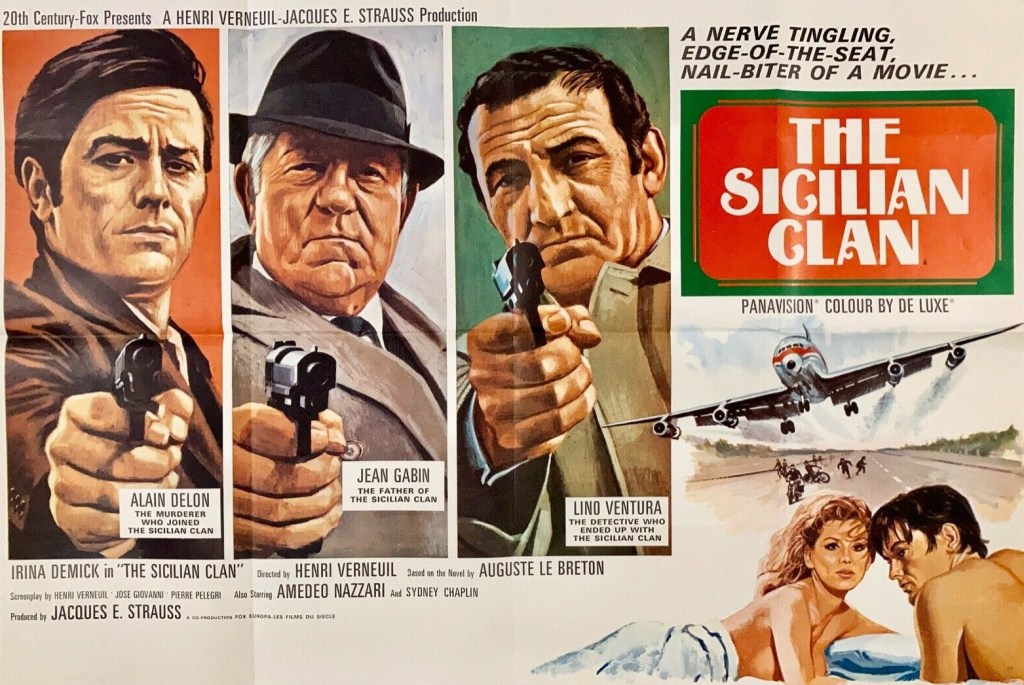
The Sicilian Clan (1969) *****

Absolutely cracking, brilliantly structured, gangster thriller featuring two fabulous heists and three legendary French stars in Jean Gabin, Alain Delon and Lino Ventura. Roger Sartet (Delon) is a trigger-happy robber whose prison escape is organized for a hefty fee by French-based Mafia chieftain Vittorio Manalese (Gabin). Le Goff (Ventura) is the rugged cop hunting down the escapee which brings him into the orbit of Manalese, about whose existence he is completely unaware, the gangster having kept an extremely low profile, never engaging in violence, hiding behind the legitimate front of a pinball machine business.  Veteran French director Henri Verneuil (Guns for San Sebastian, 1968) dukes between the twin storylines with ease.

Jean Gabin was easily the most famous French actor of the time with a career spanning four decades from Pepe Le Moko (1937) and La Grande Illusion (1937) to Holy Year (1976) . To many he was the best Inspector Maigret (1958). Generally ignored by the French New Wave directors, this picture showed what they were missing.

Sartet brings Manalese the opportunity to pull off the most audacious jewel robbery in history, even though the older man despises Sartet’s penchant for violence and sex. We often see Manalese at family gatherings, head of the dinner table, the family watching television together, frowning at one son’s liking for alcohol, playing with his grandson. He is not just a calm and clever businessman, but very quick-thinking, his sharp mind in a couple of instances preventing disaster. Sartet, on the other hand, will happily endanger his life and freedom by consorting with prostitutes and breaking an unspoken code of honor in an affair with Manalese’s daughter-in-law (Irina Demick).

The result combines dogged detective work by Le Goff and the inspired planning and execution of the jewel robbery until the two worlds collide. The investigation alone would have made this an outstanding picture. Le Goff, always seen with an unlit cigarette in his mouth although he is trying to give up smoking, concentrating initially on Sartet, sets up surveillance on the thief’s innocent sister and begins an involved – and engrossing – process of tracking down every potential lead and when at last he has Sartet in his sights it brings him up close to Manalese.

Le Goff’s professionalism is matched by that of Manalese and the picture develops into an absorbing battle of wits and the latter’s family values and moral compass puts him at odds with loner Sartet. There is some brilliant invention, the sacrificial watch, for example, and the unexpected appearance of a faithful British wife, although you do guess just how long Le Goff will go before lighting his ever-tempting cigarette.  

The ultra-cool Delon excels in this kind of amoral part, but Gabin and Ventura as old-style gangster and cop, respectively, steal the show. Demick thrives as the bored wife of a dull gangster who is attracted by the violent Delon, at one point deliberately putting herself in the line of his potential fire for the thrill. Actually, it’s the jewel heist that steals the show. Unlike other heist pictures where you have fair idea in advance of the details of the theft, here the audience is kept completely in the dark. Just as important in any heist is that the thieves get away with their plunder and the plan in this instance is breath-taking.

Catch it on Amazon Prime.

Ocean’s 11 (1960) ***

Heist pictures break down into planning, execution and reprisal. Here the planning stage moves at a leisurely pace, a bit of recruitment, and setting up bitebacks that will cripple the military-precision plan by ex-army buddies to rob five Las Vegas casinos of millions of dollars on New Year’s Eve. There’s a bit of reversal, Mr Big (Akim Tamiroff) is a collection of nervous tics, Jimmy Foster (Peter Lawford) a rich guy seeking financial independence from a possessive mother, Sam Harmon (Dean Martin) having second thoughts about the operation, and Danny Ocean (Frank Sinatra) trying to win back estranged wife Beatrice (Angie Dickinson) who surmises he prefers danger to intimacy. Mostly, it’s repartee between Harmon and Ocean while Foster makes a chump out of his mother’s next potential husband Duke Santos (Cesar Romero).

There’s not much hi-tech about the audacious plan, knocking out the electricity supply to the casinos, the switch to auxiliary power allowing the gang access to the inner sanctum where the cash is held, finding their way in and out of the darkness by nothing more sophisticated than luminous spray paint, and with a clever ruse to get the money out once all hell breaks loose.

The fun starts when one of the team (Richard Conte) drops dead post-raid and it transpires Santos is a big-shot underworld figure who investigates the robbery on behalf of the casinos and starts tracking the gang down, leading to a pay-off you don’t see coming.

Given the comedy element, there’s no great tension but it’s a pleasant enough diversion and Sinatra and Martin display an easy camaraderie that lights up the screen. It could have been funded by the Las Vegas Tourist Bureau so much attention is given to the wonder of the casinos, at a time when gambling was still only otherwise legal on racetracks, and with snippets of floorshows and the deluxe atmosphere. Add in a couple of numbers delivered a couple of times by Dean Martin (“Ain’t That a Kick in the Head”), legitimately since he is a cocktail bar singer, and Sammy Davis Jr. (“Eee-O-11”), somewhat shoehorned-in given he is a truck driver.

There’s a couple of neat reversals: Ocean’s dumped girlfriend Adele (Patrice Wymore) gets short shrift from Beatrice when she reveals the affair; casino bosses offered a double-or-quits gamble refuse to consider such a dangerous notion. Red Skelton and George Raft have credited cameos, Shirley MacLaine does not. As well as Richard Conte, Henry Silva (The Secret Invasion, 1964) has a small part as does Norman Fell (The Graduate, 1967).

Although there are on occasion outdated sexist attitudes, there is also a strong anti-racist statement in the hiring of Sammy Davis Jr., showcasing his talents in a big-budget picture, and clearly making the point that he has been welcomed by stars as big as Sinatra and Martin.  

And it’s worth also considering the picture in terms of early-onset brand management.  The “Rat Pack” was a loose group of entertainers which not only became a well-known stand-alone entity in its own right that celebrated what was considered “hip” at the time (assuming you excluded Elvis and his ilk), but as individuals supported each other on television and in live performance. They would make another two pictures as a team and another dozen or so where two or more of the players appeared. The principals were all major attractions at the nascent Las Vegas so they were also promoting their home patch. During the day they made the movie, at night they wove in and out of each others’ acts, creating an entertainment sensation. On top of that, Sinatra had his own record label Reprise – among the early acts Dean Martin and Sammy Davis Jr. So, in a sense, all this cross-promotion was money in their pockets.

Also of note are the opening and closing, the former for the credits devised by Saul Bass, the latter for the famous shot later appropriated by Quentin Tarantino for Reservoir Dogs. Ironically, Lewis Milestone, who devised the original shot, and long before that won two Best Director Oscars, is less well regarded these days than Tarantino.

Daddy’s Gone A-Hunting (1969) ***

Everyone wants to be a star-maker. Director Mark Robson thought he had some form in this area after Valley of the Dolls (1968) showcased Barbara Parkins and Sharon Tate. There’s no doubt British actress Carol White reveling in critical kudos for Poor Cow (1967) had promise. But not necessarily good professional advice otherwise how to account for a supporting role in Prehistoric Women/Slave Girls (1967) her first picture after success in three BBC television productions. The female lead in Michael Winner’s I’ll Never Forget Whatisname (1967) was followed by a small role in the more prestigious John Frankenheimer drama The Fixer (1968). But none of these films did anything at the box office. Enter Mark Robson.

This thriller might have made her a star had it not been so darned complicated. It veers from paranoia to stalkersville to Vertigo via Gaslight without stopping for breath and some elements are so obviously signposted at the start you are just waiting for them to turn up. Plus, if ever a film has dated, it’s this one, going back to the days when abortion carried automatic stigma and fathers could get away with lines like “you murdered my baby.”

So, one of the few times in history San Francisco got snow (it averages zero inches annually according to Google) the meet-cute is sketch artist Cathy (Carol White) being hit by a snowball thrown by wannabe Kenneth (Scott Hylands, making his debut). But when she realizes how much he enjoys watching cats stalking canaries decides she doesn’t want his baby and aborts it.  A few years later she marries congressional candidate Jack (Paul Burke from Valley of the Dolls) and when pregnant crosses paths with Kenneth who manages to insinuate himself into her family via her husband. Twist follows twist until we are on the Top of the Mark (a famous city landmark) for a gripping climax.

White does well as she shifts through the emotional gears but she is barely given respite from being overwrought so at times her acting appears one-dimensional rather than varied. In fairness to her, the movie’s plot gives her no chance to deliver a settled performance. Hyland looks as if he’s auditioning for a role as a serial killer, but the depth of his cunning and his twisted perceptions kept this viewer on edge -what it would take for Cathy to make amends will chill you to the bone.

Robson has some nice directorial touches, a scene reflected in the eye of a cat, a clever jump-cut from marriage proposal to marriage ceremony and some flies in milk.  Mala Powers makes a welcome big screen appearance after nearly a decade in television. That this whole concoction emanated from the fertile imaginations of screenwriters Larry Cohen (It’s Alive, 1974) and Lorenzo Semple Jr. (Fathom, 1967) might give you an idea of what to expect.

Catch-Up: Mark Robson films previously reviewed in this Blog are: The Prize (1963) and  Lost Command (1966).  

            +

Discover WordPress

A daily selection of the best content published on WordPress, collected for you by humans who love to read.

The Atavist Magazine

by Brian Hannan

WordPress.com News

The latest news on WordPress.com and the WordPress community.