Murder a la Mod (1968) ***

Take all the best elements of the Brian De Palma canon – conflicting perspective, stylish camerawork, complex narrative, diffuse sexuality, a sense of a director on the prowl, what you think you see not actually what is taking place. Take all the worst elements of the Brian De Palma oeuvre – conflicting perspective, stylish camerawork, complex narrative, diffuse sexuality, a sense of a director on the prowl, what you think you see not actually what is taking place. Yep, the very elements that make his movies work are usually what make them not work at all.

Here, in embryo, is the director of the future – the one whose understanding of cinema, excess, and willingness to take chances delivered such gems as Sisters (1972), Obsession (1976), Carrie (1976), Blow Out (1980), Dressed to Kill (1981), Scarface (1983) and The Untouchables (1987). And such misfires as The Fury (1978), Home Movies (1979), Body Double (1984), Bonfire of the Vanities (1990) and Femme Fatale (2002).

File this under “lost movie,” too self-conscious for arthouse, not enough narrative drive to be commercial, but sufficient experimentation to make it interesting.  Setting aside the director’s  penchant for showing off, this is as full of twists as many of his later films. As in Dressed to Kill the purported heroine is killed off, as in Body Double the narrative is on the sleazy side, extremely sleazy if you consider the snuff movie section, as in Blow Out we’re not sure who or what to believe, and in homage to Psycho (1960) the good girl turns bad in order to smooth out a relationship with a married man.  

Ironically, the opening is an unintended ironic homage to Me Too as an off-camera director tries to get a succession of girls to take off their clothes – and perhaps someone will do a study of just how many starlets were led to the casting couch in this fashion or convinced that nudity was the only way to advance their career. Each of the women have but one line to speak, about only doing this to finance a divorce. For one unfortunate, this is the last screen test she’ll undertake as she is slashed to death.

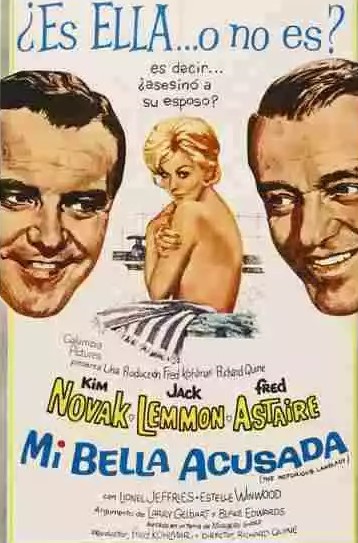
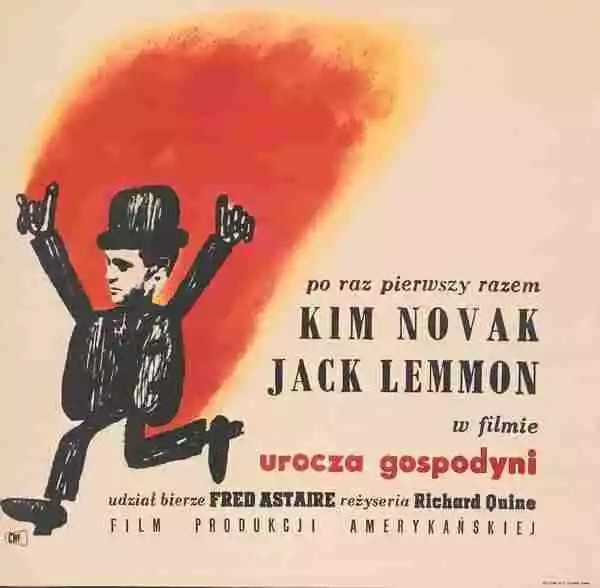
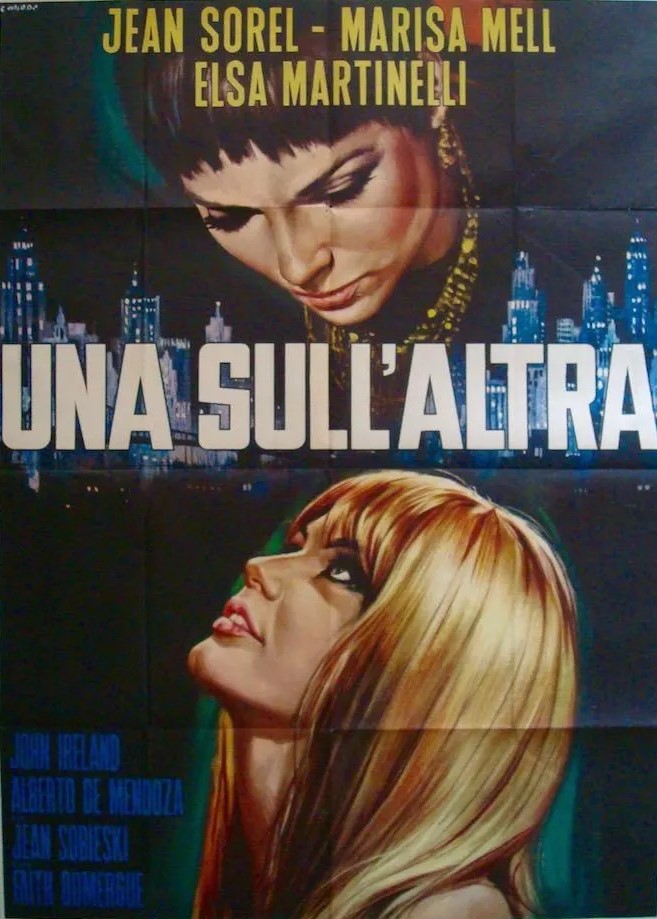
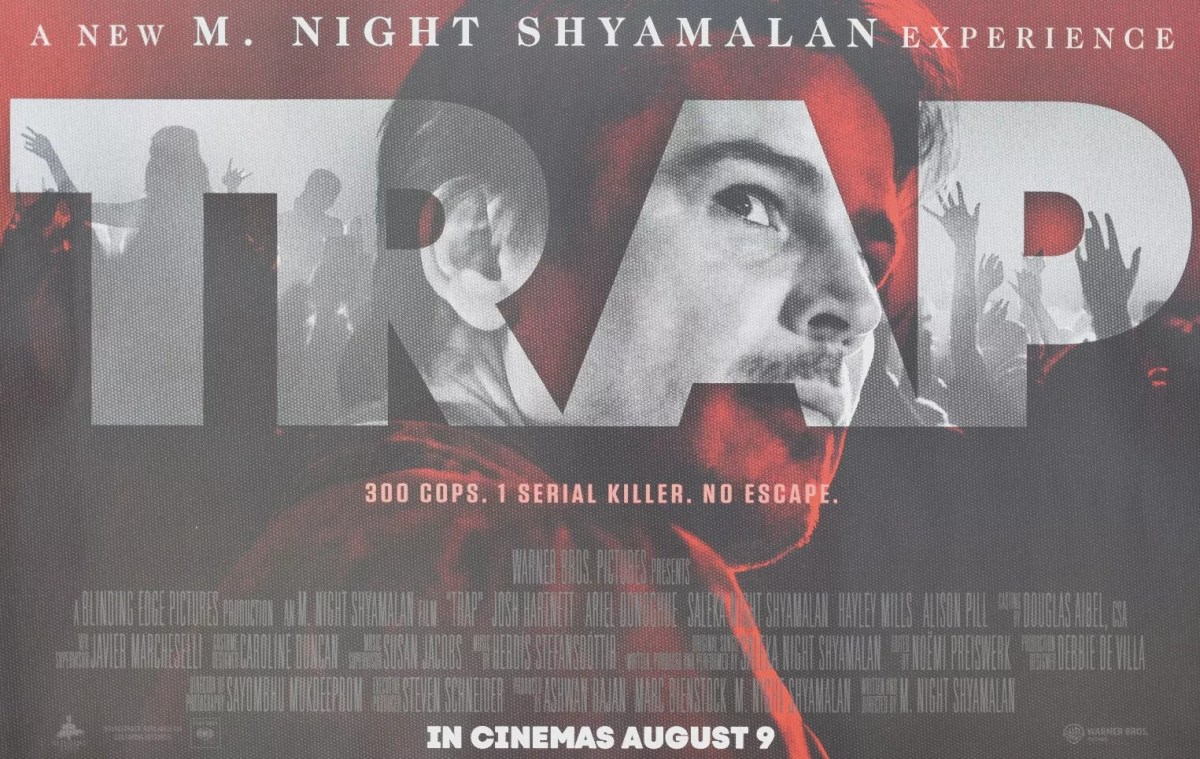
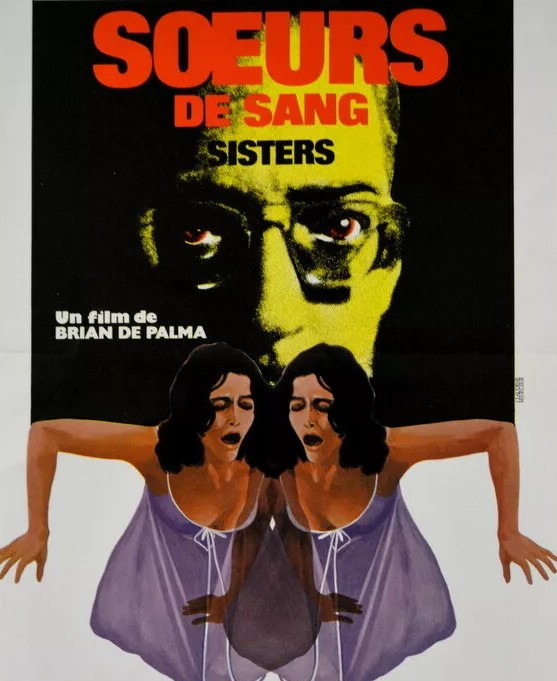
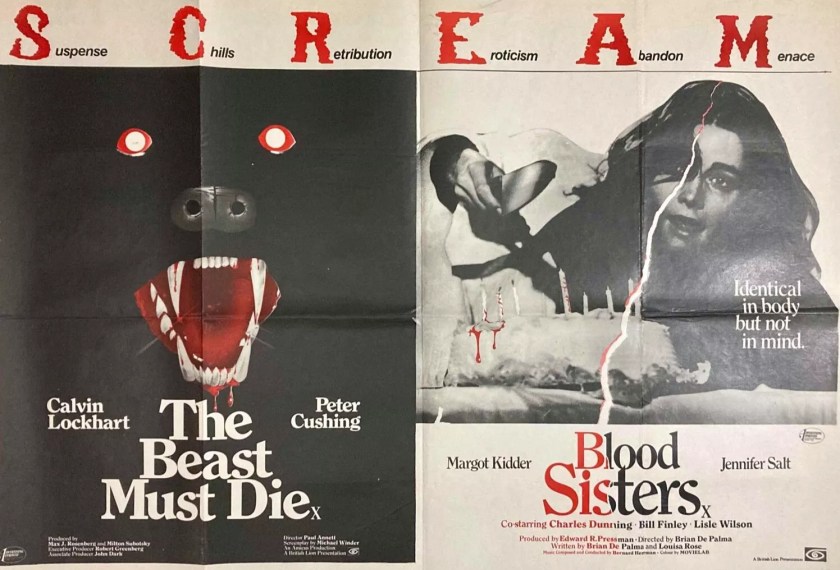
Yep, I couldn’t find any more posters of the movie I’m reviewing so I’m making do with something else from the De Palma back catalog.

Karen (Margo Norton) discovers her lover Chris (Jared Martin), who she believed to be a widower, is in fact not only married but a director of sexploitation films and complicit in a peeping tom scam. He is only doing this, he says, to finance a divorce. She is so in love that, apparently in keeping with the times, she accepts being slapped around. And so in love that, to prevent him wasting his talent by demeaning himself on such shoddy goods, she steals cash from socialite pal Tracy (Ann Ankers) to fund the divorce.

After a fake attack by nutcase Otto (William Finley) with a prop ice-pick, Karen is done to death by a real assailant with a real ice-pick. So then the tale shifts into Rashomon territory as we follow the perspective of different characters in different time periods, each time uncovering a bit more of the truth – or perhaps the fiction, who knows.

It’s quite a bold statement of directorial confidence to play bait-and-switch with the narrative, as characters who seemed resolutely in the background lurch into the foreground and at times the camera jiggery-pokery gets in the way of the narrative jiggery-pokery.

But there’s enough going on to maintain audience interest, even if sometimes the novelty of direction seems an indulgence too far. Possibly, from the contemporary viewpoint, this is better viewed as a historical document, a condemnation of the lure of cinema, how the male hierarchy believed that females were so submissive that they could easily be persuaded, with the offer of very little in the way of a concrete career, to disrobe, and almost taking the attitude that should someone object it mattered little because there were plenty others willing to put ambition before principle.

One of the best scenes is a creepy ogling bank manager, the kind of ugly male who assumes that from his position of authority he is superior to a woman who is way out of his league and far wealthier than he’ll ever be. Though why she is dumb enough to leave her valuables in an unlocked car is anybody’s guess, except for narrative convenience and the opportunity to rack up some Hitchcockian tension when a cop suddenly appears and begins to interrogate the woman the audience knows is a thief.

There’s a DVD around somewhere plugging this as the “lost” De Palma movie, but you can catch it for nothing and judge just how indicative of De Palma’s talent it might be – and how much he was served later by hiring better actors – on Youtube.

Lepke (1975) ***

Gangsters are just the same as you and I. They want to be loved, they want a family, they want the kind of respect that isn’t achieved by just pointing a gun at someone. The Godfather (1972) led the way in subtly reminding us that gangsters were human beings even if it was more seductive in making us believe we should excuse their criminal tendencies. Lepke spends as long on romance and trying to win the approval of the bride’s father as it does on the character’s perfidy. The idea that marriage cannot so much absolve you of your sins but provide an oasis of calm inside a murderous world is one only a true romantic would consider pursuing. As is the notion that a wife would forgive you your sins because her love would outweigh your actions, in the same way as the wife-beaten wife (as shown in Love Lies Bleeding) still loves her husband no matter how brutal the treatment meted out.

Lepke has got reason to be sore with the world. He was left out of the gangster chronicles. An important part of the Murder Inc operation, he was ignored when Hollywood passed judgement on such criminal enterprises. And you get the sneaky feeling his life story was only revived because after the Coppola epic his was one of the few tales untold in the gangster chronicles.

“If there’s any good in him, that’s the part I’ve got,” says wife Berenice (Anjanette Comer), “If I was a whore I could leave him.” And you can see the part she adores, not only respectful to the point of being obsequious to her upstanding father Mr Meyer (Milton Berle), but charming and romantic with her and he’s clearly able to separate business from romance, turning into an exemplary family man (but then so, too, did Don Corleone).

Which is just as well because Lepke (Tony Curtis) is a dreaded Mafia enforcer, forming a murder syndicate with Dutch Schulz (John Durren)  and Lucky Luciano (Vic Tayback) that takes responsibility for knocking off anyone who steps out of line away from the big bosses. There’s some standard gangster stuff, machine guns in violin cases, bombs in the spaghetti, but also some interesting touches, a shoot-out on a carousel, and of course the last person a gangster can trust is the one he places his truth with. Double-dealing is the order of the day.

Like all the top gangsters, Lepke is an entrepreneur, expanding out of the killing racket into dope, extortion and trade unions. New York D.A. Thomas E. Dewey is on the Murder Inc case and his assassination is only prevented by the intercession of Lepke. But he’s tackled as much by Robert Kane (Michael Callan), friend to Berenice who works in narcotics along with Dewey.

Dewey’s not the only real-life character making an entrance. Legendary journalist Walter Winchell (Vaughn Meader) plays a significant role. Most of the picture involves Lepke  being nefarious by day and loving at night and the gang are only tripped up when witnesses need to be eliminated and as the cops work a similar kind of dodge to the one that snared Al Capone. Instead of tax evasion it’s anti-trust issues.  

Covering the period from 1923, Lepke’s emergence as a ruthless street rat, and his development of the narcotics business by sourcing product direct for the Far East,  to his execution in 1944, it pays only cursory attention to the period. Most of the time, Lepke is fighting for his life one way or other, suspicious of colleagues, walking a knife-edge between actions that could inavertently lead to his demise, and trying to remain the best part of himself that remains appealing to his wife.

That any of this works other than being a standard depiction of the rise and fall of a gangster is down to Tony Curtis (The Boston Strangler, 1968) who delivers one of his best later performances while maintaining a difficult balancing act, clearly believing that he can separate the two sides of his personality, and that the murderous part is really just a performance. The documentary-style rendition helps as this can be complicated stuff, especially with so many disparate traitors.

Anjanette Comer (Guns for San Sebastian, 1968) is always watchable.  Menahem Golan, of Golan-Globus and Cannon fame, perhaps taking a cue from The Godfather, takes considerable care with the family elements and is rewarded with a better picture than the elements might suggest.

This pretty much rounds out my Hollywood History of the Gangster.

The Asunta Case (2024) ****

You didn’t used to get away with this. Until recently, screen murderers had to be unveiled or at the very least, if getting away with their crime, come unstuck in the final few minutes as with Jagged Edge (1985) or tip the wink to the audience in the manner of Keyser Soze in The Usual Suspects (1995). About the only thing Netflix can genuinely take positive credit for is the invention of a subgenre of movies/series about unsolved crimes. And now it’s taken that a step further with programs where the killer(s) are apprehended but you never find out why they committed their appalling crimes.

The Asunta Case was very much the Spanish equivalent of the Madeleine McCann Case. The latter attracted global publicity, the former headlines that raged in Spain for years. However, Asunta, the 12-year adopted daughter of the recently separated Rosario and Alfonso, was soon found not far from the couple’s country estate, albeit with hands tied with red twine, and dead.

Although the couple fell under immediate suspicion, there was little sign of motive. Would the mother, a bundle of nerves and very thin, have been capable of drugging and suffocating the child and bundling her into a car and dumping her on a piece of waste ground?  The father appeared a devoted parent and no cameras could find evidence of him anywhere near the estate or the area where the child was found.

So Netflix plays its usual narrative tricks. The couple appear guilty, then innocent, then guilty, then innocent. The investigating team hide evidence that doesn’t back up their case. A witness arrives late in the day. There’s a question of how bright the moon was that night. You can’t match two ends of this kind of twine to prove that the material that bound the child was the same as some found in a waste paper basket. Alfonso is accused of hiding his computer. Jail cells are bugged. There’s a hint that money might be involved. The media undermine the judiciary process by digging up juicy morsels that may or may not pertain to the case and may or may not influence a jury. In the absence of anything conclusive the evidence is almost entirely circunstantial.

What helps the Netflix tale most is the actress (Candela Pena) portrayng Rosario. I’ve no idea how accurate a portrayal this might be. But a more whiny, self-centred individual would be hard to find. Quite how she manages to conduct an affair just prior to the murder defies belief. As does Alfonso’s continued commitment to his unfaithful wife.

It could well be that Rosario’s witlessness, coming to pieces, is the result of loss, or, equally, the impact of guilt. She is a lawyer, so you would expect her not just to be above suspicion, but with a good idea of how the system works, enough to work her way around it. Alfonso (Tristan Ulloa) is a journalist so he, too, must be accustomed to the ways of the media and that refusing to talk will keep the media at bay long enough for his constant protestations of innocence to take effect.

As with most of these dramatized mini series, the information is structured in a way that keeps you on your toes. The situation for the investigative team is complicated in that the chief investigating officer, here deemed a “judge”, has to cope with a father with dementia while one of the cops is undergoing fertility treatment.

And the dramatists do the police work for them, presenting the circumstantial evidence as if it is fact. So what we are given are various options, how the couple could not have committed the crime, in which case the criminal, still at large, could strike again, and how they very much could. And this is after various red herrings dressed up very much as the menu du jour have been discarded, principal among which is the idea that the girl has been sexually abused, as she is seen early on wearing clothing and make-up inappropriate for her age, such photos found on the missing computer, and yet with a genuinely innocent explanation.

The investigation appears to focus more on Rosario – killer mother worse than killer father it would seem – although Alfonso’s implacability would drvie you to drink. The investigators don’t get off scot free either, complicit in permitting the judge to ignore evidence favorable to the defense. In the end the crime is solved, or at least a verdict reached, but the truth remains hidden, neither of the accused fessing up, no psychiatric reports to provide clarification, no suggestion that Alfonso did it to inflict terrible injury on the mother more than the child, which is often the case in child murders.  

The dubbing’s annoying and you might enjoy this more watching it in the original Spanish with subtitles.

Whatever, it is totally absorbing, for the most part because of the mystery of the couple themselves, how they came to be in this position, and whether doubt remains.

Compulsive viewing.

Love Lies Bleeding (2024) *** – Seen at the Cinema

This year’s Saltburn. An ethereal mix of noir, exploitation, wife beating, body building, carpetbagging, blackmail, steroids, bug snacking, daddy issues, such a long string of coincidence it could run a marathon, topped off with a healthy dose of surrealism. I guess going with the flow brings reward. Not sure it made much of being set in 1989, no signs of movie theater marquees promoting Batman or Indiana Jones and the Last Crusade though the principals might have got a buzz out of Lethal Weapon.

You do have to wonder though at choice. Was this all that Kirsten Stewart was offered or has she aligned herself as the kind of arthouse darling whose attachment makes such an unwieldy project feasible? But an actress who can switch from Seberg (2019) to Charlie’s Angels (2019) and back again to Crimes of the Future (2022) demonstrates the kind of versatility that can sit easily on both sides of the Hollywood fence. But it’s a step too far for martial artist Katy O’Brian (Ant Man and the Wasp: Quantumania, 2023).

Coincidence can only get you so far though generally you can rely on a screenwriter to attempt to magnify relationships by ensuring that nobody gets through a movie without having some difficult relationship. That guy on the corner, let’s make him an uncle. The kid who appears once, let’s make him a drug addict who’s addicted to heroin because he blames himself for his mum dying in childbirth. Coincidence overload has found a true champion here.

So hitchhiker Jackie (Katy O’Brian) has sex in the car of JJ (Dave Franco) on the understanding that he’ll find her a job on a shooting range owned by Lou (Ed Harris) who happens to be the father and shares the same name as Lou (Kirsten Stewart) a gym manager who falls for Jackie’s swelling pecs and who happens also to be JJ’s brother-in-law. Lady Lou happens to have a sometime girlfriend Daisy (Anna Baryshnikov) who happens upon Jackie driving Lady Lou’s car after Jackie’s s murdered JJ. And Lady Lou’s only happened upon the murder because – you can see where this going.

Luckily Lady Lou is experienced in getting rid of a corpse – and luckily there are plenty of good-sized rugs to spare because she has to lug out a total of three dead bodies. Her dad’s a gun-runner and corrupter of cops so he’s immune to pretty much everything unless his daughter decides to rat him out, which might be a complication for her, given that earlier she was running in his slipstream.

There’s plenty lowlife mixed in with high end angst, Lady Lou falling out with Jackie once she cottons on to the fact that she quite enjoys bisexuality and has no objection to swapping sex for a job, not even with an odious wife-beating brother-in-law. And then Lou has to come to terms with the fact that after committing murder Jackie’s only concern is in high-tailing it down to Vegas for a body building competition.

So really way too much narrative and subplot for this thin gruel. But in passing there are some memorable moments. For a start, this is the first time I can remember seeing anyone at a shooting range who isn’t a cop of the Dirty Harry persuasion or a spy. To see ordinary folks happily popping off at targets and enjoying a beer afterwards goes a long way to explain the country’s obsession with ownership of weaponry.

And the face of the victim of the wife-beating was truly shocking as was what was left of JJ’s jaw once Jackie had smashed it into a table. Then we have the surreality – a full-grown Lady Lou pops out of JJ’s mouth covered in birth residue, Jackie’s muscles audibly crack almost every time she takes a breath and when she goes into full-blown Incredible Hulk mode her tee-shirt splits in half, plus she turns into a giant to pin down Daddy Lou.

By the time you get to the end, there’s been so many changes of tempo and mood that you’re grateful that after all this is really a romantic comedy complete with making up on a tennis court and a corpse coming to life in the back of a car. It’s a good few tunes short of a decent picnic, but once you realize this is more of a cartoon than a genuine noir thriller and go with the flow it has rewarding moments. There’s a decent amount of nihilism and almost anytime anyone makes a declaration of love you can be sure they’re going to blow the loved one’s brains out or do something to totally contradict their statement.

As directed by Rose Glass (Saint Maud, 2019), it might have been better if the surrealism had infused the entire movie rather than being reseved, as if the icing on the cake, for the final segments.

As I said, this year’s Saltburn.

Daddy’s Gone A-Hunting (1969) ***

Everyone wants to be a star-maker. Director Mark Robson thought he had some form in this area after Valley of the Dolls (1968) showcased Barbara Parkins and Sharon Tate. There’s no doubt British actress Carol White reveling in critical kudos for Poor Cow (1967) had promise. But not necessarily good professional advice otherwise how to account for a supporting role in Prehistoric Women/Slave Girls (1967) her first picture after success in three BBC television productions. The female lead in Michael Winner’s I’ll Never Forget Whatisname (1967) was followed by a small role in the more prestigious John Frankenheimer drama The Fixer (1968). But none of these films did anything at the box office. Enter Mark Robson.

This thriller might have made her a star had it not been so darned complicated. It veers from paranoia to stalkersville to Vertigo via Gaslight without stopping for breath and some elements are so obviously signposted at the start you are just waiting for them to turn up. Plus, if ever a film has dated, it’s this one, going back to the days when abortion carried automatic stigma and fathers could get away with lines like “you murdered my baby.”

So, one of the few times in history San Francisco got snow (it averages zero inches annually according to Google) the meet-cute is sketch artist Cathy (Carol White) being hit by a snowball thrown by wannabe Kenneth (Scott Hylands, making his debut). But when she realizes how much he enjoys watching cats stalking canaries decides she doesn’t want his baby and aborts it. 

A few years later she marries congressional candidate Jack (Paul Burke from Valley of the Dolls) and when pregnant crosses paths with Kenneth who manages to insinuate himself into her family via her husband. Twist follows twist until we are on the Top of the Mark (a famous city landmark) for a gripping climax.

White does well as she shifts through the emotional gears but she is barely given respite from being overwrought so at times her acting appears one-dimensional rather than varied. In fairness to her, the movie’s plot gives her no chance to deliver a settled performance. Hyland looks as if he’s auditioning for a role as a serial killer, but the depth of his cunning and his twisted perceptions kept this viewer on edge – what it would take for Cathy to make amends will chill you to the bone.

Robson has some nice directorial touches, a scene reflected in the eye of a cat, a clever jump-cut from marriage proposal to marriage ceremony and some flies in milk.  Mala Powers makes a welcome big screen appearance after nearly a decade in television. That this whole concoction emanated from the fertile imaginations of screenwriters Larry Cohen (It’s Alive, 1974) and Lorenzo Semple Jr. (Fathom, 1967) might give you an idea of what to expect.

Murder Ahoy! (1964) ***

Agatha Christie tales were in a mostly B-movie limbo in the 1960s, despite Billy Wilder’s Witness for the Prosecution (1957) and would have to wait another decade before glorious all-star resurrection in Sidney Lumet’s Murder on the Orient Express (1974). In the meantime, audiences made do with Margaret Rutherford’s Miss Marple in an MGM quartet – all directed by George Pollock – that ended with Murder Ahoy!

Rutherford did not enjoy the national treasure status of the likes of Maggie Smith and Judi Dench these days, but she had been elevated to late-career fame by winning the Best Supporting Actress Oscar for The VIPs (1963). But she never quite made the cinematic impact anticipated after Blithe Spirit (1945) and was mostly seen in roles that called for eccentricity or determination, characteristics associated cinematically with Christie’s second most famous sleuth (although, in reality, the author was furious with her impersonation). And this had nothing to do with any published Christie work, just borrowed the character.

The title had led me to expect a picture set on a liner or a cruise ship. Instead, this being a cheaply-made British black-and-white feature, we are limited to sojourn on a sail training ship which remains moored at all times. Nonetheless, Miss Marple (Margaret Rutherford) is resplendent in naval attire and disports herself as if she were the captain.

Her excuse to get on board is the sudden death of a member of the committee overseeing said ship just before he makes an announcement. Miss Marple relies on a good deal more than Hercule Poirot’s little grey cells and through laboratory experiment determines the man died from strychnine poisoning. Among her other hidden talents are signaling mastery and dexterity with a sword and she drops popcorn on corridor floors to warn of imminent arrivals when she invades cabins.

The suspects include Capt Rhumstone (Lionel Jeffries), Sub-Lt Eric Humbert (Derek Nimmo), Lt. Compton (Francis Mathews) and Commander Breeze-Connington (William Mervyn) while Dr Crump (Nicholas Parsons) is described in double entendre fashion as “brisk.”  

Naturally, there is more murder, and the subplots include burglary, secret romance involving Matron Fanbraid (Joan Benham) and thwarted romance with Shirley (Norma Foster). However, nothing can deter Miss Marple and she soon puts the world to rights.

The first in the series.

It’s an engrossing enough little film, the resolution a surprise, and Rutherford has skill and charm enough to almost trademark the role. At one time in the 1960s in the USA the Marple pictures were revived as double bills but generally in Britain treated with less regard.

Although you could argue that MGM could have bolstered the standards of production, much of the merit derives from the quaintness and the quintessential English lives portrayed. Of course, Margaret Rutherford steals the show but he is ably supported by Lionel Jeffries (First Men in the Moon, 1964), Derek Nimmo, strangulated mannerisms from later BBC’s Oh, Brother not in evidence, William Mervyn (Hammerhead, 1968)  and Nicholas Parsons (ITV game show Sale of the Century.)

As a bonus there are moments of well-observed comedy and a very inventive score from Ron Goodwin (633 Squadron appeared the same year).   Directed by George Pollock (Kill or Cure, 1962) from a screenplay by the team of David Pursall and Jack Seddon (The Secret Partner, 1961).

Taken in the spirit it was intended and acknowledging the low budget, not bad.

Berserk! (1967) ***

“Murder is good for business,” declares magnificently callous circus boss Monica (Joan Crawford). And so is nostalgia. Interrupting the action every ten minutes or so with the kind of circus act – courtesy of legendary British ringmaster Billy Smart – that you couldn’t see these days is probably going to win more viewers than seeing Joan Crawford in late vintage nastiness. Roll up, roll up for the elephants ridden by glamorous lasses, death-defying (or not so much) high-wire acts, prancing horses, knife-throwing, cutting a woman (and who better than a sequined Diana Dors) in half, and “intelligent” poodles (is there any other kind?).

Step aside John Wayne (Circus World, 1964), whose magnificent showmanship has nothing on circus master Monica, calling the shots and not just in the ring. She rides roughshod over business partner Albert (Michael Gough), pushes back into his box newcomer Frank (Ty Hardin), and packs daughter Angela (Judy Geeson) off to boarding school to shut the book on maternal instinct in case it gets in the way of running the show.

Throw in a good few hapless coppers, including a toff – Monica being such a big noise it requires the involvement of a Commissioner (Geoffrey Keen) and a Superintendent (Robert Hardy) – who pop up sporadically and show surprisingly little skill for detection beyond standing over a corpse or murder implement and making a pronouncement. Naturally, such an atmosphere is riven with jealousy and it doesn’t take much to start a cat fight, no surprise to see Matilda (Diana Dors) in the thick of it.

When her star act dies (murdered) on the high wire and Monica looks around for a replacement, she happens upon pushy Frank (Ty Hardin) who not only walks across the tightrope blindfold, but operates without a safety net and should he fall will land on a series of nasty spikes. He wants to share her bed and her business, but has some dodgy backstory, hints of some incident in Canada seven years ago.

So just as Monica reckons the thrill of possibly seeing death occur in front of their eyes will pull in the punters, that could be (though I doubt it) an ironic nod at the cinema audience since, as in all serial killer pictures, viewers are calculating who will be killed next, and not so much who the murderer is, but who will survive at the end. Luckily, this is British and made in times when the censor exerted a tighter rein, so you can be sure nobody’s going to meet a sticky end just because they’ve had illicit sex.

As if her employees were scary beasts, Monica beats them into submission, though, in fact, outside of Frank, nobody’s got the guts to challenge her. And it being the 1960s and forensics not much in evidence and, frankly, the producers not much interested in rounding up any suspects, you just sit back and wait to see who will be next. Will someone scare the prize elephant into misplacing a foot and crushing to death the beauties lying on the ground so that it can daintily step over them? Will the knife-thrower miss his marks or the spinning wheel containing his human target be rigged to go awry?

My money was on the poodles attacking their mistress for making them jump over a skipping rope. I hadn’t quite seen coming Albert being foolish enough to lean against a post with his head positioned exactly beside a hole so that from behind someone could hammer a spike into it. That should have made Monica a suspect because he wanted out of the business, except she has stolen and burned their contract and not a single soul in the entire circus appears to know that he even was her business partner.

Angela, when she turns up accompanied by a headmistress, appears to be a chip off the old block, turfed out of yet another school for “causing trouble.”  Monica looks as if she was born to be trouble, and you can imagine the machinations that led her to owning a circus. There’s a surprisingly tender mother-daughter reunion and the daughter is soon enrolled in an act.

The ending seems straight out an Agatha Christie novel, take the least likely contender and make them the villain, with psychobabble as justification.

I have to say that I enjoyed this, as much for the circus acts as for seeing noir queen Joan Crawford (Mildred Pierce, 1945) returning to the tough-as-they-come persona of Johnny Guitar (1954) rather than the theatrics of Whatever Happened to Baby Jane (1962). A pre-lugubrious Michael Gough (Batman, 1989) and a non-blousy Diana Dors (Hammerhead, 1968) add to the treats. Maybe Sidney Sweeney (Immaculate, 2024) consulted the Judy Geeson (Prudence and the Pill, 1968) playbook in assessing the career value of appearing in a horror movie. Ty Hardin (Custer of the West, 1967) is miscast, especially in his high-wire wobbles, though anyone thinking they can act Ms Crawford off the screen should be taken away and locked up.

Jim O’Connolly (Vendetta for the Saint, 1969) directed from a script by the team of Aben Kandel and producer Herman Cohen  (Black Zoo, 1963).

Nostalgic fun.

Monkey Man (2024) ***

I can tell you right away why this hasn’t proved the box office breakout predicted. Way too slow, way too many ideas, way too much repetition, the obvious flaws of a debut director who nobody had the sense to rein in. Dev Patel (The Green Knight, 2021) is writer-producer-director and clearly took control of the editing suite because this should have seriously been pruned of about 20 minutes.

It’s a revenge thriller and supposedly the protagonist is better motivated because somebody didn’t kill his dog (John Wick, 2014) or his bees (The Beekeeper, 2023) but his mom. But this revenge is insanely slow-burn. It’s taken him the best part of two decades to take any action. And in the meantime, he’s had plenty of time to dwell on an idyllic childhood, and the bad guy who murdered his mom, because every two minutes whatever action there is stops dead so we can have another interminable flashback.

If you want a crash course on Indian mysticism and gods and religion, this one’s for you, but my guess if that wouldn’t be a priority for anyone turning up expecting the next John Wick or Beekeeper. And it that’s not enough side issue, there’s some malarkey involving a corrupt politician, corrupt cop and corrupt guru and a land-grab to boot plus the need to set free a whole bunch of sex workers. So, sub-plot mania.

I’m not sure I’m convinced either by the bongo-drum keep-fit technique that turns a loser in the ring into a top combatant, especially after, having spent an age demonstrating how much our hero has improved his pugilistic skills he fells his first opponent with a kick. Cage fighting without the cage, I guess.

But there are pluses, once the director sees fit to get to the action and not ramble on about philosophical mumbo-jumbo and there are a couple of fascinating characters, venomous brothel-owner Queenie (Ashwini Kalsekar) who has the best lines, and the low-life Alphonso (Pitobash) with a souped-up tuk-tuk. But mostly, we’re stuck with Kid aka Monkey Man (Dev Patel) as he takes an age to work out how he’s going to get his revenge and makes the audience labor over working out what happened to his mom and why he got his hands so badly burned. Put those two ideas together and the audience has worked it out in a trice, but the director didn’t think so, so fed it in very slowly bit by bit.

Anyway, Kid is the kind of boxer who makes a poor living being fed to the kings of the ring, he gets paid more if he bleeds. And he’s not doing this for just the money, but, purportedly, to punish himself for his mother’s death and relieve the pain inside, some kind of insane self-harming, that only stops when a guru (the good one not the bad one) tells him he has to direct his inner violence to good purpose.

There’s some nifty stuff about how he manages to get a job in the club/ restaurant (it’s never clear) owned by Queenie whose only connection to the tale is that his mother’s killer, police chief Rana (Sikander Kher), is that he was carrying a box of matches with her logo. I’m sure he could have just gunned the police chief down in the street since this is the kind of guy who swaggers around as if he owns the street, but the narrative dictates he needs to gain access to the club/brothel’s inner sanctum and that’s where Alphonso comes in.

Once it gets going it’s satisfying stuff and with some excellent occasionally innovative fight scenes. Not so sure about the soundtrack, “The Rivers of Babylon” as a throat is cut, “Roxanne” when we reach the brothel. But there’s too much sub-plot to wade through before the action gets core.

When Netflix, hardly an arbiter of taste, rejects your movie, you should take note of their objections which I guess would be the same as mine rather than trying to foist those flaws on the public via cinema release, no matter if Jordan Peele is your staunchest supporter. It’s no surprise to me this hasn’t won a release in India either – blamed on its political stance, apparently – because the same problems would apply.

So that’s a shame. A director with too much to say and decides he might only get the one chance to say it so dumps it all into his debut picture. Let’s hope he gets a second chance and is mature enough to listen to an editor.

Excellent action but, boy, you have to wait.

The League of Gentlemen (1960) ****

Cracking British heist film prefiguring titles as disparate as The Dirty Dozen (1967) and Heat (1995). Superb opening scene shows the lid coming off a manhole cover and after a short pause to avoid being drenched by a municipal street cleaner a man in a dinner suit emerges and makes his way to his Rolls Royce. Say hello to Lt-Col Hyde (Jack Hawkins).

Don’t be fooled by early reviews that tabbed this this an “action-comedy,” the humor is only incidental, while serving the important purpose of cutting the grandiose down to size, and not in the vein of, for example, Beverly Hills Cop (1984).

A group of ex-WW2 officers receive a mysterious parcel containing a pulp novel and £50 in notes torn in two, the other halves redeemed if they turn up for a meeting at the Café Royal in London. The opening section is almost a riposte to the recruitment sequence of The Magnificent Seven, out the same year, which strived for effect, and zipped along with one-liners.

This gang are all down-on-their-luck, any courage or leadership displayed during the conflict counting for nothing in peacetime. The sequence is surprisingly risqué for the period, virtually all the characters engaged with disreputable women. So, we have Major Race (Nigel Patrick) running some gambling scam with easy-come-easy-go confederate Peggy (Melissa Stribling), Lt Lexy (Richard Attenborough) a garage mechanic with a sideline in fixing the odds on one-arm bandits and inclined to steal other men’s girlfriends, and Captain Porthill (Bryan Forbes) a pianist playing in seedy dives and living off a middle-aged woman whom he cheats on.

Barely getting by emotionally or financially are Major Rutland-Smith (Terence Alexander) whose glamorous wife (Nanette Newman) takes a string of lovers while ritually humiliating him and Captain Mycroft (Roger Livesey) running a chaplain racket and selling erotic magazines. Hyde lives on his own in a mansion, his absent wife described as “the bitch.”

There’s an undercurrent here that’s barely explored of soldiers who have lost their way, but at the time it could remain underutilized because audiences would be filled with men whose post-war experiences chimed with these characters. Hyde has come up with a stunning plan to relieve a bank of close on a million pounds, the cash split equally, using the various skills his team had acquired through war service.

It’s a bold and, even if carried out with military precision, frankly terrifying exercise that intends to use machine guns and smoke bombs to scare the living daylights out of anyone who dares intervene, bringing New York-style gangsters to the streets of peaceful London. First stop is an army training where, in a ruse similar to that of the later The Dirty Dozen, Mycroft impersonates a commanding officer, inspects troops and deals out humiliation at the drop of a hat. Without doubt, this is an amusing sequence, especially when his superiors in the enterprise, Hyde and Race, are forced to eat disgusting Army slop, but it fulfils the same role as in the Robert Aldrich picture, the least likely soldier allowed to strut his stuff, tension undercut.

The heist itself follows the normal template of planning and execution and it’s brilliantly done, although the crooks are undone by a minor flaw in the procedure. Except for the opening section, and when Hyde exposes, as perhaps community therapy, the criminality of his gang, we learn little more about them, except, as if revisiting the past, how they respond (or not) to the discipline and hierarchy of the Army model on which the group operates. Scoring points off each other, or rebelling, or meting out punishment for misdemeanors, it’s like being back in the Army.

Nobody’s seeking redemption as in The Magnificent Seven or The Dirty Dozen, but it’s still easy to sympathize with an odd bunch whose expectations have been dashed. The scene where Race witnesses Hyde’s stark living conditions, and then offers to wash up the plates piled up in the sink, tells you a lot about how lost some of these men are.

Excellent acting all round from, by British standards, an all-star cast. At one time the number one British star, Jack Hawkins was an occasional Hollywood pick, leading role in Howard Hawks’ Land of the Pharaohs (1955), major supporting roles in Bridge on the River Kwai (1957) and Ben-Hur (1959). Richard Attenborough (The Angry Silence, 1960) had been a top name for over a decade, Nigel Patrick top-billed in director Basil Dearden’s previous outing Sapphire (1959). Kieron Moore (Day of the Triffids, 1963), Bryan Forbes (better known as a writer and director) and Nanette Newman (The Wrong Box, 1966) were rising stars, and you might want to include Oliver Reed (Hannibal Brooks, 1969) in that roster as he makes a camp entrance in a bit part.

Basil Dearden (Khartoum, 1966) is in top form with a script by Forbes from the John Boland bestseller.  

Worth seeing.

The Burglars (1971) ****

First half pure Walter Hill of The Driver vintage – virtually silent heist, blistering car chase – second half rachets up tension with corrupt cop, femme fatale, getaway stymied and a payoff you won’t see coming.

French jewel thieves led by Azad (Jean-Paul Belmondo) using electronic wizardry crack open a safe in Athens full of emeralds while the owner is away. Passing cop Abel (Omar Sharif) happens by but after conversing with Azad, who claims his car has broken down, seems to be satisfied nothing untoward is going on inside the house. But getaway plans are momentarily foiled when the ship they are due to leave on is unexpectedly berthed for repairs, leaving them with five days on their hands.

Azed’s disappointed girlfriend Helene (Nicole Coffen), who acts as watch for the gang, lolling about a swimming pool with too much time on her hands, attracts unwanted male gaze. Azad, followed by the cop, decides to outrun him, fast car style, and soon they are hurtling through the streets of Athens. Thinking that he’s shaken off his pursuer, and seeking a bit of relaxation himself, Azad chats up glamor model and night-club stripper Lena (Dyan Cannon) without realizing she is in cahoots with Abel.  The cop wants in on the action and is willing to trade by letting Azad off scot-free while dumping the crime onto his confederate Ralph (Robert Hosein).

So, mostly, it’s cat-and-mouse stuff between Azad and Abel, as the latter closes the doors, and the former is unaware of just how cunning a corrupt cop can be. There’s some hair-raising action as Azad has to jump between two buses, and a pursuit in a fairground, Abel naturally on horseback, and as if this was one of those cheap films that always had a shoot-out in a quarry, Azad ends up in one, though, thankfully, not for climactic reasons. The climax takes place in a wheat warehouse (I guess the makers of the later Witness, 1985, took a few clues from this.)

Mostly, it’s the character interplay. Two big stars in one film often results in scenes involving  both kept to a minimum – think Paul Newman and Steve McQueen in The Towering Inferno (1974) or Robert De Niro and Al Pacino in Heat (1995) –  but here’s it’s the opposite and watching Belmondo and Sharif dancing around each other, one or other always in the ascendancy or with a neat trick in the back pocket or a get-out-of-jail-free card for later, works a treat.

Sharif, especially, had widened his scope, running away from the matinee idol tag and this came at the end of an impressive stint that included the villain in Mackenna’s Gold (1969), The Appointment (1969), The Last Valley (1971) and The Horsemen (1971). As shabby as Columbo, but with a bit more chic, he knows he’s got to keep one step ahead of Azad, though he could indulge in a few smirks, since he’s so far ahead of the criminal, Abel won’t know what hit him when he realizes he’s been played for a dupe by Lena.

Dyan Cannon (Bob and Carol and Ted and Alice, 1969) plays her role to perfection, hints of sadness that her life is not as glamorous as she might want, possibly considering betraying her real partner, but as seductive as all-get-out. This was a bold career choice, because she had mostly been allotted wife/girlfriend parts rather than, as here, central to the machinations.

Jean-Paul Belmondo (Breathless, 1960) never appealed as much to the American audience as countryman Alain Delon, mostly because he refused to take the Hollywood coin, preferring to do his own thing in France, but he is excellent here and he would have been ideal in plenty mainstream U.S. pictures.

Hats off once again to Henri Verneuil (Guns for San Sebastian, 1968). The heist is deftly done, running a full 24 minutes, give or take a few moments for tense  conversation with the nosey cop. The second unit filmed the chase, of course, but Verneuil is a master at this particular tune. He co-wrote the script with Vahe Katcha (Two Weeks in September, 1967) from the novel by David Goodis (Shoot the Piano Player, 1960). Bonus of an Ennio Morricone score.

Sizzling set pieces, cracking characters.

Discover WordPress

A daily selection of the best content published on WordPress, collected for you by humans who love to read.

The Atavist Magazine

by Brian Hannan

WordPress.com News

The latest news on WordPress.com and the WordPress community.