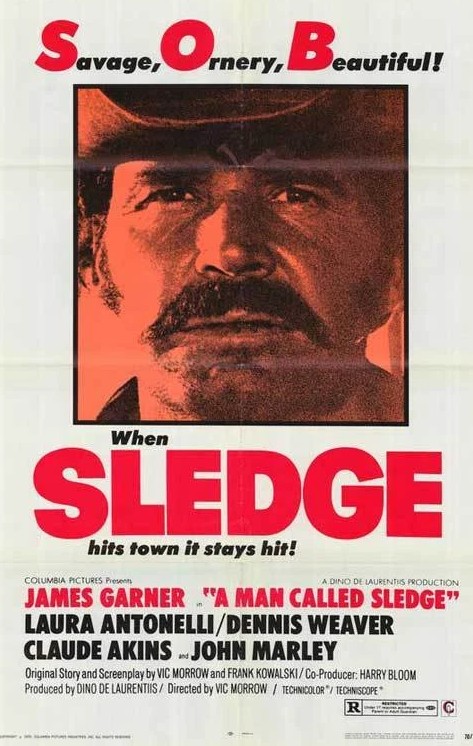
A Man Called Sledge (1970) ***

It’s a risky business for an established star to change their screen persona. The only reason they’ve achieved stardom is because there’s something appealing and even comforting about the persona they’ve adopted. Audiences queue up to see a screen favorite because they know what they’re getting. That still leaves room for chameleons like Dustin Hoffman, whose appeal is the exact opposite, moviegoers don’t know what they’re going to get from one movie to the next.

James Garner (Buddwing, 1966) had a curious screen persona. Sure, he was laid-back and his delivery involved a drawl but his persona, drawn from the scallywag Maverick (1957-1962), also included an element of the sneaky. He wasn’t always as straightforward or heroic (The Americanization of Emily, 1964) as you might expect, but that made him comfortably different.
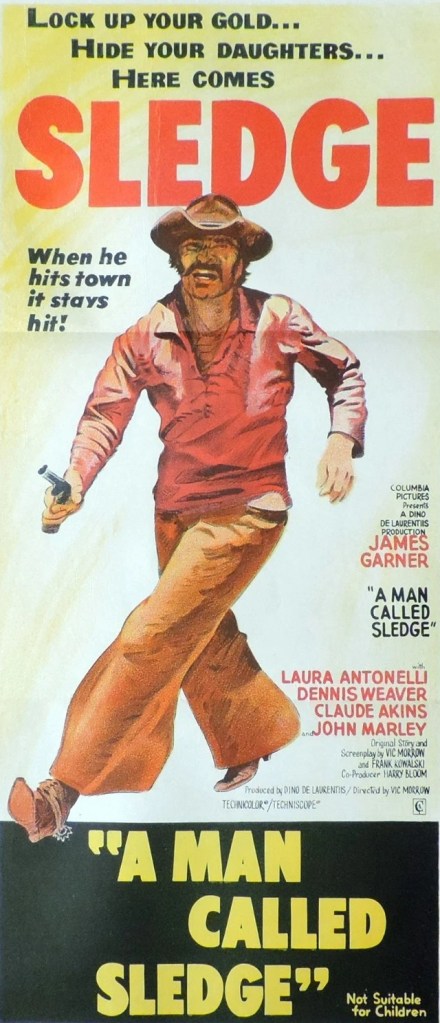
But it’s one thing to make minor changes to your screen persona, it’s another to dump it completely. Even his combed-back hairstyle is gone as well as the rest of his screen persona as he leans into the sneaky part. He’s an outlaw. And not charming like Butch Cassidy and the Sundance Kid (1969) and not hawking around a code of honor like The Wild Bunch (1969) and not a bad guy doing good for whatever reason. His only one redemptive feature is that he’s fallen in love.

On the other hand, if you’re going to play a villain, you better be a smart one, capable of shooting your way out of tricky situations, clever enough to outfox the authorities and able to come up with a plan to steal $300,000 in gold dust from the biggest and most secure safe ever build in the strongest stronghold you could find.

In short order, we are introduced to Luther Sledge (James Garner) robbing a stage, meeting up with girlfriend Ria (Laura Antonelli) and being ambushed in a saloon by gamblers who don’t like losing. Making good his escape, he comes across the Old Man (John Marley) who suggests the unthinkable, stealing the gold. The obvious method would be taking the gold when it’s being transported from the gold mine to the safe.

But it travels with a heck of a guard, more or less a small army, drilled to perfection, armed to the teeth. So, Sledge resorts to the inside job routine. Only problem is the stronghold is actually a prison with 500 prisoners and the safe is inside the maximum security section. Even so, the Old Man, whose done time there, reckons he has listened often enough to the tumblers on the safe being turned that they won’t need to resort to dynamite and the like.
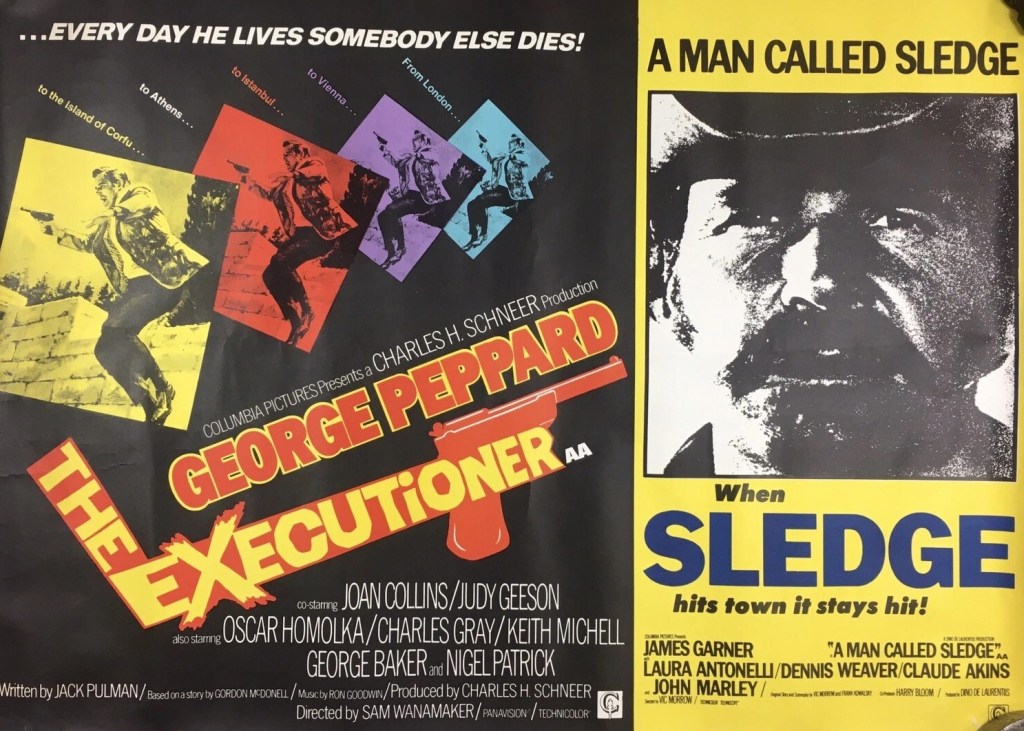
Sledge gets his buddy Erwin Ward (Dennis Weaver) to act as sheriff taking him in as a prisoner, then once inside he plans to free all the prisoners to create a diversion and tie down the guards.

As you might expect this is achieved with a little hitch here and there to ratchet up the tension. But then when we expect an army of guards in hot pursuit and a massive shootout or Sledge to come up with some other clever way of escaping, it turns into The Treasure of the Sierra Madre (1948) and the tension just drains away, hampered by a cute unbelievable ending where Sledge chooses love over gold.

Somehow the third act robs it of what it had going for it, a tough guy devoid of sentimentality, in the vein of the Lee Marvin of Point Blank (1967). You might as well have inserted an old lady or a kid and be done with it as the reason for Sledge to change his ways and, unfortunately, it just kills off interest in the character. Redemption isn’t what we came for. You can get that any day of the week at the movies. But, ruthlessness, that’s a different story and you’d be surprised how well that can play.

Maybe there’s some unseen Hollywood code. If you’re a proper star, you can only be a tough guy if you don’t kill people (i.e. Butch Cassidy though not The Sundance Kid) or if your toughness is in pursuit of bad guys (True Grit, 1969).

There are some other interesting elements. There’s a second ambush, a street shoot-out, a la The Wild Bunch. There’s a banjo-playing deputy sheriff and a keen-eyed Sheriff (Wayde Preston) who can suss out a wrong ‘un. Dead men earn their keep, either on horseback providing cover or lying on the ground where their pistols come in handy. A small town is emptied by people attending a funeral, masked faces and all.  

And there’s a good bit of sense – a Derringer has such a short range that a prison guard with the necessary keys for escape has to be passed cell by cell down a row until he can come within shooting distance for the gun to achieve its threat.

James Garner is indeed excellent in his new disguise, drawl gone, hair flopping all over the place, not a quip in sight. There’s not much room for anyone else though Claude Akins (Return of the Seven, 1966) deserves a nod. Italian Laura Antonelli (The Innocent, 1976) as the hooker in love sparkles though I’m guessing she was dubbed. John Marley (The Godfather, 1972) is a scene-stealing role does his best to steal the movie from Garner.

Actor Victor Morrow directed this, his sophomore effort. He had a hand in the screenplay, too. He parlayed the fame he’s achieved from long-running television series Combat (1962-1967) in attempting to shift him from being cast as the bad guy on the big screen but, unfortunately, he’s best remembered not for this but for his tragic ending, when he died on the set of Twilight Zone: The Movie (1983).

Which is a shame because this is a decent enough effort.

Engaging enough when in heist mode, less so when it disappears down the Sierra Madre rabbit hole.

A Child Is Waiting (1963) ****

While once the main interest in this piece would have come from fans of Judy Garland, lapping up her penultimate movie appearance, the prevalence of mental illness these days especially among the young, in part due to Covid and the scourge of social media, should switch audience attention – especially among contemporary viewers – back to the subject matter.

Garland’s stock had risen somewhat after her performance in Judgement at Nuremberg (1961), her first movie in seven years, but, given the travails of her private life, would most likely have been sympathetic to anything that cast a light on mental illness. The bulk of movies covering this ground tended towards the lurid, as exemplified by Shock Corridor (1963) and Shock Treatment, (1964) rather than the more tragic Lilith (1962). Whatever the approach, they focused on adult conditions. Here it’s the treatment of children.

Appreciation of the social conscience of star Burt Lancaster has largely gone unnoticed but this was the era when his movies touched upon crooked evangelism (Elmer Gantry, 1960), teenage gangs (The Young Savages, 1961), the Holocaust (Judgement at Nuremberg, 1961) and the effects of long-term imprisonment (The Birdman of Alcatraz, 1962). He was even an animal rights protester in The List of Adrian Messenger (1963).

Parental attitude to offspring with mental conditions is encapsulated in the opening sequence. Outside a hospital a young boy is tempted out of an automobile. Once out, the driver (the father) races off so fast the car door is still swinging open. Mentally or emotionally disturbed children were dumped, ostracized or abandoned by society, sometimes shut up in institutions along with adults, with treatment belonging to the Dark Ages.

Drawing on the ground-breaking approach of Vineland Training School in New Jersey and the Pacific Hospital in Pomona, California (pupils from the latter played the students in the film), the movie attempts to cast a light on the forgotten and to show that, with proper care and education, they need not be such victims of their circumstances.

The movie focuses on Dr Clark (Burt Lancaster), head of the Crawthorne State Training School, whose pioneering work combines tender encouragement with firm application, and the new music teacher Jean (Judy Garland) who challenges his approach. Instigating this crisis is 12-year-old Reuben, the child we see offloaded at the start, for whom Jean develops an unhealthy bond. She thinks Dr Clark is too strict and that his methods don’t work with someone as vulnerable as Reuben. Clark’s aim is to make the children so self-sufficient they are not condemned to a life in an adult institution.

Jean’s intervention creates a crisis in the child’s life but also brings home the unwelcome truth of the difficulties parents have of dealing with their children.

And while the tale is essentially confected to make the necessary points and Dr Clark and Jean epitomize opposite attitudes to handling the treatment of children, the story is really a documentary in disguise, bringing to light advances in care, and with the children not played by actors, brings a greater reality to the work.

Burt Lancaster, as ever, is good value and Judy Garland steps up to the plate. Gena Rowlands (Machine Gun McCain, 1969) and John Marley (Istanbul Express, 1968) also feature.

While this fits neatly into Lancaster’s portfolio, it stands out for the wrong reasons in the pantheon of critically-acclaimed actor-turned-director John Cassavetes (Faces, 1968). In fact, what he produced went against what producer Stanley Kramer (better known as a director – Judgment at Nuremberg, for example) wanted and the version we see is the one Kramer recut. Written by Abby Mann (Judgment at Nuremberg) from his original teleplay.

You might expect this to be awash with sentimentality but that’s far from the case.

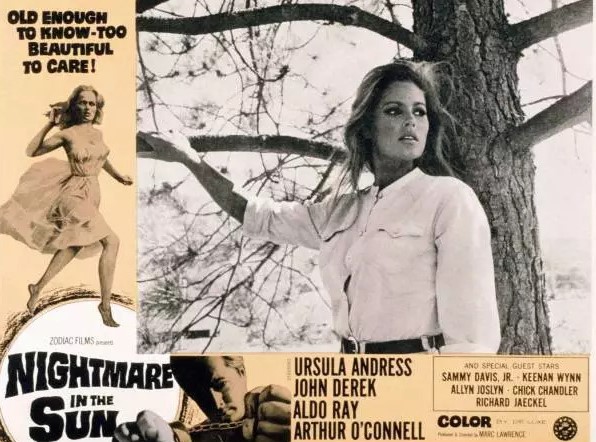
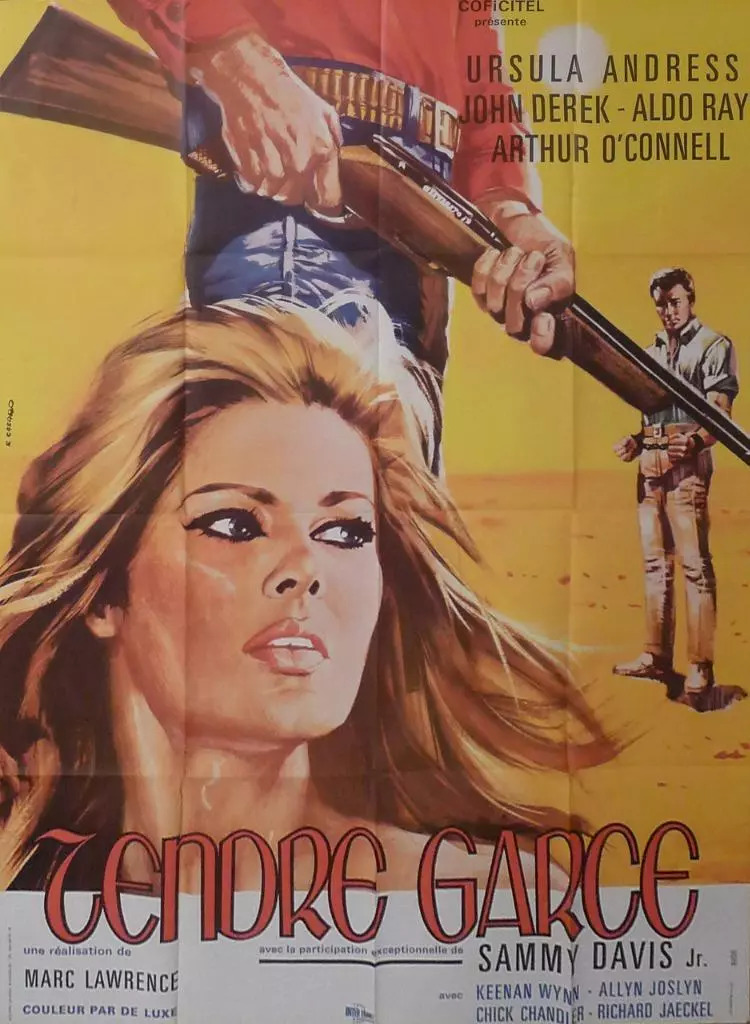
Nightmare in the Sun (1965) ***

Your first question is how did rookie director Marc Lawrence have the standing and the foresight to  assemble such an amazing cast? Not just wife-and- husband team Ursula Andress  and John Derek (Once Before I Die, 1966) upfront, but Rat Pack member Sammy Davis Jr (Sergeants 3, 1962), The Godfather (1972) alumni Robert Duvall and John Marley, Aldo Ray (The Power, 1968), Richard Jaeckel (The Devil’s Brigade, 1968), Keenan Wynn (Warning Shot, 1966) and Arthur O’Connell (Fantastic Voyage, 1966).

And it’s bold work, throwing the Psycho dice, playing the hell out of the noir tune, most of the time heading down a nihilistic road, and with a terrific twist for a climax. Some great scenes that with a more experienced director would be instantly memorable and managing to fit into what should be a straightforward thriller some intriguing oddball characters.

Anonymous drifter (John Derek) ends up in a small town in Nowheresville where Marsha (Ursula Andress) has a slew of lovers including the sheriff (Aldo Ray). Wealthy rancher husband Sam (Arthur O’Connell) is the jealous type who checks out her speedometer to see if her tales of out-of-town visits tally up. Naturally, a handsome stranger is easy prey to her seductive charms but when hubbie spots said stranger leaving his house he loses his rag and kills her.

Holy moly, talk about Psycho, getting rid of the sexy star one-third of the way through is a heck of a note. Who does this director think the audience is coming to see? But if he’s no  Hitchcock, he’s got another trick up his sleeve. Sheriff won’t let the husband plead guilty, not when he can play that card for all it’s worth, rooking the rancher for thousands of bucks, so he decides to pin the blame on the man seen leaving the house. Not only that, he plants evidence, stolen jewellery etc, on the suspect and handcuffs him.

Suspect escapes, taking with him a cop car, but those handcuffs are tougher to remove than most cinemagoers have been led to believe from previous yarns. A hacksaw won’t do it nor will trying to burn them apart with an oxy-acetylene cutter. So he’s stuck with carrying about proof of guilt or at least suspicion and spends most of the time picking up cats or items to hide the evidence.

A couple of bikers (Robert Duvall and Richard Jaeckel) decide to chase the reward money, able to scoot through the desert in a way denied the cops’ four-wheelers. It’s a shame this pair are anonymous, as most characters here are, defined by occupation rather than slowing down the pace with introductions. So it’s the Robert Duvall character who we discover is more fragile than his appearance would suggest and lashes his bike with a chain when his character is questioned.

So here’s the oddball line-up: a couple (George Tobias and Lurene Tuttle) running a small-time animal-bird sanctuary, nursing back to health creatures peppered with gunshot or the wounded version of roadkill; a junkyard dealer (Keenan Wynn), one-time hoofer who can’t wait to demonstrate his moves; and a type of boy scout leader (Allyn Roslyn) whose troop gets lost in a sandstorm, one of whom our drifter rescues. The latter sequence has a touching aspect, rescued child, probably the only person in the whole movie with an understanding of law, accepting a suspect as innocent rather than guilty, is betrayed by the leader who instead of helping our escapee to safety, hands him over to the cops.

And to a final, quite unexpected, climax.

So it’s corruption all the way, even our innocent, supposedly heading home to a beloved wife, taking time out for a touch of adultery.

There’s something about these early low-budget films that brings out the best in Ursula Andress. She’s not just spouting lines to fill in some essential part in a story, but takes her time over delivery, essentially establishing character with what she does between talking and for a practised seducer there’s an innocence in her pleading, “Please take me somewhere nice.”

Aldo Ray is as odious as they come, sneaky too, and you sense he has practice on pinning the blame on the wrong person. And no wonder the wife plays around when her self-pitying husband gets so stoned he passes out.

I saw this on a very poor print on YouTube but even so its narrative qualities, if less so the direction, were obvious.

Worth a look.

Discover WordPress

A daily selection of the best content published on WordPress, collected for you by humans who love to read.

The Atavist Magazine

by Brian Hannan

WordPress.com News

The latest news on WordPress.com and the WordPress community.