I am a published author of books about film - over a dozen to my name, the latest being "When Women Ruled Hollywood." As the title of the blog suggests, this is a site devoted to movies of the 1960s but since I go to the movies twice a week - an old-fashioned double-bill of my own choosing - I might occasionally slip in a review of a contemporary picture.
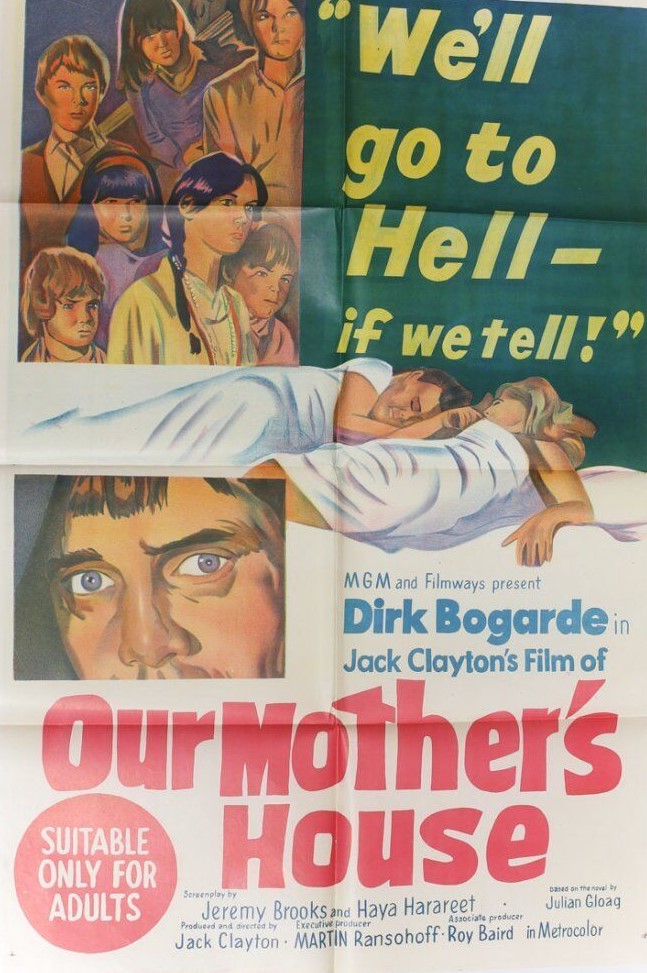
Lord of the Flies set in a sprawling London Victorian mansion. At its best when kids give rein to vivid imagination, not so strong when melodrama intrudes.
After the death of her invalid mother and dreading being sent to an orphanage, eldest child Elsa (Margaret Brooks), who has been with the help of a maid running the house anyway, determines that she and the rest of the brood will pretend their mother is still alive. They bury the body in the garden, manage financially after Jimimee (Mark Lester) discovers an aptitude for forging their mother’s signature on the monthly cheques she receives from a trust fund, and hold séances in the shed to commune with the deceased one.
To maintain the pretence, they get rid of the nosey and querulous maid Mrs Quayle (Yootha Joyce) and come up with all sorts of reasons to explain their mother’s absence to school teachers and neighbors. Child fears run rampant as they visualize the terrible lives they would lead in an orphanage. But the generally tolerant community lifestyle is disturbed by the dictatorial rule of Elsa, determining that Gerty (Sarah Nicholls), for example, must have her long hair sheared off for innocently breaking a house rule and, in keeping with their mother’s fundamentalist beliefs, refuses to call a doctor when the girl falls ill. But the séance takes on a creepier aspect, Elsa the one in communion with her mother and therefore using the supposed other-worldy presence to enforce her will.
So far, so Lord of the Flies, and excellent in its depiction of a world ruled by children according to their fears and beliefs and without adult intercession. But it loses its grip when melodrama takes hold.
Their mother’s dissolute husband Charlie (Dirk Bogarde) returns, romancing Mrs Quayle, and, initially, spoiling the children, who are delighted to see him. He soon reverts to form, spending all their money, getting Charlie to forge his mother’s signature on the house deeds, planning to pocket the proceeds and dispatch the kids to an orphanage. Worse, he breaks the spell their seemingly devout mother had over their children, informing them that their mother’s conversion to religion only came after a life of debauchery and that, in fact, every single one of them is illegitimate and not his offspring. That’s too much for Diana (Pamela Franklin) who kills him with a poker.
Too many twists for sure and by diverting a fascinating dissertation of childhood into adult melodrama robs the film of much of its power.
Director Jack Clayton had been here before with The Innocents (1961) but, there, less was spelled out. Dirk Bogarde (Justine, 1969) is surprisingly good as the charming rough layabout with an eye to the main chance but it’s the children who captivate especially Pamela Franklin (And Soon the Darkness, 1970) and Mark Lester (Oliver!, 1968). The children’s innocence in any case would have been despoiled as they challenged Elsa’s rule and it would have been more satisfying to go down that route.
It was based on the bestseller by Julian Gloag and for anyone wondering what happened to Haya Harareet (Ben-Hur, 1959, and The Secret Partner, 1961) she married Clayton and is credited with the screenplay of this along with Jeremy Brooks.
The Jules Verne express grinds to a halt in part because the promise of outer space adventure fails to materialize and in part because the treatment is comedic in the manner of The Great Race (1965). A series of sketches with a shifting array of characters rarely works. Occasionally it hits the mark in a laugh out loud fashion but too often the jokes are labored although as a tribute to a maze of inventive invention it’s a treat.
Unusually for such an all-star cast venture, we are, long before the titular action and a race (of sorts) commences, treated to the greatest hits from the book of all-time failures. So we have electricity setting on fire the first country house, belonging to the Duke of Barset (Dennis Price), to be so illuminated; a new-fangled suspension bridge, courtesy of Sir Charles Dillworthy (Lionel Jeffries), that collapses when Queen Victoria cuts the ribbon; and a new type of explosive invented by German von Bulow (Gert Frobe) that proves a tad overpowering. Meanwhile, making possible the idea of sending a man to the moon is the arrival in Britain of the diminutive General Tom Thumb (Jimmy Clitheroe) accompanied by the bombastic and greedy Phineas T. Barnum (Burl Ives).
Combining the various scientific advances of propulsion and engineering have the flaw of not being able to bring a manned rocket back home. And sinister forces are at work, spies and fraudsters.
As with all these all-star comedies you spend half the time wondering how your favorite star is going to be worked into the equation and, having been squeezed into the narrative, justify their ongoing involvement. Daliah Lavi (Old Shatterhand, 1964), not particulary known for her comic gifts, is a case in point. On her wedding day she (as Madelaine) jilts French groom Henri (Edward de Souza) in favor of balloonist Gaylord (Troy Donohue) who has, literally, appeared on the horizon. Henri trying to down said balloon triggers an awful joke about a shotgun wedding.
To gain revenge, Henri funds the project on the basis of Gaylord being the moon pilot, and, in anticipation of the craft’s failure, that he will regain his bride. Madelaine, having been sidelined by all the developments, suddenly rushes back to center stage when she uncovers the devious plot and is shipped off to a home for wayward girls, run by the very wayward Angelica (Hermione Gingold). But that requires she escape and find her way back to her beloved, that aspect complicated because she loves both men (it transpires).
As the script is in the invidious position of having to place the participants into similar frying pans in order to effect similar rescues it’s as much a game of ping-pong as a movie. But there are some nice gags, a rocket attached to a helmet, the ruination of a teleprinter and the criminally-inclined Washington-Smythe (Terry-Thomas) who rooks billiard players with a magnet. And there’s a very contemporary financial element in that large wagers are placed on failure rather than success, the equivalent of betting on stocks going down rather than up (short selling in the modern idiom)
The rocket is launched, with rather a different crew than originally anticipated following further skullduggery, and although it’s something of a cosmic joke that it only gets as far as Russia it’s rather a disappointing ending for fans of Verne who anticipated a more rigorous approach. Verne’s novel From the Earth to the Moon was surprisingly accurate in imagining how a projectile would achieve its aims. The novel had even more of a contemporary feel since it left the crew floating in space, a daringly artistically inconclusive climax, leaving the way open – again the contemporary flair – for sequel Around the Moon that explained their fate.
Oddly enough, Daliah Lavi, as the bride who can’t make up her mind, has one of the better parts, more fleshed out than most of the other flimsy characterizations. The likes of Troy Donohue, caught between heroism and doing nothing much at all, often looks flummoxed. Terry-Thomas (How To Murder Your Wife, 1965) in wily mode is the pick of the rest.
Director Don Sharp (The Brides of Fu Manchu, 1966) proves that comedy is not his metier. Screenplay by Dave Freeman (British TV sitcom writer making his movie debut) after Harry Alan Towers (Five Golden Dragons, 1967) altered the author’s original premise. While it could be skewered for taking such liberties with the august author, it is far better than you might expect, but not as good as it could, or should, be.
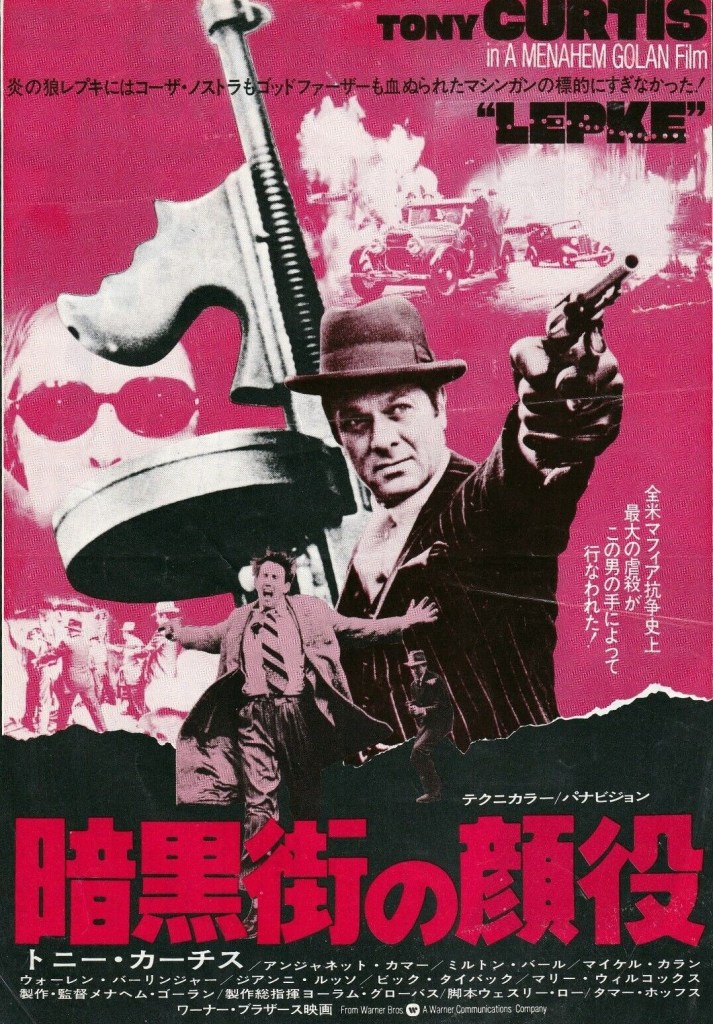
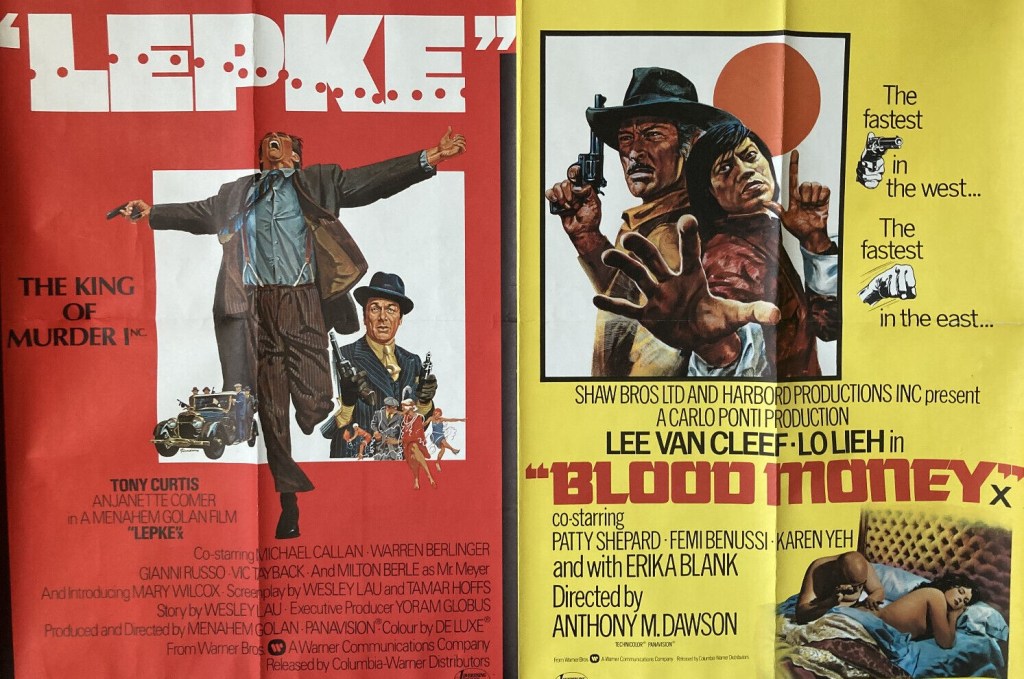
Gangsters are just the same as you and I. They want to be loved, they want a family, they want the kind of respect that isn’t achieved by just pointing a gun at someone. The Godfather (1972) led the way in subtly reminding us that gangsters were human beings even if it was more seductive in making us believe we should excuse their criminal tendencies. Lepke spends as long on romance and trying to win the approval of the bride’s father as it does on the character’s perfidy. The idea that marriage cannot so much absolve you of your sins but provide an oasis of calm inside a murderous world is one only a true romantic would consider pursuing. As is the notion that a wife would forgive you your sins because her love would outweigh your actions, in the same way as the wife-beaten wife (as shown in Love Lies Bleeding) still loves her husband no matter how brutal the treatment meted out.
Lepke has got reason to be sore with the world. He was left out of the gangster chronicles. An important part of the Murder Inc operation, he was ignored when Hollywood passed judgement on such criminal enterprises. And you get the sneaky feeling his life story was only revived because after the Coppola epic his was one of the few tales untold in the gangster chronicles.
“If there’s any good in him, that’s the part I’ve got,” says wife Berenice (Anjanette Comer), “If I was a whore I could leave him.” And you can see the part she adores, not only respectful to the point of being obsequious to her upstanding father Mr Meyer (Milton Berle), but charming and romantic with her and he’s clearly able to separate business from romance, turning into an exemplary family man (but then so, too, did Don Corleone).
Which is just as well because Lepke (Tony Curtis) is a dreaded Mafia enforcer, forming a murder syndicate with Dutch Schulz (John Durren) and Lucky Luciano (Vic Tayback) that takes responsibility for knocking off anyone who steps out of line away from the big bosses. There’s some standard gangster stuff, machine guns in violin cases, bombs in the spaghetti, but also some interesting touches, a shoot-out on a carousel, and of course the last person a gangster can trust is the one he places his truth with. Double-dealing is the order of the day.
Like all the top gangsters, Lepke is an entrepreneur, expanding out of the killing racket into dope, extortion and trade unions. New York D.A. Thomas E. Dewey is on the Murder Inc case and his assassination is only prevented by the intercession of Lepke. But he’s tackled as much by Robert Kane (Michael Callan), friend to Berenice who works in narcotics along with Dewey.
Dewey’s not the only real-life character making an entrance. Legendary journalist Walter Winchell (Vaughn Meader) plays a significant role. Most of the picture involves Lepke being nefarious by day and loving at night and the gang are only tripped up when witnesses need to be eliminated and as the cops work a similar kind of dodge to the one that snared Al Capone. Instead of tax evasion it’s anti-trust issues.
Covering the period from 1923, Lepke’s emergence as a ruthless street rat, and his development of the narcotics business by sourcing product direct for the Far East, to his execution in 1944, it pays only cursory attention to the period. Most of the time, Lepke is fighting for his life one way or other, suspicious of colleagues, walking a knife-edge between actions that could inavertently lead to his demise, and trying to remain the best part of himself that remains appealing to his wife.
That any of this works other than being a standard depiction of the rise and fall of a gangster is down to Tony Curtis (The Boston Strangler, 1968) who delivers one of his best later performances while maintaining a difficult balancing act, clearly believing that he can separate the two sides of his personality, and that the murderous part is really just a performance. The documentary-style rendition helps as this can be complicated stuff, especially with so many disparate traitors.
Anjanette Comer (Guns for San Sebastian, 1968) is always watchable. Menahem Golan, of Golan-Globus and Cannon fame, perhaps taking a cue from The Godfather, takes considerable care with the family elements and is rewarded with a better picture than the elements might suggest.
This pretty much rounds out my Hollywood History of the Gangster.
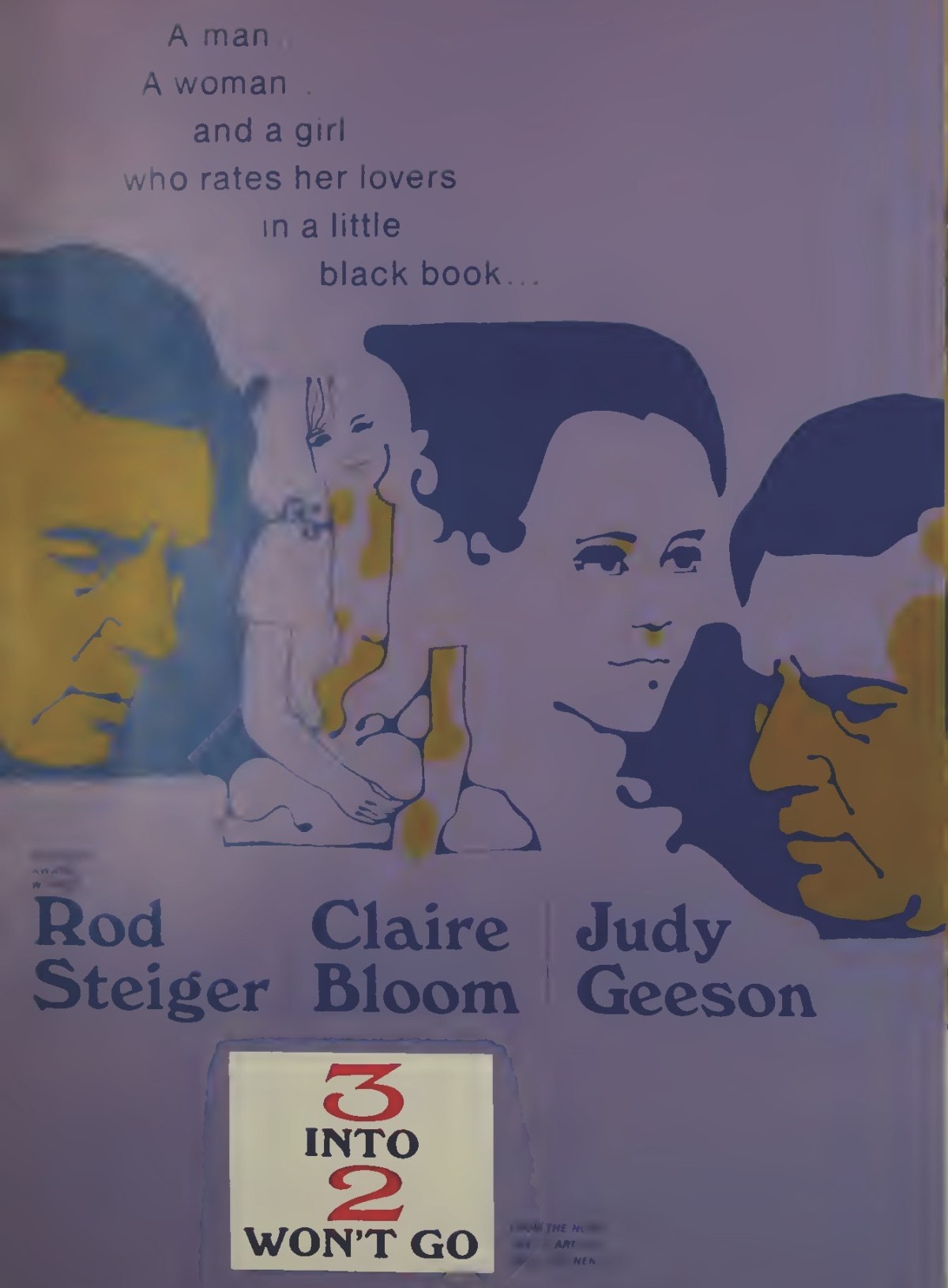
Unhappily married and childless salesman Steve (Rod Steiger) begins an affair with kooky promiscuous hitchhiker Ella (Judy Geeson). A free spirit in control of her life – no VD and on the Pill – and happy to drift from mundane job to mundane job, Ella ranks her many lovers on their sexual performance. Steve has just moved into a new house on a dreary new estate, perhaps in the hope of revitalizing his staid marriage to Frances (Claire Bloom).
While Steve is away on business, Ella turns up at his home where, revealing, without implicating Steve, that she is pregnant, she convinces Frances to let her stay the night. Naturally, it is Steve’s baby, but Ella plans an abortion. Steve wants the baby and so, too, still unaware of the father, does Frances, seeing adoption as the solution to their marital woes. And so a love triangle, or more correctly a baby triangle, plays out, with a few unexpected twists.
Like most of the marital dramas of the 1960s, especially in the wake of the no-holds-barred Who’s Afraid of Virginia Woolf (1966), this is riddled with outspoken protagonists who have no idea how to find real happiness. Based on the book by Andrea Newman and adapted by Edna O’Brien, who both have previously marked out this kind of territory, the picture shifts sympathy from one character to the next. While no one is entirely culpable, none are blameless either. Yet there is an innocence about Steve and Frances in the way they fling themselves in the direction of unlikely salvation. They are not the first couple to find themselves in a marital cul de sac, nor the first to do nothing about it, hoping that somehow through a new house or job promotion things will right themselves.
Audiences, accustomed to seeing Steiger (In the Heat of the Night, 1967) in morose roles, might have been shocked to see him happy and he manages to present a more rounded character than in some previous screen incarnations. In burying herself in domesticity, Claire Bloom (Charly, 1968) essays a far from fragile character, whose resilience and pragmatic character will always find a way forward. Geeson is the surprise package, at once knowing and in charge, and at other times completely out of her depth, and to some extent enjoying the chaos she sparks. The exuberant screen personality she presents here is almost a grown-up more calculating version of the character she portrays in Hammerhead (1968).
Director Peter Hall (Work is a Four-Letter Word, 1968) generates more universal appeal by ensuring the movie is not so obviously grounded in the 1960s that it would quickly become outdated and the snatching at last-minute fantasy to avert marital disharmony will still strike a note. The performances are all excellent, including a turn by Peggy Ashcroft (Secret Ceremony, 1968) and bit parts from British character actors Paul Rogers (Stolen Hours, 1963) and Elizabeth Spriggs in her second movie.
Soubriquets were not common currency in Hollywood. Names might be shortened to a Christian name or a surname, as in Marilyn or Garbo, and occasionally a reporter might suggest an unlikely familiarity by referring to a star as “Coop” and for sure Bogie must have been desperate for people to call him anything other than Humphrey, hardly a name that spun off the tongue for a supposedly hardbitten hero eschewing his middle-class origins. But the world swung on its axis when simple use of the star’s initials were enough to guarantee universal acceptance.
BB was born on a wave of controversy. After And God Created Woman (1956) broke box office records all over the world, a star was born. But one who seemed to live as much on the pages of newspapers as on the screen. She could forever be guaranteed to provide a revealing photograph to spice up the more puritan newspapers.
But BB’s global fame didn’t translate into worldwide box office in part because her movies were mostly X-certificate in the U.K. and, being made generally by foreign companies, slipping past the Production Code in the U.S. and therefore into arthouses or shady emporiums in both countries rather than mainstream houses.
This isn’t the best introduction to her canon, but in many senses it’s pretty typical. The camera adores BB and shuns anyone else in her presence. There’s not much story here – bored wife dashes off to a model assignment in London and has an affair and can’t decide whether he’s ready for divorce.
To fill in the time we get plenty Carnaby St fashion shoots, certainly put into the shade by the likes of Blow-Up (1966), but of the kind that used to be so common, beautiful women in outlandish clothes against backdrops like zoo animals or suits of armor and all the while flirting with photographers and being chatted up in night clubs by all and sundry. As you might expec, red buses and mini cars are common, though the chances of a cop on horseback at night seems to stretch it a bit.
Cecile (Brigitte Bardot) seems too lively for staid husband Philippe (Jean Rochefort) and burdens him with ensuring her happiness. But he seems, I guess unusually for the time for such a wealthy character, to be happy for her to continue in her profession. She’s never been unfaithful unlike model buddy Patricia (Georgina Ward). But all this cavorting brings out the lech in photographer Dickinson (Mike Sarne) and while she flirts with him she fancies for no apparent reason the doe-eyed Vincent (Laurent Terzieff) although his doe-eyed dog is livelier.
Anyway, off they go to Scotland for a romantic idyll since every filmmaker in the world has been duped by Scottish Tourist Board fantasies of sunshine, tartan, heather and miles of unspoiled beaches (unaware they are empty because the natives have more sense than to go diving into icy water in freezing temperatures). Mostly, what they get is damp streets and grey skies, though if you have BB romping in the water then nobody’s really going to notice the awful weather. And, naturally, the highways and byways are filled with tartan-clad gents so Brigadoon rides again.
Not quite sure how “To Their Heart’s Content” – clumsy in translation as it is – is turned into the dull “Two Weeks in September.”Though she hardly seems happy in the poster.
In any case, by the time September comes round, the sun has already packed up for the winter in Scotland, so there’s your get-out-of-jail-card in the title. Not much happens in Scotland either, mostly soulful camera work, soulful BB and dull-as-ditchwater Vincent. There’s a contrived ending.
What impresses most is how little BB you need to make a picture work, even one as patchy as this. It is almost the same template as an Elvis picture minus the songs. Just like BB, Elvis scarcely required a working script, just any excuse to get him on screen. Some stars possess screen charisman that it’s impossible to shift. Shame it was left to Serge Bourguignon (The Picasso Summer, 1969) to get more out of the faint storyline because he was never that bothered with narrative and inclined just to get by on close-ups and scenery. With BB she was as much scenery as audiences ever seemed to require.
Hardly falls into the recommended bracket but nonetheless an interesting example of how Bardot could get away with the mildest of trifles.
Due some unexpected reverence after being chosen by Quentin Tarantino for his inaugural eponymous festival that kicked off at the Dobie theater in Austin, Texas, in 1996. I thought I’d throw that in since my opinion alone may not have swayed you as to this film’s merits. Ken Annakin (Battle of the Bulge, 1965) wasn’t first choice as director. It was initially on the slate of Jack Cardiff (The Girl on a Motorcycle, 1969) and should have also made waves as the first big British-Indian co-production. After his World War Two tank epic, Annakin’s career unexpectedly stalled.
He backed out of a project to make a Las Vegas version of Grand Hotel (1931), another, the $1.5 million The Fifth Coin, written by Francis Coppola and to star George Segal, got snarled up on the starting grid. He balked at Texas Across the River (1966) – when the females leads were going to be Shirley MacLaine and Catherine Deneuve – due to concerns about the schedule. He actually shot half of The Perils of Pauline (1967) with Terry-Thomas, Pat Boone and Pamela Austin, wife of super-agent Guy McIllwhaine, before being fired, for reasons that were unclear. Still, he remained in demand and was immediately off to Italy to shoot Raquel Welch heist picture The Biggest Bundle of Them All – not released until two years later as explained in my Behind the Scenes blog on that movie.
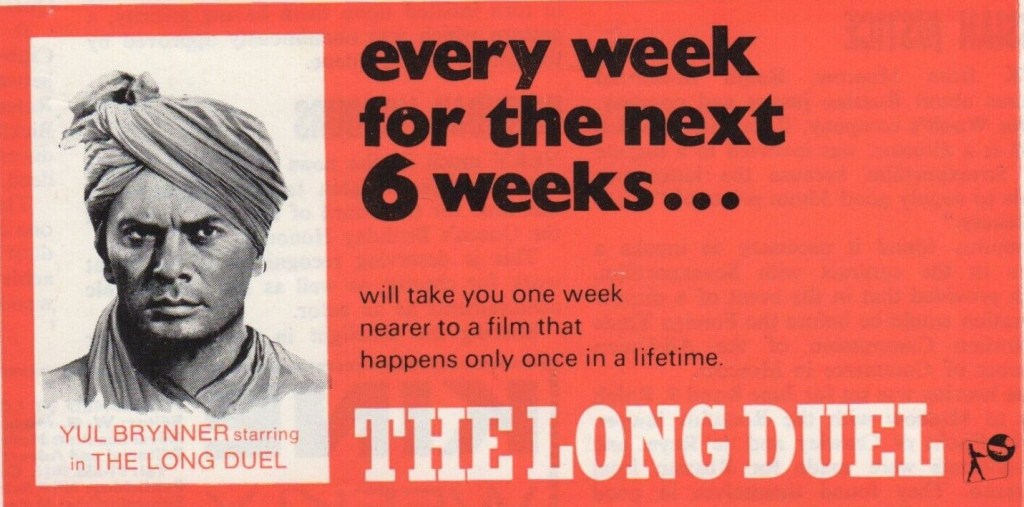
However, before jetting off to Italy, he had been sounded out by British producer Sydney Box who had a commitment from Yul Brynner and Trevor Howard to star in the $3 million The Long Duel being financed fifty-fifty by British studio Rank and fourteen Indian investors taking advantage of a tax-shelter deal. Annakin was in line for his biggest-ever fee. For Rank it was a brave new world. The British studio after years of relative inactivity was back on the production front foot, initially in co-production deals with American majors and British investment outfits like the National Film Corporation. It planned to invest $12 million in eight pictures. Initially, its stake in The Long Duel was limited to 60 per cent at a time when the movie was budgeted at $2.3 million. This was “particularly surprising because it came at a time when Britain was caught in a severe economic freeze” although the surprise success of the Bond pictures suggested the country’s movie industry was, in contrast, riding the crest of a wave.
Things turned sour on the location scouting trip to India. A “bottomless pit” of laborers was on standby to build a rope bridge across as soon as the money came through. Timber had been ordered to build a fort on a plateau with stunning views of snow-capped mountains, but nothing would arrive until money changed hands. While Rank had committed three-fifths of the finance with the rest coming from the release of blocked rupees guaranteed by a Maharajah, without any immediate cash and with the stars on pay-or-play contracts, there was no option but for Rank to pick up the entire cost and seek out alternative locations. That meant it was the single biggest British production financed domestically without a foreign partner.
Matters worsened when producer Sydney Box suffered a heart attack, triggering his departure from the business, in which he had been a mainstay for 33 years, movies ranging from The Seventh Veil (1945) to Accident (1966). In addition, Annakin was negotiating to make a permanent move to France while his wife was at home in England dealing with an adopted new-born baby. Annakin – acting also as producer for the first time – gambled on shifting the movie to Spain.
After the success of Doctor Zhivago (1965), Spain was fast being viewed as an ideal terrain, Custer of the West (1967), Camelot (1967), Fathom (1967) and The Bobo (1966) jostling for space. Having made a couple of movies there, Annakin assured the backers, the terrain was “not dissimilar” to the locations he had viewed in India. “I believe we can make Spain into India, so long as the crowds are dressed as Indians, which will cost quite a lot more because it means providing all the costumes whereas in India they already exist,” he explained. He had three weeks before the actors were due.
Yul Brynner and Trevor Howard would have seemed best buddies by now, having appeared in three films together over the past two years – Morituri (1965), The Poppy Is Also a Flower (1966) and Triple Cross (1966). Brynner’s career had revived thanks to Return of the Seven (1966). He was considered poor box office in the U.S. but made up for it with his global marquee appeal. Howard had been on an unexpected box office roll following Father Goose (1964), Operation Crossbow (1965), Von Ryan’s Express (1965) and The Liquidator (1965).
Annakin turned to the Sierra Nevadas to double as the Himalyas, located the rope bridge in a ravine near Ronda, the villages transplanted to the dusty Andalusian plains, and found sufficient horse-riding extras among the gypsies of Dacoit country. The Alhambra was called in to action for part of the Indian palace. A steam train of sufficient vintage was found.
Brynner supplied his own motor home, one of the most luxurious on the market, but required considerable assistance to move it around, especially on narrow country roads linking locations. Over 300 horses were required, with complications when the animals had to be moved in the dark. The major scenes required extensive lighting and nobody had taken into account the fierce winds which nearly blew everything away. The dancing bear was supplied by Chipperfield Zoo near Windsor, England. In the scene where Brynner returns to find his tribe massacred, the bear is also a victim. But, when the bear was knocked out by an injection, it didn’t wake up again. Cast and crew were so shocked that filming was abandoned for the day.
Howard’s alcoholism was another issue, liable to leave the actor so disoriented during the shooting of dangerous scenes that his close-ups were often shot at a later date, though, eventually informed of this accommodation, the veteran sobered up. If you felt when watching the movie that the female stars were out of place, you wouldn’t be far wrong. In the original tale there was no significant female role. But acceding to the demands of studio and distributor required various love interests. Suzanna Leigh (Subterfuge, 1968) turned down the lead, providing Charlotte Rampling (Three, 1969) with a worthy role.
Convinced it was onto a winner, Rank took out adverts in the trades claiming “all signs point to it being…among the greats” and it took the bold step of launching it in roadshow at the Odeon Marble Arch simultaneous with continuous performance at the Odeon Leicester Square in London’s West End.
SOURCES: Ken Annakin, So You Wanna Be a Director (Tomahawk Press, 2001) p186-189, 197-206; “Sydney Box $10-Mil Prod Program,” Variety, January 26, 1966, p14; “Rank Now Measuring Up,” Variety, July 27, 1966, p25; Advert, Variety, August 24, 1966, p27; “$3-Mil Rank Duel May Be Costliest British Film Ever,” Variety, October 26, 1966, p5; Advert, Variety, November 9, 1966, p27; “Sydney Box Quits Film Posts,” Variety, August 7, 1967, p2.
Surprisingly thoughtful action-packed “eastern western” with obvious parallels to the plight of the Native American. Here, the British attempt to shift nomadic tribesmen from their traditional hunting grounds in north-west India to “resettlements.” Set in post World War One India, the duel in question between tribal chief Sultan (Yul Brynner) and police chief Young (Trevor Howard) brims over with mutual respect.
Unusually intelligent approach for what could otherwise have been a more straight forward action picture, more critical of the British, whose idea of civilization is to turn everything into “a bad replica of Surrey,” than you would have expected for the period. Ruthless pursuit in large part because the British “can’t afford local heroes.”
After his tribe is taken captive with a view to forced repatriation by boorish police superintendent Stafford (Harry Andrews), Sultan organises a breakout, taking with him heavily pregnant wife Tara (Imogen Hassall) who dies while on the run. The Governor (Maurice Denham) of the province brings in Young – who knows the territory and is more familiar, through a previous career as an anthropologist, with the nomadic lifestyle, and largely sympathetic to their cause – to head up an elite force and bring to justice Sultan, whose men are now murderers.
Young seems lacking in the stiff upper lip department, condemned for “misplaced chivatry,” unwilling to just do his job, and certainly not to blindly obey the more ruthless ignorant Stafford. Aware he is unable to stop what the British would like to call progress, hopes he can ease the transition, avoid driving the tribesmen into the ground and prevent a noble leader like Sultan ending up a despised bandit, the kind who were forever presented as the bad guys in films like North West Frontier / Flame over India (1959).
Young has the sense not to be dragged all over the country searching for his quarry, and sets up his team in more sensible fashion, but still, is largely outwitted by Sultan, especially as Stafford, who later gets in on the act, is too dumb to fall for obvious lures. Adding complication is the arrival of Stafford’s equally intelligent daughter Jane (Charlotte Rampling), a Cambridge University graduate, who falls for Young.
Thankfully, there’s no need for the British hero to transition from brute into someone more appreciative of the way of life he is forced to destroy – a trope in the American western – and equally there’s no corrupt businessman selling the tribesman weaponry and there’s no savage attack either on innocent women and children, and removal of these narrative cliches allows the movie more freedom to debate the central questions of freedom. The tribesmen acquire rifles and the occasional Gatling gun simply by stealing them from the more inept British soldiers.
Anyone expecting a shoot-out or more likely a swordfght between Sultan and Young will be disappointed, the title, as with the entire picture, is more subtle than that, especially as each, in turn, have the opportunity to save each other’s lives. Eventually, Young’s sympathetic approach is deemed ineffective and Stafford is put in charge, leading to a superb climax.
While Sultan’s nomadic lifestyle is eased by dancing girl Champa (Virginia North), whose loyalty to her lover is soon put to the test, and who is not, surprisingly, necessarily looking for love, his emotions center more around his younger son, whom he doesn’t want to grow up wearting the tag of bandit’s son. The solution to that problem seems a tad simplistic, but still seems to work.
With the feeling of western with splendid use of superb mountainous locales, and excellent widescreen, an astute script opts as much for intelligence as adventure.
One of Yul Brynner’s (The Double Man, 1967) last great roles before he turned into a parody of himself and certainly more than matched by Trevor Howard (Von Ryan’s Express, 1967), given a role with considerable depth and scope. Charlotte Rampling (Three, 1969) also impresses while Virginia North (Deadlier than the Male, 1967) and Imogen Hassall (El Condor, 1970) provide support. Harry Andrews (The Night They Raided Minsky’s / The Night They Invented Striptease, 1968) has played this role before. You can catch Edward Fox (Day of the Jackal, 1973) in a tiny role.
Superbly directed by Ken Annakin (Battle of the Bulge, 1965) from a script by Peter Yeldham (Age of Consent, 1969), Ernest Borneman (Game of Danger, 1954) and Ranveer Singh in his debut.
You didn’t used to get away with this. Until recently, screen murderers had to be unveiled or at the very least, if getting away with their crime, come unstuck in the final few minutes as with Jagged Edge (1985) or tip the wink to the audience in the manner of Keyser Soze in The Usual Suspects (1995). About the only thing Netflix can genuinely take positive credit for is the invention of a subgenre of movies/series about unsolved crimes. And now it’s taken that a step further with programs where the killer(s) are apprehended but you never find out why they committed their appalling crimes.
The Asunta Case was very much the Spanish equivalent of the Madeleine McCann Case. The latter attracted global publicity, the former headlines that raged in Spain for years. However, Asunta, the 12-year adopted daughter of the recently separated Rosario and Alfonso, was soon found not far from the couple’s country estate, albeit with hands tied with red twine, and dead.
Although the couple fell under immediate suspicion, there was little sign of motive. Would the mother, a bundle of nerves and very thin, have been capable of drugging and suffocating the child and bundling her into a car and dumping her on a piece of waste ground? The father appeared a devoted parent and no cameras could find evidence of him anywhere near the estate or the area where the child was found.
So Netflix plays its usual narrative tricks. The couple appear guilty, then innocent, then guilty, then innocent. The investigating team hide evidence that doesn’t back up their case. A witness arrives late in the day. There’s a question of how bright the moon was that night. You can’t match two ends of this kind of twine to prove that the material that bound the child was the same as some found in a waste paper basket. Alfonso is accused of hiding his computer. Jail cells are bugged. There’s a hint that money might be involved. The media undermine the judiciary process by digging up juicy morsels that may or may not pertain to the case and may or may not influence a jury. In the absence of anything conclusive the evidence is almost entirely circunstantial.
What helps the Netflix tale most is the actress (Candela Pena) portrayng Rosario. I’ve no idea how accurate a portrayal this might be. But a more whiny, self-centred individual would be hard to find. Quite how she manages to conduct an affair just prior to the murder defies belief. As does Alfonso’s continued commitment to his unfaithful wife.
It could well be that Rosario’s witlessness, coming to pieces, is the result of loss, or, equally, the impact of guilt. She is a lawyer, so you would expect her not just to be above suspicion, but with a good idea of how the system works, enough to work her way around it. Alfonso (Tristan Ulloa) is a journalist so he, too, must be accustomed to the ways of the media and that refusing to talk will keep the media at bay long enough for his constant protestations of innocence to take effect.
As with most of these dramatized mini series, the information is structured in a way that keeps you on your toes. The situation for the investigative team is complicated in that the chief investigating officer, here deemed a “judge”, has to cope with a father with dementia while one of the cops is undergoing fertility treatment.
And the dramatists do the police work for them, presenting the circumstantial evidence as if it is fact. So what we are given are various options, how the couple could not have committed the crime, in which case the criminal, still at large, could strike again, and how they very much could. And this is after various red herrings dressed up very much as the menu du jour have been discarded, principal among which is the idea that the girl has been sexually abused, as she is seen early on wearing clothing and make-up inappropriate for her age, such photos found on the missing computer, and yet with a genuinely innocent explanation.
The investigation appears to focus more on Rosario – killer mother worse than killer father it would seem – although Alfonso’s implacability would drvie you to drink. The investigators don’t get off scot free either, complicit in permitting the judge to ignore evidence favorable to the defense. In the end the crime is solved, or at least a verdict reached, but the truth remains hidden, neither of the accused fessing up, no psychiatric reports to provide clarification, no suggestion that Alfonso did it to inflict terrible injury on the mother more than the child, which is often the case in child murders.
The dubbing’s annoying and you might enjoy this more watching it in the original Spanish with subtitles.
Whatever, it is totally absorbing, for the most part because of the mystery of the couple themselves, how they came to be in this position, and whether doubt remains.
A more misleading title would be hard to find – and that goes for the posters too. This is a misfit movie – a bunch of raw recruits knocked into shape by an unwilling captain tasked with sailing a ship into a South Pacific war zone in WWII. Admittedly, Jack Lemmon is in exasperated double-take default in the opening section, but it quickly shifts from comedy to drama as Lemmon shepherds his inexperienced crew into a more compact team.
Screenwriter Frank Murphy has an exceptionally good portfolio – Panic in the Streets (1950), The Desert Rats (1953), Broken Lance (1954) and Compulsion (1959) – but brings less to the table as a director, this only his second – and final – outing in that capacity. But given he is directing from his own screenplay, he must take the blame for the incongruous hybrid. Add in an unnecessary tune from Ricky Nelson and the briefest of brief romances and no wonder it’s hard to make head or tail of the movie until it does eventually head out to sea.
Once Lemmon is given more to do than shake or scratch his head the picture moves into more satisfactory territory. Instead of dismissing the crew as idiots, he takes command and shows dramatic chops that are a hint of things to come (Days of Wine and Roses just two pictures away) when he sloughed off comedy for more serious undertakings.
Reason for Lemmon being assigned this motorized sailing ship rather than something more obviously U.S. Navy is that he is in the last chance saloon. Once under sail, setting aside some dodgy process work, and it becomes clear they are heading into harm’s way rather than simply delivering the boat to General MacArthur in more harmless waters, the story switches into perilous wartime perilous adventure with decent battle, a couple of twists and some dramatic confrontation.
Lemmon is always watchable, and I always thought he could have done with more self-belief when it came to tackling more dramatic parts. When he goes ramrod-stiff and starts barking out orders and has to out-maneuver superiors and enemy, he is entirely convincing, as, too, safeguarding his charges or rescuing them and leading them in battle. Setting aside the need for Nelson to register his credentials as a singer, he is not bad either, as an ensign making his way, an ingenue role that suits this ingenue.
Veteran John Lund (My Friend Irma) appears as a crusty, wide admiral and Chips Rafferty, the only Australian actor anybody had ever heard of at that point outside of Rod Taylor, has a cameo. Irishwoman Patricia O’Driscoll manages a passable Aussie accent as the brief romancer, her role mostly confined to looks of longing while Lemmon is at sea. Raspy-voiced Mike Kellin as an out-of-his-depth chief mate turned up in the television series based on the picture. If ever there was a film of two halves (well, one-third and two-thirds) it’s this, but the second section passes muster.
It’s an easy trap to fall into. You believe a much-loved actor couldn’t possibly lead you so astray. You are determined to give him every chance to proof your instincts wrong. You turn off at 15 minutes, then you feel you’ve done him an injustice, after all he is a major figure making his directorial debut, shouldn’t you cut him more slack? You switch off again at 35 minutes and are hit by the same guilty feelings. So you stick it out till the end and what do you get? One decent sequence with JFK of all people berating our nincompoops for asking for a favor when in one of his most famous speeches he had pointedly said, “Ask not.”
Indulgence gone mad. Or, just another day in the wacky world of Netflix. Honestly, who in their right mind would greenlight the directorial debut of a television comic who has never made a movie, clearly doesn’t understand what makes a movie, and that a 90-minute picture needs a completely different approach to a 25-minute television episode, and as obviously couldn’t care less?
There’s enough to satirize in the world of business instead of some dumb satire about the creation of a cereal that defies convention. If it was such a massive success story why did it take so long so cross the Atlantic, a couple of decades as far as I’m aware. But then, over here, we were still struggling just to work out why we needed to buy a toaster when you could just toast bread under a grill.
Clearly, the director-star Jerry Seinfeld, who’s always been enamored of his own material, was bored with being so wealthy that he decided he would inflict his latest joke on a disinterested public. I own up to having been a big fan of the Seinfeld schtick of a show about nothing and perhaps that’s where he’s gone wrong here. Because this is about something. At the very least rivalry between two cereal giants.
But these two apparently great companies are run by people who don’t notice that the cleaner sticking his mop in your face has a camera attached to it and the guy appearing at an inappropriate time in your business strategy meeting has (wait for it) a camera attached to his vacuum.
Sure, Seinfeld has rounded up a bunch of his pals and you can spot the likes of Amy Schumer, Melissa McCarthy, Christian Slater and Jon Hamm. It says a lot for their acting intelligence that they all thought this was a humdinger. I did like Hugh Grant playing Tony the Tiger since he’s grown a lot better at making a fool of himself.
The bizarre aspect of the whole enterprise is that there’s certainly a truth here. Any new product can have significant effect on other players in the market. Here, it was milk and sugar. A breakfast item that does not require milk is going to damage sales of milk, forever associated with breakfast and as one of the characters so crassly puts it the first thing everyone ever drinks (birth is the clue in case you need that spelled out). Sugar is coyly referred to as the “white powder,” making a connection with that other well-known epidemic, and only in passing ruminating on the damage sugar has done to teeth, without making the obvious link between why milk, which is so good for you, is associated with sugar, which is so bad,
In the middle of it Seinfeld prances around like an inane cat, the same dry delivery that worked in in his series painfully not working here. Everyone else looks as though they are having such fun, like this is a pantomime and everyone can just, well jolly gee, over-act to their heart’s content.
This kind of picture is by now par for the course for Netflix. Hollywood had a name for this kind of movie. Vanity project. Usually, it was the price to pay for being contractually saddled with a star so big. Or, having been saddled with such a disaster, you could extract payment in the form of them making a film they had previously balked at. Sometimes, you end up doing both of you an enormous favor, The Sixth Sense, a colossal hit, the price Bruce Willis paid for his vanity project. Who says vanity doesn’t pay?
The galling part is that the fact that I’ve stuck through it will be notched up as a success by Netflix, added to the millions of other watched minutes by which the company determines a hit, rather than having some way of measuring how many switched off a sixth of the way through like I should have done.
I don’t even know why I’m giving it two stars. In terms of laffs, it’s got as many as Orgy of the Dead, my all-time stinker.






 The Magnificent 60s