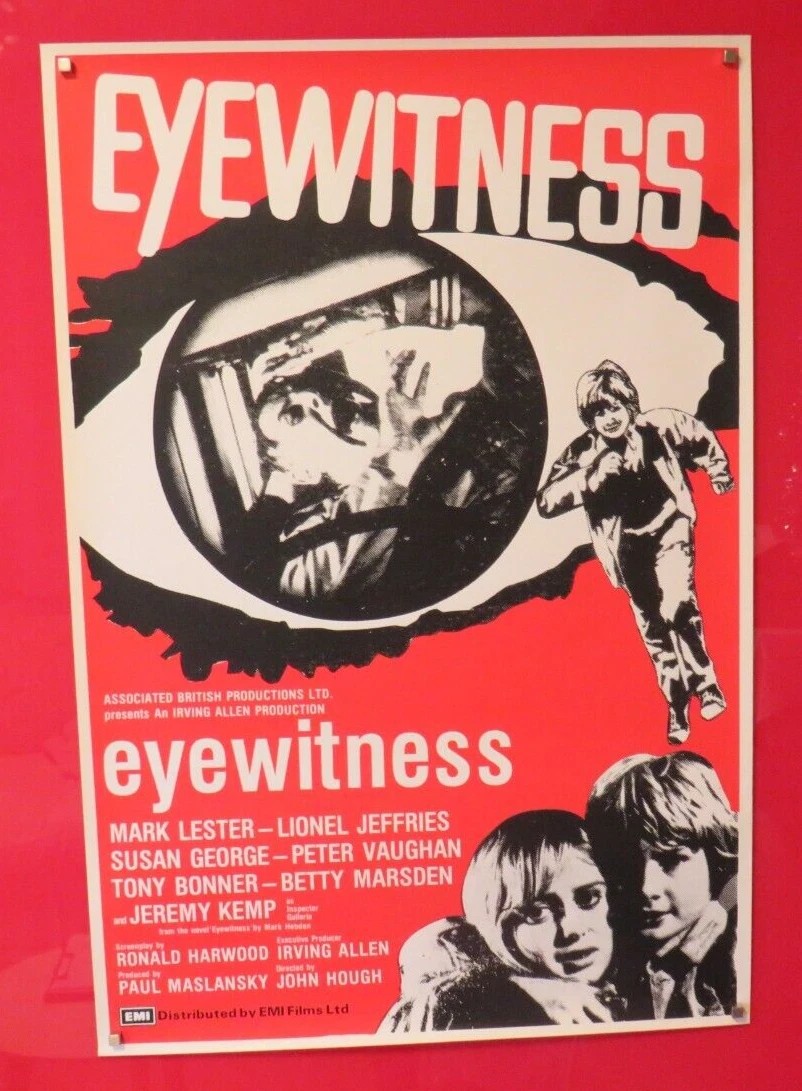
Eye Witness / Sudden Terror (1970) ***

Absolute cracking chase thriller spoiled by the central conceit and an overdose of whimsy. The standout chase is two cars, hemmed in by low walls, battering the hell out of each other at 50mph. We’ve also got motorbikes rattling down flights of stairs and a race through the catacombs.

There’s nothing new about a witness not being believed especially if he’s fingering a cop – check out a better version of this minus any of the thrilling chase sequences in Witness (1985). But when the witness, a child called Ziggy (Mark Lester), has an overactive imagination to the point of being considered a congenital liar and a grandfather (Lionel Jeffries) who encourages such playing about with the truth, it becomes a tougher watch, mostly because the bulk of the film is about the child squealing about not being believed whereas the deadly assassin he’s witnessed is scary enough – and a cop in a country where authority is not questioned – to make the whole picture fly with this complication.
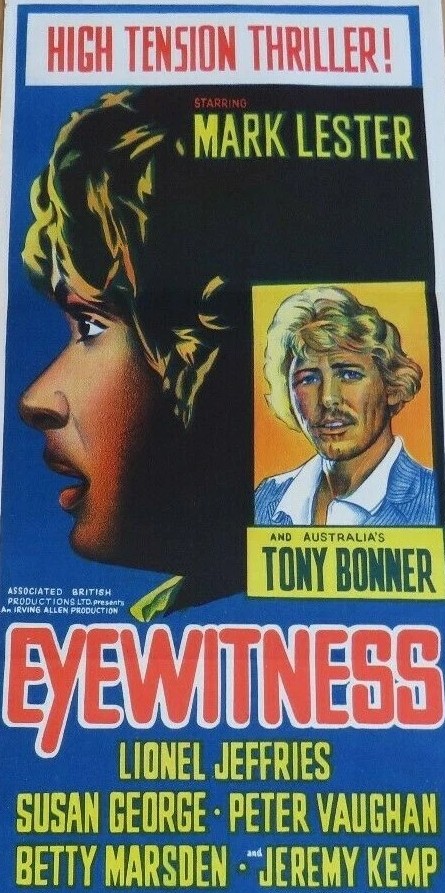
Sometimes a picture can just unintentionally come off the rails when railroaded into such a corner. Ziggy persuades his equally young pal Ann-Marie (Maxine Kalli) to go to the cops on his behalf and when in consequence she’s brutally murdered it feels like we’ve entered another movie entirely.

There’s an odd cop, Inspector Galleria (Jeremy Kemp), in charge of the investigation. A notorious bully, he constantly upbraids his underlings for not being as clever as himself, even though it takes forever for him to string the clues together. The inspector adds nothing to the story.

Ziggy has caught sight of assassin Paul Grazzini (Peter Vaughan) and the assassin has caught sight of him. Probably even if Ziggy hadn’t been a lying little toad, nobody would have believed him anyway given Paul and his complicit brother Victor (Peter Bowles) are both cops, especially as the Grazzinis are determined to eliminate him and anyone else who gets in their path – or even helps them, a confederate ends up being chucked over a cliff.

It’s quite hard for the picture to accommodate a burgeoning romance between Ziggy’s big sister Pippa (Susan George) and passing tourist Tom (Tony Bloomer), except for her ability to scream on cue and clip Ziggy around the ear. Quite why ex-soldier grandpa has to be such an oddball is unclear except that this is one of those movies where subsidiary characters are required to earn their keep by exhibiting unusual characteristics. His military experience comes in handy, though, when it comes to fending off the bad guys with Molotov cocktails.
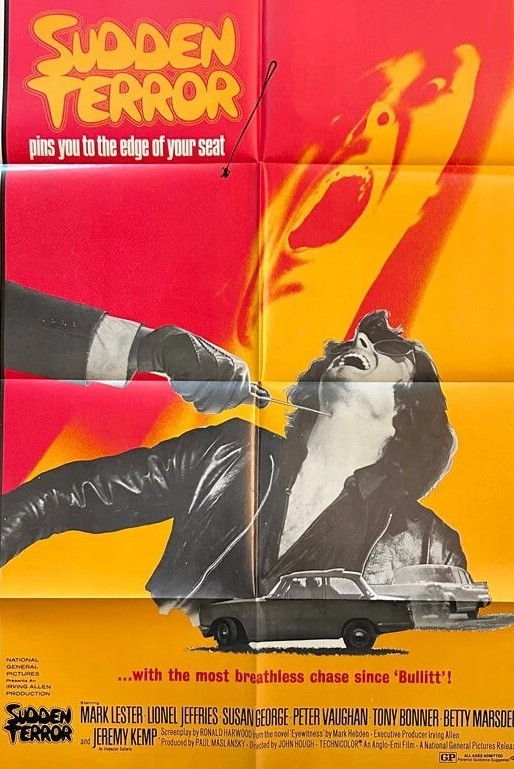
We soon realize why Tom, who’s done nothing much except upset stern housekeeper Madame Robiac (Betty Marsden), has been included in the plot – because he can drive like a maniac.

I wouldn’t say Mark Lester (Run Wild, Run Free, 1969) is out of his depth but the narrative is a bonkers version of the boy who cried wolf and given he’s spending so much of time crying wolf or running away, his character is never anchored.

Susan George certainly shines. She locked horns again with Peter Vaughan in the distinctly more venomous Straw Dogs (1971), a role that could not be more distant from the juvenile lead essayed here. Lionel Jeffries (Chitty Chitty Bang Bang, 1968) has been playing this role forever. I certainly wouldn’t want to cross Peter Vaughan on a dark night nor his sidekick Peter Bowles (Charge of the Light Brigade, 1968).

Director John Hough (Twins of Evil, 1971), in his debut,  is determined to make his mark visually with shots taken at odd angles or through spectacles etc but all that artistic effort is wasted given the adrenalin of the car chase, which must rank somewhere close to Bullitt (1968) and The Italian Job (1969). Written by Oscar-winning Ronald Harwood (A High Wind in Jamaica, 1965) from the book by John Harris.

I kept on thinking how well this would have worked if it hadn’t centered on a small boy. Apologies for being so picky but when you can create such a heart-pumping car chase as this surely it needs something stronger to fill in the gaps.
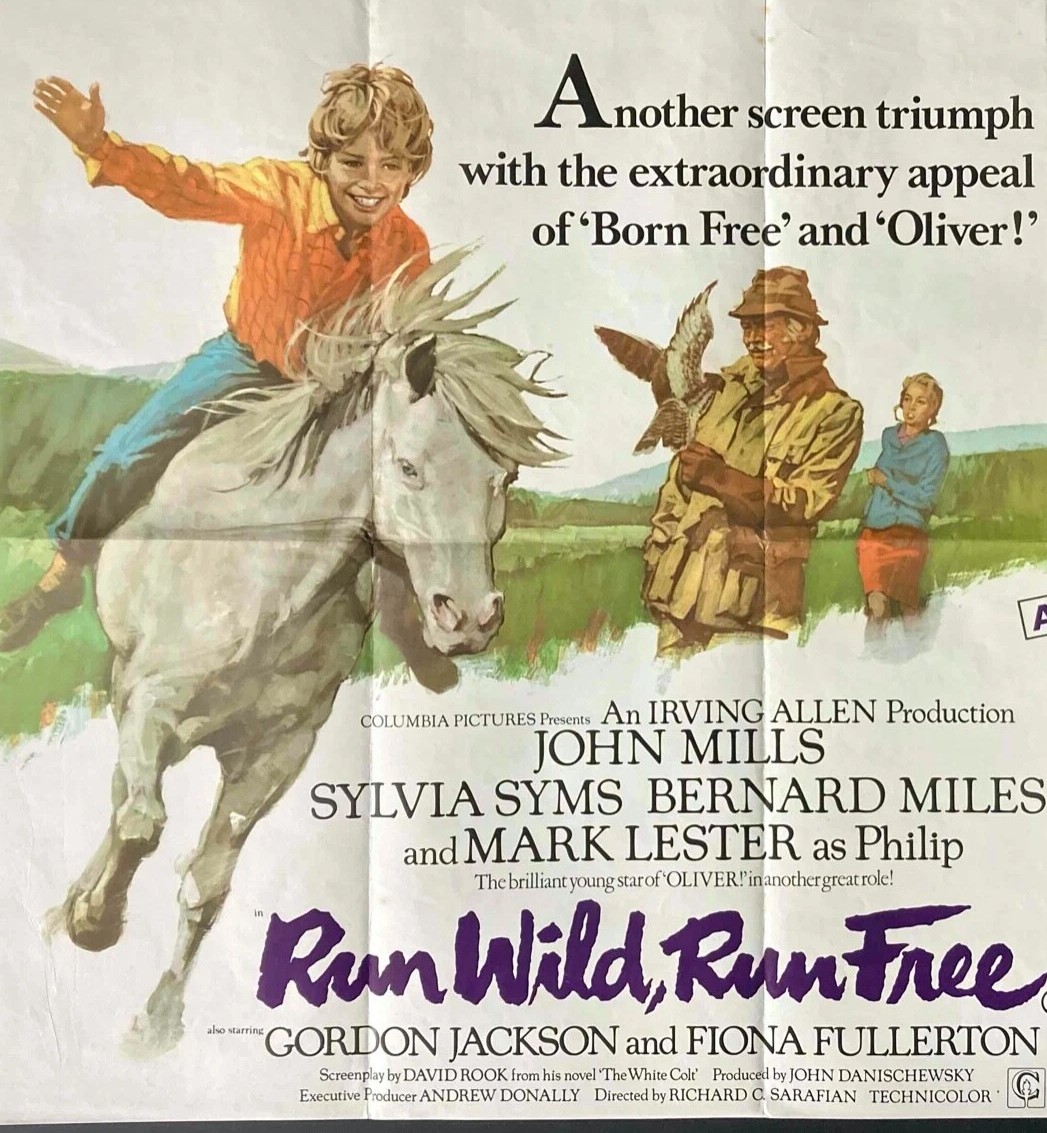
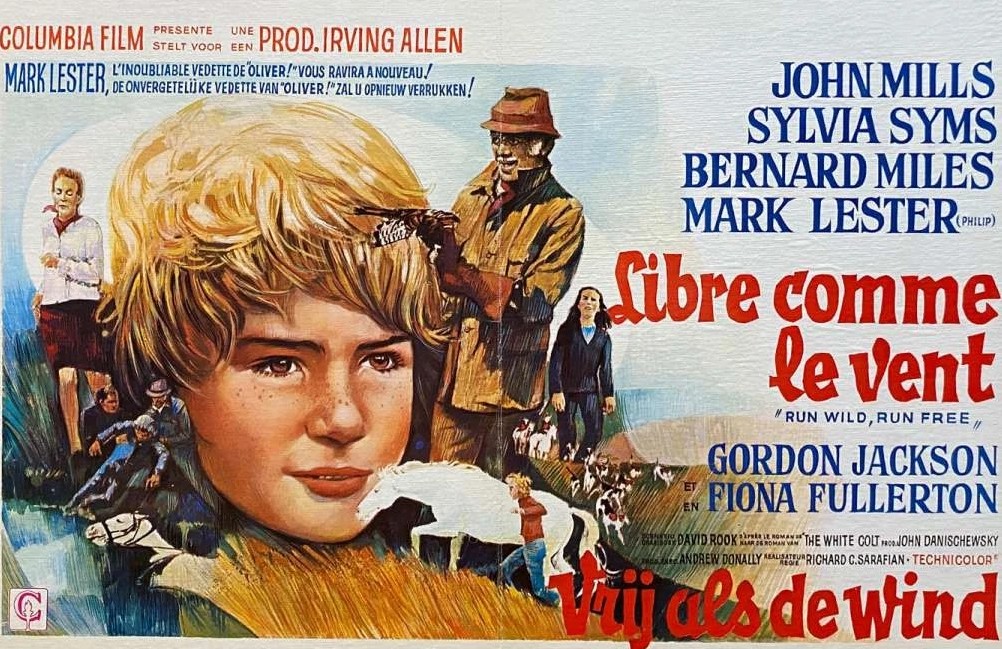
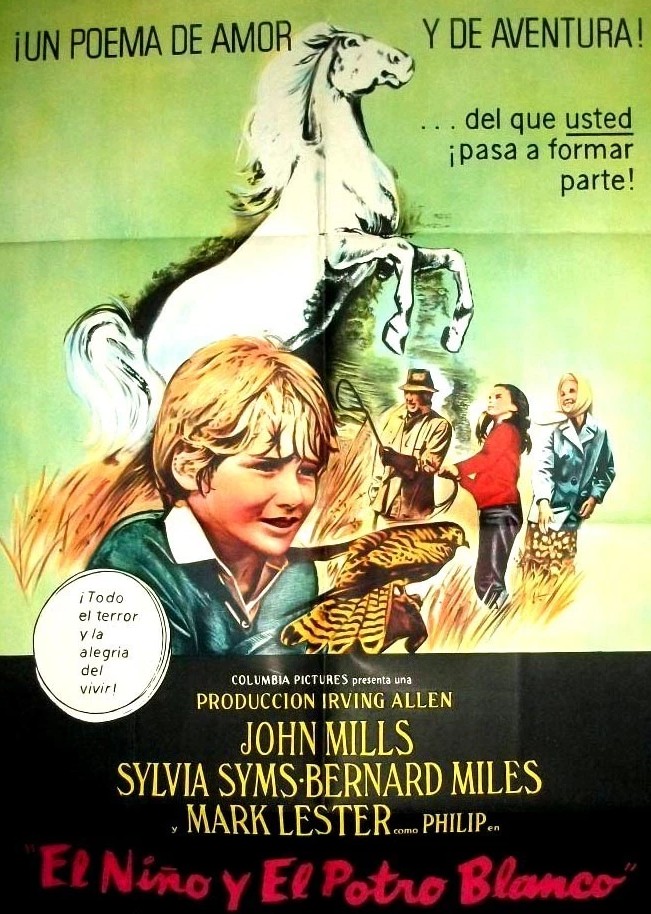
Run Wild, Run Free (1969) ****

Surprisingly absorbing, precisely because of the distinct lack of the soppiness or mawkishness associated with the genre. Nature “red in tooth and claw” scarcely puts in an appearance and even then is a good bit less dangerous than a wanton child unable to understand or control his emotions. Parents are very well-drawn, too, in an era that scarcely ran to much comprehension about child psychology, a mother rejecting her son because she is convinced he has rejected her, a traditional father who lacks the skills to convey his love for his son. And you wouldn’t get away these days with an old fellow taking more than a passing interest in a small bewildered boy with the audience immediately conjuring up images of abuse.

The film also prefigures the Gaia movement. Both the old fellow and his young charge are given to lying prostate on the grass, the better to listen to the beating heart of the Earth. And you wouldn’t think of pinning this one on director Richard C. Sarafian, best known for his biker epic Vanishing Point (1971). Far less imagine how you’d get a whole stack of actors to spend a great deal of time wading through a swamp “in camera” rather than utilizing some form of CGI or to volunteer their fingers to be bitten by a predatory bird.

If you’re searching for the kind of twist that’s so common these days, look no further than the location. Those wild moors look fantastic in the sunshine, especially for compositions that outline characters against the sky, but they’re treacherous too, when the fog comes down and you’re trapped without a signpost home, and they’re not all hard grass or spurs or rock but conceal sections of perilous swamp.

Living on the edge of the moors, small wonder Philip (Mark Lester) is attracted, even as a toddler, to the wilderness. That’s exacerbated when he’s afflicted by muteness after developing a stammer around the age of four. It’s assumed there’s a psychosomatic cause, but we’ve got no time and the parents no inclination to dwell upon that.

He develops an obsession with a wild white pony, one of a herd that runs free on the moors, and spends most of his time out trying to find it. Col Ransome (John Mills), nature lover and amateur ornithologist, befriends Philip, helping him to understand nature, and teaching him to ride – bareback – the pony. Ransome also shows him to manage a kestrel.

Scenes of characters working with horses or other animals are usually limited to  bit of nose stroking or whispering to calm said animal down, but here we go into a lot more intricate detail of how to win the cooperation of a horse, the kind of lore that nobody’s got much time for these days. So if you want to ride a horse bareback first off you need to just lie on top across its back and stroke its sides. And for a predator, you have to be willing to accept the occasional peck on your fingers while, again, you evoke a stroking mechanism. You might also be surprised to learn that the easiest way to mend a broken wing is by the use of glue.

While Philip and the Colonel and a young girl Diana (Fiona Fullerton) are happily communing with nature, Mr Ransome (Gordon Jackson) and wife (Sylvia Syms) are scarcely able to work out their feelings at being abandoned by their child. The mother tends to get angry, the father, in a very touching scene, is left desolate after Philip ignores a present the father believes would have brought more solidity to their relationship, and in another effective scene it’s the Colonel who explains that it doesn’t take much for a child to understand how devoted an apparently distant father can be.

Any potential soppiness is killed off when Philip in a wild fit of obsession nearly kills the kestrel and in another sequence of disregard almost kills the horse. Occasionally, Philip speaks a few words to the old man but refuses to express himself in front of the parents.  So it will come as little surprise that when the parents finally hear the son speak it’s at the quite gripping climax when all the adults have failed to rescue the white horse from a swamp.

And anyone expecting that cute kid from Oliver! (1968) would have their hopes dashed when Mark Lester displays all the natural truculence and wantonness of a child. He’s pretty good, I have to say, in being forced to confine his emotions to facial expression.

John Mills (Guns at Batasi, 1964) is excellent and Sylvia Syms (East of Sudan, 1964), shorn of glamor, and Gordon Jackson (The Ipcress File, 1965) as her emotionally inarticulate husband, both dump their screen personas in favor of highly believable characters. Fiona Fullerton makes her screen debut.

Richard C. Sarafian does a splendid job. Screenplay by David Rook based on his novel.

Emotionally true.

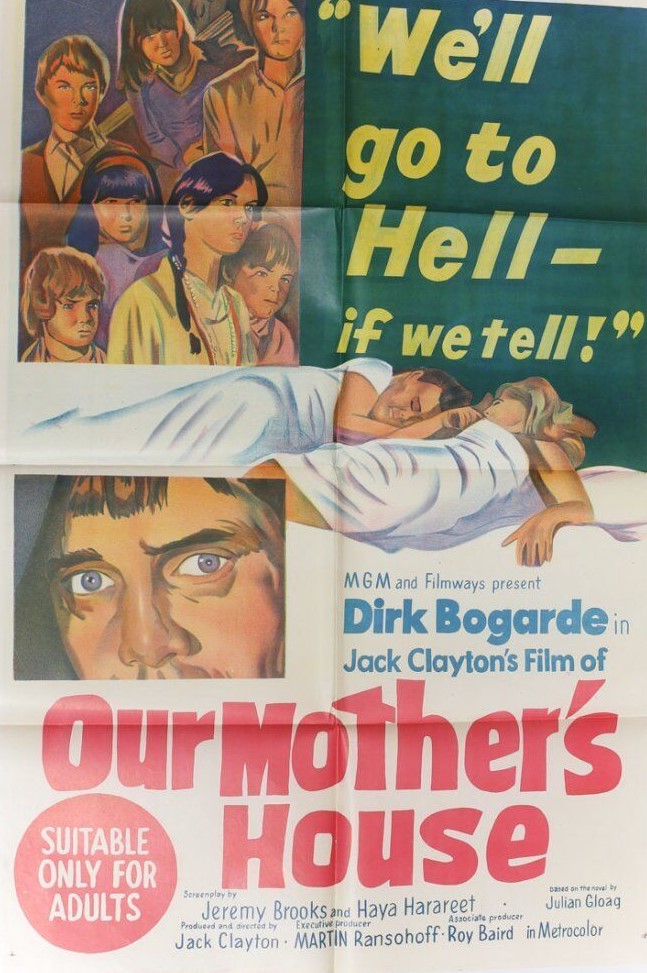
Our Mother’s House (1967) ***

Lord of the Flies set in a sprawling London Victorian mansion. At its best when kids give rein to vivid imagination, not so strong when melodrama intrudes.

After the death of her invalid mother and dreading being sent to an orphanage, eldest child Elsa (Margaret Brooks), who has been with the help of a maid running the house anyway, determines that she and the rest of the brood will pretend their mother is still alive. They bury the body in the garden, manage financially after Jimimee (Mark Lester) discovers an aptitude for forging their mother’s signature on the monthly cheques she receives from a trust fund, and hold séances in the shed to commune with the deceased one.

To maintain the pretence, they get rid of the nosey and querulous maid Mrs Quayle (Yootha Joyce) and come up with all sorts of reasons to explain their mother’s absence to school teachers and neighbors. Child fears run rampant as they visualize the terrible lives they would lead in an orphanage. But the generally tolerant community lifestyle is disturbed by the dictatorial rule of Elsa, determining that Gerty (Sarah Nicholls), for example, must have her long hair sheared off for innocently breaking a house rule and, in keeping with their mother’s fundamentalist beliefs, refuses to call a doctor when the girl falls ill. But the séance takes on a creepier aspect, Elsa the one in communion with her mother and therefore using the supposed other-worldy presence to enforce her will.

So far, so Lord of the Flies, and excellent in its depiction of a world ruled by children according to their fears and beliefs and without adult intercession. But it loses its grip when melodrama takes hold.

Their mother’s dissolute husband Charlie (Dirk Bogarde) returns, romancing Mrs Quayle, and, initially, spoiling the children, who are delighted to see him. He soon reverts to form, spending all their money, getting Charlie to forge his mother’s signature on the house deeds, planning to pocket the proceeds and dispatch the kids to an orphanage. Worse, he breaks the spell their seemingly devout mother had over their children, informing them that their mother’s conversion to religion only came after a life of debauchery and that, in fact, every single one of them is illegitimate and not his offspring. That’s too much for Diana (Pamela Franklin) who kills him with a poker.

Too many twists for sure and by diverting a fascinating dissertation of childhood into adult melodrama robs the film of much of its power.

Director Jack Clayton had been here before with The Innocents (1961) but, there, less was spelled out. Dirk Bogarde (Justine, 1969) is surprisingly good as the charming rough layabout with an eye to the main chance but it’s the children who captivate especially Pamela Franklin (And Soon the Darkness, 1970) and Mark Lester (Oliver!, 1968). The children’s innocence in any case would have been despoiled as they challenged Elsa’s rule and it would have been more satisfying to go down that route.

It was based on the bestseller by Julian Gloag and for anyone wondering what happened to Haya Harareet (Ben-Hur, 1959, and The Secret Partner, 1961) she married Clayton and is credited with the screenplay of this along with Jeremy Brooks.

Slow-burn that trips the wrong way.

Discover WordPress

A daily selection of the best content published on WordPress, collected for you by humans who love to read.

The Atavist Magazine

by Brian Hannan

WordPress.com News

The latest news on WordPress.com and the WordPress community.