Lord Love a Duck (1966) ***

Satire’s a difficult game at the best of times. Of course, it usually requires a cocky writer or director blessed with the self-belief to even consider the sub-genre. The hardest part is getting all the elements to match. Not only do you require a subject that’s going to reverberate beyond the immediate, but a director who can apply stylistic muscle and actors who are in on the game but don’t tip the wink to the audience. Stanley Kubrick’s paean to nuclear nightmare Doctor Strangelove (1964) is about the only one that’s ever unquestionably pulled it off.

Other attempts fizzle out like the over-sexualized Candy (1969), reliant on rampant nudity and marquee names to pull in an audience despite hitting the target in several areas that would touch a contemporary nerve – the aggrandizement of the medical industry, literary celebrity and the fool’s gold of the new religion. Unlike the Kubrick with its settled unremitting narrative arc, Lord Love a Duck took the scattergun approach, like a series of comedy sketches, if this one doesn’t work then they’ll chortle at our next brilliant idea. At least that had the salvation, if you’d like to call it that, of aiming for some big targets.

Beach movies wouldn’t fall into that category and hardly the kind of pompous bubble that required to be pricked. So whatever kind of self-belief director George Axelrod exuded, it wasn’t one of high intelligence, picking apart contemporary mores until the heart of America lay dismembered in the dust.

In any case, the majority of the satire in Lord Love A Duck would go over the head of anyone who wasn’t American although it stands as a snapshot of a generation in which adults were in control before the “youthquake” embodied by long hair and dropping out and pot had the older citizens muttering over their cocktails.

But you try and convince a general audience of the importance of the “Cashmere Club” or wearing a guy’s pin (whatever that is). Spring break we’re just about familiar with as an American rite of passage these days from countless other movies about rampant youth but I doubt audiences in other countries would have been familiar with the concept, least of all that the censor had no problem with endless scenes filled with beefcake and cheesecake. I’ve no idea where Balboa is and why it should assume prominence in student life. But sure, old guys have always been creepy and at the sight of teenagers prancing about they become even creepier, but I’m assuming that all this male playing with pencils is incidental. 

The main pot shots are, I guess, stardom, religion and beach movies. Barbara Ann (Tuesday Weld) is the young lass in the thrall to Hollywood stardom, how being known and feted would redeem her shallow life. Rather than taking the usual boring route of attending drama classes or auditioning for the college play she somehow manages to enlist the support of fellow student Alan (Roddy McDowall) whose self-appointed task is to fulfil her dreams, no matter how outlandish and despite his own shortcoming in the dream-realization business.

Poverty keeps her out of the kind of exclusive girls’ club inhabited by malicious teenagers put in their place in later years by a serial killer. With the help of the wealthy Alan, rather than as you might hope embarking on a shoplifting spree, Barbara acquires sufficient cashmere to join a particular club. And instead of ascending to Queen Bee status and ruling over all the other mean girls, she drops out and takes a job as a secretary – hardly a sure route to stardom unless you plan on hanging out in a tight-fitting cashmere sweater in a drugstore.

From here it’s a quick step to organized religion where she falls for pastor Bob (Martin West) and then, as is standard with movies that quickly run out of narrative steam, chance encounter takes over. She meets film producer T. Harrison Belmont (Martin Gabel) and realizes she won’t get far if she’s weighted down by a disapproving husband. So the movie takes another sharp turn and becomes one of those movies investigating how many ways you can kill a guy. Largely incompetent in this department, Alan only succeeds in maiming Bob. Then Axelrod provides Lindsay Anderson with the idea for the ideal climax to the more artie If… (1968) by having Alan taking out several classmates via tractor rampage. Naturally, Barbara becomes a star though I doubt if Axelrod had the foresight to work out that the beach movie was on the way out so her type of stardom would be immediately redundant.

Tuesday Weld (Bachelor Flat, 1965) isn’t sufficient compensation and Roddy McDowall (Five Card Stud, 1968) is miscast. Sure, he was fresh-faced but it was asking a lot of the cinemagoer to accept an actor approaching 40 as a student roughly half his age. Lola Albright (A Cold Wind in August, 1961) is underused.

In his directorial debut, Axelrod (The Secret Life of an American Wife, 1968) also co-wrote the movie with Larry H. Johnson from the bestseller by Al Hine.

While slight, it does, as I mentioned, cast a look at some of the issues of the era.

Behind the Scenes: “Compulsion”(1959)

Controversy breeds controversy. Convicted killer Nathan Leopold was furious when author Meyer Levin reneged on his deal to write a book concentrating only on the murderer’s prison time, instead churning out a fictionalized account of the “crime of the century.” Levin’s novel, published in October 1956 by Simon & Schuster in the U.S., was snapped up by Darryl F. Zanuck for an upfront fee of $150,000 and the same again when the movie appeared.

A play, also ensnared in controversy, preceded the movie. Broadway producer Michael Myerberg was so dissatisfied by Levin’s script that he called in Robert Thom as co-writer. For his efforts Thom was due one-fifth of Levin’s share of the stage royalties. The play opened at the Ambassador in New York on 24 October 24, enjoying a healthy 18-week run.

There was contemporary feel to the cast given that, like now, Broadway was recruiting big names from Hollywood including Rex Harrison, Richard Burton, Walter Pidgeon, Anne Baxter, Joan Blondell, Paulette Goddard and for Compulsion rising star Dean Stockwell (Gun for a Coward, 1956). Actually, there was a heck of cast. As in the movie Stockwell played Judd. Roddy McDowell (Five Card Stud, 1968) played Arthur. But the big sensation was an “obscure actor” understudy Michael Constantine (Beau Geste, 1966), thrown into the limelight by illness, in the key role of the defense attorney. Also in small roles were Ina Balin (The Commancheros, 1961), Barbara Loden (Fade In, 1968), Suzanne Pleshette (Nevada Smith, 1966) and John Marley (The Godfather, 1972).

Levin complained he had been forced “under duress” to take on Thom as a co-writer and refused to pay him. The case went to court. Levin lost but he won a victory of a sort in writing Thom out of the play when it made its London West End debut. Meanwhile, Leopold was intent on his own revenge, on release from prison on parole in 1958 and having published his own autobiography, suing Levin and Zanuck, among others, for $1.5 million. He, too, was a loser in court.

In an early version of the nepo baby, Darryl F. Zanuck gave son Richard a leg-up by assigning him to be producer of the movie.

When  director Richard Fleischer entered the equation Orson Welles was already cast as the defense attorney modelled after Clarence Darrow. The director might well have signed up on the strength of the script by Oscar-nominated Frank Murphy (Broken Lance, 1954). “It was the best I ever read,” he said. Among other things, Murphy had tightened up on the action of the play, removing scenes set in prison long after event, and taking a documentary-style approach to the film.

On hearing Welles was involved, “my tongue was hanging out,” admitted Fleischer. Given Welles’ murky finances, time was always going to be of the essence. Tax problems limited the amount of time – ten days exactly – he was available for shooting. And nobody was going to waste any of that valuable time on rehearsals. He arrived from Mexico on the day of the shooting and was booked onto a voyage to China the night filming finished.

Welles always supplied himself with a false nose, and that was the director’s first astonishing encounter with his star, on the first day of shooting. Welles explained his real nose was “just a button” and only once had appeared with it in a movie. He claimed Laurence Olivier was prone to the same insecurity. That wasn’t the actor’s only peccadillo.

He had trouble remembering lines. To cover this up he would claiming he was “reaching” for the words, actorspeak for showing thinking on camera. Fleischer discovered the way to challenge the actor over this was to tell him his reaching was so “realistic” it looked like he had forgotten his lines. In addition, Welles hated having anyone in his eye line, couldn’t cope with eye contact at all. So when it came for his part of a two-person scene he would play it to a blank wall, but with pauses, laughter, “exactly as though there were someone speaking to him.”

In the normal course of filming such a problem could be accommodated. It was a different story when it came to the movie climax, an 18-minute speech, the longest uninterrupted monologue in movie history. It was impossible to film it in one take. Apart from anything else, a movie camera only held ten minutes of film. So it needed broken down into smaller sections, some of which  were quite long in themselves. As some of the speech was directed in general terms to the courtroom that didn’t demand eye contact so Welles was safe there.

But other sections had to be directed to the prosecutor (E.G. Marshall) and his team. To get round the problem of maintaining eye contact, Welles had a simple solution. All the other actors had to keep their eyes closed. And that’s what they did. Fleischer recalled as “a ludicrous but memorable sight” seeing all the actors “line up, listening intently, with their eyes closed.”

Only four days were left for the speech. So the director pointed his three cameras in one direction and shot every section of the speech that applied to, then moved the cameras around until he had completed a 360-degree rotation. However, the last section was filmed in one complete, technically complicated, three-minute section. It was rehearsed to fulfil the technical criteria and then Welles was left alone on the set for a couple of hours to do his own rehearsal. He didn’t want Fleischer to see any of his performance beforehand, just come in and film it. In other words, trust the actor. A dangerous proposition given this was the second last day Welles was available. However, Welles delivered a virtuoso performance captured by intricate camerawork.

To save money, the studio had revamped a set from another picture, dressed up with “a little paint, some different trim…a set for almost no cost.” Fleischer had redressed an older that set lacked one wall. Welles, clearly unaware of budgetary problems, wanted to make his exit from the scene through the side that had no wall. Told that was impossible, Welles noted that, if director, he would have stood up to the studio, forced them to build a wall so he could exit in the manner that seemed most appropriate. “That’s why I’m directing this picture and not you,” was the director’s prompt reply.

Needless to say, Welles was not always on his best behaviour. Sometimes, he was playing to the gallery, especially if the producer hove into view, or if he was feeling narked that a director with conspicuously lesser directorial skills was in charge. Among those to receive both barrels were a hapless stills photographer and a publicity man guilty of an imaginary slight. Both these incidents could be brushed off, the collateral of tension on any movie. It was a different story when the director was in the legendary actor’s sights, as occurred when Welles had the opportunity to view dailies. He took the film apart, “a total disaster from beginning to end.” Explanation for the unexpected explosion came from the fact that his salary had been “garnished” by a tax official, meaning he wouldn’t be paid.

At Cannes the three stars shared Best Actor honors. Fleischer was nominated for a Bafta and a DGA. Despite fears that to avoid stirring up old controversy Chicago would be denied a release, that city proved one of the earliest to show the movie. It did well in the big cities, less well elsewhere. Rentals were a disappointing $1.8 million, ranking it 48th for the year. In London, exhibitors exploited the old gimmick of denying patrons entrance once Orson Welles lumbered to his feet for his big speech.

Despite success in the big-budget adventure field with movies like 20,000 Leagues under the Sea (1954) and The Vikings (1958), Fleischer hankered after independence. He set up his own shingle Nautilus but complained that with so many “properties” tied up by the studios, and likewise marquee names, he was reduced to “combing library shelves and finding properties major studios had missed.” He had three projects on his planned indie slate – Willing Is My Lover, an original screenplay by Frank Murphy, an adaptation of Tolstoy’s Resurrection and Trouble in July by Erskine Caldwell. But none ever saw the light of day.

SOURCES: Richard Fleischer, Just Tell Me When To Cry, Carroll & Graf, 1993, p161-175; “Writers Harvest,” Variety, December 5, 1956; “Compulsion Producer,” Variety, September 25, 1957, p1; “Legit Increasingly Recruits Players from Film,” Variety, October 9, 1957, p63; “Shows on Broadway,” Variety, October 30, 1957, p82; “Levin Withholds Thom Royalties for Compulsion,” Variety, December 11, 1957, -p73; “Meyer Must Pay,” Variety, March 12, 1958, p73; “Meyer Levin to London,” Variety, December 28, 1958, p49; “Old Gimmick, New Pic,” Variety, May 13, 1959, p12; “Properties, Stars Monopolized,” Variety, July 22, 1959, p10; “Now-Free Slayer Sues on Privacy,” Variety, October 7, 1959, p21.

Compulsion (1959) ****

One movie that didn’t need Orson Welles to ride in and save the day and in some senses he gets in its way. Not because he’s – as was often his wont if lacking strong direction – over-acting but because his presence shifts the narrative imperative from motive and psychiatric investigation to a plea against passing the death sentence. A fictionalized version of the “crime of the century,” the kidnapping and killing of a young boy by Leopold and Lowe, a pair of intellectually arrogant wealthy young men, in Chicago 1924, it would make ideal fodder for a Netflix true crime slot, especially as there was no contesting the evidence.

Until the arrival of woebegone defense attorney Jonathan Wilks (Orson Welles) – Clarence Darrow in the real case – this has been given a low key docu style treatment even if it only touches upon what might have caused Arthur (Bradford Dillman) and Judd (Dean Stockwell) to embark on their terrible deed. They have intellectualized murder, believing that they are beyond mortals in their cranial superiority and therefore not only capable of committing the perfect crime, but relishing the prospect of getting away with it and rubbing their inferiors’ noses in the dirt.

Cocky sexually confident Arthur is the dominant one, constantly tormenting his friend for his social deficiencies, Judd the more vulnerable, astonished to find that someone can interpret the loss of his mother as impinging on his emotional security. We enter the tale post-crime and the narrative assumes the audience is already familiar with the Leopold and Lowe case, which proves a distraction now because I had to look them up to fill in the blanks.

Setting aside their superiority, the movie brings to the fore aspects of criminal behavior only familiar to us from more recent analysis. For example, Arthur wants to remain close to the investigation, offering the police advice, and taking malicious enjoyment out of pointing out possible suspects. Police procedure, which would still have been in its infancy, nonetheless turns upon tracing 4,200 purchases of a very common type of spectacles which, in an unexpected twist, is suddenly whittled down to three thanks to this particular pair containing an unique advanced design element.

However, alibis only fall apart by accident as the pair stick to their rehearsed stories even in the face of intense interrogation, especially Judd’s contention that his spectacles could have fallen from his jacket pocket close to where the body was discovered by pure coincidence. The pair have already confessed when Wilks rides to the rescue, or at least save them from corporal punishment. Most of this is via a legal trick. He places the onus of deciding their fate on the thoughtful judge who can follow legal argument more easily than a bloodthirsty jury appalled at the crime and out for revenge.

In his deployment of Orson Welles, director Richard Fleischer (The Boston Strangler, 1968) plays a blinder. Audiences expecting to see Welles in full bombastic oratory flow were blindsided by the almost apologetic tone taken. There’s virtually none of the usual courtroom sparring and there’s no last-minute witness final twist as was de rigeur for the genre. But, then, you’ve got Orson Welles, the greatest American actor never to win an Oscar, given what he could do with words, glances, whispers and silence. He’s always going to get the last laugh in an exchange of banter, but with a life a stake this isn’t the time for bluster.

It’s an incredibly well-judged performance. Setting aside the monologue, the kind actors would kill for, it’s his general demeanor, almost self-effacing, nothing swanky in his dress, and yet not resorting either to actor gimmicks like wiping sweat from his head with a handkerchief nor even raising his voice. Compare this to the Oscar-winning performance of Gregory Peck in To Kill a Mockingbird (1962) and you’ll wonder why the Academy chose to overlook Welles.

But he’s not the only standout. Bradford Dillman (Circle of Deception, 1961) has the showiest role, oozing icy charm and indifference, but the more obviously emotionally-crippled Dean Stockwell (Psych-Out, 1968) has the more difficult. Perhaps Diane Varsi (Wild in the Streets, 1968) has the toughest part, convincing as the girl who finds something worth caring about inside a killer.

Richard Fleischer has always been unfairly tabbed as the not-great director who made a number of great films. Whichever way your sympathy falls on this issue, this is one of his great movies, steering clear of the sensational, cleverly keeping Welles out of sight until virtually the final third of the movie and then, courtesy of how well he has managed the material, not allowing the actor to steal the show.

Hardly dated at all given the death penalty is still practised in many U.S. states and countries around the world. The plea for clemency isn’t so much the driving force as the acceptance that money doesn’t buy immunity from psychiatric disorder and may well be its cause. Despite his arrogance, Arthur seeks the approval of “Mumsy”, while Judd has no mother. With a host of servants to carry out the parenting, the actual parents can go off and enjoy themselves, ignorant of the dangers of lack of attachment.

It’s still hard to feel any sympathy for the pair, indulging in a thrill kill because wealth protects them and at the mercy of intellect, and while Fleischer makes no attempt at exoneration or mitigation a contemporary audience would intuit more about the family imperfections or lack of parental care or psychiatric awareness that drove them to this.

Unmissable.

Behind the Scenes: Exhibitor Snapshot, January 1967

Unless you could afford to visit first run in big cities or grew up in the multiplex era when every cinema played the same movies, you would have noticed in 1967 a considerable difference between what was shown, both in type of movie and length of run, in different towns all over the country, whether you lived in the USA, Britain, France, Italy, Australia or the Far East. The U.S. trade magazine Box Office ran a fortnightly page devoted to reports of how various movies performed in various locales. Small town cinemas showed movies long after their first run, second run and even third run in the big cities. Sometimes they refused to pay exorbitant rentals and waited even longer. More likely, they turned down pictures they didn’t think would appeal to their clientele. So this is a snapshot of the lives of exhibitors back in the 1960s.

How to Stuff a Wild Bikini (1965) went down a storm in Lockwood, Missouri, so much so that exhibitor Charles Burton planned to bring it back for a third run. He was less keen on Born Free (1966), “a fine film” but a box office turkey because, unlike Disney, Columbia didn’t put merchandising weight behind it. Of The Chase (1966) headlining Marlon Brando, he complained “I refuse to call this a movie.” British adventure East of Sudan (1964) proved a hard sell in part due to the title at the Capitol in Rochester, New York. That Man in Istanbul (1965) was considered “better than any James Bond” at the Villa in Malta, Montana.

The owner of the Jackson Theater in Flomaton, Alabama, complained he had been duped into paying a 50 per cent rental for Lady L (1965) starring Sophia Loren and Paul Newman. “I’ll never learn,” he moaned and was equally dismissive of all-star comedy roadshow Those Magnificent Men in their Flying Machines (1965), “very disappointing in gross and entertainment value.” Paul Newman, even allied with Julie Andrews,  proved no bigger a draw there in Torn Curtain (1966). “The lowest Hitchcock grosser I’ve ever played,” lamented the owner.

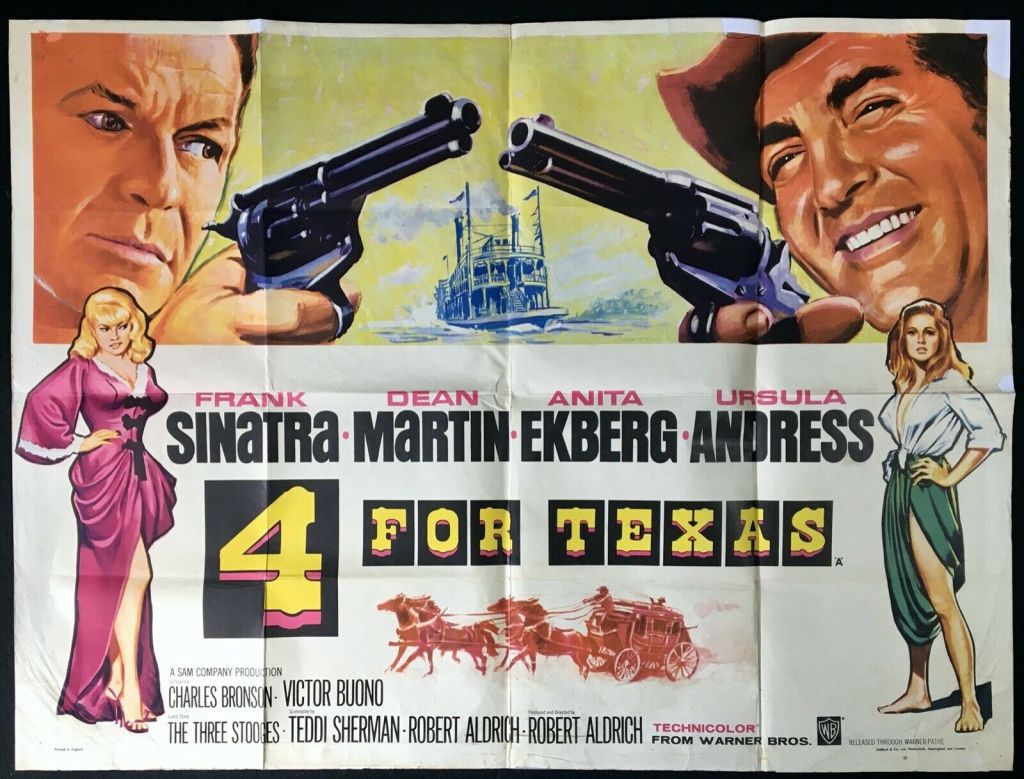
The manager of the Starlite Drive-In in Chipley, Florida, recommended sci fi The 10th Victim (1965), “guaranteed to hold interest,” although he conceded that Ursula Andress was the draw. Another house in the same state, the 90 Drive In in Baldwin,  attributed the success of Boy, Did I Get A Wrong Number (1966) not to sexy European sex symbol Elke Sommer but to comedienne Phylllis Diller because Bob Hope “doesn’t usually draw well here” and it did the best business ever for a movie featuring the star. Leon Kidwell at the Majestic in Allen, Oklahoma, reckoned Red Line 7000 (1965), a flop most places, was “just what my crowd likes” and also recommended Arabesque (1966) “one of the best pictures to come out Pinewood (England).”  But “war stories don’t work” in the Scenic in Pittsfield and Henri Verneuil’s Weekend at Dunkirk (1964) no exception despite “nice performances” from Jean-Paul Belmondo and Catherine Spaak and the in-built excuse that it was foreign.

Opinions varied on Elvis. “Poor business..(not) like they were one time (when audiences) wanted to see Elvis every few months. Old, new, rerun, they didn’t care,” but the bottom had dropped out of the market for a revival of Kid Galahad (1962) at the Main Theatre in Stonewall, Alabama, while Paradise Hawaiian Style (1966) was deemed “good enough” at the Scenic – “its Elvis and that’s a lot” commented the cinema’s Arthur K. Dame.

There was clearly still an audience for less controversial films, witness the remake of Smoky (1966) starring Fess Parker, hardly a marquee name, but it came off as a “very good horse story” at the Jackson and A Man Called Flintstone (1966) was a hit at the Star Drive In in St Johnsbury,  Vermont. Offbeat Lord Love A Duck (1966) starring Roddy McDowell and Tuesday Weld hit a home run at the Scenic. “My small audience got a big kick out of it and went home happy,” noted Dame. A reissue of The Brides of Dracula (1960) did well at Rochester which also had audiences clamoring for more gritty historical offerings like The War Lord (1965) featuring Charlton Heston. In light of the success of Cat Ballou (1965) and The Professionals (1966) the Jackson rescheduled Lee Marvin oldie The Killers (1964) as part of a double bill. .

The chances of such houses enjoying anything approaching a day-and-date release were remote. So when the Lans in Lansing, Iowa, had the opportunity to do so you could hardly blame the exhibitor for taking the gamble of putting more advertising bucks behind locally-made The Hostage (1967) but in retrospect the “fine suspense picture…didn’t do business.”

Of the features mentioned, Those Magnificent in their Flying Machines had the longest run, four days, probably dictated by the distributor, and the unheralded Lord Love a Duck the shortest (one day). Arabesque. Torn Curtain, The Hostage and That Man from Istanbul merited three days but for all the rest screenings were limited to two days, and not just at the start of the week, many of those showings taking place over the Saturday-Sunday period.  

It’s somewhat surprising to see how towns with tiny populations could support their own cinema. Among the operations featured here, the Capitol in Rochester had the biggest catchment area, a 330,000 population, but it wouldn’t have the market to itself, an area that size would have competitors. Of the other towns mentioned, Pittsfield had a population of 2,300; Malta 1,900; Flomaton 1,480; Lansing 1,328; Allen 1,000; and Lockwood 852. Small wonder they changed programs so often

SOURCE: “The Exhibitor Has His Say,” Box Office, January 9, 1967, pA4.

Nightmare in the Sun (1965) ***

Your first question is how did rookie director Marc Lawrence have the standing and the foresight to  assemble such an amazing cast? Not just wife-and- husband team Ursula Andress  and John Derek (Once Before I Die, 1966) upfront, but Rat Pack member Sammy Davis Jr (Sergeants 3, 1962), The Godfather (1972) alumni Robert Duvall and John Marley, Aldo Ray (The Power, 1968), Richard Jaeckel (The Devil’s Brigade, 1968), Keenan Wynn (Warning Shot, 1966) and Arthur O’Connell (Fantastic Voyage, 1966).

And it’s bold work, throwing the Psycho dice, playing the hell out of the noir tune, most of the time heading down a nihilistic road, and with a terrific twist for a climax. Some great scenes that with a more experienced director would be instantly memorable and managing to fit into what should be a straightforward thriller some intriguing oddball characters.

Anonymous drifter (John Derek) ends up in a small town in Nowheresville where Marsha (Ursula Andress) has a slew of lovers including the sheriff (Aldo Ray). Wealthy rancher husband Sam (Arthur O’Connell) is the jealous type who checks out her speedometer to see if her tales of out-of-town visits tally up. Naturally, a handsome stranger is easy prey to her seductive charms but when hubbie spots said stranger leaving his house he loses his rag and kills her.

Holy moly, talk about Psycho, getting rid of the sexy star one-third of the way through is a heck of a note. Who does this director think the audience is coming to see? But if he’s no  Hitchcock, he’s got another trick up his sleeve. Sheriff won’t let the husband plead guilty, not when he can play that card for all it’s worth, rooking the rancher for thousands of bucks, so he decides to pin the blame on the man seen leaving the house. Not only that, he plants evidence, stolen jewellery etc, on the suspect and handcuffs him.

Suspect escapes, taking with him a cop car, but those handcuffs are tougher to remove than most cinemagoers have been led to believe from previous yarns. A hacksaw won’t do it nor will trying to burn them apart with an oxy-acetylene cutter. So he’s stuck with carrying about proof of guilt or at least suspicion and spends most of the time picking up cats or items to hide the evidence.

A couple of bikers (Robert Duvall and Richard Jaeckel) decide to chase the reward money, able to scoot through the desert in a way denied the cops’ four-wheelers. It’s a shame this pair are anonymous, as most characters here are, defined by occupation rather than slowing down the pace with introductions. So it’s the Robert Duvall character who we discover is more fragile than his appearance would suggest and lashes his bike with a chain when his character is questioned.

So here’s the oddball line-up: a couple (George Tobias and Lurene Tuttle) running a small-time animal-bird sanctuary, nursing back to health creatures peppered with gunshot or the wounded version of roadkill; a junkyard dealer (Keenan Wynn), one-time hoofer who can’t wait to demonstrate his moves; and a type of boy scout leader (Allyn Roslyn) whose troop gets lost in a sandstorm, one of whom our drifter rescues. The latter sequence has a touching aspect, rescued child, probably the only person in the whole movie with an understanding of law, accepting a suspect as innocent rather than guilty, is betrayed by the leader who instead of helping our escapee to safety, hands him over to the cops.

And to a final, quite unexpected, climax.

So it’s corruption all the way, even our innocent, supposedly heading home to a beloved wife, taking time out for a touch of adultery.

There’s something about these early low-budget films that brings out the best in Ursula Andress. She’s not just spouting lines to fill in some essential part in a story, but takes her time over delivery, essentially establishing character with what she does between talking and for a practised seducer there’s an innocence in her pleading, “Please take me somewhere nice.”

Aldo Ray is as odious as they come, sneaky too, and you sense he has practice on pinning the blame on the wrong person. And no wonder the wife plays around when her self-pitying husband gets so stoned he passes out.

I saw this on a very poor print on YouTube but even so its narrative qualities, if less so the direction, were obvious.

Worth a look.

Dark of the Sun / The Mercenaries (1968) ****

Rod Taylor made a brisk transition to two-fisted action hero from his previous forte of drama (Hotel, 1967) and comedy foil to Doris Day (The Glass Bottom Boat, 1966) in this violent adventure set in the Congo in the early 1960s. As Captain Curry, assisted by sidekick Sgt Ruffo (Jim Brown) and 40-man local outfit Striker Blue Force, he leads an ostensibly humanitarian mission to rescue settlers cut off by the Simba rebels as a cover for collecting $50 million in diamonds. The loot is essential to save the toppling regime of President Ubi (Calvin Lockhart).  The only feasible transport is train. There is a three-day deadline.

Problems immediately ensue, not least a clash with Capt. Heinlein (Peter Carsten), former Nazi leader of Blue Force, who is even more ruthless than Curry, mowing down two native children who stray too close to the train, and apt to go into a fistfight with a chainsaw. The train is attacked by a United Nations plane and on reaching its destination Curry is forced to wait three hours until the time-controlled giant diamond vault can be opened, giving the rebels time to catch up. Then it’s an ongoing battle of one kind or another.

Although the worst of the violence is carried out by the rebels – rape, torture and massacre – a core element of the drama is how a lifetime of killing has affected Curry. Ruffo, a man of principle who grew up in a primitive tribe, acts as his conscience – and that of the audience – spelling out how violence is more than a money-making scheme and essential to upholding order in terrorist times. Curry has some redemptive features, saving widow Claire (Yvette Mimieux) from Heinlein, sending the alcoholic Doctor Wreid (Kenneth More) to help a woman give birth, and eventually acknowledging his strong bond with Ruffo. Although Curry would like to think he is the opposite of Heinlein, they are carved from the same stock and when the savage beast is loose blood lust takes over. 

Claie is more or less there as bait, tempting Heinlein and any rebels in the vicinity, but coming into her own in convincing Wreid, paralytic by this stage, to carry out a section on the pregnant woman, and as a reminder of civilization for Curry.

The action scenes are terrific, particularly the plane strafing the train, and there is a particularly good ruse, instigated by Ruffo, to outwit the enemy. Hollywood never managed to portray the terror of the native Vietnamese on being overrun by Viet Cong, and this film could easily be that substitute, especially when some of the rescued white settlers realize they will not escape.

This is not one of those films like Born Free (1966) or Out of Africa (1985) which are scenic odes to the continent, in part because the picture was shot in Jamaica, but in the main because director Jack Cardiff (Our Mother’s House, 1967) chooses to focus on the mechanics of the mission. And in so doing, he writes a love letter to a train. There had a mini-vogue for war movies set on trains – Von Ryan’s Express (1965) and The Train (1965) come to mind – but none reveal an adoration for the power and perhaps the beauty of the locomotive. Every move it makes (to steal an idea from pop group The Police) is noted on screen and on the soundtrack, the hissing, the belching smoke, the wheels, cabooses, engine, the coupling and uncoupling of links, the screech of brakes, and various tracking and crane shots as the train snakes its way through enemy terrain.

Rod Taylor is excellent in the kind of role he is made for. Jim Brown in a major step up the billing after The Dirty Dozen (1967) is surprisingly good in a part that calls as much for reflection as action. Peter Carsten is the all-time Nazi scum. Yvette Mimieux, who had partnered Taylor in The Time Machine (1960), is also in transition mode, her role a meatier dramatic departure from the likes of the innocuous Monkeys, Go Home! (1967). In what was essentially his last major role – even though it doesn’t amount to much in screen time – Kenneth More (Sink the Bismarck!, 1960) wavers considerably from his stiff-upper-lip default.

The score by Jacques Loussier is particularly good, as Quentin Tarantino attested when he incorporated elements of it for Inglorious Bastards, which was a boon for the composer since up till then he was best remembered for the music accompanying the advert for Hamlet cigars. You might get a laugh out of the screenplay credits. Quentin Werty (i.e. Qwerty, the first six letters on a typewriter) the pseudonym of Ranald McDougall, Oscar-nominated for Mildred Pierce (1945), co-wrote the screenplay, adapted from the novel by Wilbur Smith, with television writer Adrian Spies.

An outstanding example of the all-out action mission picture, its occasional outdated attitudes do not get in the way of the picture and half a century later from what we now know of how wars are fought the levels of violence will appear realistic rather than exploitative.    

When Time Ran Out (1980) / Earth’s Final Fury ***

The Director’s Cut, can you believe? Or less pompously, The Expanded Version. An extra 30 minutes added to the general release version that traveled the world to general disfavor. (The original 121-minute cut was edited to 109 minutes and this version clocks in at 144 minutes.) Was it a sense of disgruntlement – or sheer opportunism – that led to the Director’s Cut, so many of which scarcely improved on the original version. How many versions can an audience take of The Exorcist (1973) or Blade Runner (1982)? And even where extra length definitely added depth to Kingdom of Heaven (2005) that couldn’t overcome its major flaw, in a massive case of hubris, director Ridley Scott believing he could get away with casting Orlando Bloom instead of waiting till Russell Crowe became available.

When Time Ran Out killed off the disaster cycle and the Hollywood career of uber-producer Irwin Allen who had started that particular ball rolling with The Poseidon Adventure (1972), upped the ante with The Towering Inferno (1974) and dropped the ball with The Swarm (1978) and Beyond the Poseidon Adventure (1979).

This doesn’t feel so much like a disaster movie as a picture tying up all the knots, various relationships coming asunder, and having to accommodate a bunch of well-known supporting actors of dubious all-star-cast status before they suddenly spring into dramatic narrative view.   Audiences had never been particularly keen on volcanic pictures, after all what can the trapped characters do but dodge a sludge of soup and hope they don’t run straight into a tidal wave or, worse, have to negotiate a rickety/rope bridge. The chances of you having a tightrope walker coming to the rescue would generally be remote but that’s what we have here (step forward Burgess Meredith).

I had thought from the title and some guy in a hazmat suit wandering over a desolate area that this might be a prophetic eco-disaster, but excepting that there’s, for reasons best known to the scriptwriters, an oil well being drilled close to a volcano and that hotel investor Shelby (William Holden) has the bright idea of using the volcano as a marketing prop, there’s nothing much going on. The special effects are okay on the small screen, but even if they had been spectacular on the big screen their effect on the much smaller environs of DVD would in any case have been diminished.

So, basically, it’s reliant on working up sufficient audience interest in the relationships to make us care for the characters. We’re offered a pair of two-timing teams. First up, we’ve got Shelby’s secretary and marketing guru Kay (Jacqueline Bisset) who’s just turned down the offer to become his sixth “or seventh” wife, but who, presumably is enjoying, this being the 1980s and not the 1930s, some kind of sexual dalliance with him. When Kay meets up with oil driller old flame Hank (Paul Newman), they rekindle their romance, although with doom impending there’s not much time to take it forward beyond a picnic on the beach.

Next up, hotelier Bob (James Franciscus) is cheating on wife Nikki (Veronica Hamel), Shelby’s god-daughter, with staff member Iolani (Barbara Carerra) who is due to be married to childhood sweetheart hotel manager Brian (Edward Albert). To flesh out the tale, both Shelby and Bob have daddy issues, Tom (Ernest Borgnine) is a New York cop on the tail of swindler Francis (Red Buttons), and no doubt audiences will be desperate to find who wins a  cockfighting contest being held in a local saloon.

Modern transport proves no match for an eruption, so in quick succession we see a car and a helicopter tumbling down the mountainside. The tsunami wipes out a good chunk of the actors that didn’t make it into the all-star-cast bracket and everyone else takes to the hills, no doubt hoping they won’t encounter a rickety/rope bridge. Disaster turns enemies into pals, Tom and Francis, for example, though it’s only now that Nikki comes across her husband’s infidelity.

And this would be a disaster all round except that having hooked myself into watching this, courtesy of a freebie on YouTube, and nothing of real dramatic interest going on, I found myself, oddly enough, concentrating on the three principals and was treated, even more odd I guess, to fine examples of just what these stars do to earn their crust. Paul Newman (The Prize, 1963) in particular, with very little to react to, does very little but with incredible facial agility, to genuine effect, portraying emotion with infinitesimal gesture. Sure, he’s always had the shrug and the walk, both far more suggestive of inner turmoil than any other actor I can name, but here, with very little dialog coming to his aid, you can tell exactly what’s going on in those baby blues.

Jacqueline Bisset (The Cape Town Affair, 1969), too, dressed a good bit less suggestively than in the posters, essays a confident woman coming unstuck when confronted with a romantic error. The scenes between the pair are not meant to be scorching, so there’s none of the screen charisma audiences might feel they’ve been sold, but instead it’s a slow-burn, a couple trying to come to terms with each other, passing through disappointment and hopefully onto something better. And you can’t find anyone better to carry disillusion than William Holden (The Devil’s Brigade, 1968).  

Abject swansong for director James Goldstone (Winning, 1969) and Oscar-nominated screenwriter Carl Foreman (The Guns of Navarone, 1961) but Oscar-winning co-writer Stirling Silliphant (Marlowe, 1969) carried on longer. Who wrote the most effective scenes, Shelby’s engagement ploy and Hank’s initial rejection of Kay, is anybody’s guess but there is some quality writing here. Probably the strangest part of the whole debacle was that the source was a piece of non-fiction, The Day the World Ended by Gordon Thomas and Max Morgan Witts, about a 1902 eruption on Martinique that had nothing to do with oil wells or hotel construction.   

There’s always something wrong with a disaster picture if you suggest watching it for the acting, but happily, this is the case.

Bachelor Flat (1961) ****

Stereotypical Englishman reinvented. Where the suited-and-booted traditional British gent, umbrella at the ready, moustache awaiting twirling, bristling with pomposity, usually of military background and inclined towards the pedantic, was treated as a figure of fun, here in a marvelous conceit he is instead catnip to the ladies. You could imagine this was somewhat prophetic given the imminent arrival on Hollywood shores of such testosterone-charged figures as Sean Connery, Richard Harris et al.

All the elements that previously pointed to mickey-taking – impeccable manners, a sense of fair play anathema in the cut-throat American world, respect extended towards the opposite sex – are here presented as such ideals that the entire female population of a small town is swooning at the feet of its only known Englishman.

What’s more, director Frank Tashlin (The Glass Bottom Boat, 1966) doesn’t ask star Terry-Thomas (Arabella, 1967) to lampoon himself, as would often later be the case, where the actor was called upon to play an overstuffed romantic fantasist of the Bob Hope variety or presented as comedic villain or overacting butler. Instead, Terry-Thomas plays it straight, oozing astonishing charm that allows the slapstick and farcical ingredients to work a treat.

Sure, it’s mostly a dressed-up farce, people hidden in cupboards and under beds, doors slamming in faces, faces drenched in cake, and in a sharp swipe-left on gender equality, the man, rather than the woman, mostly seen in a state of undress.

Professor Patterson (Terry-Thomas) throws his adoring mostly adorable students into a tizzy when they discover he is engaged to actress Helen (Celeste Holm) currently residing in Paris. They met when the academic rented her beach house which is where Libby (Tuesday Weld) comes in. Astonished to discover a stranger in her mother’s house, Libby doesn’t let on she’s Helen’s daughter and instead pretends to have escape from juvenile detention. Helen has so far balked at telling her lover she has a 17-year-old daughter by a previous marriage.

Professor’s young neighbor, law student Mike (Richard Beymer), takes a shine to his unwelcome guest, but he’s mostly there to add complication to complication.

Usually, in these farces, it’s the guilty man trying to hide his various lovers from one another, hence stowing them away in cupboards and beds and whatever. But here the professor is a determined innocent who has to stoop to such shenanigans to pretect his integrity. But not only is he assailed by Libby but also by student Liz (Ann Del Guercio) who lets down his tyres so she can run him home and neighbor Gladys (Francesca Bellini) who makes eyes at Mike as a way of infiltrating Patterson’s defences. Added complications are a suspicious cop and a rival academic.

So when Patterson is not trying to keep the various female invaders from discovering one another, or the cop or Mike from finding them stashed away, he’s trying to fruitlessly explain how he has been snagged by the aforesaid predatory women. And of course when his fiancee returns there’s no queston she’ll catch him in some questionable act.

In some senses this is pretty formulaic stuff but it is brightened immeasurably by some choice lines (“I don’t take money from strangers unless I steal it” and “either you get a smaller bone or I get a bigger dog”), the occasional madcap situation (one of his suitors eating a slice of cream came while on a vibrating slimming machine and Mike discovering how Libby fed him a line), but mostly by the spirited playing of Terry-Thomas and Tuesday Weld. Apart from a small part in Tom Thumb (1958) this was the actor’s introduction to Hollywood and it says a lot for his talent that he’s entirely believable as the kind of charmer that women flock to.

Tuesday Weld (Pretty Poison, 1968) is more than glamor on legs and finesses her first top-billed role into surprising depths beyond the obvious enthusiastic ingenue, especially given her Ann-Margret-style shake-your-booty introduction, suggesting talent to burn. Richard Beymer (West Side Story, 1961), who was holding a real-life candle for Ms Weld, is little more than eye candy for the female gaze. And if none of this trio is sufficient to hold your attention, there’s a cute dog.

Frank Tashlin occasionally made films with more acerbic bite, but this isn’t one of them. It sticks to a magic formula that works mostly thanks to the two principles.

Raised up a good notch by the revelatory performance by Terry-Thomas, his drunk scenes are just superb and unusually played, and you probably can guess from this where Four Weddings and a Funeral (1994) got its rain-soaked proposal scene.

Tremendous fun.

In Search of Gregory (1969) ***

Off-beat examination of the fantasy vs. reality conundrum with an ever-watchable Julie Christie as the woman on the titular hunt. The only film of acclaimed British theater director Peter Wood is a more whimsical cousin to the more deliberately obscure works of Alain Resnais (Last Year at Marienbad, 1961) and Michelangelo Antonioni (Blow-Up, 1966) which pivoted upon the question of whether events presented actually occur or exist only in the head of the leading character.    

Catherine (Julie Christie) is enticed to Geneva by her father (Adolfo Celi) for his latest wedding on the basis that she will meet the impossibly handsome Gregory (Michael Sarrazin). On arrival she discovers the agoraphobia of younger brother Daniel (John Hurt) has been temporarily lifted by Gregory. Catherine appears set to meet Gregory on a number of occasions, but either he does not turn up (the wedding) or somehow, they miss each other, even at one point occupying adjoining phone booths. And it would have been a pretty dull picture if that was all that was going on. But whether the result of reality or Catherine’s imagination, the Gregory we see is a vivid screen presence. The world the characters inhabit is unusual to say the least, so unique that it is either obviously real or fake, but virtually impossible to determine which.

The best Gregory sequence, of which Steve McQueen would be proud, involves the character moving by means of the windscreen from one side to the other of a car driven at high speed. In another scene Gregory plays the equally perilous game of Autoball, a kind of polo with stock cars. As convincing is Gregory’s avant-garde orchestra consisting of two guitars, bottles, a bicycle wheel, a waste bin and coins in a glass. 

The detail is so extraordinary that it must be real. The brother seems real enough, too real if anything, close to enjoying (or pining for) an incestuous relationship with his sister. But for every moment that appears questionable – did she really witness Gregory making love to her future mother-in-law – there are others where doubts are immediately quelled (an address which appears non-existent is not). And long before anybody came up with the idea of selling bottled water, Gregory is apparently in the business of selling tinned Alpine air. Other moments she does not witness – Daniel riding a Lambretta/Vespa with feet on the handlebars – add to the prospect of genuine reality.

Catherine might even have met Gregory except that in going to bed with the man who looks very much like what we believe Gregory to look like she determines that he shall remain anonymous. So it’s anybody’s guess whether Gregory is a figment or phantom of her imagination. And why, of course, should such invention be necessary? Does it mean that her father and brother do not exist either?

It’s an entertaining mystery. There’s no great angst. Antonioni had the sense or cunning to ensure that consequence mattered in Blow-Up – a murderer escaping justice. But there’s no such tension here. While Catherine is tabbed a nympho by her brother (who never questions her father’s predilection for multiple marriages), the suggestion that she’d fly from Rome (where she lives with her boyfriend) to Geneva is the hope of a hook-up seems too far-fetched.

Despite the presence of Julie Christie – who can certainly carry even as slight a picture as this – and a quixotic turn from John Hurt (Sinful Davy, 1969) it’s neither obscure enough to be arthouse nor sufficiently plot-driven to be mainstream and remains an oddity. If you are going to be irritated beyond belief that will occur in the first fifteen minutes or so, but if you stay the course, you may find it a worthwhile watch rather than a cinematic car crash. Written by Bonnie Golightly (her only screenplay), Oscar-nominated Tonino Guerra (Blow-Up, 1966), and  Lucile Laks (The Black Belly of the Tarantula, 1971).

Once Before I Die (1966) ****

Nobody ever took Ursula Andress seriously as an actress. Ditto the directorial skills of her one-time husband John Derek (Bolero, 1984). Their combination was viewed as a cosmic joke. And it doesn’t start well here, the credits little more than a paean to her beauty, hair rippling in the wind etc, so much so you wouldn’t be surprised to find her later on running in slo-mo through a cornfield. The opening sequence couldn’t be more Raquel Welch, Andress sporting a white bikini as she shoots the rapids. And the premise looks like little more than a wartime western.

Instead…

Technically, this is surprising, ocasionally astounding, as the director makes use of the kind of image layering that attracted kudos for Francis Coppola in Apocalypse Now (1979) and with one stunning sequence shown entirely, in close-up, through the eyes of the actress. Andress is far from eye candy. Opportunities to show her naked or at least soaked to the skin, obligatory scenes set in water, are passed over. Instead, she is the camera’s conduit. The innocent bystander responding to war, and sharing in the shock of the youngsters, mostly virgins, who will never see a naked woman before they die.

Having to literally deal with the title should be the only false note and yet strangely enough there’s a haunting lyrical quality in the contrast between her, in the midst of battle,  acquiescing to the shameful desire of a 22-year-old soldier to be kissed and his colleagues’ glee at burning to death the occupants of an enemy tank. An act of humanity set off against raw brutality.

The set-up is simple enough. Just after Pearl Harbor, a group of polo playing soldiers in the Phillippines are strafed by Japanese planes. Cavalry leader Bailey (John Derek) and his troop set off by horseback cross country for Manila. He sends his girlfriend Alex (Ursula Andress) off in the same direction in her ritzy car. Against instructions, she loads up her car with puppies and refugees, an old lady and a child, and when she gets stuck, Bailey allows the trio to accompany the soldiers to safety. When they reach a village, her linguistic skills come in handy, pinpointing a Frenchman and his native girl, purportedly translating, as lying about food supplies.

In rooting out a bloodied teddy bear, Bailey is accidentally killed and for the rest of the picture Alex is in something of a catatonic state, but doing her best to keep up soldier morale, as attendant to the worries of the young, fearing death, as to the more experienced  gung-ho shaven-headed Custer (Richard Jaeckel) who welcomes a hero’s demise. By the end, she is a combatant, shooting an enemy soldier.

By taking Alex as the cinematic focus, the director can dispense with the usual tropes of a battle-weary squad in wartime. So, beyond the youngster’s confession, we learn nothing of the soldiers’ lives, and that, too, is somehow refreshing, as going down that route at best seems like a vain attempt to make audiences sympathize with unsympathetic characters, and at worst, is a delaying device.

All you need to know is that guys who would otherwise be larking about, drinking beer, telling tall stories or playing polo, are vicious in war, gunning down as if a communal firing squad a captured grunt, so trigger happy they shoot one of their own in the middle of the night, so careless they are liable to drop a grenade at their own feet.

And, much to my astonishment, there’s dialog and scenes Tarantino would be proud of. Custer explaining that he shaves his head “to get rid of every hair” is the kind of line that in a more acclaimed picture would be noted. Custer again, accused of making up a story that he has killed a bundle of Japs, looks initially as if he believes himself guilty of too fertile an imagination until he interrupts a chat between two disbelieving officers by chucking an enemy corpse onto their laps.

And there’s genuine screen charisma between Alex and Bailey, a wonderful scene where she takes gentle umbrage at being scolded for refusing to obey orders, but nothing played out to the brim, everything understated, the actions of a couple who don’t need to display their love to the world because they are already committed.

The Virgin Soldiers (1969) played the central theme for laffs but didn’t achieve an ounce of the truth expressed by the raw youngster, who’s ashamed to be revealing such fears to a woman, and to be even asking her to relieve them, and of the dumbness to be muddying his thoughts in a life-and-death situation with fantasies about sex. You can certainly argue with the notion that women in wartime are obliged to have sex with any passing soldier (who sometimes take without asking) who could die a virgin, and taking that into consideration, this shouldn’t work at all. It’s only a kiss and hand-holding after all, and she’s not maternal about it, or even pitying, and after all, deprived of a future husband, she also needs solace.

I mentioned before about finding suprises in my trawl through this decade’s movies and there couldn’t be a bigger surprise than this which must have lain unseen on my shelves for years as I dreaded inflicting upon myself another movie by the director of Tarzan the Ape Man (1981).

But astute direction and the determination to allow Andress to act, to show scenes through her eyes, the sign of any great actress, pay off. Career-best performance from Richard Jaeckel (The Devils’ Brigade, 1968), no show-boating here either.  The budget restricts the action, but, oddly enough, that’s to the film’s benefit as it allows it to play off Andress more.

Well worth a watch.

Discover WordPress

A daily selection of the best content published on WordPress, collected for you by humans who love to read.

The Atavist Magazine

by Brian Hannan

WordPress.com News

The latest news on WordPress.com and the WordPress community.