I am a published author of books about film - over a dozen to my name, the latest being "When Women Ruled Hollywood." As the title of the blog suggests, this is a site devoted to movies of the 1960s but since I go to the movies twice a week - an old-fashioned double-bill of my own choosing - I might occasionally slip in a review of a contemporary picture.
Worth seeing for all the wrong reasons prime example being Christopher Plummer with a false nose and almost unrecognisable as an eighteenth century periwigged English dandy in a pure squalor of a coastal town. The best reason is the very realistic background, all mud, missing teeth, drunkenness, cockfighting, poverty, debtors strung up in baskets – not the usual bucolic image of Olde England. But everything gets bogged down in an indecipherable plot. Robert Altman mastered the multi-character narrative in such gems as Nashville (1975) but here debut director Peter Coe most demonstrably did not.
This started life as a modestly successful London West End stage musical and probably for budgetary reasons the songs were discarded. All that’s left is plot. And plot and plot. All to do with sex as it happens. Husbands exist only to be cuckolded. Cleavage is obligatory for women. Young women lusting after sex have been brought up in contradictory fashion to view it as dirty. And no eighteenth century tale is complete without a regimen of long-lost daughters and sons.
Guess who?
It starts promisingly enough in early morning with a town crier (Arthur Mullard) filling us in on the predilections and problems of various prominent citizens, most notably Lord Foppington (Christopher Plummer), the foppest of the fops, gearing up for an arranged marriage to Hoyden (Vanessa Howard). As a virgin not wanting to come to his wedding night bereft of the necessary skills, he employs strumpet Nell (Georgia Brown) to bring him up to speed.
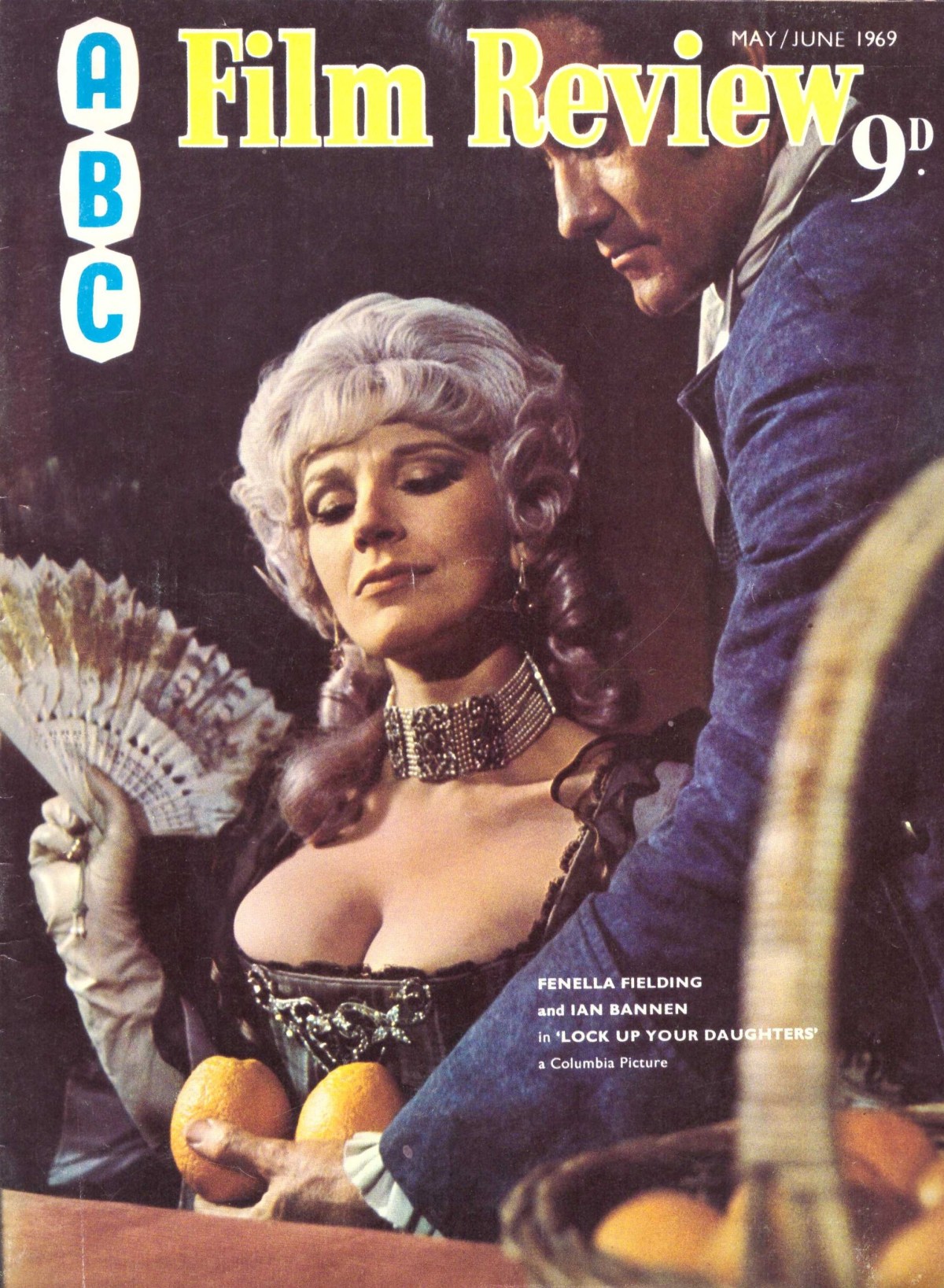
Meanwhile, it’s “lock up your daughters” time as a ship’s crew, at sea for ten months, given two days leave, start charging through the town, fondling and kissing any woman of any age who happens to stand still for a moment. Among this randy bunch are Ramble (Ian Bannen), Shaftoe (Tom Bell) and Lusty (Jim Dale). Ramble is given the eye by married Lady Eager (Fenella Fielding), Shaftoe takes a fancy to Hilaret (Susannah York) while old flame Nell is targeted by Lusty (Jim Dale). Mrs Squeezum (Glynis Johns) seeks sex anywhere and there’s maid Cloris (Elaine Taylor) also seeking physical fulfilment.
Of course, the whole purpose of the narrative is to thwart true and illicit love, husbands and fathers returning at inconvenient times. And had the storyline stuck to the tried-and-tested formula devised very successfully for Tom Jones (1963) and The Amorous Adventures of Moll Flanders (1965) it might well have worked. But the instinct to make meaningful comment by way of satire takes the story in very unlikely directions, an extended court scene with a barmy judge the worst of such excesses, though a food fight comes close.
It’s meant to play as a farce, the men climbing (literally) in and out of bedrooms, the town’s apparently only ladder put to continuous use. But what would work on stage sadly falls down here, and not just because the occasional song might have come as light relief. There is an element of the female confusion over sex, natural instinct going against education, and so ill-informed that at the slightest chaste kiss they are likely to cry rape, but that’s as close as the movie gets to anything that makes sense. A movie that needed a sense of pace just becomes one scene tumbling into another.
Christopher Plummer (Nobody Runs Forever/The High Commissioner, 1968) makes by far his worst screen choice. He’s so concealed in his clothing that movement is inhibited and most of his acting relies on overworked eyeballs. Susannah York (Sands of the Kalahari, 1965) is pretty much lost in the shuffle. Ian Bannen (Penelope, 1966) is the pick, largely because he is required not to play villain, grump or idiot, and his Scottish charm and confidence works very well. Tom Bell (The Long Day’s Dying, 1967) is not cut out for comedy whereas Jim Dale (Carry On Doctor, 1967) who very much is does not get enough.
The movie wastes the talents of a terrific supporting cast headed by former British box office queen Glynis Johns (The Chapman Report, 1962) plus Roy Dotrice (A Twist of Sand, 1968), Vanessa Howard (Some Girls Do, 1969), Elaine Taylor (Casino Royale, 1967), Roy Kinnear (The Three Musketeers, 1973), Kathleen Harrison (Operation Snafu, 1961), Fenella Fielding (Arrivedeci, Baby, 1966) and singer Georgia Brown (A Study in Terror, 1965).
Keith Waterhouse and Willis Hall (Billy Liar, 1963) wrote the screenplay based on, as well as the original musical, a number of sources drawn from the works of Henry Fielding (author of Tom Jones) and John Vanbrugh. Peter Coe never directed another movie.
All films released in Britain in the 1960s made their debuts in London’s West End which comprised a total of 18 cinemas, nearly half of these playing roadshows. While the performance of openers here was important, just as critical an indication of box office potential was length of run. Half the cinemas could seat 1,300-plus patrons. Ticket prices ranged from 70 cents to $4.20. The week ending May 4, 1965, provided this snapshot.
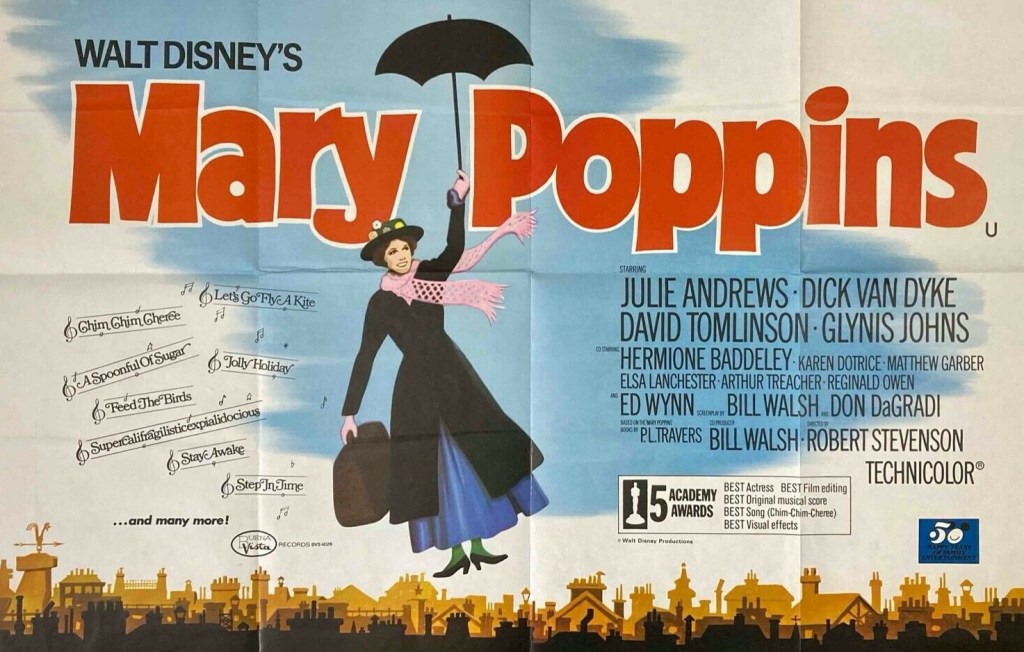
The top three films, all playing roadshow (i.e. two separate performances per day), were musicals. My Fair Lady at the 1,562-seater Warner pulled in $40,500 even though the movie was in its 15th week, some distance ahead of The Sound of Music which in its 5th week racked up $36,400 at the 1,712-seater Dominion. Much further behind, but setting a house record in the 16th week of its residency at the 600-seat Odeon Haymarket, was Mary Poppins which cleared $20,000. Both the Dominion and the Warner operated with the same ticket prices, cheapest seats setting customers back $1.45 with the most expensive seats costing $4.20, by far the dearest prices in London, no other West End cinema even breaking the $3 barrier. Tickets at the Odeon Haymarket ranged from $1.05 to $2.80.
Prospective longevity made the headlines ahead of new openings. Roadshows needed legs to justify the expense of running a movie at just one cinema in the British capital. Often, a major roadshow would play London weeks ahead of any other engagement in the country. The kind of wide release that was becoming increasingly common in the United States did not occur in Britain outside of the circuit releases in the two major chains, ABC and Odeon, which usually took product after it was played out in the West End.
Only two pictures made their debuts that week. Sylvia starring Carroll Baker was in pole position with $12,000 at the 1,889-seat Plaza (ticket prices $0.90-$2.80) just ahead of Robert Aldrich’s Hush, Hush, Sweet Charlotte which potted $11,000 at the 1,128-seat Carlton ($0.70-$2.10) but the latter, with its smaller seating and cheaper tickets, may well have been counted the winner.
The other big noise on the roadshow front was that the star-studded Samuel Bronston epic The Fall of the Roman Empire had entered its second year at the 1,474-seater Astoria. The movie had flopped in the United States where it had kicked off in 22 hard-ticket engagements in March 1964. In London in its 57th week it brought in $5,900. It would not go into general release, on the Odeon circuit, until September 1965; in other words, around 18 months after its launch.
Other roadshows displaying legs were: Lord Jim starring Peter O’Toole with $13,500 at the 1,394 seat Metropole ($1.05-$2.80) in its 6th week after moving over from the Odeon Leicester Square and The Greatest Story Ever Told grossing $16,000 in its 3rd week at the 1,155-seat Casino ($1.20-$2.80). Two Cinerama productions had been recently launched – Mediterranean Holiday snapping up $12,000 in its 3rd week at the 1,795-seat Coliseum ($1.20-$2.50) while The Golden Head marked up $4,700 at the 862-seat Royalty ($1.20-$2.50).
But other pictures playing continuous performance were held over if justified by box office returns. Peter Sellers in his second outing as Inspector Clouseau in A Shot in the Dark had taken $8,500 in its 11th week at the London Pavilion ($0.80-$1.80). In its 7th week at the 430-seat Ritz ($0.70-$1.15) was The Yellow Rolls Royce with $3,400. The 5th week of Ursula Andress as She posted $5,500 at the 556-seat Studio One ($0.50-$1.20). Anthony Quinn as Zorba the Greek turned in $5,000 in the 4th week at the 529-seat Rialto ($0.70-$1.90). The second and final week (truncated to five days) of Fail Safe at the 740-seat Columbia ($0.70-$2.10) knocked up $6,700. Films completing a third week were: The Americanization of Emily with $11,800 at the 1,330-seat Empire ($0.70-$2.10), Masquerade with $8,500 at the 1,375-seat Leicester Square Theatre ($0.70-$2.40) and Strange Bedfellows on $12,800 from the 2,200-seat Odeon Leicester Square ($0.70-$2.20).
New openings had been announced for the double bill of Invitation to a Gunfighter and That Man from Rio which was moving into the London Pavilion on May 13, Those Magnificent Men in their Flying Machines flew into the Astoria on June 3 while Operation Crossbow hit the Empire on May 19.
However, there was often a considerable time gap between roadshow movies finishing their West End run and moving into general release on the circuits – dominated by the Odeon and ABC chains. My Fair Lady would not receive an ABC general release – and the rare accolade of an extended run of two weeks – until January 1967, nearly a full two years after it had premiered in the West End and it would be 1969 before The Sound of Music received an Odeon general release (and then only in London).
On the other hand, The Yellow Rolls-Royce, while still picking up decent coin at the Ritz, entered ABC general release at the end of January – and proved one of the top box office hits of the year on that circuit. She, enjoying a healthy stint at the Studio One, had been released through ABC in April. Mary Poppins would swing onto the Odeon circuit in time for the main English summer holiday period in August 1965. The ABC circuit played the double bill of The Americanization of Emily and To Trap a Spy at the start of May 1965, only a couple of weeks after its West End bow. Hush, Hush, Sweet Charlotte, on the other hand, wasted no time in shifting into top gear, sent out onto the Odeon circuit virtually day-and-date with its West End showing, and Strange Bedfellows would head down the same route barely a month after its opening.
I should point out that general release meant a movie was playing at the local/neighbourhood cinema. The big cinemas in big city centres throughout Britain would have mostly, but not always, shown the movie shortly after the West End debut, occasionally simultaneously. To complicate matters further, in Britain general release meant London rather than the entire country. And even then the London release was split in two – to save on prints – the north side of the capital receiving the film a week ahead of the south. But I remember well, as teenager, scanning the adverts and the listings in Films and Filming magazine, noting with disappointment that films being shown in local cinemas in London had yet to be shown in any of the big cinemas in my home town of Glasgow.
SOURCES: “West End Firm Despite Few New Pix,” Variety, May 12, 1965, p8; Allen Eyles, Odeon Cinemas 2 (Cinema Theatre Association) p211-213; Allen Eyles, ABC (Cinema theatre Association ) p123.
British espionage team embarking on a scheme to fool Adolf Hitler during the Second World War find they are susceptible to deceit and deception in their own lives. What could have been a plodding step-by-step documentary-style picture is given a huge fillip by examination of the lives of those involved. The twists and turns of this extraordinary tale, both in the professional and personal sense, make for a very enjoyable picture. It is no less thrilling for, like The Day of the Jackal (1973), being aware of the outcome.
Planning to invade Sicily in 1943, the Allies are determined to convince Hitler that they are instead more likely to attack Greece. The British come up with “Operation Mincemeat,” a variation on the Trojan horse with the “gift” this time being secret papers referring to the Greek assault that are contained in a briefcase attached to a corpse which washes up on the shores of Cadiz in Spain. The assumption is that the German high command is predisposed to being hoodwinked after having ignored the papers on a genuine corpse that came their way prior to the invasion of north Africa.
Tasked with devising the operation are the accomplished Ewen Montagu (Colin Firth) and the gawky Charles Cholmondeley (Matthew Macfadyen) into whose orbit comes Jean Leslie (Kelly Macdonald) whose persona is used to provide a romantic background for the corpse. Although the project has been given the green light from the highest authority i.e Winston Churchill (Simon Russell Beale) not everyone is in favour and the team face obstacles, since technically the plan comes under the remit of the Royal Navy, from Admiral John Godfrey (Jason Isaacs).
The romantic intrigue that ensues creates sufficient resentment for one member of the team to spy on the other at the behest of the admiral, thus ensuring that those charged with deceiving Hitler through moral means are entering into immoral personal activity.
But what drives this picture is the detail. Finding the correct type of corpse, ensuring it is preserved and has sufficient water in the lungs to make a convincing drowned man at the same time as creating a suitable legend for the character. Films dependent on the inner workings of espionage science, for want of a better word, do not always work. Enigma (2001), a riveting book, did not translate well onto the screen while The Imitation Game (2014), covering similar territory, did. Here, the minutiae of minutiae are presented in such detail it is an education, down to the importance of an eyelash, how to extract a letter without breaking the seal on an envelope, and, critically how to judge whether the Germans have examined the material closely enough to ensure they have taken the bait.
The story has already been told though not in such detail as “The Man Who Never Was” (1956) but with Hollywood stars Clifton Webb and Gloria Grahame playing the leads.
And that’s before other twists and turns. The corpse was a down-and-out, abandoned, so it appeared, by all and sundry, until out of the blue his sister arrives to claim the body. The coroner on duty in Cadiz turns out, against all expectations, to be an expert in drowning. The British Attache in Spain must seduce both genders to ensure smooth passage of the secret documents. On the more human side, widows abound, husbands lost in combat. A spy on the British side must be unmasked or rendered harmless. A host of other smaller stories unfold within the larger narrative. Above all lies the tension of the necessity for the operation’s success, failure would mean the deaths of thousands of men on the Sicily beachheads and possibly a thwarted invasion.
Matthew Macfadyen (Succession, 2018-2021) steals the show as the over-sensitive individual with the sense of entitlement that comes from having too big a brain, Oscar-winner Colin Firth (Kingsman: The Secret Service, 2014) the imperturbable figure who finds emotion wreaks havoc, Kelly Macdonald (Goodbye Christopher Robin, 2017) the secretary drawn deeper into a world where genuine emotion has little place.
The cream of British character actors providing sturdy support include Johnny Flynn (Emma, 2020) as spy writer Ian Fleming, Penelope Wilton (Downton Abbey: A New Era, 2022), Mark Gatiss (The Father, 2020), Alex Jennings (Munich: The Edge of War, 2021), Jason Isaacs (The Death of Stalin, 2017) and Mark Bonnar (Guilt, 2019-2021). ,
Oscar-nominated John Madden (Shakespeare in Love, 19980 directs with something approaching verve, never letting the pace drop, zipping from scene to scene, from the war effort into more intimate moments, without any sign of the tension flagging. In her movie debut Michelle Ashford (The Masters of Sex, 2014-2016) does an excellent job of distilling Ben McIntyre’s bestselling book.
Sure, this is one of those British pictures in a long line of movies that show the country at its best, generally in the thick of war, but the story is so involving that it merits viewing. It is still showing at the time of writing in British cinemas but in the United States and Latin America it will air on Netflix on May 11.
Unusually for an Otto Preminger project, this took an unconscionably long time to get off the ground, given he had purchased rights to the bestseller by Evelyn Piper which had been published in 1957. The first problem was that no one could lick the screenplay. Getting first bite was Ira Levin (Rosemary’s Baby, 1967), followed by “wholesale doctoring” by Dalton Trumbo (Exodus, 1960) who delivered a “polished script.” But that failed to satisfy the director either and triggered further attempts by Charles Eastman (Little Fauss and Big Halsy, 1970) and Arthur Kopit (Oh Dad, Poor Dad, Mummy’s Hung You in the Closet and I’m Feeling So Sad, 1967). But nobody seemed able to come up with a satisfactory job. The book had been set in New York as had the various subsequent screenplays. The solution appeared to be to shift the location some 3,000 miles to London. Penelope Mortimer (The Pumpkin Eater, 1964) wrote a draft but ended up having a fight with Preminger and withdrew and the project was completed by her husband John Mortimer (John and Mary, 1969).
The Levin screenplay was dismissed as being too faithful to the book, the kidnapper in this instance turning out to be a former teacher who was childless and afflicted with “menopausal psychosis,” a character Preminger found weak and uninteresting. Trumbo changed the villain into a wealthy woman, not just childless but judged unfit to adopt, an approach the director deemed “very theatrical and wrong.” The Kopit and Eastman versions offered no better solution. “I almost gave up Bunny Lake,” admitted Preminger, “because while working in the script I realized that women would not like the film…because they are afraid of all situations in which a child is in danger.” After considering transplanting the story to Paris, Preminger finally settled on London, and hired the Mortimers whose villain brought the picture a 2new dimension.”
Until now, and in keeping with the original novel, Newhouse, while assisting in the investigation, had been a psychiatrist. In the hands of the Mortimers he now morphed into a police inspector. Wilson who had been Newhouse’s quite respectable friend turned into a drunken reprobate. At this point the heroine’s name remained Blanche as in the book. There was one other significant element that changed between the initial Mortimer script and the final shooting script: at the start of the film the Ann and Steven were shown reacting as if the child was there, whereas when the movie went before camera the question of the child’s existence remained in doubt. Penelope Mortimer dropped out when, summoned with her husband to Honolulu where Preminger was filming In Harm’s Way, she was roundly ignored.
Filming was originally scheduled to slip in between Anatomy of a Murder (1959) and Exodus (1960) with a budget set at $2 million. But something always seemed to get in the way. Occasionally it was a bigger project. After Columbia announced filming was scheduled for 1961, Bunny Lake was pushed back to spring 1962 to permit the filming of Advise and Consent (1961). Then The Cardinal (1962) took precedence but only to the extent of shifting the Bunny project till later that year. Then it was set to be completed by fall 1963. Further cause of delay was the decision to accommodate the pregnancy of that Lee Remick who had signed for the leading female role. But when she was ready to go, Preminger was not and she fell out of the equation.
At one point, fearful of his schedule becoming too crowded – filled with expensive projects like The Cardinal and In Harm’s Way (1965) – Preminger had tried to wriggle out of the directorial commitment, planning to limit his involvement to producing only, but studio Columbia would not accept this. Preminger was in considerable demand, like a major movie star contracted to deals with rival studios, in 1961 for three pictures with United Artists and four for Columbia and by 1965 adding into the mix a seven-picture deal with Paramount, and most of these big pictures, leaving little time for a relatively low-budget – by his standards – picture.
A good example of the British distribution system. The film opened at the Odeon Leicester Square and quickly went into general release, first in cinemas in North London and a week later the prints shifted to South London. In the West End, it ran solo, in the suburbs as a double bill.
Finally, Bunny Lake received the green light with filming beginning in London on April 9, 1965. Unusually, the movie was shot entirely on location, the director expressing a “yen for realistic on the spot” filming in a dozen places including a pub, the Cunard office and Scotland Yard. A school in Hampstead doubled for the nursery, the mews flat was found just behind Trafalgar Square. He was quick to point this was not a matter of economy. “What you save in studio (time) you spend in other ways. But I think it leads to more urgent film-making.” Somewhat surprisingly, he aimed to shoot in black-and-white, colour now being predominant except for low-budget movies and those wishing to take advantage of black-and-white world War Two newsreel footage as was the case with his previous picture In Harm’s Way.
Carolyn Lynley (The Pleasure Seekers, 1964) was given the lead with Keir Dullea (David and Lisa, 1962) in the pivotal role of her brother. Neither could be considered a big star although Lynley had the second female lead in The Cardinal and moved up the credit rankings to female lead in the low-budget Shock Treatment (1964). But she was such a hot prospect Preminger in 1965 signed her to a four-picture deal although this was not exclusive as she also had contracts with Twentieth Century Fox and Columbia. Dullea was potentially a better prospect, picking up some acting kudos for David and Lisa, the designated star of that picture and The Thin Red Line (1964) but only second lead for Mail Order Bride (1963) and the Italian-made The Naked Hours (1963).
Although some decades away from his Hollywood box office prime, the casting of Oscar-winner and five-time nominee Laurence Olivier (Spartacus, 1960) was something of a coup, although he was only hired because another actor proved too expensive. Other parts were filled by actors experienced in the Preminger school of film-making, Martita Hunt from The Fan (1949)- and Bonjour Tristesse (1958), Victor Maddern (Saint Joan, 1958) and David Oxley (Saint Joan and Bonjour Tristesse).
The first day’s shooting was in a television studio to capture the newsreader and pop group The Zombies which the content of the show shown in the pub on television. Contrary to depictions of Preminger as a martinet on set, he was keen in rehearsals to “put everyone at ease” although he emphasised the need for “slow, thoughtful diction.” The famous Preminger wrath came down heavily on personnel failing to carry out their job correctly. But he accepted Olivier’s decision to omit a particular phrase. He was specific about the look he wished to achieve, required high contrast black-and-white cinematography while nothing was to be done “to enhance Carol Lynley’s beauty: instead…to deepen her features, bring out her emotions.”
And he was determined to get what he wanted, 18 takes required to complete a lengthy tracking shot that flows Inspector Newhouse (Laurence Olivier) and Miss Smollett (Anna Massey) as they negotiate a passage through a group of noisy children in a classroom and then across a hall. Accepting Lynley’s difficulty in expressing the pain of losing a child, he instructed her to forget about subtext and play the moment. However, 14 takes of a scene between Lynley and Olivier was too much for the actress but she was comforted when Preminger told her the famous actor was the problem not her. But on another occasion, Preminger ended up giving her an almost line for line reading of how he wanted the scene played. The only way he got what he wanted was to reduce her to “sobbing uncontrollably” and then start the camera rolling.
Without question, Keir Dullea came off first. “He would humiliate you, he would scream at you…his dripping sarcasm was the worst of it,” recalled Dullea. “I was always very prepared in terms of knowing my lines…but the stress, there was some action where I was supposed to put a glass down or pick up a glass” that Dullea kept getting wrong. In face of what he deemed incompetence, Preminger accused him of being “an actor who can’t even remember a line and if heremembers a line he can’t remember an action…what, you can’t do these two things at the same time.” In the end Dullea faked a nervous breakdown and after than “he never screamed at me again.”
Olivier would occasionally coming to rescue, persuading the director to ease off and “stop screaming at the children.” Olivier found Preminger such a bully that it “almost put me off his Carmen Jones, which I found an inspired piece of work…It’s a miracle it came from such a heavy-handed egotist.” On the other hand Noel coward, who played the landlord Wilson, believed Preminger an excellent director.
Preminger spun his marketing on a similar gimmick to that utilised by Alfred Hitchcock for Psycho (1960) in preventing the public from entering once the movie had started. To make this more dramatic, he had clocks installed in the lobbies of theaters that counted down the length of the performance and a sign that stated “nobody admitted while the clock is ticking.” Preminger was credited with coming up with a longer tagline for the advertisements: “Not even Alfred Hitchcock will be admitted after the film has started.”
The only problem was Return from the Ashes, released at the same time, had adopted a similar marketing ruse, nobody admitted “after Fabi enters the bath.” Despite this, Preminger went hell-for-leather for this marketing trick, to the extent of adding a rider to exhibitor standard contracts to that effect, not a problem in more sophisticated cities where by now patrons had become accustomed to turning up for a picture’s announced start time but a problem in smaller towns and cities where the whole point of continuous programme (i.e. no break between one film and another) was that moviegoers could walk in whenever they liked.
The whole tone of the marketing did not meet the approval of two important segments of the greater movie community. The National Association of Theater Owners opined that the marketing campaign was weak and were astonished to learn that there was nothing Columbia could so about it – Preminger had advertising-publicity approval. Allowing that some of the advertising images for Preminger pictures, courtesy of designer Saul Bass – The Man with the Golden Arm (1953), Anatomy of a Murder, Exodus etc – were among the most famous in Hollywood history, it would appear Preminger knew what he was doing. But, in fact, although the Saul Bass credit sequence showing pieces of newspaper being torn away made sense in the framework of the picture, the idea was not so effective taken out of that context.
Not intentionally, perhaps, Preminger also riled the critics, deciding that to “preserve the secrecy of the surprise ending,” the movie would open without the normal advance screenings for reviewers. Such action was more likely to set alarm bells ringing, it being a standard assumption among critics that the only films that went down this route were stinkers. From a practical point-of-view it also ensured that marketing was undercut since the lack of timed reviews denied the picture an essential promotional tool.
Finally, the movie ended up in a war with the censors. Many states in the U.S. had their own censors. Columbia objected to having to wait on the say-so of a local censor – in this case Kansas – before being able to release a movie. And for any release to be delayed if there was any nit-picking by the censor, especially as this movie had an undercurrent of incest. So Columbia refused to conform and failed to submit Bunny Lake Is Missing to the Kansas censors. After being promptly banned for such arrogance, Columbia objected again and the case went to the Kansas State Supreme Court which judged that the censor was unconstitutional. That resulted in the censors losing their jobs when the board was abandoned and the movie entering release a good while after its initial opening dates.
Although it made no impact at the Oscars, Village Voice critic Andrew Sarris picked it as one the year’s ten best and it was nominated for cinematography and art direction at the Baftas. The film was a flop, failing to return even $1 million in rentals at the U.S. box office. In fact it probably made more when it was sold to ABC TV for around $800,000.
SOURCES: Chris Fujiwara, The World and Its Double, The Life and Work of Otto Preminger, p330-342; (Faber and Faber, 2008) “Trends,” Variety, January 14, 1959, p30; “Ira Levin Pacted by Preminger for Bunny,” Variety, September 2, 1959, p2; “Col Primed To Start ½ Dozen Prods,” Variety, April 5, 1961, p3; “Otto Preminger Views Film Festivals As Important Marketplaces,” Box Office, May 1, 1961, p11; “Trumbo May Script for UA,” Variety, May 31, 1961, p5; “Bunny Lake Delayed,” Variety, June 7, 1961, p18; “Preminger Postpones One,” Box Office, June 12, 1961, p13; “Otto Preminger to Film Cardinal for Col,” Box Office, August 7, 1961, -10; “Otto Preminger Is Guest of Soviet Film Makers,” Box Office , May 14, 1962, pE-4; “Two Writers Signed,” Box Office, August 6, 1962, pSW-3; “Preminger,” Variety, September 12, 1962, p15; “Preminger’s New Rap at Costly U.S. Distribution,” Variety, October 10, 1962, p7; “Preminger Gets Rights to Hurry Sundown,” Box Office, November 23, 1964, p9; “Prem’s Next in London,” Variety, January 13, 1965, p18; “Preminger Signs Actress for Four More Pictures,” Box Office, February 8, 1965, pW-3; “Advertisement,” Variety, April 7, 1965, p1; “Preminger-Paramount Pact Calls for 7 Films,” Box Office, April 26, 1965, p7; “100% Location for Bunny,” Variety, May 5, 1965, p29; “Not Even Hitch,” Variety, September 1, 1965, p4; “Preminger’s Nix on Pre-Opening Critics,” Variety, September 22, 1965, p16; “2 Pix Enforce Entrance Time on Ticket Buyers,” Variety, September 29, 1965, p5; “Time Rules Are Set for Bunny Shows,” Box Office, October 4, 1965, p13; “Preminger’s Promotional Prerogative,” Variety, October 27, 1965, p13; “Clock for Bunny Lake,” Box Office, November 8, 1965, p2; “Village Voice Vocal on Bests,” Variety, January 26, 1966, p4; “Col Kayos Kansas Censoring,” Variety, August 3, 1966, p5.
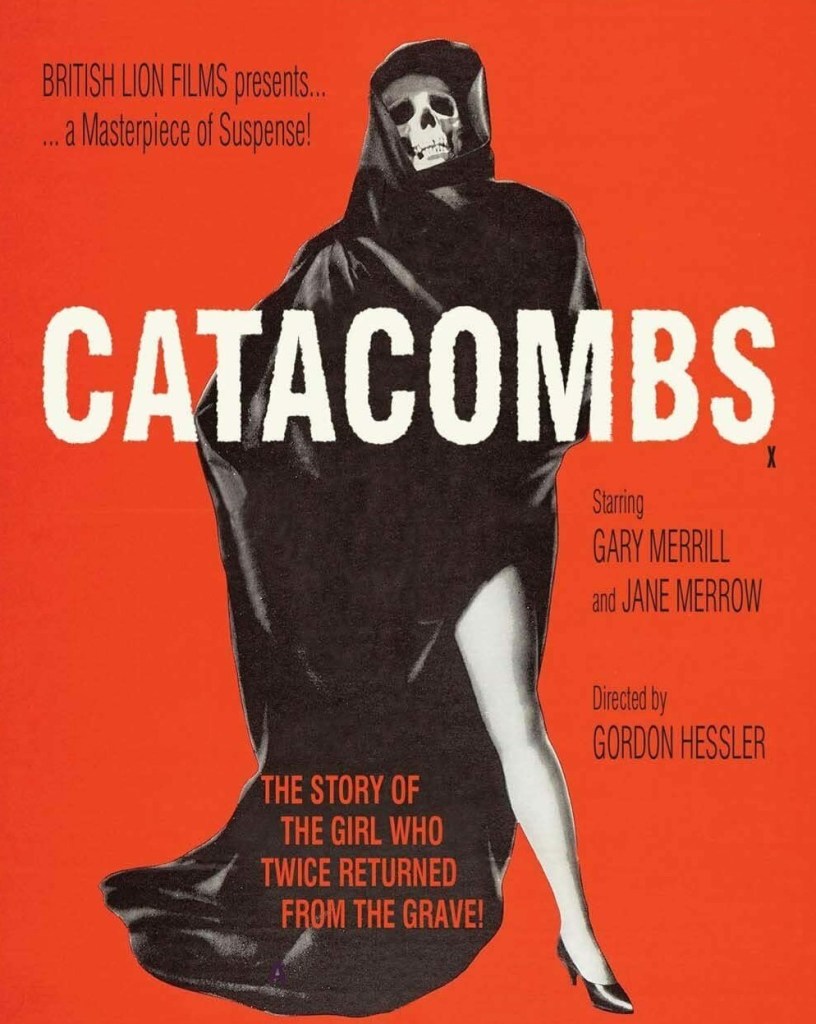
Gordon Hessler (The Oblong Box, 1969) makes his directorial debut with this neat horror thriller. It starts with a twist exceptional for the times. Ellen (Georgina Cookson) is the shrewd and shrewish millionaire businesswoman, her husband Raymond (Gary Merrill), from whom she demands frequent sex, the eye candy, a kept man. “I married a lover, not a businessman,” she retorts when, bored out of his mind, he asks for the opportunity to play a role in her business. In a further twist on the norm of the damsels decorating 1960s movies by displaying cleavage or disporting themselves in bikinis, Raymond is often seen with his chest bared in all its hirsuteness. In a further gender twist her secretary is also male, Dick (Neil MacCallum), a former, unknown to her, jailbird.
Tall, beautiful, dominant and domineering Ellen appears to have occult power, able to read minds, which keeps the larcenous-minded Dick in check, and has command of her own physical frailty – she walks with a stick – and can put herself in a trance to overcome occasional pain from her injured hip.
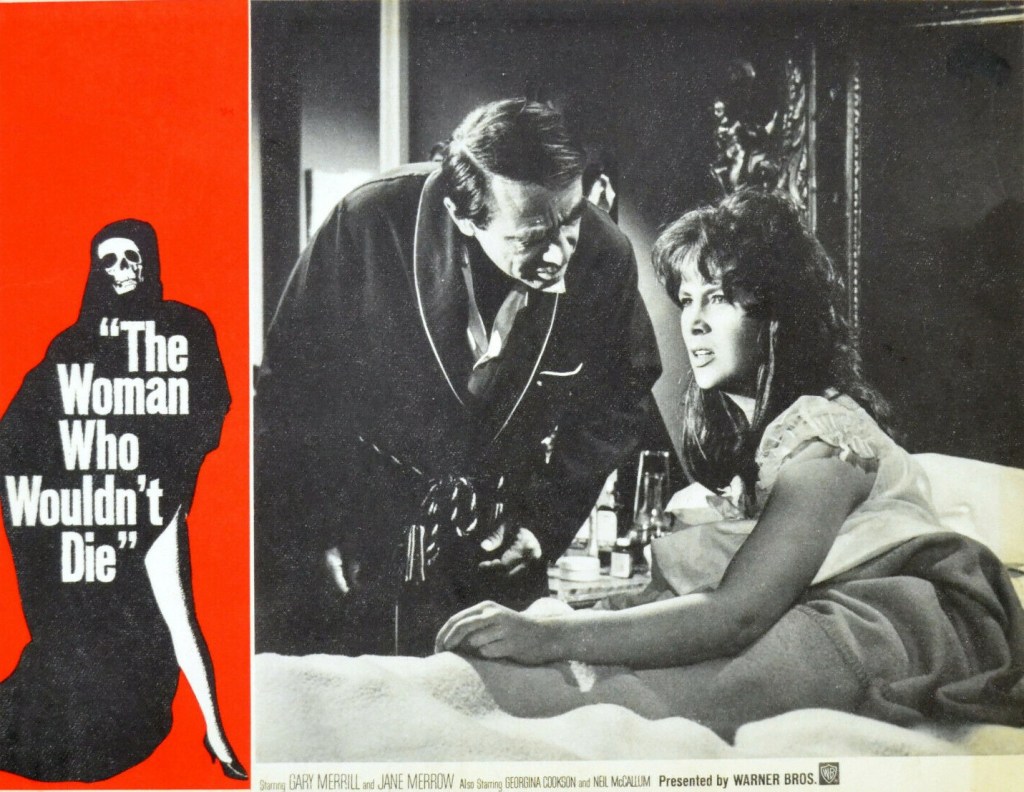
Conspiracy of fear: Raymond (Gary Merrill) and Alice (Jane Merrow).
But when Raymond falls for Ellen’s niece Alice (Jane Merrow), an artist returned from a year in Paris, he puts into action a plan that had clearly only been a pipe-dream, blackmailing Dick into participating. It’s quite clever as murderous plans go. He hires an actress to impersonate Ellen, known to go off to Italy on her own for spa treatments and with a knack for reckless driving, various driving charges over the years. Meanwhile, he strangles Ellen, allows Alice at a distance from an airport viewing terrace, to see her aunt, complete with walking stick, climbing up the steps of a plane. Faked cables and postcards arrive from Italy purportedly showing Ellen enjoying herself, even visiting the famous catacombs. In Italy Dick fakes a car accident to kill the actress.
However, twist number one comes at the reading of the will. Raymond and Alice split the million-pound bounty but while the latter is given custody of the big house the former is condemned to live for life, on pain of forfeiting the inheritance, in the cottage, in whose potting shed Ellen’s body lies. Further twists naturally follow. The maid (Rachel Thomas) doesn’t quite so much smell a rat but adds to the killer’s incipient discomfort by proclaiming that with her hip problem and claustrophobia that Ellen would never descend into the catacombs.
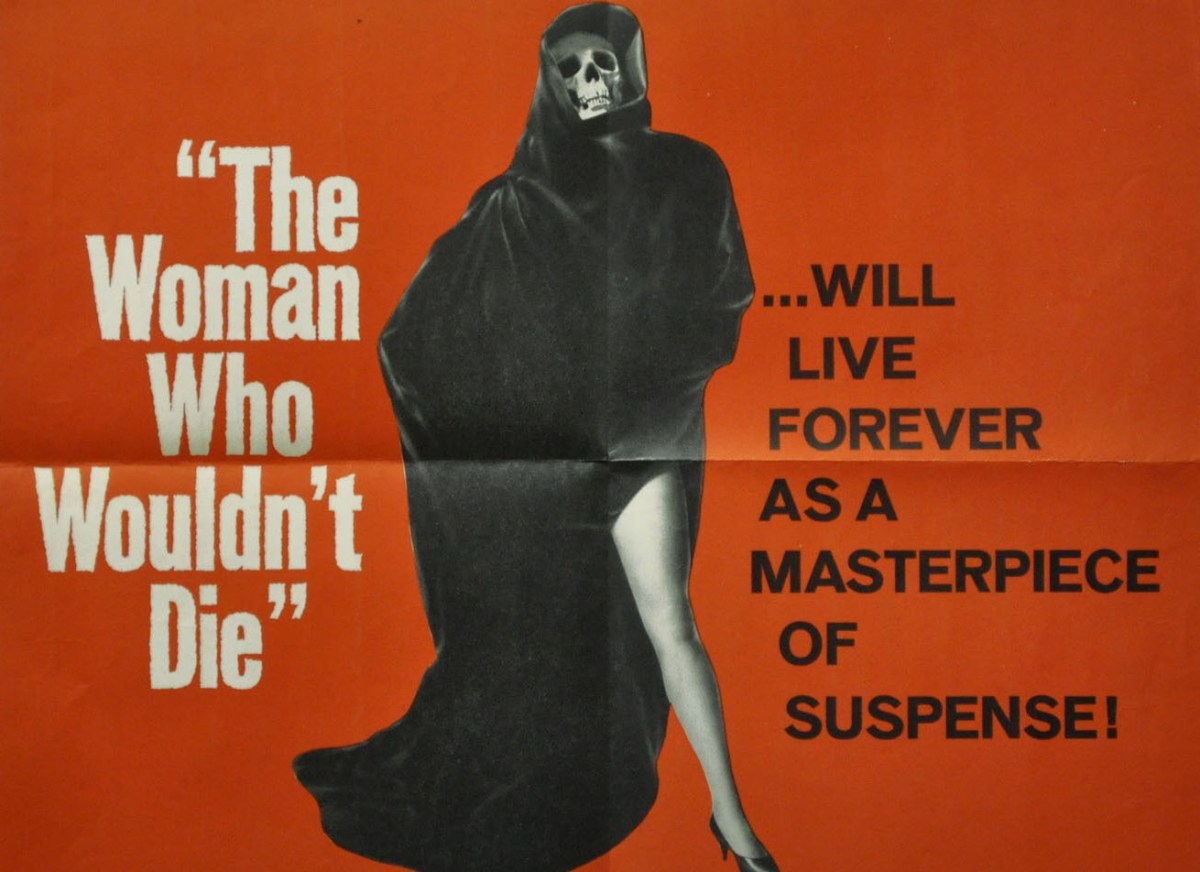
Entitled “Catacombs” in the U.K. after the novel by Jay Bennett on which it was based, it was retitled “The Woman Who Wouldn’t Die” for the U.S. market.
And Raymond might have lived happily ever after with Alice except for his guilt. Several creepy incidents, knocking, tapping, door handles turning, shadows, a depression the shape of a body in a bed, cigarettes smoking in ashtrays, lights going on and off indicate to the already nervous Raymond and the visibly frightened Alice that Ellen may not be dead after all. Virtually the entire third act is the pair of them reacting to real or imagined fears. Alice has a good line in looking scared witless. But Raymond, while trying to contain his inner demons, is equally rattled.
As you might expect there are further excellent twists to come. In fact, they are soon piling up and even at the very end the screen freezes on a final twist.
Georgina Cookson (The Picasso Summer, 1969) steals the show as the imperious businesswoman, with everyone cowering under her glare and not above stating the obvious, “I bought you body and soul,” she reminds Raymond. I’m not sure Gary Merill (The Power, 1968) is quite as good in the second half as he is in the first. Initially, he exudes charm, physical prowess, and, while under his wife’s thumb, still emotes a certain measure of confidence. He doesn’t appear to me to quite frightened enough in the second half as his plans go awry. Jane Merrow (The Lion in Winter, 1968) is excellent as the young woman caught in a mental trap and Neil MacCallum (The Lost Continent, 1968) is surprisingly effective.
But this is a low-budget B-picture that was destined for the lower half of a double bill so there was no particular reason why it should be as good as it is. Except for the Italian sequence, the action takes place on just two sets and for most of the time it’s a three-hander. But Hessler has a keen eye for composition and in a number of critical scenes makes bold choices. For Ellen’s murder, he concentrates on Raymond’s face rather than the victim’s, only showing her feet. There’s one super-shocker with a mirror. But mostly he is content to built up the tension, either by the various noises or by the reactions of Raymond and Alice. An old-fashioned gem of a picture.
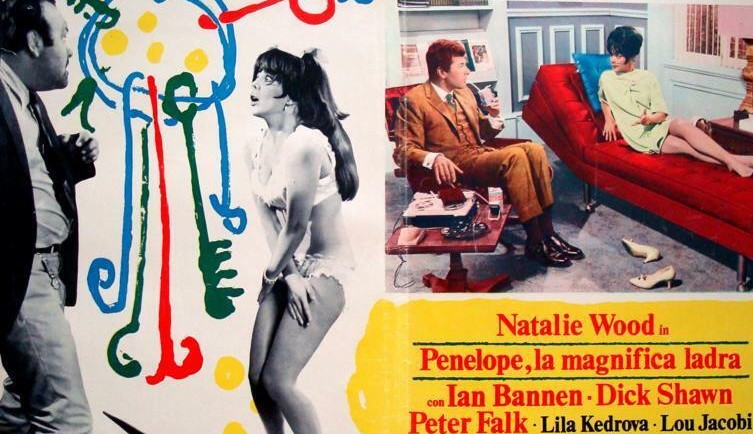
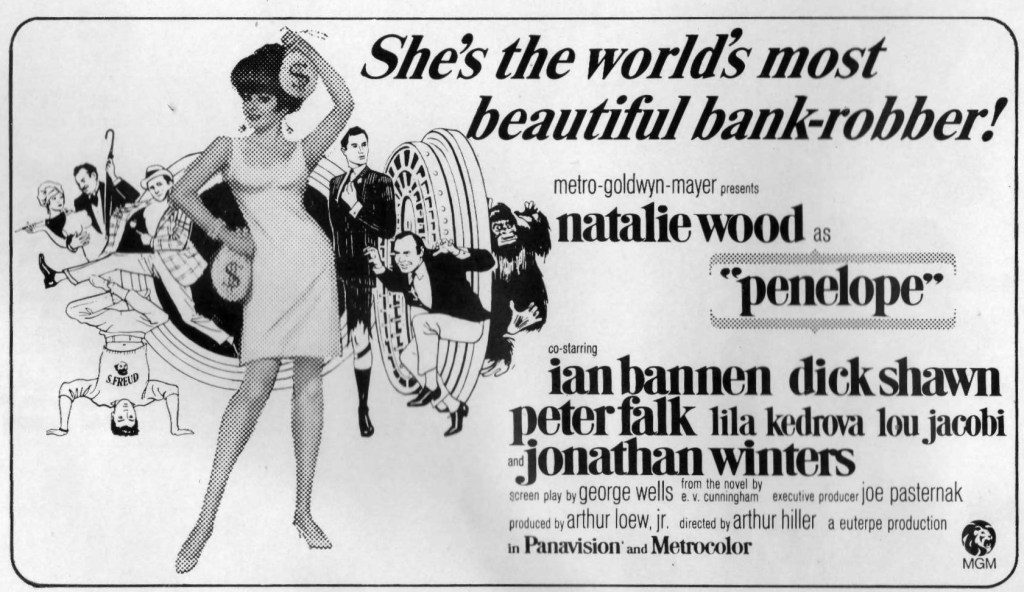
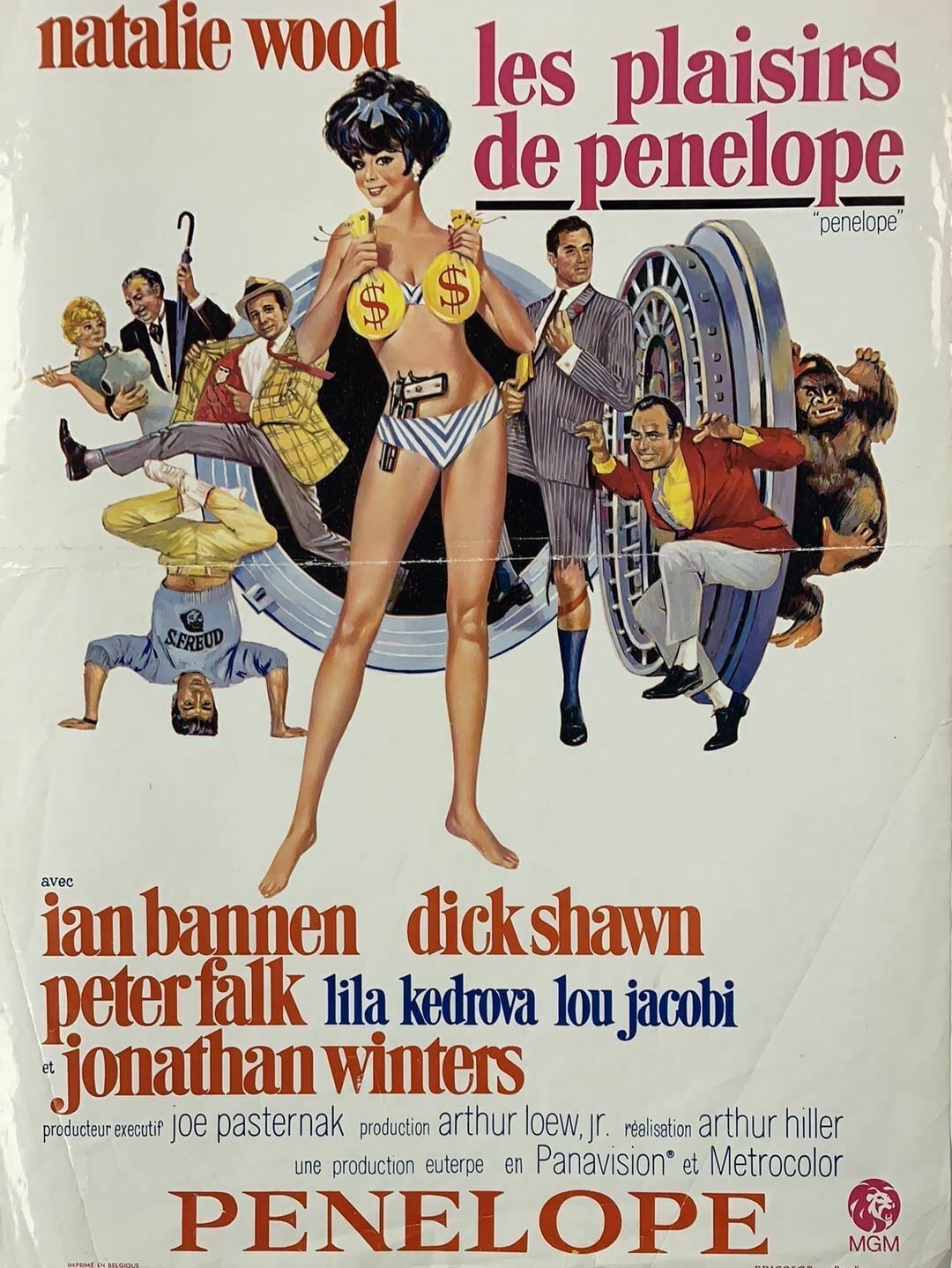
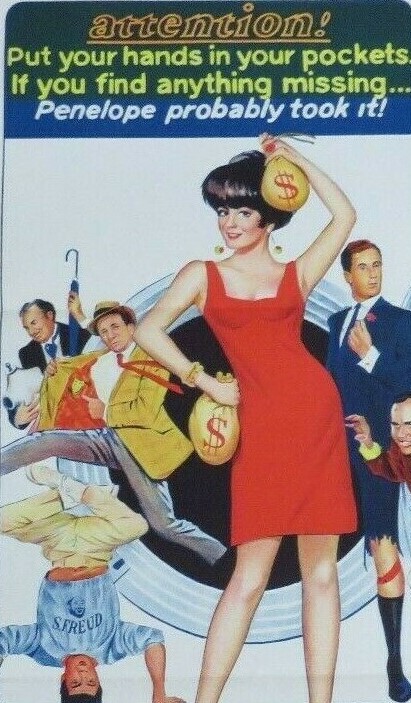
Marketeers quickly got a fix on how to sell Penelope: have star Natalie Wood holding up a bag of cash in each hand. The fact that in the most prominent of the three advertisements (a rather modest amount for movies in this decade) she was clutching the moneybags to her chest and dressed in only a bikini in what was undeniably a sexual pose could have been pure coincidence I suppose. In the second advertisement she was fully dressed and more stylishly posed in front of an open safe. The third less widely-used advertisement dispensed with the body, a head shot of her waving a wad of cash in one hand and a gun in the other.
The bikini advert features the other main characters in a variety of weird poses in comic fashion. “She’s Public Entertainment #1” ran the main tagline. Below that came: “That’s Penelope – the slick stick-up chick …and she’s leading the merriest men the hottest chase from safe to sofa” which in fact pretty much captured the storyline. A variation on the bikini ad was simply headlined: “She’s the world’s most beautiful bank-robber” – and you couldn’t argue with that either. Those two subsidiary taglines appear on an alternative bikini ad which shows four scenes from the film with a different catchline: “Attention! Put your hands in your pockets. If you find anything missing…Penelope probably took it.” The fully-dressed advertisement uses exactly the same sets of taglines.
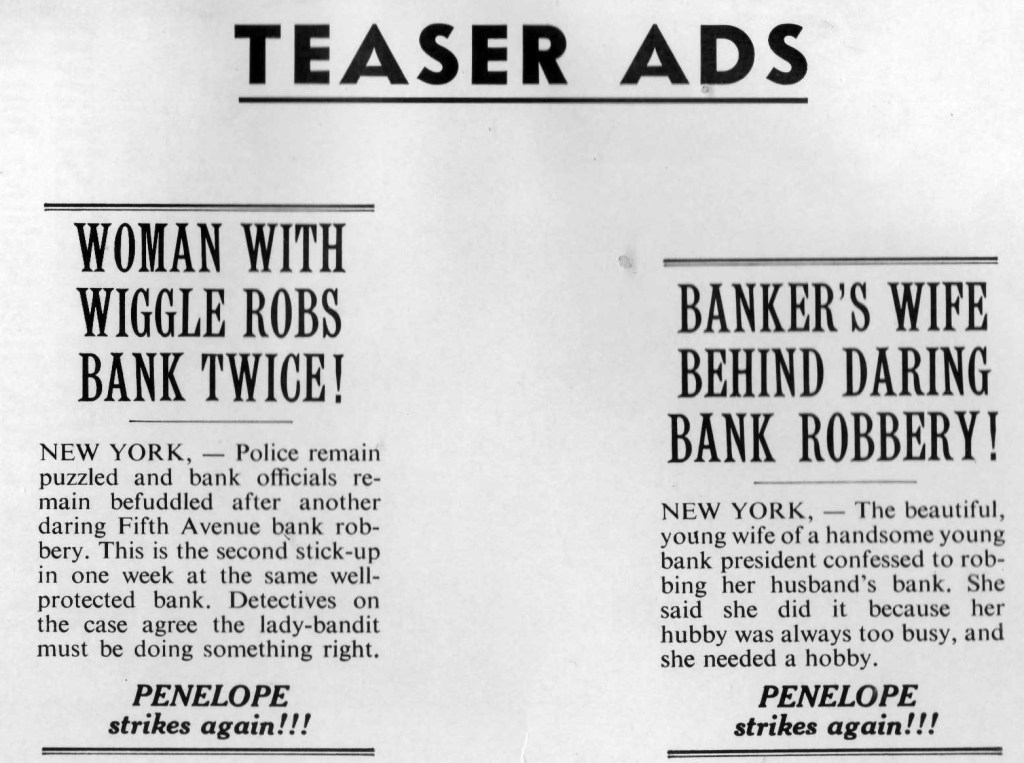
Established stars were the hardest to find anything new to write about, hence the editorial on Natalie Wood only appearing on page four of the 16-page A3 Pressbook. For the picture she received one of the “most lucrative contracts ever given a young actress” plus fringe benefits like four dressing rooms. It was unusual for a big Hollywood star to harbor so many unfulfilled ambitions. “There are still so many doors to be opened,” she revealed. “I have only started. I want to try everything, perhaps appear in a foreign film or two. And I hope some day to make a stab at the Broadway stage.” Ironically, her aspirations resulted in her not working in Hollywood for another three years.
For some reason the marketeers felt it necessary to butter up New York’s Mayor Lindsay, pointing out that the unit on location spent $15,000-$20,000 a day in the city, cast and crew housed in six floors of the Plaza Hotel, the basic cost swollen by the crew’s “thirsty eagerness for New York theater, ballet, museums, restaurants, night clubs.” Two hundred extras a day were employed. Some playing policemen got into trouble for giving the cops a bad image by smoking while waiting to be called into a scene, passers-by mistaking them for the real thing. Locations included a sculpture garden in the Museum of Modern Art and a “beatnik joint” in Greenwich Village.
Fact-checking was rarely a priority for Pressbook compilers who here managed to geographically reposition Ian Bannen’s home from the Isle of Wight on England’s south coast to Wales. “This was my first venture into slapstick,” said the actor, better known for dramatic fare like The Hill (1965) and The Flight of the Phoenix (1965).
Inadvertently, the Pressbook revealed secrets about Hollywood release schedules. Prior to making Penelope, director Arthur Hiller had been previously working on World War Two picture Tobruk. Yet Penelope hit theaters first – in November 1966 while Tobruk was delayed until February 1967. Hiller had fun with “weird” camera effects. “There are scenes in which we seem to have out-Dalied Dali.”
Oscar-winning designer Edith Head came up with what she termed a “schizophrenic wardrobe” for Natalie Wood, representing the two sides of her character, the stylish wife of a wealthy man and the larcenous opportunist. In one wardrobe were clothes representing “high style, comprising beautiful furs, discreet suits, svelte cocktail dresses and sophisticated evening gowns, all expressing financial worth.” The other wardrobe, designated “way out,” suggesting the freedom from inhibition which Penelope strives so valiantly to achieve, comprised, among other items, “a wisp of a shortie nightgown in 14-carat gold and a negligee of golden coins,” a French lace number worn over “a nothing of a mini-bikini” and a red lace nightgown.
Peter Falk, playing a cop soft on Penelope, would not have been in the picture except that his television show The Trials of O’Brien was cancelled. Forty-eight hours later he was hired for Penelope, a week later signed for a television special of Brigadoon (1966) and shortly after won a big role in Luv (1967), taking second billing to Jack Lemmon.
The $250,000 spent on Natalie Wood’s wardrobe provided ample scope for marketing tie-ins with fashion stores, hair stylists and shoe departments. Given the nature of the movie, it was inevitable that the marketeers suggest that exhibitors make up “Wanted” posters and plaster them around town especially at post offices, banks and police stations. Reflecting the psychiatry element, one other marketing route was for exhibitors to tie up with a furniture retailer to promote the kind of couch a patient might lie on. Among other ideas touted to exhibitors were a limerick contest, a senior citizen competition and a tie-in with a local bank.
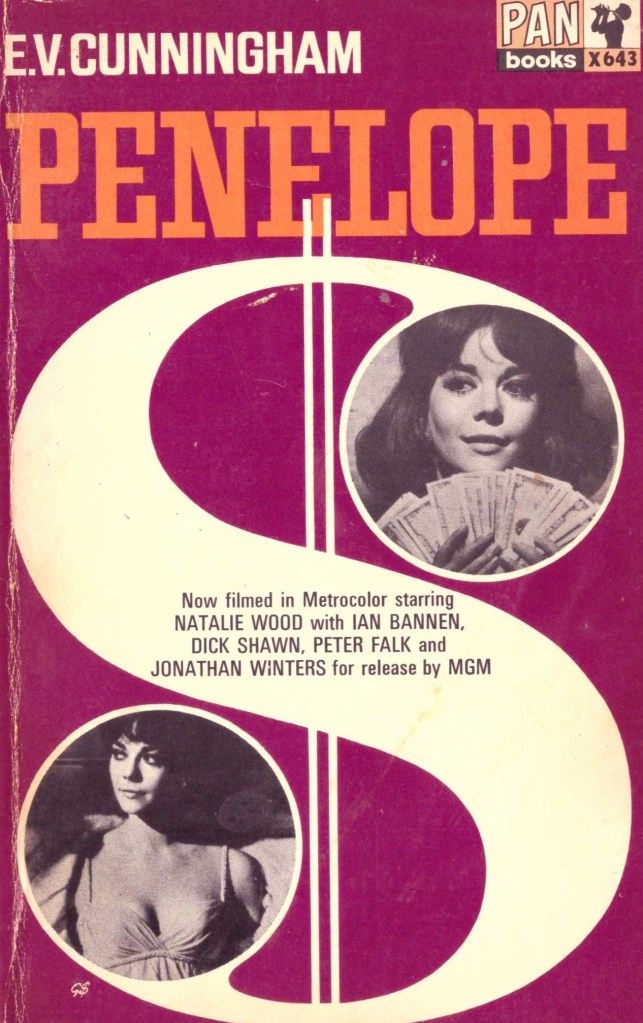
While the Pressbook promoted a soundtrack album that included Natalie Wood singing “The Sun Is Gray,” there was, unusually, no mention of the paperback of the book by E.V. Cunningham on which the movie was based.
Comedic twist on the heist movie with Natalie Wood (This Property Is Condemned, 1966) as a kleptomaniac. Given its origins in a tight little thriller by E.V. Cunningham, pseudonym of Howard Fast (Mirage, 1965), it’s an awful loose construction that seems to run around with little idea of where it wants to go. Wood, of course, is a delightfully kooky heroine who takes revenge on anyone who has ignored or slighted her by stealing their possessions.
The picture begins with her boldest coup. Cleverly disguised as an old woman, she robs the newest Park Avenue bank owned by overbearing husband James (Ian Bannen). This prompts the best comedy in the movie, a man with a violin case (Lewis Charles) being apprehended by police, the doors automatically locking after a clerk falls on the alarm button, James trapped in the revolving doors losing his trousers in the process.
In flashback, we learn that she turned to thievery after a rape attempt by Professor Klobb (Jonathan Winter), her college tutor, and while half-naked managed to make off with his watch fob. She stole a set of earrings from Mildred (Norma Crane) after suspecting she is having an affair with James. “Stealing makes me cheerful,” she tells her psychiatrist, Dr Mannix (Dick Shawn) and while admitting to dishonesty denies being a compulsive thief. After the bank robbery she even manages to relieve investigating officer Lt Bixby (Peter Falk) of his wallet.
Nobody suspects her, certainly not her husband who could not conceive of his wife having the brains to carry out such an audacious plan. Bixby is a bit more on the ball, but not much. Clues that would have snared her in seconds if seen by any half-decent cop are missed by this bunch. And generally that is the problem, the outcome is so weighted in Penelope’s favor. The plot then goes all around the houses to include as many oddballs as possible – boutique owners Sadaba (Lila Kedrova) and Ducky (Lou Jacobi), Major Higgins (Arthur Malet) and suspect Honeysuckle Rose (Arlene Golonka). Naturally, when she does confess – to save the innocent Honeysuckle – nobody believes her in part because everyone has fallen in love with her. Bixby, just as smitten, nonetheless makes a decent stab at the investigation.
Howard Fast under the pseudonym of E.V. Cunningham wrote a series of thrillers with a woman’s name as the title. He was on a roll in the 1960s providing the source material for Spartacus (1960), The Man in the Middle (1964), Cheyenne Autumn (1964), Sylvia (1965), Mirage (1965) and Jigsaw (1968).
Taken as pure confection it has its attractions. It’s certainly frothy at the edges and there are a number of funny lines especially with her psychiatrist and the slapstick approach does hit the target every now and then. The icing on the cake is top class while the cake itself has little of substance. It strikes a satirical note on occasion especially with the Greenwich Village cellar sequence. It doesn’t go anywhere near what might be driving this woman towards such potential calamity – that she gets away with it is only down to her charm. There has probably never been such a pair of rose-tinted spectacles as worn by Penelope, even though her every action is driven by revenge.
Without Natalie Wood it would have sunk without trace but her vivacious screen persona is imminently watchable and the constant wardrobe changes (courtesy of Edith Head) and glossy treatment gets it over the finishing line. It’s one of those star-driven vehicles at which Golden Age Hollywood was once so adept but which fails to translate so well to a later era. Ian Bannen (Station Six Sahara, 1963) is in his element as a grumpy husband, though you would wonder what initially she saw in him, and Peter Falk (Robin and the 7 Hoods, 1965) delivers another memorable performance. Dick Shawn (A Very Special Favor, 1965) is the pick of the supporting cast though screen personalities like Lila Kedrova (Torn Curtain, 1966), Jonathan Winters (The Loved One, 1965) and Lou Jacobi (Irma la Douce, 1963) are not easily ignored. Johnny Williams a.k.a John Williams wrote the score.
Arthur Hiller (Tobruk, 1967) delivers as much of the goods as are possible within the zany framework. Veteran Oscar-winner George Wells (Three Bites of the Apple, 1967) wrote the screenplay and it’s a far cry from the far more interesting source material and I would have to wonder what kind of sensibility – even at that time – could invent a comedy rape (not in the book, I hasten to add).
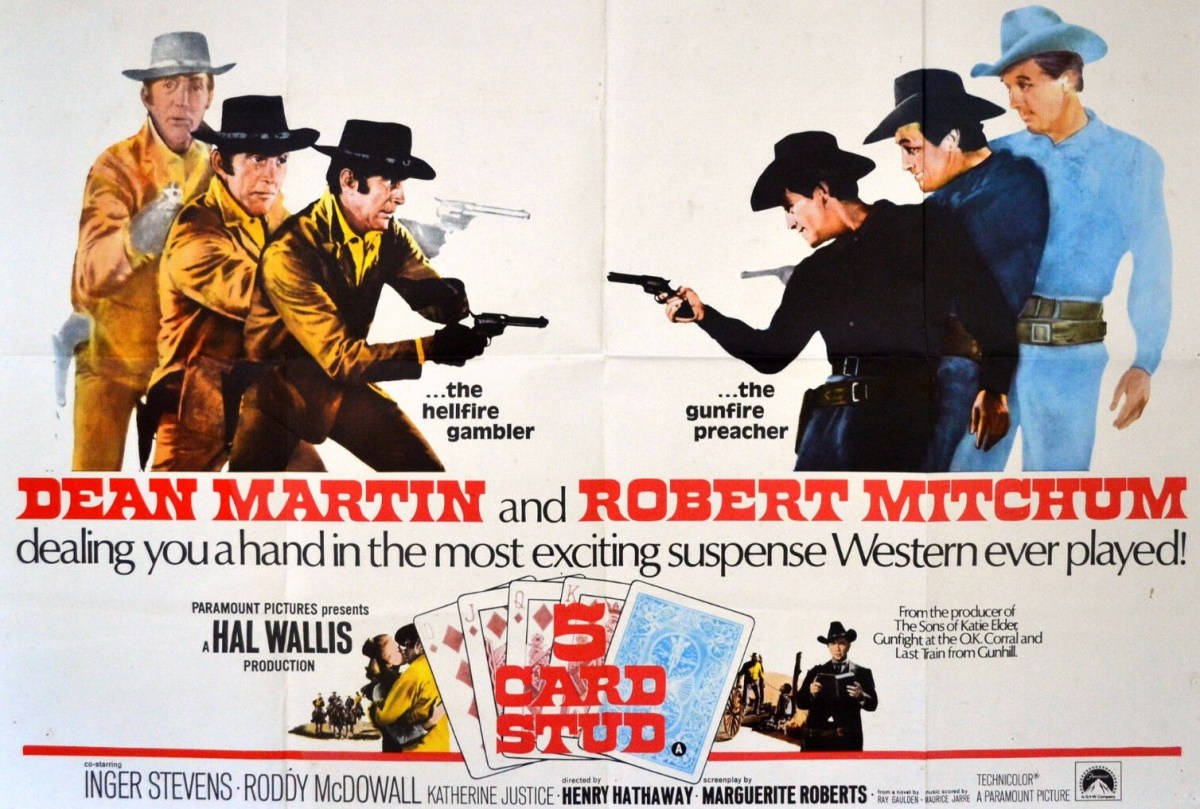
Another western in sore need of re-evaluation. Largely dismissed as a routine oater trading on the gimmick of a whodunit and packed with old stagers, this is in fact about a serial killer, a treatise on law and order, and almost acts as a conduit between the decade’s previous westerns when the good guys and the bad guys are easily defined to the end of the decade when such distinctions were muddied after The Wild Bunch (1969) and Butch Cassidy and the Sundance Kid (1969) invited audiences to root for the bad guys. In this rather well-structured picture, full of action and romance, we don’t know who the bad guy is.
The whodunit, however, is really a MacGuffin. The movie is more concerned with investigating the changing mores and hypocrisies of the West and predicting the inherent dangers in the proliferation of weaponry. It’s worth remembering that the movie came out at time when mass murderers such as Charles Whitman (the subject of Peter Bogdanovich’s Targets, 1968) who went on a killing spree in 1966 were becoming the norm.
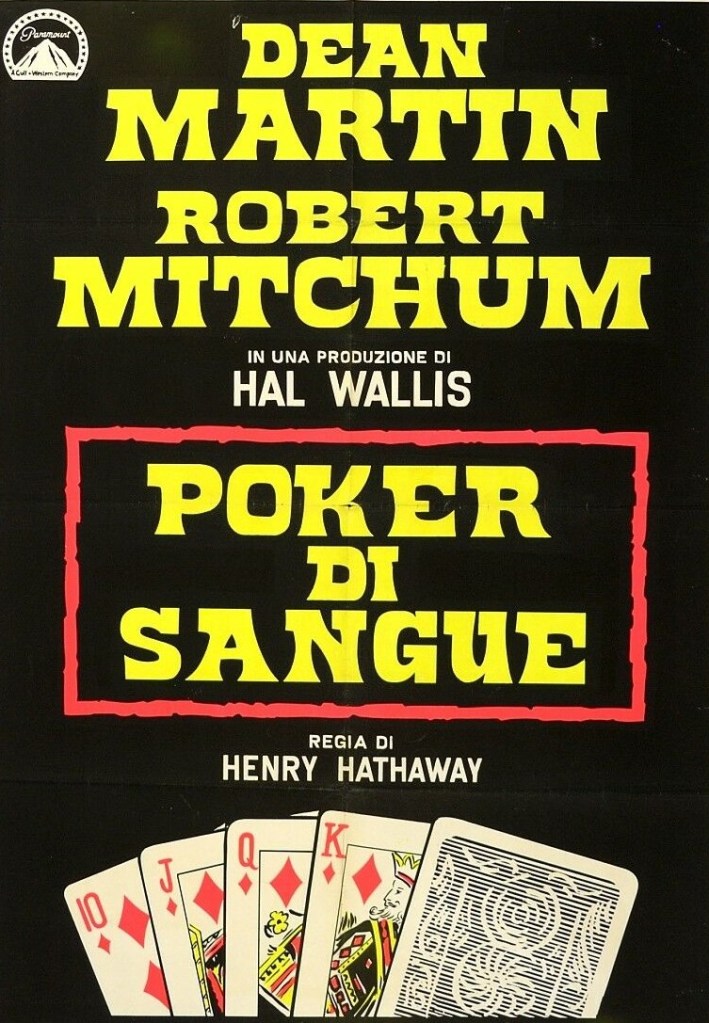
A card sharp is lynched for cheating at poker in the quiet town of Rinchon where late-night gambling is the height of entertainment. One of the players, professional gambler Van (Dean Martin), attempts to stop the hanging but is beaten up for his troubles. No surprise then, that he ambles off to Denver. Sometime later the hangmen begin dying off and Van returns not just to solve the mystery but to ensure that his name isn’t on the list. “If someone is out to kill you, you don’t sit around and let him pick the time,” he concludes. With the number of killings, not to mention brawls and shoot-outs, it’s almost continuous action.
On his return, Van discovers, with a gold strike nearby, the incipient boom town has attracted unsavory elements, not just the high murder quotient but a whorehouse and loud music in the saloon. Acting as counterbalance is gun-toting preacher Jonathan Rudd (Robert Mitchum) who announces his presence by spraying bullets in the saloon floor, emerging as the self-proclaimed “conscience” of the town.
For a sometime protector of law and order, Van is rather lax in the morals department, unwilling to commit to main squeeze rancher’s daughter Nora (Katharine Justice) when the likes of Lily (Inger Stevens), the unlikely proprietor of a barbershop-cum-whorehouse, are on hand. Van is an interesting study. Once he becomes aware that the only people likely to end up in an early grave are the six men who played poker with the lynched individual, it doesn’t occur to him to fess up to Marshal Dana (John Anderson) which would ease the fears of the ordinary public. Awareness the only corpses belonged to the guilty would have prevented further outbursts of violence among a disaffected population. Interestingly, too, Dana makes no attempt to investigate the lynching.
At the core of this picture are a couple of amazing scenes as paranoia takes hold. One miner, without the slightest sense of irony, complains that in the old days a gunfight took place face to face, not by a murderer slinking round in the dark. Rudd adds some prophetic advice: “wear a gun and use it fast, wear a gun and use it slow – I say don’t wear a gun and you won’t use it at all.”
Van likes to think he has the measure of women, when in fact they have the measure of him. The story avoids the obvious lure of a love triangle, of jealous women competing for Van’s affections. Both the young Nora and the more mature Lily are pretty well grounded. “One wore-out no-account kiss” is Nora’s dismissive description of Van’s attempts at romance while Lily lets Van know she has taken a shine to him as a matter of convenience, he’s just a man and she hasn’t had one in three years. Expecting to be treated as a pariah, Lily, expressing the notion that “women don’t usually like women who like men,” strikes up a friendship with Nora.
Marshal Dana finds it increasingly difficult to maintain any kind of peace since as the death count mounts, paranoia grows rife, exacerbated by the kind of greed gold fever brings, resulting in citizens determined to challenge authority and take matters into their own hands.
The most antsy character is Nick (Roddy McDowall), Nora’s brother and the leader of the lynch mob. Nick seems to stir up bad feelings, provoking the ire of both his father and Van. The guilty are despatched in original ways, one man “drowns” in a barrel of flour, another strangled by barbed wire, a third wakes the town at night when the church bell to which his neck is attached starts ringing out. It’s not too hard in the end to work out who the killer is, but as I said, that is not the point of the picture, although the ending is satisfactory.
There a mass of small detail of the kind that director Henry Hathaway (True Grit, 1969) tends to work into his pictures. Van is a cut above. He travels to Denver and back by stagecoach not on horseback. Citizens can purchase Pocahontas Remedies and beer from the Denver Brewery. Shaves and haircuts at the Tonsorial Parlor are reasonably priced but “miscellaneous” comes in at $20. After the preacher shoots up her floor, saloon owner Mama (Ruth Springford) smooths out the holes.
And there is some distinctive direction. Rudd’s sermon that lasts nearly 90 seconds is delivered in virtually one take, a fistfight is conducted in silence except for a soundtrack punctuated by grunts and punches hitting their target, a dying man tries to leave a physical clue about the identity of the mysterious killer. And there is a superb main street gunfight with Van trying to rescue the marshal and Rudd striding down the street in old-fashioned gunslinger mode.
Dean Martin (Rough Night in Jericho, 1967) and Robert Mitchum (The Way West, 1969), both with apparently easy-going but magisterial screen personas, come off well together. Inger Stevens (Firecreek, 1968) always a great screen presence, an ethereal beauty, is vulnerable and strong at the same time. Katherine Justice (The Way West, 1967) is sassy and independent-minded and has a terrific facial response to coming across the first murder. John Anderson (The Satan Bug, 1965) leads a fine supporting cast including Yaphet Kotto (Live and Let Die, 1973), Denver Pyle (Shenandoah, 1965) and Whit Bissell (Seven Days in May, 1964).
Screenwriter Marguerite Roberts, adapting the novel by Ray Gaulden, contributes some classic lines. “If that is a Bible, read it,” Van instructs Rudd, assuming the preacher has a gun planted in the Holy Book, “If it ain’t a Bible, drop it.” There’s a nod to a James Coburn scene in The Magnificent Seven (1960). Congratulated on his marksmanship in hitting the spinning wheels of a windmill six times out of six, Rudd protests his shooting was a failure since he was aiming for the spaces in between. It was ironic that her next assignment concerned a lawman who took much the same no-holds-approach to the criminal fraternity (True Grit, 1969) as the killer in this picture.
I was so intrigued by this picture, realizing it had much more to offer than a whodunit, that I watched it again within a few days and was pleasantly surprised by its depths.
Hamlet goes Viking is basically as much of a story as “visionary director” Robert Eggers (The Witch, 2015) can be bothered with. Yes, there some Viking lore and for all I know this has been exceptionally well-researched but what it amounts to is the same kind of gobbledy-gook that makes no more sense than your average horror picture, with a ton of underdeveloped occult elements. Once our hero is freed from being hung from the rafters by crows beckoned, I presume, by some unexplained mystical power, pecking at the rope – and with a sword handily discarded in the vicinity – I was even more convinced this was a load of old cobblers.
So, basically a revenge saga. Amleth (Alexander Skarsgard) – pronounced Amlet for punters too stupid to get it – manages to escape when his uncle Fjolnir (Claes Bang) murders his brother King Aurvandil (Ethan Hawke). Vowing revenge, he is next seen “years later” as part of a raiding party slaughtering a village. He discovers that his uncle has been dethroned by a bigger king and sent into exile in Iceland. So he hauls himself off there, pretending to be part of a chain gang. He has every opportunity in the world to kill his uncle – and save his mother (Nicole Kidman) who has been carried off – but there is always a really dumb reason why he can’t.
Revenge delay seems a pretty odd way of stringing out a movie. Of course, when he gets round to saving his mother it turns out she doesn’t want to be saved and – a la Hamlet – was in on the plan to kill her husband. He falls in love with fellow prisoner Olga (Anya Taylor-Joy) who spouts a lot of witch-type stuff that is no less convincing than any of the other spiritual malarkey.
There’s a lot of bloody violence, but the sexual violence is kept to a minimum on screen though Olga has clearly been abused by Fjolnir. And there’s a game that seems close to the Irish game of hurling and whole bunch of oddities thrown in there wholesale as if such a joblot will add depth to the movie. A misconceived art picture that looks more like a top-of-the-range direct-to-DVD movie that might have cost around $40 million rather than the $90 million quoted.
There’s a smorgasbord of dodgy accents and everybody speaks in stilted English, not far short of the “thee” and “thou” dialogue that critics used to make fun of. Alexander Skarsgard (Godzilla vs Kong, 2021) and Claes Bang (Locked Down, 2021) look rugged enough but neither has the screen presence of Schwarzenegger or even Stallone and it ends up Conan-lite. Anya Taylor-Joy (Last Night in Soho, 2021) looks as if she wondered how she managed to get talked into this. Nicole Kidman (Being the Ricardos, 2021) who has a plum scene towards the end offers the only acting of any distinction.
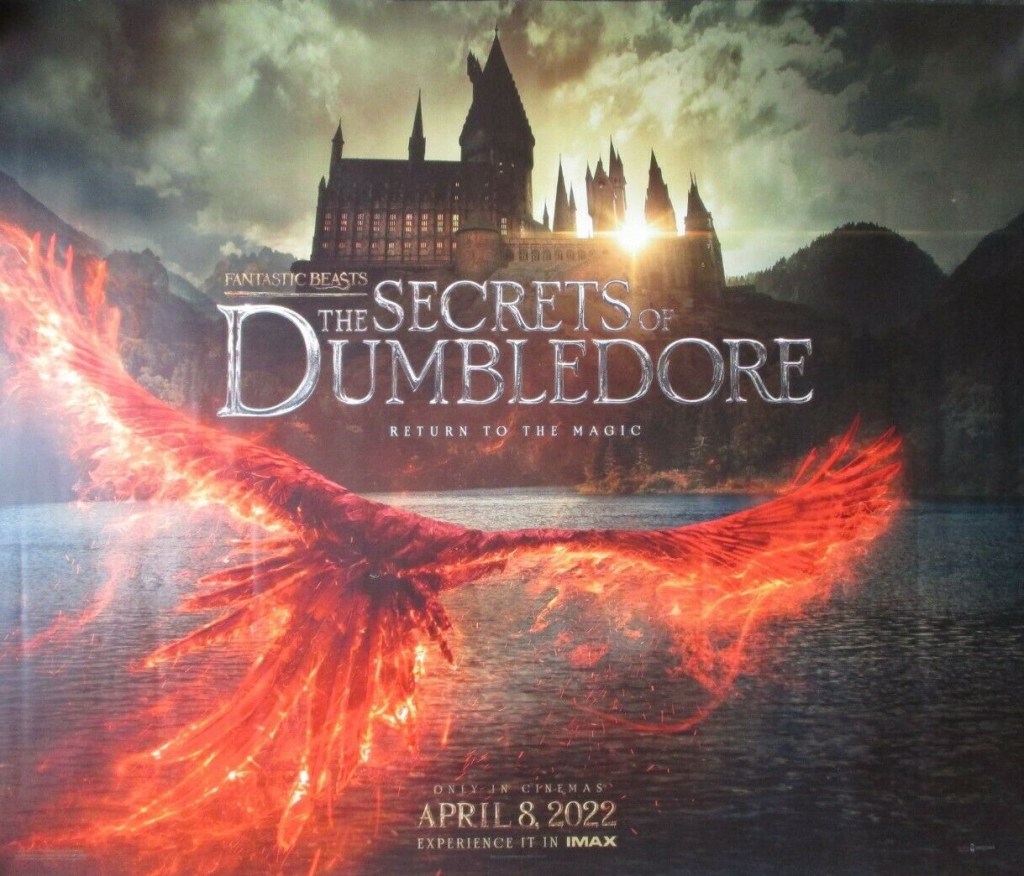
Fantastic Beasts: The Secret of Dumbledore
I kid you not, this is about an election. Yep, someone’s greenlit a $200 million fantasy picture about an election. Whatever delightful element the original entry to this series possessed has been destroyed not just by a preposterous storyline – this is for kids, remember – but a very somber tone. Everyone talks in a low voice, it is very darkly lit and there are those awful meaningful pauses.
The story they pretend is about to occur never happens. Something about “counter-sight” if I got that bit correct and how our heroes had to act together to “confuse” the bad guy because he could see into the future. There’s never any sign of him seeing in the future and most of the confusion arises because there are just way many characters. With a piece of Hollywood wizardry Grindelwald has completely changed his appearance, no longer Johnny Depp but Mads Mikkelson. You will be aware of the reason for this but Mads has taken on an impossible task. There already was an over-large contingent of players – Newt Scamanger (Eddie Redmayne) and his brother Theseus (Callum Turner), Albus Dumbledore (Jude Law) and his brother Abeforth (Richard Coyle), Credence Barebone (Ezra Miller), Jacob (Dan Fogler) and assorted characters who have a romantic interest in the principals.
But basically – hold your breath – Grindelwald is trying to crash an election party. Two candidates are already in contention to be, I presume, Chief Wizard. He kidnaps something that might be called a “chillin” – a mythical creature that looks like a gryphon – which like the wands in Harry Potter has a way of choosing the best person for the job. There’s very little CGI for a fantasy picture. One monster, a bunch of dancing lobsters (maybe scorpions, I couldn’t work it out) and the usual contents of Newt’s suitcase is just about it. The wands are now used more like light sabers or pistols. You won’t be surprised to learn there’s not much in the secrets department either.
There’s not enough Newt and he’s not as delightful as he once was and there’s far too much of boring electioneering, huge crowds gathered for rallies in favor of their candidates. This one cost $200 million and I have no idea what that was spent on. Certainly not the script. A franchise-killer if ever I saw one.








 The Magnificent 60s