Miracle of the White Stallions (1963) ***

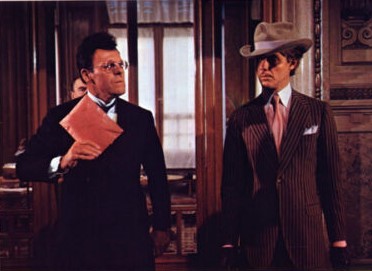
You wouldn’t look to Walt Disney in the 1960s to provide a tyro director with a calling card when so much of that studio’s output was saccharine. But this beautifully-mounted World War Two drama showed there was a new kid in town worth watching, name of Arthur Hiller. And if you always wondered why the later biopic of General Patton showed him in riding gear, that penchant is more clearly explained here.

You might balk, however, at the idea of a bunch of horses being considered in the same category as an art treasure worth protecting from the worst predations of war. And just as with the Von Trapp family, Austrians, despite welcoming the annexation of their country by Hitler in 1938, are given a free pass here.
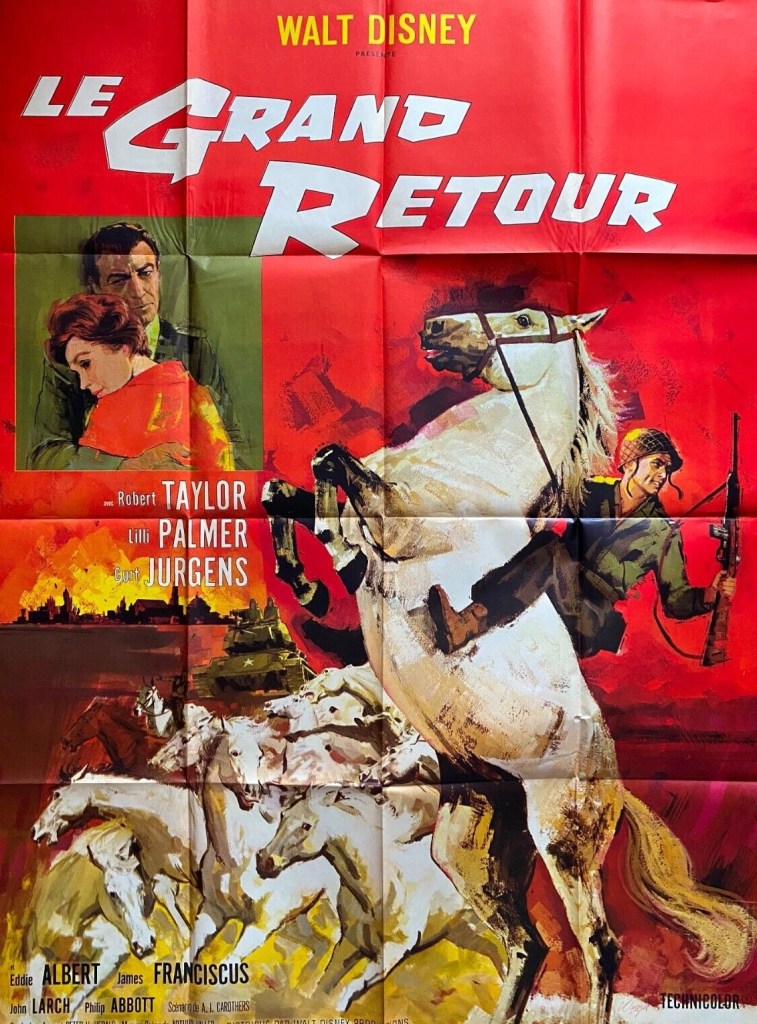
In case you’re unfamiliar with the subject matter, the Spanish Riding School in Vienna was a celebrated nearly 200-year-old institution in which the famed Lipizzaner white “dancing” horses were put through their paces. With the Second World War coming to a close it was threatened on three fronts: the German Army poached its instructors to man the front line, the invading Russians wanted to appropriate the horses and starving refugees focused on the potential horse meat.

School chief Col Alois Podhajsky (Robert Taylor) and wife Pedena (Lili Palmer) organise an evacuation under the guise of using the horses to draw cartloads of legitimate art treasures. They hole up in the castle of Countess Arco-Valley (Brigitte Horney) but the mares are stolen by the Russians and hidden in Czechoslovakia. (Only the stallions perform, but without the females as breeding stock, the line would become extinct.)

The colonel ditches his German uniform on the arrival of American forces and puts on a performance in a makeshift arena in an attempt to convince Patton (John Larch) to mount a rescue of the captured horses. Patton, we learn here, is a renowned horseman, competed in the equestrian section of the 1912 Olympic Games, and if anyone considers a fabulous horse more valuable than a work of art it’s him. As it happens, there are prisoners to be freed in Czechoslovakia so the horses are included in that mission.

What’s unusual about this animal tale, given Disney’s predilection for anthropomorphising animals, is that it’s not told from the point-of-view of the horses. Nor, as you might have expected, given the studio’s plethora of young talent, turned into  the story of a young girl or boy attached to the horses. Instead, the focal point is the impact of the creatures on those around them.
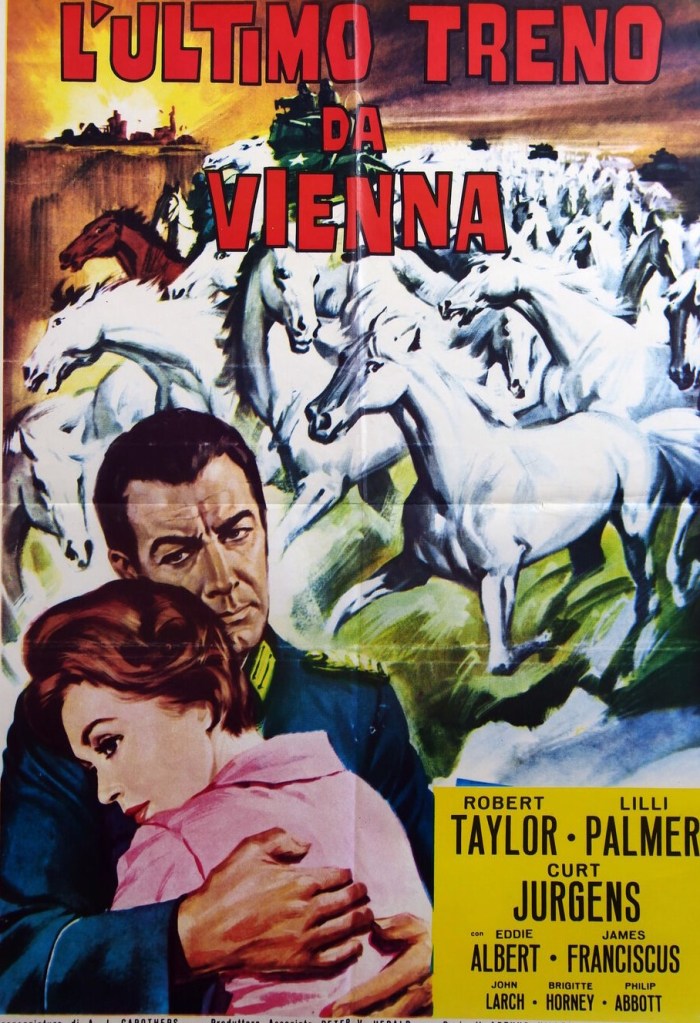
Of course the colonel is bound to be obsessed. But for the ordinary soldiers, who might never appreciate a work of art, they represent a kind of majesty,  a grandeur, rising above the horror of war, something well worth the effort of rescue.

What’s even more unusual in saccharine-town is the script’s recognition of the effect of war on humanity. At one point Pedena laments that men are asked to possess “the strength and fury of giants…and then be again the men they were before.” And in some respects acknowledging the beauty of the horses is a step in the right direction. The Yanks are neither celebrated as brave nor foolhardy, in fact mostly they are just working grunts, cleaning out the castle, fixing up the arena, cracking jokes.

Hiller is the big find here. There’s a brilliant scene, all of 40 seconds long (I timed it) that would have been cut out of any other Disney picture. In a chiaroscuro of light, the colonel walks from one end of the deserted Vienna riding hall to the other and his wife, entering the frame, goes to join him. Nothing more is needed to indicate loss. Hiller clearly recognised opportunity and while the film itself is no masterpiece every single frame reveals a talented mind at work, his use of colors and costume, movement within the frame, employing Pedena and the Countess to comment on the action, allowing the inbuilt tension to carry the story without extraneous drama.

You’re mostly likely to remember the performing horses, the balletic choreographed movements, the “airs above the ground,” and indeed Hiller wisely devotes a good 15 minutes to this, but without his input this would either be overly sentimental, saccharine or little more than a documentary. This is a very grown-up picture for Disney.

Robert Taylor (A House Is Not A Home, 1964) was at the tag-end of his career, his first film in four years, but he still has the charisma to carry the film and the gravitas to see it over the line. Lili Palmer (The Counterfeit Traitor, 1962) is well cast as a voice of reason and offering commentary on humanity. Curt Jurgens (Pysche ’59, 1964) has an interesting role, lamenting, as he picks out a classical tune at the piano, how Hitler outlawed famous composers.

There’s a stronger supporting cast than you might expect: Eddie Albert (Captain Newman M.D., 1963) , James Franciscus (Valley of Gwangi, 1969) and German actress Brigitte Horney (The Trygon Factor, 1966).

Somebody certainly took notice of Hiller’s talent because his next films were The Wheeler Dealers (1963) with Lee Remick and James Garner and The Americanization of Emily (1964) with Julie Andrews and Garner.  A.J. Carothers (The Happiest Millionaire, 1967) based the screenplay on the book by Alois Podhajsky.
Cate Blanchett and The Shawshank Redemption

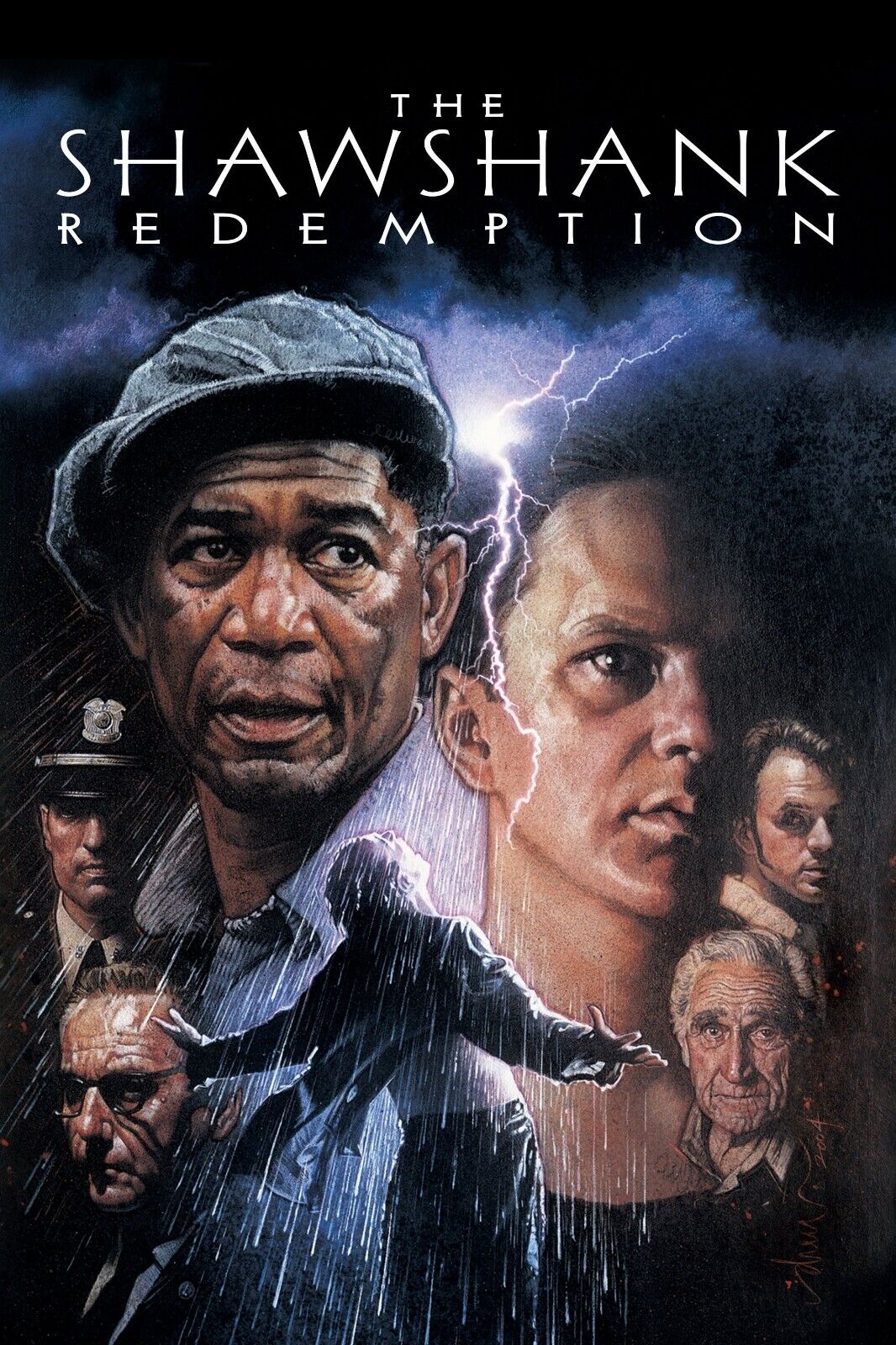
I assuming you know that the famed Stephen King novella on which the Tim Robbins/Morgan Freeman picture was based was originally entitled Rita Hayworth and the Shawshank Redemption, the poster of that movie goddess used in that version by the wannabe escapee to cover the hole he was making in his prison cell wall.

I’m making a connection to Cate Blanchett because The Shawshank Redemption (1994) was a critical success, seven Oscar nominations including Best Picture, but so conspicuously failed at the box office that it was scarcely shown abroad and only won an audience, and made more than its money back, on DVD and latterly became the poster boy for flops that somehow make a financial comeback.

Tar had all the critical support – with the exception of me, of course – that a movie could wish for and will at least pick up an Oscar nomination for Blanchett. But now that DVD is dead in the water, there’s virtually no chance of it making enough thereafter to cover the losses which are currently in the region of $30 million.

Movies used to have what was known as a “long tail,” meaning that initial box office was only one part of the equation. And a small part at that if the movie was a blockbuster. Reissue and sales to DVD, video rental, television, syndication, and early streaming services on a global scale sometimes amounted to as much as 90% of its overall earnings, especially bearing in mind that VHS/DVD in particular had various levels of revenue.

A big title might first be sold to video rental companies forking out $59.99 for the privilege and the bigger the title the more copies were purchased, so a blockbuster might easily have reaped $20-$30 million on that go-round. Then when it was released to the public, a big film would cost big money – $29.99 to $39.99 – and once that tier had done its job, the movie would be progressively sold in lower price brackets then repackaged again to supermarkets and bargain bins. More recently, the Director’s Cut, remastering and monetising anniversaries have added to that food chain.

Television went through several tiers as well. Studios never actually sold any movie to the small screen. They leased them. Usually for a period of time, say three years, and a limited number of screenings, often just two. And once that deal was done, they leased them again, and again and again. Until streaming killed off the majority of this market, movies made in the 1960s could have been leased a dozen times to television networks and even more in syndication. Cable would pay good money for a slice of that action.  

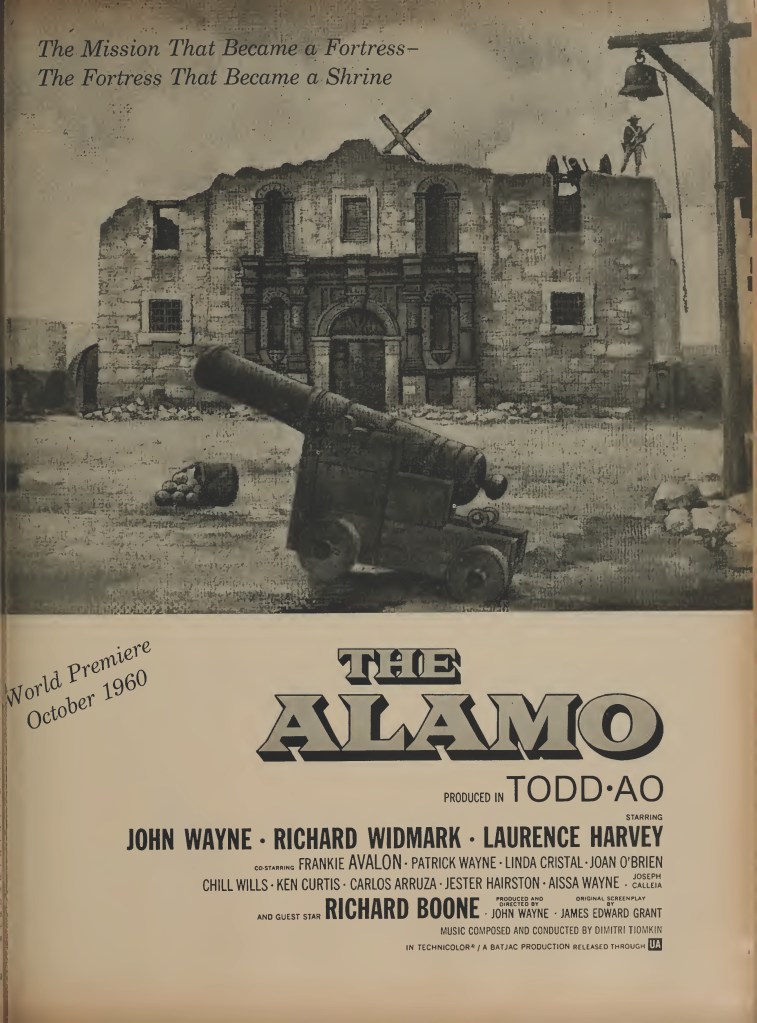
Television famously put The Alamo (1960) and Cleopatra (1963) into the black and then the combination of TV, VHS/DVD, cable etc, made them substantial profits. And studios could always wrap them up as a library and sell them off to movie-hungry stations like TCM. Imax and 3D provided reissue opportunities at the start of this century, but these days a return to a movie theater would be a seriously limited proposition and open only to major successes like The Godfather (1972).

But, in terms of redemption-sized income, virtually all those avenues have disappeared. And critics don’t have the power to turn on the money taps. I’m sure Chantal Akerman’s Jeanne Dielman…(1975) which came out of nowhere, though probably the result of a social media coup, to top the once-in-a-decade Sight & Sound Critics Poll, will bring in extra bucks, no matter that it will scarcely register on streaming and DVD sales will be limited to the arthouse fraternity.

Alfred Hitchcock is often touted as the Comeback King when Vertigo (1958) climbed to the top of the Sight & Sound Poll after initially being largely discounted in that particular race. But in the first place, Hitchcock had already been a box office giant. A very small number of his pictures lost money on initial cinema release and his “critical redemption” if you like was anything but. He achieved Sight & Sound dominance because five of his greatest pictures had been kept from public view for over two decades. When they appeared, in one of the great reissue stories, the public flocked to see them on the big screen, and on subsequent DVD release so it was from there that a new wave of critics found the films contained far more art than previously ascertained.

So, back to Tar – and other box office duds like Corsage ($2.7 million worldwide) and Empire of Light ($3.2 million). Where does it go from here?

One option is tax write-off. The companies that invested in it in the first place might have done so to avoid handing over profits to the taxman. Conversely, they can use losses to offset a future tax demand.

But that’s hardly going to stimulate the movie-making market.

Studios used to test-market films but now production companies like these shovel their pictures into an endless maw of film festivals where their movies receive the kind of reception that fills them with glee but turns out to be the opposite of what the public – even the arthouse public – actually wants.

Tar (2022) *** – Seen at the Cinema

Editor wanted to stop self-indulgent director sabotaging his own work. Normally, this would be a producer’s job but there’s so many of them (I counted 14) in this co-production that I doubt any was at the wheel of the ship, trusting the director wouldn’t do something so guaranteed to alienate an audience as stick in four minutes (or more) of credits on a blank screen at the start. Credits that, virtue-signalling gone mad, list every Tom, Dick and Harry (and potentially their dog) who so much as pushed a pen for any of the production companies involved.

That won’t erode much of the mighty 158 minutes but it will make it appear several minutes shorter, assuming the audience bolts at the end. The cinema audience I saw it with wasn’t so courteous. Some were bolting long before the end. The sound of clacking chairs could be heard on a regular basis from halfway through the film.

You what!!! But this is an acclaimed picture, 92 Metascore on Imdb! Are we going to have start screening audiences now so that only people with the taste to sit to the end are allowed in?

To be honest, I shared their pain. Absolutely terrific Oscar-worthy performance by Cate Blanchett, pretty good work too from Nina Hoss as her long-suffering partner, but boy does it go on. And on. Was the director assuming the audience was too thick to get that the eponymous lead was a bit of a fitness freak without sticking that in endlessly? It’s not like it builds tension a la Vertigo with James Stewart’s apparently endless driving.

I enjoyed quite a lot of this even though at times it felt like one of those Classic Albums documentaries where those involved dissect their work, explaining how they married a riff here with a riff there, except given the composers are all dead the only creative force available is the conductor, otherwise those pesky musicians will just go off and do their own thing.

The problem is a lot of the dialog is “dead.” It doesn’t enhance our understanding of character, build character or (God forbid!) narrative or tension. One way or another it’s just intellectual discussion of classical music. Which is fascinating – but only for a time.

The story itself is told with subtlety in some places and with a sledgehammer in others. You couldn’t have telegraphed more an impending problem with an unseen musician than have Tar (Cate Blanchett) delete email correspondence. And the minute cellist Olga (Sophie Kauer) appears on the scene with her come-to-bed eyes, you know this is a femme fatale on the prowl, and expect speedy unfair promotion is on the cards at some point.

That power corrupts, whether in male or female hands, appears to the driving point of the rest of the story but you have to wait a good 90 minutes before that assumes any real significance, plus social media is presented here in its best guise as an instrument of truth.

It’s a rise and fall tale, although the climax doesn’t ring true, the director either dodging the true climactic scene, a confrontation with Tar over an enforced change in her professional status, or that didn’t take place and the first thing the conductor knows about what has occurred is when she’s about to take her place on stage. Neither decision makes much sense.  

So, onto the good parts. Blanchett puts in a riveting performance, not just in her sense of her own superiority, but in managing so effortlessly to make a conversation just sound like a conversation rather than a string of points making dramatic emphasis. She leaves most of the parenting of their child to partner Sharon (Nina Hoss) only stepping in when someone needs to put a bullying girl in her place. That this relationship is long past its best is obvious from the off, and that Tar has a wandering eye is plain once Olga appears.

And although Tar seems to have a fine grasp of orchestral politics and can drive a hard bargain with those seeking financial gain, she is blind to consequence, needlessly making enemies of long-standing supporters, failure to provide promised promotion triggering betrayal.

What the film does get right (I guess, since I’m no expert) is the role of the big-name music director/conductor in the classical world, ferried across continents in private planes, knowing how to bend the rules in a business where, it transpires, the orchestra wields a great deal of power, and with a genuine genius for imbuing listeners with her enthusiasm for music.  

Her interpretation of “Mahler’s Symphony No 5,” initially fascinating, soon lost its hold because I had no idea what she was up to (so I hold my hands up on that one) but you’d have to be intimately acquainted with the work to get so much out of it given the time spent exploring it. This isn’t about a composer of course and lacks Peter Shaffer’s instinct with Amadeus (“too many notes” and the scene where the ill  Mozart describes his music to his arch-enemy) so quite a lot of the music stuff went over my head, leaving me with no interest in large sections of the film.

Cut down to two hours plus, okay, those four minutes of credits back in their proper position at the end, and you would have a very satisfactory movie that explored the classical musical world while detailing the downfall of a female tyrant.

Director Todd Field (Little Children, 2006) carries the can on this one.

But I would also point out to him that if you’re appealing to an adult audience and a largely arthouse one at that you’re trying to target generations that have seen all the best stuff, that respond to unusual films that take them to new places dramatically or stylistically and will not stand to be bored rigid.

People slapping down £14 to see it in their local Odeon aren’t going to be as inclined to tell people to go see it than critics watching it for free. And anybody who thinks a streaming audience isn’t going to be reaching for the switch-off button during the marathon opening credits is asking for further financial misery.

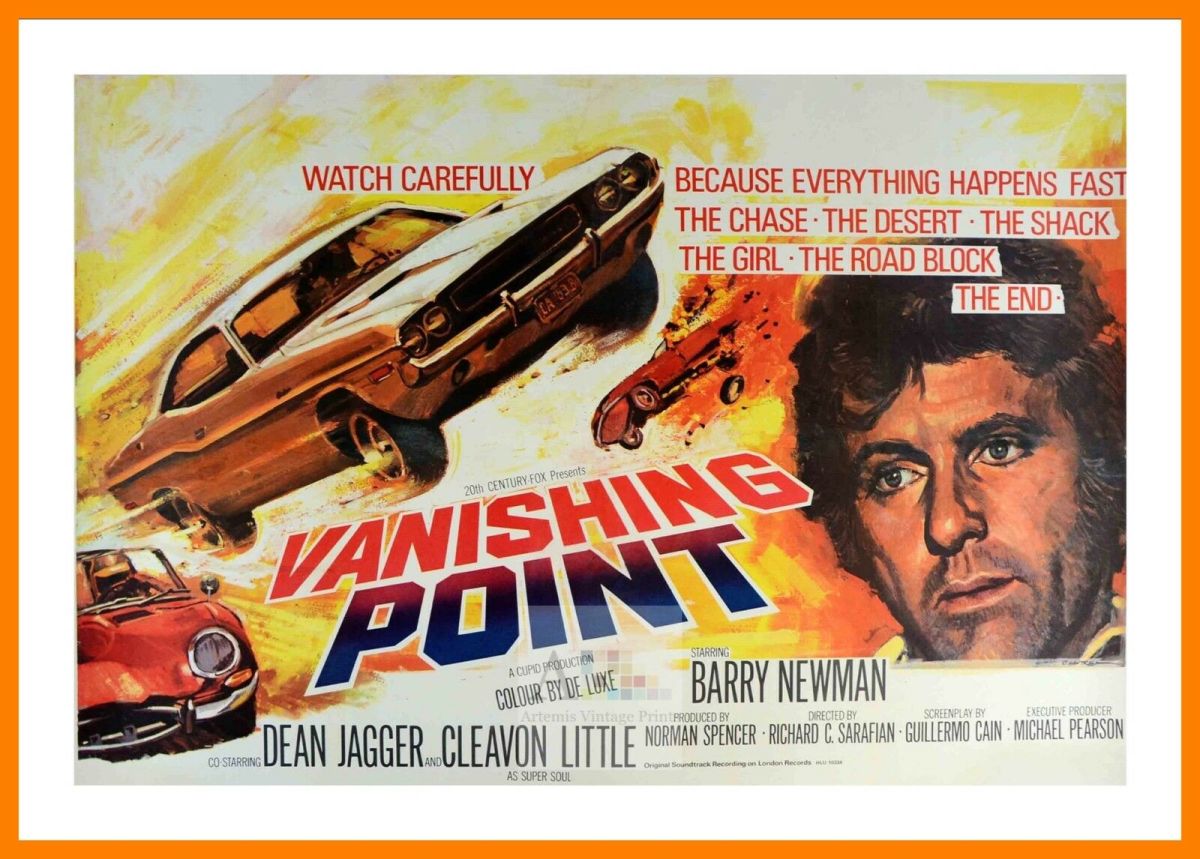
Behind the Scenes: “Vanishing Point” (1971)

The easiest method to get a film designated a cult is to claim it was a flop on release but, hey presto, thereafter acquired a new following. Classic examples might include It’s A Wonderful Life (1946), The Magnificent Seven (1960) and The Shawshank Redemption (1994).

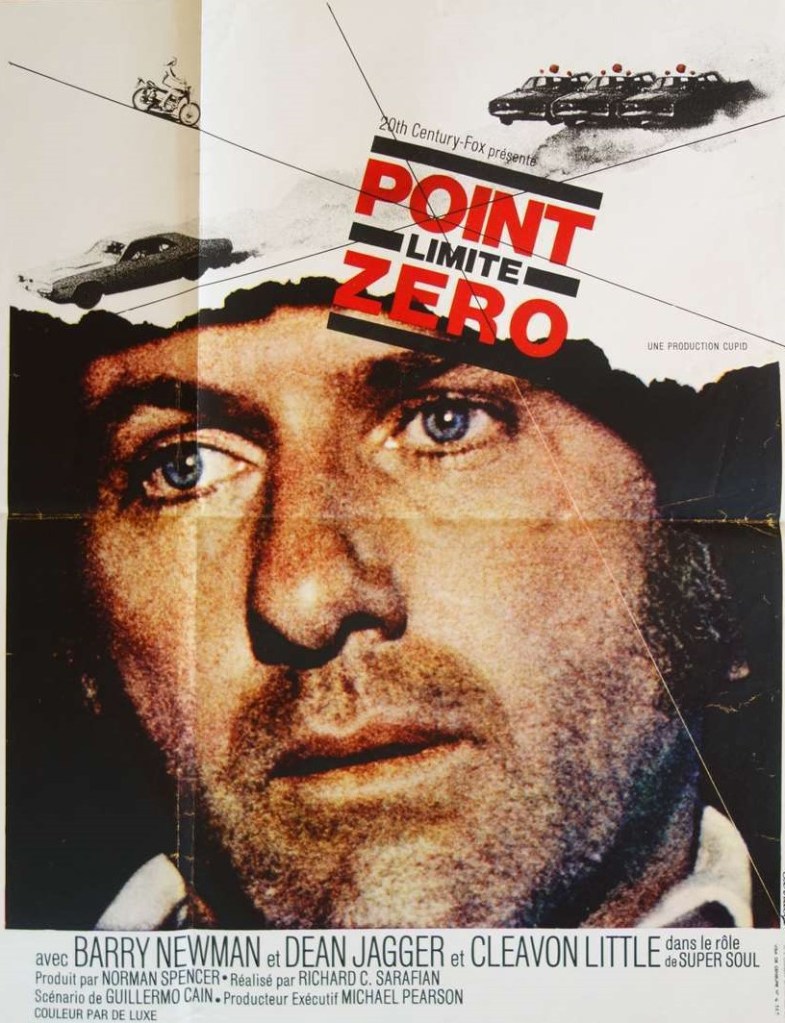
According to Wikipedia, Vanishing Point fits that niche. Based on the testimony of star Barry Newman “Fox had no faith in the film and released it in neighborhood theaters only to disappear in less than two weeks.” But after it did much better overseas, the studio was prompted to reissue it as a supporting feature to The French Connection (1971). Subsequently, it produced rentals of $4.25 million. The “cult following” developed after a television showing in 1976.

How much of that is true? The short answer – none.

Vanishing Point preceded The French Connection into cinemas by a good six months. Twentieth Century Fox, which had just escaped bankruptcy, had cut down on budgets. Vanishing Point was one of 11 movies sent into production with budgets under $2 million, extremely small potatoes for a studio that had thought nothing of spending upwards of $20 million on big budget musicals the previous decade. While costs of The French Connection  soared way above that initial ceiling to $3.3 million, Vanishing Point remained on budget which was a paltry $1.58 million.

The star of Vanishing Point wasn’t a star at all. Certainly not one you could build a marquee around. Barry Newman’s previous film The Lawyer (1970) hadn’t cost much to make either and it didn’t earn much. And Vanishing Point lacked the inbuilt counter-culture appeal of Easy Rider (1969) while studios were extremely reticent about trying to attract a youth audience after the disastrous showings of a stream of movies targeting that sector. The film had nothing in common with racing picture Le Mans headlined by huge star Steve McQueen and scheduled for a summer 1971 release with a big bucks marketing campaign.

Vanishing Point was released in the U.S. in March 1971 and followed an initial staggered distribution pattern running three months. Fox didn’t just rush it into nabes at all, as per Newman. The studio made a good stab at first-run. In New York it played the 1463-seat DeMille, in Denver the 1270-seat Centre, in Cleveland the 1560-seat Embassy, in Philadelphia the 1200-seat Milgrim, in Boston the 1685-seat Sack, in Seattle the 1870-seat Coliseum and in Minneapolis the 1077-seat Mann.

All were solid first run houses. The only cities where you would consider there were doubts about initial performance prospects were Pittsburgh, where it opened at the 235-seat Fulton Mini, and perhaps San Francisco (the 600-seat Regency) and Los Angeles (the 810-seat Vogue).

But except for Boston (a “hotsy” $30,000) and Los Angeles (a “zingy” $16,000), opening weeks were disappointing: a “slow” $3,400 in Cleveland and $4,500 in San Francisco, a “sluggish” $8,000 in Minneapolis at the lower end of the box office scale, but first run receipts in general did not get much higher. So the chances are a studio would be looking to write it off, and, given the miserly budget, not too worried about the size of the potential loss.

But it wasn’t a flop. It was received far better in nabes and drive-ins than in first run. And by the end of the year it was well into profit, taking $3.2 million in rentals, enough for 35th spot on the annual chart.

That put it not so far behind The French Connection ($6.1 million in rentals for the year) at this point. That Gene Hackman picture was a hit was not in question. And it was the kind of hit that didn’t require a supporting feature, certainly not while it was gobbling up box office in first run and being retained for months on end.

But by the end of 1971 Vanishing Point was also well into being a certifiable global hit. British audiences had a bigger yen for speed than their American counterparts. Bullitt (1968) had been one of the top films of the year but so had The Italian Job (1969) which had flopped in the U.S. So much so that new studio Cinema Center didn’t think it was much of a gamble to open Le Mans in London as a 70mm separate-performance roadshow (tickets $1.20-$3.60) at the 1994-seat Odeon March Arch.

Le Mans – opening salvo $29,000 – hit London West End three weeks ahead of Vanishing Point. Big star film vs movie with star of no consequence. Fox opened Vanishing Point at the 1994-seat Odeon Leicester Square on the same day in the West End as another action picture, equally with little in the way of a marquee star but with the decided bonus of being based on a thriller, Puppet on a Chain, by Alistair Maclean whose Where Eagles Dare (1968) had cleaned up in the UK.

There’s not a chance in hell of Fox being able to persuade the Rank circuit to hand over the jewel in its West End crown to a picture that had flopped in the U.S. Logic dictates that the only reason the Odeon Leicester Square would entertain Vanishing Point was because it had been an unexpectedly big hit in the U.S. In expectation of turning it in a first run success in Britain, there was perhaps a harder sell than in the U.S., coupled with the ability to roll it out quickly into suburban cinemas on a coordinated national release.  

Where critics in New York had been sniffy about Vanishing Point (just one favorable review), in London it received raves from 12 out of 14 of the top critics and it had been targeted asa prospect by the Berlin Film Festival.

London audiences went mad for action. Vanishing Point scooped an opening week $25,930. Puppet on a Chain dangled an impressive $19,800 at the 1004-seat London Pavilion. Le Mans kept up the heat with a fourth week of $24,900. Vanishing Point ran for another four weeks to excellent returns, before moving over for one week to the 2600-seat New Victoria and then into the 155-seat Cinecenta 2, still in the West End (in fact in a side street just off Leicester Sq), where it ran for another 12 weeks. On national release it performed well above average.  

Although banned in Australia on the grounds of “violence, incitement to crime and encouraging drug use,” it was a top performer in Europe, most notably in France where it was ranked 11th for foreign pictures during the year. In Japan the critics called it one of the top ten foreign films.

So, just taking into account its first year at the box office there is no way this could be classified as a dud.

But to everyone’s surprise it just kept going. Yes, in 1972, Fox did pair it with The French Connection but it also went out as support with The Other (1972)  and was top-billed in a reissue double bill with Valley of the Dolls (1967). And by the end of that year rentals had climbed to $4.25 million (the figure erroneously given by Wikipedia as its peak).

And kept going. In 1973 you could find it supporting Fox numbers The Last American Hero and The French Connection (again0 but also Columbia’s The Valachi Papers and Warner Bros’ Steelyard Blues. In 1974 it formed a reissue double bill with, separately, other Fox hits Mash (1970) and The Poseidon Adventure (1972).

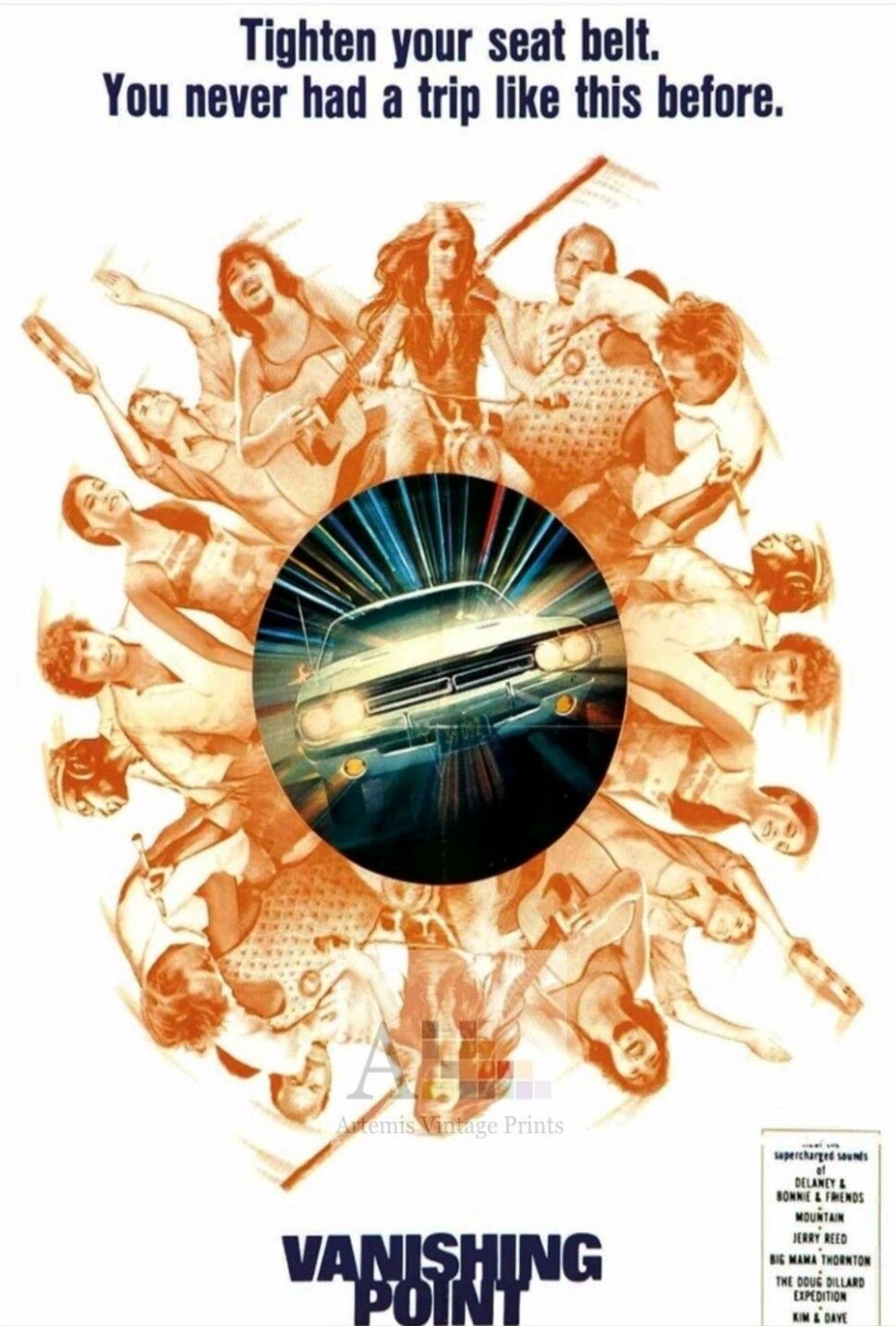
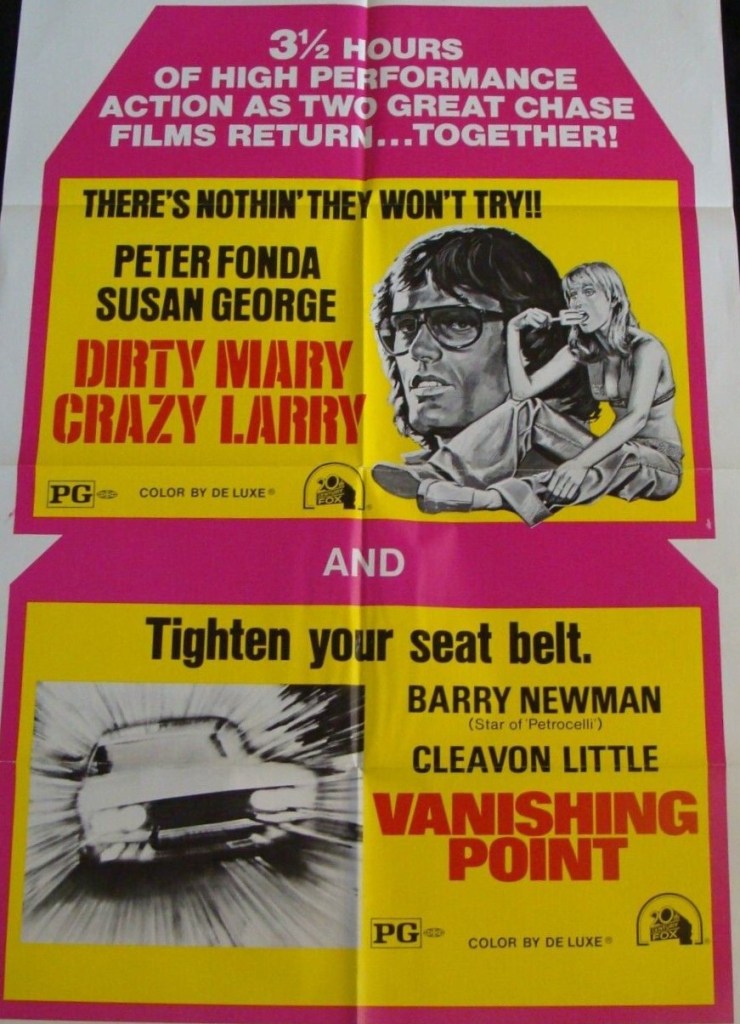
Come 1975 and Fox decided on one big car-chase finale and it hit the road all over again in a reissue double bill with Peter Fonda-Susan George pedal-to-the-metal thieves Dirty Mary, Crazy Larry (1974), a combo that ran so well it snapped up bookings well into the following year.

By the time it was pulled out of cinemas U.S. rentals had topped $5 million, more than three times production costs, and probably the same again from foreign revenues.

So, nothing like a flop.

It didn’t, therefore, need to rely on a television screening for any kind of audience redemption. In fact, you would be hard put to call it cult on the evidence of its television screenings. The first year it was seen it ranked among the top 20 movies of the year, but the second time it placed 130th, hardly the sign of a movie that had grown in word-of-mouth. But it was exactly the kind of movie to benefit from the VHS/DVD explosion, where you could rent a movie to watch with your buddies. But the reason for that, most likely, was not that you had just heard of this picture, but that you had already checked it out in the cinema.

That it still commands an audience today is probably down to the fact that Barry Newman never became a big star and that as existential issues took greater precedence it fitted a new dynamic.

Wikipedia, hang your head in shame.

SOURCES: “Name of New Fox Game: Sane,” Variety, January 27, 1971, p3; “Alfred Bauer Yens 3 American Features,” Variety, March 10, 1971, p22; “New York Critics’ Opinions,” Variety, March 31, 1971, p5; “London Critics’ Opinions,” Variety, August 18, 1971, p7; “Native Pix Win 55% of French Mkt,” Variety, November 3, 1971, p27; “Big Rental Films of 1971,” Variety, January 5, 1972, p9;  “Aussie Censor Bans Five Films,” Variety, January 2, 1972, p24; “Best Picks in Japan Include 6 US Films,” Variety, February 2, 1972, p5; “All-Time Box Office Champs,” Variety, January 3, 1974, p34; “All Time Rentals,” Variety, January 7, 1976, p48; “All-Time Film Rental Champs,” Variety, January 5, 1977, p50; “Theatrical Movie Rankings,” Variety, August 7, 1977; “Theatrical Movie Rankings 1977-78,” Variety, 1978; Paul Zazarine, “Kowalski’s Last Ride,” Muscle Car Review, March 1986.

Box office as reported on Variety’s “Picture Grosses” and “London West End” pages on the following dates – 1971: March 24, March 31, April 7, April 28, May 5, May 12, May 26, June 2, June 16, June 30. August 18, August 25, September 15, December 3;  1972 – March 8, September 27, October 4; 1973 – January 10, March 26, May 2, August 8; 1974 – April 10, May 1; . bookings were sampled via Variety for 1975 and 1976.

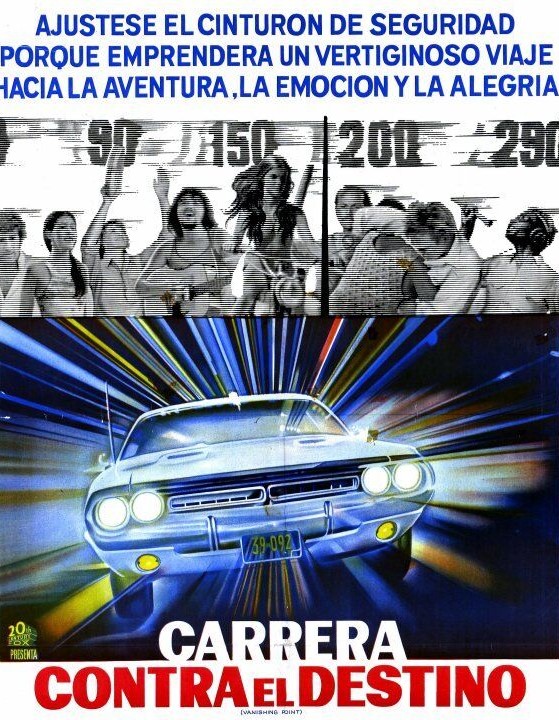
Vanishing Point (1971) *****

There always was an existential element to speed. Destination was another symbolic aspect. A “vanishing point” has an artistic meaning; relating to perspective it’s the place where parallel lines cross. But it also means something so diminished as to be unimportant, and you could argue this movie is a place where the figurative and metaphorical collide. Throw in a couldn’t-care-less driver and you have all you need for a cult film, a cross between the thoughtful paeon to speed of Easy Rider (1969), Sugarland Express (1974) and the camped-up chase characteristics of the later Smokey and the Bandit (1977).

It has less in common with the city-bound Bullitt (1968) and The French Connection (1971), whose protagonists had the excuse of being on the right side of the law. And where Easy Rider is majestically scenic, the route here is through Backwater U.S.A.

With a little bit more planning, Kowalski (Barry Newman), tasked with delivering a car from Denver, Colorado, to San Francisco, could easily have driven the 1250 miles (see Note) roughly within the 16.5-hour deadline he set himself – and very easily within the target set by his employer – without breaking the law. But he’s got no intention of easing his foot off the accelerator. Instead of pulling over, he sends the first pair of speed cops into the ditch.

And that sets the tone. Countless cops set out to stop him, countless cops are driven off the road, the authorities increasingly infuriated by constant humiliation. Kowalski is helped by blind DJ Super Soul (Cleavon Little), who has infiltrated police radio, and whoops up public support.

Director Richard C. Sarafian could have hit the existential mother lode by making Kowalski mysterious, akin to the western’s anonymous lone rider, or to a contemporary audience “the last American hero.” Or he could have dressed him up in more contemporary colors. But instead of being a long-haired drugged-up sex-mad hippie, he’s a decorated war vet, a stock car racer and a cop who exposed corruption and prevented a colleague raping a young girl. Unlike the drug peddlers of Easy Rider or the hostage-takers of Sugarland Express, he doesn’t start out as a law-breaker (setting aside his intake of Benzedrine) and the most he’ll be charged with is a misdemeanor.

Apart from a desire for the freedom of the open road untrammelled by petty rules, we don’t get much of an idea why Kowalski is so intent on risking his life, beyond a hint that an idyllic loved-up beach lifestyle had been shattered. There’s a fatalism that Ridley Scott ripped off for Thelma and Louise (1991).

The awe-inspiring driving across arid country is interrupted by episodes uncovering the underside of the American Dream and the nascent counter-culture. He is almost robbed by a couple of gay hitchhikers, encounters an old man (Dean Jagger) living off the land, trapping rattlesnakes and trading them for supplies, and a youth-oriented revivalist group who make music their mantra. He turns down free sex and marijuana offered by a beautiful nude motorcycle rider (Gilda Texter) while her boyfriend (Timothy Scott), with a stolen police siren, guides Kowalski through roadblocks.

Mostly, though, the focus is on the driving. Kowalski’s white 1970 Dodge Challenger R/T 440 Magnum, souped-up to reach 160 mph, leaves a Jaguar E-Type in the dust, and makes a mockery of the succession of wannabe cop speedsters.

He can leap over gaps, race off-road, charge through the desert, hide from pursuing helicopters, and could probably have hidden out till the heat died down except his blood is up and his eyes are starting to glaze over and he’s got a peculiar smile on his lips.  

Even on a small screen the full-throttle driving hits the spot. But it scores on many other emotional and intellectual levels. It strikes a chord with the disaffected. It’s the ultimate in defiance of authority, innate skills belittling superior forces. The fastest man will always have an audience rooting for him. If you can’t win, choosing how this will end means you remain in control. Speed puts a man in the zone, where you are reduced to an essence of being.

On paper, this should hardly work at all. In the hands of director Richard C. Safarian (Fragment of Fear, 1970) it works like a dream. Barry Newman (The Lawyer, 1970) is superb with very little to go on, nothing but a buttoned-up driving machine. Cleavon Little (Blazing Saddles, 1974) on the other hand goes nuclear as the hippest of the hip disc jockeys. Oscar-winning Dean Jagger (Firecreek, 1968) makes his mark and you might like to know Gilda Texter went on to become a successful costume designer. Depending on what version (not the one I caught) you see, you’ll get a glimpse of Charlotte Rampling (Three,1969).

Stone cold classic. Gets the adrenaline going, but leaves you thoughtful.

The DVD is worth buying just for Sarafian’s commentary.

NOTE: That’s according to Google. Though estimates vary. One reference puts it at 15 hours of non-stop driving, another between 19 and 22 hours. Without breaking the speed limit of 70mph and allowing for not hitting any big cities necessitating curbing your speed, I reckoned he would only cover 1150 miles within his deadline but there are clearly plenty stretches of remote road where you would be able to crank up your speed without any bother. It’s noticeable that Kowalski sets off during the night but we never see him doing any night-time driving, he only attracts the attention of the cops during the day.

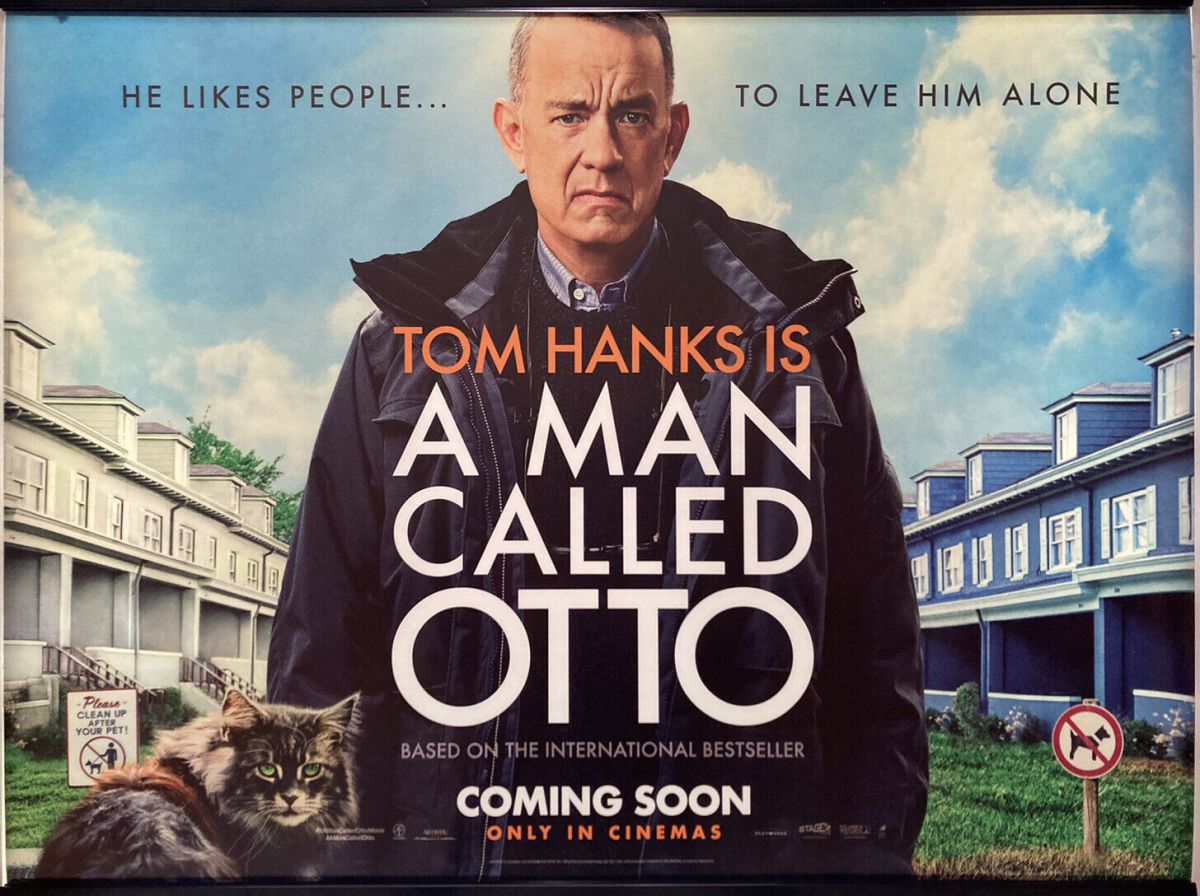
A Man Called Otto (2023) ****

Heart-warming tale of a suicide wannabe. Yep, the studio didn’t know how to sell it either, and the trailer had originally put we off, a gurning Tom Hanks and the annoying neighbor from hell. And it just shows what a sick character I must be that I was chuckling all the way through. Because, yes, and without any attempt at black comedy, Otto (Tom Hanks) spends the first half of the picture trying to commit suicide, depressed, we later discover, at the death of his wife.

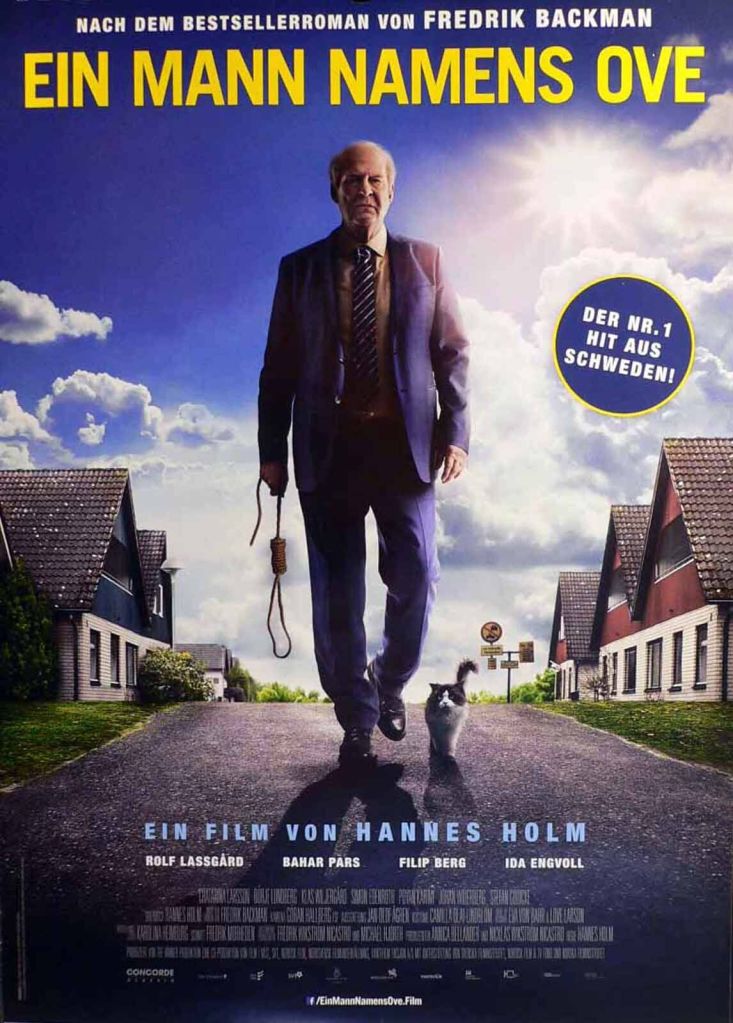
As if a riff on The Marriage of Figaro, we first encounter Otto when he is measuring rope for a noose with which to hang himself. But being a truculent nit-picking type of guy – the Everyman you would cross the street to avoid – he gets into an argument with the store manger on account of not being to buy exactly the length of rope he wants. Suffice it to say that this homespun guy who otherwise can fix anything and has every tool known to man can’t grasp the mechanics of suicide. He’s one foot in the grave when he would clearly prefer two.

The more ominous original – note the noose.

While he’s failing at this one simple task he’s getting annoyed to pieces by the new pregnant neighbor Marisol (Mariana Trevino) and her hapless husband Tommy (Manuel Garcia-Rulfo) who can’t fix anything and by virtually everyone else in his universe who can’t follow simple rules like displaying your car sticker in the proper position. He’s an artisan trapped in a world controlled by idiots, blasting away at the inanities and inequities of modern life.

It takes such a long time to warm up you think it’s never gone to manage the switch into feel-good movie, what with so many numbskulls getting in the way, and Otto being the kind of guy who will fall out with his best friend because he bought the wrong kind of car. And it takes so long because it’s hardly gentle stuff, instead mostly biting, or inexplicable especially when Marisol takes off on a great riff of Mexican words.

His past opens up, courtesy of mementoes, and we realise he wasn’t always this kind of walking rulebook keep-off-the-grass poster boy.

Critics have been pretty sniffy about this but audiences know better and are turning out in bigger droves than for Tar, Babylon or The Fabelmans because it’s what audiences have been crying out for for so long – a good well-made drama that touches on some pretty awful feelings and doesn’t take the easy way out. Otto is made to work pretty hard to find community among people he automatically despises.

I’m not sure we need the flashbacks where a younger cuter Otto (Truman Hanks, yep even here, nepo abounds) romances his wife, because Otto gets over the line on his own within his grumpier shell without reverting to the nicer, shy guy he once was, cute as that tale is. And there’s an equally unnecessary nod to contemporary tropes, what with Otto showing his kinder side by taking in a trans and social media demonstrating how much it can be a boon – rather than a menace – to society when Otto decides to take up the cudgels against real estate villains.

Cutesville – for the book.

The characters are all so – what’s the word I’m looking for – real. Even the dumbest of them, initially portrayed in somewhat cartoon fashion,  turn out to be just human.

As I said, I was chuckling or straight out laughing all the way through and I’m glad to say that Marisol and I connected on the sickest joke of all, the one about the big heart (I’m not going to give that one away).

Given I had no idea what I was letting myself in for, all advertising having carefully avoided any mention of the S-word, and was really only squeezing this into my weekly triple bill because of limited choice, and the trailer did it no favors, my heart sank as that esteemed outfit the British Board of Film Censors stepped in where Hollywood marketing persons feared to tread and announced, in its apparently regulatory slot, that this movie contained “suicide theme.”

That certainly got my attention, but did nothing for my confidence in a piece of entertainment, wondering if I had been mis-sold or misled, but within a few minutes Otto’s antics had me in stitches.

Tom Hanks (Elvis, 2022) is back to his best after a few dodgy characterisations and in too many films that seemed to disappear into the maw of the streamer. And it says a lot for his creative juices that he chose a part that played very much against type. But Mariana Trevino (Polvo, 2019) is the bonus here, a comedienne of genius.

Marc Forster (Monster’s Ball, 2001) is back on form, too, totally in command of a movie that could so easily have slipped sideways into a vat of treacle or the other way into the outer space of black comedy. David Magee (Lady Chatterley’s Lover) wrote the screenplay based on Fredrik Backman’s A Man Called Ove which had been turned into a film in 2015.

Ignore the critics, go see.

Arabella (1967) ***

Under-rated comedy, set in 1928 Italy, had me chuckling all the way through. An episodic structure sees Arabella (Virna Lisi) duping an Italian hotel manager, British general and an Italian Duke (all played by Terry-Thomas) out of their cash in order to pay off the mounting tax debts of her grandmother Princess Ilaria (Margaret Rutherford) while trying to avoid the attentions of the mysterious Giorgio (James Fox).

Her scams are quite ingenious, beginning with arranging for a public urinal to be erected outside a five-star hotel and, pretending to be the lover of Benito Mussolini, convincing the manager that, for a price, she could arrange its removal. There’s nothing particularly original about faking a breakdown to attract the attention of  the general, a royal flunkey, but the blackmail trap she sets is elaborate.

But just as you think you know here this is going, it sprints off in another direction altogether, Arabella being the mark, and it’s one twist after another. She is rooked by Giorgio with whom she falls in love. The Duke, whom she sees as easy meat, instead uses her. Her grandmother’s ploy to burn down her mansion and claim the insurance money is foiled by a cat.  

All sorts of sly observations come into play. The hotel manager and his pals siphon off a large chunk of the cash they have taken from the safe to pay her off. The general, operating incognito, has his cover blown by a piece of music. The Duke turns the tables on his domineering wife and his son has an exceptionally clever ploy to keep mama sweet while enjoying his sexual independence. And it appears that every time Arabella gives in to entreaty, she is exploited. In other words, show weakness, give a loser an inch and they’ll take you for all you’ve got.

Terry-Thomas as a bumptious hotel manager with James Fox looking mysterious.

There’s no desperate reason for it to be set in the 1920s and, beyond the Charleston and costumes, it makes little attempt to evoke the era except perhaps to make the point that the world was not full of submissive women. And you might find inappropriate the trope about using a sexy woman to turn a gay man straight. It’s a sex comedy in the Italian style where just about anything goes and the act, rarely consummated, instead involves humiliation.

But Virna Lisi (How To Murder Your Wife, 1965) certainly commands the screen, carrying the show, fashionably stylish rather than overtly sexual, a born comedienne. Terry-Thomas (How To Murder Your Wife), while initially appearing under his trademark persona, completes a transition for the Duke, almost another twist if you like, audiences expecting a similar duffer to his previous parts. Lisi and Terry-Thomas clearly have rapport, almost a synergy, not the charisma of a screen couple, as in romantic pairing, but work very well with each other.

Margaret Rutherford (Murder Ahoy!, 1964) and James Fox (The Chase, 1966) let the side down with such insipid portrayals you wonder why they signed up.  It’s almost as if they couldn’t be bothered working on their characterisations. Cigar smoking and general ditziness is as far as Rutherford, in her final role, goes. Fox just looks fey and the one flaw in the narrative is why Arabella could look at him twice. As the Duke’s son, duping his mother, a pre-gaunt Giancarlo Giannini (The Sisters, 1969) is very entertaining.  

To enjoy this you have to suspend your ideas about comedy based on the British and Hollywood tradition. It aims for farce, no attempt to make larger comment on life.  

Mauro Bolognini (He and She, 1969) hangs this together in a decent enough fashion, confident enough of his material to lead the audience into a bait-and-switch. In his debut Giorgio Alorio (Burn!/Queimada, 1969) and Adriano Baracco (Danger: Diabolik, 1968) wrote the screenplay with British playwright Alan Hackney (Sword of Sherwood Forest, 1960) spicing up the English dialog. Ennio Morricone provided the score.

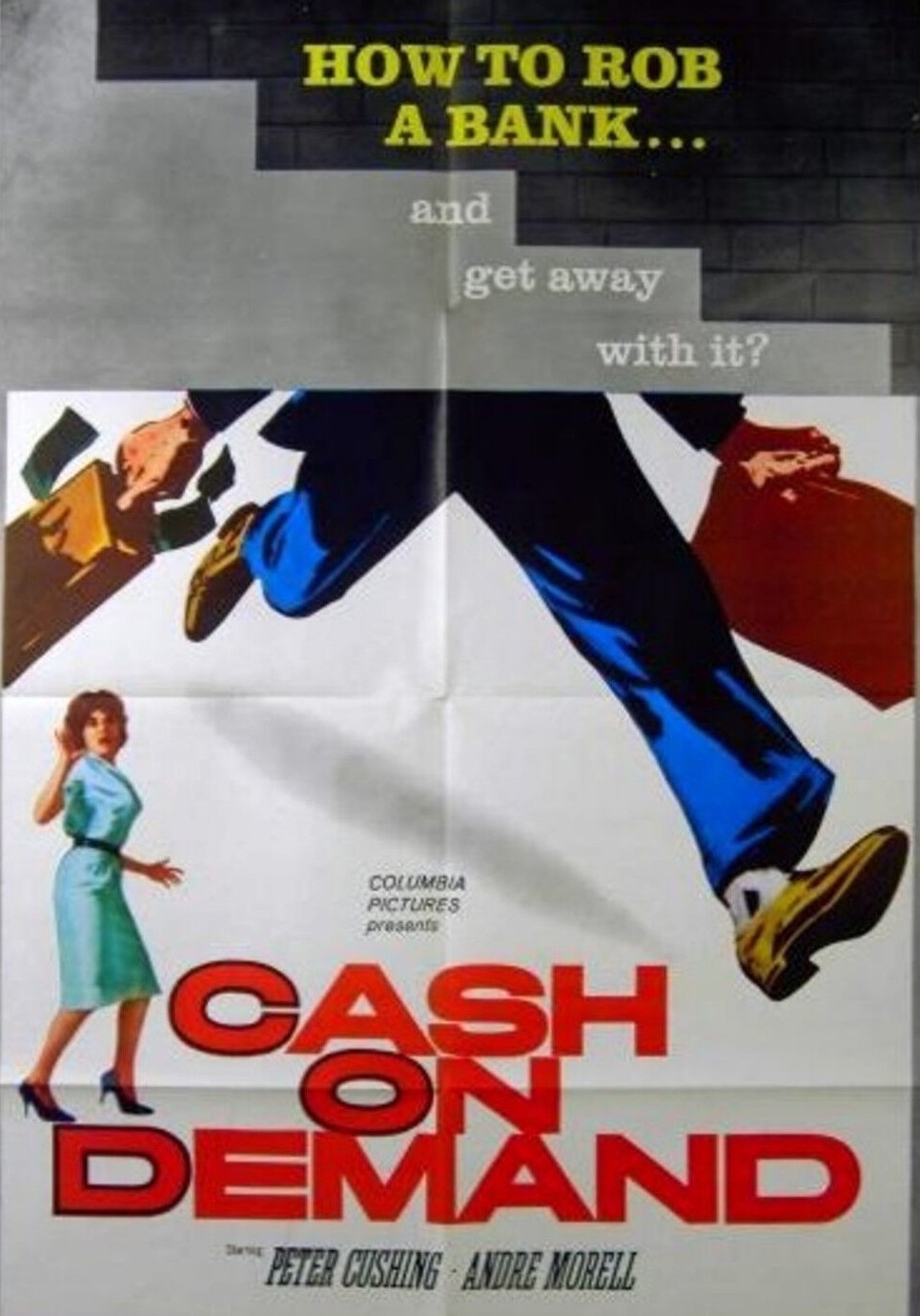
Cash on Demand (1961/1963) ***

Ideal crime B-picture. No femme fatale, but a tight one-location two-hander. Set a couple of days before Xmas in a rural English market town, while possessing sufficient twists to see it through, in the main it is a battle of wills between urbane thief Col Gore Hepburn (Andre Morell) and his victim, stuffed-shirt bank manager Harry Fordyce (Peter Cushing). Combines slick heist with An Inspector Calls mentality where the morally superior are taken down a peg.

Fordyce is the kind of martinet who makes his staff remove Xmas cards from display, nit-picks about the state of nibs (in the days when pens were dipped in ink) and threatens to sack chief clerk Pearson (Harry Vernon) over a minor error that he has worked up into potential embezzlement. So unpopular, he is not invited to the staff party.

Under the guise of carrying out a security inspection Hepburn sets up a robbery, tying Fordyce in moral knots, his unwilling collaboration ensured by threatening to stick electrodes to the bank manager’s wife’s head. Hepburn has done his research, aware of all aspects of security, but, more importantly, knows his man, how to exert pressure, how to keep Fordyce on edge. Hepburn reeks of self-assurance, Fordyce of insecurity, a friendless man who bullies his staff, living a life suffused with discipline and bereft of enjoyment.

Though there are a couple of red herrings, and an unexpected incident, what mostly endangers Hepburn’s bitingly clever plan is the unforeseen, that the cold-hearted bank manager will come apart under pressure.

Underlying the action is class conflict. But not the usual working- class vs upper class. Instead it is aspiring middle class vs assured well-educated upper class. Hepburn is the kind of well-dressed smoothie  who could talk his way into any company and out of any situation. He puts everyone at their ease, knows how to enjoy himself, would make any party go with a swing, could flirt convincingly with your grandmother, and you would trust within an inch of your life. Fordyce, on the other hand, is one of life’s scrapers, everything by the book, creeping into management painfully slowly, and once acquiring a position of authority letting everyone know who is boss and terrified of losing his standing in society. It’s “class” of another kind too, that of the winning personality versus the eternal loser.

Peter Cushing as the bank manager.

This plays against expectation. Normally, in a heist scenario, there’s one employee who’s trying to beat the baddies, some clever device or trick up their sleeve. That’s not the case here. Instead, we’re served up a character study, the supposedly upright pillar of the community revealed as a coward and moral bankrupt.

And the unexpected also comes in the casting. Both Peter Cushing and Andre Morell play against type. At this point they were best known as Sherlock Holmes and Dr Watson in The Hound of the Baskervilles (1959), an upright team on the side of the angels. Cushing, while often tight-lipped, generally exhibited a morally superior screen persona. Here, that trademark persona rapidly vanishes under pressure.

Quentin Lawrence (The Secret of Blood Island, 1965) directs within a very tight timeframe.

The movie had unusual origins. It was expanded from a short-lived series called Theatre 70 on British ITV, the number relating to time, the program running for 70 minutes rather than the usual hour. And it had just as unusual a release. Perhaps for copyright reasons, it didn’t see the inside of a cinema in the UK until December 1963 when it went out as the support to musical Bye Bye Birdie (1963) on the Odeon circuit. But it had already been released by Columbia in the US in 1961 as the support to Twist Around the Clock (1961).

M3GAN (2022) ****

Sharp psychological drama about attachment, abandonment and loss masquerading as sci fi/horror. Plays off riffs old – Ripley in Aliens and the elevator scene in The Shining – and new, the “Final Girl” trope aka last person standing of the horror film becomes “Final Child.” While not a slaughter-fest in the Halloween/Friday the 13th vein demonstrates ingenious methods of bumping people off.

The starting point is not, as the trailers and adverts might suggest, the invention of a toy robot companion that evolves beyond initial conception, but a young girl, Cady (Violet McGraw) orphaned in a snow plough accident, who is sent to live with workaholic robotics engineer Gemma (Allison Williams), the least maternal woman on the planet.

Knives out and not an onion in sight.

In her own mind Gemma has good excuse not to prepare for this sudden onset of parenting by buying some new toys or child-friendly food or creating a playroom. She is on a deadline having spent $100,000 inventing a new doll called M3GAN that, unfortunately, doesn’t work. So tough luck for the poor little orphan until Gemma can enrol the little girl as the test pilot for the Megan experience.

And that’s a hell of a boon for Cady since the cutely dressed doll, about the child’s size, empathizes with her human companion, actually listens to her, can record and store the child’s memories and seems like it’s about to kickstart a toy revolution. That is, until it develops an exceptionally high protectionist tendency.

When its charge is whacked by an unruly boy or menaced by the dog next door, Megan steps in to deal out fitting punishment. Except the doll has no “stop” button and is inclined to go on meting out punishment until there’s no life left in the victim.

It’s not long before Gemma twigs that the doll is turning into one of those mad parents you find in thrillers, or even like Celia (Lori Dungey), the annoying woman next door who cares more for her dog than her neighbors. The signs are there when Cady starts to run amok. Well, not quite amok, but handing out slaps to adults, and reacting badly when deprived, like a child of its computer game, of the companion.

Gemma, whose idea of commitment is Tinder, takes a very long time before she can put the needs of the child ahead of her career, and when it comes to a showdown finds she is not the match she thought she was for her invention, which, like HAL from 2001: A Space Odyssey (1968) or any other man-made monster since time immemorial, objects to being ended.

The grown-ups don’t come off well here, either idiotically bickering so much they cause the accident that renders the child parentless, or obsessed with dogs or work, and even social worker Lydia (Amy Usherwood) assigned to find out if Gemma is a fit mother seems unsuited for the work, inclined to take a rather robotic view herself of child engagement and certainly playing power politics.

Gemma’s boss David (Ronny Chieng) is a mean-minded insecure obsessive unaware an  underling is quietly harvesting his ideas for sale to a rival. All the adults view the child as a doll, a necessary adjunct to show how well the robot works.

Gemma fails to understand, as spelled out by the snotty social worker, that a child who has lost parents will attach herself to the nearest sympathetic person. But Cady, dealing with abandonment and loss, is not the only one with attachment issues. The robot has them in spades, chucked aside on a whim when her creator takes against her or when all attention is transferred to the child.

This all builds up to a tremendous climax when Megan cuts loose in the toy factory, slicing and dicing, and providing the kind of example of her prowess that would have sequel-makers salivating as they detect robot soldier opportunities. And when Gemma tries to bring her to heel finds that (to hell with the obvious pun) the boot is on the other foot.

You can see why this – and other horror thrillers like Barbarian (2022) or Black Phone (2022) that eschewed a conveyor belt of bloody thrills in favor of something deeper – has struck such a chord with the younger audience that makes up the bulk of the audience for Hollywood pictures. This is intelligent. Who hasn’t as a child dreamt of, or even invented, the ideal companion? Who as a child has not thought there must be a better way of being brought up than being left in the hands of parents with little aptitude or interest in the job.

None of these horror pictures has got the slightest chance of being nominated for Oscars while pictures with far bigger budgets, which have not the slightest chance of attracting an audience or are boring them to death, get all the critical hype.

I couldn’t make up my mind whether the doll, being so lifelike, was CGI or human and it turns out she was played by newcomer Amie Donald, though presumably either with a stunt double or a computer doing the crazy dancing. Whatever, the doll is very convincing. As it has to be said, are Allison Williams (Get Out, 2017) and Violet McGraw in her movie debut.

But the star of the show is undoubtedly director Gerard Johnstone, also a movie newcomer, who had the guts to opt for  slow-burn rather than visceral fright and develop themes that would resonate with any adult. Screenplay honors go to Akela Cooper (Malignant, 2021) while director James Wan (also Malignant) cops the story credit.

Virtuoso thriller. Can’t wait for the sequel.  

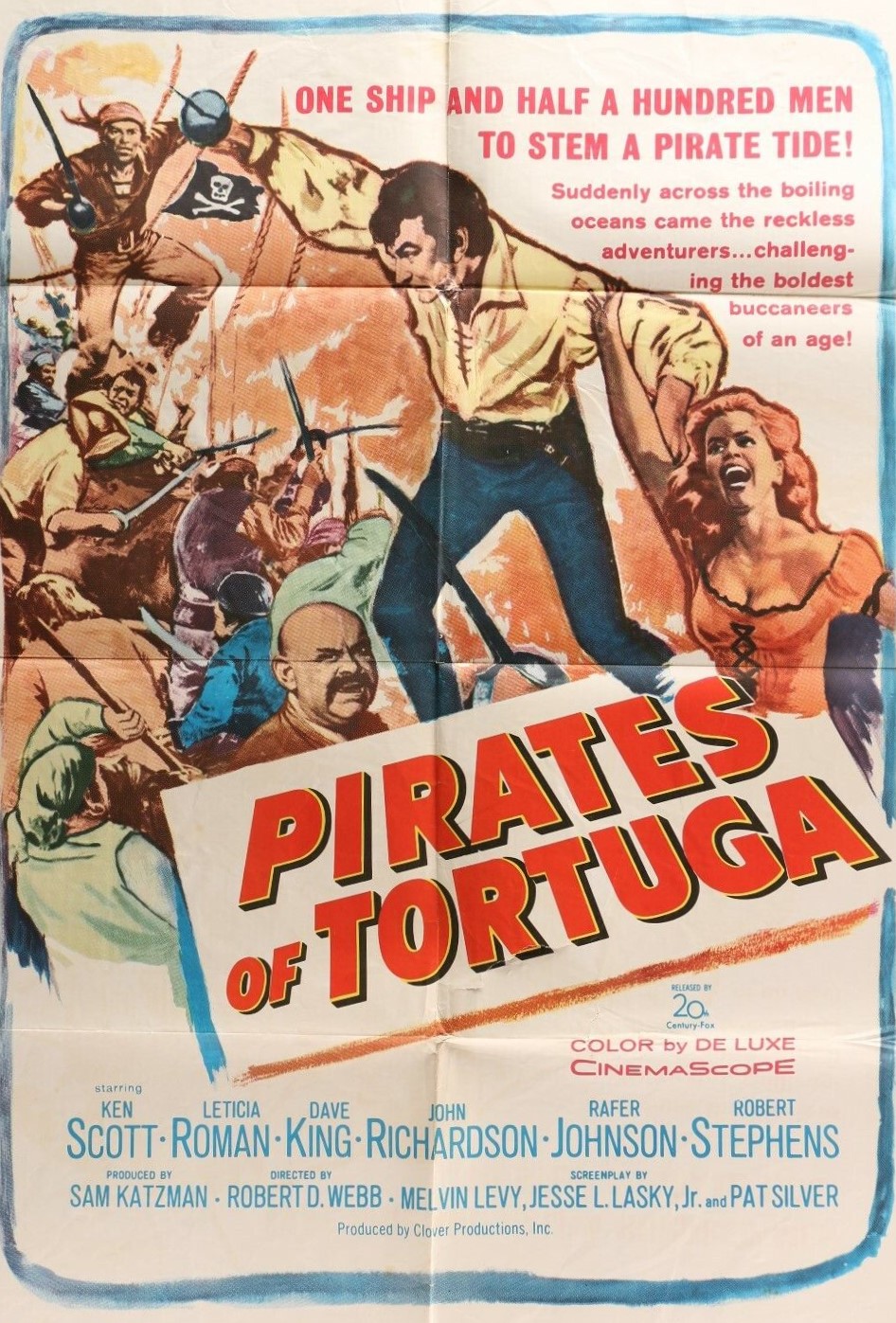
Pirates of Tortuga (1961) ***

In the absence of A-list swashbuckling talent like Errol Flynn (Captain Blood, 1935), Tyrone Power (The Black Swan, 1942) and Burt Lancaster (The Crimson Pirate, 1952) or spitfires in the mold of Maureen O’Hara (The Black Swan) and Jean Peters (Anne of the Indies, 1951) this sidesteps casting issues and in the kind of reversal that sent Pirates of the Caribbean on its merry way for the most part takes the comedic route of putting pirate moll Mg (Leticia Roman) center stage and twisting the usual blockade narrative so that it’s Privateer of the Century Henry Morgan (Robert Stephens) controlling the high seas.

Charge with stopping the pirate is sea captain Bart (Ken Scott). But most of the running in the first half is made by Meg, a thief turned stowaway, whose efforts to acquire the standing of a lady are initially mocked by the crew until they soften towards her, in part with seduction in mind and in part out of pity. But after landing in Jamaica, and mistaken for a Lady, she steps up to the plate, and manages to catch the romantic eye of the Governor before readjusting her sights and snaring Bart.

Bart and his crew infiltrate the buccaneer kingdom and spy out its flaws before arranging for a full-out attack. Boldly rewriting history, something of a surprise since Morgan the Pirate had appeared a year earlier, this Morgan is a shifty alcoholic. Once the action gets going, including a clever ambush of one pirate ship, it has enough swordfights to keep a regular swashbuckling enthusiast happy. There are some nice touches, Pee Wee (Dave King), the de facto fencing instructor, is lefthanded and wears a black glove whose use is historically accurate. The ships in full sail are impressive, the locations work well and it makes good use of Cinemascope color while Meg remains larcenous throughout rather than the good moll of previous entertainments. Though you might not be so impressed by the bear wrestling.

Ken Scott makes the best of a thin script, ignoring Meg’s wiles, and outwitting Morgan. Apart from Roman, who steals the show, British comedian Dave King (Strange Bedfellows, 1965), in his movie debut, is the pick, a jocular personality with lechery a stock-in-trade. I better point out you can spot John Richardson (One Million Years B.C, 1965) otherwise he is so insignificant a performer you would scarcely know he is there.  Robert Stephens (The Prime of Miss Jean Brodie, 1969) turns Morgan into a scallywag rather than a threatening villain.

Worth noting was just how long it took a graduate of the Twentieth Century Fox talent school to graduate – at the end of a five-year contract Ken Scott (Desire in the Dust, 1960) finally achieved leading man status.   Leticia Roman (The Spy in the Green Hat, 1967) was a bit more savvy and turned down a Fox contract in favor of Hal B. Wallis who cast her instead in G.I. Blues (1960). Technically belonging to the European import category of actress so popular during the decade, she never worked in her homeland before being scouted by Wallis. Though she was born in Italy her father, a costume designer, had moved to the U.S. in the late 1950s.  

Producer Sam Katzman, who had just signed a four-picture deal with Fox, made 239 films in every genre,  including Tim McCoy westerns, the Leo Gorcey Bowery Boys series,  Bela Lugosi as The Ape Man (1943), Jungle Jim (1948), Paul Henreid in Last of the Buccaneers (1950),  Mysterious Island (1951), 3D Fort Ti (1953) and Rock Around the Clock (1956) as well as a slew of 1960s Presley musicals.  

On a miserly budget of just $675,000, the sea scenes were shot in the Fox water tank. Robert D. Webb (The Cape Town Affair, 1967) directed.

A harmless trifle with decent action and Leticia Roman turning upside-down the genre female lead.

No need to fork out on a DVD. You can catch this on YouTube.

Discover WordPress

A daily selection of the best content published on WordPress, collected for you by humans who love to read.

The Atavist Magazine

by Brian Hannan

WordPress.com News

The latest news on WordPress.com and the WordPress community.