I am a published author of books about film - over a dozen to my name, the latest being "When Women Ruled Hollywood." As the title of the blog suggests, this is a site devoted to movies of the 1960s but since I go to the movies twice a week - an old-fashioned double-bill of my own choosing - I might occasionally slip in a review of a contemporary picture.
Just like the All-Time Top 40, this is based on views on the Blog. I realized I didn’t do a catch-up last year and haven’t done one in two years so it kind of feels redundant to do a previous-year’s-position in brackets number.
All of these movies incurred problems – budget, changes of director or star, censorship issues, studio indifference – and for some it’s a surprise they ever made it onto the big screen.
Waterloo (1970). Sergei Bondarchuk’s roadshow epic with Rod Steiger and Christopher Plummer.
The Satan Bug (1965). John Sturges adaptation of Alistair MacLean pandemic thriller, striking a stronger note now than when originally release.
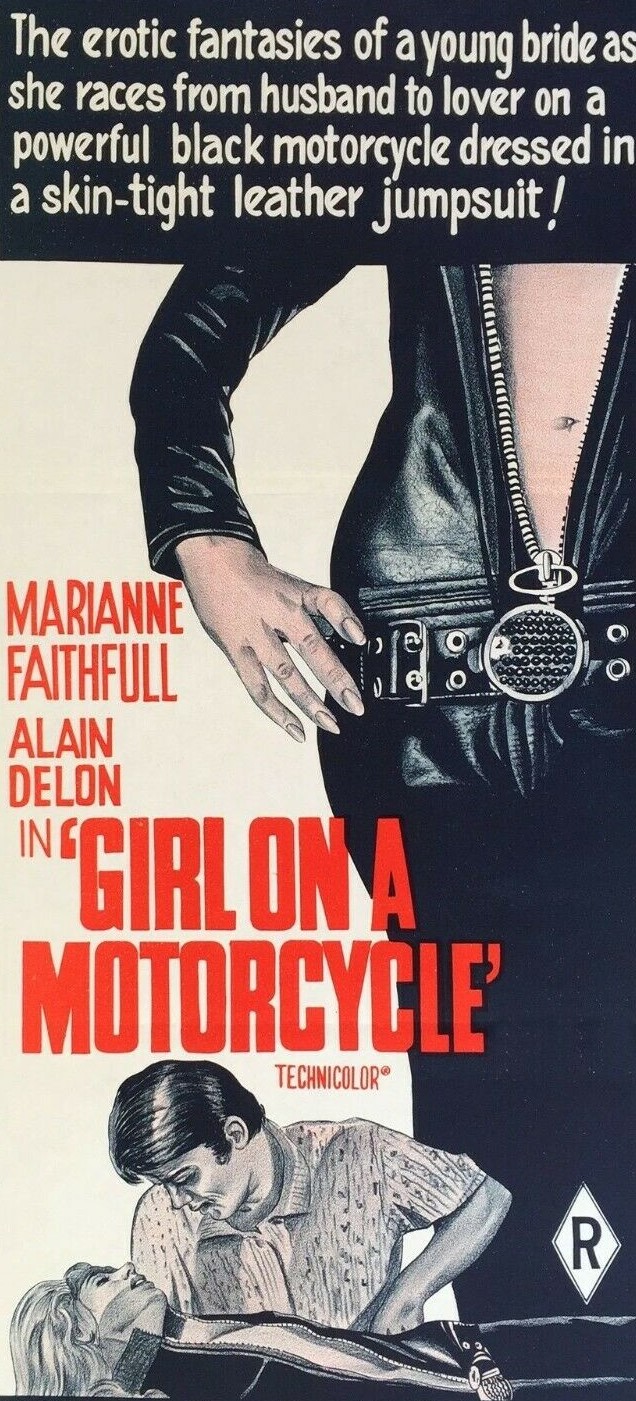
The Girl on a Motorcycle / Naked Under Leather (1968). Marianne Faithful in leathers, what more can you say, except the U.S. censors took umbrage and cut out most of what Europe went crazy for.
Ice Station Zebra (1968). John Sturges again. Alistair MacLean again. Big budget roadshow set mostly under the polar ice cap.
The Guns of Navarone (1961). All-star cast for J. Lee Thompson WW2 epic.
Cast a Giant Shadow (1966). Comedy director Melville Shavelson goes straight with Israeli action picture starring Kirk Douglas, Frank Sinatra, John Wayne and Senta Berger.
In Harm’s Way (1965). John Wayne and Kirk Douglas (again) in Otto Preminger’s examination of Army politics pre- and post-Pearl Harbor.
Spartacus (1961). Battle between the Kirk Douglas vehicle and a rival production from Yul Brynner.
Battle of the Bulge (1965). Cinerama to the fore in the battle of the tanks in WW2.
The Cincinnati Kid (1965). Sam Peckinpah fired, Norman Jewison takes over, Steve McQueen perfects his iconic loner in poker drama.
Secret Ceremony (1969). Elizabeth Taylor, Mia Farrow and a creepy Robert Mitchum in odd Joseph Losey drama.
The Ipcress File (1965). The spy picture that attempted to upend the Bond applecart. Michael Caine’s most iconic role.
Genghis Khan (1965). Though way down the credits, Omar Sharif in the title role.
Sink the Bismarck! (1962). British war film starring Kenneth More that does what it says on the tin.
They Shoot Horses, Don’t They (1969). Decades in the making, finally surfacing with a dream cast of Jane Fonda, Michael Sarrazin and Susannah York.
Doctor Zhivago (1965). Selling the David Lean epic.
The Shoes of the Fisherman (1968). Whoever imagined this would work as a roadshow? Anthony Quinn headlines.
The Biggest Bundle of Them All (1968). Raquel Welch effortlessly steals the show in Italian caper.
Night of the Living Dead (1968). Horror was never the same after George A. Romero went to work on zombies.
The Way West (1967). Underrated Andrew V. McLaglen western with top-notch cast in Kirk Douglas, Robert Mitchum and Richard Widmark.
Valley of the Dolls (1967). Would have been Judy Garland’s last hurrah except she was fired.
When Alistair MacLean Quit: Part Two. Not content with serving up concepts that were turned into some of the best films of the decade, the bestselling author had his own demons to battle.
The Wicker Man (1973). The trap is sprung on naïve Scottish cop in movie that was flop on release but is now considered one of the best horror films ever made.
The Secret Ways (1961). Richard Widmark hunted in Hungary in adaptation of Alistair MacLean thriller. The star finished off the picture when Phil Karlson quit/was fired.
Humphrey Bogart: 1960s Revival Champ. The reason Bogart became so iconic for a new generation: his reissued movies proved box office dynamite.
Once Upon a Time in the West (1969). The inside story of the Sergio Leone classic.
100 Rifles (1969). Raquel Welch, need I say more…well, yes, because Jim Brown brings a helluva lot to the action.
The Bridge at Remagen (1969). Producer David Wolper didn’t count on Russia invading Czechoslovakia when he scheduled his shoot.
The Man in the Middle / The Winston Affair (1964). Robert Mitchum defends an apparently guilty man.
When Box Office Went Worldwide. In the 1960s nobody reported foreign box office so you had to dig deep like I did to find the information all hidden away. Fascinating reading especially as it shows what films touted as successes were actually flops.
It’s Angie Dickinson vs Ann-Margret at the top of the All-Time Top 40. The two female stars take four of the top seven spots with Ann-Margret’s The Swinger replacing at the top long-time favorite The Secret Ways. These two have been duking it out over the past year, in which time the top spot has changed hands four times, with Jessica and Once Upon a Time in the West also taking a turn in the premier position. It’s also noticeable that women are top-billed in seven of the pictures in the Top Ten.
I started this Blog three years ago in June. Last year it was being read in 120 countries but that’s now gone up to 182 (out of the 193 recognized by the United Nations plus the Vatican state and the State of Palestine). Reviews have also increased and I’m now approaching 7,000 views a month, so thanks to you all.
I’ve been doing an Annual Top 40 since I started so this is the third iteration of that idea based on those reviews – out of the 900-plus posted so far – which have attracted the most attention over the three-year period. This isn’t my choice of the top films in the Blog, but yours, my loyal readers. The chart covers the films viewed the most times since the Blog began, from June 1, 2020 to July 31, 2023. (Yeah, it should have been May 31, but I’ve been remiss.)
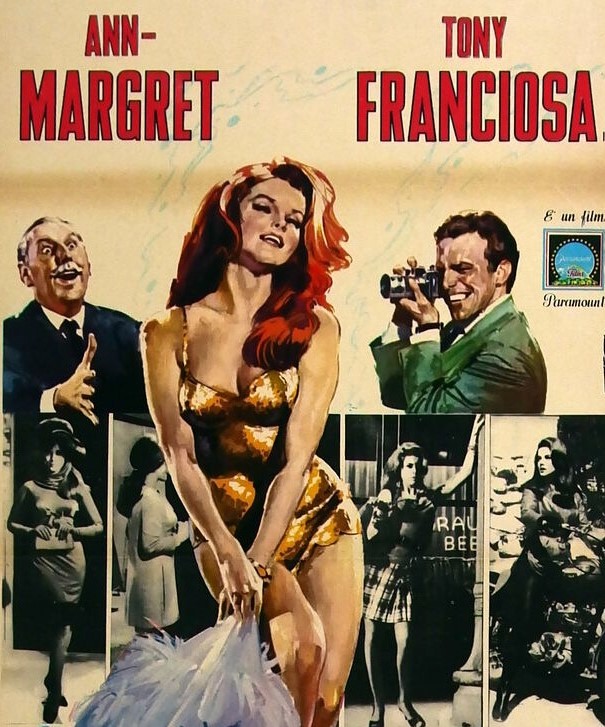
(7)The Swinger (1966). Ann-Margret struts her stuff as a magazine journalist trying to persuade Tony Franciosa she is as sexy as the characters she has written about.
(-) Once Upon A Time in the West (1968). Rated the top western of all time, Sergio Leone’s operatic epic with Claudia Cardinale, Henry Fonda and Charles Bronson and the astonishing Ennio Morricone score.
(2) Jessica (1962). Innocently gorgeous widow Angie Dickinson finds her looks turn so many male heads in a small Italian town that the female population seek revenge.
(5)Fraulein Doktor (1969). Suzy Kendall in the best role of her career as a sexy German spy in World War One.
(-) Stagecoach(1966). Ann-Margret, Alex Cord and Bing Crosby in decent remake of classic John Ford western.
(1) The Secret Ways (1961). Richard Widmark exudes menace in this adaptation of an early Alistair MacLean spy thriller set in Hungary during the Cold War. Senta Berger has a small role.
(-) The Sins of Rachel Cade (1961). Angie Dickinson as a missionary who falls in love with Peter Finch in war-torn Africa.
(-) Gerry Anderson’s Fireball XL5. Colorized version of the famed sci fi television show.
(11) Moment to Moment (1966). Hitchcockian-style thriller with Jean Seberg caught up in murder plot in the French Riviera. Also features Honor Blackman.
(3) Ocean’s 11 (1960). In the Rat Pack debut Frank Sinatra, Dean Martin, Sammy Davis Jr. et al plan an audacious Las Vegas robbery.
(17)Can Heironymous Merkin Ever Forget Mercy Humpe and Find True Happiness? (1969). Off-the-wall musical awash with nudity and Fellini-esque cavorting, directed by star Anthony Newley. Has to be seen to be believed. Joan Collins pops up.
(4) Pharoah(1966). Priests battle kings in Polish epic set in ancient Egypt. Fabulous to look at and thoughtful.
(-) Sisters (1969). French drama bordering on the incestuous starring Nathalie Delon and Susan Strasberg.
(-) Vendetta for the Saint (1969). Feature length version of the television show sees Roger Moore and Rosemary Dexter battling the Mafia in Sicily.
(6) The Golden Claws of the Cat Girl (1968). Cult French movie starring Daniele Gaubert as a sexy cat burglar.
(-) Baby Love (1969). Orphan Linda Hayden finds herself in a predatory middle-class London household.
(-) Pendulum (1969). The under-rated George Peppard as a cop accused of murdering cheating wife Jean Seberg.
(-) Lady in Cement (1969). Frank Sinatra reprises private eye Tony Rome as he tangles with Raquel Welch.
(15) Subterfuge(1968). C.I.A. operative Gene Barry hunts an M.I.5 mole in London. Intrigue all round with Joan Collins supplying the romance and a scene-stealing Suzanna Leigh as a villain.
(-) Plane (2023). Gerard Butler goes Die Hard as stranded pilot outwitting terrorists on a remote Pacific island.
(18) Pressure Point (1962). Prison psychiatrist Sidney Poitier must help racist Nazi Bobby Darin.
(31) Fade In (1968). Long-lost modern western with Burt Reynolds serenading low-level movie executive Barbara Loden whose company is actually filming Terence Stamp picture Blue.
(16) A House Is Not a Home (1965). Biopic of notorious madam Polly Adler (played by Shelley Winters) who rubbed shoulders with the cream of Prohibition gangsters.
(19) Deadlier than the Male (1967). Richard Johnson as Bulldog Drummond is led a merry dance by spear-gun-toting Elke Sommer and Sylva Koscina in outlandish thriller.
(-) The Girl on a Motorcycle (1968). Marianne Faithful dons – and slips out of – leathers in erotic drama with Alain Delon.
(-) Some Girls Do (1969). Daliah Lavi and Beba Loncar get tough with Bulldog Drummond in sequel to Deadlier than the Male.
(-) Beat Girl / Wild for Kicks (1960). London teenager heads for shady Soho. Starts out in milk bars, ends up in strip clubs.
(-) Sodom and Gomorrah (1962). Robert Aldrich biblical epic sees Stewart Granger giving way to temptation in the infamous locale.
(-) A Dandy in Aspic (1968). Director Anthony Mann died during shooting of spy picture so star Laurence Harvey took over. Mia Farrow co-stars.
(-) The Brotherhood (1968). Martin Ritt’s Pre-Godfather take on the Mafia starring Kirk Douglas and Alex Cord as duelling brothers.
(23) Once a Thief (1965). Ann-Margret (again) is a revelation in crime drama with ex-con Alain Delon coerced into a robbery despite trying to go straight. Supporting cast boasts Jack Palance, Van Heflin and Jeff Corey. .
(-) Uptight (1968). Jules Dassin remake of John Ford classic The Informer set among black revolutionaries.
(9) A Place for Lovers (1969). Faye Dunaway andMarcello Mastroianni in doomed love affair directed by Vittorio De Sica.
(-) The Misfits (1961). Stunning last hurrah for Marilyn Monroe and Clark Gable in John Huston tale of ageing cowboys.
(-) Father Stu (2022). Biopic of boxer-turned-priest with Mark Wahlberg and Mel Gibson.
(-) Blonde (2022). Andrew Dominik’s controversial take on the life of Marilyn Monroe with Ana de Armas.
(12) 4 for Texas (1963). Frank Sinatra and Dean Martin face off in a Robert Aldrich western featuring Ursula Andress and Anita Ekberg with Charles Bronson in a smaller part.
(-) Istanbul Express (1968). Gene Barry, John Saxon and Senta Berger involved in nefarious dealings on the other famous trans-European express.
(33) P.J./New Face in Hell (1968). Private eye George Peppard is duped by shady millionaire Raymond Burr and mistress Gayle Hunnicutt in murder mystery.
(10) The Venetian Affair (1966). Robert Vaughn hits his acting stride as a former C.I.A. operative turned journalist investigating suicide bombings in Venice. Great supporting cast includes Elke Sommer and Boris Karloff.
Dropping out of the Top 40
The surge of new entrants and other films attracting a vast new audience has meant some previous favorites tumble out of the Annual Top 40. (Previous year’s position shown in brackets).
(8) It’s Not All Rock’n’Roll (2020). Ageing rocker Dave Doughman aims to mix a career with being a father in this fascinating documentary
(13) Age of Consent (1969). Helen Mirren stars as the nubile muse of jaded painter James Mason returning to his Australian roots.
(14) The Double Man (1967). Yul Brynner chases his doppelganger in the Swiss Alps with Britt Ekland adding a touch of glamour.
(20) Valley of Gwangi (1969). Special effects genius Ray Harryhausen the star here as James Franciscus and Gila Golen encounter prehistoric monsters in a forbidden valley.
(21) The Naked Runner (1967). With his son held hostage, Frank Sinatra is forced to carry out an assassination in east Germany.
(22) Orgy of the Dead (1965). Bearing the Ed Wood imprint, mad monster mash-up with the naked dead.
(24) The Sicilian Clan (1969). Stunning caper with thief Alain Delon and Mafia chief Jean Gabin teaming up for audacious jewel heist with cop Lino Ventura on their trail. French thriller directed by Henri Verneuil. Great score by Ennio Morricone.
(25) Dark of the Sun / The Mercenaries (1968). More diamonds at stake as Rod Taylor leads a gang of mercenaries into war-torn Congo. Jim Brown, Yvette Mimieux and Kenneth More co-star. Based on the Wilbur Smith bestseller
(26) Stiletto (1969). Mafia hitman Alex Cord pursued by tough cop Patrick O’Neal. Britt Ekland as the treacherous girlfriend heads a supporting cast including Roy Scheider, Barbara McNair and Joseph Wiseman.
(27) Maroc 7 (1967). Yet more jewel skullduggery with Gene Barry infiltrating a gang of thieves in Morocco who use the cover of a fashion shoot. Top female cast comprises Elsa Martinelli, Cyd Charisse, Tracy Reed and Alexandra Stewart.
(28) The Rock (1996). Former inmate Sean Connery breaks into Alcatraz with Nicolas Cage to prevent mad general Ed Harris blowing up San Francisco. Michael Bay over-the-top thriller with blistering pace.
(29) The Swimmer (1968). Burt Lancaster’s life falls apart as he swims pool-by-pool across the county. Superlative performance.
(30) Hour of the Gun (1967). James Garner as a ruthless Wyatt Earp and Jason Robards as Doc Holliday in John Sturges’ realistic re-telling of events after the Gunfight at the O.K. Corral.
(32) Dr Syn Alias the Scarecrow (1963). The British movie version of Disney American television mini-series sees Patrick McGoohan as a Robin Hood-type character assisting local smugglers.
(34) Sol Madrid/The Heroin Gang (1968). In his second top-billed role David MacCallum drags hooker Stella Stevens to Mexico to capture drugs kingpin Telly Savalas.
(35) A Twist of Sand (1968). Diamonds again. Smugglers Richard Johnson and Jeremy Kemp hunt long-lost jewels in Africa. Honor Blackman is along for the voyage.
(36) Genghis Khan (1965). Omar Sharif plays the legendary warlord who unites warring Mongol tribes. Stellar cast includes Stephen Boyd, James Mason, Francoise Dorleac, Eli Wallach, Telly Savalas and Robert Morley.
(37) Interlude (1968).Bittersweet romance between famed conductor Oskar Wener and young reporter Barbara Ferris.
(38) Woman of Straw (1964). Sean Connery tangles with Gina Lollobrigida in tangled tale of the killing of wealthy uncle Ralph Richardson.
(39) Bedtime Story (1964). Marlon Brando and David Niven are rival seducers on the Riviera targeting wealthy women.
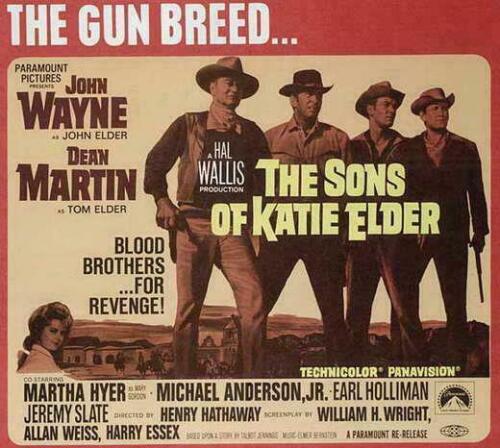
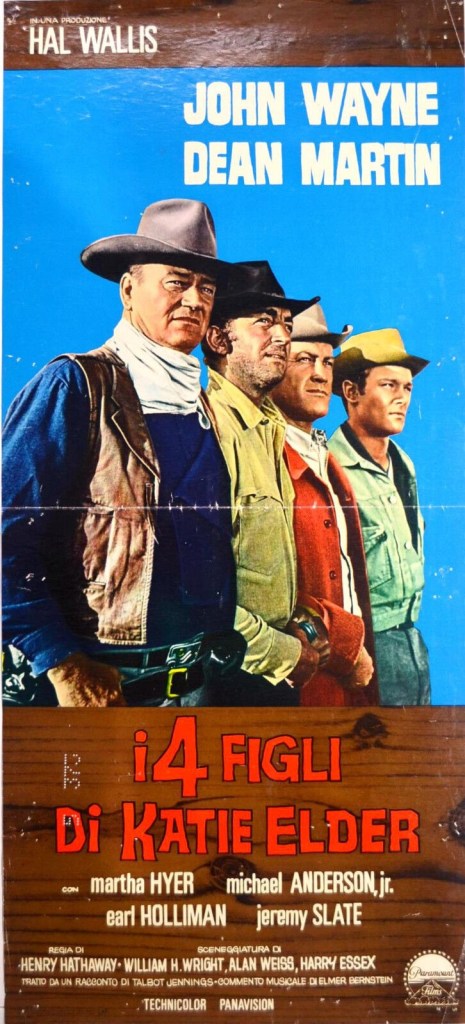
The property had been bouncing around Hollywood for over decade. It had its origins in the true-life tale of the five Marlow brothers involving murder, revenge, and jailbreak, the story making national headlines when the case was heard at the U.S. Supreme Court in 1892. Based on the book The Fighting Marlows by Glenn Shirley,William H. Wright (Assignment in Brittany, 1943) shopped around a screenplay, jointly written with Talbot Jennings (Northwest Passage, 1940), that was purchased by Paramount in 1955.
Alan Ladd (Shane, 1953), who owed the studio a movie, was cast in the lead and the script went through rewrites by Frank Burt (The Man from Laramie, 1955) and Noel Langley (Knights of the Round Table, 1953) with shooting scheduled for 1956. John Sturges (The Magnificent Seven, 1960) was set to direct until Ladd quit, having bought his way out of his contract. Burt Lancaster (The Train, 1966) was brought in as his replacement.
When Lancaster dropped out, producer Hal Wallis took over the movie in 1959 and considered replacing him with James Stewart (Shenandoah, 1965) or Charlton Heston (The Hawaiians, 1970) with Dean Martin (Rio Bravo, 1959) as the second lead. But still the movie stalled for another five years before Wallis settled on John Wayne who signed on for $600,000 plus a one-third share of the profits and one-third ownership of the negative (a bounty that would continue to pay off through reissues and leasing to television). Henry Hathaway was paid a flat $200,000.
Wayne and Hathaway had history dating back to The Shepherd of the Hills (1941) based on the million-copy bestseller by Harold Bell Wright, and groundbreaking in its use of Technicolor, then in its infancy. They didn’t work again until desert treasure hunt Legend of the Lost (1957) which teamed Wayne with Sophia Loren. A few years later came North to Alaska (1960) followed by Circus World / The Magnificent Showman (1964).
Despite this long-term relationship, the most the director could offer about his star was that “Wayne is more particular about the pants he wears than anything in the world…unless he gets the thinnest kind of material it drives him crazy.”
When the script was finally knocked into shape, the Marlow siblings had been trimmed from five to four, and that family had been replaced by the Elders, a nod to western aficionados who would recognize the name Katie Elder (“Big Nose Kate”), occasional companion of Doc Holliday whose story Wallis had previously filmed as Gunfight at the O.K. Corral (1957). Even though Elder wasn’t dead enough – she lived till 1940 – to conform to this picture, it seemed an odd decision to choose that name unless resonance was expected.
But it was still far from a done deal because Wayne’s cancer threatened to scupper the picture. Start of shooting scheduled for October 20, 1964, was shuttered when the disease was diagnosed on September 13 following the completion of Otto Preminger WW2 epic In Harm’s Way (1965). Aware surgery might jeopardize the picture, Wayne suggested Wallis replace him with Kirk Douglas (Cast a Giant Shadow, 1966).
Hathaway rejected the notion, but while neither star nor producer had any idea whether the operation would be successful, and whether Wayne would be even fit enough to work, or – God forbid, that the actor might already have made his last picture – Wallis took an optimistic approach and announced the picture would be delayed for a month and “even a little later.” Hathaway’s optimism was based on the fact that he had survived colon cancer a decade before.
At least the surgeon moved fast, operating four days after diagnosis, and again five days later. As well as fighting the damage surgery and pain had done to his body, Wayne found himself slipping into depression, convinced the operation would render him unemployable. “I’ll never work again if they find out how sick I am. If they think an actor is sick, they won’t hire him,” he said, a legitimate observation given the cost of shutting down a picture should the actor be unable to play his role.
Wallis’s business partner Joseph Hazen shared Wayne’s pessimism and urged the producer to recast with either William Holder (The 7th Dawn, 1964) or Robert Mitchum (The Way West, 1967). Paramount, too, fretted about insurance, the studio couldn’t risk hiring an uninsurable actor. Wallis refused to abandon Wayne and the studio finally agreed to tough conditions from the insurance company. So, on January 6, 1965, the principals gathered in Durango to commence the 46-day shoot on a production budgeted at $3.19 million.
The high elevations – 8,500 ft in places – were not conducive to someone recovering from a lung cancer operation and Wayne found it difficult to breathe. It didn’t help that on the fourth day of shooting Wayne was expected to jump into icy water for the sequence where the brothers were ambushed by the villains. It didn’t help, either, that Wayne was too big to wear a rubber suit to stave off the cold like his fellow actors.
Wayne never complained that Hathaway “worked me like a damn dog.” He realized that it “was the best thing ever happened to me. It meant I got no chance to walk around looking for sympathy.” The star put on a brave front, publicly acknowledging his battle with cancer as a way of giving hope to others while privately terrified not so much of dying but of being helpless. “I just couldn’t see myself lying in bed…no damn good to anybody.”
“He had to be the macho man,” commented Earl Holliman (The Power, 1968), a late substitute for original star Tommy Kirk (Swiss Family Robinson, 1960) who was sacked after being caught smoking marijuana, “he had to have more drinks than the next guy.” And despite the severity of his condition, and although publicly pretending he had given up tobacco, he continued smoking cigars.
Recalled Dean Martin (Rough Night in Jericho, 1967), “He’s two loud-speaking guys in one.” George Kennedy (Cool Hand Luke, 1967) asserted, “If you put him in a group with other movie stars, the eye went to him and that is the ultimate marker of respect. He was John Wayne. He was very real. It didn’t matter if he wasn’t Olivier; Olivier wasn’t John Wayne.”
But there were outward signs of the effect the illness had upon him. He was less sure of himself on a horse, riding with a shorter rein out of fear a horse would get away from under him, trying to minimize the chances of falling or being bucked from the animal. And as the film wore on, an oxygen inhaler was set up beside him on set.
Dennis Hopper (Easy Rider, 1969) was wary of working again with Hathaway after a difficult experience with him on From Hell to Texas (1958) starring Don Murray and Diane Varsi where the actor suffered the indignity of endless takes. Hopper quit three times and for good measure the director put the word around and virtually grounded the actor’s career. Hopper only made one movie in six years. In the interim he had married Brooke Hayward, daughter of actress Margaret Sullavan whom Hathaway respected, and peace was brokered.
Although on his best behavior on the shoot, Hopper was no less impressed. “He was a primitive director, he rarely moved his camera, the movement came from the actors.”
“Westerns are art,” declared Wayne. “They’ve got simplicity and simplicity is art…There’s simplicity of conflict you can’t beat…Westerns are our folklore and folklore is international…In Europe they understand that better than we do over here. “
Whether it was public sympathy for an ailing star and his resolve to fight cancer, or audience delight that he was back in a western after a gap of a few years, The Sons of Katie Elder was a huge hit with $5 million in initial rentals (what studios were left with after cinemas had taken their share). It earned more later in reissues but that initial sum was enough for thirteenth spot in the annual box office rankings though beaten by both Shenandoah and Cat Ballou. Its foreign earning would probably match domestic, to make it one of Wayne’s biggest earners for the decade.
SOURCES: Scott Eyman, John Wayne: His Life and Legend (Simon and Schuster Paperbacks, 2014) p111, p387-396 ; Ronald L. Davis, Duke: The Life and Image of John Wayne (University of Oklahoma Press, 1998) p266; Hal Wallis Collection, Margaret Herrick Library; Hedda Hopper, “Ladd To Star in Film of Pioneers’ Reunion,” Chicago Daily Tribune, November 9, 1955, p16; Thomas M. Pryor, “Hecht-Lancaster Obtains 2 Novels,” New York Times, January 12, 1956, p22; Oscar Godbout, “TV Movies Extras Get Salary Rises,” New York Times, July 3, 1956, p17; John Wayne, “Me? I Feel Fine,” Los Angeles Times, January 18, 1965; James Bacon, “Wayne’s Biggest Bout vs. Killer Cancer,” Los Angeles Herald Examiner, March 14, 1965; Roderick Mann, “John Wayne – A Natural as The Shootist, Los Angeles Times, March 7, 1976.
The rocking chair motif in this underrated film is ignored while the door opening and closing in The Searchers (1956) is hailed as one of cinema’s greatest images. Welcome to the world of director Henry Hathaway (Nevada Smith, 1966). Way down the pecking order when it comes to the makers of great westerns, below Sergio Leone (Once Upon a Time in the West, 1969) who only made four and Howard Hawks (Rio Bravo, 1959) only three.
Closer inspection, too, of The Wild Bunch (1969) might reveal cinematic ideas that turned up here first. Closer inspection of John Wayne (The Commancheros, 1961) might reveal a mighty fine, very touching, performance.
The genre was chock-full of vengeance, but here that is tempered by mystery over the death of their father, a drunken gambler, that has led to the loss of the family ranch, leaving the mother, for whose funeral the titular sons return, living hand-to-mouth, supplementing the usual sewing and mending with giving guitar lessons.
Hastings (James Gregory), a businessman with big ideas, has taken over the ranch and pretty much the local town of Clearwater. And he’s just hired extra muscle, notorious gunslinger Curley (George Kennedy), to swell his already-growing army.
Only the youngest son, Bud (Michael Anderson Jr), a reluctant college student, is clear of the taint of wrong-doing. John Elder (John Wayne) has a reputation as a gunfighter but unlike shifty younger brother Tom (Dean Martin) doesn’t have a wanted poster following him around. The other son Matt (Earl Holliman) takes after John, some shady action but no legal consequence.
This is certainly not a great fraternal union. When they’re not engaged in low-level investigation or trying to prevent themselves being lynched, they’re bickering and fighting. The only thing that unites them, beyond love of the deceased woman, is determination to continue paying for Bud’s education.
Apart from the ranch, one of Hastings’ other lucrative investments is a firearms business, which allows him to tote around a telescopic rifle which, of course, ensures he can bump off those who get in his way from a distance, without fear of discovery. The easiest way to get rid of the brothers is to have them arrested for murder and to kill off the one man, Sheriff Wilson (Paul Fix), who might have the brains and experience to work out something fishy was going on.
John Wayne is more emotional here than in any picture since The Searchers, though, as you’ll be aware, his emotion is registered through his eyes or bits of business rather than a lengthy speech. And given double duty of looking after the youngest while holding back the more tempestuous Tom.
Dean Martin’s (Five Card Stud, 1968) charm runs thin, as is intended, no woman to gull, and no cliché alcoholism a la Rio Bravo to fall back on. It’s a part he plays completely against type, although you can sense he’s bursting out of those confines in the false eye con. He’s pretty much always brought to heel by Wayne. The one time he defies big brother ends in personal calamity. Imagine a marquee name as big as Dean Martin taking on a role where the part sets him up to be walking in the Duke’s shadow, despite his efforts to break loose.
In fact, unusually for a western, until Butch Cassidy and the Sundance Kid (1969) came long, it’s replete with reversals. Hathaway plays with expectations from the outset, the opening sequence of big beast of a train puffing through fabulous scenery doesn’t bring John, instead, unknown to the waiting brothers, Curley disembarks. Katie Elder’s friend Mary (Martha Hayer) cuts off at the pass any idea the audience might have of incipient romance when she gives John both barrels.
Thanks to the screenplay, Michael Anderson Jr.(Major Dundee, 1965) and Earl Holliman (The Power, 1968) are given more bite than their roles might suggest and James Gregory (The Manchurian Candidate, 1962) makes his villain meaty though you suspect the presence of George Kennedy (Cool Hand Luke, 1967) is another lure, creating audience expectation that is not fulfilled. Martha Hyer (The Chase, 1966) is more conscience than glamor, spending most of the time on the sidelines.
You’d be surprised just how lean a production this is, and equally how deftly Hathaway avoids cliches. Just because there’s a kid you don’t need to teach him how to be a man. A huge herd of horses doesn’t need to stampede. Beautiful woman in the vicinity doesn’t necessarily call for a heated love affair. Ending up in jail doesn’t necessitate a bust-out. Villainous gunslinger doesn’t set up obligatory shootout in an empty street.
Hathaway’s unusual, too, in the way he anchors his pictures in reality. Here it’s a funeral director washing the wheels of his hearse, a blacksmith applying shackles.
You’d marvel, too, at just who was involved in fashioning the terrific screenplay: veteran William H. Wright, his first in two decades, Harry Essex (Creature from the Black Lagoon, 1954) in his first in eight years, and Allan Weiss whose six other movies were all Elvis Presley vehicles. Hardly the pedigree to produce one of the best westerns of the decade. This is the kind of screenplay where no line is wasted, not when a retort can be used to define character.
Most people remember the rousing theme by Elmer Bernstein (The Scalphunters, 1968), but actually there are also some very innovative musical passages worth listening out for.
Curiously, it was Andrew Sarris, hardly a John Wayne fan, who recognized the movie’s attributes, though in niggardly fashion, “The spectacle of people in Hollywood trying to do something different in a western at this late date is reassuring.”
It’s about time those differences and the picture’s excellence were recognized.
The boldest role ever undertaken by a major star of Frank Sinatra’s generation – and little thanks he got for it. Not only was he virtually unrecognisable under a slab of make-up that George Hamilton would have envied but the role was a complete reversal of his screen persona. Admittedly, he had flipped that persona for Tony Rome (1967) and as the cuckolded cop in The Detective (1968), but this was on a completely different level.
Sinatra was no Tom Hanks or Daniel Day-Lewis, known for inhabiting different types of characters, and, while he did have a vulnerability that he put to good use in The Manchurian Candidate (1962) and The Man with the Golden Arm (1955), he was best known on screen as the guy in charge.
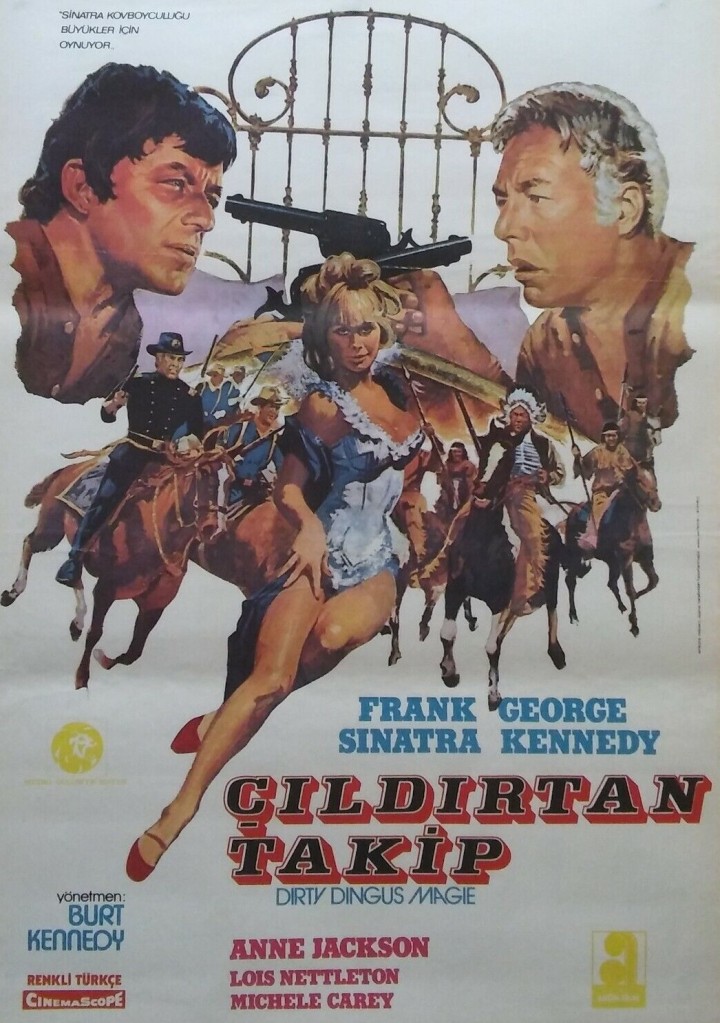
That was far from the case here. Dumb and dumber might be more apposite. Dingus Magee (Frank Sinatra) is a scamp, an outlaw so useless he is worth only $10 in reward money, who steals the stash of old rival Hoke Birdsill (George Kennedy), triggering a revenge caper that is complicated by a host of unnecessary complications by director Burt Kennedy (Welcome to Hard Times, 1967) who has set his heart on some kind of satirical comedy western with a revisionist slant.
So we get a female mayor, Belle (Anne Jackson), who happens to own the local brothel, whose commercial prospects are endangered when the local Cavalry are called away to fight the Native Americans, an Indian chief Crazy Blanket desperate to trade his daughter for a rifle, and when that looks like not working out calling on any available squaw to seal the deal, predatory schoolteacher Prudence (Lois Nettleton) and a running gag involving a Brown Derby hat that results in a gunfighter (Jack Elam) being mistaken for Magee.
It’s a bit long on complications and short on satire and is rescued by the double act of Magee and Birdsill, who constantly get in each other’s way or try to pull a fast one. Birdsill, as it happens, is appointed sheriff, since that’s in the purview of the mayor, and, on the right side of the law for the first time in his life, makes an ill-fated attempt to do good.
Magee tries to help him along. In exchange for the sheriff turning a blind eye for a period of time to Magee’s nefarious activities, the reward for the outlaw will mushroom, permitting greater kudos for the sheriff on his capture.
The main problem is that Kennedy directs with a very heavy hand, very obvious musical cues for a start, and there’s not enough that’s intrinsically funny. Though there is a reversal of an obvious joke of Birdsall being sent to the brothel to locate the mayor, expecting to find a client not the owner.
But both Sinatra and George Kennedy (The Sons of Katie Elder, 1965) are a delight, the latter also playing against type rather than his usual dominating character. Their dumbness takes some beating. Sinatra just about gets the upper hand, but there’s not much in it.
The best thing about the picture is the sense of reality. The U.S. Cavalry spend more time in the brothel than out hunting Native Americans. Law and order can go to hell as long as everyone is having illicit fun. The respectable schoolmarm proves a skilled seductress. Peace is desirable because it is more profitable than war. And the bulk of the outlaws in the Wild West are far from achieving legendary status, just two-bit punks.
Not surprisingly, this was a massive flop and killed off Sinatra’s movie career for the rest of the decade – not that he was overly concerned, “My Way” having reignited his singing career and he was a Vegas regular. But it’s a shame the acting was so vilified, Roger Ebert blamed Sinatra rather than the director for its failure, in particular taking him to task for the one-take approach that Gena Rowlands previously exalted (but what does she know, she’s just an acclaimed actress and knows how a movie works better than a critic).
Well overdue for a reappraisal and if you go in duly warned you might even enjoy it, or at least the Sinatra-Kennedy double act.
Double Oscar nominee Mark Robson was a highly respected commercially successful director with hits like Peyton Place (1957) and From the Terrace (1960) behind him and The Prize (1963) and Von Ryan’s Express (1965) still to come. So what went wrong here, in this tale of the assassination of Ghandi, especially as he had successfully negotiated foreign climes in The Inn of the Sixth Happiness (1958)?
You could start with the Indian equivalent of “blackface.” Apart from Ghandi himself all the major roles are played by white actors. Even cutting back on his trademark plumminess, the sight (and sound) of Robert Morley trying to talk the Indian leader out of exposing himself to possible assassination would just be hilarious if it wasn’t such a cringingly bad misstep.
Sure, Hollywood struggled to find anyone in Bollywood who had the box office marquee or critical kudos to provide the necessary confidence for Twentieth Century Fox (a problem that hasn’t really gone away – witness Gandhi and Passage to India). But rising star Horst Buchholz, in the leading role of assassin Godse, was nobody’s idea of the kind of actor with the credentials of a Ben Kingsley or Alec Guinness who might make a decent stab at playing an Indian.
And it’s a bizarre narrative mixture, dragnet film noir hunt led by Supt Das (Jose Ferrer) for a potential assassin (done so well in Day of the Jackal, for example), biopic of the assassin, and providing sufficient room for Ghandi to spread his principles of love and peace as well as plenty of scenes of tourist India.
And even with all these deficiencies it might still have worked except that, in the modern idiom of altering characters, times and places for dramatic effect, this pretty much ignores the known facts about the assassin’s life and in its place presents a barmy mishmash of thwarted ambition and romance.
Set in 1948 after India gained independence from the British and during ongoing violence that followed Partition, the dividing of the country on religious grounds into India and Pakistan, we find Ghandi being blamed for everything that has gone wrong, even though he was never the country’s prime minister and disavowed political office.
According to this version, against his father’s wishes and at a very inconvenient time (he is about to enter an arranged marriage), Godse attempts to fulfil a lifelong ambition to become a soldier but is rejected on the grounds that as a Brahmin he will find it difficult to take orders. He becomes involved with a right-wing organization one of whose stated aims is to take down Ghandi.
It’s actually not that hard to attempt to do so and the film conveniently misses out the fact that Godse had previously been fond guilty twice of trying to kill Ghandi, only being spared prison by his target’s clemency. Instead of that grimly ironic touch, we are fed a hotchpotch. It’s hardly surprising that the film skips the potential gender conflict inherent in Godse, since for superstitious reasons he was initially brought up as a girl, including having his nose pierced in the female fashion. And for “dramatic purposes” his father is a priest rather than the postal worker of real life.
He falls in love with a married woman (Valeri Gearon) and is violent to a prostitute Sheila (Diane Baker) who rips him off. Theoretically, Ghandi would not have fallen to this assassin’s bullet if Mrs Gearon had done the decent thing and run off with Godse.
Or if Gandhi had accepted the presence of an armed bodyguard, but the spiritual leader, pacifist to the end, was also a fatalist, and at approaching 80 certainly had cause, should he indulge in such pride, to believe he had made a difference.
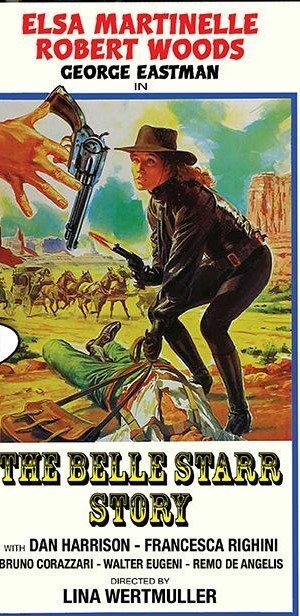
Only spaghetti western directed by a woman. Brings a distinctly feminist feel to that most sexist of the subgenres. You tend to forget that the sexy female Europeans imported to Hollywood as co-stars or to add spice further down the credits were actually top-billed stars in their natïve countries and demonstrated a greater range than the American industry allowed.
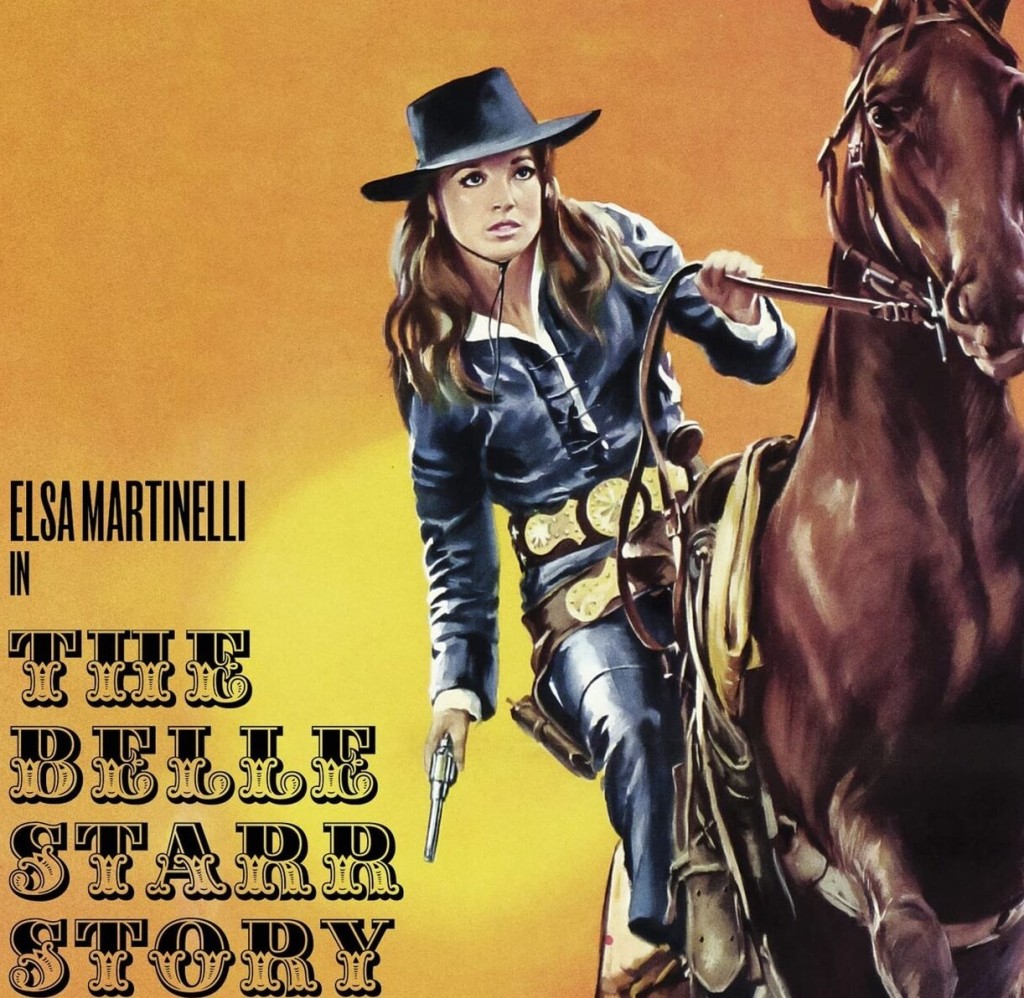
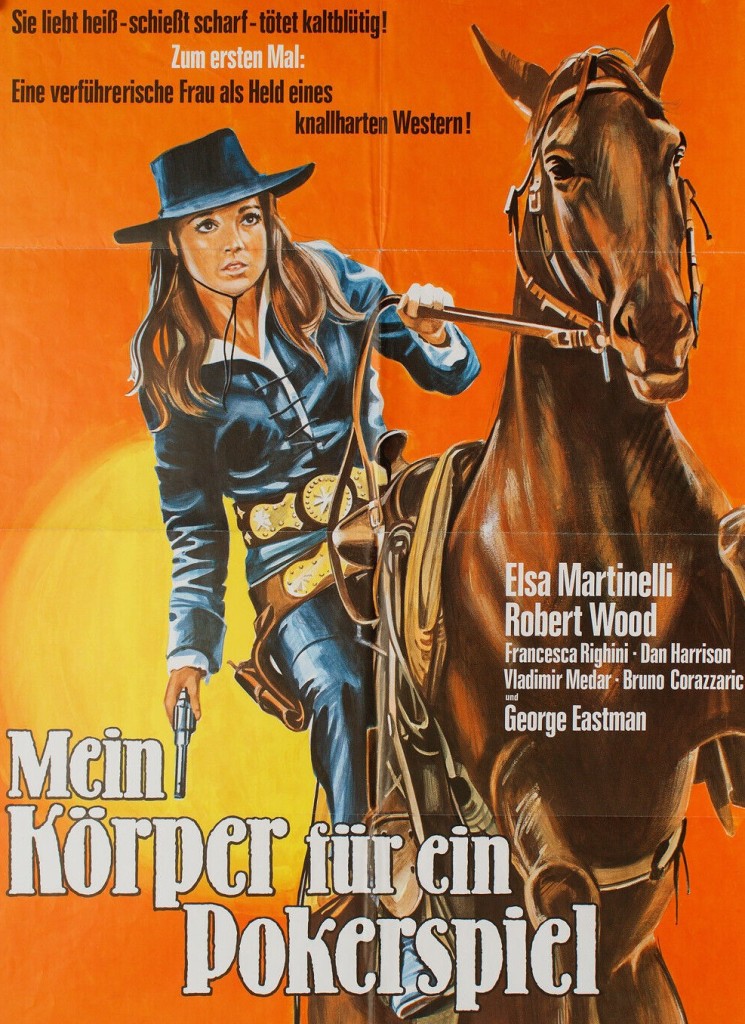
Not only do we have Elsa Martinelli (Maroc 7, 1967) as the leather-clad cigar-smoking titular gunslinger, whose watchword is female independence, but it was helmed by arthouse icon Lina Wertmuller (Swept Away, 1974). There’s a thematic consistency lacking in most Italian-made westerns, for example predating Once Upon a Time in the West (1969) in its water imagery. But any potential for lyricism is undercut by the risk attached to being a lone woman. And there’s a Tracy-Hepburn tone to the endless bickering and battle for superiority in her niggling romance with outlaw Blackie (George Eastman).
And, unusually in that decade, a woman who throws caution to the wind and will even bet her body when the money runs out at the poker table, as twisty a meet-cute as a screenwriter could devise. But thereafter it’s a struggle for dominance between the pair. She won’t take orders from a man. He won’t accept female equality even when she shoots the wooden fence he’s sitting on from under him, making him fall to the ground, and for good measure putting a bullet in his heels.
The first act builds up Belle Starr, cool at the poker table, even cooler in the bedroom, and demonstrating the gunplay that attracted her notoriety. The second act take an odd route, a lengthy flashback that digs deep into feminism, the orphaned Belle Starr running away after being sold into marriage by her uncle to an ugly old rich powerful man, traded, effectively, for political favor.
She returns to save a servant condemned to death for the crime of attacking the uncle when he tried to rape her. Sexual humiliation is a theme. Another outlaw Harvey (Robert Woods), who she regards as a platonic friend, steals her clothes as she swims in a lake, and then, having saved her from a posse, forcibly tries to take his reward.
The third act, like the duel between The Man With No Name and The Man in Black, is a case of double- and triple-cross. She refuses to join Blackie’s gang when he plans a million-dollar jewel heist, but hijacks the concept, recruiting her own gang to beat him to the robbery, and teach him a lesson.
But it backfires. Blackie is waiting. She has inadvertently hired his men. In the subsequence shoot-out he is captured. She rides to his rescue. But with their opposing ideas of a woman’s place in the world part on good terms.
The flashback was more subtly observed in Once Upon a Time in the West, and while she shared with Charles Bronson gunslinging skills he was not at any time viewed as a commodity or a piece of property or a candidate for rape. The flashback here fleshes out for the audience the powerlessness of women. But also the kind of camaraderie that is generally also usually only conferred on male characters.
We are pretty conversant with the notion that the gun rules the West. But less conscious of what happens when you are gun-less. Depriving someone of their fundamental weaponry makes them instantly impotent, as humiliating as denying someone water in a desert.
There are some nice directorial touches, blood dripping from a ceiling onto a dinner table, a saloon door opening to cast sudden light onto a corpse, waterfalls suggest sanctuary whereas open water attracts predatory males, and the finale, as they part, of Blackie, desperate to demonstrate his superiority, shooting off her hat from some distance.
Elsa Martinelli is a revelation as a star working to her own beat rather than playing second fiddle to some Hollywood marquee name. This wasn’t Lina Wertmuller’s first film and she had already made an impact with the Rita the Mosquito series, featuring another rebellious woman. Don’t be fooled by the co-directing credit, she replaced debut director Piero Cristofani after a few days.
It’s somewhat ironic that in a contemporary Hollywood attempt to create a female outlaw leader in Cat Ballou (1965), Jane Fonda was upstaged by Lee Marvin, and that in Bonnie and Clyde (1967), despite taking precedence in the title, Faye Dunaway was not the dominant one in the relationship.
By no means a great western but worth a look to see what Elsa Martinelli can achieve when not slotted in to the Hollywood co-star cliche and to get a preview of what Lina Wertmuller could offer.
Stunning opening section thrown away by shifting tone and despite excellent performances by the Oscar-nominated Alan Bates and Dirk Bogarde drifts into Kafkaesque virtue-signalling.
But let’s get the title out of the way first. I had assumed a “fixer” was a manipulator, an underworld type of character who could, for a price or future favor, sort out problems or find someone a job or act as an intermediary between politicians or businessmen. Not so. Yakov (Alan Bates) is nothing more than a handyman, who can fix broken windows or railings and turn his hand to anything such as wall-papering or basic accountancy.
In the credit sequence he demonstrates his skills by fashioning with wood, a couple of screws and some steel, a razor, with which to remove the hair and beard that would identify him as a Hassidic Jew. He is, as soon becomes apparent, afflicted by dogs. As he departs his remote cottage in a cart, a vicious dog so disturbs his horse that it bolts, resulting in the loss of a wheel. He continues his travels on horseback, arriving in a small town in time to witness a parade and Cossacks rampaging through the streets.
As it’s set in Czarist Russia, his journey is accompanied by melancholy violin with, for some reason, a disturbing undercurrent of military drum. As the credits end, we cut to the Russian flag and a marching band. He hides in terror as the horsemen drag people along by the ear, slash with sabers, hang others. It’s a pogrom, the type of attack commonly experienced by Jews living in ghettoes.
Up to now, it’s just outstanding. Then it tips into the picaresque. Yakov helps an old drunk Lebedev (Hugh Griffiths) who’s fallen down in the snow in the street. As reward he is offered work wall-papering a room. He has a prick of conscience when he realises that Lebedev is an anti-Semite. Lebedev’s daughter Zinaida (Elizabeth Hartman) seduces him. But, on spotting some blood on a cloth, he refuses to go through with the act.
Luckily, my reading of crime novelist Faye Kellerman has alerted me to the fact that it is an act of faith for Jews not to make love when a woman is menstruating. Luckly, Zinaida isn’t so up on her Bible (Leiticus 15: 19-23 in case you were interested) that she catches on to this revealing fact, for, as has been pointed out earlier, minus the distinctive curl, Yakov doesn’t have the physical characteristics associated in those times with a Jew. In fact, you would say Lebedev would more easily pass for one.
Anyway, Lebedev gives him another job, of counting the loads leaving his brickworks because he suspects he is being swindled. But the foreman, who has been rumbled, and suspects Yakov of being a Jew, calls in the Secret Police, it being a crime for Jews to leave the ghetto.
Now we tip into Kafka. The initial charge against Yakov is that he harbored another Jew during Passover. But then things spiral out of control. He is accused of passing himself off as a Gentile (non-jew), attempted rape of Zinaida and then of ritual murder, killing a small child.
Investigating magistrate Bibikov (Dirk Bogarde) is sympathetic and manages to avoid the rape charge much to the fury of prosecutor Grubeshov (Ian Holm) but once the other charges mount, he is nailed, everyone determined to prove an innocent man guilty.
This is based on a true case and clearly was a case of persecution and Yakov’s transition from worker happy to hide his ethnicity to gain work to a man who rediscovers his religion is a piece of great acting from Alan Bates. But the points are hammered home endlessly and where director John Frankenheimer (The Train, 1964) so deftly dispensed with dialogue in the superb opening sequence, now he more than makes up for it with leaden speeches, and a film that would worked better for being considerably shorter.
It feels like Hollywood is hard at work. After some moments of mild happiness Yakov’s cinematic chore is to invoke sympathy for an entire nation rather than taking on the Holocaust directly. Dalton Trumbo’s (Lonely Are the Brave, 1962) screenplay is filled with brooding lines. But providing Yakov with an interior monologue when he dithers over having sex doesn’t work at all, certainly not next to the more effective use of that technique in John and Mary (1969).
At the outset, Frankenheimer treats violence with discretion. We don’t see the dog being impaled on a saber, just its corpse thrown at Yakov. We witness a rope being wound round a man’s neck, as innocent of any crime as Yakov, but not the actual hanging. So what begins as highly-nuanced turned into a battering ram of a picture and characters forced into lines like “the law will protect you unless you are guilty” and “I am man who although not much is still more than nothing.”
Alan Bates (The Running Man, 1963) certainly deserves his Oscar nomination and Dirk Bogarde (Modesty Blaise, 1966) might feel aggrieved he missed out on a Supporting Actor nomination. But too many of the rest of the cast over-act. It’s an all-star cast only if you’re British. But check it out if you’re a fan of Hugh Griffith (The Counterfeit Traitor, 1962), Elizabeth Hartman (The Group, 1966), David Warner (Perfect Friday, 1970), Ian Holm (in his sophomore movie outing), Carol White (Daddy’s Gone A-Hunting, 1969) and Georgia Brown (Lock Up Your Daughters!, 1969).
Frankenheimer at his best when he lets the action play without the overload and there’s one almost Biblical scene, lit only by candlelight, that demonstrates his cinematic virtuosity. But otherwise it’s drowned in the verbal rather than the visual. Trumbo based his screenplay on the Pulitzer Prize winner and bestseller by Bernard Malamud.
Some effective moments, but too long drawn-out to make the impact expected.
Effervescent mystery punching a hole in the traditional private eye caper. Look elsewhere for film noir as Frank Sinatra (The Manchurian Candidate, 1962) reinvents his screen persona. On the one hand he’s such a cool cat, living on a boat in Miami, you half expect him to burst into song just with joy. On the other hand, you wouldn’t cross him. Corpses tend to pile up in his vicinity.
There’s a surprising self-awareness that’s dealt with through considerable subtlety, not with the usual angst of film noir where flaws not only tend to be magnified but spill over and drench the plot. Addicted to gambling, Rome steers clear of marriage and any long-term relationship, knowing such a move would be disastrous for the other party. A former cop, he is touchy though about his father, also a cop, who blew his brains out when some murky deal went wrong.
High on the glamorous side, houses the sizes of small cities, women parading in either next to nothing or with the current year’s hot fashion items. You’d be surprised there wasn’t a horse-riding scene, or one set at a hi-hat ball. But this is pretty much a procedural as the canny detective probes the low life as much as the high, bars where go-go dancing is the least of the illicit activities, jewellers who act as fences, and plumbs the life of millionaire Rudolph (Simon Oakland), tough on the business side, dumb as donuts when it comes to romance with former cocktail waitress (a profession often bracketed with quote marks) wife Rita (Gena Rowlands).
And oddly enough, romance here turns out to be touching, sex coming with responsibility rather than a free-for-all as you are initially led to believe. A lesbian scene for once is not exploitative.
Begins with one of the humdrum cases that must consume the bulk of a gumshoe’s time – the hunt for a valuable diamond brooch, lost from the dress of married drunken heiress Diana (Sue Lyon). Turns out he’s not the only one, inexplicably, looking. He takes a beating from a couple of hoods.
When his ex-partner meets his maker in a bathtub, it’s a cinch Tony Rome is next, which means he has a lot of explaining to do to his endlessly frustrated ex-colleague Lt Santini (Richard Conte). If it was a question of whiling away the time, Rome could spend it in the arms of Diana or multiple divorcee Anne (Jill St John).
As you might expect, everyone has secrets they prefer to keep hidden, and happy to do so with violence. Otherwise, they’re going to be knocked sideways by the past. There’s no shortage of suspects including the elusive Nimmo.
I’m assuming the censor enjoyed a chuckle when Mrs Schuyler (Templeton Fox) appeared rather than pursing their lips in disapproval at the way Sinatra wrapped his lips around the word “pussy.” There’s a certain amount of light-hearted sexual jousting but if you were looking for predatory behavior it’s women you’d point the finger at, though given a free pass since in Miami, apparently, men were vastly outnumbered by men and lasses who had not developed a come-hither would be left on the sidelines.
To properly appreciate the picture, you’d have to cast your mind back to a time before there was a surfeit of television detectives and when the general mystery picture (also encompassing spy movies) had gone AWOL or awry with balderdash plot and outsize villains whose only satisfaction in life was holding the world to ransom. In fact, in retrospect, it’s refreshing to find a picture where the director doesn’t pull the wool over your eyes and your hero isn’t an arrogant preening bantam.
So what you’ve got is a properly-plotted plot, clues aplenty that only our clever private eye can unravel, and, inevitably, in the Raymond Chandler tradition some heavy bursting through a door with a gun, and, in this case, also a shovel. This private dick doesn’t fall into the hard-working category of legend, often favors a Bud over the harder stuff, and though he can knock out the cynical one-liners they often come with a tinge of truth or melancholy.
And for once the MacGuffin (Maltese falcon might be a more apt reference) bears significance to the plot.
One of the interminable pot-shots critics took at Sinatra was his preference for working in a single take, the impression given that he was a lazy sod and a bit more effort would have resulted in a better performance. On the other hand, you could just be in awe of an actor who can hit the button stone dead in a single take.
Co-star Gena Rowlands, with something of a hard-boiled reputation herself, found him to be a “wonderful actor; he could do a whole complicated scene in one take…there was nothing pretentious about him, he was just awfully nice.”
Sinatra is no Bogart but for a time afterwards audience were saying of other pretenders to the shamus crown “he’s no Sinatra.” Jill St John (The King’s Pirate, 1967) makes the most of a more interesting part, including delivering the stinger in the tale. Gena Rowlands (Machine Gun McCain, 1969) reveals the little girl under the glam, Richard Conte (The Lady in Cement, 1969) tones down his typical belligerence, Sue Lyon (Night of the Iguana, 1964) good as a young woman confused by sudden wealth.
The under-rated Gordon Douglas (Stagecoach, 1966) directed from a script by Richard L. Breen (A Man Could Get Killed, 1966) and Marvin H. Albert (Duel at Diablo, 1966), also author of the source novel.
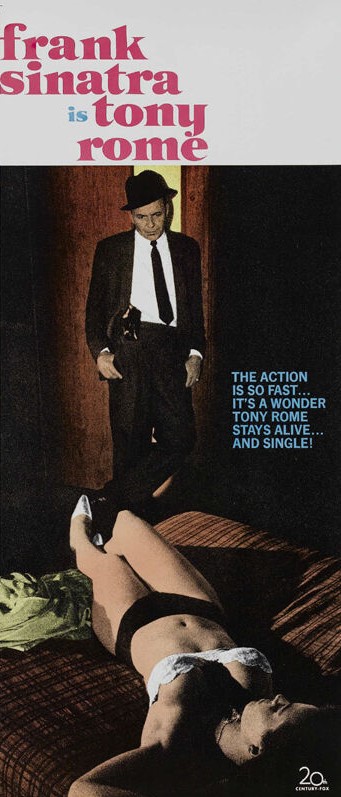
The poster designer pulled a fat one. In typical titillating fashion, you think Sinatra is staring down at a half-naked corpse. But, in fact, no female was harmed in this picture.
Takes a little while to get going but once it hots up it’s perfect entertainment.
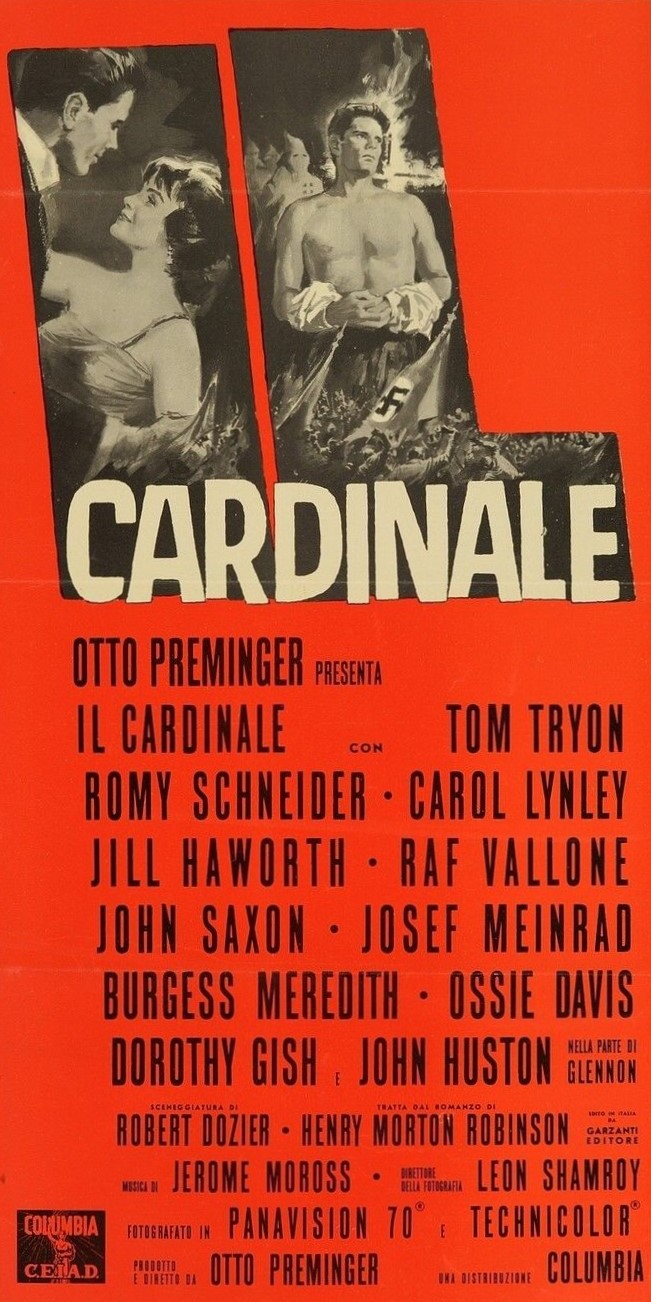
Otto Preminger was beaten to the punch on this one, the scandalous Henry Morton Robinson bestseller snapped up in 1955 by producer Louis de Rochemont (The Roman Spring of Mrs Stone, 1961) who had a tie-up with Columbia. Due to interference from the Catholic Church, de Rochemont dropped his option which Preminger picked up in 1961 while working on Advise and Consent (1962).
The last section of the novel, set in Austria during the Anschluss, reverberated with the director who was born in what was then the Austro-Hungarian Empire and although a Jew was well acquainted with Catholic society. One of his most significant changes to the book was introducing the Austrian cardinal who endorsed Hitler.
The first two screenwriters James Lee (Banning, 1967) and Daniel Taradash (Castle Keep, 1969) failed to whittle down the complex novel to cinematic proportions. So Preminger brought in Robert Dozier (The Big Bounce, 1969) and began working with him in summer 1962 making other alterations to heighten the drama. The incident involving the unborn child of the sister of Fr Fermoyle (Tom Tryon) acquires greater emotional power in the film, touching on the ambiguities inherent in any institution and provoking the priest’s guilt.
Gore Vidal (The Best Man, 1964) also worked on the script, swapping the novel’s Italian countess for the Viennese Annemarie (Romy Scheider) who, abandoned by the priest had married and was reunited with him prior to the Anschluss, and is sympathetic to Hitler until her husband’s faith endangers them both. Ring Lardner, who had satirized the Catholic church in a recent novel, was the final screenwriter added, his main task to rewrite scenes “to achieve what he (Preminger) wanted,” and, more importantly, to introduce the flashback structure. Ironically, both Vidal and Lardner were atheists.
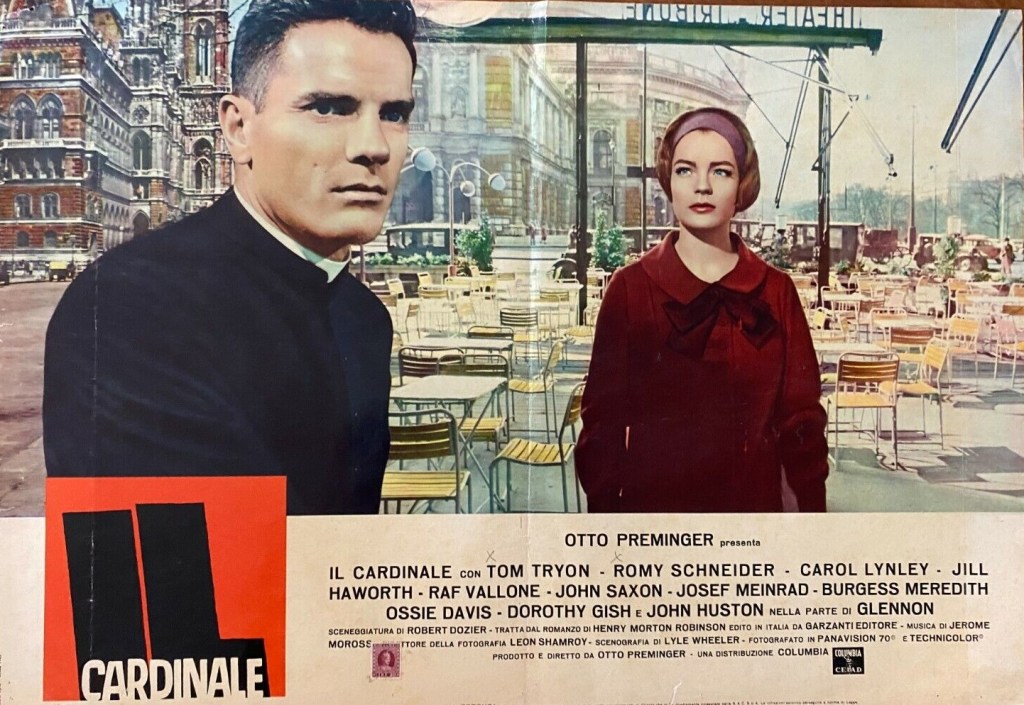
Tom Tryon and Romy Scheider meet again in Vienna.
The director considered five actors for the leading role – Hugh O’Brian (Africa – Texas Style, 1967), Stuart Whitman (The Commancheros, 1961), Cliff Robertson (The Devil’s Brigade, 1968), Bradford Dillman (Circle of Deception, 1960) and Tom Tryon (In Harm’s Way, 1965), the latter three advancing to the screen-testing stage. The 34-year-old Tryon won the role and a five-picture contract he would later regret. Carol Lynley (Bunny Lake Is Missing, 1965) who plays the priest’s sister also pacted for five movies.
Romy Scheider’s (Triple Cross, 1966) part was enhanced by the work of cinematographer Leon Shamroy who “fell madly in love with her,” resulting in the actress virtually shimmering on screen, never before “looking as beautiful.” Held in warm regard by the director, she was exempt from his tirades.
It took considerable persuasion on the part of Preminger for John Huston to participate. Curd Jurgens, initially cast as the Austrian cardinal, pulled out and was replaced by character actor Josef Meinrad whose lack of English meant he had to learn his lines phonetically.
Tom Tryon described Preminger as “tyrant who ruled by terror.” He was fired on the first day and probably wished the director had not rescinded the decision, for thereafter the actor was tabbed “lazy…a fool…stupid and unprofessional.” Commented Tryon, “I was so frightened he was going to scream that…I (just) wanted the experience to end.”
One scene with John Huston took 78 takes because Tryon could not deliver what the director wanted. And at one point first assistant director Gerry O’Hara (later director of The Bitch, 1979) found the star in tears and refusing to return unless the director agreed not to shout at him. Eventually, during the Italian section of the shoot, Tryon collapsed from nervous exhaustion, and was prescribed two days rest, and after this incident Preminger let up on his demands of the actor.
Explained Preminger, “I probably chose him without deliberation because he is weak.” He felt than an ordinary person would not side with the Church against a family member in a predicament, and that only a person “with weakness in his character” would be believable in the role. The character “fails because when you become a priest you substitute your own judgement and your own feelings for the law of the Church…The big decisions are made for him.” (Quite why he never chose an actor who could portray such weakness is not known.)
Tryon admitted that he owed a brief let-up in the bullying to “Schneider’s benign presence.” He commented, “The only fun I ever had on The Cardinal was a (ballroom) scene I did with Romy.” Prior to turning the cameras, Prior called both over, appeared ready to issue instructions, but instead waved them away “you know what to do.”
Added Schneider, “Preminger taught me an important thing: work fast. It’s true that it greatly helps our acting. Each of his directions, whether of gesture or of intonation, is precise and correct. Even better, it’s the only one possible…Each phrase, each world, each syllable are minutely weighed.” That dexterity applied to his positioning of the camera. He made decisions immediately, never hesitating “over the placement of the camera and each time…it was the simplest, the most natural and, dramatically, the best.”
Ossie Davis (The Scalphunters, 1968), who professed to have enjoyed a marvellous relationship with the director, observed: “I met actors whom Otto liked, I met actors that had no relationship or feelings one way or the other and I met actors who were almost absolutely destroyed, almost literally in panic because of Otto Preminger (who) was always looking for a spark…whether you had the spark or not, he was going to find it and even put it in you.”
But Patrick O’Neal stood his ground. “I woiuld not take it from him.” And they became friends.
The unit shot for five weeks in New England before heading to Vienna, Preminger choosing to stay in the same suite in the Hotel Imperial as appropriated by Hitler when visiting the city. Permission to shoot in the National Library, “one of the most beautiful monuments in the city” was attacked by the current minister of education who wanted the Hitler era erased from memory. And he was barred from using other government buildings for spurious reasons.
After four and a half months in Austria, the unit shifted to Rome, locations including St Peter’s Square and inside St Peter’s Cathedral and the Santa Maria sopra Minerva church, with priests and monks hired as extras for the various ceremonies. The Georgia scenes were shot in Hollywood on the Universal back lot.
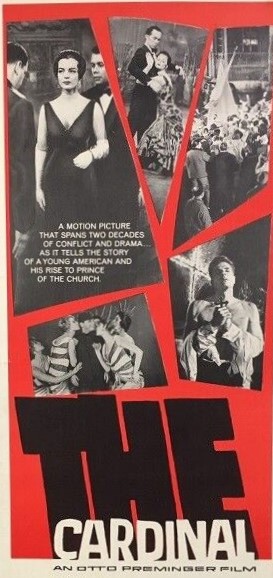
Although generally dismissed by the critics and given a hard time as you might expect from the Catholic Church, The Cardinal hit a chord with audiences, who turned it into Premigner’s second-biggest hit of the decade.