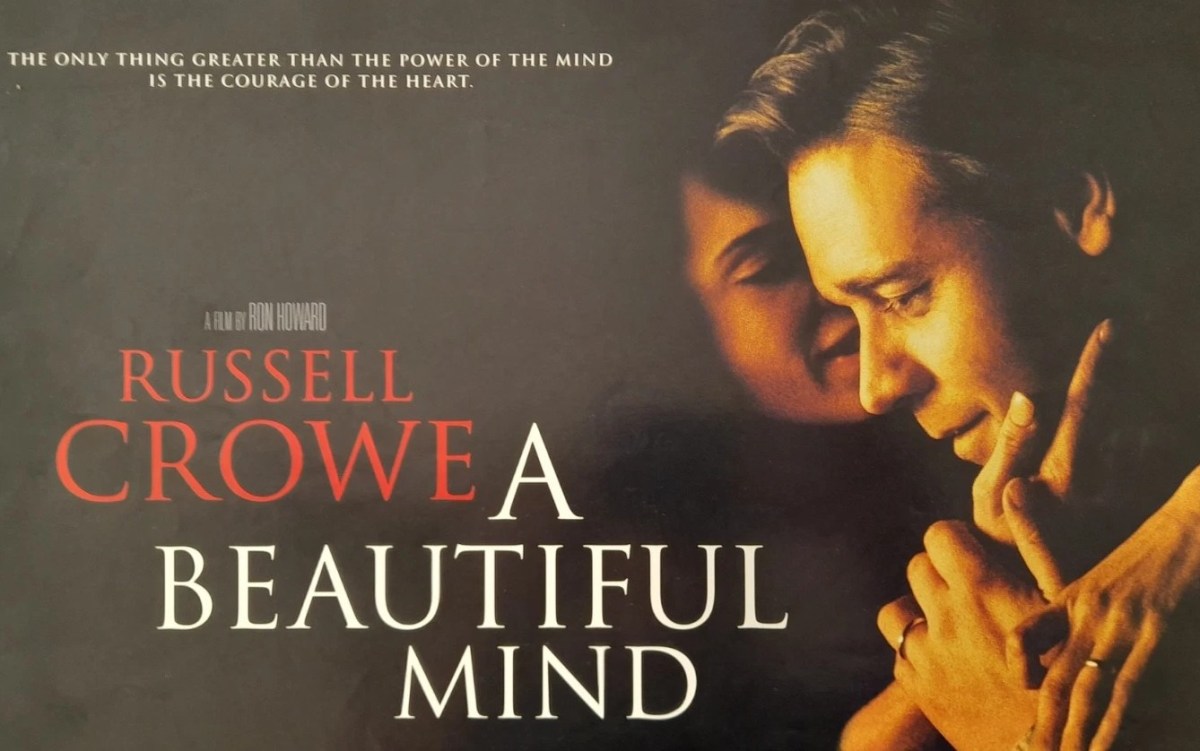
I’ve read the book by Sylvia Nasar on which this is based so I can testify to the brilliance of the script in finding cinematic ways of opening up dense prose. There are two absolutely stunning scenes which have come exclusively from the mind of screenwriter Akiva Goldman. It’s difficult enough translating scientific theories into words never mind images, but Goldman surpasses himself by explaining the zero-sum theory of John Nash (Russell Crowe) in terms of the approach of young men to young women in a bar.
The other scene, which has nothing to do with theory, but in itself I found immensely moving is Goldman’s invention of the ritual of professors at Princeton showing acclaim of a colleague by the simple method of giving him a pen, laying on the table at which he sits, proof, if you like, of the acceptance by his peers of his brilliance.
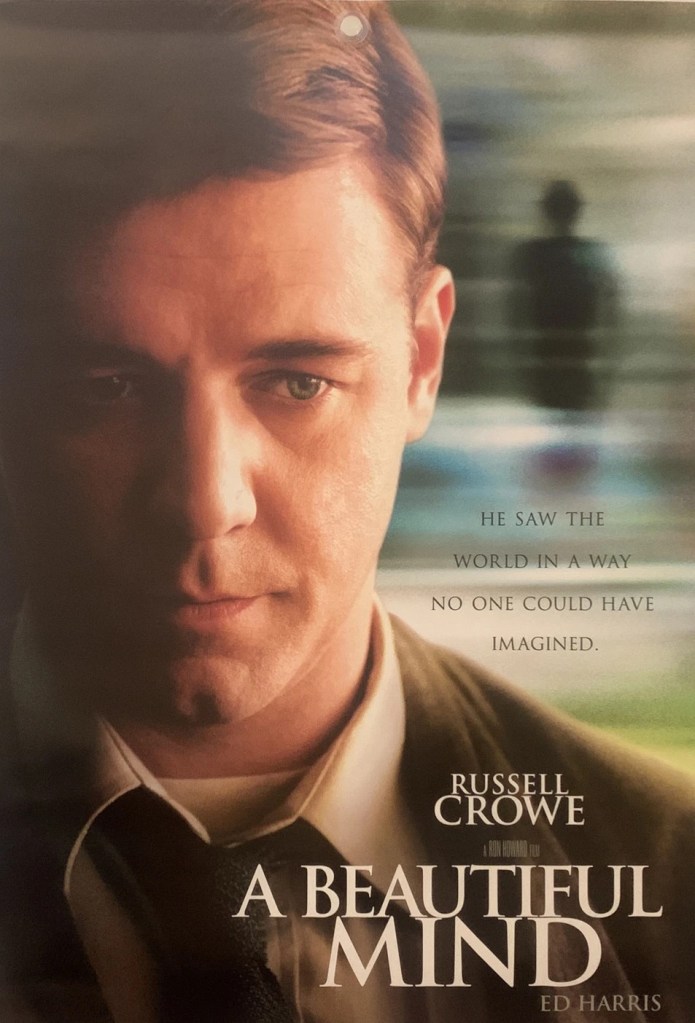
On top of that, the main theme of mental illness could not be better shown. Luckily, I read the book after I saw the film so I had no idea that the conspiracy into which Nash was drawn, setting him up as an essential weapon in the battle against Russian infiltration at the start of the atomic age, was all in his mind.
The noirish set-up including the black-hatted Parcher (Ed Harris) as his gun-toting mentor was so convincing as a conspiracy that it was one of the biggest shocks I’ve ever experienced in a cinema to discover that none of this was real, any more than his college buddy Charles (Paul Bettany), who was a cheery antidote to Nash’s gloominess and negativity and insular personality, and Charles’s niece Marcee (Vivien Cardone), were real.
In terms of creativity you can add in the scenes where Nash scrawls his theories on windows in Princeton library rather than on a blackboard.
Russell Crowe was going through a golden acting phase. Few actors have so thoroughly transmuted their screen persona across three successive films than Crowe. In Michael Mann’s The Insider (1999) he was the diffident whistle-blower exposing Big Tobacco. You couldn’t have imagined from that performance that he was capable of turning himself into the muscle-bound dynamic dominant figure of Maximus in Ridley Scott’s Gladiator (2000) only to complete a personality transplant as the mentally-ill genius of A Beautiful Mind.
There’s nothing worse for the mentally ill than to be aware of your condition. That what you believe is real is actually delusion. And that in order to live a proper life you have to be able to cast away such delusions. The way this plays out Nash doesn’t manage to rid himself of Parcher, Charles and Marcee but nonetheless is able to push them away every time they reappear, their illusion in part smashed because he has realized, in one of the movie’s most gripping scenes, that these delusional characters don’t age.
Even so, other elements of the delusion are frightening for their effect not just on him but on his wife Alicia (Jennifer Connelly), his son and any onlookers who happen to be in the vicinity when he carries out conversations or arguments in public with invisible people.
I’m sure, even without the mental afflictions, he would have had a hard time of it because he’s sorely lacking in empathy and awareness of other people’s emotions, unaware that bluntness is not always considered an attractive feature. Luckily, in the manner of movies, the meet-cute is well done, even though to some extent Alicia has to take the initiative.
And this isn’t just about how a victim copes with mental illness but its impact on those around him. It’s as much as Alicia can do to hold onto the love she feels for her husband when confronted with the dangerous and frightening parts of his illness. Her reactions to various moments of discovery or resignation are superbly handled.
Unusually, for a movie featuring disability of one kind or another, it is, courtesy of Goldman and director Ron Howard (Solo: A Star Wars Story, 2018), a visual feast with a wealth of wonderful acting. Apart from an Oscar-nominated Crowe and Oscar-winner Connelly (Top Gun: Maverick, 2022), there are acting plums all around.
Not just Ed Harris (How To Make a Killing, 2026) and Paul Bettany (Avengers: Infinity War, 2018) as distinctively realistic figments of the imagination, but also Christopher Plummer (The Insider), Adam Goldberg (The Exorcism, 2024), Josh Lucas (Ford v Ferrari, 2019), Judd Hirsch (The Fabelmans, 2022) and, if you look closely, Roy Thinnes (Doppelganger / Journey to the far Side of the Sun, 1969) and Bryce Dallas Howard (Argylle, 2024).
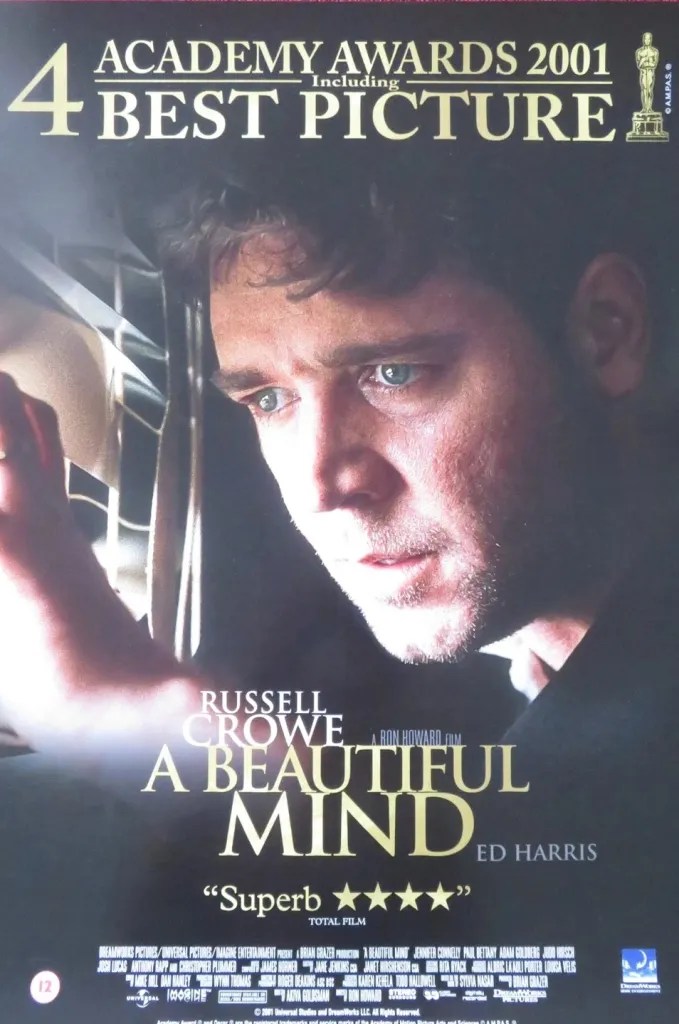
It was named Best Picture at the Oscars and Ron Howard and Akiva Goldman (Practical Magic 2, 2026) also won.
Watch out for a 25th anniversary screening of the movie coming to a cinema near you anytime soon.
Just superb and on many levels.


